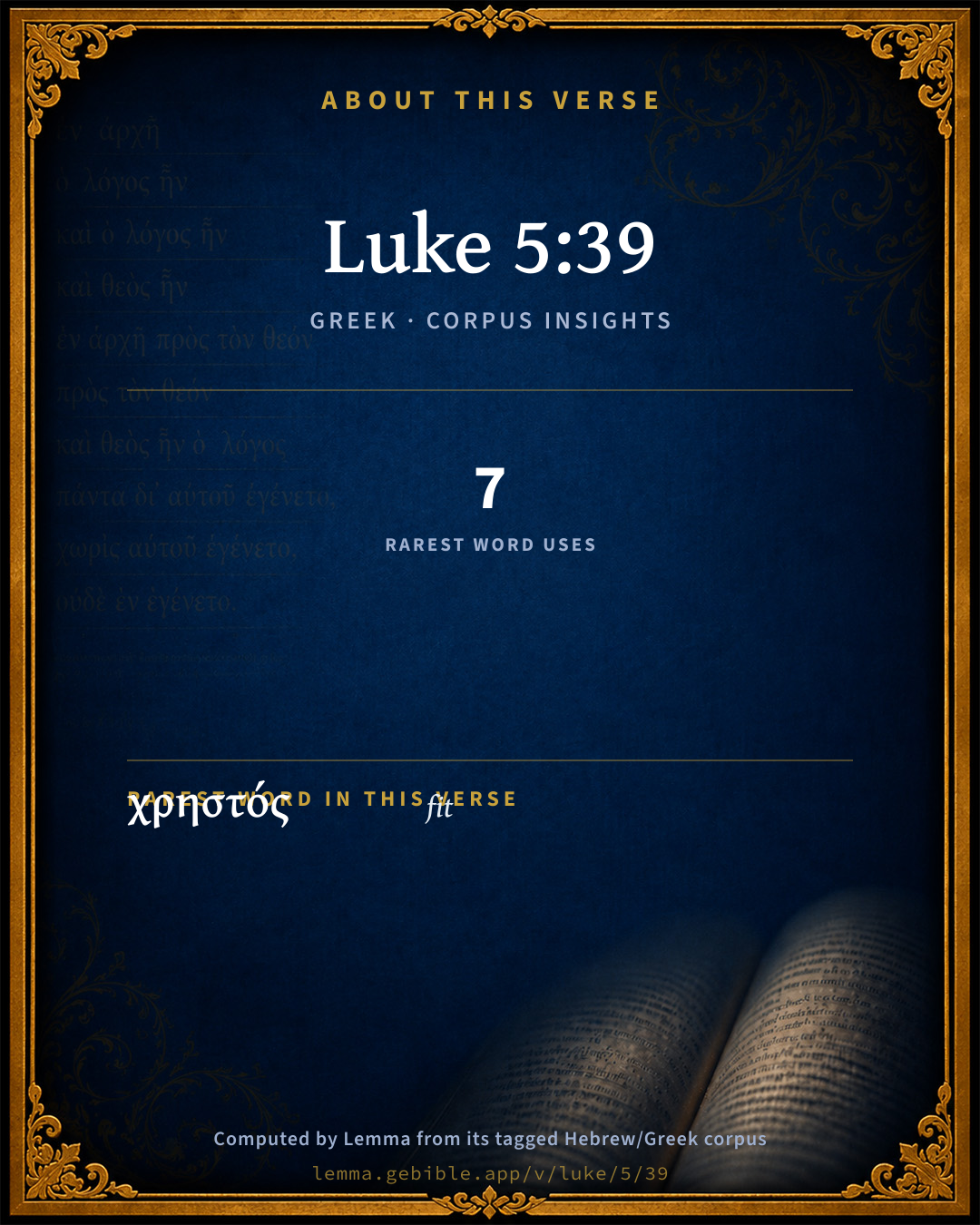
Luke 5:39

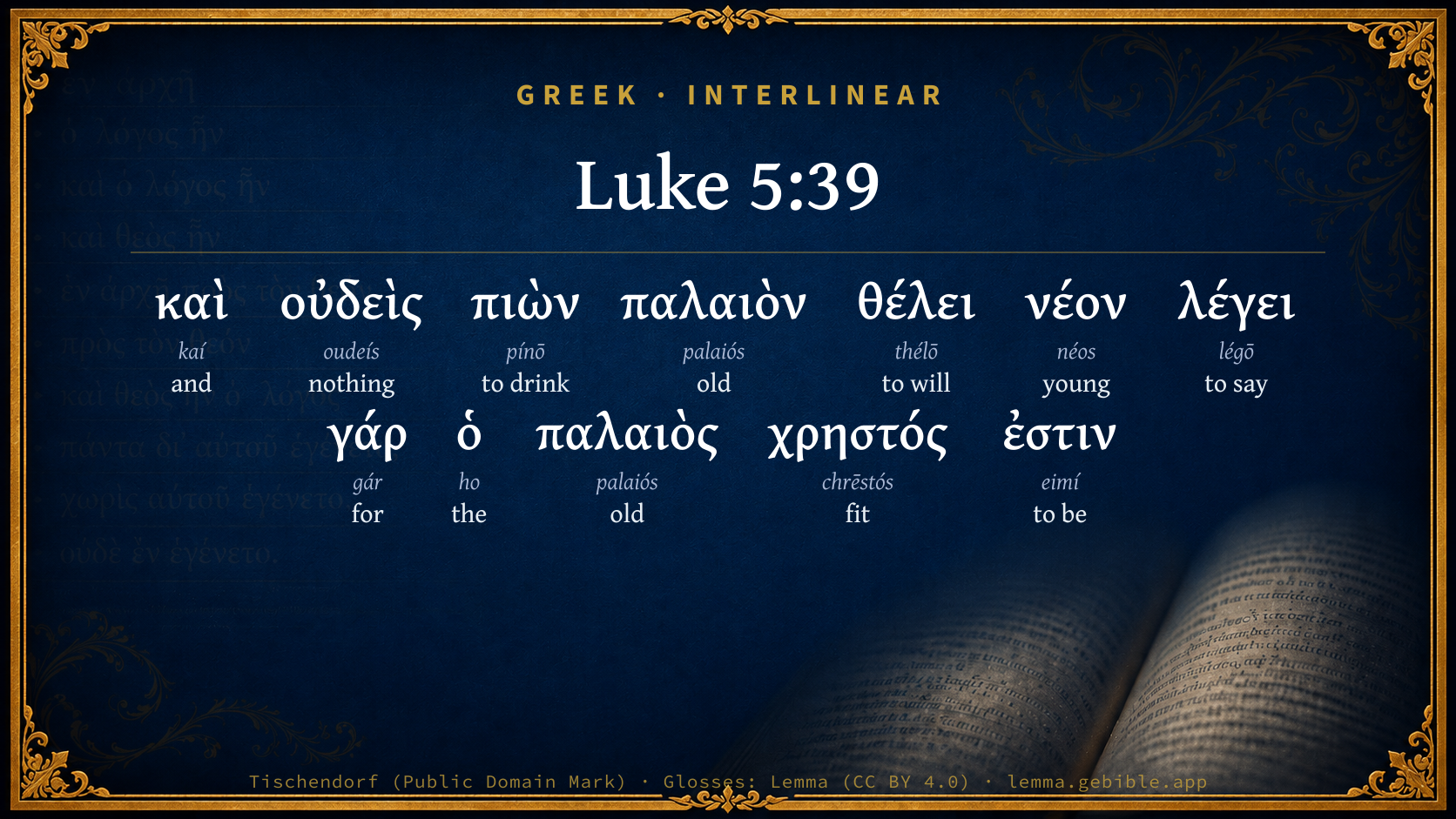
Greek (Tischendorf 8th ed.) Luke 5:39 appears in the Greek New Testament. The text above is from the Tischendorf 8th edition. Each word links to its Strong’s number and a concise gloss. Click any word for its full Thayer’s Greek Lexicon entry.
Download image
Cite this verse

Luke 5:39 (World English Bible). Public Domain. Lemma interlinear Bible study tool, https://lemma.gebible.app/v/luke/5/39.

Show BibTeX & RIS
BibTeX
RIS
English Translation
No man having drunk old wine immediately desires new, for he says, 'The old is better.'"
World English Bible · Public Domain
Download a study sheet

One document with this verse’s original text, its word-by-word gloss line, the meaning frame, cross-references with their text, attributed commentary, and full source and license credits — printable, and it pastes into notes with its structure intact.

This verse Autodidact and up

Study sheet (.html) Plain text (.txt)

A passage Seminary Student

Up to 50 verses in one chapter. A passage sheet keeps up to 6 commentary sources and 12 cross-references per verse, in the order this page ranks them, and says so on the sheet whenever that leaves anything out. Ask for a single verse and you get the Autodidact verse sheet above.

Everything on this page stays free to read, with no account — the sheet is a download of what is already on screen, not access to it.

Want to remove ads? Support Godless Engineer
Compare translations 3

The same verse in 3 English versions, stacked beneath the original-language interlinear above. Click any original word for its lexicon entry.

Each is an independent rendering of the whole verse — the interlinear is not word-aligned to these translations.

Highlighted words mark where these versions differ — a whole-verse word diff, not a word-by-word alignment.

  • World English Bible Public Domain
    No man having drunk old wine immediately desires new, for he says, 'The old is better.'"
  • King James Version Public Domain
    No man also having drunk old wine straightway desireth new: for he saith, The old is better.
  • unfoldingWord Literal Text CC BY-SA 4.0
    No one, having drunk the old, wants the new, for he says, ‘The old is better.’”

unfoldingWord Literal Text — © unfoldingWord, licensed CC BY-SA 4.0. Word-aligned USFM3 via Door43 (git.door43.org/unfoldingWord/en_ult).

Versions to compare (up to 4)

3 of 4 selected

Show all 19 translations

Every available English version of this verse, each an independent rendering of the whole verse.

  • World English Bible Public Domain
    No man having drunk old wine immediately desires new, for he says, 'The old is better.'"
  • Berean Standard Bible Public Domain
    And no one after drinking old wine wants new, for he says, ‘The old is better.’”
  • Majority Standard Bible Public Domain
    And no one after drinking old wine immediately wants new, for he says, ‘The old is better.’”
  • King James Version Public Domain
    No man also having drunk old wine straightway desireth new: for he saith, The old is better.
  • American Standard Version (1901) Public Domain
    And no man having drunk old `wine' desireth new; for he saith, The old is good.
  • Revised Version (1885) Public Domain
    And no man having drunk old wine desireth new: for he saith, The old is good.
  • Geneva Bible (1599) Public Domain
    Also no man that drinketh olde wine, straightway desireth newe: for he sayth, The olde is more profitable.
  • Douay-Rheims (1899) Public Domain
    And no man drinking old, hath presently a mind to new: for he saith, The old is better.
  • Young's Literal Translation Public Domain
    and no one having drunk old `wine', doth immediately wish new, for he saith, The old is better.'
  • Literal Standard Version CC BY-SA 4.0
    and no one having drunk old, immediately wishes new, for he says, The old is better.”
  • Unlocked Literal Bible CC BY-SA 4.0
    No one after drinking old wine wants the new, for he says, 'The old is better.'”
  • unfoldingWord Literal Text CC BY-SA 4.0
    No one, having drunk the old, wants the new, for he says, ‘The old is better.’”
  • Darby Bible Public Domain
    And no one having drunk old wine [straightway] wishes for new, for he says, The old is better.
  • World Messianic Bible Public Domain
    No man having drunk old wine immediately desires new, for he says, ‘The old is better.’”
  • Webster's Bible Public Domain
    No man also having drank old wine, immediately desireth new: for he saith, The old is better.
  • Free Bible Version CC BY-SA 4.0
    And nobody after drinking old wine wants new wine, for they say, ‘the old tastes good.’”
  • Bible in Basic English Public Domain
    And no man, having had old wine, has any desire for new, for he says, The old is better.
  • Text-Critical English NT CC BY 4.0
    And no one after drinking old wine immediately desires new wine, for he says, ‘The old is better.’ ”
  • Tyndale New Testament (1534) Public Domain
    Also no man that drinketh olde wine strayght waye can awaye with newe for he sayeth the olde is plesauter.

Literal Standard Version (2020), Covenant Press — licensed CC BY-SA 4.0. Text via the HelloAO Bible API (eBible.org). Unlocked Literal Bible (unfoldingWord) — licensed CC BY-SA 4.0. Text via the HelloAO Bible API (eBible.org). unfoldingWord Literal Text — © unfoldingWord, licensed CC BY-SA 4.0. Word-aligned USFM3 via Door43 (git.door43.org/unfoldingWord/en_ult). Free Bible Version, Dr. Jonathan Gallagher — licensed CC BY-SA 4.0. Text via the HelloAO Bible API (eBible.org).

Word by word

More ways to search: Search by grammar → Find every occurrence → Compare this word →

Practice this passage: Drill this verse → Learn its vocabulary →

χρηστός
chrēstós
G5543
“fit”
Adjective, Nominative, Singular, Masculine
Part of Speech
Adjective
Case
Nominative
Number
Singular
Gender
Masculine
Full Thayer's Definition

Origin: from G5530

TDNT: 17:03,1

1. fit, fit for use, useful a. virtuous, good 2. manageable a. mild, pleasant (as opp. to harsh, hard sharp, bitter) b. of things: more pleasant, of people, kind, benevolent
  1. καὶ kaí G2532 “and” Conjunction
  2. οὐδεὶς oudeís G3762 “nothing” Adjective, Nominative, Singular, Masculine, Negative
  3. πιὼν pínō G4095 “to drink” Verb, Aorist, Active, Participle, Nominative, Singular, Masculine
  4. παλαιὸν palaiós G3820 “old” Adjective, Accusative, Singular, Masculine
  5. θέλει thélō G2309 “to will” Verb, Present, Active, Indicative, 3rd person, Singular
  6. νέον néos G3501 “young” Adjective, Accusative, Singular, Masculine
  7. λέγει légō G3004 “to say” Verb, Present, Active, Indicative, 3rd person, Singular
  8. γάρ gár G1063 “for” Conjunction
  9. ὁ ho G3588 “the” Article, Nominative, Singular, Masculine
  10. παλαιὸς palaiós G3820 “old” Adjective, Nominative, Singular, Masculine
  11. ἐστιν eimí G1510 “to be” Verb, Present, Active, Indicative, 3rd person, Singular

About this verse

These counts appear in no published source. They are computed here, from the morphology-tagged text and Lemma’s own curated glosses. What Lemma adds →

12
words
11
distinct lemmas
Gospels
section

Notable vocabulary

The rarest word here is χρηστός fit G5543 — appearing just 7 times in the whole Greek New Testament.

Shared distinctive vocabulary

χρηστός fit G5543 occurs in 7 verses of the Greek New Testament. Also found in:

Repetition

A word recurs within this verse:

  • παλαιὸν old G3820 ×2

Cross-references

5

Topical passages linked to Luke 5:39 in the Treasury of Scripture Knowledge — connected by theme and wording, ordered by reader-vote popularity; previews shown in the World English Bible.

  • Hebrews 11:39 These all, having had testimony given to them through their faith, didn't receive the promise,
  • Jeremiah 6:16 Thus says Yahweh, Stand you in the ways and see, and ask for the old paths, where is the good way; and walk therein, and you shall find rest for your souls: but they said, We will not walk [therein].
  • Mark 7:7–13 But in vain do they worship me, Teaching as doctrines the commandments of men.'
  • Romans 4:11–12 He received the sign of circumcision, a seal of the righteousness of the faith which he had while he was in uncircumcision, that he might be the father of all those who believe, though they be in uncircumcision, that righteousness might also be accounted to them.
  • Hebrews 11:1–2 Now faith is assurance of things hoped for, proof of things not seen.

Cross-references courtesy of OpenBible.info (CC BY 4.0).

Where the printed editions differ

1 variant

Places in this verse where the major printed Greek editions disagree on the wording in a way that affects the translation — a comparison of editions, not a manuscript-by-manuscript collation. The editions are the modern critical texts (Nestlé-Aland 28/27, SBL, Westcott-Hort, Tregelles, Tyndale House) and the traditional texts behind the KJV (the Textus Receptus and the Byzantine/Majority text). It is not a claim about which reading is original.

  1. Extra text
    εὐθέως

    “immediately”

    In TRByz Not in NA28NA27TynSBLWHTreg

    εὐθέως (eutheōs) 'immediately' is only in traditional manuscripts (TR+Byz)

Textual data: Translators Amalgamated Greek New Testament (STEPBible TAGNT) · CC BY 4.0.

Commentary

Notes on Luke 5:39 from classic Christian and Jewish commentators (each source and its license shown beneath its notes). The classic Christian expositions comment on the surrounding passage and are grouped to its opening verse, so a note may address several verses; the Jewish commentaries on the Tanakh (Rashi and others) are per-verse, so they appear only where the commentator wrote on this verse.

Lemma curates 59 commentaries, every one of them public domain or Creative Commons licensed, each selected and text-cleaned for this edition rather than reprinted as found. About our sources →

Tyndale Open Study Notes

Tyndale Open Resources

5:39 The old is just fine: The religious leaders were resistant to change.

Tyndale Open Study Notes — © Tyndale Open Resources, licensed CC BY-SA 4.0. Text via the HelloAO Bible API.

Bengel's Gnomon

Johann Albrecht Bengel

Luk 5:39. Εὐθέως, straightway) It is by degrees that the dispositions of minds are changed.—ὁ παλαιὸς, the old) Their own old doctrine was more palatable to the Pharisees than the generous (excellent) doctrine of Christ, which they fancied to be new, whereas it was far more ancient than their own: Gal 3:17 [the covenant—the law, which was four hundred and thirty years after, cannot disannul]; 1Jn 2:7-8 [no new commandment—but an old commandment—from the beginning]: as to the excellence of the new wine, see Zec 9:17 [New wine—shall make cheerful—the maids]: though new, it is at the same time mild and pleasant. Mat 11:30.

Bengel's Gnomon of the New Testament — English translation (T&T Clark, Edinburgh, 1860) — public domain. Text from a community e-Sword module.

Expositor's Greek Testament

ed. W. Robertson Nicoll

Luk 5:39 . The thought in this verse is peculiar to Lk. It seems to be a genial apology for conservatism in religion, with tacit reference to John and his disciples, whom Jesus would always treat with consideration. They loved the old wine of Jewish piety, and did not care for new ways. They found it good ( χρηστός ), so good that they did not wish even to taste any other, and could therefore make no comparisons. (Hence χρηστὸς preferable to χρηστότερος in T. R.) This saying is every way worthy of Christ, and it was probably one of Lk.’s finds in his pious quest for traditions of the Personal Ministry.

With reference to the foregoing parabolic words, drawn from vesture and wine, Hahn truly remarks that they would be naturally suggested through association of ideas by the figure of a wedding feast going before. Bengel hints at the same thought: “parabolam a veste, a vino; inprimis opportunam convivio”.

The Expositor's Greek Testament, edited by W. Robertson Nicoll (1897–1910) — public domain. Text from a community e-Sword module.

Cambridge Greek Testament for Schools and Colleges

39. εὐθέως. A; omitted by אBCL, Copt. Arm. Aeth. Ti[116] W.H[117]

[116] Ti. Tischendorf.

[117] W.H. Westcott and Hort.

χρηστός. אB, Ti[118] W.H[119] χρηστότερος AC, La[120]

[118] Ti. Tischendorf.

[119] W.H. Westcott and Hort.

[120] La. Lachmann.

39. πιὼν παλαιόν. The reading of the Rec[124] gives a complete iambic πιὼν παλαιὸν εὐθέως θέλει νέον as in Luk 5:21, but εὐθέως is a gloss omitted by אBCL, and several Versions, &c. This verse is peculiar to St Luke, and is characteristic of his fondness for all that is most tender and gracious. It is an expression of considerateness towards the inveterate prejudices engendered by custom and system: a kind allowance for the reluctance of the Pharisees and the disciples of John to abandon the old systems to which they had been accustomed. The spirit for which our Lord here (as it were) offers an apology is the deep-rooted human tendency to prefer old habits to new lights, and stereotyped formulae to fresh truths. It is the unprogressive spirit which relies simply on authority, precedent, and tradition, and says, ‘It was good enough for my father, it is good enough for me;’ ‘It will last my time,’ &c. The expression itself seems to have been a Jewish proverb (Nedarim, f. 66. 1).

[124] Rec. The Textus Receptus.

ὁ παλαιὸς χρηστός ἐστιν. The bigot will not go so far as to admit (which χρηστότερος would imply) that the new is in any way ‘good.’ ‘The old is excellent’ (אBL, &c.). The reading of the E. V., χρηστότερος, is inferior, since the man, having declined to drink the new, can institute no comparison between it and the old. The wine which at the beginning has been set forth to him is good (Joh 2:10), and he assumes that only ‘that which is worse’ can follow. On the general comparison see Sir 9:10; Joh 2:10. Gess has pointed out (Christi Zeugniss) how pregnant with meaning is this brief passage in which Christ indicates the novelty of His Gospel, His dignity as bridegroom, and His violent death. Godet adds that the first of these three parables anticipates the doctrine of St Paul, the second his work among Gentiles, and the third his accommodating method. It is characteristic of the crude dogmatism of Marcion, with his hatred to the Old Testament and the Law, that he omits Luk 5:39 which is also omitted in D.

Cambridge Greek Testament for Schools and Colleges (Cambridge University Press, 1896; 21 vols, various authors incl. Carr, Maclear, Plummer, Farrar, Lumby, Moule, M. R. James, Simcox) — public domain. Text from a community e-Sword module.

Adam Clarke's Commentary

Verse 39. The old is better.] χρηστοτερος - Is more agreeable to the taste or palate. Herodotus, the scholiast on Aristophanes, and Homer, use the word in this sense. See Raphelius. The old wine, among the rabbins, was the wine of three leaves; that is, wine three years old; because, from the time that the vine had produced that wine, it had put forth its leaves three times. See Lightfoot.

1. THE miraculous draught of fishes - the cleansing of the leper-the healing of the paralytic person - the calling of Levi - and the parable of the old and new bottles, and the old and new wine - all related in this chapter, make it not only very entertaining, but highly instructive. There are few chapters in the New Testament from which a preacher of the Gospel can derive more lessons of instruction; and the reader would naturally expect a more particular explanation of its several parts, had not this been anticipated in the notes and observations on Matt. 9, Mt 9:1ff to which chapter it will be well to refer.

2. The conduct as well as the preaching of our Lord is highly edifying. His manner of teaching made every thing he spoke interesting and impressive. He had many prejudices to remove, and he used admirable address in order to meet and take them out of the way. There is as much to be observed in the manner of speaking the truth, as in the truth itself, in order to make it effectual to the salvation of them who hear it. A harsh, unfeeling method of preaching the promises of the Gospel, and a smiling manner of producing the terrors of the Lord, are equally reprehensible. Some preachers are always severe and magisterial: others are always mild and insinuating: neither of these can do God's work; and it would take two such to make one PREACHER.

Adam Clarke's Commentary on the Bible (1810–1826) — public domain. Text from a community e-Sword/MySword module.

Ellicott's Commentary for English Readers

(39) No man also having drunk old wine.—This addition is peculiar to St. Luke, and calls accordingly for distinct notice. The interpretation of the imagery is not far to seek. The old wine is the principle—in spiritual things, the religion—that animated the man’s former life. In relation to those immediately addressed, it represented the motive-power of the Law in its rigid and Pharisaic form. The new wine, as in the Notes on the previous parables, is the freer, nobler, life-power of the gospel. It was not to be wondered at that men accustomed to the older system should be unwilling to embrace the new, as thinking it stronger and more potent than they could bear. The words are spoken in a tone of something like a tolerant pity for the prejudices of age and custom.

The old is better.—The better MSS. give simply “the old is good,” the adjective partly implying the sense of “mild.” It is not the same as the “good wine” of the miracle at Cana (Joh_2:10). It is doubtful, indeed, whether the Jews attached the same value that we do to the mellowed flavour given to wine by age. New or sweet wine, drunk within a year or so of fermentation, would seem to have been the favourite delicacy (Neh_10:39; Pro_3:10; Hos_4:11; Hag_1:11, et al.), though men of weak constitutions might shrink from its effects, as the Pharisees were shrinking from the freedom of which our Lord set the example. Not altogether without significance, as bearing on this passage, is the fact recorded by St. Luke (Act_2:13), that the first workings of the Pentecostal gift led men to speak of the disciples as “full of new wine.”

A Bible Commentary for English Readers, edited by Charles John Ellicott (1878–1897) — public domain. Text from a community e-Sword module.

The Cambridge Bible for Schools and Colleges

gen. ed. J. J. S. Perowne

39. having drunk old] This verse is peculiar to St Luke, and is a characteristic of his fondness for all that is most tender and gracious. It is an expression of considerateness towards the inveterate prejudices engendered by custom and system: a kind allowance for the reluctance of the Pharisees and the disciples of John to abandon the old systems to which they had been accustomed. The spirit for which our Lord here (as it were) offers an apology is the deep-rooted human tendency to prefer old habits to new lights, and stereotyped formulae to fresh truths. It is the unprogressive spirit which relies simply on authority, precedent, and tradition, and says, ‘It was good enough for my father, it is good enough for me;’ ‘It will last my time,’ &c. The expression itself seems to have been a Jewish proverb (Nedarim, f. 66. 1).

The old is better] Rather, The old is excellent (chrestos א, B, L, &c.). The reading of the E. V., chrestoteros, is inferior, since the man, having declined to taste the new, can institute no comparison between it and the old. The wine which at the beginning has been set forth to him is good (Joh_2:10), and he assumes that only ‘that which is worse’ can follow.

The Cambridge Bible for Schools and Colleges (gen. ed. J. J. S. Perowne; Cambridge University Press, 1878–1918) — public domain. Text from a community e-Sword module.

Trapp's Complete Commentary

John Trapp

36 And he spake also a parable unto them; No man putteth a piece of a new garment upon an old; if otherwise, then both the new maketh a rent, and the piece that was taken out of the new agreeth not with the old.

37 And no man putteth new wine into old bottles; else the new wine will burst the bottles, and be spilled, and the bottles shall perish.

38 But new wine must be put into new bottles; and both are preserved.

39 No man also having drunk old wine straightway desireth new: for he saith, The old is better.

Ver. 39. The old is better] That is, milder, and so more pleasant. Vetustate enim vina mitescunt, quia velustas igneum calorem, acerbitatem, et faeces e vino tollit. (Piscator.) Age clarifies wine, and ripens it.

John Trapp, A Commentary or Exposition upon All the Books of the Old and New Testament (1647–1656) — public domain. Text from a community e-Sword module.

The Pulpit Commentary

No man also having drunk old wine straightway desireth new: for he saith, The old is better. St. Luke alone of the first three evangelists who related in detail this most important reply of Jesus when the disciples of John and the Pharisees came to question him, adds this curious simile. The meaning of the parable-pictures of the new patch being sewn on an old garment, and of new wine being poured into worn-out, decaying wine-skins, was very plain. Pitilessly severe it would ring in the ears of men brought up in the old rabbinic Jewish schools. The two first evangelists, conscious of the truth of their Master"s words, were content to leave the stern teaching, which pronounced the old state of things among the religious Jews as utterly worn-out, in all its naked severity. But Paul, under whose guidance we believe Luke wrote his Gospel, with that tender and considerate love which so beautifies the earnest and impassioned nature of the apostle of the Gentiles, knew that Jesus had added a few words to the two seemingly harsh parables; these he bade Luke carefully insert in his narrative. They contain what may be termed an almost playful apology for the slowness and reluctance of the men trained in the rabbinic schools, or even of the pupils of John the Baptist, to accept the new, broad, generous view of truth which he (Jesus) was putting forth it was an apology for a slowness and reluctance, shading too often into unveiled dislike and open hostility. (What experience Paul and Luke must have had of this hostility!) The Master, in his Divine wisdom, knew how hard it was to forsake long-cherished prejudices. Time must be given, allowance must be made, harsh judgment must be deprecated. These men, trained in the old system, are here compared to guests who, after the banquet, are suddenly asked to change the old wine, mellowed by age, of which they have been drinking, for new sweet wine. This new wine seems, in those days, generally to have been considered preferable, but to men who had been drinking the old, age-softened vintage, the new would seem fiery and even harsh. The Greek word rendered in the Authorized Version "better," in the older authorities is positive instead of comparative. The translation should therefore run," the old is good." The argument would be the same: Why change what we have been drinking for something new? surely the old wine is good? Such passages as Neh_10:35 Pro_3:10 Hos_4:11 Hag_1:11, bear out the above statement, that in those days, among the Jews of Syria, Palestine, and the adjacent countries, new sweet wine was a favourite beverage among wine-drinkers.

The Pulpit Commentary (1880–1919), ed. H.D.M. Spence-Jones & Joseph S. Exell — public domain. Text from a community e-Sword module.

John Wesley's Explanatory Notes

And no man having drunk old wine - And beside, men are not wont to be immediately freed from old prejudices.

John Wesley, Explanatory Notes Upon the Whole Bible (1754–1765) — public domain. Text via the GEBible commentary corpus.

Alford’s Greek Testament

Henry Alford

39.] This peculiar and important addition at once stamps our report with the very highest character for accuracy. Its apparent difficulty has perhaps caused its omission from Cod. and mss. of the old Latin version. It contains the conclusion of the discourse, and the final answer to the question in ver. 33, which is not given in Matt. and Mark. The πιόντες παλαιόν are the Jews, who had long been habituated to the old system;—the νέος is the new wine (see on Matt.) of the grace and freedom of the Gospel: and our Lord asserts that this new wine was not palatable to the Jews, who said ὁ παλαιὸς χρηστός ἐστιν. Observe (against De Wette, &c.) that even with the common reading χρηστότερος there is no objective comparison whatever here between the old and new wine; the whole stress is on θέλει and λέγει γάρ, and the import of χρηστότερος is subjective:—in the view of him who utters it. And even if we were to assume such an objective comparison, it makes no difficulty. In time, the new wine will become older:—the man will become habituated to its taste, and the wine itself mellowed: and the comparison between the wines is not then which is the older, but which is intrinsically the better.

Stier observes (i. 328), that the saying is a lesson for ardent and enthusiastic converts not to be disappointed, if they cannot at once instil their spirit into others about them.

As regards the readings,—the sentence seems to have been tampered with by some who wished to make it more obvious, and to bring out the comparison more strongly: εὐθέως being inserted, better to correspond with the fact, and the matter in question, and the comparative substituted for the positive: but the sentence loses much of its point and vigour by the change: the old wine is not better than the new (which has not been tasted), but merely good, i.e. good enough: therefore no new is desired.

Henry Alford, The Greek Testament (1849–1861) — public domain. Text from a community e-Sword module.

International Critical Commentary

39. This third parable is peculiar to Lk. While the first two show how fatal it would be to couple the new spirit of the Gospel with the worn out forms of Judaism, the third shows how natural it is that those who have been brought up under these forms should be unwilling to abandon them for something untried. The conversion of an outcast τελώνης, who has no such prejudices, may be easier than one whose life is bound up in the formalism of the past Grotius, starting from Ecclus. 9:15, οἶνος νέος φίλος νέος· ἐὰν παλαιωθῆς, μετʼ εὐφροσύνης πίεσαι αὐτόν, interprets: Significavit, hoc proverbio Christus homines non subito ad austeriorem vitam pertrahendos, sed per gradus quosdam assuefaciendos esse; which implies that Christ considered Jewish fasting the more excellent way, up to which His disciples must be gradually educated. Moreover, the subito on which this explanation turns is an interpolation: εὐθέως is not genuine (א B C1 L, Boh. Æth. Arm. omit). Wetstein quotes a multitude of passages to show that old wine was considered to be superior to new, and concludes; Pharisæorum austeritas comparatur vino novo, Christi lenitas vino veteri; which exactly inverts the parable. The comparative merits of the old and the new wine are not touched by the parable, but the taste for them. One who is accustomed to old will not wish for new: it does not attract him by look or fragrance. See Hort, Judaistic Christianity, p. 24.

λέγει γάρ· Ὁ παλαιὸς χρηστός ἐστιν. The reading of A C and Vulg. (χρηστότερος, melius) is a manifest corruption. The prejudiced person will not even try the new, or admit that it has any merits. He knows that the old is pleasant, and suits him; and that is enough: he is not going to change. Pharisæis doctrina sua antiqua magis erat ad palatum, quam generosa doctrina Jesu, quam illi putabant esse novam (Beng.), and which they would not even taste. Comp. Rom 7:6; 2Co 3:6. If we admit the undoubtedly spurious, εὐθέως we have another iambic line in this verse as in ver. 21: πιὼν παλαιὸν εὐθέως θέλει νέον. The whole verse is omitted in D and in most of the best MSS. of the old Latin; but WH. seem to be alone in placing it in brackets as of doubtful authority. On the three parables see Trench, Studies in the Gospels, pp. 168-183.

Jos. Josephus.

AV. Authorized Version.

D. B. Smith’s Dictionary of the Bible, 2nd edition.

Trench, Trench, New Testament Synonyms.

Beng. Bengel.

Clem. Alex. Clement of Alexandria.

Gen. Geneva.

Win. Winer, Grammar of N.T. Greek (the page refers to Moulton’s edition).

Wsctt. Westcott.

Syr Syriac.

Sin. Sinaitic.

B B. Cod. Vaticanus, sæc. 4. In the Vatican Library certainly since 15331 (Batiffol, La Vaticane de Paul 3, etc., p. 86).

D D. Cod. Bezae, sæc. vi. Given by Beza to the University Library at Cambridge 1581. Greek and Latin. Contains the whole Gospel.

X X. Cod. Monacensis, sæc. ix. In the University Library at Munich. Contains 1:1-37, 2:19-3:38, 4:21-10:37, 11:1-18:43, 20:46-24:53.

Goth. Gothic.

Tyn. Tyndale.

Vulg. Vulgate.

RV. Revised Version.

Rhem. Rheims (or Douay).

1 Cod. Brix. has hominum eritis captores, including James and John, although noli timere precedes. D has ποιήσω γὰρ ὐμᾶς ἀλιεῖς ἀνθρώπων (from Mt. and Mk.) after the insertion μὴ γίνεσθε ἁλιεῖς ἰχθύων

1 “It is worthy of notice, that all the places where our Lord is stated to have met with lepers are in the central districts of Samaria and Galilee …. It is just in this district that to this day we find the colonies of lepers most numerous” (Tristram, Eastern Customs in Bible Lands, p. 19).

A A. Cod. Alexandrinus, sæc. v. Once in the Patriarchal Library at Alexandria; sent by Cyril Lucar as a present to Charles 1. in 1628, and now in the British Museum. Complete.

C

C. Cod. Ephraemi Rescriptus, sæc. 5. In the National Library at Paris. Contains the following portions of the Gospel: 1:2-2:5, 2:42-3:21, 4:25-6:4, 6:37-7:16, or 17, 8:28-12:3, 19:42-20:27, 21:21-22:19, 23:25-24:7, 24:46-53.

These four MSS. are parts of what were once complete Bibles, and are designated by the same letter throughout the LXX and N.T.

Hist. of J. N. History of the Jewish Nation.

1 For another explanation see Tristram, Eastern Customs, pp.34, 35.

1 It has been suggested that ἦσαν καθήμενοι (Mar 2:6) and ηρξαντο = ησανἀρχόμενοι) here are simply different translations of the Aramaic verb, which has the very different meanings of “sitting at rest” and “beginning”; or possibly of two verbs which are identical in spelling (Expositor, April 1891, p. 285). See on 3:23. But these possibilities seem to be too isolated and sporadic to be of great value in accounting for differences between the Gospels.

1 Le Livre d’ Hénoch, en Particulier, lequel était fort lu dans l’entourage de Jésus (Judæ Epist. 14) nous donne la clef de l’expression de “Fils de l’homme” et des idées qui s’y rattachaient (Renan, V. de J. p. 11.). It is, of course, quite possible that the writer of the Book of Enoch took the idea from Daniel. For a discussion of the title see Dorner, Person of Christ, Eng. tr. 1:1. p. 54.

1 That this parenthesis occurs in exactly the same place in all three proves that all three made use of a narrative, the form of which was already fixed, either in memory or in writing (Salmon, Int. to N. T. p. 121, 5th ed.). Comp. Luk 8:28, Luk 8:29 with Mar 5:7, Mar 5:8, where we have similar agreement in arrangement.

Wic. Wiclif.

1 Ce seal mot suffit. La parole qui venait de guérir le lépreux, de rendre an paralysé le mouvement et de remettre les péchés, transforma soudainement un publicain en disciple (Didon, JC ch. iii. p. 340).

D. Smith’s Dictionary of the Bible, 1st edition.

Clem. Hom. Clementine Homilies.

Treg. Tregelles.

Cov. Coverdale.

Tristram, Tristram, Natural History of the Bible.

אԠא Cod. Sinaiticus, sæc. iv. Brought by Tischendorf from the Convent of St. Catherine on Mt. Sinai; now at St. Petersburg. Contains the whole Gospel complete.

L L. Cod. Regius Parisiensis, sæc. viii. National Library at Paris. Contains the whole Gospel.

Aegyptt. Egyptian.

Boh. Bohairic.

Arm. Armenian.

WH. Westcott and Hort.

International Critical Commentary — older volumes (1896–1929), various authors — public domain. Text from a community e-Sword module.

Vincent's Word Studies in the New Testament

Marvin R. Vincent

Better [χρηστοτερος] . The best texts read crhstov, good. See on Mt 11:30. ===Luk6

CHAPTER VI

1 - 5. Compare Mt 12:1 - 8; Mr 2:23 - 28.

Marvin R. Vincent, Word Studies in the New Testament (1887–1900) — public domain. Text from a community e-Sword/MySword module.

Godet's Commentaries

Frédéric Louis Godet

Ver. 39. The Third Parable.

The thorough opposition which Jesus has just established between the legal system and the evangelical system (first parable), then between the representatives of the one and those of the other (second parable), must not lead the organs of the new principles to treat those of the ancient order with harshness. They must remember that it is not easy to pass from a system, with which one has been identified from childhood, to an entirely different principle of life. Such men must be allowed time to familiarize themselves with the new principle that is presented to them; and we must beware how we turn our backs upon them, if they do not answer, as Levi the publican did, to the first call. The conversion of a publican may be sudden as lightning, but that of a scrupulous observer of the law will, as a rule, be a work of prolonged effort. This figure, like that of the preceding parable, is taken from the actual circumstances. Conversation follows a meal; the wine in the bottles circulates amongst the guests. With the figure of the bottles, which contain the wine, is easily connected the idea of the individuals who drink it. The new wine, however superior may be its quality, owing to its sharper flavour, is always repugnant to the palate of a man accustomed to wine, the roughness of which has been softened by age. In the same way, it is natural that those who have long rested in the works of the law, should at first take alarm

Jesus can well understand it—at the principle of pure spirituality. It is altogether an error in the Alex. that has erased here the word εὐθεώς, immediately. The very idea of the parable is concentrated in this adverb. We must not judge such people by their first impression. The antipathy which they experience at the first moment will perhaps give place to a contrary feeling. We must give them time, as Jesus did Nicodemus.

There is a tone of kindly humour in these words: for he saith, “Attempt to bring over to gospel views these old followers of legal routine, and immediately they tell you...”

If, with the Alex., the positive χρηστός is read: “the old is mild,” the repugnance for the new wine is more strongly marked than if we read, with the T. R., the comparative: χρηστότερος, milder; for in the first case the antithesis implied is: “The new is not mild at all.” As the idea of comparison runs through the entire phrase, the copyists were induced to substitute the comparative for the positive. The Alex. reading is therefore preferable.

“It was a great moment,” as Gess truly says, “when Jesus proclaimed in a single breath these three things: the absolute newness of His Spirit, His dignity as the Husband, and the nearness of His violent death.”

If the first parable contains the germ of Paul’s doctrine, and the second foreshadows His work among the Gentiles, the third lays down the principle whence He derived His mode of acting towards His fellow-countrymen: making Himself all things to all by subjecting Himself to the law, in order to gain them that were under the law (1Co 9:19-20).

What gentleness, condescension, and charity breathe through this saying of Jesus! What sweetness, grace, and appropriateness characterize its form! Zeller would have us believe (Apostelgesch. p. 15) that Luke invented this touching saying, and added it on his own authority, in order to render the decided Paulinism of the two preceding parables acceptable to Jewish-Christian readers. But does he not see that in saying this he vanquishes himself by his own hand? If the two former parables are so Pauline, that Luke thought he must soften down their meaning by a corrective of his own invention, how comes it to pass that the two other Syn., the Gospels which are in the main Jewish-Christian, have transmitted them to the Church, without the slightest softening down? Criticism sometimes loses its clear-sightedness through excessive sharpness.

That the ultra-Pauline Marcion should have omitted this third parable is perfectly natural; it proves that he thoroughly understood it, for it carries with it the condemnation of his system. But no consequence unfavourable to its authenticity can be drawn from this. The omission of this verse in D., and some versions, is no less easily explained by its omission in the two other synoptics.

The independence of Luke’s text, and the originality of its sources, come out clearly from this last passage, which forms such an excellent close to this portion. The difference which we have pointed out in the purport of the first parable, a difference which is entirely in Luke’s favour, also attests the excellence of the document from which he has drawn. As to the others, they are no more under obligation to Luke than Luke is to them; would they, of their own accord, have made the teaching of Jesus more anti-legal than it was?

Frédéric Louis Godet — Commentaries on Luke, John, Romans, and 1 Corinthians — English translation (T&T Clark, Edinburgh, 1870s–1890s) — public domain. Text from a community e-Sword module.

Lesson kit

Teaching starters — assembled from the data on this page, not authored interpretation. Every prompt links to the verse data it draws on. Edit before teaching.

Luke, in the Gospels, opens this verse with 12 words (11 distinct Greek lemmas). Its most distinctive word is chrēstós (“fit”). A historical commentator’s framing appears above. Read the whole chapter for the surrounding context.

Discussion questions

  1. What does “fit” (chrēstós) contribute to the verse as a whole?
  2. Matthew 11:30 shares the word «fit» with this verse. How do the two illuminate each other?
  3. “old” occurs 2× in this one verse. What is the effect of the repetition?
  4. The translations on this page render this verse differently — a whole-verse word diff, not a word-by-word alignment. What might account for the different wordings?
  5. Reading how Tyndale Open Study Notes and Bengel's Gnomon read this verse, where do the two commentators agree and where do they part?

Things to notice

Reading settings

Reading text

Shown beneath each verse's original-language words.

Old Testament
Old Testament edition

Read the OT as the Masoretic Hebrew (MT) or the Greek Septuagint (LXX).

English shown for the Greek Septuagint (in the Hebrew ↔ Greek comparison).

Comparing translations? Open the Compare panel on any verse page to stack up to four side by side.