Luke 11:33

Greek (Tischendorf 8th ed.) Luke 11:33 appears in the Greek New Testament. The text above is from the Tischendorf 8th edition. Each word links to its Strong’s number and a concise gloss. Click any word for its full Thayer’s Greek Lexicon entry.
Download image
Cite this verse

Luke 11:33 (World English Bible). Public Domain. Lemma interlinear Bible study tool, https://lemma.gebible.app/v/luke/11/33.

Show BibTeX & RIS
BibTeX
RIS
English Translation
"No man, when he has lit a lamp, puts it in a cellar, nor under a basket, but on a stand, that those who enter in may see the light.
World English Bible · Public Domain
Highlights
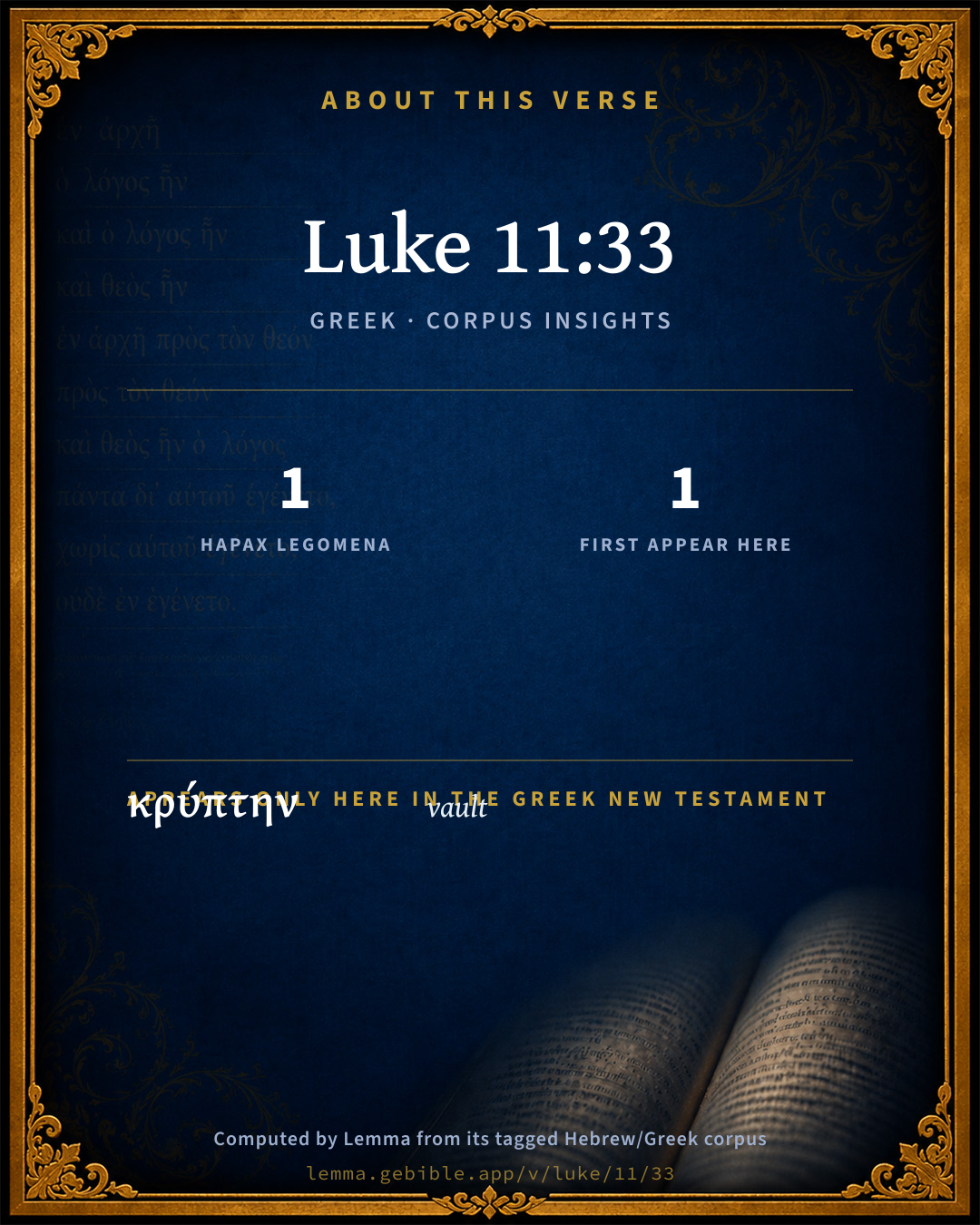
  • 1 hapax legomenon — only here in the Greek New Testament
  • 1 first appearance in the Greek New Testament
Full analysis ↓
Download a study sheet

One document with this verse’s original text, its word-by-word gloss line, the meaning frame, cross-references with their text, attributed commentary, and full source and license credits — printable, and it pastes into notes with its structure intact.

This verse Autodidact and up

Study sheet (.html) Plain text (.txt)

A passage Seminary Student

Up to 50 verses in one chapter. A passage sheet keeps up to 6 commentary sources and 12 cross-references per verse, in the order this page ranks them, and says so on the sheet whenever that leaves anything out. Ask for a single verse and you get the Autodidact verse sheet above.

Everything on this page stays free to read, with no account — the sheet is a download of what is already on screen, not access to it.

Want to remove ads? Support Godless Engineer
Compare translations 3

The same verse in 3 English versions, stacked beneath the original-language interlinear above. Click any original word for its lexicon entry.

Each is an independent rendering of the whole verse — the interlinear is not word-aligned to these translations.

Highlighted words mark where these versions differ — a whole-verse word diff, not a word-by-word alignment.

  • World English Bible Public Domain
    "No man, when he has lit a lamp, puts it in a cellar, nor under a basket, but on a stand, that those who enter in may see the light.
  • King James Version Public Domain
    No man, when he hath lighted a candle, putteth it in a secret place, neither under a bushel, but on a candlestick, that they which come in may see the light.
  • unfoldingWord Literal Text CC BY-SA 4.0
    No one, having lit a lamp, puts in a hidden place, nor under the measure, but on the lampstand, so that the ones entering may see the light.

unfoldingWord Literal Text — © unfoldingWord, licensed CC BY-SA 4.0. Word-aligned USFM3 via Door43 (git.door43.org/unfoldingWord/en_ult).

Versions to compare (up to 4)

3 of 4 selected

Show all 19 translations

Every available English version of this verse, each an independent rendering of the whole verse.

  • World English Bible Public Domain
    "No man, when he has lit a lamp, puts it in a cellar, nor under a basket, but on a stand, that those who enter in may see the light.
  • Berean Standard Bible Public Domain
    No one lights a lamp and puts it in a cellar or under a basket. Instead, he sets it on a stand, so those who enter can see the light.
  • Majority Standard Bible Public Domain
    No one lights a lamp and puts it in a cellar or under a basket. Instead, he sets it on a stand, so those who enter can see the light.
  • King James Version Public Domain
    No man, when he hath lighted a candle, putteth it in a secret place, neither under a bushel, but on a candlestick, that they which come in may see the light.
  • American Standard Version (1901) Public Domain
    No man, when he hath lighted a lamp, putteth it in a cellar, neither under the bushel, but on the stand, that they which enter in may see the light.
  • Revised Version (1885) Public Domain
    No man, when he hath lighted a lamp, putteth it in a cellar, neither under the bushel, but on the stand, that they which enter in may see the light.
  • Geneva Bible (1599) Public Domain
    No man when he hath lighted a candle, putteth it in a priuie place, neither vnder a bushell: but on a candlesticke, that they which come in, may see the light.
  • Douay-Rheims (1899) Public Domain
    No man lighteth a candle, and putteth it in a hidden place, nore under a bushel; but upon a candlestick, that they that come in, may see the light.
  • Young's Literal Translation Public Domain
    `And no one having lighted a lamp, doth put `it' in a secret place, nor under the measure, but on the lamp-stand, that those coming in may behold the light.
  • Literal Standard Version CC BY-SA 4.0
    And no one having lighted a lamp, puts [it] in a secret place, nor under the measure, but on the lampstand, that those coming in may behold the light.
  • Unlocked Literal Bible CC BY-SA 4.0
    No one, after lighting a lamp, puts it in a hidden place or under a basket, but on a lampstand, so that those who enter may see the light.
  • unfoldingWord Literal Text CC BY-SA 4.0
    No one, having lit a lamp, puts in a hidden place, nor under the measure, but on the lampstand, so that the ones entering may see the light.
  • Darby Bible Public Domain
    But no one having lit a lamp sets it in secret, nor under the corn-measure, but on the lamp-stand, that they who enter in may see the light.
  • World Messianic Bible Public Domain
    “No one, when he has lit a lamp, puts it in a cellar or under a basket, but on a stand, that those who come in may see the light.
  • Webster's Bible Public Domain
    No man when he hath lighted a candle, putteth it in a secret place, neither under a close vessel, but on a candlestick, that they who come in may see the light.
  • Free Bible Version CC BY-SA 4.0
    No one lights a lamp and then hides it or places it under a bowl. No, you put it on a lamp stand so that those who come into the house can see the light.
  • Bible in Basic English Public Domain
    No man, when the light has been lighted, puts it in a secret place, or under a vessel, but on its table, so that those who come in may see the light.
  • Text-Critical English NT CC BY 4.0
    “No one lights a lamp and puts it in a hidden place or under a basket. Instead, it is put on a lampstand, so that those who come in can see its light.
  • Tyndale New Testament (1534) Public Domain
    Noo man lighteth a candell, and putteth it in a previe place nether vnder a busshell: But on a candelsticke that they that come in maye se the light.

Literal Standard Version (2020), Covenant Press — licensed CC BY-SA 4.0. Text via the HelloAO Bible API (eBible.org). Unlocked Literal Bible (unfoldingWord) — licensed CC BY-SA 4.0. Text via the HelloAO Bible API (eBible.org). unfoldingWord Literal Text — © unfoldingWord, licensed CC BY-SA 4.0. Word-aligned USFM3 via Door43 (git.door43.org/unfoldingWord/en_ult). Free Bible Version, Dr. Jonathan Gallagher — licensed CC BY-SA 4.0. Text via the HelloAO Bible API (eBible.org).

Word by word

More ways to search: Search by grammar → Find every occurrence → Compare this word →

Practice this passage: Drill this verse → Learn its vocabulary →

κρύπτην
krýptē
G2926
“vault”
Noun, Accusative, Singular, Feminine
Part of Speech
Noun
Case
Accusative
Number
Singular
Gender
Feminine
Full Thayer's Definition

Origin: from G2927

TDNT: 18:57,5

1. crypt, a covered way, vault, cellar
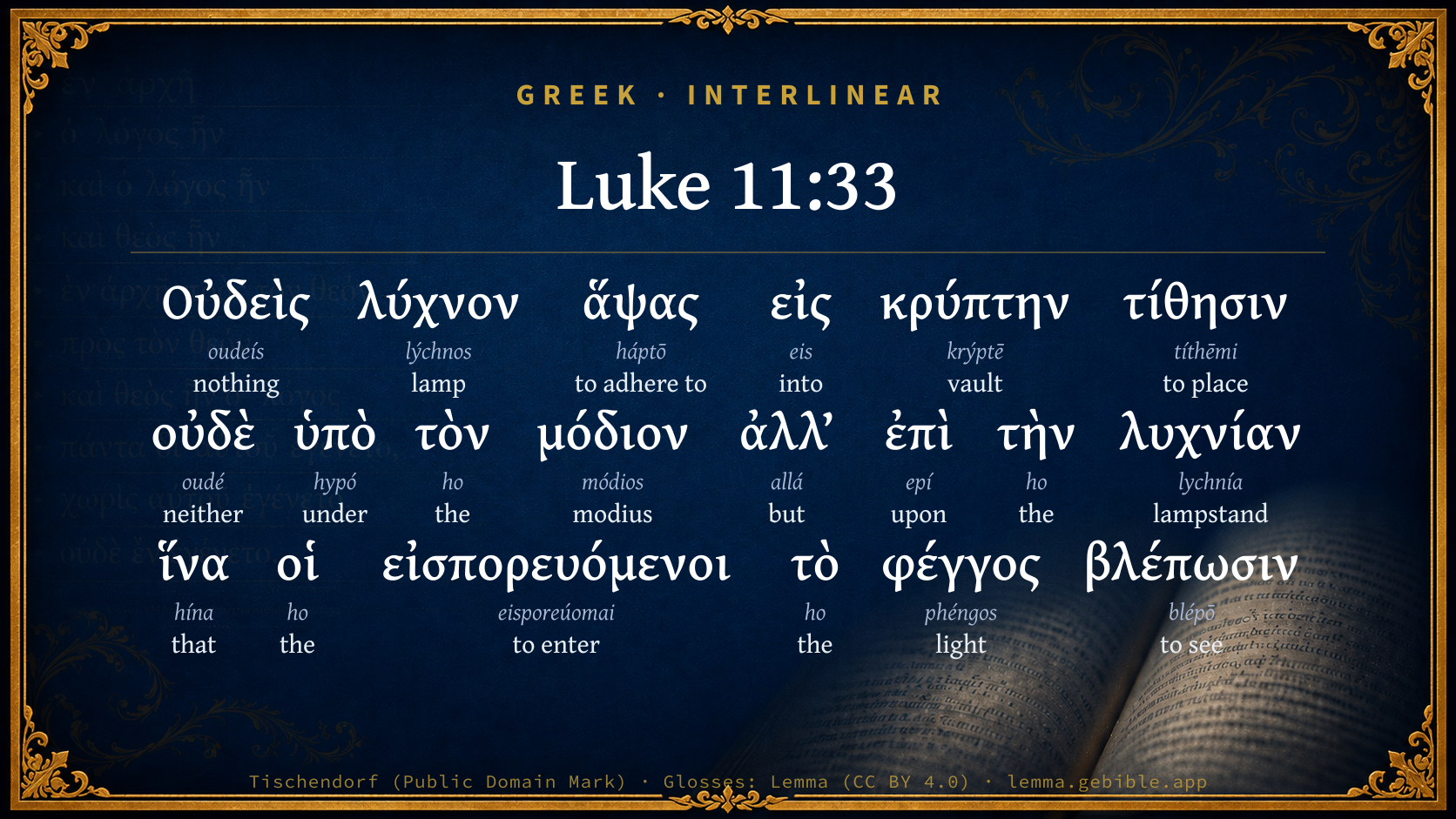
  1. Οὐδεὶς oudeís G3762 “nothing” Adjective, Nominative, Singular, Masculine, Negative
  2. λύχνον lýchnos G3088 “lamp” Noun, Accusative, Singular, Masculine
  3. ἅψας háptō G681 “to adhere to” Verb, Aorist, Active, Participle, Nominative, Singular, Masculine
  4. εἰς eis G1519 “into” Preposition
  5. τίθησιν títhēmi G5087 “to place” Verb, Present, Active, Indicative, 3rd person, Singular
  6. οὐδὲ oudé G3761 “neither” Conjunction, Negative
  7. ὑπὸ hypó G5259 “under” Preposition
  8. τὸν ho G3588 “the” Article, Accusative, Singular, Masculine
  9. μόδιον módios G3426 “modius” Noun, Accusative, Singular, Masculine
  10. ἀλλ’ allá G235 “but” Conjunction
  11. ἐπὶ epí G1909 “upon” Preposition
  12. τὴν ho G3588 “the” Article, Accusative, Singular, Feminine
  13. λυχνίαν lychnía G3087 “lampstand” Noun, Accusative, Singular, Feminine
  14. ἵνα hína G2443 “that” Conjunction
  15. οἱ ho G3588 “the” Article, Nominative, Plural, Masculine
  16. εἰσπορευόμενοι eisporeúomai G1531 “to enter” Verb, Present, Middle or Passive deponent, Participle, Nominative, Plural, Masculine
  17. τὸ ho G3588 “the” Article, Accusative, Singular, Neuter
  18. φέγγος phéngos G5338 “light” Noun, Accusative, Singular, Neuter
  19. βλέπωσιν blépō G991 “to see” Verb, Present, Active, Subjunctive, 3rd person, Plural

About this verse

These counts appear in no published source. They are computed here, from the morphology-tagged text and Lemma’s own curated glosses. What Lemma adds →

20
words
17
distinct lemmas
Gospels
section

Notable vocabulary

1 hapax legomenon — a word that appears only here in the entire Greek New Testament:

  • κρύπτην vault G2926

First appearance in Scripture

This word makes its first canonical appearance in the Greek New Testament here:

  • κρύπτην vault G2926

Shared distinctive vocabulary

μόδιον modius G3426 occurs in 3 verses of the Greek New Testament. Also found in:

Repetition

A word recurs within this verse:

Cross-references

7

Topical passages linked to Luke 11:33 in the Treasury of Scripture Knowledge — connected by theme and wording, ordered by reader-vote popularity; previews shown in the World English Bible.

  • Luke 8:16–17 "No one, when he has lit a lamp, covers it with a container, or puts it under a bed; but puts it on a stand, that those who enter in may see the light.
  • Mark 4:21–22 He said to them, "Is the lamp brought to be put under a basket or under a bed? Isn't it put on a lampstand?
  • Matthew 5:15–16 Neither do you light a lamp, and put it under a measuring basket, but on a stand; and it shines to all who are in the house.
  • John 12:46 I have come as a light into the world, that whoever believes in me may not remain in the darkness.
  • Philippians 2:15–16 that you may become blameless and harmless, children of God without blemish in the midst of a crooked and perverse generation, among whom you are seen as lights in the world,
  • John 11:9 Jesus answered, "Aren't there twelve hours of daylight? If a man walks in the day, he doesn't stumble, because he sees the light of this world.
  • Matthew 10:27 What I tell you in the darkness, speak in the light; and what you hear whispered in the ear, proclaim on the housetops.

Cross-references courtesy of OpenBible.info (CC BY 4.0).

Where the printed editions differ

1 variant

Places in this verse where the major printed Greek editions disagree on the wording in a way that affects the translation — a comparison of editions, not a manuscript-by-manuscript collation. The editions are the modern critical texts (Nestlé-Aland 28/27, SBL, Westcott-Hort, Tregelles, Tyndale House) and the traditional texts behind the KJV (the Textus Receptus and the Byzantine/Majority text). It is not a claim about which reading is original.

  1. Different wording
    κρύπτην

    “a cellar”

    In NA28NA27TynSBLWHTregByz Not in TR

    κρυπτόν (krupton) 'hidden' occurs in traditional manuscripts (TR+KJV) instead of κρύπτην (kruptēn) 'a cellar' in older manuscripts (NA28+NA27+Tyn+SBL+WH+Treg+Byz)

Textual data: Translators Amalgamated Greek New Testament (STEPBible TAGNT) · CC BY 4.0.

Commentary

Notes on Luke 11:33 from classic Christian and Jewish commentators (each source and its license shown beneath its notes). The classic Christian expositions comment on the surrounding passage and are grouped to its opening verse, so a note may address several verses; the Jewish commentaries on the Tanakh (Rashi and others) are per-verse, so they appear only where the commentator wrote on this verse.

Lemma curates 59 commentaries, every one of them public domain or Creative Commons licensed, each selected and text-cleaned for this edition rather than reprinted as found. About our sources →

The Biblical Illustrator

Joseph S. Exell

Luk_11:33-36

The light of the body is the eye

The single eye

The eye is evil when the vision is incorrect, double; is single when it lays hold of one object with clearness and firmness.

Shut the eye, or if the eye is diseased so as not to be able to see any one object distinctly, and we have the body full of darkness. This is true in the moral universe.

1. Intellectually. He whose judgment is uncertain, &c. He who has clear plans, &c.

2. Morally. He who has clear conceptions of right and wrong; with what freedom and strength he walks forward. There is light in him; there is light before him.

3. Spiritually. What does it mean to have a single eye in the religious world? It means more than supreme love to God. It means that the whole mental and moral nature of the man must be right in its conceptions of religious truths. This may be summed up in five points.

(1) Man must live for ever. The eternal, vital principle is in him. Suicide is not possible.

(2) Man, as a sinner, needs transformation into Gods character.

(3) Christ has come from heaven to work the transformation--the atonement.

(4) The necessity for a personal, affectionate faith.

(5) The only way of safety is the exercise of this faith at once. (R. S.Storrs, D. D.)

Singleness of heart

Whatever a man regards as his chief good, on that, his heart--his supreme affections--will be fixed; and by that will all his specific opinions, affections, desires, purposes, and actions be regulated and controlled. What, then, the eye is to the body, the practical estimate and regard which a man forms of his chief good is to the whole moral character. If the eye be incapable of vision, the whole body is doomed to all the evils of utter darkness. So, if the practical estimate which men form of their good be not according to the truth and reality of things, the whole moral man is doomed to error, to sin, and to ruin. To illustrate and confirm this truth I re-mark--

I. THE PRACTICAL ESTIMATE WHICH EVERY MAN FORMS OF HIS CHIEF GOOD RESPECTS EITHER GOD OR THE WORLD AS ITS OBJECT. These are the only sources of good, of any kind or degree, which are opened to man.

II. THIS PRACTICAL ESTIMATE DETERMINES ON WHICH OF THE TWO OBJECTS THE HEART IS FIXED. Here, it is necessary to distinguish carefully between a speculative estimate or judgment, and that which is practical. Let us consider the influence of this state of mind:

1. On a mans knowledge and belief of the truth. No one can have attentively considered human nature, without seeing how much the opinions of men are affected by the state of the heart; and how much more perfectly they understand those subjects which it is for their interest to understand, than any others. If a mans heart, then, be right with God, the great truths which God has revealed to influence man to act up to this end of his being will be truths which he will especially wish to understand. It is on this principle that our Saviour has declared that if any man will do His will he shall know of the doctrine.

2. This state of mend, described in the text, decides the nature of all specific and subordinate affections. Light and darkness cannot be in the same place at the same instant. God and mammon cannot reign in the same heart. And when the glory of God is the light of the soul, like the splendours of the sun, it extinguishes the lesser lights which glitter before a worldly mind. The Lord and Creator of the heart there fixes His throne, and all the affections of the inner man bow to Him as their supreme Lord.

3. This state of heart will have the same influence on the external conduct. The man who has not the love of God in him may indeed be faultless in many points, but his conduct will be greatly deficient and erroneous in externals. He will do and he will neglect to do many things which it were impossible should be done or neglected, did he carry with him a continual sense of Gods presence. But where the heart--the governing aim--is right, there is a principle which tends to bring everything right. There may indeed be some occasional deviation; but deviation will be an interruption in the general course of conduct. There will be a principle of correction within, which will discover, regret, and reform what is amiss. For the principle is a universal principle; a supreme regard to God will lead to one duty as well as to another--to acts of kindness as well as to acts of devotion. It will resist and correct little sins as well as great sins; for the same authority reaches to one as to the other, and that authority is Gods. It is also a uniform principle. It allows of no intermission of duty--sanctions no neglect of duty--admits of no indulgence of a beloved sin. For the authority which controls the man is Gods authority, and it is ceaseless and eternal like Himself. It is a pure and holy principle. It tolerates no iniquity--no moral imperfections. It points to the highest purity; it aims at Gods perfect likeness. Concluding remarks:

1. Those whose hearts are supremely devoted to the world have reason to suspect that they embrace some serious practical error.

2. Our subject shows us the substantial difference between the saint and the sinner, and how great that difference.

3. Our subject shows the necessity of maintaining a right state of heart.

4. Our subject shows those who are destitute of true religion what they must do to obtain it. They must settle it with themselves that their false views of the world must be corrected, and their hearts taken from it and be fixed on God. Cost what it may, this must be done. (N. W. Taylor, D. D.)

Self-deceit

As the bodily eye is of great use and importance to the animal life, to the direction of its powers, and to the enjoyment of it; so there is an interior eye of the mind of equal importance and usefulness to the direction of our highest capacity, and to the chief ends of our beings, which is the sense of good and evil, both natural and moral; or, the judgment of the soul concerning their difference, and the methods of pursuing the one, and avoiding the other. Now we must remember, to begin with, that there is a great disparity between the case of the external sight and the distempers to which it is liable, and the judgment of the mind with which it is compared. External vision does not depend upon our own choice; nor are we either to be praised or blamed for it; an obstruction in the eye-sight may be a mans infelicity, it is not his fault; but in the other case we are strictly and properly agents, charged with the care of ourselves, and with the improvement of our own powers and faculties, so that be may attain their true ends. Here, by the single eye, is meant the virtue of simplicity, without reserve or hesitation hearkening to, and following the pure voice of conscience, not using any artifice, colouring, or false disguise, nor suffering any bias or prejudice to rest on the mind whereby it may be imposed upon or misled. The evil eye is disease of the mind, very malignant, and extremely dangerous; what less can be meant by total and most deplorable darkness? but it is a voluntary contracted distemper.

I. THE DANGER OF SELF-DECEIT.

1. This is plainly taught in Scripture (see Pro_16:2; Isa_5:20).

2. We can see instances of it within the range of our own observation. How common is it for men to make solemn professions of religion, and declare their confident hopes of acceptance with God, while yet it is notorious that they continue in a vicious course of life? And how shall this be accounted for, without supposing the grossest self-deceit?

II. THE CAUSE OF SELF-DECEIT. In general, it is some prevailing corrupt affection or passion. The immediate result of vicious affections and unruly passions thoroughly possessing the hearts of men, is an unfairness in all their inquiries concerning their duty.

III. THE MEANS whereby this fatal disease of the mind and error of the judgment is contracted and confirmed.

1. A false imagination.

2. Wrong notions respecting sin.

3. Feeble ineffectual purposes of future amendment and obedience.

IV. THE EXTENT of this self-deceit. In some it affects the whole character and life. Such is the case described in the text, where the eye is supposed to be evil, the judgment totally perverted, the light turned into darkness which has got entire possession of the mind, and misled it in its chief concerns, its moral integrity and its future happiness. But, in some lower degree it is common to mankind; and scarcely is there any one altogether free from it, that is, who is not in some particular instances misled in judging of himself and his own conduct, through remaining self-partiality and self-ignorance. (Bishop Abernethy.)

I. SHOW THE INFLUENCE WHICH MENS PRINCIPLES HAVE UPON THEIR PRACTICE. The judgment of the mind is the guide of life and for the most part, mens outward actions are governed by their inward sentiments and opinions. They form to themselves some design, and lay down some principle or other; and this, whatever it be, gets the ascendant of everything else, is most of all in their minds, and has the prevailing sway in their actions. And thus it must needs be, as long as men do not act by any natural necessity, by any blind instinct or impulse, nor are under the power of giddy chance, or overruling fate and destiny, but are rational and free agents, and left to their own liberty and choice: they cannot but be determined by their judgment and opinion of things, and square their actions according to the notions and principles they have imbibed.

The effects of good and bad principles

II. CONSIDER THE DIFFERENT EFFECTS OF GOOD AND BAD PRINCIPLES.

1. Of the good effect and influence of good principles. If our eye be single; if we are free from all false notions and corrupt opinions; if we have a true judgment of what is our chief happiness, and wherein it consists; what is the great end of life, and what are the ways which lead to that end; our whole body will be full of light. Discretion will then guide us, and understanding will keep us; and our whole life and all our actions will be ordered right and have an uniform tendency to promote our true interest. We shall then be steady and constant in the pursuit of the one thing needful, without ever standing still, or diverting to any other end. This will prove our best security both against the enticements of our own lusts, and the allurements of the world.

2. The ill influence and effect which bad principles have upon us. It is necessary for us to have some principles or other, if we would have our life answer any purpose. Without this, we are like the double-minded man, whom St. James describes, who is unstable in all his ways (Jam_1:8), who has no particular interest to serve, but is divided between several; between the interest of this world, and of the other. Such a man is always weak and wavering, unstable and inconstant in all his actions. He has several ends to serve, which many times cross one another; and so he pursues none of them vigorously; but while he is moving towards one, inclines to another; and like a needle between two loadstones, is ever in a trembling posture, and doubtful state of mind. This is the condition of a man that has no principles at all. Next to this, it is as bad to have no good principles, no true principles of religion and virtue; for without these we shall be exposed to every temptation, and liable to change with every wind.

Having no fixed principle within us, we shall adhere to nothing upon any firm grounds; but shall be ever varying, as the complexion of our body, or the temper of our mind, or the circumstances of external affairs happen to alter. We shall be superstitious at one time, careless or profane at another; now a sceptic, and then a dogmatist; of one religion to-day, and of another to-morrow, and the next day of neither; and at last, perhaps, of no religion at all. As long as the world goes well with such a man as this, and he finds his interest in his duty, he will be loyal to his prince, true to his country, and faithful to his friend; but whenever the times alter, and these virtues are out of fashion, and become the object of scorn and reproach, and cannot be practised without apparent hazard to his own private interest, he will basely desert them, and will be sure to save himself, whatever becomes of everybody else. And this will put him upon any acts of treachery and injustice, of force or fraud, which are necessary to compass his self ends.

III. HOW MUCH IT CONCERNS US TO FURNISH OUR MINDS WITH GOOD PRINCIPLES, and to take care that no ill principle whatever prevails over us. Application:

1. Hence appears the great usefulness and necessity of knowledge and understanding, especially in religion and matters of a moral nature.

2. From what has been said, it appears how cautious we should be in the choice of our principles; as much as we should be in the choice of a guide to conduct us through an unknown and difficult way.

3. Hence appears the great evil and mischief, both the sin and the guilt, of imposing upon mens understandings, misinforming their judgments, and instilling false notions and principles into their minds, since this is to betray them to a guide that will assuredly mislead them, and instead of conducting them to heaven, will bring them into the pit of destruction.

4. And lastly, what has been said, should excite us to endeavour after this single eye, not only as it means in general a sound and impartial judgment, but in that literal sense which has already been hinted, as it imports singlemindedness, the having but one grand purpose and design, one ruling principle and affection, and that is serving God, and saving our own souls. (Dr. Ibbot.)

The universal influence of Christian principles

Consider the extensive influence of the state of heart described by the expression--If thine eye be single.

1. As it respects a mans religious opinions. I do not assert, that if the state of a mans heart be right with God, his belief will be always right; but this I maintain, that the state of his heart will very much influence his faith: so that if his heart be not upright with God he will be greatly disposed to error; and, on the other hand, if the state of his heart be right it will tend gradually to correct what was erroneous in his creed, and to give him just views of religious doctrines.

2. The state of the heart will greatly influence the state of the affections. I mean, that if a mans real aim is to serve God, this will tend to bring all his affections and dispositions into a right state. For let a man be truly desirous of pleasing God, the tendency of this desire will be first to lead him to a better acquaintance with the character and perfections of that Being whom he now honours as his Supreme Master. And where the heart is thus turned to the frequent contemplation of Him whose attributes are infinitely glorious, what must be the result but an increasing conviction that He alone ought to be feared, and loved, and trusted?

3. The general conduct will be under a right influence wherever the heart is sincere towards God; that is, if a mans grand aim is to please and serve God, it will produce a course of moral conduct worthy of a religious profession.

4. And lastly, the right state of the heart will influence, in a very remarkable degree, the future progress in religion. (J. Venn, M. A.)

The eye, the light of the body

What is the world, says one, without the sun, but a dark melancholy dungeon? What is a man without eyes, but monstrous and deformed? The two eyes are two luminaries, that God hath set up in the microcosm, mans little world. When God would express His tender love unto His people, He calls them the apple of His eye. He that toucheth you, toucheth the apple of His eye. And the like phrase St. Paul makes use of, when he speaks of the love of the Galatians unto himself: I bear you record, that if it had been possible, ye would have plucked out your eyes, and have given them to me. The Emperor Adrian, with an arrow, by accident, put out one of his servants eyes; he commanded him to be brought to him, and bade him ask what he would that he might make him amends. The poor man was silent; he pressed him again, when he said he would ask nothing, but he wished he had the eye which he had lost, intimating that an emperor was not able to make satisfaction for the loss of an eye. So the light of Divine truth is infinitely more valuable than all other blessings. If we come short of this, there can be no substitute found. If the soul should be lost, the whole world can afford us no relief. The Latin verses Adrian addressed to his soul, and translated by Pope (Vital Spark, &c.) are well known. (C. Buck.)

Intensified light

Fresnel, by forming one vast reflector from many small ones, produced a glare eight times as intense as had previously been known. Shining out from a lighthouse, it could be seen as far as the earths curvature would permit. Buffon, by collocating several hundred small mirrors, and causing the flame of a galvanic battery to play upon their focal centre, melted, in two minutes, the hardest metals, and set wood on fire at a distance of two hundred feet. The hostile ships of Rome, lying in the harbour of Syracuse, were wrapped in flames, we are told, by the fierce power of a compound sun-glass which Archimedes made. These facts are suggestive. If we unite in reflecting the rays of Him who is the Sun of Righteousness, stirring scenes will follow. It can but cause a sweeping revival; and the more flames there are, thus joined, the intenser will be the effect. Candles long hidden under bushels should, therefore, be uncovered. Their proper place is on a candlestick. Ye are the light of the world, and should help illumine it. Candles should also be trimmed. Many smoke. They need snuffing. The wick of formality is too long. The flame is feeble, and flickers. It looks like a rushlight, and ought to flash like a star. It is dimly lighting a single home, and might brighten a whole street. With every blaze clear, and every candle in its place, uniting their light, as flame plays with flame, a tremendous religious disturbance would speedily be heard of in all directions. Light never fails to make a stir. As sunrise rouses a sleepy world, so would a burst of spiritual brilliancy awaken the unconverted. (J. S.Breckenridge.)

Uncovering the light

Mrs. Godolphin testified to the truth at the corrupt Court of Charles II., and thus proved herself to be the worthy successor of the three Hebrew children and the saints in the household of Caesar. Lady Huntingdon was a brave witness-bearer in the aristocratic circles of the eighteenth century. William Wilberforce carried his convictions with him whithersoever he went--whether to the drawing-room, to Parliament, or to the hustings. To Thomas Carlyle, in our own generation, a drawing-room meant only so many square feet of infinite space, and he was just as ready to speak forth the truth that was in him, and to protest against shams and make-believes, in the gilded saloons of nobles and princes as when he was seated in his own arm-chair. (R. Abererombie, M. A.)

Seeing double

Be not like the foolish drunkard, who, staggering home one night, saw his candle lit for him. Two candles! said he, for his drunkenness made him see double, I will blow out one; and as he blew it out, in a moment he was in the dark. Many a man sees double through the drunkenness of sin. He thinks that he has one life to sow his wild oats in, and then the last part of life in which to turn to God; so, like a fool, he blows out the only candle that be has, and in the dark he will have to lie down for ever.

Peacefulness resulting from having a single eye

A South Sea Island preacher said: In the olden time I had two wives; and what was the result? There was no peace for me, day or night, on account of the jealousy and scolding of these women. Christianity came, and I put away one of my wives. Now peace reigned in my home. It is even thus with a heart divided between Christ and the world. Choose one or the other. Dont strive to keep both. Be Christs wholly; and then, as a spouse united to one Lord, you will dwell in perfect peace. (Jottings from the Pacific, by

W. Wyatt Gill, B. A.)

Take heed of unillumined darkness

In France, every carriage, or cart, or waggon, must, after sundown, carry a light; and quite right too. On our mountain-roads, where should we be if our carriage encountered a hay-cart just at the turn of a road or at the edge of a precipice? It is very curious to see a little lantern gleaming out from a moving hill of hay, but it is in every way the correct thing. How we wish that all our acquaintances carried a light! Be they good or bad, we are glad to know where they are, and where they are going, for then we know how to deal with them. Your dark men are dreadful men. They seem to be afraid of discovering their own whereabouts, and we know not whether they are friends or foes. We are bound to drive warily when these people are about; and we should in their neighbourhood be doubly careful to keep our own lamp burning brightly. (C. H.Spurgeon.)

Light in every part

We went one cold, windy day to see a poor young girl, kept at home by a lame hip. Her room was on the north side of a bleak house. It did not look pleasant without or cheerful within. Poor girl, I thought, what a cheerless life is yours, and what a pity your room is on the north side of the house. You never have any sun, I said; not a ray comes in at these windows. Its too bad. Sunshine is everything. I love the sun. Oh! she answered, with the sweetest of smiles, my Sun pours in at every window and through every crack. I looked surprised. The Sun of Righteousness, she said, softly. Jesus--He shines in here, and makes everything bright to me. Yes! Jesus shining in can make any spot beautiful, and make even one bare room a happy home.

A fountain of light

Mens experiences are too often like illuminated houses when a great victory or a great peace is celebrated. On such occasions men buy candies two or three inches long, and put them into little bits of tin sockets, and stick them up at every pane of glass, and light them, so that they may be seen by everybody that goes by in the street. And was there ever anything more beautiful? That is just like folks under preaching, and often in revivals of religion. They have little bits of enthusiasm, little bits of candles, that will not burn an hour. And after they have gone out how much tallow there is on the window, and on the carpet, and all about! Now, if men, instead of having these petty illuminations, would establish in themselves a fountain of light, how much better it would be! (H. W. Beecher.)

Take heed.

Cautions

1. Take heed of the great leading error of the worldly, who, in their practical judgment, prefer earthly to heavenly things, and thus are involved in spiritual darkness. Take eternity into account, if you would estimate things according to their real value, and would think and act as well-informed persons.

2. Take heed of shutting your eyes altogether against the light, of averting your thoughts altogether from the truth, and of resolving to persist wilfully in ignorance. There are none so blind as those who will not see.

3. Take heed of leaning to your own understanding. There are some persons who, being naturally uncommonly sagacious, or who, fancying themselves so, are so wrapped up in self-conceit as to undervalue the true light. Take heed of trusting in human learning, if you have had an opportunity of becoming learned. It is very melancholy that there are so many who rest in this to the neglect of the wisdom which is from above. Take heed of infidel and irreligious philosophy, falsely called philosophy. Reason is a noble endowment, and its right exercise is incumbent, but there are false reasonings of which you should be aware.

4. Take heed of the pride of self-righteousness; for it will blind you to your own demerit, and to the glory of Christs finished work, and to the way of pardon and acceptance by faith alone.

5. Take heed and beware of coveteousness; for it perverts the judgment and the affections. The love of money causes many to err from the faith.

6. Take heed of the love of sin in general, and the indulgence of any particular sin. There can be no doubt that the love of sin exerts a fatal influence in perverting the understanding, and keeping men in darkness. There are many who love darkness rather than light, because their deeds are evil.

7. Take heed of a spirit of envy, malice, and uncharitableness. This is called in Scripture an evil eye: Is thine eye evil, because I am good? said our Lord. The indulgence of this spirit shows that the true light has not entered the soul, and tends still to keep it out.

8. Take heed of unfounded prejudice and partiality; such a bias will lead you astray, and render your understanding as incapable of judging of truth as a jaundiced eye is of colours. Take heed of every sinister end, every improper design. This is, perhaps, peculiarly intended by an evil eye. See that you have an honest, sincere, upright, single design. (James Foote, M. A.)

The light which is in thee

Of the light within us

I. THE EVIL WE ARE WARNED AGAINST. Turning the light within us into darkness. To help our understanding of this, let us consider with ourselves those intolerable evils which bodily blindness, deafness, stupefaction, and an utter deprivation of all sense, must unavoidably subject the outward man to. For what is one in such a condition able to do? And what it he not liable to suffer? And yet doing and suffering, upon the matter, comprehend all that concerns a man in this world. If such a ones enemy seeks his life (as he may be sure that some or other will, and possibly such a one as he takes for his truest friend) in this forlorn ease, he can neither see, nor hear, nor perceive his approach, till he finds himself actually in his murdering hands. He can neither encounter nor escape him, neither in his own defence give nor ward off a blow; for whatsoever blinds a man, ipso facto disarms him; so that being thus bereft both of his sight and of all his senses besides, what such a one can be fit for, unless it be to set up for prophecy, or believe transubstantiation, I cannot imagine. These; I say, are some of those fatal mischiefs which corporal blindness and insensibility expose the body to; and are not those of a spiritual blindness inexpressibly greater?

II. THE DANGER OF FALLING INTO THIS EVIL. It is as in a common plague, in which the infection is as bard to be escaped as the distemper to be cured; for that which brings this darkness upon the soul is sin. And as the state of nature now is, the soul is not so close united to the body as sin is to the soul; indeed, so close is the union between them, that one would even think the soul itself (as much a spirit as it is) were the matter, and sin the form, in our present constitution. In a word, there is a set combination of all without a man and all within him, of all above ground and all under it (if hell be so), first to put out his eyes, and then to draw or drive him headlong into perdition.

III. How AND BY WHAT COURSES THIS DIVINE LIGHT COMES TO BURN FAINT AND DIM.

1. Whatever defiles the conscience, in the same degree also darkens it.

2. Whatever puts a bias upon the judging faculty of conscience, weakens, and, by consequence, darkens the light of it.

3. We now pass from these general observations to particulars.

(1) Every single gross act of sin is much the same thing to the conscience, that a great blow or fall is to the head: it stuns and bereaves it of its senses for a time.

(2) The frequent and repeated practice of sin has also a mighty power in it to obscure and darken the natural light of conscience, nothing being more certainly true, nor more universally acknowledged, than that custom of sinning takes away the sense of sin; and, we may add, the sight of it too. For though the darkness consequent upon any one gross act of sin be, as we have shown, very great, yet that which is caused by custom of sinning is much greater and more hardly curable.

(3) Every corrupt passion or affection of the mind will certainly pervert the judging, and obscure and darken the discerning power of conscience. (R. South, D. D.)

The nature of human actions

I. Consider the nature of human actions, and what dependence they have upon the directing principle, upon the light or understanding that is in the mind of man.

II. Show what power men have over their own actions with regard to the influence of that light or understanding by which they are to be directed.

III. Consider of what consequence it is in matters of religion that men fail not in this first and grand Foundation of all, in the Root, the Spring, the universal Guide and Director of their actions. Take heed that the light which is in thee be not darkness. (S. Clarke, D. D.)

Light turned into darkness

If, in those days, which were not characteristically days of light, Christ saw it necessary to urge this caution so strongly, we can conceive with how much greater force He would have pressed it now, when Daniels prophecy is having such literal fulfilment on every side Many shall run to and fro, and knowledge shall be increased. Through the avenues of conscience, which is to the soul what the eye is to the body, communications from God are always pouring in. In nature, in providence, but still more by His Word, and by His own inward grace, tie acts upon the man. The understanding is formed, the reason is directed, the affections are moved, the will is urged, holy influences stream in upon the inner being. And this process, up to a certain point at least, in every mans life, is continually going on. I believe that it is going on in every one of you at this moment. Hence your familiar acquaintance with Divine truth! Hence your sense of sin! Hence your frequent compunctions! Hence your better desires and good resolves! Hence your gleams of heaven! Hence your appreciation and admiration of the real and the true! To what a height that inner light is capable of being raised by culture it is impossible for us to estimate, seeing no man has ever cherished it as much as he might. But did we pray, and study, and listen, and obey the still, small voices as we ought, there would be no limit to the degree in which the judgment would be directed, the heart softened, the will conformed, the thoughts made sunny, the future assured, the love of God dominant, and heaven foretasted. For if the eye be single, the whole body is full of light. If the openings heavenward and Godward be all clear, and unchoked, and free, the whole man is capable, and wise, and happy, and safe; and that is fulfilled which we read so familiarly, and therefore so unintelligibly--The path of the just is as the shining light, which shineth more and more unto the perfect day. But it is a truth too certain, that all this light, with which God beams upon us, is capable not only of being hindered, and resisted, and destroyed, but, worse than that, of actually being converted into a deeper darkness--becoming a medium of spiritual blindness, or casting the soul into a more utter night. For there is no death so locked as that which once lived the most; there is no blackness so black as the shrouded day; there is no soul so dark as the soul that was once illumined! (J. Vaughan, M. A.)

The Biblical Illustrator, edited by Joseph S. Exell (c. 1880s–1900s) — public domain. Text from a community e-Sword module.

Joseph Benson's Commentary

Luk 11:33-36. No man, when he hath lighted a candle — The meaning is, God gives you this gospel-light, that ye may repent. Let your eye be singly fixed on him, aim only at pleasing God; and while ye do this, your whole soul will be full of wisdom, holiness, and happiness. But when thine eye is evil — When thou aimest at any thing else, thou wilt be full of folly, sin, and misery. On the contrary, If thy whole body be full of light — If thou art filled with holy wisdom, having no part dark, giving way to no sin or folly, then that heavenly principle will, like the clear flame of a lamp in a room that was dark before, shed its light into all thy powers and faculties. For a fuller explanation of these verses, see notes on Mat 5:15; Mat 6:22-23; Mar 4:21-22.

Joseph Benson's Commentary on the Old and New Testaments (1811–1818) — public domain. Text from a community e-Sword module.

Tyndale Open Study Notes

Tyndale Open Resources

11:33 No one lights a lamp and then hides it: See study note on 8:16-17.

Tyndale Open Study Notes — © Tyndale Open Resources, licensed CC BY-SA 4.0. Text via the HelloAO Bible API.

Bengel's Gnomon

Johann Albrecht Bengel

Luk 11:33. [Οὐδεὶς δὲ, moreover no man) We ought to give ourselves wholly up to the Word of GOD, so as that those who are thoroughly and inwardly enlightened by it may be enabled to gain over others.—V. g.]—εἰς κρυπτὴν) Feminine, according to the Hebrew idiom, for the Neuter.

Bengel's Gnomon of the New Testament — English translation (T&T Clark, Edinburgh, 1860) — public domain. Text from a community e-Sword module.

Meyer's Critical & Exegetical Commentary

Heinrich August Wilhelm Meyer

Luk_11:33-36. Comp. Luk_8:16; Mar_4:21; and see on Mat_5:15; Mat_6:22 f.

No awkward (Baur), unconnected (Bleek, Ritschl) interpolation, but the introduction of the passage in this place depends on the connection of thought: Here is more than Solomon, more than Jonah (Luk_11:31-32). But this knowledge (the exceeding knowledge of Christ, Php_3:8), once kindled at my word, ought not to be suppressed and made inoperative, but, like a light placed upon a candlestick, it ought to be allowed to operate unrestrainedly upon others also;[145] for the attainment of which result (Luk_11:34 ff.) it is indeed necessary to preserve clear and undimmed ones own inner light, i.e. the power of perception that receives the divine truth. Certainly the train of thought in Matthew is easier and clearer, but Luke found them in the source whence he obtained them in the connection in which he gives them.

εἰς κρυπτήν] not instead of the neuter, for which the feminine never stands in the New Testament (not even in Mat_21:42), nor is it according to the analogy of εἰς μακράν, εἰς μίαν, and the like (see Bernhardy, p. 221) adverbial (see Bornemann), since no instance of such a use of ΚΡΥΠΤΉΝ can be produced, but the accent must be placed on the penult, ΕἸς ΚΡΎΠΤΗΝ: into a concealed passage, into a vault (cellar). Thus ἡ κρύπτη in Athen. iv. p. 205 A. Comp. the Latin crypta, Sueton. Calig. 58; Vitruv. vi. 8; Prudent. Hippol. 154: Mersa latebrosis crypta patet foveis. The certainty of the usus loquendi and the appropriateness of the meaning confirm this explanation, although it occurs in none of the versions, and among the MSS. only in Γ. Yet Euthymius Zigabenus seems to give it in ΤῊΝ ἈΠΌΚΡΥΦΟΝ ΟἸΚΊΑΝ: in recent times, Valckenaer, Matthaei (ed. min. I. p. 395), Kuinoel, Bretschneider, Bleek, Holtzmann, Winer, p. 213 [E. T. 298], have it. Comp. Beza.

[145] These words have nothing further to do with the refusal of the sign. This is in opposition to Hilgenfeld, who regards the connection as being: that there is no need at all of such a sign, since, indeed, Jesus does not conceal His light, etc. Comp. also Weizsäcker, p. 157. Besides, the discourse, ver. 33, manifestly does not describe a procedure that takes place, but a duty.

Meyer — Critical and Exegetical Commentary on the New Testament — English translation by Peter Christie, edited by Frederick Crombie (T&T Clark, 1880) — public domain. Text from a community e-Sword module.

Expositor's Greek Testament

ed. W. Robertson Nicoll

Luk 11:33-36 contain parabolic utterances concerning the placing of a light, and the conditions under which the eye sees the light.

Luk 11:33 repeats Luk 8:16 in slightly varied language, and Luk 11:34-36 reproduce what Mt. gives in his version of the Sermon on the Mount (Luk 6:22-23 ). The connection with what goes before is not apparent.

Luk 11:33 . κρύπτην , a hidden place: crypt, vault, cellar, or press, to put a lamp in which is to make it useless.

The Expositor's Greek Testament, edited by W. Robertson Nicoll (1897–1910) — public domain. Text from a community e-Sword module.

Geneva Bible (1599)

Geneva Bible translators

Our minds are therefore lightened with the knowledge of God, that we should give light unto others, and therefore our chiefest labor ought to be to pray for that light.

Geneva Bible (1599) marginal notes — public domain. Text via Bolls.life.

Jamieson, Fausset & Brown

Robert Jamieson, A. R. Fausset & David Brown

(See on Mat 5:14-16; Mat 6:22-23.) But Luk 11:36 here is peculiarly vivid, expressing what pure, beautiful, broad perceptions the clarity of the inward eye imparts.

Jamieson, Fausset & Brown — Commentary Critical and Explanatory on the Whole Bible (1871) — public domain (CC PDM 1.0). Text via the HelloAO Bible API.

Adam Clarke's Commentary

Verse 33. No man, when he hath lighted, &c.] See Clarke on Mt 5:15. Our Lord intimates, that if he worked a miracle among such an obstinate people, who were determined to disbelieve every evidence of his Messiahship, he should act as a man who lighted a candle and then covered it with a bushel, which must prevent the accomplishment of the end for which it was lighted. See also Clarke on "Mr 4:21", &c.

Adam Clarke's Commentary on the Bible (1810–1826) — public domain. Text from a community e-Sword/MySword module.

Ellicott's Commentary for English Readers

(33, 34) No man, when he hath lighted a candle, . . .—See Note on Mat_5:15. Here also it seems, on the whole, more probable that we have a portion of our Lord’s previous teaching repeated by Him in almost identical terms, than that a fragment of that teaching has either been torn from its proper context by St. Luke, or artificially woven into a discourse to which it did not belong by St. Matthew. Better, as in St. Matthew, lighted a lamp . . . under the bushel. . . on the lampstand.

A Bible Commentary for English Readers, edited by Charles John Ellicott (1878–1897) — public domain. Text from a community e-Sword module.

The Cambridge Bible for Schools and Colleges

gen. ed. J. J. S. Perowne

33-36. The Inward Light.

33. in a secret place] Rather, in a crypt or cellar.

under a bushel] Rather, ‘under the bushel’; i.e. the one in use in the house; and similarly ‘the candlestick,’ or rather, ‘lamp-stand.’

that they which come in may see the light] The comparison is the same as in Mat_5:14, Mar_4:21; but the application in the next verse is different. The light is here used for inward enlightenment, not to be seen afar.

The Cambridge Bible for Schools and Colleges (gen. ed. J. J. S. Perowne; Cambridge University Press, 1878–1918) — public domain. Text from a community e-Sword module.

John Gill's Exposition

Take heed therefore,.... By attending to the light of the Gospel, shining in the ministration of it, and do not neglect and despise it:

that the light which is in thee be not darkness; lest being given up to a judicial blindness and hardness of heart, not only the light of nature, which the Jews had in common with the Gentiles, but even that notional light and knowledge of divine things, which they had by being favoured with an external revelation, the writings of the Old Testament, should be lost.

John Gill's Exposition of the Whole Bible (1746–1763) — public domain (CC PDM 1.0). Text via the HelloAO Bible API.

Trapp's Complete Commentary

John Trapp

33 No man, when he hath lighted a candle, putteth it in a secret place, neither under a bushel, but on a candlestick, that they which come in may see the light.

Ver. 33. No man, when he hath lighted, &c.] Our Saviour here warneth those that had given some good hope of their repentance, that they cherish their light, and walk by it.

John Trapp, A Commentary or Exposition upon All the Books of the Old and New Testament (1647–1656) — public domain. Text from a community e-Sword module.

Albert Barnes' Notes on the Bible

These verses are found in Matthew, but in a different connection. See the notes at Mat 5:15; Mat 6:22-23.

Albert Barnes' Notes on the Bible (1834–1885) — public domain. Text from a community e-Sword/MySword module.

Matthew Poole's English Annotations

We met with this similitude Luk 8:16; Mat 5:15; See Poole on "Luk 8:16", See Poole on "Mat 5:15". It was a kind of proverbial speech, and so applicable to divers subjects. Some think that our Saviour bringeth in these words as a reason why he would show the Pharisees no sign, viz. because he knew it would do them no good, it had been like the lighting of a candle and putting it under a bushel, which no man doth. Others think that by it he designs to give an account why he pronounced those blessed who heard the word and did it, Luk 11:28, because practice, and giving light to others, is the end of all hearing.

Matthew Poole's English Annotations on the Holy Bible (1683–1685) — public domain. Text from a community e-Sword/MySword module.

Whedon's Commentary on the Bible

Daniel D. Whedon

33-36. See notes on Mat_5:15-16; Mat_6:22-23.

Our Lord here repeats the images and illustrations used in the parallel passages of the Sermon on the Mount. The connection here is clear. If his hearers’ light had not been darkened, they would have seen that he was a greater than Jonah.

Daniel D. Whedon (gen. ed.), Commentary on the Old and New Testaments (1874–1909) — public domain. Text from a community e-Sword module.

The Pulpit Commentary

No man, when he hath lighted a candle, putteth it in a secret place, neither under a bushel, but on a candlestick, that they which come in may see the light. The Lord continues his reply to those who asked him to support his claims by a visible sign from heaven, "Do not think for a moment that the sign I speak about, and which was prefigured in the story of the Prophet Jonah, will be an obscure or secret thing. No man lights a lamp to hide: so will it be with that sign which will be given to you." Jesus was speaking all the while of the mighty sign of his resurrection.

The Pulpit Commentary (1880–1919), ed. H.D.M. Spence-Jones & Joseph S. Exell — public domain. Text from a community e-Sword module.

John Wesley's Explanatory Notes

The meaning is, God gives you this Gospel light, that you may repent. Let your eye be singly fixed on him, aim only at pleasing God; and while you do this, your whole soul will be full of wisdom, holiness, and happiness. Matt. v, 15; Mark iv, 21; Luke viii, 16.

John Wesley, Explanatory Notes Upon the Whole Bible (1754–1765) — public domain. Text via the GEBible commentary corpus.

Kretzmann's Popular Commentary

Paul E. Kretzmann

Parabolic warnings:

v. 33. No man, when he hath lighted a candle, putteth it in a secret place, neither under a bushel, but on a candlestick, that they which come in may see the light.

v. 34. The light of the body is the eye; therefore, when thine eye is single, thy whole body also is full of light; but when thine eye is evil, thy body also is full of darkness.

v. 35. Take heed therefore that the light which is in thee be not darkness.

v. 36. If thy whole body therefore be full of light, having no part dark, the whole shall be full of light, as when the bright shining of a candle doth give thee light.

These proverbial, parabolic sayings of the Lord were favorite remarks of His when He wanted to drive home the great truth of the necessity of harmony between profession and practice of Christian morality. To light a lamp or a light of any kind, and then to place it into a cellar or vault or under a measure, where it cannot be seen and cannot serve as a guide for him that comes into the house, is foolish; for the purpose of the light is not realized. But equally foolish it is for a person professing faith to give no evidence of that faith in outward visible deeds. If there were any present on that day that had gained the conviction of His Messiahship, they should come out boldly for Him and stand up before the whole world. What disastrous results follow the method of being convinced in the heart and yet not daring to confess Christ openly, He shows by a comparison. If the eye of the body, which is its light, is single, healthy, properly fitted for its work, then it severs as the instrument for conveying light to the whole body; but if the eye is evil, unhealthy, not in proper condition, it cannot serve its purpose; and the person possessing such an eye is in darkness though he stand in a flood of sunlight. If then, the light in any person "be darkness, if what he considered to be light be the opposite, then the double darkness of such a person will be appalling. But if the whole body be in bright light and no part in darkness, then the brightness will be like that of lightning. The eye of a Christian is his Christian understanding; it enables the believer to walk in the light of God’s Word, makes him ready for every good work. When the light of Christ dwells fully in the heart, it extends its influence to every thought, word, and action, and directs its possessor how he is to comport himself in all places and circumstances. "It is of the utmost importance to have the soul properly influenced by the wisdom that comes down from above. The doctrine that is contrary to the Gospel may say, Ignorance is the mother of devotion; but Christ shows that there can be no devotion without heavenly light. Ignorance is the mother of superstition; but with this the heavenly light has nothing to do."

Paul E. Kretzmann, Popular Commentary of the Bible (1921–1924) — public domain. Text from a community e-Sword module.

Burkitt's Expository Notes on the New Testament

William Burkitt

Our Saviour in these words does these two things:

1. He declares, that although his ministry had no effect upon the proud and obstinate Pharisees, yet he would not hide the light which he came into the world to bring, nor conceal that heavenly doctrine which his Father had committed to him to communicate to the children of men; teaching us that such as are enlightened by God, with the knowledge of his word and will, ought not to conceal and hide this knowledge within themselves, but communicate it to others, and improve it for the good and benefit of others: No man that lighteth a candle putteth it under a bushel.

2. Our Saviour here discovers the reason why the Pharisees continued blind under so clear a light as that of his ministry; namely, because the eye of their understanding was darkened, not so much with ignorance as with prejudice, whereby they opposed Christ and his holy doctrine: for if the mind be clearly enlightened by the word and Spirit of God, that light will diffuse and spread itself in the soul, as the bright shining of a candle does in the house, enlightening all the inward faculties, and directing all the outward actions, and communicating its light also to the enlightening of others.

William Burkitt's Expository Notes on the New Testament (1700–1703) — public domain. Text from a community e-Sword module.

The People's New Testament

B. W. Johnson

33–36. When he hath lighted a lamp. See notes on Matt. 5:15 and 6:22, 23.

If thy whole body be full of light. If it were thus the whole body would be luminous, and if our souls be full of light, of the light of Christ, then our light shall shine as that of a lamp.

B. W. Johnson's The People's New Testament with Notes (1889–1891) — public domain. Electronic text from the Christian Classics Ethereal Library (CCEL) ThML edition.

unfoldingWord translationNotes

Door43 World Missions Community

Connecting Statement:

Jesus finishes teaching the crowd.

General Information:

Verses 33-36 are a metaphor where Jesus speaks of his teaching as "light" that he wants his disciples to obey and share with others. He speaks of people who do not know or accept his teaching as being in "darkness." (See: Metaphor)

puts it in a hidden place or under a basket

"hides it or puts in under a basket"

but on a lampstand

The understood subject and verb in this clause may be supplied. AT: "but a person places it on a lampstand" or "but a person puts it on a table" (See: Ellipsis)

Your eye is the lamp of the body

In this part of the metaphor, the things they saw Jesus do provided understanding just as an eye provides light for the body. AT: "Your eye is like the lamp of the body" (See: Metaphor)

Your eye

The eye is a metonym for vision. (See: Metonymy)

the body

The body is a synecdoche for a person's life. (See: Synecdoche)

When your eye is good

Here "eye" here is a metonym for vision. AT: "When your vision is good" or "when you see well" (See: Metonymy)

the whole body is filled with light

This can be stated in active form. AT: "the light will fill your whole body" or "you will be able to see everything clearly" (See: Active or Passive)

when your eye is bad

Here "eye" is a metonym for vision. AT: "When your vision is bad" or "when you see poorly" (See: Metonymy)

your body is full of darkness

"you will not be able to see anything"

be careful that the light in you is not darkness

"make sure that what you think is light is not actually darkness" or "make sure you know what is light and make sure you know what is darkness"

then your whole body will be like when a lamp shines its brightness on you

Jesus states the same truth as a simile. He speaks of people who are full of truth as if they are a lamp that shines brightly. (See: Simile)

translationWords

lamp

lampstand

light

good

darkness

unfoldingWord translationNotes — © Distant Shores Media and the Door43 World Missions Community, licensed CC BY-SA 4.0. Source: git.door43.org/Door43/en_tn.

Cambridge Greek Testament for Schools and Colleges

33–36. THE INWARD LIGHT

33. λύχνον. A lamp.

εἰς κρυπτήν. Into ‘a crypt’ or ‘cellar.’ If the κρύπτη be thus regarded as a subst. (the Latin crypta) it should be paroxytone. Euthymius defines it to be τὴν ἀπόκρυφον οἰκίαν. Some have here most needlessly supposed it to be used by a Hebrew idiom for the neuter. See Winer, p. 298.

ὑπὸ τὸν μόδιον. ‘Under the bushel’; i.e. the one in use in the house; and similarly ‘the candlestick,’ or rather, ‘lamp-stand.’

ἵνα οἱ εἰσπορενόμενοι τὸ φέγγος βλέπωσιν. The comparison is the same as in Mat 5:14; Mar 4:21; but the application in the next verse is different. The light is here used for inward enlightenment, not to be seen afar.

Cambridge Greek Testament for Schools and Colleges (Cambridge University Press, 1896; 21 vols, various authors incl. Carr, Maclear, Plummer, Farrar, Lumby, Moule, M. R. James, Simcox) — public domain. Text from a community e-Sword module.

Alford’s Greek Testament

Henry Alford

33-36.] Our Lord goes on to speak of His teaching and miracles, which this generation despised, and demanded a sign from heaven in preference; He tells them that they will not see the significance of them, because they shut the eyes of their understanding, which should be the light of the soul;—this is set before them in a parable concerning the light of the body, which is the outward eye. The sentences are repeated from the Sermon on the Mount, see Mat 5:15; Mat 6:22 f. (where see notes on all that is common), and ch. 8:16; but, as has been shewn, the truth shines from a different side of them here.

33.] κρύπτην (for so it should be accentuated), a crypt, or covered passage; τὴν ἀπόκρυφον οἰκίαν, Athenæus, v. 205, describing a splendid ship built by Ptolemy Philopator, speaks of a κρύπτη φραγμοῖς καὶ θυρίσι περιεχομένη πάντοθεν.

Henry Alford, The Greek Testament (1849–1861) — public domain. Text from a community e-Sword module.

International Critical Commentary

33-36. The Light of the inner Eye. There is no break in the discourse, and this should hardly be printed as a separate section: the connexion with what goes before is close. Christ is still continuing His reply to those who had demanded a sign. Those whose spiritual sight has not been darkened by indifference and impenitence have no need of a sign from heaven. Their whole soul is full of the light which is all around them, ready to be recognized and absorbed. This saying appears to have been part of Christ’s habitual teaching. Lk. gives it in a rather different form after the parable of the Sower (8:16-18). Mt. has it as part of the Sermon on the Mount (5:15, 6:22, 23), but does not repeat it here. Mk. has a portion of it after the parable of the Sower (4:21). See S. Cox in the Expositor, 2nd series, 1. p. 252.

33. λύχνον ἄψας. See on 8:16.—εἰς κρύπτην. “Into a vault, crypt, cellar.” But no ancient Version seems to give this rendering, although Euthym. has τὴν ἀπόκρυφον οἰκίαν. Win. 34:3. b, P. 298. For the word comp. Jos. B. J. v. 7, 4; Athen. 5. (4.) 205 A; and the lat. crypta; Suet. Cal. 58.; Juv. v. 106.

ὑπὸ τὸν μόδιον. “Under the bushel,” i.e. the one in the room, or in the house; as we say “the sofa, the shovel.” In capacity a modius is about a peck = 16 sextarii or 1/6 μέδιμνος (comp. Nep. Att. ii.): elsewhere only Mat 5:15; Mar 4:21. Syr-Sin. omits.

International Critical Commentary — older volumes (1896–1929), various authors — public domain. Text from a community e-Sword module.

Vincent's Word Studies in the New Testament

Marvin R. Vincent

Candle. Properly, lamp.

Secret place [κρυπτην] . Rather, a cellar or crypt. which latter is the Greek word transcribed.

The bushel. See on Mt 5:15.

Candlestick. Properly stand. See on Mt 5:15.

Which enter in [εισπορευομενοι] . Better with the continuous force of the present participle, are entering in from time to time.

Light [φεγγος] . The word occurs in only two other places : Mt 24:29; Mr 13:24, on which see notes.

Marvin R. Vincent, Word Studies in the New Testament (1887–1900) — public domain. Text from a community e-Sword/MySword module.

Lesson kit

Teaching starters — assembled from the data on this page, not authored interpretation. Every prompt links to the verse data it draws on. Edit before teaching.

Luke, in the Gospels, opens this verse with 20 words (17 distinct Greek lemmas). Its most distinctive word is krýptē (“vault”). A historical commentator’s framing appears above. Read the whole chapter for the surrounding context.

Discussion questions

  1. What does “vault” (krýptē) contribute to the verse as a whole?
  2. 1 word here appears nowhere else in the Greek New Testament. Why might the author reach for such rare wording?
  3. This is the first place “vault” appears in Scripture (first appears here). What does its debut here establish?
  4. How does Matthew 5:15, which shares the word «modius», read alongside this verse?
  5. What does the repetition of “the” (4× in this one verse) do in this verse?
  6. These translations render this verse differently. What is at stake in choosing one wording over another?
  7. Compare how The Biblical Illustrator and Joseph Benson's Commentary read this verse. Where do they agree or differ?

Things to notice

  • 1 word in this verse appears nowhere else in the Greek New Testament.
  • 1 word makes its first canonical appearance in Scripture here.
  • These translations choose different wording for 28 words in this verse.
  • “the” occurs 4× in this single verse.
  • 17 distinct Greek lemmas span 20 words in this verse.

Reading settings

Reading text

Shown beneath each verse's original-language words.

Old Testament
Old Testament edition

Read the OT as the Masoretic Hebrew (MT) or the Greek Septuagint (LXX).

English shown for the Greek Septuagint (in the Hebrew ↔ Greek comparison).

Comparing translations? Open the Compare panel on any verse page to stack up to four side by side.