Deuteronomy 34:6

Hebrew (Westminster Leningrad Codex) Deuteronomy 34:6 appears in the Hebrew Old Testament. The text above is from the Westminster Leningrad Codex. Each word links to its Strong’s number, a concise gloss, and parsing drawn from the Open Scriptures Hebrew Bible morphology. Click any word for its full Brown-Driver-Briggs (BDB) entry.
Download image
Cite this verse

Deuteronomy 34:6 (World English Bible). Public Domain. Lemma interlinear Bible study tool, https://lemma.gebible.app/v/deuteronomy/34/6.

Show BibTeX & RIS
BibTeX
RIS
English Translation
He buried him in the valley in the land of Moab over against Beth Peor: but no man knows of his tomb to this day.
World English Bible · Public Domain
Download a study sheet

One document with this verse’s original text, its word-by-word gloss line, the meaning frame, cross-references with their text, attributed commentary, and full source and license credits — printable, and it pastes into notes with its structure intact.

This verse Autodidact and up

Study sheet (.html) Plain text (.txt)

A passage Seminary Student

Up to 50 verses in one chapter. A passage sheet keeps up to 6 commentary sources and 12 cross-references per verse, in the order this page ranks them, and says so on the sheet whenever that leaves anything out. Ask for a single verse and you get the Autodidact verse sheet above.

Everything on this page stays free to read, with no account — the sheet is a download of what is already on screen, not access to it.

Want to remove ads? Support Godless Engineer
Compare translations 3

The same verse in 3 English versions, stacked beneath the original-language interlinear above. Click any original word for its lexicon entry.

Each is an independent rendering of the whole verse — the interlinear is not word-aligned to these translations.

Highlighted words mark where these versions differ — a whole-verse word diff, not a word-by-word alignment.

  • World English Bible Public Domain
    He buried him in the valley in the land of Moab over against Beth Peor: but no man knows of his tomb to this day.
  • King James Version Public Domain
    And he buried him in a valley in the land of Moab, over against Bethpeor: but no man knoweth of his sepulchre unto this day.
  • unfoldingWord Literal Text CC BY-SA 4.0
    And he buried him in the valley, in the land of Moab opposite Beth Peor, but no one knows his grave is to this day.

unfoldingWord Literal Text — © unfoldingWord, licensed CC BY-SA 4.0. Word-aligned USFM3 via Door43 (git.door43.org/unfoldingWord/en_ult).

Versions to compare (up to 4)

3 of 4 selected

Show all 18 translations

Every available English version of this verse, each an independent rendering of the whole verse.

  • World English Bible Public Domain
    He buried him in the valley in the land of Moab over against Beth Peor: but no man knows of his tomb to this day.
  • Berean Standard Bible Public Domain
    And He buried him in a valley in the land of Moab facing Beth-peor, and no one to this day knows the location of his grave.
  • Majority Standard Bible Public Domain
    And He buried him in a valley in the land of Moab facing Beth-peor, and no one to this day knows the location of his grave.
  • King James Version Public Domain
    And he buried him in a valley in the land of Moab, over against Bethpeor: but no man knoweth of his sepulchre unto this day.
  • American Standard Version (1901) Public Domain
    And he buried him in the valley in the land of Moab over against Beth-peor: but no man knoweth of his sepulchre unto this day.
  • Revised Version (1885) Public Domain
    And he buried him in the valley in the land of Moab over against Beth-peor: but no man knoweth of his sepulchre unto this day.
  • Geneva Bible (1599) Public Domain
    And hee buried him in a valley in the land of Moab ouer against Beth-peor, but no man knoweth of his sepulchre vnto this day.
  • Douay-Rheims (1899) Public Domain
    And he buried him in the valley of the land of Moab over against Phogor: and no man hath known of his sepulchre until this present day.
  • Young's Literal Translation Public Domain
    and He burieth him in a valley in the land of Moab, over-against Beth-Peor, and no man hath known his burying place unto this day.
  • Literal Standard Version CC BY-SA 4.0
    and He buries him in a valley in the land of Moab, opposite Beth-Peor, and no man has known his burying place to this day.
  • Unlocked Literal Bible CC BY-SA 4.0
    Yahweh buried him in the valley in the land of Moab opposite Beth Peor, but no one knows where his grave is to this day.
  • unfoldingWord Literal Text CC BY-SA 4.0
    And he buried him in the valley, in the land of Moab opposite Beth Peor, but no one knows his grave is to this day.
  • Darby Bible Public Domain
    And he buried him in the valley in the land of Moab, opposite Beth-Peor; and no man knows his sepulchre to this day.
  • World Messianic Bible Public Domain
    He buried him in the valley in the land of Moab opposite Beth Peor, but no man knows where his tomb is to this day.
  • Webster's Bible Public Domain
    And he buried him in a valley in the land of Moab, over against Beth-peor: but no man knoweth of his sepulcher to this day.
  • Free Bible Version CC BY-SA 4.0
    He buried him in a valley there in Moab that is opposite Beth-peor, but no one knows to this day where Moses' grave is.
  • Bible in Basic English Public Domain
    And the Lord put him to rest in the valley in the land of Moab opposite Beth-peor: but no man has knowledge of his resting-place to this day.
  • JPS Tanakh (1917) Public Domain
    And he was buried in the valley in the land of Moab over against Beth-peor; and no man knoweth of his sepulchre unto this day.

Literal Standard Version (2020), Covenant Press — licensed CC BY-SA 4.0. Text via the HelloAO Bible API (eBible.org). Unlocked Literal Bible (unfoldingWord) — licensed CC BY-SA 4.0. Text via the HelloAO Bible API (eBible.org). unfoldingWord Literal Text — © unfoldingWord, licensed CC BY-SA 4.0. Word-aligned USFM3 via Door43 (git.door43.org/unfoldingWord/en_ult). Free Bible Version, Dr. Jonathan Gallagher — licensed CC BY-SA 4.0. Text via the HelloAO Bible API (eBible.org).

Word by word

More ways to search: Search by grammar → Find every occurrence → Compare this word →

Practice this passage: Drill this verse → Learn its vocabulary →

בֵּ֣ית
Bêyth Pᵉʻôwr
H1047
“Beth-peor”
Noun, Proper
Part of Speech
Noun
Type
Proper
Full BDB Definition

Origin: from H1004 and H6465

TWOT: None

Beth-peor = "house of Peor" - a place east of the Jordan, in the land of the Amorites, allotted to the tribe of Reuben
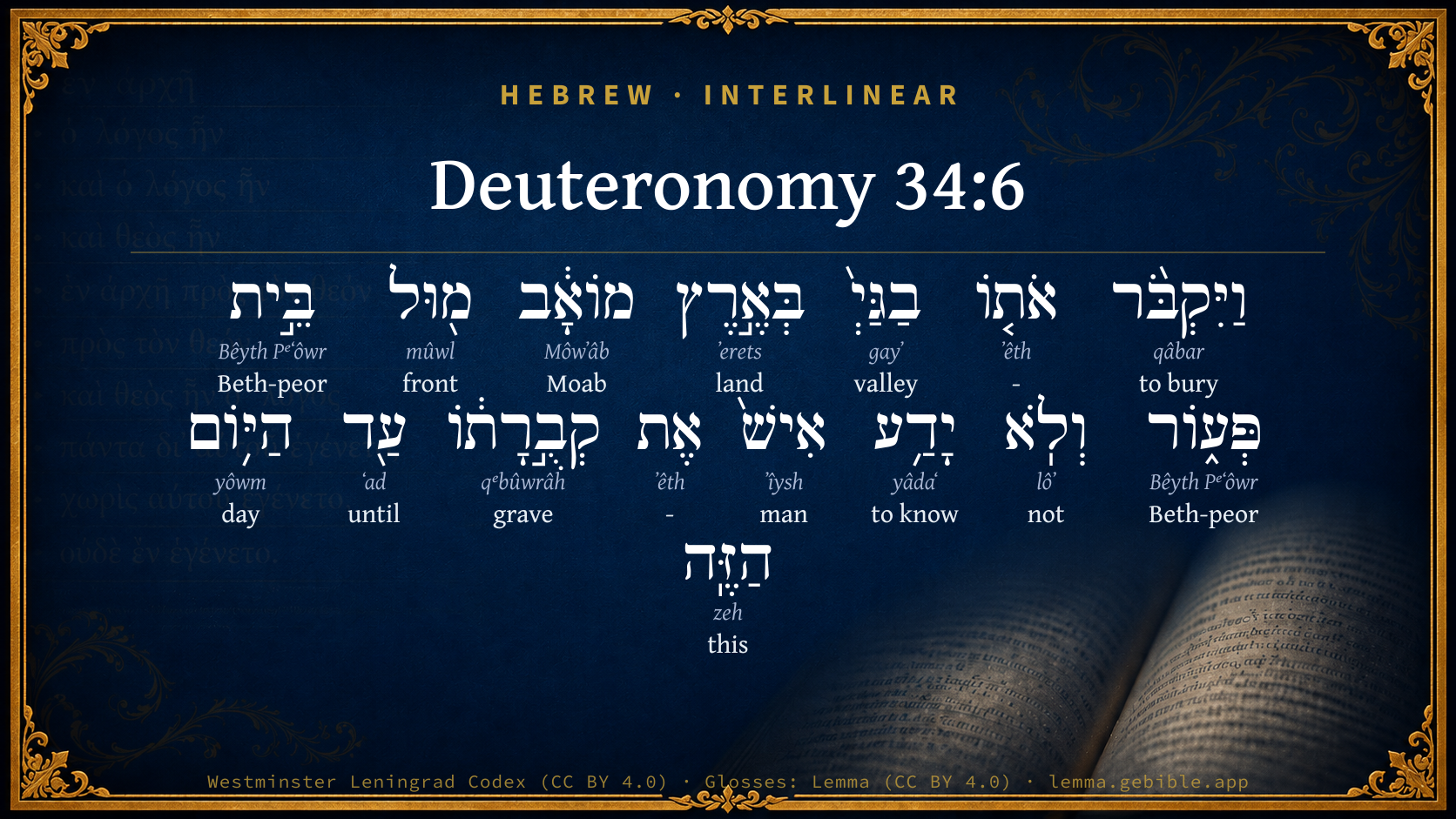
  1. וַיִּקְבֹּ֨ר qâbar H6912 “and · to bury” Conjunction + Verb, Qal, Sequential Imperfect, 3rd Person, Masculine, Singular
  2. אֹת֤וֹ ʼêth H853 “- · him” Particle, Direct Object + Suffix, Personal, 3rd Person, Masculine, Singular
  3. בַגַּיְ֙ gayʼ H1516 “in/at the · valley” Preposition, Determined + Noun, Common, Both, Singular, Absolute
  4. בְּאֶ֣רֶץ ʼerets H776 “in/at · land of” Preposition + Noun, Common, Both, Singular, Construct
  5. מוֹאָ֔ב Môwʼâb H4124 “Moab” Noun, Proper
  6. מ֖וּל mûwl H4136 “front” Preposition
  7. פְּע֑וֹר Bêyth Pᵉʻôwr H1047 “Beth-peor” Noun, Proper
  8. וְלֹֽא lôʼ H3808 “and · not” Conjunction + Particle, Negative
  9. יָדַ֥ע yâdaʻ H3045 “to know” Verb, Qal, Perfect, 3rd Person, Masculine, Singular
  10. אִישׁ֙ ʼîysh H376 “man” Noun, Common, Masculine, Singular, Absolute
  11. אֶת ʼêth H853 “-” Particle, Direct Object
  12. קְבֻ֣רָת֔וֹ qᵉbûwrâh H6900 “grave · his” Noun, Common, Feminine, Singular, Construct + Suffix, Personal, 3rd Person, Masculine, Singular
  13. עַ֖ד ʻad H5704 “until” Preposition
  14. הַיּ֥וֹם yôwm H3117 “the · day” Particle, Definite Article + Noun, Common, Masculine, Singular, Absolute
  15. הַזֶּֽה zeh H2088 “the · this” Particle, Definite Article + Pronoun, Demonstrative, Masculine, Singular

About this verse

These counts appear in no published source. They are computed here, from the morphology-tagged text and Lemma’s own curated glosses. What Lemma adds →

16
words
14
distinct lemmas
Pentateuch
section

Notable vocabulary

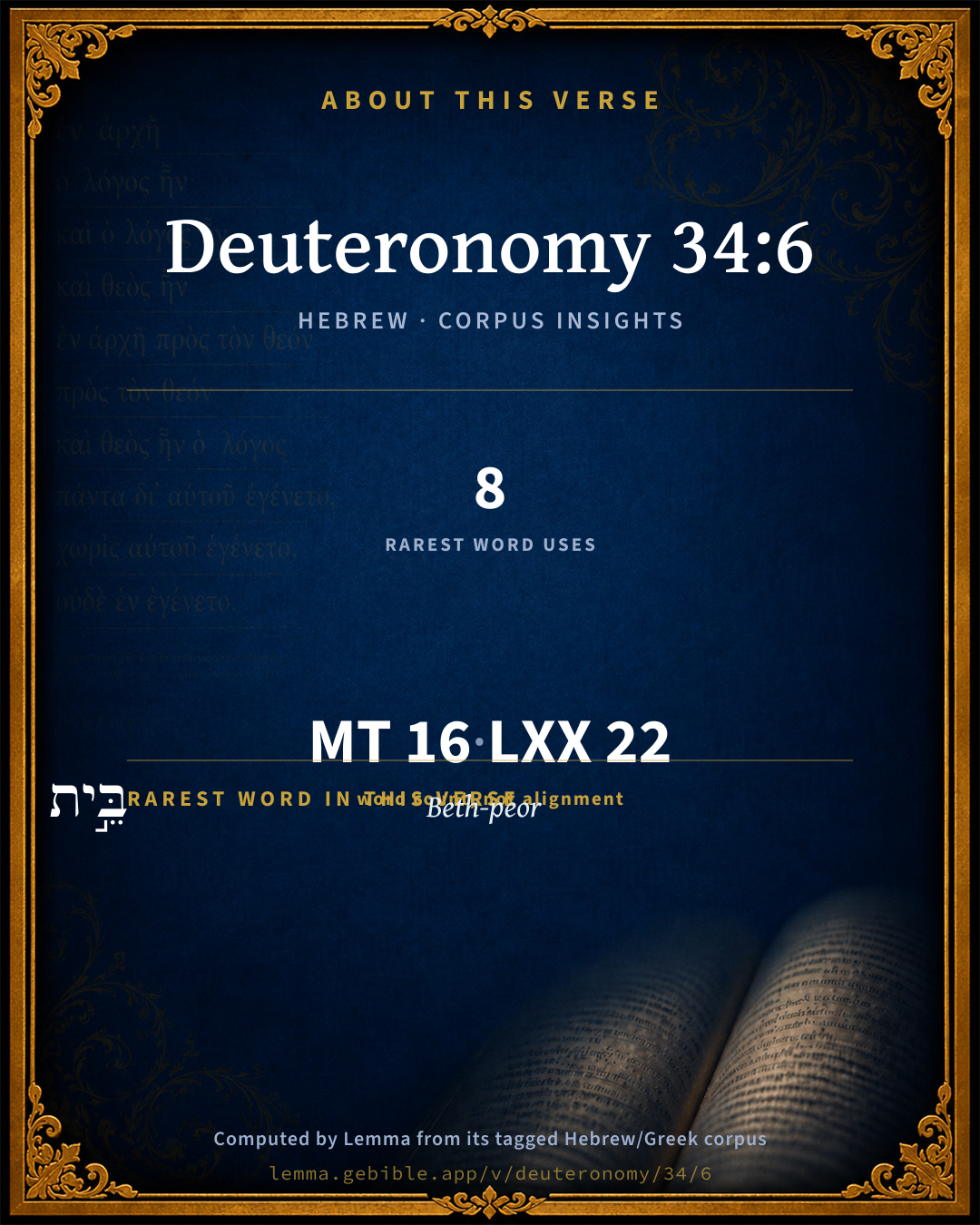
The rarest word here is בֵּ֣ית Beth-peor H1047 — appearing just 8 times in the whole Hebrew Bible.

Shared distinctive vocabulary

בֵּ֣ית Beth-peor H1047 occurs in 4 verses of the Hebrew Bible. Also found in:

Grammatical profile

  • 2 verbs
  • 8 nouns
  • 1 pronoun
  • 2 prepositions
  • 3 particles

Verb forms

  • וַיִּקְבֹּ֨ר Qal · Sequential Imperfect
  • יָדַ֥ע Qal · Perfect

Repetition

A word recurs within this verse — often emphatic in Hebrew:

  • בֵּ֣ית Beth-peor H1047 ×2

Hebrew & Septuagint length

In English translation the verse runs 25 words from the Hebrew and 21 from the Septuagint (LXX English) — closely comparable.

A rough comparison of the two English renderings, which tokenize alike — not a word-level alignment.

Word counts can differ between the Hebrew and the Greek without any difference in meaning — e.g. the Hebrew direct-object marker אֵת has no separate Greek word, and Greek often adds the article ὁ.

In the original languages it is 16 Hebrew tokens and 22 Greek tokens — but the two are counted differently (Hebrew bundles its prefixes and suffixes into one token; the Greek is in lemma form), so that isn’t a like-for-like length.

Cross-references

2

Topical passages linked to Deuteronomy 34:6 in the Treasury of Scripture Knowledge — connected by theme and wording, ordered by reader-vote popularity; previews shown in the World English Bible.

  • Jude 1:9 But Michael, the archangel, when contending with the devil and arguing about the body of Moses, dared not bring against him an abusive condemnation, but said, "May the Lord rebuke you!"
  • Deuteronomy 3:29 So we abode in the valley over against Beth Peor.

Cross-references courtesy of OpenBible.info (CC BY 4.0).

Hebrew and Greek witnesses Masoretic Hebrew ↔ Greek Septuagint

The same verse in the two great witnesses to the Old Testament, shown verse-for-verse.

These are two independent witnesses, not word-aligned to each other, and the Septuagint is shown in lemma (dictionary) form.

Hebrew Deuteronomy 34:6 Masoretic · Westminster Leningrad Codex

וַיִּקְבֹּ֨ר אֹת֤וֹ בַגַּיְ֙ בְּאֶ֣רֶץ מוֹאָ֔ב מ֖וּל בֵּ֣ית פְּע֑וֹר וְלֹֽא יָדַ֥ע אִישׁ֙ אֶת קְבֻ֣רָת֔וֹ עַ֖ד הַיּ֥וֹם הַזֶּֽה

He buried him in the valley in the land of Moab over against Beth Peor: but no man knows of his tomb to this day.

World English Bible · Public Domain

Greek LXX Deuteronomy 34:6 Septuagint · lemma form

καί θάπτω αὐτός ἐν γαι ἐν γῆ μωαβ ἐγγύς οἶκος φογωρ καί οὐ οἶδα οὐδείς ὁ ταφή αὐτός ἕως ὁ ἡμέρα οὗτος

And they buried him in Gai near the house of Phogor; and no one has seen his sepulchre to this day.

LXX2012 (modern English Septuagint) · Public Domain

On this verse, Whedon's Commentary on the Bible discusses the Septuagint’s reading. Read the note in Commentary ↓

Hebrew: Westminster Leningrad Codex (CC BY 4.0). Greek: Septuagint (public domain); English from LXX2012 (modern English Septuagint) (Public Domain). How the Septuagint differs from the Hebrew →

Targum (Aramaic paraphrase)

2

The Targum is the ancient Jewish Aramaic paraphrase of the Hebrew Scriptures — an interpretive translation, not the Hebrew text itself. Onkelos (literal) and Pseudo-Jonathan (expansive) render the Torah, and Jonathan the Prophets. Coverage is partial: where no permissively-licensed English translation exists for a verse, only the Aramaic is shown. This is verse-level text, not a word-by-word alignment to the Hebrew.

  1. Targum Onkelos Torah (Genesis–Deuteronomy)
    וּקְבַר יָתֵהּ בְּחֵילָתָא בְּאַרְעָא דְמוֹאָב לְקֳבֵל בֵּית פְּעוֹר וְלָא יְדַע אֱנַשׁ יָת קְבֻרְתֵּה עַד יוֹמָא הָדֵין

    (no public-domain English translation for this verse)

    Targum Onkelos — Aramaic: “Onkelos Genesis” (public domain); “Onkelos Exodus” (public domain); “Onkelos Leviticus” (public domain); “Onkelos Numbers” (public domain); “Onkelos Deuteronomy” (public domain). English: “Sefaria Community Translation” (CC0 1.0 (public-domain dedication)); “J.W. Etheridge. The Targums of Onkelos and Jonathan Ben Uzziel on the Pentateuch. London: Longmans, Green, 1862” (public domain). Text via Sefaria.

  2. Targum Pseudo-Jonathan Torah (Genesis–Deuteronomy)
    בְּרִיךְ שְׁמֵיהּ דְמָארֵי עַלְמָא דְאַלִיף לָן אָרְחָתֵיהּ תַּקְנֵי אַלִּיף יָתָן לְמִלְבַּשׁ עַרְטְלָאִין מִן דְּאַלְבֵּישׁ אָדָם וְחַוָּה אַלִיף יָתָן לִמְזַוְגָּא חַתְנִין וְכַלָּן מִן דְּזַוֵיג חַוָה לְוַת אָדָם אַלִּיף יָתָן לִמְבַקְרָא מַרְעִין מִן דְּאִתְגְּלֵי בְּחֶזְוֵוי מֵימְרֵיהּ עַל אַבְרָהָם כַּד הֲוָה מְרַע מִגְזֵרַת מָהוּלְתָּא אַלִּיף יָּתָן לִמְנַחְמָא אֶבְלִין מִן דְּאִתְגְּלֵי לְיַעֲקב תּוּב בְּמֵיתוֹי מִפַּדַן בַּאֲתַר דְּמִיתַת אִמֵּיהּ אַלִּיף יָתָן לִמְפַרְנְסָא מַסְכְּנִין מִן דְּאָחַת לִבְנֵי יִשְרָאֵל לַחֲמָא מִן שְׁמַיָּא. אַלִיף יָתָן לְמִקְבַּר מֵיתַיָּא מִן משֶׁה דְאִתְגְלֵי עֲלוֹי בְּמֵימְרֵיהּ וְעִמֵּיהּ חֲבוּרַן דְמַלְאֲכֵי שֵׁירוּתָא מִיכָאֵל וְגַבְרִיאֵל אַצִיעוֹן דַּרְגְּשָׁא דְּדַהֲבָה מִקְבְּעָא בְּיוֹרְכִין וְסַנְדַּלְכִין וּבוּרְלִין מְתַקְנָא כְּבִסְתַּרְקֵי מִלַּת וְסוּכְנִין דְּאַרְגְּוָון וְאוֹצִיטִילִין חִוְורִין מְטַטְרוֹן וְיוֹפִיאֵל וְאוֹרִיאֵל וִיפִיפְיָה רַבָּנֵי חָכְמָתָא אַרְבְּעִין יָתֵיהּ עֲלָהּ וּבְמֵימְרֵיהּ דַּבְּרֵי אַרְבַּעֲתֵּי מִלִּין וּקְבַר יָתֵיהּ בְּחֵילְתָא כֻּלּוֹ קָבֵיל בֵּית פְּעוֹר דְּכָל אֵימַת דְּזַקִּיף פְּעוֹר לְמִדְכַּר לְיִשְרָאֵל חוֹבַתְהוֹן מוֹדִיק בְּבֵית קְבוּרְתֵּיהּ דְמשֶׁה וּמִתְכְּבִישׁ וְלָא חַכִּים בַּר נַשׁ יַת קְבוּרְתֵּיהּ עַד זְמַן יוֹמָא הָדֵין

    Blessed be the Name of the Lord of the world, who hath taught us His righteous way. He hath taught us to clothe the naked, as He clothed Adam and Hava; He hath taught us to unite the bridegroom and the bride in marriage, as He united Hava to Adam. He hath taught us to visit the sick, as He revealed Himself to Abraham when he was ill, from being circumcised; He hath taught us to console the mourners, as He revealed Himself again to Jakob when returning from Padan, in the place where his mother had died. He hath taught us to feed the poor, as He sent Israel bread from heaven; He hath taught us to bury the dead by (what He did for) Mosheh; for He revealed Himself in His Word, and with Him the companies of ministering angels. Michael and Gabriel spread forth the golden bed, fastened with chrysolites, gems, and beryls, adorned with hangings of purple silk, and satin, and white linens. Metatron, Jophiel, and Uriel, and Jephephya, the wise sages, laid him upon it, and by His Word He conducted him four miles, and buried him in the valley opposite Beth Peor; that Israel, as oft as they look up to Peor, may have the memory of their sin; and at sight of the burying place of Mosheh may be humbled: but no man knoweth his sepulchre unto this day.

    Targum Pseudo-Jonathan — Aramaic: “Targum Jonathan on Genesis” (public domain); “Targum Jonathan on Exodus” (public domain); “Targum Jonathan on Leviticus” (public domain); “Targum Jonathan on Numbers” (public domain); “Targum Jonathan on Deuteronomy” (public domain). English: “The Targum of Jonathan ben Uzziel, trans. J. W. Etheridge, London, 1862” (public domain). Text via Sefaria.

Commentary

Notes on Deuteronomy 34:6 from classic Christian and Jewish commentators (each source and its license shown beneath its notes). The classic Christian expositions comment on the surrounding passage and are grouped to its opening verse, so a note may address several verses; the Jewish commentaries on the Tanakh (Rashi and others) are per-verse, so they appear only where the commentator wrote on this verse.

Lemma curates 59 commentaries, every one of them public domain or Creative Commons licensed, each selected and text-cleaned for this edition rather than reprinted as found. About our sources →

Trapp's Complete Commentary

John Trapp

Deu 34:6 And he buried him in a valley in the land of Moab, over against Bethpeor: but no man knoweth of his sepulchre unto this day.

Ver. 6. And he buried him.] Either the Lord or Michael. {Jdg 1:9} There lies the body of Moses as in a chamber of rest, or bed of down. {Isa 57:2} His very dust being precious; for Christ is not perfect without it. {Eph 1:23}

But no man knoweth of his sepulchre.] Though the devil made much ado about it, {Jdg 1:9} as desirous thereby to set up himself in the hearts of the living. So Chrysostom, Theodoret, Procopius, and others think: howbeit we find not anywhere that the Jews were addicted to this kind of idolatry, viz., of worshipping the relics of saints departed. {a} But of Michael’s dispute with the devil, about the body of Moses, we read in Origen {b} and others, {c} that (besides what Jude hath) there was in the primitive times a certain Apocryphal book, called Mωυσεως Aναληψις, the Assumption of Moses, wherein it was recorded, and where hence haply Jude had it.

{a} λειψανολατρια.

{b} Pερι αρχων, lib. iii. cap. 2.

{c} Abath R. Nathan.

John Trapp, A Commentary or Exposition upon All the Books of the Old and New Testament (1647–1656) — public domain. Text from a community e-Sword module.

The Biblical Illustrator

Joseph S. Exell

Deu_34:6-12

He buried him, but no man knoweth of his sepulchre.

The burial of Moses

I. God will have no one, living or dead, to stand between His creatures and Himself.

II. God wishes men to see something more left of His servants than the outward shrine.

III. God takes the honour of His servants into His own keeping.

IV. God would teach men that he has a relation to His servants which extends beyond their death.

V. God would teach men from the very first that His regard is not confined to any chosen soil.

VI. The seeming failure in a true life may have at last a complete compensation. (John Ker, D. D.)

Divine burial

The same God that, by the hands of His angels, carried up the soul of Moses to his glory, doth also, by the hand of His angels, carry his body down into the valley of Moab to his sepulchre. Those hands which had taken the law from Him, those eyes that had seen His presence, those lips that had conferred so oft with Him, that face that did so shine with the beams of His glory, may not be neglected when the soul is gone. He that took charge of his birth, and preservation in the reeds, takes charge of his carriage out of the world. The care of God ceaseth not over His own, either in death, or after it. How justly do we take care of the comely burials of our friends, when God Himself gives us this example! (Bp. Joseph Hall.)

The burial of Moses

Never had any man a more wonderful burial. No human hands assisted at it. It was not left for the winds to cover with the dust of the mountain the stalwart form of the eagle-eyed leader; nor for the dew and the rain to moisten it; nor for the sunshine to waste and bleach it. It was not left unburied. Moses died, according to the word of the Lord, and He buried him in a valley in the land of Moab. (Alexander R. Thompson, D. D.)

So the days of weeping and mourning for Moses wore ended.

The worker removed-the work continued

And when these days were ended, straightway the career of Joshua opens, the tide of things rolls forward, and the march of events sweeps on. And is this the end of it all so far as Moses is concerned? We cannot think it. In some churchyards we see the broken column, and that we always understand as the emblem of a broken life. Where are the lives which are not broken? And over what graves shall the broken column not be raised? Moses, the servant of the Lord, died there, etc. That life falls; but the thread of its conjunction with the eternal purpose is not broken; that does not fall with the life. The streamlet fails, but the mighty river rolls on. Moses dies, and is buried, but Joshua takes up the staff and stretches forth the hand. What is the life of Moses, or any other life? It is safe with God, if in purpose, at least, and intention and drift it be lived in Him and for Him--safe with God while its mortal courses are running, and safe with Him when they are stayed. But while they are running He works by them, and when they are stayed He works without them, and by other lives. And it is when the soul of the man is in harmony with this fact, and governs itself by it, as the soul of Moses was in harmony with it--it is then that the true life will be lived, and no shadow of fear will rest upon the future. But indeed it is a great thing of which we speak, this harmony of mind with the purpose of God. It is the highest life of man. It is the fruit of long patience and much strife, and the triumph of the grace of the Almighty Spirit within the human soul. (D. Wright, M. A.)

Joshua . . . was full of the spirit of wisdom.--

Joshua and Moses

We have here a very honourable encomium both of Moses and Joshua; each has his praise, and should have. It is ungrateful so to magnify our living friends as to forget the merits of those that are gone, to whose memories there is a debt of honour due. All the respects must not be paid to the rising sun; and on the other hand, it is unjust so to cry up the merits of those that are gone, as to despise the benefit we have in those that survive and succeed them. Let God be glorified in both as here.

1. Joshua is praised as a man admirably well qualified for the work to which he was called.

(1) God fitted him for it. Herein he was a type of Christ, in whom are hid the treasures of wisdom.

(2) Moses by the Divine appointment had ordained him to it; he had laid his hands upon him, so substituting him to be his successor, and praying to God to qualify him for the service to which He had called him. And this comes in as a reason why God gave him a more than ordinary spirit of wisdom, because his designation to the government was Gods own act; and those whom God employs, He will in some measure make fit for the employment. When the bodily presence of Christ withdrew from His Church, He prayed the Father to send another Comforter; and obtained what He prayed for.

(3) The people cheerfully owned him, and submitted to him. An interest in the affections of the people is a great advantage, and a great encouragement to those that are called to public trusts of what kind soever. It was also a great mercy to the people, that when Moses was dead they were not as sheep having no shepherd. Moses is praised (verses 10, 11, 12), and with good reason.

(1) He was indeed a very great man upon two accounts among others--

(a) His intimacy with the God of nature; God knew him face to face, and so he knew God (Num_12:8). He saw more of the glory of God than any (at least) of the Old Testament saints ever did; he had more free and frequent access to God; and was spoken to, not in dreams and visions and slumberings on the bed, but when he was awake, and standing before the cherubims.

(b) His interest and power in the kingdom of nature. He was greater than any other of the prophets of the Old Testament; though they were men of great interest in heaven, and great influence upon earth, yet they were none of them to be compared with this great man; none of them either evidenced or executed a commission from heaven so as Moses did. (Matthew Henry, D. D.)

The Biblical Illustrator, edited by Joseph S. Exell (c. 1880s–1900s) — public domain. Text from a community e-Sword module.

Joseph Benson's Commentary

Deu 34:6. And he — That is, the Lord, the immediate and only antecedent to the pronoun he; buried him — Using, no doubt, the ministry of angels for this purpose. Some, indeed, who are of opinion that there was nothing miraculous in his death or burial, propose rendering the words, He was buried, urging in defence of this interpretation, that active verbs in the Hebrew are often taken passively. This may be true; but still upon the very face of the narrative it evidently appears, that the manner both of his death and burial was miraculous. He died, it is said, according to the word of the Lord — Who commanded him to go up to the mount and die there, as soon as he had viewed the promised land, (Deu 32:49-50,) and that at a time when his eye was not dim, nor his natural force abated, (Deu 34:7,) and when certainly he had no symptom of any disease or weakness about him. And if there was nothing miraculous in his burial; if the Lord did not bury him, but he was buried by some of the people, and if by some, no doubt by thousands and myriads, why is it said, nay, how could it with truth be said, as it is in the next clause, No man knoweth of his sepulchre unto this day? Surely, the plain and obvious meaning of this is, not, as the same persons would interpret it. “That, when this was written, time, which brings all things to decay, had left no footsteps of Moses’s monument, or had worn out the remembrance of the place where his body was laid,” but that no man ever knew of his sepulchre, as well as that none knew of it then. And the reason which has generally been assigned for God’s concealing from the Israelites the place where he was interred, namely, to prevent their superstition and idolatry, must be thought sufficient by those who recollect how these Israelites burned incense, long after this, to the brazen serpent which Moses made, and would probably much more have paid some superstitious, if not religious honour to his body, or the relics thereof, if they could have been found. Nor is the interpretation that, with a reference hereto, has usually been put upon Jdg 1:9, which speaks of Michael contending with the devil about the body of Moses, so unreasonable or unlikely, as some would insinuate. But of this when we come thither.

Joseph Benson's Commentary on the Old and New Testaments (1811–1818) — public domain. Text from a community e-Sword module.

Tyndale Open Study Notes

Tyndale Open Resources

34:6 Beth-peor was where Israel engaged in pagan ritual (see 3:29; 4:3; Num 25) and where Moses presented his farewell address (see Deut 4:44-46). • The phrase to this day refers to the time of Deuteronomy’s final composition (see Genesis Book Introduction, “Authorship”).

Tyndale Open Study Notes — © Tyndale Open Resources, licensed CC BY-SA 4.0. Text via the HelloAO Bible API.

Geneva Bible (1599)

Geneva Bible translators

That the Jews might not have occassion thereby to commit Idolatry.

To wit, the Angel of the Lord, Jude 9.

Geneva Bible (1599) marginal notes — public domain. Text via Bolls.life.

Jamieson, Fausset & Brown

Robert Jamieson, A. R. Fausset & David Brown

he buried him--or, "he was buried in a valley," that is, a ravine or gorge of the Pisgah. Some think that he entered a cave and there died, being, according to an ancient tradition of Jews and Christians, buried by angels (Jde 1:9; Num 21:20).

no man knoweth of his sepulchre unto this day--This concealment seems to have been owing to a special and wise arrangement of Providence, to prevent its being ranked among "holy places," and made the resort of superstitious pilgrims or idolatrous veneration, in after ages.

Jamieson, Fausset & Brown — Commentary Critical and Explanatory on the Whole Bible (1871) — public domain (CC PDM 1.0). Text via the HelloAO Bible API.

Adam Clarke's Commentary

Verse 6. He buried him] It is probable that the reason why Moses was buried thus privately was, lest the Israelites, prone to idolatry, should pay him Divine honours; and God would not have the body of his faithful servant abused in this way. Almost all the gods of antiquity were defiled men, great lawgivers, eminent statesmen, or victorious generals. See the account of the life of Moses at the end of this chapter. See Clarke on De 34:10.

Adam Clarke's Commentary on the Bible (1810–1826) — public domain. Text from a community e-Sword/MySword module.

Ellicott's Commentary for English Readers

(6) And he buried him.—Moses is alone in this honour. The Son of God was buried by sinful men. Moses was buried by Jehovah.

But no man knoweth of his sepulchre.—I have always believed that the contention between Michael and the devil about the body of Moses (Jud_1:9) was in fact, a struggle for his body—that Moses was to be raised from the dead, and that Satan resisted his resurrection. When the contest took place we cannot say. But Moses, who died and was buried, and Elijah, who was translated, “appeared in glory” on the holy mount, and the New Testament gives no hint of difference between them. We do not know how Moses could have appeared as a disembodied spirit so as to be seen of men.

A Bible Commentary for English Readers, edited by Charles John Ellicott (1878–1897) — public domain. Text from a community e-Sword module.

The Cambridge Bible for Schools and Colleges

gen. ed. J. J. S. Perowne

6. he buried] He can only be Jehovah, for no man knew the grave; hence the rendering they buried, though possible, so far as the grammar goes, is contrary to the sense.

the valley … Beth-peor] See on Deu_3:29.

The Cambridge Bible for Schools and Colleges (gen. ed. J. J. S. Perowne; Cambridge University Press, 1878–1918) — public domain. Text from a community e-Sword module.

John Gill's Exposition

And he buried him,.... Aben Ezra says he buried himself, going into a cave on the top of the mount, where he expired, and so where he died his grave was; but though he died on the mount, he was buried in a valley: Jarchi and so other Jewish writers (d) say, the Lord buried him; it may be by the ministry of angels: an Arabic writer says (e), he was buried by angels: it is very probable he was buried by Michael, and who is no other than the archangel or head of principalities and powers, our Lord Jesus Christ, for a reason that will be hereafter suggested, see Jde 1:9,

in a valley in the land of Moab, over against Bethpeor; where stood a temple dedicated to the idol Peor, see Deu 3:29,

but no man knoweth of his sepulchre unto this day; to the time when Joshua wrote this, or, as others think, Samuel: if Moses is the same with the Osiris of the Egyptians, as some think (f), it may be observed, that his grave is said to be unknown to the Egyptians, as Diodorus Siculus (g) and Strabo (h) both affirm; and the grave of Moses is unknown, even unto this our day: for though no longer ago than in the year 1655, in the month of October, it was pretended to be found by some Maronite shepherds on Mount Nebo, with this inscription on it in Hebrew letters, "Moses the servant of the Lord"; but this story was confuted by Jecomas, a learned Jew, who proved it to be the grave of another Moses (i), whom Wagenseil conjectures was Moses Maimonides (k); but some think the whole story is an imposition: the reason why the grave of Moses was kept a secret was, as Ben Gersom suggests, lest, because of his miracles, succeeding generations should make a god of him and worship him, as it seems a sort of heretics called Melchisedecians did (l): the death and burial of Moses were an emblem of the weakness and insufficiency of the law of Moses, and the works of it, to bring any into the heavenly Canaan; and of the law being dead, and believers dead to that through the body of Christ, and of the entire abrogation and abolition of it by Christ, according to the will of God, as a covenant of works, as to the curse and condemnation of it, and justification by it; who is Michael the archangel, and is the end of the law for righteousness; he abolished it in his flesh, nailed it to his cross, carried it to his grave, and left it there; the rites and ceremonies of it are to be no more received, nor is it to be sought after for righteousness and life, being dead and buried, Rom 7:6.

(d) Misn. Sotah, c. 1. sect. 9. Pirke Eliezer, c. 17. (e) Abulpharag. Hist. Dynast. p. 32. (f) See Gale's Court of the Gentiles, B. 2. c. 7. p. 94. (g) Bibliothec. l. 1. p. 18. (h) Geograph. l. 17. p. 552. (i) See Calmet's Dictionary, in voce "Sepulchre". (k) Not. in Sotah, p. 327. (l) Epiphan contr. Haeres. l. 2. Haeres. 55.

John Gill's Exposition of the Whole Bible (1746–1763) — public domain (CC PDM 1.0). Text via the HelloAO Bible API.

Albert Barnes' Notes on the Bible

No man knoweth of his sepulchre - Hardly, lest the grave of Moses should become an object of superstitious honor, because the Jews were not prone to this particular fore of error. Bearing in mind the appearance of Moses at the Transfiguration Mat 17:1-10, and what is said by Jude Jud 1:9, we may conjecture that Moses after death passed into the same state with Enoch and Elijah; and that his grave could not be found because he was shortly translated (transported) from it.

Albert Barnes' Notes on the Bible (1834–1885) — public domain. Text from a community e-Sword/MySword module.

Haydock's Catholic Bible Commentary

He buried him, viz., by the ministry of angels, and would have the place of his burial to be unknown, lest the Israelites, who were so prone to idolatry, might worship him with divine honours. (Challoner) --- St. Michael therefore contended with satan about his body, Jude 9. Some have maintained that Josue and Eleazar performed these last rights to their deceased lawgiver. (Calmet) --- But then some men would have known where he was buried. (Haydock) --- Day. It is pretended that Jeremias discovered the place, 2 Machabees ii. 4, 5. He found, indeed, a hollow cave....and so stopped the door. Yet this does not prove that he found the sepulchre of Moses, (Calmet) who was buried in some valley over against Phogor, but it is not said in a cave. (Haydock) --- Cajetan infers from the body of Moses not being buried in the mountain, that it was conveyed by angels to some vale, where his attendants could not see him.

George Leo Haydock (1774–1849), Haydock's Catholic Family Bible and Commentary, 1859 edition — public domain. Excludes Psalms (Douay-Rheims chapter numbering differs from Protestant) and Deuterocanonical books (Catholic canon only).

Matthew Poole's English Annotations

He, i.e. the Lord, last mentioned, buried him either immediately, or by the ministry of angels, whereof Michael was the chief or prince, Jud 1:9.

No man knoweth of his sepulchre, i.e. of the particular place of the valley where he was buried; which God hid from the Israelites, to prevent their superstition and idolatry, to which he knew their great proneness. And for this very reason the devil endeavoured to have it known, and contended with Michael about it, Jud 1:9. And seeing God would not endure the worship of the relics or tomb of so eminent a person as Moses was, it is ridiculous to think God would permit this honour to be given to any of the succeeding saints, who were so far inferior to him.

Matthew Poole's English Annotations on the Holy Bible (1683–1685) — public domain. Text from a community e-Sword/MySword module.

Whedon's Commentary on the Bible

Daniel D. Whedon

6. And he buried him — We understand the subject of the sentence to be Jehovah. It is true that although the verb is in the singular the passage might be rendered as it is in the Septuagint, (εθαψαν αυτον,) they buried him. Jehovah gave his servant this signal honour. The statement that follows, “But no man knoweth of his sepulchre unto this day,” would hardly be consistent with the idea that the people buried him. For in that case his grave must have been known. He whom Jehovah had known face to face was buried by him, not to keep the Israelites from superstitious reverence for his grave. Abraham’s sepulchre was known. Jacob had been brought up from Egypt with imposing pageant and buried. Joseph’s bones were then in camp on their way to the sepulchre. We nowhere read in the Hebrew records of any thing like idolatrous worship paid at any of the tombs of the patriarchs. The view of Kurtz is worth considering. He says, (History of the Old Covenant, vol. iii, p. 495:) “If Jehovah would not suffer the body of Moses to be buried by men, it is natural to seek for a reason in the fact that he did not intend to leave him to corruption, but at the very time of his burial communicated some virtue by his own hand which saved the body from corruption, and prepared for the patriarch a transition into the same state of existence into which Enoch and Elijah were admitted without either death or burial. On account of the one sin at the water of strife at Kadesh, Moses was sentenced by the ruthless severity of the justice of God to pass under the same ban of death as the whole generation of those who despised the covenant and promise.… In the sight of the people the leader and lawgiver of the nation was visited with a punishment which must have convinced them far more strongly of the unsparing character of the judicial severity of God than the most powerful admonition could possibly have done; but at the same time, though punished, he received honour in their sight, that they might see the sun of mercy bursting through the storm of the judgments of God. As an example of justice Jehovah caused him to die before the people entered the land of rest and promise; but as an example of grace he prepared for him an entrance into another, as yet unknown, land of promise and of rest.”

Daniel D. Whedon (gen. ed.), Commentary on the Old and New Testaments (1874–1909) — public domain. Text from a community e-Sword module.

The Pulpit Commentary

The valley in which God is supposed to have buried Moses was probably some depression on the Pisgah range, upon or close by Nebo. The rabbins say that Moses was buried by retiring into a cavern, where he died and where his body remained. It is probable that, like Enoch and Elijah, he was transferred to the invisible world without seeing corruption. Hence his appearance along with Elijah in bodily form on the Mount of the Transfiguration; and hence also, perhaps, the tradition of the contest for the body of Moses between Michael and Satan. (Jud_1:9) If the body of Moses was actually buried, the concealment of his grave so that no man knew of it may be justly regarded as "the first instance on record of the providential obliteration, so remarkably exemplified afterwards in the gospel history, of the "holy places" of Palestine; the providential safeguard against their elevation to a sanctity which might endanger the real holiness of the history and religion which they served to commemorate" (Stanley). The reverence which the Jews paid to graves shows that there was no small danger of their coming under a superstitious regard to that of Moses had it been known.

The Pulpit Commentary (1880–1919), ed. H.D.M. Spence-Jones & Joseph S. Exell — public domain. Text from a community e-Sword module.

John Wesley's Explanatory Notes

He - The Lord, buried him either immediately, or by the ministry of angels, whereof Michael was the chief or prince. Of his sepulchre - Of the particular place where he was buried: which God hid from the Israelites, to prevent their superstition and idolatry, to which he knew their great proneness. And for this very reason the devil endeavoured to have it known and contended with Michael about it, Jude i, 9. God takes care even of the dead bodies of his servants. As their death is precious, so is their dust. Not one grain of it shall be lost, but the covenant with it shall be remembered.

John Wesley, Explanatory Notes Upon the Whole Bible (1754–1765) — public domain. Text via the GEBible commentary corpus.

Rashi

Rabbi Shlomo Yitzchaki (Rashi)

ויקבר אותו AND HE BURIED HIM — i.e. The Holy One, blessed be He, in His glory, buried him (Sotah 14a). R. Ishmael, however, said, It means: “He buried himself”. This (the word אותו) is one of the three cases of את with a pronominal suffix which R. Ishmael explained thus (as being reflexive and not accusative pronouns). Similar to it is: (Numbers 6:13; see Rashi thereon) “On the day when his naziritehood is fulfilled, he shall bring אותו”, i.e. he shall bring (present) himself. Similar to it is, (Leviticus 22:16) “And they will burden אותם with iniquity of trespass”. But did others burden them (the priests) with that iniquity? But the meaning is that they burdened themselves (Sifrei Bamidbar 32).

מול בית פעור OPPOSITE BETH PEOR — His grave was prepared there ever since the six days of Creation, to atone for the incident regarding Peor (see Numbers 25) (Sotah 14a). This (Moses' grave) was one of the things that were created “between the twilights” on the eve of the Sabbath [in the week of the Creation] (Pirkei Avot 5:6; Pesachim 54a).

Rashi on the Tanakh — English translations: “The Judaica Press complete Tanach with Rashi, translated by A. J. Rosenberg” (CC BY 4.0); “Pentateuch with Rashi's commentary by M. Rosenbaum and A.M. Silbermann, 1929-1934” (public domain); “The Metsudah Tanach series, Lakewood, N.J” (CC BY 4.0); and “The Book of Joshua, Metsudah Publications, 1997” (CC BY 4.0). Text via Sefaria.

Lesson kit

Teaching starters — assembled from the data on this page, not authored interpretation. Every prompt links to the verse data it draws on. Edit before teaching.

Deuteronomy, in the Pentateuch, opens this verse with 16 words (14 distinct Hebrew lemmas). Its most distinctive word is Bêyth Pᵉʻôwr (“Beth-peor”). A historical commentator’s framing appears above. Read the whole chapter for the surrounding context.

Discussion questions

  1. The word Bêyth Pᵉʻôwr carries the sense “Beth-peor.” How does it shape the verse?
  2. Deuteronomy 3:29 shares the word «Beth-peor» with this verse. How do the two illuminate each other?
  3. “Beth-peor” occurs 2× in this one verse. What is the effect of the repetition?
  4. The translations on this page render this verse differently — a whole-verse word diff, not a word-by-word alignment. What might account for the different wordings?
  5. The verb «וַיִּקְבֹּ֨ר» is Qal Sequential Imperfect. How does its form color the action?
  6. Reading how Trapp's Complete Commentary and The Biblical Illustrator read this verse, where do the two commentators agree and where do they part?

Things to notice

Reading settings

Reading text

Shown beneath each verse's original-language words.

Old Testament
Old Testament edition

Read the OT as the Masoretic Hebrew (MT) or the Greek Septuagint (LXX).

English shown for the Greek Septuagint (in the Hebrew ↔ Greek comparison).

Comparing translations? Open the Compare panel on any verse page to stack up to four side by side.