

Luke 8:43
Greek (Tischendorf 8th ed.) Luke 8:43 appears in the Greek New Testament. The text above is from the Tischendorf 8th edition. Each word links to its Strong’s number and a concise gloss. Click any word for its full Thayer’s Greek Lexicon entry.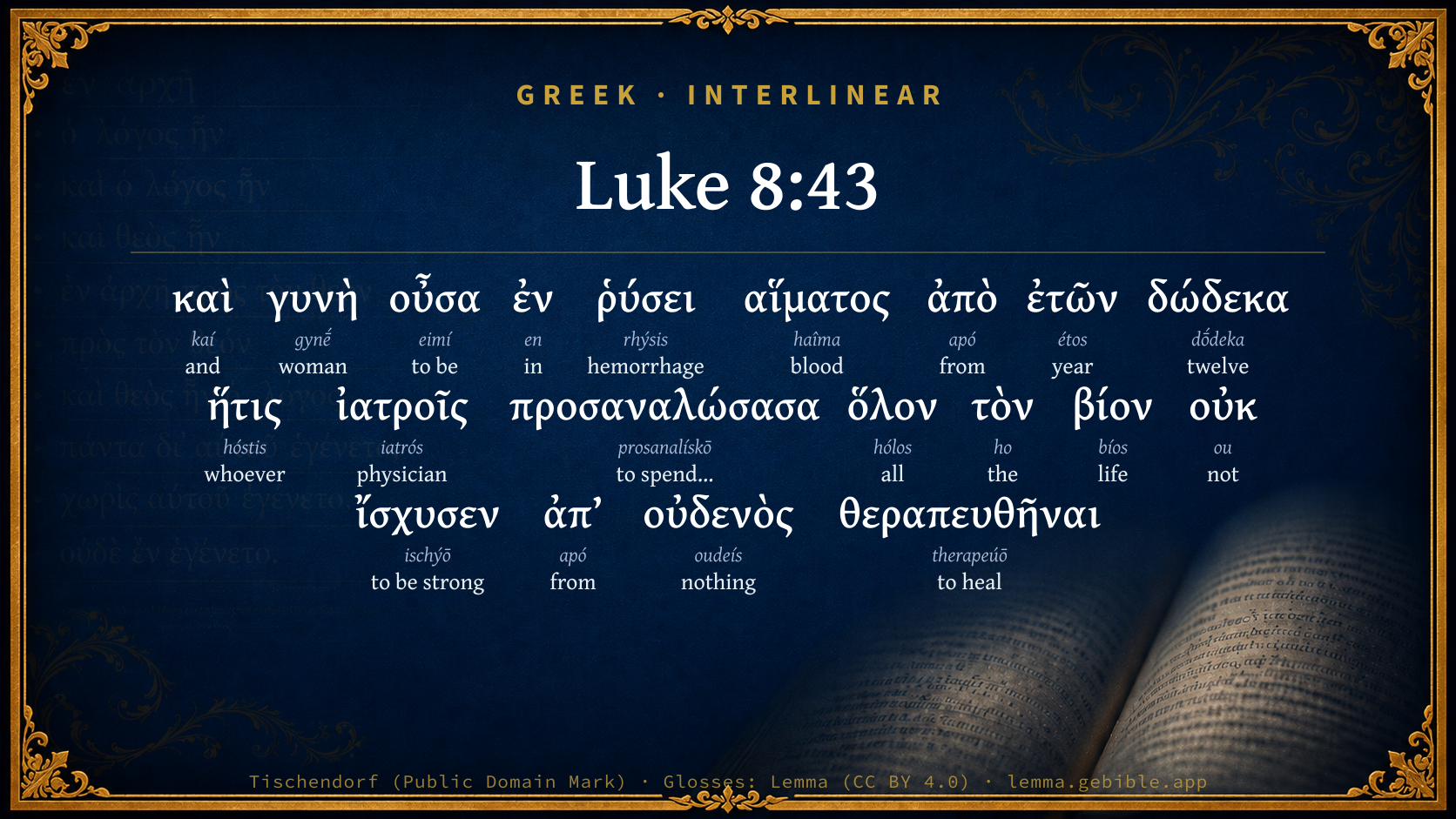
A woman who had a flow of blood for twelve years, who had spent all her living on physicians, and could not be healed by any,
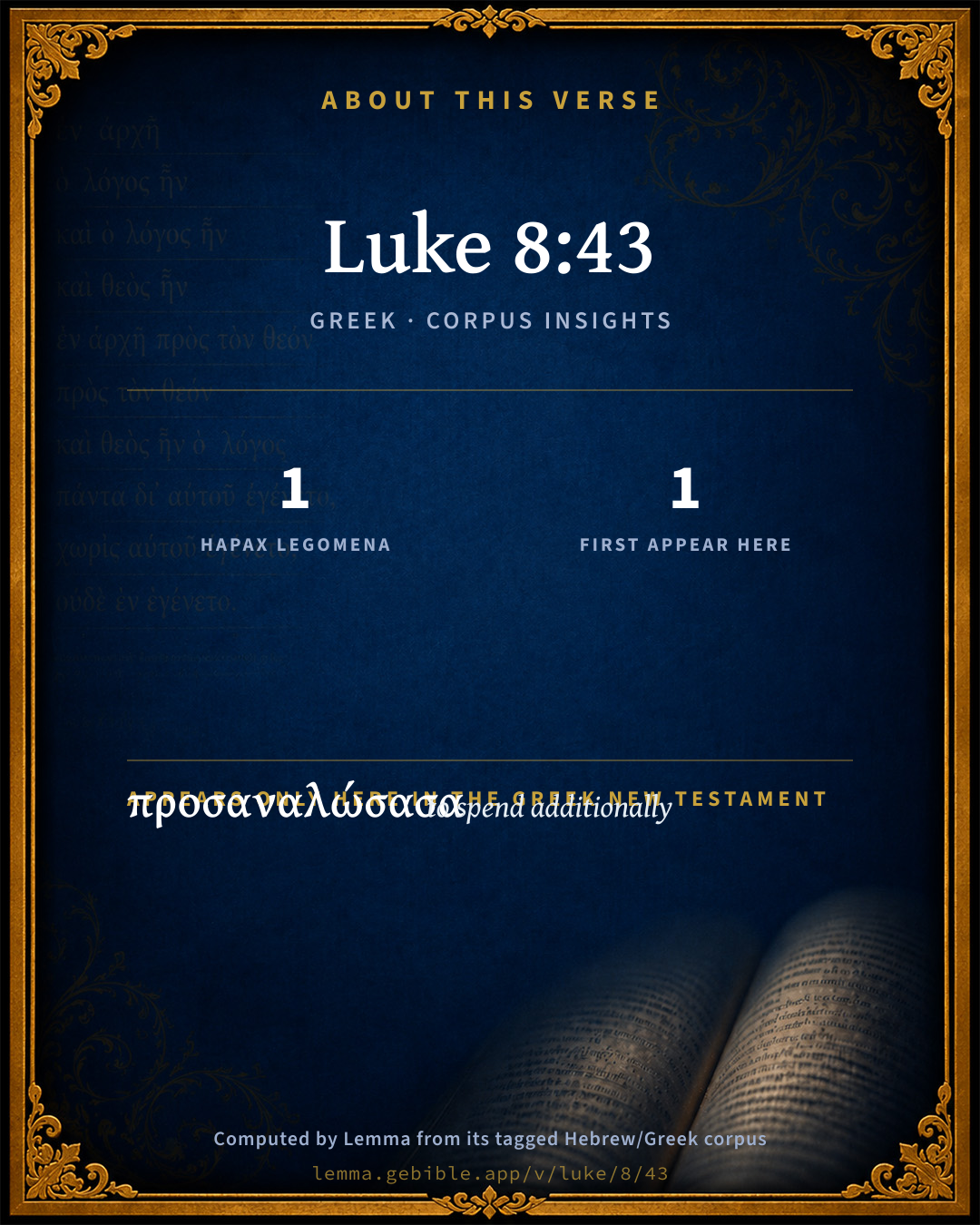
- 1 hapax legomenon — only here in the Greek New Testament
- 1 first appearance in the Greek New Testament
Download a study sheet
One document with this verse’s original text, its word-by-word gloss line, the meaning frame, cross-references with their text, attributed commentary, and full source and license credits — printable, and it pastes into notes with its structure intact.
This verse Autodidact and up
A passage Seminary Student
Up to 50 verses in one chapter. A passage sheet keeps up to 6 commentary sources and 12 cross-references per verse, in the order this page ranks them, and says so on the sheet whenever that leaves anything out. Ask for a single verse and you get the Autodidact verse sheet above.
Everything on this page stays free to read, with no account — the sheet is a download of what is already on screen, not access to it.
Compare translations 3
The same verse in 3 English versions, stacked beneath the original-language interlinear above. Click any original word for its lexicon entry.
Each is an independent rendering of the whole verse — the interlinear is not word-aligned to these translations.
Highlighted words mark where these versions differ — a whole-verse word diff, not a word-by-word alignment.
-
World English Bible Public Domain
A woman who had a flow of blood for twelve years, who had spent all her living on physicians, and could not be healed by any,
-
King James Version Public Domain
And a woman having an issue of blood twelve years, which had spent all her living upon physicians, neither could be healed of any,
-
unfoldingWord Literal Text CC BY-SA 4.0
And a woman, being with a flow of blood for 12 years, who, having spent all her living on doctors, was not able to be healed by anyone,
unfoldingWord Literal Text — © unfoldingWord, licensed CC BY-SA 4.0. Word-aligned USFM3 via Door43 (git.door43.org/unfoldingWord/en_ult).
Show all 19 translations
Every available English version of this verse, each an independent rendering of the whole verse.
-
World English Bible Public Domain
A woman who had a flow of blood for twelve years, who had spent all her living on physicians, and could not be healed by any,
-
Berean Standard Bible Public Domain
including a woman who had suffered from bleeding for twelve years. She had spent all her money on physicians, but no one was able to heal her.
-
Majority Standard Bible Public Domain
including a woman who had suffered from bleeding for twelve years. She had spent all her money on physicians, but no one was able to heal her.
-
King James Version Public Domain
And a woman having an issue of blood twelve years, which had spent all her living upon physicians, neither could be healed of any,
-
American Standard Version (1901) Public Domain
And a woman having an issue of blood twelve years, who had spent all her living upon physicians, and could not be healed of any,
-
Revised Version (1885) Public Domain
And a woman having an issue of blood twelve years, which had spent all her living upon physicians, and could not be healed of any,
-
Geneva Bible (1599) Public Domain
And a woman hauing an yssue of blood, twelue yeeres long, which had spent all her substance vpon physicians, and could not be healed of any:
-
Douay-Rheims (1899) Public Domain
And there was a certain woman having an issue of blood twelve years, who had bestowed all her substance on physicians, and could not be healed by any.
-
Young's Literal Translation Public Domain
and a woman, having an issue of blood for twelve years, who, having spent on physicians all her living, was not able to be healed by any,
-
Literal Standard Version CC BY-SA 4.0
and a woman, being with a flow of blood for twelve years, who, having spent all her living on physicians, was not able to be healed by any,
-
Unlocked Literal Bible CC BY-SA 4.0
Now a woman was there who had been bleeding for twelve years and had spent all her money, and could not be healed by anyone.
-
unfoldingWord Literal Text CC BY-SA 4.0
And a woman, being with a flow of blood for 12 years, who, having spent all her living on doctors, was not able to be healed by anyone,
-
Darby Bible Public Domain
And a woman who had a flux of blood since twelve years, who, having spent all her living on physicians, could not be cured by any one,
-
World Messianic Bible Public Domain
A woman who had a flow of blood for twelve years, who had spent all her living on physicians and could not be healed by any,
-
Webster's Bible Public Domain
And a woman having an issue of blood twelve years, who had spent all her living upon physicians, neither could be healed by any,
-
Free Bible Version CC BY-SA 4.0
In the crowd was a woman who had suffered with bleeding for twelve years. She had spent all she had on doctors, but none of them had been able to help her.
-
Bible in Basic English Public Domain
And a woman, who had had a flow of blood for twelve years, and had given all her money to medical men, and not one of them was able to make her well,
-
Text-Critical English NT CC BY 4.0
Now there was a woman who had suffered from a flow of blood for twelve years, and even though she had spent her entire livelihood on physicians, she could not be healed by anyone.
-
Tyndale New Testament (1534) Public Domain
And a woman havynge an issue of bloud twelve yeres (which had spent all her substance amonge phisicions nether coulde be holpen of eny)
Literal Standard Version (2020), Covenant Press — licensed CC BY-SA 4.0. Text via the HelloAO Bible API (eBible.org). Unlocked Literal Bible (unfoldingWord) — licensed CC BY-SA 4.0. Text via the HelloAO Bible API (eBible.org). unfoldingWord Literal Text — © unfoldingWord, licensed CC BY-SA 4.0. Word-aligned USFM3 via Door43 (git.door43.org/unfoldingWord/en_ult). Free Bible Version, Dr. Jonathan Gallagher — licensed CC BY-SA 4.0. Text via the HelloAO Bible API (eBible.org).
Word by word
More ways to search: Search by grammar → Find every occurrence → Compare this word →
Practice this passage: Drill this verse → Learn its vocabulary →
- Appears 1× in the Greek New Testament
- First appears here
- Part of Speech
- Verb
- Tense
- Aorist
- Voice
- Active
- Mood
- Participle
- Case
- Nominative
- Number
- Singular
- Gender
- Feminine
Full Thayer's Definition
- καὶ kaí G2532 “and” Conjunction
- γυνὴ gynḗ G1135 “woman” Noun, Nominative, Singular, Feminine
- οὖσα eimí G1510 “to be” Verb, Present, Active, Participle, Nominative, Singular, Feminine
- ἐν en G1722 “in” Preposition
- ῥύσει rhýsis G4511 “hemorrhage” Noun, Dative, Singular, Feminine
- αἵματος haîma G129 “blood” Noun, Genitive, Singular, Neuter
- ἀπὸ apó G575 “from” Preposition
- ἐτῶν étos G2094 “year” Noun, Genitive, Plural, Neuter
- δώδεκα dṓdeka G1427 “twelve” Adjective, Numeral (indeclinable)
- ἥτις hóstis G3748 “whoever” Relative pronoun, Nominative, Singular, Feminine
- ἰατροῖς iatrós G2395 “physician” Noun, Dative, Plural, Masculine
- προσαναλώσασα prosanalískō G4321 “to spend additionally” Verb, Aorist, Active, Participle, Nominative, Singular, Feminine
- ὅλον hólos G3650 “all” Adjective, Accusative, Singular, Masculine
- τὸν ho G3588 “the” Article, Accusative, Singular, Masculine
- βίον bíos G979 “life” Noun, Accusative, Singular, Masculine
- οὐκ ou G3756 “not” Particle, Negative
- ἴσχυσεν ischýō G2480 “to be strong” Verb, Aorist, Active, Indicative, 3rd person, Singular
- ἀπ’ apó G575 “from” Preposition
- οὐδενὸς oudeís G3762 “nothing” Adjective, Genitive, Singular, Masculine, Negative
- θεραπευθῆναι therapeúō G2323 “to heal” Verb, Aorist, Passive, Infinitive
About this verse
These counts appear in no published source. They are computed here, from the morphology-tagged text and Lemma’s own curated glosses. What Lemma adds →
- 20
- words
- 19
- distinct lemmas
- Gospels
- section
Notable vocabulary
1 hapax legomenon — a word that appears only here in the entire Greek New Testament:
- προσαναλώσασα to spend additionally G4321
First appearance in Scripture
This word makes its first canonical appearance in the Greek New Testament here:
- προσαναλώσασα to spend additionally G4321
Shared distinctive vocabulary
ῥύσει hemorrhage G4511 occurs in 3 verses of the Greek New Testament. Also found in:
Repetition
A word recurs within this verse:
- ἀπὸ from G575 ×2
Cross-references
19Topical passages linked to Luke 8:43 in the Treasury of Scripture Knowledge — connected by theme and wording, ordered by reader-vote popularity; previews shown in the World English Bible.
- Mark 5:25–26 A certain woman, who had an issue of blood for twelve years,
- Matthew 9:20–22 Behold, a woman who had an issue of blood for twelve years came behind him, and touched the tassels of his garment;
- Leviticus 15:25–33 "'If a woman has a discharge of her blood many days not in the time of her period, or if she has a discharge beyond the time of her period; all the days of the discharge of her uncleanness shall be as in the days of her period: she is unclean.
- Luke 13:16 Ought not this woman, being a daughter of Abraham, whom Satan had bound eighteen long years, be freed from this bondage on the Sabbath day?"
- 2 Chronicles 16:12 In the thirty-ninth year of his reign Asa was diseased in his feet; his disease was exceeding great: yet in his disease he didn't seek Yahweh, but to the physicians.
- Mark 9:21–22 He asked his father, "How long has it been since this has come to him?" He said, "From childhood.
- Job 13:4 But you are forgers of lies. You are all physicians of no value.
- Isaiah 2:22 Stop trusting in man, whose breath is in his nostrils; For of what account is he?
- Isaiah 55:1–3 Ho, everyone who thirsts, come you to the waters, and he who has no money; come you, buy, and eat; yes, come, buy wine and milk without money and without price.
- Luke 8:27 When Jesus stepped ashore, a certain man out of the city who had demons for a long time met him. He wore no clothes, and didn't live in a house, but in the tombs.
- Luke 13:11 Behold, there was a woman who had a spirit of infirmity eighteen years, and she was bent over, and could in no way straighten herself up.
- John 9:1 As he passed by, he saw a man blind from birth.
- Psalms 108:12 Give us help against the enemy, For the help of man is vain.
- Mark 9:18 and wherever it seizes him, it throws him down, and he foams at the mouth, and grinds his teeth, and wastes away. I asked your disciples to cast it out, and they weren't able."
- John 5:5–6 A certain man was there, who had been sick for thirty-eight years.
- John 9:21 but how he now sees, we don't know; or who opened his eyes, we don't know. He is of age. Ask him. He will speak for himself."
- Acts 3:2 A certain man who was lame from his mother's womb was being carried, whom they laid daily at the door of the temple which is called Beautiful, to ask gifts for the needy of those who entered into the temple.
- Acts 4:22 For the man on whom this miracle of healing was performed was more than forty years old.
- Acts 14:8–10 At Lystra a certain man sat, impotent in his feet, a cripple from his mother's womb, who never had walked.
Cross-references courtesy of OpenBible.info (CC BY 4.0).
Lesson kit
Teaching starters — assembled from the data on this page, not authored interpretation. Every prompt links to the verse data it draws on. Edit before teaching.
Luke, in the Gospels, opens this verse with 20 words (19 distinct Greek lemmas). Its most distinctive word is prosanalískō (“to spend additionally”). A historical commentator’s framing appears above. Read the whole chapter for the surrounding context.
Discussion questions
- The word prosanalískō carries the sense “to spend additionally.” How does it shape the verse?
- This verse holds 1 word here found nowhere else in the Greek New Testament. What might the rare word draw attention to?
- The word “to spend additionally” first appears here in Scripture. What is being introduced at this debut?
- Mark 5:25 shares the word «hemorrhage» with this verse. How do the two illuminate each other?
- “from” occurs 2× in this one verse. What is the effect of the repetition?
- These translations render this verse differently. What is at stake in choosing one wording over another?
- Reading how The Biblical Illustrator and The Preacher's Complete Homiletical Commentary read this verse, where do the two commentators agree and where do they part?
Things to notice
- 1 word in this verse appears nowhere else in the Greek New Testament.
- 1 word makes its first canonical appearance in Scripture here.
- These translations choose different wording for 17 words in this verse.
- “from” occurs 2× in this single verse.
- 19 distinct Greek lemmas span 20 words in this verse.
Commentary
Notes on Luke 8:43 from classic Christian and Jewish commentators (each source and its license shown beneath its notes). The classic Christian expositions comment on the surrounding passage and are grouped to its opening verse, so a note may address several verses; the Jewish commentaries on the Tanakh (Rashi and others) are per-verse, so they appear only where the commentator wrote on this verse.
Lemma curates 59 commentaries, every one of them public domain or Creative Commons licensed, each selected and text-cleaned for this edition rather than reprinted as found. About our sources →
The Biblical Illustrator
Joseph S. Exell
The Biblical Illustrator, edited by Joseph S. Exell (c. 1880s–1900s) — public domain. Text from a community e-Sword module.
The Preacher's Complete Homiletical Commentary
Joseph S. Exell (gen. ed.)
The Preacher's Complete Homiletical Commentary (gen. ed. Joseph S. Exell; Funk & Wagnalls, c. 1892) — public domain (pre-1929). A full-Bible homiletical/sermon-outline anthology covering 65 of 66 books (2 John is absent from the source module). Text from a community e-Sword module.
MacLaren's Expositions of Holy Scripture
Alexander MacLaren
Alexander MacLaren, Expositions of Holy Scripture (1904–1910) — public domain. Text from a community e-Sword module.
Godbey's Commentary on the New Testament
William B. Godbey
William B. Godbey, Commentary on the New Testament (1896–1900) — public domain. Text from a community e-Sword module.
Tyndale Open Study Notes
Tyndale Open Resources
Tyndale Open Study Notes — © Tyndale Open Resources, licensed CC BY-SA 4.0. Text via the HelloAO Bible API.
Bengel's Gnomon
Johann Albrecht Bengel
Bengel's Gnomon of the New Testament — English translation (T&T Clark, Edinburgh, 1860) — public domain. Text from a community e-Sword module.
Expositor's Greek Testament
ed. W. Robertson Nicoll
The Expositor's Greek Testament, edited by W. Robertson Nicoll (1897–1910) — public domain. Text from a community e-Sword module.
Geneva Bible (1599)
Geneva Bible translators
Geneva Bible (1599) marginal notes — public domain. Text via Bolls.life.
Adam Clarke's Commentary
Adam Clarke's Commentary on the Bible (1810–1826) — public domain. Text from a community e-Sword/MySword module.
Ellicott's Commentary for English Readers
A Bible Commentary for English Readers, edited by Charles John Ellicott (1878–1897) — public domain. Text from a community e-Sword module.
The Cambridge Bible for Schools and Colleges
gen. ed. J. J. S. Perowne
The Cambridge Bible for Schools and Colleges (gen. ed. J. J. S. Perowne; Cambridge University Press, 1878–1918) — public domain. Text from a community e-Sword module.
John Gill's Exposition
John Gill's Exposition of the Whole Bible (1746–1763) — public domain (CC PDM 1.0). Text via the HelloAO Bible API.
Haydock's Catholic Bible Commentary
George Leo Haydock (1774–1849), Haydock's Catholic Family Bible and Commentary, 1859 edition — public domain. Excludes Psalms (Douay-Rheims chapter numbering differs from Protestant) and Deuterocanonical books (Catholic canon only).
Whedon's Commentary on the Bible
Daniel D. Whedon
Daniel D. Whedon (gen. ed.), Commentary on the Old and New Testaments (1874–1909) — public domain. Text from a community e-Sword module.
The Pulpit Commentary
The Pulpit Commentary (1880–1919), ed. H.D.M. Spence-Jones & Joseph S. Exell — public domain. Text from a community e-Sword module.
Kretzmann's Popular Commentary
Paul E. Kretzmann
Paul E. Kretzmann, Popular Commentary of the Bible (1921–1924) — public domain. Text from a community e-Sword module.
Burkitt's Expository Notes on the New Testament
William Burkitt
William Burkitt's Expository Notes on the New Testament (1700–1703) — public domain. Text from a community e-Sword module.
unfoldingWord translationNotes
Door43 World Missions Community
unfoldingWord translationNotes — © Distant Shores Media and the Door43 World Missions Community, licensed CC BY-SA 4.0. Source: git.door43.org/Door43/en_tn.
Cambridge Greek Testament for Schools and Colleges
Cambridge Greek Testament for Schools and Colleges (Cambridge University Press, 1896; 21 vols, various authors incl. Carr, Maclear, Plummer, Farrar, Lumby, Moule, M. R. James, Simcox) — public domain. Text from a community e-Sword module.
Alford’s Greek Testament
Henry Alford
Henry Alford, The Greek Testament (1849–1861) — public domain. Text from a community e-Sword module.
International Critical Commentary
International Critical Commentary — older volumes (1896–1929), various authors — public domain. Text from a community e-Sword module.
Vincent's Word Studies in the New Testament
Marvin R. Vincent
Marvin R. Vincent, Word Studies in the New Testament (1887–1900) — public domain. Text from a community e-Sword/MySword module.
Godet's Commentaries
Frédéric Louis Godet
Frédéric Louis Godet — Commentaries on Luke, John, Romans, and 1 Corinthians — English translation (T&T Clark, Edinburgh, 1870s–1890s) — public domain. Text from a community e-Sword module.