
Acts 9:8

Greek (Tischendorf 8th ed.) Acts 9:8 appears in the Greek New Testament. The text above is from the Tischendorf 8th edition. Each word links to its Strong’s number and a concise gloss. Click any word for its full Thayer’s Greek Lexicon entry.
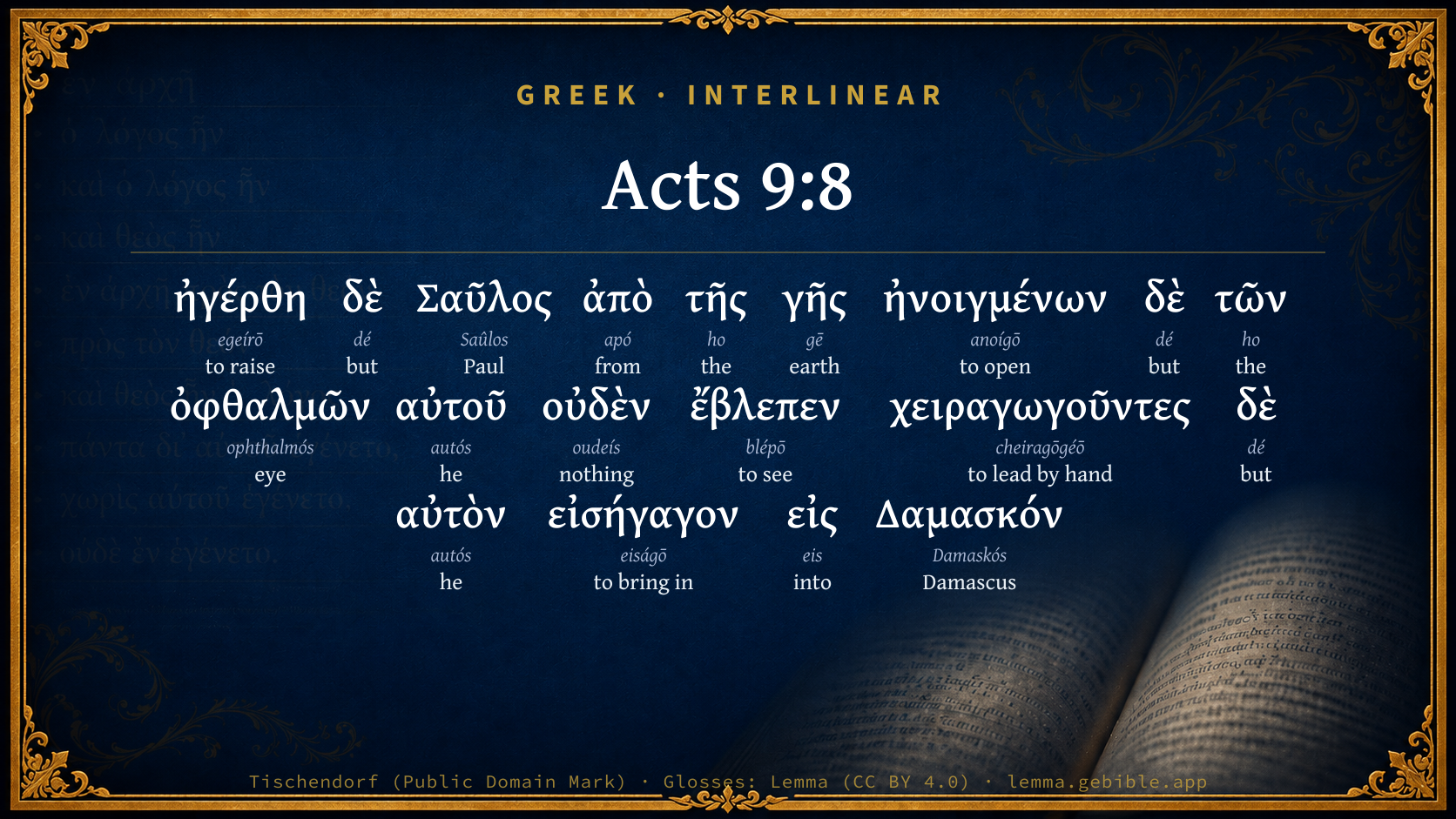
Download image
Cite this verse

Acts 9:8 (World English Bible). Public Domain. Lemma interlinear Bible study tool, https://lemma.gebible.app/v/acts/9/8.

Show BibTeX & RIS
BibTeX
RIS
English Translation
Saul arose from the ground, and when his eyes were opened, he saw no one. They led him by the hand, and brought him into Damascus.
World English Bible · Public Domain
Highlights
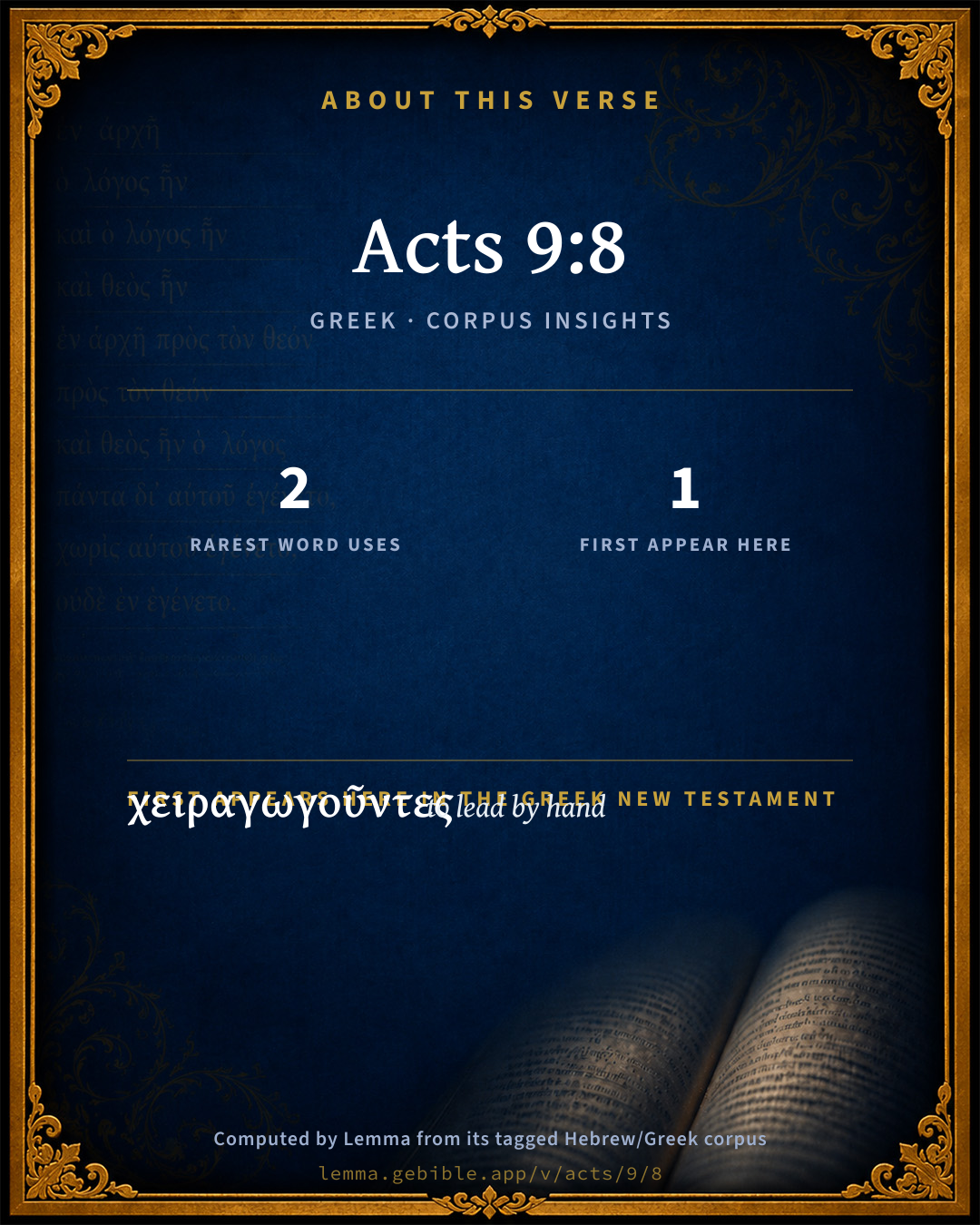
  • 1 first appearance in the Greek New Testament
Full analysis ↓
Download a study sheet

One document with this verse’s original text, its word-by-word gloss line, the meaning frame, cross-references with their text, attributed commentary, and full source and license credits — printable, and it pastes into notes with its structure intact.

This verse Autodidact and up

Study sheet (.html) Plain text (.txt)

A passage Seminary Student

Up to 50 verses in one chapter. A passage sheet keeps up to 6 commentary sources and 12 cross-references per verse, in the order this page ranks them, and says so on the sheet whenever that leaves anything out. Ask for a single verse and you get the Autodidact verse sheet above.

Everything on this page stays free to read, with no account — the sheet is a download of what is already on screen, not access to it.

Want to remove ads? Support Godless Engineer
Compare translations 3

The same verse in 3 English versions, stacked beneath the original-language interlinear above. Click any original word for its lexicon entry.

Each is an independent rendering of the whole verse — the interlinear is not word-aligned to these translations.

Highlighted words mark where these versions differ — a whole-verse word diff, not a word-by-word alignment.

  • World English Bible Public Domain
    Saul arose from the ground, and when his eyes were opened, he saw no one. They led him by the hand, and brought him into Damascus.
  • King James Version Public Domain
    And Saul arose from the earth; and when his eyes were opened, he saw no man: but they led him by the hand, and brought him into Damascus.
  • unfoldingWord Literal Text CC BY-SA 4.0
    And Saul rose up from the ground, but his eyes being opened, he was seeing nothing. But leading him by the hand, they brought him into Damascus.

unfoldingWord Literal Text — © unfoldingWord, licensed CC BY-SA 4.0. Word-aligned USFM3 via Door43 (git.door43.org/unfoldingWord/en_ult).

Versions to compare (up to 4)

3 of 4 selected

Show all 19 translations

Every available English version of this verse, each an independent rendering of the whole verse.

  • World English Bible Public Domain
    Saul arose from the ground, and when his eyes were opened, he saw no one. They led him by the hand, and brought him into Damascus.
  • Berean Standard Bible Public Domain
    Saul got up from the ground, but when he opened his eyes he could not see a thing. So they led him by the hand into Damascus.
  • Majority Standard Bible Public Domain
    Saul got up from the ground, but when he opened his eyes he could not see a thing. So they led him by the hand into Damascus.
  • King James Version Public Domain
    And Saul arose from the earth; and when his eyes were opened, he saw no man: but they led him by the hand, and brought him into Damascus.
  • American Standard Version (1901) Public Domain
    And Saul arose from the earth; and when his eyes were opened, he saw nothing; and they led him by the hand, and brought him into Damascus.
  • Revised Version (1885) Public Domain
    And Saul arose from the earth; and when his eyes were opened, he saw nothing; and they led him by the hand, and brought him into Damascus.
  • Geneva Bible (1599) Public Domain
    And Saul arose from the ground, and opened his eyes, but sawe no man. Then led they him by the hand, and brought him into Damascus,
  • Douay-Rheims (1899) Public Domain
    And Saul arose from the ground; and when his eyes were opened, he saw nothing. But they leading him by the hands, brought him to Damascus.
  • Young's Literal Translation Public Domain
    and Saul arose from the earth, and his eyes having been opened, he beheld no one, and leading him by the hand they brought him to Damascus,
  • Literal Standard Version CC BY-SA 4.0
    and Saul arose from the earth, and his eyes having been opened, he beheld no one, and leading him by the hand they brought him to Damascus,
  • Unlocked Literal Bible CC BY-SA 4.0
    Saul arose from the ground, and when he opened his eyes, he could see nothing; so they led him by the hand and brought him into Damascus.
  • unfoldingWord Literal Text CC BY-SA 4.0
    And Saul rose up from the ground, but his eyes being opened, he was seeing nothing. But leading him by the hand, they brought him into Damascus.
  • Darby Bible Public Domain
    And Saul rose up from the earth, and his eyes being opened he saw no one. But leading [him] by the hand they brought him into Damascus.
  • World Messianic Bible Public Domain
    Saul arose from the ground, and when his eyes were opened, he saw no one. They led him by the hand and brought him into Damascus.
  • Webster's Bible Public Domain
    And Saul arose from the earth; and when his eyes were opened, he saw no man: but they led him by the hand, and brought him into Damascus.
  • Free Bible Version CC BY-SA 4.0
    Saul got to his feet, and when he opened his eyes, he couldn't see anything. His companions took him by the hand and led him into Damascus.
  • Bible in Basic English Public Domain
    And Saul got up from the earth, and when his eyes were open, he saw nothing; and he was guided by the hand into Damascus.
  • Text-Critical English NT CC BY 4.0
    Saul rose from the ground, and although his eyes were open, he saw no one. So they led him by the hand and brought him to Damascus.
  • Tyndale New Testament (1534) Public Domain
    And Saul arose from the erth and opened his eyes but sawe no man. Then ledde they him by the honde and brought him into Damasco.

Literal Standard Version (2020), Covenant Press — licensed CC BY-SA 4.0. Text via the HelloAO Bible API (eBible.org). Unlocked Literal Bible (unfoldingWord) — licensed CC BY-SA 4.0. Text via the HelloAO Bible API (eBible.org). unfoldingWord Literal Text — © unfoldingWord, licensed CC BY-SA 4.0. Word-aligned USFM3 via Door43 (git.door43.org/unfoldingWord/en_ult). Free Bible Version, Dr. Jonathan Gallagher — licensed CC BY-SA 4.0. Text via the HelloAO Bible API (eBible.org).

Word by word

More ways to search: Search by grammar → Find every occurrence → Compare this word →

Practice this passage: Drill this verse → Learn its vocabulary →

χειραγωγοῦντες
cheiragōgéō
G5496
“to lead by hand”
Verb, Present, Active, Participle, Nominative, Plural, Masculine
Part of Speech
Verb
Tense
Present
Voice
Active
Mood
Participle
Case
Nominative
Number
Plural
Gender
Masculine
Full Thayer's Definition

Origin: from G5497

TDNT: 16:15,1

1. to lead by the hand
  1. ἠγέρθη egeírō G1453 “to raise” Verb, Aorist, Passive, Indicative, 3rd person, Singular
  2. δὲ dé G1161 “but” Conjunction
  3. Σαῦλος Saûlos G4569 “Paul” Noun, Nominative, Singular, Masculine
  4. ἀπὸ apó G575 “from” Preposition
  5. τῆς ho G3588 “the” Article, Genitive, Singular, Feminine
  6. γῆς gē G1093 “earth” Noun, Genitive, Singular, Feminine
  7. ἠνοιγμένων anoígō G455 “to open” Verb, Perfect, Passive, Participle, Genitive, Plural, Masculine
  8. δὲ dé G1161 “but” Conjunction
  9. τῶν ho G3588 “the” Article, Genitive, Plural, Masculine
  10. ὀφθαλμῶν ophthalmós G3788 “eye” Noun, Genitive, Plural, Masculine
  11. αὐτοῦ autós G846 “he” Personal pronoun, Genitive, Singular, Masculine
  12. οὐδὲν oudeís G3762 “nothing” Adjective, Accusative, Singular, Neuter, Negative
  13. ἔβλεπεν blépō G991 “to see” Verb, Imperfect, Active, Indicative, 3rd person, Singular
  14. δὲ dé G1161 “but” Conjunction
  15. αὐτὸν autós G846 “he” Personal pronoun, Accusative, Singular, Masculine
  16. εἰσήγαγον eiságō G1521 “to bring in” Verb, Aorist, Active, Indicative, 3rd person, Plural
  17. εἰς eis G1519 “into” Preposition
  18. Δαμασκόν Damaskós G1154 “Damascus” Noun, Accusative, Singular, Feminine

About this verse

These counts appear in no published source. They are computed here, from the morphology-tagged text and Lemma’s own curated glosses. What Lemma adds →

19
words
15
distinct lemmas
Acts
section

Notable vocabulary

The rarest word here is χειραγωγοῦντες to lead by hand G5496 — appearing just 2 times in the whole Greek New Testament.

First appearance in Scripture

This word makes its first canonical appearance in the Greek New Testament here:

  • χειραγωγοῦντες to lead by hand G5496

Shared distinctive vocabulary

χειραγωγοῦντες to lead by hand G5496 occurs in 2 verses of the Greek New Testament. Also found in:
Repetition

Words recur within this verse:

Cross-references

5

Topical passages linked to Acts 9:8 in the Treasury of Scripture Knowledge — connected by theme and wording, ordered by reader-vote popularity; previews shown in the World English Bible.

  • Acts 22:11 When I couldn't see for the glory of that light, being led by the hand of those who were with me, I came into Damascus.
  • Acts 9:18 Immediately something like scales fell from his eyes, and he received his sight. He arose and was baptized.
  • 2 Kings 6:17–20 Elisha prayed, and said, Yahweh, Please open his eyes, that he may see. Yahweh opened the eyes of the young man; and he saw: and, behold, the mountain was full of horses and chariots of fire round about Elisha.
  • Acts 13:11 Now, behold, the hand of the Lord is on you, and you will be blind, not seeing the sun for a season!" Immediately there fell on him a mist and darkness. He went around seeking someone to lead him by the hand.
  • Genesis 19:11 They struck the men who were at the door of the house with blindness, both small and great, so that they wearied themselves to find the door.

Cross-references courtesy of OpenBible.info (CC BY 4.0).

Commentary

Notes on Acts 9:8 from classic Christian and Jewish commentators (each source and its license shown beneath its notes). The classic Christian expositions comment on the surrounding passage and are grouped to its opening verse, so a note may address several verses; the Jewish commentaries on the Tanakh (Rashi and others) are per-verse, so they appear only where the commentator wrote on this verse.

Lemma curates 59 commentaries, every one of them public domain or Creative Commons licensed, each selected and text-cleaned for this edition rather than reprinted as found. About our sources →

The Biblical Illustrator

Joseph S. Exell

Act_9:8-9

And Saul arose, and … they led him by the hand.

Hand led

A wonderful change in the soul of which this was the symbol.

I. The hand yielded.

1. Confession of futile character of past opposition. Sense of helplessness.

2. Trust in a newly discovered guide.

II. The hand grasped. Soldiers accompany Saul, or strangers to him; they yet represented Divine guidance given in weakness. The responsibility of those who offer to guide.

III. The hand kept--a type of soul attitude. Continue with Christ. True progress was the outcome of being led. We shall be brought to the great ends of life by being led. We shall attain rest. We need to gain that submissiveness embodied in Lead, kindly light. (A. F. Muir, M. A.)

And was three days without sight.--

What Saul felt in his seclusion and saw in his blindness

Only one other space of three days duration can be mentioned of equal importance. The conflict of Sauls feelings was so great and his remorse so piercing that he could neither eat nor drink. He could have no communication with the Christians, for they had been terrified by the news of his approach, and the Jews could have no sympathy with his present state of mind. He fasted and prayed in silence. The recollections of his early years--the passages of Scripture which he had never understood--the thoughts of his own cruelty--the memory of the last looks of Stephen--all these crowded into his mind, and made the three days equal to long years of repentance. And if there was one feeling which above all others kept possession of his heart it was that suggested by Christs expostulation, and this feeling would be attended with thoughts of peace, with hope and faith. He waited on God; and in his blindness a vision was granted unto him. (Dean Howson.)

Saul at Damascus

Just as an eagle which has been drenched and battered by some fierce storm will alight to plume its ruffled wings, so when a great soul has passed through fire and water, it needs some quiet place in which to rest. Like Moses, like Elijah, like our Lord Himself, like almost every great soul in ancient or modern times to whom has been entrusted the task of swaying the destinies by moulding the convictions of mankind--like Sakya Mount, like Mohammed in the cave at Hira, like St. Francis of Assist in his sickness, like Luther in the monastery of Erfurt, Paul would need a quiet period in which to elaborate his thoughts, to still the tumult of his emotions, to commune in secrecy and silence with his own soul. (Archdeacon Farrar.)

The three days sepulture for the inward man

I. The old must pass away.

1. The old light is gone.

2. The old enjoyments are no longer palatable.

3. The old activity is paralysed.

4. The old friends are away.

II. The new is quietly preparing.

1. A new light is kindling within.

2. A new salvation is rising up in the soul.

3. Strength is collecting for a new calling.

4. New friends are standing at the door. (K. Gerok.)

The Biblical Illustrator, edited by Joseph S. Exell (c. 1880s–1900s) — public domain. Text from a community e-Sword module.

Joseph Benson's Commentary

Act 9:8-9. And Saul arose from the earth — When Christ bade him; but probably not without help, the vision having made him faint and weak, like Daniel; when, upon receiving a vision, no strength remained in him, Dan 10:16-17. And when his eyes were open, he saw no man — He was incapable of discerning objects; for his nerves had been so affected with the glory of that light which had shone from the body of Jesus, that he had lost the power of sight, Act 22:11; but they — That were with him; led him by the hand — For as they had not looked so earnestly and steadfastly, as Saul had done, on the glorious light wherewith the person of Christ was surrounded, but had lain with their faces on the ground, their eye-sight remained. And he was three days without sight — By scales growing over his eyes, not only to intimate to him the blindness of the state he had been in, but to impress him also with a deeper sense of the almighty power of Christ, and to turn his thoughts inward, while he was rendered less capable of conversing with external objects. This was, likewise, a manifest token to others, of what had happened to him in his journey; and ought to have humbled and convinced those bigoted Jews, to whom he had been sent from the sanhedrim. And neither did eat nor drink — This his long-continued fasting was a natural expression of his bitter grief, for having opposed the gospel, and persecuted the disciples of Jesus. With fasting he joined fervent and often-repeated prayer, perhaps, to Jesus; in which he made confession of his sin in persecuting him, and earnest supplication for pardon; all which, being certain signs of his repentance, they are here (Act 9:11) mentioned as such. During his three days’

blindness and fasting, Saul was instructed by visions and revelations from the Lord, agreeably to what was promised him, that in Damascus it should be told him what he was to do. One vision of this kind is expressly mentioned, in which the restoration of his sight by Ananias was foretold to him. See Act 9:12. Here it is natural to reflect, that the situation in which Saul now lay, was indeed apparently very melancholy; his sight being lost, his appetite for food gone, and his whole soul wrapt up in deep astonishment, or melted in deep contrition and remorse. But, though he thus sowed in tears, he was soon to reap in joy. Light and gladness were sown for him. He came out of the furnace refined as gold and silver; and these three dark and dismal days are, no doubt, recollected by him in the heavenly world, as the era from whence he dates the first beamings of that divine light in which he now dwells. Let us never be afraid of the pangs of that godly sorrow, which, working repentance to salvation, not to be repented of, will soon be ten thousand times overbalanced by that exceeding weight of glory, and those full transports of eternal joy, for which it will prepare the soul. See Doddridge.

Joseph Benson's Commentary on the Old and New Testaments (1811–1818) — public domain. Text from a community e-Sword module.

Bengel's Gnomon

Johann Albrecht Bengel

Act 9:8. Ἠγέρθη, arose) at the word of Christ, ch. Act 26:16.—ἀνεῳγμέναν, when his eyes were opened) Therefore they who beheld Saul would not have thought that he did not see.

Bengel's Gnomon of the New Testament — English translation (T&T Clark, Edinburgh, 1860) — public domain. Text from a community e-Sword module.

Meyer's Critical & Exegetical Commentary

Heinrich August Wilhelm Meyer

Act_9:8-9. ʼΑνεῳγμένων δὲ τῶν ὀφθαλμ.] Consequently Saul had lain on the ground with closed eyes since the appearance of the radiance (Act_9:4),which, however, as the appearance of Jesus for him is to be assumed as in and with the radiance, cannot prove that he had not really and personally seen the Lord.

οὐδὲν ἔβλεπε] namely, because he was blinded by the heavenly light (and not possibly in consequence of the journey through the desert, see Act_22:11). The connection inevitably requires this explanation by what immediately follows; nor is the Recepta οὐδένα ἔβλ. (see the critical remarks) to be explained otherwise than of being blinded,[240] in opposition to Haselaar and others, who refer ΟὐΔΈΝΑ to Jesus.

ΜῊ ΒΛΈΠΩΝ] he was for three days without being able to see, i.e. blind (Joh_9:39; Ellendt, Lex. Soph. I. p. 308), so that he had not his power of vision; comp. Winer, p. 453 [E. T. 610]. Hence here μή from the standpoint of the subject concerned; but afterwards ΟὐΚ and ΟὐΔΈ, because narrating objectively.

ΟὐΚ ἜΦΑΓΕΝ ΟὐΔῈ ἜΠΙΕΝ] an absolute negation of eating and drinking (Joh_3:7; Est_4:16), and not a cibi potusve largioris usu abstinebat, Kuinoel. By fasting Saul partly satisfied the compunction into which he could not but now feel himself brought for the earlier wrong direction of his efforts, and partly prepared himself by fasting and prayer (Act_9:11) for the decisive change of his inward and outward life, for which, according to Act_9:6, he waited a special intimation. See Act_9:18.

[240] That the blinding took place as a symbol of the previous spiritual blindness of Saul (Calvin, Grotius, de Wette, Baumgarten, and others) is not indicated by anything in the text, and may only be considered as the edifying application of the history, although Baur makes the formation of the legend attach itself to this idea. That blinding of Saul was a simple consequence of the heavenly radiance, and served (as also the fasting) to withdraw him for a season wholly from the outer world, and to restrict him to his inner life. And the blindness befell Saul alone: ἵνα μὴ κοινὸν καὶ ὡς ἀπὸ τύχης τὸ πάθος νομισθῇ, ἀλλὰ θείας προνοίας, Oecumenius.

Meyer — Critical and Exegetical Commentary on the New Testament — English translation by Peter Christie, edited by Frederick Crombie (T&T Clark, 1880) — public domain. Text from a community e-Sword module.

Expositor's Greek Testament

ed. W. Robertson Nicoll

Act 9:8 . ἀνεῳγμένων ; see critical notes. οὐδένα ἔβλεπε : his eyes, which he had closed mechanically, as he fell overwhelmed with the dazzling brightness of the light, and of the appearance of Jesus, he now opens, but only to find that he saw nothing ( οὐδέν ) (see critical note) he had become blind (so Weiss and Wendt, cf. Act 22:11 ). This blindness was the clearest proof that the appearances vouchsafed to him had been a reality (Felten), see also Act 9:18 . χειραγωγοῦντες : the necessary result of his blindness, cf. Jdg 16:26 and Tob 11:16 , but in each case the reading is varied (see H. and R.); in N.T. only in Acts, cf. Act 22:11 (and see Act 13:11 ); it is also found in the Apocryphal Gospel of Peter , x. (ver. 40 in Harnack’s edition). “He who would strike others was himself struck, and the proud Pharisee became a deeply humbled penitent a guide of the blind” he was himself to be guided by others (Felten).

The Expositor's Greek Testament, edited by W. Robertson Nicoll (1897–1910) — public domain. Text from a community e-Sword module.

Jamieson, Fausset & Brown

Robert Jamieson, A. R. Fausset & David Brown

Saul arose . . . and when his eyes were opened, he saw no man--after beholding the Lord, since he "could not see for the glory of that light" (Act 22:11), he had involuntarily closed his eyes to protect them from the glare; and on opening them again he found his vision gone. "It is not said, however, that he was blind, for it was no punishment" [BENGEL].

Jamieson, Fausset & Brown — Commentary Critical and Explanatory on the Whole Bible (1871) — public domain (CC PDM 1.0). Text via the HelloAO Bible API.

Adam Clarke's Commentary

Verse 8. When his eyes were opened, he saw no man] Instead of ουδενα, no man, the Codex Alexandrinus, the Syriac, Vulgate, and some others, have ουδεν nothing. He not only saw no man, but he saw nothing, being quite blind; and therefore was led by the hand to Damascus, μη βλεπων, being without sight.

Adam Clarke's Commentary on the Bible (1810–1826) — public domain. Text from a community e-Sword/MySword module.

John Calvin's Commentaries

8. He was raised up from the earth. Luke addeth now, that he was taken with so great fear that he could not rise of himself; and not that only, but he was also blind for a time, that he might forget his former wit and wiliness. When as he saith, that after that his eyes were opened, he saw not, it seemeth that it doth not agree with the other words which shall follow by and by, that his eyes were covered, as it were, with scales; but the meaning of this place is, that he was blind indeed, and deprived of his sight for that three days; because when he opened his eyes he saw nothing.

John Calvin's Commentaries (1540-1563) — public domain. Text from the Calvin Translation Society English edition (1840s-50s) via the Christian Classics Ethereal Library (ccel.org). Calvin's coverage is partial (roughly two-thirds of the Bible); uncommented books and verses are honest gaps, never fabricated. The 19th-century editor's footnotes and remarks are omitted so the notes are faithfully Calvin's own voice.

Ellicott's Commentary for English Readers

(8) He saw no man.—The blindness was that of one who has been dazzled with excess of light (comp. Act_22:11), the natural result of the vision of the supernatural glory, a witness to the man himself that the vision was not a mere play of imagination. Traces of its permanent effect on his powers of sight have been found in his habit of dictating rather than writing letters (see Note on 2Th_3:17), in the large characters traced by him when he did write (see Note on Gal_6:11), in his not recognising the high priest who commanded him to be struck. (See Notes on Act_23:2-5.) Of the many theories as to the mysterious “thorn in the flesh” (see Note on 2Co_12:7), there seems most reason for accepting that which connects it with some affection of the eyes, involving, perhaps, attacks of agonising pain. On this assumption, the eager wish of the Galatians, if it had been possible to have plucked out their own eyes and given them to him, receives a special and interesting significance. (See Note on Gal_4:15.) For Saul himself, the blindness may well have had a spiritual significance. He had looked on himself as a “guide of the blind,” boasting that he saw clearly (Rom_2:19). Now, for a time, till inward and outward light should shine in on him, he had to accept his blindness. The new-born soul had to be as

“An infant crying for the light,

And with no language but a cry.”

They led him by the hand, and brought him into Damascus.—The mission on which Saul had come was already known at Damascus, and his arrival expected with alarm. Now he came, and the mission fell to the ground. The letters to the synagogues were not delivered.

A Bible Commentary for English Readers, edited by Charles John Ellicott (1878–1897) — public domain. Text from a community e-Sword module.

The Cambridge Bible for Schools and Colleges

gen. ed. J. J. S. Perowne

8. and [but] when his eyes were opened, he saw no man [nothing] The vision had struck him blind. He opened his eyes, but their power had been taken away. Thus his physical condition becomes a fit representation of the mental blindness which he afterwards (Act_26:9) deplores: “I verily thought with myself that I ought to do many things contrary to the name of Jesus of Nazareth.”

but [and] they led him by the hand] His companions saw all things as before, and were able to guide him who had started forth as the leader in their mission of persecution.

The Cambridge Bible for Schools and Colleges (gen. ed. J. J. S. Perowne; Cambridge University Press, 1878–1918) — public domain. Text from a community e-Sword module.

John Gill's Exposition

And Saul arose from the earth,.... As he was bid by Christ, Act 9:6

and when his eyes were opened he saw no man; neither Christ, who appeared to him from heaven, whom he had before seen, nor even any of his companions, nor indeed any object: the Syriac version renders it, "he saw nothing"; not anything at all; and the Ethiopic version, "he could not see": when he opened his eye lids, he perceived his sight was gone, and this showed it to be real blindness; and which was an emblem of the ignorance and blindness he had been in:

but they led him by the hand; the men that were with him, perceiving that he could not guide himself, took him by the hand, and led him on his journey;

and brought him into Damascus; and now was fulfilled, at least in part, the prophecy in Zac 9:1.

John Gill's Exposition of the Whole Bible (1746–1763) — public domain (CC PDM 1.0). Text via the HelloAO Bible API.

Trapp's Complete Commentary

John Trapp

8 And Saul arose from the earth; and when his eyes were opened, he saw no man: but they led him by the hand, and brought him into Damascus.

Ver. 8. He saw no man] This bodily blindness was a means to open the eyes of his mind, as Gehazi’s leprosy cured his soul.

John Trapp, A Commentary or Exposition upon All the Books of the Old and New Testament (1647–1656) — public domain. Text from a community e-Sword module.

Albert Barnes' Notes on the Bible

When his eyes were opened - He naturally closed them at the appearance of the light, and in his fright kept them closed for some time.

He saw no man - This darkness continued three days, Act 9:9. There is no reason to suppose that there was a miracle in this blindness, for in Act 22:11, it is expressly said to have been caused by the intense light. “And when I could not see for the glory of that light,” etc. The intense, sudden light had so affected the optic nerve of the eye as to cause a temporary blindness. This effect is not uncommon. The disease of the eye which is thus produced is called “amaurosis,” or more commonly “gutta serena.” It consists in a loss of sight without any apparent defect of the eye. Sometimes the disease is periodic, coming on suddenly, continuing for three or four days, and then disappearing (Webster). A disease of this kind is often caused by excessive light. When we look at the sun, into a furnace, or into a crucible with fused metal, we are conscious of a temporary pain in the eye, and of a momentary blindness. “In northern and tropical climates, from the glare of the sun or snow, a variety of amaurosis (gutta serena) occurs, which, if it produces blindness during the day, is named nyctalopia; if during the night, it is called hemeralopia. Another variety exists in which the individual is blind all day, until a certain hour, when he sees distinctly, or he sees and is blind every alternate day, or is only blind one day in the week, fortnight, or month” (the Edinburgh Encyclopedia’s “Surgery”). A total loss of sight has been the consequence of looking at the sun during an eclipse, or of watching it as it sets in the west. This effect is caused by the intense action of the light on the optic nerve, or sometimes from a disorder of the brain. A case is mentioned by Michaelis (Kuinoel in loco) of a man who was made blind by a bright flash of lightning, and who continued so for four weeks, who was again restored to sight in a tempest by a similar flash of lightning. Electricity has been found to be one of the best remedies for restoring sight in such cases.

Albert Barnes' Notes on the Bible (1834–1885) — public domain. Text from a community e-Sword/MySword module.

Haydock's Catholic Bible Commentary

And his eyes being open, either by himself, or by others, he saw nothing. See the circumstances related again, chap. xxii. and xxvi. (Witham)

George Leo Haydock (1774–1849), Haydock's Catholic Family Bible and Commentary, 1859 edition — public domain. Excludes Psalms (Douay-Rheims chapter numbering differs from Protestant) and Deuterocanonical books (Catholic canon only).

Matthew Poole's English Annotations

When his eyes were opened; when he opened his eyes as at other times, when he did rise to see, the glorious light had so dazzled him, that he could see nothing: thus Saul as, and all men are, before their conversion; he had the shape of a man, and of one learned in the law, when notwithsanding he is blind, and sees or knows nothing as he ought to know.

Matthew Poole's English Annotations on the Holy Bible (1683–1685) — public domain. Text from a community e-Sword/MySword module.

The Pulpit Commentary

Nothing for no man, A.V. and T.R.; and for but, A.V. Nothing (oujden for oujdena). So the best manuscripts and editions The idea is, not like that in Mat_17:8 that when he opened his eyes the person seen in vision had disappeared, but simply that his eyesight was gone, "for the glory of that light," and he could see nothing, but had to be led like a blind man. (see Act_22:11)

Vers. 8, 9. Blind eyes, but open soul.

Attention is invited to what is suggested by the interesting fact that, after seeing the vision, Saul remained blind, and so absorbed in thought as to be wholly indifferent to food, for three days. That there are miraculous features in the circumstances attending Saul"s conversion can hardly be denied, but some incline to exaggerate the miraculous features, while others put them under too severe limitations. We need not assume a miraculous blindness, or so serious a matter as a lightning stroke. The phenomena rather suggest a sunstroke of a severe but temporary character. In the Divine order this was arranged to give the surprised and humbled man an opportunity for quietness and loneliness, that he might carry on, and carry out to a conclusion, the conflict which had been begun by hearing the voice of him whom he had called the Nazarene impostor speaking from heaven, and speaking words of power and command to him. And it was also designed as a continuing physical effect which would assure Saul of the reality of his heavenly vision. In endeavoring to estimate the thoughts of Saul"s time of blindness, consider that

I SAUL HAD KNOWLEDGE. General knowledge, as an educated man, belonging to the well-to-do classes. Special knowledge, as trained in the best Jewish schools; especially as having a kind of collegiate culture, as a Pharisee, in the highly esteemed school of Gamaliel. And a precise and wide knowledge of both Holy Scripture and rabbinical tradition, which must have included the grounds for expecting the coming Messiah the Prince. Saul would not need even his Bible in those lonely hours, for memory brought abundant subjects of thought. Illustrate the advantage of early teaching of God"s Word. Thus we become prepared to make the best of the sudden occasions of life.

II SAUL HAD NOW GAINED THE KEY TO HIS KNOWLEDGE. The key was this the Messiah has come. He was Jesus of Nazareth. He is risen, living, exalted. Show how this cleared the mystery from the fact that Jesus had been a sufferer, and brought light on the spiritual character of the Messiahship. Illustrate by the preaching of Philip to the eunuch. But

III SAUL NEEDED A TIME OF QUIETNESS FOR THE DUE APPLICATION OF THIS KEY. It had to explain the prophecy that Messiah should be born at Bethlehem, and be of the lineage of David. It must explain the figures of the King and Conqueror under which Messiah had been presented. Saul must think over the grounds on which his prejudiced opposition had rested, and over all that was involved in the proved fact that Jesus was risen from the dead and had won God"s acceptance. For with his eyes blinded, and the ordinary cravings of his body dead, Saul saw with his soul spiritual things were gaining clearness. Set out what Saul began to see with his soul, concerning Jesus, concerning his own past and future, and show what revulsions of feeling in such an impulsive man the new soul-visions occasioned. In practical application, dwell on the desire for loneliness and quietness; and for meditation, which those feel who are, by any gracious agency, smitten with conviction; and the relations of such quiet times to full decision and consecration. So much good work begun in souls is lost, proving but as" morning cloud and early dew," for want of quiet meditative times following upon convictions and impressions. Seasons of loneliness, meditation, and prayer are as truly needed for newly awakened souls, as shady, covered times for slips, or plants, newly potted, in order that they may get safe-rooted. Those who are wise to win souls will learn of God"s providing this blind season for the awakened and humbled Saul. R.T.

The Pulpit Commentary (1880–1919), ed. H.D.M. Spence-Jones & Joseph S. Exell — public domain. Text from a community e-Sword module.

Burkitt's Expository Notes on the New Testament

William Burkitt

Observe here, 1. The change of Saul’s posture; He arose from the earth. He that fell to the earth a persecutor; rises up a saint. O free mercy, and astonishing rich grace! that the earth upon which he lay did not open her mouth and swallow him up alive: He that had run away from God, and employed his feet in the service of the devil, is once more set upon his feet again.

Observe, 2. His blindness and loss of sight: When his eyes were opened, he waw no man. Christ taught him, by his bodily blindness, the blindness of his soul in spiritual things, which till now he was insensible of. As Saul was, so all naturally are, spiritually blind, before regeneration and conversion: True, he was brought up at the feet of Gamaliel, and was a great proficient in human learning, but after his conversion he counted that knowledge no better than blindness, Php 3:7-8.

Observe, 3. His manuduction or leading by the hand into the city; They hid him by the hand into Damascus. Who led him? Doubtless his companions that came along with him upon his bloody design from Jerusalem. Here the blind lead the blind; those very hands lead him to Damascus which should have haled the saints from Damascus to Jerusalem. But, O Saul! thou hadst a better leader than all these, even Christ himself: he led thee by the hand into the city, in order to the completing of thy conversion: Now happy Saul! though formerly rebellious, who hast thy Saviour for a leader, thou shalt neither wander nor miscarry.

Observe, 4. The duration and continuance of Saul’s blindness; He was three days without sight. This was a long night to him who persecuted the children of the day; a just time for him to be in darkness, who so implacably attempted to blow out the light of the gospel: But perhaps no less time would have been sufficient to humble him for his rage and madness against Christ and his members. Besides, there are some that think that, in these three days of his continued blindness, he had that rapture into the third heaven, which is mentioned, 2Co 12:2. But however that be, doubtless in this time his mind was filled with divine contemplations; and that glorious gospel was taught him in three days, which he taught to others all his days.

Observe, 5. His abstinence from food; He did neither eat nor drink: he spent those three days, we may believe in fasting and prayer, and extraordinary humiliation before God, for his former wicked life, and particularly for his violent persecution of the church of Christ: He fasted to make him more fervent in prayer; for fasting prepares for prayer, and gives wings to prayer.

William Burkitt's Expository Notes on the New Testament (1700–1703) — public domain. Text from a community e-Sword module.

McGarvey & Pendleton's Commentaries

J. W. McGarvey

8, 9. When the vision disappeared, Saul promptly obeyed the commandment given him. (8) " And Saul was raised from the earth, but when his eyes were opened he saw no one, and they led him by the hand, and brought him into Damascus. (9) And he was there three days without seeing, and did neither eat nor drink. " The physical effect of the intense light into which he had gazed upon his eyesight was not more painful than the moral effect of the whole scene upon his conscience. The former made him blind; the latter filled him with remorse. To this feeling alone can we attribute his total abstinence from food and drink. The awful crime of fighting murderously against God and Christ was pressing upon his soul, and as yet he knew not what to do that he might obtain pardon. His Jewish education, if not his natural instinct, prompted him to pray, and this he was doing with all fervor; but the hands he lifted up were stained with blood-the blood of martyrs; and how could he hope to be heard? No penitent ever had greater cause for sorrow, or wept more bitterly than he.

J. W. McGarvey (with Philip Y. Pendleton), Commentaries on the New Testament (The Fourfold Gospel, 1914; Acts; and the epistles) — public domain. Text from a community e-Sword/MySword module.

The People's New Testament

B. W. Johnson

8. He saw no man. His eyes were blinded by the brightness of the Lord. He who had come with such power to Damascus had to be led helpless into the city.

B. W. Johnson's The People's New Testament with Notes (1889–1891) — public domain. Electronic text from the Christian Classics Ethereal Library (CCEL) ThML edition.

unfoldingWord translationNotes

Door43 World Missions Community

when he opened his eyes

This implies that he had closed his eyes because the light was too bright. (See: Assumed Knowledge and Implicit Information)

he could see nothing

"he could not see anything." Saul was blind.

was without sight

"was blind" or "could not see anything"

he neither ate nor drank

It is not stated whether he chose not to eat or drink as a form of worship, or if he had no appetite because he was too distressed from his situation. It is preferable not to specify the reason.

translationWords

Paul

raise

Damascus

unfoldingWord translationNotes — © Distant Shores Media and the Door43 World Missions Community, licensed CC BY-SA 4.0. Source: git.door43.org/Door43/en_tn.

Cambridge Greek Testament for Schools and Colleges

8. οὐδὲν for οὐδένα with אAB. Vulg. ‘nihil.’

8. ἀνεῳγμένων δὲ … οὐδὲν ἔβλεπεν, but when his eyes were opened he saw nothing. The vision had struck him blind. He opened his eyes, but their power had been taken away. Thus his physical condition becomes a fit representation of the mental blindness which he afterwards (Act 26:9) deplores: ‘I verily thought with myself that I ought to do many things contrary to the name of Jesus of Nazareth.’

χειραγωγοῦντες δέ, but they led him by the hand and, &c. His companions had seen nothing of the blinding glory, and so saw all things as before.

Cambridge Greek Testament for Schools and Colleges (Cambridge University Press, 1896; 21 vols, various authors incl. Carr, Maclear, Plummer, Farrar, Lumby, Moule, M. R. James, Simcox) — public domain. Text from a community e-Sword module.

Alford’s Greek Testament

Henry Alford

8.] On his eyes being opened (it would seem that he had closed them on the first disappearance of the vision), he saw no one. He explains it, ch. 22:11, ὡς δὲ οὐκ ἐνέβλεπον ἀπὸ τῆς δόξης τοῦ φωτὸς ἐκείνου. He had seen, what those with him had not seen, the glorious Person of the Lord Jesus. See below on ver. 18.

Henry Alford, The Greek Testament (1849–1861) — public domain. Text from a community e-Sword module.

Lesson kit

Teaching starters — assembled from the data on this page, not authored interpretation. Every prompt links to the verse data it draws on. Edit before teaching.

Acts, in the Acts, opens this verse with 19 words (15 distinct Greek lemmas). Its most distinctive word is cheiragōgéō (“to lead by hand”). A historical commentator’s framing appears above. Read the whole chapter for the surrounding context.

Discussion questions

  1. What does “to lead by hand” (cheiragōgéō) contribute to the verse as a whole?
  2. The word “to lead by hand” first appears here in Scripture. What is being introduced at this debut?
  3. Acts 22:11 shares the word «to lead by hand» with this verse. How do the two illuminate each other?
  4. “but” occurs 3× in this one verse. What is the effect of the repetition?
  5. The translations on this page render this verse differently — a whole-verse word diff, not a word-by-word alignment. What might account for the different wordings?
  6. Reading how The Biblical Illustrator and Joseph Benson's Commentary read this verse, where do the two commentators agree and where do they part?

Things to notice

  • 1 word makes its first canonical appearance in Scripture here.
  • These translations choose different wording for 14 words in this verse.
  • “but” occurs 3× in this single verse.
  • 15 distinct Greek lemmas span 19 words in this verse.

Reading settings

Reading text

Shown beneath each verse's original-language words.

Old Testament
Old Testament edition

Read the OT as the Masoretic Hebrew (MT) or the Greek Septuagint (LXX).

English shown for the Greek Septuagint (in the Hebrew ↔ Greek comparison).

Comparing translations? Open the Compare panel on any verse page to stack up to four side by side.