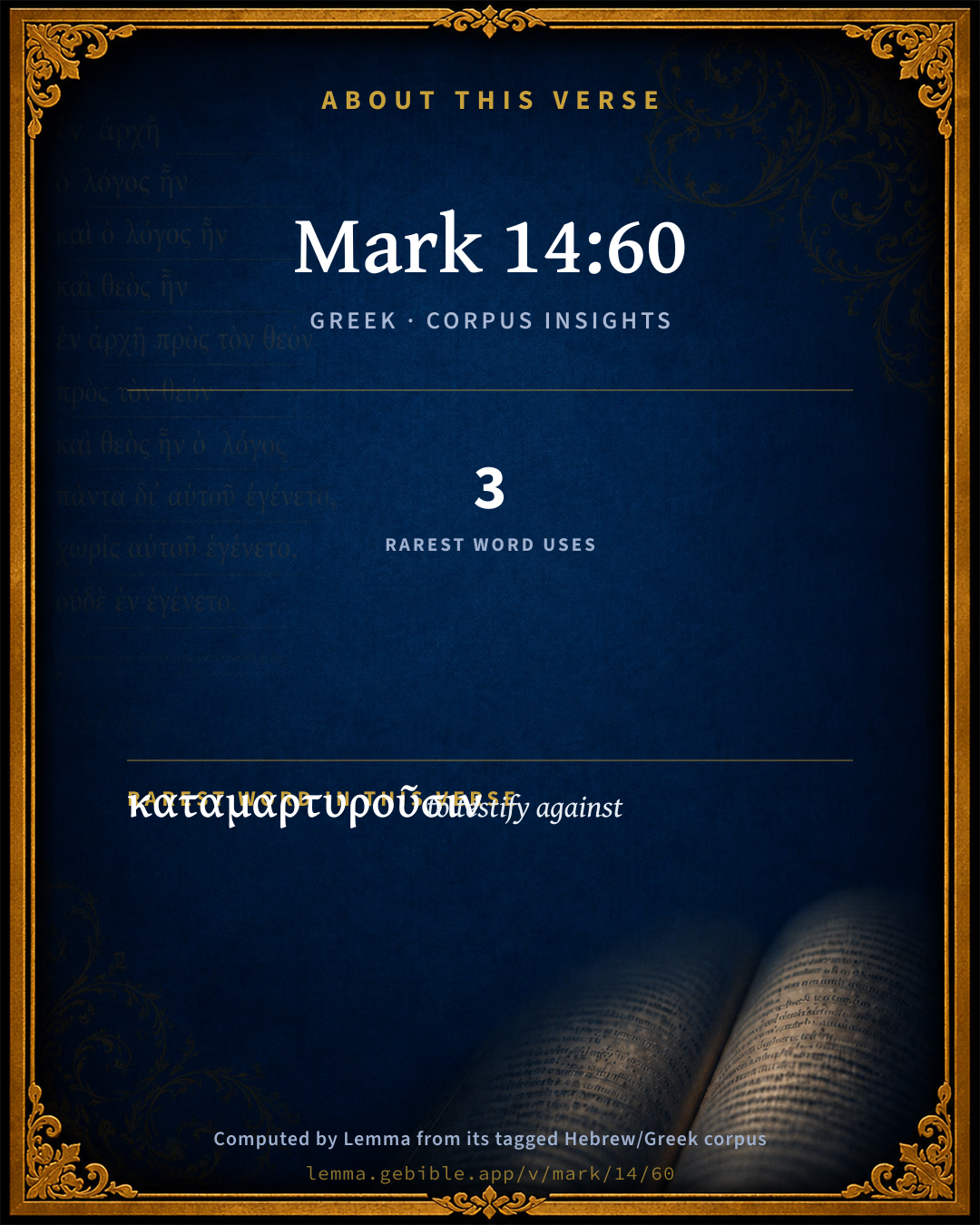
Mark 14:60

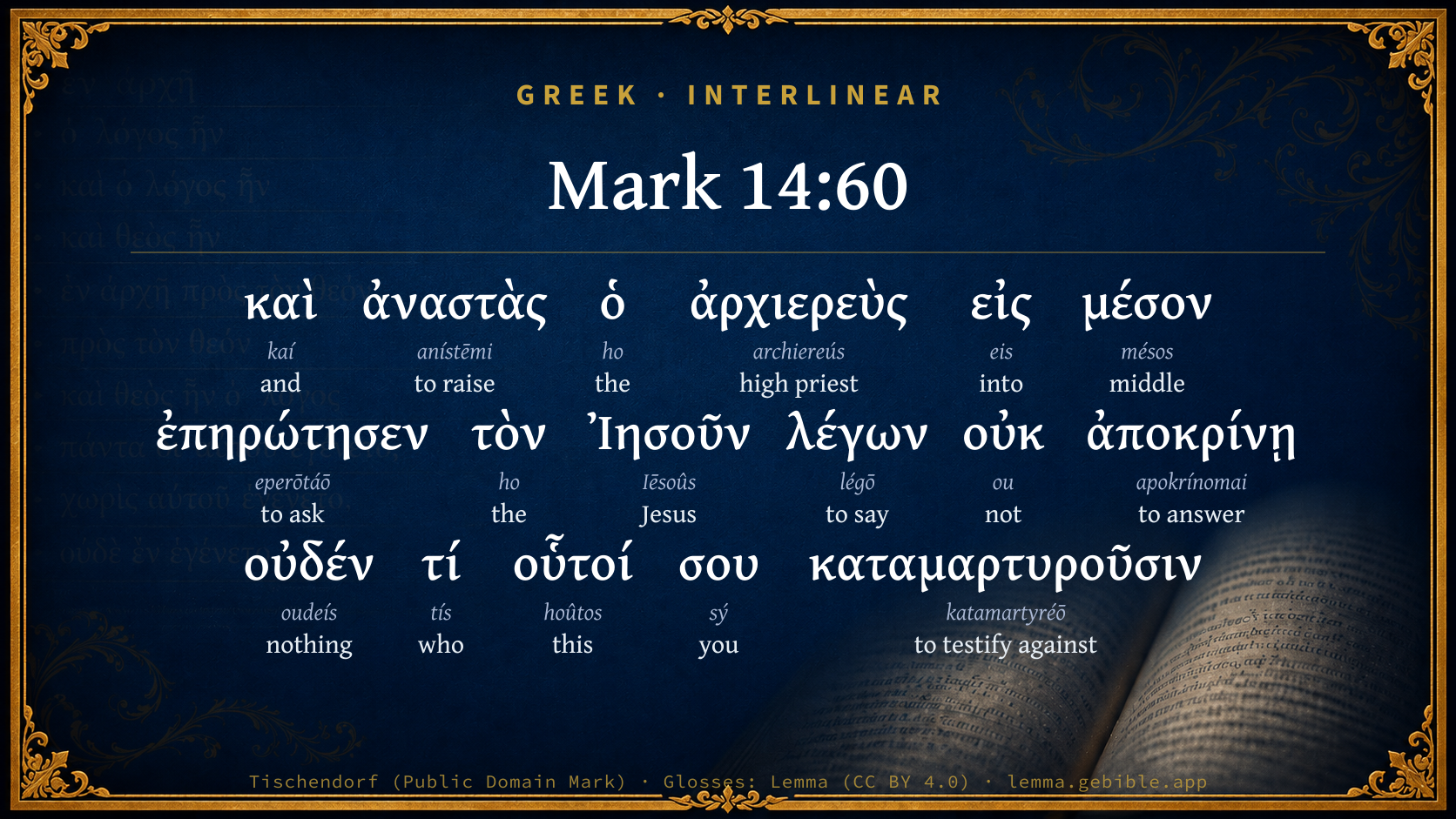
Greek (Tischendorf 8th ed.) Mark 14:60 appears in the Greek New Testament. The text above is from the Tischendorf 8th edition. Each word links to its Strong’s number and a concise gloss. Click any word for its full Thayer’s Greek Lexicon entry.
Download image
Cite this verse

Mark 14:60 (World English Bible). Public Domain. Lemma interlinear Bible study tool, https://lemma.gebible.app/v/mark/14/60.

Show BibTeX & RIS
BibTeX
RIS
English Translation
The high priest stood up in the midst, and asked Jesus, "Have you no answer? What is it which these testify against you?"
World English Bible · Public Domain
Download a study sheet

One document with this verse’s original text, its word-by-word gloss line, the meaning frame, cross-references with their text, attributed commentary, and full source and license credits — printable, and it pastes into notes with its structure intact.

This verse Autodidact and up

Study sheet (.html) Plain text (.txt)

A passage Seminary Student

Up to 50 verses in one chapter. A passage sheet keeps up to 6 commentary sources and 12 cross-references per verse, in the order this page ranks them, and says so on the sheet whenever that leaves anything out. Ask for a single verse and you get the Autodidact verse sheet above.

Everything on this page stays free to read, with no account — the sheet is a download of what is already on screen, not access to it.

Want to remove ads? Support Godless Engineer
Compare translations 3

The same verse in 3 English versions, stacked beneath the original-language interlinear above. Click any original word for its lexicon entry.

Each is an independent rendering of the whole verse — the interlinear is not word-aligned to these translations.

Highlighted words mark where these versions differ — a whole-verse word diff, not a word-by-word alignment.

  • World English Bible Public Domain
    The high priest stood up in the midst, and asked Jesus, "Have you no answer? What is it which these testify against you?"
  • King James Version Public Domain
    And the high priest stood up in the midst, and asked Jesus, saying, Answerest thou nothing? what is it which these witness against thee?
  • unfoldingWord Literal Text CC BY-SA 4.0
    And having stood up in the midst, the high priest questioned Jesus, saying, “Do you not answer anything? What are these testifying against you?”

unfoldingWord Literal Text — © unfoldingWord, licensed CC BY-SA 4.0. Word-aligned USFM3 via Door43 (git.door43.org/unfoldingWord/en_ult).

Versions to compare (up to 4)

3 of 4 selected

Show all 19 translations

Every available English version of this verse, each an independent rendering of the whole verse.

  • World English Bible Public Domain
    The high priest stood up in the midst, and asked Jesus, "Have you no answer? What is it which these testify against you?"
  • Berean Standard Bible Public Domain
    So the high priest stood up before them and questioned Jesus, “Have You no answer? What are these men testifying against You?”
  • Majority Standard Bible Public Domain
    So the high priest stood up before them and questioned Jesus, “Have You no answer? What are these men testifying against You?”
  • King James Version Public Domain
    And the high priest stood up in the midst, and asked Jesus, saying, Answerest thou nothing? what is it which these witness against thee?
  • American Standard Version (1901) Public Domain
    And the high priest stood up in the midst, and asked Jesus, saying, Answerest thou nothing? what is it which these witness against thee?
  • Revised Version (1885) Public Domain
    And the high priest stood up in the midst, and asked Jesus, saying, Answerest thou nothing? what is it which these witness against thee?
  • Geneva Bible (1599) Public Domain
    Then the hie Priest stoode vp amongst them, and asked Iesus, saying, Answerest thou nothing? what is the matter that these beare witnesse against thee?
  • Douay-Rheims (1899) Public Domain
    And the high priest rising up in the midst, asked Jesus, saying: Answerest thou nothing to the things that are laid to thy charge by these men?
  • Young's Literal Translation Public Domain
    And the chief priest, having risen up in the midst, questioned Jesus, saying, `Thou dost not answer anything! what do these testify against thee?'
  • Literal Standard Version CC BY-SA 4.0
    And the chief priest, having risen up in the midst, questioned Jesus, saying, “You do not answer anything! Why do these testify against You?”
  • Unlocked Literal Bible CC BY-SA 4.0
    The high priest stood up among them and asked Jesus, “Have you no answer? What is it these men testify against you?”
  • unfoldingWord Literal Text CC BY-SA 4.0
    And having stood up in the midst, the high priest questioned Jesus, saying, “Do you not answer anything? What are these testifying against you?”
  • Darby Bible Public Domain
    And the high priest, rising up before them all, asked Jesus, saying, Answerest thou nothing? What do these testify against thee?
  • World Messianic Bible Public Domain
    The high priest stood up in the middle, and asked Yeshua, “Have you no answer? What is it which these testify against you?”
  • Webster's Bible Public Domain
    And the high priest stood up in the midst, and asked Jesus, saying, Answerest thou nothing? what is it which these testify against thee?
  • Free Bible Version CC BY-SA 4.0
    Then the high priest stood up in front of the council, and asked Jesus, “Have you nothing to say in response to these charges made against you?”
  • Bible in Basic English Public Domain
    And the high priest got up in the middle of them, and said to Jesus, Do you say nothing in answer? what is it which these say against you?
  • Text-Critical English NT CC BY 4.0
    Then the high priest stood up before them and asked Jesus, “Do yoʋ make no answer? What are these men testifying against yoʋ?”
  • Tyndale New Testament (1534) Public Domain
    And the hyeste preste stode up amongest them and axed Iesus sayinge: answerest thou nothinge? How is it that these beare witnes agaynst the?

Literal Standard Version (2020), Covenant Press — licensed CC BY-SA 4.0. Text via the HelloAO Bible API (eBible.org). Unlocked Literal Bible (unfoldingWord) — licensed CC BY-SA 4.0. Text via the HelloAO Bible API (eBible.org). unfoldingWord Literal Text — © unfoldingWord, licensed CC BY-SA 4.0. Word-aligned USFM3 via Door43 (git.door43.org/unfoldingWord/en_ult). Free Bible Version, Dr. Jonathan Gallagher — licensed CC BY-SA 4.0. Text via the HelloAO Bible API (eBible.org).

Word by word

More ways to search: Search by grammar → Find every occurrence → Compare this word →

Practice this passage: Drill this verse → Learn its vocabulary →

καταμαρτυροῦσιν
katamartyréō
G2649
“to testify against”
Verb, Present, Active, Indicative, 3rd person, Plural
Part of Speech
Verb
Tense
Present
Voice
Active
Mood
Indicative
Person
3rd person
Number
Plural
Full Thayer's Definition

Origin: from G2596 and G3140

TDNT: 12:28,6

1. to bear witness against, to testify against one
  1. καὶ kaí G2532 “and” Conjunction
  2. ἀναστὰς anístēmi G450 “to raise” Verb, Aorist, Active, Participle, Nominative, Singular, Masculine
  3. ὁ ho G3588 “the” Article, Nominative, Singular, Masculine
  4. ἀρχιερεὺς archiereús G749 “high priest” Noun, Nominative, Singular, Masculine
  5. εἰς eis G1519 “into” Preposition
  6. μέσον mésos G3319 “middle” Adjective, Accusative, Singular, Neuter
  7. ἐπηρώτησεν eperōtáō G1905 “to ask” Verb, Aorist, Active, Indicative, 3rd person, Singular
  8. τὸν ho G3588 “the” Article, Accusative, Singular, Masculine
  9. Ἰησοῦν Iēsoûs G2424 “Jesus” Noun, Accusative, Singular, Masculine
  10. λέγων légō G3004 “to say” Verb, Present, Active, Participle, Nominative, Singular, Masculine
  11. οὐκ ou G3756 “not” Particle, Negative
  12. ἀποκρίνῃ apokrínomai G611 “to answer” Verb, Present, Middle or Passive deponent, Indicative, 2nd person, Singular
  13. οὐδέν oudeís G3762 “nothing” Adjective, Accusative, Singular, Neuter, Negative
  14. τί tís G5101 “who” Interrogative pronoun, Accusative, Singular, Neuter
  15. οὗτοί hoûtos G3778 “this” Demonstrative pronoun, Nominative, Plural, Masculine
  16. σου sý G4771 “you” Personal pronoun, 2nd person, Genitive, Singular

About this verse

These counts appear in no published source. They are computed here, from the morphology-tagged text and Lemma’s own curated glosses. What Lemma adds →

17
words
16
distinct lemmas
Gospels
section

Notable vocabulary

The rarest word here is καταμαρτυροῦσιν to testify against G2649 — appearing just 3 times in the whole Greek New Testament.

Shared distinctive vocabulary

καταμαρτυροῦσιν to testify against G2649 occurs in 3 verses of the Greek New Testament. Also found in:

Repetition

A word recurs within this verse:

Cross-references

3

Topical passages linked to Mark 14:60 in the Treasury of Scripture Knowledge — connected by theme and wording, ordered by reader-vote popularity; previews shown in the World English Bible.

  • Matthew 26:62–63 The high priest stood up, and said to him, "Have you no answer? What is this that these testify against you?"
  • Mark 15:3–5 The chief priests accused him of many things.
  • John 19:9–10 He entered into the Praetorium again, and said to Jesus, "Where are you from?" But Jesus gave him no answer.

Cross-references courtesy of OpenBible.info (CC BY 4.0).

Commentary

Notes on Mark 14:60 from classic Christian and Jewish commentators (each source and its license shown beneath its notes). The classic Christian expositions comment on the surrounding passage and are grouped to its opening verse, so a note may address several verses; the Jewish commentaries on the Tanakh (Rashi and others) are per-verse, so they appear only where the commentator wrote on this verse.

Lemma curates 59 commentaries, every one of them public domain or Creative Commons licensed, each selected and text-cleaned for this edition rather than reprinted as found. About our sources →

Joseph Benson's Commentary

Mar 14:60-62. The high-priest stood up in the midst, &c. — See notes on Mat 26:62-64, where this paragraph is largely explained. Art thou the Christ, the Son of the Blessed — Here one of the peculiar attributes of the Deity is used to express the divine nature. Supreme happiness is properly considered as belonging to God: and as all comfort flows from him, suitable ascriptions of praise and glory are his due. But this form of speech was conformable to the ancient custom of the Jews, who, when the priest in the sanctuary rehearsed the name of God, used to answer, Blessed be his name for ever. The title of the Blessed One, signified as much as the Holy One; and both, or either of them, the God of Israel. Hence such expressions are frequent in the rabbis. See also Rom 1:25; 2Co 11:31. “This is a very sublime and emphatical method of expressing the happiness of God. It conveys such an idea of the divine blessedness, that, comparatively speaking, there is none happy but he.” — Macknight.

Joseph Benson's Commentary on the Old and New Testaments (1811–1818) — public domain. Text from a community e-Sword module.

Tyndale Open Study Notes

Tyndale Open Resources

14:60-61 Since the false witnesses failed to agree (14:56), the high priest sought incriminating testimony from Jesus.

Tyndale Open Study Notes — © Tyndale Open Resources, licensed CC BY-SA 4.0. Text via the HelloAO Bible API.

Bengel's Gnomon

Johann Albrecht Bengel

Mar 14:60. Οὐκ; τί; answerest thou not? What is it that, etc.?) Two distinct interrogations.[4]

[4] But Tischend, has but one interrogation at the end of καταμαρτυροῦσιν; Lachm. says in his Preface that to introduce an interrogation after οὐδεν (;) here, where the τί is used for the relative, is subversive of the sense. Breads ὅ τι. But ADPd, τι. Vulg. “non respondes quicquam ad ea quœ tibi objiciuntur.”—ED. and TRANSL.

Bengel's Gnomon of the New Testament — English translation (T&T Clark, Edinburgh, 1860) — public domain. Text from a community e-Sword module.

Expositor's Greek Testament

ed. W. Robertson Nicoll

Mar 14:60 . εἰς μέσον : a graphic feature in Mk., suggesting that the high priest arose from his seat and advanced into the semi-circle of the council towards Jesus the action of an irritated, baffled man. οὐκ ἀποκρίνῃ : on the high priest’s question vide notes on Mt.

The Expositor's Greek Testament, edited by W. Robertson Nicoll (1897–1910) — public domain. Text from a community e-Sword module.

The Cambridge Bible for Schools and Colleges

gen. ed. J. J. S. Perowne

60. And the high priest stood up] The impressive silence, which our Lord preserved, while false witnesses were being sought against Him (Mat_26:62), was galling to the pride of Caiaphas, who saw that nothing remained but to force Him, if possible, to criminate Himself. Standing up, therefore, in the midst (a graphic touch which we owe to St Mark alone), he adjured Him in the most solemn manner possible (Mat_26:63) to declare whether He was “the Malcha Meschicha”—the King Messiah, the Son of the Blessed.

The Cambridge Bible for Schools and Colleges (gen. ed. J. J. S. Perowne; Cambridge University Press, 1878–1918) — public domain. Text from a community e-Sword module.

John Gill's Exposition

Ye have heard the blasphemy,.... The "manifest" blasphemy, as the Arabic version renders it; and "out of his own mouth", as the Syriac version adds, agreeably to Luk 22:71,

what think ye? what sentence is to, be passed upon him?

And they all condemned him to be guilty of death; excepting Joseph of Arimathea, Luk 23:51; See Gill on Mat 26:66.

John Gill's Exposition of the Whole Bible (1746–1763) — public domain (CC PDM 1.0). Text via the HelloAO Bible API.

The Pulpit Commentary

Vers. 60, 61. And the high priest stood up in the midst, and asked Jesus, saying, Answerest thou nothing?... But he held his peace, and answered nothing. The high priest would naturally be seated at the top of the semicircle, with the members of the Sanhedrim on either side of him, and the Accused in front of him. Now he rises from his seat, and comes forward into the midst (eiv to meson), and demands an answer. But Jesus answered nothing. It would have been a long and tedious business to answer such a charge, which involved a garbled and inaccurate statement of what he had said. It would have answered no good purpose to reply to an accusation so vague and inaccurate. Our Lord knew that, whatever his answer was, it would be twisted so as to make against him. Silence was therefore the most dignified treatment of such an accusation. Besides, he knew that his hour was come. The high priest now asks him plainly, Art thou the Christ, the son of the Blessed? Here he touches the point of the whole matter. Christ had frequently declared himself to be such. Caiaphas, therefore, now asks the question, not because he needed the information, but that he might condemn him.

The Pulpit Commentary (1880–1919), ed. H.D.M. Spence-Jones & Joseph S. Exell — public domain. Text from a community e-Sword module.

Kretzmann's Popular Commentary

Paul E. Kretzmann

The sentence of the council:

v. 60. And the high priest stood up in the midst and asked Jesus, saying, Answerest Thou nothing? What is it which these witness against Thee?

v. 61. But He held His peace and answered nothing. Again the high priest asked Him and said unto Him, Art Thou the Christ, the Son of the Blessed?

v. 62. And Jesus said, I am; and ye shall see the Son of Man sitting on the right hand of Power and coming in the clouds of heaven.

v. 63. Then the high priest rent his clothes and saith, What need we any further witnesses?

v. 64. Ye have heard the blasphemy; what think ye? And they all condemned Him to be guilty of death.

v. 65. And some began to spit on Him, and to cover His face, and to buffet Him, to say unto Him, Prophesy; and the servants did strike Him with the palms of their hands.

Caiaphas felt the imperative need of quick action to save the day, for the matter was rapidly coming to a point where the entire council would be obliged to confess its helplessness. Arising therefore from his chairman’s seat, he steps forward into the semicircle formed by the chairs of the members. His first thought was that of browbeating Jesus, and thus provoking Him to some statement which could be used against Him: Answerest Thou nothing to these condemnatory charges? But Jesus kept His silence and answered never a word. In many cases, where the enemies of Christ bring accusations against Christ and the Christian Church, that Christianity is a dangerous religion, that it stultifies the intellect, etc. , this is nothing but false testimony, which they do not believe themselves, where it would be a waste of breath to argue and to try to convince them of the contrary. The helplessness of the witnesses and of the council, the judges, was in this case so obvious. that any argument on Christ’s part would have been useless and would have spoiled the effect. But the high priest feels that he must save the day at all costs. So he finally asks the direct question: Art Thou the Christ, the Son of the Blessed? Here is a specimen of high-priestly religion. For the expression was chosen deliberately, a hypocritical term of relevance in refraining from using the actual name of God. In such matters the high priests could be extremely punctilious. Jesus now determined to end this farce, which must have hurt Him to the depths of His soul. He frankly answers: I am. But He adds that these His false accusers and judges would see Him, the Son of Man, sitting at the right hand of the power of God, and coming with the clouds of heaven as His throne. When these hypocrites see Him again, it will be in His capacity as the Judge of the world. And how thoroughly will these unjust blasphemers be filled with terror when this same Christ whom they rejected will sit in judgment upon them and require a full account at their hands! But the high priest had gained his object; he thought he had a word now which he could use to establish a case. In order to get the proper dramatic effect, he took hold of his mantle and perhaps both of his tunics, and tore them open, ripped them to pieces at the top. That was a sign of deep. grief, of intense suffering. He meant his act to. imply that it hurt him more than words could express to hear the prisoner make such a statement. He rejected all further testimony as useless; had they not all heard the blasphemy that this man claimed to be the Son of God? There was but one question to ask yet: What is the fitting penalty, in your opinion, for such a transgression? And with great unanimity the well-instructed hypocrites took their leaders’ cue and condemned Christ to be guilty of death. "Therefore Christ is put to death, not in a tumult, nor by rebels, also not by them that did not possess the proper authority, but by those was He killed that had the proper authority. Just. as it is done in our days: all the harm that is done to the Christian Church is done by those having the proper authority. Just as we must confess and say of our persecutors that they are princes, bishops, rulers that have power, even from God, both as concerns worldly dominion and also the power which they might have in the Church by God’s Word, if they would only use it correctly. Such as have the full and proper authority are now persecuting the Gospel."

The finding of the court and the sentence based upon it was the signal for a general abandonment of restraint; for with the sentence of death hanging over Him Christ had become an outcast, Lev 24:16. The counselors themselves began the cruel mockery, and the servants were only too willing to follow their example. They spat upon Him as an object of utter contempt; they covered a cloth around and over His head and beat Him with their fists, asking meanwhile in a jeering tone that He should prophesy and designate the offenders. And the servants added to the shame of their masters by receiving Him with slaps of the open hand—a cruel and painful torture. "This, then, is the hearing and the accusation which was done in the house of the high priest Caiaphas. And all this is written for our learning that we may know that Christ humbled Himself so deeply for our sake and permitted Himself to be accused, condemned, and killed as the greatest criminal; though He is altogether innocent, so that even His adversaries are obliged to confess secretly, feeling it in their heart that there was no cause of death to be found in Him."

Paul E. Kretzmann, Popular Commentary of the Bible (1921–1924) — public domain. Text from a community e-Sword module.

unfoldingWord translationNotes

Door43 World Missions Community

Connecting Statement:

When Jesus answers that he is the Christ, the high priest and all of the leaders there condemn him as one who deserves to die.

stood up among them

Jesus stands up in the middle of the angry crowd to speak to them. Translate this to show who was present when Jesus stood up to speak. AT: "stood up among the chief priests, scribes, and elders" (See: Assumed Knowledge and Implicit Information)

Have you no answer? What is it these men testify against you?

The chief priest is not asking Jesus for information about what the witnesses said. He is asking Jesus to prove what the witnesses said is wrong. AT: "Are you not going to reply? What do you say in response to the testimony these men are speaking against you?" (See: Assumed Knowledge and Implicit Information)

the Son of the Blessed

Here God is called "the Blessed." It is best to translate "Son" with the same word your language would naturally use to refer to a "son" of a human father. AT: "the Son of the Blessed One" or "the Son of God" (See: Nominal Adjectives and Translating Son and Father)

I am

This likely has a double meaning: 1) to respond to the high priest's question and 2) to call himself "I Am," which is what God called himself in the Old Testament.

he sits at the right hand of power

Here "power" is a metonnymm that represents God. To sit at the "right hand of God" is a symbolic action of receiving great honor and authority from God. AT: "he sits in the place of honor beside the all-powerful God" (See: Metonymy and Symbolic Action)

comes with the clouds of heaven

Here the clouds are described as accompanying Jesus when he returns. AT: "when he comes down through the clouds in the sky" (See: Metaphor)

translationWords

high priest

Jesus

testimony

Christ

Son of God

bless

Son of Man

hand

power

heaven

unfoldingWord translationNotes — © Distant Shores Media and the Door43 World Missions Community, licensed CC BY-SA 4.0. Source: git.door43.org/Door43/en_tn.

Cambridge Greek Testament for Schools and Colleges

60. Οὐκ ἀποκρίνῃ οὐδέν; This is a separate question (A.V., R.V.). Vulg. runs the two questions into one; Non respondes quicquam ad ea quae tibi objiciuntur ab his? The Greek in Mt. is the same, with the omission of one negative, but there Vulg. has Nihil respondes ad ea quae isti adversum te testificantur? Both these translations treat τί as if it were πρὸς ἅ. We might take τί as ὅ τι, “nothing as to that which”; but the two questions are more terse and more in Mk’s style. The double negative is in Mk’s style; see on Mar 14:25.

τί οὗτοί σου κ.; “What explanation is there of all this testimony against Thee?” The high-priest adopts this paternal tone in order to get evidence from Christ Himself which they had failed to get from their witnesses. Syr-Sin. make this a separate question, as also does Victor.

Cambridge Greek Testament for Schools and Colleges (Cambridge University Press, 1896; 21 vols, various authors incl. Carr, Maclear, Plummer, Farrar, Lumby, Moule, M. R. James, Simcox) — public domain. Text from a community e-Sword module.

Alford’s Greek Testament

Henry Alford

60.] On the most probable punctuation and construction, see note on Matt. ver. 62.

Henry Alford, The Greek Testament (1849–1861) — public domain. Text from a community e-Sword module.

International Critical Commentary

60. Failing to find testimony, the high priest proceeds to question Jesus, as if the testimony itself had been of such a nature as to require an answer from him. The silence of Jesus is due to this fact. It is as much as to say, “There is nothing to answer.”

Omit τὸ before μέσον, midst, Tisch. Treg. WH. and about everything, except DM Memph. οὐκ ἀπεκρίνατο οὐδέν, instead of οὐδὲν ἀπεκρίνατο, Tisch. Treg. WH. RV. א BCL 33, Egyptt.

The high priest then puts a leading question, seeking to make Jesus criminate himself. And the question is put in the form expecting assent, Thou art, art thou? ὁ υἱὸς τοῦ εὐλογητοὺ—the Son of the blessed. This addition to the simple ὁ Χριστός, the Messiah, is intended to bring out the solemnity of the claim, and thus the blasphemy that would be involved in the false claim. It was not something added to the claim of Messiahship by Jesus, involving blasphemy, whereas the claim of Messiahship by itself would not involve that: but it was a legitimate part of the Jewish description of the Messiah. εὐλογητός is not found elsewhere in the N.T., except as a predicate of Θεός in doxologies. It means the one who is worshipped.

International Critical Commentary — older volumes (1896–1929), various authors — public domain. Text from a community e-Sword module.

Lesson kit

Teaching starters — assembled from the data on this page, not authored interpretation. Every prompt links to the verse data it draws on. Edit before teaching.

Mark, in the Gospels, opens this verse with 17 words (16 distinct Greek lemmas). Its most distinctive word is katamartyréō (“to testify against”). A historical commentator’s framing appears above. Read the whole chapter for the surrounding context.

Discussion questions

  1. How does “to testify against” (katamartyréō) shape what this verse is saying?
  2. Matthew 26:62 shares the word «to testify against» with this verse. How do the two illuminate each other?
  3. “the” occurs 2× in this one verse. What is the effect of the repetition?
  4. These translations render this verse differently; the difference is in the English rendering, not the original. What questions does that raise?
  5. Reading how Joseph Benson's Commentary and Tyndale Open Study Notes read this verse, where do the two commentators agree and where do they part?

Things to notice

Reading settings

Reading text

Shown beneath each verse's original-language words.

Old Testament
Old Testament edition

Read the OT as the Masoretic Hebrew (MT) or the Greek Septuagint (LXX).

English shown for the Greek Septuagint (in the Hebrew ↔ Greek comparison).

Comparing translations? Open the Compare panel on any verse page to stack up to four side by side.