Joshua 10:21

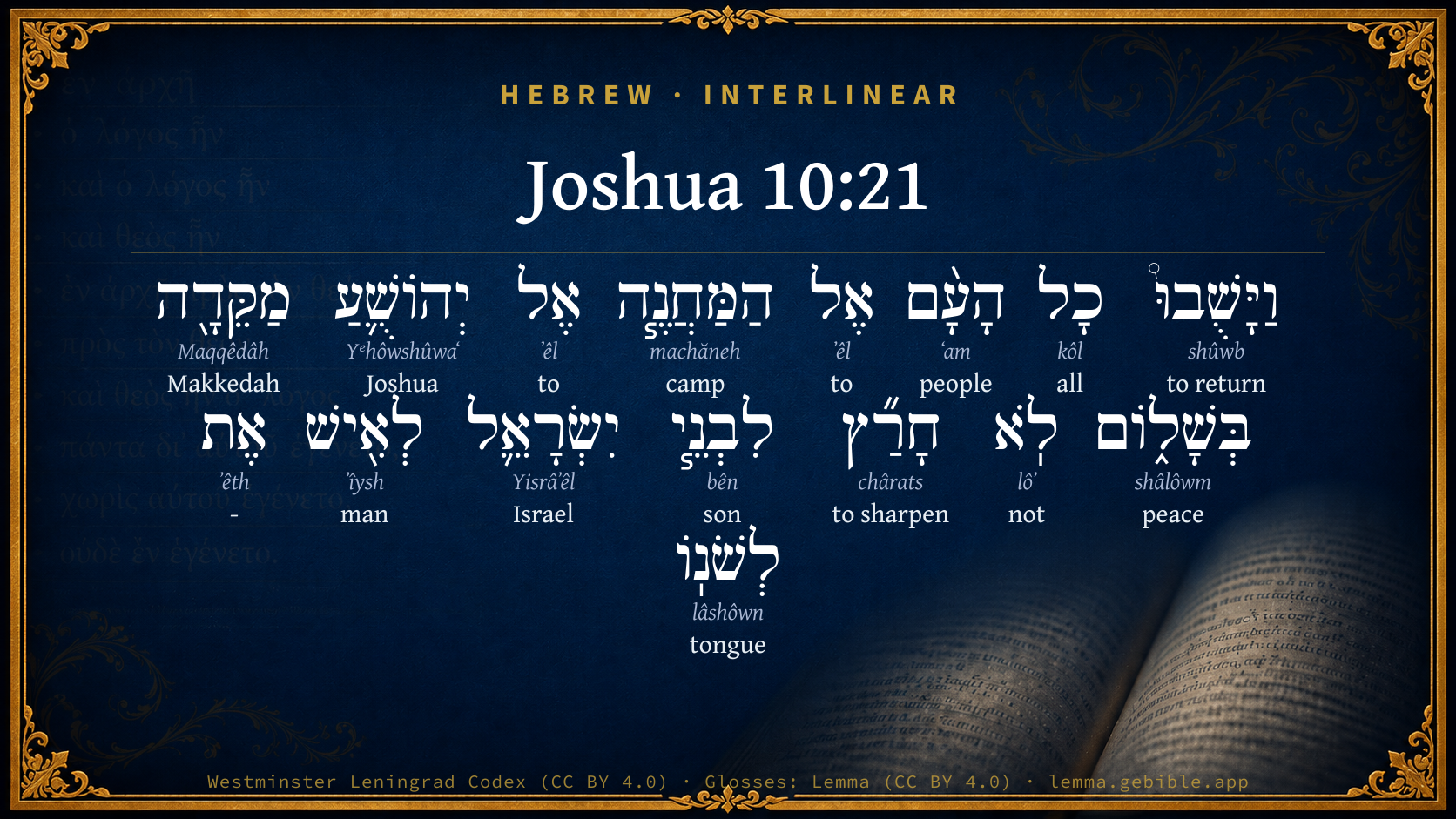
Hebrew (Westminster Leningrad Codex) Joshua 10:21 appears in the Hebrew Old Testament. The text above is from the Westminster Leningrad Codex. Each word links to its Strong’s number, a concise gloss, and parsing drawn from the Open Scriptures Hebrew Bible morphology. Click any word for its full Brown-Driver-Briggs (BDB) entry.
Download image
Cite this verse

Joshua 10:21 (World English Bible). Public Domain. Lemma interlinear Bible study tool, https://lemma.gebible.app/v/joshua/10/21.

Show BibTeX & RIS
BibTeX
RIS
English Translation
that all the people returned to the camp to Joshua at Makkedah in peace: none moved his tongue against any of the children of Israel.
World English Bible · Public Domain
Download a study sheet

One document with this verse’s original text, its word-by-word gloss line, the meaning frame, cross-references with their text, attributed commentary, and full source and license credits — printable, and it pastes into notes with its structure intact.

This verse Autodidact and up

Study sheet (.html) Plain text (.txt)

A passage Seminary Student

Up to 50 verses in one chapter. A passage sheet keeps up to 6 commentary sources and 12 cross-references per verse, in the order this page ranks them, and says so on the sheet whenever that leaves anything out. Ask for a single verse and you get the Autodidact verse sheet above.

Everything on this page stays free to read, with no account — the sheet is a download of what is already on screen, not access to it.

Want to remove ads? Support Godless Engineer
Compare translations 3

The same verse in 3 English versions, stacked beneath the original-language interlinear above. Click any original word for its lexicon entry.

Each is an independent rendering of the whole verse — the interlinear is not word-aligned to these translations.

Highlighted words mark where these versions differ — a whole-verse word diff, not a word-by-word alignment.

  • World English Bible Public Domain
    that all the people returned to the camp to Joshua at Makkedah in peace: none moved his tongue against any of the children of Israel.
  • King James Version Public Domain
    And all the people returned to the camp to Joshua at Makkedah in peace: none moved his tongue against any of the children of Israel.
  • unfoldingWord Literal Text CC BY-SA 4.0
    And all of the people returned to the camp, to Joshua at Makkedah, in peace. No one sharpened his tongue against the sons of Israel, against a man.

unfoldingWord Literal Text — © unfoldingWord, licensed CC BY-SA 4.0. Word-aligned USFM3 via Door43 (git.door43.org/unfoldingWord/en_ult).

Versions to compare (up to 4)

3 of 4 selected

Show all 18 translations

Every available English version of this verse, each an independent rendering of the whole verse.

  • World English Bible Public Domain
    that all the people returned to the camp to Joshua at Makkedah in peace: none moved his tongue against any of the children of Israel.
  • Berean Standard Bible Public Domain
    The whole army returned safely to Joshua in the camp at Makkedah, and no one dared to utter a word against the Israelites.
  • Majority Standard Bible Public Domain
    The whole army returned safely to Joshua in the camp at Makkedah, and no one dared to utter a word against the Israelites.
  • King James Version Public Domain
    And all the people returned to the camp to Joshua at Makkedah in peace: none moved his tongue against any of the children of Israel.
  • American Standard Version (1901) Public Domain
    that all the people returned to the camp to Joshua at Makkedah in peace: none moved his tongue against any of the children of Israel.
  • Revised Version (1885) Public Domain
    that all the people returned to the camp to Joshua at Makkedah in peace: none moved his tongue against any of the children of Israel.
  • Geneva Bible (1599) Public Domain
    Then all the people returned to the campe, to Ioshua at Makkedah in peace: no man mooued his tongue against the children of Israel.
  • Douay-Rheims (1899) Public Domain
    And all the army returned to Josue in Maceda, where the camp then was, in good health and without the loss of any one: and no man durst move his tongue against the children of Israel.
  • Young's Literal Translation Public Domain
    that all the people turn back to the camp, unto Joshua, `at' Makkedah, in peace; none moved sharply his tongue against the sons of Israel.
  • Literal Standard Version CC BY-SA 4.0
    that all the people return to the camp, to Joshua, [at] Makkedah, in peace; none moved his tongue sharply against the sons of Israel.
  • Unlocked Literal Bible CC BY-SA 4.0
    Then the whole army returned in peace to Joshua at the camp at Makkedah. No one dared to say one word against any of the people of Israel.
  • unfoldingWord Literal Text CC BY-SA 4.0
    And all of the people returned to the camp, to Joshua at Makkedah, in peace. No one sharpened his tongue against the sons of Israel, against a man.
  • Darby Bible Public Domain
    and all the people returned to the camp to Joshua, at Makkedah, in peace; none moved his tongue against the children of Israel.
  • World Messianic Bible Public Domain
    all the people returned to the camp to Joshua at Makkedah in peace. None moved his tongue against any of the children of Israel.
  • Webster's Bible Public Domain
    And all the people returned to the camp to Joshua at Makkedah in peace: none moved his tongue against any of the children of Israel.
  • Free Bible Version CC BY-SA 4.0
    The army returned to Joshua at the camp at Makkedah, and no one dared even to threaten the Israelites.
  • Bible in Basic English Public Domain
    All the people went back to Joshua to the tent-circle at Makkedah in peace: and no one said a word against the children of Israel.
  • JPS Tanakh (1917) Public Domain
    that all the people returned to the camp to Joshua at Makkedah in peace; none whetted his tongue against any of the children of Israel.

Literal Standard Version (2020), Covenant Press — licensed CC BY-SA 4.0. Text via the HelloAO Bible API (eBible.org). Unlocked Literal Bible (unfoldingWord) — licensed CC BY-SA 4.0. Text via the HelloAO Bible API (eBible.org). unfoldingWord Literal Text — © unfoldingWord, licensed CC BY-SA 4.0. Word-aligned USFM3 via Door43 (git.door43.org/unfoldingWord/en_ult). Free Bible Version, Dr. Jonathan Gallagher — licensed CC BY-SA 4.0. Text via the HelloAO Bible API (eBible.org).

Word by word

More ways to search: Search by grammar → Find every occurrence → Compare this word →

Practice this passage: Drill this verse → Learn its vocabulary →

מַקֵּדָ֖ה
Maqqêdâh
H4719
“Makkedah”
Noun, Proper
Part of Speech
Noun
Type
Proper
Full BDB Definition

Origin: from the same as H5348 in the denominative sense of herding (compare H5349 )

TWOT: None

Makkedah = "place of shepherds" - the location of a cave in Judah where Joshua captured and executed five Canaanite kings during the conquest; located near Bethhoron and Libnah
  1. וַיָּשֻׁבוּ֩ shûwb H7725 “and · to return” Conjunction + Verb, Qal, Sequential Imperfect, 3rd Person, Masculine, Plural
  2. כָל kôl H3605 “all of” Noun, Common, Masculine, Singular, Construct
  3. הָעָ֨ם ʻam H5971 “the · people” Particle, Definite Article + Noun, Common, Masculine, Singular, Absolute
  4. אֶל ʼêl H413 “to” Preposition
  5. הַמַּחֲנֶ֧ה machăneh H4264 “the · camp” Particle, Definite Article + Noun, Common, Both, Singular, Absolute
  6. אֶל ʼêl H413 “to” Preposition
  7. יְהוֹשֻׁ֛עַ Yᵉhôwshûwaʻ H3091 “Joshua” Noun, Proper
  8. בְּשָׁל֑וֹם shâlôwm H7965 “in/at · peace” Preposition + Noun, Common, Masculine, Singular, Absolute
  9. לֹֽא lôʼ H3808 “not” Particle, Negative
  10. חָרַ֞ץ chârats H2782 “to sharpen” Verb, Qal, Perfect, 3rd Person, Masculine, Singular
  11. לִבְנֵ֧י bên H1121 “to/for · sons of” Preposition + Noun, Common, Masculine, Plural, Construct
  12. יִשְׂרָאֵ֛ל Yisrâʼêl H3478 “Israel” Noun, Proper
  13. לְאִ֖ישׁ ʼîysh H376 “to/for · man” Preposition + Noun, Common, Masculine, Singular, Absolute
  14. אֶת ʼêth H853 “-” Particle, Direct Object
  15. לְשֹׁנֽוֹ lâshôwn H3956 “tongue · his” Noun, Common, Both, Singular, Construct + Suffix, Personal, 3rd Person, Masculine, Singular

About this verse

These counts appear in no published source. They are computed here, from the morphology-tagged text and Lemma’s own curated glosses. What Lemma adds →

16
words
15
distinct lemmas
Historical
section

Notable vocabulary

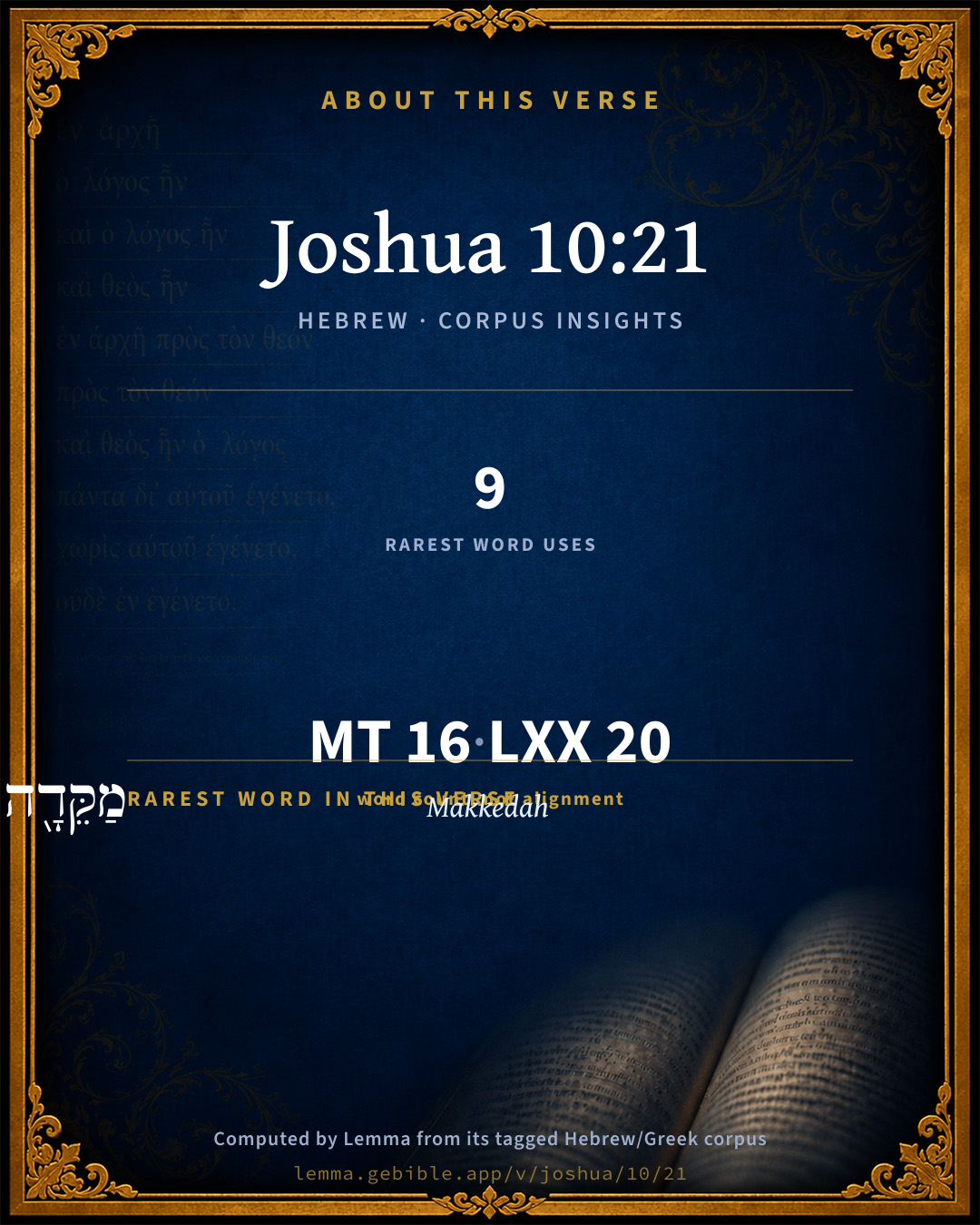
The rarest word here is מַקֵּדָ֖ה Makkedah H4719 — appearing just 9 times in the whole Hebrew Bible.

Shared distinctive vocabulary

מַקֵּדָ֖ה Makkedah H4719 occurs in 8 verses of the Hebrew Bible. Also found in:

Grammatical profile

  • 2 verbs
  • 10 nouns
  • 2 prepositions
  • 2 particles

Verb forms

  • וַיָּשֻׁבוּ֩ Qal · Sequential Imperfect
  • חָרַ֞ץ Qal · Perfect

Repetition

A word recurs within this verse — often emphatic in Hebrew:

  • אֶל to H413 ×2

Hebrew & Septuagint length

In English translation the verse runs 25 words from the Hebrew and 22 from the Septuagint (LXX English) — closely comparable.

A rough comparison of the two English renderings, which tokenize alike — not a word-level alignment.

Word counts can differ between the Hebrew and the Greek without any difference in meaning — e.g. the Hebrew direct-object marker אֵת has no separate Greek word, and Greek often adds the article ὁ.

In the original languages it is 16 Hebrew tokens and 20 Greek tokens — but the two are counted differently (Hebrew bundles its prefixes and suffixes into one token; the Greek is in lemma form), so that isn’t a like-for-like length.

Cross-references

3

Topical passages linked to Joshua 10:21 in the Treasury of Scripture Knowledge — connected by theme and wording, ordered by reader-vote popularity; previews shown in the World English Bible.

  • Exodus 11:7 But against any of the children of Israel a dog won't even bark or move its tongue, against man or animal; that you may know that Yahweh makes a distinction between the Egyptians and Israel.
  • Isaiah 54:17 No weapon that is formed against you shall prosper; and every tongue that shall rise against you in judgment you shall condemn. This is the heritage of the servants of Yahweh, and their righteousness which is of me, says Yahweh.
  • Isaiah 57:4 Against whom do you sport yourselves? against whom make you a wide mouth, and put out the tongue? Aren't you children of disobedience, a seed of falsehood,

Cross-references courtesy of OpenBible.info (CC BY 4.0).

Hebrew and Greek witnesses Masoretic Hebrew ↔ Greek Septuagint

The same verse in the two great witnesses to the Old Testament, shown verse-for-verse.

These are two independent witnesses, not word-aligned to each other, and the Septuagint is shown in lemma (dictionary) form.

Hebrew Joshua 10:21 Masoretic · Westminster Leningrad Codex

וַיָּשֻׁבוּ֩ כָל הָעָ֨ם אֶל הַמַּחֲנֶ֧ה אֶל יְהוֹשֻׁ֛עַ מַקֵּדָ֖ה בְּשָׁל֑וֹם לֹֽא חָרַ֞ץ לִבְנֵ֧י יִשְׂרָאֵ֛ל לְאִ֖ישׁ אֶת לְשֹׁנֽוֹ

that all the people returned to the camp to Joshua at Makkedah in peace: none moved his tongue against any of the children of Israel.

World English Bible · Public Domain

Greek LXX Joshua 10:21 Septuagint · lemma form

καί ἀποστρέφω πᾶς ὁ λαός πρός ἰησοῦς εἰς μακηδα ὑγιής καί οὐ γρύζω οὐδείς ὁ υἱός ἰσραήλ ὁ γλῶσσα αὐτός

And all the people returned safe to Joshua to Makeda; and no one of the children of Israel murmured with his tongue.

LXX2012 (modern English Septuagint) · Public Domain

On this verse, Haydock's Catholic Bible Commentary discusses the Septuagint’s reading. Read the note in Commentary ↓

Hebrew: Westminster Leningrad Codex (CC BY 4.0). Greek: Septuagint (public domain); English from LXX2012 (modern English Septuagint) (Public Domain). How the Septuagint differs from the Hebrew →

Targum (Aramaic paraphrase)

1

The Targum is the ancient Jewish Aramaic paraphrase of the Hebrew Scriptures — an interpretive translation, not the Hebrew text itself. Onkelos (literal) and Pseudo-Jonathan (expansive) render the Torah, and Jonathan the Prophets. Coverage is partial: where no permissively-licensed English translation exists for a verse, only the Aramaic is shown. This is verse-level text, not a word-by-word alignment to the Hebrew.

  1. Targum Jonathan Prophets (Joshua–Malachi)
    וְתָבוּ כָל עַמָא לְמַשְׁרִיתָא לְוַת יְהוֹשֻׁעַ לְמַקֵדָה בִּשְׁלָם לָא הֲוָה נִזְקָא לִבְנֵי יִשְׂרָאֵל לְמִדְחַק גְבַר יַת נַפְשֵׁיהּ:

    (no public-domain English translation for this verse)

    Targum Jonathan — Aramaic: “Mikraot Gedolot” (public domain). English: “Sefaria Community Translation” (CC0 1.0 (public-domain dedication)); “London "Chaldee Paraphrase," 1871” (public domain). Text via Sefaria.

Commentary

Notes on Joshua 10:21 from classic Christian and Jewish commentators (each source and its license shown beneath its notes). The classic Christian expositions comment on the surrounding passage and are grouped to its opening verse, so a note may address several verses; the Jewish commentaries on the Tanakh (Rashi and others) are per-verse, so they appear only where the commentator wrote on this verse.

Lemma curates 59 commentaries, every one of them public domain or Creative Commons licensed, each selected and text-cleaned for this edition rather than reprinted as found. About our sources →

Trapp's Complete Commentary

John Trapp

Jos 10:21 And all the people returned to the camp to Joshua at Makkedah in peace: none moved his tongue against any of the children of Israel.

Ver. 21. None moved his tongue, &c.] No dead dog durst once bark at them: their condition was very quiet, without any disturbance of man or beast. See Exo 11:7 Job 5:23. "Iniquity shall" one day "stop her mouth." {Job 5:16}

John Trapp, A Commentary or Exposition upon All the Books of the Old and New Testament (1647–1656) — public domain. Text from a community e-Sword module.

Tyndale Open Study Notes

Tyndale Open Resources

10:21 The armies returned safely, indicating that Israel suffered few or no casualties in this battle, a sign of God’s presence in the battle. • no one dared: The Canaanites in the south now had firsthand experience that Israel’s powerful God was fighting them.

Tyndale Open Study Notes — © Tyndale Open Resources, licensed CC BY-SA 4.0. Text via the HelloAO Bible API.

Geneva Bible (1599)

Geneva Bible translators

Or in safety, so that none gave them as much as an evil word.

Geneva Bible (1599) marginal notes — public domain. Text via Bolls.life.

Adam Clarke's Commentary

Verse 21. None moved his tongue] The whole transaction of this important day had been carried on so evidently under the direction of God that there was not the least murmuring, nor cause for it, among them, for their enemies were all discomfited. There is an expression similar to this, Ex 11:7, on which the reader is requested to consult the note.

Adam Clarke's Commentary on the Bible (1810–1826) — public domain. Text from a community e-Sword/MySword module.

The Cambridge Bible for Schools and Colleges

gen. ed. J. J. S. Perowne

21. to the camp] Which had been already formed round the royal hiding-place.

none moved his tongue] “And no man açens the sones of Yrael was hardy to grucche, ether to make priuy noise,” Wyclif. Comp. Exo_11:7, “But against any of the children of Israel shall not a dog move his tongue, against man or beast.”

The Cambridge Bible for Schools and Colleges (gen. ed. J. J. S. Perowne; Cambridge University Press, 1878–1918) — public domain. Text from a community e-Sword module.

John Gill's Exposition

Then said Joshua, open the mouth of the cave,.... That is, roll away the great stones that were laid at the mouth of it:

and bring out those five kings unto me out of the cave; to receive their sentence in a public manner, for the encouragement of his troops and the terror of the Canaanites, particularly Makkedah, now besieged by him.

John Gill's Exposition of the Whole Bible (1746–1763) — public domain (CC PDM 1.0). Text via the HelloAO Bible API.

Albert Barnes' Notes on the Bible

Joshua himself remained at Makkedah with the guards set before the cave. The other warriors would not return from the pursuit until the evening of the overthrow of the Amorites; and the execution of the kings and the capture of Makkedah itself belong, no doubt, to the day following Jos 10:27-28.

None moved his tongue - See the marginal reference and note.

Albert Barnes' Notes on the Bible (1834–1885) — public domain. Text from a community e-Sword/MySword module.

Haydock's Catholic Bible Commentary

No man, (nullus.) some supply canis, "dog," alluding to the proverbial expression, Exodus xi. 7. (Masius, &c.) --- Septuagint, "not one of the Israelites moved his tongue." (Calmet) --- All was profound silence, in expectation of what would be determined respecting the unfortunate kings. (Haydock)

George Leo Haydock (1774–1849), Haydock's Catholic Family Bible and Commentary, 1859 edition — public domain. Excludes Psalms (Douay-Rheims chapter numbering differs from Protestant) and Deuterocanonical books (Catholic canon only).

Matthew Poole's English Annotations

To the camp; to the body of the army which were encamped there with Joshua to besiege that place.

None moved his tongue; not so much as a dog, as it is expressed, Exo 11:7. Not only their men of war could not find their hands, but they were all so confounded, that they could not move their tongues in way of insultation and reproach, as doubtless they did when the Israelites were repulsed and smitten at Ai; but now they were silenced as well as conquered; they durst no more provoke nor injure the Israelites.

Matthew Poole's English Annotations on the Holy Bible (1683–1685) — public domain. Text from a community e-Sword/MySword module.

Whedon's Commentary on the Bible

Daniel D. Whedon

21. All the people — The army that had pursued the foe.

None moved his tongue — Or, pointed his tongue. None uttered an impious or threatening word against Israel. The enemy was reduced to the most abject silence.

This is the Hebrew way of expressing the complete subjection of all that region. Compare Exo_11:7.

Daniel D. Whedon (gen. ed.), Commentary on the Old and New Testaments (1874–1909) — public domain. Text from a community e-Sword module.

The Pulpit Commentary

Makkedah. Because Joshua, in his resolute pursuit of the enemy, had not forgotten the important intelligence reported to him concerning the kings. Most likely the pursuit lasted one or two days. After the return to Makkedah the execution of the kings was carried out with much ceremony (ver. 24), and their bodies hung up before all Israel, not so much as a memorial of the victory, as to impress upon the Israelites the duty of exterminating their enemies, a duty which the after history of the twelve tribes shows them to have been very prone to forget. None moved his tongue against any of the children of Israel. Literally, He did not sharpen against the children of Israel, against a man, his tongue . The Hebrew construction here is somewhat unusual. Houbigant and Maurer suppose that le is a mistake of the copyist and that vyai is the subject of the sentence. They would translate as the LXX, "no man muttered with his tongue against the children of Israel." But Keil and Rosenmuller prefer a rendering agreeing with that of the Authorised Version, node moved (or sharpened) his tongue against the children of Israel, not against a single man of them. And this is a far more forcible way of expressing the awe in which they were held. A still stronger expression is to be found in Exo_11:7; cf. RAPC Jdt 11:19.

The Pulpit Commentary (1880–1919), ed. H.D.M. Spence-Jones & Joseph S. Exell — public domain. Text from a community e-Sword module.

John Wesley's Explanatory Notes

To the camp - To the body, of the army which were engaged there with Joshua to besiege that place. None moved his tongue - Not only their men of war could not find their hands, but they were so confounded, that they could not move their tongues in way of insult, as doubtless they did when the Israelites were smitten at Ai; but now they were silenced as well as conquered: they durst no more provoke the Israelites.

John Wesley, Explanatory Notes Upon the Whole Bible (1754–1765) — public domain. Text via the GEBible commentary corpus.

Rashi

Rabbi Shlomo Yitzchaki (Rashi)

Not one person sharpened. This is an abbreviated verse. No sharp [tongued] person, sharpened his tongue against a single person of Bnei Yisroel.

חָרֶץ indicates the speech of the tongue. Similarly, “A dog will not sharpen its tongue.” Similarly “Then you will utter a sharp word.” You will call, you will cry out a battle shout.

Rashi on the Tanakh — English translations: “The Judaica Press complete Tanach with Rashi, translated by A. J. Rosenberg” (CC BY 4.0); “Pentateuch with Rashi's commentary by M. Rosenbaum and A.M. Silbermann, 1929-1934” (public domain); “The Metsudah Tanach series, Lakewood, N.J” (CC BY 4.0); and “The Book of Joshua, Metsudah Publications, 1997” (CC BY 4.0). Text via Sefaria.

Lesson kit

Teaching starters — assembled from the data on this page, not authored interpretation. Every prompt links to the verse data it draws on. Edit before teaching.

Joshua, in the Historical, opens this verse with 16 words (15 distinct Hebrew lemmas). Its most distinctive word is Maqqêdâh (“Makkedah”). A historical commentator’s framing appears above. Read the whole chapter for the surrounding context.

Discussion questions

  1. The word Maqqêdâh carries the sense “Makkedah.” How does it shape the verse?
  2. Joshua 10:10 shares the word «Makkedah» with this verse. How do the two illuminate each other?
  3. “to” occurs 2× in this one verse. What is the effect of the repetition?
  4. The translations on this page render this verse differently — a whole-verse word diff, not a word-by-word alignment. What might account for the different wordings?
  5. The verb «וַיָּשֻׁבוּ֩» is Qal Sequential Imperfect. How does its form color the action?
  6. Reading how Trapp's Complete Commentary and Tyndale Open Study Notes read this verse, where do the two commentators agree and where do they part?

Things to notice

Reading settings

Reading text

Shown beneath each verse's original-language words.

Old Testament
Old Testament edition

Read the OT as the Masoretic Hebrew (MT) or the Greek Septuagint (LXX).

English shown for the Greek Septuagint (in the Hebrew ↔ Greek comparison).

Comparing translations? Open the Compare panel on any verse page to stack up to four side by side.