Acts 4:14

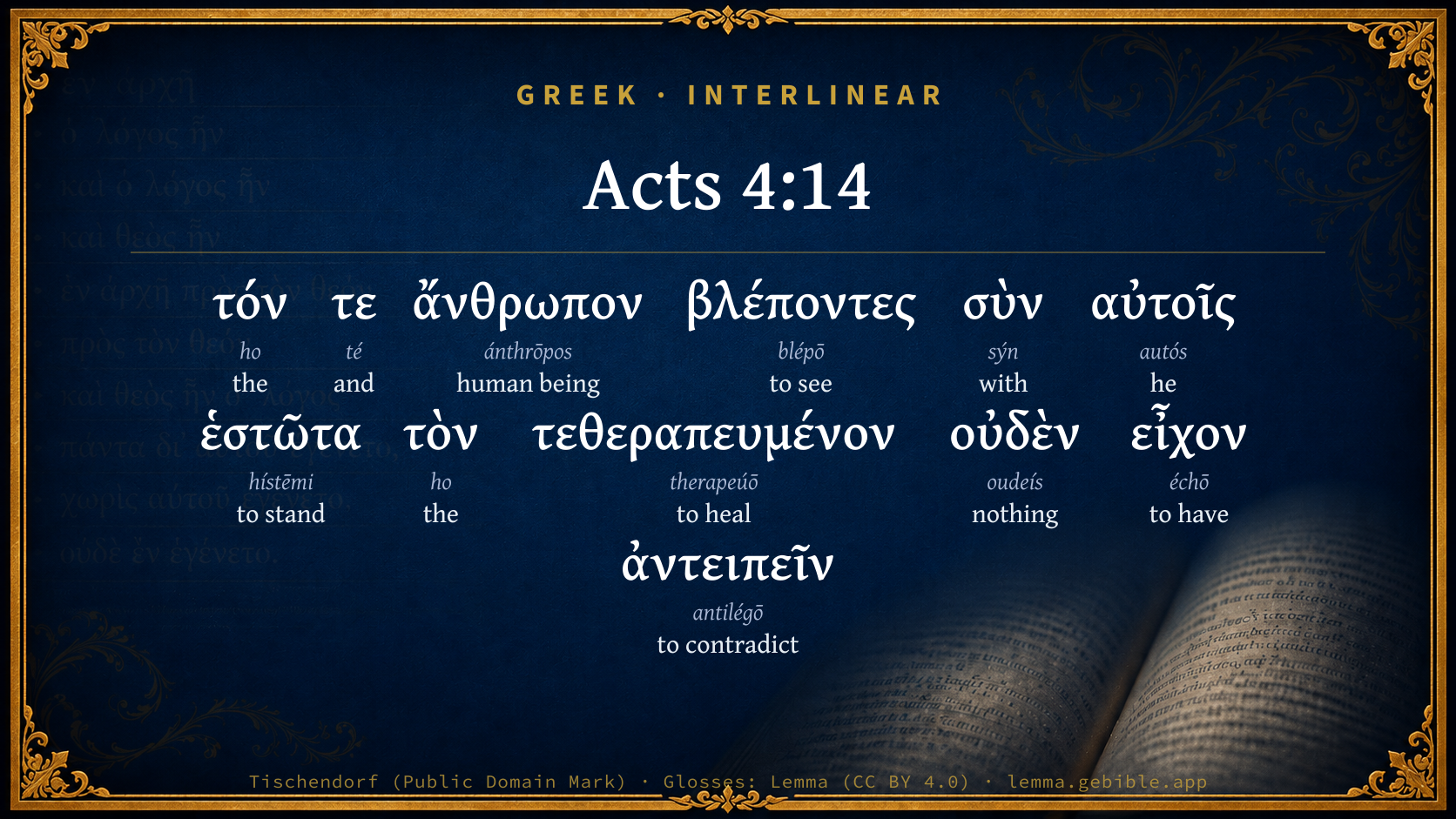
Greek (Tischendorf 8th ed.) Acts 4:14 appears in the Greek New Testament. The text above is from the Tischendorf 8th edition. Each word links to its Strong’s number and a concise gloss. Click any word for its full Thayer’s Greek Lexicon entry.
Download image
Cite this verse

Acts 4:14 (World English Bible). Public Domain. Lemma interlinear Bible study tool, https://lemma.gebible.app/v/acts/4/14.

Show BibTeX & RIS
BibTeX
RIS
English Translation
Seeing the man who was healed standing with them, they could say nothing against it.
World English Bible · Public Domain
Download a study sheet

One document with this verse’s original text, its word-by-word gloss line, the meaning frame, cross-references with their text, attributed commentary, and full source and license credits — printable, and it pastes into notes with its structure intact.

This verse Autodidact and up

Study sheet (.html) Plain text (.txt)

A passage Seminary Student

Up to 50 verses in one chapter. A passage sheet keeps up to 6 commentary sources and 12 cross-references per verse, in the order this page ranks them, and says so on the sheet whenever that leaves anything out. Ask for a single verse and you get the Autodidact verse sheet above.

Everything on this page stays free to read, with no account — the sheet is a download of what is already on screen, not access to it.

Want to remove ads? Support Godless Engineer
Compare translations 3

The same verse in 3 English versions, stacked beneath the original-language interlinear above. Click any original word for its lexicon entry.

Each is an independent rendering of the whole verse — the interlinear is not word-aligned to these translations.

Highlighted words mark where these versions differ — a whole-verse word diff, not a word-by-word alignment.

  • World English Bible Public Domain
    Seeing the man who was healed standing with them, they could say nothing against it.
  • King James Version Public Domain
    And beholding the man which was healed standing with them, they could say nothing against it.
  • unfoldingWord Literal Text CC BY-SA 4.0
    But seeing the man who had been healed standing with them, they had nothing to say in opposition.

unfoldingWord Literal Text — © unfoldingWord, licensed CC BY-SA 4.0. Word-aligned USFM3 via Door43 (git.door43.org/unfoldingWord/en_ult).

Versions to compare (up to 4)

3 of 4 selected

Show all 19 translations

Every available English version of this verse, each an independent rendering of the whole verse.

  • World English Bible Public Domain
    Seeing the man who was healed standing with them, they could say nothing against it.
  • Berean Standard Bible Public Domain
    And seeing the man who had been healed standing there with them, they had nothing to say in response.
  • Majority Standard Bible Public Domain
    And seeing the man who had been healed standing there with them, they had nothing to say in response.
  • King James Version Public Domain
    And beholding the man which was healed standing with them, they could say nothing against it.
  • American Standard Version (1901) Public Domain
    And seeing the man that was healed standing with them, they could say nothing against it.
  • Revised Version (1885) Public Domain
    And seeing the man which was healed standing with them, they could say nothing against it.
  • Geneva Bible (1599) Public Domain
    And beholding also the man which was healed standing with them, they had nothing to say against it.
  • Douay-Rheims (1899) Public Domain
    Seeing the man also who had been healed standing with them, they could say nothing against it.
  • Young's Literal Translation Public Domain
    and seeing the man standing with them who hath been healed, they had nothing to say against `it',
  • Literal Standard Version CC BY-SA 4.0
    and seeing the man standing with them who has been healed, they had nothing to say against [it],
  • Unlocked Literal Bible CC BY-SA 4.0
    Because they saw the man who was healed standing with them, they had nothing to say against this.
  • unfoldingWord Literal Text CC BY-SA 4.0
    But seeing the man who had been healed standing with them, they had nothing to say in opposition.
  • Darby Bible Public Domain
    And beholding the man who had been healed standing with them, they had nothing to reply;
  • World Messianic Bible Public Domain
    Seeing the man who was healed standing with them, they could say nothing against it.
  • Webster's Bible Public Domain
    And beholding the man who was healed standing with them, they could say nothing against it.
  • Free Bible Version CC BY-SA 4.0
    Since they could see the man who had been healed standing right there with them, they had nothing to say in response to what had happened.
  • Bible in Basic English Public Domain
    And, seeing that the man who had been made well was there with them, they were not able to say anything against it.
  • Text-Critical English NT CC BY 4.0
    But since they could see the man who had been healed standing there with them, they had nothing to say in opposition.
  • Tyndale New Testament (1534) Public Domain
    and beholdinge also the man which was healed stondinge with the they coulde not saye agaynst it.

Literal Standard Version (2020), Covenant Press — licensed CC BY-SA 4.0. Text via the HelloAO Bible API (eBible.org). Unlocked Literal Bible (unfoldingWord) — licensed CC BY-SA 4.0. Text via the HelloAO Bible API (eBible.org). unfoldingWord Literal Text — © unfoldingWord, licensed CC BY-SA 4.0. Word-aligned USFM3 via Door43 (git.door43.org/unfoldingWord/en_ult). Free Bible Version, Dr. Jonathan Gallagher — licensed CC BY-SA 4.0. Text via the HelloAO Bible API (eBible.org).

Word by word

More ways to search: Search by grammar → Find every occurrence → Compare this word →

Practice this passage: Drill this verse → Learn its vocabulary →

ἀντειπεῖν
antilégō
G483
“to contradict”
Verb, Aorist, Active, Infinitive
Part of Speech
Verb
Tense
Aorist
Voice
Active
Mood
Infinitive
Full Thayer's Definition

Origin: from G473 and G3004

TDNT: None

1. to speak against, gainsay, contradict 2. to oppose one's self to one, decline to obey him, declare one's self against him, refuse to have anything to do with him
  1. τόν ho G3588 “the” Article, Accusative, Singular, Masculine
  2. τε té G5037 “and” Particle
  3. ἄνθρωπον ánthrōpos G444 “human being” Noun, Accusative, Singular, Masculine
  4. βλέποντες blépō G991 “to see” Verb, Present, Active, Participle, Nominative, Plural, Masculine
  5. σὺν sýn G4862 “with” Preposition
  6. αὐτοῖς autós G846 “he” Personal pronoun, Dative, Plural, Masculine
  7. ἑστῶτα hístēmi G2476 “to stand” Verb, Perfect, Active, Participle, Accusative, Singular, Masculine
  8. τὸν ho G3588 “the” Article, Accusative, Singular, Masculine
  9. τεθεραπευμένον therapeúō G2323 “to heal” Verb, Perfect, Passive, Participle, Accusative, Singular, Masculine
  10. οὐδὲν oudeís G3762 “nothing” Adjective, Accusative, Singular, Neuter, Negative
  11. εἶχον échō G2192 “to have” Verb, Imperfect, Active, Indicative, 3rd person, Plural

About this verse

These counts appear in no published source. They are computed here, from the morphology-tagged text and Lemma’s own curated glosses. What Lemma adds →

12
words
11
distinct lemmas
Acts
section

Notable vocabulary

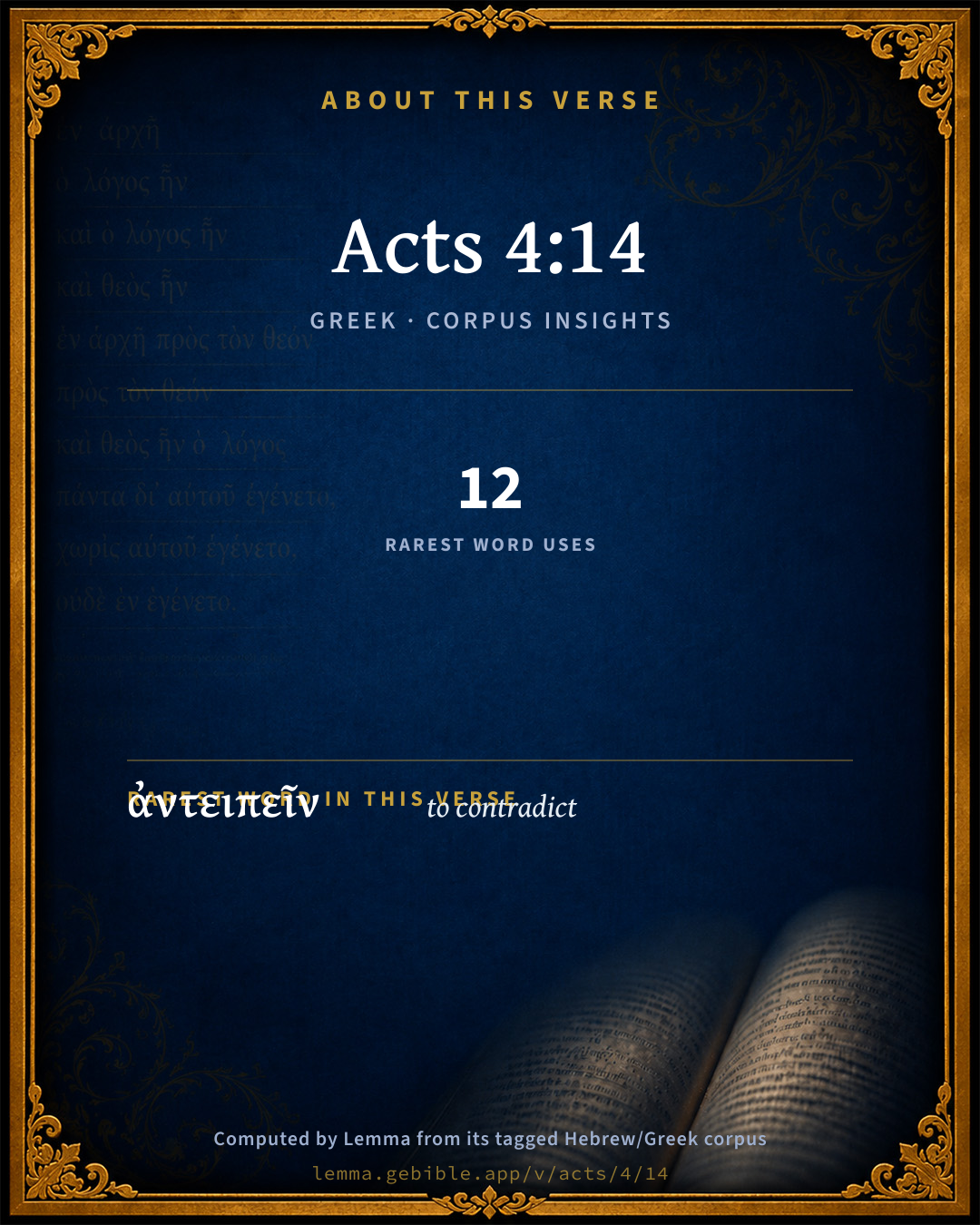
The rarest word here is ἀντειπεῖν to contradict G483 — appearing just 12 times in the whole Greek New Testament.

Shared distinctive vocabulary

ἀντειπεῖν to contradict G483 occurs in 11 verses of the Greek New Testament. Also found in:

Repetition

A word recurs within this verse:

Cross-references

5

Topical passages linked to Acts 4:14 in the Treasury of Scripture Knowledge — connected by theme and wording, ordered by reader-vote popularity; previews shown in the World English Bible.

  • Acts 3:8–12 Leaping up, he stood, and began to walk. He entered with them into the temple, walking, leaping, and praising God.
  • Acts 19:36 Seeing then that these things can't be denied, you ought to be quiet, and to do nothing rash.
  • Acts 4:10 be it known to you all, and to all the people of Israel, that in the name of Jesus Christ of Nazareth, whom you crucified, whom God raised from the dead, in him does this man stand here before you whole.
  • Acts 4:16 saying, "What shall we do to these men? Because indeed a notable miracle has been done through them, as can be plainly seen by all who dwell in Jerusalem, and we can't deny it.
  • Acts 4:21 When they had further threatened them, they let them go, finding no way to punish them, because of the people; for everyone glorified God for that which was done.

Cross-references courtesy of OpenBible.info (CC BY 4.0).

Commentary

Notes on Acts 4:14 from classic Christian and Jewish commentators (each source and its license shown beneath its notes). The classic Christian expositions comment on the surrounding passage and are grouped to its opening verse, so a note may address several verses; the Jewish commentaries on the Tanakh (Rashi and others) are per-verse, so they appear only where the commentator wrote on this verse.

Lemma curates 59 commentaries, every one of them public domain or Creative Commons licensed, each selected and text-cleaned for this edition rather than reprinted as found. About our sources →

The Biblical Illustrator

Joseph S. Exell

Act_4:14

And beholding the man which was healed … they could say nothing against it.

Practical testimony to Christianity

Have you ever heard the gospel before? asked an Englishman at Ningpo of a respectable Chinaman, whom he had not seen in his mission-room before. No, he replied, but I have seen it. I know a man who used to be the terror of his neighbourhood. If you gave him a hard word he would shout at you, and curse you for two days ariel nights without ceasing. He was as dangerous as a wild beast, and a bad opium smoker; but when the religion of Jesus took hold of him he became wholly changed. He is gentle, moral, not soon angry, and has left off opium. Truly, the teaching is good! (Homiletic Monthly.)

Months closed and opened

I. The mouths of the rulers were closed. They could say nothing against the miracle--

1. As a fact. There was the man; that he was lame, that he now walked they all knew. There are equally incontrovertible facts to-day. Men are sober who were once drunkards, honest who were once thieves, and the enemy cannot deny it.

2. As blessed fact. Not a man amongst them but would have confessed that lameness was a misfortune, and the cure of it a blessing. Similarly when sceptics see lives, homes, circumstances transformed by the power of the gospel, they can say nothing against the blessedness of the transformation.

II. The mouths of the rulers should have been opened. If they could say nothing against the fact they ought to have said something for it.

1. They should have accounted for it. If they rejected the apostles hypothesis of the cure they should have framed one more satisfactory. And so now. The blessed facts of moral healing have to be accounted for, and sceptics are bound logically to account for them. The process requires painstaking and honest research, and candour when the conclusion is reached. But no one has ever reached but one conclusion which will satisfy all the conditions of the case--the name of Jesus of Nazareth.

2. They should have been grateful for it and encouraged its repetition. However much it may have gone athwart their convictions, at least the sum of human misery was by so much reduced and the sum of human happiness augmented--why, then, net more? The Marquis of Queensberry candidly confessed his disbelief in Christianity, but he could not ignore the blessedness of its results, and so in logical consistency with the knowledge which should have upset his illogical unbelief contributed to General Booths scheme.

III. The mouth of the rulers was opened.

1. In secret confession of the truth of the fact (Act_4:16). And there is much of this nowadays Not all of it is like that before us hypocritical. Many sceptics are privately convinced of the unsoundness of their position, and many heathen are secretly convinced of the truth of Christianity. Let us hope that both may come into the public light. But these rulers, like others to-day, love darkness rather than light, etc.

2. In open prohibition of its repetition (Act_4:18). What a result! Here were men objecting to other men being made healthy and happy. Why? Because it was done in an objectionable way. Let us not be surprised, for there are doctors who forbid the use of any remedies that are not in their pharmacopoeia, although the use of those remedies has been proved to be beneficial, and there are also Christians who forbid a certain style of preaching and preachers although they convert souls.

3. Ineffectually. The mouth of the rulers was opened to close those of the apostles, instead of which mouths which were open all along opened wider.

(1) In emphatic and persistent testimony (Act_4:19-20).

(2) In powerful and prevailing prayer (Act_4:24, etc.). (J. W. Burn.)

The golden muzzle

1. It is no new thing for the gospel to be opposed.

2. Nor a strange thing for the great, the official, the powerful, and the influential to be foremost in such opposition. The opposition of ungodly men is--

(1) Natural, seeing that the heart of man is depraved.

(2) Endurable, since our Lord and His apostles suffered it.

(3) Harmless, if we commit the case to God.

(4) Overruled for good by Divine grace and wise providence.

3. The best and perhaps the only way to silence opposition is by exhibiting the blessed results which follow from the gospel.

4. Those who would say anything if they could, can say nothing of what they would, when they see before their eyes the cures wrought by the word of the Lord Jesus. The man that was healed is our best apologist. Better than Paleys Evidences, or Butlers Analogy, is the proof given by results.

I. The gospel is vindicated by its results.

1. On a broad scale in nations. England, the islands of the Pacific, Jamaica, Madagascar, etc.

2. In individual conversions from open sin. Some of the worst of men have become clear instances of the purifying power of the gospel.

3. In restoring to hope the comfortless and despairing. Very marvellous is its efficacy in the direction of healing mental maladies.

4. In elevating saints above selfish aims and designs, and inducing heroic consecrations. The biographies of gracious men and women are demonstrations of the Divine power of the Word.

5. In sustaining character under fierce temptation. Wonderful is the preserving salt of grace amid surrounding putrefaction.

6. In holy and happy death-beds. These are plentiful throughout history, among all ranks; and they never fail to convince the candid. Many another catalogue of results might be made. Many a man is unable to be an infidel because of what he has seen in his mother, wife, or child.

II. Gospel-works and workers must look for like vindication. Nowadays men ask for results: the tree must bear fruit, or the cry is, Cut it down. We do not shrink from this test.

1. The minister must find in his converts a proof of his call, and a defence of his doctrines, methods, peculiarities, etc.

2. A society, college, or institution must stand or fall by its fruits.

3. The individual professor must abide the same test.

4. The Church in any place, and the Church on the largest scale, must be tried by similar methods.

5. Even our Lord Himself loses or gains honour among men according as His followers behave themselves.

III. The gospel and its workers deserve vindication at our hands. Those who are healed should boldly stand with Peter and John as witnesses and fellow workers. This suggests a series of practical questions:--

1. Has it produced blessed results in us?

2. Have we come forward to stand with the preachers of it in evidence that it has wrought our cure? Are we continually witnessing to the truth and value of the gospel of Christ?

3. Does the influence of the gospel upon us so continue and increase unto holiness of life as to be a credit to its influence?

4. Are there not points in our character which harm the repute of the gospel? Should not these be amended at once?

5. Could we not henceforth so live as more effectually to silence the opponents of the Word? Let the Church plainly see that her converts are her best defence: they are, in fact, her reason for existence. Let converts see the reason why they should come forward and declare their faith, and unite with the people of God. (C. H. Spurgeon.)

Opponents silenced by Christian consistency

The behaviour of some professors has often given the wicked an opportunity to reproach religion. Lactantius reports, that the heathen were wont to say, The Master could not be good, when His disciples were so bad. The malice of sinners is such that they will reproach the rectitude of the law, for the obliquity of their lives who swerve from it. Oh that your pure life did but hang a padlock upon their impure lips! (William Secker.)

Conversions the test of a good ministry

Certain gentlemen waited upon Rev. Matthew Wilks to complain of the eccentricities of his discourses. Wilks heard them through, and then produced a long list of names. There, said the quaint divine, all those precious souls profess to have found salvation through what you are pleased to call my whims and oddities. Can you produce a similar list from all the sober brethren you have been so much extolling? This was conclusive: they withdrew in silence.

The Biblical Illustrator, edited by Joseph S. Exell (c. 1880s–1900s) — public domain. Text from a community e-Sword module.

MacLaren's Expositions of Holy Scripture

Alexander MacLaren

Acts

THE FIRST BLAST OF TEMPEST

Act 4:1 - Act 4:14.

Hitherto the Jewish authorities had let the disciples alone, either because their attention had not been drawn even by Pentecost and the consequent growth of the Church, or because they thought that to ignore the new sect was the best way to end it. But when its leaders took to vehement preaching in Solomon’s porch, and crowds eagerly listened, it was time to strike in.

Our passage describes the first collision of hostile authority with Christian faith, and shows, as in a glass, the constant result of that collision in all ages.

The motives actuating the assailants are significantly analysed, and may be distributed among the three classes enumerated. The priests and the captain of the Temple would be annoyed by the very fact that Peter and John taught the people: the former, because they were jealous of their official prerogative: the latter, because he was responsible for public order, and a riot in the Temple court would have been a scandal. The Saddueees were indignant at the substance of the teaching, which affirmed the resurrection of the dead, which they denied, and alleged it as having occurred ‘in Jesus.’

The position of Sadducees and Pharisees is inverted in Acts as compared with the Gospels. While Christ lived, the Pharisees were the soul of the opposition to Him, and His most solemn warnings fell on them; after the Resurrection, the Sadducees head the opposition, and among the Pharisees are some, like Gamaliel and afterwards Paul, who incline to the new faith. It was the Resurrection that made the difference, and the difference is an incidental testimony to the fact that Christ’s Resurrection was proclaimed from the first. To ask whether Jesus had risen, and to examine the evidence, were the last things of which the combined assailants thought. This public activity of the Apostles threatened their influence or their pet beliefs, and so, like persecutors in all ages, they shut their eyes to the important question, ‘Is this preaching true or false?’ and took the easier course of laying hands on the preachers.

So the night fell on Peter and John in prison, the first of the thousands who have suffered bonds and imprisonment for Christ, and have therein found liberty. What lofty faith, and what subordination of the fate of the messengers to the progress of the message, are expressed in that abrupt introduction, in Act 4:4, of the statistics of the increase of the Church from that day’s work! It mattered little that it ended with the two Apostles in custody, since it ended too with five thousand rejoicing in Christ.

The arrest seems to have been due to a sudden thought on the part of the priests, captain, and Sadducees, without commands from the Sanhedrin or the high priest. But when these inferior authorities had got hold of their prisoners, they probably did not quite know what to do with them, and so moved the proper persons to summon the Sanhedrin. In all haste, then, a session was called for next morning. ‘Rulers, elders, and scribes’ made up the constituent members of the court, and the same two ‘high priests’ who had tried Jesus are there, attended by a strong contingent of dependants, who could be trusted to vote as they were bidden. Annas was an emeritus high priest, whose age and relationship to Caiaphas, the actual holder of the post and Annas’s son-in-law, gave him an influential position. He retained the title, though he had ceased to hold the office, as a cleric without a charge is usually called ‘Reverend.’

It was substantially the same court which had condemned Jesus, and probably now sat in the same hall as then. So that Peter and John would remember the last time when they had together been in that room, and Who had stood in the criminal’s place where they now were set.

The court seems to have been somewhat at a loss how to proceed. The Apostles had been arrested for their words, but they are questioned about the miracle. It was no crime to teach in the Temple, but a crime might be twisted out of working a miracle in the name of any but Jehovah. To do that would come near blasphemy or worshipping strange gods. The Sanhedrin knew what the answer to their question would be, and probably they intended, as soon as the anticipated answer was given, to ‘rend their clothes,’ and say, as they had done once before, ‘What need we further witnesses? They have spoken blasphemy.’ But things did not go as was expected. The crafty question was put. It does not attempt to throw doubt on the reality of the miracle, but there is a world of arrogant contempt in it, both in speaking of the cure as ‘this,’ and in the scornful emphasis with which, in the Greek, ‘ye’ stands last in the sentence, and implies, ‘ye poor, ignorant fishermen.’

The last time that Peter had been in the judgment-hall his courage had oozed out of him at the prick of a maid-servant’s sharp tongue, but now he fronts all the ecclesiastical authorities without a tremor. Whence came the transformation of the cowardly denier into the heroic confessor, who turns the tables on his judges and accuses them? The narrative answers. He was ‘filled with the Holy Ghost.’ That abiding possession of the Spirit, begun on Pentecost, did not prevent special inspiration for special needs, and the Greek indicates that there was granted such a temporary influx in this critical hour.

One cannot but note the calmness of the Apostle, so unlike his old tumultuous self. He begins with acknowledging the lawful authority of the court, and goes on, with just a tinge of sarcasm, to put the vague ‘this’ of the question in its true light. It was ‘a good deed done to an impotent man,’ for which John and he stood there. Singular sort of crime that! Was there not a presumption that the power which had wrought so ‘good’ a deed was good? ‘Do men gather grapes of thorns?’ Many a time since then Christianity has been treated as criminal, because of its beneficence to bodies and souls.

But Peter rises to the full height of the occasion, when he answers the Sanhedrin’s question with the pealing forth of his Lord’s name. He repeats in substance his former contrast of Israel’s treatment of Jesus and God’s; but, in speaking to the rulers, his tone is more severe than it was to the people. The latter had been charged, at Pentecost and in the Temple, with crucifying Jesus; the former are here charged with crucifying the Christ. It was their business to have tested his claims, and to have welcomed the Messiah. The guilt was shared by both, but the heavier part lay on the shoulders of the Sanhedrin.

Mark, too, the bold proclamation of the Resurrection, the stone of offence to the Sadducees. How easy it would have been for them to silence the Apostle, if they could have pointed to the undisturbed and occupied grave! That would have finished the new sect at once. Is there any reason why it was not done but the one reason that it could not be done?

Thus far Peter has been answering the interrogation legally put, and has done as was anticipated. Now was the time for Annas and the rest to strike in; but they could not carry out their programme, for the fiery stream of Peter’s words does not stop when they expected, and instead of a timid answer followed by silence, they get an almost defiant proclamation of the Name, followed by a charge against them, which turns the accused into the accuser, and puts them at the bar. Peter learned to apply the passage in the Psalm {Act 4:11} to the rulers, from his Master’s use of it {Mat 21:42}; and there is no quaver in his voice nor fear in his heart when, in the face of all these learned Rabbis and high and mighty dignitaries, he brands them as foolish builders, blind to the worth of the Stone ‘chosen of God, and precious,’ and tells them that the course of divine Providence will run counter to their rejection of Jesus, and make him the very ‘Head of the corner,’-the crown, as well as the foundation, of God’s building.

But not even this bold indictment ends the stream of his speech. The proclamation of the power of the Name was fitly followed by pressing home the guilt and madness of rejecting Jesus, and that again by the glad tidings of salvation for all, even the rejecters. Is not the sequence in Peter’s defence substantially that which all Christian preaching should exhibit? First, strong, plain proclamation of the truth; then pungent pressing home of the sin of turning away from Jesus; and then earnest setting forth of the salvation in His name,- a salvation wide as the world, and deep as our misery and need, but narrow, inasmuch as it is ‘in none other.’ The Apostle will not end with charging his hearers with guilt, but with offering them salvation. He will end with lifting up ‘the Name’ high above all other, and setting it in solitary clearness before, not these rulers only, but the whole world. The salvation which it had wrought on the lame man was but a parable and picture of the salvation from all ills of body and spirit, which was stored in that Name, and in it alone.

The rulers’ contempt had been expressed by their emphatic ending of their question with that ‘ye.’ Peter expresses his brotherhood and longing for the good of his judges by ending his impassioned, or, rather, inspired address with a loving, pleading ‘we.’ He puts himself on the same level with them as needing salvation, and would fain have them on the same level with himself and John as receiving it. That is the right way to preach.

Little need be said as to the effect of this address. Whether it went any deeper in any susceptible souls or not, it upset the schemes of the leaders. Something in the manner and matter of it awed them into wonder, and paralysed them for the time. Here was the first instance of the fulfilment of that promise, which has been fulfilled again and again since, of ‘a mouth and wisdom, which all your adversaries shall not be able to gainsay nor resist.’ ‘Unlearned,’ as ignorant of Rabbinical traditions, and ‘ignorant,’ or, rather, ‘private,’ as holding no official position, these two wielded a power over hearts and consciences which not even official indifference and arrogance could shake off. Thank God, that day’s experience is repeated still, and any of us may have the same Spirit to clothe us with the same armour of light!

The Sanhedrin knew well enough that the Apostles had been with Jesus, and the statement that ‘they took knowledge of them’ cannot mean that that fact dawned on the rulers for the first time. Rather it means that their wonder at the ‘boldness’ of the two drove home the fact of their association with Him to their minds. That association explained the marvel; for the Sanhedrin remembered how He had stood, meek but unawed, at the same bar. They said to themselves, ‘We know where these men get this brave freedom of speech,-from that Nazarene.’ Happy shall we be if our demeanour recalls to spectators the ways of our Lord!

How came the lame man there? He had not been arrested with the Apostles. Had he voluntarily and bravely joined them? We do not know, but evidently he was not there as accused, and probably had come as a witness of the reality of the miracle. Notice the emphatic ‘standing,’ as in Act 4:10,-a thing that he had never done all his life. No wonder that the Sanhedrin were puzzled, and settled down to the ‘lame and impotent conclusion’ which follows. So, in the first round of the world-long battle between the persecutors and the persecuted, the victory is all on the side of the latter. So it has been ever since, though often the victors have died in the conflict. ‘The Church is an anvil which has worn out many hammers,’ and the story of the first collision is, in essentials, the story of all.

Alexander MacLaren, Expositions of Holy Scripture (1904–1910) — public domain. Text from a community e-Sword module.

Bengel's Gnomon

Johann Albrecht Bengel

Act 4:14. Σὺν αὐτοῖς, with them) viz. with Peter and John.—ἕστωτα, standing) with firm ankle.—οὐδὲν εἶχον, they had nothing) although they were wishing it: Act 4:21. They themselves say, we cannot: Act 4:16.

Bengel's Gnomon of the New Testament — English translation (T&T Clark, Edinburgh, 1860) — public domain. Text from a community e-Sword module.

Expositor's Greek Testament

ed. W. Robertson Nicoll

Act 4:14 . ἑστῶτα : standing, no longer a cripple, firmo talo (Bengel), and by his presence and attitude affording a testimony not to be gainsaid. σὺν αὐτοῖς , i.e. , with the disciples. We are not told whether the man was a prisoner with the disciples, but just as the healed demoniac had sought to be with Jesus, so we may easily imagine that the restored cripple, in his gratitude and faith, would desire to be with his benefactors: “great was the boldness of the man that even in the judgment-hall he had not left them: for had they ( i.e. , their opponents) said that the fact was not so, there was he to refute them,” St. Chrysostom, Hom. , x. On St. Luke’s fondness for the shorter form, ἑστώς not ἑστηκώς , both in Gospel and Acts, see Friedrich, Das Lucasevangelium , p. 8. οὐδὲν εἶχον ἀντ .: this meaning of ἔχω with the infinitive is quite classical; cf. the Latin habeo dicere ; on St. Luke’s fondness for phrases with εὑρίσκειν and ἔχειν see Friedrich, u. s. , pp. 11, 12. ἀντειπεῖν : only used by St. Luke in the N.T., Luk 21:15 . The miracle, as St. Chrysostom says, spoke no less forcibly than the Apostles themselves, but the word may be taken, as in the Gospel, of contradicting personal adversaries, i.e. , here, the Apostles, so Weiss, and cf. Rendall, in loco .

The Expositor's Greek Testament, edited by W. Robertson Nicoll (1897–1910) — public domain. Text from a community e-Sword module.

Adam Clarke's Commentary

Verse 14. They could say nothing against it.] They could not gainsay the apostolic doctrine, for that was supported by the miraculous fact before them. If the doctrine be false, the man cannot have been miraculously healed: if the man be miraculously healed, then the doctrine must be true that it is by the name of Jesus of Nazareth that he has been healed. But the man is incontestably healed; therefore the doctrine is true.

Adam Clarke's Commentary on the Bible (1810–1826) — public domain. Text from a community e-Sword/MySword module.

Ellicott's Commentary for English Readers

(14) They could say nothing against it.—Literally, they had nothing to say against it.

A Bible Commentary for English Readers, edited by Charles John Ellicott (1878–1897) — public domain. Text from a community e-Sword module.

The Cambridge Bible for Schools and Colleges

gen. ed. J. J. S. Perowne

14. It has been asked on this verse: Why the sight of the healed man so utterly confounded the judges that they had not a word to say. We may see from what happened afterwards that there were men in the council not without the thought that God was really working through the Apostles. Gamaliel says (Act_5:39) “If this work be of God,” and if this feeling operated in him, the recognized head of the Jewish court, it is not unlikely that others were silent with the consideration that “haply they might be fighting against God.”

The Cambridge Bible for Schools and Colleges (gen. ed. J. J. S. Perowne; Cambridge University Press, 1878–1918) — public domain. Text from a community e-Sword module.

John Gill's Exposition

And beholding the man which was healed,.... Who either was taken into custody, and brought before the sanhedrim, along with the apostles; or rather, who came here of his own accord to be witness for them: for he was

standing with them; in company with them, and close by them, and on their side; and so they could, and did point and appeal unto him, who was ready to justify, that it was not by the use of medicine, or of magic art, or in the name of Satan or Beelzebub, but by the name of Jesus Christ of Nazareth, that his cure was wrought:

they could say nothing against it; they could not gainsay the fact, for the man was before them, perfectly well, whom they personally knew, by his lying so long at the gate of the temple; they knew that he had been lame from his mother's womb, who was now above forty years of age; and they could say nothing against the manner of his cure, who was present to attest it; nor could they say anything against them; the apostles, as the Syriac, Arabic, and Ethiopic versions read; they could not blame them for doing it, it being a good deed, nor charge them with fraud and imposture.

John Gill's Exposition of the Whole Bible (1746–1763) — public domain (CC PDM 1.0). Text via the HelloAO Bible API.

Trapp's Complete Commentary

John Trapp

14 And beholding the man which was healed standing with them, they could say nothing against it.

Ver. 14. They could say nothing] The Arabian interpreter adds, Ut authoritate uterentur in eos, That they might punish them. They were clearly convinced, and yet ran away with the bit between their teeth; they would hold their own, howsoever, lest they should be taxed of lightness.

John Trapp, A Commentary or Exposition upon All the Books of the Old and New Testament (1647–1656) — public domain. Text from a community e-Sword module.

Albert Barnes' Notes on the Bible

They could say nothing ... - The presence of the man that was healed was an unanswerable fact in proof of the truth of what the apostles alleged. The miracle was so public, clear, and decisive; the man that was healed was so well known, that there was no evasion or subterfuge by which they could escape the conclusion to which the apostles were conducting them. It evinced no little gratitude in the man that was healed that he was present on this occasion, and showed that he was deeply interested in what befell his benefactors. The miracles of Jesus and his apostles were such that they could not be denied, and hence, the Jews did not attempt to deny that they performed them. Compare Mat 12:24; Joh 11:45-46; Act 19:36.

Albert Barnes' Notes on the Bible (1834–1885) — public domain. Text from a community e-Sword/MySword module.

Matthew Poole's English Annotations

Standing; whereas, before he was either carried, or was forced to lay down.

They could say nothing against it; they could not deny but that it was a good deed, and that it was miraculously done.

Matthew Poole's English Annotations on the Holy Bible (1683–1685) — public domain. Text from a community e-Sword/MySword module.

Whedon's Commentary on the Bible

Daniel D. Whedon

14. Standing with them—The firmness of the man and the silencing power of his presence upon the rulers form a graphic picture.

Daniel D. Whedon (gen. ed.), Commentary on the Old and New Testaments (1874–1909) — public domain. Text from a community e-Sword module.

The Pulpit Commentary

Beholding for seeing, A.V.

The Pulpit Commentary (1880–1919), ed. H.D.M. Spence-Jones & Joseph S. Exell — public domain. Text from a community e-Sword module.

McGarvey & Pendleton's Commentaries

J. W. McGarvey

See notes on verse 13

J. W. McGarvey (with Philip Y. Pendleton), Commentaries on the New Testament (The Fourfold Gospel, 1914; Acts; and the epistles) — public domain. Text from a community e-Sword/MySword module.

Cambridge Greek Testament for Schools and Colleges

14. τόν τε ἄνθρωπον. It has been asked on this verse: Why did the sight of the healed man so utterly confound the judges that they had not a word to say? We may see from what happened afterwards that there were men in the council not without the thought that God was really working through the Apostles. Gamaliel says (Act 5:39) ‘If this work be of God’; and if this feeling operated in him, the recognised head of the Jewish court, it is not unlikely that others were also silent with the consideration that ‘haply they might be fighting against God.’

Chrysostom says the miracle spake as forcibly as did the Apostles: οὐχ ἦττον δὲ τῆς τούτων φωνῆς ἠφίει φωνὴν τὸ θαῦμα καὶ τὸ σημεῖον. ὃ δὴ καὶ μάλιστα ἐνέφραξεν αὐτῶν τὰ στόματα.

Cambridge Greek Testament for Schools and Colleges (Cambridge University Press, 1896; 21 vols, various authors incl. Carr, Maclear, Plummer, Farrar, Lumby, Moule, M. R. James, Simcox) — public domain. Text from a community e-Sword module.

Alford’s Greek Testament

Henry Alford

14.] This, according to De W., is the only place in Luke where τε couples two sentences. He therefore objects to the reading; and also as destroying the contrast; but clearly the former is no sound critical reason, nor is it correct: see ch. 1:15 al. fr.:—and I cannot see that any contrast is intended: the two circumstances which the Sanhedrim found it difficult to gainsay were, the boldness of these illiterate men, conferred by their companionship with Jesus, and the presence of the healed man standing with them.

Henry Alford, The Greek Testament (1849–1861) — public domain. Text from a community e-Sword module.

Lesson kit

Teaching starters — assembled from the data on this page, not authored interpretation. Every prompt links to the verse data it draws on. Edit before teaching.

Acts, in the Acts, opens this verse with 12 words (11 distinct Greek lemmas). Its most distinctive word is antilégō (“to contradict”). A historical commentator’s framing appears above. Read the whole chapter for the surrounding context.

Discussion questions

  1. The word antilégō carries the sense “to contradict.” How does it shape the verse?
  2. Luke 2:34 shares the word «to contradict» with this verse. How do the two illuminate each other?
  3. “the” occurs 2× in this one verse. What is the effect of the repetition?
  4. The translations on this page render this verse differently — a whole-verse word diff, not a word-by-word alignment. What might account for the different wordings?
  5. Reading how The Biblical Illustrator and MacLaren's Expositions of Holy Scripture read this verse, where do the two commentators agree and where do they part?

Things to notice

Reading settings

Reading text

Shown beneath each verse's original-language words.

Old Testament
Old Testament edition

Read the OT as the Masoretic Hebrew (MT) or the Greek Septuagint (LXX).

English shown for the Greek Septuagint (in the Hebrew ↔ Greek comparison).

Comparing translations? Open the Compare panel on any verse page to stack up to four side by side.