
Luke 10:19

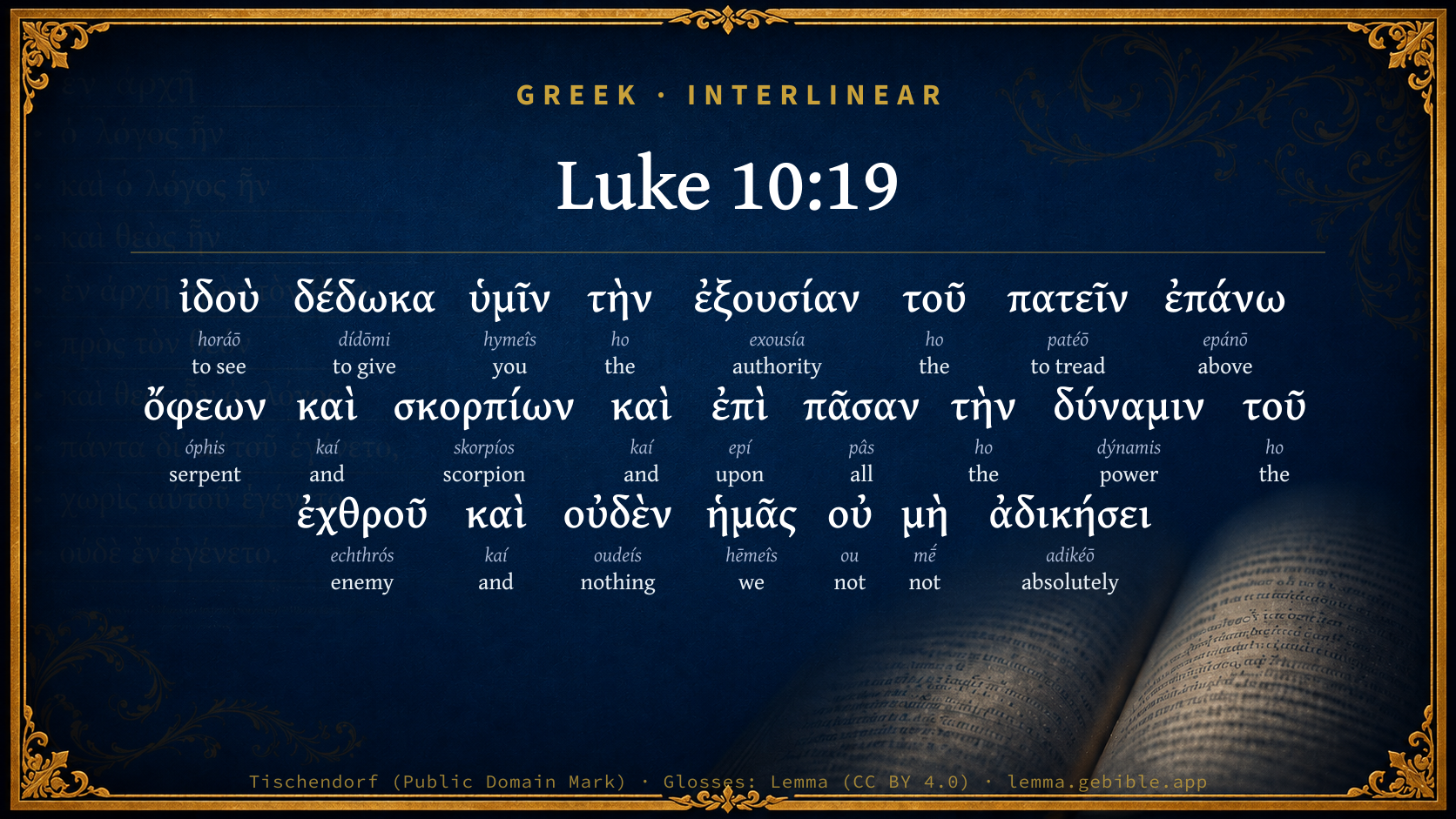
Greek (Tischendorf 8th ed.) Luke 10:19 appears in the Greek New Testament. The text above is from the Tischendorf 8th edition. Each word links to its Strong’s number and a concise gloss. Click any word for its full Thayer’s Greek Lexicon entry.
Download image
Cite this verse

Luke 10:19 (World English Bible). Public Domain. Lemma interlinear Bible study tool, https://lemma.gebible.app/v/luke/10/19.

Show BibTeX & RIS
BibTeX
RIS
English Translation
Behold, I give you authority to tread on serpents and scorpions, and over all the power of the enemy. Nothing will in any way hurt you.
World English Bible · Public Domain
Highlights
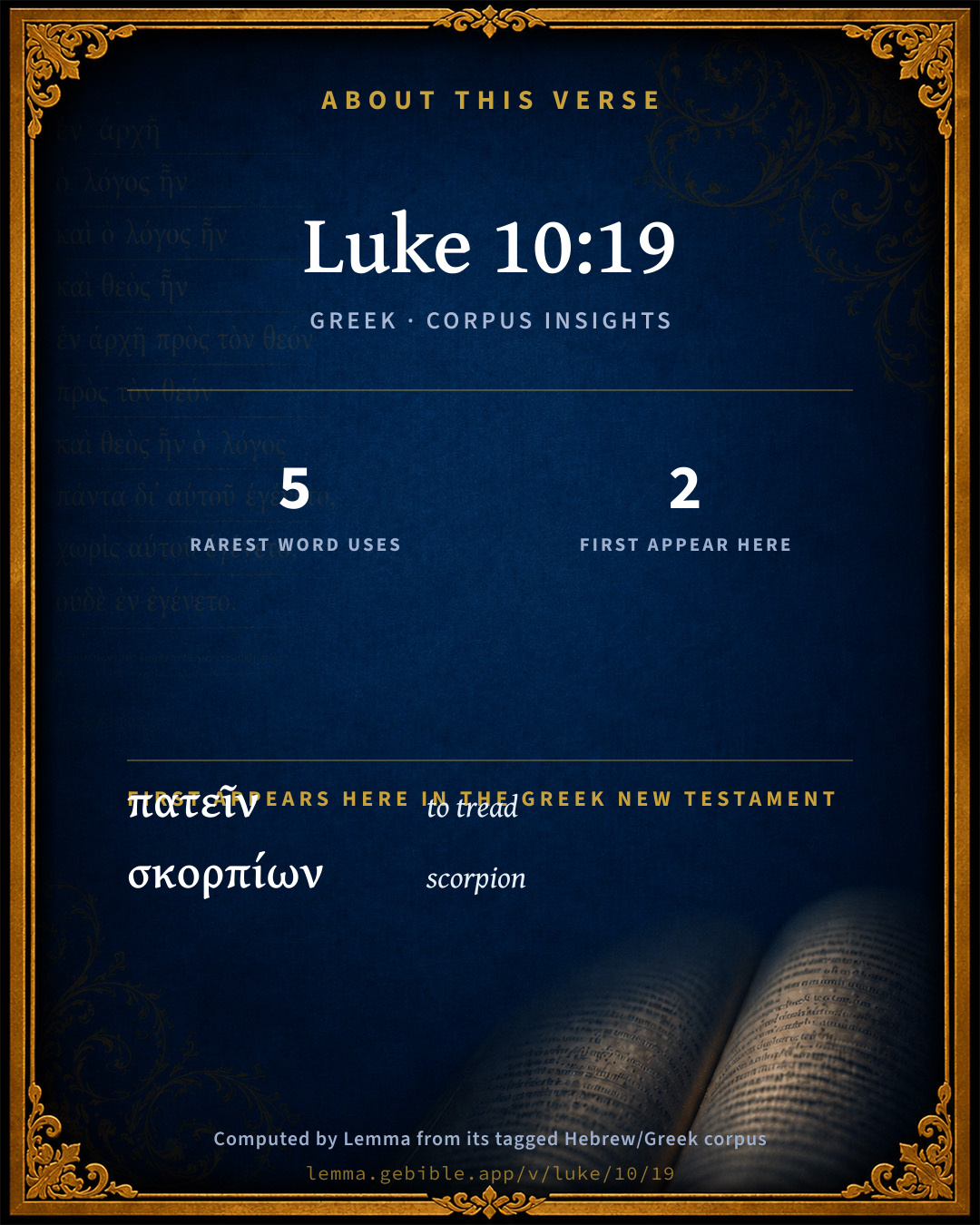
  • 2 first appearances in the Greek New Testament
Full analysis ↓
Download a study sheet

One document with this verse’s original text, its word-by-word gloss line, the meaning frame, cross-references with their text, attributed commentary, and full source and license credits — printable, and it pastes into notes with its structure intact.

This verse Autodidact and up

Study sheet (.html) Plain text (.txt)

A passage Seminary Student

Up to 50 verses in one chapter. A passage sheet keeps up to 6 commentary sources and 12 cross-references per verse, in the order this page ranks them, and says so on the sheet whenever that leaves anything out. Ask for a single verse and you get the Autodidact verse sheet above.

Everything on this page stays free to read, with no account — the sheet is a download of what is already on screen, not access to it.

Want to remove ads? Support Godless Engineer
Compare translations 3

The same verse in 3 English versions, stacked beneath the original-language interlinear above. Click any original word for its lexicon entry.

Each is an independent rendering of the whole verse — the interlinear is not word-aligned to these translations.

Highlighted words mark where these versions differ — a whole-verse word diff, not a word-by-word alignment.

  • World English Bible Public Domain
    Behold, I give you authority to tread on serpents and scorpions, and over all the power of the enemy. Nothing will in any way hurt you.
  • King James Version Public Domain
    Behold, I give unto you power to tread on serpents and scorpions, and over all the power of the enemy: and nothing shall by any means hurt you.
  • unfoldingWord Literal Text CC BY-SA 4.0
    Behold, I have given you authority to tread on snakes and scorpions, and over all the power of the enemy, and nothing will harm you at all.

unfoldingWord Literal Text — © unfoldingWord, licensed CC BY-SA 4.0. Word-aligned USFM3 via Door43 (git.door43.org/unfoldingWord/en_ult).

Versions to compare (up to 4)

3 of 4 selected

Show all 19 translations

Every available English version of this verse, each an independent rendering of the whole verse.

  • World English Bible Public Domain
    Behold, I give you authority to tread on serpents and scorpions, and over all the power of the enemy. Nothing will in any way hurt you.
  • Berean Standard Bible Public Domain
    Behold, I have given you authority to tread on snakes and scorpions, and over all the power of the enemy. Nothing will harm you.
  • Majority Standard Bible Public Domain
    Behold, I am giving you authority to tread on snakes and scorpions, and over all the power of the enemy. Nothing will harm you.
  • King James Version Public Domain
    Behold, I give unto you power to tread on serpents and scorpions, and over all the power of the enemy: and nothing shall by any means hurt you.
  • American Standard Version (1901) Public Domain
    Behold, I have given you authority to tread upon serpents and scorpions, and over all the power of the enemy: and nothing shall in any wise hurt you.
  • Revised Version (1885) Public Domain
    Behold, I have given you authority to tread upon serpents and scorpions, and over all the power of the enemy: and nothing shall in any wise hurt you.
  • Geneva Bible (1599) Public Domain
    Beholde, I giue vnto you power to treade on Serpents, and Scorpions, and ouer all the power of the enemie, and nothing shall hurt you.
  • Douay-Rheims (1899) Public Domain
    Behold, I have given you power to tread upon serpents and scorpions, and upon all the power of the enemy: and nothing shall hurt you.
  • Young's Literal Translation Public Domain
    lo, I give to you the authority to tread upon serpents and scorpions, and on all the power of the enemy, and nothing by any means shall hurt you;
  • Literal Standard Version CC BY-SA 4.0
    behold, I give to you the authority to tread on serpents and scorpions, and on all the power of the enemy, and nothing by any means will hurt you;
  • Unlocked Literal Bible CC BY-SA 4.0
    See, I have given you authority to tread on serpents and scorpions, and over all the power of the enemy, and nothing will in any way hurt you.
  • unfoldingWord Literal Text CC BY-SA 4.0
    Behold, I have given you authority to tread on snakes and scorpions, and over all the power of the enemy, and nothing will harm you at all.
  • Darby Bible Public Domain
    Behold, I give you the power of treading upon serpents and scorpions and over all the power of the enemy, and nothing shall in anywise injure you.
  • World Messianic Bible Public Domain
    Behold, I give you authority to tread on serpents and scorpions, and over all the power of the enemy. Nothing will in any way hurt you.
  • Webster's Bible Public Domain
    Behold, I give to you power to tread on serpents and scorpions, and over all the power of the enemy: and nothing shall by any means hurt you.
  • Free Bible Version CC BY-SA 4.0
    Yes, I have given you power to tread on snakes and scorpions, and to overcome all the enemy's strength, and nothing will harm you.
  • Bible in Basic English Public Domain
    See, I have given you power to put your feet on snakes and evil beasts, and over all the strength of him who is against you: and nothing will do you damage.
  • Text-Critical English NT CC BY 4.0
    Behold, I am giving you authority to tread on serpents and scorpions, and to overcome all the power of the enemy, and nothing at all will harm you.
  • Tyndale New Testament (1534) Public Domain
    Beholde I geve vnto you power to treade on serpetes and scorpions and over all maner power of the enimye and no thinge shall hurte you.

Literal Standard Version (2020), Covenant Press — licensed CC BY-SA 4.0. Text via the HelloAO Bible API (eBible.org). Unlocked Literal Bible (unfoldingWord) — licensed CC BY-SA 4.0. Text via the HelloAO Bible API (eBible.org). unfoldingWord Literal Text — © unfoldingWord, licensed CC BY-SA 4.0. Word-aligned USFM3 via Door43 (git.door43.org/unfoldingWord/en_ult). Free Bible Version, Dr. Jonathan Gallagher — licensed CC BY-SA 4.0. Text via the HelloAO Bible API (eBible.org).

Word by word

More ways to search: Search by grammar → Find every occurrence → Compare this word →

Practice this passage: Drill this verse → Learn its vocabulary →

πατεῖν
patéō
G3961
“to tread”
Verb, Present, Active, Infinitive
Part of Speech
Verb
Tense
Present
Voice
Active
Mood
Infinitive
Full Thayer's Definition

Origin: "from a derivative probably of G3817 (meaning a "path")"

TDNT: 20:40,8

1. to tread a. to trample, crush with the feet b. to advance by setting foot upon, tread upon: to encounter successfully the greatest perils from the machinations and persecutions with which Satan would fain thwart the preaching of the gospel c. to tread under foot, trample on, i.e. to treat with insult and contempt: to desecrate the holy city by devastation and outrage
  1. ἰδοὺ horáō G3708 “to see” Verb, Aorist, Middle, Imperative, 2nd person, Singular
  2. δέδωκα dídōmi G1325 “to give” Verb, Perfect, Active, Indicative, 1st person, Singular
  3. ὑμῖν hymeîs G5210 “you” Personal pronoun, 2nd person, Dative, Plural
  4. τὴν ho G3588 “the” Article, Accusative, Singular, Feminine
  5. ἐξουσίαν exousía G1849 “authority” Noun, Accusative, Singular, Feminine
  6. τοῦ ho G3588 “the” Article, Genitive, Singular, Neuter
  7. ἐπάνω epánō G1883 “above” Adverb
  8. ὄφεων óphis G3789 “serpent” Noun, Genitive, Plural, Masculine
  9. καὶ kaí G2532 “and” Conjunction
  10. σκορπίων skorpíos G4651 “scorpion” Noun, Genitive, Plural, Masculine
  11. καὶ kaí G2532 “and” Conjunction
  12. ἐπὶ epí G1909 “upon” Preposition
  13. πᾶσαν pâs G3956 “all” Adjective, Accusative, Singular, Feminine
  14. τὴν ho G3588 “the” Article, Accusative, Singular, Feminine
  15. δύναμιν dýnamis G1411 “power” Noun, Accusative, Singular, Feminine
  16. τοῦ ho G3588 “the” Article, Genitive, Singular, Masculine
  17. ἐχθροῦ echthrós G2190 “enemy” Adjective, Genitive, Singular, Masculine
  18. καὶ kaí G2532 “and” Conjunction
  19. οὐδὲν oudeís G3762 “nothing” Adjective, Accusative, Singular, Neuter, Negative
  20. ἡμᾶς hēmeîs G2249 “we” Personal pronoun, 1st person, Accusative, Plural
  21. οὐ ou G3756 “not” Particle, Negative
  22. μὴ mḗ G3361 “not” Particle, Negative
  23. ἀδικήσει adikéō G91 “absolutely” Verb, Future, Active, Indicative, 3rd person, Singular

About this verse

These counts appear in no published source. They are computed here, from the morphology-tagged text and Lemma’s own curated glosses. What Lemma adds →

24
words
19
distinct lemmas
Gospels
section

Notable vocabulary

The rarest word here is πατεῖν to tread G3961 — appearing just 5 times in the whole Greek New Testament.

First appearance in Scripture

These words make their first canonical appearance in the Greek New Testament here:

  • πατεῖν to tread G3961
  • σκορπίων scorpion G4651

Shared distinctive vocabulary

πατεῖν to tread G3961 occurs in 5 verses of the Greek New Testament. Also found in:
Repetition

Words recur within this verse:

Cross-references

10

Topical passages linked to Luke 10:19 in the Treasury of Scripture Knowledge — connected by theme and wording, ordered by reader-vote popularity; previews shown in the World English Bible.

  • Psalms 91:13 You will tread on the lion and cobra. You will trample the young lion and the serpent underfoot.
  • Mark 16:18 they will take up serpents; and if they drink any deadly thing, it will in no way hurt them; they will lay hands on the sick, and they will recover."
  • Romans 16:20 And the God of peace will quickly crush Satan under your feet. The grace of our Lord Jesus Christ be with you.
  • Acts 28:5 However he shook off the creature into the fire, and wasn't harmed.
  • Revelation 11:5 If anyone desires to harm them, fire proceeds out of their mouth and devours their enemies. If anyone desires to harm them, he must be killed in this way.
  • Luke 21:17–18 You will be hated by all men for my name's sake.
  • Ezekiel 2:6 You, son of man, don't be afraid of them, neither be afraid of their words, though briers and thorns are with you, and you do dwell among scorpions: don't be afraid of their words, nor be dismayed at their looks, though they are a rebellious house.
  • Romans 8:31–39 What then shall we say about these things? If God is for us, who can be against us?
  • Hebrews 13:5–6 Be free from the love of money, content with such things as you have, for he has said, "I will in no way leave you, neither will I in any way forsake you."
  • Isaiah 11:8 The sucking child shall play on the hole of the asp, and the weaned child shall put his hand on the adder's den.

Cross-references courtesy of OpenBible.info (CC BY 4.0).

Commentary

Notes on Luke 10:19 from classic Christian and Jewish commentators (each source and its license shown beneath its notes). The classic Christian expositions comment on the surrounding passage and are grouped to its opening verse, so a note may address several verses; the Jewish commentaries on the Tanakh (Rashi and others) are per-verse, so they appear only where the commentator wrote on this verse.

Lemma curates 59 commentaries, every one of them public domain or Creative Commons licensed, each selected and text-cleaned for this edition rather than reprinted as found. About our sources →

Tyndale Open Study Notes

Tyndale Open Resources

10:19 Snakes and scorpions were symbols of danger and evil (see Num 21:6-9; Deut 8:15; 1 Kgs 12:14; Isa 11:8; Ezek 2:6). Satan is the ancient serpent who tempted Eve (Gen 3:15; Rom 16:20; Rev 12:9; 20:2), and demonic forces are described as scorpions (Rev 9:3-4). • Nothing will injure you: This didn’t mean that Jesus’ followers should take dangerous chances. The point is that God protects his servants (e.g., Acts 28:3-6).

Tyndale Open Study Notes — © Tyndale Open Resources, licensed CC BY-SA 4.0. Text via the HelloAO Bible API.

Bengel's Gnomon

Johann Albrecht Bengel

Luk 10:19. Δίδωμι) As I have given, so in continuation I give.—ὄφεων, serpents) Mar 16:18. An appellation appropriate to an earthly enemy: He no longer alludes to the enemy descending “from heaven,” as in the image, as lightning. The passage, Act 28:3, et seqq., is parallel to Mar 16:18; but between Mark and Luke (the Gospel) there is a verbal parallelism, yet one not of the things themselves, but of the names.[97] Believers were secured against serpents, called so both in the literal and metaphorical sense.—σκορπίων, scorpions) which are more subtle (keen, or else more minute) than serpents.—δὐναμιν) power, or, צבא, forces. Serpents and scorpions are the species: All the power is the genus.—τοῦ ἐχθροῦ, of the enemy) The singular number, applying to the chief enemy [Mat 13:39; Psa 8:3].—Οὐ ΜῊ ἈΔΙΚΉΣῌ, shall not hurt) Greater danger was lying hidden beneath, than the inexperienced had been sensible of.

[97] ‘Homonymicus,” i.e. where the same name or term is applied to different things.—ED. and TRANSL.

Bengel's Gnomon of the New Testament — English translation (T&T Clark, Edinburgh, 1860) — public domain. Text from a community e-Sword module.

Expositor's Greek Testament

ed. W. Robertson Nicoll

Luk 10:19 reminds one of Mar 16:18 . τοῦ ἐχθροῦ , the enemy, Satan. οὐδὲν , may be either nominative or accusative = either, “nothing shall in any wise hurt you,” R. V [101] , or “in no respect shall he (the enemy) hurt you”.

[101] Revised Version.

The Expositor's Greek Testament, edited by W. Robertson Nicoll (1897–1910) — public domain. Text from a community e-Sword module.

Geneva Bible (1599)

Geneva Bible translators

Shall do you wrong.

Geneva Bible (1599) marginal notes — public domain. Text via Bolls.life.

Jamieson, Fausset & Brown

Robert Jamieson, A. R. Fausset & David Brown

Behold, I give you, &c.--not for any renewal of their mission, though probably many of them afterwards became ministers of Christ; but simply as disciples.

serpents and scorpions--the latter more venomous than the former: literally, in the first instance (Mar 16:17-18; Act 28:5); but the next words, "and over all the power of the enemy, and nothing shall by any means hurt you," show that the glorious power of faith to "overcome the world" and "quench all the fiery darts of the wicked one," by the communication and maintenance of which to His people He makes them innocuous, is what is meant (Jo1 5:4; Eph 6:16).

Jamieson, Fausset & Brown — Commentary Critical and Explanatory on the Whole Bible (1871) — public domain (CC PDM 1.0). Text via the HelloAO Bible API.

Adam Clarke's Commentary

Verse 19. To tread on serpents, c.] It is possible that by serpents and scorpions our Lord means the scribes and Pharisees, whom he calls serpents and a brood of vipers, Mt 23:33, (see the note there,) because, through the subtilty and venom of the old serpent, the devil, they opposed him and his doctrine and, by trampling on these, it is likely that he means, they should get a complete victory over such: as it was an ancient custom to trample on the kings and generals who had been taken in battle, to signify the complete conquest which had been gained over them. See Jos 10:24. See also Ro 16:20. See the notes on Mr 16:17; Mr 16:18.

Adam Clarke's Commentary on the Bible (1810–1826) — public domain. Text from a community e-Sword/MySword module.

Ellicott's Commentary for English Readers

(19) Behold, I give unto you . . .—The better MSS. have, “I have given,” as of something already bestowed in its completeness. In the power to “tread on serpents and scorpions,” we have a manifest reference to the words of Psa_91:13. Those words stand in closest sequence with the promise which had been wrested from its true meaning by the Tempter in the great struggle in the wilderness; and it is not over-bold to think that they were connected with our Lord’s memories of that time, and especially of the fact indicated by St. Mark’s statement (Mar_1:13) that He “was with the wild beasts.” Now, through resistance to the Temptation, there had come the victory which if He had then yielded, never would have been won. Of a literal fulfilment of the words, St. Paul’s escape from the viper at Melita (Act_28:3) is the only recorded instance; but the parallelism between this promise and that of Psa_91:13 shows that the literal meaning falls into the background, that the serpent and the scorpion are symbols of spiritual powers of evil. A merely literal interpretation lands us in two serious difficulties: (1) that it represents the treading on serpents as a greater work than casting out demons; and (2) that it implies that serpents and scorpions, as such, are not part of God’s creation, but belong to the power of the Evil One. So far as we think of a literal fulfilment at all, it can only be as the symbol and earnest of the spiritual. The real kernel of the promise lies in the last words, “Nothing shall by any means hurt you,” and these find their interpretation in the thought that “nothing shall separate us from the love of God,” and that “all things work together for good to those that love Him” (Rom_8:39; Rom_8:28).

A Bible Commentary for English Readers, edited by Charles John Ellicott (1878–1897) — public domain. Text from a community e-Sword module.

The Cambridge Bible for Schools and Colleges

gen. ed. J. J. S. Perowne

19. I give] Read, I have given, with א, B, C, L, &c.

power] Rather, the authority.

to tread on serpents and scorpions] Compare Mar_16:17-18. So far as the promise was literal, the only fact of the kind referred to in the

N. T. is Act_28:3-5. In legend we have the story of St John saved from poison, which is represented in Christian art as a viper escaping from the cup (Jameson, Sacred and Legendary Art, I. 159). But it may be doubted whether the meaning was not predominantly spiritual as in Gen_3:15; Rom_16:20; Psa_91:13; Isa_11:8.

nothing shall by any means hurt you] Rom_8:28; Rom_8:39.

The Cambridge Bible for Schools and Colleges (gen. ed. J. J. S. Perowne; Cambridge University Press, 1878–1918) — public domain. Text from a community e-Sword module.

John Gill's Exposition

Behold, I give you power to tread on serpents and scorpions,.... Which may be literally understood, as in Mar 16:18, or figuratively of the devil, and his principalities and powers, and all his emissaries, who, for their craft and cunning, and for their poisonous and hurtful nature and influence, may be compared to serpents and scorpions:

and over all the power of the enemy; of mankind in general, and of the seed of the woman, Christ and his people in particular, Christ has a power over all his power, his whole posse of devils, even the power of the air, of which he is prince; and he communicated this power to his disciples, even to the seventy: adding,

and nothing shall by any means, hurt you; not the most hurtful and poisonous animals, nor the most malicious persecutors on earth, nor all the devils in hell: as the former venomous creatures, when took up in their hands, should not hurt, their bodies; so the other, whatever they might be permitted to do with respect to their lives, and outward estate, should never hurt their souls, and the eternal welfare of them; nor even hinder the work of God prospering in their hands.

John Gill's Exposition of the Whole Bible (1746–1763) — public domain (CC PDM 1.0). Text via the HelloAO Bible API.

Trapp's Complete Commentary

John Trapp

19 Behold, I give unto you power to tread on serpents and scorpions, and over all the power of the enemy: and nothing shall by any means hurt you.

Ver. 19. To tread on serpents] {See Trapp on "Mar 16:18"} Good ministers tread so hard on the old serpent’s head, that it is no wonder he turns again, and nibbleth at their heels.

John Trapp, A Commentary or Exposition upon All the Books of the Old and New Testament (1647–1656) — public domain. Text from a community e-Sword module.

Albert Barnes' Notes on the Bible

To tread on serpents - Preservation from danger. If you tread on a poisonous reptile that would otherwise injure you, I will keep you from danger. If you go among bitter and malignant enemies that would seek your life, I will preserve you. See the notes at Mar 16:18.

Scorpions - The scorpion is an animal with eight feet, eight eyes and a long jointed tail, ending in a pointed weapon or sting. It is found in tropical climates, and seldom exceeds 4 inches in length. Its sting is extremely poisonous, and it is sometimes fatal to life. It is in Scripture the emblem of malicious and crafty men. When rolled up it has some resemblance to an egg, Luk 11:12; Eze 2:6. The annexed cut will give an idea of its usual form and appearance.

The enemy - Satan. The meaning of this verse is, that Jesus would preserve them from the power of Satan and all his emissaries - from all wicked and crafty men; and this shows that he had divine power. He that can control Satan and his hosts that can be present to guard from all their machinations, see all their plans, and destroy all their designs, must be clothed with no less than almighty power.

Albert Barnes' Notes on the Bible (1834–1885) — public domain. Text from a community e-Sword/MySword module.

Haydock's Catholic Bible Commentary

Given you power, &c. By these words our Saviour seems to insinuate, that the venom of serpents, and the other noxious qualities of some animals, proceed from the malice of the devil. These are the arms and the instruments he makes us of to kill us, being the prince of death and a murderer from the beginning, as the Scripture styles him. The Jews attributed sickness, poisons, and every thing of the same kind to evil spirits.

George Leo Haydock (1774–1849), Haydock's Catholic Family Bible and Commentary, 1859 edition — public domain. Excludes Psalms (Douay-Rheims chapter numbering differs from Protestant) and Deuterocanonical books (Catholic canon only).

Matthew Poole's English Annotations

Christ doth here:

1. Confirm the power before given to these seventy for working miracles, that they might not think that it ceased upon the determination of their first mission.

2. He confirmeth his promise to them for his presence with them, and protection of them.

Interpreters think here is a manifest allusion to Psa 91:13, Thou shalt tread upon the lion and adder: the young lion and the dragon shalt thou trample under thy feet: which must be understood figuratively, the sense being, that nothing should hurt them. This promise was more specially verified for some years in God’s protection of time first ministers of the gospel, until they had done their work; and shall be fulfilled in a sense to the end of the world, according to the promise in Psa 91:13. Nothing shall hurt their souls, as to the favour of God and their eternal happiness, nor their bodies, so far forth as, or so long as, God in his wisdom shall judge fit. They have a further power also given them more common to all the ministers of the gospel sent by Christ, yea, and to all Christians. They have a power over all the power of the enemy; God will not be wanting to them in a power to resist the devil, and they have a promise that, being resisted, he shall flee from them.

Matthew Poole's English Annotations on the Holy Bible (1683–1685) — public domain. Text from a community e-Sword/MySword module.

Whedon's Commentary on the Bible

Daniel D. Whedon

19. Behold I give—The perfect tense, I have given. The Greek perfect signifies a past act whose effect remains. I have given and the gift still remains. The gift was imparted in the first bestowment of their symbolical office, as one of its significant points. It was probably to cease with their office, though this may not be so certain. The same promise was made even to private believers in Mar_16:18, on which see our note.

Power to tread on serpents and scorpions—And as the casting out of demons by the Seventy, and the fall of Satan, which Christ saw, were both actual and physical realities, so was this treading on serpents and scorpions an actual and physical reality. The Seventy during their mission should find a superiority to reptile venom one of their miraculous gifts, as did Paul at Melita. Act_28:5. But all three of these realities were symbols of the spiritual. They were the type of the final

bruising of the serpent’s head. All the power of the enemy—It is not sin which has produced physical evil in the world; for evil, accident, and death existed on earth, as geology shows, before Adam sinned. But sin excluded man from access to the tree of life, from which he had been immortal, and thus sin established that relation of the body and mind of man towards external nature, as that disease and death ensue. Sin, therefore, constitutes to man the power of the serpent’s venom and the scorpion’s sting. Christ here promises to these his followers some faint restoration of the Adamic superiority to the power of the enemy.

The enemy—The chief and first old Serpent; the Satan of Luk_10:18, by whose first hostility all other venomous things are poisonous to man.

Hurt you—This promise of miraculous power should doubtless be limited by the laws of miracle and faith, as defined in our note on Mat_17:20.

Daniel D. Whedon (gen. ed.), Commentary on the Old and New Testaments (1874–1909) — public domain. Text from a community e-Sword module.

The Pulpit Commentary

Behold, I give unto you power to tread on serpents and scorpions, and over all the power of the enemy. The older authorities read here, "I have given." The only recorded instance of a literal fulfilment of this promise was in the case of Paul at Melita, after the shipwreck. (Act_24:3-5) A similar promise was made during the "forty days". (Mar_16:17, 18) It seems however, best, in the case of this peculiar promise, to interpret the Lord"s words as referring to spiritual powers of evil, taking the serpent and scorpion as symbols of these. It should be remembered that the subject of conversation between the Master and his servants was the conflict with and victory ever these awful powers restlessly hostile to the human race. (see Psa_91:13)

The Pulpit Commentary (1880–1919), ed. H.D.M. Spence-Jones & Joseph S. Exell — public domain. Text from a community e-Sword module.

John Wesley's Explanatory Notes

I give you power - That is, I continue it to you: and nothing shall hurt you - Neither the power, nor the subtilty of Satan.

John Wesley, Explanatory Notes Upon the Whole Bible (1754–1765) — public domain. Text via the GEBible commentary corpus.

Burkitt's Expository Notes on the New Testament

William Burkitt

Our Lord, finding that his seventy ambassadors had managed their former commission so well, he here enlarged it, adding there unto a promise of divine protection: Behold I give you power to tread on serpents, and nothing shall hurt you; as if Christ had said, "Go forth again in this armor of power, with which I have girt you, and I warrant you sword-free and shot-free; nothing shall by any means hurt you, neither strength nor stratagem shall overcome you. Neither the power, the presence, nor protection, of God, shall be wanting to any of Christ’s ministers, or members, who go forth in his strength against the spiritual enemies of their salvation."

As we have a promise of power in this text to enable us to resist the devil, so we have a promise of success elsewhere upon our resisting him: Resist the devil and he will flee from you, Jas 4:7

William Burkitt's Expository Notes on the New Testament (1700–1703) — public domain. Text from a community e-Sword module.

Cambridge Greek Testament for Schools and Colleges

19. δέδωκα. אBCL, Ti[216] W.H[217] ‘I have given.’ The Rec[218] δίδωμι, ‘I am giving.’

[216] Ti. Tischendorf.

[217] W.H. Westcott and Hort.

[218] Rec. The Textus Receptus.

19. δέδωκα. ‘I have given,’ with אBCL, &c.

τὴν ἐξουσίαν. ‘The authority.’

τοῦ πατεῖν ἐπάνω ὄφεων καὶ σκορπίων. Compare Mar 16:17-18. So far as the promise was literal, the only fact of the kind referred to in the N.T. is Act 28:3-5. In legend we have the story of St John saved from the poison, which is represented in Christian art as a viper escaping from the cup (Jameson, Sacred and Legendary Art, I. 159). But it may be doubted whether the meaning was not predominantly spiritual, as in Gen 3:15; Rom 16:20; Psa 91:13; Isa 11:8. For the metaphorical application of ‘serpents’ and ‘scorpions’ see Luk 3:7; Rev 9:5.

οὐδὲν ὑμᾶς οὐ μὴ ἀδικήσει. Rom 8:28; Rom 8:39.

Cambridge Greek Testament for Schools and Colleges (Cambridge University Press, 1896; 21 vols, various authors incl. Carr, Maclear, Plummer, Farrar, Lumby, Moule, M. R. James, Simcox) — public domain. Text from a community e-Sword module.

Alford’s Greek Testament

Henry Alford

19.] Our Lord here,—including all the evil and poison in nature in the δύναμις τοῦ ἐχθ.,—from the power given Him over that enemy, asserts the gift to them, extended afterwards to all believers (Mar 16:18), of authority to ‘bruise the head of the serpent’ (Gen 3:15). There is an evident allusion to Psa 91:13.

Henry Alford, The Greek Testament (1849–1861) — public domain. Text from a community e-Sword module.

International Critical Commentary

19. δέδωκα ὑμῖν τὴν ἐξουσίαν . The powers which they have received are larger than they had supposed. They possessed during their mission, and still retain, the ἐξουσία to vanquish the powers of evil. Note the article, which is almost peculiar to this passage. Contrast 5:24, 9:1, 12:5, 19:17; Act 9:14. The passage is possibly moulded on Psa 91:13: ἐπʼ ἀσπίδα καὶ βασιλίσκον ἐπιβήσῃ, καὶ καταπατήσεις λέοντα καὶ δράκοντα; but comp. Deu 8:15: τοῦ ἀγαγόντος σε διὰ τῆς ἐρήμου τῆς μεγάλης καὶ τῆς φοβερᾶς ἐκείνης, οὗ ὂφις δάκνων καὶ σκορπίος. The meaning is that no fraud or treachery shall prevail against them.

καὶ ἐπὶ π. τὴν δύναμιν τοῦ ἐχθροῦ. Contrast the δύναμις of the enemy with the ἐξουσια given by Christ. Nor shall any hostile strength or ability succeed. The promise in both cases refers to victory over spiritual foes rather than to immunity from bodily injuries. “The enemy” means Satan: Mat 13:25; Rom 14:20; 1Pe 5:8. But protection from physical harm may be included (Act 28:3-5). The appendix to Mk. more clearly includes this (14:18). Comp. the story of S. John being preserved from being harmed by boiling oil (Tertul. Praeligscr. Haeligr. xxxvi.), or by drinking hemlock (Lips. Apokr. Apostelgesch. 1. PP. 426, 428, 432, 480, etc.). This latter story is unknown to the Fathers of the first six centuries.

ἐπὶν πᾶσαν τὴν δυν . This does not depend upon πατεῖν, as is shown by the change of prep. and case, but upon ἐξουσίαν. They have ἐξουσία over every δύναμις. Syr-Sin. omits πᾶσαν.

πατεῖν ἐπάνω . Not of trampling under foot as vanquished, but of walking upon without being hurt.

οὐδὲν ὑμᾶς οὐ μὴ ἀδικήσει . Strong negation: οὐδέν is probably the subject of ἀδικήσει. We might translate, “and the power of the enemy shall not in anywise hurt you.” For ἀδικεῖν with double acc. comp. Act 25:10; Gal 4:12; Phm 1:18: and for ἀδικεῖν in the sense of “injure” comp. Rev 7:3, Rev 9:4. The reading ἀδικήσῃ (BC) looks like a grammatical correction.

This last clause sums up the other two. They have power over fraud and force; nothing shall harm them. Comp. Joh 10:28, Joh 10:29; Isa 11:8, Isa 11:9.Isa 11:1

International Critical Commentary — older volumes (1896–1929), various authors — public domain. Text from a community e-Sword module.

Lesson kit

Teaching starters — assembled from the data on this page, not authored interpretation. Every prompt links to the verse data it draws on. Edit before teaching.

Luke, in the Gospels, opens this verse with 24 words (19 distinct Greek lemmas). Its most distinctive word is patéō (“to tread”). A historical commentator’s framing appears above. Read the whole chapter for the surrounding context.

Discussion questions

  1. The word patéō carries the sense “to tread.” How does it shape the verse?
  2. 2 words here appear for the first time in Scripture. What is being introduced at this debut?
  3. Luke 21:24 shares the word «to tread» with this verse. How do the two illuminate each other?
  4. “the” occurs 4× in this one verse. What is the effect of the repetition?
  5. These translations render this verse differently; the difference is in the English rendering, not the original. What questions does that raise?
  6. Reading how Tyndale Open Study Notes and Bengel's Gnomon read this verse, where do the two commentators agree and where do they part?

Things to notice

  • 2 words make their first canonical appearance in Scripture here.
  • These translations choose different wording for 13 words in this verse.
  • “the” occurs 4× in this single verse.
  • 19 distinct Greek lemmas span 24 words in this verse.

Reading settings

Reading text

Shown beneath each verse's original-language words.

Old Testament
Old Testament edition

Read the OT as the Masoretic Hebrew (MT) or the Greek Septuagint (LXX).

English shown for the Greek Septuagint (in the Hebrew ↔ Greek comparison).

Comparing translations? Open the Compare panel on any verse page to stack up to four side by side.