John 18:20

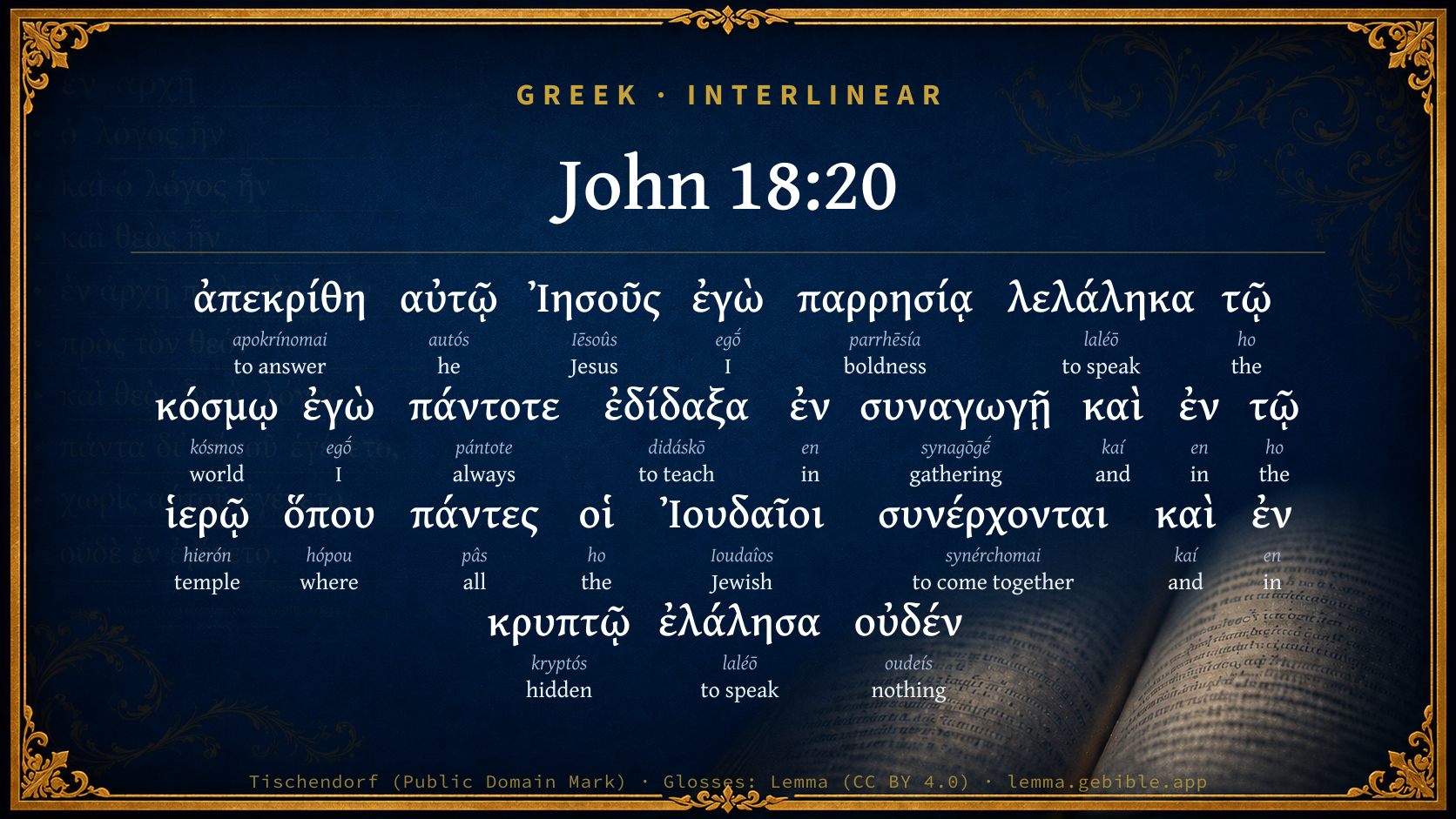
Greek (Tischendorf 8th ed.) John 18:20 appears in the Greek New Testament. The text above is from the Tischendorf 8th edition. Each word links to its Strong’s number and a concise gloss. Click any word for its full Thayer’s Greek Lexicon entry.
Download image
Cite this verse

John 18:20 (World English Bible). Public Domain. Lemma interlinear Bible study tool, https://lemma.gebible.app/v/john/18/20.

Show BibTeX & RIS
BibTeX
RIS
English Translation
Jesus answered him, "I spoke openly to the world. I always taught in synagogues, and in the temple, where the Jews always meet. I said nothing in secret.
World English Bible · Public Domain
Download a study sheet

One document with this verse’s original text, its word-by-word gloss line, the meaning frame, cross-references with their text, attributed commentary, and full source and license credits — printable, and it pastes into notes with its structure intact.

This verse Autodidact and up

Study sheet (.html) Plain text (.txt)

A passage Seminary Student

Up to 50 verses in one chapter. A passage sheet keeps up to 6 commentary sources and 12 cross-references per verse, in the order this page ranks them, and says so on the sheet whenever that leaves anything out. Ask for a single verse and you get the Autodidact verse sheet above.

Everything on this page stays free to read, with no account — the sheet is a download of what is already on screen, not access to it.

Want to remove ads? Support Godless Engineer
Compare translations 3

The same verse in 3 English versions, stacked beneath the original-language interlinear above. Click any original word for its lexicon entry.

Each is an independent rendering of the whole verse — the interlinear is not word-aligned to these translations.

Highlighted words mark where these versions differ — a whole-verse word diff, not a word-by-word alignment.

  • World English Bible Public Domain
    Jesus answered him, "I spoke openly to the world. I always taught in synagogues, and in the temple, where the Jews always meet. I said nothing in secret.
  • King James Version Public Domain
    Jesus answered him, I spake openly to the world; I ever taught in the synagogue, and in the temple, whither the Jews always resort; and in secret have I said nothing.
  • unfoldingWord Literal Text CC BY-SA 4.0
    Jesus answered him, “I have spoken openly to the world. I was always teaching in a synagogue and in the temple where all the Jews come together, and I said nothing in secret.

unfoldingWord Literal Text — © unfoldingWord, licensed CC BY-SA 4.0. Word-aligned USFM3 via Door43 (git.door43.org/unfoldingWord/en_ult).

Versions to compare (up to 4)

3 of 4 selected

Show all 19 translations

Every available English version of this verse, each an independent rendering of the whole verse.

  • World English Bible Public Domain
    Jesus answered him, "I spoke openly to the world. I always taught in synagogues, and in the temple, where the Jews always meet. I said nothing in secret.
  • Berean Standard Bible Public Domain
    “I have spoken openly to the world,” Jesus answered. “I always taught in the synagogues and at the temple, where all the Jews come together. I said nothing in secret.
  • Majority Standard Bible Public Domain
    “I have spoken openly to the world,” Jesus answered. “I always taught in the synagogues and at the temple, where the Jews always come together. I said nothing in secret.
  • King James Version Public Domain
    Jesus answered him, I spake openly to the world; I ever taught in the synagogue, and in the temple, whither the Jews always resort; and in secret have I said nothing.
  • American Standard Version (1901) Public Domain
    Jesus answered him, I have spoken openly to the world; I ever taught in synagogues, and in the temple, where all the Jews come together; and in secret spake I nothing.
  • Revised Version (1885) Public Domain
    Jesus answered him, I have spoken openly to the world; I ever taught in synagogues, and in the temple, where all the Jews come together; and in secret spake I nothing.
  • Geneva Bible (1599) Public Domain
    Iesus answered him, I spake openly to the world: I euer taught in the Synagogue and in the Temple, whither the Iewes resort continually, and in secret haue I sayde nothing.
  • Douay-Rheims (1899) Public Domain
    Jesus answered him: I have spoken openly to the world: I have always taught in the synagogue, and in the temple, whither all the Jews resort; and in secret I have spoken nothing.
  • Young's Literal Translation Public Domain
    Jesus answered him, `I spake freely to the world, I did always teach in a synagogue, and in the temple, where the Jews do always come together; and in secret I spake nothing;
  • Literal Standard Version CC BY-SA 4.0
    Jesus answered him, “I spoke freely to the world, I always taught in a synagogue, and in the temple, where the Jews always come together; and I spoke nothing in secret;
  • Unlocked Literal Bible CC BY-SA 4.0
    Jesus answered him, “I have spoken openly to the world. I was always teaching in synagogues and in the temple where all the Jews come together. I said nothing in secret.
  • unfoldingWord Literal Text CC BY-SA 4.0
    Jesus answered him, “I have spoken openly to the world. I was always teaching in a synagogue and in the temple where all the Jews come together, and I said nothing in secret.
  • Darby Bible Public Domain
    Jesus answered him, I spoke openly to the world; I taught always in [the] synagogue and in the temple, where all the Jews come together, and in secret I have spoken nothing.
  • World Messianic Bible Public Domain
    Yeshua answered him, “I spoke openly to the world. I always taught in synagogues and in the temple, where the Jews always meet. I said nothing in secret.
  • Webster's Bible Public Domain
    Jesus answered him, I spoke openly to the world; I ever taught in the synagogue and in the temple, whither the Jews always resort; and in secret have I said nothing.
  • Free Bible Version CC BY-SA 4.0
    “I've spoken openly to everyone,” Jesus replied. “I always taught in the synagogues and in the Temple where all the Jewish people meet. I haven't said anything in secret.
  • Bible in Basic English Public Domain
    Jesus made answer, I said things openly to the world at all times; I have given my teaching in the Synagogues and in the Temple to which all the Jews come; and I have said nothing secretly.
  • Text-Critical English NT CC BY 4.0
    Jesus answered him, “I have spoken openly to the world. I have always taught in the synagogues and in the temple courts, where the Jews always assemble together. I have said nothing in secret.
  • Tyndale New Testament (1534) Public Domain
    The hye preste axed Iesus of his disciples and of his doctrine.

Literal Standard Version (2020), Covenant Press — licensed CC BY-SA 4.0. Text via the HelloAO Bible API (eBible.org). Unlocked Literal Bible (unfoldingWord) — licensed CC BY-SA 4.0. Text via the HelloAO Bible API (eBible.org). unfoldingWord Literal Text — © unfoldingWord, licensed CC BY-SA 4.0. Word-aligned USFM3 via Door43 (git.door43.org/unfoldingWord/en_ult). Free Bible Version, Dr. Jonathan Gallagher — licensed CC BY-SA 4.0. Text via the HelloAO Bible API (eBible.org).

Word by word

More ways to search: Search by grammar → Find every occurrence → Compare this word →

Practice this passage: Drill this verse → Learn its vocabulary →

κρυπτῷ
kryptós
G2927
“hidden”
Adjective, Dative, Singular, Neuter
Part of Speech
Adjective
Case
Dative
Number
Singular
Gender
Neuter
Full Thayer's Definition

Origin: from G2928

TDNT: 18:57,5

1. hidden, concealed, secret
  1. ἀπεκρίθη apokrínomai G611 “to answer” Verb, Aorist, Middle deponent, Indicative, 3rd person, Singular
  2. αὐτῷ autós G846 “he” Personal pronoun, Dative, Singular, Masculine
  3. Ἰησοῦς Iēsoûs G2424 “Jesus” Noun, Nominative, Singular, Masculine
  4. ἐγὼ egṓ G1473 “I” Personal pronoun, 1st person, Nominative, Singular
  5. παρρησίᾳ parrhēsía G3954 “boldness” Noun, Dative, Singular, Feminine
  6. λελάληκα laléō G2980 “to speak” Verb, Perfect, Active, Indicative, 1st person, Singular
  7. τῷ ho G3588 “the” Article, Dative, Singular, Masculine
  8. κόσμῳ kósmos G2889 “world” Noun, Dative, Singular, Masculine
  9. ἐγὼ egṓ G1473 “I” Personal pronoun, 1st person, Nominative, Singular
  10. πάντοτε pántote G3842 “always” Adverb
  11. ἐδίδαξα didáskō G1321 “to teach” Verb, Aorist, Active, Indicative, 1st person, Singular
  12. ἐν en G1722 “in” Preposition
  13. συναγωγῇ synagōgḗ G4864 “gathering” Noun, Dative, Singular, Feminine
  14. καὶ kaí G2532 “and” Conjunction
  15. ἐν en G1722 “in” Preposition
  16. τῷ ho G3588 “the” Article, Dative, Singular, Neuter
  17. ἱερῷ hierón G2411 “temple” Noun, Dative, Singular, Neuter
  18. ὅπου hópou G3699 “where” Adverb
  19. πάντες pâs G3956 “all” Adjective, Nominative, Plural, Masculine
  20. οἱ ho G3588 “the” Article, Nominative, Plural, Masculine
  21. Ἰουδαῖοι Ioudaîos G2453 “Jewish” Adjective, Nominative, Plural, Masculine
  22. συνέρχονται synérchomai G4905 “to come together” Verb, Present, Middle or Passive deponent, Indicative, 3rd person, Plural
  23. καὶ kaí G2532 “and” Conjunction
  24. ἐν en G1722 “in” Preposition
  25. ἐλάλησα laléō G2980 “to speak” Verb, Aorist, Active, Indicative, 1st person, Singular
  26. οὐδέν oudeís G3762 “nothing” Adjective, Accusative, Singular, Neuter, Negative

About this verse

These counts appear in no published source. They are computed here, from the morphology-tagged text and Lemma’s own curated glosses. What Lemma adds →

27
words
20
distinct lemmas
Gospels
section

Notable vocabulary

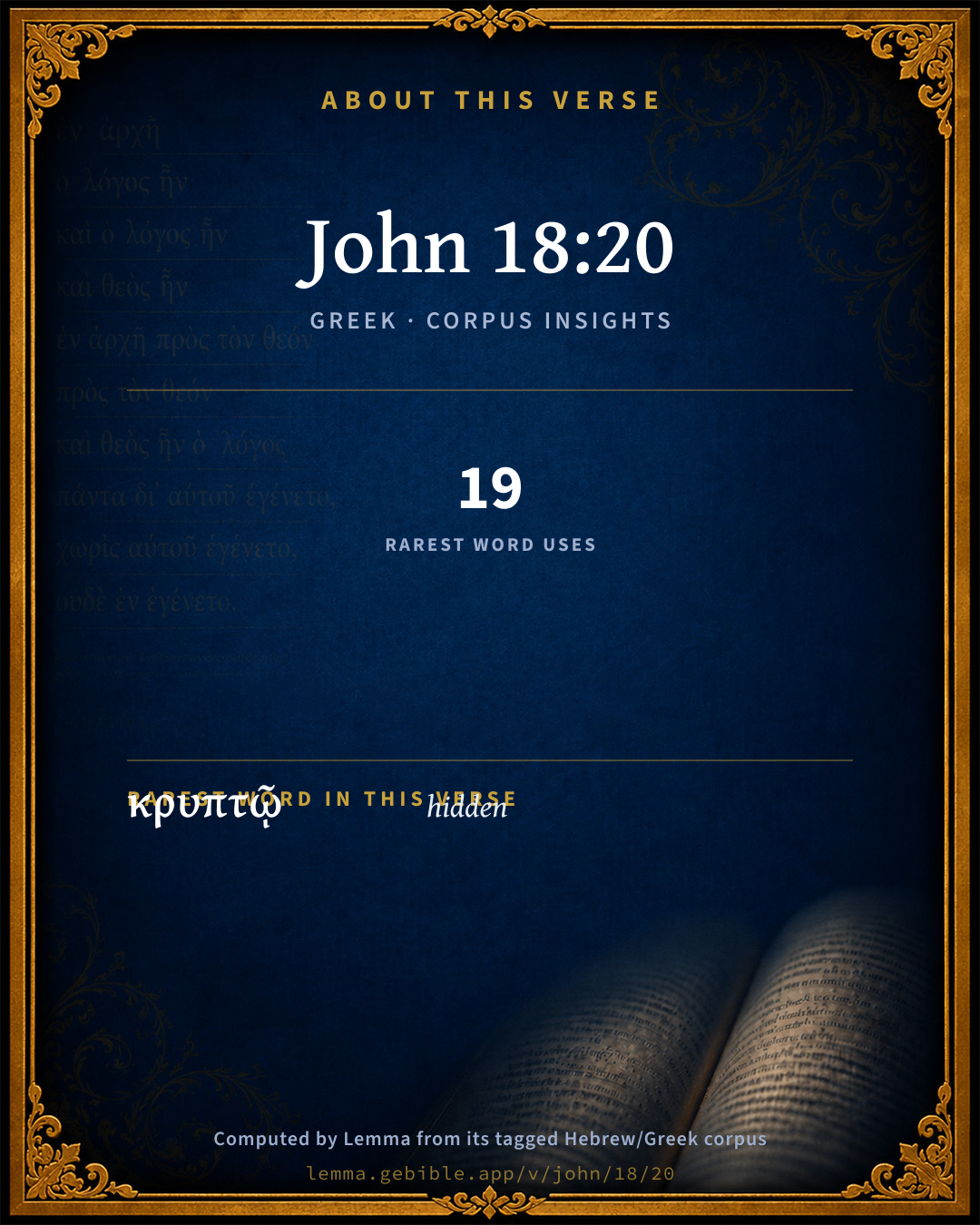
The rarest word here is κρυπτῷ hidden G2927 — appearing just 19 times in the whole Greek New Testament.

Shared distinctive vocabulary

κρυπτῷ hidden G2927 occurs in 16 verses of the Greek New Testament. Also found in:

Repetition

Words recur within this verse:

Cross-references

22

Topical passages linked to John 18:20 in the Treasury of Scripture Knowledge — connected by theme and wording, ordered by reader-vote popularity; previews shown in the World English Bible.

  • Isaiah 48:16 Come you near to me, hear you this; from the beginning I have not spoken in secret; from the time that it was, there am I: and now the Lord Yahweh has sent me, and his Spirit.
  • John 7:26 Behold, he speaks openly, and they say nothing to him. Can it be that the rulers indeed know that this is truly the Christ?
  • Matthew 4:23 Jesus went about in all Galilee, teaching in their synagogues, preaching the Gospel of the Kingdom, and healing every disease and every sickness among the people.
  • Luke 21:37 Every day Jesus was teaching in the temple, and every night he would go out and spend the night on the mountain that is called Olivet.
  • Isaiah 45:19 I have not spoken in secret, in a place of the land of darkness; I didn't say to the seed of Jacob, Seek you me in vain: I, Yahweh, speak righteousness, I declare things that are right.
  • Matthew 9:35 Jesus went about all the cities and the villages, teaching in their synagogues, and preaching the Gospel of the Kingdom, and healing every disease and every sickness among the people.
  • Matthew 26:55 In that hour Jesus said to the multitudes, "Have you come out as against a robber with swords and clubs to seize me? I sat daily in the temple teaching, and you didn't arrest me.
  • Luke 4:15 He taught in their synagogues, being glorified by all.
  • John 7:4 For no one does anything in secret, and himself seeks to be known openly. If you do these things, reveal yourself to the world."
  • Matthew 21:23–27 When he had come into the temple, the chief priests and the elders of the people came to him as he was teaching, and said, "By what authority do you do these things? Who gave you this authority?"
  • Matthew 26:65 Then the high priest tore his clothing, saying, "He has spoken blasphemy! Why do we need any more witnesses? Behold, now you have heard his blasphemy.
  • Luke 19:45–47 He entered into the temple, and began to drive out those who bought and sold in it,
  • Luke 20:1–8 It happened on one of those days, as he was teaching the people in the temple and preaching the Gospel, that the priests and scribes came to him with the elders.
  • John 7:14 But when it was now the midst of the feast, Jesus went up into the temple and taught.
  • John 7:28 Jesus therefore cried out in the temple, teaching and saying, "You both know me, and know where I am from. I have not come of myself, but he who sent me is true, whom you don't know.
  • John 8:2 Now very early in the morning, he came again into the temple, and all the people came to him. He sat down, and taught them.
  • John 8:26 I have many things to speak and to judge concerning you. However he who sent me is true; and the things which I heard from him, these I say to the world."
  • John 10:23–39 It was winter, and Jesus was walking in the temple, in Solomon's porch.
  • Psalms 22:22 I will declare your name to my brothers. In the midst of the assembly, I will praise you.
  • Psalms 40:9 I have proclaimed glad news of righteousness in the great assembly. Behold, I will not seal my lips, Yahweh, you know.
  • Matthew 24:26 If therefore they tell you, 'Behold, he is in the wilderness,' don't go out; 'Behold, he is in the inner chambers,' don't believe it.
  • Acts 26:26 For the king knows of these things, to whom also I speak freely. For I am persuaded that none of these things is hidden from him, for this has not been done in a corner.

Cross-references courtesy of OpenBible.info (CC BY 4.0).

Where the printed editions differ

1 variant

Places in this verse where the major printed Greek editions disagree on the wording in a way that affects the translation — a comparison of editions, not a manuscript-by-manuscript collation. The editions are the modern critical texts (Nestlé-Aland 28/27, SBL, Westcott-Hort, Tregelles, Tyndale House) and the traditional texts behind the KJV (the Textus Receptus and the Byzantine/Majority text). It is not a claim about which reading is original.

  1. Different wording
    πάντες

    “all”

    In NA28NA27TynSBLWHTreg Not in TRByz

    πάντοτε (pantote) 'always' occurs in traditional manuscripts (TR+Byz) instead of πάντες (pantes) 'all' in older manuscripts (NA28+NA27+Tyn+SBL+WH+Treg)

Textual data: Translators Amalgamated Greek New Testament (STEPBible TAGNT) · CC BY 4.0.

Commentary

Notes on John 18:20 from classic Christian and Jewish commentators (each source and its license shown beneath its notes). The classic Christian expositions comment on the surrounding passage and are grouped to its opening verse, so a note may address several verses; the Jewish commentaries on the Tanakh (Rashi and others) are per-verse, so they appear only where the commentator wrote on this verse.

Lemma curates 59 commentaries, every one of them public domain or Creative Commons licensed, each selected and text-cleaned for this edition rather than reprinted as found. About our sources →

Tyndale Open Study Notes

Tyndale Open Resources

18:20-21 Jesus’ sharp answer, reminding Annas that everything was in the public record, unmasked the priest’s attempt to follow Roman practice.

Tyndale Open Study Notes — © Tyndale Open Resources, licensed CC BY-SA 4.0. Text via the HelloAO Bible API.

Bengel's Gnomon

Johann Albrecht Bengel

Joh 18:20. Τῷ κόσμῳ, to the world) Language (i.e. His speaking) very comprehensive. Παῤῥησίᾳ, openly, signifies the manner; πάντοτε, ever, or always, the time; in synagogue and in the temple, the place.—ἐν συναγωγῇ) Editions have ἐν τῇ συναγωγῇ: as presently after we have the expression, ἐν τῷ ἱερῷ. But it is not without good reason that the Evangelist has omitted the article τῇ. Joh. Harduin lays it down that there were only two synagogues at Jerusalem, the one for native Jews, the other for the ‘Libertines,’ Act 6:9; and attempts to infer from this passage of John, that there was but one synagogue of native-born Jews.—Op. Sel. p. 904.[383] But the Lord is speaking of the synagogues of the whole country, not merely of the city; and so, therefore, from this passage the oneness of the synagogue in the city neither is refuted, nor is to be inferred. The noun in the Singular number, ἘΝ ΣΥΝΑΓΩΓῇ, acquires a distributive force [in synagogue, wherever it might happen to be, in every one]: and thence the article τῷ, added to “the temple,” forms an Epitasis [an emphatic addition, in repeating the previous ἘΝ].—ἘΝ ΚΡΥΠΤῷ) in secret, nothing, as far as concerns My doctrine (teaching) before the people. For He also apart taught His disciples many things; the main substance of which, however, He now confessed, even in presence of the Council (Sanhedrim). Mat 26:64, “Hereafter shall ye see the Son of Man sitting on the right hand of power, and coming in the clouds of heaven.”

[383] Rabbinical authorities, as Megill. lxxiii. 4, represent the number of synagogues in Jerusalem, 480: T. Hieros. Ctuboth. xxxv. 3, makes it 460. Act 6:9 may imply that each separate tribe and colony had a synagogue in Jerusalem. A omits the τῇ before συναγωγῇ. B, according to Lachm., supports it; but Tisch. questions it, B (?).—E. and T.

Bengel's Gnomon of the New Testament — English translation (T&T Clark, Edinburgh, 1860) — public domain. Text from a community e-Sword module.

Jamieson, Fausset & Brown

Robert Jamieson, A. R. Fausset & David Brown

I spake--have spoken.

openly to the world--See Joh 7:4.

I ever taught in the synagogues and in the temple, whither the Jews always resort--courting publicity, though with sublime noiselessness.

in secret have I said--spake I.

nothing--that is, nothing of any different nature; all His private communications with the Twelve being but explanations and developments of His public teaching. (Compare Isa 45:19; Isa 48:16). (Also see on Mar 14:54.)

Jamieson, Fausset & Brown — Commentary Critical and Explanatory on the Whole Bible (1871) — public domain (CC PDM 1.0). Text via the HelloAO Bible API.

Adam Clarke's Commentary

Verse 20. I spake openly to the world] To every person in the land indiscriminately-to the people at large: the τω κοσμω, here, is tantamount to the French tout le monde, all the world, i.e. every person within reach. This is another proof that St. John uses the term world to mean the Jewish people only; for it is certain our Lord did not preach to the Gentiles. The answer of our Lord, mentioned in this and the following verse, is such as became a person conscious of his own innocence, and confident in the righteousness of his cause. I have taught in the temple, in the synagogues, in all the principal cities, towns, and villages, and through all the country. I have had no secret school. You and your emissaries have watched me every where. No doctrine has ever proceeded from my lips, but what was agreeable to the righteousness of the law and the purity of God. My disciples, when they have taught, have taught in the same way, and had the same witnesses. Ask those who have attended our public ministrations, and hear whether they can prove that I or my disciples have preached any false doctrines, have ever troubled society, or disturbed the state. Attend to the ordinary course of justice, call witnesses, let them make their depositions, and then proceed to judge according to the evidence brought before you.

Adam Clarke's Commentary on the Bible (1810–1826) — public domain. Text from a community e-Sword/MySword module.

John Calvin's Commentaries

20. I spoke openly in the world. It is a childish error into which some have fallen, who think that this reply of Christ condemns those who expound the word of God in private apartments, when the tyranny of wieked men does not allow them to expound it publicly; for Christ does not argue as to what is lawful and what is not lawful, but his intention was to put down the insolent malice of Caiaphas.

This passage, however, appears to be inconsistent with another saying of Christ, where he enjoins the apostles to

proclaim on the house-tops what he had whispered in their ear, (Matthew 10:27;)

and again, when he declares that

it is not given to all to know the mysteries of the kingdom of heaven, (Matthew 13:14)

and that he therefore confers this favor on none but the twelve apostles. I answer, when he says in the passage now under review, that he spoke nothing in secret, this refers to the substance of the doctrine, which was always the same, though the form of teaching it was various; for he did not speak differently among the disciples, so as to instruct them in something different; nor did he act cunningly, as if he purposely intended to conceal from the people what he spoke to a small number of persons in the house. He could, therefore, testify with a good conscience that he had openly declared and honestly proclaimed the substance of his doctrine.

John Calvin's Commentaries (1540-1563) — public domain. Text from the Calvin Translation Society English edition (1840s-50s) via the Christian Classics Ethereal Library (ccel.org). Calvin's coverage is partial (roughly two-thirds of the Bible); uncommented books and verses are honest gaps, never fabricated. The 19th-century editor's footnotes and remarks are omitted so the notes are faithfully Calvin's own voice.

Ellicott's Commentary for English Readers

(20) I spake openly to the world.—He does not distinctly answer the question about His disciples, but His words imply that all may have been His disciples. The pronoun is strongly emphatic; “I am one,” His words mean, “who spake plainly and to all men.” “My followers have not been initiated into secret mysteries, nor made conspirators in any political organisation.” “I have not been a leader, and they have not been members, of a party.”

I ever taught in the synagogue, and in the temple, whither the Jews always resort.—The better reading omits the article before “synagogue,” as in Joh_6:59, and reads for the last clause, where all the Jews resort. “In synagogue” is an adverbial phrase, as we say “in church.” His constant custom was to teach “in synagogue,” and in Jerusalem He taught in the temple itself, which was the resort of all the leaders of the people. This refers to His general custom, and does not, of course, exclude His teaching in other places. The point is that during His public ministry He was constantly in the habit of teaching under the authority of the officers of the synagogues and the temple. That was the answer as to what His doctrine had been.

And in secret have I said nothing.—His private teaching of the disciples is, of course, not excluded, but that was only the exposition of His public doctrine. There was nothing in it such as they understood by “secret teaching.” It was unlike “the leaven of the Pharisees which was hypocrisy;” for in it there was “nothing covered,” “nothing hid.” (Comp. Joh_12:1-3.)

A Bible Commentary for English Readers, edited by Charles John Ellicott (1878–1897) — public domain. Text from a community e-Sword module.

The Cambridge Bible for Schools and Colleges

gen. ed. J. J. S. Perowne

20. I spake] The true reading gives, I have spoken. There is a strong emphasis on ‘I.’ Christ answers no questions about His disciples; He bears the brunt Himself alone. Moreover He seems to contrast the openness of His proceedings with the secrecy of His enemies.

openly] See on Joh_7:4; Joh_7:26.

to the world] Not to a secret society. Comp. Joh_8:26.

in the synagogue] All the best MSS. omit the article; in synagogue, as we say ‘in church.’ See on Joh_6:59.

whither the Jews always resort] The better reading gives, where all the Jews come together. The word rendered ‘resort’ is not the same as that rendered ‘resort’ in Joh_18:2. ‘I always taught in public places, where all the Jews meet.’ Nothing could be more open than His teaching. Comp. Mat_10:27.

have I said] Rather, I spake, the aorist of the verb in the first clause, which is in the perfect. See next verse.

The Cambridge Bible for Schools and Colleges (gen. ed. J. J. S. Perowne; Cambridge University Press, 1878–1918) — public domain. Text from a community e-Sword module.

John Gill's Exposition

Jesus answered him,.... Not to the first of these questions, concerning his disciples; not because they had all now forsaken him, and one was denying him; nor because he would not betray them; nor because he would suffer alone; but because if his doctrine was good; it could not be blameworthy to have disciples, and to teach them: and the charge of sedition, blasphemy, and idolatry, they wanted to fasten on him, would sufficiently appear to be groundless by the doctrine he preached; and as to that he answers not directly what he taught, but declares the manner in which he delivered it, and which was such, that they that heard him could not be strangers to it.

I spake openly to the world; with all plainness, freedom, and boldness, without any reserve or ambiguity; and that not to a few persons only, to his own particular disciples, but to all the people of the Jews, who crowded in great numbers to hear him; insomuch that it was said by his enemies, that the world was gone after him.

I ever taught in the synagogue; the Arabic, "the synagogues"; the places of public worship in all parts of the nation, where the Jews met to pray, and read, and hear the word:

and in the temple; at Jerusalem, whenever he was in that city;

whither the Jews always resort; for prayer, and to offer sacrifice, and particularly at the three grand festivals of the year, the passover, Pentecost, and feast of tabernacles, when all the males from all parts appeared before the Lord. Accordingly, the Alexandrian copy, and some others, read, "whither all the Jews resort"; and so read the Vulgate Latin, Syriac, Persic, and Ethiopic versions.

And in secret have I said nothing; not but that our Lord taught in other places than what are here mentioned, as on mountains, in deserts, by the sea shore, and in private houses, yet generally to great multitudes; and though he sometimes conversed alone, and in secret with his disciples, yet what he taught them was either an explanation of what he had said in public, or was perfectly agreeable to it.

John Gill's Exposition of the Whole Bible (1746–1763) — public domain (CC PDM 1.0). Text via the HelloAO Bible API.

Trapp's Complete Commentary

John Trapp

20 Jesus answered him, I spake openly to the world; I ever taught in the synagogue, and in the temple, whither the Jews always resort; and in secret have I said nothing.

Ver. 20. I spake openly to the world] Truth is bold and barefaced; when heresy hides itself, and loathes the light, Veritas abscondi erubescit truth loaths to hide. What said John Frith, martyr, to the archbishop’s men, that would have let him go and shift for himself? If you should both leave me here, and go to Croydon, declaring to the bishops that you had lost Frith, I would surely follow as fast after as I might, and bring them news that I had found and brought Frith again. Do ye think that I am afraid to declare my opinion to the bishops of England in a manifest truth?

John Trapp, A Commentary or Exposition upon All the Books of the Old and New Testament (1647–1656) — public domain. Text from a community e-Sword module.

Albert Barnes' Notes on the Bible

Openly to the world - If his doctrine had tended to excite sedition and tumult, if he had aimed to overthrow the government, he would have trained his friends in secret; he would have retired from public view, and would have laid his plans in private. This is the case with all who attempt to subvert existing establishments. Instead of that, he had proclaimed his views to all. He had done it in every place of public concourse in the synagogue and in the temple. He here speaks the language of one conscious of innocence and determined to insist on his rights.

Always resort - Constantly assemble. They were required to assemble there three times in a year, and great multitudes were there constantly.

In secret ... - He had taught no private or concealed doctrine. He had taught nothing to his disciples which he had not himself taught in public and commanded them to do, Mat 10:27; Luk 12:3.

Albert Barnes' Notes on the Bible (1834–1885) — public domain. Text from a community e-Sword/MySword module.

Matthew Poole's English Annotations

I spake openly to the world; to all sorts of men, my enemies as well as my friends.

I ever taught in the synagogue, and in the temple, whither the Jews always resort; the Jews for instruction do use to resort to the temple, which was in Jerusalem, and whither three times in the year all the males were wont to come from all parts of the country: and in the public assemblies of the Jews, and in the places where they use to meet.

And in secret have I said nothing; I have said nothing in secret contrary to the doctrine which I have publicly taught; though I have preached in other places, yet it hath been the same thing which I have said in public.

Matthew Poole's English Annotations on the Holy Bible (1683–1685) — public domain. Text from a community e-Sword/MySword module.

Whedon's Commentary on the Bible

Daniel D. Whedon

20. Jesus answered—Jesus, though before a magistrate, is not before a legitimate court, and so he might deny the jurisdiction and refuse to answer. He does answer, by at once refusing any specific account, and yet asserting his own openness and innocency.

Openly… synagogue… temple—He has said nothing in his teachings which all the honest world might not hear. His preaching has been in the regular public sacred places, the synagogue and the temple.

In secret… nothing—He has no conspiracy, no secret society. On the contrary, whatever confidential utterances he has made among his friends, his actual doctrines he would have all the world hear and receive.

Daniel D. Whedon (gen. ed.), Commentary on the Old and New Testaments (1874–1909) — public domain. Text from a community e-Sword module.

The Pulpit Commentary

Jesus answered him, I have frankly (so Meyer, Lange; not "openly," but boldly, with freedom of speech) spoken to the world. Without reserving any of the essentials of my teaching, always I taught synagogue, and in the temple, whither all the Jews resort and come together; and in secret spake I nothing, which they were not bidden to proclaim upon the housetops. Christ here repudiates esoteric teaching distinct from his abundant public ministry. It is true he explained his parables to his disciples, and he had within the last few hours poured forth the depth of his feelings upon them; still, he had said the same things virtually in the synagogues, on the hillside, in the temple, in the hearing of Greek as well as Jew. Much of that which he had just said in the upper chamber, hundreds and thousands had already heard. This great utterance accounts for the fact that St. Paul had received, long before the Fourth Gospel was written, truth allied to the teaching of the upper chamber.

Nothing to conceal.

I A CONTRAST. What religion is there that can bear the light of day as Christianity can? The false needs to be arranged and beautified and kept ever in one particular light. Jesus could expose everything if necessary. What a contrast to the life in the temple at Jerusalem! There was not a priest who could afford to have all his doings brought out and set before men. This ought to be part of our power when we are dealing with false religions. The more they are searched into, the more their abominations are exposed. The more Christianity is searched into, the more transparent and attractive it becomes. Not that everything is clear to the intellect, not that there is absence of mysteries; but these mysteries, whatever they are, lie open for everybody to contemplate them and be the better for them. The mysteries of heathendom are only priestcraft when one gets in behind them. Christianity is symbolized by the contents of the ark. That ark was sacred, not to be touched with heedless hands; but once it was opened, nothing lay there but the commandments, every one of which uttered forth the condemnation of everything false.

II AN EXAMPLE. That openness which was in Jesus must be in all his followers. All true Christian assemblies are perfectly open places, except when, in charity and kindness to individuals, the door is closed; and even then the closing of the door is known to all, and why it is so. Those entrusted with the propagation of Christianity have nothing to conceal. Their aim is the good of men; their method is by persuasion and appeal; they draw all their topics and their teaching from a book which is as open to others as to themselves. None of the first apostles needed to conceal anything; there was no false step, no dubious word of their Master to gloss over or keep in the background; and similarly we have nothing to apologize for. We need not to proclaim a mere ideal for the acceptance of men. Our real is better than the best ideal our imagination can fancy.

III A CAUSE FOR GLORYING. Difficulty is taken out of our way. We feel that since all is open and clear and satisfactory now, it always will be so. We find nothing to be ashamed of, nothing contradictory, in our experience of Christ in time. And similar surely will be our experience in eternity. "Whatever record leap to light," Christ will be the same. Whatever testimonies be unearthed, there will be nothing awkward to get over. Y.

The Pulpit Commentary (1880–1919), ed. H.D.M. Spence-Jones & Joseph S. Exell — public domain. Text from a community e-Sword module.

John Wesley's Explanatory Notes

I spake openly - As to the manner: continually - As to the time: in the synagogue and temple - As to the place. In secret have I said nothing - No point of doctrine which I have not taught in public.

John Wesley, Explanatory Notes Upon the Whole Bible (1754–1765) — public domain. Text via the GEBible commentary corpus.

Scofield Reference Notes

C. I. Scofield

world

kosmos = mankind. (See Scofield "Mat 4:8").

The Scofield Reference Bible (1917 edition), notes by C. I. Scofield — public domain. Text from a community e-Sword module.

Cambridge Greek Testament for Schools and Colleges

20. ἐγώ. With strong emphasis. He answers no questions about His disciples, but bears the brunt alone. Moreover He seems to contrast His openness with the secrecy of His enemies: for παρρησίᾳ see on Joh 7:13, and for ἐν συναγωγῇ on Joh 6:59. ‘I always taught in public places, where all the Jews come together. I am not the head of a secret society; nor am I ashamed of My doctrine.’ Comp. Mat 10:27 Veritas nihil erubescit praeter abscondi (Tertullian)

Cambridge Greek Testament for Schools and Colleges (Cambridge University Press, 1896; 21 vols, various authors incl. Carr, Maclear, Plummer, Farrar, Lumby, Moule, M. R. James, Simcox) — public domain. Text from a community e-Sword module.

Alford’s Greek Testament

Henry Alford

20.] ἐγώ, emphatic: q. d. I am one, who …

παῤῥησίᾳ, plainly (subjective): not openly, in an objective sense, which the word will not bear (.).

ὁ κόσμος here = πάντες οἱ Ἰουδ., or perhaps rather, all who were there to hear.

By the omission of the art. before συναγ., the distinction is made between synagogues, of which there were many, and τὸ ἱερόν, which was but one.

ἐν κρ. ἐλ. οὐδ.] Stier thinks there was an allusion in these words to Isa 45:19; Isa 48:16,—in the last of which places the Messiah is speaking.

Henry Alford, The Greek Testament (1849–1861) — public domain. Text from a community e-Sword module.

International Critical Commentary

20. ἀπεκρίθη αὐτῳ Ἰησοῦς. See on 1:29 for the omission of ὁ before Ἰησοῦς.

Jesus, in His reply, ignores the question as to His disciples and does not mention them. As to His teaching, He declares that it was always available for, and open to, every one, and that there was nothing secret about it. The reply of Socrates to his judges has often been quoted as a parallel: “If any one says that he has ever learnt or heard anything from me in private, which all others could not have heard, know ye that he does not speak the truth” (Plato, Apol. 33 B).

ἐγὼ παρρησίᾳ λελάληκα (not ἐλάλησα, as the rec. text has it) τῷ κόσμῳ, “I have spoken openly to the world,” i.e. to all and sundry. ἐγώ is emphatic: it was His teaching that was challenged. For παρρησίᾳ see on 7:4, and for κόσμος see on 1:9; cf. ταῦτα λαλῶ εἰς τὸν κόσμον (8:26), where, however, the meaning is slightly different. The Jews had said of Him παρρησίᾳ λαλεῖ (7:26); and when they had challenged Him on another occasion to speak plainly (εἰπὲ ἡμῖν παρρησίᾳ, 10:24) He had done so, with such openness that they had sought to arrest Him (10:39). When His own disciples had found difficulty in understanding His mysterious teaching about His approaching departure, He proceeded to make it quite plain (16:25, 29).

ἐγὼ πάντοτε ἐδίδαξα ἐν συναγωγῇ (the true text has no article before συναγωγῇ) καὶ ἐν τῷ ἱερῷ, “I always taught in synagogue and in the temple”; i.e. it was His custom to teach in these public places, not that He never gave any private teaching to an inquirer like Nicodemus (3:2). The discourse about the Bread of Life was given in the synagogue at Capernaum, according to the Johannine narrative (6:59), and the Synoptists frequently speak of His practice of teaching in the synagogues of Galilee. Jn. tells of His teaching in the Temple several times (2:19, 7:14, 28, 8:20, 10:23). Cf. Mar 14:49, καθʼ ἡμέραν ἤμην πρὸς ὑμᾶς ἐν τῷ ἱερῷ διδάσκων. The fact of His public teaching was notorious. It had been given ἐν τῷ ἱερῷ, ὅπου πάντες (not πάντοτε with the rec. text) οἱ Ἰουδαῖοι συνέρχονται, “where all the Jews come together.”

καὶ ἐν κρυπτῷ ἐλάλησα οὐδέν. This is like the utterance of Messiah at Isa 48:16, οὐκ ἀπʼ ἀρχῆς ἐν κρυφῇ λελάληκα (cf. Isa 45:19). But we have had the contrast between ἐν κρυπτῷ and ἐν παρρησίᾳ before (see 7:4); and it is not necessary to suppose that there is here a veiled allusion to the Isaiah passage, although it is possible.

See on 3:11 for Jn.’s use of λαλεῖν as signifying frank and unreserved speech. It is noteworthy that the strongest repudiation in the Gospels of cryptic or esoteric teaching in the words of Jesus is found in Jn.

International Critical Commentary — older volumes (1896–1929), various authors — public domain. Text from a community e-Sword module.

Vincent's Word Studies in the New Testament

Marvin R. Vincent

In the synagogue [εν τη συναγωγη] . The best texts omit the article. Render, in synagogue : when the people were assembled. Like our phrase, in church.

Always resort [παντοτε συνερχονται] . For pantote always, read pantev all. Sunercontai is rather come together, assemble. Rev., where all the Jews come together.

Marvin R. Vincent, Word Studies in the New Testament (1887–1900) — public domain. Text from a community e-Sword/MySword module.

Lesson kit

Teaching starters — assembled from the data on this page, not authored interpretation. Every prompt links to the verse data it draws on. Edit before teaching.

John, in the Gospels, opens this verse with 27 words (20 distinct Greek lemmas). Its most distinctive word is kryptós (“hidden”). A historical commentator’s framing appears above. Read the whole chapter for the surrounding context.

Discussion questions

  1. How does “hidden” (kryptós) shape what this verse is saying?
  2. Matthew 6:4 shares the word «hidden» with this verse. How do the two illuminate each other?
  3. “to speak” occurs 2× in this one verse. What is the effect of the repetition?
  4. These translations render this verse differently. What is at stake in choosing one wording over another?
  5. Reading how Tyndale Open Study Notes and Bengel's Gnomon read this verse, where do the two commentators agree and where do they part?

Things to notice

  • These translations choose different wording for 16 words in this verse.
  • “to speak” occurs 2× in this single verse.
  • 20 distinct Greek lemmas span 27 words in this verse.

Reading settings

Reading text

Shown beneath each verse's original-language words.

Old Testament
Old Testament edition

Read the OT as the Masoretic Hebrew (MT) or the Greek Septuagint (LXX).

English shown for the Greek Septuagint (in the Hebrew ↔ Greek comparison).

Comparing translations? Open the Compare panel on any verse page to stack up to four side by side.