1 Corinthians 14:10

Greek (Tischendorf 8th ed.) 1 Corinthians 14:10 appears in the Greek New Testament. The text above is from the Tischendorf 8th edition. Each word links to its Strong’s number and a concise gloss. Click any word for its full Thayer’s Greek Lexicon entry.
Download image
Cite this verse

1 Corinthians 14:10 (World English Bible). Public Domain. Lemma interlinear Bible study tool, https://lemma.gebible.app/v/1-corinthians/14/10.

Show BibTeX & RIS
BibTeX
RIS
English Translation
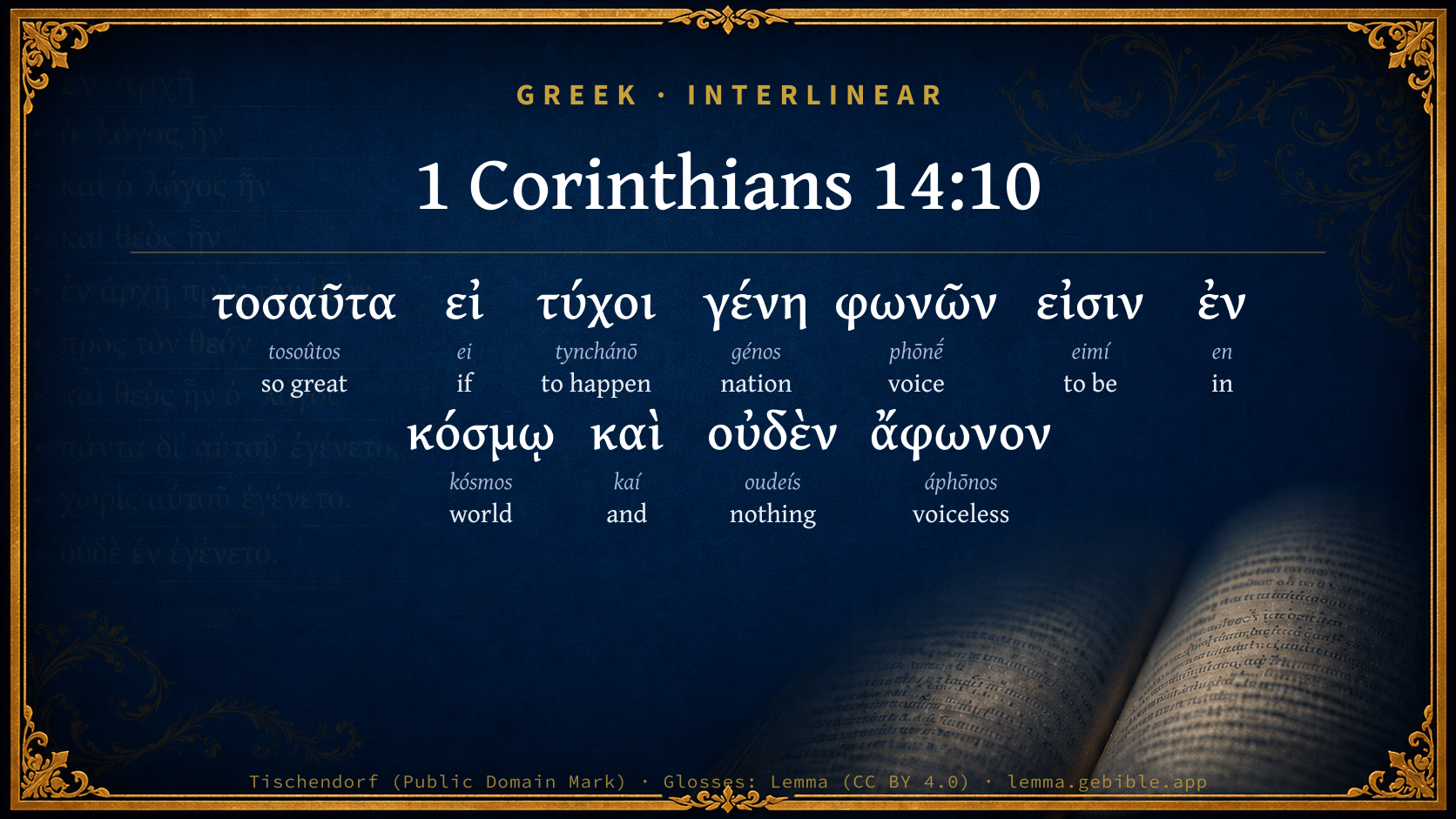
There are, it may be, so many kinds of sounds in the world, and none of them is without meaning.
World English Bible · Public Domain
Download a study sheet

One document with this verse’s original text, its word-by-word gloss line, the meaning frame, cross-references with their text, attributed commentary, and full source and license credits — printable, and it pastes into notes with its structure intact.

This verse Autodidact and up

Study sheet (.html) Plain text (.txt)

A passage Seminary Student

Up to 50 verses in one chapter. A passage sheet keeps up to 6 commentary sources and 12 cross-references per verse, in the order this page ranks them, and says so on the sheet whenever that leaves anything out. Ask for a single verse and you get the Autodidact verse sheet above.

Everything on this page stays free to read, with no account — the sheet is a download of what is already on screen, not access to it.

Want to remove ads? Support Godless Engineer
Compare translations 3

The same verse in 3 English versions, stacked beneath the original-language interlinear above. Click any original word for its lexicon entry.

Each is an independent rendering of the whole verse — the interlinear is not word-aligned to these translations.

Highlighted words mark where these versions differ — a whole-verse word diff, not a word-by-word alignment.

  • World English Bible Public Domain
    There are, it may be, so many kinds of sounds in the world, and none of them is without meaning.
  • King James Version Public Domain
    There are, it may be, so many kinds of voices in the world, and none of them is without signification.
  • unfoldingWord Literal Text CC BY-SA 4.0
    There are doubtless so many kinds of languages in the world, and none without meaning.

unfoldingWord Literal Text — © unfoldingWord, licensed CC BY-SA 4.0. Word-aligned USFM3 via Door43 (git.door43.org/unfoldingWord/en_ult).

Versions to compare (up to 4)

3 of 4 selected

Show all 19 translations

Every available English version of this verse, each an independent rendering of the whole verse.

  • World English Bible Public Domain
    There are, it may be, so many kinds of sounds in the world, and none of them is without meaning.
  • Berean Standard Bible Public Domain
    Assuredly, there are many different languages in the world, yet none of them is without meaning.
  • Majority Standard Bible Public Domain
    Assuredly, there are many different languages in the world, yet none of them is without meaning.
  • King James Version Public Domain
    There are, it may be, so many kinds of voices in the world, and none of them is without signification.
  • American Standard Version (1901) Public Domain
    There are, it may be, so many kinds of voices in the world, and no `kind' is without signification.
  • Revised Version (1885) Public Domain
    There are, it may be, so many kinds of voices in the world, and no kind is without signification.
  • Geneva Bible (1599) Public Domain
    There are so many kindes of voyces (as it commeth to passe) in the world, and none of them is dumme.
  • Douay-Rheims (1899) Public Domain
    There are, for example, so many kinds of tongues in this world; and none is without voice.
  • Young's Literal Translation Public Domain
    There are, it may be, so many kinds of voices in the world, and none of them is unmeaning,
  • Literal Standard Version CC BY-SA 4.0
    There are, it may be, so many kinds of voices in the world, and none of them is unmeaning.
  • Unlocked Literal Bible CC BY-SA 4.0
    There are doubtless many different languages in the world, and none is without meaning.
  • unfoldingWord Literal Text CC BY-SA 4.0
    There are doubtless so many kinds of languages in the world, and none without meaning.
  • Darby Bible Public Domain
    There are, it may be, so many kinds of voices in the world, and none of undistinguishable sound.
  • World Messianic Bible Public Domain
    There are, it may be, so many kinds of languages in the world, and none of them is without meaning.
  • Webster's Bible Public Domain
    There are, it may be, so many kinds of voices in the world, and none of them is without signification.
  • Free Bible Version CC BY-SA 4.0
    There are surely many languages in this world, and there is meaning in every one of them.
  • Bible in Basic English Public Domain
    There are, it may be, a number of different voices in the world, and no voice is without sense.
  • Text-Critical English NT CC BY 4.0
    There are undoubtedly many kinds of languages in the world, and none of them is without meaning.
  • Tyndale New Testament (1534) Public Domain
    Many kyndes of voyces are in the worlde and none of them are with out signification.

Literal Standard Version (2020), Covenant Press — licensed CC BY-SA 4.0. Text via the HelloAO Bible API (eBible.org). Unlocked Literal Bible (unfoldingWord) — licensed CC BY-SA 4.0. Text via the HelloAO Bible API (eBible.org). unfoldingWord Literal Text — © unfoldingWord, licensed CC BY-SA 4.0. Word-aligned USFM3 via Door43 (git.door43.org/unfoldingWord/en_ult). Free Bible Version, Dr. Jonathan Gallagher — licensed CC BY-SA 4.0. Text via the HelloAO Bible API (eBible.org).

Word by word

More ways to search: Search by grammar → Find every occurrence → Compare this word →

Practice this passage: Drill this verse → Learn its vocabulary →

About this verse

These counts appear in no published source. They are computed here, from the morphology-tagged text and Lemma’s own curated glosses. What Lemma adds →

11
words
11
distinct lemmas
Pauline Epistles
section

Notable vocabulary

The rarest word here is ἄφωνον voiceless G880 — appearing just 4 times in the whole Greek New Testament.

Shared distinctive vocabulary

ἄφωνον voiceless G880 occurs in 4 verses of the Greek New Testament. Also found in:

Commentary

Notes on 1 Corinthians 14:10 from classic Christian and Jewish commentators (each source and its license shown beneath its notes). The classic Christian expositions comment on the surrounding passage and are grouped to its opening verse, so a note may address several verses; the Jewish commentaries on the Tanakh (Rashi and others) are per-verse, so they appear only where the commentator wrote on this verse.

Lemma curates 59 commentaries, every one of them public domain or Creative Commons licensed, each selected and text-cleaned for this edition rather than reprinted as found. About our sources →

The Biblical Illustrator

Joseph S. Exell

1Co_14:10-11

There are … voices … and none of them is without signification.

Voices

1. It does not follow that because the voice has no meaning for you that therefore it has no meaning for others. I heard some splendid music the other clay, and a friend exclaimed, What tenderness, what pathos is in it. John Stuart Mill said that the first meaning of Wordsworths poetry was a new birth to him; he felt himself a better man. Maurice often talked in an unknown tongue once; people understand him now. You may read a chapter of Christian experience and it may be in an unknown tongue to you.

2. But the difficulty will be to reduce what you have seen and heard into intelligible speech that will edify others. A young person is asked to sing, and she dashes at once into a French or German song. What affectation it is when there are troops of English songs with the sweet pathos of English traditions in them. There are artists a great deal more silly. Their chief pride is that they dont edify. Many words might be spoken in praise of the noble address from the chair of the British Association; but I give the highest praise when I say you can understand it. The best part of your creed is what you can put into a little childs mouth. If you want to know what the essence of the gospel is, take a little boy of eight between your knees and tell him the gospel, and what you can make him understand is its pith and essence.

3. There are many voices in the world, and our business is to try to discover their significance. There are voices which are transitory, which speak to one generation and then cease. They startle one, and then are heard no more, like the rousing proclamation of some half-forgotten truth or a wail of consternation at the spiritual condition of England. But some voices speak on for age and age, and uninterruptedly.

I. The voice of the material creation. For its scientific or philosophical signification. You must listen to the scientific report of the year. What is its spiritual signification? What is there to be converted into fuel that can feed our faith and enlarge our hope? The material world is the revelation of the Divine intellect and heart. What do we find in this material creation that sends a message to our spiritual nature which may be converted into fuel for our faith? I think it is this: You can always calculate upon God. God has always known His own mind. He is the same yesterday, to-day, and for ever. Think of the value of that in your religious life. The first instinct of your religious life is to have unchanging things. We have said hard things about Nature. We have called her blind and pitiless. There can be not the slightest divergence from her path. Every heart in this creation may break, but the earth will still go on. But there is another side to that. You can calculate always upon God, He will never disappoint you. All of our life would break out into panic if there were any disorganisation of the laws of nature of which we complain sometimes. The farmer knows that the seasons will come round, and the mariner goes out to sea without fear. If you care to meet God this morning, there can be no doubt as to where to meet Him. There is a certainty with regard to God and our souls which we cannot have with regard to anything else. Take any promise in His Word. Come unto Me, all ye that labour and are heavy laden, and I will give you rest. He has never moved away from that. If you put your life and the lives of your children in Gods path every morning, you may be perfectly sure that He will pass that way. The Church oftentime feels that the paralysis is creeping over her and that she can do nothing. You are not content with things as they are. You want a re-vi-val, a re-consecration, a re-awakening, a fresh joy in the gospel of Christ, and a fresh equipment for service. We can have it without any uncertainty; we have as a Church only to place ourselves in Gods way. We have only to get out of the things He hates, to redouble our energies in the Sunday school, and among the erring. I have seen, when the heavens said there was a great shower coming, the housewife put out every vessel to catch the rain. You must range every faculty you possess at Gods disposal. Be ready! God will not disappoint you. If the channels are doubled the rain is sure to come.

II. The voices in your own souls. These are of two kinds. There are the imperative voices. Then there are the pathetic voices. George Eliot said, See if the sigh does not discover Him who touched the heart into a sigh. What a chapter it would be if every one in this congregation were this morning to write out one of his sorest needs. We need a living God, we need the grasp of His hand, we need heaven! We want to be forgiven; we want home. We have loved and lost. And oh, the unspeakable blessedness of the voice of our need in prayer. I have cried, Father, I am sad, I am lonely. And a voice has come into my soul, saying, Fear not; I am with thee. You may pile the scepticism of the world then, but it takes nothing of this from me. And this is the significance of our need. I have read a very wonderful book, written by a man who sums up the arguments in this way: there is as much to be said for the existence of God as there is to be said against it, and vice versa. If this were so it is enough for me. If the arguments for or against the existence of God were so equally balanced, my necessities and needs would weigh the balance down. (Morlais Jones.)

A preacher should study plain language

I. Language is designed as the vehicle of thought.

1. Many languages.

2. All significant.

II. Language ceases to be the medium of thought when not understood. There is--

1. No instruction.

2. No sympathy of mind.

3. No edification.

III. Plainness should therefore be studied--

1. As the most excellent of gifts.

2. For the benefit of the Church. With much prayer. (J. Lyth, D. D.)

The diversity of human language

Consider--

1. Language as the vehicle of thought.

2. Its extraordinary variety.

3. The cause.

4. Its effect upon the condition of mankind--social and moral.

5. Its gradual alleviation.

6. Its final removal. (J. Lyth, D. D.)

Sweetness of voice

There is no power of love so hard to get and keep, writes Elihu Burritt, as a kind voice. A kind hand is dead and dumb. It may be rough in flesh and blood, yet do the work of a soft heart, and do it with a soft touch. But there is no one thing which love so much needs as a sweet voice, to tell what it means and feels; and it is hard to get and keep in the right tone. One must start in youth, and be on the watch night and day, at work and at play, to get and keep a voice which shall speak at all times the thoughts of a kind heart. It is often in youth that one gets a voice or tone which is sharp, and it sticks to him through life, and it stirs up ill-will, and falls like a drop of gall upon the sweet joys of home. Watch the voice day by day as a pearl of great price, for it will be worth more to you in the days to come than the best pearl hid in the sea. A kind voice is to the heart what light is to the eye. It is a light which sings as well as shines.

The Biblical Illustrator, edited by Joseph S. Exell (c. 1880s–1900s) — public domain. Text from a community e-Sword module.

Joseph Benson's Commentary

1Co 14:10-12. There are — No doubt; so many kinds of voices — Or languages; in the world — As ye speak; and none of them is without signification — To those that are acquainted with them. Therefore — Nevertheless; if I know not the meaning of the voice — The import of the particular language which is used in my hearing; I shall be unto him that speaketh a barbarian — What I say will appear unintelligible jargon; and he a barbarian unto me — We shall be incapable of holding any conversation with each other. “The Greeks, after the custom of the Egyptians, mentioned by Herodotus, lib. 2., called all those barbarians who did not speak their language. In process of time, however, the Romans, having subdued the Greeks, delivered themselves by force of arms from that opprobrious appellation, and joined the Greeks in calling all barbarians who did not speak either the Greek or the Latin language. Afterward, the word barbarian signified any one who spake a language which another did not understand. Thus the Scythian philosopher, Anacharsis, said, that among the Athenians, the Scythians were barbarians; and among the Scythians, the Athenians were barbarians. This is the sense of the word barbarian in this passage.” Even so, &c. —

Wherefore ye also, that ye may not be barbarians to each other; forasmuch as ye are zealous of spiritual gifts — And are ready to vie with each other in the exercise of them, seek that ye may excel to the edifying of the church — And not merely for your own honour. Strive for the greatest share of those gifts whereby you may be useful to your fellow-Christians.

Joseph Benson's Commentary on the Old and New Testaments (1811–1818) — public domain. Text from a community e-Sword module.

Bengel's Gnomon

Johann Albrecht Bengel

1Co 14:10. Τοσαῦτα, εἰ τύχοι) εἰ τύχοι (the Latin, verbi gratia, for example; comp. 1Co 15:37) makes τοσαῦτα have the force of a certain number. If men could ever have counted the number of voices, Paul would have set down the number here.—οὐδὲν ἄφωνον, none without signification) each one of them has its own power [meaning, 1Co 14:11], δύναμιν.

Bengel's Gnomon of the New Testament — English translation (T&T Clark, Edinburgh, 1860) — public domain. Text from a community e-Sword module.

Meyer's Critical & Exegetical Commentary

Heinrich August Wilhelm Meyer

1Co_14:10-11. Another example still to induce them to lay aside this way of speakin.

εἰ τύχοι] if it so happens, if it is really the case, i.e. perhaps, just as the mere absolute τυχόν also is employed (Isocr. Archid. 38; De pace, 60; Xen. Mem. vi. 1. 20, and Kühner in loc.). So in all the passages in Wetstein, Loesner, p. 293; Viger. ed. Herm. p. 301, which are usually adduced in support of what is assumed (by Rückert also) to be the meaning here: for example. The phrase has never this meaning, and merely its approximate sense can be so expressed,[4] and that always but very unexactly, in several passages (such as 1Co_15:37; Lucian, Amor. 27). And in the present case this sense does not suit at all, partly because it would be very strange if Paul, after having already adduced flutes, citherns, and trumpets as examples, should now for the first time come out with a for example, partly and chiefly because εἰ τύχοι is a defining addition, not to the thing itself (γένη φωνῶν), but to its quantity (to τοσαῦτα). Comp. Lucian, Icarom. 6 : καὶ πολλάκις, εἰ τύχοι, μηδὲ ὁπόσοι στάδιοι Μεγαρόθεν Ἀθήναζέ εἰσιν, ἀκριβῶς ἐπιστάμενοι. Paul, namely, had conceived to himself under τοσαῦτα a number indefinite, indeed, but very great;[5] and he now takes away from this conception its demonstrative certainty by ΕἸ ΤΎΧΟΙ: in so great multitude, perhaps, there are different languages in the world. Billroth, too, followed by Olshausen, takes εἰ τύχοι in itself rightly, but introduces an element of irony, inasmuch as he quite arbitrarily takes ΤΟΣΑῦΤΑ … ΚΑῚ ΟὐΔΈΝ for ὍΣΑ … ΤΟΣΑῦΤΑ, and, in doing so, makes ΕἸ ΤΎΧΟΙ even reach over to the second clause: as many languages as there are, probably just so many have sense and significance.

On ΕἸ with the optative, expressing the mere conjecture, it may suffice to refer to Hermann, ad Viger. p. 902.

γένη φωνῶν] i.e. all sorts of different languages, each individual unit of which is a separate γένος φωνῶν. The opposite is ΦΩΝῊ ΜΊΑ ΠᾶΣΙ, Gen_11:1.

ΟὐΔΈΝ] namely, ΓΈΝΟς ΦΩΝῶΝ. Bleek renders it, contrary to the context: no rational being. Similarly Grotius and others, so that αὐτῶν in the Textus receptus would apply to men. Comp. van Hengel, Annot. p. 194 f., who supplies ἔθνος with ΟὐΔΈΝ.

ἌΦΩΝΟΝ] speechless, i.e. no language is without the essence of a language (comp. βίος ἀβίωτος, and the like, in Lobeck, Paralip. p. 229 f.; Pflugk, ad Eur. Hec. 612; Jacobs, Del. epigr. i. 33), i.e. unintelligible, and that absolutely, not merely for him, to whom it is a foreign tongue (1Co_14:11).

οὖν] therefore, draws its argument, not from the great multitude of the languages (Hofmann), which, in truth, is not at all implied in what is contained in 1Co_14:11, but from οὐδέν ἄφωνον. For were the language spoken to me (Τῆς ΦΩΝ.) ἌΦΩΝΟς, and so unintelligible in itself, I could not in that case appear even as a barbarian to the speaker, because, in fact, what he spoke would be understood by no man. The barbarian (βαρβαρόφωνος, Herod. vii. 20, ix. 43) speaks only a foreign language, not one altogether devoid of meaning for other.

ΤῊΝ ΔΎΝΑΜΙΝ Τῆς ΦΩΝῆς] the signification, the sense of the language (which is being spoken). Polyb. xx. 9. 11; Lucian, Nigr. 1, al. Comp. Herod. ii. 30; Plat. Euthyd. p. 286 C.

ἐν ἐμοί] with me, i.e. in my judgment. See Valckenaer, ad Eur. Hipp. 324; Pflugk, ad Eur. Hel. 996; Winer, pp. 362, 204 [E. T. 483, 273].

[4] This also in opposition to Hilgenfeld, Glossol. p. 24.

[5] For this reason he could limit even the indefinite expression by εἰ τύχοι (in opposition to Hilgenfeld).

REMARK.

Paul has chosen φωνή to denote language, because in the whole section he has only the meaning tongue in his mind for γλῶσσα. To instruct his readers regarding the speaking with tongues, he uses the analogy of speaking languages. Hofmann resorts to the suggestion that Paul must have used φωνή here, because he would not have expressed what καὶ οὐδὲν ἄφωνον was designed to convey by κ. οὐδὲν ἄγλωσσον. That is incorrect; for ἄγλωσσον would have conveyed the very same thing (speechless, Poll. ii. 108; Soph. Trach. 1060; Pind. Nem. viii. 41) with the very same point (et nullum elingue), if he had used γλῶσσα instead of φωνή.

Meyer — Critical and Exegetical Commentary on the New Testament — English translation by Peter Christie, edited by Frederick Crombie (T&T Clark, 1880) — public domain. Text from a community e-Sword module.

Expositor's Greek Testament

ed. W. Robertson Nicoll

1Co 14:10 . Speaking of vocal utterance, the Ap. is reminded of the multitude of human dialects; this suggests a further proof of his contention, that there must be a settled and well-observed connexion between sound and sense. “Ever so many kinds of voices, it may chance, exist in the world.” On εἰ τύχοι ( if it should hap = τυχόν , 1Co 16:6 ), which removes all known limit from the τοσαῦτα , see note of El [2058] For the anarthrous ἐν κόσμῳ , cf. 2Co 5:19 ; “in the world ” a sphere so wide. καὶ οὐδὲν ( sc. τῶν γενῶν ) ἄφωνον , “and none (of them) voiceless”: not tautologous, but asserting for every “kind of voice” the real nature of a voice, viz ., that it means something to somebody ; “nullum genus vocum vocis expers” (Est.); “aucune langue n’est une non-langue”; the Greeks love these paradoxical expressions cf. βίος ἀβίωτος , χάρις ἄχαρις (Gd [2059] , Hn [2060] ). The Vg [2061] and Bz [2062] miss the point in rendering, “nihil est mutum”.

[2058] C. J. Ellicott’s St. Paul’s First Epistle to the Corinthians .

[2059] F. Godet’s Commentaire sur la prem. Ép. aux Corinthiens (Eng. Trans.).

[2060] C. F. G. Heinrici’s Erklärung der Korintherbriefe (1880), or 1 Korinther in Meyer’s krit.-exegetisches Kommentar (1896).

[2061] Latin Vulgate Translation.

[2062] Beza’s Nov. Testamentum: Interpretatio et Annotationes (Cantab., 1642).

The Expositor's Greek Testament, edited by W. Robertson Nicoll (1897–1910) — public domain. Text from a community e-Sword module.

Godet's Commentaries

Frédéric Louis Godet

Vv. 10, 11. “There are, it may be, so many kinds of voices in the world, and none of them is without signification. 11 Therefore if I know not the force of the voice, I shall be unto him that speaketh a barbarian, and he that speaketh shall be a barbarian unto me.”

The asyndeton here denotes, as it almost always does a strong reaffirmation of the foregoing idea. 1Co 14:10-11 indeed confirm by a new example the proof given in 1Co 14:7-9. By the expression: kinds of tongues (voices), the apostle certainly does not understand what we call families of human languages; every existing language is in his view a kind. These languages are exceedingly many: τοσαῦτα, so numerous. But the exact number he does not know; the expression εἰ τύχοι, with names of number, has the force of taking away from them all precision. Edwards: “whatever may be their number.”

The pronoun αὐτῶν, of them, is a gloss, but a correct gloss. We must beware of understanding οὐδέν in the sense of no human being (Bleek) or no nation (van Hengel), as if Paul meant: “No man or no people is without language.” This idea would be unconnected with the context. The meaning is: “No language exists without articulate words.” Only the apostle expresses this idea in a striking form, saying, in a manner: “No tongue is not a tongue” (Aucune langue n’est une non-langue). The articulation of words and syllables belongs to the essence of human tongues. The Greeks are found of such paradoxical expressions; comp. βίος ἀβίωτος, a life which is no life; ἄχαρις χάρις, etc. (see Heinrici). — The force here denotes the signification of the sounds.

The Greeks and Egyptians called those peoples barbarians who did not speak their language.

The ἐν ἐμοί might certainly signify: in my judgment (Heinrici, Edwards); but according to the context the meaning rather is: in what concerns me; as between this man and me.

The application of this example is given in 1Co 14:12, in the form of a practical direction:

Frédéric Louis Godet — Commentaries on Luke, John, Romans, and 1 Corinthians — English translation (T&T Clark, Edinburgh, 1870s–1890s) — public domain. Text from a community e-Sword module.

Hodge's Commentary on Romans, Ephesians & First Corinthians

Charles Hodge

1Co_14:10

There are, it may be, so many kinds of voices in the world, and none of them (is) without signification.

There are, it may be, so many kinds of voices. The words (εἰ τύχοι), properly rendered, it may be, are often used to render a statement indefinite, where precision is impossible or unimportant. It was no matter, so far as the apostles object was concerned, whether the kinds of sound in the world were more or less. There are so many, or, as we should say, There are ever so many, it may be, languages in the world. Kinds of voices. Calvin understands this of the voices or natural cries of animals. All animated nature is vocal; no living creature is mute or utters unintelligible sounds: tota igitur naturae series quae est a Deo ordinata, nos ad distinctionem invitat. The context, however, shows that the reference is to human speech, therefore the words (γένη φωνῶν) should be translated kinds of languages, Gen_1:11. And no one of them is without signification, i.e. inarticulate. The phrase is (φωνὴ ἄφωνος), a language which is no language, that is, without significancy, which is the essence of a language. The illustration contained in this verse goes to prove that speaking with tongues was to speak in foreign languages. The very point is that as all languages are significant, so the languages used by those who spoke with tongues were significant. The difficulty was not in the language used, but in the ignorance of the hearer. This is still plainer from what follows.

Charles Hodge — Commentary on Romans (1835), First Corinthians (1857), and Ephesians (1856) — public domain. Text from a community e-Sword module.

Geneva Bible (1599)

Geneva Bible translators

He proveth that interpretation is necessarily to be joined with the gift of tongues, by the manifold variety of languages, insomuch that if one speak to another without an interpreter, it is as if he spake not.

Geneva Bible (1599) marginal notes — public domain. Text via Bolls.life.

Jamieson, Fausset & Brown

Robert Jamieson, A. R. Fausset & David Brown

it may be--that is, perhaps, speaking by conjecture. "It may chance" (Co1 15:37).

so many--as may be enumerated by investigators of such matters. Compare "so much," used generally for a definite number left undefined (Act 5:8; also Sa2 12:8).

kinds of voices--kinds of articulate speech.

without signification--without articulate voice (that is, distinct meaning). None is without its own voice, or mode of speech, distinct from the rest.

Jamieson, Fausset & Brown — Commentary Critical and Explanatory on the Whole Bible (1871) — public domain (CC PDM 1.0). Text via the HelloAO Bible API.

Adam Clarke's Commentary

Verse 10. There are, it may be] ει τυχοι, For example.

So many kinds of voices] So many different languages, each of which has its distinct articulation, pronunciation, emphasis, and meaning; or there may be so many different nations, each possessing a different language, &c.

Adam Clarke's Commentary on the Bible (1810–1826) — public domain. Text from a community e-Sword/MySword module.

John Calvin's Commentaries

10. None of them dumb He now speaks in a more general way, for he now takes in the natural voices of animals. He uses the term dumb here, to mean confused — as opposed to an articulate voice; for the barking of dogs differs from the neighing of horses, and the roaring of lions from the braying of asses. Every kind of bird, too, has its own particular way of singing and chirping. The whole order of nature, therefore, as appointed by God, invites us to observe a distinction.

John Calvin's Commentaries (1540-1563) — public domain. Text from the Calvin Translation Society English edition (1840s-50s) via the Christian Classics Ethereal Library (ccel.org). Calvin's coverage is partial (roughly two-thirds of the Bible); uncommented books and verses are honest gaps, never fabricated. The 19th-century editor's footnotes and remarks are omitted so the notes are faithfully Calvin's own voice.

Ellicott's Commentary for English Readers

(10) There are, it may be, so many kinds of voices in the world.—There are a great many voices or languages in the world, and none of them but has a right meaning when spoken rightly and to the right person. No word in any language can be meaningless, but must correspond to some thought—for the thought exists first, and the word is invented as the expression of it.

A Bible Commentary for English Readers, edited by Charles John Ellicott (1878–1897) — public domain. Text from a community e-Sword module.

The Cambridge Bible for Schools and Colleges

gen. ed. J. J. S. Perowne

10. without signification] Literally, without sound, dumb. Cf. Act_8:32, and ch. 1Co_12:1.

The Cambridge Bible for Schools and Colleges (gen. ed. J. J. S. Perowne; Cambridge University Press, 1878–1918) — public domain. Text from a community e-Sword module.

John Gill's Exposition

There are, it may be, so many kinds of voices,.... "tongues", or "languages", as the Syriac version renders it; that is, as many as there are nations in the world; there may be seventy of them, as the Jews say there were at the confusion of languages at Babel; there may be more or less:

and none of them is without signification: every language, and every word in a language, has a meaning in it, an idea annexed to it, which it conveys to him that understands it, and that cannot be done without a voice ordinarily speaking.

John Gill's Exposition of the Whole Bible (1746–1763) — public domain (CC PDM 1.0). Text via the HelloAO Bible API.

Trapp's Complete Commentary

John Trapp

10 There are, it may be, so many kinds of voices in the world, and none of them is without signification.

Ver. 10. So many kinds of voices] Seventy-two material languages, they say.

John Trapp, A Commentary or Exposition upon All the Books of the Old and New Testament (1647–1656) — public domain. Text from a community e-Sword module.

Albert Barnes' Notes on the Bible

There are it may be ... - There has been considerable variety in the interpertation of this expression. Rosenmuller renders it, “for the sake of example.” Grotius supposes that Paul meant to indicate that there were, perhaps, or might be, as many languages as the Jews supposed, to wit, seventy. Beza and others suppose it means, that there may he as many languages as there are nations of people. Bloomfield renders it, “Let there he as many kinds of languages as you choose.” Macknight, “There are, no doubt, as many kinds of languages in the world as ye speak.” Robinson (Lexicon) renders it, “If so happen, it may be; perchance, perhaps;” and says the phrase is equivalent to “for example,” The sense is, “There are perhaps, or for example, very many kinds of voices in the world; and all are significant. None are used by those who speak them without meaning; none speak them without designing to convey some intelligible idea to their hearers.” The “argument” is, that as “all” the languages that are in the world, however numerous they are, are for “utility,” and as none are used for the sake of mere display, so it should be with those who had the power of speaking them in the Christian church. They should speak them only when and where they would be understood.

Voices - Languages.

Albert Barnes' Notes on the Bible (1834–1885) — public domain. Text from a community e-Sword/MySword module.

Matthew Poole's English Annotations

The whole earth was originally of one language, and of one speech, Gen 11:1; but upon the building of Babel, Gen 11:7, God confounded their languages, so as they did not understand one another. They being scattered abroad, had different languages; so as now there are in the world many languages, and the words in every language are significant to those that understand that language.

Matthew Poole's English Annotations on the Holy Bible (1683–1685) — public domain. Text from a community e-Sword/MySword module.

Whedon's Commentary on the Bible

Daniel D. Whedon

10. So many… voices—So many speeches, dialects, or languages. The Jews customarily reckoned human languages to be seventy in number.

Without signification—Literally, none of them (speeches) is speechless. They all say something; express a signification.

Daniel D. Whedon (gen. ed.), Commentary on the Old and New Testaments (1874–1909) — public domain. Text from a community e-Sword module.

The Pulpit Commentary

It may be. A mere expression of uncertainty as to the exact number. (comp. 1Co_15:37) It is one of the very few instances where even the verb which implies "chance" is recognized. The word "chance" itself (tuch) does not occur in the New Testament. So many kinds of voices. This does not seem to mean "so many languages." The Jews always asserted that the languages, of the world were seventy in number. It seems to mean "classes of expressive sounds." None of them is without signification. The words rendered "without signification," literally mean dumb. The meaning must either be that "nothing no creature is dumb," or that "every class of sounds has its own distinct meaning."

The Pulpit Commentary (1880–1919), ed. H.D.M. Spence-Jones & Joseph S. Exell — public domain. Text from a community e-Sword module.

Burkitt's Expository Notes on the New Testament

William Burkitt

Here the apostle tells them, That there may probably be as many voices or languages in the world as there are nations; and every nation understands its own language, and commonly no other.

Now, says the apostle, if he that has the gift of tongues speak to you in a language which ye understand not, will he not be a barbarian unto you? And if you talk to him in a language he understands not, will you not be barbarians unto him? Verily, it will be just as if two men of two different countries should talk to one another, and neither understands a word of each other.

He farther adds, That seeing they were so very desirous of the extraordinary gifts of the Spirit, they should seek those gifts especially by which the church may receive edification and advantage: Seek that ye may excel, to the edifying of the church.

Here note, 1. The noble end which St. Paul directs them to propound in what they desire and design, namely, the edifying of the church.

The church’s edification should be the scope of all her members’, especially of all her ministers’, wishes and prayers, enterprizes and endeavours: our first care should be to lay a right foundation, namely, the doctrine of redemption and salvation, by the meritorious undertaking of Christ Jesus our Lord, the eternal Son of the Father.

Our next care, that our superstructure be answerable to our foundation; this being solid and substantial, that must be so too; acquainting persons with the whole will of God, and the whole duty of man.

Note, 2. The operation to be performed, and the means to be used in order to this noble end: Seek that ye may excel, to the edifying of the church.

Learn hence, 1. That the edifying of the church, and the improvement of its members in knowledge, faith, and holiness, is, and ought to be, the great end which the ministers of God propound to themselves in the use of their gifts, and discharge of their office.

Learn, 2. That the edifying of the church being the proper office of the ministers of Christ, they should study to excel in all gifts and graces conducing thereunto, by such means and methods as are proper for that end; namely, by fervent prayer to God for divine illumination and knowledge, by reading the scriptures with great attention and application of mind, by studying other authors in order to that end, by deep meditation, by judicious, zealous, and laborious preaching, but especially by holy living.

There ought to be a consecration of our lives, as well as of our persons, to the service of God and his church; in this manner, especially, the meanest of her ministers may seek that they may excel, to the edifying of the church.

William Burkitt's Expository Notes on the New Testament (1700–1703) — public domain. Text from a community e-Sword module.

McGarvey & Pendleton's Commentaries

J. W. McGarvey

There are, it may be, so many kinds of voices in the world, and no kind is without signification .

J. W. McGarvey (with Philip Y. Pendleton), Commentaries on the New Testament (The Fourfold Gospel, 1914; Acts; and the epistles) — public domain. Text from a community e-Sword/MySword module.

The People's New Testament

B. W. Johnson

10. There are, it may be, so many kinds of voices in the world. Articulate language spoken and understood by some men.

B. W. Johnson's The People's New Testament with Notes (1889–1891) — public domain. Electronic text from the Christian Classics Ethereal Library (CCEL) ThML edition.

unfoldingWord translationNotes

Door43 World Missions Community

none is without meaning

This can be stated as a positive. AT: "they all have meaning" (See: Double Negatives)

translationWords

know

alien

unfoldingWord translationNotes — © Distant Shores Media and the Door43 World Missions Community, licensed CC BY-SA 4.0. Source: git.door43.org/Door43/en_tn.

Cambridge Greek Testament for Schools and Colleges

10. εἰσὶν אABDEFG. Rec. ἐστιν.

[αὐτῶν] after οὐδὲν rec. with E and Peshito. Text אABDFG, Vulg.

10. τοσαῦτα. ‘So many,’ i. e. a certain definite number, how much soever it may be, but all that number, however great, has its own proper signification.

ἄφωνον. Literally, without sound, dumb. Cf. Act 8:32 and ch. 1Co 12:2.

Cambridge Greek Testament for Schools and Colleges (Cambridge University Press, 1896; 21 vols, various authors incl. Carr, Maclear, Plummer, Farrar, Lumby, Moule, M. R. James, Simcox) — public domain. Text from a community e-Sword module.

Alford’s Greek Testament

Henry Alford

10.] εἰ τύχοι, if it should so happen, i.e. peradventure:—it is commonly found with numerical nouns; but sometimes with hypothetical sentences in general, as in ch. 15:37. See reff. and examples in Wetst. It will not bear the rendering ‘for example,’ though in meaning it nearly approaches it. It belongs here to τοσαῦτα, itself representing some fixed number, but not assignable by the information which the writer possesses, or not worth assigning. See similar expressions, Act 5:8,—and 2Sa 12:8 in E. V.

γένη φωνῶν] kinds of languages: the more precise expression would be γένη φωνῆς or φωναί: we can hardly say, with Meyer, that each language is a γένος φωνῶν. The use of φωνῶν, and not γλωσσῶν, is no doubt intentional, to avoid confusion, γλῶσσα being for the most part used in this passage in a peculiar meaning: but no argument can he grounded on it as to the γλῶσσαι being languages or not.

εἰσίν (plur.), because it is wished to distinguish them in their variety.

οὐδέν, scil. γένος Bleek renders, ‘no rational animal is without speech;’ and Grot., reading as the rec. αὐτῶν, understands it as referring to men: others supply ἔθνος to οὐδέν. But the common rendering is both simpler, and better sense: none of them is without signification, as E. V.: or, is inarticulate.

Henry Alford, The Greek Testament (1849–1861) — public domain. Text from a community e-Sword module.

International Critical Commentary

10. Third argument, from the sounds of human language. Speech is useless to the hearer, unless he understands it.

τοσαῦτα, εἰ τύχοι, γένη φωνῶν … καὶ οὐδὲν ἄφωνον. ‘There are, it may be, so many kinds of voices (Gen 11:1, Gen 11:7) in the world, and no kind (of course) is voiceless’ (12:2; Act 8:32). But here ἄφωνος does not mean ‘dumb’ but, what may be worse, ‘unintelligible.’ Voiceless voice, i.e. meaningless sound, had better be inaudible; it is mere distracting noise. This was just the case with Tongues in a congregation without an interpreter. Wetstein gives many examples of εἰ τύχοι, ‘if it so happens,’ or ‘I dare say.’ It implies that the number is large, but that the exact number does not matter: ‘There are, I dare say, ever so many kinds.’ For ἐν κόσμῳ without the article, ‘in existence,’ comp. 8:4; 2Co 5:19.† Probably γένος is to be understood with ουδέν: to say that nothing is without a voice of some kind would hardly be true. But the Vulg. takes it so; nihil sine voce est; nihil horum mutum (Calv.); nihil est mutum (Beza); which moreover destroys the oxymoron in φωνὴ ἄφωνος: comp. χάρις ἄχαρις, βίος ἄβιος or ἀβίωτος, γάμος ἄγαμος, πλοῦτος ἄπλουτος. Nullum genus vocum vocis expers is better. Speech without meaning is a contradiction in terms.

No doubt ἐστίν (K L Chrys. Thdrt.) is a grammatical correction of εἰσίν (א A B D E F G P); but the plural is deliberate, to emphasize the number of different kinds. A few authorities insert τῷ before κόσμῳ, αὐτῶν after οὐδέν, and ἐστίν after ἄφωνον: in all cases א* A B P with other witnesses omit.

International Critical Commentary — older volumes (1896–1929), various authors — public domain. Text from a community e-Sword module.

Vincent's Word Studies in the New Testament

Marvin R. Vincent

Voices - without signification [φωνων - αφωνων] . The translation loses the word - play. So many kinds of voices, and no kind is voiceless. By voices are meant languages.

Marvin R. Vincent, Word Studies in the New Testament (1887–1900) — public domain. Text from a community e-Sword/MySword module.

Lesson kit

Teaching starters — assembled from the data on this page, not authored interpretation. Every prompt links to the verse data it draws on. Edit before teaching.

1 Corinthians, in the Pauline Epistles, opens this verse with 11 words (11 distinct Greek lemmas). Its most distinctive word is áphōnos (“voiceless”). A historical commentator’s framing appears above. Read the whole chapter for the surrounding context.

Discussion questions

  1. The word áphōnos carries the sense “voiceless.” How does it shape the verse?
  2. How does Acts 8:32, which shares the word «voiceless», read alongside this verse?
  3. The translations on this page render this verse differently — a whole-verse word diff, not a word-by-word alignment. What might account for the different wordings?
  4. Compare how The Biblical Illustrator and Joseph Benson's Commentary read this verse. Where do they agree or differ?

Things to notice

Reading settings

Reading text

Shown beneath each verse's original-language words.

Old Testament
Old Testament edition

Read the OT as the Masoretic Hebrew (MT) or the Greek Septuagint (LXX).

English shown for the Greek Septuagint (in the Hebrew ↔ Greek comparison).

Comparing translations? Open the Compare panel on any verse page to stack up to four side by side.