
Philippians 4:15

Greek (Tischendorf 8th ed.) Philippians 4:15 appears in the Greek New Testament. The text above is from the Tischendorf 8th edition. Each word links to its Strong’s number and a concise gloss. Click any word for its full Thayer’s Greek Lexicon entry.

Download image
Cite this verse

Philippians 4:15 (World English Bible). Public Domain. Lemma interlinear Bible study tool, https://lemma.gebible.app/v/philippians/4/15.

Show BibTeX & RIS
BibTeX
RIS
English Translation
You yourselves also know, you Philippians, that in the beginning of the Gospel, when I departed from Macedonia, no assembly shared with me in the matter of giving and receiving but you only.
World English Bible · Public Domain
Highlights
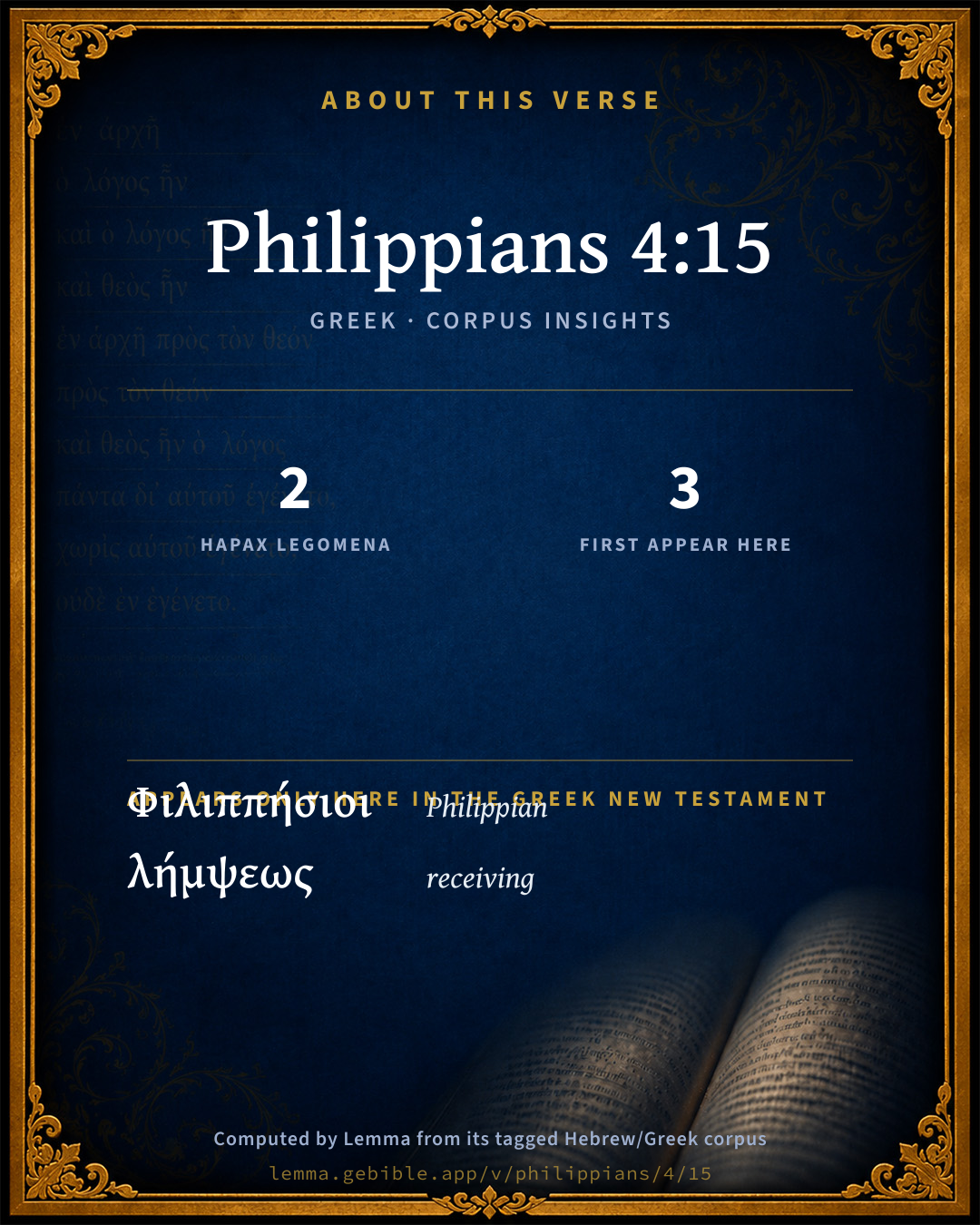
  • 2 hapax legomena — only here in the Greek New Testament
  • 3 first appearances in the Greek New Testament
Full analysis ↓
Download a study sheet

One document with this verse’s original text, its word-by-word gloss line, the meaning frame, cross-references with their text, attributed commentary, and full source and license credits — printable, and it pastes into notes with its structure intact.

This verse Autodidact and up

Study sheet (.html) Plain text (.txt)

A passage Seminary Student

Up to 50 verses in one chapter. A passage sheet keeps up to 6 commentary sources and 12 cross-references per verse, in the order this page ranks them, and says so on the sheet whenever that leaves anything out. Ask for a single verse and you get the Autodidact verse sheet above.

Everything on this page stays free to read, with no account — the sheet is a download of what is already on screen, not access to it.

Want to remove ads? Support Godless Engineer
Compare translations 3

The same verse in 3 English versions, stacked beneath the original-language interlinear above. Click any original word for its lexicon entry.

Each is an independent rendering of the whole verse — the interlinear is not word-aligned to these translations.

Highlighted words mark where these versions differ — a whole-verse word diff, not a word-by-word alignment.

  • World English Bible Public Domain
    You yourselves also know, you Philippians, that in the beginning of the Gospel, when I departed from Macedonia, no assembly shared with me in the matter of giving and receiving but you only.
  • King James Version Public Domain
    Now ye Philippians know also, that in the beginning of the gospel, when I departed from Macedonia, no church communicated with me as concerning giving and receiving, but ye only.
  • unfoldingWord Literal Text CC BY-SA 4.0
    Now you Philippians also know that in the beginning of the gospel, when I went out from Macedonia, no church shared with me in the matter of giving and receiving except you alone,

unfoldingWord Literal Text — © unfoldingWord, licensed CC BY-SA 4.0. Word-aligned USFM3 via Door43 (git.door43.org/unfoldingWord/en_ult).

Versions to compare (up to 4)

3 of 4 selected

Show all 19 translations

Every available English version of this verse, each an independent rendering of the whole verse.

  • World English Bible Public Domain
    You yourselves also know, you Philippians, that in the beginning of the Gospel, when I departed from Macedonia, no assembly shared with me in the matter of giving and receiving but you only.
  • Berean Standard Bible Public Domain
    And as you Philippians know, in the early days of the gospel, when I left Macedonia, no church but you partnered with me in the matter of giving and receiving.
  • Majority Standard Bible Public Domain
    And as you Philippians know, in the early days of the gospel, when I left Macedonia, no church but you partnered with me in the matter of giving and receiving.
  • King James Version Public Domain
    Now ye Philippians know also, that in the beginning of the gospel, when I departed from Macedonia, no church communicated with me as concerning giving and receiving, but ye only.
  • American Standard Version (1901) Public Domain
    And ye yourselves also know, ye Philippians, that in the beginning of the gospel, when I departed from Macedonia, no church had fellowship with me in the matter of giving and receiving but ye only;
  • Revised Version (1885) Public Domain
    And ye yourselves also know, ye Philippians, that in the beginning of the gospel, when I departed from Macedonia, no church had fellowship with me in the matter of giving and receiving, but ye only;
  • Geneva Bible (1599) Public Domain
    And yee Philippians knowe also that in the beginning of the Gospell, when I departed from Macedonia, no Church communicated with me, concerning the matter of giuing and receiuing, but yee onely.
  • Douay-Rheims (1899) Public Domain
    And you also know, O Philippians, that in the beginning of the gospel, when I departed from Macedonia, no church communicated with me as concerning giving and receiving, but you only:
  • Young's Literal Translation Public Domain
    and ye have known, even ye Philippians, that in the beginning of the good news when I went forth from Macedonia, no assembly did communicate with me in regard to giving and receiving except ye only;
  • Literal Standard Version CC BY-SA 4.0
    and you have known, even you Philippians, that in the beginning of the good news when I went forth from Macedonia, no assembly communicated with me in regard to giving and receiving except you only;
  • Unlocked Literal Bible CC BY-SA 4.0
    You Philippians know that in the beginning of the gospel, when I left Macedonia, no church supported me in the matter of giving and receiving except you alone.
  • unfoldingWord Literal Text CC BY-SA 4.0
    Now you Philippians also know that in the beginning of the gospel, when I went out from Macedonia, no church shared with me in the matter of giving and receiving except you alone,
  • Darby Bible Public Domain
    And know also *ye*, O Philippians, that in [the] beginning of the gospel, when I came out of Macedonia, no assembly communicated [anything] to me in [the] way of giving and receiving save *ye* alone;
  • World Messianic Bible Public Domain
    You yourselves also know, you Philippians, that in the beginning of the Good News, when I departed from Macedonia, no assembly shared with me in the matter of giving and receiving but you only.
  • Webster's Bible Public Domain
    Now, ye Philippians, know also, that in the beginning of the gospel, when I departed from Macedonia, no church communicated with me as concerning giving and receiving, but ye only.
  • Free Bible Version CC BY-SA 4.0
    You Philippians remember that right at the beginning of sharing the good news, when I left Macedonia, that yours was the only church that helped me financially.
  • Bible in Basic English Public Domain
    And you have knowledge, Philippians, that when the good news first came to you, when I went away from Macedonia, no church took part with me in the business of giving to the saints, but you only;
  • Text-Critical English NT CC BY 4.0
    As you Philippians know, in the early days of the gospel, when I set out from Macedonia, no church partnered with me in the matter of giving and receiving except you alone.
  • Tyndale New Testament (1534) Public Domain
    Ye of Philippos knowe that in the begynnynge of the gospell when I departed from Macedonia no congregacion bare parte with me as concernynge gevynge and receavynge but ye only.

Literal Standard Version (2020), Covenant Press — licensed CC BY-SA 4.0. Text via the HelloAO Bible API (eBible.org). Unlocked Literal Bible (unfoldingWord) — licensed CC BY-SA 4.0. Text via the HelloAO Bible API (eBible.org). unfoldingWord Literal Text — © unfoldingWord, licensed CC BY-SA 4.0. Word-aligned USFM3 via Door43 (git.door43.org/unfoldingWord/en_ult). Free Bible Version, Dr. Jonathan Gallagher — licensed CC BY-SA 4.0. Text via the HelloAO Bible API (eBible.org).

Word by word

More ways to search: Search by grammar → Find every occurrence → Compare this word →

Practice this passage: Drill this verse → Learn its vocabulary →

Φιλιππήσιοι
Philippḗsios
G5374
“Philippian”
Noun, Vocative, Plural, Masculine
Part of Speech
Noun
Case
Vocative
Number
Plural
Gender
Masculine
Full Thayer's Definition

Origin: from G5375

TDNT: None

1. a resident of the town of Philippi
  1. οἴδατε eídō G1492 “to see” Verb, Perfect, Active, Indicative, 2nd person, Plural
  2. δὲ dé G1161 “but” Conjunction
  3. καὶ kaí G2532 “and” Conjunction
  4. ὑμεῖς hymeîs G5210 “you” Personal pronoun, 2nd person, Nominative, Plural
  5. ὅτι hóti G3754 “that” Conjunction
  6. ἐν en G1722 “in” Preposition
  7. ἀρχῇ archḗ G746 “beginning” Noun, Dative, Singular, Feminine
  8. τοῦ ho G3588 “the” Article, Genitive, Singular, Neuter
  9. εὐαγγελίου euangélion G2098 “gospel” Noun, Genitive, Singular, Neuter
  10. ὅτε hóte G3753 “when” Adverb
  11. ἐξῆλθον exérchomai G1831 “to come forth” Verb, Aorist, Active, Indicative, 1st person, Singular
  12. ἀπὸ apó G575 “from” Preposition
  13. Μακεδονίας Makedonía G3109 “Macedonia” Noun, Genitive, Singular, Feminine
  14. οὐδεμία oudeís G3762 “nothing” Adjective, Nominative, Singular, Feminine, Negative
  15. μοι egṓ G1473 “I” Personal pronoun, 1st person, Dative, Singular
  16. ἐκκλησία ekklēsía G1577 “assembly” Noun, Nominative, Singular, Feminine
  17. ἐκοινώνησεν koinōnéō G2841 “to share” Verb, Aorist, Active, Indicative, 3rd person, Singular
  18. εἰς eis G1519 “into” Preposition
  19. λόγον lógos G3056 “word” Noun, Accusative, Singular, Masculine
  20. δόσεως dósis G1394 “gift” Noun, Genitive, Singular, Feminine
  21. καὶ kaí G2532 “and” Conjunction
  22. λήμψεως lēmpsis G3028 “receiving” Noun, Genitive, Singular, Feminine
  23. εἰ ei G1487 “if” Conditional
  24. μὴ mḗ G3361 “not” Particle, Negative
  25. ὑμεῖς hymeîs G5210 “you” Personal pronoun, 2nd person, Nominative, Plural
  26. μόνοι mónos G3441 “alone” Adjective, Nominative, Plural, Masculine

About this verse

These counts appear in no published source. They are computed here, from the morphology-tagged text and Lemma’s own curated glosses. What Lemma adds →

27
words
25
distinct lemmas
Pauline Epistles
section

Notable vocabulary

2 hapax legomena — words that appear only here in the entire Greek New Testament:

  • Φιλιππήσιοι Philippian G5374
  • λήμψεως receiving G3028

First appearance in Scripture

These words make their first canonical appearance in the Greek New Testament here:

  • Φιλιππήσιοι Philippian G5374
  • δόσεως gift G1394
  • λήμψεως receiving G3028

Shared distinctive vocabulary

δόσεως gift G1394 occurs in 2 verses of the Greek New Testament. Also found in:
Repetition

Words recur within this verse:

  • καὶ and G2532 ×2
  • ὑμεῖς you G5210 ×2

Cross-references

4

Topical passages linked to Philippians 4:15 in the Treasury of Scripture Knowledge — connected by theme and wording, ordered by reader-vote popularity; previews shown in the World English Bible.

  • Philippians 1:5 for your partnership in furtherance of the Gospel from the first day until now;
  • 2 Corinthians 11:8–12 I robbed other assemblies, taking wages from them that I might serve you.
  • Acts 16:40–17:5 They went out of the prison, and entered into Lydia's house. When they had seen the brothers, they encouraged them, and departed.
  • 2 Corinthians 12:11–15 I have become foolish in boasting. You compelled me, for I ought to have been commended by you, for in nothing was I inferior to the very best apostles, though I am nothing.

Cross-references courtesy of OpenBible.info (CC BY 4.0).

Commentary

Notes on Philippians 4:15 from classic Christian and Jewish commentators (each source and its license shown beneath its notes). The classic Christian expositions comment on the surrounding passage and are grouped to its opening verse, so a note may address several verses; the Jewish commentaries on the Tanakh (Rashi and others) are per-verse, so they appear only where the commentator wrote on this verse.

Lemma curates 59 commentaries, every one of them public domain or Creative Commons licensed, each selected and text-cleaned for this edition rather than reprinted as found. About our sources →

The Biblical Illustrator

Joseph S. Exell

Php_4:15-19

Now, ye Philippians, know also that in the beginning of the gospel--Observe

I.

The straitened circumstances of the apostle.

II. The honourable conduct of the Philippians.

1. Though poor (2Co_8:2) they acknowledged their debt.

2. Stood alone.

3. Repeated their bounty of their own free will.

III. The commendation of the spirit of God.

1. Recorded for their honour.

2. For our instruction. (J. Lyth, D. D.)

Liberality to the minister

is--

I. Honourable.

II. Profitable.

III. Acceptable to God.

IV. A pledge of abundant blessing. (J. Lyth, D. D.)

The Biblical Illustrator, edited by Joseph S. Exell (c. 1880s–1900s) — public domain. Text from a community e-Sword module.

Joseph Benson's Commentary

Php 4:15-19. Ye know that in the beginning of the gospel — When it was first preached at Philippi; no church — No Christian society, as such; communicated with me — In the matter of giving me money, and of my receiving money from them; but ye only — I received money from no church but yours. Not because I desire a gift, &c. — I would not have you think that I commend your liberality merely out of respect to myself; but I desire fruit, &c. — I do it chiefly out of respect to you; that you may do that which may turn to your everlasting advantage. But l have all — So also the Vulgate reads the clause; but the original expression, απεχω παντα, according to Estius, may be translated, I have from you all things; that is, my wants are amply supplied by you; and I abound — I have more than sufficient for my present state; having received of Epaphroditus the things sent from you — Besides money, the Philippians may have sent to the apostle clothes and other necessaries: an odour of a sweet smell — A service wherewith God is well pleased. See Heb 13:16. “The same epithets were anciently given to all the kinds of sacrifices; not only in the peace and thank-offerings, but to the burnt-offerings and sin-offerings. See note on Eph 5:2. Here they are given to the present which the Philippians sent to the apostle; not because that present partook of the nature of any sacrifice or offering whatever, as is plain from this, that it was offered immediately to the apostle, and not to God; but merely to show how acceptable to God that work of charity was which the Philippians had performed to the suffering apostle of Christ.” — Macknight. But my God — Whose ambassador I am; shall supply all your need — As he has mine. He shall recompense you even in this life, as far as he knows will be for your good; according to his riches in glory — And he is well able to do it, being gloriously rich in blessings of all kinds.

Joseph Benson's Commentary on the Old and New Testaments (1811–1818) — public domain. Text from a community e-Sword module.

Whedon's Commentary on the Bible

Daniel D. Whedon

2. Grateful mention of the past, Php_4:15-19.

15. Ye Philippians—This gift was no new thing, for that Church had, from the time of their reception of the gospel, repeatedly shown in the same way its grateful love. After the apostle had left Macedonia, and while he was at Corinth, where he supported himself by working at his trade, Silas and Timothy brought to him the first, perhaps, of a series of contributions sent him when at a distance. The help was opportune. 2Co_11:9. We may wonder that the Churches of Thessalonica and Berea, in their familiarity with his principle of labouring for his bread that he might not be chargeable to any, (see 1Th_2:9, and 2Th_3:8-9,) should have been forgetful of his wants; but no complaint is made of them, while the ye only attests the deep impression which the conduct of the Philippians had made upon his heart.

Daniel D. Whedon (gen. ed.), Commentary on the Old and New Testaments (1874–1909) — public domain. Text from a community e-Sword module.

The Preacher's Complete Homiletical Commentary

Joseph S. Exell (gen. ed.)

CRITICAL AND EXPLANATORY NOTES

Php_4:15. No Church communicated with me.—The lofty independence of the apostle had not unbent to any other Church as to this. There are men from whom one could never receive a gift without sacrifice of self-respect. St. Paul was not the man to be patronised.

Php_4:18. An odour of a sweet smell, a sacrifice acceptable, well pleasing to God.—The last word transfers their deed to another sphere entirely. “Ye did it unto Me,” says Christ.

Php_4:19. My God shall supply all your need.—Did I say, “I am filled”? (Php_4:18). I can make you no return, but my God will. He will fulfil every need of yours. According to His riches in glory.—According to the abundant power and glorious omnipotence whereby as Lord of heaven and earth He can bestow what He will.

MAIN HOMILETICS OF THE PARAGRAPH.—Php_4:15-19

A Generous Church—

I. Spontaneously contributing to the earliest efforts in the propagation of the gospel.—

1. Its generosity conspicuous by its solitary example. “No Church communicated with me as concerning giving and receiving, but ye only” (Php_4:15). In the account between us, the giving was on your part, the receiving on mine. The Philippians had followed Paul with their bounty when he left Macedonia and came to Corinth. We are not to wait for others in a good work, saying, “I will do so when others do it.” We must go forward though alone (Fausset). Their liberality followed him on distant missionary tours, and when no longer in their own province. One single example of generosity is an inspiration and a hint to others. Any Church will wither into narrowing dimensions when it confines its benefactions to itself.

2. Its generosity was repeated.—“For even in Thessalonica ye sent once and again unto my necessity” (Php_4:16). Even in Thessalonica, still in their own province and not far from Philippi, they more than once contributed to his help, and thus rendered him less dependent on those among whom he was breaking new ground. Help in time of need is a pleasant memory; and the apostle delights in reminding the Philippians of their timely and thoughtful generosity. Repeated kindnesses should increase our gratitude.

II. The gifts of a generous Church are appreciated as indicating growth in practical religion.—“Not because I desire a gift: but I desire fruit that may abound to your account” (Php_4:17). It is not the gift he covets, but that rich spiritual blessing which the gift secures to its donors. The apostle wished them to reap the growing spiritual interest of their generous expenditure. Not for his own sake but theirs does he desire the gift. He knew that the state of mind which devised and contributed such a gift was blessed in itself, that it must attract divine blessing, for it indicated the depth and amount of spiritual good which the apostle had done to them, and for which they thus expressed their gratitude; and it showed their sympathy with the cause of Christ, when they had sought to enable their spiritual founder in former days to give his whole time, without distraction or physical exhaustion, to the work of his apostleship. This was a spiritual condition which could not but meet with the divine approbation and secure the divine reward (Eadie).

III. The gifts of a generous Church are accepted as a sacrifice well pleasing to God.—“Having received of Epaphroditus the things which were sent from you, an odour of a sweet smell, a sacrifice acceptable, well-pleasing to God” (Php_4:18). It was a gift in which God delighted, fragrant as the sweet-smelling incense which burned in the censer. It was felt that God is supreme Benefactor and that all possessions are His gracious gift, that these have an end beyond the mere personal enjoyment of them, that they may and ought to be employed in God’s service, and that the spirit of such employment is the entire dedication of these to Him. The money, while contributed to the apostle, was offered to God. They discharged a spiritual function in doing a secular act—“the altar sanctified the gift” (Ibid.). Giving to the cause of Christ is worship, acceptable and well-pleasing to God. It belongs to the same class of acts as the presentation of sacrifices under the old economy, which was the central act of worship. For the proper use of no talent is self-denial more needed than for that of money.

IV. The gifts of a generous Church will be recompensed with abundant spiritual blessing.—“But my God shall supply all your need according to His riches in glory by Christ Jesus,” (Php_4:19). The money we give to God’s cause is well invested, and will yield a rich return: spiritual blessing in return for material gifts; this is beyond the power of arithmetic to compute. This was no rash and unwarrantable promise on the part of Paul. He knew something of the riches of the divine generosity, and was justified in assuring his kind benefactors of God’s perfect supply of every want of body and soul, bestowed not grudgingly but with royal beneficence.

Lessons.—

1. Gratitude for blessings received should prompt generosity.

2. Money is never more wisely employed than in forwarding the cause of God.

3. Our gifts to God are handsomely rewarded.

GERM NOTES ON THE VERSES

Php_4:15-16. Christian Generosity—

I. Indicates a genuine interest in the work of God and love for its ministers.

II. Is especially valuable in prosecuting pioneer mission work.

III. Should not be conspicuous by one solitary example, but be continuous and commensurate with the pressing needs of the work of God.

Php_4:17-18. Liberality a Fruit of the Christian Life.

I. It is not a gift, but the discharge of a just claim.

II. Paul did not desire a gift only to benefit himself, because he wanted nothing.

III. Liberality is a fruit of the Christian life by discharging a debt to which we stood engaged.

IV. Liberality is an advantage in the exercise of our patience before the day of trial come upon us.

V. As God will punish the neglect of this duty, so if we perform it He will count Himself in debt to us.—Farindon.

Php_4:19. Man’s Need supplied from God’s Riches.

I. Look at man’s necessity.

II. God’s wealth.—Its abundance; its excellence.

III. The supply the apostle anticipates for this necessity out of this wealth.

Learn.—

1. Contentment with our present lot.

2. Confidence for the future.—C. Bradley.

Our Need and our Supply.

I. Examine the scope of the promise.—There is danger of fanaticism in the interpretation of truth. God promises to supply our need, but not to gratify our wishes or whims. Some of us God sees cannot bear wealth, and so it is not given us; but as our day is so is our strength.

II. The supply—The supply is not according to our deserts, but according to the riches of His glory. The resources of the Trinity are drawn upon. His wealth is unbounded. He is not a cistern, but a fountain.

III. The Medium.—This supply comes through Christ. We can claim it in no other name. But God ordains means and puts us under conditions. As in agriculture, so here, we are to work in harmony with God’s established methods if we would secure fruits.—Homiletic Monthly.

The Preacher's Complete Homiletical Commentary (gen. ed. Joseph S. Exell; Funk & Wagnalls, c. 1892) — public domain (pre-1929). A full-Bible homiletical/sermon-outline anthology covering 65 of 66 books (2 John is absent from the source module). Text from a community e-Sword module.

MacLaren's Expositions of Holy Scripture

Alexander MacLaren

Philippians

GIFTS GIVEN, SEED SOWN

Php 4:15-19 {R.V.}.

Paul loved the Philippians too well and was too sure of their love to be conscious of any embarrassment in expressing his thanks for money help. His thanks are profuse and long drawn out. Our present text still strikes the note of grateful acknowledgment. It gives us a little glimpse into earlier instances of their liberality, and beautifully suggests that as they had done to him so God would do to them, and that their liberality was in a fashion a prophecy, because it was in some measure an imitation, of God’s liberality. He had just said ‘I am full, having received the things which were sent from you,’ and now he says, ‘My God shall fill full all your needs.’ The use of the same word in these two connections is a piece of what one would call the very ingenuity of graceful courtesy, if it were not something far deeper, even the utterance of a loving and self-forgetting heart.

I. We may note here Paul’s money relations with the churches.

We know that he habitually lived by his own labour. He could call to witness the assembled elders at Ephesus, when he declared that ‘these hands ministered unto my necessities,’ and could propose himself as an illustration of the words of the Lord Jesus, ‘It is more blessed to give than to receive.’ He firmly holds the right of Christian teachers to be supported by the churches, and vehemently insists upon it in the First Epistle to the Corinthians. But he waives the right in his own case, and passionately insists that it were better for him rather to die than that any man should make his glorying void. He will not use to the full his right in the Gospel ‘that he may make a Gospel without charge,’ but when needed he gladly accepted money gifts, as he did from the Philippians. In our text he points back to an earlier instance of this. The history of that instance we may briefly recall. After his indignities and imprisonment in Philippi he went straight to Thessalonica, stayed there a short time till a riot drove him to take refuge in Berea, whence again he had to flee, and guided by brethren reached Athens. There he was left alone, and his guides went back to Macedonia to send on Silas and Timothy. From Athens he went to Corinth, and there was rejoined by them. According to our text, ‘in the beginning of the Gospel,’ that is, of course, its beginning in Philippi, they relieved him twice in Thessalonica, and if the words in our text which date the Philippians’ gift may be read ‘when I had departed from Macedonia,’ we should have here another reference to the same incident mentioned in 2 Corinthians, chap. 11: 8-9, where he speaks of being in want there, and having ‘the measure of my want’ supplied by the brethren who came from Macedonia. The coincidence of these two incidental references hid away, as it were, confirms the historical truthfulness of both Epistles. And if we take into view the circumstances in which he was placed in Thessalonica and at the beginning of his stay in Corinth, his needing and receiving such aid is amply accounted for. Once again, after a long interval, when he was a prisoner in Rome, and probably unable to work for his maintenance, their care of him flourished again.

In the present circumstances of our churches, it seems necessary that the right which Paul so strongly asserted should, for the most part, not be waived, but the only true way of giving and receiving as between minister and people is when it is a matter not of payment but a gift. When it is an expression of sympathy and affection on both sides, the relationship is pleasant and may be blessed. When it comes to be a business transaction, and is to be measured by the rules applicable to such, it goes far to destroy some of the sweetest bonds, and to endanger a preacher’s best influence.

II. The lofty view here taken of such service.

It is ‘the fruit that increaseth to your account.’ Fruit, which as it were is put to their credit in the account-book of heaven, but it is called by Paul by a sacreder name as being an odour of a sweet smell, a sacrifice acceptable, well pleasing to God, in which metaphor all the sacred ideas of yielding up precious things to God and of the sacred fire that consumed the offering or brought to bear on the prosaic material gift.

The principle which the Apostle here lays down in reference to a money gift has, of course, a much wider application, and is as true about all Christian acts. We need not be staggered at the emphasis with which Paul states the truths of their acceptableness and rewardableness, but in order fully to understand the ground of his assurance we must remember that in his view the root of all such fruit increasing to our account, and of everything which can claim to be an odour of a sweet smell well pleasing to God, is love to Christ, and the renewal of our nature by the spirit of God dwelling in us. In us there dwells no good thing. It is only as we abide in Him and His words abide in us that we bear much fruit. Separate from Him we can do nothing. If our works are ever to smell sweet to God, they must be done for Christ, and in a very profound and real sense, done by Him.

The essential character of all work which has the right to be called good, and which is acceptable to God, is sacrifice. The one exhortation which takes the place and more than fills the place of all other commandments, and is enforced by the motive which takes the place, and more than takes the place of all other motives, is, ‘I beseech you by the mercies of God to present your bodies a living sacrifice.’ It is works which in the intention of the doer are offered to Him, and in which therefore there is a surrender of our own wills, or tastes, or inclinations, or passions, or possessions, that yield to Him an odour of a sweet smell. The old condition which touched the chivalrous heart of David has to be repeated by us in regard to any work which we can ever hope to make well pleasing to God; ‘I will not offer burnt offerings unto the Lord my God which cost me nothing.’

There is a spurious humility which treats all the works of good men as filthy rags, but such a false depreciation is contradicted by Christ’s ‘Well done, good and faithful servant.’ It is true that all our deeds are stained and imperfect, but if they are offered on the altar which He provides, it will sanctify the giver and the gift. He is the great Aaron who makes atonement for the iniquity of our holy things. And whilst we are stricken silent with thankfulness for the wonderful mercy of His gracious allowance, we may humbly hope that His ‘Well done’ will be spoken of us, and may labour, not without a foretaste that we do not labour in vain, that ‘whether present or absent we may be well pleasing to Him.’

The fruit is here supposed to be growing, that is, of course, in another life. We need not insist that the service and sacrifice and work of earth, if the motive be right, tell in a man’s condition after death. It is not all the same how Christian men live; some gain ten talents, some five, and some two, and the difference between them is not always as the parable represents it, a difference in the original endowment. An entrance may be given into the eternal kingdom, and yet it may not be an abundant entrance.

III. The gift that supplies the givers.

Paul has nothing to bestow, but he serves a great God who will see to it that no man is the poorer by helping His servants. The king’s honour is concerned in not letting a poor man suffer by lodging and feeding his retainers. The words here suggest to us the source from which our need may be filled full, as an empty vessel might be charged to the brim with some precious liquid, the measure or limit of the fulness, and the channel by which we receive it.

Paul was so sure that the Philippians’ needs would all be satisfied, because he knew that his own had been; he is generalising from his own case, and that, I think, is at all events part of the reason why he says with much emphasis, ‘ My God. As He has done to me He will do to you,’ but even without the ‘my,’ the great name contains in itself a promise and its seal. ‘God will supply just because He is God’; that is what His name means--infinite fulness and infinite self-communicativeness and delight in giving. But is not so absolutely unlimited a promise as this convicted of complete unreality when contrasted with the facts of any life, even of the most truly Christian or the most outwardly happy? Its contradiction of the grim facts of experience is not to be slurred over by restricting it to religious needs only. The promise needs the eye of Faith to interpret the facts of experience, and to let nothing darken the clear vision that if any seeming need is left by God unfilled, it is not an indispensable need. If we do not get what we want we may be quite sure that we do not need it. The axiom of Christian faith is that whatever we do not obtain we do not require. Very desirable things may still not be necessary. Let us limit our notions of necessity by the facts of God’s giving, and then we, too, shall have learned, in whatsoever state we are, therein to be content. When the Apostle says that God shall fill all our need full up to the brim, was he contemplating only such necessities as God could supply through outward gifts? Surely not. God Himself is the filler and the only filler of a human heart, and it is by this impartation of Himself and by nothing else that He bestows upon us the supply of our needs.

Unless we have been initiated into this deepest and yet simplest secret of life, it will be full of gnawing pain and unfulfilled longings. Unless we have learned that our needs are like the cracks in the parched ground, cups to hold the rain from heaven, doors by which God Himself can come to us, we shall dwell for ever in a dry and thirsty land. God Himself is the only satisfier of the soul. ‘Whom have I in heaven but Thee, and there is none upon earth that’--if I am not a fool--’I desire side by side with Thee?’

But Paul here sets forth in very bold words the measure or limits of the divine supply of our need. It is ‘according to His riches in glory.’ Then, all of God belongs to me, and the whole wealth of His aggregated perfections is available for stopping the crannies of my heart and filling its emptiness. My emptiness corresponds with His fulness as some concavity does with the convexity that fits into it, and the whole that He is waits to fill and to satisfy me. There is no limit really to what a man may have of God except the limitless limit of the infinite divine nature, but on the other hand this great promise is not fulfilled all at once, and whilst the actual limit is the boundlessness of God, there is a working limit, so to speak, a variable one, but a very real one. The whole riches of God’s glory are available for us, but only so much of the boundless store as we desire and are at present capable of taking in will belong to us now. What is the use of owning half a continent if the owner lives on an acre of it and grows what he wants there, and has never seen the broad lands that yet belong to him? Nothing hinders a man from indefinitely increased possession of a growing measure of God, except his own arbitrarily narrowed measure of desire and capacity. Therefore it becomes a solemn question for each of us, Am I day by day becoming more and more fit to possess more of God, and enjoy more of the God whom I possess? In Him we have each ‘a potentiality of wealth beyond the dreams of avarice.’ Do we growingly realise that boundless possibility?

The channel by which that boundless supply is to reach us is distinctly set forth here. All these riches are stored up ‘in Christ Jesus.’ A deep lake may be hidden away in the bosom of the hills that would pour blessing and fertility over a barren land if it could find a channel down into the plains, but unless there be a river flowing out of it, its land-locked waters might as well be dried up. When Paul says ‘riches in glory,’ he puts them up high above our reach, but when he adds ‘in Christ Jesus,’ he brings them all down amongst us. In Him is ‘infinite riches in a narrow room.’ If we are in Him then we are beside our treasure, and have only to put out our hands and take the wealth that is lying there. All that we need is ‘in Christ,’ and if we are in Christ it is all close at our sides.

Then the question comes to be, ‘Am I thus near my wealth, and can I get at it whenever I want it, as I want it, and as much as I want of it?’ We can if we will. The path is easy to define, though our slothfulness find it hard to tread. That man is in Christ who dwells with Him by faith, whose heart is by love plunged in His love, who daily seeks to hold communion with Him amid the distractions of life, and who in practical submission obeys His will. If thus we trust, if thus we love, if thus we hold fast to Him, and if thus we link Him with all our activities in the world, need will cease to grow, and will only be an occasion for God’s gift. ‘Delight thyself in the Lord,’ and then the heart’s desires being set upon Him, ‘He will give thee the desire of thy heart.’

Paul says to us ‘My God shall supply all your need.’ Let us answer, ‘The Lord is my Shepherd, I shall not want.’

Alexander MacLaren, Expositions of Holy Scripture (1904–1910) — public domain. Text from a community e-Sword module.

Tyndale Open Study Notes

Tyndale Open Resources

4:15 the only ones who gave me financial help: By contrast, Paul determined not to accept financial help from the Corinthians because it would have damaged the reputation of the Good News in their eyes (1 Cor 9:11-18; 2 Cor 11:7-12). He did not face such a problem with the Philippians. • when I first brought you the Good News: See Acts 16:11-40.

Tyndale Open Study Notes — © Tyndale Open Resources, licensed CC BY-SA 4.0. Text via the HelloAO Bible API.

Bengel's Gnomon

Johann Albrecht Bengel

Php 4:15. Οἴδατε, ye know) He shows that he was mindful even of former kindnesses: you know signifies remembrance in respect of the Philippians; knowledge, in respect of other churches.—Φιλιππήσιοι, Philippians) The proper name indicates an antithesis to the churches of other towns.—ἐν ἀρχῇ, in the beginning) of the Gospel preaching in your case. He had gone forth from them some time ago.—ὅτε, when) Join this with the following words, no, etc.—οὐδεμία, no) They might have said, We will do it, if others have done it: now their praise is greater on that account; that of the others, less.—ἐκκλησία, church) Therefore the church of Philippi sent to Paul in common.—εἰς λόγον, as far as concerns) This is a limitation.—δόσεως, of giving, of what has been given) on your part.—λήψεως, of receiving, of what has been received) on mine.—μόνοι, alone) in a manner worthy of praise. He hereby shows his need.

Bengel's Gnomon of the New Testament — English translation (T&T Clark, Edinburgh, 1860) — public domain. Text from a community e-Sword module.

Meyer's Critical & Exegetical Commentary

Heinrich August Wilhelm Meyer

Php_4:15 f. A courteous recalling of the fact, that in the very beginning of the gospel the Philippians had distinguished themselves by such manifestation of love towards Paul.

δέ] carrying the discourse onward: But what ye have done connects itself with a relation into which, as ye also know, no other church, but yours only, placed itself to me at the very first!

οἴδατε δὲ κ.τ.λ.] but it is known also to you, Philippians, that, etc. Hofmann very erroneously derives the object of οἴδατε from what precedes, and takes ὅτι in the sense of because. He makes the apostle say, namely, to the Philippians: That they had done well in helpfully taking part in his affliction they knew also, as other churches knew that it was well done; by experience they knew it, because it was not the first time that they had sent similar gifts to him, etc. This explanation is erroneous, because invariably where οἶδα (οἴδαμεν, οἴδατε, κ.τ.λ.) is accompanied, not with an accusative of the object, but with ὅτι, the latter conveys the contents (that), and not the reason or the cause (because), of the οἶδα (comp. Php_1:19; Php_1:25; Rom_3:2; 1Co_3:16; 1Co_12:2; Gal_4:13, and innumerable other passages); secondly, because the previously attested καλῶς ἐποιήσατε, while perfectly suitable to be expressed by the grateful apostle, was not so suited to be transferred to the consciousness of the donors, to which it was self-evident, and to be appealed to by them; thirdly, because the καί in the alleged reference to other churches would be very unsuitable, since the question here concerns merely a work of love of the Philippians, but other churches could only know generally that it was well done to aid the apostle, into which general idea, therefore, Hofmann insensibly transforms the object of οἴδατε, instead of abiding strictly by the concrete καλῶς ἐποιήσατε as its object; finally, it would be strange and not in keeping with the thoughtful manner of the apostle, to furnish the idea: ye know that ye did well therein (which οἶδατε is supposed to convey) with the altogether external specification of a ground for it: because ye have already formerly and repeatedly supported me. The contents attributed by Hofmann to οἴδατε needed no assignment of a causal ground, orif anyone internal, ethical, and in harmony with the subtle delicacy of the apostle.

Observe, moreover, in connection with οἴδατε κ. ὑμεῖς, that in that which the readers also know (consequently in ὅτι κ.τ.λ.) the stress lies upon the negative οὐδεμία κ.τ.λ.

καὶ ὑμεῖς] ye also, as I.[191]

Φιλιππήσιοι] addressing them by name, not because he desires to assert something of them which no other church had done (Bengel: for in this case Paul would have written ὅτι ὑμεῖς, Φιλιππ.), but in his increasing earnestness. Comp. 2Co_6:11.

ἐν ἀρχῇ τ. εὐαγγ.] glancing back, certainly, to the second missionary journey (Weiss); but the relative expression is used from the standpoint of the time then present, behind which lay the founding of the Macedonian churches about ten years back; a long past which seemed, in relation to the present and to the wider development of the church now attained, as still belonging to the period of the beginning of the gospel. Comp. Clement. Cor. I. 47. An epexegetical more precise definition of this expressionwhich does not betray the hand of a later author (Hinsch)for the date intended is: ὅτε ἐξῆλθον ἀπὸ Μακεδ., when I departed from Macedonia, Act_17:14. Paul, therefore, immediately on leaving that country, received aid from the infant church, when the brethren τὸν Παῦλον ἐξαπέστειλαν πορεύεσθαι ὡς ἐπὶ τὴν θάλασσαν and ἤγαγον ἕως Ἀθηνῶν, Acts l.c. Doubtless the money which Paul subsequently received in Corinth (see 2Co_11:9) through Macedonian delegates was sent, if not exclusively, at least jointly by the Philippians, so that they thereby gave continued active proof of the fellowship εἰς λόγον δόσ. κ. λήψ., into which they had entered with the apostle at his very departure. But this receipt of money at Corinth is not the fact meant by ἐκοινώνησεν κ.τ.λ., in which case ἐξῆλθον would have to be taken, with Estius, Flatt, van Hengel, de Wette, Wiesinger, Weiss, Hofmann, and others, in the sense of the pluperfect (Winer, p. 258 [E. T. 343]); for the latter would be the more unwarranted in the context, seeing that Paul himself by ἐν ἀρχῇ τοῦ εὐαγγ. carries them back to the earliest time possible, and indeed afterwards (Php_4:16) to a period even antecedent to the ὅτε ἐξῆλθον. The aorist, however, has its justification in this purely historical statement of fact, although the imperfect also, but following a different conception, mightnot, however (in opposition to Hofmanns objection), musthave been used.

ἐκοινώνησεν εἰς λόγον δόσεως κ. λήψ.] entered into fellowship with me in reference to account of giving and receiving,a euphemistic indication, calculated to meet the sense of delicacy in the readers, of the thought: has entered into the relation of furnishing aid towards me. On κοινωνεῖν εἰς, comp. on Php_1:5. The analysis of the figurative description is this: The Philippians keep an account of expenditure on Paul and income from him; and the apostle likewise keeps account of his expenditure on the Philippians and income from them. This mutual account-keeping, in which the δόσις on the one part, agrees with the λῆψις on the other, is the κοινωνία εἰς λόγον κ.τ.λ. It is true that in this case no money-amount is entered in the account of the Philippians under the heading of λῆψις, or the account of the apostle under the heading of δόσις; instead of this, however, comes in the blessing, which the readers were to receive from their gifts of love, according to Php_4:17, as if it were an income corresponding to this expenditure, and coming in from it. We are therefore not justified in adopting the view, that δόσ. and λῆψ. apply to Paul alone (Schrader), or that δόσεως applies to the Philippians and λήψ. to Paul (Ego sum in vestris expensi tabulis, vos in meis accepti, Grotius; comp. Erasmus, Camerarius, Casaubon, Castalio, and others, including Heinrichs, Storr, Flatt, Matthies, van Hengel, Rilliet, Ewald); for the words require the idea of an account under both headings on the side of both parties. Others, maintaining indeed this reciprocity, but arbitrarily introducing ideas from 1Co_11:11, comp. Rom_15:27, consider that the δόσις on the part of the apostle, and the λῆψις on the part of the Philippians, consisted in the spiritual benefits brought about by the preaching of the gospel (so Chrysostom, Oecumenius, Theophylact, Pelagius, Calvin, Cornelius a Lapide, Zanchius, Zeger, Estius, Hammond, Wiesinger, Weiss, Hofmann, and others); whilst others, again, import into the words the thought: Quae a Philippensibus accepit in rationes Dei remuneratoris refert Paulus (Wetstein, Rosenmüller; comp. Wolf, Schoettgen, and already Ambrosiaster). Rheinwald finds the λῆψις of the Philippians and the δόσις of the apostle even in the assumption that he also had assisted them, namely, out of the sums of money collected in the churches,an error which is at variance with the context, and which ought to have been precluded both by the prominence given to the statement of the date, and also by the exclusion of all other churches, as well as by the inappropriateness of the mention just in this passage of such a λῆψις on the part of the Philippians.

On λόγος, ratio, account, comp. Mat_12:36; Luk_16:2; Rom_14:12; 1Ma_10:40; Dem. 227. 26; Diod. Sic. i. 49; Polyb. xv. 34. 2. The rendering which takes εἰς λόγον: in respect to (Bengel, Heinrichs, Storr, Matthies, van Hengel, Rilliet, Lünemann), would no doubt be linguistically correct (Dem. 385. 11; 2Ma_1:14; and see Krüger on Thuc. iii. 46. 3), but is to be rejected on account of the context, as expressions of accounting follow (comp. Cic. Lael. 16: ratio acceptorum et datorum). For instances from Greek writers of δόσις καὶ λῆψις (Sir_41:14; Sir_42:7) as expenditure and income, see Wetstein. Comp. Plat. Rep. p. 332 A B: ἡ ἀπόδοσις κ. ἡ λῆψις. As to the corresponding משא ומתן, see Schoettgen, Hor. p. 804.

[191] To express this, Paul was not at all under the necessity of writing οἴδατε αὐτοί, as Hofmann objects. The latter would convey a different conception, namely: ye know without my reminding you (Act_2:22; 1Th_2:1; 1Th_3:3; 2Th_3:7).

Meyer — Critical and Exegetical Commentary on the New Testament — English translation by Peter Christie, edited by Frederick Crombie (T&T Clark, 1880) — public domain. Text from a community e-Sword module.

Expositor's Greek Testament

ed. W. Robertson Nicoll

Phi 4:15-19 . THEIR EARLIER AND LATER GENEROSITY AND ITS DIVINE REWARD.

Phi 4:15 . δέ marks the transition to his first experience of their generosity. “But this is no new thing, for you have always been generous. You know this as well as I do” ( καὶ ὑμεῖς ). φιλιππής . (A Latin form, see Ramsay, Journal of Theol. Studies , i., 1, p. 116.) He singles them out from all the other Churches. ἐν ἀρχ . τ . εὐαγ . It is difficult to see (in spite of Haupt’s objections) how this could mean anything else than “at the time when the Gospel was first preached to you”. That had been about ten years previously. Cf. 1 Clem. 47, ἀναλάβετε τὴν ἐπιστολὴν τοῦ μακαρίου Παύλου τοῦ ἀποστόλου · τί πρῶτον ὑμῖν ἐν ἀρχῇ τοῦ εὐαγγελίου ἔγραψεν ; probably this is the gift referred to in 2Co 11:9 ( Cf. Act 18:5 ). He refused to take any pecuniary aid at Corinth lest the Judaising teachers should make it a ground for false charges. μοι … ἐκοινών . This use (in N.T.) is apparently confined to the Epistles. A precise parallel ( κοιν . with dative and εἰς ) is found in Plat., Repub. , v., 453 A. εἰς λόγ . δ . κ . λ . Lit. = “No Church communicated with me so as to have an account of giving and receiving” (debit and credit). The whole of the context has a colouring of financial terms. Probably Paul uses them in a half-humorous manner. The combination of [58] δ . and λ . is frequent. Cf. Sir 42:7 , δόσις καὶ λῆμψις παντὶ ἐν γραφῇ , and in Latin authors, Cic., Lael. , 16, ratio acceptorum et datorum . Numerous exx. are given by Wetst. Paul had bestowed on them priceless spiritual gifts. It was only squaring the account that he should receive material blessings from them. Their mutual relations are expressed by the Apostle very delicately, as throughout this paragraph. His manner here gives a luminous view of his refined sensibility.

[58] Codex Sangallensis

The Expositor's Greek Testament, edited by W. Robertson Nicoll (1897–1910) — public domain. Text from a community e-Sword module.

Geneva Bible (1599)

Geneva Bible translators

He witnesseth that he remembereth also their former benefits, and again putteth away sinistrous suspicion of immoderate desire, in that that he received nought of any else.

At that beginning when I preached the Gospel amongst you.

Geneva Bible (1599) marginal notes — public domain. Text via Bolls.life.

Jamieson, Fausset & Brown

Robert Jamieson, A. R. Fausset & David Brown

Now--"Moreover." Arrange as Greek, "Ye also know (as well as I do myself)."

in the beginning of the gospel--dating from the Philippian Christian era; at the first preaching of the Gospel at Philippi.

when I departed from Macedonia-- (Act 17:14). The Philippians had followed Paul with their bounty when he left Macedonia and came to Corinth. Co2 11:8-9 thus accords with the passage here, the dates assigned to the donation in both Epistles agreeing; namely, "in the beginning of the Gospel" here, and there, at the time of his first visit to Corinth [PALEY, Horæ Paulinæ]. However, the supply meant here is not that which he received at Corinth, but the supply sent to him when "in Thessalonica, once and again" (Phi 4:16), [ALFORD].

as concerning giving and receiving--In the account between us, "the giving" was all on your part; "the receiving" all on mine.

ye only--We are not to wait for others in a good work, saying, "I will do so, when others do it." We must go forward, though alone.

Jamieson, Fausset & Brown — Commentary Critical and Explanatory on the Whole Bible (1871) — public domain (CC PDM 1.0). Text via the HelloAO Bible API.

Adam Clarke's Commentary

Verse 15. In the beginning of the Gospel] When, having preached to you, I went forth into Macedonia, I received help from none of the Churches which I had founded, but from you alone. I received nothing from any others, and nothing was offered me.

Adam Clarke's Commentary on the Bible (1810–1826) — public domain. Text from a community e-Sword/MySword module.

John Calvin's Commentaries

15 And ye know I understand this to have been added by way of excuse, inasmuch as he often received something from them, for if the other Churches had discharged their duty, it might have seemed as though he were too eager to receive. Hence in clearing himself he praises them, and in praising them he modestly excuses others. We must also, after Paul’s example, take heed lest the pious, on seeing us too much inclined to receive from others, should on good grounds reckon us to be insatiable. You also know, says he. “I do not require to call in other witnesses, for ye yourselves also know.” For it frequently happens, that when one thinks that others are deficient in duty, he is the more liberal in giving assistance. Thus the liberality of some escapes the notice of others.

In the matter of giving and receiving He alludes to pecuniary matters, in which there are two parts, the one receiving, the other expending. It is necessary that these should be brought to an equality by mutual compensation. There was an account of this nature carried on between Paul and the Churches. While Paul administered the gospel to them, there was an obligation devolving upon them in return for supplying what was necessary for the support of his life, as he says elsewhere,

If we dispense to you spiritual thinqs, is it a great matter if you give in return carnal things? (1 Corinthians 9:11.)

Hence, if the other churches had relieved Paul’s necessities, they would have been giving nothing gratuitously, but would have been simply paying their debt, for they ought to have acknowledged themselves indebted to him for the gospel. This, however, he acknowledges, had not been the case, inasmuch as they had not laid out anything on his account. What base ingratitude, and how very unseemly, to treat such an Apostle with neglect, to whom they knew themselves to be under obligation beyond their power to discharge! On the other hand, how great the forbearance of this holy man, to bear with their inhumanity with so much gentleness and indulgence, as not to make use of one sharp word by way of accusing them!

John Calvin's Commentaries (1540-1563) — public domain. Text from the Calvin Translation Society English edition (1840s-50s) via the Christian Classics Ethereal Library (ccel.org). Calvin's coverage is partial (roughly two-thirds of the Bible); uncommented books and verses are honest gaps, never fabricated. The 19th-century editor's footnotes and remarks are omitted so the notes are faithfully Calvin's own voice.

Ellicott's Commentary for English Readers

(15) Now ye Philippians know also.—Properly, But ye also yourselves know. The mention of the proper name is always emphatic (comp. 2Co_6:11); here it evidently marks the dignity of their exclusive position of benefaction.

In the beginning of the gospel.—At the beginning (that is) of the gospel to them and their sister churches in Macedonia. The time referred to is his leaving Macedonia for Athens and Corinth (Act_17:14). At Corinth we know that he received offerings from Macedonia: “That which was lacking to me the brethren who came (when they came) from Macedonia supplied” (2Co_11:9). His language to the Thessalonian Church (1Th_2:9; 2Th_3:8) precludes all idea that any part of this contribution was from Thessalonica; we learn here that it was from no other Church than Philippi. It is probably to this gift that reference is made; though it is of course possible that some contribution may have reached him at the time of his actual departure in haste after the persecution at Berœa.

Communicated with me as concerning . . .—The metaphor here is drawn from commercial transaction. Literally the passage runs, had dealings with me on account of giving and receiving; “opened (so to speak) an account with me,” not of debit and credit, but “of free giving and receiving.” There is possibly an allusion (as Chrysostom suggests) to the idea embodied in 1Co_9:11, “If we have sown unto you spiritual things, is it a great matter if we shall reap your carnal things?” (Comp. Rom_15:27.) In the one respect he had all to give, and they to receive; in the other the relations were reversed. But if there be such allusion, it is kept in the background. The prominent idea is of the Philippians, and of them alone, as givers.

A Bible Commentary for English Readers, edited by Charles John Ellicott (1878–1897) — public domain. Text from a community e-Sword module.

The Cambridge Bible for Schools and Colleges

gen. ed. J. J. S. Perowne

15. Now] Better, But. He suggests, with the same delicacy of love, that their previous gifts would have sufficed, without this gift, to witness and seal their hearts’ cooperation with him. “You have done well in such participation; but indeed you had assured its existence before.”

ye Philippians know also] Better, ye yourselves too know, Philippians; ye, as well as I.—“Philippians”:—the form used by St Paul is “Philippesians”, one of several forms of the civic adjective. The same appears in the ancient “Title” (see above) and in the “Subscription” below. See Lightfoot here.

the gospel] I.e. his evangelization (of their region). For this meaning of “the Gospel” cp. 2Co_10:14 (and perhaps 2Co_8:18); Gal_2:7; 1Th_3:2; and above, Php_1:5; Php_1:7; Php_1:12, Php_4:3.

when I departed from Macedonia] He refers to about the time of his advance into “Achaia,” Roman Southern Greece; just before and just after he actually crossed the border. For the narrative, cp. Act_17:1-15. This is a reminiscence after an interval of about ten years.

communicated with me] Better, took its share with me. See last note on Php_4:14.

as concerning] Better, with R.V., in the matter of.

giving and receiving] I.e., their giving a subsidy to him, and his receiving it from them. The Greek phrase is a recognized formula, like our “credit and debit.” See Lightfoot here. To bring in the thought of their “giving temporal things” and “receiving spiritual things” (1Co_9:11) is to complicate and confuse the passage.

ye only] No blame of other Churches is necessarily implied. The thought is occupied with the fact of a sure and early proof of Philippian sympathy.

The Cambridge Bible for Schools and Colleges (gen. ed. J. J. S. Perowne; Cambridge University Press, 1878–1918) — public domain. Text from a community e-Sword module.

John Gill's Exposition

Now ye Philippians know also,.... As well as the apostle did, that they not only communicated now, but also had done formerly, and when none else beside them did; wherefore he not only commends them for their present kindness to him, but for their past favours:

that in the beginning of the Gospel; of the preaching of it by the apostle in the parts of Macedonia, particularly at Philippi; as soon as ever the Gospel was preached to them, they showed a grateful and beneficent spirit; of which we have an instance in Lydia, the first person we read of converted there, and also in the jailer, who was the next; see Act 16:12; yea, not only while he was with them they communicated to him, but when he was gone from them:

when I departed from Macedonia; when he went to Corinth and other places, to preach the Gospel in other parts and to other people, they sent the brethren after him with presents which supplied what was lacking to him, and in which other churches were deficient; see Co2 11:8; the Ethiopic version reads, "when ye went from Macedonia with me": but is not supported by any copy or other version:

no church communicated with me, as concerning giving and receiving,

but ye only; the phrase, "giving and receiving", is the same with avm wmtN, which is often used by the Jews for trading and commerce (e); and the allusion is to the keeping of accounts by men in business, by debtor and creditor, in a book, putting down in one column what is delivered out, and in the other what is received, whereby accounts are kept clear: the apostle's meaning is, that whereas he and his fellow ministers had delivered out spiritual things to this church, they had in return communicated their carnal things; so that there was a proper account kept, which was not observed by other churches, and which was greatly to the commendation of this,

(e) Vid. Kimchi in Psal. xv. 3. & Targum in Isa. ix. 4.

John Gill's Exposition of the Whole Bible (1746–1763) — public domain (CC PDM 1.0). Text via the HelloAO Bible API.

Trapp's Complete Commentary

John Trapp

15 Now ye Philippians know also, that in the beginning of the gospel, when I departed from Macedonia, no church communicated with me as concerning giving and receiving, but ye only.

Ver. 15. But ye only] One poor Philippian shamed a hundred close fisted Corinthians. Araunah gave like a king, 2Sa 24:23, and is therefore crowned and chronicled: Zec 9:7; "Ekron shall be as the Jebusite," that is, as this famous Jebusite Araunah, that parted with his freehold for pious uses. (Tremel.)

John Trapp, A Commentary or Exposition upon All the Books of the Old and New Testament (1647–1656) — public domain. Text from a community e-Sword module.

Albert Barnes' Notes on the Bible

In the beginning of the gospel - “At the time when I first preached the gospel to you; or when the gospel began its benign influence on your hearts.”

When I departed from Macedonia - See Act 17:14. The last place that Paul visited in Macedonia, at that time, was Berea. There a tumult was excited by the Jews, and it was necessary for him to go away. He left Macedonia to go to Athens; and left it in haste, amidst scenes of persecution, and when he needed sympathizing aid. At that time, as well as when he was in Thessalonica Act 17:1-10, he needed the assistance of others to supply his wants; and he says that aid was not withheld. The meaning here is, that this aid was sent to him “as he was departing from Macedonia;” that is, alike in Thessalonica and afterward. This was about twelve years before this Epistle was written - Doddridge.

No church communicated with me - No church so participated with me in my sufferings and necessities, as to send to my relief; compare 2Co 11:8-9. Why they did not, Paul does not intimate. it is not necessary to suppose that he meant to blame them. They might not have been acquainted with his necessities. All that is implied here is, that he specially commends the Philippians for their attention to him.

Albert Barnes' Notes on the Bible (1834–1885) — public domain. Text from a community e-Sword/MySword module.

Haydock's Catholic Bible Commentary

Giving and receiving; by my giving your spiritual instructions, and you returning me temporal assistance; and know that these, your charities, are an odour of sweetness, an acceptable sacrifice to God. (ver. 18.) (Witham)

George Leo Haydock (1774–1849), Haydock's Catholic Family Bible and Commentary, 1859 edition — public domain. Excludes Psalms (Douay-Rheims chapter numbering differs from Protestant) and Deuterocanonical books (Catholic canon only).

Matthew Poole's English Annotations

He amplifies the present favour the Christians at Philippi had vouchsafed to him, by a thankful recollection of their former liberality.

In the beginning of the gospel; soon after he had preached and planted the good things of salvation amongst them, Phi 2:22 Act 16:12,13,40.

When I departed from Macedonia; comparing their first benevolence with other churches, when leaving of Macedonia, Act 18:5; 2Co 11:9.

No church communicated with me as concerning giving and receiving, but ye only; none of the rest of the churches had, for the spiritual things received of him in his ministration, distributed of their carnal or temporal, (though that was their duty beyond dispute, 1Co 9:7,11,13,14; Ga 6:6; 1Ti 5:17,18), but they alone: which might at once commend their Christian liberality, and evince that he in preaching of the gospel was not mercenary, not having exacted a reward from others, but preached the gospel freely, 2Co 11:7.

Matthew Poole's English Annotations on the Holy Bible (1683–1685) — public domain. Text from a community e-Sword/MySword module.

The Pulpit Commentary

Now ye Philippians know also, that in the beginning of the gospel when I departed from Macedonia. He reminds them delicately of their former liberality to show his love for them; he was not unwilling to receive kindnesses from them. He had always refused to accept contributions from the Corinthians; but the bonds which bound him to the Macedonian Churches were closer and tenderer. In the beginning of the gospel; when he first preached in Macedonia, ten years ago. The words, "when I departed from Macedonia," may refer either to some gifts not mentioned elsewhere, sent to him when be left Beroea for Athens; or, if the aorist be taken in a pluperfect sense, to the supplies afterwards sent to him at Corinth. (2Co_11:8, 2Co_11:9) No Church communicated with me as concerning giving and receiving, but ye only. Chrysostom understands this of giving worldly things and receiving spiritual things. (1Co_9:11) But the context seems to restrict the meaning to temporal gifts: the Philippians gave, St. Paul received. Bengel says, "Poterant diccre, Faciemus, si alii fecerint: nunc eo major horum laus est: ceterorum, eo minor."

The Pulpit Commentary (1880–1919), ed. H.D.M. Spence-Jones & Joseph S. Exell — public domain. Text from a community e-Sword module.

John Wesley's Explanatory Notes

In the beginning of the gospel - When it was first preached at Philippi. In respect of giving - On your part. And receiving - On mine.

John Wesley, Explanatory Notes Upon the Whole Bible (1754–1765) — public domain. Text via the GEBible commentary corpus.

The People's New Testament

B. W. Johnson

15–20. In the beginning of the gospel. When you first received the gospel (Acts, chapter 16). When I departed from Macedonia. Keep in mind that Philippi “was a chief city of Macedonia.” No church communicated with me. Had fellowship. Those who sustained him were partners of his labors. See Acts 17:14.

B. W. Johnson's The People's New Testament with Notes (1889–1891) — public domain. Electronic text from the Christian Classics Ethereal Library (CCEL) ThML edition.

Cambridge Greek Testament for Schools and Colleges

15. οἴδατε δὲ. The δὲ suggests, with the same delicacy of love, that their earlier gifts would have sufficed to assure him of their fellowship with him. “You have now done well; but indeed you had repeatedly, and to a rare degree, shewn your sympathy before.”

καὶ ὑμεῖς. You as well as I.

Φιλιππήσιοι. This form of the civic adjective appears also in “Titles” of the Epistle, and in “Subscriptions.” Other forms (in secular Greek) are Φιλιππεῖς, Φιλιππηνοί. Probably the Latin “colonists” called themselves Philippenses, which is the word used here in the Vulg. So Corinthienses, Romanenses, Sicilienses, were foreign residents in Corinth, &c. (See Facciolati, Lexicon, s.v. Corinthiensis.) And this word may have grown out of that, for Greek tends to represent the Latin -ens- by -ησ-: so Clemens, Κλήμης.

ἐν ἀρχῇ τοῦ εὐαγγελίου. In the beginning of his Gospel-work in their region. For this use of the word εὐαγγέλιον see above Php 1:5; Php 1:7; Php 1:12, Php 4:3. Cp. 2Co 10:14, ἄχρι καὶ ὑμῶν ἐφθάσαμεν ἐν τῷ εὐ. τοῦ χριστοῦ.

ὅτε ἐξῆλθον ἀπὸ Μακεδονίας. “On my leaving Macedonia”; not “when I had left,” for he proceeds to refer to an incident at Thessalonica, in Macedonia. He means the general period of his removal from Macedonia (Roman Northern Greece) into Achaia (Roman Southern Greece). For the narrative, see Act 17:1-15. He is looking back now over some ten years.

οὐδεμία … ἐκκλησία. We gather that thus early the Gospel had taken root in more than one or two spots in Macedonia, not counting Philippi and Thessalonica. Acts 16. (and Act 17:1) evidently gives only the leading specimen of the first work of the evangelists.

εἰς λόγον. “As regards”; literally, “to the account of.” Lightfoot quotes Thucyd., iii. 46, ἐς χρημάτων λόγον ἰσχυούσαις (πόλεσι), “states strong in regard to wealth”; and Demosth. (de F. L., p. 385), εἰς ἀρετῆς λόγον.

δόσεως καὶ λήμψεως. A recognized formula for money transactions, where one gives and another takes. Chrysostom explains the words as meaning εἰς δόσεως τῶν σαρκικῶν καὶ λήψ. τῶν πνευματικῶν—the Philippians gaining blessing in return for their alms. But this misses the point; St Paul is speaking exclusively of practical liberality. See Lightfoot here.

Cambridge Greek Testament for Schools and Colleges (Cambridge University Press, 1896; 21 vols, various authors incl. Carr, Maclear, Plummer, Farrar, Lumby, Moule, M. R. James, Simcox) — public domain. Text from a community e-Sword module.

Alford’s Greek Testament

Henry Alford

15-17.] Honourable recollection of their former kindness to him.

15.] δέ contrasts this former service with their present one.

καὶ ὑμεῖς] ‘as well as I myself.’ He addresses them by name (as 2Co 6:11) to mark them particularly as those who did what follows: but not to the absolute exclusion of others, as Bengel (‘antitheton ad ecclesias aliorum oppidorum’): others may have done it too, for aught that this appellative implies: that they did not, is by and by expressly asserted: ἐν ἀρχῇ τοῦ εὐαγγελίου, penes vos, Beng.: he places himself in their situation; dates from (so to speak) their Christian era. This he specifies by ὅτε ἐξῆλθον ἀπὸ Μακεδονίας. See Act 17:14. By this is not meant, as commonly understood, the supply which he received at Corinth (2Co 11:9), in order to which De W., Wies., al., understand ἐξῆλθον as a pluperfect,—but that mentioned below: see there: ἐξῆλθον being the aorist marking the simple date: when I left Macedonia.

οὐδεμία μοι ἐκκλησία] no church communicated with me as to (in) an account of giving and receiving (i.e. every receipt being part of the department of giving and receiving, being one side of such a reckoning, ye alone opened such an account with me. It is true the Philippians had all the giving, the Apostle all the receiving: the debtor side was vacant in their account, the creditor side in his: but this did not make it any the less an account of “giving-and-receiving,” categorically so called. This explanation, which is Meyer’s, is in my view far the most simple (against Ellic., who apparently has misunderstood it), and preferable to the almost universal one, that his creditor and their debtor side was that which he spiritually imparted to them: for the introduction of spiritual gifts does not belong to the context, and therefore disturbs it. Similar usages of λῆψις κ. δόσις occur: e.g. Artemid. i. 44, οἱ διὰ δόσεως κ. λήψεως ποριζόμενοι: Arrian, Epict. ii. 9, τὸν φιλάργυρον (ἐπαύξουσιν) αἱ ἀκατάλληλοι λήψεις κ. δόσεις: Cicero, Lælio 16, ‘ratio acceptorum et datorum.’ See Wetst.) but you only:

Henry Alford, The Greek Testament (1849–1861) — public domain. Text from a community e-Sword module.

International Critical Commentary

15. οἴδατε δὲ καὶ ὑμεῖς Φιλιππήσιοι: ‘and ye also, Philippians, know.’ Δὲ passes on to the mention of former acts of liberality, or perhaps marks the contrast between the expression of his own judgment (vs. 14) and the appeal to their knowledge. Καὶ marks the comparison of the Philippians with the apostle himself. ‘Ye as well as I.’ Not, as Calv., ‘ye as well as other witnesses whom I might cite.’ It is quite unnecessary to assume, as Hofn. and Weiss, any special sensitiveness of Paul in alluding to his relations with other churches, which causes him to appeal to the knowledge of the Philippians.

Φιλιππήσιοι: Paul is not accustomed thus to address his readers by name. (See 2Co 6:11; Gal 3:1.) The address is not intended to point a contrast with other churches, but expresses earnestness and affectionate remembrance.

ὅτι: ‘that.’ Habitual construction with οἶδα. (See 1:19, 25; 1Co 3:16; Gal 4:13, etc.) Not ‘because,’ as Hofn., whose explanation, ‘ye know that ye have done well because this is not the first time that you have sent me similar gifts,’ needs no comment. (See Mey. ad loc.)

ἐν ἀρχῇ τοῦ εὐαγγελίου: ‘in the beginning of the gospel.’ The reference is clearly shown by the succeeding words to be to the first preaching of the gospel in Macedonia, about ten years before the composition of this letter. It is equivalent to ‘when the gospel was first proclaimed among you.’ He alludes, no doubt, to money supplied before or at his departure from Macedonia (Act 17:14).

Some, as Lightf., De W., Weiss, refer to the contribution given at Corinth (2Co 11:9), in which case ἐξῆλθον must be rendered as pluperf. This, of course, is grammatically defensible. Lightf. says that as the entrance into Macedonia was one of the two most important stages in Paul’s missionary life, he speaks of his labors in Macedonia as the beginning of the gospel, though his missionary career was now half run. “The faith of Christ had, as it were, made a fresh start” (Biblical Essays: “The Churches of Macedonia”). This is fanciful. (See Ramsay, St. Paul, the Traveller, etc. p. 199.)

Explanations which assume to fix the exact points of correspondence between Paul’s statements here and the narrative in Acts must needs be tentative and indecisive. No doubt the different parts of the N.T., in some cases, exhibit “undesigned coincidences”; but in many other cases the coincidences are imperfect, or are altogether wanting. It is most unlikely that all the contributions of the Philippians to Paul were accurately chronicled by Luke. That Paul in vs. 16 mentions a contribution earlier than that noted in vs. 15 presents no difficulty. Having said that the Philippians were the very first to assist him on his departure from Macedonia, he emphasises that readiness by going back to a still earlier instance. ‘Not only on my departure, but even before I departed you were mindful of my necessities.’

Μακεδονίας: In Paul’s later letters he always prefers to mention provinces rather than cities in connection with his own travels, and does so in cases where a definite city might have been as properly referred to. (See Rom 16:5; 1Co 16:15; 2Co 2:13, 2Co 7:5, 2Co 8:1, 2Co 9:2, and Weizs. Apost. Zeit. p. 195.)

μοι … ἐκοινώνησεν: ‘became partner with me,’ or ‘entered into partnership with me.’ See on συνκοιν., vs. 14. Comp. Ril., “ne se mit en rapport avec moi.” For the construction with dat. of the person, see Gal 6:6, and Ellic.’s note there.

εἰς λόγον δόσεως καὶ λήμψεως: ‘as to an account of giving and receiving.’ The matter is expressed in a mercantile metaphor. He means that the question of money given and received did not enter into his relations with any other church. The Philippians, by their contributions, had ‘opened an account’ with him.

Others, as Ril. and Lightf., dismiss the metaphor and render εἰς λόγον ‘as regards,’ or ‘with reference to.’ This has classical but not N.T. precedent. (See Thuc. iii. 46; Dem. De Falsa Leg. 385; Hdt. iii. 99, vii. 9.) But the recurrence of λόγον in vs. 17, where the metaphor is unmistakable, seems to point to the other explanation.

For ἐκοιν. εἰς comp. κοιν. εἰς (1:5), and see Win. xxx. 8 a. Ἐκοιν. εἰς λόγ. forms one idea. For λόγος, in the sense of ‘account’ or ‘reckoning’, see Mat 12:36; Luk 16:2; Rom 14:12; and comp. Ign. Philad. xi., εἰς λόγον τιμῆς, “as a mark of honor”; Smyr. x., οἳ ἐπηκολούθησάν μοι εἰς λόγον θεοῦ, “who followed me in the cause of God.”

Δός. καὶ λήμψ., in the sense of credit and debt, occurs in LXX, Sir. 41:19, 42:7. (Comp. Arist. Eth. Nic. ii. 7, 4; Plat. Repub. 332 A.) Δόσις in N.T. only here and Jas 1:17. The giving by the Philippians and the receiving by Paul form the two sides of the account. Chr., Theoph., Œc., Aug., followed by Calv., Weiss, Lips., and others, explain of an exchange: Paul giving spiritual gifts to the Philippians, and receiving their material gifts. This is possible, but seems far-fetched.

εἰ μὴ ὑμεῖς μόνοι: ‘but ye only.’ (Comp. 1Co 9:6-18; 2Co 11:7-10; 1Th 2:9.) In all those cases he is speaking of rightful remuneration for apostolic service, and not, as here, of free offerings.

International Critical Commentary — older volumes (1896–1929), various authors — public domain. Text from a community e-Sword module.

Vincent's Word Studies in the New Testament

Marvin R. Vincent

When I departed from Macedonia. On his first European circuit, going by way of Athens to Corinth, where he was joined by Silvanus and Timothy, bringing a contribution from Macedonia. Act 18:5; 2Co 11:9.

Marvin R. Vincent, Word Studies in the New Testament (1887–1900) — public domain. Text from a community e-Sword/MySword module.

Lesson kit

Teaching starters — assembled from the data on this page, not authored interpretation. Every prompt links to the verse data it draws on. Edit before teaching.

Philippians, in the Pauline Epistles, opens this verse with 27 words (25 distinct Greek lemmas). Its most distinctive word is Philippḗsios (“Philippian”). A historical commentator’s framing appears above. Read the whole chapter for the surrounding context.

Discussion questions

  1. How does “Philippian” (Philippḗsios) shape what this verse is saying?
  2. 2 words here appear nowhere else in the Greek New Testament. Why might the author reach for such rare wording?
  3. 3 words make their first appearance in Scripture here. What does this debut establish?
  4. How does James 1:17, which shares the word «gift», read alongside this verse?
  5. What does the repetition of “and” (2× in this one verse) do in this verse?
  6. These translations render this verse differently; the difference is in the English rendering, not the original. What questions does that raise?
  7. Compare how The Biblical Illustrator and Joseph Benson's Commentary read this verse. Where do they agree or differ?

Things to notice

  • 2 words in this verse appear nowhere else in the Greek New Testament.
  • 3 words make their first canonical appearance in Scripture here.
  • These translations choose different wording for 15 words in this verse.
  • “and” occurs 2× in this single verse.
  • 25 distinct Greek lemmas span 27 words in this verse.

Reading settings

Reading text

Shown beneath each verse's original-language words.

Old Testament
Old Testament edition

Read the OT as the Masoretic Hebrew (MT) or the Greek Septuagint (LXX).

English shown for the Greek Septuagint (in the Hebrew ↔ Greek comparison).

Comparing translations? Open the Compare panel on any verse page to stack up to four side by side.