Luke 22:35

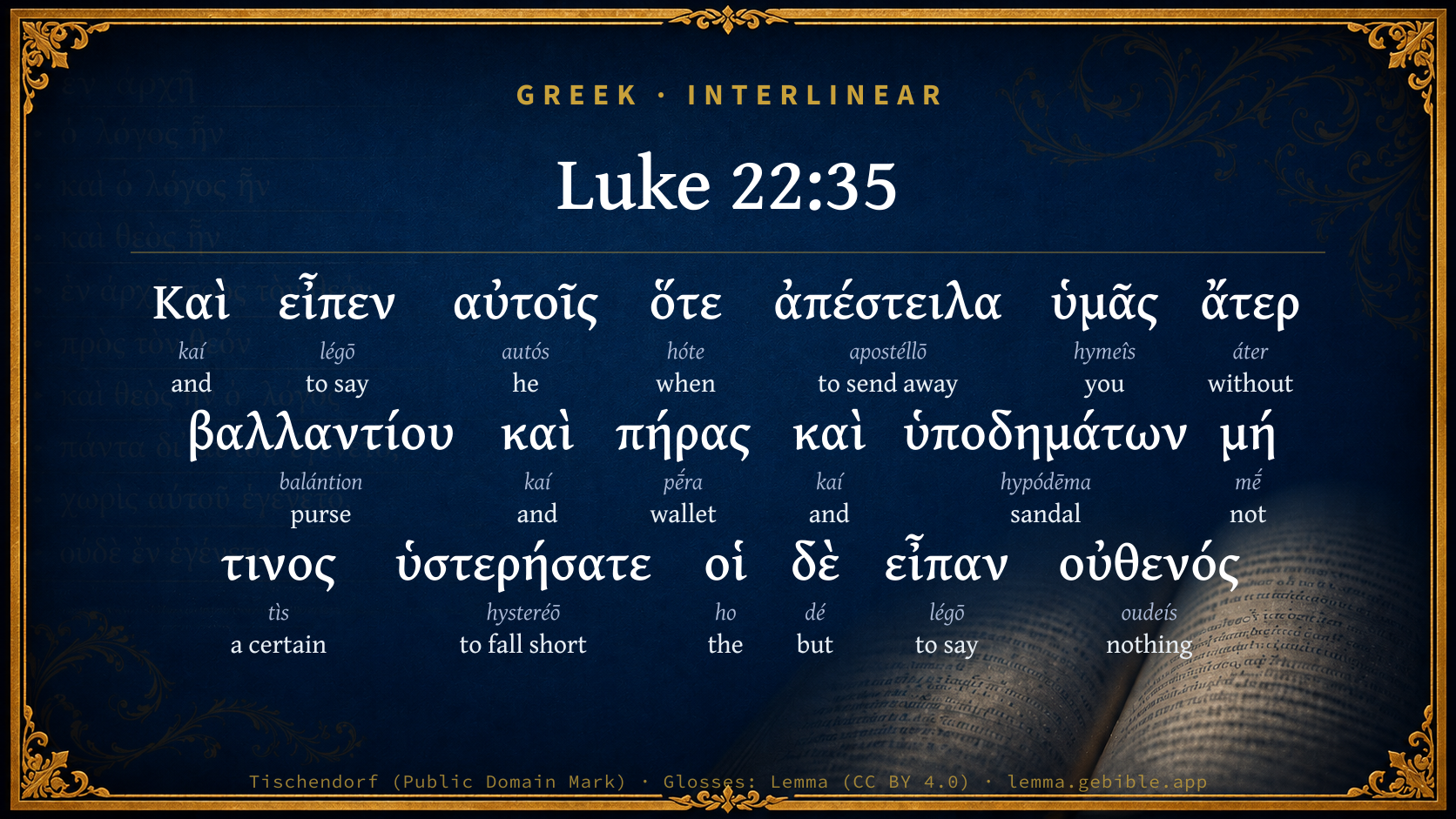
Greek (Tischendorf 8th ed.) Luke 22:35 appears in the Greek New Testament. The text above is from the Tischendorf 8th edition. Each word links to its Strong’s number and a concise gloss. Click any word for its full Thayer’s Greek Lexicon entry.
Download image
Cite this verse

Luke 22:35 (World English Bible). Public Domain. Lemma interlinear Bible study tool, https://lemma.gebible.app/v/luke/22/35.

Show BibTeX & RIS
BibTeX
RIS
English Translation
He said to them, "When I sent you out without purse, and wallet, and shoes, did you lack anything?" They said, "Nothing."
World English Bible · Public Domain
Download a study sheet

One document with this verse’s original text, its word-by-word gloss line, the meaning frame, cross-references with their text, attributed commentary, and full source and license credits — printable, and it pastes into notes with its structure intact.

This verse Autodidact and up

Study sheet (.html) Plain text (.txt)

A passage Seminary Student

Up to 50 verses in one chapter. A passage sheet keeps up to 6 commentary sources and 12 cross-references per verse, in the order this page ranks them, and says so on the sheet whenever that leaves anything out. Ask for a single verse and you get the Autodidact verse sheet above.

Everything on this page stays free to read, with no account — the sheet is a download of what is already on screen, not access to it.

Want to remove ads? Support Godless Engineer
Compare translations 3

The same verse in 3 English versions, stacked beneath the original-language interlinear above. Click any original word for its lexicon entry.

Each is an independent rendering of the whole verse — the interlinear is not word-aligned to these translations.

Highlighted words mark where these versions differ — a whole-verse word diff, not a word-by-word alignment.

  • World English Bible Public Domain
    He said to them, "When I sent you out without purse, and wallet, and shoes, did you lack anything?" They said, "Nothing."
  • King James Version Public Domain
    And he said unto them, When I sent you without purse, and scrip, and shoes, lacked ye any thing? And they said, Nothing.
  • unfoldingWord Literal Text CC BY-SA 4.0
    And he said to them, “When I sent you out without a money bag and sack and sandals, you did not lack anything, did you?” And they said, “Nothing.”

unfoldingWord Literal Text — © unfoldingWord, licensed CC BY-SA 4.0. Word-aligned USFM3 via Door43 (git.door43.org/unfoldingWord/en_ult).

Versions to compare (up to 4)

3 of 4 selected

Show all 19 translations

Every available English version of this verse, each an independent rendering of the whole verse.

  • World English Bible Public Domain
    He said to them, "When I sent you out without purse, and wallet, and shoes, did you lack anything?" They said, "Nothing."
  • Berean Standard Bible Public Domain
    Then Jesus asked them, “When I sent you out without purse or bag or sandals, did you lack anything?” “Nothing,” they answered.
  • Majority Standard Bible Public Domain
    Then Jesus asked them, “When I sent you out without purse or bag or sandals, did you lack anything?” “Nothing,” they answered.
  • King James Version Public Domain
    And he said unto them, When I sent you without purse, and scrip, and shoes, lacked ye any thing? And they said, Nothing.
  • American Standard Version (1901) Public Domain
    And he said unto them, When I sent you forth without purse, and wallet, and shoes, lacked ye anything? And they said, Nothing.
  • Revised Version (1885) Public Domain
    And he said unto them, When I sent you forth without purse, and wallet, and shoes, lacked ye any thing? And they said, Nothing.
  • Geneva Bible (1599) Public Domain
    And he saide vnto them, When I sent you without bagge, and scrip, and shooes, lacked ye any thing? And they said, Nothing.
  • Douay-Rheims (1899) Public Domain
    When I sent you without purse, and scrip, and shoes, did you want anything
  • Young's Literal Translation Public Domain
    And he said to them, `When I sent you without bag, and scrip, and sandals, did ye lack anything?' and they said, `Nothing.'
  • Literal Standard Version CC BY-SA 4.0
    And He said to them, “When I sent you without bag, and leather pouch, and sandals, did you lack anything?” And they said, “Nothing.”
  • Unlocked Literal Bible CC BY-SA 4.0
    Then Jesus said to them, “When I sent you out without a purse, a bag of provisions, or shoes, did you lack anything?” They answered, “Nothing.”
  • unfoldingWord Literal Text CC BY-SA 4.0
    And he said to them, “When I sent you out without a money bag and sack and sandals, you did not lack anything, did you?” And they said, “Nothing.”
  • Darby Bible Public Domain
    And he said to them, When I sent you without purse and scrip and sandals, did ye lack anything? And they said, Nothing.
  • World Messianic Bible Public Domain
    He said to them, “When I sent you out without purse, bag, and sandals, did you lack anything?” They said, “Nothing.”
  • Webster's Bible Public Domain
    And he said to them, When I sent you without purse, and sack, and shoes, lacked ye any thing? And they said, Nothing.
  • Free Bible Version CC BY-SA 4.0
    Jesus asked them, “When I sent you out without money, without a bag, and without an extra pair of sandals, did you lack anything?” “No, nothing,” they replied.
  • Bible in Basic English Public Domain
    And he said to them, When I sent you out without money or bag or shoes, were you in need of anything? And they said, Nothing.
  • Text-Critical English NT CC BY 4.0
    Then Jesus said to them, “When I sent you without a moneybag, knapsack, or sandals, did you lack anything?” They said, “Nothing.”
  • Tyndale New Testament (1534) Public Domain
    And he sayde vnto them: when I sent you with out wallet and scripe and shoes? lacked ye eny thinge? And they sayd no.

Literal Standard Version (2020), Covenant Press — licensed CC BY-SA 4.0. Text via the HelloAO Bible API (eBible.org). Unlocked Literal Bible (unfoldingWord) — licensed CC BY-SA 4.0. Text via the HelloAO Bible API (eBible.org). unfoldingWord Literal Text — © unfoldingWord, licensed CC BY-SA 4.0. Word-aligned USFM3 via Door43 (git.door43.org/unfoldingWord/en_ult). Free Bible Version, Dr. Jonathan Gallagher — licensed CC BY-SA 4.0. Text via the HelloAO Bible API (eBible.org).

Word by word

More ways to search: Search by grammar → Find every occurrence → Compare this word →

Practice this passage: Drill this verse → Learn its vocabulary →

ἄτερ
áter
G817
“without”
Preposition
Part of Speech
Preposition
Full Thayer's Definition

Origin: a particle probably akin to G427

TDNT: None

1. without, apart from
  1. Καὶ kaí G2532 “and” Conjunction
  2. εἶπεν légō G3004 “to say” Verb, Aorist, Active, Indicative, 3rd person, Singular
  3. αὐτοῖς autós G846 “he” Personal pronoun, Dative, Plural, Masculine
  4. ὅτε hóte G3753 “when” Adverb
  5. ἀπέστειλα apostéllō G649 “to send away” Verb, Aorist, Active, Indicative, 1st person, Singular
  6. ὑμᾶς hymeîs G5210 “you” Personal pronoun, 2nd person, Accusative, Plural
  7. βαλλαντίου balántion G905 “purse” Noun, Genitive, Singular, Neuter
  8. καὶ kaí G2532 “and” Conjunction
  9. πήρας pḗra G4082 “wallet” Noun, Genitive, Singular, Feminine
  10. καὶ kaí G2532 “and” Conjunction
  11. ὑποδημάτων hypódēma G5266 “sandal” Noun, Genitive, Plural, Neuter
  12. μή mḗ G3361 “not” Particle, Negative
  13. τινος tìs G5100 “a certain” Indefinite pronoun, Genitive, Singular, Neuter
  14. ὑστερήσατε hysteréō G5302 “to fall short” Verb, Aorist, Active, Indicative, 2nd person, Plural
  15. οἱ ho G3588 “the” Article, Nominative, Plural, Masculine
  16. δὲ dé G1161 “but” Conjunction
  17. εἶπαν légō G3004 “to say” Verb, Aorist, Active, Indicative, 3rd person, Plural
  18. οὐθενός oudeís G3762 “nothing” Adjective, Genitive, Singular, Neuter, Negative

About this verse

These counts appear in no published source. They are computed here, from the morphology-tagged text and Lemma’s own curated glosses. What Lemma adds →

19
words
16
distinct lemmas
Gospels
section

Notable vocabulary

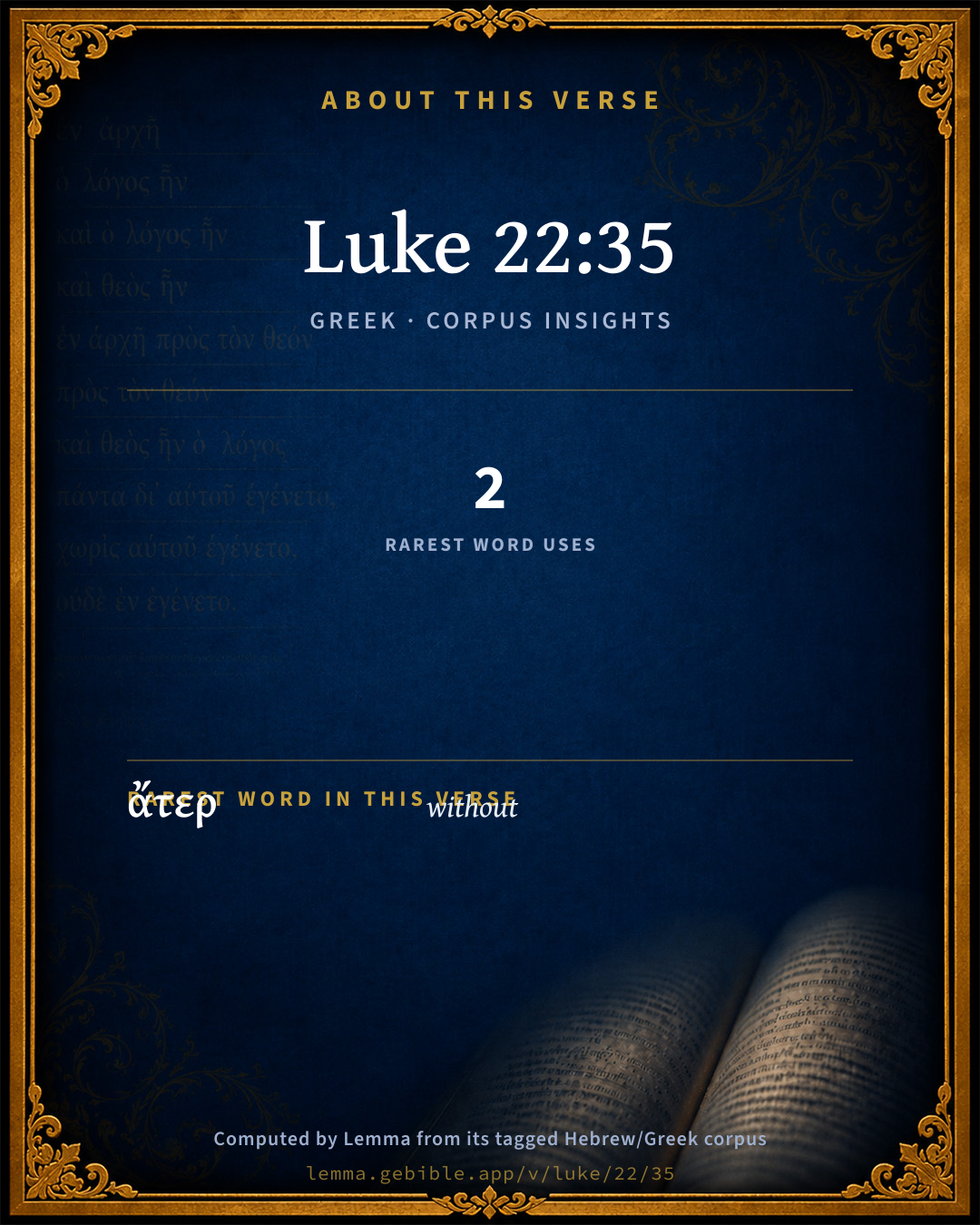
The rarest word here is ἄτερ without G817 — appearing just 2 times in the whole Greek New Testament.

Shared distinctive vocabulary

ἄτερ without G817 occurs in 2 verses of the Greek New Testament. Also found in:

Repetition

Words recur within this verse:

  • εἶπεν to say G3004 ×2
  • Καὶ and G2532 ×3

Cross-references

12

Topical passages linked to Luke 22:35 in the Treasury of Scripture Knowledge — connected by theme and wording, ordered by reader-vote popularity; previews shown in the World English Bible.

  • Matthew 10:9–10 Don't take any gold, nor silver, nor brass in your money belts.
  • Luke 10:4 Carry no purse, nor wallet, nor sandals. Greet no one on the way.
  • Psalms 23:1 Yahweh is my shepherd: I shall lack nothing.
  • Psalms 34:9–10 Oh fear Yahweh, you his saints, For there is no lack with those who fear him.
  • Psalms 37:3 Trust in Yahweh, and do good. Dwell in the land, and enjoy safe pasture.
  • Luke 9:3 He said to them, "Take nothing for your journey--neither staffs, nor wallet, nor bread, nor money; neither have two coats apiece.
  • Matthew 6:31–33 "Therefore don't be anxious, saying, 'What will we eat?', 'What will we drink?' or, 'With what will we be clothed?'
  • Mark 6:8–9 He charged them that they should take nothing for their journey, except a staff only: no bread, no wallet, no money in their purse,
  • Genesis 48:15 He blessed Joseph, and said, "The God before whom my fathers Abraham and Isaac did walk, the God who has fed me all my life long to this day,
  • Deuteronomy 8:2–3 You shall remember all the way which Yahweh your God has led you these forty years in the wilderness, that he might humble you, to prove you, to know what was in your heart, whether you would keep his commandments, or not.
  • Deuteronomy 8:16 who fed you in the wilderness with manna, which your fathers didn't know; that he might humble you, and that he might prove you, to do you good at your latter end:
  • Luke 12:29–31 Don't seek what you will eat or what you will drink; neither be anxious.

Cross-references courtesy of OpenBible.info (CC BY 4.0).

Commentary

Notes on Luke 22:35 from classic Christian and Jewish commentators (each source and its license shown beneath its notes). The classic Christian expositions comment on the surrounding passage and are grouped to its opening verse, so a note may address several verses; the Jewish commentaries on the Tanakh (Rashi and others) are per-verse, so they appear only where the commentator wrote on this verse.

Lemma curates 59 commentaries, every one of them public domain or Creative Commons licensed, each selected and text-cleaned for this edition rather than reprinted as found. About our sources →

Matthew Poole's English Annotations

Those who interpret Luk 22:35,36, as a precept of our Saviour’s imposing a duty upon his disciples, or a counsel concerning the proviting arms which they might use for the protection and defence of themselves, will not only find a difficulty to reconcile their notion of it to several other precepts, and the will of God declared by the apostles’ practice, who never went about by force and arms to defend themselves in the first plantation and propagation of the gospel; but also to reconcile it to the last words of our Saviour, who said, when his disciples told him they had two swords, It is enough; which he would never have said, if he had intended any such thing; for two swords was much too little to have conquered that multitude of adversaries which the disciples of Christ were to meet with. Our Saviour doth doubtless speak in a figure, and all that he intends amounts but to this: Hitherto I have been with you, and you have had my special protection; though you went out without a purse or a scrip, yet you have wanted nothing; though you went without a sword, yet none did you any harm. But the time is now come, when the posture of your affairs will be much altered; your friends will be few, your enemies many, therefore you stand concerned to make as good preparation as you can do in those things that are consistent with the general precepts that I have given you. The tragedy will begin with me; for what is written of me must now be accomplished, Isa 53:12, He was numbered with the transgressors. I must be brought before magistrates as a common malefactor, and hanged on a cross between two thieves. And

the things concerning me shall shortly have an end: you will next come upon the stage, and therefore prepare what in you lieth for the performance of your part.

Matthew Poole's English Annotations on the Holy Bible (1683–1685) — public domain. Text from a community e-Sword/MySword module.

Joseph Benson's Commentary

Luk 22:35-37. And he said, When I sent you without purse, &c. — “Our Lord, having finished what he had to say to Peter in particular, now turned to the other disciples, and put them in mind how they had been prohibited, when they were first sent out, to make any provision for their journey, and directed to rely wholly on God; and that, though they had accordingly gone away without purse, scrip, and shoes, they had never wanted any thing, but had had abundant provision made for them by the kindness of men whom God had disposed to befriend them: but he told them that matters were now altered; they were to be violently assaulted by their enemies, were to meet with the strongest temptations, and to be so hotly persecuted by their countrymen, that they could no longer expect any succour at their hands; for which reason, he ordered them in their future journeys to provide money, and clothes, and swords for themselves: that is, besides relying on the Divine Providence, as formerly, they were to use all prudent precautions in fortifying themselves against the trials that were coming on them.” — Macknight. Or rather, these commands to arm themselves against dangers, are to be considered merely as predictions and warnings given them of the dangers and trials they were to meet with. For the predictions of the prophets are often announced under the form of commands. Thus Isaiah, foretelling the destruction of the family of the king of Babylon, Isa 14:21, says, Prepare slaughter for his children, &c. And Jeremiah, foretelling in like manner the destruction of the Jews, exhibits God as thus addressing them, Jer 9:17-18, Call for the mourning women, &c. And in the prophecy of Ezekiel (Eze 39:17-19) and in the Apocalypse (Rev 19:17-18) this allegoric spirit is carried so far, that orders are given to brute animals to do what the prophet means only to foretel they would do. For this prophecy that is written, must yet be accomplished — As all the other predictions of the prophets concerning me must also be: and he was numbered with the transgressors — Prepare, therefore, to meet a most violent persecution; for I, your Leader, am to be treated as a malefactor, and of course you, my followers, will not escape suffering. Nor are these trials at a distance, they are just at hand. For the things which are written concerning me have an end — Are now drawing to a period, are upon the point of being accomplished. And they said, Behold, here are two swords — Our Lord’s disciples, mistaking his meaning about the swords, replied, they had two: the reason why they had any at all, probably, was, that they might defend themselves against robbers in their journey from Galilee and Perea; and from the beasts of prey, which in those parts were very frequent, and dangerous in the night- time: And he said unto them, It is enough — To show them their mistake, he told them that two swords were sufficient, which it is evident they could not have been for so many men, had he meant what he said in a literal sense. He only meant, This will be a time of extreme danger; to meet which, it will be necessary to be prepared by faith, fortitude, and patience.

Joseph Benson's Commentary on the Old and New Testaments (1811–1818) — public domain. Text from a community e-Sword module.

Whedon's Commentary on the Bible

Daniel D. Whedon

The new responsibilities of the Apostles, Luk_22:35-38.

In this paragraph our Lord shows his apostles how his departure will leave them very much to their own resources. During his stay on earth his divine care had equipped and guarded them in the travel and the battle. But now they must set up on their own account and provide their own resources.

35. Purse… scrip—The means, figuratively, of conducting their ministry.

Nothing—They had been like children for whom the parent cared and provided.

Daniel D. Whedon (gen. ed.), Commentary on the Old and New Testaments (1874–1909) — public domain. Text from a community e-Sword module.

Bengel's Gnomon

Johann Albrecht Bengel

Luk 22:35. Καὶ εἶπεν αὐτοῖς, and He said to them) This is intended to stir up the disciples to watchfulness, that they may not rely on their own strength.—ὅτε) when, not, as often soever. For we read of the Seventy having been so sent but once, ch. Luk 10:4; and the Twelve also but once, ch. Luk 9:3 [Comp. the note on Mat 10:1].—ἀπέστειλα, I sent) The Lord fed and supplied them whilst they were present with Him.—βαλαντίου καὶ πήρας, purse and wallet [‘scrip”]) On the difference between these words, see the note on Mat 10:9-10.[240]

[240] The former was for money; the latter, for bread and other provisions.—E. and T.

Bengel's Gnomon of the New Testament — English translation (T&T Clark, Edinburgh, 1860) — public domain. Text from a community e-Sword module.

Meyer's Critical & Exegetical Commentary

Heinrich August Wilhelm Meyer

Luk_22:35-38. Peculiar to Luke, from tradition or from some other unknown source. But the utterance itself is in respect of its contents so remarkably significant, that we are bound to hold by its originality, and not to say that it was introduced into this place for the sake of explaining the subsequent stroke with the sword (Schleiermacher, Strauss, de Wette), or the reason why Judas is afterwards represented as appearing with armed men (Holtzmann).

καὶ εἶπεν αὐτοῖς] A pause must be supposed as occurring before what follows, the connection of the thought being: not without reason have I uttered words so momentous (Luk_22:31-34), for now your position, when I am no more with you, will be entirely different from what it was formerly; there comes for you the time of care for yourselves and of contest!

ὅτε ἀπέστειλα κ.τ.λ.] Luk_9:3; comp. Luk_10:4.

Luk_22:36. οὖν] in consequence of this acknowledgment.

ἀράτω] not: tollat, ut emat gladium (Erasmus, Beza, and others), but: let him take it up, in order to bear it. The representation of the thought now refers to the time when ye can no more be unconcerned about your maintenance, but must yourselves care for it in the world which for you is inhospitable.

καὶ ὁ μὴ ἔχων] to wit, βαλλάντιον καὶ πήραν. The contrast allows nothing else. Hence μάχαιραν is erroneously suggested as implied (Beza, Jansen, Paulus, Baumgarten-Crusius, Lange, Ewald, Bleek, and others), and equally erroneously is the general reference suggested: he who is without means (Kuinoel, Olshausen, Schegg). Jesus means to say, how far more necessary still than purse and scrip, nay, even more necessary than the upper garment, should now be to them a sword, for defence and protection against hostile attacks. But observe in this connection (1) that he wishes for the purchase of the sword, not by those merely who have no purse and knapsack, but, on the contrary, whilst he requires it of these, yea, requires it with the sacrifice of the cloak, otherwise so needful, yet he regards it as a self-evident duty on the part of those who have the means for the purchase. The form of his utterance is a parallelism, in which the second member supplements and throws a new light upon the first. (2) Nevertheless Jesus does not desire that His disciples should actually carry and use the sword (Mat_26:52), but He speaks in such a manner as figuratively to represent in what a hostile relation they should henceforth find the world arrayed against them, and what resistance and struggle on their part would now be necessary in their apostolic missionary journeys. That the discourse is in reference to these is clearly proved by βαλλάντ. and πήραν, in opposition to Olshausen, who perversely allegorizes the whole passage, so that βαλλάντ. and πήρ. are taken to signify the means for the spiritual life, and μαχ. sword of the Spirit, Eph_6:17 (comp. also Erasmus).

Luk_22:37. A confirmation of the ἀλλὰ νῦν κ.τ.λ. For since, moreover, that (etiamnum hoc extremum post tot alia, Bengel) must still be fulfilled on me which is written in Isa_53:12; so ye, as my disciples, cannot expect for yourselves anything better than what I have announced to you, Luk_22:36. The cogency of the proof follows from the presupposition that the disciple is not above his master (Mat_10:24 f.; Joh_15:20). On the δεῖ of the divine counsel, comp. Mat_26:54 (Act_2:23), and observe how inconsistent therewith it is to regard the passion of Jesus as a fortuitous occurrence (Hofmann).

καὶ μετὰ ἀν. ἐλογ.] καί, and, adopted together with the rest as a constituent part of the passage quoted. The completion (the Messianic fulfilment, Luk_18:31) of the prophecy began with the arrest (Luk_22:52), and comprehended the whole subsequent treatment until the death.

καὶ γὰρ τὰ περὶ ἐμοῦ τέλ. ἔχει] for, moreover, that which concerneth me has to come to an end; i.e., for, moreover, with my destiny, as with the destiny of him of whom Isaiah speaks, there is an end. Observe that Jesus did not previously say τὸ εἰς ἐμὲ γεγραμμένον κ.τ.λ. or the like, but τὸ γεγρ. δεῖ τελεσθ. ἐν ἐμοί, so that He does not explain the passage immediately of Himself (Olshausen), but asserts that it must be fulfilled in Him, in respect of which it is plain from καὶ γὰρ κ.τ.λ. that He conceived of another as the subject of the first historical meaning of the passage (whom? is another question, comp. Act_8:34), of whom He was the antitype, so that in Him is found the antitypal historical fulfilment of that which is predicted in reference to the servant of God. On τὰ περὶ ἐμοῦ, see Kühner, II. p. 119; on τέλος ἔχει, Mar_3:26; Plat. Pol. iii. p. 392 C; Dem. 932. 4, and the examples from Xenophon in Sturz, IV. p. 275. Most commentators (Euthymius Zigabenus, Luther, Beza, Calvin, Bengel, and many others, including Kuinoel, Olshausen, de Wette, Bleek) read: for, moreover, that which is written of me, like other prophecies, is about to be accomplished, as though γεγραμμένα formed part of the sentence, as at Luk_24:44, or flowed from the context, as at Luk_24:27. Comp. Fritzsche, ad Rom. II. p. 380. But what a nugatory argument! and what is the meaning of the καί (which certainly most of them leave wholly unnoticed), since, indeed, it is just the Messianic prophecies which constitute the main substance of prophecy, and do not come in merely by the way?

Luk_22:38. The disciples, not understanding the utterance about the sword, imagined that Christ required them to have swords actually[254] ready for defence from impending violence. Peter had one of the two swords (Luk_22:50). They may have been worn on the last journey, or even on account of the risk of these days they may have been first procured with a view to circumstances that might occur. Butchers knives (from the cutting up of the lamb, as supposed by Euthymius Zigabenus, following Chrysostom) they could not be, according to Luk_22:36, although the word, so early as the time of Homer (Döderlein, Glossar. I. p. 201 f.), but never in the New Testament, has this signification.

ἱκανόν ἑστι] a gentle turning aside of further discussion, with a touch of sorrowful irony: it is enough! More than your two swords ye need not! Comp. Castalio on the passage. The disciples, carrying out this idea, must have at once concluded that Jesus had still probably meant something else than an actual purchase of swords, Luk_22:36.[255] The significance of the answer so conceived gives to this view the preference over the explanation of others (Theophylact, Calovius, Jansen, Wolf, Bisping, Kuinoel): enough of this matter! Compare the Rabbinical דייך in Schoettgen, p. 314 ff. Olshausen and de Wette combine the two, saying that Jesus spoke in a twofold sense; comp. Bleek. Without sufficient reason, since the setting aside of the subject is found also in our view.

Boniface VIII. proves from the passage before us the double sword of the papal sovereignty, the spiritual and temporal jurisdiction! Protervum ludibrium (Calvin).

[254] Schleiermacher even has forced this misunderstanding (L. J. p. 417 f.) to a groundless combination; namely, that Jesus wished the swords for the case of an unofficial assault.

[255] Comp. Luthers gloss: It is of no more avail to fight with the bodily sword, but henceforth it is of avail to suffer for the sake of the gospel, and to bear the cross; for the devil cannot be fought against with steel, therefore there is need to venture all on that, and only to take the spiritual sword, the word of God.

Meyer — Critical and Exegetical Commentary on the New Testament — English translation by Peter Christie, edited by Frederick Crombie (T&T Clark, 1880) — public domain. Text from a community e-Sword module.

Expositor's Greek Testament

ed. W. Robertson Nicoll

Luk 22:35-38 . Coming danger , peculiar to Lk. There is danger ahead physically as well as morally. Jesus turns now to the physical side. What He says about a sword is not to be taken literally. It is a vivid way of intimating that the supreme crisis is at hand = the enemy approaches, prepare!

Luk 22:35 . ὅτε ἀπέστειλα : the reference if to Luk 9:3 , or rather, so far as language is concerned, to Luk 10:4 , which relates to the mission of the seventy . ἄτερ as in Luk 22:6 .

The Expositor's Greek Testament, edited by W. Robertson Nicoll (1897–1910) — public domain. Text from a community e-Sword module.

Godet's Commentaries

Frédéric Louis Godet

Vers. 35-38. “And He said unto them, When I sent you without purse and scrip and shoes, lacked ye anything? And they said, Nothing. 36. Then He said unto them, But now, he that hath a purse, let him take it, and likewise his scrip. And he that hath no [sword], let him sell his garment, and buy one. 37. For I say unto you, that this that is written must yet be accomplished in me, And He was reckoned among the transgressors: for the things concerning me are coming to an end....38.”

Till then, the apostles, protected by the favour which Jesus enjoyed with the people, had led a comparatively easy life. But the last conflict between Him and the Jewish authorities was about to break out, and how could the apostles, during all the rest of their career, escape the hostile blows? This is the thought which occupies our Lord’s mind: He gives it a concrete form in the following figures. In Luk 22:35 He recalls to mind their first mission (Luk 9:1 et seq.). We learn on this occasion the favourable issue which had been the result of that first proof of their faith. The historian had told us nothing of it, Luk 9:6.

The object of μὴ ἔχων is evidently μαχαίραν (not πήραν or βαλαντίον): “Let him who hath not [a sword], buy one.” It heightens the previous warning. Not only can they no longer reckon on the kind hospitality which they enjoyed during the time of their Master’s popularity, and not only must they prepare to be treated henceforth like ordinary travellers, paying their way, etc.; but they shall even meet with open hostility. Disciples of a man treated as a malefactor, they shall be themselves regarded as dangerous men; they shall see themselves at war with their fellow-countrymen and the whole world. Comp. Joh 15:18-25, the piece of which this is, as it were, the summary and parallel. The sword is here, as in Mat 10:34, the emblem of avowed hostility. It is clear that in the mind of Him who said: “I send you forth as lambs among wolves,” this weapon represents the power of holiness in conflict with the sin of the world,—that sword of the Spirit spoken of by Paul (Eph 6:17).

The καὶ γάρ, and in truth, at the end of the verse, announces a second fact analogous to the former (and), and which at the same time serves to explain it (in truth). The tragical end of the ministry of Jesus is also approaching, and consequently no features of the prophetic description can be slow in being realized.

The disciples seem to take literally the recommendation of Jesus, and even to be proud of their prudence. The words, It is enough, have been understood in this sense: “Let us say no more; let us now break up; events will explain to you my mind, which you do not understand.” But is it not more natural to give to ἱκανόν ἐστι this mournfully ironic sense: “Yes, for the use which you shall have to make of arms of this kind, those two swords are enough.”

Here we must place the last words of John 14 : “Rise; let us go hence.” The Syn. have preserved only a few hints of the last discourses of Jesus (John 14-17). These were treasures which could not be transmitted to the Church in the way of oral tradition, and which, assuming hearers already formed in the school of Jesus like the apostles, were not fitted to form the matter of popular evangelization.

Frédéric Louis Godet — Commentaries on Luke, John, Romans, and 1 Corinthians — English translation (T&T Clark, Edinburgh, 1870s–1890s) — public domain. Text from a community e-Sword module.

Jamieson, Fausset & Brown

Robert Jamieson, A. R. Fausset & David Brown

But now--that you are going forth not as before on a temporary mission, provided for without purse or scrip, but into scenes of continued and severe trial, your methods must be different; for purse and scrip will now be needed for support, and the usual means of defense.

Jamieson, Fausset & Brown — Commentary Critical and Explanatory on the Whole Bible (1871) — public domain (CC PDM 1.0). Text via the HelloAO Bible API.

Adam Clarke's Commentary

Verse 35. When I sent you without purse] See the notes on Mt 10:9; Mt 10:10.

Adam Clarke's Commentary on the Bible (1810–1826) — public domain. Text from a community e-Sword/MySword module.

Ellicott's Commentary for English Readers

(35) When I sent you without purse, and scrip.—The words refer specially to the command given to the disciples in Luk_10:4; Mat_10:9-10. The whole incident is peculiar to St. Luke. The appeal to their past experience is interesting as showing that on their first mission they were welcomed by those who heard them, and received food and shelter that met all their wants.

A Bible Commentary for English Readers, edited by Charles John Ellicott (1878–1897) — public domain. Text from a community e-Sword module.

The Cambridge Bible for Schools and Colleges

gen. ed. J. J. S. Perowne

35. without purse, &c.] See Luk_9:3, Luk_10:4.

The Cambridge Bible for Schools and Colleges (gen. ed. J. J. S. Perowne; Cambridge University Press, 1878–1918) — public domain. Text from a community e-Sword module.

John Gill's Exposition

Then said he unto them,.... That is, Jesus said unto them, as the Persic version expresses it:

but now he that hath a purse let him take it, and likewise his scrip; signifying hereby, that from this time forward, immediately after his departure from them, after his death, resurrection, and ascension, when they should be sent into all the world to preach the Gospel, it would be otherwise with them than before; that they should be reduced to great penury and distress, should neither have food, nor money to buy any with; and that they should suffer hunger, and thirst, and nakedness, and have no certain dwellingplace, as was their case; see Co1 4:11 and that they would not be received, and entertained in the manner they had been; and therefore it would be advisable, if they had any provisions, to take them with them in their scrips; or if they had any money, to carry it with them in their purses; for glad would they be to provide themselves with necessaries at any rate:

and he that hath no sword; the word "sword" is not in this clause, but in the next; it is only in the original, "he that hath not"; which, at first sight; looks as if the sense was, he that hath not a purse, or a scrip, to sell, and buy a sword with, let him sell his garment, and buy one: but, as De Dieu observes, the phrase, "he that hath not", is the same with "he that has nothing"; who is a poor man, and has no money to buy a sword with, let him part with his garment, which rich men, who had money, had no need to do; though the Syriac, Persic, and Arabic versions put the word sword, in both clauses;

he that hath no sword, let him sell his garment and buy a sword; that is, if he could get one no other way. Christ here uses the common dialect of the nation, as Dr. Lightfoot observes. So on the feast of dedication of the temple,

"if a man had not any thing to eat, but what he had by alms, he must beg, or , "sell his garment", and take oil, and lamps, and light them (u).''

These words of Christ are not to be understood literally, that he would have his disciples furnish themselves with swords at any rate, since he would never have said, as he afterwards does, that two were sufficient; which could not be enough for eleven men; or have forbid Peter the use of one, as he did in a very little time after this: but his meaning is, that wherever they came, and a door was opened for the preaching of the Gospel, they would have many adversaries, and these powerful, and would be used with great violence, and be followed with rage and persecution; so that they might seem to stand in need of swords to defend them: the phrase is expressive of the danger they would be exposed to, and of their need of protection; and therefore it was wrong in them to be disputing and quarrelling about superiority, or looking out for, and expecting temporal pomp and grandeur, when this would be their forlorn, destitute, and afflicted condition; and they would quickly see the affliction and distress begin in himself. In "seven" ancient copies of Beza's, it is read in the future tense, "he shall take, he shall sell, he shall buy".

(u) Maimon. Hilch. Megilla Uchanucha, c. 4. sect. 12.

John Gill's Exposition of the Whole Bible (1746–1763) — public domain (CC PDM 1.0). Text via the HelloAO Bible API.

Trapp's Complete Commentary

John Trapp

35 And he said unto them, When I sent you without purse, and scrip, and shoes, lacked ye any thing? And they said, Nothing.

Ver. 35. See Mat 10:9; Luk 10:4.

John Trapp, A Commentary or Exposition upon All the Books of the Old and New Testament (1647–1656) — public domain. Text from a community e-Sword module.

Albert Barnes' Notes on the Bible

When I sent you ... - See the notes at Mat 10:9-10.

Lacked ye ... - Did you want anything? Did not God fully provide for you? He refers to this to convince them that his words were true; that their past experience should lead them to put confidence in him and in God.

Albert Barnes' Notes on the Bible (1834–1885) — public domain. Text from a community e-Sword/MySword module.

The Pulpit Commentary

Vers. 35, 36. And he said unto them, When I sent you without purse, and scrip, and shoes, lacked ye anything. And they said, Nothing. Then said he unto them, But now, he that hath a purse, let him take it, and likewise his scrip; and he that hath no sword, let him sell his garment, and buy one. The Lord speaks one more word to his own before leaving the upper room, More occupied with the future trials of his disciples than with his own tragic destiny, which he knew was about to be fulfilled, he reminds his friends of the comparatively quiet and serene existence they had been spending during the last two years and a half with him. In that period, generally speaking, they had been welcomed and kindly entertained by the people, sometimes, they would remember, even with enthusiasm. But they must prepare now for a different life cold looks, opposition, even bitter persecution, would be their lot for the future. They must order themselves now to meet these things. No ordinary prudent forethought must be omitted by them. He had more than hinted that this future lay before them in his words, "Behold I send you forth as lambs in the midst of wolves;" now he plainly tells them what kind of life awaited them in the immediate future. Of course, the advice as to the sword was not meant to be taken literally. It was one of those metaphors the Lord used so often in his teaching. For a similar metaphor still more elaborately developed, see Eph_6:17, and following verses.

Vers. 35-38. Misunderstanding Christ.

There is no teacher who has been so well beard, and none that has been so much honored and obeyed, as Jesus Christ. Yet there can have been few who have been so much misunderstood as he has been. We have our attention drawn by the text to

I CONTEMPORARY MISUNDERSTANDING.

1. By the apostles themselves.

(1) On this occasion their Lord wished to intimate to them, in strong and forcible language, that to whatever perils and straits they had been exposed before, the time was now at hand when, he himself being taken from their side and the saddest foreshadowings being fulfilled, they would be subjected to far severer trials, and would be (in a sense) cast on their own defences. The apostles, mistaking his meaning, put a literal interpretation on his words, and produced a couple of swords, as perhaps meeting the emergency!

(2) On a previous occasion (Mat_16:5-8) the Lord warned them against "the leaven of the Pharisees;" and they supposed him to refer to their neglect in forgetting the bread!

(3) They completely failed to apprehend his meaning when he foretold his own sufferings and death. (Luk_18:31-34)

2. By his disciples generally.

(1) They could not comprehend what he meant by "eating his flesh and drinking his blood. (Joh_6:60)

(2) They completely misunderstood the end he had in view, the character of that "kingdom of heaven" of which he spoke so much.

(3) They did not enter into the great redeeming purpose for which he came.

3. By his enemies.

(1) In so small a matter as his saying recorded in Joh_2:19;

(2) in so great a matter as that recorded in Joh_18:37.

II SUBSEQUENT MISUNDERSTANDING. In how many ways has the Church of Christ, since apostolic days, misunderstood its Lord! It has done so in regard to the meaning of particular words; and in regard to the great end he had in view (the nature of his kingdom); and in regard to the means and methods he would have his friends employ. How pitifully and how painfully has it misunderstood him when it has interpreted his reference to the sword of the text (ver. 36), and his use of the word "compel" (Luk_14:23) as justifying every conceivable cruelty in the furtherance of his cause!

III MODERN MISUNDERSTANDING. Judging from what we know has been, we conclude that it is likely enough that we also misunderstand our Master.

1. We may fail to reach the true significance of his words; we may find out, further on, that they have another and a larger meaning than that we have been ascribing to them.

2. We may mistake his will as to the object we should work for, or as to the right and the wise methods we should adopt to secure our end.

3. We may be wrong in our judgment of what Christ is doing with ourselves and with our life; we may misread his Divine purpose concerning us. There are three principles which we shall do well to keep in mind in our endeavor to understand the Divine Teacher. The thought of Christ is

a. profound rather than superficial:

b. spiritual rather than sensuous;

c. comprehensive and far-seeing (reaching through time to immortality) rather than narrow and time-bounded. C.

The Pulpit Commentary (1880–1919), ed. H.D.M. Spence-Jones & Joseph S. Exell — public domain. Text from a community e-Sword module.

John Wesley's Explanatory Notes

When I sent you - lacked ye any thing - Were ye not born above all want and danger?

John Wesley, Explanatory Notes Upon the Whole Bible (1754–1765) — public domain. Text via the GEBible commentary corpus.

Kretzmann's Popular Commentary

Paul E. Kretzmann

The seriousness of the coming danger:

v. 35. And He said unto them, When I sent you without purse, and scrip, and shoes, lacked ye anything? And they said, Nothing.

v. 36. Then said He unto them, But now, he that hath a purse, let him take it, and likewise his scrip; and he that hath no sword, let him sell his garment and buy one.

v. 37. For I say unto you that this that is written must yet be accomplished in Me, And He was reckoned among the transgressors; for the things concerning Me have an end.

v. 38. And they said, Lord, behold, here are two swords. And He said unto them, It is enough.

This section is not a digression, but has a very close connection with the foregoing. It was on account of the constant watchfulness and solicitude of the Lord that His disciples had been protected so well; and it was probably just for this reason that Peter had grown so overconfident. About this faithfulness and loving care He now asks the apostles, whether, on any of their trips, when He had sent them off without purse and beggar’s collecting sack and heavy sandals, they had ever been in want of anything. Upon which they answered, in all truthfulness, that they had never lacked anything. He had taken care of them at all times, and their trust had not been in vain. Note: The care of the Lord accompanies His servants even today, sustaining and upholding them amidst the difficulties of their work: a promise full of consolation and comfort. But now the Lord frankly tells His disciples that in the future His physical presence and care would no longer accompany them; they would have to learn to shift for themselves. This the Lord says to them in figurative language, telling them that he who had a purse should be sure to take it, also he that had a beggar’s sack; and as for a sword, they might find it to their advantage to sell their upper garment, however indispensable this might seem, in order to buy one. The disciples, after the removal of their Lord, would not find the same kind reception as before; they would have to care for their means of livelihood; they would have to expect bitter enmity. Days of want, trouble, and severe trials and battles were coming, and they should be prepared for them. As for Him, He is under obligation to the eternal plan of God for the salvation of men. In Him the word of Isa 53:12, would be fulfilled, as well as all the other prophecies. His life and work, His death and resurrection, represent the end of Old Testament prophecy; His fate is fixed beyond recall. The disciples, as usual, did not grasp the real meaning of Jesus, but were under the impression that He was referring to physical fighting. So they showed Him two swords which they had procured in some way or had kept from former years. His only remark upon this was: It is enough. It sounds weary and spiritless, almost disgusted over the lack of understanding shown even now. " For the end I have in view more than enough; but also enough of misunderstanding, disenchantment, speech, teaching, and life generally."

Paul E. Kretzmann, Popular Commentary of the Bible (1921–1924) — public domain. Text from a community e-Sword module.

Burkitt's Expository Notes on the New Testament

William Burkitt

As if our Lord had said, "Hitherto I have been with you, and you have had my special protection and careful provision, though you went without purse, script, or sword: but the time is now at hand when I must leave you; when your friends will be few, and your enemies many; therefore make such provision for yourselves, as prudence shall direct. Indeed, my sufferings will be first; I must be numbered with the transgressors, and all things that are written of me must be accomplished, and will suddenly be fulfilled; and after me you will next come upon the stage, therefore prepare and provide for it."

Learn, that Christ having forewarned his members, but especially his ministers, of the dangers, distresses, and difficulties that they are to conflict and encounter with; it is their duty, by faith and patience, with courage and Christian resolution, to be well armed and prepared against them.

William Burkitt's Expository Notes on the New Testament (1700–1703) — public domain. Text from a community e-Sword module.

The People's New Testament

B. W. Johnson

35. When I sent you forth without purse. See Matt. 10:9–15; Mark 6:8, 9.

B. W. Johnson's The People's New Testament with Notes (1889–1891) — public domain. Electronic text from the Christian Classics Ethereal Library (CCEL) ThML edition.

unfoldingWord translationNotes

Door43 World Missions Community

Connecting Statement:

Jesus turns his attention back to speaking to all of his disciples.

Jesus said to them, "When ... did you lack anything?" They answered, "Nothing."

Jesus uses a question to help the apostles remember how well the people provided for them as they traveled. Though this is a rhetorical question and Jesus is not asking for information, you should translate it as a question unless only a statement would cause the disciples to reply that they had lacked nothing. (See: Rhetorical Question)

When I sent you out

Jesus was talking to his apostles. So languages that have different forms of "you" should use the plural form. (See: Forms of You)

purse

A purse is a bag for holding money. Here it is used to refer to "money." (See: Metonymy)

a bag of provisions

"travelers' bag" or "bag of food"

Nothing

It may be helpful to some audiences to include more about the conversation. AT: "We did not lack anything" or "We had everything we needed" (See: Ellipsis)

The one who does not have a sword should sell his cloak

Jesus was not referring to a specific person who did not have a sword. AT: "If anyone does not have a sword, he should sell his cloak"

cloak

"coat" or "outer garment"

translationWords

Jesus

sword

unfoldingWord translationNotes — © Distant Shores Media and the Door43 World Missions Community, licensed CC BY-SA 4.0. Source: git.door43.org/Door43/en_tn.

Cambridge Greek Testament for Schools and Colleges

35. ἄτερ βαλλαντίου κ.τ.λ. See Luk 9:3, Luk 10:4.

Cambridge Greek Testament for Schools and Colleges (Cambridge University Press, 1896; 21 vols, various authors incl. Carr, Maclear, Plummer, Farrar, Lumby, Moule, M. R. James, Simcox) — public domain. Text from a community e-Sword module.

Alford’s Greek Testament

Henry Alford

35-38.] Forewarning of perils at hand. Peculiar to Luke. The meaning of our Lord in this much controverted passage appears to be, to forewarn the Apostles of the outward dangers which will await them henceforward in their mission:—unlike the time when He sent them forth without earthly appliances, upheld by His special Providence, they must now make use of common resources for sustenance, yea and even of the sword itself for defence. This they misunderstand, and point to the two swords which they have,—for which they are rebuked (see below).

35.] See ch. 9:3; 10:4; also Mat 10:9.

Henry Alford, The Greek Testament (1849–1861) — public domain. Text from a community e-Sword module.

International Critical Commentary

35-38. § The New Conditions; the Saying about the Sword. The opening words mark the beginning of a new subject; and there is no indication of any connexion with what precedes. It is one more proof of His care for them. Precautions and equipments, which would have hindered them in more peaceful times, have become necessary now. What He formerly forbade, He now enjoins. Dominus non eâdem vivendi regulâ persecutionis quam pacis tempore discipulas informat (Bede).

35. Ὅτε ἀπέστειλα ὑμᾶς ἄτερ β. The wording suggests a direct reference to 10:4. which is addressed to the Seventy. In 9:3, where similar directions are given to the Twelve, the wording is different. In the source which Lk. is here using the words given in 10:4 would seem to have been addressed to the Apostles. There may have been some confusion in the tradition respecting two similar incidents, or in the use which Lk. makes of it.

This use of ὑστερεῖν occurs here only in N.T. Comp. Jos. Ant. ii.2, 1. The pass. is thus used 15:14; Rom 3:23; Heb 11:37.

International Critical Commentary — older volumes (1896–1929), various authors — public domain. Text from a community e-Sword module.

Lesson kit

Teaching starters — assembled from the data on this page, not authored interpretation. Every prompt links to the verse data it draws on. Edit before teaching.

Luke, in the Gospels, opens this verse with 19 words (16 distinct Greek lemmas). Its most distinctive word is áter (“without”). A historical commentator’s framing appears above. Read the whole chapter for the surrounding context.

Discussion questions

  1. How does “without” (áter) shape what this verse is saying?
  2. How does Luke 22:6, which shares the word «without», read alongside this verse?
  3. What does the repetition of “to say” (2× in this one verse) do in this verse?
  4. These translations render this verse differently. What is at stake in choosing one wording over another?
  5. Compare how Matthew Poole's English Annotations and Joseph Benson's Commentary read this verse. Where do they agree or differ?

Things to notice

Reading settings

Reading text

Shown beneath each verse's original-language words.

Old Testament
Old Testament edition

Read the OT as the Masoretic Hebrew (MT) or the Greek Septuagint (LXX).

English shown for the Greek Septuagint (in the Hebrew ↔ Greek comparison).

Comparing translations? Open the Compare panel on any verse page to stack up to four side by side.