1 Corinthians 6:5

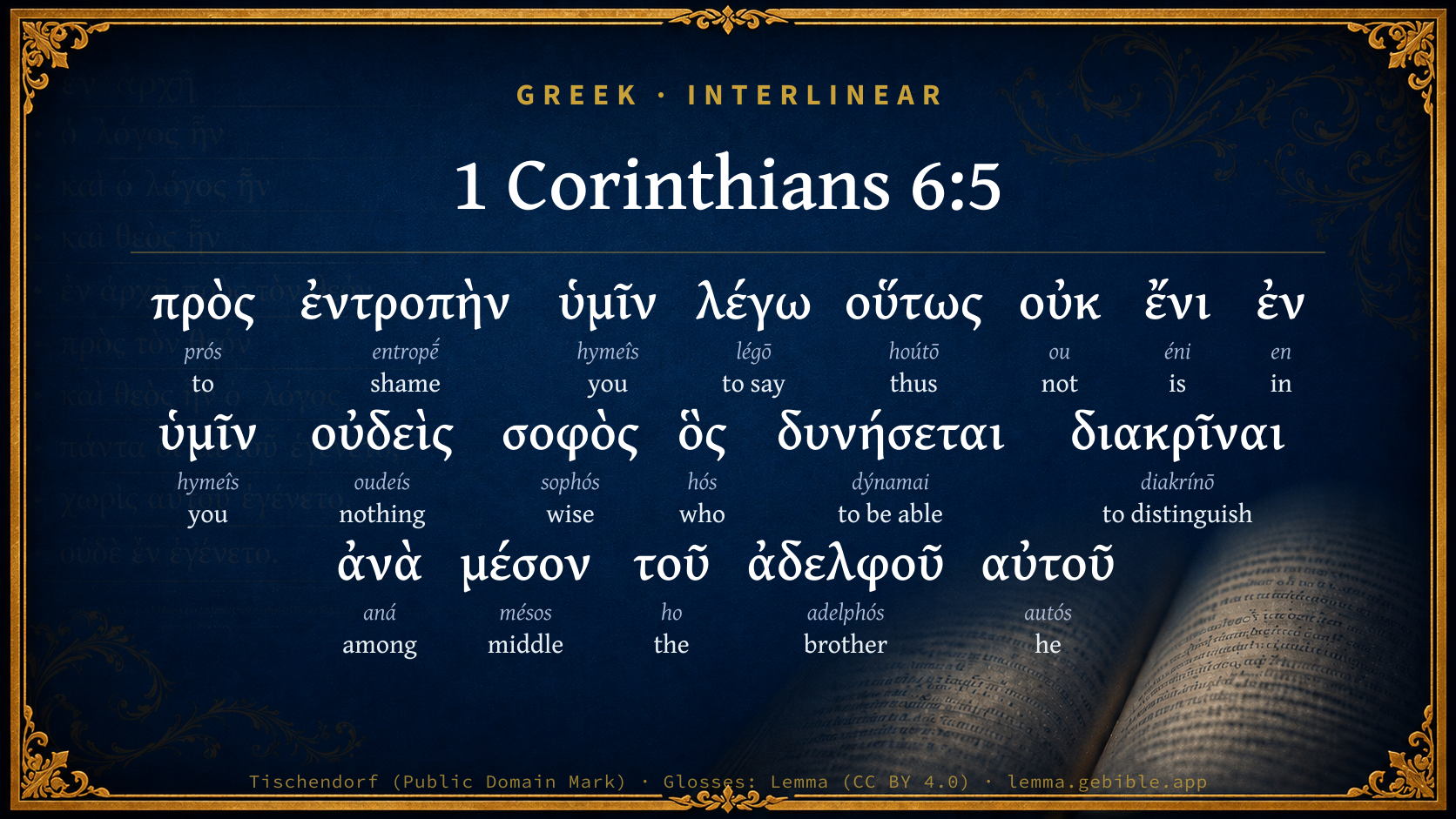
Greek (Tischendorf 8th ed.) 1 Corinthians 6:5 appears in the Greek New Testament. The text above is from the Tischendorf 8th edition. Each word links to its Strong’s number and a concise gloss. Click any word for its full Thayer’s Greek Lexicon entry.
Download image
Cite this verse

1 Corinthians 6:5 (World English Bible). Public Domain. Lemma interlinear Bible study tool, https://lemma.gebible.app/v/1-corinthians/6/5.

Show BibTeX & RIS
BibTeX
RIS
English Translation
I say this to move you to shame. Isn't there even one wise man among you who would be able to decide between his brothers?
World English Bible · Public Domain
Highlights
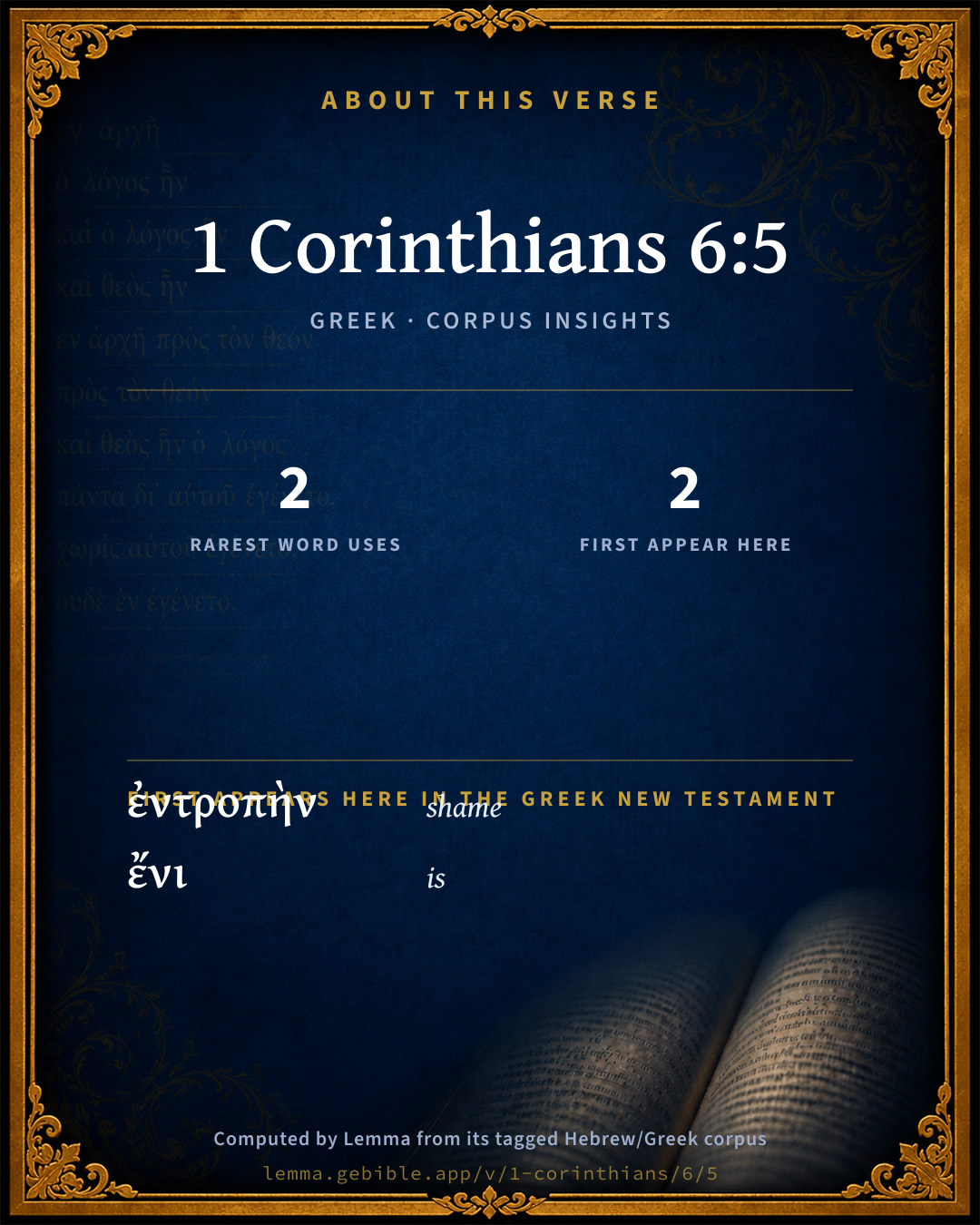
  • 2 first appearances in the Greek New Testament
Full analysis ↓
Download a study sheet

One document with this verse’s original text, its word-by-word gloss line, the meaning frame, cross-references with their text, attributed commentary, and full source and license credits — printable, and it pastes into notes with its structure intact.

This verse Autodidact and up

Study sheet (.html) Plain text (.txt)

A passage Seminary Student

Up to 50 verses in one chapter. A passage sheet keeps up to 6 commentary sources and 12 cross-references per verse, in the order this page ranks them, and says so on the sheet whenever that leaves anything out. Ask for a single verse and you get the Autodidact verse sheet above.

Everything on this page stays free to read, with no account — the sheet is a download of what is already on screen, not access to it.

Want to remove ads? Support Godless Engineer
Compare translations 3

The same verse in 3 English versions, stacked beneath the original-language interlinear above. Click any original word for its lexicon entry.

Each is an independent rendering of the whole verse — the interlinear is not word-aligned to these translations.

Highlighted words mark where these versions differ — a whole-verse word diff, not a word-by-word alignment.

  • World English Bible Public Domain
    I say this to move you to shame. Isn't there even one wise man among you who would be able to decide between his brothers?
  • King James Version Public Domain
    I speak to your shame. Is it so, that there is not a wise man among you? no, not one that shall be able to judge between his brethren?
  • unfoldingWord Literal Text CC BY-SA 4.0
    I speak to your shame. thus that there is not any wise among you who will be able to discern between his brothers?

unfoldingWord Literal Text — © unfoldingWord, licensed CC BY-SA 4.0. Word-aligned USFM3 via Door43 (git.door43.org/unfoldingWord/en_ult).

Versions to compare (up to 4)

3 of 4 selected

Show all 19 translations

Every available English version of this verse, each an independent rendering of the whole verse.

  • World English Bible Public Domain
    I say this to move you to shame. Isn't there even one wise man among you who would be able to decide between his brothers?
  • Berean Standard Bible Public Domain
    I say this to your shame. Is there really no one among you wise enough to arbitrate between his brothers?
  • Majority Standard Bible Public Domain
    I say this to your shame. Is there really not even one among you wise enough to arbitrate between his brothers?
  • King James Version Public Domain
    I speak to your shame. Is it so, that there is not a wise man among you? no, not one that shall be able to judge between his brethren?
  • American Standard Version (1901) Public Domain
    I say `this' to move you to shame. What, cannot there be `found' among you one wise man who shall be able to decide between his brethren,
  • Revised Version (1885) Public Domain
    I say this to move you to shame. Is it so, that there cannot be found among you one wise man, who shall be able to decide between his brethren,
  • Geneva Bible (1599) Public Domain
    I speake it to your shame. Is it so that there is not a wise man among you? no not one, that can iudge betweene his brethren?
  • Douay-Rheims (1899) Public Domain
    I speak to your shame. Is it so that there is not among you any one wise man, that is able to judge between his brethren?
  • Young's Literal Translation Public Domain
    unto your shame I speak: so there is not among you one wise man, not even one, who shall be able to discern in the midst of his brethren!
  • Literal Standard Version CC BY-SA 4.0
    I speak to your shame: so there is not among you one wise man, not even one, who will be able to discern in the midst of his brothers!
  • Unlocked Literal Bible CC BY-SA 4.0
    I say this to your shame. Is there no one among you wise enough to settle a dispute between brothers?
  • unfoldingWord Literal Text CC BY-SA 4.0
    I speak to your shame. thus that there is not any wise among you who will be able to discern between his brothers?
  • Darby Bible Public Domain
    I speak to you [to put you] to shame. Thus there is not a wise person among you, not even one, who shall be able to decide between his brethren!
  • World Messianic Bible Public Domain
    I say this to move you to shame. Isn’t there even one wise man among you who would be able to decide between his brothers?
  • Webster's Bible Public Domain
    I speak to your shame. Is it so, that there is not a wise man among you? no, not one that will be able to judge between his brethren?
  • Free Bible Version CC BY-SA 4.0
    I'm trying to shame you by saying this. What? You can't find one wise person among you who can settle a dispute that you have?
  • Bible in Basic English Public Domain
    I say this to put you to shame. Is there not among you one wise man who may be able to give a decision between his brothers?
  • Text-Critical English NT CC BY 4.0
    I say this to your shame. Is there not a wise man among you, not even one, who would be able to decide between a man and his brother,
  • Tyndale New Testament (1534) Public Domain
    This I saye to youre shame. Is ther vtterly no wyse man amonge you? What not one at all that can iudge bitwene brother and brother

Literal Standard Version (2020), Covenant Press — licensed CC BY-SA 4.0. Text via the HelloAO Bible API (eBible.org). Unlocked Literal Bible (unfoldingWord) — licensed CC BY-SA 4.0. Text via the HelloAO Bible API (eBible.org). unfoldingWord Literal Text — © unfoldingWord, licensed CC BY-SA 4.0. Word-aligned USFM3 via Door43 (git.door43.org/unfoldingWord/en_ult). Free Bible Version, Dr. Jonathan Gallagher — licensed CC BY-SA 4.0. Text via the HelloAO Bible API (eBible.org).

Word by word

More ways to search: Search by grammar → Find every occurrence → Compare this word →

Practice this passage: Drill this verse → Learn its vocabulary →

ἐντροπὴν
entropḗ
G1791
“shame”
Noun, Accusative, Singular, Feminine
Part of Speech
Noun
Case
Accusative
Number
Singular
Gender
Feminine
Full Thayer's Definition

Origin: from G1788

TDNT: None

1. shame 2. respect, reverence
  1. πρὸς prós G4314 “to” Preposition
  2. ὑμῖν hymeîs G5210 “you” Personal pronoun, 2nd person, Dative, Plural
  3. λέγω légō G3004 “to say” Verb, Present, Active, Indicative, 1st person, Singular
  4. οὕτως hoútō G3779 “thus” Adverb
  5. οὐκ ou G3756 “not” Particle, Negative
  6. ἔνι éni G1762 “is” Verb, Present, Active, Indicative, 3rd person, Singular
  7. ἐν en G1722 “in” Preposition
  8. ὑμῖν hymeîs G5210 “you” Personal pronoun, 2nd person, Dative, Plural
  9. οὐδεὶς oudeís G3762 “nothing” Adjective, Nominative, Singular, Masculine, Negative
  10. σοφὸς sophós G4680 “wise” Adjective, Nominative, Singular, Masculine
  11. ὃς hós G3739 “who” Relative pronoun, Nominative, Singular, Masculine
  12. δυνήσεται dýnamai G1410 “to be able” Verb, Future, Middle deponent, Indicative, 3rd person, Singular
  13. διακρῖναι diakrínō G1252 “to distinguish” Verb, Aorist, Active, Infinitive
  14. ἀνὰ aná G303 “among” Preposition
  15. μέσον mésos G3319 “middle” Adjective, Accusative, Singular, Neuter
  16. τοῦ ho G3588 “the” Article, Genitive, Singular, Masculine
  17. ἀδελφοῦ adelphós G80 “brother” Noun, Genitive, Singular, Masculine
  18. αὐτοῦ autós G846 “he” Personal pronoun, Genitive, Singular, Masculine

About this verse

These counts appear in no published source. They are computed here, from the morphology-tagged text and Lemma’s own curated glosses. What Lemma adds →

19
words
18
distinct lemmas
Pauline Epistles
section

Notable vocabulary

The rarest word here is ἐντροπὴν shame G1791 — appearing just 2 times in the whole Greek New Testament.

First appearance in Scripture

These words make their first canonical appearance in the Greek New Testament here:

Shared distinctive vocabulary

ἐντροπὴν shame G1791 occurs in 2 verses of the Greek New Testament. Also found in:

Repetition

A word recurs within this verse:

  • ὑμῖν you G5210 ×2

Cross-references

9

Topical passages linked to 1 Corinthians 6:5 in the Treasury of Scripture Knowledge — connected by theme and wording, ordered by reader-vote popularity; previews shown in the World English Bible.

  • 1 Corinthians 4:14 I don't write these things to shame you, but to admonish you as my beloved children.
  • 1 Corinthians 15:34 Wake up righteously, and don't sin, for some have no knowledge of God. I say this to your shame.
  • James 3:13–18 Who is wise and understanding among you? Let him show by his good conduct that his deeds are done in gentleness of wisdom.
  • Proverbs 14:8 The wisdom of the prudent is to think about his way, But the folly of fools is deceit.
  • 1 Corinthians 3:18 Let no one deceive himself. If anyone thinks that he is wise among you in this world, let him become a fool, that he may become wise.
  • 1 Corinthians 4:10 We are fools for Christ's sake, but you are wise in Christ. We are weak, but you are strong. You have honor, but we have dishonor.
  • 1 Corinthians 11:14 Doesn't even nature itself teach you that if a man has long hair, it is a dishonor to him?
  • James 1:5 But if any of you lacks wisdom, let him ask of God, who gives to all liberally and without reproach; and it will be given to him.
  • Acts 1:15 In these days, Peter stood up in the midst of the disciples (and the number of names was about one hundred twenty), and said,

Cross-references courtesy of OpenBible.info (CC BY 4.0).

Commentary

Notes on 1 Corinthians 6:5 from classic Christian and Jewish commentators (each source and its license shown beneath its notes). The classic Christian expositions comment on the surrounding passage and are grouped to its opening verse, so a note may address several verses; the Jewish commentaries on the Tanakh (Rashi and others) are per-verse, so they appear only where the commentator wrote on this verse.

Lemma curates 59 commentaries, every one of them public domain or Creative Commons licensed, each selected and text-cleaned for this edition rather than reprinted as found. About our sources →

Bengel's Gnomon

Johann Albrecht Bengel

1Co 6:5. Πρὸς ἐντροπὴν, to your shame) The puffed up spirit [ch. 1Co 5:2] of the Corinthians is hereby checked: Comp. 1Co 15:34.—σοφὸς, a wise man) They admired wisdom on other occasions, and wisdom produces the ability for judging between brethren in deciding causes.—οὐδὲ εἷς, not even one) Even the least among believers is a wiser and more desirable judge than an ungodly man.—δυνἠσεται) the future; shall be able if he be applied to.—διακρῖναι) to determine between parties. It differs from κρῖναι, to judge.—ἀδελφοῦ, a brother) The singular for the plural, to denote how easy a matter it is; he wishes that the plaintiff and the defendant should settle the dispute between themselves, without any interference on the part of the judge.

Bengel's Gnomon of the New Testament — English translation (T&T Clark, Edinburgh, 1860) — public domain. Text from a community e-Sword module.

Meyer's Critical & Exegetical Commentary

Heinrich August Wilhelm Meyer

1Co_6:5. Πρὸς ἐντρ. ὑμῖν λέγω] is to be referred, as is done by Lachmann, Tischendorf, Neander, and Hofmann, to 1Co_6:4, comp 1Co_15:34 (it is commonly referred to what comes after), so that the following question unfolds the humiliating consideration involved in 1Co_6:4. The address thus acquires more point and impressiveness.

οὕτως] belongs not to ΛΈΓΩ (Hofmann), but to ΟὐΚ ἜΝΙ Κ.Τ.Λ[917], and sums up the state of things: sic igitur, rebus ita comparatis, since you τοὺς ἐξουθενημένους καθίζετε. See Bornemann in Rosenmüllers Repert. II. p. 245 ff.; Hermann, a[918] Viger. p. 933. C. Fr. Hermann, a[919] Lucian. de hist. conscr. p. 161. It is otherwise understood by Chrysostom, Theophylact, Luther, al[920], including Flatt, Billroth, Rückert, Olshausen, Ewald, who make it: so much, so completely is there lacking, etc. But it is only the definition of mode, not of degree, that will suit the absolute negation of this clause, intensified as it is by οὐδὲ εἷς.

Regarding ἔνι, see on Gal_3:28. The σοφός carries point against the Corinthian self-conceit.

οὐδὲ εἷς] ne unus quidem. Quod est vehementius, as Erasmus well puts it, cum sitis tum multi. See on Joh_1:3, and Krüger, Anab. iii. 1. 3; Bornemann and Poppo, a[921] Cyrop. ii. 1. 21. Comp non ullus (Kühner, a[923] Cic. Tusc. i. 39. 94) nemo unus (Locella, a[924] Xen. Eph. p. 137). Frequent in Isocr., see Bremi, I. Exc. iii.

ὃς δυνήσεται] purely future in force: who (as cases shall occur) will be able.

διακρῖναι] to judge, as arbitrator.

ἀνὰ μέσον τ. ἀδ. αὐτοῦ] between (LXX. Gen_16:5; Exo_11:7; Eze_22:26; Isa_57:11; Mat_13:25; Theocr. xxii. 21; Strabo, xi. 5. 1, p. 503; Polyb. x. 48. 1, v. 55. 7) his (Christian) brother. The expression, τ. ἀδελφοῦ, is meant to put to shame. The singular is used for this reason, that τοῦ ἀδελφοῦ must mean the plaintiff who brings on the lawsuit (not the defendant, as Ewald would have it), between whom (and, as is obvious, the defendant) the arbitrator, called into requisition by the bringing of the suit, pronounces his decision. Were the plural employed, that would indicate the two litigants generally, but not the party bringing on the suit in particular. Hofmann, contrary to the plain meaning of the words, understands the phrase of the self-decision of the individual demanding or refusing, namely, as to the point where his right ceased and his wrong began. In that case, Paul, if he wished to be intelligible, would have required to say something like this: διακρῖναι ἐν ἑαυτῷ πρὸς τὸν ἀδελφὸν αὐτοῦ. Moreover, οὐδὲ εἷς (or οὐδείς, as Hofmann reads) would militate against this view, seeing that it contains what would be, according to 1Co_6:1, a disproportionate accusation, if the meaning is not, not a single man fitted to be an arbitrator.

The reading, τ. ἀδεκφοῦ κ. τοῦ ἀδελφοῦ αὐτοῦ (Syr[925] Arr.), is an interpretation, although recommended by Grotius and again by Laurent.

[917] .τ.λ. καὶ τὰ λοιπά.

[918] d refers to the note of the commentator or editor named on the particular passage.

[919] d refers to the note of the commentator or editor named on the particular passage.

[920] l. and others; and other passages; and other editions.

[921] d refers to the note of the commentator or editor named on the particular passage.

[923] d refers to the note of the commentator or editor named on the particular passage.

[924] d refers to the note of the commentator or editor named on the particular passage.

[925] yr. Peschito Syriac

Meyer — Critical and Exegetical Commentary on the New Testament — English translation by Peter Christie, edited by Frederick Crombie (T&T Clark, 1880) — public domain. Text from a community e-Sword module.

Godet's Commentaries

Frédéric Louis Godet

Vv. 5, 6. “I speak to your shame: is it so that there is not a wise man among you, no not one, that shall be able to judge between his brethren! 6. But brother goeth to law with brother, and that before the unbelievers.”

The first words of 1Co 6:5 may bear on what precedes; in that case they signify: “I am certainly not opposed to your choosing capable men as arbiters; I have only spoken as I have done (1Co 6:4) to make you ashamed, by showing how little importance I attach to those wretched interests for which you do not scruple to compromise the honour of the Church.” But the following οὕτως takes a more serious and definite meaning, if the first proposition is connected with what follows, 1Co 6:5: “Thus then — I say this to your shame — in your Church of wise men, not a wise man capable of pronouncing on such affairs!” The proper reading is οὐκ ἔνι (abbreviation of ἔνεστι), there is not there.

The Alex. read: not a wise man; the Greco-Lat.: not a single wise man; the T. R.: no wise man, not even one; the last reading is preferable, at least in point of sense.

The aorist διακρῖναι here signifies: to decide summarily, settling the question with a stroke of the pen. It is a case of arbitration, not a law process. — The expression ἀνὰ μέσον τοῦ ἀδελφοῦ is evidently incomplete; the ἀνὰ μέσον, between, supposes a regimen formed of two terms: between a brother (the plaintiff) and his brother (the accused); comp. Gen 16:5; Exo 11:7; Exo 26:33 (in the LXX.). Either the second term was understood, or it might be supposed that by an elliptical form of the word his brother was put for: “the claim of his brother.” The word διακρῖναι, to distinguish, decide, would then signify: to separate between the true and the false in this claim. In any case the meaning is: “No law pleading! The word of an arbiter, let that be final!” In this mode of expression there is a sort of disdain for the object of contention.

Frédéric Louis Godet — Commentaries on Luke, John, Romans, and 1 Corinthians — English translation (T&T Clark, Edinburgh, 1870s–1890s) — public domain. Text from a community e-Sword module.

Hodge's Commentary on Romans, Ephesians & First Corinthians

Charles Hodge

1Co_6:5

I speak to your shame. Is it so, that there is not a wise man among you? no, not one that shall be able to judge between his brethren?

I speak to your shame. That is, I desire to produce in you a sense of shame. This may refer either to what precedes or to what follows. It was adapted to make them ashamed that they had acted so unworthily of their dignity as Christians; and it was no less disgraceful to them to suppose that there was not in the church a single man fit to act as arbitrator. Who shall be able. The future here expresses what should or may happen. Between his brethren; literally, between his brother; i.e. between his complaining brother and him against whom the complaint was brought.

Charles Hodge — Commentary on Romans (1835), First Corinthians (1857), and Ephesians (1856) — public domain. Text from a community e-Sword module.

Geneva Bible (1599)

Geneva Bible translators

He applieth the general proposition to a particular, always calling them back to this, to take away from them that false opinion of their own excellency, from whence all these mischiefs sprang.

Geneva Bible (1599) marginal notes — public domain. Text via Bolls.life.

Jamieson, Fausset & Brown

Robert Jamieson, A. R. Fausset & David Brown

your shame--Thus he checks their puffed-up spirit (Co1 5:2; compare Co1 15:34). To shame you out of your present unworthy course of litigation before the heathen, I have said (Co1 6:4), "Set the least esteemed in the Church to judge." Better even this, than your present course.

Is it so?--Are you in such a helpless state that, &c.?

not a wise man--though ye admire "wisdom" so much on other occasions (Co1 1:5, Co1 1:22). Paul alludes probably to the title, "cachain," or wise man, applied to each Rabbi in Jewish councils.

no, not one--not even one, amidst so many reputed among you for wisdom (Co1 3:18; Co1 4:6).

shall be able--when applied to.

brethren--literally, "brother"; that is, judge between brother and brother. As each case should arise, the arbitrator was to be chosen from the body of the church, such a wise person as had the charism, or gift, of church government.

Jamieson, Fausset & Brown — Commentary Critical and Explanatory on the Whole Bible (1871) — public domain (CC PDM 1.0). Text via the HelloAO Bible API.

Adam Clarke's Commentary

Verse 5. Is it so, that there is not a wise man among you?] Have you none among yourselves that can be arbitrators of the differences which arise, that you go to the heathen tribunals?

Adam Clarke's Commentary on the Bible (1810–1826) — public domain. Text from a community e-Sword/MySword module.

John Calvin's Commentaries

5. I speak to your shame The meaning is — “If other considerations do not influence you, let it at least be considered by you, how disgraceful it is to you that there is not so much as one among you who is qualified to settle an affair amicably among brethren — an honor which you assign to unbelievers Now this passage is not inconsistent with the declaration which we met with above, when he stated that he did not make mention of their faults with the view of shaming them, (1 Corinthians 4:14,) for instead of this, by putting them to shame in this manner, he calls them back from disgrace, and shows that he is desirous to promote their honor. He does not wish them, then, to form so unfavorable an opinion of their society, as to take away from all their brethren an honor which they allow to unbelievers

John Calvin's Commentaries (1540-1563) — public domain. Text from the Calvin Translation Society English edition (1840s-50s) via the Christian Classics Ethereal Library (ccel.org). Calvin's coverage is partial (roughly two-thirds of the Bible); uncommented books and verses are honest gaps, never fabricated. The 19th-century editor's footnotes and remarks are omitted so the notes are faithfully Calvin's own voice.

Ellicott's Commentary for English Readers

(5) I speak to your shame.—Better, I say this to cause you to feel ashamed. From the latent irony of the previous words, the Apostle turns to ask solemnly whether it be a fact that in the whole Christian community at Corinth, which boasted of their superior wisdom, there is not to be found even one man sufficiently esteemed for his wisdom to be trusted by the brethren with the settlement of their disputes.

Shall be able to judge. . . .—Better, shall be able to arbitrate, in contrast to the “going to law” of the next verse, the words for these two expressions being different in the original.

A Bible Commentary for English Readers, edited by Charles John Ellicott (1878–1897) — public domain. Text from a community e-Sword module.

The Cambridge Bible for Schools and Colleges

gen. ed. J. J. S. Perowne

5. I speak to your shame] ‘You are not to suppose me in earnest. I only say this to shame you for the undue value you set on the things of this life. Such matters might fitly be left to the decision of the most insignificant member of your community. But there is no necessity for that. Surely there are plenty of persons among you who are competent to settle such questions, and thus save you the scandal of carrying your disputes before the heathen, when you have pledged yourself to lead a life above such considerations.’

The Cambridge Bible for Schools and Colleges (gen. ed. J. J. S. Perowne; Cambridge University Press, 1878–1918) — public domain. Text from a community e-Sword module.

John Gill's Exposition

I speak to your shame,.... Not that they did set such persons to judge, but that they did not; and instead of so doing went to law with their brethren before the unjust:

is it so that there is not a wise man among you? this also the apostle speaks to their shame, who had so much gloried in their wisdom, and boasted of their parts and abilities to the contempt of others, and even of the apostle himself; and yet acted as if there was not a wise man among them capable of judging and determining trivial matters, but they must carry them before unconverted persons:

no not one that shall be able to judge between his brethren? for though the above mentioned benches consisted of three persons, yet the contending parties might choose one man to be an arbitrator and judge between them. The rule with the Jews was this (f);

"pecuniary judgments are by three, but if he is authorised or approved by the majority, , "he may judge alone". Says R. Nachman, as I judge pecuniary judgments alone; and so says R. Chaijah, as I judge pecuniary punishments alone.''

(f) T. Bab. Sanhed. fol. 5. 1. Maimon. Hilch. Sanhed. c. 5. sect. 8.

John Gill's Exposition of the Whole Bible (1746–1763) — public domain (CC PDM 1.0). Text via the HelloAO Bible API.

Trapp's Complete Commentary

John Trapp

5 I speak to your shame. Is it so, that there is not a wise man among you? no, not one that shall be able to judge between his brethren?

Ver. 5. No, not one that shall be able] Our late judge Dier, if there came any controversies of poor men to be tried before him, would usually say, that either the parties are wilful, or their neighbours uncharitable, because their suits were not quietly ended at home. (The Practice of Quietness.)

John Trapp, A Commentary or Exposition upon All the Books of the Old and New Testament (1647–1656) — public domain. Text from a community e-Sword module.

Albert Barnes' Notes on the Bible

I speak to your shame - I declare that which is a reproach to you, that your matters of dispute are carried before pagan tribunals.

Is it so ... - Can it be that in the Christian church - the church collected in refined and enlightened Corinth - there is not a single member so wise, intelligent and prudent that his brethren may have confidence in him, and refer their causes to him? Can this be the case in a church that boasts so much of its wisdom, and that prides itself so much in the number and qualifications of its intelligent members?

Albert Barnes' Notes on the Bible (1834–1885) — public domain. Text from a community e-Sword/MySword module.

Matthew Poole's English Annotations

I do not speak this, as if I would have you make choice of the meanest persons among you to arbitrate and determine all matters that may be in difference between you; but it would be a shame to you if, amongst you all, there could not be found one man whom you can judge wise enough to determine differences between you about things of this life, without bringing one another into pagan courts, to the reproach and scandal of the religion which you profess: make use of any, yea, the meanest Christians, in such judgments, rather than infidels and unbelievers, who will make use of your differences to the reproaching of the holy name of God.

Now therefore there is utterly a fault among you, because ye go to law one with another; not that it is simply unlawful for men to make use of human laws, and courts, and methods of judicature; for even the laws of men are good, if they be lawfully used: and the word here used by the apostle is ηττημα, which signifieth rather an impotency or weakness of mind and affections, a defect or diminution from perfection, than any scandalous sin. Going to law with brethren (though lawful in itself) may be made unlawful by circumstances:

1. When it is before judges that are unbelievers, so as men’s going to law before them tends to the reproach of religion, the credit and reputation of the gospel ought to be dearer to us than any little secular concern. This was the case in this place.

2. When it is for little matters, such as a coat or a cloak. It is against the law of charity to do another a great wrong to recover to ourselves a little that is our right.

3. When we cannot do it without wrath, anger, impatience, covetousness, or desire of revenge. It is a thing possible to go to law without sin, but what very few do, through that corruption which cleaveth to corrupt nature.

Why do ye not rather take wrong? why do ye not rather suffer yourselves to be defrauded? It is therefore far more becoming conscientious Christians to take a little wrong, and to suffer themselves to be cheated of their right, especially under such circumstances, where the credit of the gospel and religion must lose more than they can get. And to do otherwise speaks ηττημα, a defect or imperfection in Christians, and is not without its guilt. If, by their contentiousness, they do not show themselves so bad as some would make them, who hold all contendings at law amongst Christians unlawful, yet they do not show themselves so good as the rule of Christianity requireth them to be, Mat 5:39,40; Lu 6:29; Rom 12:19.

Matthew Poole's English Annotations on the Holy Bible (1683–1685) — public domain. Text from a community e-Sword/MySword module.

Whedon's Commentary on the Bible

Daniel D. Whedon

5. Your shame—He has shown them the high ideal of their state in Christ to humiliate them for debasing that ideal before heathen magistrates.

Able to judge—On the level of plain, literal thought, St. Paul here advises them to place their disputes before some competent Christian arbiter.

Daniel D. Whedon (gen. ed.), Commentary on the Old and New Testaments (1874–1909) — public domain. Text from a community e-Sword module.

The Pulpit Commentary

I speak to your shame. He adds this to account for the severe irony of the last remark. Not a wise man among you. Among you, who set yourselves up as so specially wise! To judge; rather, to decide.

The Pulpit Commentary (1880–1919), ed. H.D.M. Spence-Jones & Joseph S. Exell — public domain. Text from a community e-Sword module.

John Wesley's Explanatory Notes

Is there not one among you, who are such admirers of wisdom, that is wise enough to decide such causes?

John Wesley, Explanatory Notes Upon the Whole Bible (1754–1765) — public domain. Text via the GEBible commentary corpus.

Kretzmann's Popular Commentary

Paul E. Kretzmann

The apostle’s reproof:

v. 5. I speak to your shame. Is it so that there is not a wise man among you? no, not one that shall be able to judge between his brethren?

v. 6. But brother goeth to law with brother, and that before the unbelievers.

v. 7. Now, therefore, there is utterly a fault among you because ye go to law one with another. Why do ye not rather take wrong? Why do ye not rather suffer yourselves to be defrauded?

v. 8. Nay, ye do wrong, and defraud, and that your brethren.

No wonder that Paul, under such circumstances, must call out shame upon them; their conduct is disgraceful and altogether unbecoming that of meek and charitable Christians. And he stresses this point still more: To this point have matters progressed that there is not one wise man among you who could make a decision between his brothers? Was there not a single man with enough experience to arbitrate a matter when a cause came up? He concludes that there is evidently no such man, since one brother is involved in litigation with another, and that before the unbelievers! If there were but one man in the congregation wise enough to settle such matters in private, surely they would have called him in to decide the disputes And so they air their grievances against one another before the unbelieving magistrates. Was not that equivalent to a confession of bankruptcy?

Paul now lays bare the real root of the matter: It is indeed altogether a detriment to you, a bad thing all around, that you have lawsuits. From the very start it is a defeat for them, morally speaking, that it ever comes to that pass, that their differences ever rise to that pitch. Their case is lost before they have ever entered the court, and their action represents a sinking down from the high standard of pure Christian feeling. The cause of Christianity is bound to be harmed by such behavior, for the Gentiles will naturally judge the moral worth of the movement by the evidence of its power in the lives of the Christians. How the believers of all times should conduct themselves in cases which might develop into lawsuits according to the common experience of mankind, the apostle states in the more striking form of questions: Why do you not rather suffer injustice? Why do you not rather submit to fraud? Paul here reproduces the teaching of Jesus, Luk 6:27-35. In following the example of Jesus and of Paul, the believers will be constrained at all times to suffer injustice rather than to afflict injustice. But the litigious members of the Corinthian congregation had not yet reached this stage of unselfish love: It is rather that you commit wrong and defraud, deprive your neighbor of that which is his, and that, literally, to your brethren! The spiritual relationship which obtains between believers should make them all the more willing to yield to their brother in love, but instead of that they provoke quarrels, they inflict wrong. "Paul here does not attack the court, but the fault of the heart that a brother summoned the other before the secular court, namely, before enemies of the faith. For to invoke justice and to seek the sustenance of life he does not prohibit, else a master would not be permitted to tear the lamb away from the wolf. They, however, sought their own vengeance; they tried to bring disgrace upon their brother. But this text means to teach us that not eagerness or desire for vengeance should be our motive for appealing to the judge for help, but rather justice and necessity."

Paul E. Kretzmann, Popular Commentary of the Bible (1921–1924) — public domain. Text from a community e-Sword module.

Godbey's Commentary on the New Testament

William B. Godbey

5. “I speak to your shame. Is there not some wise man among you who shall be able to judge between brother and his brother?” The answer is in the affirmative. The Lord will raise up some Moses among you if you will give Him a chance, who will be fully competent to adjudicate and finally settle all your little controversies involving temporal interests.

William B. Godbey, Commentary on the New Testament (1896–1900) — public domain. Text from a community e-Sword module.

McGarvey & Pendleton's Commentaries

J. W. McGarvey

I say this to move you to shame . [If called on as a church to judge any matter, would you choose its simpletons and numbskulls as judges? I ask this to make you ashamed, for ye do even more foolishly when you submit your cases to worldlings, who are even less competent judges.] What, cannot there be found among you one wise man who shall be able to decide between his brethren ,

J. W. McGarvey (with Philip Y. Pendleton), Commentaries on the New Testament (The Fourfold Gospel, 1914; Acts; and the epistles) — public domain. Text from a community e-Sword/MySword module.

The People's New Testament

B. W. Johnson

5–8. I speak to your shame. The last sentence was spoken to shame them, not as a serious rule. He now speaks seriously. Is there not a wise man among you? A man of prudent judgment, capable of settling differences among them.

B. W. Johnson's The People's New Testament with Notes (1889–1891) — public domain. Electronic text from the Christian Classics Ethereal Library (CCEL) ThML edition.

Cambridge Greek Testament for Schools and Colleges

5. ἔνι אBC, rec. ἔστιν with DEFG.

οὐδεὶς σοφός אBC, σοφὸς οὐδείς FG, rec. σοφὸς οὐδὲ εἷς. Vulg. has sapiens quisquam.

5. πρὸς ἐντροπὴν ὑμῖν λέγω. ‘You are not to take my words literally. I only say this to shame you for the undue value you set on the things of this life. Such matters might fitly be left to the decision of the most insignificant member of your community. But there is no necessity for that. Surely there are plenty of persons among you who are competent to settle such questions, and thus save you the scandal of carrying your disputes before the heathen, when you have pledged yourself to lead a life above such considerations.’

ἔνι. For this form see Winer, Gr. Gram. § 14.

διακρῖναι. To decide after a judicial hearing. See ch. 1Co 4:7, note.

ἀνὰ μέσον τοῦ ἀδελφοῦ. The singular is here put for the plural. ἀνὰ μέσον is a Hebraism. Cf. Gen 23:15 (LXX.).

Cambridge Greek Testament for Schools and Colleges (Cambridge University Press, 1896; 21 vols, various authors incl. Carr, Maclear, Plummer, Farrar, Lumby, Moule, M. R. James, Simcox) — public domain. Text from a community e-Sword module.

Alford’s Greek Testament

Henry Alford

5.] πρὸς ἐντρ. ὑμ. λέγω refers to the ironical command in ver. 4—I say this to put you to shame.

οὕτως] Is there so completely a lack of all wise men among you.… He now suggests the more Christian way of settling their differences, viz. by arbitration: and asks, ‘Are you come to this, that yon are obliged καθίζειν any δικαστάς at all,’—have you no wise man among you (the rec., οὐδὲ εἷς, would be ‘quod est vehementius, cum sitis tam multi.’ Erasm.) who shall be able (in such event) to decide (as arbitrator) between his brother (i.e. his brethren)? This last is a harsh method of expression, and apparently only to be accounted for by the singular form of οὐδεὶς σοφός having attracted the other into the singular likewise, so that instead of σοφοὶ οἳ δυνήσονται διακρ. ἀνὰ μέσον τῶν ἀδελφῶν αὐτῶν, we have σαφὸς ὃς δυνήσεται διακρ. ἀνὰ μ. τοῦ ἀδ. αὐτοῦ. But it is not without use: it prevents the apparent inference, which might be made if τῶν ἀδελφῶν αὐτοῦ were used, that one wise man was to be appointed universal arbitrator,—and confines the appointment of the arbitrator to each possibly arising case respectively.

Henry Alford, The Greek Testament (1849–1861) — public domain. Text from a community e-Sword module.

International Critical Commentary

5. οὑτως οὐκ ἔνι κ.τ.λ. ‘Is there such a total lack among you of any wise person’ that you are thus obliged to go outside? Or, ‘So is there not found among you one wise person?’ The οὕτως refers to the condition of things in the Corinthian Church: Chrys., τοσαύτη σπάνις ἀνδρῶν συνετῶν παρʼ ὑμῖν; it is now commonly admitted that ἔνι “is not a contraction from ἔνεστι, but the preposition ἐν or ἐνί, strengthened by a vigorous accent, like ἔπι, πάρα, and used with an ellipse of the substantive verb” (Lightfoot on Gal 3:28; J. B. Mayor on Jas 1:17): translate, therefore, ‘is not found.’

διακρῖναι ἀνὰ μέσον τοῦ ἀδελφοῦ αὐτοῦ. A highly condensed sentence; ‘to decide between his fellow-Christian’ meaning ‘to act as arbitrator between one fellow-Christian and another.’ We want ἀνὰ μέσον ἀδελφοῦ καὶ τοῦ ἀδ. αὐτοῦ, like ἀνὰ μέσον ἐμοῦ καὶ σοῦ (Gen 23:15). J. H. Moulton (Gr. p. 99) suspects a corruption in the text, but dictation may account for the abbreviation: τῶν ἀδελφῶν αὐτοῦ is the simplest conjecture. The compound preposition ἀνὰ μέσον is frequent in papyri. As the Lord had directed (Mat 18:17), the aggrieved brother ought to ‘tell it to the Church.’*

Both here and in 15:34 there is difference of reading between λέγω and λαλῶ. Here λέγω (א D E F G L P) is to be preferred to λαλῶ (B, with C doubtful). ἔνι (א B C L P) rather than ἐστιν (D E F G). οὐδεὶς σοφός (א B C 17, Copt.) rather than οὐδὲ εῖς σοφός (F G P) or (F G P) or σοφὸς οὐδὲ εῖς (D 3 L) or σοφός without οὐδὲ εῖς or οὐδείς (D* E, Aeth.). For τοῦ ἀδελφοῦ some editors conjecture τῶν ἀδελφῶν.

International Critical Commentary — older volumes (1896–1929), various authors — public domain. Text from a community e-Sword module.

Vincent's Word Studies in the New Testament

Marvin R. Vincent

To your shame [προς εντροπην υμιν] . Lit., I speak to you with a view to shame; i e., to move you to shame, as Rev. See on ch. 1Co 4:14. To judge [διακριναι] . Rev., better, decide; by arbitration.

Marvin R. Vincent, Word Studies in the New Testament (1887–1900) — public domain. Text from a community e-Sword/MySword module.

Lesson kit

Teaching starters — assembled from the data on this page, not authored interpretation. Every prompt links to the verse data it draws on. Edit before teaching.

1 Corinthians, in the Pauline Epistles, opens this verse with 19 words (18 distinct Greek lemmas). Its most distinctive word is entropḗ (“shame”). A historical commentator’s framing appears above. Read the whole chapter for the surrounding context.

Discussion questions

  1. What does “shame” (entropḗ) contribute to the verse as a whole?
  2. 2 words here appear for the first time in Scripture. What is being introduced at this debut?
  3. 1 Corinthians 15:34 shares the word «shame» with this verse. How do the two illuminate each other?
  4. “you” occurs 2× in this one verse. What is the effect of the repetition?
  5. These translations render this verse differently. What is at stake in choosing one wording over another?
  6. Reading how Bengel's Gnomon and Meyer's Critical & Exegetical Commentary read this verse, where do the two commentators agree and where do they part?

Things to notice

  • 2 words make their first canonical appearance in Scripture here.
  • These translations choose different wording for 18 words in this verse.
  • “you” occurs 2× in this single verse.
  • 18 distinct Greek lemmas span 19 words in this verse.

Reading settings

Reading text

Shown beneath each verse's original-language words.

Old Testament
Old Testament edition

Read the OT as the Masoretic Hebrew (MT) or the Greek Septuagint (LXX).

English shown for the Greek Septuagint (in the Hebrew ↔ Greek comparison).

Comparing translations? Open the Compare panel on any verse page to stack up to four side by side.