1 Corinthians 13:2

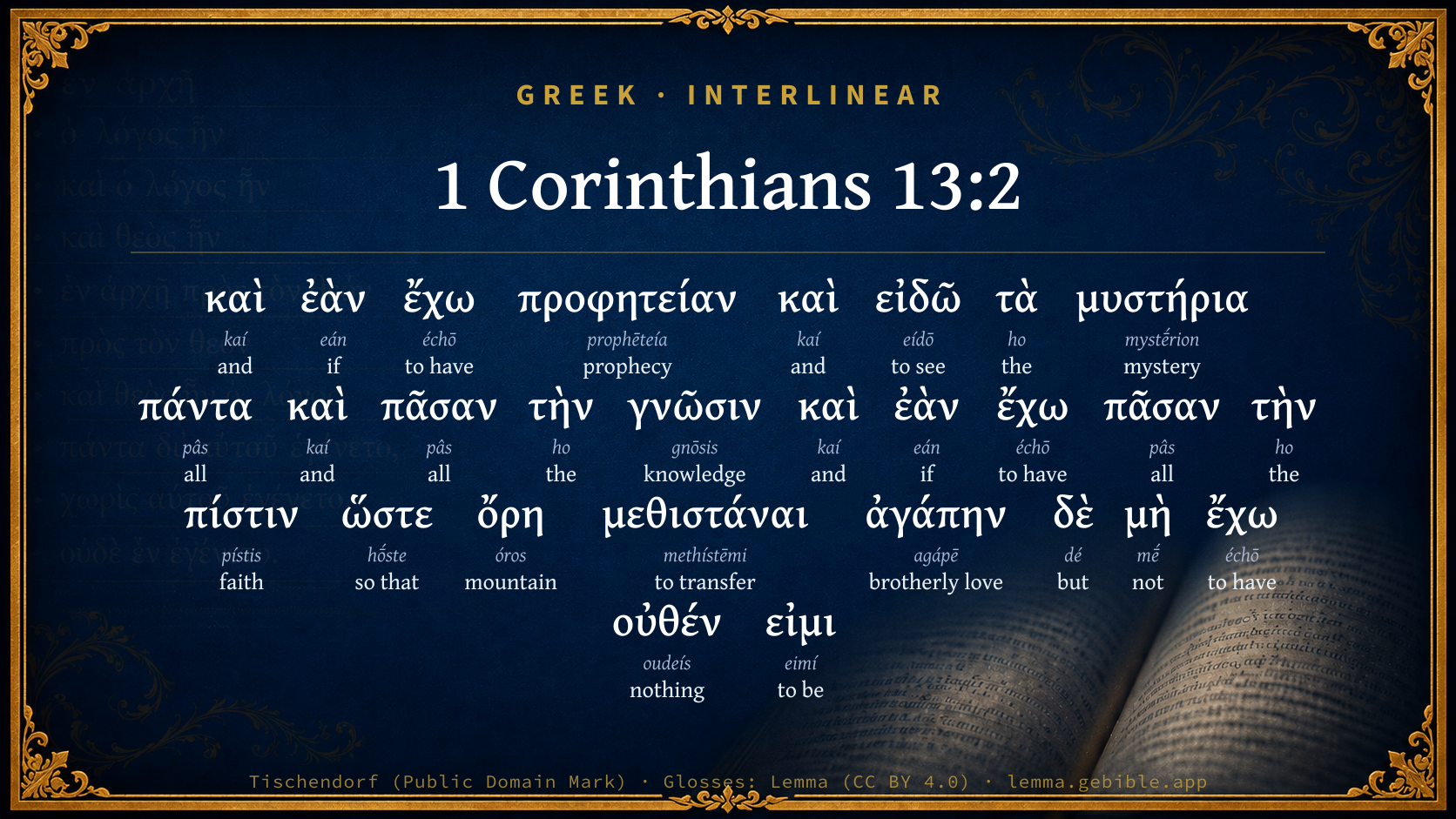
Greek (Tischendorf 8th ed.) 1 Corinthians 13:2 appears in the Greek New Testament. The text above is from the Tischendorf 8th edition. Each word links to its Strong’s number and a concise gloss. Click any word for its full Thayer’s Greek Lexicon entry.
Download image
Cite this verse

1 Corinthians 13:2 (World English Bible). Public Domain. Lemma interlinear Bible study tool, https://lemma.gebible.app/v/1-corinthians/13/2.

Show BibTeX & RIS
BibTeX
RIS
English Translation
If I have the gift of prophecy, and know all mysteries and all knowledge; and if I have all faith, so as to remove mountains, but don't have love, I am nothing.
World English Bible · Public Domain
Download a study sheet

One document with this verse’s original text, its word-by-word gloss line, the meaning frame, cross-references with their text, attributed commentary, and full source and license credits — printable, and it pastes into notes with its structure intact.

This verse Autodidact and up

Study sheet (.html) Plain text (.txt)

A passage Seminary Student

Up to 50 verses in one chapter. A passage sheet keeps up to 6 commentary sources and 12 cross-references per verse, in the order this page ranks them, and says so on the sheet whenever that leaves anything out. Ask for a single verse and you get the Autodidact verse sheet above.

Everything on this page stays free to read, with no account — the sheet is a download of what is already on screen, not access to it.

Want to remove ads? Support Godless Engineer
Compare translations 3

The same verse in 3 English versions, stacked beneath the original-language interlinear above. Click any original word for its lexicon entry.

Each is an independent rendering of the whole verse — the interlinear is not word-aligned to these translations.

Highlighted words mark where these versions differ — a whole-verse word diff, not a word-by-word alignment.

  • World English Bible Public Domain
    If I have the gift of prophecy, and know all mysteries and all knowledge; and if I have all faith, so as to remove mountains, but don't have love, I am nothing.
  • King James Version Public Domain
    And though I have the gift of prophecy, and understand all mysteries, and all knowledge; and though I have all faith, so that I could remove mountains, and have not charity, I am nothing.
  • unfoldingWord Literal Text CC BY-SA 4.0
    And if I have prophecy and understand all mysteries and all knowledge, and if I have all faith so as to remove mountains, but I do not have love, I am nothing.

unfoldingWord Literal Text — © unfoldingWord, licensed CC BY-SA 4.0. Word-aligned USFM3 via Door43 (git.door43.org/unfoldingWord/en_ult).

Versions to compare (up to 4)

3 of 4 selected

Show all 19 translations

Every available English version of this verse, each an independent rendering of the whole verse.

  • World English Bible Public Domain
    If I have the gift of prophecy, and know all mysteries and all knowledge; and if I have all faith, so as to remove mountains, but don't have love, I am nothing.
  • Berean Standard Bible Public Domain
    If I have the gift of prophecy and can fathom all mysteries and all knowledge, and if I have absolute faith so as to move mountains, but have not love, I am nothing.
  • Majority Standard Bible Public Domain
    If I have the gift of prophecy and can fathom all mysteries and all knowledge, and if I have absolute faith so as to move mountains, but have not love, I am nothing.
  • King James Version Public Domain
    And though I have the gift of prophecy, and understand all mysteries, and all knowledge; and though I have all faith, so that I could remove mountains, and have not charity, I am nothing.
  • American Standard Version (1901) Public Domain
    And if I have `the gift of' prophecy, and know all mysteries and all knowledge; and if I have all faith, so as to remove mountains, but have not love, I am nothing.
  • Revised Version (1885) Public Domain
    And if I have the gift of prophecy, and know all mysteries and all knowledge; and if I have all faith, so as to remove mountains, but have not love, I am nothing.
  • Geneva Bible (1599) Public Domain
    And though I had the gift of prophecie, and knewe all secrets and all knowledge, yea, if I had all faith, so that I could remooue mountaines and had not loue, I were nothing.
  • Douay-Rheims (1899) Public Domain
    And if I should have prophecy and should know all mysteries, and all knowledge, and if I should have all faith, so that I could remove mountains, and have not charity, I am nothing.
  • Young's Literal Translation Public Domain
    and if I have prophecy, and know all the secrets, and all the knowledge, and if I have all the faith, so as to remove mountains, and have not love, I am nothing;
  • Literal Standard Version CC BY-SA 4.0
    and if I have prophecy, and know all the secrets, and all the knowledge, and if I have all faith, so as to remove mountains, and do not have love, I am nothing;
  • Unlocked Literal Bible CC BY-SA 4.0
    Suppose that I have the gift of prophecy and understand all hidden truths and knowledge, and that I have all faith so as to remove mountains. But if I do not have love, I am nothing.
  • unfoldingWord Literal Text CC BY-SA 4.0
    And if I have prophecy and understand all mysteries and all knowledge, and if I have all faith so as to remove mountains, but I do not have love, I am nothing.
  • Darby Bible Public Domain
    And if I have prophecy, and know all mysteries and all knowledge, and if I have all faith, so as to remove mountains, but have not love, I am nothing.
  • World Messianic Bible Public Domain
    If I have the gift of prophecy, and know all mysteries and all knowledge, and if I have all faith, so as to remove mountains, but don’t have love, I am nothing.
  • Webster's Bible Public Domain
    And though I have the gift of prophecy, and understand all mysteries, and all knowledge; and though I have all faith, so that I could remove mountains, and have not charity, I am nothing.
  • Free Bible Version CC BY-SA 4.0
    If I were to speak prophecies, to know every secret mystery and be completely knowledgeable, and if I were able to have so much faith I could move mountains, but have no love, then I am nothing.
  • Bible in Basic English Public Domain
    And if I have a prophet's power, and have knowledge of all secret things; and if I have all faith, by which mountains may be moved from their place, but have not love, I am nothing.
  • Text-Critical English NT CC BY 4.0
    If I have the gift of prophecy and know all mysteries and all knowledge, and if I have all faith, so as to move mountains, but do not have love, I am nothing.
  • Tyndale New Testament (1534) Public Domain
    And though I coulde prophesy and vnderstode all secretes and all knowledge: yee yf I had all fayth so that I coulde move mountayns oute of ther places and yet had no love I were nothynge.

Literal Standard Version (2020), Covenant Press — licensed CC BY-SA 4.0. Text via the HelloAO Bible API (eBible.org). Unlocked Literal Bible (unfoldingWord) — licensed CC BY-SA 4.0. Text via the HelloAO Bible API (eBible.org). unfoldingWord Literal Text — © unfoldingWord, licensed CC BY-SA 4.0. Word-aligned USFM3 via Door43 (git.door43.org/unfoldingWord/en_ult). Free Bible Version, Dr. Jonathan Gallagher — licensed CC BY-SA 4.0. Text via the HelloAO Bible API (eBible.org).

Word by word

More ways to search: Search by grammar → Find every occurrence → Compare this word →

Practice this passage: Drill this verse → Learn its vocabulary →

μεθιστάναι
methístēmi
G3179
“to transfer”
Verb, Present, Active, Infinitive
Part of Speech
Verb
Tense
Present
Voice
Active
Mood
Infinitive
Full Thayer's Definition

Origin: from G3326 and G2476

TDNT: None

1. to transpose, transfer, remove from one place to another a. of change of situation or place b. to remove from the office of a steward c. to depart from life, to die
  1. καὶ kaí G2532 “and” Conjunction
  2. ἐὰν eán G1437 “if” Conditional
  3. ἔχω échō G2192 “to have” Verb, Present, Active, Subjunctive, 1st person, Singular
  4. προφητείαν prophēteía G4394 “prophecy” Noun, Accusative, Singular, Feminine
  5. καὶ kaí G2532 “and” Conjunction
  6. εἰδῶ eídō G1492 “to see” Verb, Perfect, Active, Subjunctive, 1st person, Singular
  7. τὰ ho G3588 “the” Article, Accusative, Plural, Neuter
  8. μυστήρια mystḗrion G3466 “mystery” Noun, Accusative, Plural, Neuter
  9. πάντα pâs G3956 “all” Adjective, Accusative, Plural, Neuter
  10. καὶ kaí G2532 “and” Conjunction
  11. πᾶσαν pâs G3956 “all” Adjective, Accusative, Singular, Feminine
  12. τὴν ho G3588 “the” Article, Accusative, Singular, Feminine
  13. γνῶσιν gnōsis G1108 “knowledge” Noun, Accusative, Singular, Feminine
  14. καὶ kaí G2532 “and” Conjunction
  15. ἐὰν eán G1437 “if” Conditional
  16. ἔχω échō G2192 “to have” Verb, Present, Active, Subjunctive, 1st person, Singular
  17. πᾶσαν pâs G3956 “all” Adjective, Accusative, Singular, Feminine
  18. τὴν ho G3588 “the” Article, Accusative, Singular, Feminine
  19. πίστιν pístis G4102 “faith” Noun, Accusative, Singular, Feminine
  20. ὥστε hṓste G5620 “so that” Conjunction
  21. ὄρη óros G3735 “mountain” Noun, Accusative, Plural, Neuter
  22. ἀγάπην agápē G26 “brotherly love” Noun, Accusative, Singular, Feminine
  23. δὲ dé G1161 “but” Conjunction
  24. μὴ mḗ G3361 “not” Particle, Negative
  25. ἔχω échō G2192 “to have” Verb, Present, Active, Subjunctive, 1st person, Singular
  26. οὐθέν oudeís G3762 “nothing” Adjective, Nominative, Singular, Neuter, Negative
  27. εἰμι eimí G1510 “to be” Verb, Present, Active, Indicative, 1st person, Singular

About this verse

These counts appear in no published source. They are computed here, from the morphology-tagged text and Lemma’s own curated glosses. What Lemma adds →

28
words
18
distinct lemmas
Pauline Epistles
section

Notable vocabulary

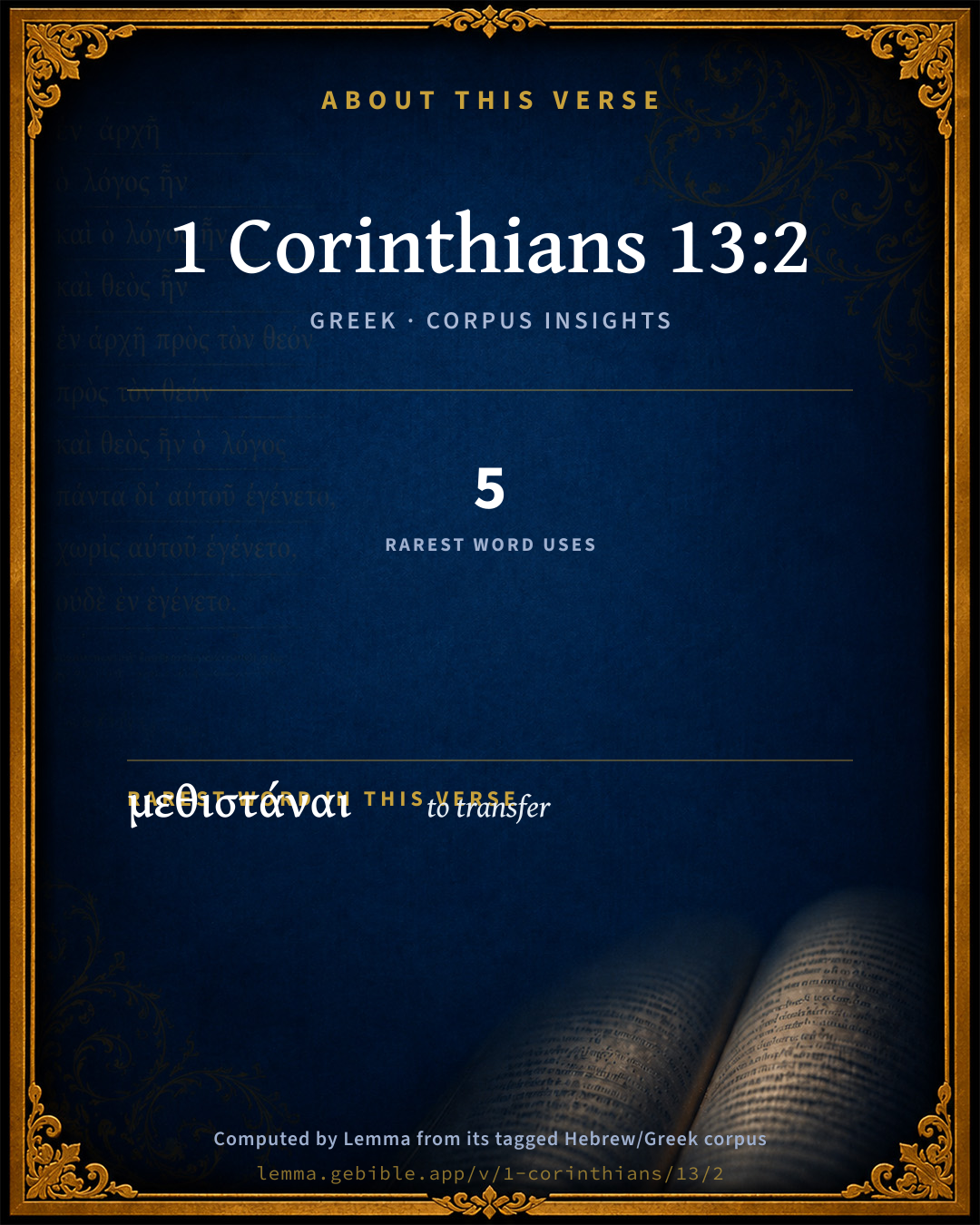
The rarest word here is μεθιστάναι to transfer G3179 — appearing just 5 times in the whole Greek New Testament.

Shared distinctive vocabulary

μεθιστάναι to transfer G3179 occurs in 5 verses of the Greek New Testament. Also found in:

Repetition

Words recur within this verse:

Cross-references

31

Topical passages linked to 1 Corinthians 13:2 in the Treasury of Scripture Knowledge — connected by theme and wording, ordered by reader-vote popularity; previews shown in the World English Bible.

  • 1 John 4:8 He who doesn't love doesn't know God, for God is love.
  • 1 Corinthians 13:3 If I dole out all my goods to feed the poor, and if I give my body to be burned, but don't have love, it profits me nothing.
  • 1 John 4:20–21 If a man says, "I love God," and hates his brother, he is a liar; for he who doesn't love his brother whom he has seen, how can he love God whom he has not seen?
  • Matthew 17:20 He said to them, "Because of your unbelief. For most assuredly I tell you, if you have faith as a grain of mustard seed, you will tell this mountain, 'Move from here to there,' and it will move; and nothing will be impossible for you.
  • Matthew 21:21 Jesus answered them, "Most assuredly I tell you, if you have faith, and don't doubt, you will not only do what is done to the fig tree, but even if you told this mountain, 'Be taken up and cast into the sea,' it would be done.
  • 1 Corinthians 16:22 If any man doesn't love the Lord Jesus Christ, let him be accursed. Come, Lord!
  • 1 Corinthians 12:8–10 For to one is given through the Spirit the word of wisdom, and to another the word of knowledge, according to the same Spirit;
  • 1 Corinthians 13:1 If I speak with the languages of men and of angels, but don't have love, I have become sounding brass, or a clanging cymbal.
  • 1 Corinthians 14:1–2 Follow after love, and earnestly desire spiritual gifts, but especially that you may prophesy.
  • Galatians 5:16 But I say, walk by the Spirit, and you won't fulfill the lust of the flesh.
  • Ephesians 3:4 by which, when you read, you can perceive my understanding in the mystery of Christ;
  • Colossians 1:26 the mystery which has been hidden for ages and generations. But now it has been revealed to his saints,
  • Matthew 7:22–23 Many will tell me in that day, 'Lord, Lord, didn't we prophesy in your name, in your name cast out demons, and in your name do many mighty works?'
  • Mark 11:22–23 Jesus answered them, "Have faith in God.
  • Luke 17:5–6 The apostles said to the Lord, "Increase our faith."
  • 1 Corinthians 7:19 Circumcision is nothing, and uncircumcision is nothing, but the keeping of the commandments of God.
  • 1 Corinthians 12:28 God has set some in the assembly: first apostles, second prophets, third teachers, then miracle workers, then gifts of healings, helps, governments, and various kinds of languages.
  • 1 Corinthians 14:6–9 But now, brothers, if I come to you speaking with other languages, what would I profit you, unless I speak to you either by way of revelation, or of knowledge, or of prophesying, or of teaching?
  • Galatians 5:22 But the fruit of the Spirit is love, joy, peace, patience, kindness, goodness, faithfulness,
  • Galatians 6:3 For if a man thinks himself to be something when he is nothing, he deceives himself.
  • Numbers 24:15–24 He took up his parable, and said, Balaam the son of Beor says, The man whose eye was closed says;
  • Matthew 13:11 He answered them, "To you it is given to know the mysteries of the Kingdom of Heaven, but it is not given to them.
  • Matthew 21:19 Seeing a fig tree by the road, he came to it, and found nothing on it but leaves. He said to it, "Let there be no fruit from you forever!" Immediately the fig tree withered away.
  • Romans 11:25 For I don't desire, brothers, to have you ignorant of this mystery, so that you won't be wise in your own conceits, that a partial hardening has happened to Israel, until the fullness of the Gentiles has come in,
  • Romans 16:25
  • 1 Corinthians 4:1 So let a man think of us as Christ's servants, and stewards of God's mysteries.
  • Ephesians 6:19 on my behalf, that utterance may be given to me in opening my mouth, to make known with boldness the mystery of the Gospel,
  • 1 Timothy 3:16 Without controversy, the mystery of godliness is great: God was revealed in the flesh, Justified in the spirit, Seen by angels, Preached among the nations, Believed on in the world, And received up in glory.
  • 1 Corinthians 8:4 Therefore concerning the eating of things sacrificed to idols, we know that no idol is anything in the world, and that there is no other God but one.
  • 1 Corinthians 14:39 Therefore, brothers, desire earnestly to prophesy, and don't forbid speaking with other languages.
  • 2 Corinthians 12:11 I have become foolish in boasting. You compelled me, for I ought to have been commended by you, for in nothing was I inferior to the very best apostles, though I am nothing.

Cross-references courtesy of OpenBible.info (CC BY 4.0).

Commentary

Notes on 1 Corinthians 13:2 from classic Christian and Jewish commentators (each source and its license shown beneath its notes). The classic Christian expositions comment on the surrounding passage and are grouped to its opening verse, so a note may address several verses; the Jewish commentaries on the Tanakh (Rashi and others) are per-verse, so they appear only where the commentator wrote on this verse.

Lemma curates 59 commentaries, every one of them public domain or Creative Commons licensed, each selected and text-cleaned for this edition rather than reprinted as found. About our sources →

The Biblical Illustrator

Joseph S. Exell

1Co_13:2

And though I have the gift of prophecy … and have not charity, I am nothing.

Strong love

These are the words of a man of high culture, who could prophesy and work miracles, and had attained great faith, to the most learned nation in the world. See how he loads the scales and strikes the balance of head and heart !All the rest is as light as a feather compared with love.

I. Why should love rank thus high?

1. God is love. God has knowledge, and wisdom, and power infinite; but He is never said to be knowledge, etc. Love is His essence, the rest are His attributes: and whatever comes nearest to the image of God is the finest condition of man.

2. The greatest deed ever done was the result of love.

3. The first-fruit of the Holy Ghost is love. So we have a Trinity of love.

4. What brings salvation? Say that I believe every truth in the Bible. That is all nothing. The devils believe and tremble. But when I believe and feel it is all for me, it is mine immediately I love. I cannot help loving when it is so personal to myself, and that moment I am saved.

5. And what moves to good actions and makes them continuous? Love. There are plenty of things which will give impulse and start, but there is only love which will give continuance. Love, and only love, therefore, is the fulfilling of the law

6. What will be the subject of the great Judgment Day? Love. Inasmuch as ye have done, etc.

7. And what will heaven be? Perfect love.

8. And what is the whole summary of the law by which we try ourselves? Thou shalt love. That is the great subject of self-examination this Lent.

9. And why are we to be sorry for our sins, and so humble? From sorrow for having been so very ungrateful to so good a God. This is the true spirit of all Lenten exercises, without which it would not be acceptable to God, nor do us any good.

II. How is this prerequisite for all that is good and pleasing to God, and all that shall make our very being in His sight to be obtained?

1. Take clearer and loving views of God, always waiting and yearning to receive back His prodigal.

2. Take grand views of the power of the Cross. And as you see it, feel That is all for me.

3. Cherish every good emotion of the Holy Ghost. Especially look to Him as the love-maker, and ask Him to create love in that heart of yours.

4. And then, as working with Him, who is working in you, do stronger battle with your temper, pride, selfishness.

5. Then go and do some acts of love. Acts make motives, as well as motives make acts. Do acts of love, that you may get the spirit of love.

6. But remember above all that all life, which is life indeed, is the result of union with Him, who is the life. The life of love depends upon that union; without it, love will soon die. Having Christ, you will have love; but the more you have of Christ, the more you will always say, I am nothing, because Christ is everything. (J. Vaughan, M.A.)

Love superior to gifts

I. In its nature.

1. Noble as were these gifts, they were simply intellectual or executive, not moral. So distinct is charity, the moral product of the Spirits regenerating power, from these extraordinary gifts, that Paul in this discourse could eliminate it, and represent the highest endowments as existing without it. Look on the prophet of Midian. You can almost feel the thrill of his inspiration. And yet the name of Balaam is a synonym of the wickedness of all who love the wages of unrighteousness. Who can read the story of Jonah without admiration of his message and of contempt for the man? Our Lord gave to His twelve disciples power against unclean spirits, to cast them out, and to heal all manner of sickness and all manner of disease, and Judas Iscariot was amongst them. The apostles had power to heal the sick, but not grace enough to prevent them from striving which should be the greatest. They had faith to cast out devils, but they all forsook Him and fled, and one denied Him. In this Corinthian Church, which seems to have been distinguished above all others in miraculous force, these gifts were accompanied with glaring inconsistencies.

2. Charity, on the other hand, is moral. It is the product of the Spirit in the moral nature. It is the single element of holy character; and all moral excellence must be traced back to love, even as under the searching analysis of the spectroscope it has been suggested that all material substances may be traced to a single element.

(1) God is love; but that love differs in its forms of expression with the different relations of its exercise. In relation to right and wrong, justice; in relation to need and suffering, mercy; in relation to pardon, grace.

(2) And so all human goodness is resolved into love.

(a) Love, in relation to Gods majesty, is adoration, worship; in relation to His will, submission; in relation to His command, obedience; to His superiority, humility; to His grace in Christ and to His declarations, faith; to His bestowals, gratitude.

(b) So love, in relation to human need, is beneficence; in relation to injury, meekness; in relation to trials, patience; and in relation to the want and the woe of a lost world for which Christ died, it is the pity and the love and the longing which find expression in intercession and in service.

3. Thus, in its very nature, is charity superior to all gifts. Gifts were a power conferred, charity is the Divine requirement; in gifts, Gods natural attributes are represented; in holy love, His moral perfection. Miraculous gifts are super-imposed by the Spirit. In love the Spirit communicates Himself to us in His own true nature. Love unites the soul in fellowship and sympathy with God, for love is of God, and every one that loveth is born of God.

II. In the fact that it was the end for which all, supernatural endowments were given. They were the scaffolding of that temple whose shrine is love. And so gifts of miraculous power would be withdrawn, but love would be eternal. There is no more need of miracles. But the Spirits distinctive work continues, and we receive not the power of Christ, but the Spirit of Christ; not the arm or the lips of Christ, but fellowship with the heart of Christ. No miracle so much declares the excellence and the might of the Spirit as the conversion of such a man as Bunyan, the production of such a character as that of John Howard, or such triumphant resignation as that of the dairymans daughter. Thus secondary are gifts, and thus pre-eminent is charity, intrinsically good, god-like, enduring. For this let the Church long rather than for the return of miracle, that thus, ye being rooted and grounded in love, etc. Conclusion:

1. There is entering into the religious thinking and experience of our time an element which greatly needs the antidote of this discussion. Men are eagerly gazing for prodigies of the Spirit, miracles of healing, etc.

2. So also what claims and aims to be a superior type of piety, places emphasis on what relates to intellect and power, rather than on character. Natural gifts now, like those that were supernatural, are desirable. Consecrated in love, they shall be sources of a princely Christian power; but gifts do not indicate the genuineness or the degree of holy devotion. Jesus has said that in the great day many will say unto Me, Lord, Lord, have we not prophesied in Thy name, etc. (A. H. Coolidge.)

The worthlessness of gifts without love

I. Prophecy--i.e., preaching. Great power of setting forth the truths of the gospel often co-exists with a bitter, exclusive, uncharitable spirit. Has not the hatred of theologians become a byword? Look at the language of so-called religious publications, and judge by it of that which is current where they circulate. What is our religious influence upon the world without, with all our preaching, religious meetings, reports, pleadings for good and for God? Are not our hospitals, reformatories, missions, church-buildings, struggling or languishing--striving to exist by continually strained artificial appeals from the pulpit and from the platform? Is it not true that, having this gift of utterance in abundance, yet as to any worthy effect on the vast mass of wealth and talent about us we are next to nothing? And this because of our want of love.

II. The understanding of mysteries and all knowledge.

1. What St. Paul intended we may gather from his own expressions, viz., the mystery of Gods purpose in revealing the gospel to the Gentiles; in Christ are hidden all the treasures of wisdom and knowledge. He refers, therefore, to sacred things, and the knowledge of the truths of salvation.

2. There is such a thing as a very accurate and thorough knowledge of Christian doctrine; nay, more, a power of reasoning able to enter thoroughly into, and carry further, speculations on the deep things of God; and yet all this taken up and carried on in a cold and selfish and unloving spirit. Some of the soundest theologians have been some of the keenest haters. It is perhaps one of the commonest temptations of those who are much versed in theology to forget the necessity of allowing for those who differ from them. And what have been the consequences?

(1) A considerable portion of the knowledge of Divine things has remained shut up as the possession of one or other of the Churches.

(2) A proficient in doctrinal distinctions has almost always been a person dreaded and shunned as exclusive and narrow-minded.

III. Faith and power to work miracles.

1. Faith is realising belief in the truth of God. The faithful man not only yields assent to, but believes and lives in, Gods revelation concerning His Son. And that no less than this is meant is evident; for Pauls supposition is dealt with also by our Lord, when He says, No man that can do a miracle in My name can speak lightly of Me.

2. I suppose, if we are to translate what is said into the language of our own day, we have a man working by means of faith great victories over himself and others, mighty in word and deed; and yet such an one is nothing. Why? Because these spiritual endowments are held and exercised in an unloving spirit. Thus even Divine truth loses its power for good: with such an one, even the birth of the Spirit is cut off in mid-youth, and comes to an untimely end: beneath such an one, even the Rock of Ages crumbles away like the shifting sand.

(1) We uphold essentials in a wrong spirit. Is our usual behaviour to, and method of speaking of, the so-called Unitarian such as to induce him to re-examine the grounds of a faith which can bring forth such fruits?

(2) We put that first which should be second. The first and indispensable care for every Christian and every Christian body is the spirit of love. No difference of belief can be truly conscientious unless it be subordinated to the spirit of love. If you are a Christian, you must love me before you can conscientiously differ from me. (Dean Alford.)

The life of the affections

1. Ours is an age of great intellectual activity. In former times, first physical strength, then birth or hereditary rank, then and almost till now, wealth, have successively been the measures of greatness. But now the aristocracy of the world is an aristocracy of intellect. But there is danger that, while we rejoice in having found something better than men used to seek and strive for, we may not recognise that which alone is supremely good. Religion is the life of the affections; and in the reverence now paid to intellect there is danger that religion be undervalued, and that the affections, which are its throne, receive much less than their due regard and cultivation.

2. By the religious life I mean a life, not of mere proprieties, but of love. It includes, first, the thankful recognition of a present God, and the exercise of the affections in worship and obedience; then and thence, the cherishing of sincere brotherly love towards our fellow-men.

I. The life of the affections is essential to the full development and healthy working of the intellect. The affections are our highest faculties. They have the nearest view of truth, and the strongest hold upon it. Of the men who have essentially connected their names with the progress of the race, there has been hardly one whose mind was not trained by religious faith. There exists an essential connection of cause and effect between the life of the heart and that of the mind, and the highest walks of intellectual greatness cannot be reached without the keenness, breadth, and loftiness of vision which religion alone can supply. There are many men who exert no intellectual influence, simply because they have no moral power. They are shrewd, well-informed, and of admirable executive capacity; and yet you cannot render them confidence, because their views are all sordid, narrow, and selfish.

II. Compare the life of the affections and that of the intellect as to the promise of success and attainment. In every path of intellectual effort the prizes are but for few. But the high places of moral excellence are within the reach of all. How much nearer absolute perfection can we approach in the moral than in the intellectual life! Our growth in knowledge is growth in conscious ignorance. But of the life of the affections, of that love which mounts to the throne of God, and excludes none of His children from its embrace, the Divine Teacher has said, Be ye perfect, even as your Father in heaven is perfect. The wisest men have always been outgrown in a few generations. We look down on all ancient wisdom as men used to look up to it; and future generations will learn in their infant schools truths that have but just dawned upon the greatest minds of the present day. But a good man the world never outgrows, never looks down upon.

III. Compare the life of mere intellect with that of the afffctions as to the power of resisting temptation. It is a common idea that a clear mind and an accurate perception of the qualities and tendencies of actions are enough to save one from moral degradation. But I have known men, second to none of our day in mental power and culture, ensnared in palpable and gross meanness, and many of the highest mental endowments sleep in early graves dug by their own profligacy. But the affections, fixed on a present God, and filling the life with charity, have power over every meaner propensity of our nature. The soul that prays has ever at hand a name in which it can bid the tempter depart.

IV. The life of intellect has its meridian and then its decline. One must expect to see more recent wisdom preferred to his own. And he who is thus set aside, if possessed of no moral resources, grows almost uniformly unhappy and misanthropic. But moral qualities fade not with declining years. The plants of our Heavenly Fathers planting are all evergreens. Nor yet is the good man, in his old age, thrust aside, or willingly spared from his post of duty. Veneration and love for him only grow the more intense and tender as his steps tremble on the margin of eternity.

V. It becomes every prudent man to take some account of that only event, death, which is sure to all. Did you know death to be close at hand, as it may be, is there anything in mere attainments which would nerve you to meet the last hour with serenity, confidence, and hope? (A. Peabody, D.D.)

Man-worth

The greatest thing in the universe is mind, and the greatest thing in mind is love. This love, however--

1. Is not the gregarious sentiment which links us to, and gives us an interest in, our species. All sentient creatures have this. It is a blessing, but not a virture. Man is no more to be praised or blamed for its existence than he is for the colour of his skin.

2. Nor is it theological love; that affection which one has for those of his faith and sect, but which will look coldly upon all besides--which reduces the gospel to a dogma, and man to a bigot.

3. Nor is it sacerdotal love--that love which speaks from ecclesiastical chairs about the cure of souls and Church extension, but whispers no accents of sympathy for the woes of the race.

4. But it is a generous moral sympathy for the race springing from love to the Creator. If a man love God, he will love his brother also. Jesus was the incarnation of this love, the love which alone can confer real worth on humanity. Man, without this love, is nothing--

I. In relation to nature. As nature would be nothing to a man whose senses were sealed up, or whose reflective faculty was paralysed, so it is nothing to a man who has not a loving heart. To such a man the world is merely a larder to feed him, a wardrobe to clothe him, a market to enrich him, or, at most, a riddle to amuse his intellect. Love entering the heart of a selfish man touches all nature into a new form. To the sensual, nature is gratification; to the thinker, it is theory; to the loving, it is heaven.

II. In relation to Providence. If I have not love, Providence ministers no real good to me. I am amidst its influences, not like the healthy man, feeling the buoyant throbbing of new life flowing from salubrious wind and quickening scenes, but like one whose system is the subject of a mortal disease, having no power to appropriate the healthy elements. As the mortally diseased must say, I am nothing to the health-giving economy of nature, so the unloving must say, I am nothing in relation to the spiritual blessings of Providence. But love in the heart makes Providence a minister for good--and for good only. Like the bee, it transmutes the bitterest fruit into honey; like the AEolian harp, it turns the wildest wind into music. Tribulation worketh patience,… because the love of God is shed abroad, in the heart.

III. In relation to Christianity.

1. Christianity is a revelation of love, and none but the loving can rise to its meaning. Mind destitute of this generous element, however powerful in philosophy, etc., will be as incapable of understanding it as the wayward boy the workings of a mothers heart, or the frozen-souled miser Howards philanthropy.

2. Still more, that which renders us incapable of entering into its meaning, unfits at the same time from applying its overtures. It is a system of great and precious promises, which offer Gods strength in weakness, His guidance in perplexity, etc. But is there one who, uninspired with love, dares apply a single promise?

IV. In relation to the community of the good. Wherever they exist they have the same bond of union, the same principle of inspiration, and the same standard of worth. What is that? Wealth, learning, talent, birth? Such is the corrupt state of society here, that if a man have any of these, especially the first, he is recognised as a respectable member, however cold and callous his heart. But in the great community of the good love is everything. (D. Thomas, D.D.)

Intellect without love

I. How much can it achieve?

1. It is capable of inspiration.

2. Can penetrate to mysteries.

3. Acquire all knowledge.

II. How little is it worth? It cannot--

1. Change its heart.

2. Conquer sin.

3. Please God.

4. Secure heaven. (J. Lyth, D.D.)

Knowledge without love

There is a well-authenticated tradition of a famous argument between that great scholar and divine Bishop Horsley, and Dr. Cyril Jackson, dean of Christ Church. They sat late into the night debating the question whether God could be better reached through the exercise of the intellect, or through the exercise of the affection. Unwillingly, but step by step, the bishop, who advocated the claims of intellect, retreated before the arguments of his friend, till at length, in a spirit which did no less honour to his humility than to his candour, he exclaimed, Then my whole life has been one great mistake. Certainly that conclusion had been already anticipated by St. Paul; and the extreme antagonist theory, whether put forward by primitive Gnostics, or by paradoxical schoolmen, or by the cold sceptics of the last ago, has never found an echo in the great heart of the human family. For men perceive that a pure intellectualism is apt to fall short even of the lower measures of duty. When it is unbalanced by a warm heart and a vigorous will, the mere cultivation of mind makes a man alternately selfish and weak. Selfish; if, for instance, to the prosecution of a private speculation or to the assertion of a private theory, the faith, the moral vigour, the broadest and highest interests of others are sacrificed or postponed. Weak; when the entire man is cultivated intellect and nothing else, neither love nor resolution; when the clearness of intellectual perception contrasts grimly with the absence of any practical effort; when mental development, instead of being the crowning grace of a noble character, is but as an unseemly and unproductive fungus, that has drained out to no purpose the life and strength of its parent soul. Instead of protecting and illustrating that Truth which really nerves the will for action, intellect has too often amused itself with pulverising all fixed convictions. It has persuaded itself that it can dispense with those high motives, without which it is itself too cold and incorporeal a thing to be of practical service in this human world. It has learnt to rejoice in its own selfish if not aimless energy; but it really has abandoned the highest work of which it was capable; it has left to an unintellectual enthusiasm, to men of much love, if of inferior mental cultivation, the task of stimulating and guiding the true progress of mankind. (Canon Liddon.)

Faith and love

1. What is charity? St. Paul answers by giving a great number of properties of it. Which of all these is it, for if it is all at once, surely it is a name for all virtues? And what makes this conclusion still more plausible is that St. Paul calls charity the fulfilling of the law: and our Saviour makes our whole duty consist in loving God and our neighbour. And St. James calls it the royal law: and St. John says, We know that we have passed from death unto life, because we love the brethren.

2. It is well, by way of contrast, to consider the description of faith in Heb_11:1-40, which starts with a definition of it, and is then illustrated in a series of instances. How then is it that faith is of so definite a character, and love so large and comprehensive?

3. Now the reason is what at first sight is the difficulty. The difficulty is whether, if love be such as here described, it is not all virtues at once. In one sense it is, and therefore St. Paul cannot describe it more definitely. It is the root of all holy dispositions, and grows and blossoms into them: they are its parts; and when it is described, they of necessity are mentioned. Love is the material out of which all graces are made, and as being such, it will last for ever. Charity. or love, never faileth. Faith and hope are graces of an imperfect state, and they cease with that state; but love is greater, because it is perfection. Faith will be lost in sight, and hope in enjoyment; but love will increase more and more to all eternity. Faith and hope are means by which we express our love: we believe Gods Word, because we love it; we hope after heaven, because we love it. Faith, then, and hope are but instruments or expressions of love; but as to love itself, we do not love because we believe, for the devils believe, yet do not love; nor do we love because we hope, for hypocrites hope, who do not love. Balaam had faith and hope, but not love. May I die the death of the righteous! is an act of hope. The word that the Lord putteth into my mouth, that will I speak, is an act of faith; but his conduct showed that neither his faith nor his hope was loving. The servant in the parable, who fell down at his lords feet, and begged to be excused his debt, had both faith and hope. He believed his lord able, and he hoped him willing, to forgive him. But he had neither love of God nor of his brother. There are then two kinds of faith in God, a good and a worthless; and two kinds of hope, good and worthless: but there are not two kinds of love of God. In the text it is said, Though I had all faith, yet without love I am nothing: it is nowhere said, Though I have all love, without faith I am nothing. Love, then, is the seed of holiness, and grows into all excellences, not indeed destroying their peculiarities, but making them what they are.

4. But here it may be asked, whether Scripture does not make faith, not love, the root, and all graces its fruits. I think not. In our Lords parable of the Sower we read of persons who, when they hear, receive the word with joy, yet having no root, fall away. Now, receiving the word with joy, surely implies faith; faith, then, is certainly distinct from the root. However, it is allowable to call faith the root, because, in a certain sense at least, works do proceed from it. And hence Scripture speaks of faith working by love. And in this chapter we read of faith, hope, and charity, which seems to imply that faith precedes charity (see also 1Ti_1:5). In what sense, then, is faith the beginning of love, and love of faith? I observe faith is the first element of religion, and love, of holiness; and as holiness and religion are distinct, yet united, so are love and faith. Faith is to love as religion to holiness; for religion is the Divine law as coming to us from without, as holiness is the acquiescence in the same law as written within. Love is meditative, tranquil, gentle, abounding in all offices of goodness and truth; and faith is strenuous and energetic, formed for this world, combating it, training the mind towards love, fortifying it in obedience, and overcoming sense and reason by representations more urgent than their own. Moreover, it is plain that, while love is the root out of which faith grows, faith by receiving the wonderful tidings of the gospel, and presenting before the soul its sacred objects, expands our love, and raises it to a perfection which otherwise it could never reach. And thus our duty lies in faith working by love; love is the sacrifice we offer to God, and faith is the sacrificer. Yet they are not distinct from each other except in our way of viewing them. Priest and sacrifice are one; the loving faith and the believing love. Faith at most only makes a hero, but love makes a saint; faith can but put us above the world, but love brings us under Gods throne; faith can but make us sober, but love makes us happy. (J. H. Newman, D.D.)

Faith and charity

The unity of the Bible is a unity of spirit within a changeful individual variety. The writers care little for seeming contradiction. St. James and St. Paul would have smiled if they heard their several views of faith pitted against one another. They would have said, We are at root agreed, but we each follow a different radius from the same centre. St. Paul would have been exceedingly surprised if he had heard that the text was considered as in the slightest degree lessening the full value of Christs saying, If ye have faith as a grain of mustard seed, etc. In fact, St. Paul balances this statement as Christ Himself would have done, and we shall follow him to-day, and balance the glory of faith by the glory of charity. The phrase is strange on the lips of the apostle who, more than all the others dwelt on faith; but for that very reason it has additional force. Note--

I. The need of this balance.

1. There have been times when faith has been insisted on, and love put in the background. Men had faith--they did remove mountains--but they grew to be nothing because they lost love, and the mountains were only removed to be rebuilt. Wherever we look in the history of religion we find that faith without love does nothing for the progress of man.

2. There have been times when love has been so insisted on as to put the necessity for a clearly conceived statement of faith into the background.

(1) Such teaching made religious life first too sentimental, and then often hysterical. The idea of God lost the sternness necessary to check sin, and the result was a widespread immorality.

(2) Another form of the same thing is found in those who maintain that love to man is enough, without faith in God; and the result is that while the body is helped and the mind strengthened, the soul, left untouched, grows hard. The history of philanthropy without faith in God is written in loss of the culture of the highest feelings, in despondency, and often in revolutionary excess. Mazzini saw that with regard to the French Revolution. Faith in God, in his view and in that of all great prophets, was necessary as the balance of love of man.

II. Faith in God is nothing without love of man, and nothing without love of God.

1. It is nothing without love of man.

(1) There is a faith without love which takes scorn for its companion. It arises chiefly in those who have become one-sided from having been brought up in a closed circle of opinions. They despise then those who contradict them, just as the one-sided scientist despises those who deny theories which seem proved to him, or as the extremely cultured person has scorn of him whom he calls a Philistine. The religious man suffers more than the rest, for the very life of his religion is love to man, and he ceases, in proportion as he loses love, to be religious at all. With scorn, how can you befit all things for men, believe and hope all things for them, endure all things that they may advance? The faith in God which has in it any scorn of others is without charity, and is nothing, and you who have, or seem to have it, are also nothing.

(2) Another kind of faith which has a tendency to lose love--the impetuous faith. It is full of love to man, of longings for his progress. It believes and hopes all things for all men, and in idea it does not fail in love. But in practical life it sometimes sins against love for the very sake of love. Suppose that a man who feels that faith in God, as a Father of men, and in immortality as the destiny of man, are the very pillars of the universe, meet those who quietly deny these truths, he will feel this denial, not as a personal insult, as the man who scorns others does, but as an injury done to the whole human race he loves. But the intensity of his feeling will lead him into violence of his words; and forgetting that the question is for God, the advocate of charity forgets that charity doth not behave itself unseemly, and does not seek her own. The result is, his faith and he are for the time nothing. He has done harm to Gods cause, and to his own influence. What should be his guard?

(a) He should remember that the questions he supports do not stand by his support, but by Gods. He should have truer faith; for in losing love he has also in reality lost faith. If his faith were firm, he would not think that a few doubts or many sceptics could shake the pillars of heaven.

(b) And he should recall in society the words, Love beareth all things. Make love the ceaseless companion of faith, and then faith will not fail. Make faith intense enough, and then love will not fail.

2. There is a faith in God without love of God, which is also nothing.

(1) Faith in a creed only, and not in a Divine Spirit that dwells within us. Such a faith leaves you a nothing, and in itself it is nothing also--the mere froth of the wave. But love of God in marriage with faith in a creed about Him are living powers. It is all the difference between saying, I believe that the seamen of England in some small ships destroyed the great Armada, and it is an interesting story, and saying, I believe it, and I love my nation for it; I rejoice to belong to a people capable of such great doing, and every drop of my blood thrills when I hear the tale. That is faith and love together, and it produces results in thought and action. So mere faith in Gods fatherhood is only assent to a statement; but when we feel Him as our Father, our whole heart, brimming over with love, grows passionate with desire to be like Him, and do His will.

(2) Faith in God without love of Him may be faith in an abstract idea to which we give His name. We may confess Him as the Thought that makes the universe, or as the Order that keeps it in harmony, or as the Movement that builds or unbuilds it. And it is wise and right to so believe. But, first, it is not a belief which will do for the whole of life. It is not human; it may do for rocks and stones and trees, but not for men, women, and children. It may do to explain the earthquake and the outburst of the morning, but not the shattered heart or the rapture of the soul. It may satisfy us as we see the building of the crystal, but it will not satisfy us as we watch the building up of our childs character. Nor will it satisfy us as we consider through ages past the upbuilding of the human race, for into that upbuilding an almost infinite disorder seems to enter--sin and sorrow, and it would seem aimless sacrifice. Oh, then, in order to be at rest, to be able to work and worship with hope and joy, to have the heart to be something and not nothing, we must add love of God to faith in God. For only when we love Him do we understand and feel that He loves us, and that His love will make clear and right at last, not only the tangle of our childs character, but the tangled web of the whole world of men. (Stopford A. Brooke, M.A.)

The Biblical Illustrator, edited by Joseph S. Exell (c. 1880s–1900s) — public domain. Text from a community e-Sword module.

Tyndale Open Study Notes

Tyndale Open Resources

13:2 If I . . . possessed all knowledge possibly refers to the gift of “special knowledge” (12:8).

Tyndale Open Study Notes — © Tyndale Open Resources, licensed CC BY-SA 4.0. Text via the HelloAO Bible API.

Bengel's Gnomon

Johann Albrecht Bengel

1Co 13:2. Μυστήρια, mysteries) Rom 11:25, note. He does not add wisdom, which is nothing without love.—καὶ πᾶσαν τὴν γνῶσιν, and all knowledge) This is construed with εἰδῶ, I understand, as being a word of kindred meaning and immediately preceding. Of those gifts, which are enumerated at ch. 12, Paul at ch. 13. selected such as are more remarkable, and to which the peculiar prerogatives of love are fitly opposed. Mysteries relate to things concealed; knowledge comprehends things which are more ready at hand, and more necessary, as Wissenschaften is commonly said of natural things—πίστιν, faith) ch. 1Co 12:9, note.

Bengel's Gnomon of the New Testament — English translation (T&T Clark, Edinburgh, 1860) — public domain. Text from a community e-Sword module.

Meyer's Critical & Exegetical Commentary

Heinrich August Wilhelm Meyer

1Co_13:2. That Paul adduces only two charismata (προφητεία and πίστις) in the protasis, and consequently uses καὶ εἰδῶ … γνῶσιν to mark out the degree of προφητεία, is shown plainly by himself in his repeating the καὶ ἐάν. In the case of these gifts also he is supposing the highest conceivable degree.

τὰ μυστήρια πάντα] the whole of the mysteries, i.e. what remains hidden from human knowledge without revelation, as, in particular, the divine decrees touching redemption and the future relations of the Messianic kingdom, 1Co_4:1; Mat_13:11; Rom_16:25, al[2052]

ΓΝῶΣΙΝ] profound knowledge of these mysteries, as 1Co_12:8. The verb connected with it is εἰδῶ, but in such a way that the latter is to be taken here zeugmatically in the sense: I am at home in (Homer, Od. ii. 121; Il. xviii. 363, xv. 412). Observe further, that before it was μυστήρια, but here ΠᾶΣΑΝ, which has the emphasis; translate: the mysteries one and all, and all knowledge. To these two departments correspond the λόγος σοφίας and the ΛΌΓΟς ΓΝΏΣΕΩς in 1Co_12:8.

ΠᾶΣΑΝ Τ. ΠΊΣΤΙΝ Κ.Τ.Λ[2053]] the whole heroism of faith (not specially the faith of miracles, see on 1Co_12:9), so that I displace mountains.

The latter phrase in a proverbial sense (to realize the seemingly impossible), as Jesus Himself (Mat_17:20; Mat_21:21) had already portrayed the omnipotence of faith. But without love, even in such an instance of the might of faith there would still not be the fides salvifica, Mat_7:22.

οὐδέν εἰμι] in an ethical respect, without any significance and value. Comp 2Co_12:11; Arist. Eccl. 144; Soph. Oed. Rex, 56; Xen. Anab. vi. 2. 10, al[2055]; Wis_3:17; Wis_9:6; Bornemann, a[2056] Xen. Cyr. vi. 2. 8; Stallbaum, a[2057] Plat. Symp. p. 216 E; Ellendt, Lex. Soph. II. 430.

Notice further, that Paul only supposes the cases in 1Co_13:1-2 in a general way; but they must be conceived of as possible; and their possibility arises from the fact that, in the midst of the charismatic phenomena which made their appearance as if by contagion in the church, men might be carried away and rapt into states of exaltation without the presence of the true ground of the new inward life, the new creature, the true καινότης ζωῆς and πνεύματος (Rom_6:4; Rom_7:6).

[2052] l. and others; and other passages; and other editions.

[2053] .τ.λ. καὶ τὰ λοιπά.

[2055] l. and others; and other passages; and other editions.

[2056] d refers to the note of the commentator or editor named on the particular passage.

[2057] d refers to the note of the commentator or editor named on the particular passage.

Meyer — Critical and Exegetical Commentary on the New Testament — English translation by Peter Christie, edited by Frederick Crombie (T&T Clark, 1880) — public domain. Text from a community e-Sword module.

Expositor's Greek Testament

ed. W. Robertson Nicoll

1Co 13:2 . Prophecy in its widest range, and faith at its utmost stretch in those lacking love, both amount to “nothing!” ( ἐὰν ) εἰδῶ τὰ μυστήρια πάντα κ . τ . λ ., “If I know all the mysteries (of revelation) and all the knowledge (relating thereto),” explains καὶ ἐὰν ἔχω προφητείαν by stating the source, or resources, from which “prophecy” is drawn: πᾶσαν τ . γνῶσιν (attached somewhat awkwardly to εἰδῶ ), combined with τ . μυστ ., posits a mental grasp of the contents of revelation added to the supernatural insight which discovers them (see notes on λόγος γνώσεως and προφητεία , 1Co 12:8 ff.), as e.g . in the case of Isaiah . Hn [1967] supplies ἔχω , instead of the nearer εἰδῶ , before τ . γνῶσιν ( cf. 1Co 8:1 ; 1Co 8:10 ), reading “if I have all knowledge” as a second, distinct assumption following on “if I know all mysteries,” on account of the incongruity of Prophecy and Knowledge; but the point of P.’s extreme supposition lies in this unusual combination the intellect of a philosopher joined to the inspiration of a seer. For μυστήρια , see note on 1Co 2:1 . πίστιν (see note on 1Co 12:9 ) ὥστε μεθιστάνειν ὄρη an allusion to the hyperbolical sayings of Jesus ad rem (Mat 17:20 ; Mat 21:21 ; see notes in vol. i.); in the pr [1968] (continuous) inf [1969] “to remove mountain after mountain” (Ed [1970] ). Whatever God may be pleased to accomplish through such a man ( cf. 1Co 3:9 ), he is personally worthless. On the form οὐθέν , see Wr [1971] , p. 48; for the thought, cf. 1Co 3:18 , 2Co 12:11 , Gal 6:3 .

[1967] C. F. G. Heinrici’s Erklärung der Korintherbriefe (1880), or 1 Korinther in Meyer’s krit.-exegetisches Kommentar (1896).

[1968] present tense.

[1969] infinitive mood.

[1970] T. C. Edwards’ Commentary on the First Ep. to the Corinthians . 2

[1971] Winer-Moulton’s Grammar of N.T. Greek (8th ed., 1877).

The Expositor's Greek Testament, edited by W. Robertson Nicoll (1897–1910) — public domain. Text from a community e-Sword module.

Godet's Commentaries

Frédéric Louis Godet

Vv. 2. “And though I have the gift of prophecy, and understand all mysteries, and [though I have] all knowledge; and though I have all faith, so that I could remove mountains, but have not charity, I am nothing.”

The apostle rises to the higher gifts. The gift of the prophet and that of the teacher (knowledge) are here joined together by the expression: knowing all mysteries, which, from its position, seems to be connected with both. And in fact both relate to the understanding of God’s plan of salvation. Now this plan is the supreme mystery, and contains within it all particular mysteries (comp. 1Co 2:7). It is to the latter, to certain details as to the final accomplishment of salvation, for example, that the revelations granted to the prophets specially refer; whereas knowledge denotes the understanding of salvation itself in its totality, and as already accomplished and revealed in Christ. The expression εἴδεναι γνῶσιν, to know knowledge, is a familiar form in Greek. To be remarked is the article before γνῶσις, the knowledge, a form by which Paul means: all it is possible to have; and the adjective πᾶς, all, thrice repeated, with the words mystery, knowledge, and faith, supposes each of those gifts possessed in its ideal perfection, like that of tongues in 1Co 13:1.

Commentators explain otherwise than I have done the relation between the three propositions concerning prophecy, the understanding of mysteries and knowledge. Heinrici finds two gifts here: (1) prophecy, with which he connects the understanding of mysteries, and (2) knowledge properly so called. But how can knowledge (γνῶσιν) be thus separated from (εἰδῶ) knowing? Edwards rather connects the second proposition with the third. Meyer applies the three propositions to one and the same gift, prophecy; but 1Co 12:8 expressly distinguishes prophecy from knowledge.

Faith is taken here in the same sense as in 1Co 12:9; the assurance, founded on the feeling of reconciliation, that nothing can resist us when we are really doing the work of God. Possible obstacles are represented under the figure of a mountain to be removed, as in Mat 17:20. The abrupt brevity of the phrase which closes this paragraph: I am nothing, contrasts with the long developments given to the preceding propositions. Behold the fruit of all those magnificent gifts: all speech, all knowledge, all power, and yet nothing! What such a man has done may be of value to the Church; to himself it is nothing, because there was no love in it. Love alone is anything in the eyes of love.

But how is it credible that a man can reach this height of knowledge and power in God without love? Here, again, are we not face to face with an impossible supposition? No; the faith of first days may develop more or less exclusively in the direction of knowledge (1Co 13:2 a) or of force of will (1Co 13:2 b), as well as in the direction of sensibility (1Co 13:1); comp. Luk 9:54, where James and John ask the Lord to bring down fire from heaven on the Samaritan village. Faith is there, but where is charity? This is what Jesus points out to them. Or there are believers who may have preserved the gift of prophesying, of driving out demons, of working miracles, while in the eyes of Him who tries the heart and reins they are only workers of iniquity; comp. Mat 7:22. In our day, too, one may be a celebrated theologian, the instrument of powerful revivals, the author of beautiful works in the kingdom of God, a missionary with a name filling the world; if in all these things the man is self-seeking, and if it is not the Divine breath of charity which animates him, in God’s eyes this is only seeming, not being. The apostle goes further still.

Frédéric Louis Godet — Commentaries on Luke, John, Romans, and 1 Corinthians — English translation (T&T Clark, Edinburgh, 1870s–1890s) — public domain. Text from a community e-Sword module.

Hodge's Commentary on Romans, Ephesians & First Corinthians

Charles Hodge

1Co_13:2

And though I have (the gift of) prophecy, and understand all mysteries, and all knowledge; and though I have all faith, so that I could remove mountains, and have not charity, I am nothing.

There are three gifts here referred to, prophecy, the word of knowledge, and miracles. Though I have the gift of prophecy, so as to understand all mysteries, and (though I have) all knowledge, and all faith, etc. As the particle ἐάν, though, by which the distinction of gifts is indicated in the context, is here omitted, the first two clauses are commonly combined Though I have the gift of prophecy, so as to understand all mysteries, and so as to possess all knowledge. There are two objections to this. The passage literally reads, that I may know all mysteries and all knowledge; so that the words mysteries and knowledge grammatically depend on (εἰδῶ), I may know. But this would make Paul use an unexampled phrase, to know knowledge. Something, therefore, must be supplied, and it is as natural to borrow from the context the words, though I have, as simply, that I may have. And secondly, Paul distinguishes between prophecy and knowledge as distinct gifts, 1Co_13:8 and 1Co_12:8-10. The understanding or apprehension of mysteries, and not the possession of knowledge, in its distinctive sense, was the result of the gift of prophecy. Mysteries are secrets, things undiscoverable by human reason, which divine revelation alone can make known. And the gift of prophecy was the gift of revelation by which such mysteries were communicated; see 1Co_14:30. All mysteries, therefore, here means, all the secret purposes of God relating to redemption. This limitation is required by the context. Paul intends to say, that though he was the recipient of all the revelations which God ever designed to make concerning the plan of salvation and the kingdom of Christ, without love he would be nothing.

And all knowledge, i.e. and though I have all knowledge. By knowledge is meant the intellectual apprehension or cognition of revealed truth. It was the prerogative of the prophet to reveal, of the teacher to know and to instruct. Compare 1Co_14:6, where Paul connects revelation with prophecy, and knowledge with doctrine or teaching. And all faith, i.e. all degrees of the faith of miracles, so that the greatest wonders, such as removing mountains, could be thereby accomplished. Compare our Lords language in Mat_21:21. I am nothing, i.e. worthless. Neither intellectual gifts nor attainments, nor power, without love, are of any real value. They do not elevate the character or render it worthy of respect or confidence. Satan may have, and doubtless has, more of intelligence and power than any man ever possessed, and yet he is Satan still. Those, therefore, who seek to exalt men by the mere cultivation of the intellect, are striving to make satans of them.

Charles Hodge — Commentary on Romans (1835), First Corinthians (1857), and Ephesians (1856) — public domain. Text from a community e-Sword module.

Geneva Bible (1599)

Geneva Bible translators

By faith, he meaneth the gift of doing miracles, and not that faith which justified, which cannot be void of Charity as the other may.

Geneva Bible (1599) marginal notes — public domain. Text via Bolls.life.

Jamieson, Fausset & Brown

Robert Jamieson, A. R. Fausset & David Brown

mysteries-- (Rom 11:25; Rom 16:25). Mysteries refer to the deep counsels of God hitherto secret, but now revealed to His saints. Knowledge, to truths long known.

faith . . . remove mountains-- (Mat 17:20; Mat 21:21). The practical power of the will elevated by faith [NEANDER]; confidence in God that the miraculous result will surely follow the exercise of the will at the secret impulse of His Spirit. Without "love" prophecy, knowledge, and faith, are not what they seem (compare Co1 8:1-2; Mat 7:22; Jam 2:14; compare Co1 13:8), and so fail of the heavenly reward (Mat 6:2). Thus Paul, who teaches justification by faith only (Rom 3:4-5; Gal 2:16; Gal 3:7-14), is shown to agree with James, who teaches (Jam 2:24) "by works" (that is, by LOVE, which is the "spirit" of faith, Jam 2:26) a man is justified, "and not by faith only."

Jamieson, Fausset & Brown — Commentary Critical and Explanatory on the Whole Bible (1871) — public domain (CC PDM 1.0). Text via the HelloAO Bible API.

Adam Clarke's Commentary

Verse 2. And though I have the gift of prophecy] Though I should have received from God the knowledge of future events, so that I could correctly foretell what is coming to pass in the world and in the Church:-

And understand all mysteries] The meaning of all the types and figures in the Old Testament, and all the unexplored secrets of nature; and all knowledge-every human art and science; and though I have all faith-such miraculous faith as would enable me even to remove mountains; or had such powerful discernment in sacred things that I could solve the greatest difficulties, See Clarke on Mt 21:21, and have not charity-this love to God and man, as the principle and motive of all my conduct, the characteristics of which are given in the following verses; I am nothing-nothing in myself, nothing in the sight of God, nothing in the Church, and good for nothing to mankind. Balaam, and several others not under the influence of this love of God, prophesied; and we daily see many men, who are profound scholars, and well skilled in arts and sciences, and yet not only careless about religion but downright infidels! It does not require the tongue of the inspired to say that these men, in the sight of God, are nothing; nor can their literary or scientific acquisitions give them a passport to glory.

Adam Clarke's Commentary on the Bible (1810–1826) — public domain. Text from a community e-Sword/MySword module.

John Calvin's Commentaries

2. And if I should have the gift of prophecy. He brings down to nothing the dignity of even this endowment, which, nevertheless, he had preferred to all others. To know all mysteries, might seem to be added to the term prophecy, by way of explanation, but as the term knowledge is immediately added, of which he had previously made mention by itself, (1 Corinthians 12:8,) it will deserve your consideration, whether the knowledge of mysteries may not be used here to mean wisdom. As for myself, while I would not venture to affirm that it is so, I am much inclined to that opinion.

That faith, of which he speaks, is special, as is evident from the clause that is immediately added — so that I remove mountains Hence the Sophists accomplish nothing, when they pervert this passage for the purpose of detracting from the excellence of faith. As, therefore, the term faith is (πολύσημον) used in a variety of senses, it is the part of the prudent reader to observe in what signification it is taken. Paul, however, as I have already stated, is his own interpreter, by restricting faith, here, to miracles. It is what Chrysostom calls the “faith of miracles,” and what we term a “special faith,” because it does not apprehend a whole Christ, but simply his power in working miracles; and hence it may sometimes exist in a man without the Spirit of sanctification, as it did in Judas.

John Calvin's Commentaries (1540-1563) — public domain. Text from the Calvin Translation Society English edition (1840s-50s) via the Christian Classics Ethereal Library (ccel.org). Calvin's coverage is partial (roughly two-thirds of the Bible); uncommented books and verses are honest gaps, never fabricated. The 19th-century editor's footnotes and remarks are omitted so the notes are faithfully Calvin's own voice.

Ellicott's Commentary for English Readers

(2) Prophecy.—The Apostle valued the gift of prophecy—i.e., preaching—more highly than the gift of tongues, which stood first in Corinthian estimation. He therefore naturally selects it as coming into the same condemnation, if unaccompanied by love. All the secrets of God’s providence and complete knowledge (see 1Co_12:8), even such a transcendent faith as Christ had spoken of as capable of moving mountains (Mat_17:20), may belong to a man, and without love he is nothing. We must not take these words as implying that the Apostle possessed this vast knowledge and faith personally. The whole argument is put hypothetically—it supposes a man possessed of these qualities.

A Bible Commentary for English Readers, edited by Charles John Ellicott (1878–1897) — public domain. Text from a community e-Sword module.

The Cambridge Bible for Schools and Colleges

gen. ed. J. J. S. Perowne

2. all faith] In the sense of ch. 1Co_12:9, where see note.

so that I could remove mountains] A quotation of words recorded in St Mat_17:20; Mat_21:21. Whether St Matthew’s Gospel were already written or not, these words had reached St Paul, and this must be regarded as a confirmation of the truth of the Gospel narrative. It is remarkable that they appear in a different form in St Luke (Luk_17:6).

I am nothing] The Apostle does not say that it is possible for a man to have all these gifts without love. He only says that if it were possible, it would be useless. But real faith, in the Scripture sense, without love, is an impossibility. Cf. Gal_5:6; Eph_3:17; Eph_3:19; Eph_4:13-16; St Jas_2:18-26. True Christian faith unites us to Christ, Who is Love.

The Cambridge Bible for Schools and Colleges (gen. ed. J. J. S. Perowne; Cambridge University Press, 1878–1918) — public domain. Text from a community e-Sword module.

John Gill's Exposition

And though I have the gift of prophecy,.... Either of foretelling future events, as Balaam, who foretold many things concerning the Messiah and the people of Israel, and yet had no true love for either; and Caiaphas, who was high priest the year Christ suffered, and prophesied of his death, and was himself concerned in it, being a bitter enemy to him; or of explaining the prophecies of the Old Testament, by virtue of an extraordinary gift which some persons had; or of the ordinary preaching of the word, which is sometimes expressed by prophesying, which gift some have had, and yet not the grace of God; see Phi 1:15

and understand all mysteries; either the mysteries of the kingdom of heaven, the mysterious doctrines of the Gospel; such as the trinity of persons in the Godhead, the incarnation of Christ, the unity of the two natures, human and divine, in him, eternal predestination, the doctrines of regeneration, justification, satisfaction, and the resurrection of the dead; all which a man may have a speculative understanding of, and be without love to God or Christ, or to his people: or else the mystical sense of the types, figures, and shadows of the old law; as the meaning of the passover, brazen serpent, and the rock in the wilderness, the tabernacle, temple, sacrifices, and all things appertaining thereunto. The Jews give us an instance (c) of one who was no lover of Christ, and lived in the times of the apostle; R. Jochanan ben Zaccai, of whom they boast, and who they say was the least of the disciples of Hillell, and yet

"perfectly understood the Scripture, the Misna, the Gemara, the traditions, the allegorical interpretations, the niceties of the law, and the subtleties of the Scribes, the lighter and weightier matters of the law (or the arguments from the greater to the lesser, and "vice versa"), the arguments taken from a parity of reason, the revolution of the sun and moon, rules of interpretation by gematry, parables, &c.''

The apostle proceeds,

and all knowledge; of things natural, as Solomon had; of the heavens, and the stars thereof, of the earth and sea, and all things therein, and appertaining thereunto; of all languages, arts, and sciences; of things divine, as a speculative knowledge of God, and the perfections of his nature, of Christ, his person and offices, of the Gospel, and the doctrines of it:

and though I have all faith; not true, special, saving faith, or that faith in Christ, which has salvation connected with it; for a man cannot have that, and be nothing; such an one shall be certainly saved; and besides, this cannot be without love, and therefore not to be supposed: but all historical faith, an assent to everything that is true, to all that is contained in the Scriptures, whether natural, civil, moral, or evangelical; to all that is contained in the law, or in the Gospel; that faith which believes everything: so the Jews (d) say, what is faith? that in which is found , "all faith"; or rather the faith of miracles is meant, both of believing and doing all sorts of miracles, one of which is mentioned;

so that I could remove mountains; meaning either literally, a power of removing mountains from one place to another, referring to Mat 17:20 so Gregory of Neocaesarea, called "Thaumaturgus", the wonder worker, from the miracles done by him, is said (e) to remove a mountain, to make more room for building a church; but whether fact, is a question; or this may be understood figuratively, see Rev 8:8 for doing things very difficult and wonderful, and almost incredible. The Jews used to call their learned and profound doctors, such as could solve difficulties, and do wondrous things, by the name of mountains, or removers of mountains; thus (f).

"they called Rab Joseph, "Sinai", because he was very expert in the Talmudic doctrines, and Rabbah bar Nachmani, , "a rooter up of mountains"; because he was exceeding acute in subtle disputations.''

Says Rabba (g) to his disciples,

"lo, I am ready to return an answer smartly to everyone that shall ask me, as Ben Azzai, who expounded in the streets of Tiberias; and there was not in his days such a , "rooter up of mountains", as he.''

Again (h),

"Ula saw Resh Lekish in the school, as if , "he was rooting up the mountains", and grinding them together; says Rabenu, does not everybody see R. Meir in the school, as if he was "rooting up the mountains of mountains", and grinding them together?''

They (i) elsewhere dispute which is the most honourable to be called, "Sinai" or a remover of mountains;

"one says "Sinai" is the more excellent name; another says "the rooter up of mountains" is the more excellent; Rab Joseph is Sinai, and Rabbah the remover of mountains;''

the gloss says the former is so called,

"because the Misnic laws and their explications were ordered by him, as if they had been given on Mount Sinai,''

though he was not so acute as Rabbah; and the latter was called the rooter up of mountains, because

"he was sharp and subtle in the law;''

once more on those words relating to Issachar, Gen 49:15 "and bowed his shoulder to bear", it is observed (k); that

"this intimates that he was wise in wisdom, , "a breaker of the mountains", a shatterer in pieces of the rocks of dissensions and division various ways; as it is said, Jer 23:29 "is not my word like as a fire, saith the Lord, and like a hammer that breaketh the rock in pieces?" So a wise man, by the sharpness of his wit, breaks the mountains of difficulties, and divides them by the words of his mouth: hence they used to call the wise men by the names of Sinai, and a rooter of mountains; because they beat and brake the rocks in pieces, the traditions that are difficult and deep.''

The phrase is also used of removing difficulties in a civil and political sense, as well as in a theological one (l): but let a man be able to do ever such great things, yet if he has not "charity", love to God, to Christ and to his people, he is nothing at all; as the apostle says of himself, supposing it was his own case,

I am nothing; not nothing as a man, nor nothing as a gifted man, still he would be a man, and a man of gifts; nor does the apostle say, that his gifts were nothing, that the gift of prophecy was nothing, or the gift of understanding mysteries nothing, or the gift of knowledge nothing, or the gift of doing miracles nothing, for these are all something, and very great things too, and yet a man in whom the grace of love is wanting, is nothing himself with all these; he is nothing in the account of God, of no esteem with him; he is nothing as a believer in Christ, nor nothing as a Christian. This is also a Jewish way of speaking; for they say (m),

"as a bride that is to be adorned with four and twenty ornaments, if she wants anyone of them, , "she is nothing"; so a disciple of a wise man ought to be used to the twenty four books (of the Scripture), and if he is wanting in one of them, , "he is nothing".''

(c) T. Bab. Bava Bathra, fol. 134. 1. & Succa, fol. 28. 1. (d) Zohar in Numb. fol. 60. 1. (e) Gregor. Pap. Dialog. l. 1. c. 7. (f) T. Bab. Beracot, fol. 64. 1. Shalsheleth Hakabala, fol. 25. 2. Juchasin, fol. 95. 2. & 160. 2. Ganz Tzemach David, par. 1. fol. 32. 2. Halichot Olam, p. 23, 207. (g) Gloss. in T. Bab. Erubin, fol. 29. 1. Juchasin, fol. 44. 2. (h) T. Bab. Sanhedrin, fol. 24. 1. (i) T. Bab. Horayot, fol. 14. 1. Juchasin, fol. 112. 1. (k) Tzeror Hammor, fol. 39. 3. & 126. 4. (l) Vid. T. Bab. Bava Bathra, fol. 3. 2. (m) Shirhashirim Rabba, fol. 18. 2.

John Gill's Exposition of the Whole Bible (1746–1763) — public domain (CC PDM 1.0). Text via the HelloAO Bible API.

Trapp's Complete Commentary

John Trapp

2 And though I have the gift of prophecy, and understand all mysteries, and all knowledge; and though I have all faith, so that I could remove mountains, and have not charity, I am nothing.

Ver. 2. And have not charity] If I knew and did all for ostentation, not for edification; as Stephen Gardiner, who blew up his gifts to the view of others, as butchers blow up their flesh. Chrysostom saith that to show mercy is a more glorious work than to raise from the dead. Removing of mountains is instanced, because noted by our Saviour as a master miracle, Mat 17:20; Luk 17:6. A man may cast out devils, and yet be cast to the devil.

And have not charity, it profiteth me nothing] The same is true of all other parts of obedience, whether active or passive. If we were as constant frequenters of the Church as Anna the prophetess was of the temple, Luk 2:36-38, si aures nostrae ad portam Ecclesiae fixae essent, saith one, if our ears were nailed to the church doors, if our knees were grown as hard as camel’s knees with much kneeling before the Lord, if our faces were furrowed with continual weeping, as Peter’s is said to have been, yet if we lacked charity, all were nothing.

John Trapp, A Commentary or Exposition upon All the Books of the Old and New Testament (1647–1656) — public domain. Text from a community e-Sword module.

Albert Barnes' Notes on the Bible

And though I have the gift of prophecy - See the note at 1Co 12:10; note at 1Co 14:1.

And understand all mysteries - On the meaning of the word “mystery” see note, 1Co 2:7. This passage proves that it was one part of the prophetic office, as referred to here, to be able to understand and explain the “mysteries” of religion; that is, the things that were before unknown, or unrevealed. It does not refer to the prediction of future events, but to the great and deep truths connected with religion; the things that were unexplained in the old economy, the meaning of types and emblems; and the obscure portions of the plan of redemption. All these might be plain enough if they were revealed; but there were many things connected with religion which God had not chosen to reveal to people.

And all knowledge - See the note at 1Co 12:8. Though I knew every thing. Though I were acquainted fully with all the doctrines of religion; and were with all sciences and arts.

And though I have all faith, so that I could remove mountains - Thould I should have the highest kind of faith. This is referred to by the Saviour Mat 17:20, as the highest kind of faith; and Paul here had this fact doubtless in his eye.

I am nothing - All would be of no value. it would not save me. I should still be an unredeemed, unpardoned sinner. I should do good to no one; I should answer none of the great purposes which God has designed; I should not by all this secure my salvation. All would be in vain in regard to the great purpose of my existence. None of these things could be placed before God as a ground of acceptance in the Day of Judgment. Unless I should have love, I should still be lost. A somewhat similar idea is expressed by the Saviour, in regard to the Day of Judgment, in Mat 7:22-23, “Many will say unto me in that day, Lord, Lord, have we not prophesied in thy name? and in thy name have cast out devils? and in thy name done many wonderful works? And then will I profess unto them, I never knew you depart from me, ye that work iniquity.”

Albert Barnes' Notes on the Bible (1834–1885) — public domain. Text from a community e-Sword/MySword module.

Haydock's Catholic Bible Commentary

These prove that faith without good works, and especially charity for God and our neighbour, cannot avail to eternal life; faith and charity are both essentially necessary. Hence St. Augustine declares, that where there is not true faith, there cannot be justice; because the just man liveth by faith: and where charity is not, there can be no justice, which if they had, they would never tear in pieces the body of Christ, which is the Church. (De fid. ad Pet. chap. xxxix.)

George Leo Haydock (1774–1849), Haydock's Catholic Family Bible and Commentary, 1859 edition — public domain. Excludes Psalms (Douay-Rheims chapter numbering differs from Protestant) and Deuterocanonical books (Catholic canon only).

Matthew Poole's English Annotations

And though I have the gift of prophecy: it hath been before showed, that the gift of prophecy, signifieth an extraordinary power or faculty, by which men in those primitive times were enabled to reveal the mind and will of God, either as to future contingencies, or things which should afterwards come to pass in the world, or by further explication or application of the mind and will of God already revealed in holy writ.

And understand all mysteries, and all knowledge: though, saith the apostle, I have a vast knowledge, and could in any notion comprehend the most sublime and hidden things, whether Divine or human.

And though I have all faith (except that which is saving and justifying).

So that I could remove mountains: he further opens what faith he meant, viz. faith of miracles, a firm persuasion that God would upon my prayer work things beyond the power, and contrary to the course, of nature: the apostle alludeth to the words of our Saviour, Mat 17:20.

And have not charity, I am nothing; yet, saith he, if I have not love, that true love to God and men, by which that faith which is profitable to salvation worketh and showeth itself, it will all signify nothing, be of no profit nor avail unto me in order to my eternal salvation; I may perish for ever, notwithstanding such gifts.

Matthew Poole's English Annotations on the Holy Bible (1683–1685) — public domain. Text from a community e-Sword/MySword module.

Whedon's Commentary on the Bible

Daniel D. Whedon

2. All mysteries—Blessed mysteries, such as Jesus indicated, Mar_4:11, “Unto you it is given to know the mysteries of the kingdom of heaven;” namely, the revelations unfolded by Christianity to man. These mysteries were for ages concealed. Eph_3:9; Col_1:26. There are also mysteries of iniquity. 2Th_2:7.

Faith—A divinely energized power of will, so that it moves external nature as the ordinary volition moves the body. See note on Mat_17:20.

Have not charity—That miraculous endowments are not confined to the holy is indicated by the cases of Balaam, Samson, and the witch of Endor. Note on Act_8:24. The apostle only supposes a possible thing in a most extraordinary degree.

Nothing—All these endowments put together leave me a moral cypher.

Daniel D. Whedon (gen. ed.), Commentary on the Old and New Testaments (1874–1909) — public domain. Text from a community e-Sword module.

The Pulpit Commentary

Prophecy. The power of lofty utterance belonged to Balaam and Caiaphas; yet it availed them nothing without love. "Lord, Lord," exclaim the troubled souls at the left hand, "have we not prophesied in thy Name?" Yet he answers them," I never knew you." All mysteries. Though I can speak of the secrets of God once hidden but now revealed. (Mat_13:11; Rom_16:27; 1Co_2:7; Eph_3:3, etc.) And all knowledge. Insight into the deeper meanings of Scripture, etc. All faith. Not here meaning "justifying faith," or "saving faith," which can no more exist without showing itself in works than light can exist without heat; but fides miraculosa, reliance on the power to work wonders. Judas, for instance, must have possessed this kind of faith, and it was exercised by "many" who will yet be rejected because they also work iniquity. (Mat_7:21-23) So that I could remove mountains. It has been supposed that this must be a reference to Mat_17:20 Mat_21:21. It is, however, much more probable that, if St. Paul derived the words from our Lord, they came to him by oral tradition. And the inference must in any case be precarious, for the phrase was so common among the rabbis that "remover of mountains" was one of their admiring titles for a great teacher. I am nothing. No expression could involve a more forcible rebuke to intellectual and spiritual pride.

Vers. 2, 3.

Man worth.

"Though I have the gift of prophecy," etc.

1. The greatest thing in the universe is mind. All material systems would lack completeness and meaning were there no mind to observe, study, and worship the great Invisible.

2. The greatest thing in mind is love. Here the apostle teaches that whatever a human intelligence may be, if it is destitute of love it is nothing. What is this love without which humanity is nothing? It is not the gregarious sentiment which links us to and gives us an interest in our species. This is an instinct common to animal existence. We regard this element as a blessing, not a virtue. Nor is it theological love the affection which one has for his own faith and sect, but which will look coldly and hardly on all besides. This is a demon working under the mask of an angel. It reduces the gospel to a dogma and man to a bigot. Nor is it sacerdotal love the love which speaks from ecclesiastical chairs, consecrated altars and seats of political power, but whispers no accents of sympathy for the physical and social woes of the race. We call this priestly selfishness: not manly love. What, then, is love? We may describe it for we cannot define it as a generous moral sympathy for the race springing from love to the Creator. This is, in fact, the love that only can confer real worth on humanity. We observe

I That man without this love is nothing spiritually in relation to NATURE. We say spiritually; for we assume, of course, that the spiritual is the man. Whatever does not minister to this, does not minister to him. Nature has three kinds of pleasure to, impart the sensuous, the intellectual, and spiritual. The last is the highest in the scale, and arises from a warm and living sympathy with the being, character, and purpose of the Creator of all. It is nature looked at through the heart, through the self. It is not sensation, but inspiration; not philosophy, hut poetry; not the letter of a science, but the spirit of lift. These are the highest joys of nature and the only real joys for man as man. To impart these is nature"s highest function. But are they not confined entirely to the children of love? As nature would be nothing to the body of a man were his senses sealed up, and nothing to the intellect of a man whose reflective faculty was paralyzed, so it is nothing to the soul of a man who has not a loving heart. To the sensual nature is gratification, to the thinker it is theory, to the loving it is heaven. True it is, then, that without love "I am nothing" in relation to the spiritual enjoyment of nature.

II That man without this love is nothing spiritually in relation to the PROVIDENCE THAT IS OVER US. If I have not love, I am nothing to providence. It ministers no real good to me as a spiritual existent as a man. As the mortally diseased must say, "I am nothing to the health giving economy of nature," so the unloving may truly say, "I am nothing in relation to the spiritual blessings of providence." But love in the heart makes providence a minister for good, and for good only. Like the bee, it transmutes the bitterest fruit into honey. "All things work together for good.

III That man without this love is nothing spiritually in relation to CHRISTIANITY. Love alone can interpret love. Christianity is a revelation of love, and none but the loving can rise to its meaning. Theology is one thing, Christianity is another, the one is a "letter," the other is a "spirit." Love is the single eye of the soul, and it fills the whole body with the light of life. Still more that which renders us incapable of entering into its meaning unfits at the same time from applying its provisions. It is a system of great and precious promises. But of all the sons of the earth is there one who, uninspired with love, dare apply a single promise? They are for the children of love, and them only. Without love, then, I am nothing in relation to Christianity.

IV That man without this love is nothing spiritually in relation to the COMMUNITY OF THE GOOD. There is a great social system in the universe a city, a Church, a family. There are myriads of beings who mingle together as citizens, fellow members of one Church, a family. Wherever they exist they have the same bond of union, the same condition of friendship, the same principle of inspiration, and the same standard of worth. What is that? In the great community of the good love is everything. "If I have not love, I am nothing to this community. Thou art learned, but though thou shouldst speak with the tongues of men and of angels, and have not charity, thou art as sounding brass or a tinkling cymbal." Thou art gifted; prophetic genius is thine; thou art conversant with the arcana of science: thou hast faith too, orthodox, vigorous, and earnest; but though thou hast the "gift of prophecy" and understandest "all mysteries and all knowledge, "and though "thou hast all faith, so that thou couldst remove mountains, and hast not love, thou art nothing." Thou art liberal; but "though thou bestowest all thy goods to feed the poor, and though thou givest thy body to be burned, and hast not charity, it profiteth thee nothing." (Extracted from Homilist, vol. 8. p. 433.)

Love and knowledge.

Different gifts have attractions for different minds. To the Corinthians the charisms of language seem to have had an especial charm and value. It might be supposed that those possessions here mentioned prophecy, unravelling of mysteries, and knowledge, especially of spiritual things would have a deeper interest for such a one as Paul. And that he did prize these is not to be questioned. Yet such was his appreciation of love, that in this eulogium of it he sets it above those half intellectual, half spiritual gifts.

I THESE GIFTS ARE IN THEMSELVES VALUABLE. There is nothing here said to disparage the gifts. On the contrary, they are introduced in a way which witnesses to their excellence. Prophecy is the speaking forth of the mind of God a function the most honourable the mind can conceive. To understand and reveal mysteries would universally be acknowledged to be a high distinction. Knowledge ranks high in connection with a religion which addresses man"s intelligence. All these are, so to speak, aspects of religion peculiarly congenial to a thoughtful Christian, and peculiarly advantageous to a Christian community.

II BUT IT IS POSSIBLE THAT THESE GIFTS MAY BE OF NO VALUE TO THE POSSESSOR. That is, in case they be unaccompanied by love. The purely intellectual character is the unlovely character. The man may be the vehicle of truth, and yet the truth may pass through him without affecting his character, his spiritual position. Who does not know such men men of Biblical scholarship, sound theology, great teaching power, yet loveless, and because loveless unlovely? To themselves they may be great men, and in the view of the Church; but in reality, and before God, they are nothing!

III IT IS LOVE WHICH MAKES THESE GIFTS VALUABLE TO THEIR POSSESSOR. How needful love is to impart a spiritual flavour and quality to these great endowments, is clear enough, i.e. to every enlightened mind.

1. Love infuses the spirit in which they are to be used. How differently the man of intellect or of learning uses his powers when his soul is pervaded by the spirit of brotherly love, every observer must have noticed. "Let all your things be done in charity" is an admonition appropriate to all, but especially so to the man of genius or of ability.

2. Love controls the purpose to which they are to be applied. Not for self exaltation, not for the advancement of a great cause, but for the general welfare, will love inspire the great to consecrate their talents, according to the mind and method of the great Master himself. T.

Love and faith.

St. Paul was so emphatically the apostle of faith, that it is hard to believe that he wrote anything approaching to disparagement of that great and efficacious virtue. If he devoted a great part of his chief Epistle that to the Romans to an exhibition of the power of faith, it is not likely that here or anywhere he should write one word which could cast faith into the shade. And, in fact, the reference of the apostle in this passage is not to faith in Christ as a Saviour, but to that special faith m a special promise which was the means of enabling the possessor to perform great marvels in the figurative language of Scripture, to remove mountains.

I THIS LANGUAGE IS NOT IN DISPARAGEMENT OF THE FAITH WHICH WORKS BY LOVE. It is always taught in Scripture that faith precedes love; the heart must find Christ and rest in him and live from him, in order that it may love him. Confidence in a personal Saviour revealed in his words and life, in his sacrifice and triumph, will certainly awaken affection, more or less ardent according to the temperament and history of the individual believer. Strong faith is fitted to enkindle warm love.

II WE ARE TAUGHT THAT "GIFTS" ARE NOT ALWAYS A SIGN OF PIETY. The faith which was so much admired and coveted in the primitive Church was confidence in a certain definite promise of the Lord of supernatural aid to those whose position rendered such aid expedient. The removal of mountains is, of course, a figure for the vanquishing of difficulties, and probably for the performance of miracles. It would seem that there were in the early Churches some who possessed this gift who had not the spiritual qualifications which were far more to be desired. And it is not to be denied that even now there are in all Christian communities men largely endowed with gifts of administration, learning, and eloquence, who yet are lacking in those first qualities of Christian character which are a sign of the Spirit"s indwelling. Far more to be desired is simple faith in the Saviour than the faith which removes mountains and dazzles multitudes.

III THESE LESSONS ARE ENFORCED BY THE CONSIDERATION THAT PAUL POSSESSED BOTH SUPERNATURAL GIFTS AND FERVENT CHARITY, AND WAS WELL ABLE TO COMPARE THE TWO. Never were wonders, miracles of moral power, wrought more manifestly, more repeatedly, than in the ministry of the great apostle of the Gentiles. If any had reason to boast, he had more. Yet to him his love to the Saviour, and his devotion to those for whom that Saviour died, were of far more consequence and value than all his supernatural gifts.

Love is the brightest of the train, And strengthens all the rest.

T.

The Pulpit Commentary (1880–1919), ed. H.D.M. Spence-Jones & Joseph S. Exell — public domain. Text from a community e-Sword module.

John Wesley's Explanatory Notes

And though I have the gift of prophecy - Of foretelling future events. And understand all the mysteries - Both of God's word and providence. And all knowledge - Of things divine and human, that ever any mortal attained to. And though I have the highest degree of miracle working faith, and have not this love, I am nothing.

John Wesley, Explanatory Notes Upon the Whole Bible (1754–1765) — public domain. Text via the GEBible commentary corpus.

Burkitt's Expository Notes on the New Testament

William Burkitt

Farther, Suppose I had the spirit of prophecy, and could speak by inspiration of things present, and things to come, and could understand deep and difficult points in God’s word and works, what is this more than Balaam had?

And suppose I have all faith, that is, the highest degree of miraculous faith, so that I could remove mountains; yet this, severed from charity, or the predominant love of God and our neighbour, is all nothing. And I am nothing, that is, nothing worth in the sight of God.

Observe here, That miraculous faith may be severed from charity, but justifying faith cannot, which always worketh by love; and wherever that grace is found, it gives value and acceptance to all other graces.

Faith without charity is but a dead assent; hope without charity is but like a tympany, the bigger it grows, the more dangerous it proves; and the most diffusive alms-giving, without love, is but a sacrifice to vanity.

William Burkitt's Expository Notes on the New Testament (1700–1703) — public domain. Text from a community e-Sword module.

Godbey's Commentary on the New Testament

William B. Godbey

2. “Though I have prophecy and understand all mysteries and all knowledge, and have faith so as to remove mountains, and have not Divine love, I am nothing.” Here is a case of a man having four of these wonderful, extraordinary spiritual gifts, i. e., prophecy, wisdom, knowledge and faith, and yet, like Balaam, whose beautiful and transcendent eloquence charms every Bible reader, must make his bed in Hell. You must keep up the distinction here incessantly between the gifts and the graces; e. g., we see in this case the man has faith; if he had the grace of faith, he would be saved; but Paul is not talking about the grace of faith, but the gift, which has no salvation in it for its possessor, while its province is to save others. Many souls have been saved through the instrumentality of people who, at that time, themselves were not saved. The truth is the instrument of salvation on condition of faith. God will honor His own truth though preached by the devil. Hence, many a man instrumental in saving a few souls preaches his way down to Hell. In my own observation I once knew a notorious drunkard who was a very powerful preacher. I have known him to go away in a strange place and keep sober till he could have a sweeping revival, and I have personally known some of his converts bearing the beautiful fruits of righteousness. John A. Murrill, a noted highway robber, was a powerful preacher, frequently going into a strange place, raising a great stir, getting all the people down on their knees, and exhorting them with all his might to give their hearts to the Lord and get converted, meanwhile his clan out stealing their horses. This chapter, which is parenthetical on grace, by which we are saved, and without which we are lost, even though possessing rare and valuable gifts, specifies nothing but the Divine love, which is really comprehensive of all the graces of the Spirit, agapee being generic, while the subordinate graces are specific; e. g., humility is love at the feet of Jesus; patience is love enduring; long-suffering is love on trial; faith is love on the battlefield, and hope is love in anticipation. Hence all the graces are resolvable into love.

William B. Godbey, Commentary on the New Testament (1896–1900) — public domain. Text from a community e-Sword module.

McGarvey & Pendleton's Commentaries

J. W. McGarvey

And if I have the gift of prophecy, and know all mysteries and all knowledge; and if I have all faith, so as to remove mountains, but have not love, I am nothing . [Love is next compared with the gifts of prophecy and miracle-working faith mentioned in the last chapter. The gift of prophecy manifested itself in two ways: 1. Ability to receive revelations of those counsels of God which were either not revealed at all, or else concealed in mystery ( Mat_13:11 ; Rom_16:25 ; 1Co_2:7 ; Eph_3:3 ; Eph_3:9 ; Col_1:26 ). 2. Ability to fully understand the revelations in all their bearings upon present and future life, former revelations, dispensations, etc. This latter Paul calls "knowledge." The phrase "I would not have you ignorant," so familiar in his writings, shows how frequently he used this knowledge to impart the full truth to others. The fate of those who exercised the gift of prophecy and miracles without love is described at Mat_7:21-23 . Balaam, Judas and Caiaphas may be taken as examples, and Satan himself is partially such. To say that one possessed of such gifts was "nothing"--a spiritual cipher--was a crushing blow to the pride and vanity of the Corinthians. We see that Paul agrees with James that faith which does not work in love is profitless-- Jam_2:26 ; comp. Gal_5:6 ; 1Th_1:3 ]

J. W. McGarvey (with Philip Y. Pendleton), Commentaries on the New Testament (The Fourfold Gospel, 1914; Acts; and the epistles) — public domain. Text from a community e-Sword/MySword module.

The People's New Testament

B. W. Johnson

2. Though I have the gift of prophecy. Another and a high spiritual gift. See note on 12:10. And know all mysteries. Have supernatural wisdom so as to understand all the secrets of God. And all knowledge. See note on 12:8. Though I have all faith. See note on 12:9. The faith that imparts miraculous power, faith that could remove mountains. See Matt. 17:20. It is clear that Paul knew of the utterance of Christ, since the test of the power of faith is the same.

B. W. Johnson's The People's New Testament with Notes (1889–1891) — public domain. Electronic text from the Christian Classics Ethereal Library (CCEL) ThML edition.

Cambridge Greek Testament for Schools and Colleges

2. μεθιστάναι אBDEFG. Rec. μεθιστάνειν AC.

2. εἰδῶ. See note on 1Co 2:11.

πίστιν. In the sense of ch. 1Co 12:9, where see note.

ὥστε ὄρη μεθιστάναι. A quotation of words recorded in Mat 17:20; Mat 21:21. Whether St Matthew’s Gospel were already written or not (as some have asserted, but without any definite evidence in support of the assertion), these words had reached St Paul, and this must be regarded as a confirmation of the truth of the Gospel narrative. It is most remarkable, when we consider the relation between St Luke and St Paul, that they appear in a different form in St Luke (Luk 17:6).

οὐθέν εἰμι. The Apostle does not say that it is possible for a man to have all these gifts without love. He only says that if it were possible, it would be useless. But real faith, in the Scripture sense, without love, is an impossibility. Cf. Gal 5:6; Eph 3:17; Eph 3:19; Eph 4:13-16; Jas 2:18-26. True Christian faith unites us to Christ, Who is Love.

Cambridge Greek Testament for Schools and Colleges (Cambridge University Press, 1896; 21 vols, various authors incl. Carr, Maclear, Plummer, Farrar, Lumby, Moule, M. R. James, Simcox) — public domain. Text from a community e-Sword module.

Alford’s Greek Testament

Henry Alford

2.] τὰ μυστήρ. πάντα are all the secrets of the divine counsel,—see Rom 11:25 (note); 16:25,—and reff. The knowledge of these would be the perfection of the gift of prophecy. The verb belongs to both μυστ. and γνῶσιν. The full construction would be εἰδῶ μυστ. and ἔχω γνῶσιν.

πᾶσαν τὴν πίστιν hardly, as Stanley, implies ‘all the faith in the world,’ but rather, ‘all the faith required to,’ &c.: or perhaps the art. conveys the allusion to our Lord’s saying, Mat 17:20; Mat 21:21: ‘all that faith,’so as, &c.

Henry Alford, The Greek Testament (1849–1861) — public domain. Text from a community e-Sword module.

International Critical Commentary

2. κἄν ἔχω προφητείαν κ.τ.λ. ‘And if I should have the gift of prophesying (preaching with special inspiration), and should know all the mysteries (of God’s counsels and will), and all possible knowledge about them (12:8), and if I should have all possible faith (12:9), so as to remove mountains, while I have no love, I am nothing’—spiritually a cipher. Having said that the ecstatic gifts are worthless without love, he now says that the teaching gifts are equally worthless: and perhaps he is here indicating the three kinds of spiritual instructors (12:8, 10, 28), for τὰ μυστήρια πάντα may refer to the σοφία of the ἀπόστολοι, and πᾶσαν τὴν γνῶσιν to the γνῶσις of the διδάσκλοι. Comp. Rom 11:33, Rom 15:14. By πίστις is meant wonder-working faith, not saving faith, not saving faith; ‘enough to displace mountains’: comp. τὰ ὄρη μεταστήσεσθαι (Isa. liv. 10). It is possible that St Paul is alluding to our Lord’s saying (Mar 11:22; Mat 17:20, Mat 21:21), although of course not to Gospels which were not yet written. But it is quite as probable that both He and the Apostle used a proverbial expression, moving mountains being a common metaphor for a great difficulty. See Abbott, The Son of Man, p. 387. In N.T. the verb is found only in Paul and Luke. Balaam and Samson were instances of persons who had supernatural gifts and yet were morally degraded. For the combination of faith and knowledge, comp. 2Co 8:7, and for the emphatic repetition of πᾶς, 2Co 9:8. The abruptness of οὐθέν ἒμι, after the prolonged hypotheses of three clauses, is impressive.

In vv. 2 and 3 the MSS. differ considerably between κἄν and καὶ ἐάν and καὶ ἄν. But it is proboble that κἄν is right throughout, the evidence for it being stronger in v. 3 than in v. 2, but not decisive. For μεθιστάναι (א B D E F G) the external evidence in stronger than for μεθιστάνειν (A C K L Orig. Chrys.); but, jon the other hand, the unusual μεθιστάνειν would be llikely to be altered to the common form. And σὐθέν (א A B C L) is to be preferred to οὐδέν (D* F G K).

International Critical Commentary — older volumes (1896–1929), various authors — public domain. Text from a community e-Sword module.

Vincent's Word Studies in the New Testament

Marvin R. Vincent

All mysteries [τα μυστηρια παντα] . The mysteries, all of them. See on Rom 11:25. The article indicates the well - known spiritual problems which exercise men's minds.

All faith [πασαν την πιστιν] . All the special faith which works miracles.

Marvin R. Vincent, Word Studies in the New Testament (1887–1900) — public domain. Text from a community e-Sword/MySword module.

Lesson kit

Teaching starters — assembled from the data on this page, not authored interpretation. Every prompt links to the verse data it draws on. Edit before teaching.

1 Corinthians, in the Pauline Epistles, opens this verse with 28 words (18 distinct Greek lemmas). Its most distinctive word is methístēmi (“to transfer”). A historical commentator’s framing appears above. Read the whole chapter for the surrounding context.

Discussion questions

  1. What does “to transfer” (methístēmi) contribute to the verse as a whole?
  2. How does Luke 16:4, which shares the word «to transfer», read alongside this verse?
  3. What does the repetition of “to have” (3× in this one verse) do in this verse?
  4. The translations on this page render this verse differently — a whole-verse word diff, not a word-by-word alignment. What might account for the different wordings?
  5. Compare how The Biblical Illustrator and Tyndale Open Study Notes read this verse. Where do they agree or differ?

Things to notice

  • These translations choose different wording for 9 words in this verse.
  • “to have” occurs 3× in this single verse.
  • 18 distinct Greek lemmas span 28 words in this verse.

Reading settings

Reading text

Shown beneath each verse's original-language words.

Old Testament
Old Testament edition

Read the OT as the Masoretic Hebrew (MT) or the Greek Septuagint (LXX).

English shown for the Greek Septuagint (in the Hebrew ↔ Greek comparison).

Comparing translations? Open the Compare panel on any verse page to stack up to four side by side.