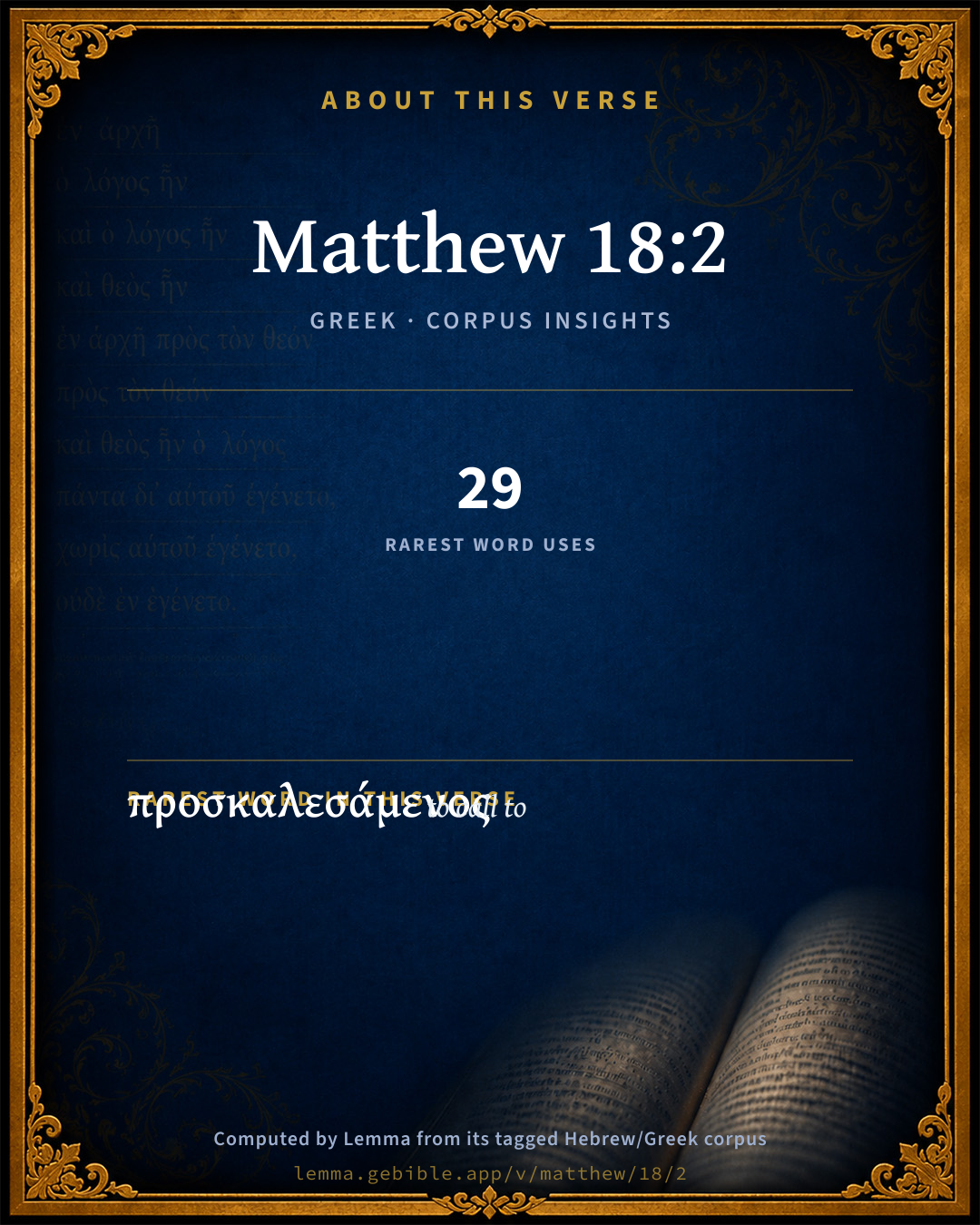
Matthew 18:2

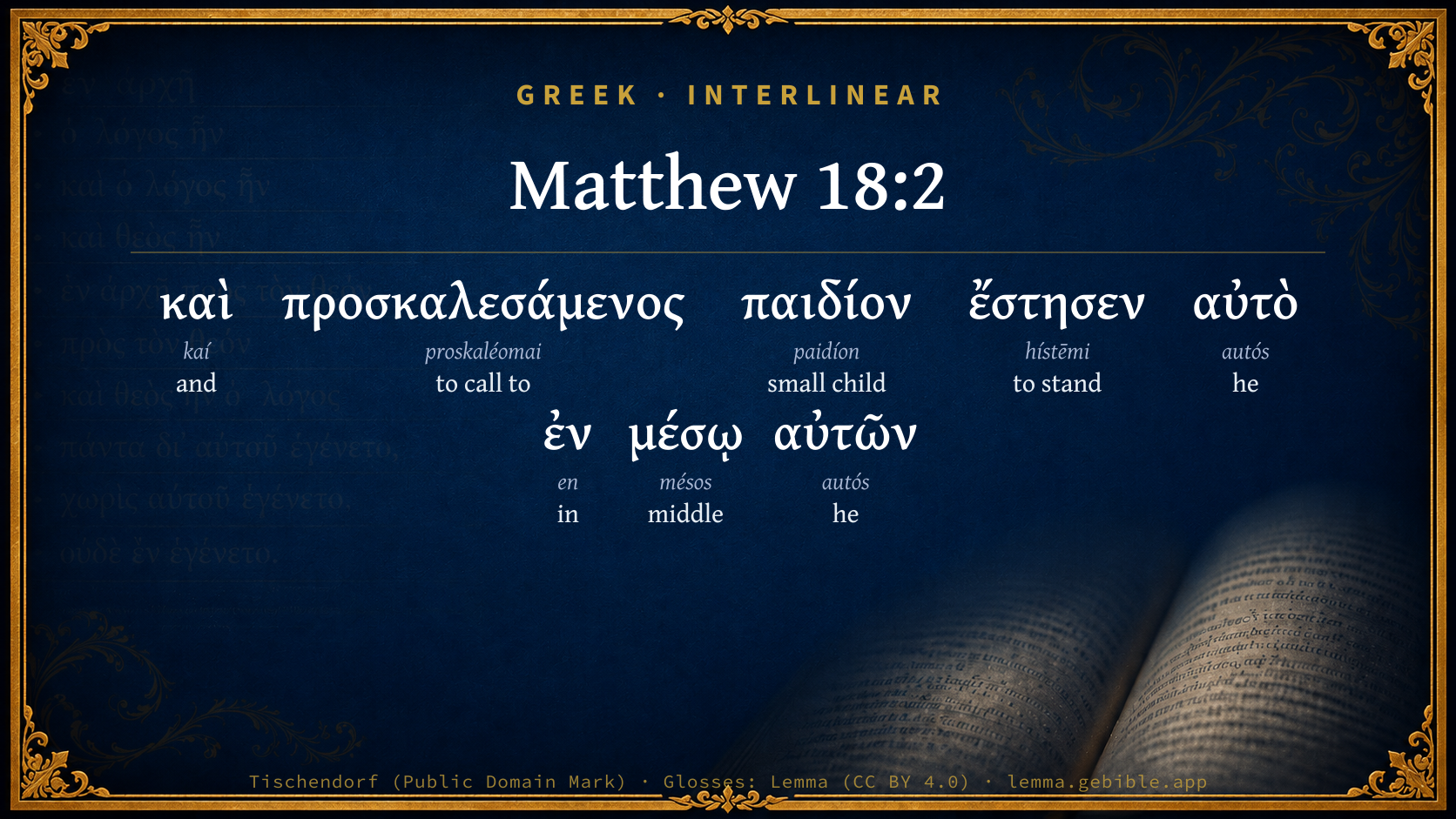
Greek (Tischendorf 8th ed.) Matthew 18:2 appears in the Greek New Testament. The text above is from the Tischendorf 8th edition. Each word links to its Strong’s number and a concise gloss. Click any word for its full Thayer’s Greek Lexicon entry.
Download image
Cite this verse

Matthew 18:2 (World English Bible). Public Domain. Lemma interlinear Bible study tool, https://lemma.gebible.app/v/matthew/18/2.

Show BibTeX & RIS
BibTeX
RIS
English Translation
Jesus called a little child to himself, and set him in the midst of them,
World English Bible · Public Domain
Download a study sheet

One document with this verse’s original text, its word-by-word gloss line, the meaning frame, cross-references with their text, attributed commentary, and full source and license credits — printable, and it pastes into notes with its structure intact.

This verse Autodidact and up

Study sheet (.html) Plain text (.txt)

A passage Seminary Student

Up to 50 verses in one chapter. A passage sheet keeps up to 6 commentary sources and 12 cross-references per verse, in the order this page ranks them, and says so on the sheet whenever that leaves anything out. Ask for a single verse and you get the Autodidact verse sheet above.

Everything on this page stays free to read, with no account — the sheet is a download of what is already on screen, not access to it.

Want to remove ads? Support Godless Engineer
Compare translations 3

The same verse in 3 English versions, stacked beneath the original-language interlinear above. Click any original word for its lexicon entry.

Each is an independent rendering of the whole verse — the interlinear is not word-aligned to these translations.

Highlighted words mark where these versions differ — a whole-verse word diff, not a word-by-word alignment.

  • World English Bible Public Domain
    Jesus called a little child to himself, and set him in the midst of them,
  • King James Version Public Domain
    And Jesus called a little child unto him, and set him in the midst of them,
  • unfoldingWord Literal Text CC BY-SA 4.0
    And having summoned a little child, he set him in the midst of them

unfoldingWord Literal Text — © unfoldingWord, licensed CC BY-SA 4.0. Word-aligned USFM3 via Door43 (git.door43.org/unfoldingWord/en_ult).

Versions to compare (up to 4)

3 of 4 selected

Show all 19 translations

Every available English version of this verse, each an independent rendering of the whole verse.

  • World English Bible Public Domain
    Jesus called a little child to himself, and set him in the midst of them,
  • Berean Standard Bible Public Domain
    Jesus invited a little child to stand among them.
  • Majority Standard Bible Public Domain
    Jesus invited a little child to stand among them.
  • King James Version Public Domain
    And Jesus called a little child unto him, and set him in the midst of them,
  • American Standard Version (1901) Public Domain
    And he called to him a little child, and set him in the midst of them,
  • Revised Version (1885) Public Domain
    And he called to him a little child, and set him in the midst of them,
  • Geneva Bible (1599) Public Domain
    And Iesus called a litle childe vnto him, and set him in the mids of them,
  • Douay-Rheims (1899) Public Domain
    And Jesus calling unto him a little child, set him in the midst of them,
  • Young's Literal Translation Public Domain
    And Jesus having called near a child, did set him in the midst of them,
  • Literal Standard Version CC BY-SA 4.0
    And Jesus having called near a child, set him in the midst of them,
  • Unlocked Literal Bible CC BY-SA 4.0
    Jesus called to himself a little child, set him among them,
  • unfoldingWord Literal Text CC BY-SA 4.0
    And having summoned a little child, he set him in the midst of them
  • Darby Bible Public Domain
    And Jesus having called a little child to [him], set it in their midst,
  • World Messianic Bible Public Domain
    Yeshua called a little child to himself, and set him in the middle of them
  • Webster's Bible Public Domain
    And Jesus called a little child to him, and set him in the midst of them,
  • Free Bible Version CC BY-SA 4.0
    Jesus called over a small child. He had the child stand in front of them.
  • Bible in Basic English Public Domain
    And he took a little child, and put him in the middle of them,
  • Text-Critical English NT CC BY 4.0
    So Jesus called over a little child, placed him among them,
  • Tyndale New Testament (1534) Public Domain
    Iesus called a chylde vnto him and set him in the middes of them:

Literal Standard Version (2020), Covenant Press — licensed CC BY-SA 4.0. Text via the HelloAO Bible API (eBible.org). Unlocked Literal Bible (unfoldingWord) — licensed CC BY-SA 4.0. Text via the HelloAO Bible API (eBible.org). unfoldingWord Literal Text — © unfoldingWord, licensed CC BY-SA 4.0. Word-aligned USFM3 via Door43 (git.door43.org/unfoldingWord/en_ult). Free Bible Version, Dr. Jonathan Gallagher — licensed CC BY-SA 4.0. Text via the HelloAO Bible API (eBible.org).

Word by word

More ways to search: Search by grammar → Find every occurrence → Compare this word →

Practice this passage: Drill this verse → Learn its vocabulary →

προσκαλεσάμενος
proskaléomai
G4341
“to call to”
Verb, Aorist, Middle deponent, Participle, Nominative, Singular, Masculine
Part of Speech
Verb
Tense
Aorist
Voice
Middle deponent
Mood
Participle
Case
Nominative
Number
Singular
Gender
Masculine
Full Thayer's Definition

Origin: middle voice from G4314 and G2564

TDNT: 3:500,*

1. to call to 2. to call to one's self 3. to bid to come to one's self 4. metaph. a. God is said to call to himself the Gentiles, aliens as they are from him, by inviting them, through the preaching of the gospel unto fellowship with himself in the Messiah's kingdom b. Christ and the Holy Sprit are said to call to themselves those preachers of the gospel to whom they have decided to intrust a service having reference to the extension of the gospel
  1. καὶ kaí G2532 “and” Conjunction
  2. παιδίον paidíon G3813 “small child” Noun, Accusative, Singular, Neuter
  3. ἔστησεν hístēmi G2476 “to stand” Verb, Aorist, Active, Indicative, 3rd person, Singular
  4. αὐτὸ autós G846 “he” Personal pronoun, Accusative, Singular, Neuter
  5. ἐν en G1722 “in” Preposition
  6. μέσῳ mésos G3319 “middle” Adjective, Dative, Singular, Neuter
  7. αὐτῶν autós G846 “he” Personal pronoun, Genitive, Plural, Masculine

About this verse

These counts appear in no published source. They are computed here, from the morphology-tagged text and Lemma’s own curated glosses. What Lemma adds →

8
words
7
distinct lemmas
Gospels
section

Shared distinctive vocabulary

προσκαλεσάμενος to call to G4341 occurs in 29 verses of the Greek New Testament. Also found in:

Repetition

A word recurs within this verse:

  • αὐτὸ he G846 ×2

Cross-references

4

Topical passages linked to Matthew 18:2 in the Treasury of Scripture Knowledge — connected by theme and wording, ordered by reader-vote popularity; previews shown in the World English Bible.

  • Matthew 19:13–14 Then little children were brought to him, that he should lay his hands on them and pray; and the disciples rebuked them.
  • 1 Kings 3:7 Now, Yahweh my God, you have made your servant king instead of David my father: and I am but a little child; I don't know how to go out or come in.
  • Mark 9:36–37 He took a little child, and set him in the midst of them. Taking him in his arms, he said to them,
  • Jeremiah 1:7 But Yahweh said to me, Don't say, I am a child; for to whoever I shall send you, you shall go, and whatever I shall command you, you shall speak.

Cross-references courtesy of OpenBible.info (CC BY 4.0).

Commentary

Notes on Matthew 18:2 from classic Christian and Jewish commentators (each source and its license shown beneath its notes). The classic Christian expositions comment on the surrounding passage and are grouped to its opening verse, so a note may address several verses; the Jewish commentaries on the Tanakh (Rashi and others) are per-verse, so they appear only where the commentator wrote on this verse.

Lemma curates 59 commentaries, every one of them public domain or Creative Commons licensed, each selected and text-cleaned for this edition rather than reprinted as found. About our sources →

Joseph Benson's Commentary

Mat 18:2. And Jesus — Perceiving the thought of their heart, says Luke, or the dispositions by which they were animated, and their ambitious views and expectations; in order to check and eradicate all such sinful inclinations and affections, he called a little child, and set him in the midst of them — That they might consider him attentively, and learn by the sweetness, docility, and modesty visible in his countenance, what the temper and dispositions of his disciples ought to be, and how dear to him persons of such dispositions are. This little child is said to have been the great Ignatius, whom Trajan the wise, the good Emperor Trajan, condemned to be cast to the wild beasts at Rome! This method of instruction was agreeable to the manner of the eastern doctors and prophets, who, in teaching, impressed the minds of their disciples by symbolical actions, as well as by words. Thus, Joh 20:22, Jesus, by breathing on his apostles, signified that through the invisible energy of his power he conferred on them the gifts of his Spirit. Thus also, Joh 21:19, he bade Peter follow him, to show that he should be his follower in sufferings. And, Rev 18:21, an angel cast a great stone into the sea, to signify the utter destruction of Babylon.

Joseph Benson's Commentary on the Old and New Testaments (1811–1818) — public domain. Text from a community e-Sword module.

Godbey's Commentary on the New Testament

William B. Godbey

THE INFANT THE PARAGON

Mat 18:2-5; Mar 9:36-37; Luk 9:48. Mark: “Jesus, calling to Him a little child, placed it in their midst, and said, Truly, I say unto you, Except ye may be converted, and become as little children, you may not enter into the kingdom of the heavens. Therefore whosoever may humble himself as this little child, the same is the greater in the kingdom of the heavens; and whosoever may receive one such little child in My name, receiveth Me.” Mark: “Taking a little child, He placed it in their midst, and taking it up in His arms, He said to them.” . . . There is no mistake as to the conclusion that these are literal, natural infants, small enough for Jesus to lift up in His arms, exhibiting them illustratively. This is beautifully illustrative of the glorious, universal redemption in Christ, reaching every human being, even in the prenatal state, so soon as soul and body, united, constitute personality. Now as these infants, by the redemption of Christ, had been born in the kingdom, and could only get out by sinning out, which they could not do till they reached responsibility, it was demonstrative proof that they are all members of the heavenly kingdom; whereas, in the case of adults, the matter is at least problematical, so that we can not know for any one but ourselves the status before God. So here we have an irrefutable illustration of the consolatory fact that all infants are members of God’s kingdom, and here held up as paragons, because there can be no defalcation in their case, as they can only get out by actual sin, of which they are incapable till they reach responsibility. Hence, in their case, there can be no doubt, which can not be said of any adult, because no one but God knows the heart. It is a patent fact that infancy is the very period of an humble, loving disposition; humility and love constituting the preeminent graces of the kingdom. We may pertinently here observe that these infants are not sanctified, but possessed of depravity, manifested in evil tempers cropping out from the cradle; but, as Jesus says, they are normal citizens of the kingdom, standing where a genuine conversion brings every adult, and needing sanctification, like every justified Christian, such as those apostles, who there permitted ministerial ambition to show its cloven foot to their just reprehension.

William B. Godbey, Commentary on the New Testament (1896–1900) — public domain. Text from a community e-Sword module.

Bengel's Gnomon

Johann Albrecht Bengel

Mat 18:2. Παιδίον, a little child) A diminutive, to rebuke the disciples who sought great things. It is said to have been Ignatius—ὁ θεοφόρος.[804] Without doubt it must have been a child of excellent disposition and sweetest appearance who was then present by Divine appointment.—ἐν μέσῳ αὐτῶν, in the midst of them) see Gnomon on Mar 9:36.

[804] Considerable difference of opinion exists as to the meaning of this word: some rendering it “one who was carried by GOD,” in allusion to the circumstance mentioned in the text; others explaining it to mean “one who carried GOD always about with him, sc. in his heart.”—(I. B.)

Bengel's Gnomon of the New Testament — English translation (T&T Clark, Edinburgh, 1860) — public domain. Text from a community e-Sword module.

Meyer's Critical & Exegetical Commentary

Heinrich August Wilhelm Meyer

Mat_18:2. Παιδίον] According to Nicephorus, ii. 35, the child in question is alleged to have been St. Ignatius. Chrysostom correctly observes that it is a little child (σφόδρα παιδίον); τὸ γὰρ τοιοῦτον παιδίον καὶ ἀπονοίας καὶ δοξομανίας κ. βασκανίας κ. φιλονεικείας κ. πάντων τῶν τοιούτων ἀπήλλακται παθῶν, καὶ πολλὰς ἔχον τὰς ἀρετὰς, ἀφέλειαν, ταπεινοφ ροσύνην, ἀπραγμοσύνην, ἐπʼ οὐδενὶ τούτων ἐπαίρεται. Comp. Mar_9:36; Luk_9:47.

Meyer — Critical and Exegetical Commentary on the New Testament — English translation by Peter Christie, edited by Frederick Crombie (T&T Clark, 1880) — public domain. Text from a community e-Sword module.

Expositor's Greek Testament

ed. W. Robertson Nicoll

Mat 18:2 . παιδίον : the task of Jesus is not merely to communicate instruction but to rebuke and exorcise an evil spirit, therefore He does not trust to words alone, but for the greater impressiveness uses a child who happens to be present as a vehicle of instruction. The legendary spirit which dearly loves certainty in detail identified the child with Ignatius, as if that would make the lesson any the more valuable!

The Expositor's Greek Testament, edited by W. Robertson Nicoll (1897–1910) — public domain. Text from a community e-Sword module.

Geneva Bible (1599)

Geneva Bible translators

Humbleness of mind is the right way to preeminence.

A child in years.

Geneva Bible (1599) marginal notes — public domain. Text via Bolls.life.

Adam Clarke's Commentary

Verse 2. A little child] But this child could walk, for he called him to him. Nicephorus says, this was Ignatius, who was afterwards bishop of Antioch, and suffered martyrdom under, and by command of, the Roman Emperor Trojan, in the 107th year of our Lord. But this good father is not much to be depended on, being both weak and credulous.

Adam Clarke's Commentary on the Bible (1810–1826) — public domain. Text from a community e-Sword/MySword module.

Ellicott's Commentary for English Readers

(2) Jesus called a little child unto him.—As the conversation was “in the house” (Mar_9:33), and that house probably was Peter’s, the child may have been one of his. As in other like incidents (Mat_19:13; Mat_21:15-16), we may recognise in our Lord’s act a recognition of the special beauty of childhood, a tender love for the gracious trust and freedom from rivalry which it shows when, as yet, the taint of egotism is undeveloped. St. Mark adds that He folded His arms round the child as in loving fondness, and, before He did so, uttered the warning words, “If any one will (wishes to) be first, he shall be last of all and servant of all.” A late tradition of the Eastern Church identified the child with Ignatius, Bishop of Antioch, taking the name which he gave himself as passive, Θεοφόρος (Theo-phoros), “one who had been carried or borne by God.” Ignatius himself, however, uses it in its active sense, “one who carries God within him.”

A Bible Commentary for English Readers, edited by Charles John Ellicott (1878–1897) — public domain. Text from a community e-Sword module.

The Cambridge Bible for Schools and Colleges

gen. ed. J. J. S. Perowne

2. set him in the midst of them] St Mark adds, “when He had taken him in His arms.”

The Cambridge Bible for Schools and Colleges (gen. ed. J. J. S. Perowne; Cambridge University Press, 1878–1918) — public domain. Text from a community e-Sword module.

John Gill's Exposition

And Jesus called a little child unto him,.... One, very likely, that was in the house, and might belong to the master of it, and which was big enough to come to him at his call. Some have thought that this was Ignatius the martyr, but without any foundation. His own words, in his epistle to the church at Smyrna (y), can give no countenance to it; where he says, "for I also know, that after his resurrection he was in the flesh, and I believe that he is." The Latin version indeed renders it thus; "for I also saw him in the flesh after the resurrection, and believe that he exists." But it does not follow from hence that he must be this child, but rather the contrary; since it cannot be thought, that a child so young as this, in half a year after, had it seen Christ, when risen from the dead, could have took so much notice of him, as this version represents Ignatius to do; but it matters not who it was; Christ designed, by this emblem, to give them his sense of the question, and convey some proper instruction to the minds of his disciples:

and set him in the midst of them; that everyone might see him; and upon the very sight of him, had he said no more to them, they might easily have perceived what was his opinion; that he that was but a child, the most humble, and least in his own eyes, would be the greatest: but besides setting the child in such a situation, he pointed to him, saying what follows.

(y) p. 3. Ed. Voss.

John Gill's Exposition of the Whole Bible (1746–1763) — public domain (CC PDM 1.0). Text via the HelloAO Bible API.

Trapp's Complete Commentary

John Trapp

2 And Jesus called a little child unto him, and set him in the midst of them,

Ver. 2. And Jesus called a little child] Nicephorus saith this was Ignatius, who was afterwards Bishop of Antioch; but I am not bound to believe him. It is well known that he is full of fictions. Christ calling for a little child, who neither thinks great things of himself nor seeks great things for himself, rightly and really confutes their preposterous ambition and affectation of primacy, and gives them such a dumb answer as Tarquin did his son, when walking in the garden he struck off the heads of the poppies in the sight of the messenger: and as Periander the Corinthian did Thrasybulus the tyrant of Athens, when pulling off the upper ears of grain, he made all the standing grain equal, intimating thereby what a tyrant must do that would live safely and quietly.

John Trapp, A Commentary or Exposition upon All the Books of the Old and New Testament (1647–1656) — public domain. Text from a community e-Sword module.

Haydock's Catholic Bible Commentary

And Jesus calling ... a little child. In St. Mark (ix. 32) we find that Jesus did this in the house, when they were arrived at Capharnaum.

George Leo Haydock (1774–1849), Haydock's Catholic Family Bible and Commentary, 1859 edition — public domain. Excludes Psalms (Douay-Rheims chapter numbering differs from Protestant) and Deuterocanonical books (Catholic canon only).

Matthew Poole's English Annotations

Mark saith, Mar 9:35-37, And he sat down, and called the twelve, and saith unto them, If any man desire to be first, the same shall be last of all, and servant of all. And he took a child, and set him in the midst of them: and when he had taken him in his arms, he said unto them, &c. Luke saith only, that he took the child, and set him by him, Luk 9:47; and adds, Luk 9:48, he that is least among you all, the same shall be great. How easy a thing had it been for our Saviour, had the intended any such primacy in the church as the papists contend for, to have said, Peter shall be the greatest! Here was a very fair opportunity for him, if he had pleased, so to have declared his will; but here is not a word of such tendency. Mark saith our Saviour,

1. Sat down, as the manner of their teachers was, when they taught, to denote their authority.

2. He called the twelve, to let them know that what he was about to speak was a grave matter not of a particular but universal concern for them to learn, that, they might teach others.

He said unto them, ( saith Mark), If any man desire to be first, the same shall be last of all, and servant of all; and (which Luke adds) he that is least among you all, the same shall be great. You would know (saith he) who shall be greatest he that doth not desire to be first; he who is most remote from pride and ambition; he that most contemneth the world, and the priorities and superiorities of it. The proud and ambitious man, he that seeketh great things for himself, shall be of least esteem in my kingdom; he is really least in grace, and ought to be of least esteem and repute among Christians, and he will be the last in the kingdom of glory.

Then he calleth to him a little child: the word doth not always signify a very young child; here it doth, for,

1. He took him in his arms (saith Mark).

2. A young child was the fittest pattern to commend humility to them.

This was an ancient and usual way of teaching, by types, as it were, or patterns: see Jer 19:10; 27:2. He reads this lecture upon the child, Verily I say unto you, Except ye be converted, and become as little children, ye shall not enter into the kingdom of heaven. Whosoever therefore shall humble himself as this little child, &c. The prefixing Verily adds much to the authority of this saying. Converted here, στρα-φητε, doth not signify the change or conversion of a soul from a state of sin unto God, (so the apostles were already converted), but the turning of their souls from a particular lust or error, into the opposite right way of truth and holiness: except ye repent of your pride and ambition, ye cannot be saved. The next words expound it, and become as little children: not as little children in all things, (which was the Anabaptists’ dream in Germany, upon which they would run about the streets playing with rattles, &c.), but, Mat 18:4, humbling yourselves as little children.

1. Little children know not what dominion means, and therefore affect it not, are not ambitious.

2. They are not given to boast and glory, and to prefer themselves before others.

3. They are ready to be taught and instructed.

4. They live upon their fathers’ providence, and are not over solicitous.

5. They are not malicious and vindictive. In malice (saith the apostle) be ye children.

The three first are principally here intended. If ye be not thus like little children, ye will be so far from being greatest in the kingdom of God, that you will never come here at all. So as this text teacheth us all,

1. The necessity of humility in order to salvation.

2. That even converted souls have need of a daily conversion. Repentance is a work which will never be perfected till we come to die.

3. How abominable in the eyes of God ambition and pride are in any, especially in ministers of the gospel.

4. That in the church the way to be great is to be humble.

5. That true humility lieth in a mean opinion of ourselves, not minding high things, condescending to men of low estate, not being wise in our own conceits, Rom 12:16; in honour preferring one another, Rom 12:10.

Matthew Poole's English Annotations on the Holy Bible (1683–1685) — public domain. Text from a community e-Sword/MySword module.

Whedon's Commentary on the Bible

Daniel D. Whedon

2. Called a little child — There is an interesting tradition that this was St. Irenaeus, one of the most celebrated fathers of the early Church.

Daniel D. Whedon (gen. ed.), Commentary on the Old and New Testaments (1874–1909) — public domain. Text from a community e-Sword module.

The Pulpit Commentary

A little child. Our Lord teaches, not only by spoken parables, but by symbolical actions also. This was not a mere infant, as Christ is said to have called him unto him. A tradition, mentioned by Nicephorus, ("Hist. Ec:," 2:35) asserts that this child was the famous martyr Ignatius. Set him in the midst of them. Taking him in his arms, as St. Mark tells. What a picture of Christ"s tenderness and human love! From the boy"s trustfulness and submission he draws a needed lesson for the ambitious apostles.

The Pulpit Commentary (1880–1919), ed. H.D.M. Spence-Jones & Joseph S. Exell — public domain. Text from a community e-Sword module.

John Wesley's Explanatory Notes

And Jesus calling to him a little child - This is supposed to have been the great Ignatius, whom Trajan, the wise, the good Emperor Trajan, condemned to be cast to the wild beasts at Rome! Mark ix, 36; Luke ix, 47.

John Wesley, Explanatory Notes Upon the Whole Bible (1754–1765) — public domain. Text via the GEBible commentary corpus.

Kretzmann's Popular Commentary

Paul E. Kretzmann

The demonstration:

v. 2. And Jesus called a little child unto Him, and set him in the midst of them,

v. 3. and said, Verily I say unto you, Except ye be converted and become as little children, ye shall not enter into the kingdom of heaven.

v. 4. Whosoever, therefore, shall humble himself as this little child, the same is greatest in the kingdom of heaven.

v. 5. And whoso shall receive one such little child in My name, receiveth Me.

Christ determined to make His answer very plain, His demonstration very palpable. Calling to Him a little child, perhaps one of the household. He took him in His arms and embraced him, Mar 9:36, reassured him by these signs of loving regard, and then let him stand in the very midst of the disciples. The little child furnishes the subject for a very impressive lesson with a very solemn introduction. Most emphatically He declares that they must be converted, turn around and head in the opposite direction. They had indeed accepted and confessed Jesus, but the thoughts which they just now voiced showed that they were still far from possessing that condition of mind and heart which is indispensable in a servant of Christ. Their faith could never last at that rate. As children they must become, in simplicity of faith, in unqualified acceptance of Bible-truths, in trusting humility. In the proper relation of a child toward his parents, all self-consciousness, all. forwardness, all arrogance is absent. Instead, there is a simple, unswerving belief in the truthfulness, in the ability, and in the care of the parents. This same condition of mind and heart is necessary in disciples of Christ if they wish to enter into the kingdom of heaven. There must be no considering of honor and glory before men, no false ambition, no scheming for power, all this being contrary to the spirit of Jesus Christ. Do not think, as Luther says, about becoming great, but about becoming small. The elevation will come in due time, if you but practice humiliation first. To become humble as a little child, that is true greatness in the kingdom of heaven, not only to feign humility by symbolic acts and dresses, whose very unusualness makes them doubly conspicuous, for the latter may be the very essence of pride. "As though He would say: I see that your carnal mind is not affected by mere words; therefore I present this child to you, in order that ye may afterward and always think of it. Behold, here is a child! Now tell Me whether it is prepared for a worldly or temporal kingdom, of which you undoubtedly dream. That would be a poor kingdom, yea, none at all, which would be ruled by this child. But now, as much as this child is prepared to rule a worldly kingdom, so foolish it is to think that My kingdom is of this world. For the kingdom which I begin is of such a nature that all worldly-wise understand much less of it than this child may understand of a worldly kingdom. Therefore the idea and the thought of a worldly kingdom must be laid aside entirely if ye want to speak of My kingdom. For My kingdom will be of such nature that ye must become children in it, that permit themselves to be ruled, but do not rule in their own person, just as this child in the worldly kingdom does not rule, but is ruled. " Jesus now turns the argument slightly, in order to emphasize the importance of properly appreciating the souls of children. Whosoever, every one that accepts, receives like a true father, with all the evidences of such regard, even a single little child of this kind in the name and for the sake of Jesus, receives the Lord Himself, in and with the child. Everyone that, for love of Christ, shows such Christ-like kindness to poor, forsaken children, has the promise that he, in doing so, receives Christ Himself, and with Christ His Father in heaven, Mar 9:37.

Paul E. Kretzmann, Popular Commentary of the Bible (1921–1924) — public domain. Text from a community e-Sword module.

Burkitt's Expository Notes on the New Testament

William Burkitt

Our Saviour intending to cure this pride and ambition in his disciples, first preaches to them the doctrine of humility, and to enforce his doctrine he sets before them, a little child, the proper emblem of humility; assuring them, that unless they be converted, or turned from this sin of pride and ambition, and become as a little child in lowliness of mind, and contempt of worldly greatness, they cannot be saved.

Learn hence, 1. That no sins are more odious and abominable in the sight of God, than pride and ambition; especially amongst the ministers of the gospel.

Learn, 2. That persons already converted, do stand in need of farther conversion: they that are converted from a state of sin, may want to be converted from a particular act of sin: this was the disciples case here; they were turned from a course of sin, but they wanted conversion from a particular act of sin; to wit, from ambition.

Learn, 3. That conversion, though sincere, may be very imperfect. Converts still have remains of corruption, some lust often breaking forth, which they must take special care to resist and subdue.

William Burkitt's Expository Notes on the New Testament (1700–1703) — public domain. Text from a community e-Sword module.

The People's New Testament

B. W. Johnson

2. And Jesus called a little child unto him. In order to enforce the words that Mark reports, he uses a striking object lesson. This method was a prominent feature of Oriental teaching. Thus it was that Christ washed the disciples' feet (John 13) and Agabus bound his hands and feet with Paul's girdle (Acts 21:11).

B. W. Johnson's The People's New Testament with Notes (1889–1891) — public domain. Electronic text from the Christian Classics Ethereal Library (CCEL) ThML edition.

Cambridge Greek Testament for Schools and Colleges

2. ἐν μέσῳ αὐτῶν. So Mark; St Luke has the more loving ἔστησεν αὐτὸ παρʼ ἑαυτῷ. St Mark notes that Jesus first took the child in His arms (ἐγκαλισάμενος αὐτό).

Cambridge Greek Testament for Schools and Colleges (Cambridge University Press, 1896; 21 vols, various authors incl. Carr, Maclear, Plummer, Farrar, Lumby, Moule, M. R. James, Simcox) — public domain. Text from a community e-Sword module.

Alford’s Greek Testament

Henry Alford

2.] From Mar 9:36 it appears that our Lord first placed the child in the midst, and then took it in His arms: possibly drawing a lesson for His disciples from its ready submission and trustfulness.

Henry Alford, The Greek Testament (1849–1861) — public domain. Text from a community e-Sword module.

International Critical Commentary

2. And He called a child, and placed him in the midst of them, and said.] Mk. has: “And sitting down, He called (ἐφώνησε) the Twelve, and saith to them, If any one wishes to be first, he shall be last of all, and servant of all. And He took a child, and placed him in the midst of them; and having taken him into His arms, He said to them.” For the omission of ἐναρκαλισάμενος, cf. 19:15. In Mk. there now follows a series of sayings, 9:37-50, broken by a short paragraph of incident, 38-40. The connection of these sayings is sometimes very obscure, and frequently artificial. The transition, e.g., from 42 to 43 is difficult, and unless πυρί in v. 49 has the same reference as in 48, the connection of thought seems to be broken there also. It is probable that Mk. has strung together detached sayings or paragraphs. ἐπὶ τῷ ὀνόματί μου of v. 37 would remind the Evangelist of 38-40 and 41, both of which have a similar phrase vv. 39, 41. τῶν τοιούτων παιδίων (= children) of v. 37 would bring to his remembrance v. 42 with its μικρῶν τούτων τῶν πιστευόντων (= recent converts). And the σκανδαλίσῃ of 42 would suggest the section 43-48, although this paragraph has no immediate bearing on the subject with which the discourse started. Lastly, πυρί of v. 48 would suggest the (probably) quite different πῦρ of v. 49 (see Swete), and ἁλισθήσεται of this verse recalls to the Evangelist’s mind the saying about salt, v. 50.

The editor of Mt., however, has treated the whole series of sayings as though it formed a unity, only omitting some of the least harmonious verses. But just as he has made Mar 6:8-12 and 4 the basis round which to group a number of other sayings so as to form a discourse of some length, so he has done here. The relation of Mt. to Mk. may be shown as follows. Passages in brackets are added by Mt.:

Mat_18[3-4]

for 3; cf.

Mar 10:15.

5

=

9:37a.

omitted

37b.

omitted

International Critical Commentary — older volumes (1896–1929), various authors — public domain. Text from a community e-Sword module.

Lesson kit

Teaching starters — assembled from the data on this page, not authored interpretation. Every prompt links to the verse data it draws on. Edit before teaching.

Matthew, in the Gospels, opens this verse with 8 words (7 distinct Greek lemmas). Its most distinctive word is proskaléomai (“to call to”). A historical commentator’s framing appears above. Read the whole chapter for the surrounding context.

Discussion questions

  1. How does “to call to” (proskaléomai) shape what this verse is saying?
  2. How does Matthew 10:1, which shares the word «to call to», read alongside this verse?
  3. What does the repetition of “he” (2× in this one verse) do in this verse?
  4. The translations on this page render this verse differently — a whole-verse word diff, not a word-by-word alignment. What might account for the different wordings?
  5. Compare how Joseph Benson's Commentary and Godbey's Commentary on the New Testament read this verse. Where do they agree or differ?

Things to notice

  • These translations choose different wording for 5 words in this verse.
  • “he” occurs 2× in this single verse.
  • 7 distinct Greek lemmas span 8 words in this verse.

Reading settings

Reading text

Shown beneath each verse's original-language words.

Old Testament
Old Testament edition

Read the OT as the Masoretic Hebrew (MT) or the Greek Septuagint (LXX).

English shown for the Greek Septuagint (in the Hebrew ↔ Greek comparison).

Comparing translations? Open the Compare panel on any verse page to stack up to four side by side.