
Matthew 18:12

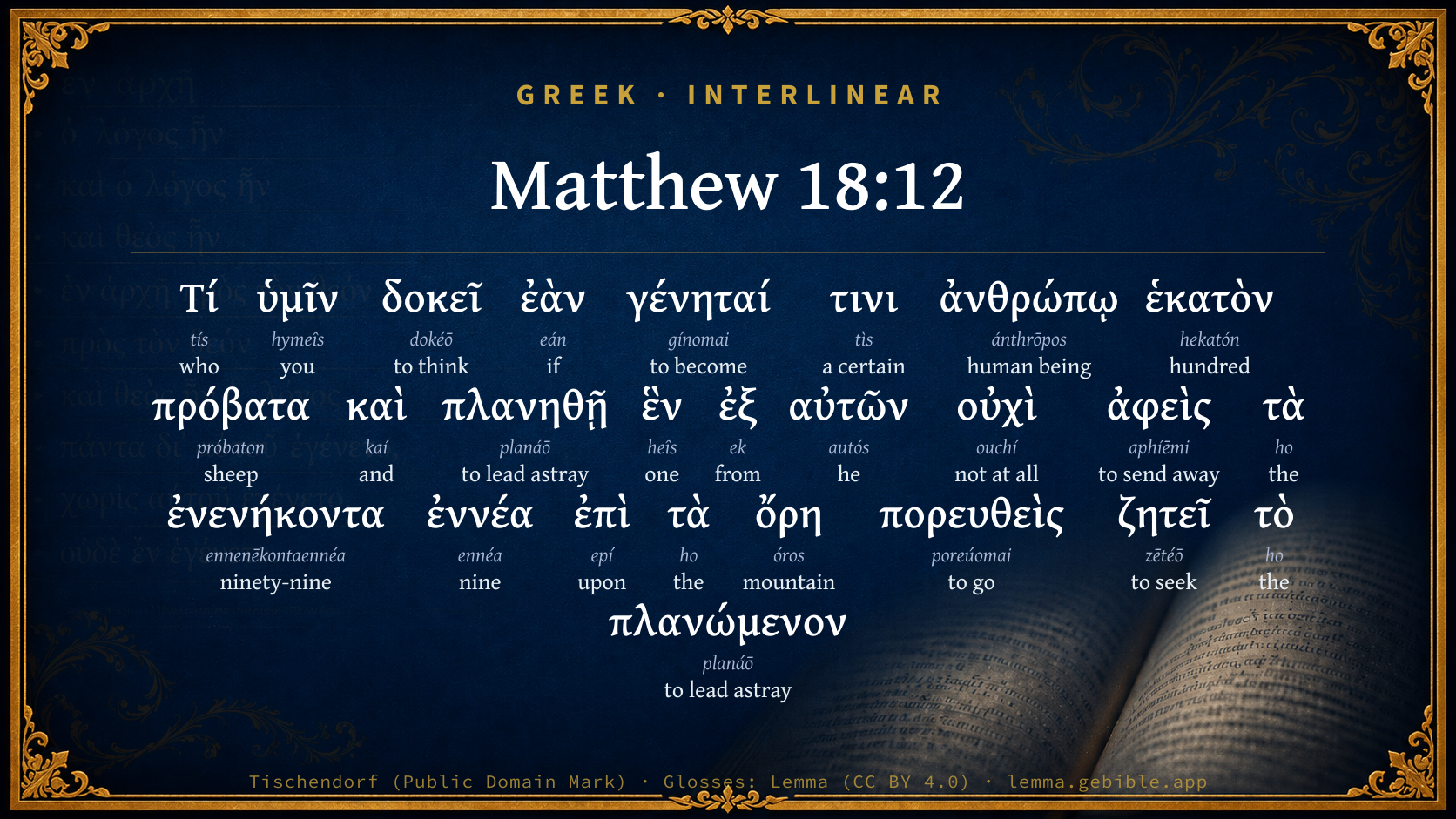
Greek (Tischendorf 8th ed.) Matthew 18:12 appears in the Greek New Testament. The text above is from the Tischendorf 8th edition. Each word links to its Strong’s number and a concise gloss. Click any word for its full Thayer’s Greek Lexicon entry.
Download image
Cite this verse

Matthew 18:12 (World English Bible). Public Domain. Lemma interlinear Bible study tool, https://lemma.gebible.app/v/matthew/18/12.

Show BibTeX & RIS
BibTeX
RIS
English Translation
"What do you think? If a man has one hundred sheep, and one of them goes astray, doesn't he leave the ninety-nine, go to the mountains, and seek that which has gone astray?
World English Bible · Public Domain
Highlights
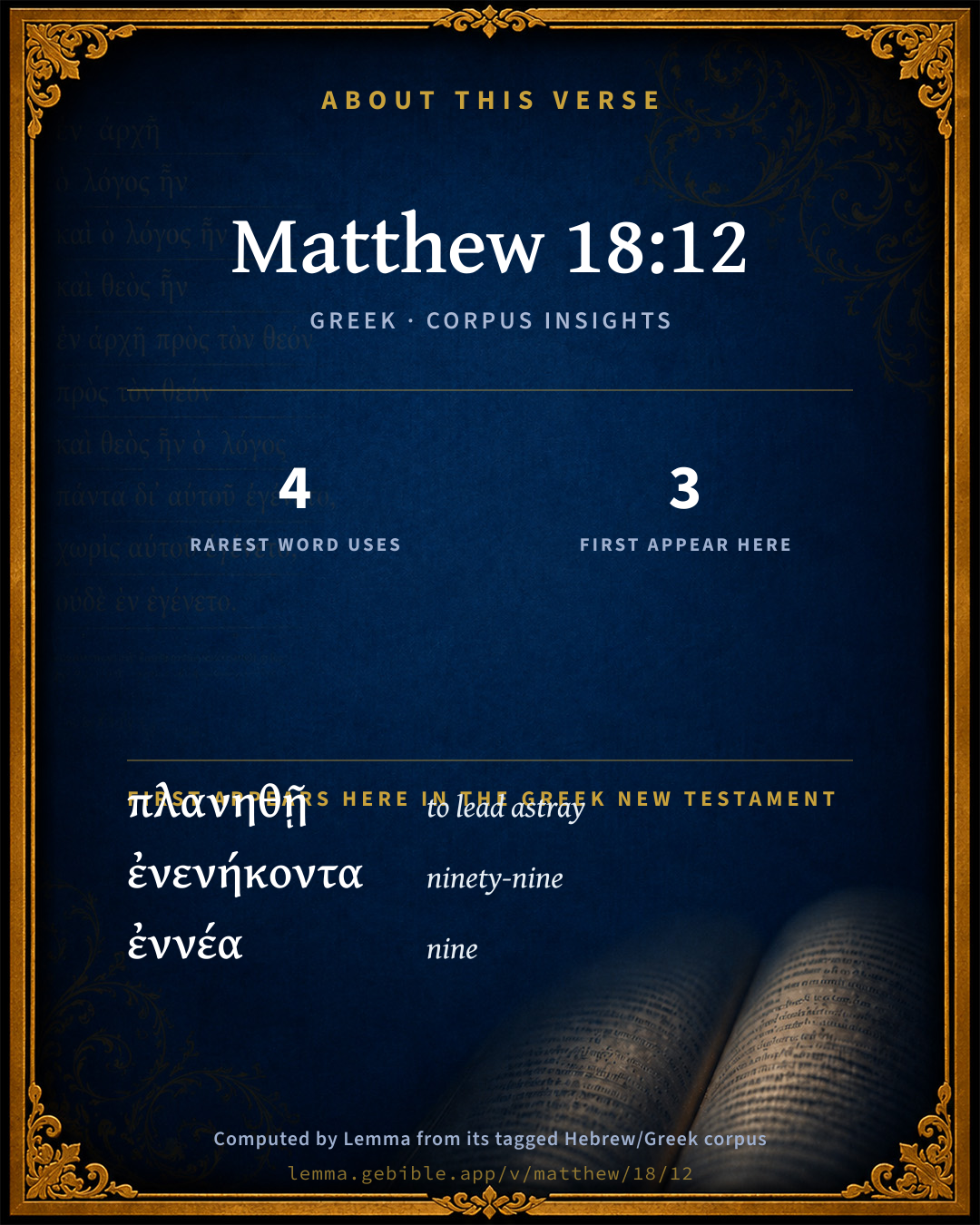
  • 3 first appearances in the Greek New Testament
Full analysis ↓
Download a study sheet

One document with this verse’s original text, its word-by-word gloss line, the meaning frame, cross-references with their text, attributed commentary, and full source and license credits — printable, and it pastes into notes with its structure intact.

This verse Autodidact and up

Study sheet (.html) Plain text (.txt)

A passage Seminary Student

Up to 50 verses in one chapter. A passage sheet keeps up to 6 commentary sources and 12 cross-references per verse, in the order this page ranks them, and says so on the sheet whenever that leaves anything out. Ask for a single verse and you get the Autodidact verse sheet above.

Everything on this page stays free to read, with no account — the sheet is a download of what is already on screen, not access to it.

Want to remove ads? Support Godless Engineer
Compare translations 3

The same verse in 3 English versions, stacked beneath the original-language interlinear above. Click any original word for its lexicon entry.

Each is an independent rendering of the whole verse — the interlinear is not word-aligned to these translations.

Highlighted words mark where these versions differ — a whole-verse word diff, not a word-by-word alignment.

  • World English Bible Public Domain
    "What do you think? If a man has one hundred sheep, and one of them goes astray, doesn't he leave the ninety-nine, go to the mountains, and seek that which has gone astray?
  • King James Version Public Domain
    How think ye? if a man have an hundred sheep, and one of them be gone astray, doth he not leave the ninety and nine, and goeth into the mountains, and seeketh that which is gone astray?
  • unfoldingWord Literal Text CC BY-SA 4.0
    What do you think? If a certain man has 100 sheep, and one of them goes astray, having left the 99 on the mountains and having gone, does he not seek the one having gone astray?

unfoldingWord Literal Text — © unfoldingWord, licensed CC BY-SA 4.0. Word-aligned USFM3 via Door43 (git.door43.org/unfoldingWord/en_ult).

Versions to compare (up to 4)

3 of 4 selected

Show all 19 translations

Every available English version of this verse, each an independent rendering of the whole verse.

  • World English Bible Public Domain
    "What do you think? If a man has one hundred sheep, and one of them goes astray, doesn't he leave the ninety-nine, go to the mountains, and seek that which has gone astray?
  • Berean Standard Bible Public Domain
    What do you think? If a man has a hundred sheep and one of them goes astray, will he not leave the ninety-nine on the hills and go out to search for the one that is lost?
  • Majority Standard Bible Public Domain
    What do you think? If a man has a hundred sheep and one of them goes astray, does he not leave the ninety-nine on the hills and go out to search for the one that is lost?
  • King James Version Public Domain
    How think ye? if a man have an hundred sheep, and one of them be gone astray, doth he not leave the ninety and nine, and goeth into the mountains, and seeketh that which is gone astray?
  • American Standard Version (1901) Public Domain
    How think ye? if any man have a hundred sheep, and one of them be gone astray, doth he not leave the ninety and nine, and go unto the mountains, and seek that which goeth astray?
  • Revised Version (1885) Public Domain
    How think ye? if any man have a hundred sheep, and one of them be gone astray, doth he not leave the ninety and nine, and go unto the mountains, and seek that which goeth astray?
  • Geneva Bible (1599) Public Domain
    How thinke ye? If a man haue an hundreth sheepe, and one of them be gone astray, doeth he not leaue ninetie and nine, and go into the mountaines, and seeke that which is gone astray?
  • Douay-Rheims (1899) Public Domain
    What think you? If a man have an hundred sheep, and one of them should go astray: doth he not leave the ninety-nine in the mountains, and go to seek that which is gone astray?
  • Young's Literal Translation Public Domain
    `What think ye? if a man may have an hundred sheep, and there may go astray one of them, doth he not -- having left the ninety-nine, having gone on the mountains -- seek that which is gone astray?
  • Literal Standard Version CC BY-SA 4.0
    What do you think? If a man may have one hundred sheep, and there may go astray one of them, does he not—having left the ninety-nine, having gone on the mountains—seek that which is gone astray?
  • Unlocked Literal Bible CC BY-SA 4.0
    What do you think? If anyone has a hundred sheep, and one of them goes astray, does he not leave the ninety-nine on the hillside and go off seeking the one that went astray?
  • unfoldingWord Literal Text CC BY-SA 4.0
    What do you think? If a certain man has 100 sheep, and one of them goes astray, having left the 99 on the mountains and having gone, does he not seek the one having gone astray?
  • Darby Bible Public Domain
    What think ye? If a certain man should have a hundred sheep, and one of them be gone astray, does he not, leaving the ninety and nine on the mountains, go and seek the one that has gone astray?
  • World Messianic Bible Public Domain
    “What do you think? If a man has one hundred sheep, and one of them goes astray, doesn’t he leave the ninety-nine, go to the mountains, and seek that which has gone astray?
  • Webster's Bible Public Domain
    How think ye? if a man hath a hundred sheep, and one of them is gone astray, doth he not leave the ninety and nine, and go to the mountains, and seek that which is gone astray?
  • Free Bible Version CC BY-SA 4.0
    What do you think about this? If a man has a hundred sheep, and one of them wanders off, won't he leave the ninety-nine on the hills and go in search of the one that's wandered away?
  • Bible in Basic English Public Domain
    What would you say now? if a man has a hundred sheep, and one of them has gone wandering away, will he not let the ninety-nine be, and go to the mountains in search of the wandering one?
  • Text-Critical English NT CC BY 4.0
    What do you think? If a man has a hundred sheep, and one of them goes astray, does he not leave the other ninety-nine and go seek on the mountains the one that has gone astray?
  • Tyndale New Testament (1534) Public Domain
    How thinke ye? Yf a man have an hondred shepe and one of them be gone astray dothe he not leve nynty and nyne in the moutains and go and seke that one which is gone astray?

Literal Standard Version (2020), Covenant Press — licensed CC BY-SA 4.0. Text via the HelloAO Bible API (eBible.org). Unlocked Literal Bible (unfoldingWord) — licensed CC BY-SA 4.0. Text via the HelloAO Bible API (eBible.org). unfoldingWord Literal Text — © unfoldingWord, licensed CC BY-SA 4.0. Word-aligned USFM3 via Door43 (git.door43.org/unfoldingWord/en_ult). Free Bible Version, Dr. Jonathan Gallagher — licensed CC BY-SA 4.0. Text via the HelloAO Bible API (eBible.org).

Word by word

More ways to search: Search by grammar → Find every occurrence → Compare this word →

Practice this passage: Drill this verse → Learn its vocabulary →

ἐνενήκοντα
ennenēkontaennéa
G1768
“ninety-nine”
Adjective, Numeral (indeclinable)
Part of Speech
Adjective · Numeral (indeclinable)
Full Thayer's Definition

Origin: "from a (tenth) multiple of G1767 ">1767) and 1767 itself"

TDNT: None

1. ninety nine
  1. Τί tís G5101 “who” Interrogative pronoun, Accusative, Singular, Neuter
  2. ὑμῖν hymeîs G5210 “you” Personal pronoun, 2nd person, Dative, Plural
  3. δοκεῖ dokéō G1380 “to think” Verb, Present, Active, Indicative, 3rd person, Singular
  4. ἐὰν eán G1437 “if” Conditional
  5. γένηταί gínomai G1096 “to become” Verb, Aorist, Middle deponent, Subjunctive, 3rd person, Singular
  6. τινι tìs G5100 “a certain” Indefinite pronoun, Dative, Singular, Masculine
  7. ἀνθρώπῳ ánthrōpos G444 “human being” Noun, Dative, Singular, Masculine
  8. ἑκατὸν hekatón G1540 “hundred” Adjective, Numeral (indeclinable)
  9. πρόβατα próbaton G4263 “sheep” Noun, Nominative, Plural, Neuter
  10. καὶ kaí G2532 “and” Conjunction
  11. πλανηθῇ planáō G4105 “to lead astray” Verb, Aorist, Passive, Subjunctive, 3rd person, Singular
  12. ἓν heîs G1520 “one” Adjective, Nominative, Singular, Neuter
  13. ἐξ ek G1537 “from” Preposition
  14. αὐτῶν autós G846 “he” Personal pronoun, Genitive, Plural, Neuter
  15. οὐχὶ ouchí G3780 “not at all” Particle, Interrogative
  16. ἀφεὶς aphíēmi G863 “to send away” Verb, Aorist, Active, Participle, Nominative, Singular, Masculine
  17. τὰ ho G3588 “the” Article, Accusative, Plural, Neuter
  18. ἐννέα ennéa G1767 “nine” Adjective, Numeral (indeclinable)
  19. ἐπὶ epí G1909 “upon” Preposition
  20. τὰ ho G3588 “the” Article, Accusative, Plural, Neuter
  21. ὄρη óros G3735 “mountain” Noun, Accusative, Plural, Neuter
  22. πορευθεὶς poreúomai G4198 “to go” Verb, Aorist, Passive deponent, Participle, Nominative, Singular, Masculine
  23. ζητεῖ zētéō G2212 “to seek” Verb, Present, Active, Indicative, 3rd person, Singular
  24. τὸ ho G3588 “the” Article, Accusative, Singular, Neuter
  25. πλανώμενον planáō G4105 “to lead astray” Verb, Present, Passive, Participle, Accusative, Singular, Neuter

About this verse

These counts appear in no published source. They are computed here, from the morphology-tagged text and Lemma’s own curated glosses. What Lemma adds →

26
words
23
distinct lemmas
Gospels
section

Notable vocabulary

The rarest word here is ἐνενήκοντα ninety-nine G1768 — appearing just 4 times in the whole Greek New Testament.

First appearance in Scripture

These words make their first canonical appearance in the Greek New Testament here:

  • πλανηθῇ to lead astray G4105
  • ἐνενήκοντα ninety-nine G1768
  • ἐννέα nine G1767

Shared distinctive vocabulary

ἐνενήκοντα ninety-nine G1768 occurs in 4 verses of the Greek New Testament. Also found in:
Repetition

Words recur within this verse:

  • πλανηθῇ to lead astray G4105 ×2
  • τὰ the G3588 ×3

Cross-references

14

Topical passages linked to Matthew 18:12 in the Treasury of Scripture Knowledge — connected by theme and wording, ordered by reader-vote popularity; previews shown in the World English Bible.

  • Ezekiel 34:12 As a shepherd seeks out his flock in the day that he is among his sheep that are scattered abroad, so will I seek out my sheep; and I will deliver them out of all places where they have been scattered in the cloudy and dark day.
  • Luke 15:4–7 "Which of you men, if you had one hundred sheep, and lost one of them, wouldn't leave the ninety-nine in the wilderness, and go after the one that was lost, until he found it?
  • Ezekiel 34:16 I will seek that which was lost, and will bring back that which was driven away, and will bind up that which was broken, and will strengthen that which was sick: but the fat and the strong I will destroy; I will feed them in justice.
  • Isaiah 53:6 All we like sheep have gone astray; everyone has turned to his own way; and Yahweh has laid on him the iniquity of us all.
  • Ezekiel 34:28 They shall no more be a prey to the nations, neither shall the animals of the earth devour them; but they shall dwell securely, and none shall make them afraid.
  • Ezekiel 34:6 My sheep wandered through all the mountains, and on every high hill: yes, my sheep were scattered on all the surface of the earth; and there was none who searched or sought.
  • 1 Peter 2:25 For you were going astray like sheep; but are now returned to the Shepherd and Overseer of your souls.
  • Psalms 119:176 I have gone astray like a lost sheep. Seek your servant, for I don't forget your commandments.
  • Jeremiah 50:6 My people have been lost sheep: their shepherds have caused them to go astray; they have turned them away on the mountains; they have gone from mountain to hill; they have forgotten their resting-place.
  • Matthew 12:11 He said to them, "What man is there among you, who has one sheep, and if this one falls into a pit on the Sabbath day, won't he grab on to it, and lift it out?
  • John 10:11–21 I am the good shepherd. The good shepherd lays down his life for the sheep.
  • Matthew 21:28 But what do you think? A man had two sons, and he came to the first, and said, 'Son, go work today in my vineyard.'
  • 1 Corinthians 10:15 I speak as to wise men. Judge what I say.
  • Matthew 22:42 saying, "What do you think of the Christ? Whose son is he?" They said to him, "Of David."

Cross-references courtesy of OpenBible.info (CC BY 4.0).

Commentary

Notes on Matthew 18:12 from classic Christian and Jewish commentators (each source and its license shown beneath its notes). The classic Christian expositions comment on the surrounding passage and are grouped to its opening verse, so a note may address several verses; the Jewish commentaries on the Tanakh (Rashi and others) are per-verse, so they appear only where the commentator wrote on this verse.

Lemma curates 59 commentaries, every one of them public domain or Creative Commons licensed, each selected and text-cleaned for this edition rather than reprinted as found. About our sources →

Joseph Benson's Commentary

Mat 18:12-14. How think ye — What do you think would be the conduct of a faithful shepherd? If a man have a hundred sheep, and but one of them wander from the rest, and go astray, doth he not leave the ninety and nine in their pasture or fold, and goeth into the mountains, with the most solicitous care and labour, and seeketh that which is gone astray — With persevering diligence? And if he find it — After long and painful seeking; he rejoiceth more over that sheep. — Which was in such danger of being finally lost; than over the ninety and nine which remained in safety. Thus does our Lord display the unspeakable love of our heavenly Father to the souls of men, and the immense care which he takes, of them. He therefore adds, It is not the will of your Father, &c., that one of these little ones should perish — He loves them certainly infinitely better than the shepherd loves his sheep, and therefore will not fail to watch over them in order to their preservation: and will judge all those that would deter, or drive away from his duty, the meanest believer. Observe, reader, the gradation: the angels, the Son, the Father!

Joseph Benson's Commentary on the Old and New Testaments (1811–1818) — public domain. Text from a community e-Sword module.

Tyndale Open Study Notes

Tyndale Open Resources

18:12 Just as a shepherd will work to recover a lost sheep, the “little ones” (18:6) must not be despised or neglected.

Tyndale Open Study Notes — © Tyndale Open Resources, licensed CC BY-SA 4.0. Text via the HelloAO Bible API.

Bengel's Gnomon

Johann Albrecht Bengel

Mat 18:12. Τί ὑμῖν δοκεῖ, κ.τ.λ., what think ye? etc.) A gracious instance of Communicatio.[814]—ἑκατὸν, an hundred) Otherwise the loss of one out of so great a number would be easier.[815]—ἕν, one) The roundness of the number would be broken, and the exact hundred diminished, by the loss even of one.—ἀφεὶς, leaving) It is the business of shepherds to give their first care to wandering sheep, as distinguished from those which are in the right way.—ἐπὶ τὰ ὄρη, into the mountains) even with great toil, into solitary places. The discourse appears to have been delivered on the shore of the lake of Gennesareth.[816]

[814] “A figure in rhetoric, whereby the orator consults the audience what they would do in such a case.”—Ainsworth. It is used in this sense by Cicero. See also explanation of technical terms in Appendix.—(I. B.)

[815] i.e. If it were not a round number.—(I. B.)

[816] Which was surrounded by mountains—(I. B.)

Bengel's Gnomon of the New Testament — English translation (T&T Clark, Edinburgh, 1860) — public domain. Text from a community e-Sword module.

Expositor's Greek Testament

ed. W. Robertson Nicoll

Mat 18:12-14 . Parable of straying sheep (Luk 15:4-7 ); may seem less appropriate here than in Lk., but has even here a good setting, amounting to a climax = God cares not only for the lowly and little but even for the low the morally erring. In both places the parable teaches the precious characteristically Christian doctrine of the worth of the individual at the worst to God.

Mat 18:12 . τί ὑ . δοκεῖ as in Mat 17:25 . ἐὰν γένηταί τ . ἀ . ἐ . πρόβατα : if a man happen to have as large a number, yet, etc. καὶ π . ἓν : only one wanderer, out of so many. πορευθεὶς ζητεῖ : does he not go and seek the one?

The Expositor's Greek Testament, edited by W. Robertson Nicoll (1897–1910) — public domain. Text from a community e-Sword module.

Jamieson, Fausset & Brown

Robert Jamieson, A. R. Fausset & David Brown

How think ye? If a man have an hundred sheep, and one of them be gone astray, &c.--This is another of those pregnant sayings which our Lord uttered more than once. See on the delightful parable of the lost sheep in Luk 15:4-7. Only the object there is to show what the good Shepherd will do, when even one of His sheep is lost, to find it; here the object is to show, when found, how reluctant He is to lose it. Accordingly, it is added,

Jamieson, Fausset & Brown — Commentary Critical and Explanatory on the Whole Bible (1871) — public domain (CC PDM 1.0). Text via the HelloAO Bible API.

Adam Clarke's Commentary

Verse 12. Doth he not leave the ninety and nine, and goeth into the mountains] So our common translation reads the verse; others, Doth he not leave the ninety and nine UPON THE MOUNTAINS, and go, c. This latter reading appears to me to be the best because, in Lu 15:4, it is said, he leaveth the ninety and nine IN THE DESERT. The allusion, therefore, is to a shepherd feeding his sheep on the mountains, in the desert; not seeking the lost one ON the mountains.

Leaving the ninety and nine, and seeking the ONE strayed sheep: - This was a very common form of speech among the Jews, and includes no mystery, though there are some who imagine that our Lord refers to the angels who kept not their first estate, and that they are in number, to men, as NINETY are to ONE. But it is likely that our Lord in this place only alludes to his constant solicitude to instruct, heal, and save those simple people of the sea coasts, country villages, &c., who were scattered abroad, as sheep without a shepherd, (Mt 9:36,) the scribes and Pharisees paying no attention to their present or eternal well-being. This may be also considered as a lesson of instruction and comfort to backsliders. How hardly does Christ give them up!

Adam Clarke's Commentary on the Bible (1810–1826) — public domain. Text from a community e-Sword/MySword module.

Ellicott's Commentary for English Readers

(12) If a man have an hundred sheep.—The parable is repeated more fully in Luk_15:4-6, and will best find its full explanation there. The fact that it reappears there is significant as to the prominence, in our Lord’s thoughts and teaching, of the whole cycle of imagery on which it rests. Here the opening words, “How think ye?” sharpen its personal application to the disciples, as an appeal to their own experience. Even in this shorter form the parable involves the claim on our Lord’s part to be the true Shepherd, and suggests the thought that the “ninety and nine” are (1) strictly, the unfallen creatures of God’s spiritual universe; and (2) relatively, those among men who are comparatively free from gross offences.

A Bible Commentary for English Readers, edited by Charles John Ellicott (1878–1897) — public domain. Text from a community e-Sword module.

The Cambridge Bible for Schools and Colleges

gen. ed. J. J. S. Perowne

12. This parable is followed in Luke by the parable of the Lost Drachma and that of the Prodigal Son which illustrate and amplify the same thought.

doth he not leave the ninety and nine] St Luke adds “in the wilderness.”

The Cambridge Bible for Schools and Colleges (gen. ed. J. J. S. Perowne; Cambridge University Press, 1878–1918) — public domain. Text from a community e-Sword module.

John Gill's Exposition

Even so it is not the will of your father which is in heaven,.... This is the accommodation, or application of the parable of the lost sheep to the present purpose, and is the top of the climax or gradation here made use of. First, Christ observes, in order to deter any from despising and offending any of his disciples, even the meanest, that they have angels to be their guardians, who are continually in the presence of God; and next, that he himself in human nature came to be the author of salvation to these persons; and then rises up to the sovereign will of his Father, and their's, the source and security of their everlasting happiness; which will is, not

that one of these little ones, that believe in Christ,

should perish. It is his will of command that no stumbling block should be laid in their way to cause them to stumble and fall, to the grieving of their souls, the wounding of their consciences, and the perishing, or loss of their peace and comfort; and it is his unalterable will of purpose, or his unchangeable decree, that not one of them, even the meanest, shall perish eternally: in pursuance of which will, he has chosen them in his Son, he has put them into his hands, and secured them in his covenant; and having redeemed them by Christ, and called them by grace, he keeps them by his power, through faith unto salvation. Nor shall anyone of them finally and totally fall away and perish, through the power of their own corruptions, the temptations of Satan, the reproaches and persecutions of men, the frowns or flatteries of the world, or through the errors and heresies of false teachers, or any other way. It is to be observed, that when our Lord, in Mat 18:10, is speaking of the happiness of the angels, and the honour done to the little ones by having such guardians; then the more to aggrandize this matter, he represents those as in the presence of his "Father which is in heaven"; but here, when he would express the wonderful love and grace of God, in the resolutions of his heart, and purposes of his will, to save them, then it is "your Father which is in heaven"; and this, the rather to engage them to the belief of it, since they stood in such a near relation to him, as children to a father: and therefore must be infinitely more concerned for their welfare, than a proprietor of sheep can be, for one that is lost. The Arabic and Ethiopic versions indeed read, "my father", but without any authority; for the phraseology, "the will before your Father", as in the original text; see Gill on Mat 11:26

John Gill's Exposition of the Whole Bible (1746–1763) — public domain (CC PDM 1.0). Text via the HelloAO Bible API.

Trapp's Complete Commentary

John Trapp

12 How think ye? if a man have an hundred sheep, and one of them be gone astray, doth he not leave the ninety and nine, and goeth into the mountains, and seeketh that which is gone astray?

Ver. 12. Doth he not leave the ninety and nine] I am not, saith a divine, of their fond opinion that think the angels are here meant by the ninety-nine sheep, as if they were so infinite in number beyond the number of mankind: {a} yet, without question, they are exceeding many, and that number cannot be known of us in this world, Dan 7:10; Psa 68:17; "The chariots of God are 20,000, even thousands of angels: the Lord is among them as in Sinai," &c., that is, those myriads of angels made Sion as dreadful to all her enemies as those angels made Sinai at the delivery of the law. But the application of this parable makes it plain, that the hundred sheep are God’s elect little ones; all which are set safe by Christ upon the everlasting mountains, and not one of them lost, Joh 10:27-29 Mat 24:31; Mat 24:36-41

{a} Theophrastus, 99 oves vult esse angelos qui non erraverunt, unam perditam, genus humanum.

John Trapp, A Commentary or Exposition upon All the Books of the Old and New Testament (1647–1656) — public domain. Text from a community e-Sword module.

Albert Barnes' Notes on the Bible

To show still further the reason why we should not despise Christians, he introduced a parable showing the joy felt when a thing lost is found. A shepherd rejoices over the recovery of one of his flock that had wandered more than over all that remained; so God rejoices that man is restored: so he seeks his salvation, and wills that not one thus found should perish. If God thus loves and preserves the redeemed, then surely man should not despise them. See this passage further explained in Luk 15:4-10.

Albert Barnes' Notes on the Bible (1834–1885) — public domain. Text from a community e-Sword/MySword module.

Haydock's Catholic Bible Commentary

If a man have a hundred sheep. This is to shew the goodness and mercy of God towards sinners. By the one sheep, some understand all mankind, and by the ninety-nine, the angels in heaven. (Witham) --- Jesus Christ manifests his tender regard and solicitude for us poor weak creatures, by becoming himself the Son of man, thus abandoning in some measure the angels who are in heaven. He is come down upon earth to save by his death what was lost, imitating thus, with regard to men, the conduct themselves observe with regard to their sheep. (Bible de Vence) --- In the Greek, it is dubious whether the shepherd leaves the ninety-nine in the mountains, or, whether he himself goeth into the mountains in quest of the lost sheep.

George Leo Haydock (1774–1849), Haydock's Catholic Family Bible and Commentary, 1859 edition — public domain. Excludes Psalms (Douay-Rheims chapter numbering differs from Protestant) and Deuterocanonical books (Catholic canon only).

Matthew Poole's English Annotations

We shall meet with the parable or similitude more fully, Luk 15:4. To what purpose it is brought here our Lord hath told us, Mat 18:14, to show us, that it is not the will of our heavenly Father that the least and meanest believer should perish. And every scandal, or offence, (as I before showed), hath a tendency to destroy that soul before whom it is laid, or to which it is given. Take heed, saith our Saviour, of giving scandals and offences to others, yea, though you should have observed them in something slipping and going astray. Will you be more uncharitable to men than you are to the beasts which you keep? You do not thus with a sheep; though it be gone astray you do not despise and neglect it, much less take courses to drive it further. No, you rather leave the rest, as being safe, and go, though it be into the mountains, to recover the sheep that is lost; and if you find it, have a greater passion of joy for that one sheep so recovered than for all the other. If you see some error in any of my sheep, if they do wander, should it not be your care rather to restore such in the spirit of meekness, as Gal 6:1, than to lay further stumbling blocks before them, and give them occasion of further stumbling and falling? My Father hath done so for lost man: my coming to seek and to save that which is lost, is an evidence to you that it is not his will that one of my little ones should be lost.

Matthew Poole's English Annotations on the Holy Bible (1683–1685) — public domain. Text from a community e-Sword/MySword module.

The Pulpit Commentary

The parable that follows teaches the same lesson as the preceding verse. It is found in Luk_15:1-7, with some variations, delivered to a different audience and under different circumstances, as Jesus often repeated his instructions and teaching according to the occasion. How think ye? What say ye to the following case? Thus the Lord engages the disciples" attention. A hundred sheep. A round number, representing a considerable flock. If but one of these stray, the good Shepherd regards only the danger and possible destruction of this wanderer, and puts aside every other care in order to secure its safety. The ninety and nine. These must be left for a time, if he is to conduct the search in person. It may he that some idea of probation is here intended, as when Jesus let the disciples embark on the lake while he himself remained on the shore. Many of the Fathers interpret the ninety-nine as representing the sinless angels, the lost sheep as man, to seek and save whom Christ left heaven, i.e. became incarnate. This, indeed, may be a legitimate application of the parable, but is inexact as an exposition of the passage, which regards the whole flock as figuring the human race. The sheep that remained safe and true to their Master are the righteous; the errant are the sinners, which, however few, are the special care of the merciful Lord. Into the mountains (epi ta urh). There is much doubt whether these words are to be joined with goeth (poreuyeiv), as in both our versions, or with leave (afeiv), as in the Vulgate, Nonne relinquit nonaginta novem in montibus? In the former case we have a picture of the toil of the shepherd traversing the mountains in search of the lost. But this does not seem to be the particular point contemplated, nor is any special emphasis assigned to this part of the transaction. In the parable as recounted by St. Luke, (Luk_15:4) we read, "Doth he not leave the ninety and nine in the wilderness, and go?" So here it is best to render, Doth he not leave the ninety and nine upon the mountains? The shepherd is not regardless of the safety and comfort of the flock during his temporary absence; he leaves them where they are sure to find pasture, as they roam over (epi with accusative) the hill tops, which, catching clouds and dew, are never without fresh grass. So Psa_147:8, "Who covereth the heaven with clouds, who prepareth rain for the earth, who maketh grass to grow upon the mountains." Seeketh. The lost sheep would not return of itself. Such erring souls Jesus seeks by the inspiration of his Spirit, by allowing distress and sorrow, by awakening conscience and memory, by ways manifold which may lead the sinner to "come to himself.

Vers. 12, 13. The lost sheep and the good shepherd.

This parable is here associated with Christ"s care for little children (see vers. 10-14). But in St. Luke it is applied to the recovery of publicans and sinners. (Luk_15:1, Luk_15:4-7) There can be no doubt that St. Luke connects it with its most evident and general lesson. Still, there is an a fortiori argument in the use of the parable in St. Matthew. If Christ cares for the most abandoned sinners, much more will he save little children when they begin to wander, especially as this is too often the case just because the negligence or evil example of older people causes them "to stumble.

I THE SHEEP.

1. The hundred. We start with the picture of a complete flock. All men belong by nature to God. We begin life with God. If we sin we fall. Sin is losing our first estate, wandering from the fold.

2. The ninety and nine. Many are here represented as faithful. We might think of many worlds of angelic beings in contrast of our own fallen world, or of many members of a Church or family when contrasted with a single defaulter. A parable cannot be pressed in all its details in order to extort from it the exact statistics of a religious census. It is enough that under certain circumstances one is seen to fall away from the fidelity preserved by his companions. Now the ninety and nine are left. Absolutely Christ does not leave his true sheep. But a special care is needed to find the lost one. There is a common selfishness in religious people who would enjoy the luxuries of devotion in such a way as to hinder the work of saving the lost. Churches are filled with worshippers, who in some eases hold their pews as private possessions, so that the wayfaring man and the stranger feel that they are not welcome. Yet if the gospel is for any one, it is for them.

3. The lost sheep. There is but one. Yet it is a great trouble that one should go astray.

(1) This shows the value of an individual soul.

(2) It reveals the awful evil of sin. The lapse of but one man into so fearful a fall is enough to disarrange the whole order of the community.

II THE SHEPHERD.

1. His departure. He leaves the flock; but they are safe; for they are in the fold. Moreover, the sight of his departure to save the lost is a warning to those left at home of the evil of straying.

2. His journey. He must travel far in a waste and difficult country. Sin leads its votaries into hungry solitudes and among fearful dangers. Christ follows the wandering soul. His advent to this world was his following, and his hard life and death his journeying over wild mountains, he follows each one now. He will not leave the lost to their fate.

3. His success. He finds the lost sheep. He is a good Shepherd energetic, persevering, self-sacrificing. Therefore he succeeds. Christ brings back souls who have wandered into the lowest abysses of sin.

4. His joy. This is proportionate

a. to his love for the lost sheep;

b. to its distress, danger, evil condition;

c. to the toil and difficulty involved in finding it. The joy of Christ is the joy of saving the lost. W.F.A.

The Pulpit Commentary (1880–1919), ed. H.D.M. Spence-Jones & Joseph S. Exell — public domain. Text from a community e-Sword module.

John Wesley's Explanatory Notes

Luke xv, 4.

John Wesley, Explanatory Notes Upon the Whole Bible (1754–1765) — public domain. Text via the GEBible commentary corpus.

The People's New Testament

B. W. Johnson

12, 13. How think ye? This illustration of the anxiety of the shepherd for a lost sheep is used to show the deep interest that God feels in any one of the straying “little ones.” If a man have an hundred sheep. The man having a hundred sheep is plainly the Son of God—the Good Shepherd.

B. W. Johnson's The People's New Testament with Notes (1889–1891) — public domain. Electronic text from the Christian Classics Ethereal Library (CCEL) ThML edition.

unfoldingWord translationNotes

Door43 World Missions Community

Connecting Statement:

Jesus continues to use a little child to teach the disciples and tells a parable to explain God's care for people.

What do you think?

Jesus uses this question to get people's attention. AT: "Think about how people act." or "Think about this." (See: Rhetorical Question)

you ... your

All occurrences of these words are plural. (See: Forms of You)

If anyone ... that did not go astray

Jesus uses a parable to teach his disciples. (See: Parables)

a hundred ... ninety-nine

"100 ... 99" (See: Numbers)

does he not leave ... astray?

Jesus uses a question to teach his disciples. AT: "he will always leave ... astray." (See: Rhetorical Question)

truly I say to you

"I tell you the truth." This adds emphasis to what Jesus says next.

it is not the will of your Father in heaven that one of these little ones should perish

"your Father in heaven does not want any of these little ones to die" or "your Father in heaven does not want even one of these little ones to die"

Father

This is an important title for God. (See: Translating Son and Father)

translationWords

ewe

astray

amen

joy

will of God

ancestor

heaven

perish

unfoldingWord translationNotes — © Distant Shores Media and the Door43 World Missions Community, licensed CC BY-SA 4.0. Source: git.door43.org/Door43/en_tn.

Cambridge Greek Testament for Schools and Colleges

12. The expression and the imagery of the parable recall Ezekiel 34; comp. also ch. Mat 15:24. In Luke the parable is spoken with direct reference to publicans and sinners, whom the Pharisees despised, and who are the ‘little ones’ of these verses. Such differences of context in the Gospels are very instructive; they are, indeed, comments by the Evangelists themselves on the drift and bearing of particular sayings of Christ.

This parable is followed in Luke by the parable of the Lost Drachma and that of the Prodigal Son which illustrate and amplify the same thought.

ἀφεὶς τὰ ἐνενήκοντα. St Luke adds ἐν τῇ ἐρήμῳ.

Cambridge Greek Testament for Schools and Colleges (Cambridge University Press, 1896; 21 vols, various authors incl. Carr, Maclear, Plummer, Farrar, Lumby, Moule, M. R. James, Simcox) — public domain. Text from a community e-Sword module.

International Critical Commentary

12. What think ye? if any man have a hundred sheep, and one of them stray, doth he not leave the ninety-nine, and go to the mountains and seek that which has strayed?]

(M)

International Critical Commentary — older volumes (1896–1929), various authors — public domain. Text from a community e-Sword module.

Vincent's Word Studies in the New Testament

Marvin R. Vincent

Leave upon the mountains. The text here is disputed. Both A. V. and Rev. follow a text which reads : "Doth he not, leaving the ninety and nine, go into the mountains ?" Rather join leave with on the mountains, and read, "Will he not leave the ninety and nine upon (ejpi, scattered over) the mountains, and go," etc. This also corresponds with ajfhsei, leaving, letting out, or letting loose.

Marvin R. Vincent, Word Studies in the New Testament (1887–1900) — public domain. Text from a community e-Sword/MySword module.

Lesson kit

Teaching starters — assembled from the data on this page, not authored interpretation. Every prompt links to the verse data it draws on. Edit before teaching.

Matthew, in the Gospels, opens this verse with 26 words (23 distinct Greek lemmas). Its most distinctive word is ennenēkontaennéa (“ninety-nine”). A historical commentator’s framing appears above. Read the whole chapter for the surrounding context.

Discussion questions

  1. The word ennenēkontaennéa carries the sense “ninety-nine.” How does it shape the verse?
  2. 3 words here appear for the first time in Scripture. What is being introduced at this debut?
  3. Matthew 18:13 shares the word «ninety-nine» with this verse. How do the two illuminate each other?
  4. “to lead astray” occurs 2× in this one verse. What is the effect of the repetition?
  5. These translations render this verse differently; the difference is in the English rendering, not the original. What questions does that raise?
  6. Reading how Joseph Benson's Commentary and Tyndale Open Study Notes read this verse, where do the two commentators agree and where do they part?

Things to notice

  • 3 words make their first canonical appearance in Scripture here.
  • These translations choose different wording for 25 words in this verse.
  • “to lead astray” occurs 2× in this single verse.
  • 23 distinct Greek lemmas span 26 words in this verse.

Reading settings

Reading text

Shown beneath each verse's original-language words.

Old Testament
Old Testament edition

Read the OT as the Masoretic Hebrew (MT) or the Greek Septuagint (LXX).

English shown for the Greek Septuagint (in the Hebrew ↔ Greek comparison).

Comparing translations? Open the Compare panel on any verse page to stack up to four side by side.