Matthew 15:33

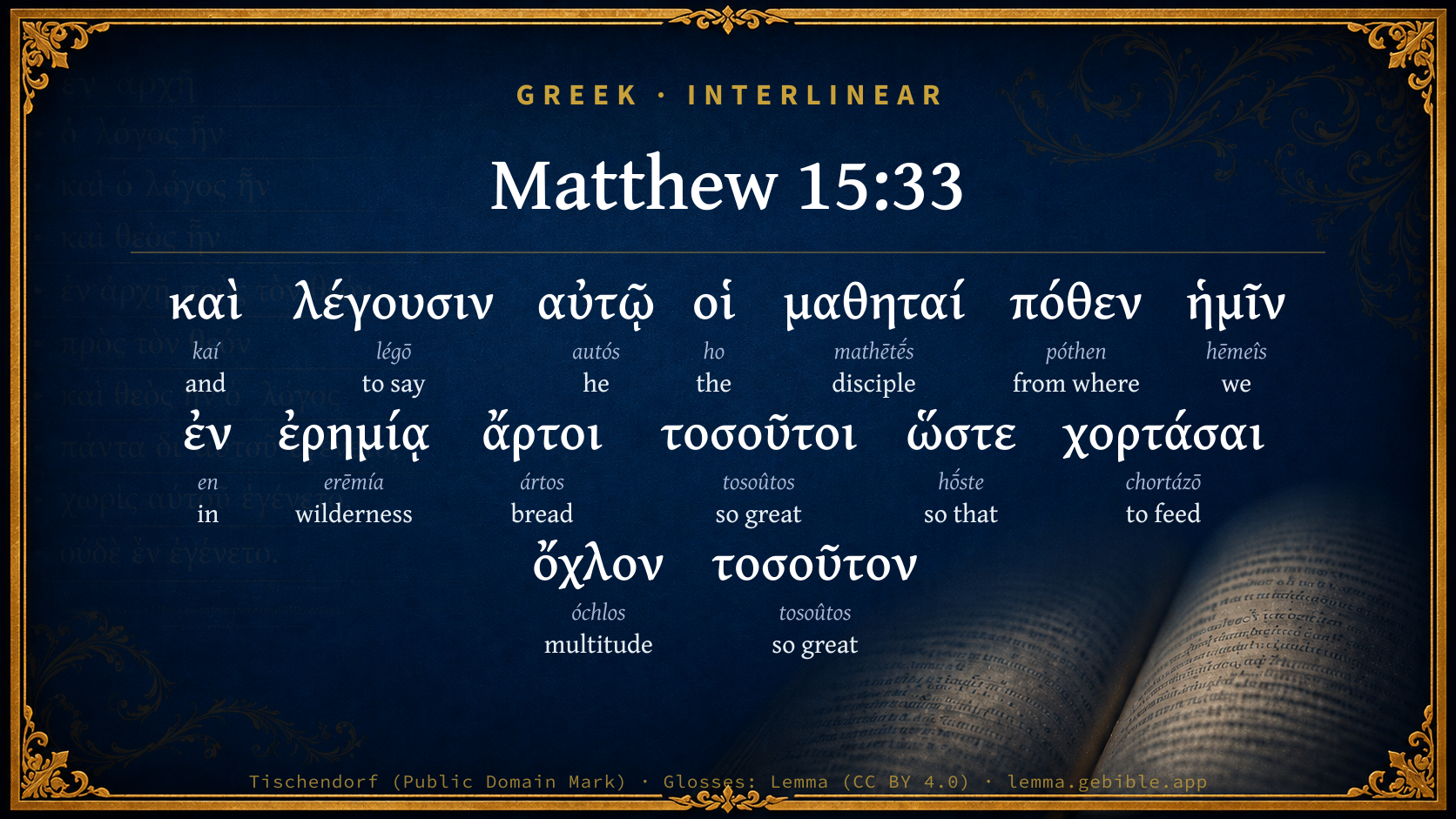
Greek (Tischendorf 8th ed.) Matthew 15:33 appears in the Greek New Testament. The text above is from the Tischendorf 8th edition. Each word links to its Strong’s number and a concise gloss. Click any word for its full Thayer’s Greek Lexicon entry.
Download image
Cite this verse

Matthew 15:33 (World English Bible). Public Domain. Lemma interlinear Bible study tool, https://lemma.gebible.app/v/matthew/15/33.

Show BibTeX & RIS
BibTeX
RIS
English Translation
The disciples said to him, "Where should we get so many loaves in a deserted place as to satisfy so great a multitude?"
World English Bible · Public Domain
Highlights
  • 1 first appearance in the Greek New Testament
Full analysis ↓
Download a study sheet

One document with this verse’s original text, its word-by-word gloss line, the meaning frame, cross-references with their text, attributed commentary, and full source and license credits — printable, and it pastes into notes with its structure intact.

This verse Autodidact and up

Study sheet (.html) Plain text (.txt)

A passage Seminary Student

Up to 50 verses in one chapter. A passage sheet keeps up to 6 commentary sources and 12 cross-references per verse, in the order this page ranks them, and says so on the sheet whenever that leaves anything out. Ask for a single verse and you get the Autodidact verse sheet above.

Everything on this page stays free to read, with no account — the sheet is a download of what is already on screen, not access to it.

Want to remove ads? Support Godless Engineer
Compare translations 3

The same verse in 3 English versions, stacked beneath the original-language interlinear above. Click any original word for its lexicon entry.

Each is an independent rendering of the whole verse — the interlinear is not word-aligned to these translations.

Highlighted words mark where these versions differ — a whole-verse word diff, not a word-by-word alignment.

  • World English Bible Public Domain
    The disciples said to him, "Where should we get so many loaves in a deserted place as to satisfy so great a multitude?"
  • King James Version Public Domain
    And his disciples say unto him, Whence should we have so much bread in the wilderness, as to fill so great a multitude?
  • unfoldingWord Literal Text CC BY-SA 4.0
    And the disciples say to him, “From where to us in a desolate place so many loaves so as to satisfy so large a crowd?”

unfoldingWord Literal Text — © unfoldingWord, licensed CC BY-SA 4.0. Word-aligned USFM3 via Door43 (git.door43.org/unfoldingWord/en_ult).

Versions to compare (up to 4)

3 of 4 selected

Show all 19 translations

Every available English version of this verse, each an independent rendering of the whole verse.

  • World English Bible Public Domain
    The disciples said to him, "Where should we get so many loaves in a deserted place as to satisfy so great a multitude?"
  • Berean Standard Bible Public Domain
    The disciples replied, “Where in this desolate place could we find enough bread to feed such a large crowd?”
  • Majority Standard Bible Public Domain
    His disciples replied, “Where in this desolate place could we find enough bread to feed such a large crowd?”
  • King James Version Public Domain
    And his disciples say unto him, Whence should we have so much bread in the wilderness, as to fill so great a multitude?
  • American Standard Version (1901) Public Domain
    And the disciples say unto him, Whence should we have so many loaves in a desert place as to fill so great a multitude?
  • Revised Version (1885) Public Domain
    And the disciples say unto him, Whence should we have so many loaves in a desert place, as to fill so great a multitude?
  • Geneva Bible (1599) Public Domain
    And his disciples saide vnto him, Whence should we get so much bread in the wildernes, as should suffice so great a multitude!
  • Douay-Rheims (1899) Public Domain
    And the disciples say unto him: Whence then should we have so many loaves in the desert, as to fill so great a multitude?
  • Young's Literal Translation Public Domain
    And his disciples say to him, `Whence to us, in a wilderness, so many loaves, as to fill so great a multitude?'
  • Literal Standard Version CC BY-SA 4.0
    And His disciples say to Him, “From where to us in a wilderness [will we get] so many loaves, as to fill so great a multitude?”
  • Unlocked Literal Bible CC BY-SA 4.0
    The disciples said to him, “Where can we get enough loaves of bread in such a deserted place to satisfy so large a crowd?”
  • unfoldingWord Literal Text CC BY-SA 4.0
    And the disciples say to him, “From where to us in a desolate place so many loaves so as to satisfy so large a crowd?”
  • Darby Bible Public Domain
    And his disciples say to him, Whence should we have so many loaves in [the] wilderness as to satisfy so great a crowd?
  • World Messianic Bible Public Domain
    The disciples said to him, “Where could we get so many loaves in a deserted place as to satisfy so great a multitude?”
  • Webster's Bible Public Domain
    And his disciples say to him, Whence should we have so much bread in the wilderness, as to satisfy so great a multitude?
  • Free Bible Version CC BY-SA 4.0
    “Where could we find enough bread here in this desert to feed such a huge crowd?” the disciples responded.
  • Bible in Basic English Public Domain
    And the disciples say to him, How may we get enough bread in a waste place, to give food to such a number of people?
  • Text-Critical English NT CC BY 4.0
    His disciples said to him, “Where can we get so many loaves in such a desolate place to fill such a large crowd?”
  • Tyndale New Testament (1534) Public Domain
    And his disciples sayd vnto him: whence shuld we get so moche breed in the wildernes as shuld suffise so greate a multitude?

Literal Standard Version (2020), Covenant Press — licensed CC BY-SA 4.0. Text via the HelloAO Bible API (eBible.org). Unlocked Literal Bible (unfoldingWord) — licensed CC BY-SA 4.0. Text via the HelloAO Bible API (eBible.org). unfoldingWord Literal Text — © unfoldingWord, licensed CC BY-SA 4.0. Word-aligned USFM3 via Door43 (git.door43.org/unfoldingWord/en_ult). Free Bible Version, Dr. Jonathan Gallagher — licensed CC BY-SA 4.0. Text via the HelloAO Bible API (eBible.org).

Word by word

More ways to search: Search by grammar → Find every occurrence → Compare this word →

Practice this passage: Drill this verse → Learn its vocabulary →

ἐρημίᾳ
erēmía
G2047
“wilderness”
Noun, Dative, Singular, Feminine
Part of Speech
Noun
Case
Dative
Number
Singular
Gender
Feminine
Full Thayer's Definition

Origin: from G2048

TDNT: 12:57,3

1. a solitude, an uninhabited region, a waste
  1. καὶ kaí G2532 “and” Conjunction
  2. λέγουσιν légō G3004 “to say” Verb, Present, Active, Indicative, 3rd person, Plural
  3. αὐτῷ autós G846 “he” Personal pronoun, Dative, Singular, Masculine
  4. οἱ ho G3588 “the” Article, Nominative, Plural, Masculine
  5. μαθηταί mathētḗs G3101 “disciple” Noun, Nominative, Plural, Masculine
  6. πόθεν póthen G4159 “from where” Adverb, Interrogative
  7. ἡμῖν hēmeîs G2249 “we” Personal pronoun, 1st person, Dative, Plural
  8. ἐν en G1722 “in” Preposition
  9. ἄρτοι ártos G740 “bread” Noun, Nominative, Plural, Masculine
  10. τοσοῦτοι tosoûtos G5118 “so great” Demonstrative pronoun, Nominative, Plural, Masculine
  11. ὥστε hṓste G5620 “so that” Conjunction
  12. χορτάσαι chortázō G5526 “to feed” Verb, Aorist, Active, Infinitive
  13. ὄχλον óchlos G3793 “multitude” Noun, Accusative, Singular, Masculine
  14. τοσοῦτον tosoûtos G5118 “so great” Demonstrative pronoun, Accusative, Singular, Masculine

About this verse

These counts appear in no published source. They are computed here, from the morphology-tagged text and Lemma’s own curated glosses. What Lemma adds →

15
words
14
distinct lemmas
Gospels
section

Notable vocabulary

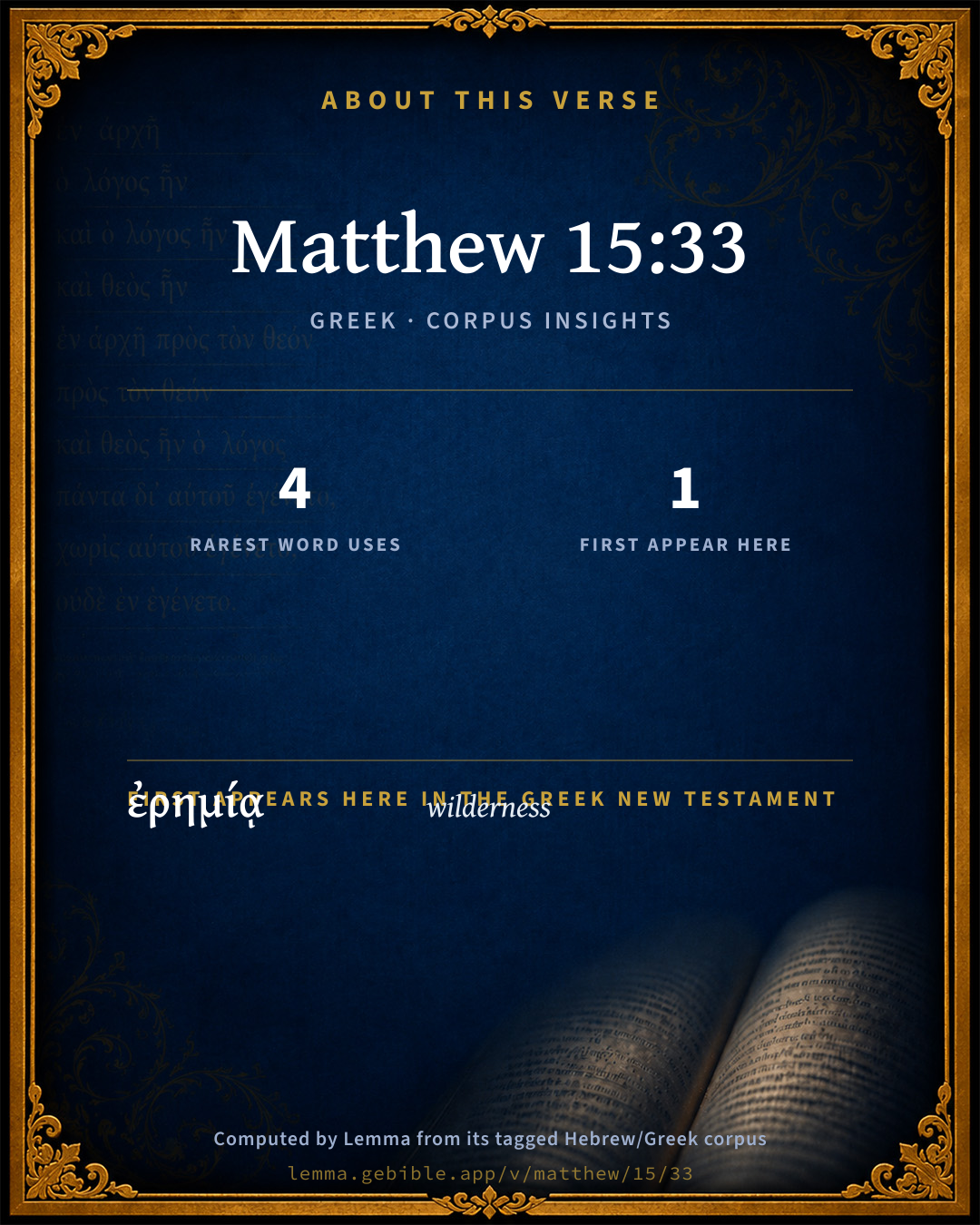
The rarest word here is ἐρημίᾳ wilderness G2047 — appearing just 4 times in the whole Greek New Testament.

First appearance in Scripture

This word makes its first canonical appearance in the Greek New Testament here:

  • ἐρημίᾳ wilderness G2047

Shared distinctive vocabulary

ἐρημίᾳ wilderness G2047 occurs in 4 verses of the Greek New Testament. Also found in:

Repetition

A word recurs within this verse:

  • τοσοῦτοι so great G5118 ×2

Cross-references

7

Topical passages linked to Matthew 15:33 in the Treasury of Scripture Knowledge — connected by theme and wording, ordered by reader-vote popularity; previews shown in the World English Bible.

  • Matthew 14:15 When evening had come, his disciples came to him, saying, "This place is deserted, and the hour is already late. Send the multitudes away, that they may go into the villages, and buy themselves food."
  • Mark 6:37 But he answered them, "You give them something to eat." They asked him, "Shall we go and buy two hundred denarii worth of bread, and give them something to eat?"
  • Mark 8:4–5 His disciples answered him, "From where could one satisfy these people with bread here in a deserted place?"
  • Luke 9:13 But he said to them, "You give them something to eat." They said, "We have no more than five loaves and two fish, unless we should go and buy food for all these people."
  • John 6:5–9 Jesus therefore lifting up his eyes, and seeing that a great multitude was coming to him, said to Philip, "Where are we to buy bread, that these may eat?"
  • Numbers 11:21–22 Moses said, The people, among whom I am, are six hundred thousand footmen; and you have said, I will give them flesh, that they may eat a whole month.
  • 2 Kings 4:42–44 There came a man from Baal Shalishah, and brought the man of God bread of the first fruits, twenty loaves of barley, and fresh ears of grain in his sack. He said, Give to the people, that they may eat.

Cross-references courtesy of OpenBible.info (CC BY 4.0).

Commentary

Notes on Matthew 15:33 from classic Christian and Jewish commentators (each source and its license shown beneath its notes). The classic Christian expositions comment on the surrounding passage and are grouped to its opening verse, so a note may address several verses; the Jewish commentaries on the Tanakh (Rashi and others) are per-verse, so they appear only where the commentator wrote on this verse.

Lemma curates 59 commentaries, every one of them public domain or Creative Commons licensed, each selected and text-cleaned for this edition rather than reprinted as found. About our sources →

Whedon's Commentary on the Bible

Daniel D. Whedon

§ 69. — THE MIRACLE OF FEEDING THE FOUR THOUSAND, Mat_15:33-39.

Skeptical critics have maintained that this narrative is a traditional repetition, by mistake, of the miracle of feeding the five thousand. That there was no oversight, however, on the part of the author of this Gospel is plain from Mat_16:9-10, where both accounts are alluded to in connection. But there is a minute but convincing argument for the genuineness of the two accounts thus given by Mr. Alford: “It is, that whereas the baskets in which the fragments were collected on the other occasion are called by all four evangelists κοφινοι, cophini, those used for that purpose after this miracle are, in both Matthew and Mark, σπυριδες, spurides. And when our Lord refers to the two miracles, the same distinction is observed; a particularity which could not have arisen except as pointing to a matter of fact, that (whatever the distinction be, which is uncertain) different kinds of baskets were used on the two occasions.”

But besides the differences in detail, such as the different number of the fed, and of the loaves and fishes, there are differences important in character. The first miraculous feeding was performed for the inhabitants who followed Jesus, and anticipated his debarkation from the western side of the lake. They meet Jesus in intense excitement at the shore, and the miracle takes place upon the plain of Butaiha, near the village of Bethsaida.

This second feeding takes place when Jesus is secreting himself from Herod Antipas. He rapidly and quietly passes to the coast northeast of the lake, out of the dominion of Herod; and it is in the country, probably, of the Decapolis that the miracle takes place. It is probably the multitudes from the eastern side who are sharers of the product of this miracle. And we cannot help thinking that there is some truth in the ancient opinion that they were mostly Gentiles; and thus an intimation is given that since the Jews have had their banquet at the table of God, the Gentiles too shall have a share. After the former miracle, the Lord sends forward his disciples by ship at night, and overtakes them before morning dawn by walking upon the sea. After the present miracle our Lord leaves the multitudes in their own regions, and departs to Magdala.

33. Whence should we have… bread — The wavering reply of the apostles evinces a recollection of the former miracle. They have not indeed the boldness to call for a miracle, as his mother Mary did at the wedding of Cana; and mother though she was, she received a check from her son and Lord. They do not say, If we are to feed this multitude your miraculous power must meet the expense. They only put a modest but suggestive Whence? Their eyes then watch every movement, we may suppose, of his lip and hand.

Daniel D. Whedon (gen. ed.), Commentary on the Old and New Testaments (1874–1909) — public domain. Text from a community e-Sword module.

Bengel's Gnomon

Johann Albrecht Bengel

Mat 15:33. Πόθεν, whence) Cf. Num 11:21; 2Ki 4:43.—ἡμῖν, to us) The disciples already understood that they would have to take some part in the matter.

Bengel's Gnomon of the New Testament — English translation (T&T Clark, Edinburgh, 1860) — public domain. Text from a community e-Sword module.

Meyer's Critical & Exegetical Commentary

Heinrich August Wilhelm Meyer

Mat_15:33 ff. See note on Mat_14:15 ff.

ἡμῖν] Jam intelligebant discipuli, suas fore in ea re partes aliquas, Bengel.

ὥστε] not a telic particle (de Wette), but what is meant is: such a quantity of bread as will be sufficient for their wants, and so on. The use of ὥστε after τοσοῦτος in a way corresponding to this is of very frequent occurrence (Plat. Gorg. p. 458 C). See Sturz, Lex. Xen. IV. p. 320; Kühner, II. 2, p. 1003. Notice the emphatic correlation of τοσοῦτοι and τοσοῦτον.

The perplexity of the disciples, and the fact of their making no reference to what was formerly done under similar circumstances, combined with the great resemblance between the two incidents, have led modern critics to assume that Matthew and Mark simply give what is only a duplicate narrative of one and the same occurrence (Schleiermacher, Scholz, Kern, Credner, Strauss, Neander, de Wette, Hase, Ewald, Baur, Köstlin, Hilgenfeld, Holtzmann, Weiss, Weizsäcker, Volkmar, Keim, Scholten); while Wilke and Bruno Bauer maintain, though quite unwarrantably, that in Mark the account of the second instance of miraculous feeding is an interpolation; and Weiss, on the other hand, is of opinion that this evangelist has constructed his duplicate out of materials drawn from two distinct sources (1865, p. 346 f.). As a consequence of this duplicate-hypothesis, it has been found necessary to question the authenticity of Mat_16:9 f., Mar_8:19. The whole difficulty in connection with this matter arises chiefly out of the question of the disciples, and the fact of their seeming to have no recollection of what took place before,a difficulty which is not to be got rid of by reminding us of their feeble capacities (Olshausen), but which justifies us in assuming that there were actually two instances of miraculous feeding of a substantially similar character, but that (Bleek) in the early traditions the accounts came to assume pretty much the same shape, all the more that the incidents themselves so closely resembled each other.

Mat_15:34. ἰχθύδια] Observe the use of the diminutive on the part of the disciples themselves (extenuant apparatum, Bengel); the use of ἰχθύας, on the other hand, in the narrative, Mat_15:36.

Mat_15:35. κελεύειν τινι] occurs nowhere else in the New Testament, though frequently in Homer and later writers (Plat. Rep. p. 396 A). See Bornemann in the Sächs. Stud. 1843, p. 51.

Mat_15:37. Seven baskets full is in apposition with τὸ περισς. τ. κλασμ.,

σπυρίς is the term regularly employed to denote a basket for carrying provisions when on a journey, sporta. Comp. Arr. Ep. iv. 10. 21; Athen. viii. p. 365 A; Valckenaer, Schol. I. p. 455. The seven baskets corresponded to the seven loaves, Mat_15:34; the twelve baskets, Mat_14:20, to the twelve apostles.

χωρὶς γυναικ. κ. παιδ.] See note on Mat_14:21.

Meyer — Critical and Exegetical Commentary on the New Testament — English translation by Peter Christie, edited by Frederick Crombie (T&T Clark, 1880) — public domain. Text from a community e-Sword module.

Expositor's Greek Testament

ed. W. Robertson Nicoll

Mat 15:33 . τοσοῦτοι , ὥστε χορτάσαι . ὥστε with infinitive may be used to express a consequence involved in the essence or quality of an object or action, therefore after τοσοῦτος and similar words; vide Kühner, § 584, 2, aa.

The Expositor's Greek Testament, edited by W. Robertson Nicoll (1897–1910) — public domain. Text from a community e-Sword module.

Adam Clarke's Commentary

Verse 33. Whence should we have so much bread in the wilderness, &c.] Human foresight, even in the followers of Christ, is very short. In a thousand instances, if we supply not its deficiency by faith, we shall be always embarrassed, and often miserable. This world is a desert, where nothing can be found to satisfy the soul of man, but the salvation which Christ has procured.

Adam Clarke's Commentary on the Bible (1810–1826) — public domain. Text from a community e-Sword/MySword module.

Ellicott's Commentary for English Readers

(33) His disciples say unto him.—Here, on the assumption that we are dealing with a true record, a difficulty of another kind meets us. How was it, we ask, that the disciples, with the memory of the former miracle still fresh in their recollection, should answer as before with the same child-like perplexity? Why did they not at once assume that the same divine power could be put forth to meet a like want now? The answers to that question may, perhaps, be grouped as follows:—(1.) It is not easy for us to put ourselves in the position of men who witnessed, as they did, these workings of a supernatural might. We think of the Power as inherent, and therefore permanent. To them it might seem intermittent, a gift that came and went. Their daily necessities had been supplied, before and after the great event, in the common way of gift or purchase. The gathering of the fragments (Mat_14:20; Joh_6:12) seemed to imply that they were not to rely on the repetition of the wonder. (2.) The fact that three days had passed, and that hunger had been allowed to pass on to the borders of exhaustion, might well have led to think that the power was not to be exerted now. (3.) Our Lord’s implied question—though, as before, He Himself “knew what He would do” (Joh_6:6)—must have appeared to them to exclude the thought that He was about to make use again of that reserve of power which He had displayed before. They would seem to themselves to be simply following in His footsteps when they answered His question as on the level which He Himself thus appeared to choose.

A Bible Commentary for English Readers, edited by Charles John Ellicott (1878–1897) — public domain. Text from a community e-Sword module.

John Gill's Exposition

And his disciples said unto him,.... The former miracle of feeding five thousand men, besides women and children, with five loaves and two fishes, being quite out of their thoughts, they reply,

whence should we have so much bread in the wilderness, as to fill so great a multitude? The question is big with objections, and is put with some vehemency and astonishment: the people to be led were a multitude, a great multitude, a very great multitude, and these too had had but little, or no food, for a great while; and therefore would require the more to fill and satisfy them; and besides, it was a wilderness where they were, and where no provisions were to be had; and if they could have been got for money, they had not stock enough to purchase such a large number of loaves, as were necessary to feed so great a company with.

John Gill's Exposition of the Whole Bible (1746–1763) — public domain (CC PDM 1.0). Text via the HelloAO Bible API.

Trapp's Complete Commentary

John Trapp

33 And his disciples say unto him, Whence should we have so much bread in the wilderness, as to fill so great a multitude?

Ver. 33. Whence should we have, &c.] See their stupidity and diffidence, yet still budging and breaking out upon all occasions. {a} What a life hath Christ with the best of us, ere he can bring us to anything? Corruption will have stone flurts, some outbursts. Nothing cleaves to us more pertinaciously than this evil heart of unbelief; like a fretting leprosy in our cottages of clay, though the walls be well scraped, yet it will never utterly be gone, till the house be demolished.

{a} Discipuli ut homines nimis homines, &c. Aret. in loc.

John Trapp, A Commentary or Exposition upon All the Books of the Old and New Testament (1647–1656) — public domain. Text from a community e-Sword module.

The Pulpit Commentary

Whence should we have so much bread, etc.? Christ had said nothing to his disciples concerning his design of feeding the people, but his remarks pointed to the possibility of such a design, and the apostles at once throw cold water upon the project. They do not indeed, as they did before urge him to send the multitude away, that they may supply their own needs, but they emphasize the impossibility of carrying out the idea of feeding them. Their answer bristles with objections. The place is uninhabited; the multitude is numerous; the quantity of food required is enormous; and how can we, poor and needy as we are, help them? It seems to us incredible that they could return this answer, after having, net very long before, experienced the miracle of the feeding of the five thousand. They seemed now to have forgotten the earlier marvel, and to be in utter doubt how the necessary food was to be provided on the present occasion. That Christ would display his miraculous powers appears not to have crossed their minds. Such surprising forgetfulness and slowness of faith have seemed to some critics so unlikely and unusual, that they have regarded the apostles" attitude as confirming their assumption of the identity of the two miracles of feeding. But really such conduct is true to human nature. Calvin, while he condemns in vehement terms the disciples" dulness brutum produnt stuporem is careful to add that men are always liable to a similar insensibility, prone to forget past deliverance in the face of present difficulty. Immediately after the passage of the Red Sea, the people feared that they would perish of thirst in the wilderness; and when God promised to give them flesh to eat, even Moses doubted the possibility of the supply, and asked whence it could be provided. (Exo_17:1, etc.; Num_11:21, etc.) How often did Jesus speak of his sufferings, death, and resurrection! And yet these events came upon believers as a surprise for which they were altogether unprepared. Continually the disciples forgot what they ought to have remembered, drew no proper inferences from what they had seen and experienced, and had to be taught the same lessons repeatedly under different circumstances. Since the first miraculous meal many events had happened; often possibly they had been in want of food, as when on the sabbath day they appeased their hunger with ears of corn plucked by the way, and Christ had worked no miracle for their relief. It did not immediately suggest itself to them to have recourse to their Master in the emergency; they were very far from expecting Divine interposition at every turn. If they thought at all of the former miracle, they may have looked upon it as the outcome of an intermittent power, not always at command, or at any rate not likely to be exercised on the present occasion. They were slow to apprehend Christ"s Divine mission and character. The acknowledgment of his Messiahship did net necessarily connote the realization of his Godhead. In the writings of this and the immediately preceding period we see that the great Prophet, Prince, Conqueror, who is to appear, is not God, but one commissioned by God, and at most a God-inspired man or angel. So the apostles were only in unison with the best of their contemporaries when at present they hesitated to believe in, and were incapable of apprehending, the Divine nature of Christ.

The Pulpit Commentary (1880–1919), ed. H.D.M. Spence-Jones & Joseph S. Exell — public domain. Text from a community e-Sword module.

The People's New Testament

B. W. Johnson

33. Whence should we have so many loaves? This was not said in ignorance of the Lord's creative power, but probably to suggest the need of its exercise. They could not have forgotten the events narrated in Matt. 14:15–21.

B. W. Johnson's The People's New Testament with Notes (1889–1891) — public domain. Electronic text from the Christian Classics Ethereal Library (CCEL) ThML edition.

International Critical Commentary

33. And the disciples say to Him, Whence have we in a wilderness loaves sufficient to feed so great a multitude?] Mk. has: “And His disciples answered to Him that, Whence shall one be able to feed these with loaves here on a wilderness?” For the omission of Mk.’s ὅτι, see Introduction, p. xx. ἐρημία and νῆστις occur only here in the Gospels. Both are rare words in Biblical Greek. For χορτάζειν, see on 5:6. ἐν ἐρημίᾳ is easier than Mk.’s ἐπʼ ἐρημίας.

International Critical Commentary — older volumes (1896–1929), various authors — public domain. Text from a community e-Sword module.

Lesson kit

Teaching starters — assembled from the data on this page, not authored interpretation. Every prompt links to the verse data it draws on. Edit before teaching.

Matthew, in the Gospels, opens this verse with 15 words (14 distinct Greek lemmas). Its most distinctive word is erēmía (“wilderness”). A historical commentator’s framing appears above. Read the whole chapter for the surrounding context.

Discussion questions

  1. The word erēmía carries the sense “wilderness.” How does it shape the verse?
  2. The word “wilderness” first appears here in Scripture. What is being introduced at this debut?
  3. Mark 8:4 shares the word «wilderness» with this verse. How do the two illuminate each other?
  4. “so great” occurs 2× in this one verse. What is the effect of the repetition?
  5. The translations on this page render this verse differently — a whole-verse word diff, not a word-by-word alignment. What might account for the different wordings?
  6. Reading how Whedon's Commentary on the Bible and Bengel's Gnomon read this verse, where do the two commentators agree and where do they part?

Things to notice

  • 1 word makes its first canonical appearance in Scripture here.
  • These translations choose different wording for 23 words in this verse.
  • “so great” occurs 2× in this single verse.
  • 14 distinct Greek lemmas span 15 words in this verse.

Reading settings

Reading text

Shown beneath each verse's original-language words.

Old Testament
Old Testament edition

Read the OT as the Masoretic Hebrew (MT) or the Greek Septuagint (LXX).

English shown for the Greek Septuagint (in the Hebrew ↔ Greek comparison).

Comparing translations? Open the Compare panel on any verse page to stack up to four side by side.