
Matthew 11:21

Greek (Tischendorf 8th ed.) Matthew 11:21 appears in the Greek New Testament. The text above is from the Tischendorf 8th edition. Each word links to its Strong’s number and a concise gloss. Click any word for its full Thayer’s Greek Lexicon entry.
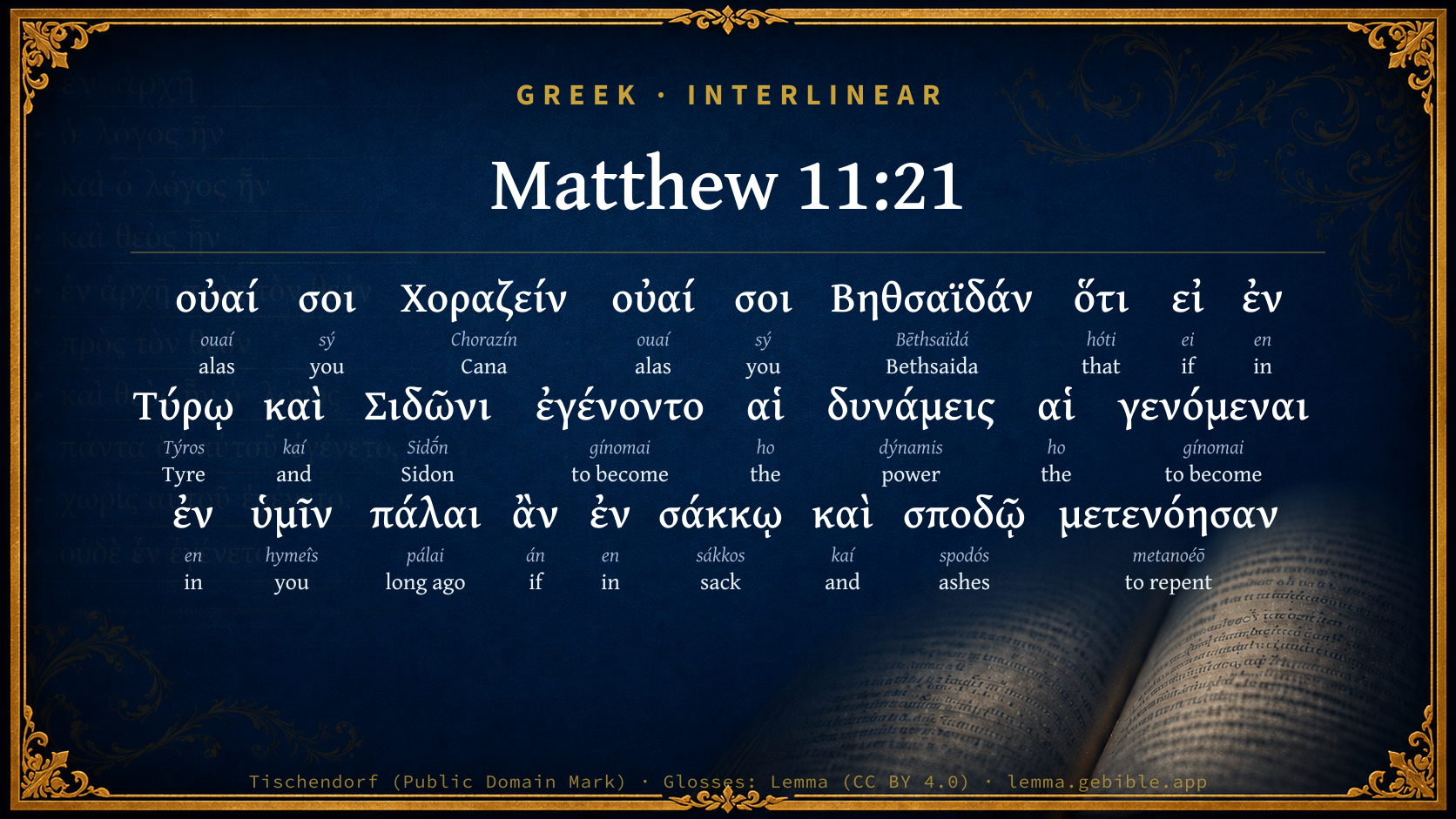
Download image
Cite this verse

Matthew 11:21 (World English Bible). Public Domain. Lemma interlinear Bible study tool, https://lemma.gebible.app/v/matthew/11/21.

Show BibTeX & RIS
BibTeX
RIS
English Translation
"Woe to you, Chorazin! Woe to you, Bethsaida! For if the mighty works had been done in Tyre and Sidon which were done in you, they would have repented long ago in sackcloth and ashes.
World English Bible · Public Domain
Highlights
  • 8 first appearances in the Greek New Testament
Full analysis ↓
Download a study sheet

One document with this verse’s original text, its word-by-word gloss line, the meaning frame, cross-references with their text, attributed commentary, and full source and license credits — printable, and it pastes into notes with its structure intact.

This verse Autodidact and up

Study sheet (.html) Plain text (.txt)

A passage Seminary Student

Up to 50 verses in one chapter. A passage sheet keeps up to 6 commentary sources and 12 cross-references per verse, in the order this page ranks them, and says so on the sheet whenever that leaves anything out. Ask for a single verse and you get the Autodidact verse sheet above.

Everything on this page stays free to read, with no account — the sheet is a download of what is already on screen, not access to it.

Want to remove ads? Support Godless Engineer
Compare translations 3

The same verse in 3 English versions, stacked beneath the original-language interlinear above. Click any original word for its lexicon entry.

Each is an independent rendering of the whole verse — the interlinear is not word-aligned to these translations.

Highlighted words mark where these versions differ — a whole-verse word diff, not a word-by-word alignment.

  • World English Bible Public Domain
    "Woe to you, Chorazin! Woe to you, Bethsaida! For if the mighty works had been done in Tyre and Sidon which were done in you, they would have repented long ago in sackcloth and ashes.
  • King James Version Public Domain
    Woe unto thee, Chorazin! woe unto thee, Bethsaida! for if the mighty works, which were done in you, had been done in Tyre and Sidon, they would have repented long ago in sackcloth and ashes.
  • unfoldingWord Literal Text CC BY-SA 4.0
    “Woe to you, Chorazin! Woe to you, Bethsaida! For if the miracles had happened in Tyre and Sidon which happened in you, they would have repented long ago in sackcloth and ashes.

unfoldingWord Literal Text — © unfoldingWord, licensed CC BY-SA 4.0. Word-aligned USFM3 via Door43 (git.door43.org/unfoldingWord/en_ult).

Versions to compare (up to 4)

3 of 4 selected

Show all 19 translations

Every available English version of this verse, each an independent rendering of the whole verse.

  • World English Bible Public Domain
    "Woe to you, Chorazin! Woe to you, Bethsaida! For if the mighty works had been done in Tyre and Sidon which were done in you, they would have repented long ago in sackcloth and ashes.
  • Berean Standard Bible Public Domain
    “Woe to you, Chorazin! Woe to you, Bethsaida! For if the miracles that were performed in you had been performed in Tyre and Sidon, they would have repented long ago in sackcloth and ashes.
  • Majority Standard Bible Public Domain
    “Woe to you, Chorazin! Woe to you, Bethsaida! For if the miracles that were performed in you had been performed in Tyre and Sidon, they would have repented long ago in sackcloth and ashes.
  • King James Version Public Domain
    Woe unto thee, Chorazin! woe unto thee, Bethsaida! for if the mighty works, which were done in you, had been done in Tyre and Sidon, they would have repented long ago in sackcloth and ashes.
  • American Standard Version (1901) Public Domain
    Woe unto thee, Chorazin! woe unto thee, Bethsaida! for if the mighty works had been done in Tyre and Sidon which were done in you, they would have repented long ago in sackcloth and ashes.
  • Revised Version (1885) Public Domain
    Woe unto thee, Chorazin! woe unto thee, Bethsaida! for if the mighty works had been done in Tyre and Sidon which were done in you, they would have repented long ago in sackcloth and ashes.
  • Geneva Bible (1599) Public Domain
    Woe be to thee, Chorazin: Woe be to thee, Bethsaida: for if ye great workes, which were done in you, had bene done in Tyrus and Sidon, they had repented long agone in sackecloth and ashes.
  • Douay-Rheims (1899) Public Domain
    Woe to thee, Corozain, woe to thee, Bethsaida: for if in Tyre and Sidon had been wrought the miracles that have been wrought in you, they had long ago done penance in sackcloth and ashes.
  • Young's Literal Translation Public Domain
    `Wo to thee, Chorazin! wo to thee, Bethsaida! because, if in Tyre and Sidon had been done the mighty works that were done in you, long ago in sackcloth and ashes they had reformed;
  • Literal Standard Version CC BY-SA 4.0
    “Woe to you, Chorazin! Woe to you, Bethsaida! Because, if in Tyre and Sidon had been done the mighty works that were done in you, long ago in sackcloth and ashes they had converted;
  • Unlocked Literal Bible CC BY-SA 4.0
    “Woe to you, Chorazin! Woe to you, Bethsaida! If the mighty deeds had been done in Tyre and Sidon which were done in you, they would have repented long ago in sackcloth and ashes.
  • unfoldingWord Literal Text CC BY-SA 4.0
    “Woe to you, Chorazin! Woe to you, Bethsaida! For if the miracles had happened in Tyre and Sidon which happened in you, they would have repented long ago in sackcloth and ashes.
  • Darby Bible Public Domain
    Woe to thee, Chorazin! woe to thee Bethsaida! for if the works of power which have taken place in you, had taken place in Tyre and Sidon, they had long ago repented in sackcloth and ashes.
  • World Messianic Bible Public Domain
    “Woe to you, Chorazin! Woe to you, Bethsaida! For if the mighty works had been done in Tyre and Sidon which were done in you, they would have repented long ago in sackcloth and ashes.
  • Webster's Bible Public Domain
    Woe to thee, Chorazin; woe to thee, Bethsaida: for if the mighty works which have been done in you had been done in Tyre and Sidon, they would have repented long ago in sackcloth and ashes.
  • Free Bible Version CC BY-SA 4.0
    “Shame on you, Korazin! Shame on you, Bethsaida! If the miracles had been performed in Tyre and Sidon which happened among you, they would have repented in sackcloth and ashes long ago.
  • Bible in Basic English Public Domain
    Unhappy are you, Chorazin! Unhappy are you, Beth-saida! For if the works of power which were done in you had been done in Tyre and Sidon, they would have been turned from their sins in days gone by, clothing themselves in haircloth and putting dust on their heads.
  • Text-Critical English NT CC BY 4.0
    “Woe to yoʋ, Chorazin! Woe to yoʋ, Bethsaida! For if the miracles that were done in you had been done in Tyre and Sidon, they would have repented long ago in sackcloth and ashes.
  • Tyndale New Testament (1534) Public Domain
    Wo be to the Chorasin. Wo be to the Betzaida: for if the miracles which were shewd in you had bene done in Tyre and Sidon they had repented longe agone in sackcloth and asshes.

Literal Standard Version (2020), Covenant Press — licensed CC BY-SA 4.0. Text via the HelloAO Bible API (eBible.org). Unlocked Literal Bible (unfoldingWord) — licensed CC BY-SA 4.0. Text via the HelloAO Bible API (eBible.org). unfoldingWord Literal Text — © unfoldingWord, licensed CC BY-SA 4.0. Word-aligned USFM3 via Door43 (git.door43.org/unfoldingWord/en_ult). Free Bible Version, Dr. Jonathan Gallagher — licensed CC BY-SA 4.0. Text via the HelloAO Bible API (eBible.org).

Word by word

More ways to search: Search by grammar → Find every occurrence → Compare this word →

Practice this passage: Drill this verse → Learn its vocabulary →

Χοραζείν
Chorazín
G5523
“Cana”
Noun, Proper, indeclinable
Part of Speech
Noun · Proper, indeclinable
Full Thayer's Definition

Origin: of uncertain derivation

TDNT: None

Chorazin = "a furnace of smoke" 1. a town in Galilee
  1. οὐαί ouaí G3759 “alas” Interjection
  2. σοι sý G4771 “you” Personal pronoun, 2nd person, Dative, Singular
  3. οὐαί ouaí G3759 “alas” Interjection
  4. σοι sý G4771 “you” Personal pronoun, 2nd person, Dative, Singular
  5. Βηθσαϊδάν Bēthsaïdá G966 “Bethsaida” Noun, Proper, indeclinable
  6. ὅτι hóti G3754 “that” Conjunction
  7. εἰ ei G1487 “if” Conditional
  8. ἐν en G1722 “in” Preposition
  9. Τύρῳ Týros G5184 “Tyre” Noun, Dative, Singular, Feminine
  10. καὶ kaí G2532 “and” Conjunction
  11. Σιδῶνι Sidṓn G4605 “Sidon” Noun, Dative, Singular, Feminine
  12. ἐγένοντο gínomai G1096 “to become” Verb, Aorist, Middle deponent, Indicative, 3rd person, Plural
  13. αἱ ho G3588 “the” Article, Nominative, Plural, Feminine
  14. δυνάμεις dýnamis G1411 “power” Noun, Nominative, Plural, Feminine
  15. αἱ ho G3588 “the” Article, Nominative, Plural, Feminine
  16. γενόμεναι gínomai G1096 “to become” Verb, Aorist, Middle deponent, Participle, Nominative, Plural, Feminine
  17. ἐν en G1722 “in” Preposition
  18. ὑμῖν hymeîs G5210 “you” Personal pronoun, 2nd person, Dative, Plural
  19. πάλαι pálai G3819 “long ago” Adverb
  20. ἂν án G302 “if” Particle
  21. ἐν en G1722 “in” Preposition
  22. σάκκῳ sákkos G4526 “sack” Noun, Dative, Singular, Masculine
  23. καὶ kaí G2532 “and” Conjunction
  24. σποδῷ spodós G4700 “ashes” Noun, Dative, Singular, Feminine
  25. μετενόησαν metanoéō G3340 “to repent” Verb, Aorist, Active, Indicative, 3rd person, Plural

About this verse

These counts appear in no published source. They are computed here, from the morphology-tagged text and Lemma’s own curated glosses. What Lemma adds →

26
words
19
distinct lemmas
Gospels
section

Notable vocabulary

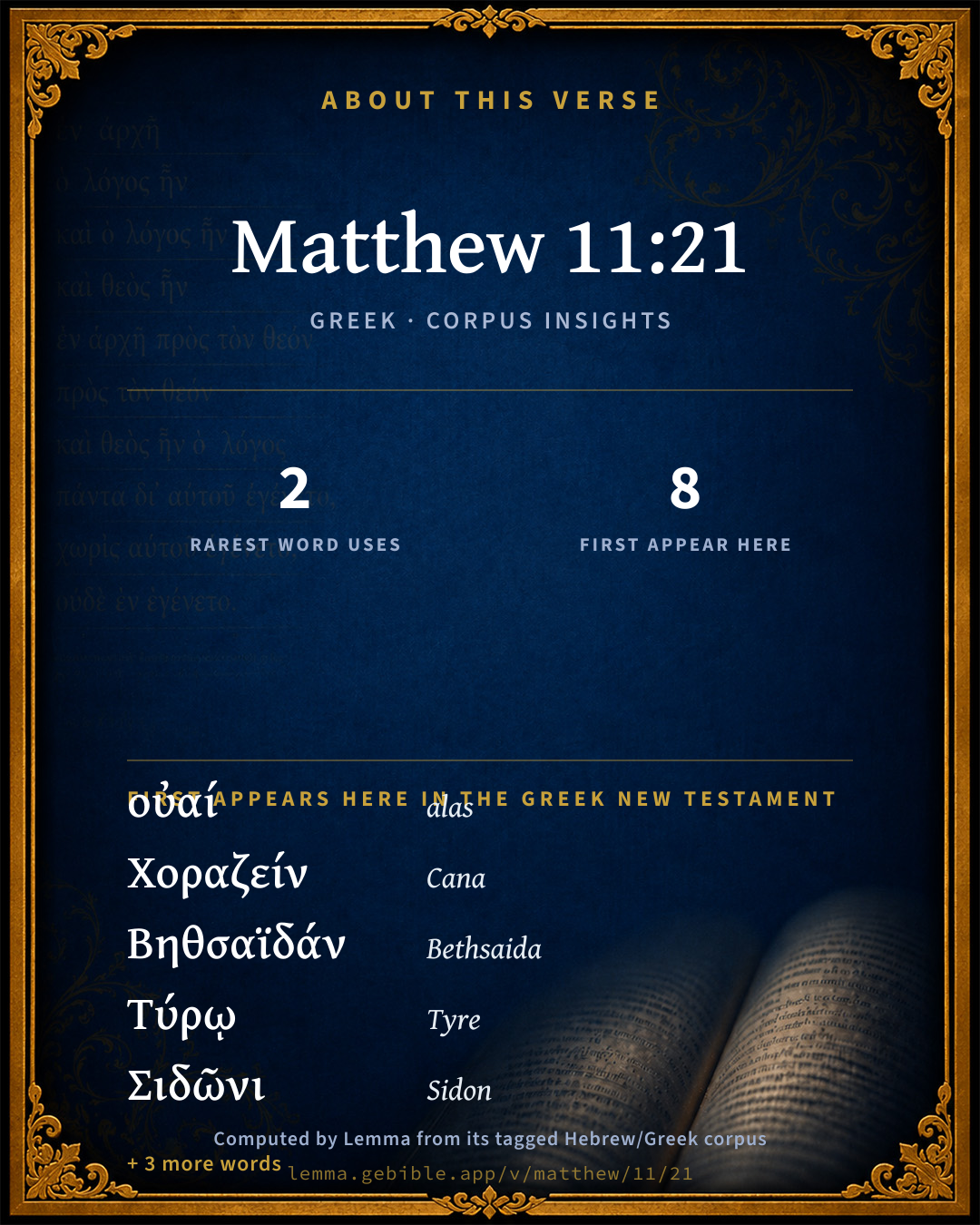
The rarest word here is Χοραζείν Cana G5523 — appearing just 2 times in the whole Greek New Testament.

First appearance in Scripture

These words make their first canonical appearance in the Greek New Testament here:

  • οὐαί alas G3759
  • Χοραζείν Cana G5523
  • Βηθσαϊδάν Bethsaida G966
  • Τύρῳ Tyre G5184
  • Σιδῶνι Sidon G4605
  • πάλαι long ago G3819
  • σάκκῳ sack G4526
  • σποδῷ ashes G4700

Shared distinctive vocabulary

Χοραζείν Cana G5523 occurs in 2 verses of the Greek New Testament. Also found in:
Repetition

Words recur within this verse:

Cross-references

27

Topical passages linked to Matthew 11:21 in the Treasury of Scripture Knowledge — connected by theme and wording, ordered by reader-vote popularity; previews shown in the World English Bible.

  • Ezekiel 3:6–7 not to many peoples of a strange speech and of a hard language, whose words you can not understand. Surely, if I sent you to them, they would listen to you.
  • Job 42:6 Therefore I abhor myself, And repent in dust and ashes."
  • Matthew 15:21 Jesus went out from there, and withdrew into the region of Tyre and Sidon.
  • Mark 6:45 Immediately he made his disciples get into the boat, and to go ahead to the other side, to Bethsaida, while he himself sent the multitude away.
  • Luke 9:10 The apostles, when they had returned, told him what things they had done. He took them, and withdrew apart to a deserted place of a city called Bethsaida.
  • John 12:21 These, therefore, came to Philip, who was from Bethsaida of Galilee, and asked him, saying, "Sir, we want to see Jesus."
  • Acts 12:20 Now Herod was very angry with the people of Tyre and Sidon. They came with one accord to him, and, having made Blastus, the king's chamberlain, their friend, they asked for peace, because their country depended on the king's country for food.
  • Matthew 11:22 But I tell you, it will be more tolerable for Tyre and Sidon on the day of judgment than for you.
  • Matthew 18:7 "Woe to the world because of occasions of stumbling! For it must be that the occasions come, but woe to that person through whom the occasion comes!
  • Mark 3:8 from Jerusalem, from Idumaea, beyond the Jordan, and those from around Tyre and Sidon. A great multitude, hearing what great things he did, came to him.
  • Mark 7:31 Again he departed from the borders of Tyre and Sidon, and came to the sea of Galilee, through the midst of the region of Decapolis.
  • Mark 8:22 He came to Bethsaida. They brought a blind man to him, and begged him to touch him.
  • Luke 6:17 He came down with them, and stood on a level place, with a crowd of his disciples, and a great number of the people from all Judea and Jerusalem, and the sea coast of Tyre and Sidon, who came to hear him and to be healed of their diseases;
  • John 1:44 Now Philip was from Bethsaida, of the city of Andrew and Peter.
  • Jude 1:11 Woe to them! For they went in the way of Cain, and ran riotously in the error of Balaam for hire, and perished in Korah's rebellion.
  • Jeremiah 13:27 I have seen your abominations, even your adulteries, and your neighing, the lewdness of your prostitution, on the hills in the field. Woe to you, Jerusalem! you will not be made clean; how long shall it yet be?
  • Matthew 12:41–42 The men of Nineveh will stand up in the judgment with this generation, and will condemn it, for they repented at the preaching of Jonah; and behold, someone greater than Jonah is here.
  • Matthew 23:13–29 "Woe to you, scribes and Pharisees, hypocrites! For you devour widows' houses, and as a pretense you make long prayers. Therefore you will receive greater condemnation.
  • Matthew 26:24 The Son of Man goes, even as it is written of him, but woe to that man through whom the Son of Man is betrayed! It would be better for that man if he had not been born."
  • Mark 7:24 From there he arose, and went away into the borders of Tyre and Sidon. He entered into a house, and didn't want anyone to know it, but he couldn't escape notice.
  • Luke 4:26 Elijah was sent to none of them, except to Zarephath, in the land of Sidon, to a woman who was a widow.
  • Luke 10:13–15 "Woe to you, Chorazin! Woe to you, Bethsaida! For if the mighty works had been done in Tyre and Sidon which were done in you, they would have repented long ago, sitting in sackcloth and ashes.
  • Luke 11:42–52 But woe to you Pharisees! For you tithe mint and rue and every herb, but you bypass justice and the love of God. You ought to have done these, and not to have left the other undone.
  • John 3:5–10 Jesus answered, "Most assuredly I tell you, unless one is born of water and spirit, he can't enter into the Kingdom of God!
  • Acts 13:44–48 The next Sabbath almost the whole city was gathered together to hear the word of God.
  • Acts 27:3 The next day, we touched at Sidon. Julius treated Paul kindly, and gave him permission to go to his friends and refresh himself.
  • Acts 28:25–28 When they didn't agree among themselves, they departed after Paul had spoken one word, "The Holy Spirit spoke rightly through Isaiah, the prophet, to our fathers,

Cross-references courtesy of OpenBible.info (CC BY 4.0).

Commentary

Notes on Matthew 11:21 from classic Christian and Jewish commentators (each source and its license shown beneath its notes). The classic Christian expositions comment on the surrounding passage and are grouped to its opening verse, so a note may address several verses; the Jewish commentaries on the Tanakh (Rashi and others) are per-verse, so they appear only where the commentator wrote on this verse.

Lemma curates 59 commentaries, every one of them public domain or Creative Commons licensed, each selected and text-cleaned for this edition rather than reprinted as found. About our sources →

Tyndale Open Study Notes

Tyndale Open Resources

11:21-24 As Jesus moved through the villages of Galilee—from Korazin to Bethsaida to Capernaum—he gave the people a greater revelation of himself, with a correspondingly more severe judgment when they refused to listen. The severity is indicated by comparison with the pagan cities of Tyre (Isa 23; Ezek 26:1–28:19), Sidon (Ezek 28:20-23), and Sodom (Gen 18:22–19:29).

Tyndale Open Study Notes — © Tyndale Open Resources, licensed CC BY-SA 4.0. Text via the HelloAO Bible API.

Bengel's Gnomon

Johann Albrecht Bengel

Mat 11:21. Οὐαὶ, woe) This interjection is not imprecatory, but enunciatory. See ch. Mat 24:17. Its opposite is blessed. This should be observed everywhere.

Mat 11:21; Mat 11:23. Ὑμῖν—σοὶ, you—thee) Two cities in the neighbourhood are compared with two mentioned in the Old Testament history, and one more miserable than the former is compared to one more miserable than the latter.—πάλαι, long ago) In that ancient time, in which it was more difficult to repent. See Act 17:30. We must not say, “What doest thou?” Cf. Eze 3:6.—ἐν σάκκῳ, in sackcloth) understand sitting, or some such word.

Bengel's Gnomon of the New Testament — English translation (T&T Clark, Edinburgh, 1860) — public domain. Text from a community e-Sword module.

Expositor's Greek Testament

ed. W. Robertson Nicoll

Mat 11:21 . Χοραζίν , Βηθσαϊδάν : the former not again mentioned in Gospels, the latter seldom ( vide Mar 6:45 ; Mar 8:22 ; Luk 9:10 ), yet scenes of important evangelic incidents, probably connected with the synagogue ministry in Galilee (Mat 4:23 ). The Gospels are brief records of a ministry crowded with events. These two towns may be named along with Capernaum because all three were in view where Christ stood when He uttered the reproachful words, say on the top of the hill above Capernaum: Bethsaida on the eastern shore or Jordan, just above where it falls into the lake; Chorazin on the western side on the road to Tyre from Capernaum (Furrer, Wanderungen , p. 370). They may also have been prosperous business centres selected to represent the commercial side of Jewish national life. Hence the reference to Tyre and Sidon , often the subject of prophetic animadversion, yet not so blameworthy in their impenitence as the cities which had seen Christ’s works. ἐν σάκκῳ καὶ σποδῷ : in black sackcloth, and with ashes on the head, or sitting in ashes like Job (Mat 2:8 ).

The Expositor's Greek Testament, edited by W. Robertson Nicoll (1897–1910) — public domain. Text from a community e-Sword module.

Jamieson, Fausset & Brown

Robert Jamieson, A. R. Fausset & David Brown

Woe unto thee, Chorazin!--not elsewhere mentioned, but it must have lain near Capernaum.

woe unto thee, Bethsaida--"fishing-house," a fishing station--on the western side of the Sea of Galilee, and to the north of Capernaum; the birthplace of three of the apostles--the brothers Andrew and Peter, and Philip. These two cities appear to be singled out to denote the whole region in which they lay--a region favored with the Redeemer's presence, teaching, and works above every other.

for if the mighty works--the miracles

which were done in you had been done in Tyre and Sidon--ancient and celebrated commercial cities, on the northeastern shores of the Mediterranean Sea, lying north of Palestine, and the latter the northernmost. As their wealth and prosperity engendered luxury and its concomitant evils--irreligion and moral degeneracy--their overthrow was repeatedly foretold in ancient prophecy, and once and again fulfilled by victorious enemies. Yet they were rebuilt, and at this time were in a flourishing condition.

they would have repented long ago in sackcloth and ashes--remarkable language, showing that they had done less violence to conscience, and so, in God's sight, were less criminal than the region here spoken of.

Jamieson, Fausset & Brown — Commentary Critical and Explanatory on the Whole Bible (1871) — public domain (CC PDM 1.0). Text via the HelloAO Bible API.

Adam Clarke's Commentary

Verse 21. Wo unto thee, Chorazin - Bethsaida!] It would be better to translate the word ουαι σοι, alas for thee, than wo to thee. The former is an exclamation of pity; the latter a denunciation of wrath. It is evident that our Lord used it in the former sense. It is not known precisely where Chorazin was situated; but as Christ joins it in the same censure with Bethsaida, which was in Upper Galilee, beyond the sea, Mr 6:45, it is likely that Chorazin was in the same quarter. Though the people in these cities were (generally) impenitent, yet there is little doubt that several received the word of life. Indeed, Bethsaida itself furnished not less than three of the twelve apostles, Philip, Andrew, and Peter. See Joh 1:44.

Tyre and Sidon] Were two heathen cities, situated on the shore of the Mediterranean Sea, into which it does not appear that Christ ever went, though he was often very nigh to them; see Mt 15:21.

They would have repented long ago] παλαι, formerly, seems here to refer to the time of Ezekiel, who denounced destruction against Tyre and Sidon, Eze 26, 27, and 28. Our Lord, then, intimates that, if Ezekiel had done as many miracles in those cities as himself had in Chorazin and Bethsaida, the inhabitants would have repented in sackcloth and ashes, with the deepest and most genuine sorrow.

A Hindoo who renounces the secular life, and becomes a religious mendicant, often covers himself with a coarse cloth sprinkled over with ashes. This is the sackcloth and ashes which our Lord refers to; and this covering was the outward sign of deep repentance, and forsaking of sin.

Adam Clarke's Commentary on the Bible (1810–1826) — public domain. Text from a community e-Sword/MySword module.

Ellicott's Commentary for English Readers

(21) Woe unto thee, Chorazin! woe unto thee, Bethsaida!—It is singular enough that no miracles are recorded in the Gospels as wrought at either of these cities. The latter was indeed nigh unto the scene of the feeding of the five thousand, but that comes later on in the Gospel narrative. The former is only known to us through this passage and the parallel words of Luk_10:12-16. We may at least infer from the absence of any such record the genuineness of the words reported and the truthful aim of the Evangelists. The words were not an after-thought dove-tailed into the narrative. The narrative was not expanded or modified in order to explain the words. In St. Luke the “woes” are connected with the mission of the Seventy. They may well have been uttered, as has been said above, more than once.

The position of Chorazin is described by Jerome as being on the shore of the lake, about two miles from Capernaum.

The Bethsaida here spoken of was probably that on the western shore of the Sea of Galilee. The name in Aramaic signifies “House of Fish;” and it was therefore, we may believe, on the shore, and not far from the two cities with which it is here grouped.

Tyre and Sidon.—The two cities are chosen as being, next to Sodom and Gomorrah (Mat_10:15, and Mat_11:24), the great representative instances of the evil of the heathen world, and of the utter overthrow to which that evil was destined (Ezekiel 27, 28). Over and above their immediate import the words are full of meaning as throwing light on the ultimate law of God’s dealings with the heathen world. Men are judged not only according to what they have done, but according to what they might or would have done under other circumstances and conditions of life. In other words, they are judged according to their opportunities. The whole teaching of St. Paul in Romans 2, all the wider hopes of later times as to the future of mankind, are but the development of the truth partly declared and partly suggested here.

A Bible Commentary for English Readers, edited by Charles John Ellicott (1878–1897) — public domain. Text from a community e-Sword module.

The Cambridge Bible for Schools and Colleges

gen. ed. J. J. S. Perowne

21. Chorazin] is identified with Kerazeh, two and a half miles N. of Tell Hum. The ruins here are extensive and interesting; among them a synagogue built of hard black basalt and houses with walls still six feet high. Recovery of Jerusalem, p. 347.

Bethsaida] (House of Fish) called Julias in honour of Julia daughter of Augustus, was rebuilt and beautified by Herod Philip, in whose dominions the town was situated.

The Cambridge Bible for Schools and Colleges (gen. ed. J. J. S. Perowne; Cambridge University Press, 1878–1918) — public domain. Text from a community e-Sword module.

John Gill's Exposition

But I say unto you,.... What may be depended upon as true, and which shall certainly come to pass, however the inhabitants of these cities might flatter themselves; or in whatsoever light they might look upon their neighbours, the Tyrians and Sidonians; and fancy themselves to be the favourites of heaven, and these as the most execrable of creatures;

it shall be more tolerable for Tyre and Sidon at the day off judgment, than for you. Their punishment in another world will be more mild and moderate; they will not have such severe stings of conscience, nor have reason to make such bitter reflections on themselves, as those will who have had the advantages of a Gospel revelation: all sins are not alike, nor will the punishment of them be the same; there will be degrees of torments in hell, and which the justice of God requires. These words suppose, that the men of Tyre and Sidon will be punished for their many abominable sins, committed against the law and light of nature; but that the inhabitants of Chorazin and Bethsaida, having rejected the Messiah, and the doctrines of the Gospel, against all the evidence of miracles, and convictions of their own minds, and probably sinned the sin against the Holy Ghost; as their sins are aggravated, their condemnation will be the greater, and their punishment the more intolerable.

John Gill's Exposition of the Whole Bible (1746–1763) — public domain (CC PDM 1.0). Text via the HelloAO Bible API.

Trapp's Complete Commentary

John Trapp

21 Woe unto thee, Chorazin! woe unto thee, Bethsaida! for if the mighty works, which were done in you, had been done in Tyre and Sidon, they would have repented long ago in sackcloth and ashes.

Ver. 21. Woe unto thee, Chorazin] These littorals, or those that dwell by the sea coast, are noted to be duri, horridi, immanes, omnium denique pessimi, rough, harsh, thievish, peevish people, and as bad as those that are worst. But that which aggravated these men’s sin, and made it out of measure sinful, was the contempt of the gospel: which, as it is post naufragium tabula, so "how shall they escape that neglect so great salvation?" See that ye shift not off him that speaketh from heaven, &c., μη παραιτησησθε, Heb 12:25. Jerome tells us that Chorazin was in his time turned into a desert, being two miles distant from Capernaum. As for Bethsaida, our Saviour had there hence taken three of his apostles at least, to be lights of the world, but the inhabitants of this town loved darkness rather than light; the apostles, their countrymen, could do no good upon them. Our Saviour therefore would not allow so much as the blind man whom he had cured to be their preacher, but led him to the town’s end, and there restoring him to sight, sent him away.

They would have repented long ago] Blind heathens, when any misery was upon them, would to their sackcloth and sorrows, thinking thereby to pacify God, and so they rested. In like sort there are among us, that when they are afflicted, especially in conscience, set upon some duty, so to lick themselves whole again, Isa 58:5. They do as crows, that when they are sick give themselves a vomit, by swallowing down some stone, and then they are well. They rest in their repentance: hence Austin saith, "Repentance damns more than sin."

John Trapp, A Commentary or Exposition upon All the Books of the Old and New Testament (1647–1656) — public domain. Text from a community e-Sword module.

Albert Barnes' Notes on the Bible

Chorazin and Bethsaida - These were towns not far from Capernaum, but the precise situation is unknown. See “The Land and the Book” (Thomson), vol. ii. pp. 8, 9. Bethsaida means literally a “house of hunting” or “a house of game,” and it was probably situated on the banks of the Sea of Galilee, and supported itself by hunting or fishing. It was the residence of Philip, Andrew, and Peter, Joh 1:44. It was enlarged by Philip the Tetrarch, and called “Julia,” after the emperor’s daughter.

Tyre and Sidon - These were cities of Phoenicia, formerly very opulent, and distinguished for merchandise. They were situated on the shore of the Mediterranean Sea, and were in the western part of Judea. They were therefore well known to the Jews. Tyre is frequently mentioned in the Old Testament as being the place through which Solomon derived many of the materials for building the temple, 2Ch 2:11-16. It was also a place against which one of the most important and pointed prophecies of Isaiah was directed. See the notes at Isa. 23. Compare Eze 26:4-14. Both these cities were very ancient. Sidon was situated within the bounds of the tribe of Asher Jos 19:28, but this tribe could never get possession of it, Jdg 1:31. It was famous for its great trade and navigation. Its inhabitants were the first remarkable merchants in the world, and were much celebrated for their luxury. In the time of our Saviour it was probably a city of much splendor and extensive commerce. It is now called Seide, or Saide, and is far less populous and splendid than it was in the time of Christ. It was subdued successively by the Babylonians, Egyptians, and Romans, the latter of whom deprived it of its freedom.

Messrs. Fisk and King, American missionaries, passed through Sidon in the summer of 1823, and estimated the population, as others have estimated it, at 8,000 or 10,000; but Mr. Goodell, another American missionary, took up his residence there in June, 1824, for the purpose of studying the Armenian language with a bishop of the Armenian Church who lives there, and of course had far better opportunities to know the statistics of the place. He tells us there are six Muslim mosques, a Jewish synagogue, a Maronite, Latin, and Greek church. Dr. Thomson (“The Land and the Book,” vol. i. p. 164) supposes that the population may now be about 10,000 - about 6,800 Moslems, 850 Greek Catholics, 750 Maronites, 150 Greeks, and 300 Jews. It exports tobacco, oil, fruit, and silk, but the amount of exports is small.

Tyre was situated about 20 miles south of Sidon. It was built partly on a small island about 70 paces from the shore, and partly on the mainland. It was a city of great extent and splendor, and extensive commerce. It abounded in luxury and wickedness. It was often besieged. It held out against Shalmaneser five years, and was taken by Nebuchadnezzar after a siege of “thirteen” years. It was afterward rebuilt, and was at length taken by Alexander the Great, after a most obstinate siege of five months. There are no signs now of the ancient city. It is the residence only of a few miserable fishermen, and contains, amid the ruins of its former magnificence, only a few huts. Thus was fulfilled the prophecy of Ezekiel: “Thou shalt be built no more; though thou be sought for, yet shalt thou never be found again” Eze 26:21. For a description of Tyre as it was formerly and as it is now, see the notes at Isa. 23.

In sackcloth and ashes - Sackcloth was a coarse cloth, like canvas, used for the dress of the poor, and for the more common articles of domestic economy. It was worn also as a sign of mourning. The Jews also frequently threw ashes on their heads as expressive of grief, Job 1:21; Job 2:12; Jer 6:26. The meaning is, that they would have repented with “expressions of deep sorrow.” Like Nineveh, they would have seen their guilt and danger, and would have turned from their iniquities. “Heathen” cities would have received him better than the cities of the Jews, his native land,

Albert Barnes' Notes on the Bible (1834–1885) — public domain. Text from a community e-Sword/MySword module.

Haydock's Catholic Bible Commentary

Woe to thee, Corozain, &c. These four verses shew us how dangerous it is to resist the divine graces, and not to make good use of those favourable opportunities which the divine Providence hat placed us in, of working our salvation and of improving ourselves in virtue and sanctity. (Witham) --- Sack-cloth and ashes, &c. It was the custom for those who were in mourning, to be clothed with sack-cloth, and sit in ashes. (Menochius)

George Leo Haydock (1774–1849), Haydock's Catholic Family Bible and Commentary, 1859 edition — public domain. Excludes Psalms (Douay-Rheims chapter numbering differs from Protestant) and Deuterocanonical books (Catholic canon only).

Matthew Poole's English Annotations

Luke hath the same, Luk 10:13,14. Chorazin (and) Bethsaida were two cities of Galilee not far from one another, only the lake of Gennesaret was between them. Capernaum (by and by spoken of) was between them both, on the same side of the lake as Bethsaida, which was the city of Philip, Andrew, and Peter, Joh 1:44. In these towns Christ had often preached, so probably had the apostles, and Christ had done many great works in them.

Tyre and Sidon were habitations of heathens, their country joined to Galilee. They were places of great traffic, inhabited with Canaanitish idolaters, and exceedingly wicked; threatened by the prophet Isaiah, Isa 23:1-18, and by the prophet Ezekiel, Eze 26:1-28:26, and by Amos, Amo 1:9,10; a people odious to the Jews upon many accounts. To these our Lord here compares the Galileans, telling them that they were worse than that pagan people, who were so contemptible in their eyes, and that their plagues in the day of judgment would be greater.

For (saith he)

if the mighty works, which were done in you, had been done in Tyre and Sidon, they would have repented long ago in sackcloth and ashes. Some think this a strong proof, that where the gospel is preached God gives a sufficiency of grace; so as if men will but use that power which they have in their own wills, they may, with the assistance only of that grace, truly repent and be saved. I shall not meddle with that dispute, but cannot see how that notion can derive any proof from this text;

1. Because the text only mentions Christ’s miracles, not his preaching.

2. The text doth not say, they would long ago have repented unto life, but they would have repented in sackcloth and ashes, they would have been more affected than these Galileans were, who showed no sense at all of their sins. The king of Nineveh and his people repented, Jon 3:7,8; so did Ahab, 1Ki 21:27; yet none will say they repented unto life. None ever denied a power in man’s will (his understanding being by the gospel enlightened to his duty) to perform acts of moral discipline.

3. Our Saviour might here speak after the manner of men, according to rational conjectures and probabilities. The scope of our Saviour in these words is to be attended, which was only to show, that the men of Chorazin and Bethsaida, showing no signs of remorse for sin, or conviction of the Messias upon the sight of his miracles, confirming his doctrine to be from heaven, had showed a greater stubbornness and hardness of heart than these heathens, who, though they were bad enough, yet had not had such means to reform and to convince them. Therefore he tells them their place in hell would be more dreadful than the place of the men of Tyre and Sidon. And so we are by this text taught, that as the sins of men who have the light of the gospel are much greater than the sins of the worst of men who have it not, so their condemnation in the day of judgment will be much heavier, Joh 3:19.

Matthew Poole's English Annotations on the Holy Bible (1683–1685) — public domain. Text from a community e-Sword/MySword module.

Whedon's Commentary on the Bible

Daniel D. Whedon

21. Chorazin — The three cities here named were all on the northwest side of the Lake of Gennesaret; but of their precise position no infallible account can be given, as no certain traces of them now exist. But the latest researches, those of Dr. Thomson, will probably establish the opinion that Chorazin is identical with the modern Khorazy. See note on Mat_4:13, and the map. Tyre — This celebrated city, the commercial emporium of ancient Phenicia, was founded two hundred years before the time of Solomon. It stood on the eastern coast of the Mediterranean, about midway between Egypt and Asia Minor. It was one of the wealthiest and most celebrated cities of antiquity. Sidon, or Zidon, was a still more ancient Phenician city, standing on the same shore, about forty miles north of Tyre. It was situated within the limits of the tribe of Asher, but was never conquered by Israel. It was celebrated for commerce and manufactures. It is now a town of some fifteen thousand inhabitants.

Daniel D. Whedon (gen. ed.), Commentary on the Old and New Testaments (1874–1909) — public domain. Text from a community e-Sword module.

The Pulpit Commentary

Woe unto thee, Chorazin. The modern Kerazeh, two miles from the northwest bank of the sea of Galilee. Among its ruins are the remains of a synagogue. The corn of both it and Kephar Ahim (probably Capernaum)was so excellent as to make R. Jose say that, had they been nearer Jerusalem, it would have been used for the temple offerings (Talm. Bab.," Menachoth," 85 a; see Neubauer, "Geogr.," p. 220. There appears, however, to be a slight doubt about the reading of both names, see Rabbinoviez, "Var. Lect.," in loc. ). Woe unto thee, Bethsaida. Schurer (I 2:14; compare, however, II 1:136) thinks that this is probably not identical with the large town Bethsaida Julias on the east bank of the Jordan as it enters the sea of Galilee. It is, perhaps, Khan Minyeh (Nosgen), and if so was a little south-west of Capernaum. For if the mighty works, which were done in you, had been done in Tyre and Sidon. The transposition of parts of these clauses in the Revised Version approaches more closely the order of the Greek, and better Dreserves the double emphasis there given. Tyro and Sidon. (Eze 28) They would have repented long ago in sackcloth and ashes. (Jon_3:6 Dan_9:3 Est_4:1; comp. also Job_2:8 2Sa_3:31; and Ezekiel"s description of the effect of Tyre"s punishment upon her princes, Eze_26:16)

The Pulpit Commentary (1880–1919), ed. H.D.M. Spence-Jones & Joseph S. Exell — public domain. Text from a community e-Sword module.

John Wesley's Explanatory Notes

Woe to thee, Chorazin - That is, miserable art thou. For these are not curses or imprecations, as has been commonly supposed; but a solemn, compassionate declaration of the misery they were bringing on themselves. Chorazin and Bethsaida were cities of Galilee, standing by the lake Gennesareth. Tyre and Sidon were cities of Phenicia, lying on the sea shore. The inhabitants of them were heathens. Luke x, 13.

John Wesley, Explanatory Notes Upon the Whole Bible (1754–1765) — public domain. Text via the GEBible commentary corpus.

Kretzmann's Popular Commentary

Paul E. Kretzmann

The curse upon Chorazin and Bethsaida:

v. 21. Woe unto thee, Chorazin! Woe unto thee, Bethsaida! For if the mighty works which were done in you had been done in Tyre and Sidon, they would have repented long ago in sackcloth and ashes.

v. 22. But I say unto you, It shall be more tolerable for Tyre and Sidon at the Day of Judgment than for you.

It is not a mere personal opinion which Christ here utters, but a judgment which is fully equivalent to a curse. They had rejected Him and His Gospel, and so He is compelled to pronounce sentence upon them: Woe, judgment, condemnation! Chorazin was a town on the western side, on the road from Capernaum to Tyre, not far from the seashore. Bethsaida was on the other side of Capernaum, on the lake. Mar 6:45; Mar 8:22. Tyre and Sidon were heathen cities, and had often been the subject of prophetic curses, Isa 23:1; Eze 26:2-3; Eze 27:2; Zec 9:2; Jer 25:22; Jer 27:3; Joe 3:9. They are taken as representatives of the entire heathen world in their opposition to the true God, in their moral corruptness and idolatry. The contrast is purposely glaring: The Galilean cities signally blessed both temporally and spiritually from olden times, their inhabitants members of the chosen people of God, now distinguished more than ever by the sojourn of Christ in their midst with the revelation of His glory, with opportunities such as no other cities ever had; and the heathen cities that were visited only occasionally by a prophet of the Lord. The greater the grace, the greater the responsibility. On the Day of Judgment all these things will be taken into account and sentence rendered accordingly, Luk 12:47-48; Luk 13:34-35. Only the deepest and most sincere repentance, in black sackcloth, with ashes on the head, in token of penitence, is acceptable to Christ.

Paul E. Kretzmann, Popular Commentary of the Bible (1921–1924) — public domain. Text from a community e-Sword module.

The People's New Testament

B. W. Johnson

21. Woe unto thee, Chorazin. Chorazin has long been extinct, and its site is not certainly known. It is named only here and in Luke 10:13. Situated about two miles from the ruins of Tell-Hum, thought to be Capernaum, there are ruins now called Kerazeh, including a synagogue, columns and walls of buildings, supposed to mark the site of Chorazin. Woe unto thee, Bethsaida. The word means “House of fish,” and the name would imply that it was a fishing town, and it was the home of the fishermen, Peter, Andrew and Philip (John 1:44). Its locality is in dispute. It was probably situated on both sides of the Jordan, where it emptied into the Sea of Galilee. The ruins of a city lie there, mostly on the east side of the river. For if the mighty works had been done in Tyre and Sidon. These were rich Phoenician trading cities on the east shore of the Mediterranean. Tyre was long the chief commercial city of the world; it still exists as a wretched town. In sackcloth and ashes. The symbols of mourning and repentance. See Jonah 3:5, on the repentance of Nineveh. Sackcloth was a kind of coarse cloth, woven of camel's hair.

B. W. Johnson's The People's New Testament with Notes (1889–1891) — public domain. Electronic text from the Christian Classics Ethereal Library (CCEL) ThML edition.

Cambridge Greek Testament for Schools and Colleges

21. Χοραζείν is identified with Kerazeh, two and a half miles N. of Tell Hum. The ruins here are extensive and interesting; among them a synagogue built of hard black basalt and houses with walls still six feet high. Recovery of Jerusalem, p. 347.

Βηθσαϊδάν (House of Fish), either on the Western shore of the Lake near Capernaum (see Map); or, in case there was only one place of that name (see note, chap. Mat 14:13), it is Bethsaida Julias, so named by Herod Philip in honour of Julia, daughter of Augustus.

Cambridge Greek Testament for Schools and Colleges (Cambridge University Press, 1896; 21 vols, various authors incl. Carr, Maclear, Plummer, Farrar, Lumby, Moule, M. R. James, Simcox) — public domain. Text from a community e-Sword module.

Alford’s Greek Testament

Henry Alford

21. Χοραζείν] According to Jerome (cited by Winer, Realwörterbuch) a town of Galilee, two (according to Eusebius twelve, but most likely an error in the transcription) miles from Capernaum. It is no where mentioned except here and in the similar place of Luke. The etymology is uncertain. Some would read χώρα ζίν.

Βηθσαϊδάν] Called πόλις Joh 1:45,—κώμη Mar 8:23,—in Galilee Joh 12:21;—on the western bank of the lake of Gennesaret, near the middle, not far from Capernaum; the birth-place of Simon Peter, Andrew, and Philip. Both this and Chorazin appear to be put as examples of the lesser towns in which our Lord had wrought His miracles (the κωμοπόλεις of Mar 1:38), as distinguished from Capernaum, the chief town (ver. 23) of the neighbourhood.

Τύρῳ κ. Σιδῶνι] These wealthy cities, so often the subject of prophecy, had been chastised by God’s judgment under Nebuchadnezzar and Alexander, but still existed (Act 12:20; Act 21:3, Act 21:7; Act 27:3).

ἐν σάκ. κ. σποδῷ μετ. is probably an allusion to Jon 3:6, or to general Eastern custom.

Henry Alford, The Greek Testament (1849–1861) — public domain. Text from a community e-Sword module.

International Critical Commentary

(L) 21. Woe to thee, Chorazin! woe to thee, Bethsaida! Because if in Tyre and Sidon had happened the miracles which happened in you, long ago they would have repented in sackcloth and ashes.] Lk. has ἐγενήθησαν for ἐγένοντο, and adds καθήμενοι after σποδῷ. Chorazin lay about an hour’s distance north from Tell Ḥûm (= Capharnaum?); see Sanday, Sacred Sites, p. 24. Bethsaida was situated on the left side of the Jordan, a little north of the lake; see Sanday, p. 41. It is remarkable that the Gospel tradition should have preserved the name Chorazin without at the same time transmitting some account of the “many” miracles done there. For sackcloth and ashes as symbols of grief, cf. Jon 3:6, Dan 9:3, Isa 58:5.

International Critical Commentary — older volumes (1896–1929), various authors — public domain. Text from a community e-Sword module.

Lesson kit

Teaching starters — assembled from the data on this page, not authored interpretation. Every prompt links to the verse data it draws on. Edit before teaching.

Matthew, in the Gospels, opens this verse with 26 words (19 distinct Greek lemmas). Its most distinctive word is Chorazín (“Cana”). A historical commentator’s framing appears above. Read the whole chapter for the surrounding context.

Discussion questions

  1. How does “Cana” (Chorazín) shape what this verse is saying?
  2. 8 words make their first appearance in Scripture here. What does this debut establish?
  3. How does Luke 10:13, which shares the word «Cana», read alongside this verse?
  4. What does the repetition of “alas” (2× in this one verse) do in this verse?
  5. These translations render this verse differently. What is at stake in choosing one wording over another?
  6. Compare how Tyndale Open Study Notes and Bengel's Gnomon read this verse. Where do they agree or differ?

Things to notice

  • 8 words make their first canonical appearance in Scripture here.
  • These translations choose different wording for 6 words in this verse.
  • “alas” occurs 2× in this single verse.
  • 19 distinct Greek lemmas span 26 words in this verse.

Reading settings

Reading text

Shown beneath each verse's original-language words.

Old Testament
Old Testament edition

Read the OT as the Masoretic Hebrew (MT) or the Greek Septuagint (LXX).

English shown for the Greek Septuagint (in the Hebrew ↔ Greek comparison).

Comparing translations? Open the Compare panel on any verse page to stack up to four side by side.