

Matthew 15:31
Greek (Tischendorf 8th ed.) Matthew 15:31 appears in the Greek New Testament. The text above is from the Tischendorf 8th edition. Each word links to its Strong’s number and a concise gloss. Click any word for its full Thayer’s Greek Lexicon entry.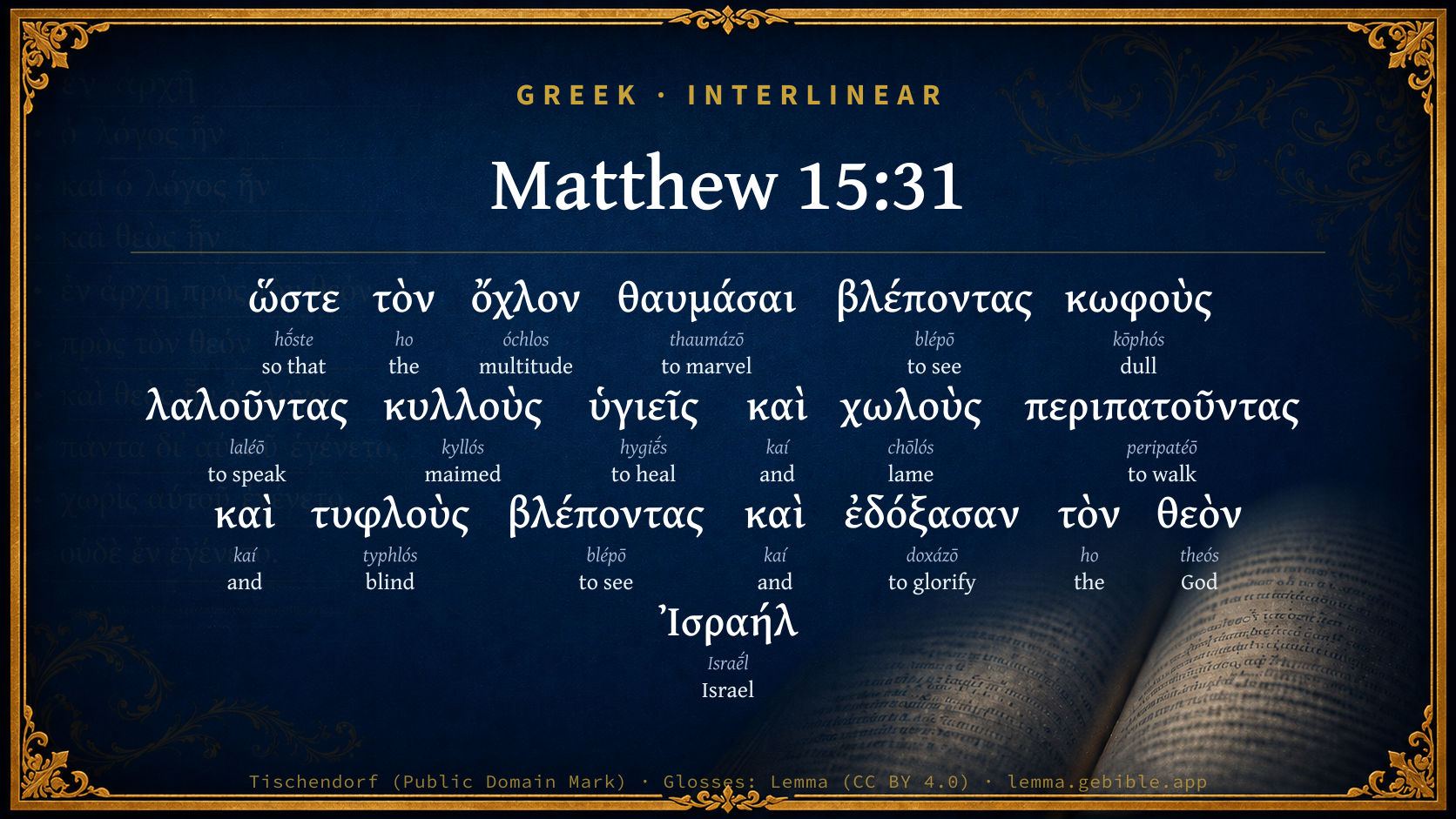
so that the multitude wondered when they saw the mute speaking, injured whole, lame walking, and blind seeing--and they glorified the God of Israel.
Download a study sheet
One document with this verse’s original text, its word-by-word gloss line, the meaning frame, cross-references with their text, attributed commentary, and full source and license credits — printable, and it pastes into notes with its structure intact.
This verse Autodidact and up
A passage Seminary Student
Up to 50 verses in one chapter. A passage sheet keeps up to 6 commentary sources and 12 cross-references per verse, in the order this page ranks them, and says so on the sheet whenever that leaves anything out. Ask for a single verse and you get the Autodidact verse sheet above.
Everything on this page stays free to read, with no account — the sheet is a download of what is already on screen, not access to it.
Compare translations 3
The same verse in 3 English versions, stacked beneath the original-language interlinear above. Click any original word for its lexicon entry.
Each is an independent rendering of the whole verse — the interlinear is not word-aligned to these translations.
Highlighted words mark where these versions differ — a whole-verse word diff, not a word-by-word alignment.
-
World English Bible Public Domain
so that the multitude wondered when they saw the mute speaking, injured whole, lame walking, and blind seeing--and they glorified the God of Israel.
-
King James Version Public Domain
Insomuch that the multitude wondered, when they saw the dumb to speak, the maimed to be whole, the lame to walk, and the blind to see: and they glorified the God of Israel.
-
unfoldingWord Literal Text CC BY-SA 4.0
so that the crowd marveled, seeing the mute speaking, the crippled healthy, and the lame walking, and the blind seeing, and they glorified the God of Israel.
unfoldingWord Literal Text — © unfoldingWord, licensed CC BY-SA 4.0. Word-aligned USFM3 via Door43 (git.door43.org/unfoldingWord/en_ult).
Show all 19 translations
Every available English version of this verse, each an independent rendering of the whole verse.
-
World English Bible Public Domain
so that the multitude wondered when they saw the mute speaking, injured whole, lame walking, and blind seeing--and they glorified the God of Israel.
-
Berean Standard Bible Public Domain
The crowd was amazed when they saw the mute speaking, the crippled restored, the lame walking, and the blind seeing. And they glorified the God of Israel.
-
Majority Standard Bible Public Domain
The crowds were amazed when they saw the mute speaking, the crippled restored, the lame walking, and the blind seeing. And they glorified the God of Israel.
-
King James Version Public Domain
Insomuch that the multitude wondered, when they saw the dumb to speak, the maimed to be whole, the lame to walk, and the blind to see: and they glorified the God of Israel.
-
American Standard Version (1901) Public Domain
insomuch that the multitude wondered, when they saw the dumb speaking, the maimed whole, and lame walking, and the blind seeing: and they glorified the God of Israel.
-
Revised Version (1885) Public Domain
insomuch that the multitude wondered, when they saw the dumb speaking, the maimed whole, and the lame walking, and the blind seeing: and they glorified the God of Israel.
-
Geneva Bible (1599) Public Domain
In so much that the multitude wondered, to see the dumme speake, the maimed whole, the halt to goe, and the blinde to see: and they glorified the God of Israel.
-
Douay-Rheims (1899) Public Domain
So that the multitudes marvelled seeing the dumb speak, the lame walk, and the blind see: and they glorified the God of Israel.
-
Young's Literal Translation Public Domain
so that the multitudes did wonder, seeing dumb ones speaking, maimed whole, lame walking, and blind seeing; and they glorified the God of Israel.
-
Literal Standard Version CC BY-SA 4.0
so that the multitudes wondered, seeing mute ones speaking, maimed whole, lame walking, and blind seeing; and they glorified the God of Israel.
-
Unlocked Literal Bible CC BY-SA 4.0
So the crowd marveled when they saw the mute persons speak, the crippled made well, the lame walking, and the blind seeing. They praised the God of Israel.
-
unfoldingWord Literal Text CC BY-SA 4.0
so that the crowd marveled, seeing the mute speaking, the crippled healthy, and the lame walking, and the blind seeing, and they glorified the God of Israel.
-
Darby Bible Public Domain
so that the crowds wondered, seeing dumb speaking, crippled sound, lame walking, and blind seeing; and they glorified the God of Israel.
-
World Messianic Bible Public Domain
so that the multitude wondered when they saw the mute speaking, the injured healed, the lame walking, and the blind seeing—and they glorified the God of Israel.
-
Webster's Bible Public Domain
So that the multitude wondered, when they saw the dumb to speak, the maimed to be whole, the lame to walk, and the blind to see: and they glorified the God of Israel.
-
Free Bible Version CC BY-SA 4.0
The crowd was astounded at what they saw happen: the deaf could speak, the crippled were healed, the lame could walk, and the blind could see. They praised the God of Israel.
-
Bible in Basic English Public Domain
So that the people were full of wonder when they saw that those who had no voice were talking, the feeble were made strong, those whose bodies were broken had the power of walking, and the blind were able to see: and they gave glory to the God of Israel.
-
Text-Critical English NT CC BY 4.0
So the crowds were amazed when they saw the mute speaking, the crippled made well, the lame walking, and the blind seeing. And they glorified the God of Israel.
-
Tyndale New Testament (1534) Public Domain
in so moche that the people wondred to se the dome speake the maymed whole the halt to go and the blynde to se. And they glorified the God of Israel.
Literal Standard Version (2020), Covenant Press — licensed CC BY-SA 4.0. Text via the HelloAO Bible API (eBible.org). Unlocked Literal Bible (unfoldingWord) — licensed CC BY-SA 4.0. Text via the HelloAO Bible API (eBible.org). unfoldingWord Literal Text — © unfoldingWord, licensed CC BY-SA 4.0. Word-aligned USFM3 via Door43 (git.door43.org/unfoldingWord/en_ult). Free Bible Version, Dr. Jonathan Gallagher — licensed CC BY-SA 4.0. Text via the HelloAO Bible API (eBible.org).
Word by word
More ways to search: Search by grammar → Find every occurrence → Compare this word →
Practice this passage: Drill this verse → Learn its vocabulary →
- Appears 4× in the Greek New Testament
- First appears at Matthew 15:30
- Part of Speech
- Adjective
- Case
- Accusative
- Number
- Plural
- Gender
- Masculine
Full Thayer's Definition
- ὥστε hṓste G5620 “so that” Conjunction
- τὸν ho G3588 “the” Article, Accusative, Singular, Masculine
- ὄχλον óchlos G3793 “multitude” Noun, Accusative, Singular, Masculine
- θαυμάσαι thaumázō G2296 “to marvel” Verb, Aorist, Active, Infinitive
- βλέποντας blépō G991 “to see” Verb, Present, Active, Participle, Accusative, Plural, Masculine
- κωφοὺς kōphós G2974 “dull” Adjective, Accusative, Plural, Masculine
- λαλοῦντας laléō G2980 “to speak” Verb, Present, Active, Participle, Accusative, Plural, Masculine
- κυλλοὺς kyllós G2948 “maimed” Adjective, Accusative, Plural, Masculine
- ὑγιεῖς hygiḗs G5199 “to heal” Adjective, Accusative, Plural, Masculine
- καὶ kaí G2532 “and” Conjunction
- χωλοὺς chōlós G5560 “lame” Adjective, Accusative, Plural, Masculine
- περιπατοῦντας peripatéō G4043 “to walk” Verb, Present, Active, Participle, Accusative, Plural, Masculine
- καὶ kaí G2532 “and” Conjunction
- τυφλοὺς typhlós G5185 “blind” Adjective, Accusative, Plural, Masculine
- βλέποντας blépō G991 “to see” Verb, Present, Active, Participle, Accusative, Plural, Masculine
- καὶ kaí G2532 “and” Conjunction
- ἐδόξασαν doxázō G1392 “to glorify” Verb, Aorist, Active, Indicative, 3rd person, Plural
- τὸν ho G3588 “the” Article, Accusative, Singular, Masculine
- θεὸν theós G2316 “God” Noun, Accusative, Singular, Masculine
- Ἰσραήλ Israḗl G2474 “Israel” Noun, Proper, indeclinable
About this verse
These counts appear in no published source. They are computed here, from the morphology-tagged text and Lemma’s own curated glosses. What Lemma adds →
- 20
- words
- 16
- distinct lemmas
- Gospels
- section
Cross-references
20Topical passages linked to Matthew 15:31 in the Treasury of Scripture Knowledge — connected by theme and wording, ordered by reader-vote popularity; previews shown in the World English Bible.
- Matthew 9:8 But when the multitudes saw it, they marveled and glorified God, who had given such authority to men.
- Luke 18:43 Immediately he received his sight, and followed him, glorifying God. All the people, when they saw it, praised God.
- Genesis 32:28 He said, "Your name will no longer be called 'Jacob,' but, 'Israel,' for you have fought with God and with men, and have prevailed."
- Psalms 50:15 Call on me in the day of trouble. I will deliver you, and you will honor me."
- Psalms 50:23 Whoever offers the sacrifice of thanksgiving glorifies me, And prepares his way so that I will show God's salvation to him."
- Matthew 9:33 When the demon was cast out, the mute man spoke. The multitudes marveled, saying, "Nothing like this has ever been seen in Israel!"
- Matthew 18:8 If your hand or your foot causes you to stumble, cut it off, and cast it from you. It is better for you to enter into life maimed or crippled, rather than having two hands or two feet to be cast into the eternal fire.
- Luke 7:16 Fear took hold of all, and they glorified God, saying, "A great prophet has arisen among us!" and, "God has visited his people!"
- Luke 17:15–18 One of them, when he saw that he was healed, turned back, glorifying God with a loud voice.
- Genesis 33:20 He erected an altar there, and called it El Elohe Israel.
- Exodus 24:10 They saw the God of Israel. Under his feet was like a paved work of sapphire stone, like the skies for clearness.
- Matthew 21:14 The blind and the lame came to him in the temple, and he healed them.
- Mark 2:12 He arose, and immediately took up the mat, and went out in front of them all; so that they were all amazed, and glorified God, saying, "We never saw anything like this!"
- Mark 7:37 They were astonished beyond measure, saying, "He has done all things well. He makes even the deaf hear, and the mute speak!"
- Mark 9:43 If your hand causes you to stumble, cut it off. It is better for you to enter into life maimed, rather than having your two hands to go into Gehenna, into the unquenchable fire,
- Luke 14:13 But when you make a feast, ask the poor, the maimed, the lame, or the blind;
- Luke 14:21 "That servant came, and told his lord these things. Then the master of the house, being angry, said to his servant, 'Go out quickly into the streets and lanes of the city, and bring in the poor, maimed, blind, and lame.'
- John 9:24 So they called the man who was blind a second time, and said to him, "Give glory to God. We know that this man is a sinner."
- Acts 3:2–11 A certain man who was lame from his mother's womb was being carried, whom they laid daily at the door of the temple which is called Beautiful, to ask gifts for the needy of those who entered into the temple.
- Acts 14:8–10 At Lystra a certain man sat, impotent in his feet, a cripple from his mother's womb, who never had walked.
Cross-references courtesy of OpenBible.info (CC BY 4.0).
Lesson kit
Teaching starters — assembled from the data on this page, not authored interpretation. Every prompt links to the verse data it draws on. Edit before teaching.
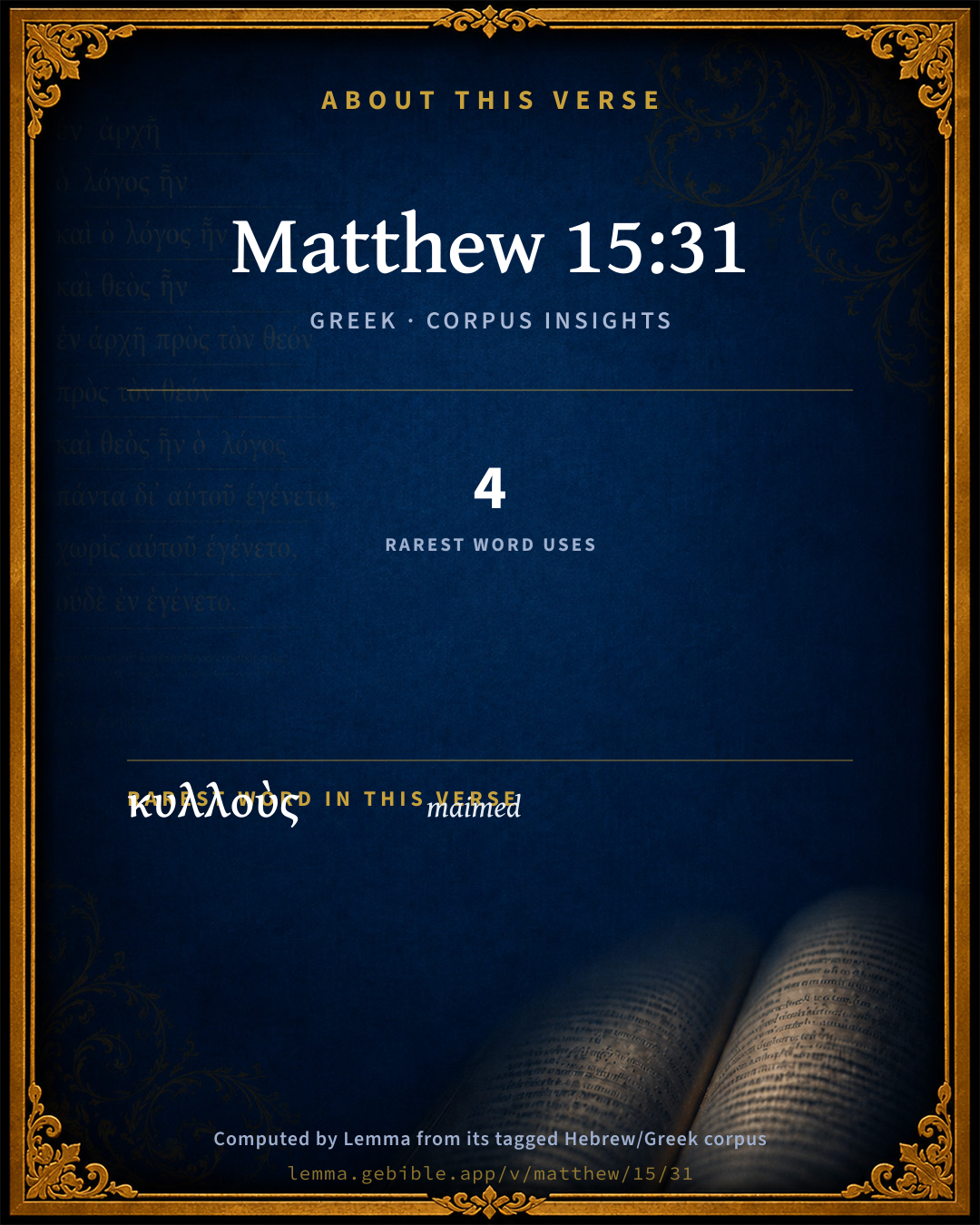
Matthew, in the Gospels, opens this verse with 20 words (16 distinct Greek lemmas). Its most distinctive word is kyllós (“maimed”). A historical commentator’s framing appears above. Read the whole chapter for the surrounding context.
Discussion questions
- What does “maimed” (kyllós) contribute to the verse as a whole?
- Matthew 15:30 shares the word «maimed» with this verse. How do the two illuminate each other?
- “to see” occurs 2× in this one verse. What is the effect of the repetition?
- These translations render this verse differently; the difference is in the English rendering, not the original. What questions does that raise?
- Reading how Expositor's Greek Testament and Adam Clarke's Commentary read this verse, where do the two commentators agree and where do they part?
Things to notice
- These translations choose different wording for 21 words in this verse.
- “to see” occurs 2× in this single verse.
- 16 distinct Greek lemmas span 20 words in this verse.
Commentary
Notes on Matthew 15:31 from classic Christian and Jewish commentators (each source and its license shown beneath its notes). The classic Christian expositions comment on the surrounding passage and are grouped to its opening verse, so a note may address several verses; the Jewish commentaries on the Tanakh (Rashi and others) are per-verse, so they appear only where the commentator wrote on this verse.
Lemma curates 59 commentaries, every one of them public domain or Creative Commons licensed, each selected and text-cleaned for this edition rather than reprinted as found. About our sources →
Expositor's Greek Testament
ed. W. Robertson Nicoll
The Expositor's Greek Testament, edited by W. Robertson Nicoll (1897–1910) — public domain. Text from a community e-Sword module.
Adam Clarke's Commentary
Adam Clarke's Commentary on the Bible (1810–1826) — public domain. Text from a community e-Sword/MySword module.
John Gill's Exposition
John Gill's Exposition of the Whole Bible (1746–1763) — public domain (CC PDM 1.0). Text via the HelloAO Bible API.
Trapp's Complete Commentary
John Trapp
John Trapp, A Commentary or Exposition upon All the Books of the Old and New Testament (1647–1656) — public domain. Text from a community e-Sword module.
Matthew Poole's English Annotations
Matthew Poole's English Annotations on the Holy Bible (1683–1685) — public domain. Text from a community e-Sword/MySword module.
Whedon's Commentary on the Bible
Daniel D. Whedon
Daniel D. Whedon (gen. ed.), Commentary on the Old and New Testaments (1874–1909) — public domain. Text from a community e-Sword module.
The Pulpit Commentary
The Pulpit Commentary (1880–1919), ed. H.D.M. Spence-Jones & Joseph S. Exell — public domain. Text from a community e-Sword module.
The People's New Testament
B. W. Johnson
B. W. Johnson's The People's New Testament with Notes (1889–1891) — public domain. Electronic text from the Christian Classics Ethereal Library (CCEL) ThML edition.
Alford’s Greek Testament
Henry Alford
Henry Alford, The Greek Testament (1849–1861) — public domain. Text from a community e-Sword module.