Matthew 11:18

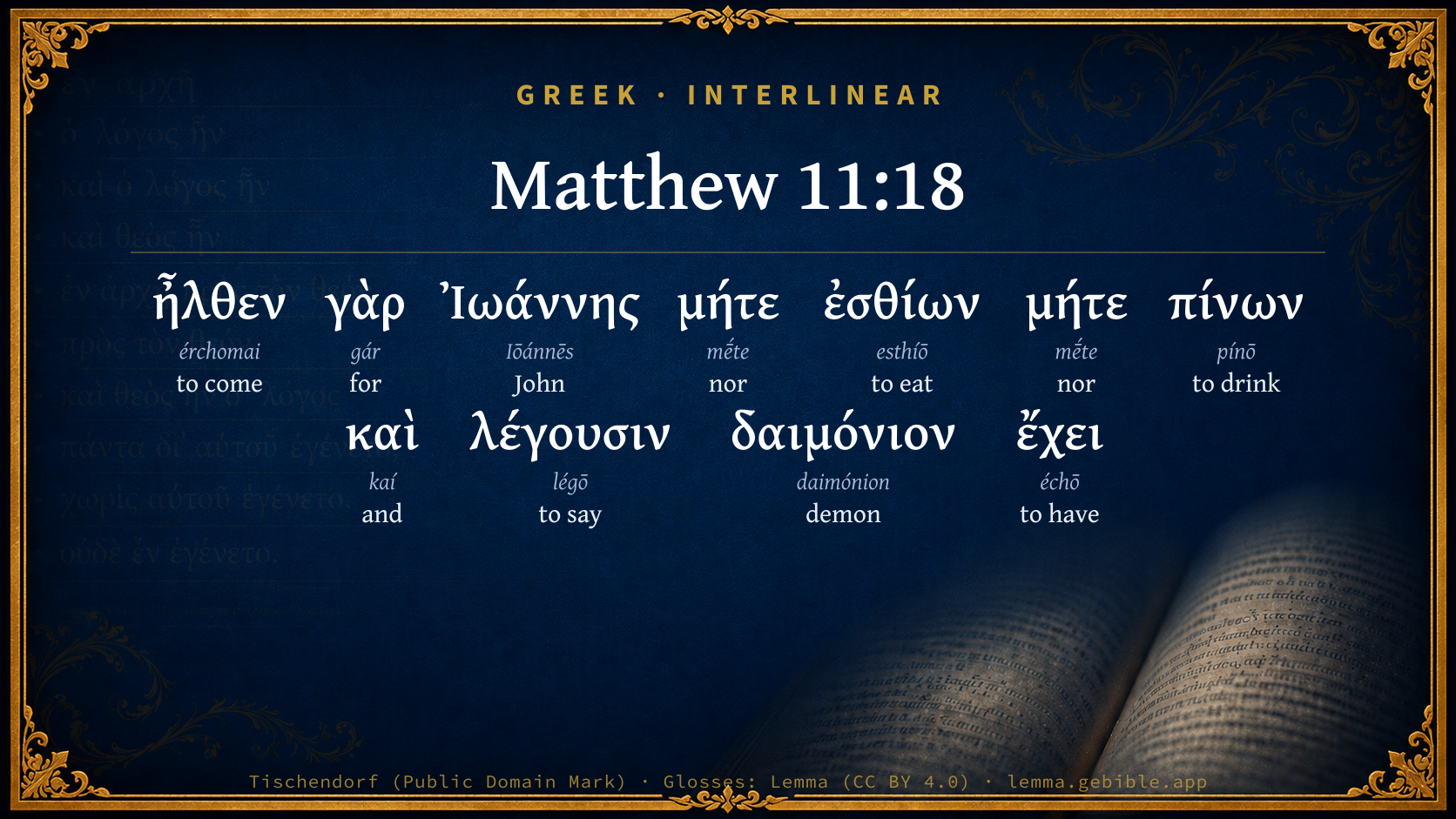
Greek (Tischendorf 8th ed.) Matthew 11:18 appears in the Greek New Testament. The text above is from the Tischendorf 8th edition. Each word links to its Strong’s number and a concise gloss. Click any word for its full Thayer’s Greek Lexicon entry.
Download image
Cite this verse

Matthew 11:18 (World English Bible). Public Domain. Lemma interlinear Bible study tool, https://lemma.gebible.app/v/matthew/11/18.

Show BibTeX & RIS
BibTeX
RIS
English Translation
For John came neither eating nor drinking, and they say, 'He has a demon.'
World English Bible · Public Domain
Download a study sheet

One document with this verse’s original text, its word-by-word gloss line, the meaning frame, cross-references with their text, attributed commentary, and full source and license credits — printable, and it pastes into notes with its structure intact.

This verse Autodidact and up

Study sheet (.html) Plain text (.txt)

A passage Seminary Student

Up to 50 verses in one chapter. A passage sheet keeps up to 6 commentary sources and 12 cross-references per verse, in the order this page ranks them, and says so on the sheet whenever that leaves anything out. Ask for a single verse and you get the Autodidact verse sheet above.

Everything on this page stays free to read, with no account — the sheet is a download of what is already on screen, not access to it.

Want to remove ads? Support Godless Engineer
Compare translations 3

The same verse in 3 English versions, stacked beneath the original-language interlinear above. Click any original word for its lexicon entry.

Each is an independent rendering of the whole verse — the interlinear is not word-aligned to these translations.

Highlighted words mark where these versions differ — a whole-verse word diff, not a word-by-word alignment.

  • World English Bible Public Domain
    For John came neither eating nor drinking, and they say, 'He has a demon.'
  • King James Version Public Domain
    For John came neither eating nor drinking, and they say, He hath a devil.
  • unfoldingWord Literal Text CC BY-SA 4.0
    For John came neither eating nor drinking, and they say, ‘He has a demon.’

unfoldingWord Literal Text — © unfoldingWord, licensed CC BY-SA 4.0. Word-aligned USFM3 via Door43 (git.door43.org/unfoldingWord/en_ult).

Versions to compare (up to 4)

3 of 4 selected

Show all 19 translations

Every available English version of this verse, each an independent rendering of the whole verse.

  • World English Bible Public Domain
    For John came neither eating nor drinking, and they say, 'He has a demon.'
  • Berean Standard Bible Public Domain
    For John came neither eating nor drinking, and they say, ‘He has a demon!’
  • Majority Standard Bible Public Domain
    For John came neither eating nor drinking, and they say, ‘He has a demon!’
  • King James Version Public Domain
    For John came neither eating nor drinking, and they say, He hath a devil.
  • American Standard Version (1901) Public Domain
    For John came neither eating nor drinking, and they say, He hath a demon.
  • Revised Version (1885) Public Domain
    For John came neither eating nor drinking, and they say, He hath a devil.
  • Geneva Bible (1599) Public Domain
    For Iohn came neither eating nor drinking, and they say, He hath a deuill.
  • Douay-Rheims (1899) Public Domain
    For John came neither eating nor drinking; and they say: He hath a devil.
  • Young's Literal Translation Public Domain
    `For John came neither eating nor drinking, and they say, He hath a demon;
  • Literal Standard Version CC BY-SA 4.0
    For John came neither eating nor drinking, and they say, He has a demon;
  • Unlocked Literal Bible CC BY-SA 4.0
    For John came not eating bread or drinking wine, and they say, 'He has a demon.'
  • unfoldingWord Literal Text CC BY-SA 4.0
    For John came neither eating nor drinking, and they say, ‘He has a demon.’
  • Darby Bible Public Domain
    For John has come neither eating nor drinking, and they say, He has a demon.
  • World Messianic Bible Public Domain
    For Yochanan came neither eating nor drinking, and they say, ‘He has a demon.’
  • Webster's Bible Public Domain
    For John came neither eating nor drinking, and they say, He hath a demon.
  • Free Bible Version CC BY-SA 4.0
    John didn't come feasting and drinking, so people say, ‘He's devil-possessed!’
  • Bible in Basic English Public Domain
    For John came, taking no food or drink, and they say, He has an evil spirit.
  • Text-Critical English NT CC BY 4.0
    For John came neither eating nor drinking, and they say, ‘He has a demon.’
  • Tyndale New Testament (1534) Public Domain
    For Ihon came nether eatinge nor drinkinge and they saye he hath the devyll.

Literal Standard Version (2020), Covenant Press — licensed CC BY-SA 4.0. Text via the HelloAO Bible API (eBible.org). Unlocked Literal Bible (unfoldingWord) — licensed CC BY-SA 4.0. Text via the HelloAO Bible API (eBible.org). unfoldingWord Literal Text — © unfoldingWord, licensed CC BY-SA 4.0. Word-aligned USFM3 via Door43 (git.door43.org/unfoldingWord/en_ult). Free Bible Version, Dr. Jonathan Gallagher — licensed CC BY-SA 4.0. Text via the HelloAO Bible API (eBible.org).

Word by word

More ways to search: Search by grammar → Find every occurrence → Compare this word →

Practice this passage: Drill this verse → Learn its vocabulary →

About this verse

These counts appear in no published source. They are computed here, from the morphology-tagged text and Lemma’s own curated glosses. What Lemma adds →

11
words
10
distinct lemmas
Gospels
section

Shared distinctive vocabulary

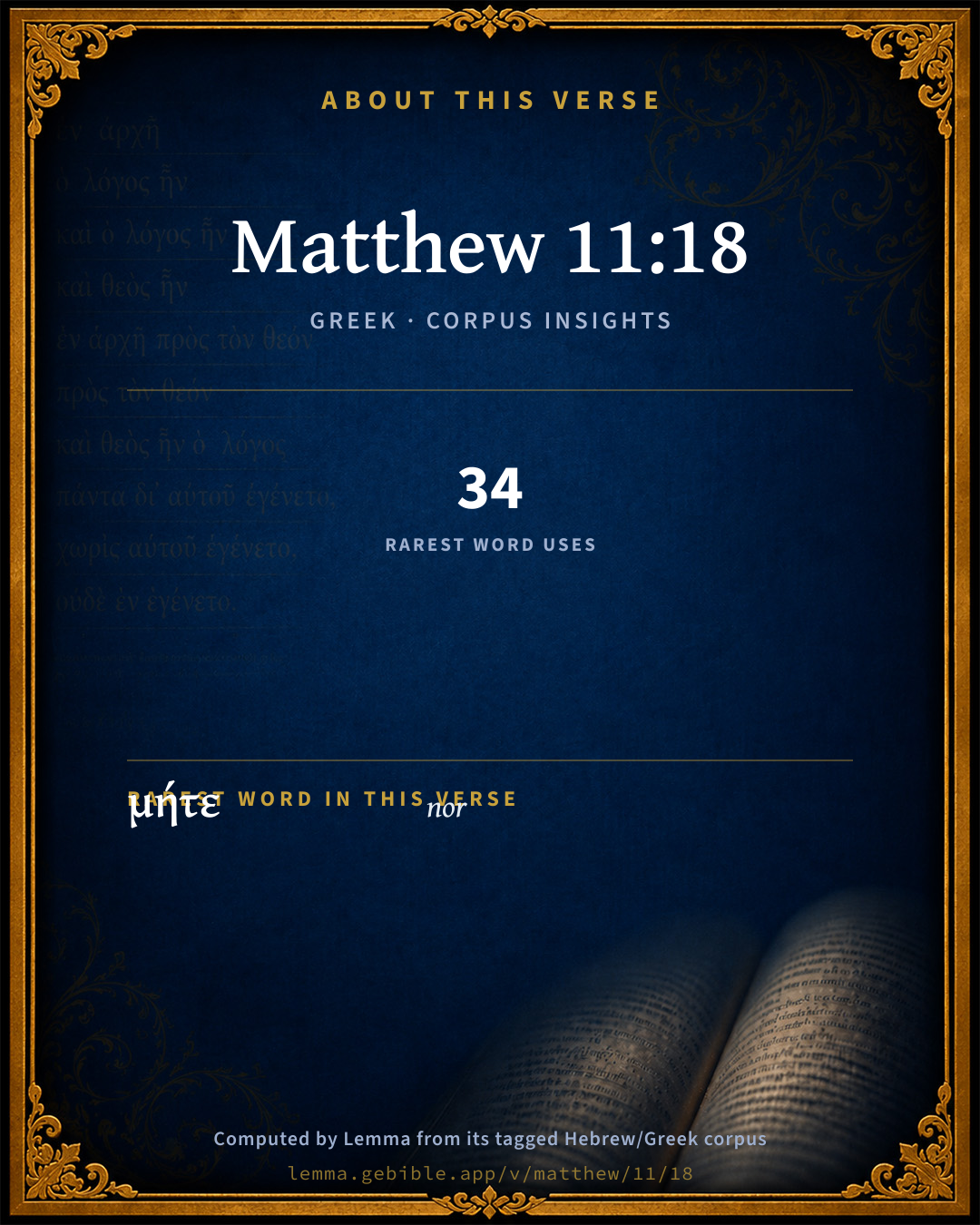
μήτε nor G3383 occurs in 16 verses of the Greek New Testament. Also found in:

Repetition

A word recurs within this verse:

Cross-references

13

Topical passages linked to Matthew 11:18 in the Treasury of Scripture Knowledge — connected by theme and wording, ordered by reader-vote popularity; previews shown in the World English Bible.

  • Matthew 3:4 Now John himself wore clothing made of camel's hair, with a leather belt around his waist. His food was locusts and wild honey.
  • Luke 1:15 For he will be great in the sight of the Lord, and he will drink no wine nor strong drink. He will be filled with the Holy Spirit, even from his mother's womb.
  • Matthew 10:25 It is enough for the disciple that he be like his teacher, and the servant like his lord. If they have called the master of the house Beelzebul, how much more those of his household!
  • John 10:20 Many of them said, "He has a demon, and is insane! Why do you listen to him?"
  • Jeremiah 15:17 I didn't sit in the assembly of those who make merry, nor rejoiced; I sat alone because of your hand; for you have filled me with indignation.
  • John 8:48 Then the Jews answered him, "Don't we say well that you are a Samaritan, and have a demon?"
  • Hosea 9:7 The days of visitation have come. The days of reckoning have come. Israel will consider the prophet to be a fool, And the man who is inspired to be insane, Because of the abundance of your sins, And because your hostility is great.
  • John 7:20 The multitude answered, "You have a demon! Who seeks to kill you?"
  • 2 Kings 9:11 Then Jehu came forth to the servants of his lord: and one said to him, Is all well? why came this mad fellow to you? He said to them, You know the man and what his talk was.
  • Jeremiah 16:8–9 You shall not go into the house of feasting to sit with them, to eat and to drink.
  • Jeremiah 29:26 Yahweh has made you priest in the place of Jehoiada the priest, that there may be officers in the house of Yahweh, for every man who is mad, and makes himself a prophet, that you should put him in the stocks and in shackles.
  • Acts 26:24 As he thus made his defense, Festus said with a loud voice, "Paul, you are crazy! Your great learning is driving you insane!"
  • 1 Corinthians 9:27 but I beat my body and bring it into submission, lest by any means, after I have preached to others, I myself should be rejected.

Cross-references courtesy of OpenBible.info (CC BY 4.0).

Commentary

Notes on Matthew 11:18 from classic Christian and Jewish commentators (each source and its license shown beneath its notes). The classic Christian expositions comment on the surrounding passage and are grouped to its opening verse, so a note may address several verses; the Jewish commentaries on the Tanakh (Rashi and others) are per-verse, so they appear only where the commentator wrote on this verse.

Lemma curates 59 commentaries, every one of them public domain or Creative Commons licensed, each selected and text-cleaned for this edition rather than reprinted as found. About our sources →

Tyndale Open Study Notes

Tyndale Open Resources

11:18-19 Here Jesus describes the specific ways in which John and Jesus offended the present generation. John, who stayed in the wilderness and ate locusts and honey (3:1, 4), was accused of being possessed by a demon; while Jesus, who ate and drank freely, was accused of being a rebellious son (see Deut 21:18-21).

Tyndale Open Study Notes — © Tyndale Open Resources, licensed CC BY-SA 4.0. Text via the HelloAO Bible API.

Bengel's Gnomon

Johann Albrecht Bengel

Mat 11:18. Ἦλθε, came) A striking instance of Anaphora;[531] cf. Mat 11:19.—ΜΉΤΕ ἘΣΘΊΩΝ, neither eating) John did not eat with others, nor even in the presence of others. His mode of life agreed with the character of his teaching, and so did that of Christ [with the character of HIS teaching.] Therefore the one is, as it were, implied by the other.—μήτε πίνων, nor drinking) See Luk 1:15.—λέγουσι, they say) The world disparages virtue, representing it as the extreme; it advocates the cause of vice, representing it as the mean.—δαιμόνἱον, a devil) in common parlance, a familiar spirit.—ἔχει, He has) A reproach common to the Jews, by which they denoted one who was mad, or silly, or proud. They who abstain from the society of men, easily incur this suspicion.

[531] See Append. The same word repeated in the beginnings of sentences or sections, in order to mark them.—ED.

Bengel's Gnomon of the New Testament — English translation (T&T Clark, Edinburgh, 1860) — public domain. Text from a community e-Sword module.

Meyer's Critical & Exegetical Commentary

Heinrich August Wilhelm Meyer

Mat_11:18-19. Μήτε ἐσθίων μήτε πίνων] hyperbolical; ἡ μὲν Ἰωάννου δίαιτα δυσπρόσιτος καὶ τραχεῖα, Euth. Zigabenus. Comp. Mat_3:4; Luk_1:15; Dan_10:3. In contrast to the liberal principles of Jesus, who ate and drank without imposing upon Himself Nazarite abstinences (like John) or regular fastings (Mat_9:14), or without declining (like the Pharisees) to go to entertainments provided by those in a different rank of life from His own.

δαιμόνιον ἔχει] which, through perverting His judgment, leads Him into those ascetic eccentricities; comp. Joh_10:20.

φαγός] glutton, is a word belonging to a very late period. See Lobeck, ad Phryn. p. 434; on the accent, Lipsius, gramm. Unters. p. 28.

καὶ ἐδικαιώθη ἡ σοφία ἀπὸ τῶν τέκνων αὐτῆς] not a continuation of the words of the Jews, in which case ἐδικαιώθη would have to be taken ironically (in answer to Bornemann), but the closing observation of Jesus in reference to the perverse manner in which His own claims and those of John had been treated by the Jews; and justified (i.e. shown to be the true wisdom) has been the wisdom (the divine wisdom which has been displayed in John and me) on the part of her children, i.e. on the part of those who reverence and obey her (Sir_4:11), who, through their having embraced her and followed her guidance, have proved how unwarranted are those judgments of the profanum vulgus; comp. Luk_7:29. The (actual) confirmation has come to wisdom from those devoted to her (ἀπό, comp. on Act_2:22; Hermann, ad Soph. El. 65; Kühner, ad Xen. Anab. vi. 5. 18; not ὑπό). Those disciples of wisdom are the same who in Mat_11:12 are said βιάζειν τὴν βασιλείαν; but the καί which introduces the passage cum vi pronuntiandum est, ut saepe in sententiis oppositionem continentibus, ubi frustra fuere, qui καίτοι requirerent, Stallbaum, ad Plat. Apol. p. 29 B. Such a use of καί occurs with special frequency in John. Wolf, ad Lept. p. 238; Hartung, Partikell. I. p. 147. This view is in the main that of (though in some cases the τέκνα τῆς σοφίας has been too much limited by being understood as referring merely to the disciples of Jesus) Jerome (ego, qui sum Dei virtus et sapientia Dei, juste fecisse ab apostolis meis filiis comprobatus sum), Münster, Beza, Vatablus, Calovius, Hammond, Jansen, Fritzsche, Olshausen, de Wette, Ebrard, Bleek, Lange, Hofmann, Keim, Weiss. Yet many, while also retaining the meaning given above, take the aorist, though without any warrant from the text, or any example of it in the New Testament, in the sense of cherishing (see Kühner, II. 1, p. 139; Fritzsche, ad Rom. I. p. 305), as Kuinoel (sapientia non nisi a sapientiae cultoribus et amicis probatur et laudatur, reliqui homines eam rident, etc.). Chrysostom, Theophylact, and Castalio understand the words as expressing the thought that the wisdom manifested in Jesus has nothing to answer for with regard to the Jews (similarly Weizsäcker); a view to which it may be objectedfirst, that δικαιοῦσθαι ἀπό τινος cannot be taken in the sense of to be free from the guilt of any one (δικ. ἀπὸ τῆς ἁμαρτίας τινός; comp. Sir_26:29; Rom_6:7); and secondly, that the Jews, unless something in the context should specially suggest or lead to it, cannot straightway be spoken of as the children of wisdom. The latter objection is equally applicable to the explanation of Schneckenburger: and so wisdom (which is supposed to mean Gods care for His people; comp. also Euth. Zigabenus and Grotius) has been treated cavalierly (has been arrogantly condemned) by her own children, which, moreover, is precluded by the fact that δικαιοῦσθαι is never used in this sense in the New Testament. Oppenrieder, p. 441 f., likewise understands the children of wisdom to refer to the Jews, inasmuch, that is, as they were subjected to the discipline of divine wisdom. The doings of σοφία were demonstrated to be righteous by the conduct of the Jews; that is to say, they had desired, instead of John, a divine messenger of a less ascetic character (and him the divine wisdom sent them in the person of Christ); while, on the other hand, instead of Christ, with His freer manner of life, they desired one more rigorously disposed (and this wish the divine wisdom had gratified by giving them the Baptist). So far Schneckenburger. But this conduct of the Jews was capricious and wilful, and was ill calculated to display the justice of the divine dealings, which it could have done only if it had been supposed to proceed from a feeling of real moral need, for which, however, in Mat_11:16-19, Jesus shows Himself by no means inclined to give them credit. Besides, one is at a loss to see, even if this view were adopted, how the Jews with their foolish and obstinate behaviour should come to be called τέκνα τῆς σοφίας. According to Ewald (Gesch. Chr. p. 432), Jesus means to say that it is just her wrong-headed children (who quarrel with her) that do most to justify the divine wisdom by their not knowing, with all their wisdom, what they would really like. But this view, again, which necessitates an antiphrastic interpretation of the τέκνα τῆς σοφίας, finds no support in the text, besides involving accessory thoughts to which there is no allusion. Similarly Calvin even understood the words to refer to the Jews who thought themselves so wise; before whom, however, wisdom is supposed to assert her dignity and authority through the medium of her genuine children.

Meyer — Critical and Exegetical Commentary on the New Testament — English translation by Peter Christie, edited by Frederick Crombie (T&T Clark, 1880) — public domain. Text from a community e-Sword module.

Expositor's Greek Testament

ed. W. Robertson Nicoll

Mat 11:18 . he commentary on the parable showing that it was the reception given to John and Himself that suggested it. μήτε ἐσθ . μήτε πιν .: eating and drinking, the two parts of diet; not eating nor drinking = remarkably abstemious, ascetic, that his religious habit; μήτε not οὐτε , to express not merely the fact, but the opinion about John. Vide notes on chap. Mat 5:34 . δαιμόνιον ἔχει : is possessed, mad, with the madness of a gloomy austerity. The Pharisee could wear gloomy airs in fasting (Mat 6:16 ), but that was acting . The Baptist was in earnest with his morose, severely abstinent life. Play for them, grim reality for him; and they disliked it and shrank from it as something weird. None but Pharisees would dare to say such a thing about a man like John. They are always so sure, and so ready to judge. Ordinary people would respect the ascetic of the wilderness, though they did not imitate him.

The Expositor's Greek Testament, edited by W. Robertson Nicoll (1897–1910) — public domain. Text from a community e-Sword module.

Adam Clarke's Commentary

Verse 18. For John came neither eating nor drinking] Leading a very austere and mortified life: and yet, he did not receive him. A sinner will not be persuaded that what he has no mind to imitate can come from God. There are some who will rather blame holiness itself, than esteem it in those whom they do not like.

He hath a devil.] He is a vile hypocrite, influenced by a demon to deceive and destroy the simple.

Adam Clarke's Commentary on the Bible (1810–1826) — public domain. Text from a community e-Sword/MySword module.

Ellicott's Commentary for English Readers

(18) He hath a devil.—The phrase was a common one, asserting at once the fact of insanity, and ascribing it to demoniacal possession as its cause. (Comp. Joh_7:20; Joh_8:48.) This was the explanation which the scribes gave of John’s austerities. The locusts and wild honey were to them the diet of a madman.

A Bible Commentary for English Readers, edited by Charles John Ellicott (1878–1897) — public domain. Text from a community e-Sword module.

John Gill's Exposition

The son of man came eating and drinking,.... Meaning himself, who ate and drank as men usually do, lived in the common way of life, was free and sociable, went to feasts, entertainments, and weddings, when he was invited; and was affable, courteous, and friendly in his deportment, to all men;

and they say, behold a man gluttonous, a voracious man, an epicurean, one that indulges his appetite to a very great degree, and in a scandalous manner;

a winebibber, a common tippler, one that drinks to excess; whom the Rabbins call (k), who is one, they say, that drinks up his cup at one draught; one that is given to wine, and is greedy of it:

a friend of publicans and sinners; such as are openly and notoriously wicked; and loves their company, for the sake of tippling with them; and encourages them in their revelling and drunkenness; a very black charge this!

But wisdom is justified of her children; either the wisdom of God, in making use of ministers of a different disposition and deportment, whereby some are gained, and others left inexcusable: or the Gospel, in which there is such a display of divine wisdom, which is vindicated from the charge of licentiousness, by the agreeable lives and conversations of the children of God: or rather Christ himself, who is the wisdom of God; and in whom are hid all the treasures of wisdom and knowledge; who, however he may be traduced by ignorant and malicious men, yet will be acquitted from all such charges, as here insinuated, by all the true sons of wisdom; or by such, who are made wise unto salvation. We may learn from hence, that no sort of preachers and preaching will please some men; that the best of Gospel ministers may be reproached as libertines, or madmen; and that they will be sooner, or later, justified and cleared from all such aspersions.

(k) T. Bab. Pesachim, fol. 86. 2. Betza, fol. 25. 2.

John Gill's Exposition of the Whole Bible (1746–1763) — public domain (CC PDM 1.0). Text via the HelloAO Bible API.

Trapp's Complete Commentary

John Trapp

18 For John came neither eating nor drinking, and they say, He hath a devil.

Ver. 18. For John came neither eating, &c.] So froward men are and gobble up, that no preacher can please them. If he preach plainly, it will seem careless slubbering: if elaborately, curious affectation. And for his life; austere John hath a devil, sociable Christ is a winebibber. And it was the worse, because from scribes and Pharisees, whose word must carry such credit with it, as alone to condemn Christ; and whose life must be a rule to others. Do any of the Pharisees believe in him? In this case duty must be done, however it be construed. Evil men, when they learn to think well, will learn to report well. Let our lives and labours in the Lord’s work confute them: and though they should by their reproaches bury our good names in their throats, those open sepulchres, yet at utmost, when Christ comes to judgment, there shall be a resurrection of names as well as of bodies. "Be patient therefore, brethren, unto the coming of the Lord," Jas 5:7.

And they say he hath a devil] So Staphylus and Surius said that Luther learned his divinity of the devil. The Jesuits affirm that he was stirred up by the devil, and they were sent out by God to resist him. Himself knew all this, and took it well aworth. Prorsus Satan est Lutherus (saith he in an epistle to Spalatinus), sed Christus vivit et regnat: Amen. He adds his Amen to it.

John Trapp, A Commentary or Exposition upon All the Books of the Old and New Testament (1647–1656) — public domain. Text from a community e-Sword module.

Haydock's Catholic Bible Commentary

He hath a devil. Those possessed by devils, were often accustomed to pass their time in the open air, to use unusual food, and sometimes to refrain a considerable time from meat and drink. (Menochius)

George Leo Haydock (1774–1849), Haydock's Catholic Family Bible and Commentary, 1859 edition — public domain. Excludes Psalms (Douay-Rheims chapter numbering differs from Protestant) and Deuterocanonical books (Catholic canon only).

Matthew Poole's English Annotations

Luke hath the same words, Luk 7:33-35. The sense of the words is this: God hath by his providence used all means to win this people to the gospel. The doctrine of John the Baptist and Christ was the same, but their temper and converse was very different: John was an austere and morose man, Christ was of a more free and familiar conversation; but these men would neither give the one nor the other a good word; they reviled both of them, and rejected them both, and the doctrine which they brought.

John came neither eating nor drinking, that is, not as other men ordinarily do; he was a man that lived most in the wilderness, and fed upon very ordinary diet, not eating with publicans and sinners, not coming at any feasts, &c.; and they said of him, He hath a devil; he is a melancholic, hypochondriac fellow, a kind of a madman.

The Son of man came eating and drinking, he was of a more affable, pleasant temper, of a more free and less reserved converse, eating and drinking as other men (though keeping to the law of temperance) such things as the country afforded, not refusing to be present at feasts, though publicans and sinners were there. They said of him, Behold a man gluttonous, and a winebibber, a friend of publicans and sinners: he displeased them with the two great freedom of his conversation; from whence, by the way, they may be better instructed, who place some perfection, or merit, in living like monks and hermits; by that rule John the Baptist was to be preferred before Christ. But Christ could please the Pharisees and lawyers, and their followers, no more than John did. They could not say he was melancholic or morose; but they blasphemed him to a higher degree, calling him a glutton and drunkard, and a friend of publicans and sinners. A godly man, let his temper and converse be what it will, pleaseth none who hateth the truth of the gospel, and the power of godliness. If he be reserved, then he is a morose, melancholic man; if he be of a more free and open converse, then he is a drunkard, or a glutton; something or other they must have to say against a man that will not run with them to the same excess of riot, though they lay to their charge things that they know not. The business is, they hate the power of godliness in them. This instance of these men’s thus treating John the Baptist and Christ, is of mighty use to strengthen those who meet with the very same things.

But wisdom is justified of her children. There is a great variety amongst interpreters in giving the sense of these words. Some think them spoken ironically, for the Pharisees went for the children of wisdom. Some think them spoken plainly, and think it should be, wisdom is judged, or condemned, of her children; but though the word δικαιοομαι, signifying to justice or do justice to another, which, according to the merit or demerit of the person, may be by justifying or condemning, upon which account it was true here that wisdom was condemned of those who pretended to be her children, and the word is so used in other authors, yet we have no such usage of it in Scripture. Not to reckon the various senses others put upon the words, the plain sense of them seems to be this. It is a proverbial speech, something like that, Ars non habet inimicum praeter ignorantem, Learning hath no enemies but the ignorant.

1. I, who am the Wisdom of God, am justified by you, who truly believe on me: you know I am no glutton, no winebibber, no friend of publicans and sinners. Or;

2. Grace is justified of all that are partakers of it. Godly men that are wise will own the grace of God in all men, whether they be of John’s temper or of mine, whether of more austere or more pleasant tempers. Or;

3. The wise counsel of God, making use of several instruments of several tempers to win these people unto his gospel, will be justified, that is, acquitted, defended, praised, adored of those who belong unto God, and are acquainted with his wisdom and counsels.

Luke saith, The people justified God, Luk 7:29. Some, by the children of wisdom, understand the scribes and Pharisees themselves, (who thought themselves the children of wisdom), or the generality of the Jews, who were condemned in their own consciences, and could not but in heart justify Christ, though in their speeches they condemned him. But Christ never called them the children of wisdom. This interpretation therefore seemeth something strained. That which seemeth the most natural is what I before hinted. Though those that pretend to be the children of wisdom thus speak of John and of me, yet those who are truly wise will justify me, and also the counsels and wisdom of my Father in the use of all means to bring them to receive the glad tidings of salvation, brought to them both by my more austere and reserved forerunner, and by myself, who have chosen, though a holy and unblamable, yet a more free and pleasant way of converse with them.

Matthew Poole's English Annotations on the Holy Bible (1683–1685) — public domain. Text from a community e-Sword/MySword module.

The Pulpit Commentary

For John came neither eating (Mat_3:4) nor drinking, (Luk_1:15) and they say, He hath a devil; i.e. he is possessed of strange and melancholy fancies. (see Bishop Westcott on Joh_7:20)

The Pulpit Commentary (1880–1919), ed. H.D.M. Spence-Jones & Joseph S. Exell — public domain. Text from a community e-Sword module.

John Wesley's Explanatory Notes

John came neither eating nor drinking - In a rigorous austere way, like Elijah. And they say, He hath a devil - Is melancholy, from the influence of an evil spirit.

John Wesley, Explanatory Notes Upon the Whole Bible (1754–1765) — public domain. Text via the GEBible commentary corpus.

Scofield Reference Notes

C. I. Scofield

devil demon.

(See Scofield "Mat 7:22").

The Scofield Reference Bible (1917 edition), notes by C. I. Scofield — public domain. Text from a community e-Sword module.

Kretzmann's Popular Commentary

Paul E. Kretzmann

The direct application:

v. 18. For John came neither eating nor drinking, and they say, He hath a devil.

v. 19. The Son of Man came eating and drinking, and they say, Behold a man gluttonous, and a wine-bibber, a friend of publicans and sinners. But wisdom is justified of her children.

The proof for the accusation of childishness. When John the Baptist led an austere life, not eating nor drinking, confining his food to the articles most necessary to sustain life, the suspicion was raised that he must surely be mad. The Pharisee loved to play at fasting and act the role of an abstemious holy person, but he could not endure the earnest, sincere preacher. The contrast is very strong in the language of Christ: Came John neither eating nor drinking,—Came the Son of Man eating and drinking. Jesus, in His outward behavior, purposely did not distinguish Himself from ordinary men. He neither advocated nor practiced false asceticism, works for mere show before men. And the result: In horrified outrage they point the finger of scorn at Him. What a glutton, what a wine-bibber, what a toper! The criticism is harsh, unjust, childish, but in total harmony with the character of the Pharisees. "They play at religion; with all their seeming earnestness in reality triflers. They are also fickle, fastidious, given to peevish fault-finding, easily offended. These are recognizable features of the Pharisees. They were great zealots and precisians, yet not in earnest, rather haters of earnestness, as seen in different ways in John and Jesus. They were hard to please: equally dissatisfied with John and with Jesus; satisfied with nothing but their own artificial formalism. " This perverse generation has its representatives on earth even today. The world wants nothing either of John or of Jesus. The preaching of the Law, of repentance, hurts their fine sensibilities, but the Gospel of free grace and mercy in Christ Jesus is still less to their liking. The comfort of Christ under such circumstances is that wisdom is justified of her children, of her works, or fruits. This proverb, as it stands, may mean: Christ, the personal Wisdom, Pro 8:1-36; Pro 9:1-18, was obliged to justify Himself against the judicial verdict of those who should be His children, but refused to accept Him; or: The wisdom of God, present in the preaching of John, and embodied in the person of Jesus, was justified, acknowledged, given its right by the children of wisdom, who accepted its teachings. Thus the heavenly Wisdom always finds some disciples and children that receive Him gladly and are, in turn, instructed in the way of salvation by grace.

Paul E. Kretzmann, Popular Commentary of the Bible (1921–1924) — public domain. Text from a community e-Sword module.

The People's New Testament

B. W. Johnson

18. John came neither eating nor drinking. At feasts. He lived abstemiously and austerely. He hath a demon. They accused him of being under the influence of evil spirits; of being a crank, or fanatic.

B. W. Johnson's The People's New Testament with Notes (1889–1891) — public domain. Electronic text from the Christian Classics Ethereal Library (CCEL) ThML edition.

unfoldingWord translationNotes

Door43 World Missions Community

Connecting Statement:

Jesus concludes talking to the crowds about John the Baptist.

not eating bread or drinking wine

Here "bread" refers to food. It does not mean that John never ate food. It means he fasted often, and when he ate, he did not eat good, expensive food. AT: "frequently fasting and not drinking alcohol" or "not eating fancy food and not drinking wine" (See: Synecdoche and Assumed Knowledge and Implicit Information)

they say, 'He has a demon.'

This can be translated as an indirect quote. AT: "they say that he has a demon" or "they accuse him of having a demon" (See: Direct and Indirect Quotations)

they say

All occurrences of "they" refer to the people of that generation, and most specifically to the Pharisees and religious leaders.

The Son of Man came

Jesus is referring to himself. AT: "I, the Son of Man, came" (See: First, Second, or Third Person)

came eating and drinking

This is the opposite of John's behavior. This means more than just consuming the normal amount of food and drink. It means Jesus celebrated and enjoyed good food and drink like other people did.

they say, 'Look, he is a gluttonous man and a drunkard ... sinners!'

This can be translated as an indirect quote. AT: "they say that he is a gluttonous man and a drunkard ... sinners." or "they accuse him of eating and drinking too much and of being ... sinners." (See: Direct and Indirect Quotations)

they say, 'Look, he is a gluttonous man and a drunkard ... sinners!'

If you translated "The Son of Man" as "I, the Son of man," you can state this as an indirect statement and use the first person. AT: "they say that I am a gluttonous man and a drunkard ... sinners." (See: Direct and Indirect Quotations and First, Second, or Third Person)

he is a gluttonous man

"he is a greedy eater" or "he continually eats too much food"

a drunkard

"a drunk" or "he continually drinks too much alcohol"

But wisdom is justified by her deeds

This is a proverb that Jesus applies to this situation, because the people who rejected both him and John were not being wise. Jesus and John the Baptist are the wise ones, and the results of their deeds prove it. (See: Proverbs)

wisdom is justified by her deeds

Here "wisdom" is described as a woman who is proven to be right by what she does. Jesus means that the results of a wise person's actions prove that he is truly wise. This can be stated in active form. AT: "the results of a wise person's deeds prove that he is wise" (See: Personification and Active or Passive)

translationWords

John (the Baptist)

bread

wine

demon

Son of Man

drunk

tax

sin

wise

just

works

unfoldingWord translationNotes — © Distant Shores Media and the Door43 World Missions Community, licensed CC BY-SA 4.0. Source: git.door43.org/Door43/en_tn.

Cambridge Greek Testament for Schools and Colleges

18. μήτε ἐσθίων μήτε πίνων. μήτε not οὔτε, because it is not only that a matter of fact is stated, but the view which was taken of John’s conduct.

Demosthenes was reproached for being a water drinker, ὡς ἐγὼ μὲν ὕδωρ πίνων εἰκότως δύστροπος καὶ δύσκολός εἰμί τις ἄνθρωπος. Phil. II. 30.

Cambridge Greek Testament for Schools and Colleges (Cambridge University Press, 1896; 21 vols, various authors incl. Carr, Maclear, Plummer, Farrar, Lumby, Moule, M. R. James, Simcox) — public domain. Text from a community e-Sword module.

Alford’s Greek Testament

Henry Alford

18. μήτε ἐσθ. μήτε πίν.] Luk 7:33 fills up this expression by inserting ἄρτον and οἶνον. See ch. 3:4. The neglect of John’s preaching, and rejection of his message, is implied in several places of the Gospels (see ch. 21:23-27: Joh 5:35, πρὸς ὥραν): but hence only do we learn that they brought against him the same charge which they afterwards tried against our Lord. See Joh 7:20; Joh 10:20.

Henry Alford, The Greek Testament (1849–1861) — public domain. Text from a community e-Sword module.

International Critical Commentary

(L) 18. For John came neither eating nor drinking, and they say, He hath a devil.] Lk. has: “For John the Baptist has come neither eating bread nor drinking wine, and you say, He hath a devil.” The austere life of the Baptist (cf. ch. 3), and his call to repentance, failed to influence his contemporaries. “He has a demon,” they said, “who drives him to an excess of asceticism.”

International Critical Commentary — older volumes (1896–1929), various authors — public domain. Text from a community e-Sword module.

Lesson kit

Teaching starters — assembled from the data on this page, not authored interpretation. Every prompt links to the verse data it draws on. Edit before teaching.

Matthew, in the Gospels, opens this verse with 11 words (10 distinct Greek lemmas). Its most distinctive word is mḗte (“nor”). A historical commentator’s framing appears above. Read the whole chapter for the surrounding context.

Discussion questions

  1. What does “nor” (mḗte) contribute to the verse as a whole?
  2. How does Matthew 5:34, which shares the word «nor», read alongside this verse?
  3. What does the repetition of “nor” (2× in this one verse) do in this verse?
  4. These translations render this verse differently. What is at stake in choosing one wording over another?
  5. Compare how Tyndale Open Study Notes and Bengel's Gnomon read this verse. Where do they agree or differ?

Things to notice

Reading settings

Reading text

Shown beneath each verse's original-language words.

Old Testament
Old Testament edition

Read the OT as the Masoretic Hebrew (MT) or the Greek Septuagint (LXX).

English shown for the Greek Septuagint (in the Hebrew ↔ Greek comparison).

Comparing translations? Open the Compare panel on any verse page to stack up to four side by side.