
Matthew 14:9

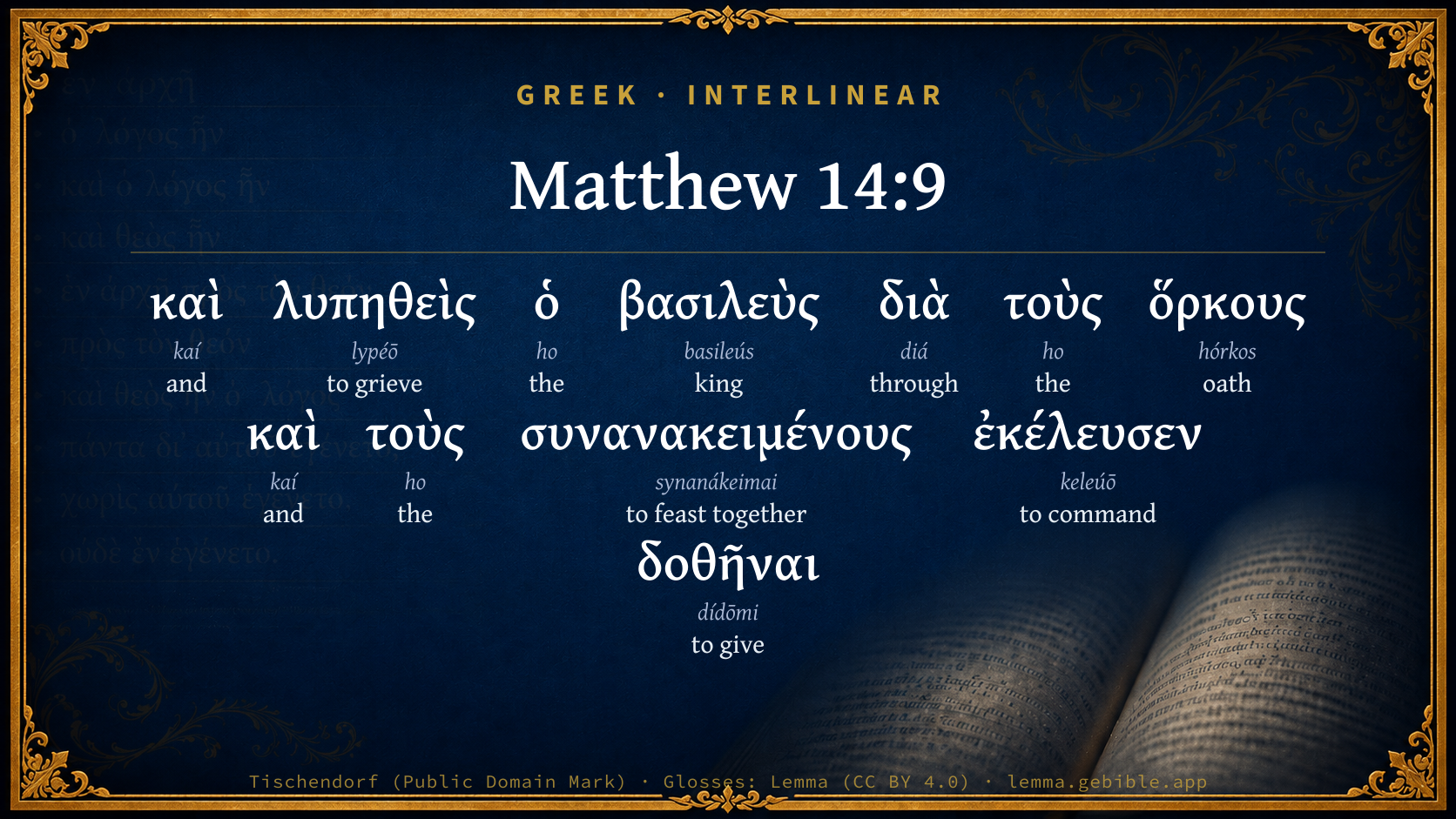
Greek (Tischendorf 8th ed.) Matthew 14:9 appears in the Greek New Testament. The text above is from the Tischendorf 8th edition. Each word links to its Strong’s number and a concise gloss. Click any word for its full Thayer’s Greek Lexicon entry.
Download image
Cite this verse

Matthew 14:9 (World English Bible). Public Domain. Lemma interlinear Bible study tool, https://lemma.gebible.app/v/matthew/14/9.

Show BibTeX & RIS
BibTeX
RIS
English Translation
The king was grieved, but for the sake of his oaths, and of those who sat at the table with him, he commanded it to be given,
World English Bible · Public Domain
Highlights
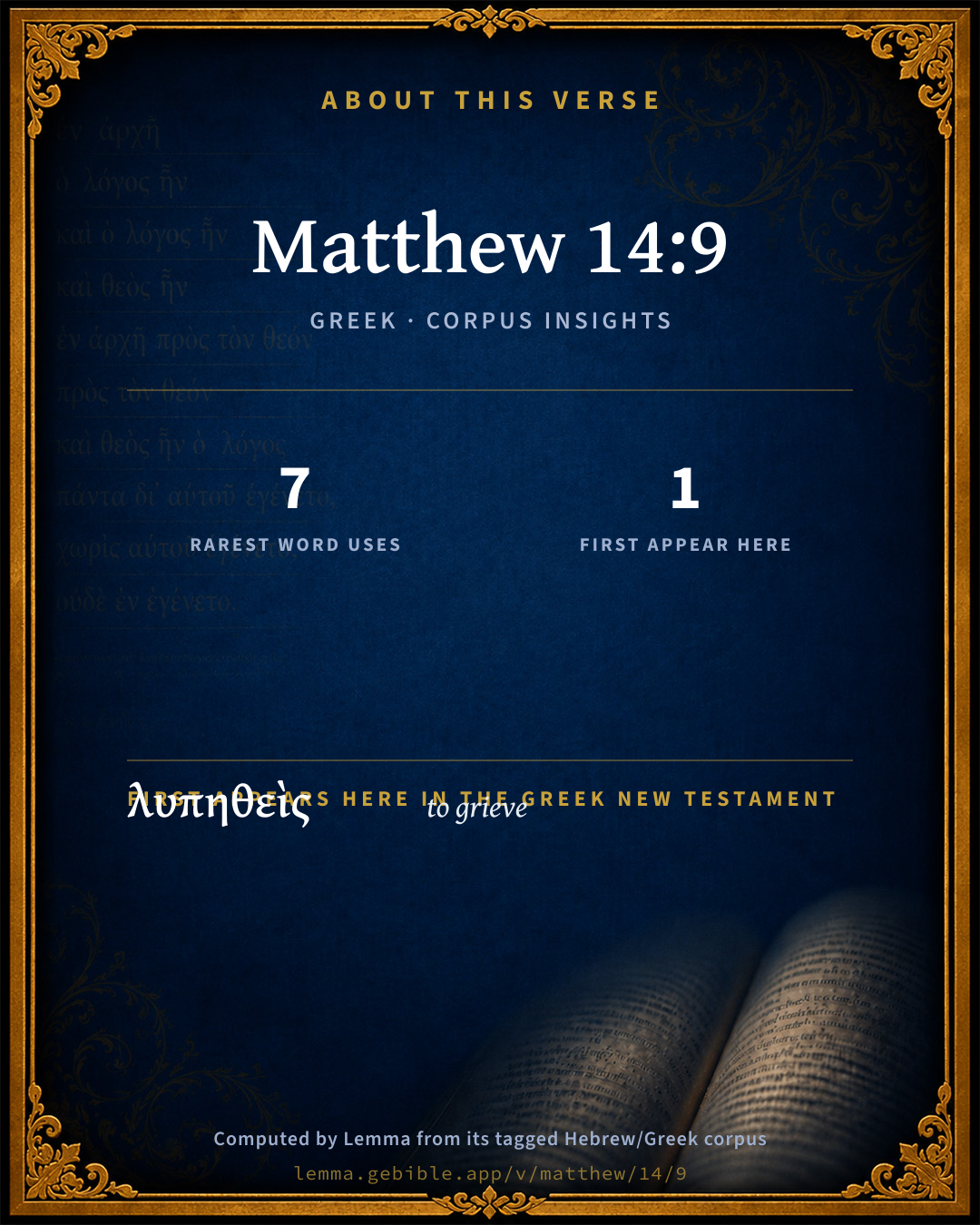
  • 1 first appearance in the Greek New Testament
Full analysis ↓
Download a study sheet

One document with this verse’s original text, its word-by-word gloss line, the meaning frame, cross-references with their text, attributed commentary, and full source and license credits — printable, and it pastes into notes with its structure intact.

This verse Autodidact and up

Study sheet (.html) Plain text (.txt)

A passage Seminary Student

Up to 50 verses in one chapter. A passage sheet keeps up to 6 commentary sources and 12 cross-references per verse, in the order this page ranks them, and says so on the sheet whenever that leaves anything out. Ask for a single verse and you get the Autodidact verse sheet above.

Everything on this page stays free to read, with no account — the sheet is a download of what is already on screen, not access to it.

Want to remove ads? Support Godless Engineer
Compare translations 3

The same verse in 3 English versions, stacked beneath the original-language interlinear above. Click any original word for its lexicon entry.

Each is an independent rendering of the whole verse — the interlinear is not word-aligned to these translations.

Highlighted words mark where these versions differ — a whole-verse word diff, not a word-by-word alignment.

  • World English Bible Public Domain
    The king was grieved, but for the sake of his oaths, and of those who sat at the table with him, he commanded it to be given,
  • King James Version Public Domain
    And the king was sorry: nevertheless for the oath's sake, and them which sat with him at meat, he commanded it to be given her.
  • unfoldingWord Literal Text CC BY-SA 4.0
    And the king was grieved, because of the oaths and the ones reclining to eat with him, he commanded to be given.

unfoldingWord Literal Text — © unfoldingWord, licensed CC BY-SA 4.0. Word-aligned USFM3 via Door43 (git.door43.org/unfoldingWord/en_ult).

Versions to compare (up to 4)

3 of 4 selected

Show all 19 translations

Every available English version of this verse, each an independent rendering of the whole verse.

  • World English Bible Public Domain
    The king was grieved, but for the sake of his oaths, and of those who sat at the table with him, he commanded it to be given,
  • Berean Standard Bible Public Domain
    The king was grieved, but because of his oaths and his guests, he ordered that her wish be granted
  • Majority Standard Bible Public Domain
    The king was grieved, but because of his oaths and his guests, he ordered that her wish be granted
  • King James Version Public Domain
    And the king was sorry: nevertheless for the oath's sake, and them which sat with him at meat, he commanded it to be given her.
  • American Standard Version (1901) Public Domain
    And the king was grieved; but for the sake of his oaths, and of them that sat at meat with him, he commanded it to be given;
  • Revised Version (1885) Public Domain
    And the king was grieved; but for the sake of his oaths, and of them which sat at meat with him, he commanded it to be given;
  • Geneva Bible (1599) Public Domain
    And the King was sorie: neuerthelesse because of the othe, and them that sate with him at the table, he commanded it to be giuen her,
  • Douay-Rheims (1899) Public Domain
    And the king was struck sad: yet because of his oath, and for them that sat with him at table, he commanded it to be given.
  • Young's Literal Translation Public Domain
    and the king was grieved, but because of the oaths and of those reclining with him, he commanded `it' to be given;
  • Literal Standard Version CC BY-SA 4.0
    and the king was grieved, but because of the oaths and of those dining with him, he commanded [it] to be given;
  • Unlocked Literal Bible CC BY-SA 4.0
    The king was very upset by her request, but because of his oath and because of all those at dinner with him, he ordered that it should be done.
  • unfoldingWord Literal Text CC BY-SA 4.0
    And the king was grieved, because of the oaths and the ones reclining to eat with him, he commanded to be given.
  • Darby Bible Public Domain
    And the king was grieved; but on account of the oaths, and those lying at table with [him], he commanded [it] to be given.
  • World Messianic Bible Public Domain
    The king was grieved, but for the sake of his oaths and of those who sat at the table with him, he commanded it to be given,
  • Webster's Bible Public Domain
    And the king was sorry: nevertheless for the sake of the oath, and of them who sat with him at table, he commanded it to be given her.
  • Free Bible Version CC BY-SA 4.0
    Then the king regretted the promise he had made, but because of the oaths he'd made in front of his dinner guests, he gave the order to do it.
  • Bible in Basic English Public Domain
    And the king was sad; but because of his oaths and because of his guests, he gave the order for it to be given to her;
  • Text-Critical English NT CC BY 4.0
    The king was grieved, but because of his oaths and his guests, he commanded it to be given
  • Tyndale New Testament (1534) Public Domain
    And the kynge sorowed. Neverthelesse for his othes sake and for their sakis which sate also at the table he commaunded that to be geven hir:

Literal Standard Version (2020), Covenant Press — licensed CC BY-SA 4.0. Text via the HelloAO Bible API (eBible.org). Unlocked Literal Bible (unfoldingWord) — licensed CC BY-SA 4.0. Text via the HelloAO Bible API (eBible.org). unfoldingWord Literal Text — © unfoldingWord, licensed CC BY-SA 4.0. Word-aligned USFM3 via Door43 (git.door43.org/unfoldingWord/en_ult). Free Bible Version, Dr. Jonathan Gallagher — licensed CC BY-SA 4.0. Text via the HelloAO Bible API (eBible.org).

Word by word

More ways to search: Search by grammar → Find every occurrence → Compare this word →

Practice this passage: Drill this verse → Learn its vocabulary →

συνανακειμένους
synanákeimai
G4873
“to feast together”
Verb, Present, Middle or Passive deponent, Participle, Accusative, Plural, Masculine
Part of Speech
Verb
Tense
Present
Voice
Middle or Passive deponent
Mood
Participle
Case
Accusative
Number
Plural
Gender
Masculine
Full Thayer's Definition

Origin: from G4862 and G345

TDNT: 13:54,4

1. to recline together, feast together a. of guests
  1. καὶ kaí G2532 “and” Conjunction
  2. λυπηθεὶς lypéō G3076 “to grieve” Verb, Aorist, Passive, Participle, Nominative, Singular, Masculine
  3. ὁ ho G3588 “the” Article, Nominative, Singular, Masculine
  4. βασιλεὺς basileús G935 “king” Noun, Nominative, Singular, Masculine
  5. διὰ diá G1223 “through” Preposition
  6. τοὺς ho G3588 “the” Article, Accusative, Plural, Masculine
  7. ὅρκους hórkos G3727 “oath” Noun, Accusative, Plural, Masculine
  8. καὶ kaí G2532 “and” Conjunction
  9. τοὺς ho G3588 “the” Article, Accusative, Plural, Masculine
  10. ἐκέλευσεν keleúō G2753 “to command” Verb, Aorist, Active, Indicative, 3rd person, Singular
  11. δοθῆναι dídōmi G1325 “to give” Verb, Aorist, Passive, Infinitive

About this verse

These counts appear in no published source. They are computed here, from the morphology-tagged text and Lemma’s own curated glosses. What Lemma adds →

12
words
9
distinct lemmas
Gospels
section

Notable vocabulary

The rarest word here is συνανακειμένους to feast together G4873 — appearing just 7 times in the whole Greek New Testament.

First appearance in Scripture

This word makes its first canonical appearance in the Greek New Testament here:

  • λυπηθεὶς to grieve G3076

Shared distinctive vocabulary

συνανακειμένους to feast together G4873 occurs in 7 verses of the Greek New Testament. Also found in:
Repetition

Words recur within this verse:

Cross-references

24

Topical passages linked to Matthew 14:9 in the Treasury of Scripture Knowledge — connected by theme and wording, ordered by reader-vote popularity; previews shown in the World English Bible.

  • John 19:12–16 At this, Pilate was seeking to release him, but the Jews cried out, saying, "If you release this man, you aren't Caesar's friend! Everyone who makes himself a king speaks against Caesar!"
  • Numbers 30:5–8 But if her father disallow her in the day that he hears, none of her vows, or of her bonds with which she has bound her soul, shall stand: and Yahweh will forgive her, because her father disallowed her.
  • Judges 11:30–31 Jephthah vowed a vow to Yahweh, and said, If you will indeed deliver the children of Ammon into my hand,
  • Judges 11:39 It happened at the end of two months, that she returned to her father, who did with her according to his vow which he had vowed: and she was a virgin. It was a custom in Israel,
  • Judges 21:1 Now the men of Israel had sworn in Mizpah, saying, There shall not any of us give his daughter to Benjamin as wife.
  • Judges 21:7–23 How shall we do for wives for those who remain, seeing we have sworn by Yahweh that we will not give them of our daughters to wives?
  • 1 Samuel 14:24 The men of Israel were distressed that day; for Saul had adjured the people, saying, Cursed be the man who eats any food until it be evening, and I be avenged on my enemies. So none of the people tasted food.
  • 1 Samuel 14:28 Then answered one of the people, and said, Your father directly charged the people with an oath, saying, Cursed be the man who eats food this day. The people were faint.
  • 1 Samuel 14:39–45 For, as Yahweh lives, who saves Israel, though it be in Jonathan my son, he shall surely die. But there was not a man among all the people who answered him.
  • 1 Samuel 25:22 God do so to the enemies of David, and more also, if I leave of all that belongs to him by the morning light so much as one man-child.
  • 1 Samuel 25:32–34 David said to Abigail, Blessed be Yahweh, the God of Israel, who sent you this day to meet me:
  • 1 Samuel 28:10 Saul swore to her by Yahweh, saying, As Yahweh lives, there shall no punishment happen to you for this thing.
  • 2 Kings 6:31–33 Then he said, God do so to me, and more also, if the head of Elisha the son of Shaphat shall stand on him this day.
  • Ecclesiastes 5:2 Don't be rash with your mouth, and don't let your heart be hasty to utter anything before God; for God is in heaven, and you on earth. Therefore let your words be few.
  • Daniel 6:14–16 Then the king, when he heard these words, was sore displeased, and set his heart on Daniel to deliver him; and he labored until the going down of the sun to rescue him.
  • Matthew 14:1 At that time, Herod the tetrarch heard the report concerning Jesus,
  • Matthew 14:5 When he would have put him to death, he feared the multitude, because they counted him as a prophet.
  • Matthew 27:17–26 When therefore they were gathered together, Pilate said to them, "Whom do you want me to release to you? Barabbas, or Jesus, who is called Christ?"
  • Mark 6:14 King Herod heard this, for his name had become known, and he said, "John the Baptizer has risen from the dead, and therefore these powers are at work in him."
  • Mark 6:20 for Herod feared John, knowing that he was a righteous and holy man, and kept him safe. When he heard him, he did many things, and he heard him gladly.
  • Mark 6:26 The king was exceedingly sorry, but for the sake of his oaths, and of his dinner guests, he didn't wish to refuse her.
  • Luke 13:32 He said to them, "Go and tell that fox, 'Behold, I cast out demons and perform cures today and tomorrow, and the third day I complete my mission.
  • Acts 24:23–27 He ordered the centurion that Paul should be kept in custody, and should have some privileges, and not to forbid any of his friends to serve him or to visit him.
  • Acts 25:3–9 asking a favor against him, that he would summon him to Jerusalem; plotting to kill him on the way.

Cross-references courtesy of OpenBible.info (CC BY 4.0).

Commentary

Notes on Matthew 14:9 from classic Christian and Jewish commentators (each source and its license shown beneath its notes). The classic Christian expositions comment on the surrounding passage and are grouped to its opening verse, so a note may address several verses; the Jewish commentaries on the Tanakh (Rashi and others) are per-verse, so they appear only where the commentator wrote on this verse.

Lemma curates 59 commentaries, every one of them public domain or Creative Commons licensed, each selected and text-cleaned for this edition rather than reprinted as found. About our sources →

Bengel's Gnomon

Johann Albrecht Bengel

Mat 14:9. Ἐλυπήθη, was grieved) Conscience was not yet entirely banished from the monarch’s breast. The sudden necessity of executing an evil purpose startles even the worst. The joys of this world are accompanied by sadness.—ὁ βασιλεὺς, the king) strictly tetrarch; see Mat 14:1.—συνανακειμένους, reclining at his table) The king feared the guests, the guests the king. By not interceding as they ought to have done for John, they became accomplices in his murder.

Bengel's Gnomon of the New Testament — English translation (T&T Clark, Edinburgh, 1860) — public domain. Text from a community e-Sword module.

Meyer's Critical & Exegetical Commentary

Heinrich August Wilhelm Meyer

Mat_14:9. Λυπηθείς] he was annoyed, διότι ἔμελλε μέγαν ἀνελεῖν ἄνδρα, καὶ κινῆσαι πρὸς μῖσος ἑαυτοῦ τὸν ὄχλον, Euth. Zigabenus, comp. Mat_14:5; Mar_7:20. Altogether, he was deeply pained at finding matters take this sudden and tragic turn, which is not inconsistent with Mat_14:5, but may be accounted for psychologically as arising out of that disturbed state of the conscience which this unlooked-for catastrophe has occasioned; consequently, we must not, with Schneckenburger, suppose (comp. Weiss and Holtzmann) that Matthew has failed to notice Marks statement that Herodias was desirous to see John put to death. This circumstance is involved in what Matthew says in Mat_14:8. Bengel appropriately observes: Latuerat in rege judicii aliquid.

διὰ τοὺς ὅρκ.] The μεθʼ ὅρκ. in Mat_14:6 represents a series of oaths that had been given, one at one time and another at another.

συνανακειμένους] to whom he did not wish to appear as perjured. A case of unlawful adhering to an oath, similar in its character to what was done by Jephthah.

Meyer — Critical and Exegetical Commentary on the New Testament — English translation by Peter Christie, edited by Frederick Crombie (T&T Clark, 1880) — public domain. Text from a community e-Sword module.

Expositor's Greek Testament

ed. W. Robertson Nicoll

Mat 14:9 . λυπηθεὶς : participle used concessively, though grieved he granted the request, the grief quite compatible with the truculent wish in Mat 14:5 . βασιλεύς : only by courtesy. ὅρκους , plural, singular in Mat 14:7 ; spoken in passion, more like profane swearing than deliberate utterance once for all of a solemn oath.

The Expositor's Greek Testament, edited by W. Robertson Nicoll (1897–1910) — public domain. Text from a community e-Sword module.

Adam Clarke's Commentary

Verse 9. The king was sorry] He knew John to be a righteous man, and at first did many things gladly which John told him it was his duty to perform: Mr 6:20.

Nevertheless, for the oath's sake] The OATHS, ορκους - he had probably sworn again and again-one sin begets many.

And them which sat with him at meat] Who were probably such as himself, and would have considered it a breach of honour if he had not fulfilled his sworn promise: he therefore commanded it to be given!

Adam Clarke's Commentary on the Bible (1810–1826) — public domain. Text from a community e-Sword/MySword module.

Ellicott's Commentary for English Readers

(9) The king was sorry.—It was the last struggle of conscience. In that moment there must have come before his mind his past reverence for the prophet, the joy which had for a time accompanied the strivings of a better life, possibly the counsels of his foster-brother Manaen. Had there been only the personal influence of Herodias these might have prevailed against it, but, like most weak men, Herod feared to be thought weak. It was not so much his regard for the oath which he had taken (that, had it been taken in secret, he might have got over), but his shrinking from the taunt, or whispered jest, or contemptuous gesture of the assembled guests, if they should see him draw back from his plighted word. A false regard for public opinion, for what people will say or think of us in our own narrow circle, was in this, as in so many other instances, an incentive to guilt instead of a restraint.

A Bible Commentary for English Readers, edited by Charles John Ellicott (1878–1897) — public domain. Text from a community e-Sword module.

The Cambridge Bible for Schools and Colleges

gen. ed. J. J. S. Perowne

9. for the oaths’ sake] “Because of the oaths;” he had sworn repeatedly.

The Cambridge Bible for Schools and Colleges (gen. ed. J. J. S. Perowne; Cambridge University Press, 1878–1918) — public domain. Text from a community e-Sword module.

John Gill's Exposition

And the king was sorry,.... As he might be upon many accounts; partly on account of John, whom, notwithstanding his freedom in reproving him, he had a respect; and partly on his own account, his conscience dictating to him that it was an evil action, and would leave a brand of perpetual infamy upon him; as also on account of the people, who were so much affected to John, lest they should make an insurrection, and rebel against him; and likewise, because it was reckoned an ill omen with the Romans, to take away life on that day they received their own; and therefore carefully abstained, on such days, from executions.

Nevertheless for his oath's sake; that he might not be guilty of perjury, chose rather to commit murder; though it would have been no iniquity in him, to have acted contrary to such a rash promise, and wicked oath; which would have been better to have been broke, than kept;

and them which sat with him at meat; lest he should be thought by them fickle and inconstant, and not a man of his word, and who had no regard to an oath: or it may be, they, either to curry favour with Herodias, or out of ill will they might bear to John; or in great respect to the damsel, who had so well pleased them with her dancing; instead of dissuading him from it, pressed him much to perform his promise: and therefore,

he commanded it to be given her; in the form and manner she requested it. Some have thought, that the whole of this affair was a concerted scheme; and that Herod himself was in it, though he pretended to be sorry and uneasy, having fixed on this season as a convenient time for it; and chose to have it done in this way, and in so public a manner, to lessen the odium of it; or otherwise, it is not easy to account for his extravagant promise, and his punctual performance of it.

John Gill's Exposition of the Whole Bible (1746–1763) — public domain (CC PDM 1.0). Text via the HelloAO Bible API.

Trapp's Complete Commentary

John Trapp

9 And the king was sorry: nevertheless for the oath’s sake, and them which sat with him at meat, he commanded it to be given her.

Ver. 9. And the king was sorry] John’s innocence might haply so triumph in Herod’s conscience, as to force some grief upon him at the thought of so foul a fact. But I rather think otherwise, that all was but in hypocrisy, Luk 13:31. For lasciviousness usually sears up the conscience (till the time of reckoning for all comes) and brings men to that dead and dedolent disposition, Eph 4:19. Only this fox feigns himself sorry for John, as his father feigned himself willing to worship the Lord Christ, Mat 2:8; as Tiberius (Herod’s lord and master) would seem very sorry for those whom for his pleasure’s sake only, he put to death, Gallius Germanicus, Drusus, &c. {a} And as Andronicus the Greek Emperor, that deep dissembler, would weep over those whom he had for no cause caused to be executed, as if he had been the most sorrowful man alive, Dissimulat mentis suae malitiam artifex homicida. This cunning murderer craftily hides his malice, saith St Jerome, and seeming sad in the face is glad at heart to be rid of the importunate Baptist, that he may sin uncontrolled.

For the oath’s sake, and them which sat] All this was but pretended to his villany, and that he might have somewhat to say to the people, whom he feared, in excuse for himself. As that he beheaded the Baptist indeed, but his guests would needs have it so, because he had promised the damosel her whole desire, and she would not otherwise be satisfied. Besides, it was his birthday, wherein it was not fit he should deny his nobles anything, who minded him of his oath, &c. But the oath was wicked, and therefore not obligatory. {b} He should have broken it, as David in like case did, 1Sa 25:33, when he swore a great oath what he would do to Nabal. But Herod, for the avoiding of the sands, rusheth upon the rocks, prevents perjury by murder, not considering the rule, that no man is held so perplexed between two vices, but that he may find an issue without falling into a third. {c}

And them which sat with him at meat] These he had more respect to than to God. A hypocrite’s care is all for the world’s approval and applause. They should have showed him his sin, and opposed his sentence. But that is not the guise of godless parasites, those Aiones et Negones aulici, qui omnia loquuntur ad gratiam, nihil ad veritatem. These court parasites and parrots know no other tune or tone, but what will please their masters, quorum etiam sputum lingunt, as one saith, soothing and smoothing, and smothering up many of their foul facts, that they thereby may the better ingratiate. {d} Principibus ideo amicus deest quia nihil deest: there is a wonderful sympathy between princes and parasites. But David would none of them, Psa 101:7, and Sigismond, the emperor, cussed them out of his presence. And surely if wishing were anything (said Henricus Stephanus), like as the Thessalians once utterly overthrew the city called Flattery, so I could desire, that above all other malefactors, court parasites were utterly rooted out, as the most pestilent persons in the world.

{a} Commiserabatur cos in quos graviter animadvertebat. Dio.

{b} Iuramenta contra bonos mores facta non sunt obligatoria: est regula in utroque iure.

{c} Nemo ita perplexus tenetur inter duo vitia, quin exitus pateat absque tertio.

{d} Apud principes η ηκιστα η ηδιστα, ut sensit quidam Croesi conciliarius.

John Trapp, A Commentary or Exposition upon All the Books of the Old and New Testament (1647–1656) — public domain. Text from a community e-Sword module.

Haydock's Catholic Bible Commentary

Yet because of his oath, which could not bind him, being unjust. (Witham) --- See the preposterous religion of this wicked prince. He feels no remorse for his impious conduct to his brother and his own wife; murder, adultery, and incest do not appal him; and yet he is terrified with the thought of violating a vain and wicked oath on no occasion and in no circumstances obligatory. Herod did wrong in taking such a rash oath, but he did worse in fulfilling it. (Jansenius) ---David swore to Nabal. He swore rashly; but with greater piety, he refused to keep his oath. Perhaps it is because Catholics inculcate this principle, that they have been accused by their adversaries of teaching that faith is not to be kept, and also the doctrine of expediency. (Haydock)

George Leo Haydock (1774–1849), Haydock's Catholic Family Bible and Commentary, 1859 edition — public domain. Excludes Psalms (Douay-Rheims chapter numbering differs from Protestant) and Deuterocanonical books (Catholic canon only).

Matthew Poole's English Annotations

Mark relates it more largely, in Mar 6:26-28, And the king was exceeding sorry; yet for his oath’s sake, and for their sake which sat with him, he would not reject her. And immediately the king sent an executioner, and commanded his head to be brought: and he went and beheaded him in the prison, and brought his head in a charger, and gave it to the damsel: and the damsel gave it to her mother. The king was exceeding sorry; he could have wished she had asked something else: he was troubled; for we heard before, that although he feared not God, yet he feared the people. Yet for his oath’s sake; not out of any religion of his oath: Juramentum non petest esse vinculum iniquitatis. They must be sottishly ignorant, that think their calling God to witness that they will do a thing which God hath forbidden them to do, should oblige them in any measure to the doing of the thing. But for his oath’s sake, in point of honour, because his word was gone out, that he might not appear guilty of any temerity or levity; and for the sake of those that were with him, that he might not seem before them to vary from his word, or it may be, as well to gratify them as to gratify the damsel and her mother; he sends an executioner, who took off John the Baptist’s head, and gave it to the damsel in a charger, who carried it to her mother. What could be more unjust, and inhuman, and bloody? John was not tried, nor condemned. It was a great festival, and should not have been profaned or defiled with blood. These things were nothing, when an unsatiable malice was to be gratified. Herodias will have her husband and his guests see that John Baptist’s head in a charger was to her as pleasing a dish as any was at Herod’s great feast. Thus died this great man, to satisfy the malice and lust of a lewd and imperious woman; and to teach us what we must expect, it we will be faithful to the trust which God reposes in us.

Matthew Poole's English Annotations on the Holy Bible (1683–1685) — public domain. Text from a community e-Sword/MySword module.

Whedon's Commentary on the Bible

Daniel D. Whedon

9. The king was sorry — Though he had before desired and plotted John’s death, yet is he now appalled at such a bloody request from this young girl. It was a fearful story to be told to the people whose reverence for John was so profound. Besides, the tyrant himself shared the religious awe for the Baptist’s character and mission.

Oath’s sake — Might he not as well be a perjurer as a murderer? Them which sat with him — A point of honour rises here. He must not flinch, but keep his pledge before his honourable fellows. A duellist or a gambler is the very model of such faith.

Daniel D. Whedon (gen. ed.), Commentary on the Old and New Testaments (1874–1909) — public domain. Text from a community e-Sword module.

The Pulpit Commentary

And the king was sorry: nevertheless for the oath"s sake; better, and though the king was grieved, yet for the sake of his oaths (kai luphyei tu). That he was grieved at John"s death is a verbal contradiction to ver. 5, but after some weeks" or months" delay psychologically quite possible (cf. note there). Kubel attributes the change to his conscience recoiling when his wish had a sudden chance of being accomplished; or it may be that he still fearest the multitude (cf. ver. 5), and felt anxious lest he should bring about some political disturbance. Oaths; for in making the promise of ver. 7 he would certainly take more than one. And them which sat with him at meat. Had he uttered the promise and the oaths in private, it would have been different, but now there were so many witnesses. Observe that these said nothing to stop him. They were no friends of the enthusiast who was now a prisoner. He commanded it to be given her.

Vain regrets.

"And the king was sorry." But no good came of his sorrow. It was too late. He had lost his opportunity. He had put his foot upon a slide, and down he had to go. Plumptre says, "It was the last struggle of conscience. In that moment there must have come before his mind his past reverence for the prophet, the joy which had for a time accompanied the strivings of a better life, possibly the counsels of his foster brother Manaen." Every man must have his regrets. Things done in all good faith turn out very different to our expectations, and we regret that we did them. But, if we are strong men, we work at the correction or the remedying of our unintended evil. And regret sometimes is an important element in repentance. Regret concerns the result of action. Repentance concerns the wrong of action.

I REGRETS ARE VAIN WHEN CHARACTER IS WEAK. Undisciplined people are always full of regrets; but they do them little or no good. Herod was sorry that he had made that unconditional promise.

But he was too weak to refuse to do the wrong to which it led. The weak fear of man extracted the order for the beheading; he was ashamed before that assembly to recall his too hasty promise. "Like most weak men, Herod feared to be thought weak. It was not so much his regard for the oath which he had taken, but his shrinking from the taunt, or whispered jest, or contemptuous gesture of the assembled guests, if they should see him draw back from his plighted word." When the character is weak it is

(1) always sensitive to public opinion;

(2) it is always subject to the sway of stronger characters.

Herod may be as sorry as he pleases, but his regret is helpless and vain. Public opinion will drag him on into crime, and so will the shameless companion of his sins.

II REGRETS ARE VAIN WHEN CIRCUMSTANCES ARE MASTERFUL. A man may be sorry, and may even try to put right his wrong, yet find all his efforts in vain. The man who plays with the fates will be dragged on to his doom by them. It is easy to set going a train of circumstances, but even the strong man vainly tries to check their unfoldings; they become masterful; and he must see the misery he has made, and be punished by seeing it. Our life is so ordered that good, sooner or later, inevitably unfolds good; and evil, sooner or later, inevitably unfolds misery. Let a man do the prudent, the thoughtful, the self-restrained, the good, and he will never know the misery of vain regrets. R.T.

The Pulpit Commentary (1880–1919), ed. H.D.M. Spence-Jones & Joseph S. Exell — public domain. Text from a community e-Sword module.

John Wesley's Explanatory Notes

And the king was sorry - Knowing that John was a good man. Yet for the oath's sake - So he murdered an innocent man from mere tenderness of conscience.

John Wesley, Explanatory Notes Upon the Whole Bible (1754–1765) — public domain. Text via the GEBible commentary corpus.

Kretzmann's Popular Commentary

Paul E. Kretzmann

The reaction and its result:

v. 9. And the king was sorry; nevertheless for the oath’s sake, and them which sat with him at meat, he commanded it to be given her.

v. 10. And he sent, and beheaded John in the prison.

v. 11. And his head was brought in a charger, and given to the damsel; and she brought it to her mother.

v. 12. And his disciples came, and took up the body, and buried it, and went and told Jesus.

Although Herod, here called king by courtesy, was sorry, touched for a moment with regret, and because, for the once, he realized that he had been tricked, yet his foolish, rash, repeated oaths had been heard by the guests, and the cowardly tyrant feared their criticism. He yielded, with something like a sigh of relief. The adulterer became a murderer. And Herodias, no less guilty, could celebrate her triumph when her daughter brought her the head of John on the platter, as it had been cut off the body in prison. A gruesome sight, no less in the private room of the mother than in the banquet-hall. The young woman truly was a match for her mother in depravity: Her indecent, sensual dance is paralleled by her cool acceptance of the horrible gift. The closing chapter of John’s career: His disciples took the dead body and buried it, after which they notified Jesus, probably with the intention of warning Him.

The lessons of the story are evident. "Now this is the most important point, that we learn two things from John. The first is for the preachers. Whoever is in the office of preacher should not esteem his life dearly, but do the work of his calling, and freely, without dread, rebuke whatever is offensive. That is well-pleasing to God, and therewith, as we read in the prophet Ezekiel, every one saves his own soul; for else he must give account for the sins of those whom he does not rebuke, as he should do by reason of his office. The other point is not only for preachers, but for all Christians, that we may learn especially from this example that God is not evilly inclined toward us, even though He permits us to be persecuted, to come under the cross, and to suffer all distress. He that wants to be in the kingdom of Christ dare not be afraid of cross and death. For such is the testament of the Lord Christ, and He, Christ Himself, has entered thus into the Kingdom."

Paul E. Kretzmann, Popular Commentary of the Bible (1921–1924) — public domain. Text from a community e-Sword module.

The People's New Testament

B. W. Johnson

9. The king was sorry. The Greek word thus translated is very strong, and denotes a very great grief, and sorrow. For the oath's sake, and them which sat with him. It was not so much his regard for the oath which he had taken, but his shrinking from the taunt of the guests, if they should see him draw back from his plighted word.

B. W. Johnson's The People's New Testament with Notes (1889–1891) — public domain. Electronic text from the Christian Classics Ethereal Library (CCEL) ThML edition.

Cambridge Greek Testament for Schools and Colleges

9. λυπηθείς, ‘though vexed;’ he still feared the popular vengeance, and perhaps did not himself desire the death of John, see Mar 6:20.

ὁ βασιλεύς. A title which Antipas had in vain tried to acquire: it was probably addressed to him by his courtiers.

διὰ τοὺς ὅρκους. ‘Because of the oaths;’ he had sworn repeatedly.

Cambridge Greek Testament for Schools and Colleges (Cambridge University Press, 1896; 21 vols, various authors incl. Carr, Maclear, Plummer, Farrar, Lumby, Moule, M. R. James, Simcox) — public domain. Text from a community e-Sword module.

Alford’s Greek Testament

Henry Alford

9.] ὁ βασιλεύς was a title which Herod never properly possessed. Subsequently to this event, Herodias prevailed on him to go to Rome to get the title, which had been granted to his nephew Agrippa. He was opposed by the emissaries of Agrippa, and was exiled to Lugdunum. See note on ver. 1, and Josephus there cited.

Herod was grieved because he heard John gladly (Mar 6:20), and from policy did not wish to put him to death on so slight a cause. This is not inconsistent with his wishing to put him to death: his estimate of John was wavering and undecided, and he was annoyed at the decision being taken out of his hands by a demand, compliance with which would be irrevocable.

Henry Alford, The Greek Testament (1849–1861) — public domain. Text from a community e-Sword module.

International Critical Commentary

9. And being grieved, the king, because of his oaths, and because of those who sat with him, commanded (it) to be given.] Mk.’s βασιλεύς creeps in here, in spite of τετραάρχης in v. 1. The συνανακειμένους is a hint that Mt. has omitted much that precedes in Mk. The editor summarises Mk vv. 26, 27.

(M)

International Critical Commentary — older volumes (1896–1929), various authors — public domain. Text from a community e-Sword module.

Vincent's Word Studies in the New Testament

Marvin R. Vincent

The oath 's sake [δια τους ορκους] . But the A. V. puts the apostrophe in the wrong place. The word is plural, and the Rev. rightly renders for the sake of his oaths. It is implied that Herod in his mad excitement had confirmed his promise with repeated oaths.

Marvin R. Vincent, Word Studies in the New Testament (1887–1900) — public domain. Text from a community e-Sword/MySword module.

Lesson kit

Teaching starters — assembled from the data on this page, not authored interpretation. Every prompt links to the verse data it draws on. Edit before teaching.

Matthew, in the Gospels, opens this verse with 12 words (9 distinct Greek lemmas). Its most distinctive word is synanákeimai (“to feast together”). A historical commentator’s framing appears above. Read the whole chapter for the surrounding context.

Discussion questions

  1. What does “to feast together” (synanákeimai) contribute to the verse as a whole?
  2. The word “to grieve” first appears here in Scripture. What is being introduced at this debut?
  3. Matthew 9:10 shares the word «to feast together» with this verse. How do the two illuminate each other?
  4. “the” occurs 3× in this one verse. What is the effect of the repetition?
  5. The translations on this page render this verse differently — a whole-verse word diff, not a word-by-word alignment. What might account for the different wordings?
  6. Reading how Bengel's Gnomon and Meyer's Critical & Exegetical Commentary read this verse, where do the two commentators agree and where do they part?

Things to notice

  • 1 word makes its first canonical appearance in Scripture here.
  • These translations choose different wording for 15 words in this verse.
  • “the” occurs 3× in this single verse.
  • 9 distinct Greek lemmas span 12 words in this verse.

Reading settings

Reading text

Shown beneath each verse's original-language words.

Old Testament
Old Testament edition

Read the OT as the Masoretic Hebrew (MT) or the Greek Septuagint (LXX).

English shown for the Greek Septuagint (in the Hebrew ↔ Greek comparison).

Comparing translations? Open the Compare panel on any verse page to stack up to four side by side.