
Matthew 17:25

Greek (Tischendorf 8th ed.) Matthew 17:25 appears in the Greek New Testament. The text above is from the Tischendorf 8th edition. Each word links to its Strong’s number and a concise gloss. Click any word for its full Thayer’s Greek Lexicon entry.
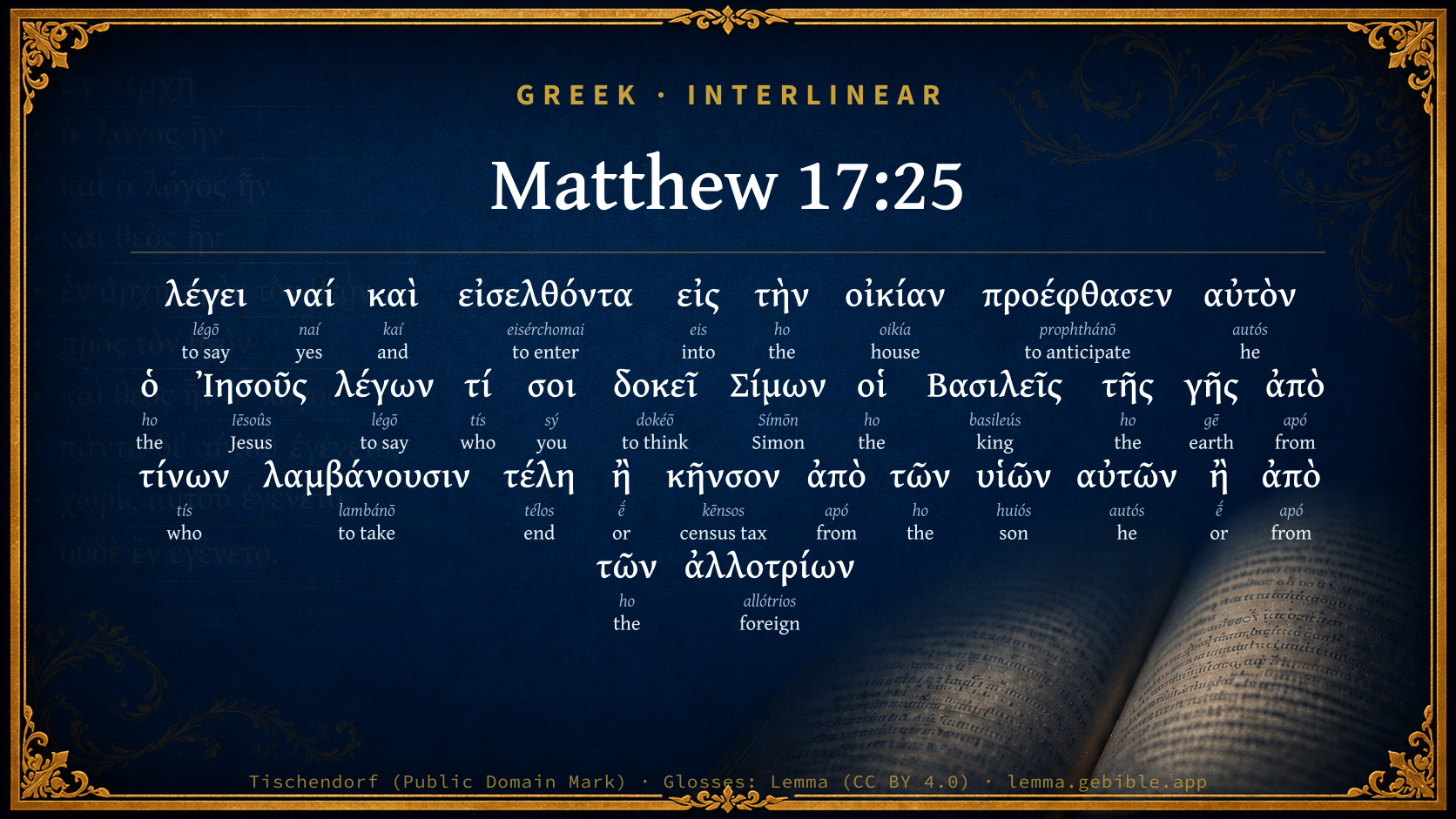
Download image
Cite this verse

Matthew 17:25 (World English Bible). Public Domain. Lemma interlinear Bible study tool, https://lemma.gebible.app/v/matthew/17/25.

Show BibTeX & RIS
BibTeX
RIS
English Translation
He said, "Yes." When he came into the house, Jesus anticipated him, saying, "What do you think, Simon? From whom do the kings of the earth receive toll or tribute? From their children, or from strangers?"
World English Bible · Public Domain
Highlights
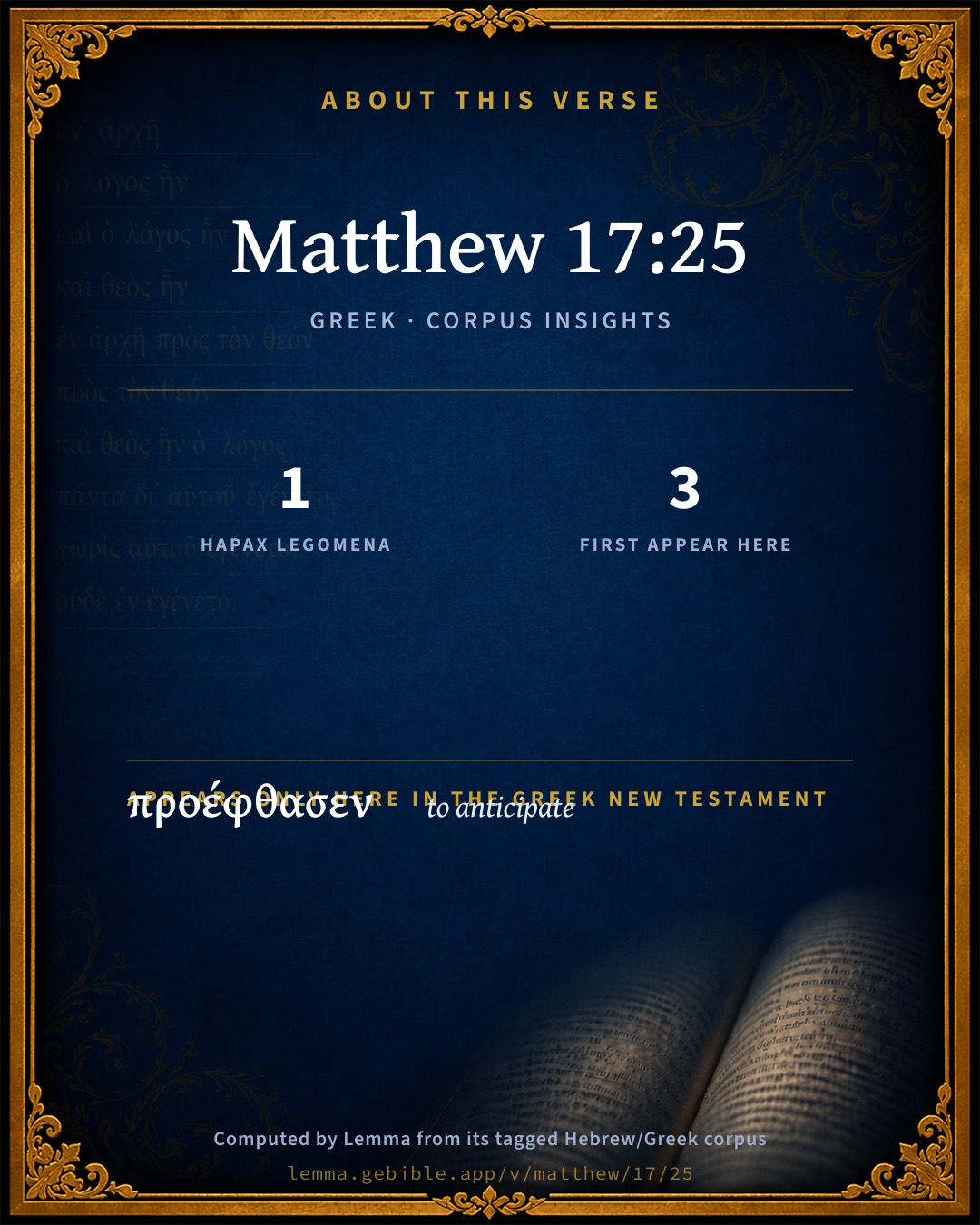
  • 1 hapax legomenon — only here in the Greek New Testament
  • 3 first appearances in the Greek New Testament
Full analysis ↓
Download a study sheet

One document with this verse’s original text, its word-by-word gloss line, the meaning frame, cross-references with their text, attributed commentary, and full source and license credits — printable, and it pastes into notes with its structure intact.

This verse Autodidact and up

Study sheet (.html) Plain text (.txt)

A passage Seminary Student

Up to 50 verses in one chapter. A passage sheet keeps up to 6 commentary sources and 12 cross-references per verse, in the order this page ranks them, and says so on the sheet whenever that leaves anything out. Ask for a single verse and you get the Autodidact verse sheet above.

Everything on this page stays free to read, with no account — the sheet is a download of what is already on screen, not access to it.

Want to remove ads? Support Godless Engineer
Compare translations 3

The same verse in 3 English versions, stacked beneath the original-language interlinear above. Click any original word for its lexicon entry.

Each is an independent rendering of the whole verse — the interlinear is not word-aligned to these translations.

Highlighted words mark where these versions differ — a whole-verse word diff, not a word-by-word alignment.

  • World English Bible Public Domain
    He said, "Yes." When he came into the house, Jesus anticipated him, saying, "What do you think, Simon? From whom do the kings of the earth receive toll or tribute? From their children, or from strangers?"
  • King James Version Public Domain
    He saith, Yes. And when he was come into the house, Jesus prevented him, saying, What thinkest thou, Simon? of whom do the kings of the earth take custom or tribute? of their own children, or of strangers?
  • unfoldingWord Literal Text CC BY-SA 4.0
    He says, “Yes.” And having entered into the house, Jesus anticipated him, saying, “What do you think, Simon? The kings of the earth—from whom do they receive taxes or tolls? From their sons or from strangers?”

unfoldingWord Literal Text — © unfoldingWord, licensed CC BY-SA 4.0. Word-aligned USFM3 via Door43 (git.door43.org/unfoldingWord/en_ult).

Versions to compare (up to 4)

3 of 4 selected

Show all 19 translations

Every available English version of this verse, each an independent rendering of the whole verse.

  • World English Bible Public Domain
    He said, "Yes." When he came into the house, Jesus anticipated him, saying, "What do you think, Simon? From whom do the kings of the earth receive toll or tribute? From their children, or from strangers?"
  • Berean Standard Bible Public Domain
    “Yes,” he answered. When Peter entered the house, Jesus preempted him. “What do you think, Simon?” He asked. “From whom do the kings of the earth collect customs and taxes: from their own sons, or from others?”
  • Majority Standard Bible Public Domain
    “Yes,” he answered. When Peter entered the house, Jesus preempted him. “What do you think, Simon?” He asked. “From whom do the kings of the earth collect customs and taxes: from their own sons, or from others?”
  • King James Version Public Domain
    He saith, Yes. And when he was come into the house, Jesus prevented him, saying, What thinkest thou, Simon? of whom do the kings of the earth take custom or tribute? of their own children, or of strangers?
  • American Standard Version (1901) Public Domain
    He saith, Yea. And when he came into the house, Jesus spake first to him, saying, What thinkest thou, Simon? the kings of the earth, from whom do they receive toll or tribute? from their sons, or from strangers?
  • Revised Version (1885) Public Domain
    He saith, Yea. And when he came into the house, Jesus spake first to him, saying, What thinkest thou, Simon? the kings of the earth, from whom do they receive toll or tribute? from their sons, or from strangers?
  • Geneva Bible (1599) Public Domain
    He sayd, Yes. And when he was come into the house, Iesus preuented him, saying, What thinkest thou, Simon? Of whome doe the Kings of the earth take tribute, or polle money? of their children, or of strangers?
  • Douay-Rheims (1899) Public Domain
    And he said: Of strangers. Jesus said to him: Then the children are free.
  • Young's Literal Translation Public Domain
    And when he came into the house, Jesus anticipated him, saying, `What thinkest thou, Simon? the kings of the earth -- from whom do they receive custom or poll-tax? from their sons or from the strangers?'
  • Literal Standard Version CC BY-SA 4.0
    And when he came into the house, Jesus anticipated him, saying, “What do you think, Simon? The kings of the earth—from whom do they receive custom or poll-tax? From their sons or from the strangers?”
  • Unlocked Literal Bible CC BY-SA 4.0
    He said, “Yes.” When Peter came into the house, Jesus spoke to him first and said, “What do you think, Simon? From whom do the kings of the earth collect tolls or taxes? From their sons or from others?”
  • unfoldingWord Literal Text CC BY-SA 4.0
    He says, “Yes.” And having entered into the house, Jesus anticipated him, saying, “What do you think, Simon? The kings of the earth—from whom do they receive taxes or tolls? From their sons or from strangers?”
  • Darby Bible Public Domain
    He says, Yes. And when he came into the house, Jesus anticipated him, saying, What dost thou think, Simon? the kings of the earth, from whom do they receive custom or tribute? from their own sons or from strangers?
  • World Messianic Bible Public Domain
    He said, “Yes.” When he came into the house, Yeshua anticipated him, saying, “What do you think, Simon? From whom do the kings of the earth receive toll or tribute? From their children, or from strangers?”
  • Webster's Bible Public Domain
    He saith, Yes. And when he had come into the house, Jesus anticipated him, saying, What thinkest thou, Simon? from whom do the kings of the earth take custom or tribute? from their own children, or from strangers?
  • Free Bible Version CC BY-SA 4.0
    “Yes, of course,” Peter replied. When he returned to where they were staying, Jesus anticipated the issue. “What do you think, Simon?” Jesus asked him. “Do the kings of this world collect their taxes and duties from their own sons or from others?”
  • Bible in Basic English Public Domain
    He says, Yes. And when he came into the house, Jesus said to him, What is your opinion, Simon? from whom do the kings of the earth get payment or tax? from their sons or from other people?
  • Text-Critical English NT CC BY 4.0
    He said, “Yes.” And when Peter came into the house, Jesus spoke to him first, saying, “What do yoʋ think, Simon? From whom do the kings of the earth receive toll or tax? From their own sons or from strangers?”
  • Tyndale New Testament (1534) Public Domain
    He sayd: ye. And when he was come into the house Iesus spake fyrst to him saying What thinkest thou Simon? of whome do the kynges of the erth take tribute or poll money? of their chyldren or of straungers?

Literal Standard Version (2020), Covenant Press — licensed CC BY-SA 4.0. Text via the HelloAO Bible API (eBible.org). Unlocked Literal Bible (unfoldingWord) — licensed CC BY-SA 4.0. Text via the HelloAO Bible API (eBible.org). unfoldingWord Literal Text — © unfoldingWord, licensed CC BY-SA 4.0. Word-aligned USFM3 via Door43 (git.door43.org/unfoldingWord/en_ult). Free Bible Version, Dr. Jonathan Gallagher — licensed CC BY-SA 4.0. Text via the HelloAO Bible API (eBible.org).

Word by word

More ways to search: Search by grammar → Find every occurrence → Compare this word →

Practice this passage: Drill this verse → Learn its vocabulary →

προέφθασεν
prophthánō
G4399
“to anticipate”
Verb, Aorist, Active, Indicative, 3rd person, Singular
Part of Speech
Verb
Tense
Aorist
Voice
Active
Mood
Indicative
Person
3rd person
Number
Singular
Full Thayer's Definition

Origin: from G4253 and G5348

TDNT: 10:28,1

1. to come before, to anticipate
  1. λέγει légō G3004 “to say” Verb, Present, Active, Indicative, 3rd person, Singular
  2. ναί naí G3483 “yes” Particle
  3. καὶ kaí G2532 “and” Conjunction
  4. εἰσελθόντα eisérchomai G1525 “to enter” Verb, Aorist, Active, Participle, Accusative, Singular, Masculine
  5. εἰς eis G1519 “into” Preposition
  6. τὴν ho G3588 “the” Article, Accusative, Singular, Feminine
  7. οἰκίαν oikía G3614 “house” Noun, Accusative, Singular, Feminine
  8. αὐτὸν autós G846 “he” Personal pronoun, Accusative, Singular, Masculine
  9. ὁ ho G3588 “the” Article, Nominative, Singular, Masculine
  10. Ἰησοῦς Iēsoûs G2424 “Jesus” Noun, Nominative, Singular, Masculine
  11. λέγων légō G3004 “to say” Verb, Present, Active, Participle, Nominative, Singular, Masculine
  12. τί tís G5101 “who” Interrogative pronoun, Accusative, Singular, Neuter
  13. σοι sý G4771 “you” Personal pronoun, 2nd person, Dative, Singular
  14. δοκεῖ dokéō G1380 “to think” Verb, Present, Active, Indicative, 3rd person, Singular
  15. Σίμων Símōn G4613 “Simon” Noun, Vocative, Singular, Masculine
  16. οἱ ho G3588 “the” Article, Nominative, Plural, Masculine
  17. Βασιλεῖς basileús G935 “king” Noun, Nominative, Plural, Masculine
  18. τῆς ho G3588 “the” Article, Genitive, Singular, Feminine
  19. γῆς gē G1093 “earth” Noun, Genitive, Singular, Feminine
  20. ἀπὸ apó G575 “from” Preposition
  21. τίνων tís G5101 “who” Interrogative pronoun, Genitive, Plural, Masculine
  22. λαμβάνουσιν lambánō G2983 “to take” Verb, Present, Active, Indicative, 3rd person, Plural
  23. τέλη télos G5056 “end” Noun, Accusative, Plural, Neuter
  24. ἢ ḗ G2228 “or” Particle
  25. κῆνσον kēnsos G2778 “census tax” Noun, Accusative, Singular, Masculine
  26. ἀπὸ apó G575 “from” Preposition
  27. τῶν ho G3588 “the” Article, Genitive, Plural, Masculine
  28. υἱῶν huiós G5207 “son” Noun, Genitive, Plural, Masculine
  29. αὐτῶν autós G846 “he” Personal pronoun, Genitive, Plural, Masculine
  30. ἢ ḗ G2228 “or” Particle
  31. ἀπὸ apó G575 “from” Preposition
  32. τῶν ho G3588 “the” Article, Genitive, Plural, Masculine
  33. ἀλλοτρίων allótrios G245 “foreign” Adjective, Genitive, Plural, Masculine

About this verse

These counts appear in no published source. They are computed here, from the morphology-tagged text and Lemma’s own curated glosses. What Lemma adds →

34
words
23
distinct lemmas
Gospels
section

Notable vocabulary

1 hapax legomenon — a word that appears only here in the entire Greek New Testament:

  • προέφθασεν to anticipate G4399

First appearance in Scripture

These words make their first canonical appearance in the Greek New Testament here:

  • προέφθασεν to anticipate G4399
  • κῆνσον census tax G2778
  • ἀλλοτρίων foreign G245

Shared distinctive vocabulary

κῆνσον census tax G2778 occurs in 4 verses of the Greek New Testament. Also found in:
Repetition

Words recur within this verse:

Cross-references

6

Topical passages linked to Matthew 17:25 in the Treasury of Scripture Knowledge — connected by theme and wording, ordered by reader-vote popularity; previews shown in the World English Bible.

  • Matthew 22:21 They said to him, "Caesar's." Then he said to them, "Give therefore to Caesar the things that are Caesar's, and to God the things that are God's."
  • Matthew 22:17 Tell us therefore, what do you think? Is it lawful to pay taxes to Caesar, or not?"
  • Matthew 22:19 Show me the tax money." They brought to him a denarius.
  • Romans 13:6–7 For this reason you also pay taxes, for they are ministers of God's service, attending continually on this very thing.
  • 1 Samuel 17:25 The men of Israel said, Have you seen this man who is come up? surely to defy Israel is he come up: and it shall be, that the man who kills him, the king will enrich him with great riches, and will give him his daughter, and make his father's house free in Israel.
  • Matthew 3:15 But Jesus, answering, said to him, "Allow it now, for this is the fitting way for us to fulfill all righteousness." Then he allowed him.

Cross-references courtesy of OpenBible.info (CC BY 4.0).

Commentary

Notes on Matthew 17:25 from classic Christian and Jewish commentators (each source and its license shown beneath its notes). The classic Christian expositions comment on the surrounding passage and are grouped to its opening verse, so a note may address several verses; the Jewish commentaries on the Tanakh (Rashi and others) are per-verse, so they appear only where the commentator wrote on this verse.

Lemma curates 59 commentaries, every one of them public domain or Creative Commons licensed, each selected and text-cleaned for this edition rather than reprinted as found. About our sources →

Tyndale Open Study Notes

Tyndale Open Resources

17:25-26 As an obedient Jew, Jesus would have paid the tax annually, and he did pay it. Jesus’ point was that as God’s Son, he is greater than the Temple (12:5-6), and he makes a decisive break with it (see 16:18-19; 21:33-46).

Tyndale Open Study Notes — © Tyndale Open Resources, licensed CC BY-SA 4.0. Text via the HelloAO Bible API.

Bengel's Gnomon

Johann Albrecht Bengel

Mat 17:25. Ναὶ, yes) It is clear therefore that our Lord had paid it the previous year.[800]—ὅτε εἰσῆλθεν εἰς τὴν οἰκιαν, when he was come into the house) for that very purpose.—προέφθασεν, prevented, anticipated) Peter was wishing to ask [when Jesus anticipated him]. The whole of this circumstance wonderfully confirmed the faith of Peter. Our Lord’s majesty shines forth in the very act of submission.—Σίμων, Simon) An address as it were domestic and familiar.[801]—τέλη ἢ κῆνσον, custom or tribute, lat. vectigadia aut censum) i.e. land-tax and poll-tax.—ἀλλοτρίων, strangers) subjects who are not sons.

[800] But, meanwhile, having been solemnly recognised as the Son of GOD, He most becomingly, at this time, enters this protest in presence of Peter in vindication of His own dignity.—Harm., p. 380.

[801] Οἱ βασιλεῖς τῆς γῆς, the kings of the earth) With these is compared the Lord Jehovah, for whose worship the tribute was paid.—V. g.

Bengel's Gnomon of the New Testament — English translation (T&T Clark, Edinburgh, 1860) — public domain. Text from a community e-Sword module.

Meyer's Critical & Exegetical Commentary

Heinrich August Wilhelm Meyer

Mat_17:25. From the ναί of Peter it is clear that Jesus had hitherto been in the habit of paying the tax.

προέφθασεν] Since it is stated in Mat_17:24 that the collectors came to Peter, and as one is at a loss to see why, if Jesus had been present at the same time, they should not have asked Himself, it follows that the evangelist must have ascribed what Jesus says to Peter to His immediate knowledge of the thoughts of others. Comp. Chrysostom, Theophylact, Euth. Zigabenus, Steinmeyer, Ewald, Keim. Instead of προέφθασεν λέγων (Arist. Eccl. 884; Thuc. vii. 73. 3) we might also have had προφθάσας ἔλεγε (Plat. Rep. vi. p. 500 A; Thuc. viii. 51. 1). See Kühner, II. 1, p. 626 f.

Σίμων] appellatio quasi domestica et familiaris, Bengel. Comp. Mar_14:37.

τέλη] duty upon goods.

κῆνσος] Tax upon individuals and landed property, Mat_22:17; Mat_22:19, the Greek φόρος in contradistinction to τέλος (indirect tax). Comp. note on Luk_20:22; Rom_13:7.

ἀπὸ τῶν ἀλλοτρ.] from those who are not members of their family, i.e. from their subjects.

Meyer — Critical and Exegetical Commentary on the New Testament — English translation by Peter Christie, edited by Frederick Crombie (T&T Clark, 1880) — public domain. Text from a community e-Sword module.

Expositor's Greek Testament

ed. W. Robertson Nicoll

Mat 17:25 . ναί : this prompt, confident answer may be either an inference from Christ’s general bearing, as Peter understood it, or a statement of fact implying past payment. ἐλθόντα ἐ . τ . ὁ . The meeting of the tax collectors with Peter had taken place outside; it had been noticed by Jesus, and the drift of the interview instinctively understood by Him. προέφθασεν , anticipated him, here only in N. T. Peter meant to report, but Jesus spoke first, having something special to say, and a good reason for saying it. In other circumstances He would probably have taken no notice, but left Peter to manage the matter as he pleased. But the Master is aware of something that took place among His disciples on the way home, not yet mentioned by the evangelist but about to be (Mat 18:1 ), and to be regarded as the key to the meaning of this incident. The story of what Jesus said to Peter about the temple dues is really the prelude to the discourse following on humility, and that discourse in turn reflects light on the prelude. τί σοι δοκεῖ ; phrase often found in Mt. (Mat 18:12 , Mat 21:28 , etc.) with lively colloquial effect: what think you? τέλη ἢ κῆνσον , customs or tribute; the former taxes on wares, the latter a tax on persons = indirect and direct taxation. The question refers specially to the latter. ἀλλοτρίων , foreigners, in reference not to the nation, but to the royal family, who have the privilege of exemption.

The Expositor's Greek Testament, edited by W. Robertson Nicoll (1897–1910) — public domain. Text from a community e-Sword module.

Geneva Bible (1599)

Geneva Bible translators

By children we must not understand subjects which pay tribute, but natural children.

Geneva Bible (1599) marginal notes — public domain. Text via Bolls.life.

Jamieson, Fausset & Brown

Robert Jamieson, A. R. Fausset & David Brown

He saith, yes--that is, "To be sure He does"; as if eager to remove even the suspicion of the contrary. If Peter knew--as surely he did--that there was at this time no money in the bag, this reply must be regarded as a great act of faith in his Master.

And when he was come into the house--Peter's.

Jesus prevented him--anticipated him; according to the old sense of the word "prevent."

saying, What thinkest thou, Simon?--using his family name for familiarity.

of whom do the kings of the earth take custom--meaning custom on goods exported or imported.

or tribute--meaning the poll-tax, payable to the Romans by everyone whose name was in the census. This, therefore, it will be observed, was strictly a civil tax.

of their own children, or of strangers--This cannot mean "foreigners," from whom sovereigns certainly do not raise taxes, but those who are not of their own family, that is, their subjects.

Jamieson, Fausset & Brown — Commentary Critical and Explanatory on the Whole Bible (1871) — public domain (CC PDM 1.0). Text via the HelloAO Bible API.

Adam Clarke's Commentary

Verse 25. He saith, Yes.] From this reply of Peter, it is evident that our Lord customarily paid all taxes, tributes, c., which were common among the people wherever he came. The children of God are subject to all civil laws in the places where they live - and should pay the taxes levied on them by public authority and though any of these should be found unjust, THEY rebel not, as their business is not to reform the politics of nations, but the morals of the world.

Adam Clarke's Commentary on the Bible (1810–1826) — public domain. Text from a community e-Sword/MySword module.

Ellicott's Commentary for English Readers

(25) He saith, Yes.—Peter’s answer was ready enough. There was no need for him to inquire further. His Master would pay it now as He had paid it before (this is clearly implied), as every devout Israelite would pay. Both the application and the answer suggest the thought that our Lord was looked upon as domiciled in the house of Peter. The answer, however, was given without thought of the altered conditions of the case. He had not yet learnt to grasp the full meaning of the truth which he had himself so recently confessed.

Jesus prevented him.—Literally, anticipated, The word is nowhere else used of our Lord’s teaching. Its significance is explained by what follows. Peter and the other disciples were about to come to Him with a question of a very different kind (Mat_18:1), rising out of their mutual rivalries, and therefore, before that question could be asked, He anticipated the eager disciple that He might lead him on one step further into the mysteries of the kingdom.

Take custom or tribute.—The first word points to the duties on the export or import of goods, the octroi, in modern language, levied on provisions as they were brought in or out of towns; the second, as stated above, to the poll-tax paid into the Roman treasury, which followed on the taxing or registration of Luk_2:2; Act_5:37. Both were probably farmed by the capitalist publicani, and collected by the “publicans” of the Gospels, or other inferior officers.

Of their own children, or of strangers?—The first word can hardly be taken of merely natural relationship. The “children of the kingdom” (Mat_13:38) are not the king’s sons, but his home-born, free subjects. The “strangers” were the aliens, the men of another race, who owned his sovereignty.

A Bible Commentary for English Readers, edited by Charles John Ellicott (1878–1897) — public domain. Text from a community e-Sword module.

The Cambridge Bible for Schools and Colleges

gen. ed. J. J. S. Perowne

25. prevented] anticipated him by answering his thoughts. To prevent is (1) to “go before,” “to anticipate” then, “to precede” either (2) to aid, or (3) to hinder.

custom or tribute] taxes (1) indirect and (2) direct; on (1) things and on (2) persons.

of their own children, or of strangers?] i. e. of their own sons, or of those who do not belong to the family, namely, subjects and tributaries.

The Cambridge Bible for Schools and Colleges (gen. ed. J. J. S. Perowne; Cambridge University Press, 1878–1918) — public domain. Text from a community e-Sword module.

John Gill's Exposition

He saith, yes,.... Without any hesitation, knowing it had been his master's practice; and therefore as he had done it, did not doubt but he would again:

and when he was come into the house; that is, Peter, as both the Syriac and Persic versions express; when he was come into his own house, or at least into that where Christ was, in order to talk with him about this affair, the collectors had been speaking of to him, who seems to have been alone when they met with him; however, Christ was not with him:

Jesus prevented him; saying what he intended to say, on that head; for he being the omniscient God, though not present, knew what question had been put to Peter, and what answer he had returned; and therefore, before Peter could lay the case before him, he puts this question to him;

saying, what thinkest thou, Simon? How does it appear to thee, to thy reason and understanding? in what light dost thou consider this matter? what is thy judgment of it?

of whom do the kings of the earth take custom or tribute? of their own children, or of strangers, or others? What is the usual practice of earthly kings, whether of Judea, or of other countries? do their own children, sons, and heirs, such as are of their own family, pay? or is it only their subjects that are not of their family?

John Gill's Exposition of the Whole Bible (1746–1763) — public domain (CC PDM 1.0). Text via the HelloAO Bible API.

Trapp's Complete Commentary

John Trapp

25 He saith, Yes. And when he was come into the house, Jesus prevented him, saying, What thinkest thou, Simon? of whom do the kings of the earth take custom or tribute? of their own children, or of strangers?

Ver. 25. He saith, Yes] Christ submitted himself "to every ordinance of man for the Lord’s sake," 1Pe 2:13; and hath bidden us, Give unto Caesar those things that are Caesar’s, tribute to whom tribute is due, custom to whom custom, &c., Mat 22:21; Rom 13:7. So doth not the great Heteroclite of Rome; he not only detains, but demands Peter Pence and other undue payments from kings and states. One pope said that he could never lack money so long as he could hold a pen in his hand. This kingdom was of old called the pope’s ass, for bearing his burdens and exactions. Innocent IV said, that England was the pope’s Paradise, and a pit that could never be drawn dry, Hortus delieiarum et puteus inexhaustus. What vast sums drained they hence in King John’s days! Otto (one of the pope’s muscipulatores , mice-catchers, as the story calleth them), sent hither by Gregory IX, after three years’ raking together of money, left not so much in the whole kingdom as he either carried with him or sent to Rome before him. But I hope ere long the kings of the earth, awakened by their gross abuses put upon them, will fleece that withered whore, and burn her flesh with fire, a punishment before prophesied, and well befitting so foul a harlot.

John Trapp, A Commentary or Exposition upon All the Books of the Old and New Testament (1647–1656) — public domain. Text from a community e-Sword module.

Whedon's Commentary on the Bible

Daniel D. Whedon

25. He saith, Yes — Peter is here, perhaps, as often, a little too forward. He wishes to speak favourably for his Master. Jesus prevented him — Introduced the matter as soon as Peter came into the house, and before the latter had time to do so.

Daniel D. Whedon (gen. ed.), Commentary on the Old and New Testaments (1874–1909) — public domain. Text from a community e-Sword module.

The Pulpit Commentary

He saith, Yes. Without consulting his Master, or even letting him know of the demand, Peter answered affirmatively, he knew that Christ never withdrew from conscientious obligations; Jesus may have paid the rate in former years, and might be confidently supposed to be ready to do so again. But was there not another feeling that dictated the quick reply, and made him pledge Jesus to the payment? He had a fear at his heart, caused by Christ"s late warning and prophecy, that made him morbidly anxious to live at peace with all men at this conjuncture. As far as in him lay he would shield his beloved Master from the dread result which he anticipated; at any rate, he would endeavour to postpone the fatal day; no offence that he could obviate should be given. So, thinking only of present safety, forgetting or wilfully ignoring Christ"s true position, he answered hastily, "Yes." When he (Peter) was come into the house. The collectors had addressed Peter in the street or at the door, and the apostle, having given his reply, hastened into the house where Jesus was, either to obtain the necessary coins or to make the demand known. Prevented him. The Revised Version paraphrases, spake first to him, which gives the meaning (though the Greek does not warrant such translation) Jesus anticipated what Peter was going to say by showing that he knew the apostle"s thoughts and all that had passed outside the house, he takes the opportunity of enforcing a needful lesson, making the listener, in the Socratic method, teach himself. What thinkest thou, Simon? By such familiar address he claims his attention. The kings of the earth. He contrasts these with the King of heaven, to whom a reference is implied in the Lord"s subsequent words. Custom (telh) or tribute (khnson). The former of these words (which would be better rendered tolls) signifies the customs laid on goods and merchandise and other such paymentsvectigalia, as the Romans called them; the tribute (not the same word as that so translated in ver. 24) is the census, the capitation tax (epikefalaion) imposed upon every citizen of the empire. Strangers (allotriwn). The contrast is between the family of the monarch and those who are not connected with him by any relationship.

The Pulpit Commentary (1880–1919), ed. H.D.M. Spence-Jones & Joseph S. Exell — public domain. Text from a community e-Sword module.

John Wesley's Explanatory Notes

Jesus prevented him - Just when St. Peter was going to ask him for it. Of their own sons, or of strangers? - That is, such as are not of their own family.

John Wesley, Explanatory Notes Upon the Whole Bible (1754–1765) — public domain. Text via the GEBible commentary corpus.

The People's New Testament

B. W. Johnson

25. He saith, Yea. Peter, as usual, answered before he reflected, and then came to Jesus with the matter. Jesus prevented. Peter came into the house to speak about it, but Christ knew his thoughts and spoke first. Of whom do the kings of the earth take custom? Not of their own children, but from subjects. Hence, Christ, the King's Son, for whom the temple was built, was not subject to tax for the benefit of the temple. The Son of the King would not pay tribute to the King. For the origin of this temple tax, see Exod. 30:12, and 2 Chron. 24:5.

B. W. Johnson's The People's New Testament with Notes (1889–1891) — public domain. Electronic text from the Christian Classics Ethereal Library (CCEL) ThML edition.

Cambridge Greek Testament for Schools and Colleges

25. εἰσελθόντα, the reading of א*. There is much variation in the MSS. ὅτε ἦλθεν is well supported, but looks like an explanation of the participle.

25. προέφθασεν αὐτόν. ‘Anticipated him’ by answering his thoughts.

τέλη ἢ κῆνσον. Taxes (1) indirect and (2) direct; on (1) things and on (2) persons. κῆνσος, Lat. census: see ch. Mat 22:17.

ἀπὸ τῶν υἱῶν κ.τ.λ., i.e. of their own sons, or of those who do not belong to the family, namely, subjects and tributaries.

Cambridge Greek Testament for Schools and Colleges (Cambridge University Press, 1896; 21 vols, various authors incl. Carr, Maclear, Plummer, Farrar, Lumby, Moule, M. R. James, Simcox) — public domain. Text from a community e-Sword module.

International Critical Commentary

25. And when he entered into the house, Jesus anticipated him, saying, What thinkest thou, Simon? From whom do the kings of the earth receive taxes or tribute; from their own people, or from aliens?]—εἰς τὴν οἰκίαν] may be a reminiscence of Mk. v. 33.—τί σοι δοκεῖ] the phrase is common in the latter part of the Gospel; cf. 18:12, 21:28, 22:17, 42, 26:66.—οἱ βασιλεῖς τῆς γῆς] are obviously contrasted with God, the heavenly King; cf. 5:35.—τῶν υἱῶν αὐτῶν αὐτῶν] in Oriental idiom, means not relatives, but members of one’s own race. “Earthly monarchs (in the East) take no tribute from their own people, but from aliens.” The implied analogy is that God, the heavenly King, takes no tribute from His own people. But by His sons or people the Jews can hardly be intended. Otherwise, the meaning would be that the Temple tax, as paid by the Jews, was an unjustifiable one, not binding on the consciences of religious Jews. It might be paid voluntarily as a freewill offering, but not of necessity. It is, however, questionable whether the Lord would thus have criticised the imposition of the Temple tribute sanctioned by Old Testament precedent, Exo 30:13. Compare, however, His criticism of the Pentateuchal distinction between clean and unclean meats. Rather the υἱοί seem to signify a class of people contrasted with the Jews. The latter are the aliens who are rightly called upon to pay tribute to the heavenly King. In this case the υἱοί must be Christ and His disciples. They were in a true sense “Sons of God,” cf. 5:9, and might claim exemption from tribute.

τέλη] taxes on goods.—κῆνσος] the capitation tax.

(P)

International Critical Commentary — older volumes (1896–1929), various authors — public domain. Text from a community e-Sword module.

Vincent's Word Studies in the New Testament

Marvin R. Vincent

Yes [ναι] . Indicating that Jesus had paid the tax on former occasions.

Prevented [προεφθασεν] . Rev., rather awkwardly, but following Tynd., Spake first to him. Prevent, in its older sense, to anticipate, get before, was a correct translation. Compare Shakspeare :

"So shall my anticipation prevent your discovery."

Hamlet, 2 1.

Out of this grew the secondary meaning, to hinder. By getting before another, one hinders him from accomplishing his purpose. This meaning has supplanted the other. Wyc. renders came before him. The meaning is that Jesus did not wait for Peter to tell him of the demand of the collectors. He anticipated him in speaking about it.

Custom or tribute [τελη η κηνσον] . Rev. gives toll for custom. Toll is duty upon goods; tribute, tax upon individuals. Khnsov, tribute, is merely a transcription of the Latin census, which means, first, a registration with a view to taxation, and then the tax itself.

Strangers [αλλοτριων] . Not foreigners, but others than those of their own families; their subjects. In other words, Does a king tax his own children or his subjects?

Marvin R. Vincent, Word Studies in the New Testament (1887–1900) — public domain. Text from a community e-Sword/MySword module.

Lesson kit

Teaching starters — assembled from the data on this page, not authored interpretation. Every prompt links to the verse data it draws on. Edit before teaching.

Matthew, in the Gospels, opens this verse with 34 words (23 distinct Greek lemmas). Its most distinctive word is prophthánō (“to anticipate”). A historical commentator’s framing appears above. Read the whole chapter for the surrounding context.

Discussion questions

  1. What does “to anticipate” (prophthánō) contribute to the verse as a whole?
  2. 1 word here appears nowhere else in the Greek New Testament. Why might the author reach for such rare wording?
  3. 3 words make their first appearance in Scripture here. What does this debut establish?
  4. How does Matthew 22:17, which shares the word «census tax», read alongside this verse?
  5. What does the repetition of “to say” (2× in this one verse) do in this verse?
  6. These translations render this verse differently. What is at stake in choosing one wording over another?
  7. Compare how Tyndale Open Study Notes and Bengel's Gnomon read this verse. Where do they agree or differ?

Things to notice

  • 1 word in this verse appears nowhere else in the Greek New Testament.
  • 3 words make their first canonical appearance in Scripture here.
  • These translations choose different wording for 24 words in this verse.
  • “to say” occurs 2× in this single verse.
  • 23 distinct Greek lemmas span 34 words in this verse.

Reading settings

Reading text

Shown beneath each verse's original-language words.

Old Testament
Old Testament edition

Read the OT as the Masoretic Hebrew (MT) or the Greek Septuagint (LXX).

English shown for the Greek Septuagint (in the Hebrew ↔ Greek comparison).

Comparing translations? Open the Compare panel on any verse page to stack up to four side by side.