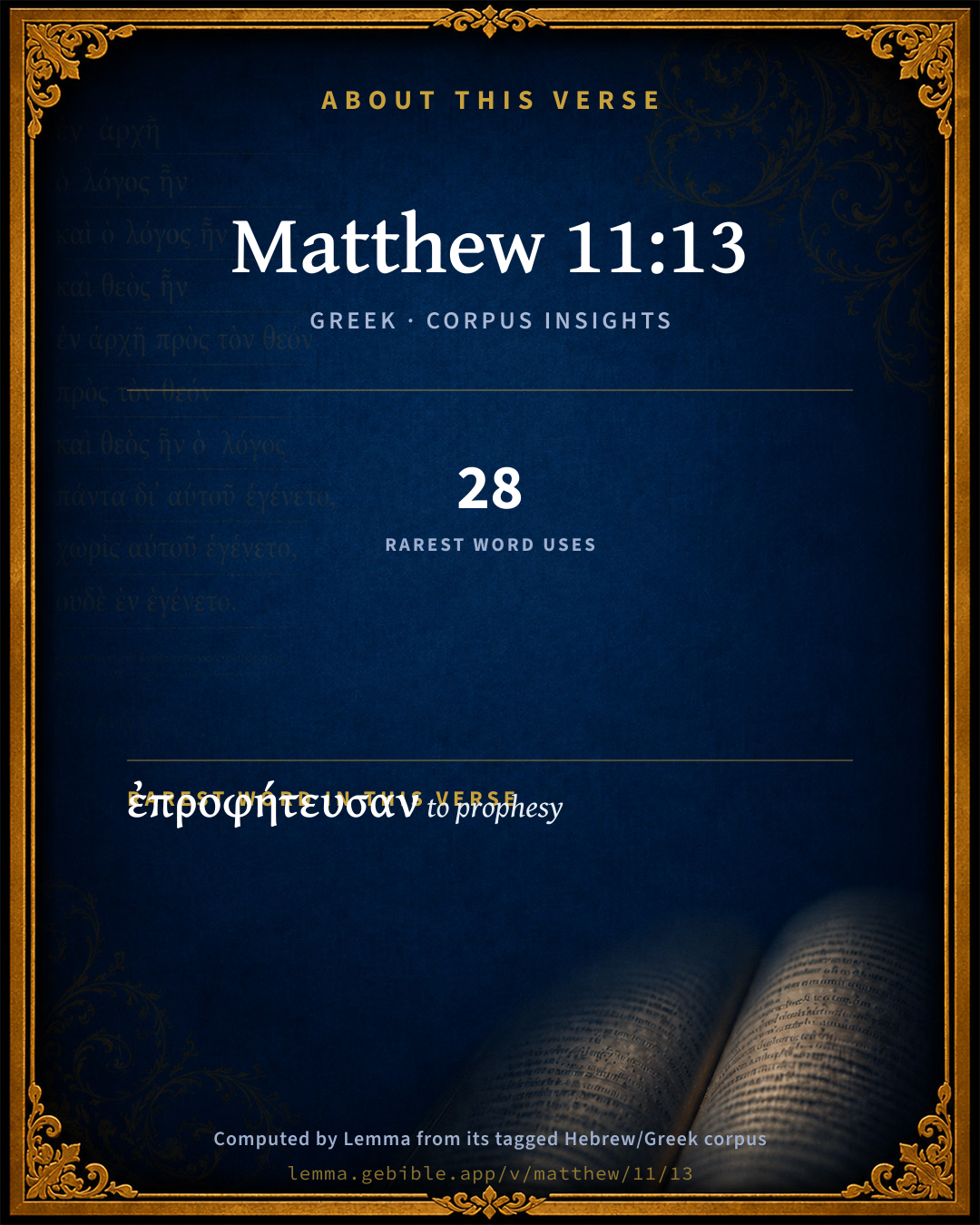
Matthew 11:13

Greek (Tischendorf 8th ed.) Matthew 11:13 appears in the Greek New Testament. The text above is from the Tischendorf 8th edition. Each word links to its Strong’s number and a concise gloss. Click any word for its full Thayer’s Greek Lexicon entry.
Download image
Cite this verse

Matthew 11:13 (World English Bible). Public Domain. Lemma interlinear Bible study tool, https://lemma.gebible.app/v/matthew/11/13.

Show BibTeX & RIS
BibTeX
RIS
English Translation
For all the prophets and the law prophesied until John.
World English Bible · Public Domain
Download a study sheet

One document with this verse’s original text, its word-by-word gloss line, the meaning frame, cross-references with their text, attributed commentary, and full source and license credits — printable, and it pastes into notes with its structure intact.

This verse Autodidact and up

Study sheet (.html) Plain text (.txt)

A passage Seminary Student

Up to 50 verses in one chapter. A passage sheet keeps up to 6 commentary sources and 12 cross-references per verse, in the order this page ranks them, and says so on the sheet whenever that leaves anything out. Ask for a single verse and you get the Autodidact verse sheet above.

Everything on this page stays free to read, with no account — the sheet is a download of what is already on screen, not access to it.

Want to remove ads? Support Godless Engineer
Compare translations 3

The same verse in 3 English versions, stacked beneath the original-language interlinear above. Click any original word for its lexicon entry.

Each is an independent rendering of the whole verse — the interlinear is not word-aligned to these translations.

Highlighted words mark where these versions differ — a whole-verse word diff, not a word-by-word alignment.

  • World English Bible Public Domain
    For all the prophets and the law prophesied until John.
  • King James Version Public Domain
    For all the prophets and the law prophesied until John.
  • unfoldingWord Literal Text CC BY-SA 4.0
    For all the Prophets and the Law have prophesied until John;

unfoldingWord Literal Text — © unfoldingWord, licensed CC BY-SA 4.0. Word-aligned USFM3 via Door43 (git.door43.org/unfoldingWord/en_ult).

Versions to compare (up to 4)

3 of 4 selected

Show all 19 translations

Every available English version of this verse, each an independent rendering of the whole verse.

  • World English Bible Public Domain
    For all the prophets and the law prophesied until John.
  • Berean Standard Bible Public Domain
    For all the Prophets and the Law prophesied until John.
  • Majority Standard Bible Public Domain
    For all the Prophets and the Law prophesied until John.
  • King James Version Public Domain
    For all the prophets and the law prophesied until John.
  • American Standard Version (1901) Public Domain
    For all the prophets and the law prophesied until John.
  • Revised Version (1885) Public Domain
    For all the prophets and the law prophesied until John.
  • Geneva Bible (1599) Public Domain
    For all the Prophetes and the Lawe prophecied vnto Iohn.
  • Douay-Rheims (1899) Public Domain
    For all the prophets and the law prophesied until John:
  • Young's Literal Translation Public Domain
    for all the prophets and the law till John did prophesy,
  • Literal Standard Version CC BY-SA 4.0
    for all the Prophets and the Law prophesied until John,
  • Unlocked Literal Bible CC BY-SA 4.0
    For all the prophets and the law have been prophesying until John;
  • unfoldingWord Literal Text CC BY-SA 4.0
    For all the Prophets and the Law have prophesied until John;
  • Darby Bible Public Domain
    For all the prophets and the law have prophesied unto John.
  • World Messianic Bible Public Domain
    For all the Prophets and the Torah prophesied until Yochanan.
  • Webster's Bible Public Domain
    For all the prophets and the law prophesied until John.
  • Free Bible Version CC BY-SA 4.0
    For all the prophets and the law spoke for God until John came.
  • Bible in Basic English Public Domain
    For all the prophets and the law were in force till John.
  • Text-Critical English NT CC BY 4.0
    For all the prophets and the law prophesied until John.
  • Tyndale New Testament (1534) Public Domain
    For all the prophetes and the lawe prophesyed vnto to the tyme of Ihon.

Literal Standard Version (2020), Covenant Press — licensed CC BY-SA 4.0. Text via the HelloAO Bible API (eBible.org). Unlocked Literal Bible (unfoldingWord) — licensed CC BY-SA 4.0. Text via the HelloAO Bible API (eBible.org). unfoldingWord Literal Text — © unfoldingWord, licensed CC BY-SA 4.0. Word-aligned USFM3 via Door43 (git.door43.org/unfoldingWord/en_ult). Free Bible Version, Dr. Jonathan Gallagher — licensed CC BY-SA 4.0. Text via the HelloAO Bible API (eBible.org).

Word by word

More ways to search: Search by grammar → Find every occurrence → Compare this word →

Practice this passage: Drill this verse → Learn its vocabulary →

ἐπροφήτευσαν
prophēteúō
G4395
“to prophesy”
Verb, Aorist, Active, Indicative, 3rd person, Plural
Part of Speech
Verb
Tense
Aorist
Voice
Active
Mood
Indicative
Person
3rd person
Number
Plural
Full Thayer's Definition

Origin: from G4396

TDNT: 19:02,0

1. to prophesy, to be a prophet, speak forth by divine inspirations, to predict a. to prophesy b. with the idea of foretelling future events pertaining esp. to the kingdom of God c. to utter forth, declare, a thing which can only be known by divine revelation d. to break forth under sudden impulse in lofty discourse or praise of the divine counsels 1. under like prompting, to teach, refute, reprove, admonish, comfort others e. to act as a prophet, discharge the prophetic office
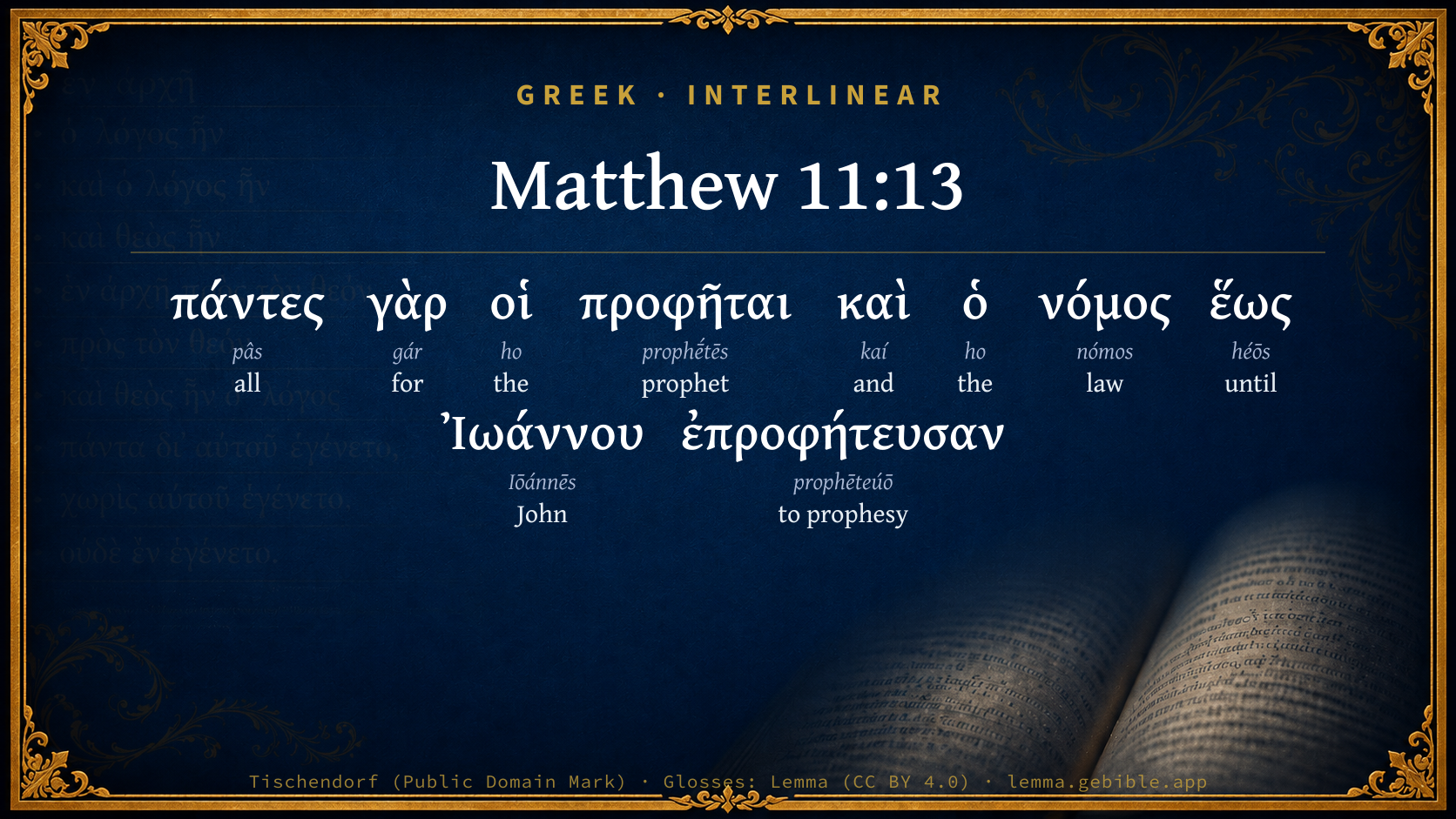
  1. πάντες pâs G3956 “all” Adjective, Nominative, Plural, Masculine
  2. γὰρ gár G1063 “for” Conjunction
  3. οἱ ho G3588 “the” Article, Nominative, Plural, Masculine
  4. προφῆται prophḗtēs G4396 “prophet” Noun, Nominative, Plural, Masculine
  5. καὶ kaí G2532 “and” Conjunction
  6. ὁ ho G3588 “the” Article, Nominative, Singular, Masculine
  7. νόμος nómos G3551 “law” Noun, Nominative, Singular, Masculine
  8. ἕως héōs G2193 “until” Adverb
  9. Ἰωάννου Iōánnēs G2491 “John” Noun, Genitive, Singular, Masculine

About this verse

These counts appear in no published source. They are computed here, from the morphology-tagged text and Lemma’s own curated glosses. What Lemma adds →

10
words
9
distinct lemmas
Gospels
section

Shared distinctive vocabulary

ἐπροφήτευσαν to prophesy G4395 occurs in 27 verses of the Greek New Testament. Also found in:

Repetition

A word recurs within this verse:

Cross-references

8

Topical passages linked to Matthew 11:13 in the Treasury of Scripture Knowledge — connected by theme and wording, ordered by reader-vote popularity; previews shown in the World English Bible.

  • Matthew 5:17–18 "Don't think that I came to destroy the law or the prophets. I didn't come to destroy, but to fulfill.
  • Romans 3:21 But now apart from the law, a righteousness of God has been revealed, being testified by the law and the prophets;
  • Luke 24:44 He said to them, "This is what I told you, while I was still with you, that all things which are written in the law of Moses, the prophets, and the psalms, concerning me must be fulfilled."
  • Acts 3:22–24 For Moses indeed said to the fathers, 'The Lord God will raise up a prophet for you from among your brothers, like me. You shall listen to him in all things whatever he says to you.
  • Acts 13:27 For those who dwell in Jerusalem, and their rulers, because they didn't know him, nor the voices of the prophets which are read every Sabbath, fulfilled them by condemning him.
  • Malachi 4:6 He will turn the hearts of the fathers to the children, and the hearts of the children to their fathers, lest I come and strike the earth with a curse."
  • Luke 24:27 Beginning from Moses and from all the prophets, he explained to them in all the Scriptures the things concerning himself.
  • John 5:46–47 For if you believed Moses, you would believe me; for he wrote about me.

Cross-references courtesy of OpenBible.info (CC BY 4.0).

Commentary

Notes on Matthew 11:13 from classic Christian and Jewish commentators (each source and its license shown beneath its notes). The classic Christian expositions comment on the surrounding passage and are grouped to its opening verse, so a note may address several verses; the Jewish commentaries on the Tanakh (Rashi and others) are per-verse, so they appear only where the commentator wrote on this verse.

Lemma curates 59 commentaries, every one of them public domain or Creative Commons licensed, each selected and text-cleaned for this edition rather than reprinted as found. About our sources →

Bengel's Gnomon

Johann Albrecht Bengel

Mat 11:13. Γὰρ, for) Now is fulfilled that which had been predicted up to the time of John.—προφῆται—νόμος—Ἰωάννου, prophets—law—John) Cf. Mal. 1:1, 3:22, 23; and see Gnomon on Mat 3:12. There were prophets also before Moses; and the law being put in the second place, makes a regular gradation; for Moses was the greatest of the prophets of the Old Testament. The law also is mentioned in this passage on account of its prophetic office. Where the Old Testament concludes at the end of Malachi, there the New Testament commences at the beginning of Mark. This phrase, therefore, even until John, holds good of Scripture. Its application extends also beyond Malachi, even to the father of John. Sec Luk 1:67. Even until, without change. Here was the boundary of prophecy and of the Old Testament dispensation; thenceforward is the fulfilling.—προεφήτευσαν, prophesied) This was the whole of their office, to bear witness to future things. John was something more. See Mat 11:9.

Bengel's Gnomon of the New Testament — English translation (T&T Clark, Edinburgh, 1860) — public domain. Text from a community e-Sword module.

Meyer's Critical & Exegetical Commentary

Heinrich August Wilhelm Meyer

Mat_11:13-14 are by way of showing how it happens that, since the commencement of the Baptists ministry, the Messiahs kingdom has been the object toward which such a violent movement has been directed. All the prophets, and even the law, have prophesied up till Johns time; John was the terminus ad quem of the period of prophecy which he brought to a close, and he who forms the termination of this epoch then steps upon the scene as the immediate forerunner of the Messiahas the Elias who was to come. Accordingly, that new violent stirring of life among the people must be connected with this manifestation of Elias. Others interpret differently, while Bleek and Holtzmann are even inclined to suppose that originally Mat_11:13 was uttered before Mat_11:12.

καὶ ὁ νόμος] for even with this the era of prophecy began, Joh_5:46; Act_7:37; Rom_10:6; Rom_11:19; although prophecy was not the principal function of the law, for which reason the prophets are here mentioned first. Different in Mat_5:17.

εἰ θέλετε δέξασθαι] if youand on this it depends whether by you also he is taken for what he iswill not reject this assurance (see on 1Co_2:14), but are disposed to receive it with a view to fuller consideration. The reason for interposing this remark is to be found in the fact that the unhappy circumstances in which John was then placed appeared to be inconsistent with such a view of his mission.

αὐτός] no other than He.

Ἠλίας] in accordance with Mal. 3:23 (Mal_4:5), on which the Jews founded the expectation that Elias, who had been taken up into heaven, would appear again in bodily form and introduce the Messiah (Wetstein on this passage; Lightfoot on Mat_17:10; Schoettgen, p. 148),an expectation which Jesus regarded as veritably fulfilled in the person and work of the Baptist; in him, according to the ideal meaning of the prophecy, he saw the promised Elias; comp. Luk_1:17.

ὁ μέλλων ἔρχεσθαι] the usual predicate. Bengel: sermo est tanquam e prospectu testamenti veteris in novum.

Meyer — Critical and Exegetical Commentary on the New Testament — English translation by Peter Christie, edited by Frederick Crombie (T&T Clark, 1880) — public domain. Text from a community e-Sword module.

Expositor's Greek Testament

ed. W. Robertson Nicoll

Mat 11:13-15 . Conclusion of speech about John.

Mat 11:13 . he thought here is hinted rather than fully expressed. It has been suggested that the sense would become clearer if Mat 11:12-13 were made to change places (Maldonatus). This inversion might be justified by reference to Luk 16:16 , where the two thoughts are given in the inverse order. Wendt (L. J., i. 75) on this and other grounds arranges the Mat 11:13-14 ; Mat 11:12 . But even as they stand the words can be made to yield a fitting sense, harmonising with the general aim, the eulogy of John. The surface idea is that the whole O. T., prophets of course, and even the law in its predictive aspects (by symbolic rites and foreshadowing institutions) pointed forward to a Kingdom of God. The kingdom coming the burden of O. T. revelation. But what then? To what end make this observation? To explain the impatience of the stormers: their determination to have at last by all means, and in some form, what had so long been foretold? (Weiss). No; but to define by contrast John’s position. Observe ἕως l. goes not with the subject, but with the verb Prophets (and even law) till John prophesied . The suggestion is that he is not a mere continuator of the prophetic line, one more repeating the message: the kingdom will come . His function is peculiar and exceptional. What is it? Mat 11:14 explains. He is the Elijah of Malachi, herald of the Great Day, usherer in of the kingdom, the man who says not merely “the kingdom will come,” but “the kingdom is here”; says it, and makes good the saying, bringing about a great movement of repentance. εἰ θέλετε δέξασθαι : the identification of John with Elijah to be taken cum grano , not as a prosaic statement of fact. Here, as always, Christ idealises, seizes the essential truth. John was all the Elijah that would ever come, worthy to represent him in spirit, and performing the function assigned to Elijah redivivus in prophecy. Some of the Fathers distinguished two advents of Elijah, one in spirit in the Baptist, another literally at the second coming of Christ. Servile exegesis of the letter. δέξασθαι has no expressed object: the object is the statement following. Lutteroth supplies “him” = the Baptist. In the θέλετε Weiss finds a tacit allusion to the impenitence of the people: Ye are not willing because ye know that Elijah’s coming means a summons to repentance.

The Expositor's Greek Testament, edited by W. Robertson Nicoll (1897–1910) — public domain. Text from a community e-Sword module.

Geneva Bible (1599)

Geneva Bible translators

They prophesied of things to come, which are now present and clearly and plainly seen.

Geneva Bible (1599) marginal notes — public domain. Text via Bolls.life.

Adam Clarke's Commentary

Verse 13. All the prophets and the law prophesied until John.] I believe προεφητευσαν means here, they taught, or continued to instruct. They were the instructers concerning the Christ who was to come, till John came and showed that all the predictions of the one, and the types and ceremonies of the other were now about to be fully and finally accomplished; for Christ was now revealed. The word is taken in this sense, Mt 7:22.

Adam Clarke's Commentary on the Bible (1810–1826) — public domain. Text from a community e-Sword/MySword module.

Ellicott's Commentary for English Readers

(13) All the prophets and the law.—The usual order is inverted, because stress is laid on the prophetic rather than the legislative aspect of previous revelation. They did their work pointing to the kingdom of heaven in the far-off future of the latter days, but John saw it close at hand, and proclaimed its actual appearance.

A Bible Commentary for English Readers, edited by Charles John Ellicott (1878–1897) — public domain. Text from a community e-Sword module.

The Cambridge Bible for Schools and Colleges

gen. ed. J. J. S. Perowne

13. For] gives the reason why the wonderful growth of the kingdom should be witnessed now.

The Cambridge Bible for Schools and Colleges (gen. ed. J. J. S. Perowne; Cambridge University Press, 1878–1918) — public domain. Text from a community e-Sword module.

John Gill's Exposition

And if ye will receive it,.... The words carry in them some suspicion of unbelief and hardness of heart, as though they would not receive it: however, whether they would or not, it was a certain truth, that

this same person, "John the Baptist",

is Elias, which was for to come; who was appointed by God to come, and was prophesied of Mal 4:5 that he should come; and even according to the doctrine of the Scribes and Rabbins, he was expected to come before the Messiah; only they in general thought that Elijah the Tishbite, in person, was meant; though some, as before observed (e), were of opinion, that some great prophet equal to Elijah, and endued with the same spirit, is intended; and which is true of John the Baptist, who came "in the Spirit" and "power" of Elias, Luk 1:17. And, as it was usual with the Jews (f), to call Phinehas by the name of Elias, and Elias Phinehas, because of his zeal for the Lord of hosts; for the same reason may John be called by the same name, there being a great resemblance between Elias and him; in their temper and disposition; in their manner of clothing, and austere way of living; in their very great piety and holiness; in their courage and integrity, in reproving vice; and in their zeal and usefulness in the cause of God, and true religion: in respect to which, Christ must be here understood, when he affirms John to be Elias; not Elias in person, but he that was intended by Elias, that was said should come: hence here is no contradiction to the words of the Baptist, in Joh 1:21 when he says, that he was not Elias; for the Jews, who put the question to him, whether he was Elias, or not? meant whether he was Elias in person, Elias the Tishbite, or not; and so John understood them, and very honestly and sincerely replies, he was not: but he does not deny that he was intended by this Elias, that was prophesied should come; yea, he says such things as might induce them to believe he was that person; hence, Christ, and he, say nothing contrary to, and irreconcilable, as the Jew (g) suggests, with each other.

(e) Vid. Pocock. not. in porta Mosis, p. 219. (f) Baal Hatturim in Num. xxv. 12. Kimchi in 1 Chron. ix. 20. Targum Jon. in Exod. vi. 18. (g) R. Isaac Chizzuk Emuna, par. 1. c. 39. & par. 2. c. 15.

John Gill's Exposition of the Whole Bible (1746–1763) — public domain (CC PDM 1.0). Text via the HelloAO Bible API.

Trapp's Complete Commentary

John Trapp

13 For all the prophets and the law prophesied until John.

Ver. 13. For all the prophets and the law, &c.] i.e. The ministry of the prophets and the shadows of the law determined in John’s preaching. As for the substance of the law, Christ came not to destroy, but fulfil it, Mat 5:17-18. {See Trapp on "Mat 5:17"} {See Trapp on "Mat 5:18"}

John Trapp, A Commentary or Exposition upon All the Books of the Old and New Testament (1647–1656) — public domain. Text from a community e-Sword module.

Albert Barnes' Notes on the Bible

All the prophets ... - It is meant by this verse that John introduced a new dispensation; and that the old one, under which the prophets and the law of Moses were the guide, was closed when he preached that the kingdom of heaven was at hand. By the “law” is meant here the five books of Moses; by the prophets, the remainder of the books of the Old Testament.

Albert Barnes' Notes on the Bible (1834–1885) — public domain. Text from a community e-Sword/MySword module.

Haydock's Catholic Bible Commentary

All the prophets and the law prophesied until John: as if he had said, all they who prophesied before, foretold the coming of the Messias; but now John points him out present with you, so that now all the types and figures of the ancient law will be fulfilled, and are at an end. (Witham)

George Leo Haydock (1774–1849), Haydock's Catholic Family Bible and Commentary, 1859 edition — public domain. Excludes Psalms (Douay-Rheims chapter numbering differs from Protestant) and Deuterocanonical books (Catholic canon only).

Matthew Poole's English Annotations

It is no wonder that there was such a heat kindled in the souls of people upon John the Baptist’s coming, for they understood that Christ, typified in the law, and only foretold by the prophets, was now come. So as the ceremonial law from his time began to die, and all the prophecies of Christ in the prophets began then to have their complement. John showed them with his finger him who before had been only darkly revealed under types and figures, and in the prophecies of the prophets; men came to see that they had not hoped or waited in vain for the salvation of Israel.

Prophesied, in this verse, signifies, made dark revelations of Christ and the kingdom of heaven.

Matthew Poole's English Annotations on the Holy Bible (1683–1685) — public domain. Text from a community e-Sword/MySword module.

Whedon's Commentary on the Bible

Daniel D. Whedon

13. Until John — The parallel passage in Luke runs thus: “The law and the prophets were until John; since that the kingdom of God is preached, and every man presseth into it.” The word for presseth in the original signifies to force one’s self by violence in. The phrase describes the impatience with which men were entering into the kingdom of God in no genuine way, and truly not at all.

Daniel D. Whedon (gen. ed.), Commentary on the Old and New Testaments (1874–1909) — public domain. Text from a community e-Sword module.

The Pulpit Commentary

For. It is only right that there should be such a seizing of the kingdom of heaven, for in a certain sense the function of the prophets and the Law ceased with John. All. Not one alone, but all, however various their teaching. The prophets and the law. In Luke (Luk_16:16) the Law is mentioned first, because the context is there dealing chiefly with the Law. Here our Lord has said that John was more than a prophet, and he naturally continues to speak of prophets first. The mention of the Law comes in almost as an afterthought, and yet without it the Jews might have fallen back on the Law when the prophets failed them (cf. ver. 11, note). Prophesied. Including the ideas both of predicting Messiah and of making known the will of God. (cf. Mat_5:19, note) Until John. The message of the written Word was considered as active the prophets and the Law still spoke until, in tact, he came who was the close of that epoch.

The Pulpit Commentary (1880–1919), ed. H.D.M. Spence-Jones & Joseph S. Exell — public domain. Text from a community e-Sword module.

John Wesley's Explanatory Notes

For all the prophets and the law prophesied until John - For all that is written in the law and the prophets only foretold as distant what is now fulfilled. In John the old dispensation expired, and the new began. Luke xvi, 16.

John Wesley, Explanatory Notes Upon the Whole Bible (1754–1765) — public domain. Text via the GEBible commentary corpus.

Burkitt's Expository Notes on the New Testament

William Burkitt

Here is still a farther commendation of John. The law and the prophets till the coming of John, did foretell the Messiah, but not so determinately, not so nearly, not so clearly as John did: and accordingly, he was that Elias which Isaiah and Malachi foretold should be the barbinger and forerunner of Christ. But why hath John the Baptist the name of Elias? Possibly because they were alike zealous in the work of God; they were alike successful in that work, and they were alike persecuted for their work: the one by Jezebel, the other by Herodias.

William Burkitt's Expository Notes on the New Testament (1700–1703) — public domain. Text from a community e-Sword module.

The People's New Testament

B. W. Johnson

13. The prophets and the law prophesied until John. For the meaning we must turn to Luke 16:16, where the same words occur with the addition, “since that time the kingdom of God is preached.” Then first began the announcement that John was the way-preparer, the forerunner of the King, that the kingdom was at hand, that the old dispensation was about to close.

B. W. Johnson's The People's New Testament with Notes (1889–1891) — public domain. Electronic text from the Christian Classics Ethereal Library (CCEL) ThML edition.

unfoldingWord translationNotes

Door43 World Missions Community

Connecting Statement:

Jesus continues to talk to the crowds about John the Baptist.

all the prophets and the law have been prophesying until John

Here "prophets and the law" refer to the things that the prophets and Moses wrote in scripture. AT: "for these are the things that the prophets and Moses have prophesied through the scriptures until the time of John the Baptist" (See: Metonymy)

if you

Here "you" is plural and refers to the crowd. (See: Forms of You)

he is Elijah who was to come

The word "he" refers to John the Baptist. This does not mean John the Baptist is literally Elijah. Jesus means John the Baptist fulfills the prophecy about "Elijah, who is to come" or the next Elijah. AT: "when the prophet Malachi said that Elijah would return, he was speaking about John the Baptist"

He who has ears to hear

This is a way of referring to everyone there who was hearing what Jesus was saying. AT: "Whoever can hear me" (See: Idiom)

listen

Here "listen" represents paying attention. AT: "pay attention to what I am saying" (See: Metonymy)

translationWords

prophet

law

prophet

John (the Baptist)

Elijah

unfoldingWord translationNotes — © Distant Shores Media and the Door43 World Missions Community, licensed CC BY-SA 4.0. Source: git.door43.org/Door43/en_tn.

Cambridge Greek Testament for Schools and Colleges

13. γάρ gives the reason why the wonderful growth of the kingdom should be witnessed now.

Cambridge Greek Testament for Schools and Colleges (Cambridge University Press, 1896; 21 vols, various authors incl. Carr, Maclear, Plummer, Farrar, Lumby, Moule, M. R. James, Simcox) — public domain. Text from a community e-Sword module.

International Critical Commentary

13. ἐπροφήτευσαν] For the augment, see Blass, p. 39.

International Critical Commentary — older volumes (1896–1929), various authors — public domain. Text from a community e-Sword module.

Lesson kit

Teaching starters — assembled from the data on this page, not authored interpretation. Every prompt links to the verse data it draws on. Edit before teaching.

Matthew, in the Gospels, opens this verse with 10 words (9 distinct Greek lemmas). Its most distinctive word is prophēteúō (“to prophesy”). A historical commentator’s framing appears above. Read the whole chapter for the surrounding context.

Discussion questions

  1. What does “to prophesy” (prophēteúō) contribute to the verse as a whole?
  2. Matthew 7:22 shares the word «to prophesy» with this verse. How do the two illuminate each other?
  3. “the” occurs 2× in this one verse. What is the effect of the repetition?
  4. The translations on this page render this verse differently — a whole-verse word diff, not a word-by-word alignment. What might account for the different wordings?
  5. Reading how Bengel's Gnomon and Meyer's Critical & Exegetical Commentary read this verse, where do the two commentators agree and where do they part?

Things to notice

  • These translations choose different wording for 1 word in this verse.
  • “the” occurs 2× in this single verse.
  • 9 distinct Greek lemmas span 10 words in this verse.

Reading settings

Reading text

Shown beneath each verse's original-language words.

Old Testament
Old Testament edition

Read the OT as the Masoretic Hebrew (MT) or the Greek Septuagint (LXX).

English shown for the Greek Septuagint (in the Hebrew ↔ Greek comparison).

Comparing translations? Open the Compare panel on any verse page to stack up to four side by side.