
Matthew 10:41

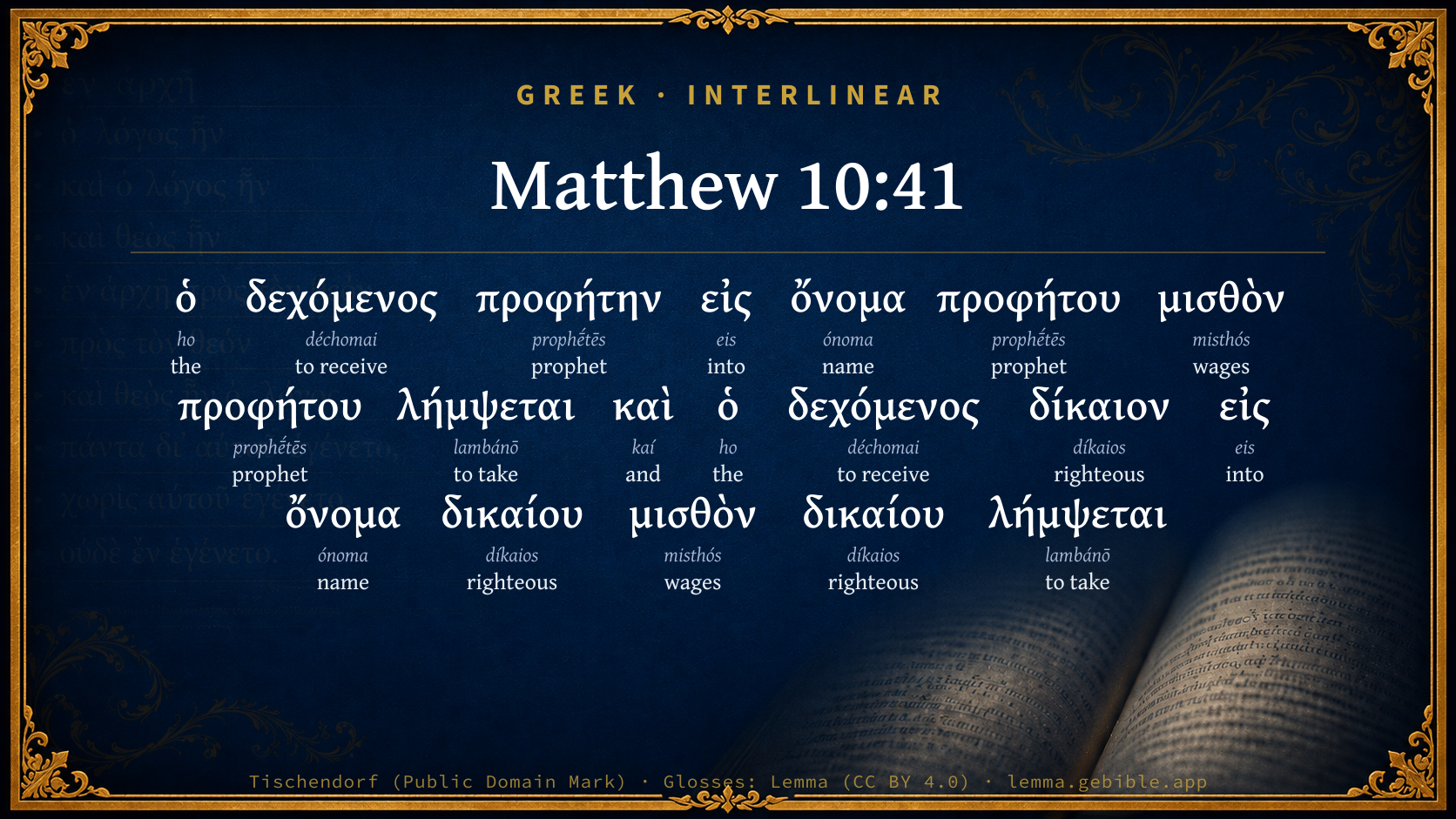
Greek (Tischendorf 8th ed.) Matthew 10:41 appears in the Greek New Testament. The text above is from the Tischendorf 8th edition. Each word links to its Strong’s number and a concise gloss. Click any word for its full Thayer’s Greek Lexicon entry.
Download image
Cite this verse

Matthew 10:41 (World English Bible). Public Domain. Lemma interlinear Bible study tool, https://lemma.gebible.app/v/matthew/10/41.

Show BibTeX & RIS
BibTeX
RIS
English Translation
He who receives a prophet in the name of a prophet will receive a prophet's reward: and he who receives a righteous man in the name of a righteous man will receive a righteous man's reward.
World English Bible · Public Domain
Download a study sheet

One document with this verse’s original text, its word-by-word gloss line, the meaning frame, cross-references with their text, attributed commentary, and full source and license credits — printable, and it pastes into notes with its structure intact.

This verse Autodidact and up

Study sheet (.html) Plain text (.txt)

A passage Seminary Student

Up to 50 verses in one chapter. A passage sheet keeps up to 6 commentary sources and 12 cross-references per verse, in the order this page ranks them, and says so on the sheet whenever that leaves anything out. Ask for a single verse and you get the Autodidact verse sheet above.

Everything on this page stays free to read, with no account — the sheet is a download of what is already on screen, not access to it.

Want to remove ads? Support Godless Engineer
Compare translations 3

The same verse in 3 English versions, stacked beneath the original-language interlinear above. Click any original word for its lexicon entry.

Each is an independent rendering of the whole verse — the interlinear is not word-aligned to these translations.

Highlighted words mark where these versions differ — a whole-verse word diff, not a word-by-word alignment.

  • World English Bible Public Domain
    He who receives a prophet in the name of a prophet will receive a prophet's reward: and he who receives a righteous man in the name of a righteous man will receive a righteous man's reward.
  • King James Version Public Domain
    He that receiveth a prophet in the name of a prophet shall receive a prophet's reward; and he that receiveth a righteous man in the name of a righteous man shall receive a righteous man's reward.
  • unfoldingWord Literal Text CC BY-SA 4.0
    The one receiving a prophet in the name of a prophet will receive a reward of a prophet, and the one receiving a righteous in the name of a righteous will receive a reward of a righteous.

unfoldingWord Literal Text — © unfoldingWord, licensed CC BY-SA 4.0. Word-aligned USFM3 via Door43 (git.door43.org/unfoldingWord/en_ult).

Versions to compare (up to 4)

3 of 4 selected

Show all 19 translations

Every available English version of this verse, each an independent rendering of the whole verse.

  • World English Bible Public Domain
    He who receives a prophet in the name of a prophet will receive a prophet's reward: and he who receives a righteous man in the name of a righteous man will receive a righteous man's reward.
  • Berean Standard Bible Public Domain
    Whoever receives a prophet because he is a prophet will receive a prophet’s reward, and whoever receives a righteous man because he is a righteous man will receive a righteous man’s reward.
  • Majority Standard Bible Public Domain
    Whoever receives a prophet because he is a prophet will receive a prophet’s reward, and whoever receives a righteous man because he is a righteous man will receive a righteous man’s reward.
  • King James Version Public Domain
    He that receiveth a prophet in the name of a prophet shall receive a prophet's reward; and he that receiveth a righteous man in the name of a righteous man shall receive a righteous man's reward.
  • American Standard Version (1901) Public Domain
    He that receiveth a prophet in the name of a prophet shall receive a prophet's reward: and he that receiveth a righteous man in the name of a righteous man shall receive a righteous man's reward.
  • Revised Version (1885) Public Domain
    He that receiveth a prophet in the name of a prophet shall receive a prophet’s reward; and he that receiveth a righteous man in the name of a righteous man shall receive a righteous man’s reward.
  • Geneva Bible (1599) Public Domain
    Hee that receiueth a Prophet in the name of a Prophet, shall receiue a Prophetes rewarde: and hee that receiueth a righteous man, in the name of a righteous man, shall receiue the rewarde of a righteous man.
  • Douay-Rheims (1899) Public Domain
    He that receiveth a prophet in the name of a prophet, shall receive the reward of a prophet: and he that receiveth a just man in the name of a just man, shall receive the reward of a just man.
  • Young's Literal Translation Public Domain
    he who is receiving a prophet in the name of a prophet, shall receive a prophet's reward, and he who is receiving a righteous man in the name of a righteous man, shall receive a righteous man's reward,
  • Literal Standard Version CC BY-SA 4.0
    he who is receiving a prophet in the name of a prophet, will receive a prophet’s reward, and he who is receiving a righteous man in the name of a righteous man, will receive a righteous man’s reward,
  • Unlocked Literal Bible CC BY-SA 4.0
    He who welcomes a prophet because he is a prophet will receive a prophet's reward, and he who welcomes a righteous man because he is a righteous man will receive a righteous man's reward.
  • unfoldingWord Literal Text CC BY-SA 4.0
    The one receiving a prophet in the name of a prophet will receive a reward of a prophet, and the one receiving a righteous in the name of a righteous will receive a reward of a righteous.
  • Darby Bible Public Domain
    He that receives a prophet in the name of a prophet, shall receive a prophet's reward; and he that receives a righteous man in the name of a righteous man, shall receive a righteous man's reward.
  • World Messianic Bible Public Domain
    He who receives a prophet in the name of a prophet will receive a prophet’s reward. He who receives a righteous man in the name of a righteous man will receive a righteous man’s reward.
  • Webster's Bible Public Domain
    He that receiveth a prophet in the name of a prophet, shall receive a prophet's reward; and he that receiveth a righteous man in the name of a righteous man, shall receive a righteous man's reward.
  • Free Bible Version CC BY-SA 4.0
    Those who welcome a prophet because that's what they are, will receive the same reward as a prophet. Those who welcome someone who does right will receive the same reward as someone who does right.
  • Bible in Basic English Public Domain
    He who gives honour to a prophet, in the name of a prophet, will be given a prophet's reward; and he who gives honour to an upright man, in the name of an upright man, will be given an upright man's reward.
  • Text-Critical English NT CC BY 4.0
    Whoever receives a prophet in the name of a prophet will receive a prophet's reward; whoever receives a righteous person in the name of a righteous person will receive a righteous person's reward.
  • Tyndale New Testament (1534) Public Domain
    He that receavith a prophet in the name of a prophet shall receave a prophetes rewarde. And he that receavith a righteous man in the name of a righteous man shall receave the rewarde of a righteous man.

Literal Standard Version (2020), Covenant Press — licensed CC BY-SA 4.0. Text via the HelloAO Bible API (eBible.org). Unlocked Literal Bible (unfoldingWord) — licensed CC BY-SA 4.0. Text via the HelloAO Bible API (eBible.org). unfoldingWord Literal Text — © unfoldingWord, licensed CC BY-SA 4.0. Word-aligned USFM3 via Door43 (git.door43.org/unfoldingWord/en_ult). Free Bible Version, Dr. Jonathan Gallagher — licensed CC BY-SA 4.0. Text via the HelloAO Bible API (eBible.org).

Word by word

More ways to search: Search by grammar → Find every occurrence → Compare this word →

Practice this passage: Drill this verse → Learn its vocabulary →

μισθὸν
misthós
G3408
“wages”
Noun, Accusative, Singular, Masculine
Part of Speech
Noun
Case
Accusative
Number
Singular
Gender
Masculine
Full Thayer's Definition

Origin: apparently a primary word

TDNT: 15:35,6

1. dues paid for work a. wages, hire 2. reward: used of the fruit naturally resulting from toils and endeavours a. in both senses, rewards and punishments b. of the rewards which God bestows, or will bestow, upon good deeds and endeavours c. of punishments
  1. ὁ ho G3588 “the” Article, Nominative, Singular, Masculine
  2. δεχόμενος déchomai G1209 “to receive” Verb, Present, Middle or Passive deponent, Participle, Nominative, Singular, Masculine
  3. προφήτην prophḗtēs G4396 “prophet” Noun, Accusative, Singular, Masculine
  4. εἰς eis G1519 “into” Preposition
  5. ὄνομα ónoma G3686 “name” Noun, Accusative, Singular, Neuter
  6. προφήτου prophḗtēs G4396 “prophet” Noun, Genitive, Singular, Masculine
  7. προφήτου prophḗtēs G4396 “prophet” Noun, Genitive, Singular, Masculine
  8. λήμψεται lambánō G2983 “to take” Verb, Future, Middle deponent, Indicative, 3rd person, Singular
  9. καὶ kaí G2532 “and” Conjunction
  10. ὁ ho G3588 “the” Article, Nominative, Singular, Masculine
  11. δεχόμενος déchomai G1209 “to receive” Verb, Present, Middle or Passive deponent, Participle, Nominative, Singular, Masculine
  12. δίκαιον díkaios G1342 “righteous” Adjective, Accusative, Singular, Masculine
  13. εἰς eis G1519 “into” Preposition
  14. ὄνομα ónoma G3686 “name” Noun, Accusative, Singular, Neuter
  15. δικαίου díkaios G1342 “righteous” Adjective, Genitive, Singular, Masculine
  16. μισθὸν misthós G3408 “wages” Noun, Accusative, Singular, Masculine
  17. δικαίου díkaios G1342 “righteous” Adjective, Genitive, Singular, Masculine
  18. λήμψεται lambánō G2983 “to take” Verb, Future, Middle deponent, Indicative, 3rd person, Singular

About this verse

These counts appear in no published source. They are computed here, from the morphology-tagged text and Lemma’s own curated glosses. What Lemma adds →

19
words
9
distinct lemmas
Gospels
section

Shared distinctive vocabulary

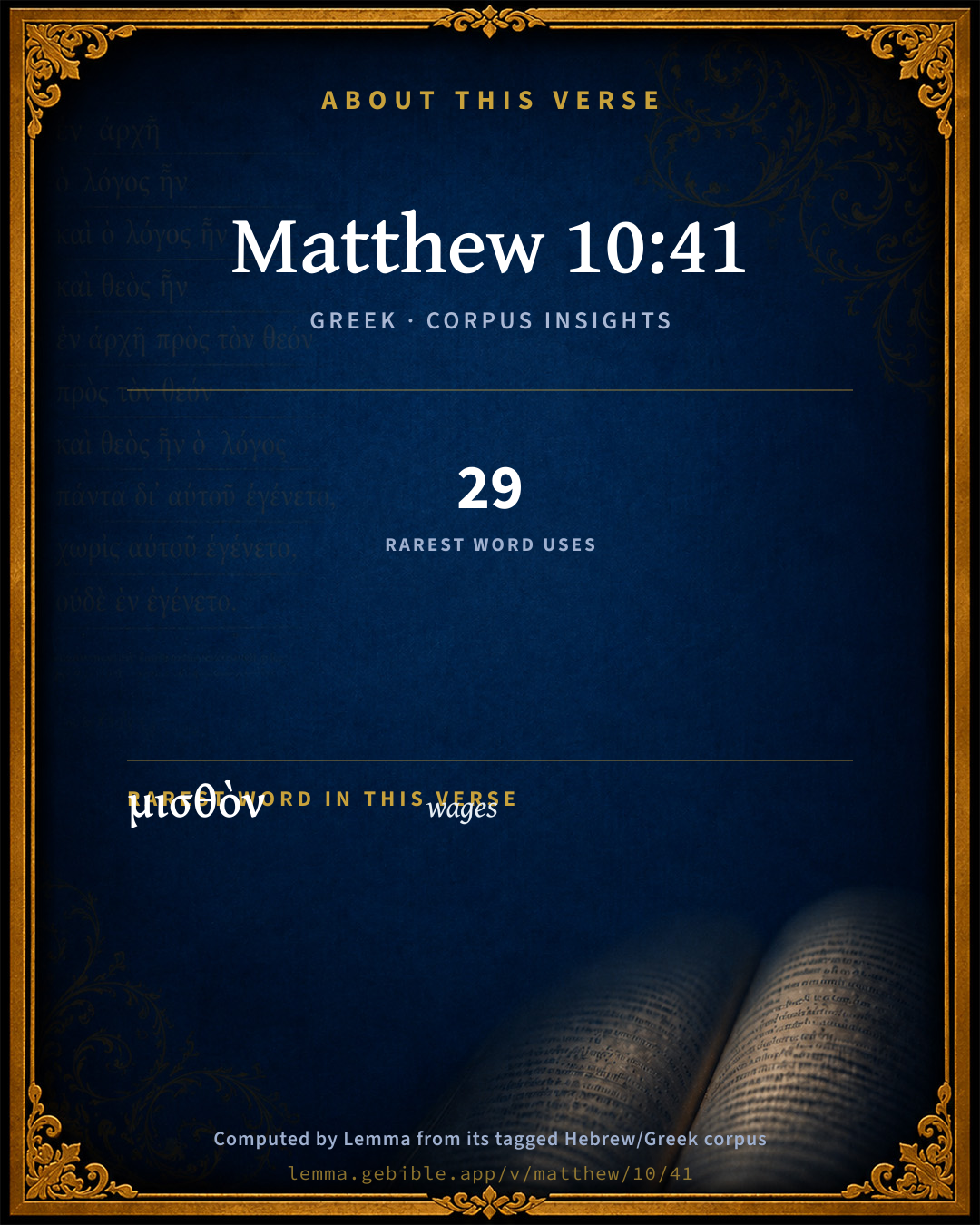
μισθὸν wages G3408 occurs in 28 verses of the Greek New Testament. Also found in:
Repetition

Words recur within this verse:

  • προφήτην prophet G4396 ×3
  • δίκαιον righteous G1342 ×3
  • δεχόμενος to receive G1209 ×2
  • εἰς into G1519 ×2
  • ὄνομα name G3686 ×2
  • μισθὸν wages G3408 ×2
  • λήμψεται to take G2983 ×2
  • ὁ the G3588 ×2

Cross-references

23

Topical passages linked to Matthew 10:41 in the Treasury of Scripture Knowledge — connected by theme and wording, ordered by reader-vote popularity; previews shown in the World English Bible.

  • 3 John 1:5–8 Beloved, you do a faithful work in whatever you accomplish for those who are brothers and strangers.
  • Hebrews 6:10 For God is not unrighteous, so as to forget your work and the labor of love which you showed toward his name, in that you served the saints, and still do serve them.
  • 2 Kings 4:8–10 It fell on a day, that Elisha passed to Shunem, where was a great woman; and she constrained him to eat bread. So it was, that as often as he passed by, he turned in there to eat bread.
  • 2 Kings 4:16–17 He said, At this season, when the time comes round, you shall embrace a son. She said, No, my lord, you man of God, do not lie to your handmaid.
  • Luke 14:13–14 But when you make a feast, ask the poor, the maimed, the lame, or the blind;
  • 1 Kings 18:3–4 Ahab called Obadiah, who was over the household. (Now Obadiah feared Yahweh greatly:
  • 2 John 1:8 Watch yourselves, that we don't lose the things which we have accomplished, but that we receive a full reward.
  • Genesis 20:7 Now therefore, restore the man's wife. For he is a prophet, and he will pray for you, and you will live. If you don't restore her, know for sure that you will die, you, and all who are yours."
  • 2 Kings 4:32–37 When Elisha was come into the house, behold, the child was dead, and laid on his bed.
  • Matthew 25:34–40 Then the King will tell those on his right hand, 'Come, blessed of my Father, inherit the Kingdom prepared for you from the foundation of the world;
  • Romans 16:1–4 I commend to you Phoebe, our sister, who is a servant of the assembly that is at Cenchreae,
  • 1 Corinthians 9:17 For if I do this of my own will, I have a reward. But if not of my own will, I have a stewardship entrusted to me.
  • 2 Thessalonians 1:6–7 Since it is a righteous thing with God to repay affliction to those who afflict you,
  • Matthew 6:6 But you, when you pray, enter into your inner chamber, and having shut your door, pray to your Father who is in secret, and your Father who sees in secret will reward you openly.
  • Matthew 6:18 so that you are not seen by men to be fasting, but by your Father who is in secret, and your Father, who sees in secret, will reward you.
  • Matthew 16:27 For the Son of Man will come in the glory of his Father with his angels, and then he will render to everyone according to his deeds.
  • 2 Timothy 1:16–18 May the Lord grant mercy to the house of Onesiphorus, for he often refreshed me, and was not ashamed of my chain,
  • 1 Kings 17:9–15 Arise, get you to Zarephath, which belongs to Sidon, and dwell there: behold, I have commanded a widow there to sustain you.
  • Romans 16:23 Gaius, my host and host of the whole assembly, greets you. Erastus, the treasurer of the city, greets you, as does Quartus, the brother.
  • 1 Kings 17:20–24 He cried to Yahweh, and said, Yahweh my God, have you also brought evil on the widow with whom I sojourn, by killing her son?
  • Matthew 6:1 "Be careful that you don't do your charitable giving before men, to be seen by them, or else you have no reward from your Father who is in heaven.
  • Matthew 6:4 so that your merciful deeds may be in secret, then your Father who sees in secret will reward you openly.
  • Acts 16:15 When she and her household were baptized, she begged us, saying, "If you have judged me to be faithful to the Lord, come into my house, and stay." So she persuaded us.

Cross-references courtesy of OpenBible.info (CC BY 4.0).

Commentary

Notes on Matthew 10:41 from classic Christian and Jewish commentators (each source and its license shown beneath its notes). The classic Christian expositions comment on the surrounding passage and are grouped to its opening verse, so a note may address several verses; the Jewish commentaries on the Tanakh (Rashi and others) are per-verse, so they appear only where the commentator wrote on this verse.

Lemma curates 59 commentaries, every one of them public domain or Creative Commons licensed, each selected and text-cleaned for this edition rather than reprinted as found. About our sources →

The Biblical Illustrator

Joseph S. Exell

Mat_10:41

He that receiveth a prophet.

The reception of prophet

I. What, is the bible meaning of the term, is a prophet?

1. There is first what may properly be called the seer, men with burning eye to take in visions of the unseen.

2. Then the word prophet merges into our word preacher.

3. But there are two conditions without which no man has a right to this name; a godly life, a special message from God.

II. The true spirit in which a prophet should be received.

1. The true exercise of our receptive faculties is an important element of our responsibility.

2. Let us receive without prejudice.

3. Let us receive with humility.

4. That such a reception will bring us a prophets reward. (J. Brierley, B. A.)

Goodness essential to a true Prophet

In other walks of life man may attain high distinction without this condition. He may be a suecessful lawyer, and, as some modern examples have shown, obtain the chief prizes of his profession without possessing moral character that will bear inspection. A man may obtain fortune and fame as an artist, and be all the while, like Turner, addicted to the lowest pleasures. In fact, a recent French writer has given us the exquisitely French doctrine that immorality is a great auxiliary to art. A man may be a success on the Stock Exchange, and have in him no scintilla of spiritual principle. All this is possible, but a man who in any age takes the name and function of prophet of God, proclaimer of His truth and message, and who at the same time keeps not step in his life to the sublime music of heavens highest law, is a self-confessed monstrosity. (J. Brierley, B. A.)

The true prophet has spiritual knowledge at first hand

Like a man who has been teaching geography in a school. His time has been occupied with maps, atlases, globes, and text-books of geography. He knows all the mountains in Europe by name, and the length of the principal rivers. His head is full of this, and he has tried to fill the heads of his pupils with this, and to him and to them it has been a business unspeakably dry. By-and-by he gets a vacation, and somebody fills his purse for him, and says, Now go off somewhere and enjoy yourself. He goes to Switzerland. He sees Mont Blanc and the Rhine, and the Lake of Geneva. It is not a bit like the geography book. These fresh breezes that blow, the deep blue of the glorious lake, the glint up yonder of the everlasting snows, whisper no hint of page sixteen in that odious text-book with its endless names and figures. This is the difference between knowledge at second hand and at first hand. (J. Brierley, B. A.)

The responsible use of our receptive faculties

Physiologists tell us we have two sets of nerves, the afferent and the efferent; the one bringing to us impressions from without, the other acting on the muscles and carrying to the outside world the tides of force that are within. Life is just this contrast, giving and receiving, and the one process needs as much watching as the other. It is not enough to look after the activities of the soul. The call may be for courtesy, sympathy, and unless these are forthcoming, in spite of activities, the man is a failure over half his nature. (J. Brierley, B. A.)

When Gods rains are descending, and His gracious breezes blowing from off the everlasting hills, keep the soul open. It is a grand opportunity on the receptive side. (J. Brierley, B. A.)

The principle of future recompenses

1. By our works shall be decided the degree of our future reward.

2. The reward affixed to an action may be obtained though the action itself has not been performed. He who receives a prophet in the name of a prophet is to obtain the recompense as though he were himself a prophet. There must be division of labour; all working to the same end receive same reward.

3. If our works are susceptible of reward, it seems necessarily to follow that there will be differences in reward, so that the future portion of the righteous will be far from uniform. What the prophet receives is not what the righteous man receives.

4. That no good work is so inconsiderable as to be excluded from recompense. Cup of cold water given in the name of a disciple. But if the cup of cold water is not to lose its reward, it must be proffered when he who gives it has nothing better to give. (H. Melvill, B. D.)

Difference of office does not preclude sameness of recompense

For instance, what wholly different spheres of duty are assigned to the clergy and the laity! And we are told that he who labours with great earnestness in the work of a clergyman has a reward of peculiar splendour within reach, inasmuch as they who turn many to righteousness shall shine as the stars for ever and ever. But it is evident from our text that the same reward is attainable by others who have never been called to the clergymans work. They who have not been prophets may receive a prophets reward; and if an individual have upheld a clergyman in his arduous and most responsible calling, strengthening him by such assistances as the occasion demands, sustaining him when assailed, cheering him when disheartened, and all out of love for his office, and desire for his success, so that he receives the pastor in the name of a pastor, we may say of such an individual that in Gods sight lie takes part in the clergymans labours. (H. Melvill, B. D.)

Sympathy with a character involves likeness to that character

The power of sympathizing with an) character is the partial possession of that character for ourselves. A man who is capable of having his soul bowed by the stormy thunder of Beethoven, or lifted to heaven by the etherial melody of Mendelsshon, is a musician, though he never composed a bar. The man who recognizes and feels the grandeur of the organ music of Paradise Lost has some fibre of a poet in him, though he be but; a mute inglorious Milton. (Dr. Maclaren.)

Sympathy, not action, the condition of reward

The old knight that clapped Luther on the back when he went into the Diet of Worms, and said to him, Well done, little monk! shared in Luthers victory and in Luthers crown. He that helps a prophet because he is a prophet, has got the making of a prophet in himself. (Dr. Maclaren.)

Holding the ropes

I am going down into the pit, you hold the ropes, said Carey, the pioneer missionary. They that hold the ropes, and the daring miner that swings away down in the blackness, are one in the work, may be one in the motive, and, if they are, shall be one in the reward. So, brethren, though no coal of fire may be laid upon your lips, if you sympathize with the workers that are trying to serve God, and do what you can to help them, and identify yourself with them, and so hold the ropes, my text; will be true about you.

He that receiveth a prophet in the name of a prophet; shall receive a prophets reward. They who by reason of circumstances, by deficiency of power, or by the weight of other tasks and duties, can only give silent sympathy, and prayer, and help, are one with the men whom they help. (Dr. Maclaren.)

Participation in service

As there is a way of partaking of other mens sins, so in other mens holy services. (Gurnall.)

The Biblical Illustrator, edited by Joseph S. Exell (c. 1880s–1900s) — public domain. Text from a community e-Sword module.

MacLaren's Expositions of Holy Scripture

Alexander MacLaren

Matthew

THE GREATEST IN THE KINGDOM, AND THEIR REWARD

Mat 10:41 - Mat 10:42.

There is nothing in these words to show whether they refer to the present or to the future. We shall probably not go wrong if we regard them as having reference to both. For all godliness has ‘promise of the life that now is, as well as of that which is to come,’ and ‘in keeping God’s commandments,’ as well as for keeping them, ‘there is great reward,’ a reward realised in the present, even although Death holds the keys of the treasure-house in which the richest rewards are stored. No act of holy obedience is here left without foretastes of joy, which, though they be but ‘brooks by the way,’ contain the same water of life which hereafter swells to an ocean.

Some people tell us that it is defective morality in Christianity to bribe men to be good by promising them Heaven, and that he who is actuated by such a motive is selfish. Now that fantastic and overstrained objection may be very simply answered by two considerations: self-regard is not selfishness, and Christianity does not propose the future reward as the motive for goodness. The motive for goodness is love to Jesus Christ; and if ever there was a man who did acts of Christian goodness only for the sake of what he would get by them, the acts were not Christian goodness, because the motive was wrong. But it is a piece of fastidiousness to forbid us to reinforce the great Christian motive, which is love to Jesus Christ, by the thought of the recompense of reward. It is a stimulus and an encouragement of, not the motive for, goodness. This text shows us that it is a subordinate motive, for it says that the reception of a prophet, or of a righteous man, or of ‘one of these little ones,’ which is rewardable, is the reception ‘in the name of’ a prophet, a disciple, and so on, or, in other words, is the recognising of the prophet, or the righteous man, or the disciple for what he is, and because he is that, and not because of the reward, receiving him with sympathy and solace and help.

So, with that explanation, let us look at these very remarkable words of our text.

I. The first thing which I wish to observe in them is the three classes of character which are dealt with-’prophet,’ ‘righteous man,’ ‘these little ones.’

Now the question that I would suggest is this: Is there any meaning in the order in which these are arranged? If so, what is it? Do we begin at the bottom, or at the top? Have we to do with an ascending or with a descending scale? Is the prophet thought to be greater than the righteous man, or less? Is the righteous man thought to be higher than the little one, or to be lower? The question is an important one, and worth considering.

Now, at first sight, it certainly does look as if we had here to do with a descending scale, as if we began at the top and went downwards. A prophet, a man honoured with a distinct commission from God to declare His will, is, in certain very obvious respects, loftier than a man who is not so honoured, however pure and righteous he may be. The dim and venerable figures, for instance, of Isaiah and Jeremiah, tower high above all their contemporaries; and godly men who hung upon their lips, like Baruch on Jeremiah’s, felt themselves to be, and were, inferior to them. And, in like manner, the little child who believes in Christ may seem to be insignificant in comparison with the prophet with his God-touched lips, or the righteous man of the old dispensation with his austere purity; as a humble violet may seem by the side of a rose with its heart of fire, or a white lily regal and tall. But one remembers that Jesus Christ Himself declared that ‘the least of the little ones’ was greater than the greatest who had gone before; and it is not at all likely that He who has just been saying that whosoever received His followers received Himself, should classify these followers beneath the righteous men of old. The Christian type of character is distinctly higher than the Old Testament type; and the humblest believer is blessed above prophets and righteous men because his eyes behold and his heart welcomes the Christ.

Therefore I am inclined to believe that we have here an ascending series-that we begin at the bottom and not at the top; that the prophet is less than the righteous man, and the righteous man less than the little one who believes in Christ. For, suppose there were a prophet who was not righteous, and a righteous man who was not a prophet. Suppose the separation between the two characters were complete, which of them would be the greater? Balaam was a prophet; Balaam was not a righteous man; Balaam was immeasurably inferior to the righteous whose lives he did not emulate, though he could not but envy their deaths. In like manner the humblest believer in Jesus Christ has something that a prophet, if he is not a disciple, does not possess; and that which he has, and the prophet has not, is higher than the endowment that is peculiar to the prophet alone.

May we say the same thing about the difference between the righteous man and the disciple? Can there be a righteous man that is not a disciple? Can there be a disciple that is not a righteous man? Can the separation between these two classes be perfect and complete? No! in the profoundest sense, certainly not. But then at the time when Christ spoke there were some men standing round Him, who, ‘as touching the righteousness which is of the law,’ were ‘blameless.’ And there are many men to-day, with much that is noble and admirable in their characters, who stand apart from the faith that is in Jesus Christ; and if the separation be so complete as that, then it is to be emphatically and decisively pronounced that, if we have regard to all that a man ought to be, and if we estimate men in the measure in which they approximate to that ideal in their lives and conduct, ‘the Christian is the highest style of man.’ The disciple is above the righteous men adorned with many graces of character, who, if they are not Christians, have a worm at the root of all their goodness, because it lacks the supreme refinement and consecration of faith; and above the fiery-tongued prophet, if he is not a disciple.

Now, brethren, this thought is full of very important practical inferences. Faith is better than genius. Faith is better than brilliant gifts. Faith is better than large acquirements. The poet’s imagination, the philosopher’s calm reasoning, the orator’s tongue of fire, even the inspiration of men that may have their lips touched to proclaim God to their brethren, are all less than the bond of living trust that knits a soul to Jesus Christ, and makes it thereby partaker of that indwelling Saviour. And, in like manner, if there be men, as there are, and no doubt some of them among my hearers, adorned with virtues and graces of character, but who have not rested their souls on Jesus Christ, then high above these, too, stands the lowliest person who has set his faith and love on that Saviour. Neither intellectual endowments nor moral character are the highest, but faith in Jesus Christ. A man may be endowed with all brilliancy of intellect and fair with many beauties of character, and he may be lost; and on the other hand simple faith, rudimentary and germlike as it often is, carries in itself the prophecy of all goodness, and knits a man to the source of all blessedness. ‘Whether there be tongues, they shall cease; whether there be knowledge, it shall vanish away. Now abideth these three, faith, hope, charity.’ ‘Rejoice not that the spirits are subject unto you, but rather rejoice because your names are written in Heaven.’

Ah! brethren, if we believed in Christ’s classification of men, and in the order of importance and dignity in which He arranges them, it would make a wonderful practical difference to the lives, to the desires, and to the efforts of a great many of us. Some of you students, young men and women that are working at college or your classes, if you believed that it was better to trust in Jesus Christ than to be wise, and gave one-tenth, ay! one-hundredth part of the attention and the effort to secure the one which you do to secure the other, would be different people. ‘Not many wise men after the flesh,’ but humble trusters in Jesus Christ, are the victors in the world. Believe you that, and order your lives accordingly.

Oh! what a reversal of this world’s estimates is coming one day, when the names that stand high in the roll of fame shall pale, like photographs that have been shut up in a portfolio, and when you take them out have faded off the paper. ‘The world knows nothing of its greatest men,’ but there is a time coming when the spurious mushroom aristocracy that the world has worshipped will be forgotten, like the nobility of some conquered land, who are brushed aside and relegated to private life by the new nobility of the conquerors, and when the true nobles, God’s aristocrats, the righteous, who are righteous because they have trusted in Christ, shall shine forth like the sun ‘in the Kingdom of My Father.’

Here is the climax: gifts and endowments at the bottom, character and morality in the middle, and at the top faith in Jesus Christ.

II. Now notice briefly in the second place the variety of the reward according to the character.

The prophet has his, the righteous man has his, the little one has his. That is to say, each level of spiritual or moral stature receives its own prize. There is no difficulty in seeing that this is so in regard to the rewards of this life. Every faithful message delivered by a prophet increases that prophet’s own blessedness, and has joys in the receiving of it from God, in the speaking of it to men, in the marking of its effects as it spreads through the world, which belong to him alone. In all these, and in many other ways, the ‘prophet’ has rewards that no stranger can intermeddle with. All courses of obedient conduct have their own appropriate consequences and satisfaction. Every character is adapted to receive, and does receive, in the measure of its goodness, certain blessings and joys, here and now. ‘Surely the righteous shall be recompensed in the earth.’

And the same principle, of course, applies if we think of the reward as altogether future. It must be remembered, however, that Christianity does not teach, as I believe, that if there be a prophet or a righteous man who is not a disciple, that prophet or righteous man will get rewards in the future life. It must be remembered, too, that every disciple is righteous in the measure of his faith. Discipleship being presupposed, then the disciple who is a prophet will have one reward, and the disciple who is a righteous man shall have another; and where all three characteristics coincide, there shall be a triple crown of glory upon his head.

That is all plain and obvious enough, if only we get rid of the prejudice that the rewards of a future life are merely bestowed upon men by God’s arbitrary good pleasure. What is the reward of Heaven? ‘Eternal life,’ people say. Yes! ‘Blessedness.’ Yes! But where does the life come from, and where does the blessedness come from? They are both derived, they come from God in Christ; and in the deepest sense, and in the only true sense, God is Heaven, and God is the reward of Heaven. ‘I am thy shield,’ so long as dangers need to be guarded against, and then, thereafter, ‘I am thine exceeding great Reward.’ It is the possession of God that makes all the Heaven of Heaven, the immortal life which His children receive, and the blessedness with which they are enraptured. We are heirs of immortality, we are heirs of life, we are heirs of blessedness, because, and in the measure in which, we become heirs of God.

And if that be so, then there is no difficulty in seeing that in Heaven, as on earth, men will get just as much of God as they can hold; and that in Heaven, as on earth, capacity for receiving God is determined by character. The gift is one, the reward is one, and yet the reward is infinitely various. It is the same light which glows in all the stars, but ‘star differeth from star in glory.’ It is the same wine, the new wine of the Kingdom, that is poured into all the vessels, but the vessels are of divers magnitudes, though each be full to the brim.

And so in those two sister parables of our Master’s, which are so remarkably discriminated and so remarkably alike, we have both these aspects of the Heavenly reward set forth-both that which declares its identity in all cases, and the other which declares its variety according to the recipient’s character. All the servants receive the same welcome, the same prize, the same entrance into the same joy; although one of them had ten talents, and another five, and another two. But the servants who were each sent out to trade with one poor pound in their hands, and by their varying diligence reaped varying profits, were rewarded according to the returns that they had brought; and one received ten, and the other five, and the other two, cities over which to have authority and rule. So the reward is one, and yet infinitely diverse. It is not the same thing whether a man or a woman, being a Christian, is an earnest, and devoted, and growing Christian here on earth, or a selfish, and an idle, and a stagnant one. It is not the same thing whether you content yourselves with simply laying hold on Christ, and keeping a tremulous and feeble hold of Him for the rest of your lives, or whether you grow in the grace and knowledge of our Lord and Saviour. There is such a fate as being saved, yet so as by fire, and going into the brightness with the smell of the fire on your garments. There is such a fate as having just, as it were, squeezed into Heaven, and got there by the skin of your teeth. And there is such a thing as having an abundant entrance ministered, when its portals are thrown wide open. Some imperfect Christians die with but little capacity for possessing God, and therefore their heaven will not be as bright, nor studded with as majestic constellations, as that of others. The starry vault that bends above us so far away, is the same in the number of its stars when gazed on by the savage with his unaided eye, and by the astronomer with the strongest telescope; and the Infinite God, who arches above us, but comes near to us, discloses galaxies of beauty and oceans of abysmal light in Himself, according to the strength and clearness of the eye that looks upon Him. So, brethren, remember that the one glory has infinite degrees; and faith, and conduct, and character here determine the capacity for God which we shall have when we go to receive our reward.

III. The last point that is here is the substantial identity of the reward to all that stand on the same level, however different may be the form of their lives.

‘He that receiveth a prophet in the name of a prophet shall receive a prophet’s reward.’ And so in the case of the others. The active prophet, righteous man, or disciple, and the passive recogniser of each in that character, who receives each as a prophet, or righteous man, or disciple, stand practically and substantially on the same level, though the one of them may have his lips glowing with the divine inspiration and the other may never have opened his mouth for God.

That is beautiful and deep. The power of sympathising with any character is the partial possession of that character for ourselves. A man who is capable of having his soul bowed by the stormy thunder of Beethoven, or lifted to Heaven by the ethereal melody of Mendelssohn, is a musician, though he never composed a bar. The man who recognises and feels the grandeur of the organ music of ‘Paradise Lost’ has some fibre of a poet in him, though he be but ‘a mute, inglorious Milton.’

All sympathy and recognition of character involve some likeness to that character. The poor woman who brought the sticks and prepared food for the prophet entered into the prophet’s mission and shared in the prophet’s work and reward, though his task was to beard Ahab, and hers was only to bake Elijah’s bread. The old knight that clapped Luther on the back when he went into the Diet of Worms, and said to him, ‘Well done, little monk!’ shared in Luther’s victory and in Luther’s crown. He that helps a prophet because he is a prophet, has the making of a prophet in himself.

As all work done from the same motive is the same in God’s eyes, whatever be the outward shape of it, so the work that involves the same type of spiritual character will involve the same reward. You find the Egyptian medal on the breasts of the soldiers that kept the base of communication as well as on the breasts of the men that stormed the works at Tel-el-Kebir. It was a law in Israel, and it is a law in Heaven: ‘As his part is that goeth down into the battle, so shall his part be that tarrieth by the stuff, they shall part alike.’ ‘I am going down into the pit, you hold the ropes,’ said Carey, the pioneer missionary. They that hold the ropes, and the daring miner that swings away down in the blackness, are one in the work, may be one in the motive, and, if they are, shall be one in the reward. So, brethren, though no coal of fire may be laid upon your lips, if you sympathise with the workers that are trying to serve God, and do what you can to help them, and identify yourself with them, and so hold the ropes, my text will be true about you. ‘He that receiveth a prophet in the name of a prophet shall receive a prophet’s reward.’ They who by reason of circumstances, by deficiency of power, or by the weight of other tasks and duties, can only give silent sympathy, and prayer, and help, are one with the men whom they help.

Dear brethren! remember that this awful, mystical life of ours is full everywhere of consequences that cannot be escaped. What we sow we reap, and we grind it, and we bake it, and we live upon it. We have to drink as we have brewed; we have to lie on the beds that we have made. ‘Be not deceived: God is not mocked.’ The doctrine of reward has two sides to it. ‘Nothing human ever dies.’ All our deeds drag after them inevitable consequences; but if you will put your trust in Jesus Christ, He will not deal with you according to your sins, nor reward you according to your iniquities; and the darkest features of the recompense of your evil will all be taken away by the forgiveness which we have in His blood. If you will trust yourselves to Him you will have that eternal life, which is not wages, but a gift; which is not reward, but a free bestowment of God’s love. And then, if we build upon that Foundation on which alone men can build their hopes, their thoughts, their characters, their lives, however feeble may be our efforts, however narrow may be our sphere,-though we be neither prophets nor sons of prophets, and though our righteousness may be all stained and imperfect, yet, to our own amazement and to God’s glory, we shall find, when the fire is kindled which reveals and tests our works, that, by the might of humble faith in Christ, we have built upon that Foundation, gold and silver and precious stones; and shall receive the reward given to every man whose work abides that trial by fire.

Alexander MacLaren, Expositions of Holy Scripture (1904–1910) — public domain. Text from a community e-Sword module.

Tyndale Open Study Notes

Tyndale Open Resources

10:41 The same reward as a prophet (literally A prophet’s reward) means either the same reward a prophet would receive or the benefit of the prophet’s ministry. • Righteous people are those who conform their behavior to God’s law as taught by both John the Baptist (21:32) and Jesus (see 3:15), and therefore are approved by God (13:43, 49; 25:37-46).

Tyndale Open Study Notes — © Tyndale Open Resources, licensed CC BY-SA 4.0. Text via the HelloAO Bible API.

Bengel's Gnomon

Johann Albrecht Bengel

Mat 10:41. Εἰς ὄνομα, κ.τ.λ., in the name, etc.) i.e., on this ground, and on no other.[503]—προφήτην—δίκαιον, a prophet—a righteous man) A prophet is one who speaks, a righteous man one who acts, in the name of God, and is distinguished for his remarkable righteousness; see ch. Mat 13:17, Mat 23:29; Heb 11:33.—μισθὸν, hire, reward) for he shows himself as obedient to God as if he were a prophet himself. It may be asked how he who is not righteous himself can receive a righteous man as a righteous man? The reply is easy: Such a man, by the very act, abandons his evil way, and ceases to be the enemy of righteousness.

[503] So the French Version, published in Geneva in 1744 A.D., “En qualitè de Prophete.” The Latin expression, Prophetœ nomine, is similar.—E. B.

Bengel's Gnomon of the New Testament — English translation (T&T Clark, Edinburgh, 1860) — public domain. Text from a community e-Sword module.

Meyer's Critical & Exegetical Commentary

Heinrich August Wilhelm Meyer

Mat_10:41. A general expression, the special reference of which to the disciples is found in Mat_10:42.

εἰς ὄνομα] from a regard to that which the name implies, to the prophetic character; διʼ αὐτὸ τὸ ὀνομάζεσθαι καὶ εἶναι, Euth. Zigabenus. In Rabbinical writers we find לְשֵׁם. Schoettgen, p. 107; Buxtorf, Lex. Talm. p. 2431. Therefore; for the sake of the cause which stamps them with their distinguishing characteristics, for sake of the divine truth which the prophet interprets from the revelation that has been made to him, and for sake of the integrity which the δίκαιος exhibits in his life.

δίκαιον] an upright man, correct parallel to προφήτην. The apostles, however, belong to both categories, inasmuch as they receive and preach the revelation (προφῆται) communicated by God through Christ, and seeing that, through their faith in the Lord, they are characterized by true and holy righteousness of life (δίκαιοι).

The reward of a prophet and of a righteous man is the same reward, which they will receive (in the Messianic kingdom).

Meyer — Critical and Exegetical Commentary on the New Testament — English translation by Peter Christie, edited by Frederick Crombie (T&T Clark, 1880) — public domain. Text from a community e-Sword module.

Expositor's Greek Testament

ed. W. Robertson Nicoll

Mat 10:41 . hen in two distinct forms the law is stated that to befriend the representative of Christ and God ensures the reward belonging to that representative. εἰς ὄνομα , having regard to the fact that he is a prophet or righteous man. The prophet is the principal object of thought, naturally, in connection with a mission to preach truth. But Christ knows (Mat 7:15 ) that there are false prophets as well as true; therefore from vocation He falls back on personal character. Here as everywhere we see how jealously He made the ethical interest supreme. “See,” says Chrys., commenting on Mat 10:8 , “how He cares for their morals, not less than for the miracles, showing that the miracles without the morals are nought” (Hom. 32). So here He says in effect: let the prophet be of no account unless he be a just, good man. The fundamental matter is character, and the next best thing is sincere respect for it. To the latter Christ promises the reward of the former. ὁ δεχόμενος δίκαιον … μισθὸν δ . λήψετοι : a strong, bold statement made to promote friendly feeling towards the moral heroes of the world in the hearts of ordinary people; not the utterance of a didactic theologian scientifically measuring his words. Yet there is a great principle underlying, essentially the same as that involved in St. Paul’s doctrine of justification by faith. The man who has goodness enough to reverence the ideal of goodness approximately or perfectly realised in another, though not in himself, shall, in the moral order of the world, be counted as a good man.

The Expositor's Greek Testament, edited by W. Robertson Nicoll (1897–1910) — public domain. Text from a community e-Sword module.

Geneva Bible (1599)

Geneva Bible translators

As a Prophet.

We shall lose nothing that we bestow upon Christ.

Geneva Bible (1599) marginal notes — public domain. Text via Bolls.life.

Jamieson, Fausset & Brown

Robert Jamieson, A. R. Fausset & David Brown

He that receiveth a prophet--one divinely commissioned to deliver a message from heaven. Predicting future events was no necessary part of a prophet's office, especially as the word is used in the New Testament.

in the name of a prophet--for his office's sake and love to his master. (See Kg2 4:9 and see on Kg2 4:10).

shall receive a prophet's reward--What an encouragement to those who are not prophets! (See Joh 3:5-8).

and he that receiveth a righteous man in the name of a righteous man--from sympathy with his character and esteem for himself as such

shall receive a righteous man's reward--for he must himself have the seed of righteousness who has any real sympathy with it and complacency in him who possesses it.

Jamieson, Fausset & Brown — Commentary Critical and Explanatory on the Whole Bible (1871) — public domain (CC PDM 1.0). Text via the HelloAO Bible API.

Adam Clarke's Commentary

Verse 41. He that receiveth a prophet] προφητην, a teacher, not a foreteller of future events, for this is not always the meaning of the word; but one commissioned by God to teach the doctrines of eternal life. It is no small honour to receive into one's house a minister of Jesus Christ. Every person is not admitted to exercise the sacred ministry; but none are excluded from partaking of its grace, its spirit, and its reward. If the teacher should be weak, or even if he should be found afterwards to have been worthless, yet the person who has received him in the name, under the sacred character, of an evangelist, shall not lose his reward; because what he did he did for the sake of Christ, and through love for his Church. Many sayings of this kind are found among the rabbins, and this one is common: "He who receives a learned man, or an elder, into his house, is the same as if he had received the Shekinah." And again: "He who speaks against a faithful pastor, it is the same as if he had spoken against God himself." See Schoettgen.

Adam Clarke's Commentary on the Bible (1810–1826) — public domain. Text from a community e-Sword/MySword module.

Ellicott's Commentary for English Readers

(41) In the name of a prophet—i.e., for the sake of that which the name connotes—the prophet’s work as a messenger of God, the righteousness of which the living righteous man is the concrete example. The distinction between the two involves the higher inspiration of the prophet as a messenger of God, and perhaps implies that that inspiration belonged to some, and not to all the Twelve, while those who were not to receive that special gift were at all events called to set forth the pattern of a righteous life. The “reward,” and the time of its being received, belong to the future glory of the kingdom; and the words of the promise throw the gate wide open, so as to admit not only those whose gifts and characters command the admiration of mankind, but all those who show in action that they are in sympathy with the work for which the gifts have been bestowed.

A Bible Commentary for English Readers, edited by Charles John Ellicott (1878–1897) — public domain. Text from a community e-Sword module.

The Cambridge Bible for Schools and Colleges

gen. ed. J. J. S. Perowne

41. in the name of]=for the sake of, out of regard to the prophet’s character.

a prophet’s reward] Such reward as a prophet or preacher of the gospel hath.

righteous] Those who fulfil the requirements of the Christian law (comp. ch. Mat_1:19), true members of the Christian Church—the saints.

The Cambridge Bible for Schools and Colleges (gen. ed. J. J. S. Perowne; Cambridge University Press, 1878–1918) — public domain. Text from a community e-Sword module.

John Gill's Exposition

And whosoever shall give to drink unto one of these little ones,.... Our Lord gradually descends from prophets to righteous men, and from righteous men, to those of the lowest form and class among them; who have the least measure of grace, and share of spiritual light, and knowledge; who are outwardly the poorest, meanest, and most contemptible in the eyes of the world; and are little, even the least of saints, in their own esteem and account: whosoever takes notice but of "one" of these, receives him into his house, and gives him

a cup of cold water only, is regarded, a phrase used to express the least favour, or benefit whatever.

"So says (t) Maimonides, one that calls to his friend to dine with him, and he refuses, and swears, or vows, that he shall not enter into his house, nor will he give him to drink, "a drop of cold water", &c.''

Moreover, this is said to prevent any objection, on account of the mean and low condition persons may be in, to their relieving necessitous objects; for everyone is capable of doing this, and if they can do no more, it is accepted. Now whosoever takes notice of, and shows favour to the meanest of Christ's people, though it be but bestowing so small a benefit as a cup of cold water; yet, if it is done

in the name of a disciple, or because that poor person is a disciple of Christ,

verily, says Christ,

I say unto you, he shall in no wise lose his reward: it will be observed another day by Christ, who takes what is done to the least of his brethren, as done to himself. The Jews say many things in praise of hospitality, to , "a disciple of a wise man"; and observe (u), that he that hospitably entertains such an one in his house, and causes him to eat and drink, and partake of the goods of his house, there is reason to believe, he shall be much more blessed than the house of Obed Edom was for the ark's sake, which neither ate nor drank with him; and which may be compared with this passage.

(t) Hilchot Nedarim, c. 8. sect. 10. (u) T. Bab, Beracot, fol. 63. 2. & 64. 1.

Next: Matthew Chapter 11

John Gill's Exposition of the Whole Bible (1746–1763) — public domain (CC PDM 1.0). Text via the HelloAO Bible API.

Trapp's Complete Commentary

John Trapp

41 He that receiveth a prophet in the name of a prophet shall receive a prophet’s reward; and he that receiveth a righteous man in the name of a righteous man shall receive a righteous man’s reward.

Ver. 41. He that receiveth a prophet in the name, &c.] Though, haply, he be no prophet. This takes away the excuse of such as say, They would do good, if they knew to whom, as worthy.

Shall receive a prophet’s reward] Both actively, that which the prophet shall give him, by teaching him the faith of the gospel, casting pearls before him, &c. And passively, that reward that God gives the prophet, the same shall he give his host. Gaius lost nothing by such guests as John; nor the Shunammite or Sareptan by the prophets, Of such Christ seems to say, as Paul did of Onesimus, "If he owe thee ought, put that in mine account: I will repay it," Phm 1:18-19: and he, I can tell you, is a liberal paymaster. Saul and his servant had but five pence in their purse to give the prophet, 1Sa 9:8. The prophet, after much good cheer, gives him the kingdom. Such is God’s dealing with us. Seek out therefore some of his receivers, some Mephibosheth to whom we may show kindness.

He that receiveth a righteous man] Though not a minister, if for that he is righteous, and for the truth’s sake that dwelleth in him, 2Jn 1:2. The Kenites in Saul’s time, that were born many ages after Jethro’s death, receive life from his dust and favour from his hospitality. Nay, the Egyptians, for harbouring (and at first dealing kindly with) the Israelites, though without any respect to their righteousness, were preserved by Joseph in that sore famine, and kindly dealt with ever after by God’s special command.

John Trapp, A Commentary or Exposition upon All the Books of the Old and New Testament (1647–1656) — public domain. Text from a community e-Sword module.

Haydock's Catholic Bible Commentary

The reward of a prophet. That is, shall be partaker of the reward of a prophet, or shall receive the same reward as a prophet; as, according to the law of David, (1 Kings, Chap. xxx, ver. 24,) He who descended to the battle, and he who remained with the baggage, shared equally. So Saul, whilst he kept the clothes of those who stoned Stephen, stoned him by the hands of them all, as St. Augustine observes. (Menochius)

George Leo Haydock (1774–1849), Haydock's Catholic Family Bible and Commentary, 1859 edition — public domain. Excludes Psalms (Douay-Rheims chapter numbering differs from Protestant) and Deuterocanonical books (Catholic canon only).

The Pulpit Commentary

Matthew only. The whole verso recalls Jewish Christianity; it was hardly likely to have been remembered outside Jewish Christian circles. He that receiveth a prophet. One upon whom the mantle of the old prophets might in any sense he said to have fallen. The saying was probably recorded with special thought of the Christian peripatetic "prophets," who are brought before us so vividly in the "Didache." In the name of a prophet (eiv onoma profhtou ). In late Hebrew and in Aramaic the word for "name" passed into little more than a preposition, just as the word for "face "had already passed. (and so the Greek, en onomati , Mar_9:41) Here, however, this is hardly the case, the word appearing to retain its idea of both name and corresponding position. The preposition may mean either receive him into the position of a prophet, i.e. into the treatment with which a prophet should be received; or, simply, receive him at the rank and standing of a prophet. (Act_7:53) Anyhow, it is in contrast to receiving him out of mere human compassion or ordinary friendliness. The reception is to have regard to that which the name implies, for the sake of the cause that the prophet represents. Shall receive a prophet"s reward; i.e. shall share in the reward of that work in which by his kindness to the prophet he so tar takes part. Thus the widow of Sarepta shared in the blessing given to Elijah. (1Ki_17:10; cf. also 2Ki_4:8, sqq) (On reward, see Mat_5:12, note) Observe that not the action, but the motive for the action, is made all-important. It is a matter of faith, not of works (cf Nosgen). And he that receiveth a righteous man. A righteous man; i.e. one who is punctilious in performing all the details of the revealed will of God. (Mat_1:19, note; Act_22:14 Jam_5:6) This word also is used in a quasi-Jewish sense, andpoints back to the time when Jewish Christians performed, not only the law as expounded in the sermon on the mount, but also those external rites and observances which had been commanded them as Jews. (Act_21:20) Among such Jewish Christians some would he especially noticeable for their regard to these things ( e.g. James the "Just," or "Righteous"), and it is to one of these that the epithet here refers.

The Pulpit Commentary (1880–1919), ed. H.D.M. Spence-Jones & Joseph S. Exell — public domain. Text from a community e-Sword module.

John Wesley's Explanatory Notes

He that entertaineth a prophet - That is, a preacher of the Gospel: In the name of a prophet - That is, because he is such, shall share in his reward.

John Wesley, Explanatory Notes Upon the Whole Bible (1754–1765) — public domain. Text via the GEBible commentary corpus.

Scofield Reference Notes

C. I. Scofield

righteous

Righteousness. (See Scofield "Rom 10:10").

The Scofield Reference Bible (1917 edition), notes by C. I. Scofield — public domain. Text from a community e-Sword module.

The People's New Testament

B. W. Johnson

41. In the name of a prophet. That is, because he is a prophet. The apostles themselves were prophets.

B. W. Johnson's The People's New Testament with Notes (1889–1891) — public domain. Electronic text from the Christian Classics Ethereal Library (CCEL) ThML edition.

Cambridge Greek Testament for Schools and Colleges

41. λήμψεται (א B C D). The non-assimilation of consonants was also characteristic of the Alexandrine dialect, as ἐνγύς, σύνκεισθε, συνπάτει. On the other hand assimilation takes place in the Alexandrine dialect in the case of ν, contrary to the usage of other dialects, as ἐμμέσῳ, ἐμ Πάρῳ ἐγ Κυβέλοις, though, as might be expected, the MSS. differ considerably in these readings (Sturz, 130–134).

THE MISSION OF THE TWELVE 1–4, AND THE CHARGE TO THEM, 5–42

Mar 3:14-19; Mar 6:7-13. Luk 6:12-16; Luk 9:1-6.

41. εἰς ὄνομα προφήτου. A Hebraism: for the sake of, out of regard to the prophet’s character. In translating the Hebr. l’shem the Hellenistic writers use indifferently εἰς [τὸ] ὄνομα, ἐν [τῷ] ὀνόματι, ἐπὶ [τῷ] ὀνοματι.

μισθὸν προφήτου. Such reward as a prophet or preacher of the gospel hath.

δίκαιον. The righteous are those who fulfil the requirements of the Christian law (comp. ch. Mat 1:19), true members of the Christian Church—the saints.

Cambridge Greek Testament for Schools and Colleges (Cambridge University Press, 1896; 21 vols, various authors incl. Carr, Maclear, Plummer, Farrar, Lumby, Moule, M. R. James, Simcox) — public domain. Text from a community e-Sword module.

Alford’s Greek Testament

Henry Alford

41. μισθὸν προφήτου] οἷον εἰκὸς τὸν προφήτην ἢ δίκαιον δεξάμενον λαβεῖν, ἢ οἷον ἐκεῖνος μέλλει λαμβάνειν. Chrysost. Hom. xxxv. 2, p. 401.

εἰς ὄνομα, a Hebraism (לְשֵׁם): because He is: i.e. ‘for the love of Christ, whose prophet he is.’ The sense is, ‘He who by receiving (see above) a prophet because he is a prophet, or a holy man because he is a holy man, recognizes, enters into, these states as appointed by Me, shall receive the blessedness of these states, shall derive all the spiritual benefits which these states bring with them, and share their everlasting reward.’

Henry Alford, The Greek Testament (1849–1861) — public domain. Text from a community e-Sword module.

International Critical Commentary

(L) 41. He who receiveth a prophet in the name of a prophet shall receive the reward of a prophet; and he who receives a righteous man in the name of a righteous man shall receive the reward of a righteous man.] V. 40 finds a parallel in Mar 9:37b ὃς ἂν ἓν τῶν τοιούτων παιδίων δέξηται ἐπὶ τῷ ὀνόματί μου ἐμὲ δέχεται· καὶ ὃς ἂν ἐμὲ δέχηται οὐκ ἐμὲ δέχεται ἀλλὰ τὸν ἀποστείλαντά με. Mt. adapts to his context here by substituting ὑμᾶς for “one of such children,” and omits from Mk when he comes to that passage. The thought passes from the fate of the disciples to that of those who receive the teaching of Christ, which they are to proclaim to the world. Those who receive them, i.e. welcome their teaching, receive Christ, because it is His teaching which the disciples transmit, and receive God who sent Him. This idea of Christ’s mission from God has already underlain the ἦλθον of 5:17, 10:34. In v. 40 the Christian missionaries are called προφῆται and δίκαιοι. For the first, cf. 23:34. They were δίκαιοι as practising the δικαιοσύνη which he taught them, 6:1-18; cf. 5:20. εἰς ὄνομα is a translation of the Jewish לשם = “in the capacity of,” “as,” “on the ground of his prophetic qualifications.” Cf. Heitmüller, Im Namen Jesu, pp. 112 ff. Those who receive the Christian missionaries in respect of their Christian message, i.e. accept their teaching and become Christians, will receive the same reward as the preachers themselves. For the idea of eternal life as a reward, see on 19:29; and for the conception that early and late comers into the kingdom receive the same reward of eternal life, see on 20:1-16.

International Critical Commentary — older volumes (1896–1929), various authors — public domain. Text from a community e-Sword module.

Lesson kit

Teaching starters — assembled from the data on this page, not authored interpretation. Every prompt links to the verse data it draws on. Edit before teaching.

Matthew, in the Gospels, opens this verse with 19 words (9 distinct Greek lemmas). Its most distinctive word is misthós (“wages”). A historical commentator’s framing appears above. Read the whole chapter for the surrounding context.

Discussion questions

  1. What does “wages” (misthós) contribute to the verse as a whole?
  2. Matthew 5:12 shares the word «wages» with this verse. How do the two illuminate each other?
  3. “prophet” occurs 3× in this one verse. What is the effect of the repetition?
  4. These translations render this verse differently; the difference is in the English rendering, not the original. What questions does that raise?
  5. Reading how The Biblical Illustrator and MacLaren's Expositions of Holy Scripture read this verse, where do the two commentators agree and where do they part?

Things to notice

  • These translations choose different wording for 10 words in this verse.
  • “prophet” occurs 3× in this single verse.
  • 9 distinct Greek lemmas span 19 words in this verse.

Reading settings

Reading text

Shown beneath each verse's original-language words.

Old Testament
Old Testament edition

Read the OT as the Masoretic Hebrew (MT) or the Greek Septuagint (LXX).

English shown for the Greek Septuagint (in the Hebrew ↔ Greek comparison).

Comparing translations? Open the Compare panel on any verse page to stack up to four side by side.