
Matthew 12:13

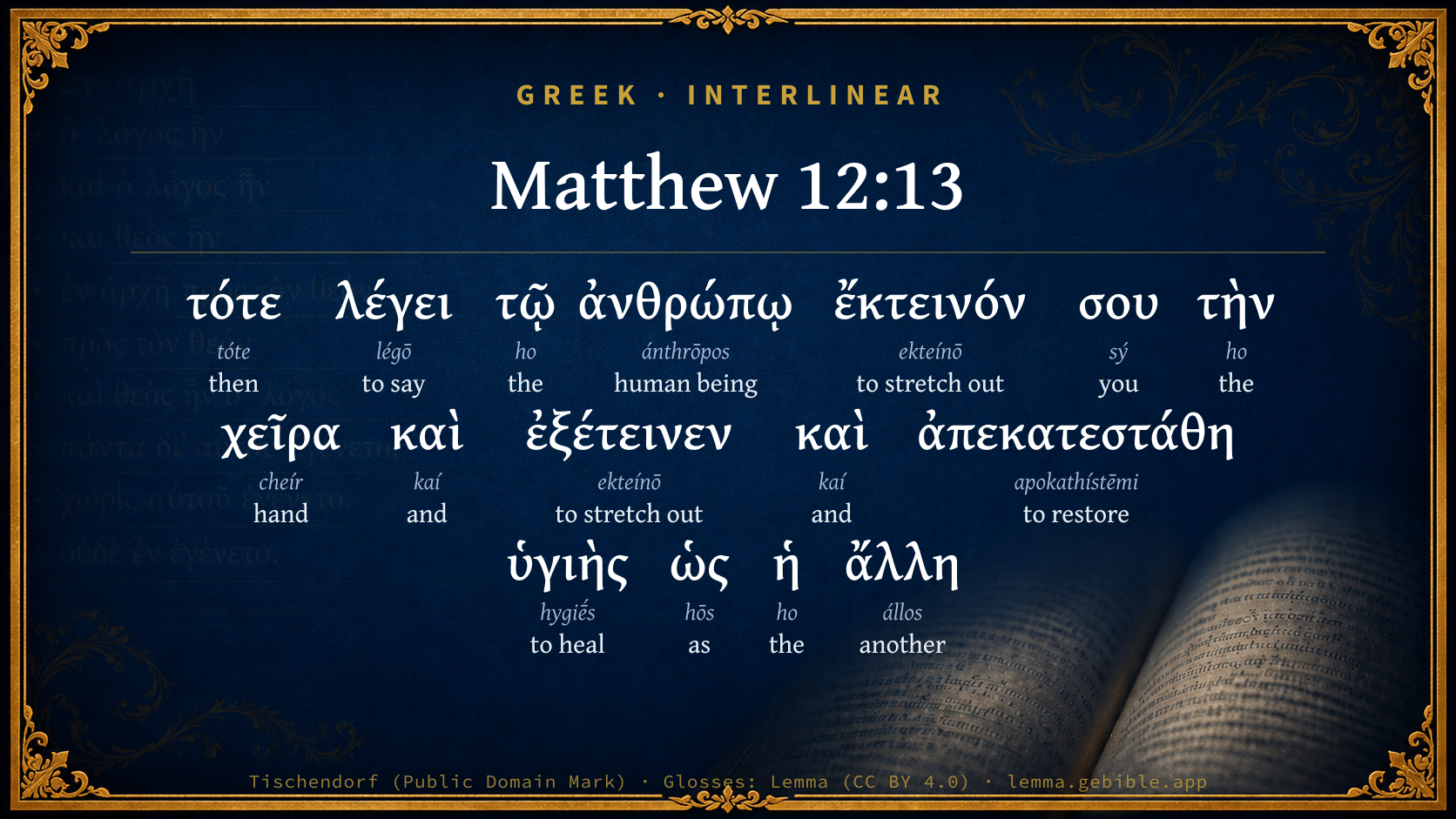
Greek (Tischendorf 8th ed.) Matthew 12:13 appears in the Greek New Testament. The text above is from the Tischendorf 8th edition. Each word links to its Strong’s number and a concise gloss. Click any word for its full Thayer’s Greek Lexicon entry.
Download image
Cite this verse

Matthew 12:13 (World English Bible). Public Domain. Lemma interlinear Bible study tool, https://lemma.gebible.app/v/matthew/12/13.

Show BibTeX & RIS
BibTeX
RIS
English Translation
Then he told the man, "Stretch out your hand." He stretched it out; and it was restored whole, just like the other.
World English Bible · Public Domain
Highlights
  • 2 first appearances in the Greek New Testament
Full analysis ↓
Download a study sheet

One document with this verse’s original text, its word-by-word gloss line, the meaning frame, cross-references with their text, attributed commentary, and full source and license credits — printable, and it pastes into notes with its structure intact.

This verse Autodidact and up

Study sheet (.html) Plain text (.txt)

A passage Seminary Student

Up to 50 verses in one chapter. A passage sheet keeps up to 6 commentary sources and 12 cross-references per verse, in the order this page ranks them, and says so on the sheet whenever that leaves anything out. Ask for a single verse and you get the Autodidact verse sheet above.

Everything on this page stays free to read, with no account — the sheet is a download of what is already on screen, not access to it.

Want to remove ads? Support Godless Engineer
Compare translations 3

The same verse in 3 English versions, stacked beneath the original-language interlinear above. Click any original word for its lexicon entry.

Each is an independent rendering of the whole verse — the interlinear is not word-aligned to these translations.

Highlighted words mark where these versions differ — a whole-verse word diff, not a word-by-word alignment.

  • World English Bible Public Domain
    Then he told the man, "Stretch out your hand." He stretched it out; and it was restored whole, just like the other.
  • King James Version Public Domain
    Then saith he to the man, Stretch forth thine hand. And he stretched it forth; and it was restored whole, like as the other.
  • unfoldingWord Literal Text CC BY-SA 4.0
    Then he says to the man, “Stretch out your hand.” And he stretched out, and it was restored to health, just like the other.

unfoldingWord Literal Text — © unfoldingWord, licensed CC BY-SA 4.0. Word-aligned USFM3 via Door43 (git.door43.org/unfoldingWord/en_ult).

Versions to compare (up to 4)

3 of 4 selected

Show all 19 translations

Every available English version of this verse, each an independent rendering of the whole verse.

  • World English Bible Public Domain
    Then he told the man, "Stretch out your hand." He stretched it out; and it was restored whole, just like the other.
  • Berean Standard Bible Public Domain
    Then Jesus said to the man, “Stretch out your hand.” So he stretched it out, and it was restored to full use, just like the other.
  • Majority Standard Bible Public Domain
    Then Jesus said to the man, “Stretch out your hand.” So he stretched it out, and it was restored to full use, just like the other.
  • King James Version Public Domain
    Then saith he to the man, Stretch forth thine hand. And he stretched it forth; and it was restored whole, like as the other.
  • American Standard Version (1901) Public Domain
    Then saith he to the man, Stretch forth thy hand. And he stretched it forth; and it was restored whole, as the other.
  • Revised Version (1885) Public Domain
    Then saith he to the man, Stretch forth thy hand. And he stretched it forth; and it was restored whole, as the other.
  • Geneva Bible (1599) Public Domain
    Then said he to the man, Stretch forth thine hand. And he stretched it foorth, and it was made whole as the other.
  • Douay-Rheims (1899) Public Domain
    Then he saith to the man: Stretch forth thy hand; and he stretched it forth, and it was restored to health even as the other.
  • Young's Literal Translation Public Domain
    Then saith he to the man, `Stretch forth thy hand,' and he stretched `it' forth, and it was restored whole as the other.
  • Literal Standard Version CC BY-SA 4.0
    Then He says to the man, “Stretch forth your hand,” and he stretched [it] forth, and it was restored whole as the other.
  • Unlocked Literal Bible CC BY-SA 4.0
    Then Jesus said to the man, “Stretch out your hand.” He stretched it out, and it was restored to health, just like the other hand.
  • unfoldingWord Literal Text CC BY-SA 4.0
    Then he says to the man, “Stretch out your hand.” And he stretched out, and it was restored to health, just like the other.
  • Darby Bible Public Domain
    Then he says to the man, Stretch out thy hand. And he stretched [it] out, and it was restored sound as the other.
  • World Messianic Bible Public Domain
    Then he told the man, “Stretch out your hand.” He stretched it out; and it was restored whole, just like the other.
  • Webster's Bible Public Domain
    Then saith he to the man, Stretch out thy hand. And he stretched it out; and it was restored to a sound state like the other.
  • Free Bible Version CC BY-SA 4.0
    Then he said to the man, “Hold out your hand.” The man held out his hand, and it was healed, just as healthy as the other hand.
  • Bible in Basic English Public Domain
    Then said he to the man, Put out your hand. And he put it out, and it was made as well as the other.
  • Text-Critical English NT CC BY 4.0
    Then he said to the man, “Stretch out yoʋr hand.” So he stretched it out, and it was restored, becoming as sound as the other.
  • Tyndale New Testament (1534) Public Domain
    Then sayde he to the man: stretch forth thy had. And he stretched it forthe. And it was made whole agayne lyke vnto the other.

Literal Standard Version (2020), Covenant Press — licensed CC BY-SA 4.0. Text via the HelloAO Bible API (eBible.org). Unlocked Literal Bible (unfoldingWord) — licensed CC BY-SA 4.0. Text via the HelloAO Bible API (eBible.org). unfoldingWord Literal Text — © unfoldingWord, licensed CC BY-SA 4.0. Word-aligned USFM3 via Door43 (git.door43.org/unfoldingWord/en_ult). Free Bible Version, Dr. Jonathan Gallagher — licensed CC BY-SA 4.0. Text via the HelloAO Bible API (eBible.org).

Word by word

More ways to search: Search by grammar → Find every occurrence → Compare this word →

Practice this passage: Drill this verse → Learn its vocabulary →

ἀπεκατεστάθη
apokathístēmi
G600
“to restore”
Verb, Aorist, Passive, Indicative, 3rd person, Singular
Part of Speech
Verb
Tense
Aorist
Voice
Passive
Mood
Indicative
Person
3rd person
Number
Singular
Full Thayer's Definition

Origin: from G575 and G2525

TDNT: 07:27,6

1. to restore to its former state 2. to be in its former state
  1. τότε tóte G5119 “then” Adverb
  2. λέγει légō G3004 “to say” Verb, Present, Active, Indicative, 3rd person, Singular
  3. τῷ ho G3588 “the” Article, Dative, Singular, Masculine
  4. ἀνθρώπῳ ánthrōpos G444 “human being” Noun, Dative, Singular, Masculine
  5. ἔκτεινόν ekteínō G1614 “to stretch out” Verb, Aorist, Active, Imperative, 2nd person, Singular
  6. σου sý G4771 “you” Personal pronoun, 2nd person, Genitive, Singular
  7. τὴν ho G3588 “the” Article, Accusative, Singular, Feminine
  8. χεῖρα cheír G5495 “hand” Noun, Accusative, Singular, Feminine
  9. καὶ kaí G2532 “and” Conjunction
  10. ἐξέτεινεν ekteínō G1614 “to stretch out” Verb, Aorist, Active, Indicative, 3rd person, Singular
  11. καὶ kaí G2532 “and” Conjunction
  12. ὑγιὴς hygiḗs G5199 “to heal” Adjective, Nominative, Singular, Feminine
  13. ὡς hōs G5613 “as” Adverb
  14. ἡ ho G3588 “the” Article, Nominative, Singular, Feminine
  15. ἄλλη állos G243 “another” Adjective, Nominative, Singular, Feminine

About this verse

These counts appear in no published source. They are computed here, from the morphology-tagged text and Lemma’s own curated glosses. What Lemma adds →

16
words
12
distinct lemmas
Gospels
section

Notable vocabulary

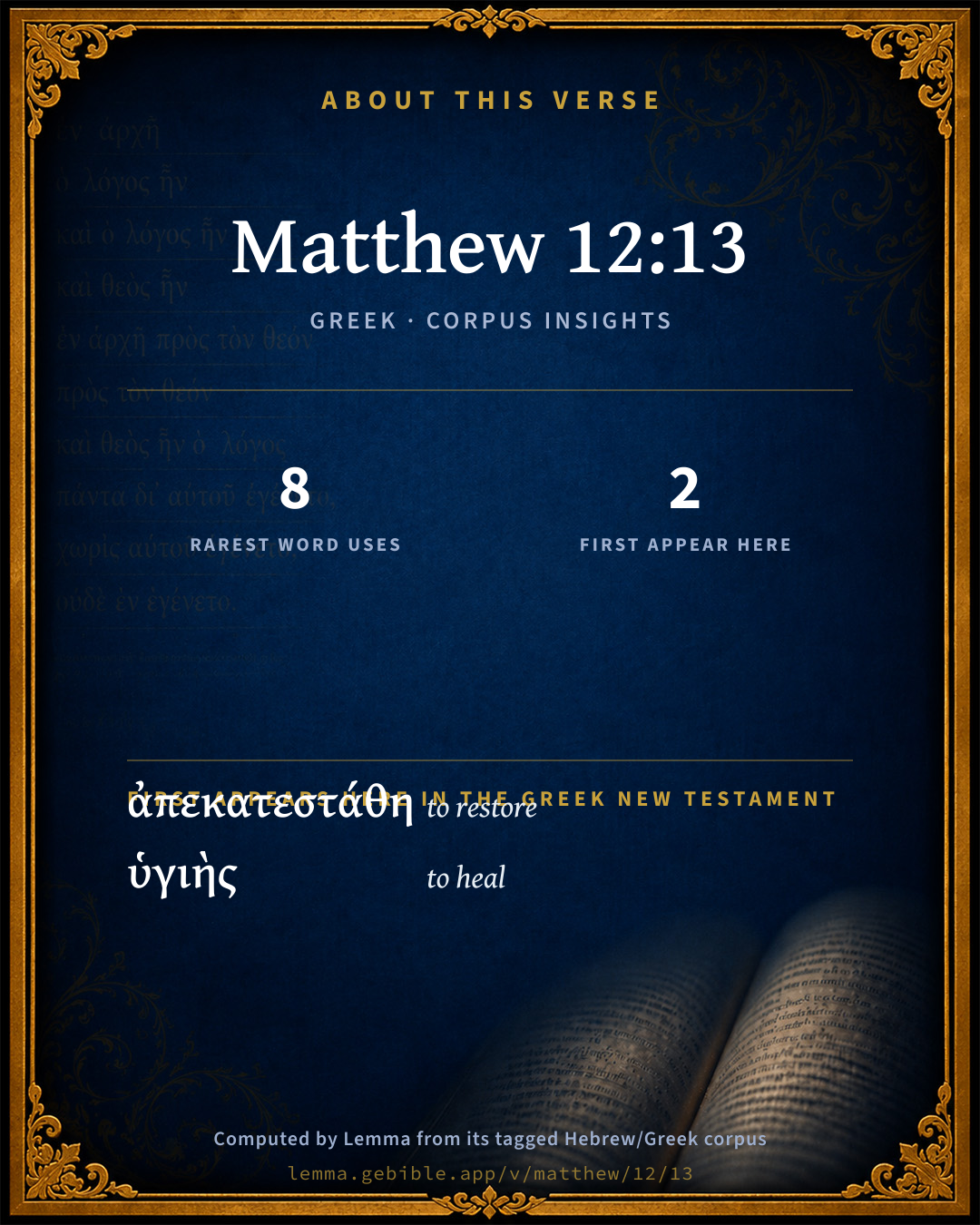
The rarest word here is ἀπεκατεστάθη to restore G600 — appearing just 8 times in the whole Greek New Testament.

First appearance in Scripture

These words make their first canonical appearance in the Greek New Testament here:

  • ἀπεκατεστάθη to restore G600
  • ὑγιὴς to heal G5199

Shared distinctive vocabulary

ἀπεκατεστάθη to restore G600 occurs in 8 verses of the Greek New Testament. Also found in:
Repetition

Words recur within this verse:

  • ἔκτεινόν to stretch out G1614 ×2
  • τῷ the G3588 ×3
  • καὶ and G2532 ×2

Cross-references

2

Topical passages linked to Matthew 12:13 in the Treasury of Scripture Knowledge — connected by theme and wording, ordered by reader-vote popularity; previews shown in the World English Bible.

  • Luke 13:13 He laid his hands on her, and immediately she stood up straight, and glorified God.
  • Acts 3:7–8 He took him by the right hand, and raised him up. Immediately his feet and his ankle bones received strength.

Cross-references courtesy of OpenBible.info (CC BY 4.0).

Commentary

Notes on Matthew 12:13 from classic Christian and Jewish commentators (each source and its license shown beneath its notes). The classic Christian expositions comment on the surrounding passage and are grouped to its opening verse, so a note may address several verses; the Jewish commentaries on the Tanakh (Rashi and others) are per-verse, so they appear only where the commentator wrote on this verse.

Lemma curates 59 commentaries, every one of them public domain or Creative Commons licensed, each selected and text-cleaned for this edition rather than reprinted as found. About our sources →

Meyer's Critical & Exegetical Commentary

Heinrich August Wilhelm Meyer

Mat_12:13-14. Ἀπεκατεστ.] just as he was stretching it out, and at the bidding of Jesus. For the double augment, see Winer, p. 69 f. [E. T. 84].

ὑγιής] result of the ἀπεκατεστ. See Winer, pp. 491, 580 [E. T. 663, 779]; Lübcker, grammat. Stud. p. 33 f.; Pflugk, ad. Hec. 690. Marks version of the incident is more animated, fresher, and more original (Keims opinion is different), and likewise free from the amplification contained in what is said about the animal falling into the well. This saying is introduced by Luke in another form, and in connection with a different incident (Luk_14:5), which, however, would not justify us in holding, with Strauss, that the different narratives are only different settings for the saying in question, while supposing at the same time that there is even an allusion here to 1Ki_13:4; 1Ki_13:6. According to the Evang. s. Hebr. (Hilgenfeld, N. T. extra can. IV. 16, 23), the man with the withered hand was a mason, who begged to be healed, that he might not be under the necessity of begging.

ἐξελθόντες] from the synagogue, Mat_12:9.

σνμβούλ. ἔλαβ. κατ. αὐτ., ὅπως] they devised measures for the purpose of crushing Him (see on Mat_22:15); the opposition to Him had now assumed this very decided character.

Meyer — Critical and Exegetical Commentary on the New Testament — English translation by Peter Christie, edited by Frederick Crombie (T&T Clark, 1880) — public domain. Text from a community e-Sword module.

Expositor's Greek Testament

ed. W. Robertson Nicoll

Mat 12:13-14 . The issue: the hand cured, and Pharisaic ill-will deepened .

Mat 12:13 . τότε λέγει . He heals by a word: sine contactu sola voce, quod ne speciem quidem violati Sabbati habere poterat (Grotius). Ἔκτεινόν σου τ . χ . Brief authoritative word, possessing both physical and moral power, conveying life to the withered member, and inspiring awe in spectators. καὶ ἐξέτ . καὶ ἀπεκατ . The double καὶ signifies the quick result (“celeritatem miraculi,” Elsner). Grotius takes the second verb as a participle rendering: he stretched out his restored hand, assuming that not till restored could the hand be stretched out. The healing and the outstretching may be conceived of as contemporaneous. ὑγιὴς ὡς ἡ ἄλλη : the evangelist adds this to ἀπεκατ . to indicate the completeness. We should have expected this addition rather from Luke, who ever aims at making prominent the greatness of the miracle, as well as its benevolence.

The Expositor's Greek Testament, edited by W. Robertson Nicoll (1897–1910) — public domain. Text from a community e-Sword module.

Jamieson, Fausset & Brown

Robert Jamieson, A. R. Fausset & David Brown

Then saith he to the man, Stretch forth thine hand. And he stretched it forth--the power to obey going forth with the word of command.

and it was restored whole, like as the other--The poor man, having faith in this wonderful Healer--which no doubt the whole scene would singularly help to strengthen--disregarded the proud and venomous Pharisees, and thus gloriously put them to shame.

Jamieson, Fausset & Brown — Commentary Critical and Explanatory on the Whole Bible (1871) — public domain (CC PDM 1.0). Text via the HelloAO Bible API.

Adam Clarke's Commentary

Verse 13. Stretch forth thine hand.] The bare command of God is a sufficient reason of obedience. This man might have reasoned thus: "Lord, my hand is withered; how then can I stretch it out? Make it whole first, and afterwards I will do as thou commandest." This may appear reasonable, but in his case it would have been foolishness. At the command of the Lord he made the effort, and in making it the cure was effected! Faith disregards apparent impossibilities, where there is a command and promise of God. The effort to believe is, often, that faith by which the soul is healed.

A little before (Mt 12:6; Mt 12:8) Jesus Christ had asserted his Godhead, in this verse he proves it. What but the omnipotence of the living God could have, in a moment, restored this withered hand? There could be no collusion here; the man who had a real disease was instantaneously and therefore miraculously cured; and the mercy and power of God were both amply manifested in this business.

It is worthy of remark, that as the man was healed with a word, without even a touch, the Sabbath was unbroken, even according to their most rigid interpretation of the letter of the law.

Adam Clarke's Commentary on the Bible (1810–1826) — public domain. Text from a community e-Sword/MySword module.

Ellicott's Commentary for English Readers

(13) Then saith he to the man.—St. Mark, with his usual vividness, adds the look and gesture and feeling which accompanied the words, “looking round about on them with anger, being grieved at the hardness of their hearts.”

It was restored whole—i.e., as the tense implies, in the act of stretching the hand forth. The man’s ready obedience to the command, which if he had not believed in the power of Jesus would have seemed an idle mockery, was, ipso facto, a proof that he had “faith to be healed.”

A Bible Commentary for English Readers, edited by Charles John Ellicott (1878–1897) — public domain. Text from a community e-Sword module.

John Gill's Exposition

Then the Pharisees went out,.... Of the synagogue, being, as Luke says, filled with madness, at the unanswerableness of his arguments; and because of the violation of the sabbath, as they thought; and most of all, because of the miracle wrought by him; and which was so glaringly a proof of his being Lord of the sabbath, and could not fail of creating him esteem among the people: and held a council against him, how they might destroy him. Mark says, the council was held by them with the Herodians; of whom, See Gill on Mat 22:16 who, though they differed from them both in religion and politics, yet might be thought very proper persons to advise with about this matter; and especially, as they might have a greater interest at court, than they had. Nor did they scruple to enter into such a consultation, though on the sabbath day, and about the taking away of the life of an innocent person; which shows what scared consciences, and hard hearts they had, and how full of hypocrisy they were.

who, though they differed from them both in religion and politics, yet might be thought very proper persons to advise with about this matter; and especially, as they might have a greater interest at court, than they had. Nor did they scruple to enter into such a consultation, though on the sabbath day, and about the taking away of the life of an innocent person; which shows what scared consciences, and hard hearts they had, and how full of hypocrisy they were.

Matthew 12:15

mat 12:15

mat 12:15

mat 12:15But when Jesus knew it,.... Their consultation against him, as he did, not by any discovery made to him by men, but as the omniscient God; he withdrew himself from thence; from the synagogue and city, where he was, to the sea of Galilee, and his disciples with him, as Mark observes; not through fear, but because his time was not yet come, that he must suffer and die for his people; he had some other work to do first, and therefore rightly and wisely provides for his safety. And great multitudes followed him; from Galilee, Judea, Jerusalem, Idumea, and from beyond Jordan; and were joined by another multitude of people, who came from about Tyre and Sidon, as Mark relates: so that his departure was not so very private; nor was he forsaken by the common people, though the Pharisees were so offended with him. And he healed them all; that stood in need of healing, as many as had plagues and unclean spirits; practising agreeably to his doctrine, that it was lawful to do good on the sabbath day, and to heal the bodies as well as the souls of men.

John Gill's Exposition of the Whole Bible (1746–1763) — public domain (CC PDM 1.0). Text via the HelloAO Bible API.

Trapp's Complete Commentary

John Trapp

13 Then saith he to the man, Stretch forth thine hand. And he stretched it forth; and it was restored whole, like as the other.

Ver. 13. And he stretched it forth] So would our hold fasts stretch out their hands to the poor, would they but come to Christ, and hear his voice, as this man did. But till then they will as easily part with their blood as with their good. All their strife is, who (like the toad) shall fall asleep with most earth in his paws: as when they die, nothing grieves them more than that they must leave that which they have so dearly loved while alive. I read of one wretch, who being at point of death, clapped a piece of gold in his own mouth, and said, Some wiser than some, I mean to have this with me however.

John Trapp, A Commentary or Exposition upon All the Books of the Old and New Testament (1647–1656) — public domain. Text from a community e-Sword module.

Haydock's Catholic Bible Commentary

Stretch forth. Our Saviour places the man that had the withered hand in the midst of the Jews, and looking round upon the multitude, (according to St. Mark) he ordered him to stretch out his hand, that by these several ways, he might excite the pity of the stiff-necked people; but no sooner had he performed this act of charity, than they, swelling with anger, went out, meditating destruction. So ruinous and pestiferous is the vice of envy! (St. John Chrysostom, hom. xli). --- St. Matthew having mentioned this miracle, takes occasion to narrate others which Christ performed on his second return from Judea. We have frequently to mention that the particle tunc, then, and such like, do not always relate to what immediately goes before. A soul in sin may be said to resemble the withered hand, but obedience with faith to God’s commands can and will restore it to its pristine state. Jesus bids him stretch out his hand, and power accompanies the command; he stretches it forth, and is made whole like the other. (Haydock)

George Leo Haydock (1774–1849), Haydock's Catholic Family Bible and Commentary, 1859 edition — public domain. Excludes Psalms (Douay-Rheims chapter numbering differs from Protestant) and Deuterocanonical books (Catholic canon only).

Matthew Poole's English Annotations

Mark saith, they held their peace, they made him no answer to his question, upon which he, looking round about him with anger, being grieved for the hardness of their hearts, saith unto the man, Stretch forth thine hand. Luke saith, Looking round about upon them all, he said, &c. Our Saviour looked about him to see if any of them would adventure to answer him, but he saw their mouths were shut. He was angry that these great doctors of the law should understand the law of God no better, and should yet be so hardy as to take upon them to instruct him. He was also grieved (saith Mark) at the hardness of their hearts. That which we call hardness, is a quality in a thing which resisteth the truth, a unimpressiveness, when a thing will receive no impression from things apt to make impressions: the hardness of the Pharisees’ hearts lay in this, that whereas Christ’s words and works might reasonably and ought to have made an impression upon them of faith, that they should have owned and received him as the Messiah, yet they had no such effect, nor made any such impressions upon them. He said to the man, Stretch forth thine hand. And he stretched it forth, & c. Christ sometimes used the ceremony of laying on his hand; here he doth not, to let us know that that was but a sign of what was done by his power. What little things malicious men will carp at! What was here of servile labour on the sabbath day? They did far more themselves, as often as they lifted a beast out of a pit. Our Saviour compounds or prepareth no medications, he only speaks the word, and he is healed. But Matthew tells us that ...( see Mat 12:14).

Matthew Poole's English Annotations on the Holy Bible (1683–1685) — public domain. Text from a community e-Sword/MySword module.

Whedon's Commentary on the Bible

Daniel D. Whedon

13. Stretch forth thine hand — Our Lord here commanded an intrinsically impossible act. Yet the volition or will to stretch forth was not impossible. And when the will was exerted, power to accomplish was granted.

When men say that they cannot obey the will of God, because God’s Spirit does not operate upon them, let them know that a graciously bestowed power from God is conferred on all, through the atonement, to will to obey, if they will use it. And as they proceed onward in the effort to obey, they will find divine strength supplied when needed and used. Let them truly exert, in the spirit of this man’s faith, their graciously conferred powers, as Christ’s Gospel directs, and they will find their powers energized and recreated.

Daniel D. Whedon (gen. ed.), Commentary on the Old and New Testaments (1874–1909) — public domain. Text from a community e-Sword module.

The Pulpit Commentary

Then saith he to the man, Stretch forth thine hand. He is bid use his strength before he is told that it is given. The intellectual difficulties that might have occurred to him lose themselves fir the action. In the somewhat similar ease in Mat_9:5, 6 there had been the preparation of forgiveness of sins. And he stretched it forth; and it was restored whole, like as the other. Power is linked to obedience. Whole; i.e. sound, in complete health and vigour. The word comes more often in the account of the man healed at the pool of Bethesda than in all the rest of the New Testament.

Power allied to obedience.

"Then saith he to the man, Stretch forth thine hand. And he stretched it forth; and it was restored whole, like as the other." The man did as he was bidden, and found himself able to do what he was bidden to do. And this illustrates a great, comprehensive, ever-working law. Every man can do what he ought to do. He who tries to obey will surely find himself able to obey. This man was bidden to do precisely what, to all appearance, he could not do. He did it, in obedience to a Divine command, and, to his own surprise, and every one else"s surprise, he found he could do it. In a similar way our Lord said to the paralytic, "Rise, take up thy bed, and walk." How a paralyzed man was to do this did not appear. But the man tried to obey, and found that power came with the obedience. Had he waited for consciousness of strength he might have waited, helpless, for ever. Prompt obedience proved the possession of faith; that is the arranged channel of Divine blessing. "Whatsoever he saith unto you, do it," and you will find that you can do it.

I MAN"S OBEDIENCE IS THE SIGN OF HIS FAITH. Therein lies the virtue of it. The act reveals the spirit of the man. He who believes in Christ will, without question or hesitancy, do whatever Christ tells him to do. Illustrate from such cases as that of Abraham offering up his son. We can see the obedience, but behind the obedience, and inspiring the obedience, we may see the faith. And this the writer of the Epistle to the Hebrews brings out: "By faith Abraham offered up Isaac... accounting that God was able to raise him up, even from the dead; from whence also he received him in a figure." Mere obedience has no special virtue in it. It is no more than our duty. But when obedience becomes the expression of faith, then it becomes supremely interesting, it is a high moral and spiritual power. St. James points out that "faith without works obediences is dead;" but it is equally true that "works obediences without faith are dead." This man stretched out his hand because he believed in Christ"s power to heal.

II GOD"S POWER IN RESPONSE TO A MAN"S FAITH. It should be clearly seen that Christ rewarded the faith. It is that honours God. We may even illustrate from the relations of our home-life. We love to be obeyed, and we do much for the children who are good. But we, in a far higher sense, love to be trusted, and we do our best, unfold our richest, for those who lean on us with loving confidence. It is the sweet mystery of the Fatherhood of God that he loves to be trusted, and gives his best to those who trust. "Only believe; all things are possible to him that believeth. R.T.

The Pulpit Commentary (1880–1919), ed. H.D.M. Spence-Jones & Joseph S. Exell — public domain. Text from a community e-Sword module.

Burkitt's Expository Notes on the New Testament

William Burkitt

Observe, 1. The merciful and miraculous cure wrought by our Saviour’s power upon the impotent man: he said unto him, Stretch out thine hand, and his hand was restored.

Observe, 2. What a contrary effect this cure had upon the Pharisees; instead of convincing them, they conspire against him: Christ’s enemies, when arguments fail, fall to violence.

Observe, 3. The prudent means which our Saviour uses for his own preservation, he withdrew himself. Christ’s example teaches his ministers their duty; to avoid the hands of persecutors, and prudently to preserve their lives unless when their sufferings are like to do more good than their lives.

Observe, 4. The great humility of Christ in concealing his own praises; he had no ambition that the fame of his miracles should be spread abroad, for he sought not his own glory; neither would he by the noise of his miracles enrage the Pharisees against him to take away his life; knowing that his time was not yet come, and he had much work to do before his death.

William Burkitt's Expository Notes on the New Testament (1700–1703) — public domain. Text from a community e-Sword module.

The People's New Testament

B. W. Johnson

13. Stretch forth thine hand. As the cure is wrought only by a word, the Pharisees have no ground of accusation.

B. W. Johnson's The People's New Testament with Notes (1889–1891) — public domain. Electronic text from the Christian Classics Ethereal Library (CCEL) ThML edition.

unfoldingWord translationNotes

Door43 World Missions Community

Then Jesus said to the man, "Stretch out your hand."

This can be translated as an indirect quotation. AT: "Then Jesus commanded the man to stretch out his hand" (See: Direct and Indirect Quotations)

to the man

"to the man with the paralyzed hand" or "to the man with the crippled hand"

Stretch out your hand

"Hold out your hand" or "Extend your hand"

He stretched

"The man stretched"

it was restored to health

This can be stated in active form. AT: "it was healthy again" or "it became well again" (See: Active or Passive)

plotted against him

"planned to harm Jesus"

were seeking how they might put him to death

"were discussing how they might kill Jesus"

translationWords

Jesus

restore

unfoldingWord translationNotes — © Distant Shores Media and the Door43 World Missions Community, licensed CC BY-SA 4.0. Source: git.door43.org/Door43/en_tn.

Cambridge Greek Testament for Schools and Colleges

13. ἀπεκατεστάθη. For the double augment see Winer, P. ii., xii. 7.

Cambridge Greek Testament for Schools and Colleges (Cambridge University Press, 1896; 21 vols, various authors incl. Carr, Maclear, Plummer, Farrar, Lumby, Moule, M. R. James, Simcox) — public domain. Text from a community e-Sword module.

Alford’s Greek Testament

Henry Alford

13.] Our Lord does no outward act: the healing is performed without even a word of command. The stretching forth the hand was to prove its soundness, which the divine power wrought in the act of stretching it forth. Thus his enemies were disappointed, having no legal ground against Him.

Henry Alford, The Greek Testament (1849–1861) — public domain. Text from a community e-Sword module.

International Critical Commentary

(M) 13. Then He saith to the man, Stretch forth thy hand. And he stretched it forth; and it was restored whole, as the other.] Mk. has: “He saith to the man, Stretch forth thy hand. And he stretched it forth, and his hand was restored.” For τότε, see on 2:7.—ἀπεκατεστάθη] For the double augment, see Blass, p. 39. Omit ὑγιής, S1 S2 latt.

International Critical Commentary — older volumes (1896–1929), various authors — public domain. Text from a community e-Sword module.

Vincent's Word Studies in the New Testament

Marvin R. Vincent

Stretch forth thy hand. The arm was not withered.

Marvin R. Vincent, Word Studies in the New Testament (1887–1900) — public domain. Text from a community e-Sword/MySword module.

Lesson kit

Teaching starters — assembled from the data on this page, not authored interpretation. Every prompt links to the verse data it draws on. Edit before teaching.

Matthew, in the Gospels, opens this verse with 16 words (12 distinct Greek lemmas). Its most distinctive word is apokathístēmi (“to restore”). A historical commentator’s framing appears above. Read the whole chapter for the surrounding context.

Discussion questions

  1. The word apokathístēmi carries the sense “to restore.” How does it shape the verse?
  2. 2 words make their first appearance in Scripture here. What does this debut establish?
  3. How does Matthew 17:11, which shares the word «to restore», read alongside this verse?
  4. What does the repetition of “to stretch out” (2× in this one verse) do in this verse?
  5. These translations render this verse differently. What is at stake in choosing one wording over another?
  6. Compare how Meyer's Critical & Exegetical Commentary and Expositor's Greek Testament read this verse. Where do they agree or differ?

Things to notice

  • 2 words make their first canonical appearance in Scripture here.
  • These translations choose different wording for 7 words in this verse.
  • “to stretch out” occurs 2× in this single verse.
  • 12 distinct Greek lemmas span 16 words in this verse.

Reading settings

Reading text

Shown beneath each verse's original-language words.

Old Testament
Old Testament edition

Read the OT as the Masoretic Hebrew (MT) or the Greek Septuagint (LXX).

English shown for the Greek Septuagint (in the Hebrew ↔ Greek comparison).

Comparing translations? Open the Compare panel on any verse page to stack up to four side by side.