Matthew 12:35

Greek (Tischendorf 8th ed.) Matthew 12:35 appears in the Greek New Testament. The text above is from the Tischendorf 8th edition. Each word links to its Strong’s number and a concise gloss. Click any word for its full Thayer’s Greek Lexicon entry.
Download image
Cite this verse

Matthew 12:35 (World English Bible). Public Domain. Lemma interlinear Bible study tool, https://lemma.gebible.app/v/matthew/12/35.

Show BibTeX & RIS
BibTeX
RIS
English Translation
The good man out of his good treasure brings out good things, and the evil man out of his evil treasure brings out evil things.
World English Bible · Public Domain
Download a study sheet

One document with this verse’s original text, its word-by-word gloss line, the meaning frame, cross-references with their text, attributed commentary, and full source and license credits — printable, and it pastes into notes with its structure intact.

This verse Autodidact and up

Study sheet (.html) Plain text (.txt)

A passage Seminary Student

Up to 50 verses in one chapter. A passage sheet keeps up to 6 commentary sources and 12 cross-references per verse, in the order this page ranks them, and says so on the sheet whenever that leaves anything out. Ask for a single verse and you get the Autodidact verse sheet above.

Everything on this page stays free to read, with no account — the sheet is a download of what is already on screen, not access to it.

Want to remove ads? Support Godless Engineer
Compare translations 3

The same verse in 3 English versions, stacked beneath the original-language interlinear above. Click any original word for its lexicon entry.

Each is an independent rendering of the whole verse — the interlinear is not word-aligned to these translations.

Highlighted words mark where these versions differ — a whole-verse word diff, not a word-by-word alignment.

  • World English Bible Public Domain
    The good man out of his good treasure brings out good things, and the evil man out of his evil treasure brings out evil things.
  • King James Version Public Domain
    A good man out of the good treasure of the heart bringeth forth good things: and an evil man out of the evil treasure bringeth forth evil things.
  • unfoldingWord Literal Text CC BY-SA 4.0
    The good man from his good treasure brings forth good things, and the evil man from his evil treasure brings forth evil things.

unfoldingWord Literal Text — © unfoldingWord, licensed CC BY-SA 4.0. Word-aligned USFM3 via Door43 (git.door43.org/unfoldingWord/en_ult).

Versions to compare (up to 4)

3 of 4 selected

Show all 19 translations

Every available English version of this verse, each an independent rendering of the whole verse.

  • World English Bible Public Domain
    The good man out of his good treasure brings out good things, and the evil man out of his evil treasure brings out evil things.
  • Berean Standard Bible Public Domain
    The good man brings good things out of his good store of treasure, and the evil man brings evil things out of his evil store of treasure.
  • Majority Standard Bible Public Domain
    The good man brings good things out of his good store of treasure, and the evil man brings evil things out of his evil store of treasure.
  • King James Version Public Domain
    A good man out of the good treasure of the heart bringeth forth good things: and an evil man out of the evil treasure bringeth forth evil things.
  • American Standard Version (1901) Public Domain
    The good man out of his good treasure bringeth forth good things: and the evil man out of his evil treasure bringeth forth evil things.
  • Revised Version (1885) Public Domain
    The good man out of his good treasure bringeth forth good things: and the evil man out of his evil treasure bringeth forth evil things.
  • Geneva Bible (1599) Public Domain
    A good man out of the good treasure of his heart bringeth foorth good things: and an euill man out of an euill treasure, bringeth forth euill things.
  • Douay-Rheims (1899) Public Domain
    A good man out of a good treasure bringeth forth good things: and an evil man out of an evil treasure bringeth forth evil things.
  • Young's Literal Translation Public Domain
    The good man out of the good treasure of the heart doth put forth the good things, and the evil man out of the evil treasure doth put forth evil things.
  • Literal Standard Version CC BY-SA 4.0
    The good man out of the good treasure of the heart puts forth the good things, and the evil man out of the evil treasure puts forth evil things.
  • Unlocked Literal Bible CC BY-SA 4.0
    The good man from the good treasure of his heart produces what is good, and the evil man from the evil treasure of his heart produces what is evil.
  • unfoldingWord Literal Text CC BY-SA 4.0
    The good man from his good treasure brings forth good things, and the evil man from his evil treasure brings forth evil things.
  • Darby Bible Public Domain
    The good man out of the good treasure brings forth good things; and the wicked man out of the wicked treasure brings forth wicked things.
  • World Messianic Bible Public Domain
    The good man out of his good treasure brings out good things, and the evil man out of his evil treasure brings out evil things.
  • Webster's Bible Public Domain
    A good man, out of the good treasure of the heart, bringeth forth good things: and an evil man, out of the evil treasure, bringeth forth evil things.
  • Free Bible Version CC BY-SA 4.0
    A good person brings out good from their store of good things, and an evil person brings out evil from their store of evil things.
  • Bible in Basic English Public Domain
    The good man out of his good store gives good things; and the evil man out of his evil store gives evil things.
  • Text-Critical English NT CC BY 4.0
    The good person brings good things out of his good treasure, and the evil person brings evil things out of his evil treasure.
  • Tyndale New Testament (1534) Public Domain
    A good man oute of the good treasure of his hert bringeth forth good thynges. And an evyll man out of his evyll treasure bringeth forth evyll thinges.

Literal Standard Version (2020), Covenant Press — licensed CC BY-SA 4.0. Text via the HelloAO Bible API (eBible.org). Unlocked Literal Bible (unfoldingWord) — licensed CC BY-SA 4.0. Text via the HelloAO Bible API (eBible.org). unfoldingWord Literal Text — © unfoldingWord, licensed CC BY-SA 4.0. Word-aligned USFM3 via Door43 (git.door43.org/unfoldingWord/en_ult). Free Bible Version, Dr. Jonathan Gallagher — licensed CC BY-SA 4.0. Text via the HelloAO Bible API (eBible.org).

Word by word

More ways to search: Search by grammar → Find every occurrence → Compare this word →

Practice this passage: Drill this verse → Learn its vocabulary →

θησαυροῦ
thēsaurós
G2344
“treasure”
Noun, Genitive, Singular, Masculine
Part of Speech
Noun
Case
Genitive
Number
Singular
Gender
Masculine
Full Thayer's Definition

Origin: from G5087

TDNT: 05:16,3

1. the place in which good and precious things are collected and laid up a. a casket, coffer, or other receptacle, in which valuables are kept b. a treasury c. storehouse, repository, magazine 2. the things laid up in a treasury, collected treasures
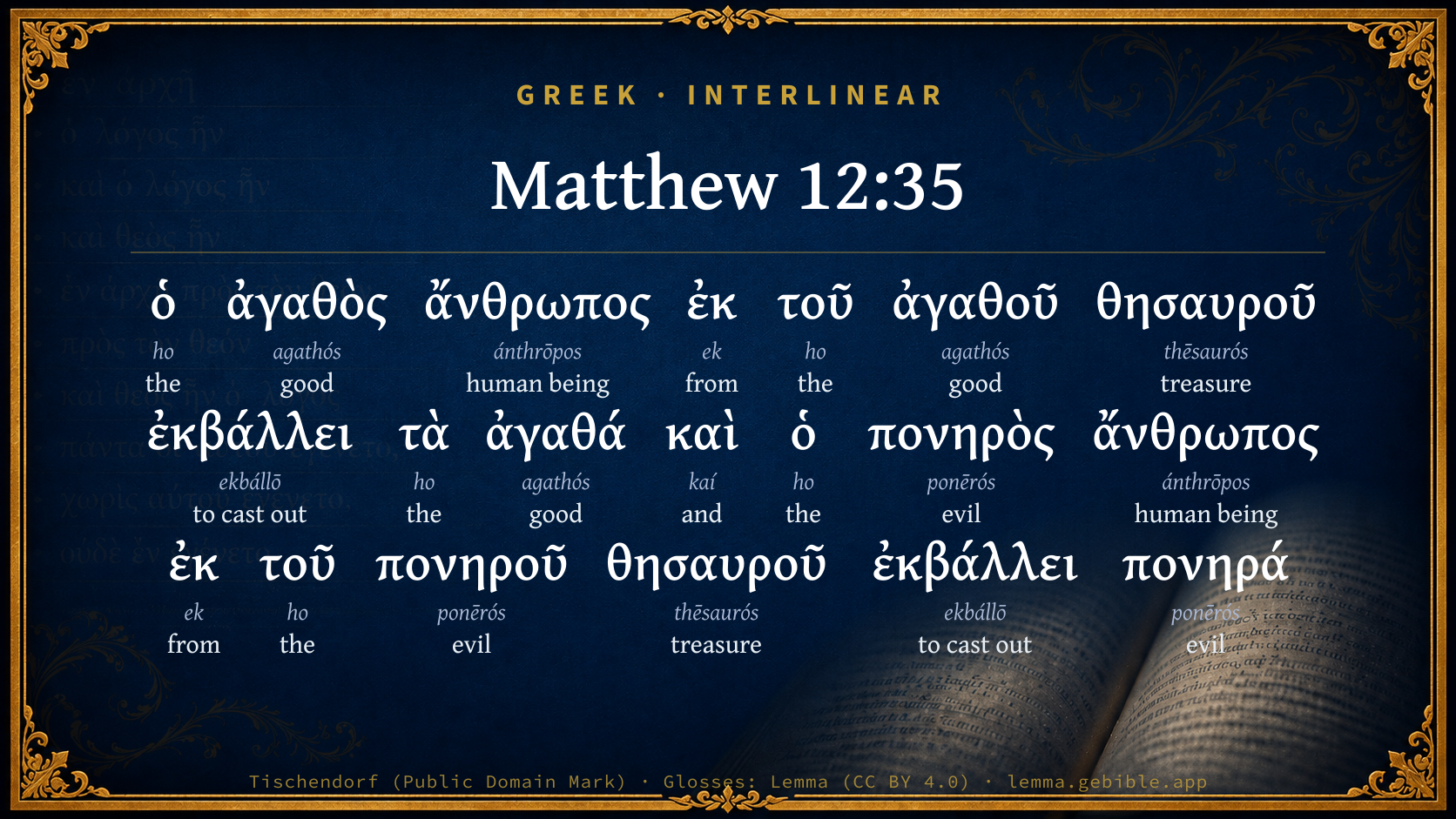
  1. ὁ ho G3588 “the” Article, Nominative, Singular, Masculine
  2. ἀγαθὸς agathós G18 “good” Adjective, Nominative, Singular, Masculine
  3. ἄνθρωπος ánthrōpos G444 “human being” Noun, Nominative, Singular, Masculine
  4. ἐκ ek G1537 “from” Preposition
  5. τοῦ ho G3588 “the” Article, Genitive, Singular, Masculine
  6. ἀγαθοῦ agathós G18 “good” Adjective, Genitive, Singular, Masculine
  7. ἐκβάλλει ekbállō G1544 “to cast out” Verb, Present, Active, Indicative, 3rd person, Singular
  8. τὰ ho G3588 “the” Article, Accusative, Plural, Neuter
  9. ἀγαθά agathós G18 “good” Adjective, Accusative, Plural, Neuter
  10. καὶ kaí G2532 “and” Conjunction
  11. ὁ ho G3588 “the” Article, Nominative, Singular, Masculine
  12. πονηρὸς ponērós G4190 “evil” Adjective, Nominative, Singular, Masculine
  13. ἄνθρωπος ánthrōpos G444 “human being” Noun, Nominative, Singular, Masculine
  14. ἐκ ek G1537 “from” Preposition
  15. τοῦ ho G3588 “the” Article, Genitive, Singular, Masculine
  16. πονηροῦ ponērós G4190 “evil” Adjective, Genitive, Singular, Masculine
  17. θησαυροῦ thēsaurós G2344 “treasure” Noun, Genitive, Singular, Masculine
  18. ἐκβάλλει ekbállō G1544 “to cast out” Verb, Present, Active, Indicative, 3rd person, Singular
  19. πονηρά ponērós G4190 “evil” Adjective, Accusative, Plural, Neuter

About this verse

These counts appear in no published source. They are computed here, from the morphology-tagged text and Lemma’s own curated glosses. What Lemma adds →

20
words
8
distinct lemmas
Gospels
section

Notable vocabulary

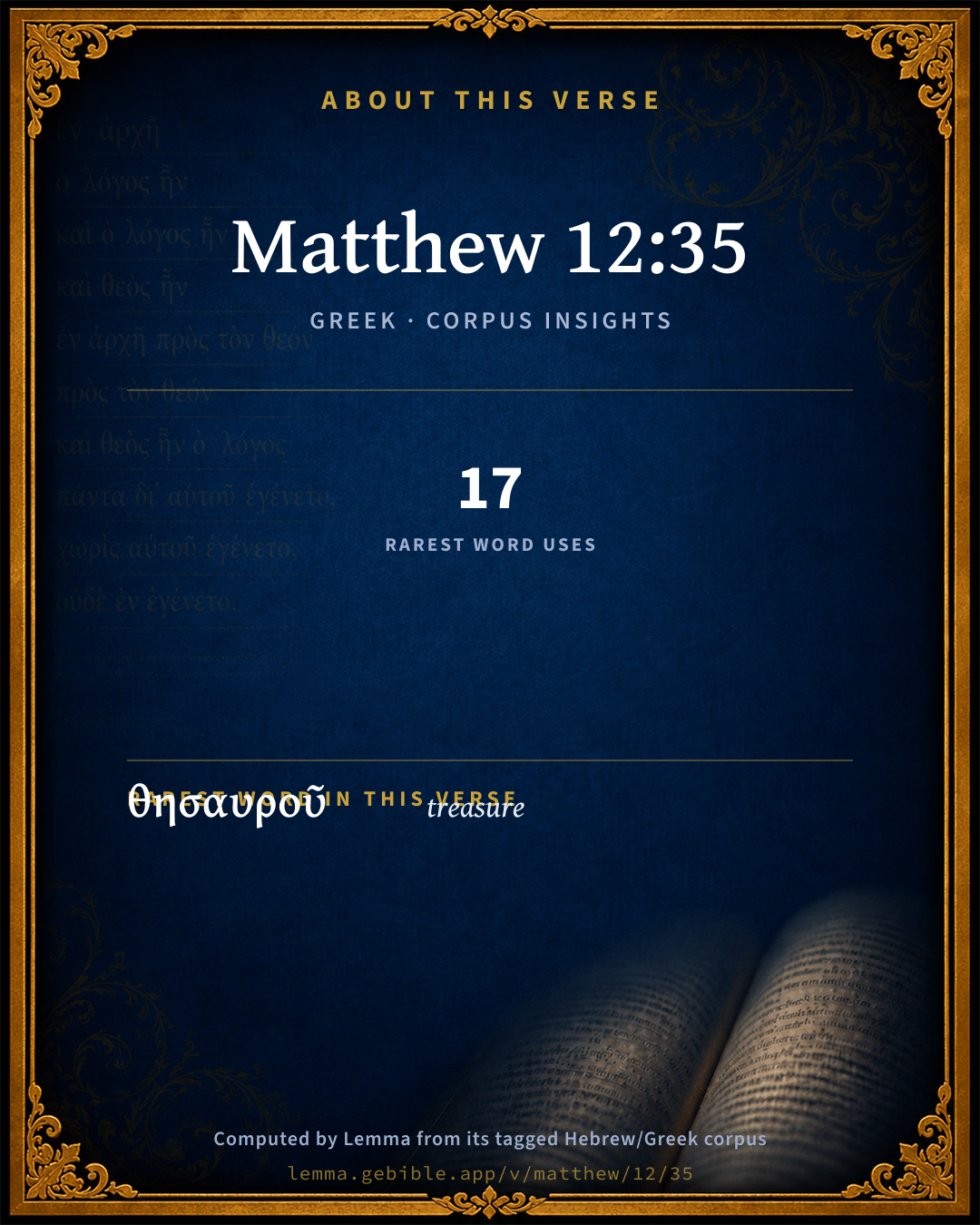
The rarest word here is θησαυροῦ treasure G2344 — appearing just 17 times in the whole Greek New Testament.

Shared distinctive vocabulary

θησαυροῦ treasure G2344 occurs in 16 verses of the Greek New Testament. Also found in:

Repetition

Words recur within this verse:

  • ἀγαθὸς good G18 ×3
  • πονηρὸς evil G4190 ×3
  • ἄνθρωπος human being G444 ×2
  • θησαυροῦ treasure G2344 ×2
  • ἐκβάλλει to cast out G1544 ×2
  • ὁ the G3588 ×5
  • ἐκ from G1537 ×2

Cross-references

14

Topical passages linked to Matthew 12:35 in the Treasury of Scripture Knowledge — connected by theme and wording, ordered by reader-vote popularity; previews shown in the World English Bible.

  • Proverbs 15:4 A gentle tongue is a tree of life, But deceit in it crushes the spirit.
  • Colossians 4:6 Let your speech always be with grace, seasoned with salt, that you may know how you ought to answer each one.
  • Proverbs 15:28 The heart of the righteous weighs answers, But the mouth of the wicked gushes out evil.
  • Colossians 3:16 Let the word of Christ dwell in you richly; in all wisdom teaching and admonishing one another with psalms, hymns, and spiritual songs, singing with grace in your heart to the Lord.
  • Proverbs 25:11–12 A word fitly spoken Is like apples of gold in settings of silver.
  • Matthew 12:34 You offspring of vipers, how can you, being evil, speak good things? For out of the abundance of the heart, the mouth speaks.
  • Proverbs 10:20–21 The tongue of the righteous is like choice silver. The heart of the wicked is of little worth.
  • Proverbs 16:21–23 The wise in heart shall be called prudent. Pleasantness of the lips promotes instruction.
  • Ephesians 4:29 Let no corrupt speech proceed out of your mouth, but such as is good for building up as the need may be, that it may give grace to those who hear.
  • Psalms 37:30–31 The mouth of the righteous talks of wisdom. His tongue speaks justice.
  • Proverbs 12:6 The words of the wicked are about lying in wait for blood, But the speech of the upright rescues them.
  • Proverbs 15:23 Joy comes to a man with the reply of his mouth. How good is a word at the right time!
  • Proverbs 12:17–19 He who is truthful testifies honestly, But a false witness lies.
  • Matthew 13:52 He said to them, "Therefore, every scribe who has been made a disciple in the Kingdom of Heaven is like a man who is a householder, who brings out of his treasure new and old things."

Cross-references courtesy of OpenBible.info (CC BY 4.0).

Where the printed editions differ

1 variant

Places in this verse where the major printed Greek editions disagree on the wording in a way that affects the translation — a comparison of editions, not a manuscript-by-manuscript collation. The editions are the modern critical texts (Nestlé-Aland 28/27, SBL, Westcott-Hort, Tregelles, Tyndale House) and the traditional texts behind the KJV (the Textus Receptus and the Byzantine/Majority text). It is not a claim about which reading is original.

  1. Extra text
    τῆς καρδίας

    “<the> of [his] heart”

    In TR Not in NA28NA27TynSBLWHTregByz

    τῆς καρδίας (tēs kardias) ' of [his] heart' is only in traditional manuscripts (TR)

Textual data: Translators Amalgamated Greek New Testament (STEPBible TAGNT) · CC BY 4.0.

Commentary

Notes on Matthew 12:35 from classic Christian and Jewish commentators (each source and its license shown beneath its notes). The classic Christian expositions comment on the surrounding passage and are grouped to its opening verse, so a note may address several verses; the Jewish commentaries on the Tanakh (Rashi and others) are per-verse, so they appear only where the commentator wrote on this verse.

Lemma curates 59 commentaries, every one of them public domain or Creative Commons licensed, each selected and text-cleaned for this edition rather than reprinted as found. About our sources →

Bengel's Gnomon

Johann Albrecht Bengel

Mat 12:35. Θησαυροῦ, treasure) There is truly treasure and hidden abundance in every man.[576]—ΤᾺ ἈΓΑΘᾺ—ΠΟΝΗΡᾺ, the good things, evil things) The article has frequently a relative value: I have therefore sometimes thought that it was on that account added to ἀγαθὰ, good things, as being already mentioned in Mat 12:34, and not to ΠΟΝΗΡᾺ, which does not there occur. But many have either written or omitted the article too promiscuously.[577] The ancient Cambridge MS. has ἈΓΑΘᾺ without an article.[578]

[576] This word treasure, which plainly implies abundance, proves that also in the preceding ver. the word πλήρωμα is not to be too readily understood as fulness (Germ. Ueberfluss): although in its own proper place it may be understood, by a Hebraism, simply as a thing contained, מלא. Luther himself does not translate it Was im Herzen ist, what is in the heart, but, Wess das Herz VOLL ist, that with which the heart is FULL. Comp. Luk 6:45, where θησαυρὸς is explained by περίσσευμα. See Ernesti Neueste Theol. Bibl. T. i., p. 809.—E. B.

[577] See f. n. on Maestricht’s twenty-second Canon, quoted in Section ix. of the Author’s Preface.—(I. B.)

[578] In his App. Crit. in loc. Bengel writes—

“τὰ ante πονηρὰ) Er. Bas. α.β.γ., etc., τὰ Comp. Aug. 2. Byz. Par. 6, vel plures; Chrys. Articulus in priore colo lectus, in altero non lectus, medium: et articulus sæpe vim relativam habet: ideo ad τὰ ἀγαθὰ versu 34 laudata, non ad πονηρὰ, ibidem non memorata, adhiberi, aliquando mihi visus est, unde alii bis, alii ne semel quidem, alii posteriore tantum loco scribendum putarint. Sed nimis promiscue, etc.,” as in Gnomon.—(I. B.)

In the margin of Ed. 2, and in Vers. Germ., the article τὰ is omitted.—E. B.

BD omits τὰ before ἀγαθά. Perhaps the τὰ of Rec. Text crept in from the τὸ ἀγαθὸν of Luk 6:35, through the Harmonies. LΔ read also τὰ πονηρά. But the primary authorities oppose this reading.—ED.

Bengel's Gnomon of the New Testament — English translation (T&T Clark, Edinburgh, 1860) — public domain. Text from a community e-Sword module.

Meyer's Critical & Exegetical Commentary

Heinrich August Wilhelm Meyer

Mat_12:35. Θησαυρός, here the inward treasurehouse (receptaculum) of the hearts thoughts (Luk_6:45) which are revealed in words, through which latter they take outward shape, are thrown out, as it were, from the heart of the speaker through the channel of the mouth.

πονηροῦ θησαυροῦ] θησαυρ. of wickedness, also in Eur. Ion. 923.

Meyer — Critical and Exegetical Commentary on the New Testament — English translation by Peter Christie, edited by Frederick Crombie (T&T Clark, 1880) — public domain. Text from a community e-Sword module.

Expositor's Greek Testament

ed. W. Robertson Nicoll

Mat 12:35 is found in Luke’s version of the Sermon (Luk 6:45 ). They might have been remarks made to the disciples about the Pharisees, as in Mat 16:6 , though in their present form direct address is implied ( vide Mat 12:34 ). Their essential import is that the nature or heart of a man determines his speech and action. Given the tree, the fruit follows.

Mat 12:35 . ὁ ἀγαθὸς ἀ .: good in the sense of benignant, gracious, kindly, the extreme moral opposite of the malignant viper-nature. θησαυροῦ : in Mat 12:34 the heart is conceived as a fountain, of which speech is the overflow, here as a treasure whose stores of thought and feeling the mouth freely distributes. ἐκβάλλει suggests speech characterised by energy, passion. There was no lack of emphasis in Pharisaic comments on Jesus. They hissed out their malevolent words at Him, being not heartless but bad-hearted. But cf. texts referred to on margin.

Mat 12:36 . πᾶν ρ . ἀργὸν : speech being the outcome of the heart, no word is insignificant, not even that which is ἀργόν , ineffectual ( α . ἔργον ), insipid, “idle”. It is an index of thoughtlessness if not of malice. This verse contains an important warning, whether spoken at this time or not.

The Expositor's Greek Testament, edited by W. Robertson Nicoll (1897–1910) — public domain. Text from a community e-Sword module.

Jamieson, Fausset & Brown

Robert Jamieson, A. R. Fausset & David Brown

A good man, out of the good treasure of the heart, bringeth forth good things--or, "putteth forth good things":

and an evil man, out of the evil treasure, bringeth forth evil things--or "putteth forth evil things." The word "putteth " indicates the spontaneity of what comes from the heart; for it is out of the abundance of the heart that the mouth speaketh. We have here a new application of a former saying (see on Mat 7:16-20). Here, the sentiment is, "There are but two kingdoms, interests, parties--with the proper workings of each: If I promote the one, I cannot belong to the other; but they that set themselves in wilful opposition to the kingdom of light openly proclaim to what other kingdom they belong. As for you, in what ye have now uttered, ye have but revealed the venomous malignity of your hearts."

Jamieson, Fausset & Brown — Commentary Critical and Explanatory on the Whole Bible (1871) — public domain (CC PDM 1.0). Text via the HelloAO Bible API.

Adam Clarke's Commentary

Verse 35. A good man out of the good treasure of the heart] της καρδιας, of the heart, is omitted by upwards of one hundred MSS., many of them of the greatest antiquity and authority; by all the Syriac, Arabic, and Persic; by the Slavonic, Saxon, Vulgate, and Itala, (except four,) and by several of the primitive fathers. It seems to have been added here by some copyist, merely to explain. The good heart is the good treasury, and the treasure that is in it is the love of God, and of all mankind. The bad heart is the bad treasury, and its treasure is the carnal mind, which is enmity against God, and ill-will to man.

Adam Clarke's Commentary on the Bible (1810–1826) — public domain. Text from a community e-Sword/MySword module.

Ellicott's Commentary for English Readers

(35) A good man out of the good treasure.—A whole parable is wrapt up in this last word. Every thought and desire of a man is added to the ever accumulating store of such desires or thoughts in the inner chamber of his heart, and thence passes out into word or deed. In the ideal division of the context, which excludes neutrality, the treasure is either simply good or simply evil. Practically, it might seem as if the character of most men implied a treasure of good and evil mingled in ever-varying proportion, but that thought is traversed in its turn by the fact that if there is not the unity of goodness which comes from the love of God, there must be the distraction and diversity that come from the love of self, and that this makes the treasure predominantly evil. The poison of worldliness acts in such a case with accumulative power. The same image reappears in reference to the intellectual side of the religious life in Mat_13:52.

A Bible Commentary for English Readers, edited by Charles John Ellicott (1878–1897) — public domain. Text from a community e-Sword module.

The Cambridge Bible for Schools and Colleges

gen. ed. J. J. S. Perowne

35. treasure] Rather, treasury or storehouse: for a similar use of the Greek word see ch. Mat_2:11.

The Cambridge Bible for Schools and Colleges (gen. ed. J. J. S. Perowne; Cambridge University Press, 1878–1918) — public domain. Text from a community e-Sword module.

John Gill's Exposition

For as Jonas was three days and three nights in the whale's belly,.... Or "in the belly of a great fish", as is said, Jon 1:17 for that it was a whale, is not there said, nor is it certain it was; nor from the smallness of its swallow, is it thought probable it should; nor does the word here used, necessarily imply one, but some large fish; nor are there whales in the Phoenician Sea: it might be a kind of a sea dog, called Carcharias, and sometimes Lamia, or Lamina, from its vast swallow; in which whole men; even in coats of mail, have been found. However, be it what it will, Jonas was three days and three nights in the belly of it; which agrees with the account in the above mentioned place, and is the sign Christ speaks of in the foregoing verse; and a very great sign and miracle it was, that being swallowed down by such a fish, he should remain in the belly of it three days and three nights, as one dead; for, without a miracle, he could not have lived an hour; and on the third day, as one raised from the dead, be cast out of it upon the dry land; which was a very eminent type of the death, burial, and resurrection of Christ, as appears by what follows. The Jews reckon up several wonders or miracles in this case of Jonah's; as that a fish was prepared to swallow him up, and he not drowned in the sea; and that this was prepared for him from the creation of the world; that he should be three days and three nights in the fish's belly, and be alive; and that he should retain his senses and his understanding, so as to be able to pray: they represent him also as if he was in the state of the dead (l), and that the fish itself was dead, and was quickened again. According to Josephus, after he had been carried 250 miles in the Hellespont of the Euxine Sea, he was cast ashore (m).

So shall the Son of man be three days and three nights in the heart of the earth. That Christ means himself by the "son of man", there is no reason to doubt; and his being laid in a tomb, dug out of a rock, is sufficient to answer this phrase, "the heart of the earth", in distinction from the surface of it; but some difficulty arises about the time of his continuing there, and the prediction here made agreeable to the type: for it was on the sixth day of the week, we commonly call "Friday", towards the close, on the day of the preparation for the sabbath, and when the sabbath drew on, that the body of Christ was laid in the sepulchre; where it lay all the next day, which was the sabbath of the Jews, and what we commonly call "Saturday"; and early on the first of the week, usually called "Sunday", or the Lord's day, he rose from the dead; so that he was but one whole day, and part of two, in the grave. To solve this difficulty, and set the matter in a clear light, let it be observed, that the three days and three nights, mean three natural days, consisting of day and night, or twenty four hours, and are what the Greeks call "night days"; but the Jews have no other way of expressing them, but as here; and with them it is a well known rule, and used on all occasions, as in the computation of their feasts and times of mourning, in the observance of the passover, circumcision, and divers purifications, that , "a part of a day is as the whole" (n): and so, whatever was done before sun setting, or after, if but an hour, or ever so small a time, before or after it, it was reckoned as the whole preceding, or following day; and whether this was in the night part, or day part of the night day, or natural day, it mattered not, it was accounted as the whole night day: by this rule, the case here is easily adjusted; Christ was laid in the grave towards the close of the sixth day, a little before sun setting, and this being a part of the night day preceding, is reckoned as the whole; he continued there the whole night day following, being the seventh day; and rose again early on the first day, which being after sun setting, though it might be even before sun rising, yet being a part of the night day following, is to be esteemed as the whole; and thus the son of man was to be, and was three days and three nights in the grave; and which was very easy to be understood by the Jews; and it is a question whether Jonas was longer in the belly of the fish.

(l) R. David Kimchi & Jarchi, in Jonah i. 17. & ii. 1. Zohar in Exod. fol. 20. 3. & 78. 3. (m) Antiq. 1. 9. c. 18. (n) T. Hieros. Pesach. fol. 31. 2. T. Bab. Moed. Katon, fol. 16. 2. 17. 2. 19. 2. & 20. 2. Bechorot, fol. 20. 2. & 21. 1, Nidda, fol. 33. 1. Maimon. Hilch. Ebel, c. 7. sect. 1, 2, 3. Aben Ezra in Lev. xii. 3.

John Gill's Exposition of the Whole Bible (1746–1763) — public domain (CC PDM 1.0). Text via the HelloAO Bible API.

Trapp's Complete Commentary

John Trapp

35 A good man out of the good treasure of the heart bringeth forth good things: and an evil man out of the evil treasure bringeth forth evil things.

Ver. 35. Out of the good treasure, &c.] Out of his habit of heavenly mindedness, out of that law of grace in his heart, "his mouth speaketh wisdom, and his tongue talks of judgment," Psa 37:30-31. Works not done from a principle of life within are dead works, saith the author to the Hebrews, be they for the matter never so good and praiseworthy. This moved Luther to say that good works make not men good; but good we must be first ere good can be done by us. {a} This moved Austin to say that Omnis vita infidelium peccatum est, the whole life of an unbeliever is sin, though Spira, the popish expositor, censure that saying for a cruel sentence; crudelis est illa sententia.

An evil man out of the evil treasure, &c.] Carnal hearts are stews of unclean thoughts, shambles of cruel and bloody thoughts, exchanges and shops of vain thoughts, a very forge and mint of false, political, undermining thoughts, yea, often a little hell of confused and black imaginations, as one well describeth them.

{a} Bona opera non faciunt bonos, sed prius oportet bonos esse quam faciamus bona. Luther.

John Trapp, A Commentary or Exposition upon All the Books of the Old and New Testament (1647–1656) — public domain. Text from a community e-Sword module.

Whedon's Commentary on the Bible

Daniel D. Whedon

35. Good treasure of the heart — A most beautiful expression. The heart of a good man is a treasure of good things. Divine truths, blessed expressions, spiritual susceptibilities, holy emotions, dwell there richly, and abound. Like a wealthy banker, he has only to draw the precious treasure forth whenever occasion demands. Evil treasure — But the depraved man also has his treasury of evil. Hostile feelings against truth and goodness, skeptical arguments, malign emotions, purpose to prefer self-interest to right, hatred of God and religion, are all heaped together, and ready to furnish of their store whenever the occasion demands.

Daniel D. Whedon (gen. ed.), Commentary on the Old and New Testaments (1874–1909) — public domain. Text from a community e-Sword module.

The Pulpit Commentary

A good man out of the good treasure of the heart; out of his good treasure (Revised Version), of the heart being added in the Received Text from Luk_6:45. Treasure. (Mat_2:11, note) "Vere thesaurus est in quovis heroine, et copia latens" (Bengel); cf. also Mat_13:52. Bringeth forth good things: and an (the, Revised Version) evil man out of the (his, Revised Version) evil treasure bringeth forth evil things. Bringeth forth (ekballei , but Luke proferei). Matthew regards the receptacle from which, Luke the outer world into which, the things are brought.

The Pulpit Commentary (1880–1919), ed. H.D.M. Spence-Jones & Joseph S. Exell — public domain. Text from a community e-Sword module.

Burkitt's Expository Notes on the New Testament

William Burkitt

Observe here, A double treasure discovered in the heart of man.

1. An evil treasure of sin and corruption, both natural and acquired, from whence proceed evil things. Now this is called a treasure, not for the preciousness of it, but for the abundance of it; a little doth not make a treasure: and also for the continuance of the life, yet doth the heart continue full; nature may be drawn low in this life, by sanctifying grace, but it never can be drawn dry.

2. Here is a good treasure of grace discovered in a sanctified and renewed man; which is the source and spring from whence all gracious actions do proceed and flow. For as the heart of man by nature is the fountain from whence all sin springs, so the heart renewed by grace is the source and spring from whence all gracious actions do proceed and flow.

William Burkitt's Expository Notes on the New Testament (1700–1703) — public domain. Text from a community e-Sword module.

Cambridge Greek Testament for Schools and Colleges

35. τῆς καρδίας after θησαυροῦ is rightly rejected as a gloss.

35. ἐκβάλλει expresses vigorous and enthusiastic teaching and influence.

θησαυροῦ. Treasury or storehouse. Cp. ch. Mat 2:11.

Cambridge Greek Testament for Schools and Colleges (Cambridge University Press, 1896; 21 vols, various authors incl. Carr, Maclear, Plummer, Farrar, Lumby, Moule, M. R. James, Simcox) — public domain. Text from a community e-Sword module.

Alford’s Greek Testament

Henry Alford

35-37.] The treasure spoken of is that inner storehouse of good and evil only seen by God and (partially) by ourselves. And on that account—because words, so lightly thought of by the world and the careless, spring from the inner fountains of good and ill, therefore they will form subjects of the judgment of the great day, when the whole life shall be unfolded and pronounced upon. See Jas 3:2-12.

Henry Alford, The Greek Testament (1849–1861) — public domain. Text from a community e-Sword module.

International Critical Commentary

(L) 35. The good man from the good treasure brings forth good things: and the evil man from the evil treasure brings forth evil things.] Cf. Luk 6:45 “The good man from the good treasure of (his) heart brings forth (προφέπει) the good. And the evil man from the evil brings forth the evil. For out of the abundance of the heart his mouth speaketh.”

The meaning is: “Your malicious judgements come from the treasure-house of your malicious nature.”

International Critical Commentary — older volumes (1896–1929), various authors — public domain. Text from a community e-Sword module.

Vincent's Word Studies in the New Testament

Marvin R. Vincent

Bringeth forth [εκβαλλει] . But the translation is feeble. The word means to throw or fling out. The good or evil things come forth out of the treasure of the heart (34). "Out of the abundance of the heart the mouth speaketh." The issues of the heart are thrown out, as if under pressure of the abundance within.

Marvin R. Vincent, Word Studies in the New Testament (1887–1900) — public domain. Text from a community e-Sword/MySword module.

Lesson kit

Teaching starters — assembled from the data on this page, not authored interpretation. Every prompt links to the verse data it draws on. Edit before teaching.

Matthew, in the Gospels, opens this verse with 20 words (8 distinct Greek lemmas). Its most distinctive word is thēsaurós (“treasure”). A historical commentator’s framing appears above. Read the whole chapter for the surrounding context.

Discussion questions

  1. How does “treasure” (thēsaurós) shape what this verse is saying?
  2. How does Matthew 2:11, which shares the word «treasure», read alongside this verse?
  3. What does the repetition of “good” (3× in this one verse) do in this verse?
  4. The translations on this page render this verse differently — a whole-verse word diff, not a word-by-word alignment. What might account for the different wordings?
  5. Compare how Bengel's Gnomon and Meyer's Critical & Exegetical Commentary read this verse. Where do they agree or differ?

Things to notice

  • These translations choose different wording for 5 words in this verse.
  • “good” occurs 3× in this single verse.
  • 8 distinct Greek lemmas span 20 words in this verse.

Reading settings

Reading text

Shown beneath each verse's original-language words.

Old Testament
Old Testament edition

Read the OT as the Masoretic Hebrew (MT) or the Greek Septuagint (LXX).

English shown for the Greek Septuagint (in the Hebrew ↔ Greek comparison).

Comparing translations? Open the Compare panel on any verse page to stack up to four side by side.