
Matthew 14:20

Greek (Tischendorf 8th ed.) Matthew 14:20 appears in the Greek New Testament. The text above is from the Tischendorf 8th edition. Each word links to its Strong’s number and a concise gloss. Click any word for its full Thayer’s Greek Lexicon entry.
Download image
Cite this verse

Matthew 14:20 (World English Bible). Public Domain. Lemma interlinear Bible study tool, https://lemma.gebible.app/v/matthew/14/20.

Show BibTeX & RIS
BibTeX
RIS
English Translation
They all ate, and were filled. They took up twelve baskets full of that which remained left over from the broken pieces.
World English Bible · Public Domain
Highlights
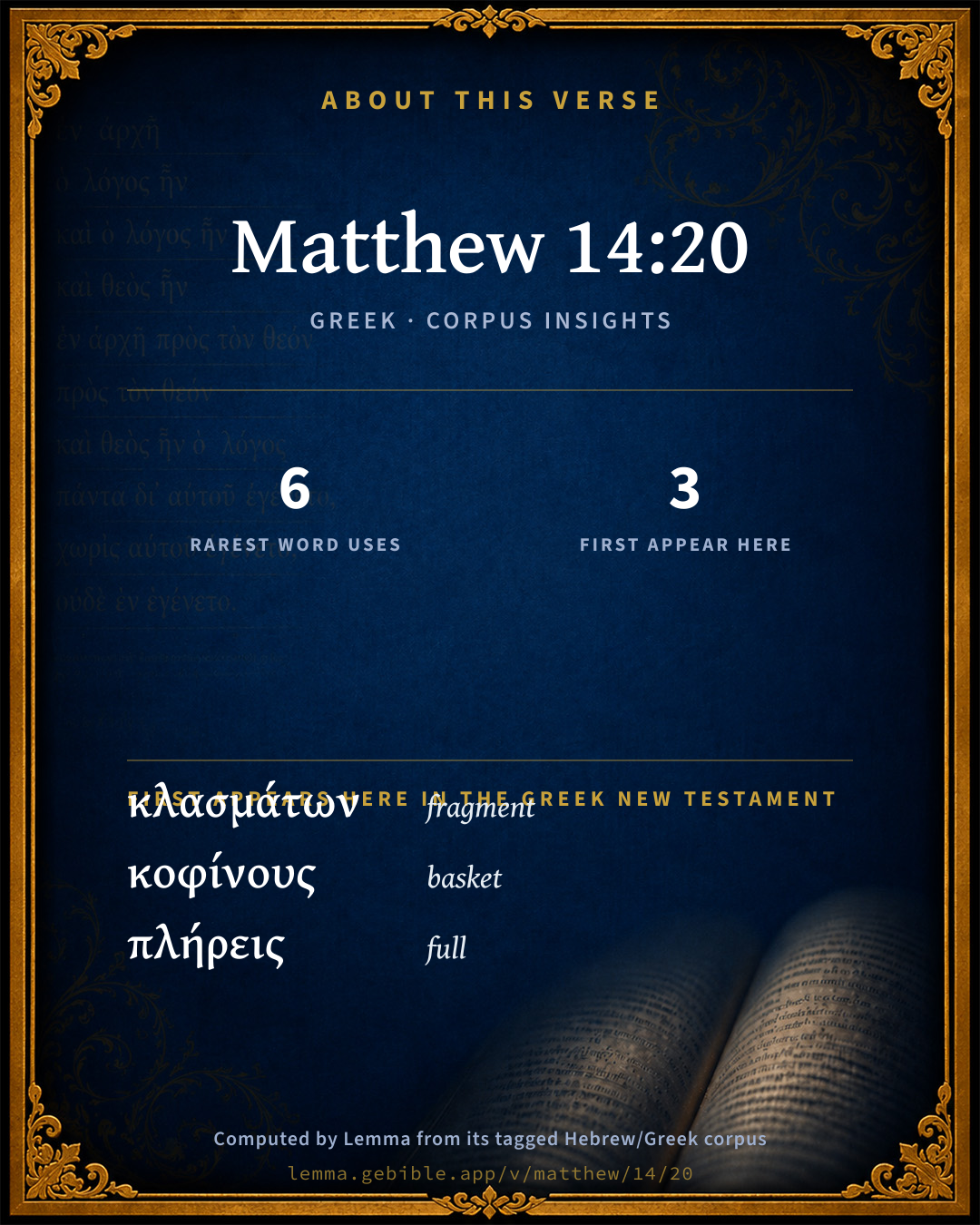
  • 3 first appearances in the Greek New Testament
Full analysis ↓
Download a study sheet

One document with this verse’s original text, its word-by-word gloss line, the meaning frame, cross-references with their text, attributed commentary, and full source and license credits — printable, and it pastes into notes with its structure intact.

This verse Autodidact and up

Study sheet (.html) Plain text (.txt)

A passage Seminary Student

Up to 50 verses in one chapter. A passage sheet keeps up to 6 commentary sources and 12 cross-references per verse, in the order this page ranks them, and says so on the sheet whenever that leaves anything out. Ask for a single verse and you get the Autodidact verse sheet above.

Everything on this page stays free to read, with no account — the sheet is a download of what is already on screen, not access to it.

Want to remove ads? Support Godless Engineer
Compare translations 3

The same verse in 3 English versions, stacked beneath the original-language interlinear above. Click any original word for its lexicon entry.

Each is an independent rendering of the whole verse — the interlinear is not word-aligned to these translations.

Highlighted words mark where these versions differ — a whole-verse word diff, not a word-by-word alignment.

  • World English Bible Public Domain
    They all ate, and were filled. They took up twelve baskets full of that which remained left over from the broken pieces.
  • King James Version Public Domain
    And they did all eat, and were filled: and they took up of the fragments that remained twelve baskets full.
  • unfoldingWord Literal Text CC BY-SA 4.0
    And they all ate and were satisfied. And they took up the remaining of the broken pieces—12 baskets full.

unfoldingWord Literal Text — © unfoldingWord, licensed CC BY-SA 4.0. Word-aligned USFM3 via Door43 (git.door43.org/unfoldingWord/en_ult).

Versions to compare (up to 4)

3 of 4 selected

Show all 19 translations

Every available English version of this verse, each an independent rendering of the whole verse.

  • World English Bible Public Domain
    They all ate, and were filled. They took up twelve baskets full of that which remained left over from the broken pieces.
  • Berean Standard Bible Public Domain
    They all ate and were satisfied, and the disciples picked up twelve basketfuls of broken pieces that were left over.
  • Majority Standard Bible Public Domain
    They all ate and were satisfied, and the disciples picked up twelve basketfuls of broken pieces that were left over.
  • King James Version Public Domain
    And they did all eat, and were filled: and they took up of the fragments that remained twelve baskets full.
  • American Standard Version (1901) Public Domain
    And they all ate, and were filled: and they took up that which remained over of the broken pieces, twelve baskets full.
  • Revised Version (1885) Public Domain
    And they did all eat, and were filled: and they took up that which remained over of the broken pieces, twelve baskets full.
  • Geneva Bible (1599) Public Domain
    And they did all eate, and were sufficed, and they tooke vp of the fragments that remained, twelue baskets full.
  • Douay-Rheims (1899) Public Domain
    And they did all eat, and were filled. And they took up what remained, twelve full baskets of fragments.
  • Young's Literal Translation Public Domain
    and they did all eat, and were filled, and they took up what was over of the broken pieces twelve hand-baskets full;
  • Literal Standard Version CC BY-SA 4.0
    and they all ate, and were filled, and they took up what was over of the broken pieces twelve hand-baskets full;
  • Unlocked Literal Bible CC BY-SA 4.0
    They all ate and were filled. Then they took up what remained of the broken pieces of food—twelve baskets full.
  • unfoldingWord Literal Text CC BY-SA 4.0
    And they all ate and were satisfied. And they took up the remaining of the broken pieces—12 baskets full.
  • Darby Bible Public Domain
    And all ate and were filled, and they took up what was over and above of fragments twelve hand-baskets full.
  • World Messianic Bible Public Domain
    They all ate and were filled. They took up twelve baskets full of that which remained left over from the broken pieces.
  • Webster's Bible Public Domain
    And they all ate, and were satisfied: and they took up of the fragments that remained twelve baskets full.
  • Free Bible Version CC BY-SA 4.0
    Everybody ate until they were full. Then they collected up the leftovers which filled twelve baskets.
  • Bible in Basic English Public Domain
    And they all took of the food and had enough: and they took up twelve baskets full of broken bits which were not used.
  • Text-Critical English NT CC BY 4.0
    They all ate and were filled, and the disciples picked up what was left over of the broken pieces, twelve baskets full.
  • Tyndale New Testament (1534) Public Domain
    And they dyd all eate and were suffised. And they gadered vp of the gobbetes that remayned vii. basketes full.

Literal Standard Version (2020), Covenant Press — licensed CC BY-SA 4.0. Text via the HelloAO Bible API (eBible.org). Unlocked Literal Bible (unfoldingWord) — licensed CC BY-SA 4.0. Text via the HelloAO Bible API (eBible.org). unfoldingWord Literal Text — © unfoldingWord, licensed CC BY-SA 4.0. Word-aligned USFM3 via Door43 (git.door43.org/unfoldingWord/en_ult). Free Bible Version, Dr. Jonathan Gallagher — licensed CC BY-SA 4.0. Text via the HelloAO Bible API (eBible.org).

Word by word

More ways to search: Search by grammar → Find every occurrence → Compare this word →

Practice this passage: Drill this verse → Learn its vocabulary →

κοφίνους
kóphinos
G2894
“basket”
Noun, Accusative, Plural, Masculine
Part of Speech
Noun
Case
Accusative
Number
Plural
Gender
Masculine
Full Thayer's Definition

Origin: of uncertain derivation

TDNT: None

1. a basket, wicker basket
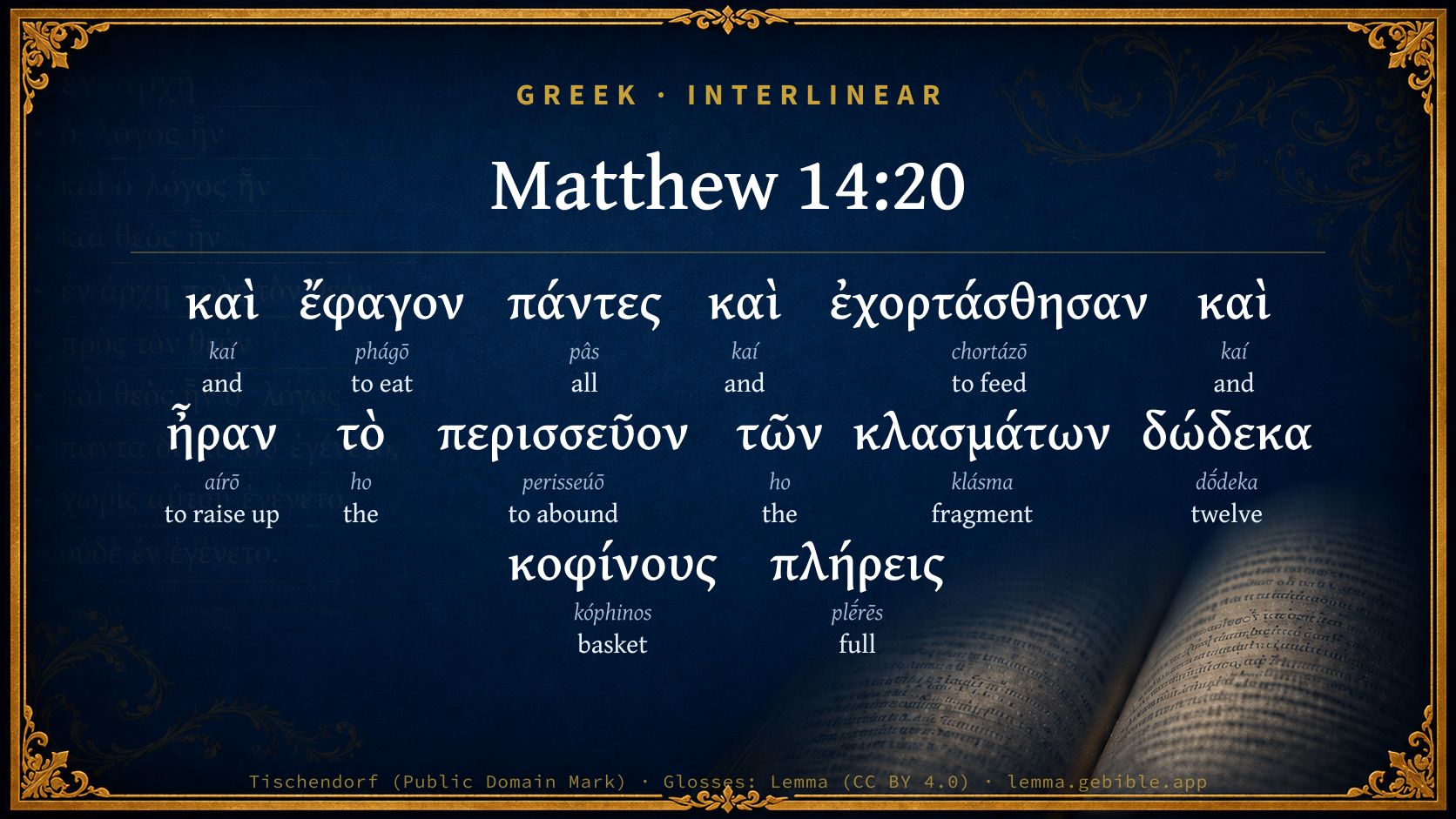
  1. καὶ kaí G2532 “and” Conjunction
  2. ἔφαγον phágō G5315 “to eat” Verb, Aorist, Active, Indicative, 3rd person, Plural
  3. πάντες pâs G3956 “all” Adjective, Nominative, Plural, Masculine
  4. καὶ kaí G2532 “and” Conjunction
  5. ἐχορτάσθησαν chortázō G5526 “to feed” Verb, Aorist, Passive, Indicative, 3rd person, Plural
  6. καὶ kaí G2532 “and” Conjunction
  7. ἦραν aírō G142 “to raise up” Verb, Aorist, Active, Indicative, 3rd person, Plural
  8. τὸ ho G3588 “the” Article, Accusative, Singular, Neuter
  9. περισσεῦον perisseúō G4052 “to abound” Verb, Present, Active, Participle, Accusative, Singular, Neuter
  10. τῶν ho G3588 “the” Article, Genitive, Plural, Neuter
  11. κλασμάτων klásma G2801 “fragment” Noun, Genitive, Plural, Neuter
  12. δώδεκα dṓdeka G1427 “twelve” Adjective, Numeral (indeclinable)
  13. πλήρεις plḗrēs G4134 “full” Adjective, Accusative, Plural, Masculine

About this verse

These counts appear in no published source. They are computed here, from the morphology-tagged text and Lemma’s own curated glosses. What Lemma adds →

14
words
11
distinct lemmas
Gospels
section

Notable vocabulary

The rarest word here is κοφίνους basket G2894 — appearing just 6 times in the whole Greek New Testament.

First appearance in Scripture

These words make their first canonical appearance in the Greek New Testament here:

  • κλασμάτων fragment G2801
  • κοφίνους basket G2894
  • πλήρεις full G4134

Shared distinctive vocabulary

κοφίνους basket G2894 occurs in 6 verses of the Greek New Testament. Also found in:
Repetition

Words recur within this verse:

Cross-references

20

Topical passages linked to Matthew 14:20 in the Treasury of Scripture Knowledge — connected by theme and wording, ordered by reader-vote popularity; previews shown in the World English Bible.

  • Exodus 16:12 "I have heard the murmurings of the children of Israel. Speak to them, saying, 'At evening you shall eat meat, and in the morning you shall be filled with bread: and you shall know that I am Yahweh your God.'"
  • Matthew 16:8–10 Jesus, perceiving it, said, "Why do you reason among yourselves, you of little faith, 'because you have brought no bread?'
  • Exodus 16:8 Moses said, "Now Yahweh shall give you meat to eat in the evening, and in the morning bread to satisfy you; because Yahweh hears your murmurings which you murmur against him. And who are we? Your murmurings are not against us, but against Yahweh."
  • 1 Kings 17:12–16 She said, As Yahweh your God lives, I don't have a cake, but a handful of meal in the jar, and a little oil in the jar: and, behold, I am gathering two sticks, that I may go in and bake it for me and my son, that we may eat it, and die.
  • Mark 6:42–44 They all ate, and were filled.
  • Leviticus 26:26 When I break your staff of bread, ten women shall bake your bread in one oven, and they shall deliver your bread again by weight: and you shall eat, and not be satisfied.
  • 2 Kings 4:1–7 Now there cried a certain woman of the wives of the sons of the prophets to Elisha, saying, Your servant my husband is dead; and you know that your servant did fear Yahweh: and the creditor is come to take to him my two children to be bondservants.
  • 2 Kings 4:43–44 His servant said, What, should I set this before a hundred men? But he said, Give the people, that they may eat; for thus says Yahweh, They shall eat, and shall leave of it.
  • Mark 8:8–9 They ate, and were filled. They took up seven baskets of broken pieces that were left over.
  • Luke 1:53 He has filled the hungry with good things. He has sent the rich away empty.
  • Luke 9:17 They ate, and were all filled. They gathered up twelve baskets of broken pieces that were left over.
  • John 6:11–14 Jesus took the loaves; and having given thanks, he distributed to the disciples, and the disciples to those who were sitting down; likewise also of the fish as much as they desired.
  • Proverbs 13:25 The righteous one eats to the satisfying of his soul, But the belly of the wicked goes hungry.
  • Ezekiel 4:14–16 Then said I, Ah Lord Yahweh! behold, my soul has not been polluted; for from my youth up even until now have I not eaten of that which dies of itself, or is torn of animals; neither came there abominable flesh into my mouth.
  • Haggai 1:6 You have sown much, and bring in little. You eat, but you don't have enough. You drink, but you aren't filled with drink. You clothe yourselves, but no one is warm, and he who earns wages earns wages to put them into a bag with holes in it."
  • Matthew 5:6 Blessed are those who hunger and thirst after righteousness, For they shall be filled.
  • Matthew 15:33 The disciples said to him, "Where should we get so many loaves in a deserted place as to satisfy so great a multitude?"
  • Mark 8:16–21 They reasoned with one another, saying, "It's because we have no bread."
  • John 6:7 Philip answered him, "Two hundred denarii worth of bread is not sufficient for them, that everyone of them may receive a little."
  • Matthew 15:37–38 They all ate, and were filled. They took up seven baskets full of the broken pieces that were left over.

Cross-references courtesy of OpenBible.info (CC BY 4.0).

Commentary

Notes on Matthew 14:20 from classic Christian and Jewish commentators (each source and its license shown beneath its notes). The classic Christian expositions comment on the surrounding passage and are grouped to its opening verse, so a note may address several verses; the Jewish commentaries on the Tanakh (Rashi and others) are per-verse, so they appear only where the commentator wrote on this verse.

Lemma curates 59 commentaries, every one of them public domain or Creative Commons licensed, each selected and text-cleaned for this edition rather than reprinted as found. About our sources →

Bengel's Gnomon

Johann Albrecht Bengel

Mat 14:20. Πἀντες, all) How much more can all partake of the one body of the Lord in the Holy Super.—κλασμάτων, of fragments) of most excellent bread; cf. Joh 2:10. A most substantial miracle. The people were not permitted to carry any away for the sake of curiosity.—δώδεκα, twelve) see Gnomon on ch. Mat 16:9. There were remnants also of fishes; see Mar 6:43. They were preserved for future eating, not, like manna, as a memorial.

Bengel's Gnomon of the New Testament — English translation (T&T Clark, Edinburgh, 1860) — public domain. Text from a community e-Sword module.

Meyer's Critical & Exegetical Commentary

Heinrich August Wilhelm Meyer

Mat_14:20 f. Τῶν κλασμ. is independent of τὸ περισς. (the fragments that were over), with which latter also δώδεκα κοφ. πλήρεις, twelve baskets full, is in apposition. In travelling, the Jews carried small baskets with them to hold their provisions and other necessaries. For κόφινος, see Jacobs, ad Anthol. IX. p. 455. It is more general (in Xen. Anab. iii. 8. 6, it is used in the sense of a dung-basket) than σπυρίς (Mat_15:37; Act_9:25).

ἦραν] they took up, from the ground on which the people had been eating. The subject of the verb is the apostles (Joh_6:12); each of the Twelve fills his travelling-basket. But the κλάσματα are the pieces (comp. Mat_14:19, κλάσας) into which the loaves had been divided, and which had so multiplied in the course of distribution that a great quantity still remained over.

γυναικ. κ. παιδ.] occurring frequently in classical writers, and sometimes with the order of the words inverted; Maetzner, ad Lycurg. p. 75. But observe here the diminutive παιδίων, little children, whom their mothers either carried in their arms or led by the hand.

REMARK.

To explain away the miracle, as Paulus has done (who thinks that the hospitable example of Jesus may have induced the people to place at His disposal the provisions they had brought along with them; comp. Gfrörer, Heiligth. u. Wahrh. p. 171 ff.; Ammon, L. J. II. p. 217 f.), is inconsistent with the accounts of all the evangelists, and especially with that of the eye-witness John. Notwithstanding this, Schleiermacher, L. J. p. 234, thought that, even on exegetical principles, the plural σημεῖα in Joh_6:26 (but see note on this passage) would justify him in declining to rank the incident among the miracles; whilst Schenkel thinks he sees his way to an explanation by supposing what is scarcely possible, viz. that Jesus fed the multitude with a rich supply of the bread of life from heaven, which caused them to forget their ordinary food, though at the same time He devoutly consecrated for their use the provisions which they had brought with them, or had managed to procure for the present emergency. Weizsäcker likewise leaves the fact, which is supposed to underlie the present narrative, too much in a state of perplexing uncertainty; this element of fact, he thinks, must somehow correspond with the symbolism of the miracle, which is intended to teach us that there is no sphere in which the believer may not become a partaker of the fulness of Jesus blessing. Keim, adhering above all to the ideal explanation that the bread which Jesus provided was spiritual bread, and referring by way of parallel to the story of the manna and the case of Elisha, follows the Paulus-Schenkel line of interpretation, in conceding a residuum of historical fact, though he seems to doubt whether that residuum will be considered worth retaining. But to eliminate the element of fact altogether, is no less inconsistent with historical testimony. This, however, has been done by Strauss, who thereupon proceeds to account for the narrative, partly by tracing it to some original parable (Weisse, I. p. 510 ff.), partly by treating it as a myth, and deriving it from the types of the Old Testament (Exodus 16; 1Ki_17:8-16; 2Ki_4:42 ff.) and the popular Messianic ideas (Joh_6:30 f.), partly by supposing it to belong to the lofty sphere of ideal legend (Ewald, see note on Joh_6:12), and partly by understanding it in a symbolic sense (Hase, de Wette). Such a mode of dealing with this incident is the result of denying the possibility of bringing a creative agency to bear upon dead, rather upon artificially prepared materials,a possibility which is not rendered more conceivable by having recourse to the somewhat poor expedient of supposing that what was done may have been brought about by an accelerated natural process (Olshausen). But that such agency was actually brought to bear, is a historical fact so well established by the unanimous testimony of the evangelists, that we must be contented to accept it with all its incomprehensibility, and, in this case not less than in that of the changing of water into wine at Cana, abandon the hope of being able to get a clearer conception of the process of the miracle by the help of natural analogies. The symbolical application, that is, to the higher spiritual food, was made by our Lord Himself in Joh_6:26 ff.; but, in doing so, He takes the miraculous feeding with material bread as His historical basis and warrant. Moreover, the view of Origen, that it was τῷ λόγῳ καὶ τῇ εὐλογίᾳ that Jesus caused the bread to multiply, is greatly favoured by the fact that the circumstance of the thanksgiving is mentioned by the whole four evangelists, and above all by Lukes expression: εὐλόγησεν αὐτούς.

Meyer — Critical and Exegetical Commentary on the New Testament — English translation by Peter Christie, edited by Frederick Crombie (T&T Clark, 1880) — public domain. Text from a community e-Sword module.

Expositor's Greek Testament

ed. W. Robertson Nicoll

Mat 14:20 . δώδεκα κοφ . πλ . is in appos. with τὸ περισσεῦον τ . κ . They took the surplus of the broken pieces to the extent of twelve baskets. κοφίνους , answering to the Rabbinical קופא , a basket of considerable size (“ein grosses Behältniss,” Wünsche). Each of the Twelve had one. The word recalls the well-known line of Juvenal ( Sat. iii. 14): “Judaeis, quorum cophinus foenumque suppellex,” on which and its bearing on this place vide Schöttgen (Hor. Tal.) and Elsner.

The Expositor's Greek Testament, edited by W. Robertson Nicoll (1897–1910) — public domain. Text from a community e-Sword module.

Adam Clarke's Commentary

Verse 20. They did all eat, and were filled] Little or much is the same in the hands of Jesus Christ. Here was an incontestable miracle - five thousand men, besides women and children, fed with five cakes and two fishes! Here must have been a manifest creation of substance - the parts of the bread were not dilated to make them appear large, nor was there any delusion in the eating-for they all ate, and were all filled. Here then is one miracle of our Lord attested by at least five thousand persons! But did not this creation of bread prove the unlimited power of Jesus? Undoubtedly: and nothing less than eternal power and Godhead could have effected it.

They took up - twelve baskets] It was customary for many of the Jews to carry a basket with them at all times: and Mr. Wakefield's conjecture here is very reasonable: - "By the number here particularized, it should seem that each apostle filled his own bread basket." Some think that the Jews carried baskets in commemoration of their Egyptian bondage, when they were accustomed to carry the clay and stubble to make the bricks, in a basket that was hung about their necks. This seems to be what Sidonius Apollinaris refers to in the following words, Epist. vii. 6. Ordinis res est, ut, (dum in allegorica versamur AEgypto) Pharao incedat cum diademate, Israelita cum COPHINO.

These words of Alcimus Avitus, lib. v. 30, are to the same effect:-

Servitii longo lassatam pondere plebem,

Oppressos cophinis humeros, attritaque collo.

It appears that a basket about the neck, and a bunch of hay, were the general characteristic of this long enslaved and oppressed people in the different countries where they sojourned.

Juvenal also mentions the basket and the hay: -

Cum dedit ille locum, cophino faenoque relicto,

Arcanam Judaea tremens mendicat in aurem.

Sat vi. 542.

A gypsy Jewess whispers in your ear--

Her goods a basket, and old hay her bed,

She strolls, and telling fortunes, gains her bread.

Dryden.

And again, Sat iii. 13: -

Nunc sacri fontis nemus, et delubra locantur

Judaeis, quorum cophinus, faenumque supellex.

Now the once hallowed fountain, grove, and fane,

Are let to Jews, a wretched, wandering train,

Whose wealth is but a basket stuff'd with hay.

Gifford.

The simple reason why the Jews carried baskets with them appears to be this:-When they went into Gentile countries, they carried their own provision with them, as they were afraid of being polluted by partaking of the meat of heathens. This also obliged them probably to carry hay with them to sleep on: and it is to this, in all likelihood, that Juvenal alludes.

After five thousand were fed, twelve times as much, at least, remained, as the whole multitude at first sat down to! See Clarke on Lu 9:16.

Adam Clarke's Commentary on the Bible (1810–1826) — public domain. Text from a community e-Sword/MySword module.

Ellicott's Commentary for English Readers

(20) Twelve baskets full.—The basket here is the cophinus, a small basket carried in the hand, and often used by travellers to hold their food. So Juvenal (Sat. iii. 14) describes the Jews of Italy as travelling with “their cophinus and a wisp of hay,” by way of pillow, as their only luggage. St. John records that the gathering was made by our Lord’s express commands, “that nothing be lost.” The marvellous display of creative power was not to supersede forethought, thrift, economy in the use of the gifts it had bestowed. It is probable, from the language of the disciples in Mar_6:37, and from Joh_13:29, that they were in the habit of distributing food to the poor in the villages and towns in which they preached, and the fragments were, we may believe, reserved for that use.

A Bible Commentary for English Readers, edited by Charles John Ellicott (1878–1897) — public domain. Text from a community e-Sword module.

The Cambridge Bible for Schools and Colleges

gen. ed. J. J. S. Perowne

20. they took up of the fragments] The Greek word for fragments is connected with the verb “to break” in the preceding verse. The true meaning of the word is therefore “the portions broken off for distribution.”

twelve baskets] The same word kophinoi is used for baskets in the four accounts of this miracle, and also by our Lord, when He refers to the miracle (ch. Mat_16:9); whereas a different word is used in describing the feeding of four thousand and in the reference made to that event by our Lord (ch. Mat_16:10). The Roman poet Juvenal describes a large provision-basket of this kind, together with a bundle of hay, as being part of the equipment of the Jewish mendicants who thronged the grove of Egeria at Rome. The motive for this custom was to avoid ceremonial impurity in eating or in resting at night.

The Cambridge Bible for Schools and Colleges (gen. ed. J. J. S. Perowne; Cambridge University Press, 1878–1918) — public domain. Text from a community e-Sword module.

John Gill's Exposition

And they that had eaten were about five thousand men,.... The word "about", is omitted in the Vulgate Latin, in Munster's Hebrew Gospel, and in the Syriac, Arabic, and Persic versions, which expressly say there were so many. A large number indeed, to be fed with five loaves and two fishes!

besides women and children; who were not taken into the account, though they all ate, and were filled, it not being usual with the Jews to number their women; and who might be near as large a number as the men: for generally there is a very great concourse of the female sex, and of children, where anything extraordinary, or out of the way, is to be seen or heard; and of this sort was a large number of Christ's audience, who only came out of curiosity, or for one sinister end or another.

John Gill's Exposition of the Whole Bible (1746–1763) — public domain (CC PDM 1.0). Text via the HelloAO Bible API.

Trapp's Complete Commentary

John Trapp

20 And they did all eat, and were filled: and they took up of the fragments that remained twelve baskets full.

Ver. 20. And were filled] So David’s cup overflowed, Psa 23:5; he had not only a sufficience but an affluence. So, at the marriage of Cana, Christ gave them wine enough for 150 guests, Joh 2:10. Howbeit he hath not promised us superfluities. Having food and raiment, let us be content, 1Ti 6:8. A little of the creature will serve to carry us through our pilgrimage.

And they took up of the fragments] Thrift is a great revenue ( ingens vectigal parsimonia), and good husbandry well pleasing to God, Pro 27:26-27, so it degenerate not into niggardise.

Twelve baskets full] If we consider what they are, we may wonder they left anything, as if, what they left, that they ate anything.

John Trapp, A Commentary or Exposition upon All the Books of the Old and New Testament (1647–1656) — public domain. Text from a community e-Sword module.

Haydock's Catholic Bible Commentary

And they did all eat, and were filled. This miraculous multiplication of the loaves was effected on a Thursday evening --- an excellent figure of the blesses Eucharist. On the next morning, Friday, he cured the sick at Genesareth, and arrived at Capharnaum for the first vespers of the sabbath; where, in the Synagogue, he made his promise of the holy Eucharist, which he instituted on a Thursday evening, the eve of his death. See Evangile medite. Tom. iii, p. 425.

George Leo Haydock (1774–1849), Haydock's Catholic Family Bible and Commentary, 1859 edition — public domain. Excludes Psalms (Douay-Rheims chapter numbering differs from Protestant) and Deuterocanonical books (Catholic canon only).

Whedon's Commentary on the Bible

Daniel D. Whedon

20. All eat, and were filled — Like the widow’s cruse of oil, when a part was taken, its place was instantly supplied by divine power. The loaf remained still as large when the piece was broken off, and each piece in hand imperceptibly became large as the loaf. Was this an original act of creation? Not necessarily. He who guided through the water the fishes to Peter’s net could guide the invisible atomic elements, in however gaseous a form through the air, to form upon the loaf, the material bread. This is but hastening the process that ever is taking place in the growth of the grain. There is but the additional modification produced by heat in the oven; but even this is only a different arrangement of the particles. Twelve baskets full — This shows that the miracle was performed upon the bread and not upon the stomach. There was an actual increase of the amount of the material, not a supernatural cessation of the appetite under an imaginary or conceptual food.

The lad’s basket could doubtless have carried the original loaves and fishes. But when a divine bounty gives (so the Saviour’s miracle teaches) it gives plentifully and worthily, the wealth of a God.

The multitudes, John informs us, felt the bounty and the miracle. Tradition had reported to them that the Messiah would rain manna from heaven; and they now exclaim: “This is of a truth that prophet which should come into the world.” They were ready to place upon him the Messianic crown, with the expectation that the time of miraculous plenty and easy life was at hand under his reign. So little, alas! did the most munificent miracle spiritualize their hearts.

Daniel D. Whedon (gen. ed.), Commentary on the Old and New Testaments (1874–1909) — public domain. Text from a community e-Sword module.

The Pulpit Commentary

And they did all eat, and were filled. (ecortasyhsan , Mat_5:6, note) And they. Undefined, but seen from Mat_16:9 Joh_6:12, to have been the disciples. Took up of the fragments that remained; that which remained over of the broken pieces (Revised Version); i.e. of the pieces broken by our Lord for distribution (ver. 19). Twelve baskets full. The disciples personally lost nothing by the miracle (ver. 15, note), the provision basket that each always carried was now replenished. Baskets; "cofyns" (Wickliffe); kofinouv . (cf. Luk_9:17, note; and the Talmudic saying, "He that has bread in his basket is not like him that has not bread in his basket," Talm. Bab., "Yoma," 74 b)

The Pulpit Commentary (1880–1919), ed. H.D.M. Spence-Jones & Joseph S. Exell — public domain. Text from a community e-Sword module.

Burkitt's Expository Notes on the New Testament

William Burkitt

They did all eat, not a crumb or a bit, but to satiety and fullness: They did eat and were filled, yet twelve baskets remained; more was left than was at first set on. So many bellies, and yet so many baskets filled. The miracle was doubled by an act of boundless omnipotency. It is hard to say, which was the greater miracle, the miraculous eating, or the miraculous leaving. If we consider that they ate, we may justly wonder that they left any thing.

Observe farther, these fragments, though of barley bread and fish bones must not be lost; but by our Saviour’s command, gathered up. The liberal housekeeper of the world will not allow the loss of his orts. O how fearful then will the account of those be, who have large and plentiful estates to answer for as lost, being spent upon their lusts in riot and excess!

William Burkitt's Expository Notes on the New Testament (1700–1703) — public domain. Text from a community e-Sword module.

The People's New Testament

B. W. Johnson

20. Twelve baskets full. Baskets were taken by the Jews on journeying, to carry their provisions, etc., that they might not have to depend on Gentiles, and so incur the risk of ceremonial pollution.

B. W. Johnson's The People's New Testament with Notes (1889–1891) — public domain. Electronic text from the Christian Classics Ethereal Library (CCEL) ThML edition.

Cambridge Greek Testament for Schools and Colleges

20. τὸ περισσεῦον τῶν κλασμάτων. κλασμάτων connected with κλάσας, therefore not ‘fragments’ in the sense of crumbs of bread, but the ‘portions’ broken off for distribution.

δώδεκα κοφίνους. The same word is used for baskets in the four accounts of this miracle, and also by our Lord, when He refers to the miracle (ch. Mat 16:9); whereas a different word (σπυρίδες) is used in describing the feeding of four thousand and in the reference made to that event by our Lord (ch. Mat 16:10). Juvenal describes a large provision-basket of this kind, together with a bundle of hay, as being part of the equipment of the Jewish mendicants who thronged the grove of Egeria at Rome: ‘Judæis quorum cophinus fœnumque supellex, III. 14,’ ‘cophino fœnoque relicto | arcanam Judæa tremens mendicat in aurem,’ VI. 542. The motive for this custom was to avoid ceremonial impurity in eating or in resting at night.

Cambridge Greek Testament for Schools and Colleges (Cambridge University Press, 1896; 21 vols, various authors incl. Carr, Maclear, Plummer, Farrar, Lumby, Moule, M. R. James, Simcox) — public domain. Text from a community e-Sword module.

Alford’s Greek Testament

Henry Alford

20. κοφίνους] in the construction, is in apposition with τὸ περισσεῦον.

The cophinus was the usual accompaniment of the Jew: see Sat. iii.14—‘Judæis, quorum cophinus fœnumque supellex;’ and Sat. vi. 542. Reland, whom Schöttgen (in loc.) follows, supposes that the basket was to carry their own meats on a journey, for fear of pollution by eating those of the Gentiles, and the hay to sleep on for the same reason.

Henry Alford, The Greek Testament (1849–1861) — public domain. Text from a community e-Sword module.

International Critical Commentary

20. And they all ate, and were filled; and they took up the remain der of the fragments twelve baskets full.] For χορτάζειν, see on 5:6.

τὸ περισσεῦον τῶν κλασμάτων δώδεκα κοφίνους πλήρεις] for Mk.’s harsher κλάσματα δώδεκα κοφίνων πληρώματα. Mk. adds καὶ ἀπὸ τῶν ἰχθύων.

(M)

International Critical Commentary — older volumes (1896–1929), various authors — public domain. Text from a community e-Sword module.

Vincent's Word Studies in the New Testament

Marvin R. Vincent

Were filled [εχορτασθησαν] . See on Mt 5:6.

Baskets [κοφινους] . Wyc., coffins, a transcription of the Greek word. Juvenal, the Roman satirist, describes the grove of Numa, near the Capenian gate of Rome, as being "let out to the Jews, whose furniture is a basket [χοπηινυσ] and some hay" (for a bed), "Sat." 3 14. These were small hand - baskets, specially provided for the Jews to carry levitically clean food while travelling in Samaria or other heathen districts. The word for basket used in relating the feeding of the four thousand (Mt 14:37) is spuriv, a large provision - basket or hamper, of the kind used for letting Paul down over the wall at Damascus (Act 9:25). In Mt 16:9, 10, Christ, in alluding to the two miracles, observes the distinctive term in each narrative; using kofinouv in the case of the five thousand, and spuridav in the other. Burgon (" Letters from Rome ") gives a drawing of a wicker basket used by the masons in the cathedral at Sorrento, and called coffano. He adds, "Who can doubt that the basket of the gospel narrative was of the shape here represented, and that the denomination of this basket exclusively has lingered in a Greek colony, where the Jews (who once carried the cophinus as a personal equipment) formerly lived in great numbers?"

Marvin R. Vincent, Word Studies in the New Testament (1887–1900) — public domain. Text from a community e-Sword/MySword module.

Lesson kit

Teaching starters — assembled from the data on this page, not authored interpretation. Every prompt links to the verse data it draws on. Edit before teaching.

Matthew, in the Gospels, opens this verse with 14 words (11 distinct Greek lemmas). Its most distinctive word is kóphinos (“basket”). A historical commentator’s framing appears above. Read the whole chapter for the surrounding context.

Discussion questions

  1. The word kóphinos carries the sense “basket.” How does it shape the verse?
  2. 3 words make their first appearance in Scripture here. What does this debut establish?
  3. How does Matthew 16:9, which shares the word «basket», read alongside this verse?
  4. What does the repetition of “and” (3× in this one verse) do in this verse?
  5. These translations render this verse differently. What is at stake in choosing one wording over another?
  6. Compare how Bengel's Gnomon and Meyer's Critical & Exegetical Commentary read this verse. Where do they agree or differ?

Things to notice

  • 3 words make their first canonical appearance in Scripture here.
  • These translations choose different wording for 15 words in this verse.
  • “and” occurs 3× in this single verse.
  • 11 distinct Greek lemmas span 14 words in this verse.

Reading settings

Reading text

Shown beneath each verse's original-language words.

Old Testament
Old Testament edition

Read the OT as the Masoretic Hebrew (MT) or the Greek Septuagint (LXX).

English shown for the Greek Septuagint (in the Hebrew ↔ Greek comparison).

Comparing translations? Open the Compare panel on any verse page to stack up to four side by side.