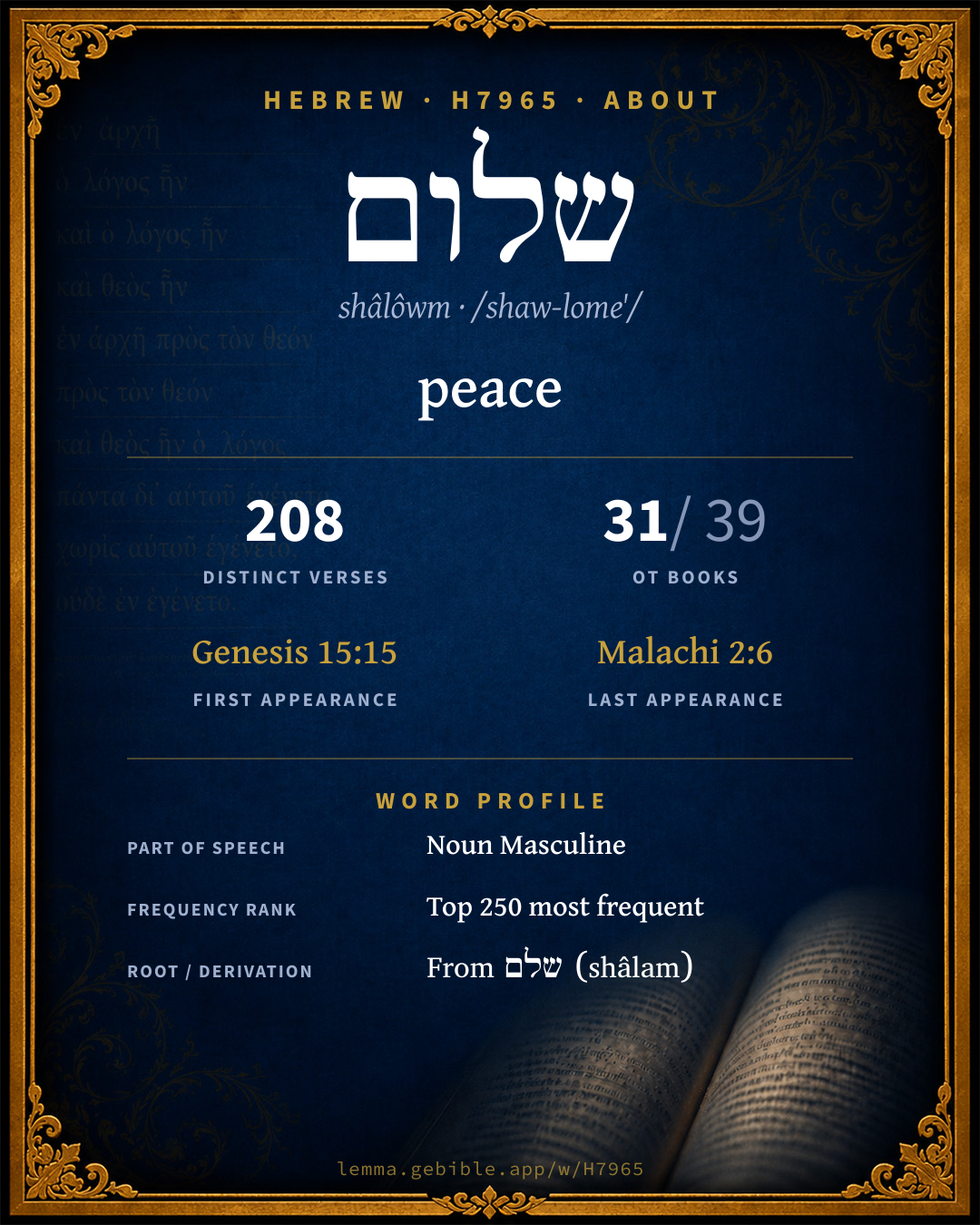
שָׁלוֹם
peace
also: completeness, soundness, welfare fuller range ↓
Full lexicon entry — Brown-Driver-Briggs (BDB)
From Brown-Driver-Briggs (BDB)
Where this word appears
See every Absolute-state word in the Hebrew Bible →
Grammar key — what these labels mean
Part of speech
- Noun
- A naming word — a person, place, thing, or idea.
Noun type
- Common
- A common noun — a general class of person, place, or thing (“king,” “city,” “water”), not a specific name.
State
- Absolute
- The independent form of a noun, not bound to a following word.
- Construct
- A noun bound to a following noun in a possessive / “of” relationship (the construct chain).
Gender
- Masculine
- Grammatically masculine.
Number
- Singular
- One.
- Plural
- More than one (in Hebrew, generally three or more).
Grammatical forms
- Noun, Common, Masculine, Singular, Absolute 208 times (88%)
- Noun, Common, Masculine, Singular, Construct 25 times (11%)
- Noun, Common, Masculine, Plural, Absolute 2 times (1%)
- Noun, Common, Masculine, Plural, Construct 1 time (0%)
Parsed forms decoded from the imported morphology (morphhb / Westminster Leningrad Codex — WLC text public domain, morphhb tagging CC BY 4.0), counted across 236 parsed occurrences — not distinct verses.
Page 1 of 2 — showing verses 1–200 of 208 distinct verses where H7965 appears, across 31 books. Click any verse to open its interlinear word-by-word view. Verse text shown in the World English Bible for context — . Each verse’s Hebrew form is shown with its reference; the English is not keyword-highlighted, since the data carries no word-level English alignment. Use “Compare translations” on any verse to read it across multiple English versions. This concordance covers the Hebrew Bible; Septuagint (Greek Old Testament) occurrences are not indexed here.
Genesis 12 verses
- Genesis 15:15 בְּ/שָׁל֑וֹם prep + n c ms But you will go to your fathers in peace. You will be buried in a good old age.
- Genesis 26:29 בְּ/שָׁל֑וֹם prep + n c ms that you will do us no harm, as we have not touched you, and as we have done to you nothing but good, and have sent you away in peace.' You are now the blessed of Yahweh."
- Genesis 26:31 בְּ/שָׁלֽוֹם prep + n c ms They rose up some time in the morning, and swore one to another. Isaac sent them away, and they departed from him in peace.
- Genesis 28:21 בְ/שָׁל֖וֹם prep + n c ms so that I come again to my father's house in peace, and Yahweh will be my God,
- Genesis 29:6 הֲ/שָׁל֣וֹם שָׁל֔וֹם ptcl inter + n c ms n c ms He said to them, "Is it well with him?" They said, "It is well. See, Rachel, his daughter, is coming with the sheep."
- Genesis 37:4 לְ/שָׁלֹֽם prep + n c ms His brothers saw that their father loved him more than all his brothers, and they hated him, and couldn't speak peaceably to him.
- Genesis 37:14 שְׁל֤וֹם שְׁל֣וֹם n c ms cs n c ms cs He said to him, "Go now, see whether it is well with your brothers, and well with the flock; and bring me word again." So he sent him out of the valley of Hebron, and he came to Shechem.
- Genesis 41:16 שְׁל֥וֹם n c ms cs Joseph answered Pharaoh, saying, "It isn't in me. God will give Pharaoh an answer of peace."
- Genesis 43:23 שָׁל֨וֹם n c ms He said, "Peace be to you. Don't be afraid. Your God, and the God of your father, has given you treasure in your sacks. I received your money." He brought Simeon out to them.
- Genesis 43:27 לְ/שָׁל֔וֹם הֲ/שָׁל֛וֹם prep + n c ms ptcl inter + n c ms He asked them of their welfare, and said, "Is your father well, the old man of whom you spoke? Is he yet alive?"
- Genesis 43:28 שָׁל֛וֹם n c ms They said, "Your servant, our father, is well. He is still alive." They bowed the head, and did homage.
- Genesis 44:17 לְ/שָׁל֖וֹם prep + n c ms He said, "Far be it from me that I should do so. The man in whose hand the cup is found, he will be my bondservant; but as for you, go up in peace to your father."
Exodus 3 verses
- Exodus 4:18 לְ/שָׁלֽוֹם prep + n c ms Moses went and returned to Jethro his father-in-law, and said to him, "Please let me go and return to my brothers who are in Egypt, and see whether they are still alive." Jethro said to Moses, "Go in peace."
- Exodus 18:7 לְ/שָׁל֑וֹם prep + n c ms Moses went out to meet his father-in-law, and bowed and kissed him. They asked each other of their welfare, and they came into the tent.
- Exodus 18:23 בְ/שָׁלֽוֹם prep + n c ms If you will do this thing, and God commands you so, then you will be able to endure, and all of these people also will go to their place in peace."
Leviticus 1 verse
Numbers 2 verses
Deuteronomy 5 verses
- Deuteronomy 2:26 שָׁל֖וֹם n c ms I sent messengers out of the wilderness of Kedemoth to Sihon king of Heshbon with words of peace, saying,
- Deuteronomy 20:10 לְ/שָׁלֽוֹם prep + n c ms When you draw near to a city to fight against it, then proclaim peace to it.
- Deuteronomy 20:11 שָׁל֣וֹם n c ms It shall be, if it make you answer of peace, and open to you, then it shall be, that all the people who are found therein shall become tributary to you, and shall serve you.
- Deuteronomy 23:6 שְׁלֹמָ֖/ם n c ms cs + sfx pers 3mp You shall not seek their peace nor their prosperity all your days forever.
- Deuteronomy 29:19 שָׁל֣וֹם n c ms and it happen, when he hears the words of this curse, that he bless himself in his heart, saying, I shall have peace, though I walk in the stubbornness of my heart, to destroy the moist with the dry.
Joshua 2 verses
- Joshua 9:15 שָׁל֔וֹם n c ms Joshua made peace with them, and made a covenant with them, to let them live: and the princes of the congregation swore to them.
- Joshua 10:21 בְּ/שָׁל֑וֹם prep + n c ms that all the people returned to the camp to Joshua at Makkedah in peace: none moved his tongue against any of the children of Israel.
Judges 10 verses
- Judges 4:17 שָׁל֗וֹם n c ms However Sisera fled away on his feet to the tent of Jael the wife of Heber the Kenite; for there was peace between Jabin the king of Hazor and the house of Heber the Kenite.
- Judges 6:23 שָׁל֥וֹם n c ms Yahweh said to him, Peace be to you; don't be afraid: you shall not die.
- Judges 6:24 שָׁל֑וֹם n c ms Then Gideon built an altar there to Yahweh, and called it Yahweh-shalom: to this day it is yet in Ophrah of the Abiezrites.
- Judges 8:9 בְ/שָׁל֔וֹם prep + n c ms He spoke also to the men of Penuel, saying, When I come again in peace, I will break down this tower.
- Judges 11:13 בְּ/שָׁלֽוֹם prep + n c ms The king of the children of Ammon answered to the messengers of Jephthah, Because Israel took away my land, when he came up out of Egypt, from the Arnon even to the Jabbok, and to the Jordan: now therefore restore those [lands] again peaceably.
- Judges 11:31 בְ/שָׁל֖וֹם prep + n c ms then it shall be, that whatever comes forth from the doors of my house to meet me, when I return in peace from the children of Ammon, it shall be Yahweh's, and I will offer it up for a burnt offering.
- Judges 18:6 לְ/שָׁל֑וֹם prep + n c ms The priest said to them, Go in peace: before Yahweh is your way wherein you go.
- Judges 18:15 לְ/שָׁלֽוֹם prep + n c ms They turned aside there, and came to the house of the young man the Levite, even to the house of Micah, and asked him of his welfare.
- Judges 19:20 שָׁל֣וֹם n c ms The old man said, Peace be to you; howsoever let all your wants lie on me; only don't lodge in the street.
- Judges 21:13 שָׁלֽוֹם n c ms The whole congregation sent and spoke to the children of Benjamin who were in the rock of Rimmon, and proclaimed peace to them.
1 Samuel 15 verses
- 1 Samuel 1:17 לְ/שָׁל֑וֹם prep + n c ms Then Eli answered, Go in peace; and the God of Israel grant your petition that you have asked of him.
- 1 Samuel 7:14 שָׁל֔וֹם n c ms The cities which the Philistines had taken from Israel were restored to Israel, from Ekron even to Gath; and the border of it did Israel deliver out of the hand of the Philistines. There was peace between Israel and the Amorites.
- 1 Samuel 10:4 לְ/שָׁל֑וֹם prep + n c ms and they will greet you, and give you two loaves of bread, which you shall receive of their hand.
- 1 Samuel 16:4 שָׁלֹ֥ם n c ms Samuel did that which Yahweh spoke, and came to Bethlehem. The elders of the city came to meet him trembling, and said, Come you peaceably?
- 1 Samuel 16:5 שָׁל֗וֹם n c ms He said, Peaceably; I am come to sacrifice to Yahweh: sanctify yourselves, and come with me to the sacrifice. He sanctified Jesse and his sons, and called them to the sacrifice.
- 1 Samuel 17:18 לְ/שָׁל֔וֹם prep + n c ms and bring these ten cheeses to the captain of their thousand, and look how your brothers fare, and take their pledge.
- 1 Samuel 17:22 לְ/שָׁלֽוֹם prep + n c ms David left his baggage in the hand of the keeper of the baggage, and ran to the army, and came and greeted his brothers.
- 1 Samuel 20:7 שָׁל֣וֹם n c ms If he says, 'It is well;' your servant shall have peace: but if he be angry, then know that evil is determined by him.
- 1 Samuel 20:13 לְ/שָׁל֑וֹם prep + n c ms Yahweh do so to Jonathan, and more also, should it please my father to do you evil, if I don't disclose it to you, and send you away, that you may go in peace: and Yahweh be with you, as he has been with my father.
- 1 Samuel 20:21 שָׁל֥וֹם n c ms Behold, I will send the boy, [saying], Go, find the arrows. If I tell the boy, Behold, the arrows are on this side of you; take them, and come; for there is peace to you and no hurt, as Yahweh lives.
- 1 Samuel 25:5 לְ/שָׁלֽוֹם prep + n c ms David sent ten young men, and David said to the young men, Go up to Carmel, and go to Nabal, and greet him in my name:
- 1 Samuel 25:6 שָׁלוֹם֙ שָׁל֔וֹם שָׁלֽוֹם n c ms n c ms n c ms and thus shall you tell him who lives [in prosperity], Peace be to you, and peace be to your house, and peace be to all that you have.
- 1 Samuel 25:35 לְ/שָׁלוֹם֙ prep + n c ms So David received of her hand that which she had brought him: and he said to her, Go up in peace to your house; behold, I have listened to your voice, and have accepted your person.
- 1 Samuel 29:7 בְּ/שָׁל֑וֹם prep + n c ms Therefore now return, and go in peace, that you not displease the lords of the Philistines.
- 1 Samuel 30:21 לְ/שָׁלֽוֹם prep + n c ms David came to the two hundred men, who were so faint that they could not follow David, whom also they had made to abide at the brook Besor; and they went forth to meet David, and to meet the people who were with him: and when David came near to the people, he greeted them.
2 Samuel 14 verses
- 2 Samuel 3:21 בְּ/שָׁלֽוֹם prep + n c ms Abner said to David, I will arise and go, and will gather all Israel to my lord the king, that they may make a covenant with you, and that you may reign over all that your soul desires. David sent Abner away; and he went in peace.
- 2 Samuel 3:22 בְּ/שָׁלֽוֹם prep + n c ms Behold, the servants of David and Joab came from a foray, and brought in a great spoil with them: but Abner was not with David in Hebron; for he had sent him away, and he was gone in peace.
- 2 Samuel 3:23 בְּ/שָׁלֽוֹם prep + n c ms When Joab and all the host who was with him had come, they told Joab, saying, Abner the son of Ner came to the king, and he has sent him away, and he is gone in peace.
- 2 Samuel 8:10 לְ/שָׁל֜וֹם prep + n c ms then Toi sent Joram his son to king David, to Greet him, and to bless him, because he had fought against Hadadezer and struck him: for Hadadezer had wars with Toi. [Joram] brought with him vessels of silver, and vessels of gold, and vessels of brass:
- 2 Samuel 11:7 לִ/שְׁל֤וֹם וְ/לִ/שְׁל֣וֹם וְ/לִ/שְׁל֖וֹם prep + n c ms cs conj + prep + n c ms cs conj + prep + n c ms cs When Uriah was come to him, David asked of him how Joab did, and how the people fared, and how the war prospered.
- 2 Samuel 15:9 בְּ/שָׁל֑וֹם prep + n c ms The king said to him, Go in peace. So he arose, and went to Hebron.
- 2 Samuel 15:27 בְּ/שָׁל֑וֹם prep + n c ms The king said also to Zadok the priest, "Aren't you a seer? Return into the city in peace, and your two sons with you, Ahimaaz your son, and Jonathan the son of Abiathar.
- 2 Samuel 17:3 שָׁלֽוֹם n c ms and I will bring back all the people to you: the man whom you seek is as if all returned: [so] all the people shall be in peace.
- 2 Samuel 18:28 שָׁל֔וֹם n c ms Ahimaaz called, and said to the king, All is well. He bowed himself before the king with his face to the earth, and said, Blessed be Yahweh your God, who has delivered up the men who lifted up their hand against my lord the king.
- 2 Samuel 18:29 שָׁל֥וֹם n c ms The king said, Is it well with the young man Absalom? Ahimaaz answered, When Joab sent the king's servant, even me your servant, I saw a great tumult, but I don't know what it was.
- 2 Samuel 18:32 הֲ/שָׁל֥וֹם ptcl inter + n c ms The king said to the Cushite, Is it well with the young man Absalom? The Cushite answered, The enemies of my lord the king, and all who rise up against you to do you hurt, be as that young man is.
- 2 Samuel 19:24 בְ/שָׁלֽוֹם prep + n c ms Mephibosheth the son of Saul came down to meet the king; and he had neither dressed his feet, nor trimmed his beard, nor washed his clothes, from the day the king departed until the day he came home in peace.
- 2 Samuel 19:30 בְּ/שָׁל֖וֹם prep + n c ms Mephibosheth said to the king, yes, let him take all, because my lord the king is come in peace to his own house.
- 2 Samuel 20:9 הֲ/שָׁל֥וֹם ptcl inter + n c ms Joab said to Amasa, Is it well with you, my brother? Joab took Amasa by the beard with his right hand to kiss him.
1 Kings 10 verses
- 1 Kings 2:5 בְּ/שָׁלֹ֑ם prep + n c ms Moreover you know also what Joab the son of Zeruiah did to me, even what he did to the two captains of the hosts of Israel, to Abner the son of Ner, and to Amasa the son of Jether, whom he killed, and shed the blood of war in peace, and put the blood of war on his sash that was about his loins, and in his shoes that were on his feet.
- 1 Kings 2:6 בְּ/שָׁלֹ֖ם prep + n c ms Do therefore according to your wisdom, and don't let his gray head go down to Sheol in peace.
- 1 Kings 2:13 הֲ/שָׁל֣וֹם שָׁלֽוֹם ptcl inter + n c ms n c ms Then Adonijah the son of Haggith came to Bathsheba the mother of Solomon. She said, Come you peaceably? He said, Peaceably.
- 1 Kings 2:33 שָׁל֛וֹם n c ms So shall their blood return on the head of Joab, and on the head of his seed forever: but to David, and to his seed, and to his house, and to his throne, shall there be peace for ever from Yahweh.
- 1 Kings 4:24 וְ/שָׁל֗וֹם conj + n c ms For he had dominion over all [the region] on this side the River, from Tiphsah even to Gaza, over all the kings on this side the River: and he had peace on all sides round about him.
- 1 Kings 5:12 שָׁלֹ֗ם n c ms Yahweh gave Solomon wisdom, as he promised him; and there was peace between Hiram and Solomon; and they two made a league together.
- 1 Kings 20:18 לְ/שָׁל֥וֹם prep + n c ms He said, Whether they are come out for peace, take them alive, or whether they are come out for war, taken them alive.
- 1 Kings 22:17 בְּ/שָׁלֽוֹם prep + n c ms He said, I saw all Israel scattered on the mountains, as sheep that have no shepherd: and Yahweh said, These have no master; let them return every man to his house in peace.
- 1 Kings 22:27 בְ/שָׁלֽוֹם prep + n c ms and say, Thus says the king, Put this fellow in the prison, and feed him with bread of affliction and with water of affliction, until I come in peace.
- 1 Kings 22:28 בְּ/שָׁל֔וֹם prep + n c ms Micaiah said, If you return at all in peace, Yahweh has not spoken by me. He said, Hear, you peoples, all of you.
2 Kings 14 verses
- 2 Kings 4:23 שָׁלֽוֹם n c ms He said, Why will you go to him today? it is neither new moon nor Sabbath. She said, It shall be well.
- 2 Kings 4:26 הֲ/שָׁל֥וֹם הֲ/שָׁל֥וֹם הֲ/שָׁל֣וֹם שָׁלֽוֹם ptcl inter + n c ms ptcl inter + n c ms ptcl inter + n c ms n c ms please run now to meet her, and ask her, Is it well with you? is it well with your husband? is it well with the child? She answered, It is well.
- 2 Kings 5:19 לְ/שָׁל֑וֹם prep + n c ms He said to him, Go in peace. So he departed from him a little way.
- 2 Kings 5:21 הֲ/שָׁלֽוֹם ptcl inter + n c ms So Gehazi followed after Naaman. When Naaman saw one running after him, he alighted from the chariot to meet him, and said, Is all well?
- 2 Kings 5:22 שָׁל֗וֹם n c ms He said, All is well. My master has sent me, saying, Behold, even now there are come to me from the hill-country of Ephraim two young men of the sons of the prophets; please give them a talent of silver, and two changes of clothing.
- 2 Kings 9:11 הֲ/שָׁל֔וֹם ptcl inter + n c ms Then Jehu came forth to the servants of his lord: and one said to him, Is all well? why came this mad fellow to you? He said to them, You know the man and what his talk was.
- 2 Kings 9:17 הֲ/שָׁלֽוֹם ptcl inter + n c ms Now the watchman was standing on the tower in Jezreel, and he spied the company of Jehu as he came, and said, I see a company. Joram said, Take a horseman, and send to meet them, and let him say, Is it peace?
- 2 Kings 9:18 הֲ/שָׁל֔וֹם וּ/לְ/שָׁל֖וֹם ptcl inter + n c ms conj + prep + n c ms So there went one on horseback to meet him, and said, Thus says the king, Is it peace? Jehu said, What have you to do with peace? turn you behind me. The watchman told, saying, The messenger came to them, but he isn't coming back.
- 2 Kings 9:19 שָׁל֑וֹם וּ/לְ/שָׁל֖וֹם n c ms conj + prep + n c ms Then he sent out a second on horseback, who came to them, and said, Thus says the king, Is it peace? Jehu answered, What have you to do with peace? turn you behind me.
- 2 Kings 9:22 הֲ/שָׁל֣וֹם הַ/שָּׁל֔וֹם ptcl inter + n c ms ptcl def.art + n c ms It happened, when Joram saw Jehu, that he said, Is it peace, Jehu? He answered, What peace, so long as the prostitution of your mother Jezebel and her witchcraft abound?
- 2 Kings 9:31 הֲ/שָׁל֔וֹם ptcl inter + n c ms As Jehu entered in at the gate, she said, Is it peace, you Zimri, your master's murderer?
- 2 Kings 10:13 לִ/שְׁל֥וֹם prep + n c ms cs Jehu met with the brothers of Ahaziah king of Judah, and said, Who are you? They answered, We are the brothers of Ahaziah: and we go down to Greet the children of the king and the children of the queen.
- 2 Kings 20:19 שָׁל֥וֹם n c ms Then said Hezekiah to Isaiah, Good is the word of Yahweh which you have spoken. He said moreover, Isn't it so, if peace and truth shall be in my days?
- 2 Kings 22:20 בְּ/שָׁלוֹם֒ prep + n c ms Therefore, behold, I will gather you to your fathers, and you shall be gathered to your grave in peace, neither shall your eyes see all the evil which I will bring on this place. They brought the king word again.
1 Chronicles 4 verses
- 1 Chronicles 12:17 לְ/שָׁל֞וֹם prep + n c ms David went out to meet them, and answered them, If you be come peaceably to me to help me, my heart shall be knit to you; but if [you be come] to betray me to my adversaries, seeing there is no wrong in my hands, the God of our fathers look thereon, and rebuke it.
- 1 Chronicles 12:18 שָׁל֨וֹם שָׁל֜וֹם וְ/שָׁלוֹם֙ n c ms n c ms conj + n c ms Then the Spirit came on Amasai, who was chief of the thirty, [and he said], "We are yours, David, and on your side, you son of Jesse: peace, peace be to you, and peace be to your helpers; for your God helps you." Then David received them, and made them captains of the band.
- 1 Chronicles 18:10 לְ/שָׁל֜וֹם prep + n c ms he sent Hadoram his son to king David, to Greet him, and to bless him, because he had fought against Hadarezer and struck him; (for Hadarezer had wars with Tou;) and [he had with him] all manner of vessels of gold and silver and brass.
- 1 Chronicles 22:9 וְ/שָׁל֥וֹם conj + n c ms Behold, a son shall be born to you, who shall be a man of rest; and I will give him rest from all his enemies round about; for his name shall be Solomon, and I will give peace and quietness to Israel in his days:
2 Chronicles 6 verses
- 2 Chronicles 15:5 שָׁל֖וֹם n c ms In those times there was no peace to him who went out, nor to him who came in; but great vexations were on all the inhabitants of the lands.
- 2 Chronicles 18:16 בְּ/שָׁלֽוֹם prep + n c ms He said, I saw all Israel scattered on the mountains, as sheep that have no shepherd: and Yahweh said, These have no master; let them return every man to his house in peace.
- 2 Chronicles 18:26 בְ/שָׁלֽוֹם prep + n c ms and say, Thus says the king, Put this fellow in the prison, and feed him with bread of affliction and with water of affliction, until I return in peace.
- 2 Chronicles 18:27 בְּ/שָׁל֔וֹם prep + n c ms Micaiah said, If you return at all in peace, Yahweh has not spoken by me. He said, Hear, you peoples, all of you.
- 2 Chronicles 19:1 בְּ/שָׁל֖וֹם prep + n c ms Jehoshaphat the king of Judah returned to his house in peace to Jerusalem.
- 2 Chronicles 34:28 בְּ/שָׁלוֹם֒ prep + n c ms Behold, I will gather you to your fathers, and you shall be gathered to your grave in peace, neither shall your eyes see all the evil that I will bring on this place, and on the inhabitants of it. They brought back word to the king.
Ezra 1 verse
Esther 3 verses
- Esther 2:11 שְׁל֣וֹם n c ms cs Mordecai walked every day before the court of the women's house, to know how Esther did, and what would become of her.
- Esther 9:30 שָׁל֖וֹם n c ms He sent letters to all the Jews, to the hundred twenty-seven provinces of the kingdom of Ahasuerus, [with] words of peace and truth,
- Esther 10:3 שָׁל֖וֹם n c ms For Mordecai the Jew was next to king Ahasuerus, and great among the Jews, and accepted of the multitude of his brothers, seeking the good of his people, and speaking peace to all his seed.
Job 4 verses
- Job 5:24 שָׁל֣וֹם n c ms You shall know that your tent is in peace. You shall visit your fold, and shall miss nothing.
- Job 15:21 בַּ֝/שָּׁל֗וֹם prep det + n c ms A sound of terrors is in his ears; In prosperity the destroyer shall come on him.
- Job 21:9 שָׁל֣וֹם n c ms Their houses are safe from fear, Neither is the rod of God upon them.
- Job 25:2 שָׁ֝ל֗וֹם n c ms "Dominion and fear are with him; He makes peace in his high places.
Psalms 27 verses
- Psalms 4:8 בְּ/שָׁל֣וֹם prep + n c ms In peace I will both lay myself down and sleep, For you, Yahweh alone, make me live in safety.
- Psalms 28:3 שָׁ֭לוֹם n c ms Don't draw me away with the wicked, With the workers of iniquity who speak peace with their neighbors, But mischief is in their hearts.
- Psalms 29:11 בַ/שָּׁלֽוֹם prep det + n c ms Yahweh will give strength to his people. Yahweh will bless his people with peace.
- Psalms 34:14 שָׁל֣וֹם n c ms Depart from evil, and do good. Seek peace, and pursue it.
- Psalms 35:20 שָׁל֗וֹם n c ms For they don't speak peace, But they devise deceitful words against those who are quiet in the land.
- Psalms 35:27 שְׁל֣וֹם n c ms cs Let them shout for joy and be glad, who favor my righteous cause. Yes, let them say continually, "Yahweh be magnified, Who has pleasure in the prosperity of his servant!"
- Psalms 37:11 שָׁלֽוֹם n c ms But the humble shall inherit the land, And shall delight themselves in the abundance of peace.
- Psalms 37:37 שָׁלֽוֹם n c ms Mark the perfect man, and see the upright, For there is a future for the man of peace.
- Psalms 38:3 שָׁל֥וֹם n c ms There is no soundness in my flesh because of your indignation, Neither is there any health in my bones because of my sin.
- Psalms 41:9 שְׁלוֹמִ֨/י n c ms cs + sfx pers 1cs Yes, my own familiar friend, in whom I trusted, Who ate bread with me, Has lifted up his heel against me.
- Psalms 55:18 בְ/שָׁל֣וֹם prep + n c ms He has redeemed my soul in peace from the battle that was against me, Although there are many who oppose me.
- Psalms 55:20 בִּ/שְׁלֹמָ֗י/ו prep + n c mp cs + sfx pers 3ms He raises his hands against his friends. He has violated his covenant.
- Psalms 69:22 וְ/לִ/שְׁלוֹמִ֥ים conj + prep + n c mp Let their table before them become a snare. May it become a retribution and a trap.
- Psalms 72:3 שָׁ֘ל֥וֹם n c ms The mountains shall bring prosperity to the people. The hills bring the fruit of righteousness.
- Psalms 72:7 שָׁ֝ל֗וֹם n c ms In his days, the righteous shall flourish, And abundance of peace, until the moon is no more.
- Psalms 73:3 שְׁל֖וֹם n c ms cs For I was envious of the arrogant, When I saw the prosperity of the wicked.
- Psalms 85:8 שָׁל֗וֹם n c ms I will hear what God, Yahweh, will speak, For he will speak peace to his people, his saints; But let them not turn again to folly.
- Psalms 85:10 וְ/שָׁל֣וֹם conj + n c ms Mercy and truth meet together. Righteousness and peace have kissed each other.
- Psalms 119:165 שָׁל֣וֹם n c ms Those who love your law have great peace. Nothing causes them to stumble.
- Psalms 120:6 שָׁלֽוֹם n c ms My soul has had her dwelling too long With him who hates peace.
- Psalms 120:7 שָׁ֭לוֹם n c ms I am for peace, But when I speak, they are for war.
- Psalms 122:6 שְׁל֣וֹם n c ms cs Pray for the peace of Jerusalem. Those who love you will prosper.
- Psalms 122:7 שָׁל֥וֹם n c ms Peace be within your walls, And prosperity within your palaces.
- Psalms 122:8 שָׁל֣וֹם n c ms For my brothers' and companions' sakes, I will now say, "Peace be within you."
- Psalms 125:5 שָׁ֝ל֗וֹם n c ms But as for those who turn aside to their crooked ways, Yahweh will lead them away with the workers of iniquity. Peace be on Israel.
- Psalms 128:6 שָׁ֝ל֗וֹם n c ms Yes, may you see your children's children. Peace be upon Israel.
- Psalms 147:14 שָׁל֑וֹם n c ms He makes peace in your borders. He fills you with the finest of the wheat.
Proverbs 3 verses
- Proverbs 3:2 וְ֝/שָׁל֗וֹם conj + n c ms For length of days, and years of life, And peace, will they add to you.
- Proverbs 3:17 שָׁלֽוֹם n c ms Her ways are ways of pleasantness. All her paths are peace.
- Proverbs 12:20 שָׁל֣וֹם n c ms Deceit is in the heart of those who plot evil, But joy comes to the promoters of peace.
Ecclesiastes 1 verse
Song of Solomon 1 verse
Isaiah 25 verses
- Isaiah 9:6 שָׁלֽוֹם n c ms For to us a child is born, to us a son is given; and the government shall be on his shoulder: and his name shall be called Wonderful, Counselor, Mighty God, Everlasting Father, Prince of Peace.
- Isaiah 9:7 וּ/לְ/שָׁל֣וֹם conj + prep + n c ms Of the increase of his government and of peace there shall be no end, on the throne of David, and on his kingdom, to establish it, and to uphold it with justice and with righteousness from henceforth even forever. The zeal of Yahweh of Hosts will perform this.
- Isaiah 26:3 שָׁל֣וֹם שָׁל֑וֹם n c ms n c ms You will keep [him] in perfect peace, [whose] mind [is] stayed [on you]; because he trusts in you.
- Isaiah 26:12 שָׁל֖וֹם n c ms Yahweh, you will ordain peace for us; for you have also worked all our works for us.
- Isaiah 27:5 שָׁל֖וֹם שָׁל֖וֹם n c ms n c ms Or else let him take hold of my strength, that he may make peace with me; [yes], let him make peace with me.
- Isaiah 32:17 שָׁל֑וֹם n c ms The work of righteousness shall be peace; and the effect of righteousness, quietness and confidence forever.
- Isaiah 32:18 שָׁל֑וֹם n c ms My people shall abide in a peaceable habitation, and in safe dwellings, and in quiet resting-places.
- Isaiah 33:7 שָׁל֔וֹם n c ms Behold, their valiant ones cry outside; the ambassadors of peace weep bitterly.
- Isaiah 38:17 לְ/שָׁל֖וֹם prep + n c ms Behold, [it was] for [my] peace [that] I had great bitterness: But you have in love to my soul delivered it from the pit of corruption; For you have cast all my sins behind your back.
- Isaiah 39:8 שָׁל֥וֹם n c ms Then said Hezekiah to Isaiah, Good is the word of Yahweh which you have spoken. He said moreover, For there shall be peace and truth in my days.
- Isaiah 41:3 שָׁל֑וֹם n c ms He pursues them, and passes on safely, even by a way that he had not gone with his feet.
- Isaiah 45:7 שָׁל֖וֹם n c ms I form the light, and create darkness; I make peace, and create evil. I am Yahweh, who does all these things.
- Isaiah 48:18 שְׁלוֹמֶ֔/ךָ n c ms cs + sfx pers 2ms Oh that you had listened to my commandments! then had your peace been as a river, and your righteousness as the waves of the sea:
- Isaiah 48:22 שָׁל֔וֹם n c ms There is no peace, says Yahweh, to the wicked.
- Isaiah 52:7 שָׁל֛וֹם n c ms How beautiful on the mountains are the feet of him who brings good news, who publishes peace, who brings good news of good, who publishes salvation, who says to Zion, Your God reigns!
- Isaiah 53:5 שְׁלוֹמֵ֨/נוּ֙ n c ms cs + sfx pers 1cp But he was pierced for our transgressions, he was crushed for our iniquities; the punishment that brought our peace was on him; and by his wounds we are healed.
- Isaiah 54:10 שְׁלוֹמִ/י֙ n c ms cs + sfx pers 1cs For the mountains may depart, and the hills be removed; but my loving kindness shall not depart from you, neither shall my covenant of peace be removed, says Yahweh who has mercy on you.
- Isaiah 54:13 שְׁל֥וֹם n c ms cs All your children shall be taught of Yahweh; and great shall be the peace of your children.
- Isaiah 55:12 וּ/בְ/שָׁל֖וֹם conj + prep + n c ms For you shall go out with joy, and be led forth with peace: the mountains and the hills shall break forth before you into singing; and all the trees of the fields shall clap their hands.
- Isaiah 57:2 שָׁל֔וֹם n c ms He enters into peace; they rest in their beds, each one who walks in his uprightness.
- Isaiah 57:19 שָׁל֨וֹם שָׁל֜וֹם n c ms n c ms I create the fruit of the lips: Peace, peace, to him who is far off and to him who is near, says Yahweh; and I will heal him.
- Isaiah 57:21 שָׁל֔וֹם n c ms There is no peace, says my God, to the wicked.
- Isaiah 59:8 שָׁלוֹם֙ שָׁלֽוֹם n c ms n c ms The way of peace they don't know; and there is no justice in their goings: they have made them crooked paths; whoever goes therein does not know peace.
- Isaiah 60:17 שָׁל֔וֹם n c ms For brass I will bring gold, and for iron I will bring silver, and for wood brass, and for stones iron. I will also make your officers peace, and righteousness your ruler.
- Isaiah 66:12 שָׁל֜וֹם n c ms For thus says Yahweh, Behold, I will extend peace to her like a river, and the glory of the nations like an overflowing stream: and you shall suck [of it]; you shall be borne on the side, and shall be dandled on the knees.
Jeremiah 25 verses
- Jeremiah 4:10 שָׁל֖וֹם n c ms Then said I, Ah, Lord Yahweh! surely you have greatly deceived this people and Jerusalem, saying, You shall have peace; whereas the sword reaches to the life.
- Jeremiah 6:14 שָׁל֣וֹם שָׁל֑וֹם שָׁלֽוֹם n c ms n c ms n c ms They have healed also the hurt of my people slightly, saying, Peace, peace; when there is no peace.
- Jeremiah 8:11 שָׁל֣וֹם שָׁל֑וֹם שָׁלֽוֹם n c ms n c ms n c ms They have healed the hurt of the daughter of my people slightly, saying, Peace, peace; when there is no peace.
- Jeremiah 8:15 לְ/שָׁל֖וֹם prep + n c ms We looked for peace, but no good came; [and] for a time of healing, and, behold, dismay!
- Jeremiah 9:8 שָׁל֤וֹם n c ms Their tongue is a deadly arrow; it speaks deceit: one speaks peaceably to his neighbor with his mouth, but in his heart he lays wait for him.
- Jeremiah 12:5 שָׁלוֹם֙ n c ms If you have run with the footmen, and they have wearied you, then how can you contend with horses? and though in a land of peace you are secure, yet how will you do in the pride of the Jordan?
- Jeremiah 12:12 שָׁל֖וֹם n c ms Destroyers are come on all the bare heights in the wilderness; for the sword of Yahweh devours from the one end of the land even to the other end of the land: no flesh has peace.
- Jeremiah 13:19 שְׁלוֹמִֽים n c mp The cities of the South are shut up, and there is none to open them: Judah is carried away captive, all of it; it is wholly carried away captive.
- Jeremiah 14:13 שְׁל֤וֹם n c ms cs Then said I, Ah, Lord Yahweh! behold, the prophets tell them, You shall not see the sword, neither shall you have famine; but I will give you assured peace in this place.
- Jeremiah 14:19 לְ/שָׁלוֹם֙ prep + n c ms Have you utterly rejected Judah? has your soul loathed Zion? why have you struck us, and there is no healing for us? We looked for peace, but no good came; and for a time of healing, and, behold, dismay!
- Jeremiah 15:5 לְ/שָׁלֹ֖ם prep + n c ms For who will have pity on you, Jerusalem? or who will bemoan you? or who will turn aside to ask of your welfare?
- Jeremiah 16:5 שְׁלוֹמִ֜/י n c ms cs + sfx pers 1cs For thus says Yahweh, Don't enter into the house of mourning, neither go to lament, neither bemoan them; for I have taken away my peace from this people, says Yahweh, even loving kindness and tender mercies.
- Jeremiah 20:10 שְׁלוֹמִ֔/י n c ms cs + sfx pers 1cs For I have heard the defaming of many, terror on every side. Denounce, and we will denounce him, [say] all my familiar friends, those who watch for my fall; peradventure he will be persuaded, and we shall prevail against him, and we shall take our revenge on him.
- Jeremiah 23:17 שָׁל֖וֹם n c ms They say continually to those who despise me, Yahweh has said, You shall have peace; and to everyone who walks in the stubbornness of his own heart they say, No evil shall come on you.
- Jeremiah 25:37 הַ/שָּׁל֑וֹם ptcl def.art + n c ms The peaceable folds are brought to silence because of the fierce anger of Yahweh.
- Jeremiah 28:9 לְ/שָׁל֑וֹם prep + n c ms The prophet who prophesies of peace, when the word of the prophet shall happen, then shall the prophet be known, that Yahweh has truly sent him.
- Jeremiah 29:7 שְׁל֣וֹם בִ/שְׁלוֹמָ֔/הּ שָׁלֽוֹם n c ms cs prep + n c ms cs + sfx pers 3fs n c ms Seek the peace of the city where I have caused you to be carried away captive, and pray to Yahweh for it; for in the peace of it shall you have peace.
- Jeremiah 29:11 שָׁלוֹם֙ n c ms For I know the thoughts that I think toward you, says Yahweh, thoughts of peace, and not of evil, to give you hope in your latter end.
- Jeremiah 30:5 שָׁלֽוֹם n c ms For thus says Yahweh: We have heard a voice of trembling, of fear, and not of peace.
- Jeremiah 33:6 שָׁל֖וֹם n c ms Behold, I will bring it health and cure, and I will cure them; and I will reveal to them abundance of peace and truth.
- Jeremiah 33:9 הַ/שָּׁל֔וֹם ptcl def.art + n c ms [This city] shall be to me for a name of joy, for a praise and for a glory, before all the nations of the earth, which shall hear all the good that I do to them, and shall fear and tremble for all the good and for all the peace that I procure to it.
- Jeremiah 34:5 בְּ/שָׁל֣וֹם prep + n c ms you shall die in peace; and with the burnings of your fathers, the former kings who were before you, so shall they make a burning for you; and they shall lament you, [saying], Ah Lord! for I have spoken the word, says Yahweh.
- Jeremiah 38:4 לְ/שָׁל֛וֹם prep + n c ms Then the princes said to the king, Let this man, we pray you, be put to death; because he weakens the hands of the men of war who remain in this city, and the hands of all the people, in speaking such words to them: for this man doesn't seek the welfare of this people, but the hurt.
- Jeremiah 38:22 שְׁלֹמֶ֔/ךָ n c ms cs + sfx pers 2ms behold, all the women who are left in the king of Judah's house shall be brought forth to the king of Babylon's princes, and those women shall say, Your familiar friends have set you on, and have prevailed over you: [now that] your feet are sunk in the mire, they are turned away back.
- Jeremiah 43:12 בְּ/שָׁלֽוֹם prep + n c ms I will kindle a fire in the houses of the gods of Egypt; and he shall burn them, and carry them away captive: and he shall array himself with the land of Egypt, as a shepherd puts on his garment; and he shall go forth from there in peace.
Lamentations 1 verse
Ezekiel 5 verses
- Ezekiel 7:25 שָׁל֖וֹם n c ms Destruction comes; and they shall seek peace, and there shall be none.
- Ezekiel 13:10 שָׁל֖וֹם שָׁל֑וֹם n c ms n c ms Because, even because they have seduced my people, saying, Peace; and there is no peace; and when one builds up a wall, behold, they daub it with whitewash:
- Ezekiel 13:16 שָׁלֹ֑ם שָׁלֹ֔ם n c ms n c ms [to wit], the prophets of Israel who prophesy concerning Jerusalem, and who see visions of peace for her, and there is no peace, says the Lord Yahweh.
- Ezekiel 34:25 שָׁל֔וֹם n c ms I will make with them a covenant of peace, and will cause evil animals to cease out of the land; and they shall dwell securely in the wilderness, and sleep in the woods.
- Ezekiel 37:26 שָׁל֔וֹם n c ms Moreover I will make a covenant of peace with them; it shall be an everlasting covenant with them; and I will place them, and multiply them, and will set my sanctuary in the midst of them forevermore.
Daniel 1 verse
Obadiah 1 verse
Micah 2 verses
- Micah 3:5 שָׁל֔וֹם n c ms Thus says Yahweh concerning the prophets who lead my people astray; for those who feed their teeth, they proclaim, "Peace!" and whoever doesn't provide for their mouths, they prepare war against him:
- Micah 5:5 שָׁל֑וֹם n c ms He will be our peace when Assyria invades our land, And when he marches through our fortresses, Then we will raise against him seven shepherds, And eight leaders of men.
Nahum 1 verse
Haggai 1 verse
About this entry
At a glance — auto-summarized from this page’s data, not written by a person. Every figure links to its source below. This summary describes the numbers; it doesn’t interpret them.
שלום — transliterated shâlôwm — is a Hebrew noun carrying the sense “peace.” Alongside “peace” the lexicon also lists “completeness”, “soundness”, and “welfare” — part of its full sense range. The Hebrew Bible uses it across 208 verses — common. Debuting at Genesis 15:15, it then recurs through the corpus. It shares a root with שלם, שלום and שלם. Each statement above links to its evidence; the full detail follows below.
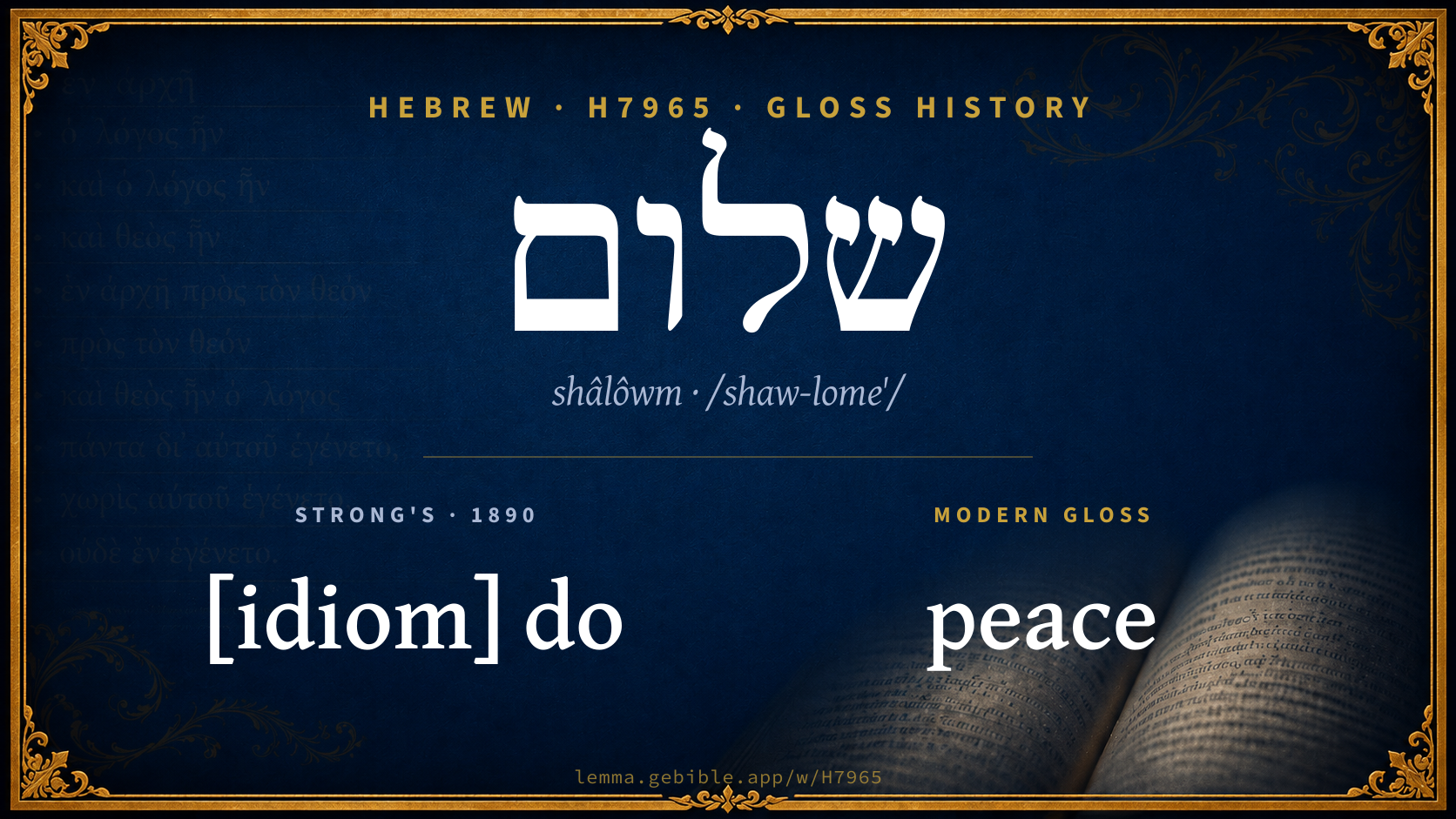
Gloss history
Strong's 1890 vs modern scholarship
About this word
Strong's H7965 catalogs a Hebrew word from the Hebrew Old Testament.
These counts are not copied from any lexicon or concordance. They are computed here, from the morphology-tagged Hebrew Old Testament. What Lemma adds →
- 208
- distinct verses
- The word appears in 208 distinct verses.
- 31 / 39
- OT books
- The word appears in 31 of 39 Old Testament books.
- #199
- by frequency
- Top 250 most frequent Hebrew words (rank 199 of 8,640 Hebrew words by occurrence).
View all 208 occurrences in the concordance →
By section of the Old Testament
By traditional corpus
Conventional, traditional groupings — biblical authorship is debated, so this is a traditional corpus grouping, not an authorship claim. Each share is this word’s portion of its verses in that division of the Hebrew canon. Each figure is a share of the word’s 208 distinct verses.
- Prophets (Nevi'im) 133 verses · 64%
- Writings (Ketuvim) 52 verses · 25%
- Torah (Pentateuch) 23 verses · 11%
How translations render this word
Counts come from each version’s own published word-to-Strong’s tagging or interlinear alignment — an approximate guide to how each version renders this word, not a word-level alignment the data otherwise carries. Because each total is that version’s own tagged count, the per-version totals vary from one another and need not match the appearance or distinct-verse counts above. These counts may also differ from a printed concordance because Lemma counts each distinctly tagged rendering and does not collapse phrase taggings into a single head-word total. This is a fixed set of word-tagged versions (KJV, ASV, BSB, ULT) and does not change with the reading translation you choose elsewhere. Each version’s license is shown beside its name below (and on Sources).
- King James Version: Peace 129×, Peaceably 7×, Is no peace 5×
- American Standard Version: Peace 111×, Is no peace 5×, Him 4×
- Berean Standard Bible: Peace 130×, Safely 9×, Prosperity 8×
- unfoldingWord Literal Text: Peace 181×, About peace 3×, About the welfare of 3×
King James Version Public Domain
Renders H7965 across 229 tagged occurrences — most commonly:
Plus other, less common renderings. Plus 45 renderings that appear only once — usually multi-word phrases or single function words the recovered tagging swept in, not distinct renderings. Not rendered by a distinct English word in 7 further occurrences.
American Standard Version Public Domain
Renders H7965 across 229 tagged occurrences — most commonly:
Plus other, less common renderings. Plus 64 renderings that appear only once — usually multi-word phrases or single function words the recovered tagging swept in, not distinct renderings.
Berean Standard Bible Public Domain
Renders H7965 across 222 tagged occurrences — most commonly:
Plus other, less common renderings. Plus 44 renderings that appear only once — usually multi-word phrases or single function words the recovered tagging swept in, not distinct renderings. Not rendered by a distinct English word in 12 further occurrences.
unfoldingWord Literal Text CC BY-SA 4.0
Renders H7965 across 237 tagged occurrences — most commonly:
Plus other, less common renderings. Plus 22 renderings that appear only once — usually multi-word phrases or single function words the recovered tagging swept in, not distinct renderings.
9 senses and sub-senses in the full BDB
What do BDB’s symbols mean?
BDB uses these scholarly abbreviations:
| Symbol | Meaning |
|---|---|
| 𝔊 | the Septuagint (the ancient Greek translation, LXX) |
| 𝔙 | the Vulgate (the Latin translation) |
| 𝔖 | the Syriac version (the Peshitta) |
| 𝔗 | the Targum (the Aramaic translation) |
| ψ | the Psalms |
| √ | root (the underlying root or stem) |
| ‖ | parallel passage (a synonymous or contrasted parallel) |
| † | the dagger: every passage where the word occurs is cited |
The 9 senses and sub-senses the full Brown-Driver-Briggs lexicon distinguishes for this word, in lexicon order (not ranked by frequency), with BDB’s own verbatim wording and sub-sense lettering. Shown in Hebrew script with BDB’s own scholarly abbreviations. The condensed entry is in the Lexicon Entry tab. See also the Forms in the corpus table below.
- 1. completeness in no., הָגְלָת שְׁלוֹמִים Je 13:19 Judah is wholly carried captive (but read גָּלוּת שְׁלֵמָה, cf. Am 1:6; so 𝔊 We Am SS Buhl). e.g. Jeremiah 13:19
- 2. safety, soundness, in body, אֵין שָׁלוֹם בַּעֲצָמַי ψ 38:4; לְשָׁלוֹם Is 38:17; שָׁלוֹם אָהֳלֶ֑ךָ (Ges§ 141 c) Jb 5:24 is safe, secure. e.g. Psalms 38:4
- 3. welfare, health, prosperity: †שָׁאַל לפ׳ לשׁ׳ ask one about welfare Gn 43:27 (J), Ex 18:7 (E), Ju 18:15 + 7 times, cf. 2 S 11:7(×3); pregn. ירד לשׁלום 2 K 10:13 descend (to ask) about welfare of, cf. 1 S 17:18 Je 38:4; הלך לשׁ׳ Ex 4:18 (E) + 5 times; עלה לשׁ׳ Gn 44:17 (J), 1 S 25:35; דבּר לשׁ׳ Gn 37:4 (JE); שָׁלוֹם ל׳ be well with Gn 29:6; 43:23, 28 (J), Ju 6:23; 19:20; 1 S 20:7, 21 + 10 times, 2 K 4:26(×3); שָׁלוֹם בְּ (יְהִי) ψ 122:7(8) be it well with; abs. as obj. of אָמַר well, be well, שׁ׳ Gn 29:6 (J), 2 S 18:28 2 K 9:11, 17, 18, 19, 22; Je 6:14(×2) + 10 times; הֲשָׁלוֹם אֲבִיכֶם Gn 43:27 (J) cp. 1 S 25:6; †שׁ׳ בּ(וֹ)אֶ֑ךָ 1 S 16:4 (v. Dr), 1 K 2:13; אֵין שׁ׳ Je 6:14 + 3 times; †אין שׁ׳ לרשׁעים Is 48:22; 57:21; but ראה שׁ׳ רשׁעים ψ 73:3; †רֹב שׁ׳ 37:11; 72:7; שׁאל שׁ׳ פ׳ 122:6; דרשׁ שׁ׳ (‖ טוב) Dt 23:7; Ezr 9:12; שׁ׳ יוֹסִיפוּ לָךְ Pr 3:2; בַּשּׁ׳ Jb 15:21 in time of prosperity. e.g. Genesis 43:27
- 4. peace, quiet, tranquillity, contentment, Is 32:17 (‖ הַשְׁקֵט וָבֶטַח); שָׁכַב בשׁ׳ ψ 4:9 (to sleep); depart life בְּשׁ׳ in tranquillity Gn 15:15 (Rje), 1 K 2:6 + 3 times, יָבוֹא Is 57:2; אַחֲרִית לְאִישׁ שׁ׳ ψ 37:37; בא בשׁ׳ Ex 18:23 (E) come in contentment; ארץ שׁ׳ Je 12:5; נְוֵה שׁ׳ (‖ מבטחים) Is 32:18, cf. Je 25:37; שׁ׳ מִפָּ֑חַד Jb 21:9, cf. Zc 8:10; ולשׁלומים לְמוֹקֵשׁ ψ 69:23 and let security become a trap (but 𝔊 Aq Sym Theod Jer וּלְמ׳ וּכְשִׁלּוּמִים, Du (cf. 𝔗) וּשְׁלָמִים peace-offerings, and שֻׁלְחָן va). e.g. Isaiah 32:17
- 5. peace, friendship:
- a. human relations: אֱנוֹשׁ שְׁלֹמִי Je 20:10 man of my friendship, cf. 38:22 Ob 7 ψ 41:10; עֲצַת שׁ׳ בין Zc 6:13; יֹעֲצֵי שׁ׳ Pr 12:20; (אֵת, עִם) דבּר שׁ׳ ψ 28:3; 35:20 Je 9:7; בקּשׁ שׁ׳ ψ 34:15; ידע שׁ׳ Is 59:8; דֶּרֶךְ שׁ׳ v 8; שׁלּח בשׁ׳ Gn 26:29 (J); הלך בשׁ׳ v 31 (J), 1 S 29:7 + 4 times; שׁוב בשׁ׳ 2 S 15:27; ‖ צדקה in Mess. reign ψ 72:3. e.g. Jeremiah 20:10
- b. peace with God, especially in covt. relation: Is 54:10 ברית covt. of my peace, cf. Nu 25:12 (P), Ez 34:25; 37:26, also Mal 2:5; י׳ שׁ׳ as name of altar Ju 6:24; י׳ subj. שָׂם שׁ׳ לְ Nu 6:26 (P); בֵּרַךְ בשׁ׳ ψ 29:11; חפץ שׁ׳ 35:27; עשׂה שׁ׳ לְ Je 33:9; אָסַף שׁ׳ מֵאֵת Je 16:5 (‖ חסד); דבּר שׁ׳ אֶל ψ 85:9; נתן שׁ׳ Hg 2:9; מחשׁבות שׁ׳ Je 29:11; man subj. עשׂה שׁ׳ ל׳ Is 27:5(×2); הלך בשׁ׳ Mal 2:6. In this sense ‖ צֶדֶק ψ 85:11, ‖ צְדָקָה Is 54:13; 60:17, ‖ שִׂמְחָה 55:12, is like a river 48:18; 66:12; שׁ׳ עַל־ישׂראל ψ 125:5; 128:6, שׁ׳ רָב לְאֹהֲבֵי תוֹרָתֶ֑ךָ 119:165; מוּסַר שׁ׳ Is 53:5 chastisement for our peace (but SS Buhl שִׁלֻּמֵינוּ). e.g. Isaiah 54:10
- 6. peace from war: (ל) עשׂה שׁ׳ make peace (with) Jos 9:15; Jb 25:2; נתן שׁ׳ בארץ Lv 26:6 (H); †שׁ׳ בין ובין Ju 4:17; 1 S 7:14; 1 K 5:26; †קרא (ל)שׁ׳ Dt 20:10; Ju 21:13; Mi 3:5; †שׁוב בשׁ׳ Jos 10:21; Ju 8:9; 11:31 (cf. v 13); בא בשׁ׳ 2 S 19:25, 31 + 7 times; †היה שׁ׳ לְ 1 K 5:4 + 3 times, cf. 2 S 17:3 (v. Dr); בקּשׁ שׁ׳ Ez 7:25; מלאכי שׁ׳ Is 33:7; נתן שׁ׳ וָשֶׁקֶט 1 Ch 22:9; מוֹצְאֵת שׁ׳ Ct 8:10; †שׁ׳(ו)אמת Is 39:8 = 2 K 20:19 + 3 times, cf. Zc 8:19; עֵת שׁ׳ Ec 3:8; בְּשׁ׳ 1 K 2:5 in time of peace; שַׂר שׁ׳ Is 9:5 (Mess. title), cf. זֶה שׁ׳ Mi 5:4. e.g. Joshua 9:15
- 7. as adj. שְׁלֹמָיו ψ 55:21 those at peace with him (read שֹֽׁלְמָיו Bae Buhl Du, or שְׁלֵמָיו SS; 𝔊 appar. שִׁלּוּמָיו). e.g. Psalms 55:21
Senses from the full Brown-Driver-Briggs lexicon (Brown, Driver, Briggs; Oxford 1906 — public domain), digitized via Sefaria, supplemented by the OpenScriptures HebrewLexicon (CC BY 4.0). Full attribution on Sources.
Word origin
n.m. Is 54:13 completeness, soundness, welfare, peace (LagBN 174);—שׁ׳ Gn 29:6 +; שָׁלֹם (rare) Ez 13:16 +; cstr. שְׁלוֹם Gn 37:14 +; sf. שְׁלוֹמִי ψ 41:10 +, etc.; pl. (all dub.) שְׁלוֹמִים Je 13:19 ψ 69:23; sf. שְׁלֹמָיו 55:21;—
— Brown-Driver-Briggs (Oxford 1906, public domain), digitized via Sefaria, supplemented by the OpenScriptures HebrewLexicon (CC BY 4.0). See Sources.
Derived from שלם (shâlam) (H7999) — to be at peace.
Jastrow Dictionary
A second Hebrew/Aramaic lexicon for comparison, covering Aramaic and post-biblical (Talmudic, Targumic, Midrashic) usage that the biblical-Hebrew BDB does not. Matched by lemma rather than by Strong’s number, so a lemma may carry more than one Jastrow headword (shown separately below), and the entries cover usage well beyond the Bible.
שָׁלוֹם I
- 1. peace, salvation; salutation. Lev. R. s. 9 גדול ש׳ … חותמין בש׳ peace is something great, for all benedictions, good tidings, and consolations … close with peace. Num. R. s. 21, beg. אין כלי … אלא ש׳ no vessel contains blessing but peace; Ukts. III, 12, a. e., v. חָזַק. Ber. 14ᵃ משיב ש׳ וכ׳ may return a salutation to any person. Ib. כל הנותן ש׳ וכ׳ he who offers salutation to his neighbor before prayer, is considered as if he made him a highplace (worshipping man before God). Shebi. IV, 3 ושואלין בשְׁלוֹמָן מפני דרכי ש׳ and you must salute them (gentiles in the field) &c., v. דֶּרֶךְ; Y. ib. 35ᵇ מהו שואלין בשלומן בשְׁלוֹם ישראל ש׳ עליכם how must we salute them? As we salute Israelites, ‘peace be upon you.’ Tam. I, 3 הגיעו … אמרו ש׳ הכל ש׳ when they (the two parties patrolling the Temple) met, they said, ‘peace?’ (answer) ‘all peace’ (everything is in good order); Lev. R. l. c. Sifra Vayikra, Par. 13, ch. XVI מי שהוא ש׳ וכ׳ he who is at peace offers peace-offerings, opp. אונן; v. שָׁלֵם. Ib. the peace-offerings are called sh’lamim, שהכל ש׳ בהן because everything in them is at peace (is turned to use; Yalk. Lev. 458 מְשׁוּלָּמִים). Ber. 39ᵇ (play on the name שלמן) ש׳ אתה וכ׳ thou art peace (perfection), and thy teaching is perfect (v. שָׁלֵם); a. v. fr.—חס וש׳, v. חַס.
- 2. (adv.) safely, unimpaired. T’bul Yom IV, 7, a. e. שתעלה ש׳ that it will be brought up safely, v. שֶׁבֶר I.—Pl. שְׁלוֹמוֹת. Num. R. s. 1316 עושה שני ש׳ וכ׳ produces two conditions of peace, peace above and peace below. Yalk. Is. 340 ארבעה רוב ש׳ וכ׳ (not שלומית) four times in the Scriptures ‘peace’ appears in connection with ‘abundance.’—Ch. v. שְׁלָמָא.
שָׁלוֹם II
- אִימָּא ש׳ Imma (Mother) Shalom, wife of R. Eliezer. Y. Shebi. VI, 36ᶜ top. Erub. 63ᵃ; a. fr.
שִׁלּוּם
- , v. שִׁילּוּם
שַׁלּוּם
- (b. h.) pr. n. m. Shallum,
- 1. husband of Huldah the prophetess. Meg. 14ᵇ (counted among the prophets). Yalk. Kings 233.
- 2. name of several Amoraim. Lev. R. s. 26 רב ש׳. Pesik. R. s. 3 יהודה הלוי ברבי ש׳; ib. s. 5; a. fr.
A Dictionary of the Targumim, the Talmud Babli and Yerushalmi, and the Midrashic Literature (Marcus Jastrow; London, Luzac, 1903) — Public Domain. Digitized via Sefaria. Digitized via Sefaria. Full attribution on Sources.
Forms in the corpus
The 86 distinct written forms H7965 takes in the Hebrew Bible, most frequent first — each parse links to that state’s occurrences in the concordance. Hebrew forms include their vowel points and cantillation, so a single lemma takes many written forms.
The 60 most common forms are shown; 26 rarer forms follow in the full concordance.
Same root — word family
Other BDB entries built from the same root as H7965, grouped by Strong’s listed origin. These share a root / origin per the lexicon — not necessarily a shared meaning. Each links to that word’s own entry.
Derives from
Shares the same root
- שלום shillûwm H7966 reward
- שלם shᵉlam H8000 to finish
- שלם shelem H8002 peace offering
- שלם shâlêm H8003 complete
- שלם shillêm H8005 recompense
- שלמן shalmôn H8021 reward
Derived from this word
Proper names from this root
People and places named from this root — a name, not an additional meaning of the word.
- משלם Mᵉshullâm H4918 Meshullam
- משלמות Mᵉshillêmôwth H4919 Meshillemoth
- משלמיה Mᵉshelemyâh H4920 Meshelemiah
- משלמית Mᵉshillêmîyth H4921 Meshillemith
- שולמית Shûwlammîyth H7759 Shulamite
- שלמה Shᵉlômôh H8010 Solomon
- שלמות Shᵉlômôwth H8013 Shelomoth
- שלמי Shᵉlômîy H8015 Shelomi
- שלמיאל Shᵉlumîyʼêl H8017 Shelumiel
- שלמית Shᵉlômîyth H8019 Shelomith
Compare all same-root words → Showing 4 of 19 — not the complete family. 10 of the same-root words are proper names (people or places). They share a root, not necessarily a meaning.
Septuagint verse parallels
This word appears in 191 verses that also exist in the Greek Old Testament (Septuagint), out of the 208 Hebrew verses it occurs in. You can read those verses in Greek by switching the Old Testament edition to the Septuagint.
Read these verses in the Septuagint
- Genesis 15:15
- Exodus 4:18
- Leviticus 26:6
- Numbers 6:26
- Deuteronomy 2:26
- Joshua 9:15
- Judges 4:17
- 1 Samuel 1:17
- 2 Samuel 3:21
- 1 Kings 2:5
- 2 Kings 4:23
- 1 Chronicles 12:17
This is a verse-level parallel only — the same verses exist in both the Hebrew and Greek Old Testaments. No word-level Hebrew↔Greek correspondence is claimed: the data carries no such alignment, so no Greek word is shown as this Hebrew word’s translation. Coverage is not total — the Septuagint omits the deuterocanon and renumbers the Psalms, so some Hebrew verses have no direct Greek parallel.