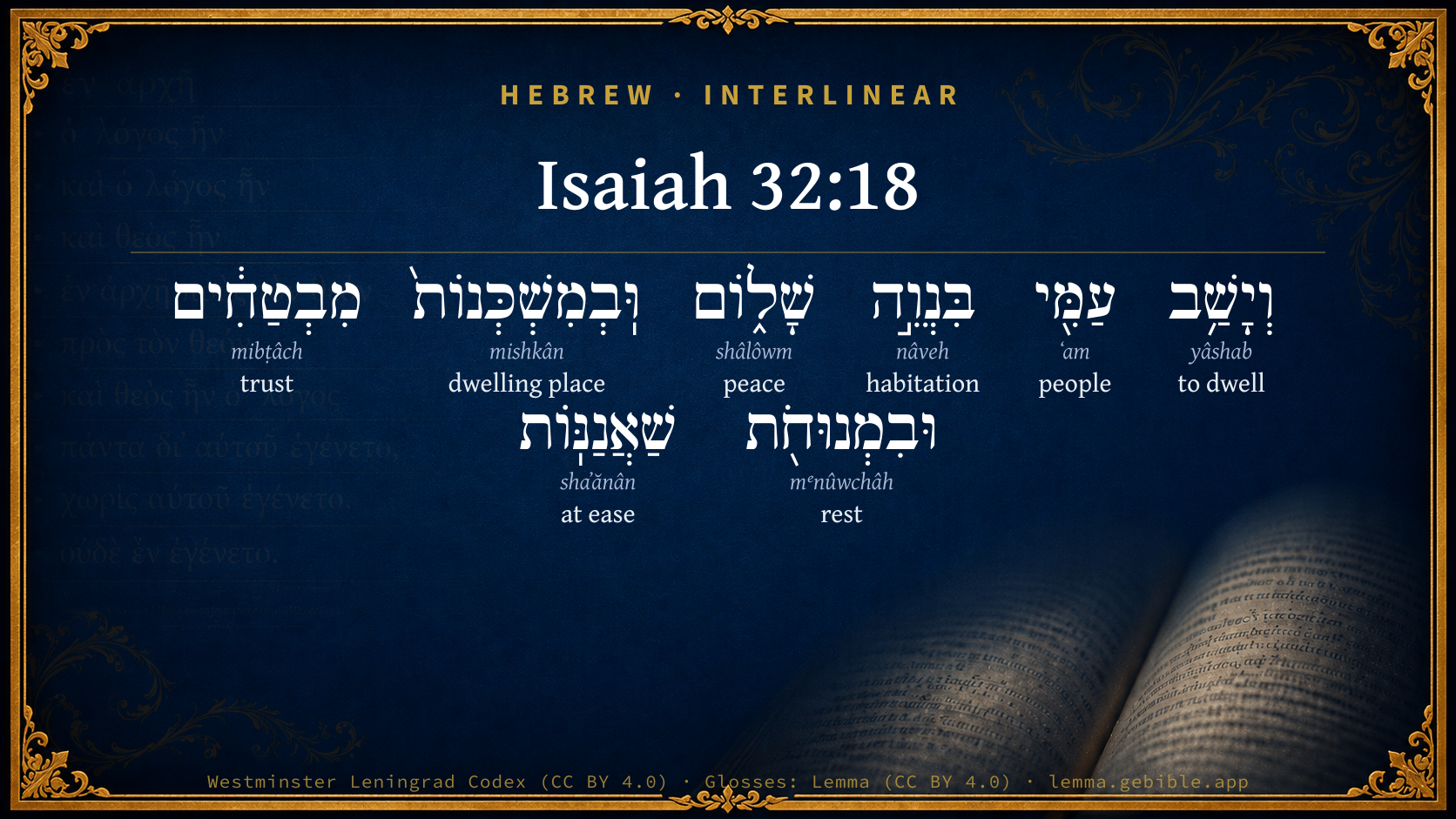
Isaiah 32:18

Hebrew (Westminster Leningrad Codex) Isaiah 32:18 appears in the Hebrew Old Testament. The text above is from the Westminster Leningrad Codex. Each word links to its Strong’s number, a concise gloss, and parsing drawn from the Open Scriptures Hebrew Bible morphology. Click any word for its full Brown-Driver-Briggs (BDB) entry.
Download image
Cite this verse

Isaiah 32:18 (World English Bible). Public Domain. Lemma interlinear Bible study tool, https://lemma.gebible.app/v/isaiah/32/18.

Show BibTeX & RIS
BibTeX
RIS
English Translation
My people shall abide in a peaceable habitation, and in safe dwellings, and in quiet resting-places.
World English Bible · Public Domain
Download a study sheet

One document with this verse’s original text, its word-by-word gloss line, the meaning frame, cross-references with their text, attributed commentary, and full source and license credits — printable, and it pastes into notes with its structure intact.

This verse Autodidact and up

Study sheet (.html) Plain text (.txt)

A passage Seminary Student

Up to 50 verses in one chapter. A passage sheet keeps up to 6 commentary sources and 12 cross-references per verse, in the order this page ranks them, and says so on the sheet whenever that leaves anything out. Ask for a single verse and you get the Autodidact verse sheet above.

Everything on this page stays free to read, with no account — the sheet is a download of what is already on screen, not access to it.

Want to remove ads? Support Godless Engineer
Compare translations 3

The same verse in 3 English versions, stacked beneath the original-language interlinear above. Click any original word for its lexicon entry.

Each is an independent rendering of the whole verse — the interlinear is not word-aligned to these translations.

Highlighted words mark where these versions differ — a whole-verse word diff, not a word-by-word alignment.

  • World English Bible Public Domain
    My people shall abide in a peaceable habitation, and in safe dwellings, and in quiet resting-places.
  • King James Version Public Domain
    And my people shall dwell in a peaceable habitation, and in sure dwellings, and in quiet resting places;
  • unfoldingWord Literal Text CC BY-SA 4.0
    And my people will dwell in a habitation of peace and in residences of security and in quiet resting places.

unfoldingWord Literal Text — © unfoldingWord, licensed CC BY-SA 4.0. Word-aligned USFM3 via Door43 (git.door43.org/unfoldingWord/en_ult).

Versions to compare (up to 4)

3 of 4 selected

Show all 18 translations

Every available English version of this verse, each an independent rendering of the whole verse.

  • World English Bible Public Domain
    My people shall abide in a peaceable habitation, and in safe dwellings, and in quiet resting-places.
  • Berean Standard Bible Public Domain
    Then my people will dwell in a peaceful place, in safe and secure places of rest.
  • Majority Standard Bible Public Domain
    Then my people will dwell in a peaceful place, in safe and secure places of rest.
  • King James Version Public Domain
    And my people shall dwell in a peaceable habitation, and in sure dwellings, and in quiet resting places;
  • American Standard Version (1901) Public Domain
    And my people shall abide in a peaceable habitation, and in safe dwellings, and in quiet resting-places.
  • Revised Version (1885) Public Domain
    And my people shall abide in a peaceable habitation, and in sure dwellings, and in quiet resting places.
  • Geneva Bible (1599) Public Domain
    And my people shall dwell in the tabernacle of peace, and in sure dwellings, and in safe resting places.
  • Douay-Rheims (1899) Public Domain
    And my people shall sit in the beauty of peace, and in the tabernacles of confidence, and in wealthy rest.
  • Young's Literal Translation Public Domain
    And dwelt hath My people in a peaceful habitation, And in stedfast tabernacles, And in quiet resting-places.
  • Literal Standard Version CC BY-SA 4.0
    And My people have dwelt in a peaceful habitation, || And in steadfast dwelling places, || And in quiet resting places.
  • Unlocked Literal Bible CC BY-SA 4.0
    My people will live in a peaceful habitation, in secure homes, and in quiet resting places.
  • unfoldingWord Literal Text CC BY-SA 4.0
    And my people will dwell in a habitation of peace and in residences of security and in quiet resting places.
  • Darby Bible Public Domain
    And my people shall dwell in a peaceable habitation, and in sure dwellings, and in quiet resting-places.
  • World Messianic Bible Public Domain
    My people will live in a peaceful habitation, in safe dwellings, and in quiet resting places,
  • Webster's Bible Public Domain
    And my people shall dwell in a peaceable habitation, and in sure dwellings, and in quiet resting-places;
  • Free Bible Version CC BY-SA 4.0
    My people will live in peace, safe and secure in their homes.
  • Bible in Basic English Public Domain
    And my people will be living in peace, in houses where there is no fear, and in quiet resting-places.
  • JPS Tanakh (1917) Public Domain
    And my people shall abide in a peaceable habitation, and in secure dwellings, and in quiet resting-places.

Literal Standard Version (2020), Covenant Press — licensed CC BY-SA 4.0. Text via the HelloAO Bible API (eBible.org). Unlocked Literal Bible (unfoldingWord) — licensed CC BY-SA 4.0. Text via the HelloAO Bible API (eBible.org). unfoldingWord Literal Text — © unfoldingWord, licensed CC BY-SA 4.0. Word-aligned USFM3 via Door43 (git.door43.org/unfoldingWord/en_ult). Free Bible Version, Dr. Jonathan Gallagher — licensed CC BY-SA 4.0. Text via the HelloAO Bible API (eBible.org).

Word by word

More ways to search: Search by grammar → Find every occurrence → Compare this word →

Practice this passage: Drill this verse → Learn its vocabulary →

שַׁאֲנַנּֽוֹת
shaʼănân
H7600
“at ease”
Adjective, Adjective, Feminine, Plural, Absolute
Part of Speech
Adjective
Type
Adjective
Gender
Feminine
Number
Plural
State
Absolute
Full BDB Definition

Origin: from H7599

TWOT: 2304a

at ease, quiet, secure (adjective) - at ease, secure - at ease, careless, wanton, arrogant - security, pride, arrogance (substantive) - one at ease - arrogance
  1. וְיָשַׁ֥ב yâshab H3427 “and · to dwell” Conjunction + Verb, Qal, Sequential Perfect, 3rd Person, Masculine, Singular
  2. עַמִּ֖י ʻam H5971 “people · my” Noun, Common, Masculine, Singular, Construct + Suffix, Personal, 1st Person, Common, Singular
  3. בִּנְוֵ֣ה nâveh H5116 “in/at · habitation of” Preposition + Noun, Common, Both, Singular, Construct
  4. שָׁל֑וֹם shâlôwm H7965 “peace” Noun, Common, Masculine, Singular, Absolute
  5. וּֽבְמִשְׁכְּנוֹת֙ mishkân H4908 “and · in/at · dwelling places of” Conjunction + Preposition + Noun, Common, Masculine, Plural, Construct
  6. מִבְטַחִ֔ים mibṭâch H4009 “trusts” Noun, Common, Masculine, Plural, Absolute
  7. וּבִמְנוּחֹ֖ת mᵉnûwchâh H4496 “and · in/at · resting places of” Conjunction + Preposition + Noun, Common, Both, Plural, Construct

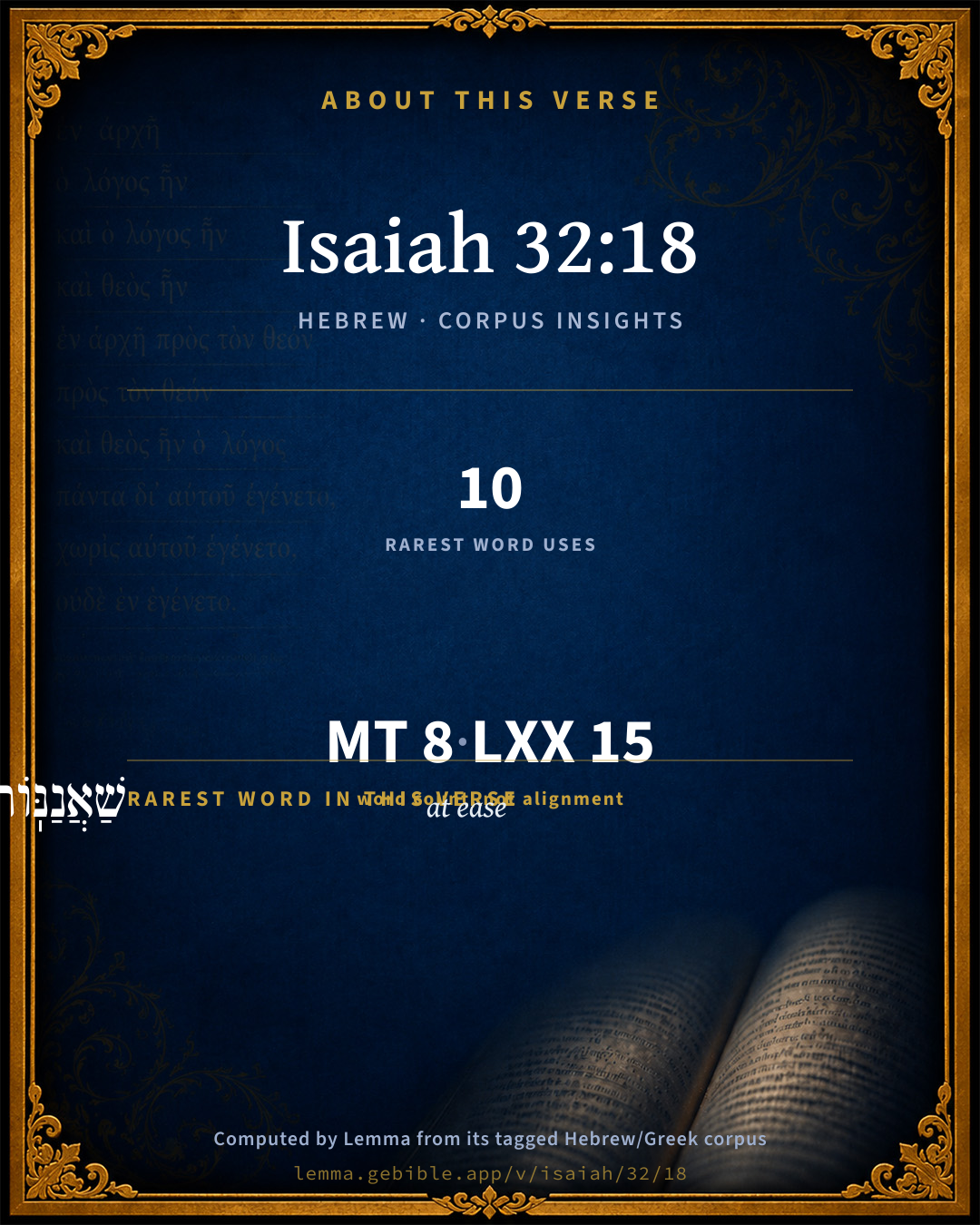
About this verse

These counts appear in no published source. They are computed here, from the morphology-tagged text and Lemma’s own curated glosses. What Lemma adds →

8
words
8
distinct lemmas
Prophets
section

Notable vocabulary

The rarest word here is שַׁאֲנַנּֽוֹת at ease H7600 — appearing just 10 times in the whole Hebrew Bible.

Shared distinctive vocabulary

שַׁאֲנַנּֽוֹת at ease H7600 occurs in 10 verses of the Hebrew Bible. Also found in:

Grammatical profile

  • 1 verb
  • 6 nouns
  • 1 adjective

Verb forms

  • וְיָשַׁ֥ב Qal · Sequential Perfect

Hebrew & Septuagint length

In English translation the verse runs 16 words from the Hebrew and 21 from the Septuagint (LXX English) — closely comparable.

A rough comparison of the two English renderings, which tokenize alike — not a word-level alignment.

Word counts can differ between the Hebrew and the Greek without any difference in meaning — e.g. the Hebrew direct-object marker אֵת has no separate Greek word, and Greek often adds the article ὁ.

In the original languages it is 8 Hebrew tokens and 15 Greek tokens — but the two are counted differently (Hebrew bundles its prefixes and suffixes into one token; the Greek is in lemma form), so that isn’t a like-for-like length.

Cross-references

11

Topical passages linked to Isaiah 32:18 in the Treasury of Scripture Knowledge — connected by theme and wording, ordered by reader-vote popularity; previews shown in the World English Bible.

  • Zechariah 2:5 For I,' says Yahweh, 'will be to her a wall of fire around it, and I will be the glory in the midst of her.
  • Hosea 2:18–23 In that day I will make a covenant for them with the animals of the field, And with the birds of the sky, And with the creeping things of the ground. I will break the bow, the sword, and the battle out of the land, And will make them lie down safely.
  • Jeremiah 33:16 In those days shall Judah be saved, and Jerusalem shall dwell safely; and this is [the name] by which she shall be called: Yahweh our righteousness.
  • Ezekiel 34:25–26 I will make with them a covenant of peace, and will cause evil animals to cease out of the land; and they shall dwell securely in the wilderness, and sleep in the woods.
  • Isaiah 33:20–22 Look on Zion, the city of our solemnities: your eyes shall see Jerusalem a quiet habitation, a tent that shall not be removed, the stakes of it shall never be plucked up, neither shall any of the cords of it be broken.
  • Isaiah 35:9–10 No lion shall be there, nor shall any ravenous animal go up thereon; they shall not be found there; but the redeemed shall walk [there]:
  • Isaiah 60:17–18 For brass I will bring gold, and for iron I will bring silver, and for wood brass, and for stones iron. I will also make your officers peace, and righteousness your ruler.
  • Jeremiah 23:5–6 Behold, the days come, says Yahweh, that I will raise to David a righteous Branch, and he shall reign as king and deal wisely, and shall execute justice and righteousness in the land.
  • Hebrews 4:9 There remains therefore a Sabbath rest for the people of God.
  • 1 John 4:16 We know and have believed the love which God has for us. God is love, and he who remains in love remains in God, and God remains in him.
  • Zechariah 2:8 For thus says Yahweh of hosts: 'For honor he has sent me to the nations which plundered you; for he who touches you touches the apple of his eye.

Cross-references courtesy of OpenBible.info (CC BY 4.0).

Hebrew and Greek witnesses Masoretic Hebrew ↔ Greek Septuagint

The same verse in the two great witnesses to the Old Testament, shown verse-for-verse.

These are two independent witnesses, not word-aligned to each other, and the Septuagint is shown in lemma (dictionary) form.

Hebrew Isaiah 32:18 Masoretic · Westminster Leningrad Codex

וְיָשַׁ֥ב עַמִּ֖י בִּנְוֵ֣ה שָׁל֑וֹם וּֽבְמִשְׁכְּנוֹת֙ מִבְטַחִ֔ים וּבִמְנוּחֹ֖ת שַׁאֲנַנּֽוֹת

My people shall abide in a peaceable habitation, and in safe dwellings, and in quiet resting-places.

World English Bible · Public Domain

Greek LXX Isaiah 32:18 Septuagint · lemma form

καί καταοἰκέω ὁ λαός αὐτός ἐν πόλις εἰρήνη καί ἐνοἰκέω πείθω καί ἀναπαύω μετά πλοῦτος

And his people shall inhabit a city of peace, and dwell in it in confidence, and they shall rest with wealth.

LXX2012 (modern English Septuagint) · Public Domain

Hebrew: Westminster Leningrad Codex (CC BY 4.0). Greek: Septuagint (public domain); English from LXX2012 (modern English Septuagint) (Public Domain). How the Septuagint differs from the Hebrew →

Targum (Aramaic paraphrase)

1

The Targum is the ancient Jewish Aramaic paraphrase of the Hebrew Scriptures — an interpretive translation, not the Hebrew text itself. Onkelos (literal) and Pseudo-Jonathan (expansive) render the Torah, and Jonathan the Prophets. Coverage is partial: where no permissively-licensed English translation exists for a verse, only the Aramaic is shown. This is verse-level text, not a word-by-word alignment to the Hebrew.

  1. Targum Jonathan Prophets (Joshua–Malachi)
    וְיֵתְבוּן עַמִי בִּמְדוֹרֵיהוֹן שְׁלָם וְעַל אַרְעֲהוֹן לְרוֹחֲצָן וּבְקִירְוֵיהוֹן שְׁלֵיוָן:

    And my people shall dwell in their habitations in peace, and in their land in safety, and in their cities at ease.

    Targum Jonathan — Aramaic: “Mikraot Gedolot” (public domain). English: “Sefaria Community Translation” (CC0 1.0 (public-domain dedication)); “London "Chaldee Paraphrase," 1871” (public domain). Text via Sefaria.

Commentary

Notes on Isaiah 32:18 from classic Christian and Jewish commentators (each source and its license shown beneath its notes). The classic Christian expositions comment on the surrounding passage and are grouped to its opening verse, so a note may address several verses; the Jewish commentaries on the Tanakh (Rashi and others) are per-verse, so they appear only where the commentator wrote on this verse.

Lemma curates 59 commentaries, every one of them public domain or Creative Commons licensed, each selected and text-cleaned for this edition rather than reprinted as found. About our sources →

Trapp's Complete Commentary

John Trapp

Isa 32:18 And my people shall dwell in a peaceable habitation, and in sure dwellings, and in quiet resting places;

Ver. 18. And my people shall dwell in a peaceable habitation.] Great peace have all those that love God’s law, and nothing shall offend them. {Psa 119:165} Peace shall be within their walls, and prosperity within their palaces. From this and the next verse one well gathereth that, when the heart lieth lowest, it lieth quietest; in loco humili humills erit civitas, sc., Dei.

John Trapp, A Commentary or Exposition upon All the Books of the Old and New Testament (1647–1656) — public domain. Text from a community e-Sword module.

The Biblical Illustrator

Joseph S. Exell

Isa_32:18-19

My people shall dwell in a peaceable habitation

The safety of believers in time of judgment

I.

CONTEMPLATE THE COMING JUDGMENTS OF THE LORD.

II. CONSIDER THE BLESSED PROMISES MADE TO HIS SEEKING PEOPLE.

III. THE PERIOD WHEN THESE PROMISES SHALL HAVE THEIR FULFILMENT. Read the first verse of this chapter, and what is there stated is enough to answer all inquiries upon this head. Behold, a king, &c. I expect this when the King of righteousness, the Lord Jesus Christ, reigns. The personal improvement of this subject consists--

1. In directing you to the safety of believers.

2. In considering the conduct becoming those who have so high a destiny. Watch and pray. Pray for yourselves, pray for your country. Be valiant for the truth, continue in persevering faith. (J. Wilcox, M. A.)

The peaceable habitation

I. I believe I shall not be doing justice to the prospective design of all Old Testament truth, if I do not represent to you all peace--all true moral peace--as founded in and on, not only THE ATONEMENT MADE BY THE LORD JESUS CHRIST, but on the nature of that atonement. The peaceable habitation, in which only we have a sure dwelling, and a quiet resting-place, is made of the wood of the Cross.

II. Having said this, I must say, that no doubt the peaceable habitation is found in MORAL DISPOSITIONS CREATED WITHIN BY DIVINE GRACE. There is, first, the chamber of holiness. Oh, the sweet tranquillity of a holy life! This is the deep centre of peace. There is a hallowed chamber in the same palace of holy dispositions--a quiet habitation--resignation to the Divine will. From these chambers we climb the stairs and rise higher. Trust in Gods providence-this is the observatory; and like all observatories, it is high and clear. Other observatories boast that from them you may see the stars in the day-time; but from this, you may see the sun in the night-time! A quiet habitation indeed! Scripture speaks of a peace which passeth all understanding. The grave is a hallowed cavern, a blessed hiding-place. (Paxton Hood.)

A quiet life

George Herbert, thinking of his former ambitions in the court of James I., in contrast with his quiet life of prayer and song, could write: I now look back upon my aspiring thoughts and think myself more happy than if I had attained what I then so ambitiously thirsted for.

Quiet resting-places

The Christian in temporary retirement from business

To speak of cessation from business, to urge retirement, will sound very strange and, perhaps, very ridiculous to some. What, they exclaim, sacrifice opportunities of getting money? To get what we can, and keep what we get, is our motto. But, has it ever occurred to you that you may so pursue business as to destroy the power of doing it? Besides, if thou be getting the chief good, is getting all? Is there to be no enjoyment of it? And no use of it? But, the gain on which thou hast set thine heart, and which thou thinkest it a great mistake and weakness to forego in any measure, will not last long. Does it accord with reason to let thy nature be neglected for the sake of temporary possessions?

I. LET US CONSIDER THOSE RETIREMENTS WHICH ARE INCUMBENT ON THE CHRISTIAN IN THE MIDST OF SECULAR LIFE.

1. I shall omit the compulsory, and confine myself to the voluntary; and shall treat of these in relation rather to their ends than to their seasons.

(1) The first end is health. This I put on the ground of duty. If a man kill himself, or if he deprive himself of some bodily organ, we pronounce him a grave offender. Why? Because he has no right to do it. He is not his own proprietor. A man may kill himself by excessive toil and care, just as well as by poison or the knife. And if he who maims his body is a sinner, is not he who destroys the vigour and elasticity of his powers, physical or mental? There is no law more clear and indubitable than that rest is necessary to health. And if this ordinance be violated, it will tell somewhere.

(2) Enjoyment is another end. We were made for happiness, for various kinds of pleasurable sensations and emotion. Benevolence must contemplate that end. Now, he who gives himself to unremitting toil cannot enjoy the gifts of providence, as it is meant he should. He may have much pleasure in the very exercise of his faculties; but there is a pleasure in the calm contemplation of the Divine bounty, in the unbending and relaxation of the soul, and in the gratification of its varied tastes by the means afforded by success, which is impossible to him. He feasts at Gods table, but it is a hurried and an unquiet meal; he rests on Gods pillow, but it is a dreamy and disturbed slumber. He lives wholly without, and not within. He is like one who labours only in the sun, and never seeks the calm cool shade. The bow is kept bent till its spring is lost. He obtains a portion, but does not rejoice in it. He holds property, but does not possess it. He builds a house, but does not inhabit it. He has gorgeous apparel, but does not wear it. His connection with his lot is that of title and outward law, not of fresh and joyous interest.

(3) The general cultivation of faculty is an end. Business requires and sharpens some faculties; and, in connection with other things, it may exercise a sanitary and invigorating influence upon many faculties. But when it is pursued, as it must be by him who does nothing else, it has but a limited influence for good, and a powerful influence for evil. It is well known, that the powers necessary to the greatest secular success are none of the highest, and that they may have but a small range. His only reading may be the city article; his only meditation, the state of the market; his only estimate, profit; his only aspiration, gain. He may have, in high perfection, the activity, the cunning, the quickness, the perseverance, which belong to many portions of the animal world, and be almost entirely destitute of the distinguishing endowments of a rational and moral being. Now, retirement from business should be sought in order that the mind be furnished and expanded with knowledge; that it be refined and elevated by literature; that noble affections be nourished by the study and contemplation of noble natures; that social sympathies be developed by intercourse; and that principles more lofty and disinterested than those which rule the world of commerce may be fed and fostered by thought and service.

(4) Religion is an end of retirement. Devotional engagements have the same relation to active life that food has to exercise. The world is the place in which to exercise and apply spiritual principles, rather than the place in which to get or increase them. If exercise does strengthen, it cannot do so without truth and grace, to be obtained elsewhere. It is by the study of the book of life, by deep meditation on spiritual things, by intercourse with Christ, by earnest prayer, by severe self-examination, that we must minister to the principles and habits of holiness, that we must exercise ourselves unto godliness.

(5) Benevolent activity is an end of retirement. We may not stop at personal religion. Can it be doubted that the salvation of men would be largely promoted, if those Christians who give themselves wholly to secular life were to devote a portion of their time to good works, to intercourse with the sinful, to earnest endeavours to teach and warn them? Need I specify the family? By incessant work how is that defrauded! Need I mention the school; the neighbourhood; the Church, whose wants and spheres are neglected by the over-busy saint?

2. I must say a few words on the relations of retirement from business to business.

(1) In retiring from business, do not take business with you.

(2) Do not bring the spirit of business into your retirements.

(3) Look at business from those points of view which are accessible only in retirement. We cannot properly estimate our pursuits, when actively engaged in them. It is often necessary to withdraw from an object in order to get a proper view of it; and we must come out of the world to see it clearly and fully.

(4) Use your retirement, at least in part, with a view to your return to it. I do not mean that you should make your retirement a mere means of more effectually prosecuting worldly pursuits. I mean that you should seek for a counteracting influence to business. It may be that you have failed in the exercise of some moral virtue, that you have wronged some brother, that some particular sensibility is in danger of being injured, that some care is becoming engrossing and benumbing; then, let your retirement be, in part, directed to this matter.

II. I did intend to speak on another point, THAT RETIREMENT FROM BUSINESS WHICH CONSISTS IN A FINAL ABANDONMENT OF IT, IN A COMPLETE RESIGNATION OF ITS CONCERNS; not that which takes place at death, but that which takes place, though a voluntary act, in consequence of the obtainment of competency, on the growth of infirmities, or the influence of other circumstances.

1. This retirement may be a duty. It may be a duty in order that you may give place to others. It is a selfish thing for a man to go on getting as much as he can, simply because he can. But the duty becomes still plainer when considered in relation to a mans own well-being. If God has prospered secular diligence so that there is enough and to spare, it is a loud call to modes of activity and service that are impossible, to any great extent, in the heat and absorption of worldly pursuits.

2. When a Christian has retired from business, he should form some settled plan of life. (A. J. Morris.)

Nothing to do!

I know that many find retirement a burden and a snare, and that many have returned to business after having left it, because they were oppressed by having nothing to do. But what a condemnation is this of their past life; what a rebuke of their treatment of the immortal mind! Nothing to do; and yet living in a world of mysteries! Nothing to do; and yet surrounded with the images and works of God! Nothing to do; and yet belonging to a race which has seen six thousand years, and to a system of redemption which has been a Divine gift and power for nearly two! Nothing to do; and yet the works of countless mighty dead extant, and full of glorious things and thoughts! Nothing to do; and yet possessing a nature which is the reflection of Deity, and the heir of immortality! Nothing to do; and yet the world in its sin and suffering calling for the utmost tenderness of human compassion, and the utmost activity of human energy. He who pleads that he has nothing to do after business is abandoned, what has he been doing in the long years devoted to its pursuits? (A. J. Morris.)

Quiet resting places

It is impossible to doubt that the prophet, now and again, in describing those nearer scenes obtains and reveals glimpses of a higher glory, and refreshes his readers and himself with anticipations of Messiahs times. The closing verses of the chapter are full of the Gospel, penetrated with the very spirit of evangelical peace. My people seems to make the promise general, and to hold it out to us sealed with the yea and amen which is attached to every promise of God. Shall dwell seems to import some settled order of Divine procedure. If Solomon said in his day, all things are full of labour, what would he say in ours? How fierce and keen are the conflicts of life! Where shall rest be found? Only in some of those quiet resting-places which God makes and keeps for His pilgrim people. They have soul-quietness for city strife.

I. THE EVENING. A sacred time even in Eden was the cool of the day. Isaac went out into the field to meditate at eventide. Jesus often left His disciples about sundown, and wandered up among the Syrian hills to find some sequestered spot where He might feel himself alone in the full presence of God. The breeze that fanned the leaves of Paradise will touch our cheek, and make coolness at the close of our day, if we will but cease from care and sin. We read in the Scriptures that day and night are the ordinances of God. Can anyone suppose that He has established them for only material ends? Surely a higher end is found in the trial, nurture, and purification of souls. To a devout soul the evening is like the secret place of the Most High. It is the shadow of the Almighty. It is a closet of which God builds the walls and shuts to the door. Think, then, as the evening comes round--for thought is the souls rest--of the day that is gone with gratitude, for every hour of it has been overflowing with the goodness of God; with penitence, for you will easily discover that it has been a day of shortcomings and sins; with wisdom, aiming to understand it better than when you lived it; with tenderness and holy fear, as feeling how good and how grand a thing it is to be permitted to live on, and to hope to live better. Think of to-morrow which will come so soon, with its unknown and yet probable events--of the task that will await you then; of the persons who will be around you, of their words, their looks, their influence; of the peril you will have to brave; of the weakness you will feel; of the strength you will need; of the failure you fear, that by your thought and prayer it may be the less likely to come; and of the goodness which will certainly enrich and crown to-morrow as it has filled and now closes to-day. Think of the evening of life itself. Think any such thoughts with prayer and faith, and your soul must be lifted at least somewhat above the dust and drudgery of this vexing and down-dragging world.

II. THE SABBATH. In the beginning God rested from His work, and blessed and hallowed the day for all time, and never has there been a Sabbath on earth in which men have not been entering into the very rest of God.

III. THE PROVIDENTIAL CHANGE may be of such a character as to lead us at once into a quiet resting-place. It may be a change of locality, or of occupation, or of condition. Any considerable providential change has something of the same character. An infant is born, and in his first sleep sheds through the house something of the solemnity of being. A child is recovered of his sickness, in which the little pilgrim seemed to be wandering away from all your care and love. A son has gone out to a foreign land. A daughter has been married. Anything that breaks the continuity, that alters the relationships, that makes a pause in life--an open space in the forest of its toils and cares--anything of that kind is Gods voice, saying, Here is relief for you. Enter this quiet resting-place which My hand has made. Or, let the change, be from health to sickness, then the quiet resting-place is made in the retirement of the chamber, or the stillness of the bed.

IV. THE GRAVE. There the prisoners rest together; they hear not the voice of the oppressor. The small and great are there, and the servant is free from his master. There the wicked cease from troubling, and there the weary be at rest. It is not our mere human fancy that invests the burial-place of the Christian dead with such a sacred charm, that wraps it as in the peace and silence of God. It is Christ who thus hallows the grave. He has been a sleeper there; He has taken the harshness, the disquietude, the terror away.

V. HEAVEN is the quietest resting-place of all. (A. Raleigh, D. D.)

Gods thoughtful loving-kindness

In eastern countries, where the habit of hospitality is stronger than with us, the traveller is sometimes surprised and regaled by much-needed but unexpected wayside comforts. Yonder husbandman who is now a-field at his work was here in the early morning to leave by the wayside that pitcher of water that the passing traveller might drink. This clump of trees which makes a thick and welcome shadow from the heat, was planted by one who expected neither fame nor money for his toil, and who now lies in a nameless grave. Hands now mouldering in dust scooped out this cool seat in the rock. Some Father Jacob gave us this well after drinking thereof himself, and his children, and his cattle. Travellers from the west are much affected by such instances of pure humanity and unselfish kindness. And yet these are but feeble types, mere dim shadows of Divine thoughtfulness and care. The heavenly benefactor comes down in preventing loving-kindness upon the earthly pathway of His people. (A. Raleigh, D. D.)

True rest in persons; specially in God

We need one great complemental truth--we do not find our true rest in places at all, but only in persons. The living soul must have a living portion. What were the fairest prospect if a man were condemned to behold it for ever alone? What even the higher things of this human life, the duties, and the interests, and the struggles, if there were not intermingled with them all a sense of the nearness of other human beings, and if there were not the continual reciprocal action of these affections and sympathies which make life so sacred and dear? But no human being, no assemblage of human beings, can meet the wants and fulfil the longings of even one human soul. Your heart is waiting, and aching while it waits, for an infinite sympathy, for an everlasting strength, for a grace that will cancel sin and restore purity, in one word, for the love of God; for the love of God in Christ. (A. Raleigh, D. D.)

The Biblical Illustrator, edited by Joseph S. Exell (c. 1880s–1900s) — public domain. Text from a community e-Sword module.

The Preacher's Complete Homiletical Commentary

Joseph S. Exell (gen. ed.)

THE PEACEFUL HABITATION

Isa_32:18. And my people shall dwell in a peaceable habitation [1210]

[1210] See CHARACTERISTICS OF THE CHURCH OF CHRIST, Isa_33:20.

No doubt “the peaceable habitation” is found in moral dispositions created within by Divine grace. Here is, 1st. The Chamber of Holiness. Oh, the sweet tranquillity of a holy life!

2. Here is the hallowed Chamber of Resignation to the Divine will. If the soul is, by Divine grace, able to be still in the midst of temptation, it will also be still in the midst of personal trial.

3. Here is Trust in God’s providence. This is the observatory, and like all observatories, it is high and clear. Other observatories boast that from them you may see the stars in the day-time; but from this, you may see the sun in the night-time.—E. Paxton Hood: Dark Sayings on a Harp, pp. 361–368.

The Preacher's Complete Homiletical Commentary (gen. ed. Joseph S. Exell; Funk & Wagnalls, c. 1892) — public domain (pre-1929). A full-Bible homiletical/sermon-outline anthology covering 65 of 66 books (2 John is absent from the source module). Text from a community e-Sword module.

Tyndale Open Study Notes

Tyndale Open Resources

32:18 Living in safety and feeling at rest were blessings of Israel’s covenant with the Lord (see Lev 26:5-6), but the people’s sin had previously brought curses rather than blessings (cp. Isa 32:9-11).

Tyndale Open Study Notes — © Tyndale Open Resources, licensed CC BY-SA 4.0. Text via the HelloAO Bible API.

Jamieson, Fausset & Brown

Robert Jamieson, A. R. Fausset & David Brown

sure . . . quiet--free from fear of invasion.

Jamieson, Fausset & Brown — Commentary Critical and Explanatory on the Whole Bible (1871) — public domain (CC PDM 1.0). Text via the HelloAO Bible API.

John Gill's Exposition

And my people shall dwell in a peaceable habitation,.... Jews and Gentiles, and all the saints, shall dwell in peace and love one with another, and shall be free from all the outrages and persecutions of the enemy; which, when these happy times of the pouring forth of the Spirit and of the spiritual reign of Christ come, will be no more:

and in sure dwellings; where they may dwell safely and confidently, secure from all enemies, in no fear of them, and free from all hurt and danger by them:

and in quiet resting places; where they may sleep and rest quietly, and none to disturb them, and make them afraid: and though all this may be understood of their private houses and habitations, yet may well enough be applied to the several Christian communities and churches to which they belong; where they shall enjoy much spiritual prosperity and safety, great peace and quietness, comfort and rest, under the ministry of the word, and administration of ordinances.

John Gill's Exposition of the Whole Bible (1746–1763) — public domain (CC PDM 1.0). Text via the HelloAO Bible API.

Albert Barnes' Notes on the Bible

And my people shall dwell in a peaceable habitation - In cities and towns that would not be alarmed bv internal or external foes.

And in sure dwellings - In dwellings that would be secure from invasion. - All this is descriptive of the peaceful times, and the general security which followed the return from Babylon. To this period of happiness and prosperity, Isaiah, as well as the other prophets, often refers.

Albert Barnes' Notes on the Bible (1834–1885) — public domain. Text from a community e-Sword/MySword module.

Matthew Poole's English Annotations

My people; either the Gentiles, who then shall be my people; or the Jews, to whom this promise shall be made good upon their conversion to Christ in the latter times of the gospel.

Matthew Poole's English Annotations on the Holy Bible (1683–1685) — public domain. Text from a community e-Sword/MySword module.

Whedon's Commentary on the Bible

Daniel D. Whedon

18. A peaceable habitation — At such a time the moral influences shall be so great that God’s people shall tranquilly pass their lives in peaceful homes, sure dwellings, and in quiet resting places; that is, faith gives sweet rest in God and blessed association with him.

Daniel D. Whedon (gen. ed.), Commentary on the Old and New Testaments (1874–1909) — public domain. Text from a community e-Sword module.

J. A. Alexander on Isaiah

Joseph Addison Alexander

“And my people shall abide in a home of peace, in sure dwellings, and in quiet resting-places.” There is something tranquilizing in the very sound of this delightful promise, which as usual is limited to God’s own people, implying either that all should have become such, or that those who had not should be still perturbed and restless.

Joseph Addison Alexander, The Prophecies of Isaiah (1846–1847; New York: Scribner, 1870–1878) — public domain. Text from a community e-Sword module.

Ibn Ezra

Rabbi Abraham ibn Ezra

My people. Judah.

Ibn Ezra on the Tanakh — English translations: “Sefaria Community Translation” (CC0 1.0 (public-domain dedication)); “Yalkut, Sifsei Chachomim Chumash, Metsudah Publications, 2009” (CC BY 4.0); and “Commentary of Ibn Ezra on Isaiah - trans. by M. Friedlander, 1873” (public domain). Text via Sefaria.

Lesson kit

Teaching starters — assembled from the data on this page, not authored interpretation. Every prompt links to the verse data it draws on. Edit before teaching.

Isaiah, in the Prophets, opens this verse with 8 words (8 distinct Hebrew lemmas). Its most distinctive word is shaʼănân (“at ease”). A historical commentator’s framing appears above. Read the whole chapter for the surrounding context.

Discussion questions

  1. What does “at ease” (shaʼănân) contribute to the verse as a whole?
  2. How does 2 Kings 19:28, which shares the word «at ease», read alongside this verse?
  3. These translations render this verse differently. What is at stake in choosing one wording over another?
  4. «וְיָשַׁ֥ב» is a Qal Sequential Perfect verb. How does that grammatical form shape the action described?
  5. Compare how Trapp's Complete Commentary and The Biblical Illustrator read this verse. Where do they agree or differ?

Things to notice

Reading settings

Reading text

Shown beneath each verse's original-language words.

Old Testament
Old Testament edition

Read the OT as the Masoretic Hebrew (MT) or the Greek Septuagint (LXX).

English shown for the Greek Septuagint (in the Hebrew ↔ Greek comparison).

Comparing translations? Open the Compare panel on any verse page to stack up to four side by side.