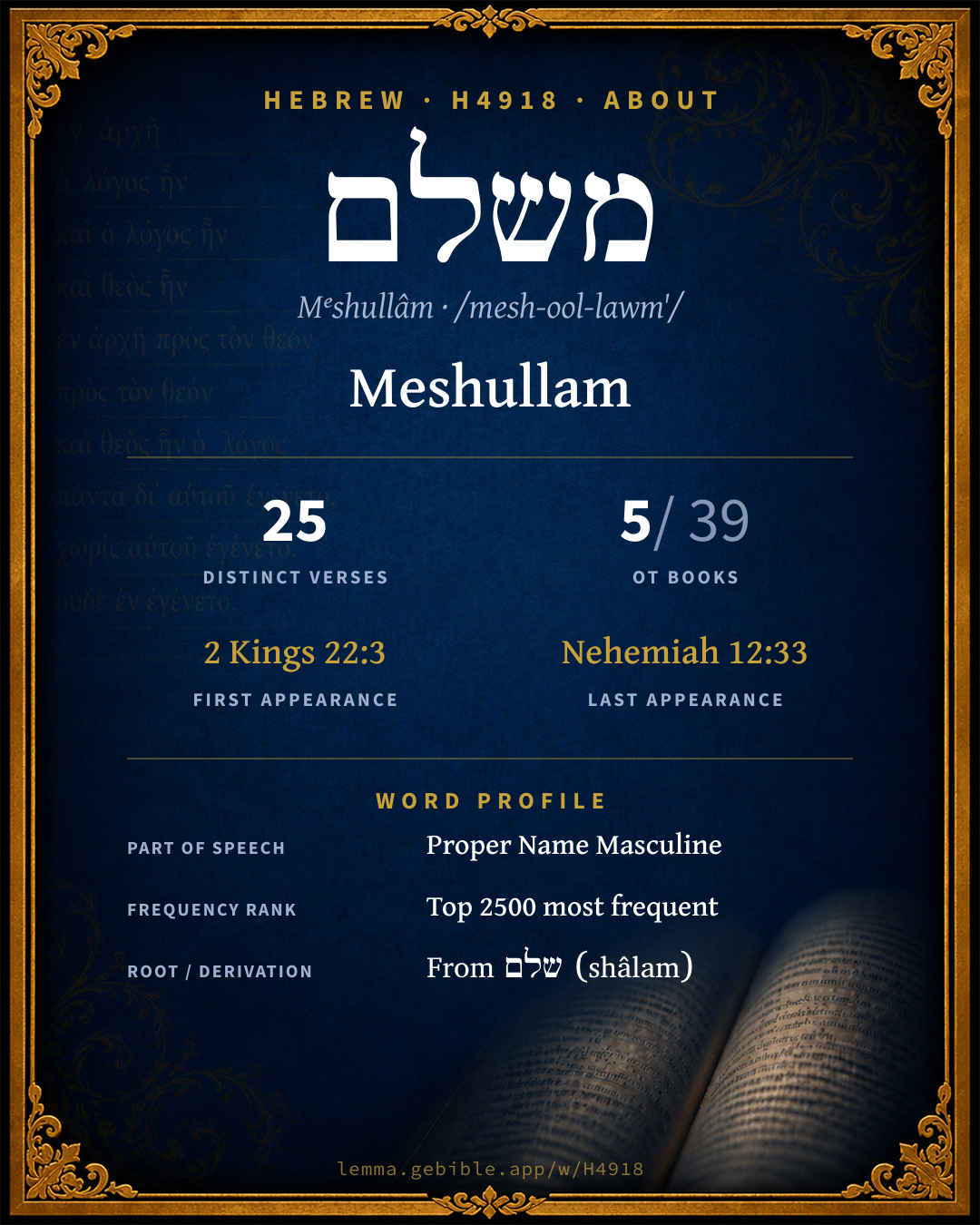
מְשֻׁלָּם
Meshullam
BDB lists 10 entries for ‘Meshullam’ fuller range ↓
Full lexicon entry — Brown-Driver-Briggs (BDB)
From Brown-Driver-Briggs (BDB)
Where this word appears
Grammar key — what these labels mean
Part of speech
- Noun
- A naming word — a person, place, thing, or idea.
Noun type
- Proper
- A name of a specific person, place, or people (e.g. Abraham, Zion, Israel).
Every verse where H4918 appears — 25 distinct verses across 5 books. Click any verse to open its interlinear word-by-word view. Verse text shown in the World English Bible for context — . Each verse’s Hebrew form is shown with its reference; the English is not keyword-highlighted, since the data carries no word-level English alignment. Use “Compare translations” on any verse to read it across multiple English versions. This concordance covers the Hebrew Bible; Septuagint (Greek Old Testament) occurrences are not indexed here.
2 Kings 1 verse
1 Chronicles 7 verses
- 1 Chronicles 3:19 מְשֻׁלָּ֣ם n Proper The sons of Pedaiah: Zerubbabel, and Shimei. The sons of Zerubbabel: Meshullam, and Hananiah; and Shelomith was their sister;
- 1 Chronicles 5:13 וּ/מְשֻׁלָּ֡ם conj + n Proper Their brothers of their fathers' houses: Michael, and Meshullam, and Sheba, and Jorai, and Jacan, and Zia, and Eber, seven.
- 1 Chronicles 8:17 וּ/מְשֻׁלָּ֖ם conj + n Proper and Zebadiah, and Meshullam, and Hizki, and Heber,
- 1 Chronicles 9:7 מְשֻׁלָּ֔ם n Proper Of the sons of Benjamin: Sallu the son of Meshullam, the son of Hodaviah, the son of Hassenuah,
- 1 Chronicles 9:8 וּ/מְשֻׁלָּם֙ conj + n Proper and Ibneiah the son of Jeroham, and Elah the son of Uzzi, the son of Michri, and Meshullam the son of Shephatiah, the son of Reuel, the son of Ibnijah;
- 1 Chronicles 9:11 מְשֻׁלָּ֣ם n Proper and Azariah the son of Hilkiah, the son of Meshullam, the son of Zadok, the son of Meraioth, the son of Ahitub, the ruler of the house of God;
- 1 Chronicles 9:12 מְשֻׁלָּ֥ם n Proper and Adaiah the son of Jeroham, the son of Pashhur, the son of Malchijah, and Maasai the son of Adiel, the son of Jahzerah, the son of Meshullam, the son of Meshillemith, the son of Immer;
2 Chronicles 1 verse
Ezra 3 verses
- Ezra 8:16 וְ/לִ/מְשֻׁלָּ֖ם conj + prep + n Proper Then sent I for Eliezer, for Ariel, for Shemaiah, and for Elnathan, and for Jarib, and for Elnathan, and for Nathan, and for Zechariah, and for Meshullam, chief men; also for Joiarib, and for Elnathan, who were teachers.
- Ezra 10:15 וּ/מְשֻׁלָּ֛ם conj + n Proper Only Jonathan the son of Asahel and Jahzeiah the son of Tikvah stood up against this [matter]: and Meshullam and Shabbethai the Levite helped them.
- Ezra 10:29 מְשֻׁלָּ֤ם n Proper Of the sons of Bani: Meshullam, Malluch, and Adaiah, Jashub, and Sheal, Jeremoth.
Nehemiah 13 verses
- Nehemiah 3:4 מְשֻׁלָּ֥ם n Proper Next to them repaired Meremoth the son of Uriah, the son of Hakkoz. Next to them repaired Meshullam the son of Berechiah, the son of Meshezabel. Next to them repaired Zadok the son of Baana.
- Nehemiah 3:6 וּ/מְשֻׁלָּ֖ם conj + n Proper The old gate repaired Joiada the son of Paseah and Meshullam the son of Besodeiah; they laid the beams of it, and set up the doors of it, and the bolts of it, and the bars of it.
- Nehemiah 3:30 מְשֻׁלָּם֙ n Proper After him repaired Hananiah the son of Shelemiah, and Hanun the sixth son of Zalaph, another portion. After him repaired Meshullam the son of Berechiah over against his chamber.
- Nehemiah 6:18 מְשֻׁלָּ֖ם n Proper For there were many in Judah sworn to him, because he was the son-in-law of Shecaniah the son of Arah; and his son Jehohanan had taken the daughter of Meshullam the son of Berechiah as wife.
- Nehemiah 8:4 מְשֻׁלָּֽם n Proper Ezra the scribe stood on a pulpit of wood, which they had made for the purpose; and beside him stood Mattithiah, and Shema, and Anaiah, and Uriah, and Hilkiah, and Maaseiah, on his right hand; and on his left hand, Pedaiah, and Mishael, and Malchijah, and Hashum, and Hashbaddanah, Zechariah, [and] Meshullam.
- Nehemiah 10:7 מְשֻׁלָּ֥ם n Proper Meshullam, Abijah, Mijamin,
- Nehemiah 10:20 מְשֻׁלָּ֖ם n Proper Magpiash, Meshullam, Hezir,
- Nehemiah 11:7 מְשֻׁלָּ֡ם n Proper These are the sons of Benjamin: Sallu the son of Meshullam, the son of Joed, the son of Pedaiah, the son of Kolaiah, the son of Maaseiah, the son of Ithiel, the son of Jeshaiah.
- Nehemiah 11:11 מְשֻׁלָּ֣ם n Proper Seraiah the son of Hilkiah, the son of Meshullam, the son of Zadok, the son of Meraioth, the son of Ahitub, the ruler of the house of God,
- Nehemiah 12:13 מְשֻׁלָּ֔ם n Proper of Ezra, Meshullam; of Amariah, Jehohanan;
- Nehemiah 12:16 מְשֻׁלָּֽם n Proper of Iddo, Zechariah; of Ginnethon, Meshullam;
- Nehemiah 12:25 מְשֻׁלָּ֖ם n Proper Mattaniah, and Bakbukiah, Obadiah, Meshullam, Talmon, Akkub, were porters keeping the watch at the store-houses of the gates.
- Nehemiah 12:33 וּ/מְשֻׁלָּֽם conj + n Proper and Azariah, Ezra, and Meshullam,
About this entry
At a glance — auto-summarized from this page’s data, not written by a person. Every figure links to its source below. This summary describes the numbers; it doesn’t interpret them.
משלם (Mᵉshullâm) is a Hebrew name most often rendered “Meshullam.” Nehemiah dominates its distribution — 13 of 25 verses. The Hebrew Bible uses it across 25 verses — uncommon. It first appears in 2 Kings 22:3. The sections below give every occurrence and version rendering.
Gloss history
Strong's 1890 vs modern scholarship
About this word
Strong's H4918 catalogs a Hebrew word from the Hebrew Old Testament.
These counts are not copied from any lexicon or concordance. They are computed here, from the morphology-tagged Hebrew Old Testament. What Lemma adds →
- 25
- distinct verses
- The word appears in 25 distinct verses.
- 5 / 39
- OT books
- The word appears in 5 of 39 Old Testament books.
- #1,282
- by frequency
- Top 2500 most frequent Hebrew words (rank 1,282 of 8,640 Hebrew words by occurrence).
View all 25 occurrences in the concordance →
Most concentrated in
- Nehemiah 13 verses 52%
- 1 Chronicles 7 verses 28%
- Ezra 3 verses 12%
By section of the Old Testament
By traditional corpus
Conventional, traditional groupings — biblical authorship is debated, so this is a traditional corpus grouping, not an authorship claim. Each share is this word’s portion of its verses in that division of the Hebrew canon. Each figure is a share of the word’s 25 distinct verses.
- Writings (Ketuvim) 24 verses · 96%
- Prophets (Nevi'im) 1 verse · 4%
How translations render this word
Counts come from each version’s own published word-to-Strong’s tagging or interlinear alignment — an approximate guide to how each version renders this word, not a word-level alignment the data otherwise carries. Because each total is that version’s own tagged count, the per-version totals vary from one another and need not match the appearance or distinct-verse counts above. These counts may also differ from a printed concordance because Lemma counts each distinctly tagged rendering and does not collapse phrase taggings into a single head-word total. This is a fixed set of word-tagged versions (KJV, ASV, BSB, ULT) and does not change with the reading translation you choose elsewhere. Each version’s license is shown beside its name below (and on Sources).
- King James Version: Meshullam 24×
- American Standard Version: Meshullam 24×
- Berean Standard Bible: Meshullam 25×
- unfoldingWord Literal Text: Meshullam 25×
King James Version Public Domain
Renders H4918 across 25 tagged occurrences — most commonly:
Plus 1 rendering that appears only once — usually multi-word phrases or single function words the recovered tagging swept in, not distinct renderings.
American Standard Version Public Domain
Renders H4918 across 25 tagged occurrences — most commonly:
Plus 1 rendering that appears only once — usually multi-word phrases or single function words the recovered tagging swept in, not distinct renderings.
Berean Standard Bible Public Domain
Renders H4918 across 25 tagged occurrences — most commonly:
unfoldingWord Literal Text CC BY-SA 4.0
Renders H4918 across 25 tagged occurrences — most commonly:
23 senses and sub-senses in the full BDB
What do BDB’s symbols mean?
BDB uses these scholarly abbreviations:
| Symbol | Meaning |
|---|---|
| 𝔊 | the Septuagint (the ancient Greek translation, LXX) |
| 𝔙 | the Vulgate (the Latin translation) |
| 𝔖 | the Syriac version (the Peshitta) |
| 𝔗 | the Targum (the Aramaic translation) |
| ψ | the Psalms |
| √ | root (the underlying root or stem) |
| ‖ | parallel passage (a synonymous or contrasted parallel) |
| † | the dagger: every passage where the word occurs is cited |
The 23 senses and sub-senses the full Brown-Driver-Briggs lexicon distinguishes for this word, in lexicon order (not ranked by frequency), with BDB’s own verbatim wording and sub-sense lettering. Shown in Hebrew script with BDB’s own scholarly abbreviations. The condensed entry is in the Lexicon Entry tab. See also the Forms in the corpus table below.
- 1. grandfather of Shaphan 2 K 22:3. e.g. 2 Kings 22:3
- 2. son of Zerub. 1 Ch 3:19. e.g. 1 Chronicles 3:19
- 3. in Benj.:
- a. 8:17, perhaps = e.g. 1 Chronicles 8:17
- b. 9:7. e.g. 1 Chronicles 9:7
- c. v 8. e.g. 1 Chronicles 3:8
- d. Ne 11:7. e.g. Nehemiah 11:7
- 4. in Gad 1 Ch 5:13. e.g. 1 Chronicles 5:13
- 5. wall-builders:
- a. Ne 3:4, 30. e.g. Nehemiah 3:4
- b. 3:6. e.g. Nehemiah 3:6
- 6. a chief 10:21. e.g. Nehemiah 10:21
- 7. priests (distinctions in part obscure):
- a. 1 Ch 9:11; Ne 11:11; 12:13 (perhaps = שַׁלּוּם 11). e.g. 1 Chronicles 9:11
- b. 1 Ch 9:12. e.g. 1 Chronicles 9:12
- c. Ne 10:8. e.g. Nehemiah 10:8
- d. Ne 12:6. e.g. Nehemiah 12:6
- e. v 33. e.g. Nehemiah 12:33
- 8. Levites:
- a. 2 Ch 34:12. e.g. 2 Chronicles 34:12
- b. Ezr 8:16; 10:15; Ne 8:14. e.g. Ezra 8:16
- c. 12:25 (= שַׁלּוּם 12 a). e.g. Nehemiah 12:25
- 9. Ezr 10:29. e.g. Ezra 10:29
Senses from the full Brown-Driver-Briggs lexicon (Brown, Driver, Briggs; Oxford 1906 — public domain), digitized via Sefaria, supplemented by the OpenScriptures HebrewLexicon (CC BY 4.0). Full attribution on Sources.
Word origin
n.pr.m. Μεσουλαμ, Μοσολλαμ, etc.:
— Brown-Driver-Briggs (Oxford 1906, public domain), digitized via Sefaria, supplemented by the OpenScriptures HebrewLexicon (CC BY 4.0). See Sources.
Derived from שלם (shâlam) (H7999) — to be at peace.
Jastrow Dictionary
A second Hebrew/Aramaic lexicon for comparison, covering Aramaic and post-biblical (Talmudic, Targumic, Midrashic) usage that the biblical-Hebrew BDB does not. Matched by lemma rather than by Strong’s number, so a lemma may carry more than one Jastrow headword (shown separately below), and the entries cover usage well beyond the Bible.
מִשְׁלָם
- (שְׁלַם) completion, end. Targ. Job I, 4.—B. Mets. 67ᵇ, a. e. במִשְׁלַם שניא אילין after the lapse of so and so many years, v. מַשְׁכַּנְתָּא.
A Dictionary of the Targumim, the Talmud Babli and Yerushalmi, and the Midrashic Literature (Marcus Jastrow; London, Luzac, 1903) — Public Domain. Digitized via Sefaria. Digitized via Sefaria. Full attribution on Sources.
Forms in the corpus
The 14 distinct written forms H4918 takes in the Hebrew Bible, most frequent first — each parse links to that state’s occurrences in the concordance. Hebrew forms include their vowel points and cantillation, so a single lemma takes many written forms.
| Form | Parsing | Example | Uses |
|---|---|---|---|
| מְשֻׁלָּ֖ם | Noun, Proper | Nehemiah 6:18 | 3 |
| מְשֻׁלָּ֣ם | Noun, Proper | 1 Chronicles 3:19 | 3 |
| מְשֻׁלָּ֥ם | Noun, Proper | 1 Chronicles 9:12 | 3 |
| וּ/מְשֻׁלָּ֖ם | Noun, Proper | 1 Chronicles 8:17 | 2 |
| וּ/מְשֻׁלָּ֛ם | Noun, Proper | Ezra 10:15 | 2 |
| מְשֻׁלָּ֔ם | Noun, Proper | 1 Chronicles 9:7 | 2 |
| מְשֻׁלָּֽם | Noun, Proper | Nehemiah 8:4 | 2 |
| מְשֻׁלָּם֙ | Noun, Proper | 2 Kings 22:3 | 2 |
| וְ/לִ/מְשֻׁלָּ֖ם | Noun, Proper | Ezra 8:16 | 1 |
| וּ/מְשֻׁלָּ֡ם | Noun, Proper | 1 Chronicles 5:13 | 1 |
| וּ/מְשֻׁלָּֽם | Noun, Proper | Nehemiah 12:33 | 1 |
| וּ/מְשֻׁלָּם֙ | Noun, Proper | 1 Chronicles 9:8 | 1 |
| מְשֻׁלָּ֡ם | Noun, Proper | Nehemiah 11:7 | 1 |
| מְשֻׁלָּ֤ם | Noun, Proper | Ezra 10:29 | 1 |
Same root — word family
Other BDB entries built from the same root as H4918, grouped by Strong’s listed origin. These share a root / origin per the lexicon — not necessarily a shared meaning. Each links to that word’s own entry.
Derives from
Shares the same root
- שלום shâlôwm H7965 peace
- שלום shillûwm H7966 reward
- שלם shᵉlam H8000 to finish
- שלם shelem H8002 peace offering
- שלם shâlêm H8003 complete
- שלם shillêm H8005 recompense
- שלמן shalmôn H8021 reward
Proper names from this root
People and places named from this root — a name, not an additional meaning of the word.
- משלמות Mᵉshillêmôwth H4919 Meshillemoth
- משלמיה Mᵉshelemyâh H4920 Meshelemiah
- משלמית Mᵉshillêmîyth H4921 Meshillemith
- שולמית Shûwlammîyth H7759 Shulamite
- משלמת Mᵉshullemeth H4922 Meshullemeth
Compare all same-root words → Showing 4 of 14 — not the complete family. 5 of the same-root words are proper names (people or places). They share a root, not necessarily a meaning.
Bible dictionary
Public-domain dictionary articles matched to this entry by name (Meshullam). A biblical name can be shared by more than one person or place, so an article may treat several.
Easton's Bible Dictionary · M. G. Easton, 1897
Befriended. (1.) One of the chief Gadites in Bashan in the time of Jotham (1 Chr. 5:13).
(2.) Grandfather of Shaphan, "the scribe," in the reign of Josiah (2 Kings 22:3).
(3.) A priest, father of Hilkiah (1 Chr. 9:11; Neh. 11:11), in the reign of Ammon; called Shallum in 1 Chr. 6:12.
(4.) A Levite of the family of Kohath (2 Chr. 34:12), in the reign of Josiah.
(5.) 1 Chr. 8:17.
(6.) 1 Chr. 3:19.
(7.) Neh. 12:13.
(8.) A chief priest (Neh. 12:16).
(9.) One of the leading Levites in the time of Ezra (8:16).
(10.) A priest (1 Chr. 9:12).
(11.) One of the principal Israelites who supported Ezra when expounding the law to the people (Neh. 8:4).
Smith's Bible Dictionary · William Smith, 1863
(friend).
+ Ancestor of Shaphan the scribe. (2 Kings 22:3) + The son of Zerubbabel. (1 Chronicles 3:19) + A Gadite in the reign of Jotham king of Judah. (1 Chronicles 5:13) + A Benjamite, of the sons of Elpaal. (1 Chronicles 8:17) + A Benjamite, father of Sallu. (1 Chronicles 9:7; Nehemiah 11:7) + A Benjamite who lived at Jerusalem after the captivity. (1 Chronicles 9:8) + The same as Shallum, who was high priest probably in the reign of Amon, and father of Hilkiah. (1 Chronicles 9:11; Nehemiah 11:11) + A priest, son of Meshillemith or Meshillemoth the son of Immer, and ancestor of Maasiai or Amashai. (1 Chronicles 9:12) comp. Nehe 11:13 + A Kohathite or a family of Kohathite Levites, in the reign of Josiah. (2 Chronicles 34:12) + One of the "heads" sent by Ezra to Iddo, "the head," to gather together the Levites to join the caravan about to return to Jerusalem. (Ezra 8:16) + A chief man who assisted Ezra in abolishing the marriages which some of the people had contracted with foreign wives. (Ezra 10:15) + One of the descendants of Bani, who had married a foreign wife and put her away. (Ezra 10:29) + (Nehemiah 3:30; 6:18) The son of Berechiah, who assisted in rebuilding the wall of Jerusalem. (Nehemiah 3:4) + The son of Besodeiah: he assisted Jehoiada the son of Paseah in restoring the old gate of Jerusalem. (Nehemiah 3:6) + One of those who stood at the left hand of Ezra when he read the law to the people. (Nehemiah 8:4) + A priest or family of priests who sealed the covenant with Nehemiah. (Nehemiah 10:7) + One of the heads of the people who sealed the covenant with Nehemiah. (Nehemiah 10:20) + A priest in the days of Joiakim the son of Jeshua, and representative of the house of Ezra. (Nehemiah 12:13) + Also a priest at the same time as the preceding, and head of the priestly family of Ginnethon. (Nehemiah 12:16) + A family of porters, descendants of Meshullam, (Nehemiah 12:25) who is also called Meshelemiah, (1 Chronicles 26:1) Shelemiah, (1 Chronicles 26:14) and Shallum. (Nehemiah 7:45) + One of the princes of Judah at the dedication of the wall of Jerusalem. (Nehemiah 12:33)
Hitchcock's Bible Names Dictionary · Roswell D. Hitchcock, 1869
peaceable; perfect; their parables
Classic public-domain reference works; full attribution on Sources.
Septuagint verse parallels
This word appears in 12 verses that also exist in the Greek Old Testament (Septuagint), out of the 25 Hebrew verses it occurs in. You can read those verses in Greek by switching the Old Testament edition to the Septuagint.
Read these verses in the Septuagint
This is a verse-level parallel only — the same verses exist in both the Hebrew and Greek Old Testaments. No word-level Hebrew↔Greek correspondence is claimed: the data carries no such alignment, so no Greek word is shown as this Hebrew word’s translation. Coverage is not total — the Septuagint omits the deuterocanon and renumbers the Psalms, so some Hebrew verses have no direct Greek parallel.