
Micah 3:5

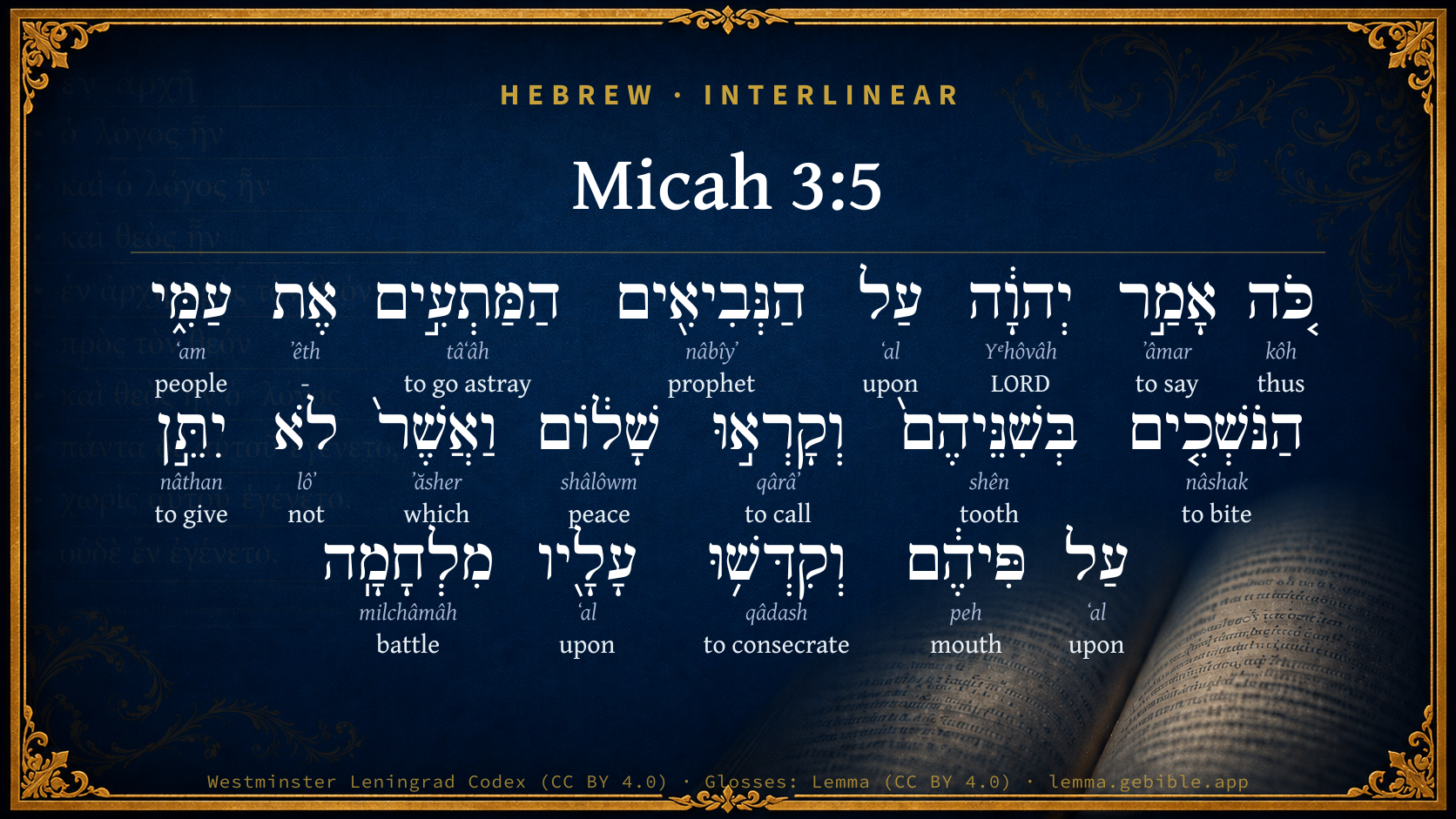
Hebrew (Westminster Leningrad Codex) Micah 3:5 appears in the Hebrew Old Testament. The text above is from the Westminster Leningrad Codex. Each word links to its Strong’s number, a concise gloss, and parsing drawn from the Open Scriptures Hebrew Bible morphology. Click any word for its full Brown-Driver-Briggs (BDB) entry.
Download image
Cite this verse

Micah 3:5 (World English Bible). Public Domain. Lemma interlinear Bible study tool, https://lemma.gebible.app/v/micah/3/5.

Show BibTeX & RIS
BibTeX
RIS
English Translation
Thus says Yahweh concerning the prophets who lead my people astray; for those who feed their teeth, they proclaim, "Peace!" and whoever doesn't provide for their mouths, they prepare war against him:
World English Bible · Public Domain
Download a study sheet

One document with this verse’s original text, its word-by-word gloss line, the meaning frame, cross-references with their text, attributed commentary, and full source and license credits — printable, and it pastes into notes with its structure intact.

This verse Autodidact and up

Study sheet (.html) Plain text (.txt)

A passage Seminary Student

Up to 50 verses in one chapter. A passage sheet keeps up to 6 commentary sources and 12 cross-references per verse, in the order this page ranks them, and says so on the sheet whenever that leaves anything out. Ask for a single verse and you get the Autodidact verse sheet above.

Everything on this page stays free to read, with no account — the sheet is a download of what is already on screen, not access to it.

Want to remove ads? Support Godless Engineer
Compare translations 3

The same verse in 3 English versions, stacked beneath the original-language interlinear above. Click any original word for its lexicon entry.

Each is an independent rendering of the whole verse — the interlinear is not word-aligned to these translations.

Highlighted words mark where these versions differ — a whole-verse word diff, not a word-by-word alignment.

  • World English Bible Public Domain
    Thus says Yahweh concerning the prophets who lead my people astray; for those who feed their teeth, they proclaim, "Peace!" and whoever doesn't provide for their mouths, they prepare war against him:
  • King James Version Public Domain
    Thus saith the LORD concerning the prophets that make my people err, that bite with their teeth, and cry, Peace; and he that putteth not into their mouths, they even prepare war against him.
  • unfoldingWord Literal Text CC BY-SA 4.0
    Thus says Yahweh, “Concerning the prophets causing my people to wander astray, biting with their teeth, then they call out, ‘Peace!’ But whoever does not put in their mouths, they consecrate war against him.

unfoldingWord Literal Text — © unfoldingWord, licensed CC BY-SA 4.0. Word-aligned USFM3 via Door43 (git.door43.org/unfoldingWord/en_ult).

Versions to compare (up to 4)

3 of 4 selected

Show all 18 translations

Every available English version of this verse, each an independent rendering of the whole verse.

  • World English Bible Public Domain
    Thus says Yahweh concerning the prophets who lead my people astray; for those who feed their teeth, they proclaim, "Peace!" and whoever doesn't provide for their mouths, they prepare war against him:
  • Berean Standard Bible Public Domain
    This is what the LORD says: “As for the prophets who lead My people astray, who proclaim peace while they chew with their teeth, but declare war against one who puts nothing in their mouths:
  • Majority Standard Bible Public Domain
    This is what the LORD says: “As for the prophets who lead My people astray, who proclaim peace while they chew with their teeth, but declare war against one who puts nothing in their mouths:
  • King James Version Public Domain
    Thus saith the LORD concerning the prophets that make my people err, that bite with their teeth, and cry, Peace; and he that putteth not into their mouths, they even prepare war against him.
  • American Standard Version (1901) Public Domain
    Thus saith Jehovah concerning the prophets that make my people to err; that bite with their teeth, and cry, Peace; and whoso putteth not into their mouths, they even prepare war against him:
  • Revised Version (1885) Public Domain
    Thus saith the LORD concerning the prophets that make my people to err; that bite with their teeth and cry, Peace; and whoso putteth not into their mouths, they even prepare war against him:
  • Geneva Bible (1599) Public Domain
    Thus saith the Lord, Concerning the prophets that deceiue my people, and bite them with their teeth, and cry peace, but if a man put not into their mouthes, they prepare warre against him,
  • Douay-Rheims (1899) Public Domain
    Thus saith the Lord concerning the prophets that make my people err: that bite with their teeth, and preach peace: and if a man give not something into their mouth, they prepare war against him.
  • Young's Literal Translation Public Domain
    Thus said Jehovah concerning the prophets Who are causing My people to err, Who are biting with their teeth, And have cried `Peace,' And he who doth not give unto their mouth, They have sanctified against him war.
  • Literal Standard Version CC BY-SA 4.0
    Thus said YHWH concerning the prophets || Who are causing My people to err, || Who are biting with their teeth, || And have cried “Peace,” || And he who does not give to their mouth, || They have sanctified against him war:
  • Unlocked Literal Bible CC BY-SA 4.0
    Yahweh says this, “As for the prophets who lead my people astray, if one gives them something to eat, they proclaim, 'Peace.' But if he puts nothing in their mouths, they dedicate themselves to wage war on him.
  • unfoldingWord Literal Text CC BY-SA 4.0
    Thus says Yahweh, “Concerning the prophets causing my people to wander astray, biting with their teeth, then they call out, ‘Peace!’ But whoever does not put in their mouths, they consecrate war against him.
  • Darby Bible Public Domain
    Thus saith Jehovah concerning the prophets that cause my people to err, that bite with their teeth, and cry, Peace! but whoso putteth not into their mouths they prepare war against him:
  • World Messianic Bible Public Domain
    The LORD says concerning the prophets who lead my people astray—for those who feed their teeth, they proclaim, “Peace!” and whoever doesn’t provide for their mouths, they prepare war against him:
  • Webster's Bible Public Domain
    Thus saith the LORD concerning the prophets that make my people err, that bite with their teeth, and cry, Peace; and he that putteth not into their mouths, they even prepare war against him:
  • Free Bible Version CC BY-SA 4.0
    This is what the Lord says about the prophets who deceive my people. To those who feed them they prophesy peace to them, while to those who do not they prophesy war against them.
  • Bible in Basic English Public Domain
    This is what the Lord has said about the prophets by whom my people have been turned from the right way; who, biting with their teeth, say, Peace; and if anyone puts nothing in their mouths they make ready for war against him.
  • JPS Tanakh (1917) Public Domain
    Thus saith the LORD concerning the prophets that make my people to err; that cry: 'Peace', when their teeth have any thing to bite; and whoso putteth not into their mouths, they even prepare war against him:

Literal Standard Version (2020), Covenant Press — licensed CC BY-SA 4.0. Text via the HelloAO Bible API (eBible.org). Unlocked Literal Bible (unfoldingWord) — licensed CC BY-SA 4.0. Text via the HelloAO Bible API (eBible.org). unfoldingWord Literal Text — © unfoldingWord, licensed CC BY-SA 4.0. Word-aligned USFM3 via Door43 (git.door43.org/unfoldingWord/en_ult). Free Bible Version, Dr. Jonathan Gallagher — licensed CC BY-SA 4.0. Text via the HelloAO Bible API (eBible.org).

Word by word

More ways to search: Search by grammar → Find every occurrence → Compare this word →

Practice this passage: Drill this verse → Learn its vocabulary →

הַנֹּשְׁכִ֤ים
nâshak
H5391
“the · biting”
Particle, Definite Article + Verb, Qal, Participle Active, Masculine, Plural, Absolute
Part of Speech
Particle + Verb
Stem
Qal
Form
Participle Active
Gender
Masculine
Number
Plural
State
Absolute
Full BDB Definition

Origin: a primitive root

TWOT: 1430 , 1430b

to bite - (Qal) to bite - (Piel) to bite - to pay, give interest, lend for interest or usury - (Qal) to give interest - (Hiphil) to make to give interest
  1. כֹּ֚ה kôh H3541 “thus” Adverb
  2. אָמַ֣ר ʼâmar H559 “to say” Verb, Qal, Perfect, 3rd Person, Masculine, Singular
  3. יְהוָ֔ה Yᵉhôvâh H3068 “LORD” Noun, Proper
  4. עַל ʻal H5921 “upon” Preposition
  5. הַנְּבִיאִ֖ים nâbîyʼ H5030 “the · prophets” Particle, Definite Article + Noun, Common, Masculine, Plural, Absolute
  6. הַמַּתְעִ֣ים tâʻâh H8582 “the · going astray” Particle, Definite Article + Verb, Hiphil, Participle Active, Masculine, Plural, Absolute
  7. אֶת ʼêth H853 “-” Particle, Direct Object
  8. עַמִּ֑י ʻam H5971 “people · my” Noun, Common, Masculine, Singular, Construct + Suffix, Personal, 1st Person, Common, Singular
  9. בְּשִׁנֵּיהֶם֙ shên H8127 “in/at · teeth · their” Preposition + Noun, Common, Both, Dual, Construct + Suffix, Personal, 3rd Person, Masculine, Plural
  10. וְקָרְא֣וּ qârâʼ H7121 “and · to call” Conjunction + Verb, Qal, Sequential Perfect, 3rd Person, Common, Plural
  11. שָׁל֔וֹם shâlôwm H7965 “peace” Noun, Common, Masculine, Singular, Absolute
  12. וַאֲשֶׁר֙ ʼăsher H834 “and · which” Conjunction + Particle, Relative
  13. לֹא lôʼ H3808 “not” Particle, Negative
  14. יִתֵּ֣ן nâthan H5414 “to give” Verb, Qal, Imperfect, 3rd Person, Masculine, Singular
  15. עַל ʻal H5921 “upon” Preposition
  16. פִּיהֶ֔ם peh H6310 “mouth · their” Noun, Common, Masculine, Singular, Construct + Suffix, Personal, 3rd Person, Masculine, Plural
  17. וְקִדְּשׁ֥וּ qâdash H6942 “and · to consecrate” Conjunction + Verb, Piel, Sequential Perfect, 3rd Person, Common, Plural
  18. עָלָ֖יו ʻal H5921 “upon · him” Preposition + Suffix, Personal, 3rd Person, Masculine, Singular
  19. מִלְחָמָֽה milchâmâh H4421 “battle” Noun, Common, Feminine, Singular, Absolute

About this verse

These counts appear in no published source. They are computed here, from the morphology-tagged text and Lemma’s own curated glosses. What Lemma adds →

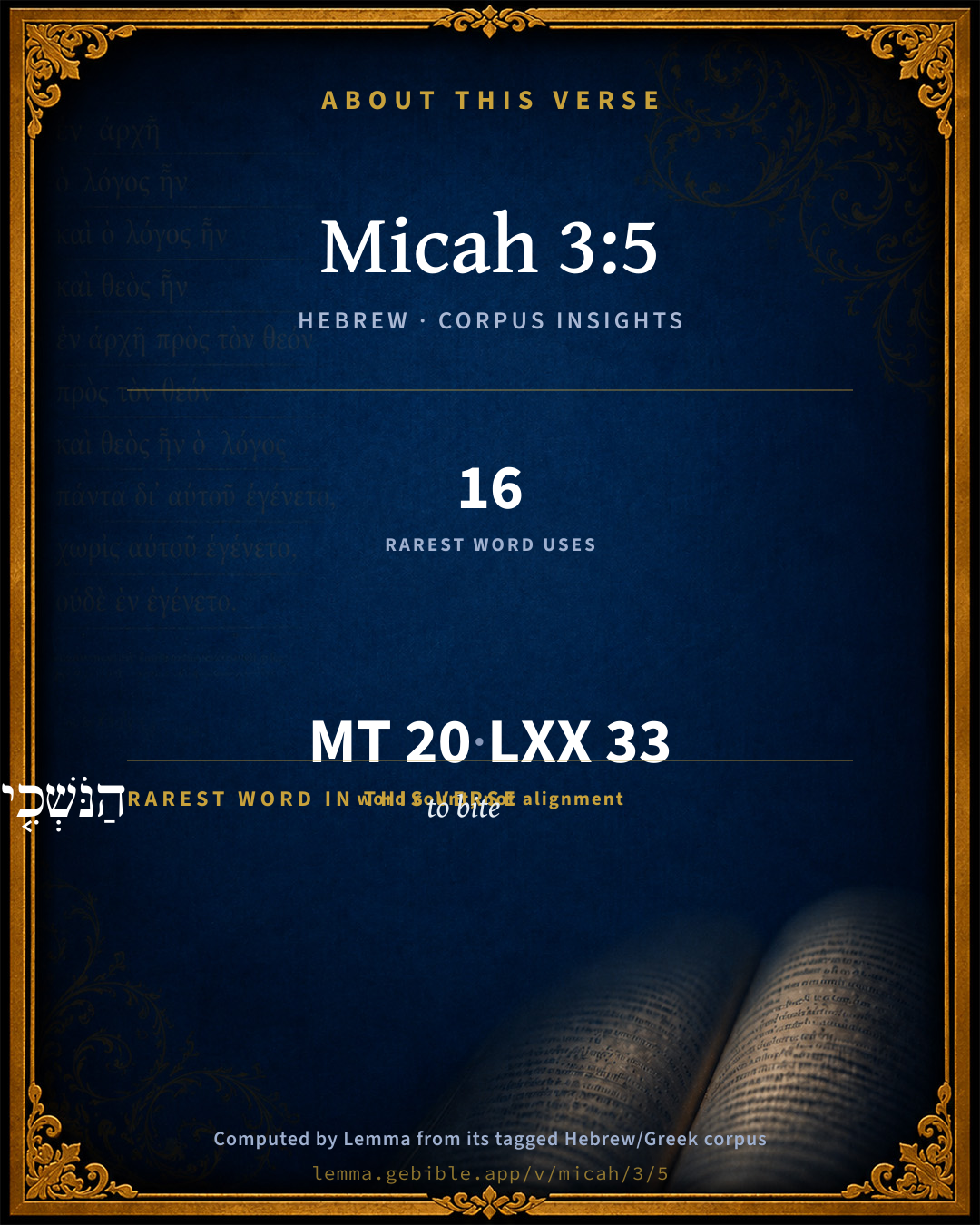
20
words
18
distinct lemmas
Prophets
section

Notable vocabulary

The rarest word here is הַנֹּשְׁכִ֤ים to bite H5391 — appearing just 16 times in the whole Hebrew Bible.

Shared distinctive vocabulary

הַנֹּשְׁכִ֤ים to bite H5391 occurs in 14 verses of the Hebrew Bible. Also found in:

Grammatical profile

  • 6 verbs
  • 7 nouns
  • 3 prepositions
  • 1 adverb
  • 3 particles

Verb forms

  • אָמַ֣ר Qal · Perfect
  • הַמַּתְעִ֣ים Hiphil · Participle Active
  • הַנֹּשְׁכִ֤ים Qal · Participle Active
  • וְקָרְא֣וּ Qal · Sequential Perfect
  • יִתֵּ֣ן Qal · Imperfect
  • וְקִדְּשׁ֥וּ Piel · Sequential Perfect

Repetition

A word recurs within this verse — often emphatic in Hebrew:

Hebrew & Septuagint length

In English translation the verse runs 32 words from the Hebrew and 36 from the Septuagint (LXX English) — closely comparable.

A rough comparison of the two English renderings, which tokenize alike — not a word-level alignment.

Word counts can differ between the Hebrew and the Greek without any difference in meaning — e.g. the Hebrew direct-object marker אֵת has no separate Greek word, and Greek often adds the article ὁ.

In the original languages it is 20 Hebrew tokens and 33 Greek tokens — but the two are counted differently (Hebrew bundles its prefixes and suffixes into one token; the Greek is in lemma form), so that isn’t a like-for-like length.

Cross-references

19

Topical passages linked to Micah 3:5 in the Treasury of Scripture Knowledge — connected by theme and wording, ordered by reader-vote popularity; previews shown in the World English Bible.

  • Jeremiah 14:14–15 Then Yahweh said to me, The prophets prophesy lies in my name; I didn't send them, neither have I commanded them, neither spoke I to them: they prophesy to you a lying vision, and divination, and a thing of nothing, and the deceit of their own heart.
  • Jeremiah 6:14 They have healed also the hurt of my people slightly, saying, Peace, peace; when there is no peace.
  • Isaiah 9:15–16 The elder and the honorable man, he is the head; and the prophet who teaches lies, he is the tail.
  • Jeremiah 23:32 Behold, I am against those who prophesy lying dreams, says Yahweh, and do tell them, and cause my people to err by their lies, and by their vain boasting: yet I didn't send them, nor commanded them; neither do they profit this people at all, says Yahweh.
  • Ezekiel 13:10–16 Because, even because they have seduced my people, saying, Peace; and there is no peace; and when one builds up a wall, behold, they daub it with whitewash:
  • Ezekiel 22:25–29 There is a conspiracy of her prophets in the midst of it, like a roaring lion ravening the prey: they have devoured souls; they take treasure and precious things; they have made her widows many in the midst of it.
  • Jeremiah 23:9–17 Concerning the prophets. My heart within me is broken, all my bones shake; I am like a drunken man, and like a man whom wine has overcome, because of Yahweh, and because of his holy words.
  • Jeremiah 28:15–17 Then said the prophet Jeremiah to Hananiah the prophet, Hear now, Hananiah: Yahweh has not sent you; but you make this people to trust in a lie.
  • Micah 3:11 Her leaders judge for bribes, And her priests teach for a price, And her prophets of it tell forturnes for money: Yet they lean on Yahweh, and say, Isn't Yahweh in the midst of us? No disaster will come on us.
  • Malachi 2:8 But you have turned aside out of the way. You have caused many to stumble in the law. You have corrupted the covenant of Levi," says Yahweh of Hosts.
  • Matthew 7:15 "Beware of false prophets, who come to you in sheep's clothing, but inwardly are ravening wolves.
  • Matthew 15:14 Leave them alone. They are blind guides of the blind. If the blind guide the blind, both will fall into a pit."
  • Romans 16:18 For those who are such don't serve our Lord, Jesus Christ, but their own belly; and by their smooth and flattering speech, they deceive the hearts of the innocent.
  • Isaiah 3:12 As for my people, children are their oppressors, And women rule over them. My people, those who lead you cause you to err, And destroy the way of your paths.
  • Isaiah 56:9–12 All you animals of the field, come to devour, [yes], all you animals in the forest.
  • Jeremiah 23:27 who think to cause my people to forget my name by their dreams which they tell every man to his neighbor, as their fathers forgot my name for Baal.
  • Jeremiah 29:21–23 Thus says Yahweh of Hosts, the God of Israel, concerning Ahab the son of Kolaiah, and concerning Zedekiah the son of Maaseiah, who prophesy a lie to you in my name: Behold, I will deliver them into the hand of Nebuchadrezzar king of Babylon; and he shall kill them before your eyes;
  • Ezekiel 13:18–19 and say, Thus says the Lord Yahweh: Woe to the women who sew pillows on all elbows, and make kerchiefs for the head of [persons of] every stature to hunt souls! Will you hunt the souls of my people, and save souls alive for yourselves?
  • Micah 2:11 If a man walking in a spirit of falsehood lies: 'I will prophesy to you of wine and of strong drink;' He would be the prophet of this people.

Cross-references courtesy of OpenBible.info (CC BY 4.0).

Hebrew and Greek witnesses Masoretic Hebrew ↔ Greek Septuagint

The same verse in the two great witnesses to the Old Testament, shown verse-for-verse.

These are two independent witnesses, not word-aligned to each other, and the Septuagint is shown in lemma (dictionary) form.

Hebrew Micah 3:5 Masoretic · Westminster Leningrad Codex

כֹּ֚ה אָמַ֣ר יְהוָ֔ה עַל הַנְּבִיאִ֖ים הַמַּתְעִ֣ים אֶת עַמִּ֑י הַנֹּשְׁכִ֤ים בְּשִׁנֵּיהֶם֙ וְקָרְא֣וּ שָׁל֔וֹם וַאֲשֶׁר֙ לֹא יִתֵּ֣ן עַל פִּיהֶ֔ם וְקִדְּשׁ֥וּ עָלָ֖יו מִלְחָמָֽה

Thus says Yahweh concerning the prophets who lead my people astray; for those who feed their teeth, they proclaim, "Peace!" and whoever doesn't provide for their mouths, they prepare war against him:

World English Bible · Public Domain

Greek LXX Micah 3:5 Septuagint · lemma form

ὅδε λέγω κύριος ἐπί ὁ προφήτης ὁ πλανάω ὁ λαός ἐγώ ὁ δάκνω ἐν ὁ ὀδούς αὐτός καί κηρύσσω ἐπί αὐτός εἰρήνη καί οὐ δίδωμι εἰς ὁ στόμα αὐτός ἀγείρω ἐπί αὐτός πόλεμος

Thus says the Lord concerning the prophets that lead my people astray, that bit with their teeth, and proclaim peace to them; and when nothing was put into their mouth, they raised up war against them:

LXX2012 (modern English Septuagint) · Public Domain

Hebrew: Westminster Leningrad Codex (CC BY 4.0). Greek: Septuagint (public domain); English from LXX2012 (modern English Septuagint) (Public Domain). How the Septuagint differs from the Hebrew →

Targum (Aramaic paraphrase)

1

The Targum is the ancient Jewish Aramaic paraphrase of the Hebrew Scriptures — an interpretive translation, not the Hebrew text itself. Onkelos (literal) and Pseudo-Jonathan (expansive) render the Torah, and Jonathan the Prophets. Coverage is partial: where no permissively-licensed English translation exists for a verse, only the Aramaic is shown. This is verse-level text, not a word-by-word alignment to the Hebrew.

  1. Targum Jonathan Prophets (Joshua–Malachi)
    כִּדְנַן אֲמַר יְיָ עַל נְבִיַיָא דְשִׁקְרָא דְמַטְעַן יַת עַמִי דְמַן מוֹכִיל לְהוֹן שַׁרְוָן דִבְסַר מִתְנַבָּן עֲלוֹהִי שְׁלָמָא וּדְלָא מוֹכִיל לְהוֹן מְזַמְנִין עֲלוֹהִי קְרָבָא:

    (no public-domain English translation for this verse)

    Targum Jonathan — Aramaic: “Mikraot Gedolot” (public domain). English: “Sefaria Community Translation” (CC0 1.0 (public-domain dedication)); “London "Chaldee Paraphrase," 1871” (public domain). Text via Sefaria.

Commentary

Notes on Micah 3:5 from classic Christian and Jewish commentators (each source and its license shown beneath its notes). The classic Christian expositions comment on the surrounding passage and are grouped to its opening verse, so a note may address several verses; the Jewish commentaries on the Tanakh (Rashi and others) are per-verse, so they appear only where the commentator wrote on this verse.

Lemma curates 59 commentaries, every one of them public domain or Creative Commons licensed, each selected and text-cleaned for this edition rather than reprinted as found. About our sources →

Trapp's Complete Commentary

John Trapp

Mic 3:5 Thus saith the LORD concerning the prophets that make my people err, that bite with their teeth, and cry, Peace; and he that putteth not into their mouths, they even prepare war against him.

Ver. 5. Thus saith the Lord concerning the prophets] False prophets, who pretended Divine authority, when as God never sent them, but expressly declareth here against them, and threateneth them. Those profane princes had their fleshflies, those court parasites, to soothe and smooth them up in their sins; to promise them peace, albeit they walked in the imagination of their own hearts, "to add drunkenness to thirst," and to live as they wanted, Deu 29:19. Mirifica est sympathia inter Magnates et parasites, saith Bucholcer. There is a strange sympathy between great men and clawbacks: nothing so troublesome to such as truth, nothing so toothsome as flattery: this is the fruit of sinful selflove; and the end thereof are the ways of death Pro 16:25.

That make my people to err] That seduce them and carry them out of the right way into bypaths and blind thickets of error, where they are lost for ever, Deu 13:18. Seducers are said to draw men violently, αποσταν, Act 20:30, or to thrust them onward. Jeroboam is said to have "driven Israel from following the Lord"; and the false apostles to drag disciples after them, Act 20:29-30, compelling them, by their persuasions, to embrace those distorted doctrines that cause convulsions of conscience.

That bite with their teeth] The dogs of Congo bite though they bark not, saith Mr Purchas (Pilgr. of Religion): there are a sort of cur dogs, saith another, that suck a man’s blood only with licking (Christ’s Politician, by The. Scot). Seducers are such: "Beware of false prophets for they come to you in sheep’s clothing; but inwardly they are ravening wolves." And in this sense Jerome and Theodoret take this text: they devour those they make prize of, as the apostle’s word signifieth, συλαγωγειν, Col 2:8. Others think their covetousness and gormandise is noted.

“ O Monachi, vestri stomachi sunt amphora Bacchi:

Vos estis, Deus est testis, certissima pestis. ”

As hungry dogs they snap at a crust, and make clean work, such is their voracity and unsatisfiableness.

“ Ingluvies, et tempestas, barathrumque macelli. ”

And cry, Peace] Pαντα καλως εσται. All shall be as well as heart can wish or need require. Let these Cerberuses {a} but be morselled and you shall hear no worse of them. Like they are to the ravens of Arabia, that, full gorged, have a tuneably sweet record, but empty, screech horribly. Si veatri bene si lateri, as Epicurus saith in Horace; Let their bellies be filled and their backs fitted, and they will prophesy all good to you: as those false prophets, nourished by Jezebel, did to Ahab; as the Pharisees cried up to the centurion, who had built them a synagogue, Luk 7:5; as the Popish clergy canonize their benefactors, and extol them to the skies. Wulfin, Bishop of Sherborn, displaced secular priests and put in monks. Hence the monkish writers make him a very holy man, and report of him, that when he lay dying he cried out suddenly, "I see the heavens open and Jesus Christ standing at the right hand of God," and so died. Yea, they had a trick to make their images speak their minds this way. As the cross of grace here in England had a man within it enclosed with a hundred wires to make the image goggle with the eyes, nod with the head, hang the lip, move and shake his jaws, according as the value was of the gift that was offered. If it were a small piece of silver, he would hang a frowning lip; if a piece of gold, then should his jaws go merrily. This idolatrous forgery was at last, by Cromwell’s means, disclosed, and the image, with all his engines, showed openly at Paul’s Cross, and there torn in pieces by the people who had been so seduced (Acts and Mon. fol. 1084).

And he that putteth not into their mouths, they even prepare war against him] Heb. sanctify a war, id est, excommunicatis aqua et igni interdicunt, crucem adversus eos praedicant, they thunder against them, and throw them out of the Church: publish their crusades, as they did against the Waldenses in France, the Hussites in Bohemia, and Luther in Germany, whom the Pope excommunicated, the emperor proscribed, various divines wrote against: the reason whereof, when Erasmus was asked by the Elector of Saxony, he rightly answered, Because he meddleth with the Pope’s triple crown and with the friar’s fat paunches.

{a} In Greek and Latin mythology the proper name of the watch dog which guarded the entrance of the infernal regions, represented as having three heads. ŒD

John Trapp, A Commentary or Exposition upon All the Books of the Old and New Testament (1647–1656) — public domain. Text from a community e-Sword module.

The Biblical Illustrator

Joseph S. Exell

Mic_3:5-7

Thus saith the Lord concerning the prophets that make My people err

False prophets

Here the prophet attacks the false prophets, as before he had attacked the princes.

I. They are DECEIVING. God says, they make My people err Preachers often make their hearers err.

(1) In theology. They propound ideas, crude and ill digested, concerning God, Christ, moral conditions and relations, utterly inconsistent with truth.

(2) In worship.

(3) In morality. Their standard of duty is often wrong.

II. They are avaricious. They bite with their teeth, and cry peace. Greed governs them in all their ministries.

III. They are confounded.

1. Confounded in darkness. Night shall be unto you, that ye shall not have a vision; and it shall be dark unto you, that ye shall not divine; and the sun shall go down over the prophets, and the day shall be dark over them.

2. Confounded in shame. Then shall the seers be ashamed, and the diviners be confounded. Jehovah ignores them. There is no answer of God. Those, says Matthew Henry, who deceive others are but preparing confusion for their own faces. (Homilist.)

The Biblical Illustrator, edited by Joseph S. Exell (c. 1880s–1900s) — public domain. Text from a community e-Sword module.

Joseph Benson's Commentary

Mic 3:5. Thus saith the Lord concerning the prophets — As the prophets prophesied falsely, and it was chiefly through their means that the princes bore rule, the prophet next addresses them, and lets them hear their doom; that make my people err — That lead them into mistakes, both concerning what they should do, and what God would do with them: that tell them they do well, and all shall be well with them, whereas they are in the paths of sin, and within a step of ruin. It is ill indeed with a people when their leaders cause them to err, and those draw them out of the way that should guide them and go before them in it. That bite with their teeth, and cry, Peace — Who speak smooth things, and promise peace and prosperity to the people, while they are bringing destruction upon them; or, who compliment and flatter those that will furnish them with gifts, and feed them well. And he that putteth not into their mouths — That will not entertain them at his table, and treat them with wine and strong drink; they even prepare war against him — They raise false accusations against him, as if he were an enemy to the government, and thereby bring him into trouble; or in some other way do him all the mischief they can.

Joseph Benson's Commentary on the Old and New Testaments (1811–1818) — public domain. Text from a community e-Sword module.

Whedon's Commentary on the Bible

Daniel D. Whedon

Condemnation of the mercenary prophets, Mic_3:5-8.

5. Micah considers the mercenary prophets largely responsible for the moral and spiritual decline of the nation.

Make my people err — They lead the people astray by preaching the divine favor and peace, when their message should have been one of repentance and judgment. 5b sets forth the motives determining the character of their message.

That bite with their teeth, and cry, Peace — If they receive something to eat, or, in a more general sense, if by doing so they can serve their own interests, they announce, without regard for the truth, peace, that is, something that will please the hearers. The rough expression “bite with their teeth,” instead of the simple “eat,” is in perfect harmony with the strong language of Mic_3:2-3.

He that putteth not into their mouths — He who fails to purchase their favor.

Prepare war — Woe to such a one; for him they have only unpleasant things; unto him they declare the wrath of Jehovah and all sorts of calamity (see on Joe_3:9). “The satisfying or non-satisfying of their stomach determined the character of their prophecy.”

Daniel D. Whedon (gen. ed.), Commentary on the Old and New Testaments (1874–1909) — public domain. Text from a community e-Sword module.

The Preacher's Complete Homiletical Commentary

Joseph S. Exell (gen. ed.)

CRITICAL NOTES.]

Mic_3:5. Prophets] False prophets flatter and promise security from judgment. Bite] Like serpents; cry, Peace] When they are doing mischief. Prepare] Lit. “sanctify war against him (cf. Joe_3:9); as if the cause of their own appetite were the cause of Heaven!” [Words].

Mic_3:6. Night] Calamities like a dark night would come upon them (Isa_8:22; Amo_5:18; Amo_8:9).

Mic_3:7. Ashamed] Because their predictions proved lies. Confounded] False prophets had no visions from God. “Their lying being punished in its results, they become, since God by no word of revelation helps them out of their necessity, entirely disgraced” [Hitzig]. Cover] i.e. to cover the face up to the nose, a sign of sorrow (Lev_13:45); here of shame (Eze_24:17). With their lips they had lied, now they are dumb and covered with shame. “They shall be so ashamed of themselves as not to dare to open their mouths, or boast of the name of prophet” [Calvin].

Mic_3:8. I] In contrast to false prophets, am filled with power. Judgment] A sense of justice (Act_1:8). Might] “Moral intrepidity in speaking the truth at all costs” (2Ti_1:7). Sin] Not to flatter with false promises of peace.

HOMILETICS

THE DESCRIPTION OF FALSE TEACHERS.—Mic_3:5-7

From unjust judges Micah turns to false prophets, who are accused of flattering in sin and seducing by error. Corruption and crime in the nation will always endanger the Church. It is bad enough to be under ungodly rulers, but worse to be guided by false teachers.

I. They are mercenary in their purpose. Their chief end and only desire is gain. Rents and tithes, preferment and honour, govern their lives. Their god is their belly, filthy lucre their aim, and their “gospel is their maw”—supplied with food, they are satisfied and promise peace; but when no one puts anything into their mouths they are offended and intolerant. “They are greedy dogs which can never have enough, and they are shepherds that cannot understand; they all look to their own way, every one for his gain.”

II. They are deceptive in their teaching. They flatter and mislead the people. “They make my people err.” An unfaithful ministry carries the people from God and leaves them to perish in sin. “For the leaders of this people cause them to err, and they that are led of them are destroyed.”

1. They deceive by predicting prosperity when there is danger. They cry peace when God threatens judgment. They bite with treachery and deadly poison in their mouths.

2. They deceive by flattering rebellion when they should urge to repentance. They rebuked no extortion and excess. They soothed and smoothed the people, and fawned like greedy dogs to those who fed them. “Will ye pollute me among my people for handfuls of barley and for pieces of bread, to slay the souls that should not die, and to save the souls alive that should not live, by your lying to my people that hear your lies?”

III. They are hypocritical in their spirit. “They even sanctify war against him” that withholds their due. Acting professedly on the authority of God, they abuse the word of God. Men now are denounced as “atheists” and “infidels,” condemned as “disloyal” and “traitors,” if they obey not the behests of the priest. Ecclesiastics threaten and discountenance, bless or curse, to get what they require. They rebuke only when their gains are disturbed, and comfort others to promote their own ends.

IV. They are judged in their ministry. They promise what never comes to pass. Instead of peace they have calamity.

1. They are darkened in their minds. “Therefore, night shall be unto you.” Moral obliquity shuts out the light, darkens the understanding, and brings judicial blindness. When teachers are dark, how can light be expected? “If the blind lead the blind,” &c.

2. They are silenced in their pretensions. They pretended to do good, but sinned against light and were condemned by their own consciences. Deprived of power to divine, and robbed of an answer of God; they had neither vision nor courage to speak. They were seen in their true colours, and deciphered before the world.

3. They were confounded in their ways. Events put them to shame, reputation waned, and confidence failed them. They kept others in the dark; God kept them in the dark, and perplexed them with their own devices. When God’s providence contradicts the religious teacher, he is seen to be opposed to God’s will, and proved not to be sent of God.

4. They were overwhelmed in their circumstances. They preached falsehood, walked in darkness, and stumbled in distress. There was darkness without and darkness within, a night of sorrow and calamity. Their sun went down, and dark cold night settled upon them. They had to cover their lips and hold their tongue.

THE TRUE MINISTER.—Mic_3:8

Micah now contrasts himself with the false prophets, sets forth the nature of the true ministry, which is one of Divine power, earnest appeal, and pure aim.

I. It is a ministry of power. “I am filled with power.”

1. Personal power. Power lodged in him, controlling heart and life.

2. Power exerted upon others. Power must be in the soul, before it can be expressed in the doctrine. This will prove the Divine calling and vindicate the real character of a minister.

3. Power of the highest nature. “By the Spirit of the Lord.” Not the power of intellect and gifts, but “power from on high.” “The power of God unto salvation.”

4. Power in the greatest degree. “Filled with power.” Here is no stint nor measure, except moral capacity. This is most needful, and the best furniture to the minister. Mr. Gladstone recently said that we had nothing to depend upon but moral power. “Tarry ye, until ye be endued with power from on high.” Power in yourselves, power in your words, and power in the hearts of men. “Ye shall receive power after that the Holy Ghost is come upon you.”

II. It is a ministry of light. “And of judgment.”

1. The minister himself is enlightened. He is endowed with “a spirit of wisdom and knowledge.” He has judgment to discern things that differ, to speak a word in season, from a sense of justice, a regard to truth, and not to please men.

2. The doctrine which he preaches enlightens others. It is judgment; an impartial view of God’s word, righteous indignation against sin, and mercy to the penitent. He has an ardent love for souls, and great zeal for the glory of God. Under such a ministry, sinners are convinced, inquirers enlightened, and saints edified.

III. It is a ministry of courage. “And of might.” He feared not the wrath, nor flattered the sins of man. He had courage to brave danger, adhere to truth, and reprove the mighty. He was manly in his utterances, endued with spiritual boldness, and steeled against all opposition in declaring “unto Jacob his transgression, and to Israel his sin.”

“Virtue is bold, and goodness never fearful” [Shakespeare].

HOMILETIC HINTS AND SUGGESTIONS

Mic_3:8. Here we have a pattern ministry by which to test all others. Israel’s prophets were demoralized, and had sadly declined from the dignity of the days of Samuel. The entrance of the earthly-minded and unspiritual into the sacred calling will be a curse to the nation. Here we perceive the distinction between a false and a true prophet, between a converted and an unconverted teacher, and the different ground, nature, and object of their office. There is with the true man, spirit, power, light, self-denial, wise temperance, pure, uncorrupted delivery of God’s plan of salvation; and with the false, envy, imagination, self-love, which puffs up, personal gain, respect of persons, deception, &c. [Lange].

The Three Gifts of a true ministry.

1. Their Divine source.

2. Their human necessity.

3. Their practical design. All the fruits of one Spirit, all to qualify for the discharge of one duty, “to declare unto Jacob,” &c. “So, then, of these three gifts power expresses the Divine might lodged in him; judgment, the substance of what he had to deliver; might or courage, the strength to deliver it in face of human power, persecution, ridicule, death” [Pusey].

Mic_3:5-8. Warning to the Heralds of God’s Word.

1. Their ideal character (Mic_3:8).

2. Their danger of darkening God’s Word through self-seeking, in that either they for personal advantage preach what the ears of people lust after, or brand their personal enemies as God’s enemies.

3. The aggravation of their sin; desecration of the Word; confusion of God’s congregation.

4. Their punishment; they lose the capacity to discern God’s Word, and speak to the disgust of others and of themselves [Lange].

ILLUSTRATIONS TO CHAPTER 3

Mic_3:5-7. It shall be dark. Misery assails riches as lightning does the highest towers; or as a tree that is heavy laden with fruit breaks its own boughs, so do riches destroy the virtue of their possessor [Burton].

Mic_3:8. Power. The crowning power of the messenger of God is power over the moral man; power which, whether it, approaches the soul through the avenue of the intellect or of the affections, does reach into the soul. The sphere of the Christian power is the heart,—the moral man; and the result of its action is not to be surely distinguished from that of mere eloquence by instantaneous emotion, but by subsequent moral fruit. Power which cleanses the heart and produces holy living is the power of the Holy Ghost [Wm. Arthur].

The Preacher's Complete Homiletical Commentary (gen. ed. Joseph S. Exell; Funk & Wagnalls, c. 1892) — public domain (pre-1929). A full-Bible homiletical/sermon-outline anthology covering 65 of 66 books (2 John is absent from the source module). Text from a community e-Sword module.

Keil & Delitzsch

C. F. Keil & F. Delitzsch

In the second strophe, Micah turns from the godless princes and judges to the prophets who lead the people astray, with whom he contrasts the true prophets and their ways. Mic 3:5. Thus saith Jehovah concerning the prophets who lead my people astray, who bite with their teeth, and preach peace; and whoever should put nothing into their mouths, against him they sanctify war. Mic 3:6. Therefore night to you because of the visions, and darkness to you because of the soothsaying! and the sun will set over the prophets, and the day blacken itself over them. Mic 3:7. And the seers will be ashamed, and the soothsayers blush, and all cover their beard, because (there is) no answer of God. Mic 3:8. But I, I am filled with power, with the Spirit of Jehovah, and with judgment and strength, to show to Jacob his transgression, and to Israel his sin." As the first strophe attaches itself to Mic 2:1-2, so does the second to Mic 2:6 and Mic 2:11, carrying out still further what is there affirmed concerning the false prophets. Micah describes them as people who predict peace and prosperity for a morsel of bread, and thereby lead the people astray, setting before them prosperity and salvation, instead of preaching repentance to them, by charging them with their sins. Thus they became accomplices of the wicked rulers, with whom they are therefore classed in Mic 3:11, together with the wicked priests. המּתעים, leading astray (cf. Isa 3:12; Isa 9:15) my people, namely, by failing to charge them with their sins, and preach repentance, as the true prophets do, and predicting prosperity for bread and payment. The words, "who bite with their teeth," are to be connected closely with the next clause, "and they preach peace," in the sense of "who preach peace if they can bite with their teeth," i.e., if they receive something to bite (or eat). This explanation, which has already been expressed by the Chaldee, is necessarily required by the antithesis, "but whoever puts nothing into their mouth," i.e., gives them nothing to eat, notwithstanding the fact that in other passages nâshakh only signifies to bite, in the sense of to wound, and is the word generally applied to the bite of a snake (Amo 5:19; Gen 49:17; Num 21:6, Num 21:8). If, however, we understand the biting with the teeth as a figurative representation of the words of the prophets who always preach prosperity, and of the injury they do to the real welfare of the people (Ros., Casp., and others), the obvious antithesis of the two double clauses of Mic 3:5 is totally destroyed. The harsh expression, to "bite with the teeth," in the sense of "to eat," is perfectly in harmony with the harsh words of Mic 3:2 and Mic 3:3. Qiddēsh milchâmâh, to sanctify war, i.e., to preach a holy war (cf. Joe 3:9), or, in reality, to proclaim the vengeance of God. For this shall night and darkness burst upon them. Night and darkness denote primarily the calamity which would come upon the false prophets (unto you) in connection with the judgment (Mic 2:4). The sun which sets to them is the sun of salvation or prosperity (Amo 8:9; Jer 15:9); and the day which becomes black over them is the day of judgment, which is darkness, and not light (Amo 5:18). This calamity is heightened by the fact that they will then stand ashamed, because their own former prophecies are thereby proved to be lies, and fresh, true prophecies fail them, because God gives no answer. "Convicted by the result, they are thus utterly put to shame, because God does not help them out of their trouble by any word of revelation" (Hitzig). Bōsh, to be ashamed, when connected with châphēr (cf. Jer 15:9; Psa 35:26., etc.), signifies to become pale with shame; châphēr, to blush, with min causae, to denote the thing of which a man is ashamed. Qōsemı̄m (diviners) alternates with chōzı̄m (seers), because these false prophets had no visions of God, but only divinations out of their own hearts. ‛Atâh sâphâm: to cover the beard, i.e., to cover the face up to the nose, is a sign of mourning (Lev 13:45), here of trouble and shame (cf. Eze 24:17), and is really equivalent to covering the head (Jer 14:4; Est 6:12). Ma‛ănēh, the construct state of the substantive, but in the sense of the participle; some codd. have indeed מענה. In Mic 3:8 Micah contrasts himself and his own doings with these false prophets, as being filled with power by the Spirit of Jehovah (i.e., through His assistance) and with judgment. Mishpât, governed by מלא, is the divine justice which the prophet has to proclaim, and gebhūrâh strength, manliness, to hold up before the people their sins and the justice of God. In this divine strength he can and must declare their unrighteousness to all ranks of the people, and predict the punishment of God (Mic 3:9-12).

Keil & Delitzsch — Biblical Commentary on the Old Testament (1861–1891) — public domain (CC PDM 1.0). Text via the HelloAO Bible API. (Old Testament only.)

Tyndale Open Study Notes

Tyndale Open Resources

3:5 The false prophets were among the spiritual leaders of Israel, so they fell under Micah’s accusations. Prophets were supposed to call Israel to the true way, not to send them astray (see Deut 13, 18). These prophets used their gifts to benefit themselves.

Tyndale Open Study Notes — © Tyndale Open Resources, licensed CC BY-SA 4.0. Text via the HelloAO Bible API.

Geneva Bible (1599)

Geneva Bible translators

They devour all their substance, and then flatter them, promising that all shall go well, but if one restrain from their bellies, then they invent all ways to mischief.

Geneva Bible (1599) marginal notes — public domain. Text via Bolls.life.

Jamieson, Fausset & Brown

Robert Jamieson, A. R. Fausset & David Brown

Here he attacks the false prophets, as before he had attacked the "princes."

make my people err--knowingly mislead My people by not denouncing their sins as incurring judgment.

bite with . . . teeth, and cry, Peace--that is, who, so long as they are supplied with food, promise peace and prosperity in their prophecies.

he that putteth not into their mouths, they . . . prepare war against him--Whenever they are not supplied with food, they foretell war and calamity.

prepare war--literally, "sanctify war," that is, proclaim it as a holy judgment of God because they are not fed (see on Jer 6:4; compare Isa 13:3; Joe 1:14).

Jamieson, Fausset & Brown — Commentary Critical and Explanatory on the Whole Bible (1871) — public domain (CC PDM 1.0). Text via the HelloAO Bible API.

Adam Clarke's Commentary

Verse 5. That bite with their teeth] That eat to the full; that are well provided for, and as long as they are so, prophesy smooth things, and cry, Peace! i.e., Ye shall have nothing but peace and prosperity. Whereas the true prophet, "who putteth not into their mouths," who makes no provision for their evil propensities, "they prepare war against him." קדשו עליו מלחמה kiddeshu alaiu milchamah, "They sanctify a war against him." They call on all to help them to put down a man who is speaking evil of the Lord's people; and predicting the destruction of his temple, and Israel his inheritance.

Adam Clarke's Commentary on the Bible (1810–1826) — public domain. Text from a community e-Sword/MySword module.

John Calvin's Commentaries

Micah accuses here the Prophets, in the first place, of avarice and of a desire for filthy lucre. But he begins by saying that he spoke by God’s command, and as it were from his mouth, in order that his combination might have more weight and power. Thus then saith Jehovah against the Prophets: and he calls them the deceivers of the people: but at the same time he points out the source of the evil, that is, why or by what passion they were instigated to deceive, and that was, because the desire of gain had wholly possessed them, so that they made no difference between what was true and what was false, but only sought to please for the sake of gain. And he shows also, on the other hand, that they were so covetous of gain, that they declared war, if any one did not feed them. And God repeats again the name of his people: this had escaped my notice lately in observing on the words of Micah, that the princes devoured the flesh of God’s people; for the indignity was increased when this wrong, was done to the people of God. Had the Assyrians, or the Ethiopians, or the Egyptians, been pillaged by their princes, it would have been more tolerable; but when the very people of God were thus devoured, it was, as I have said, less to be borne. So when the people of God were deceived, and the truth was turned to a lie, it was a sacrilege the more hateful.

This then was the reason why he said, Who deceive my people “This people is sacred to me, for I have chosen them for myself; as then they are destroyed by frauds and deceptions, is not my majesty in a manner dishonored — is not my authority lessened?” We now then see the reason why the Prophet says, They deceive my people. It is indeed certain, that the Jews were worthy of such deceptions; and God elsewhere declares, that whenever he permitted false prophets to come among them, it was to try them to see what sort of people they were, (Deuteronomy 13.) It was then their just reward, when liberty was given to Satan to prevent sound doctrine among the people. And no one is ever deceived, except through his own will. Though their own simplicity seems to draw many to destruction, yet there is ever in them some hypocrisy. But it does not extenuate the sin of false teachers, that the people deserve such a punishment: and hence the Prophet still goes on with his reproof and says, that they were the people of God, — in what respect? By adoption. Though then the Jews had rendered themselves unworthy of such an honor, yet God counts them his people, that he might punish the wickedness of the false teachers, of which he now accuses them. It now follows, that they did bite with their teeth But I cannot finish today.

John Calvin's Commentaries (1540-1563) — public domain. Text from the Calvin Translation Society English edition (1840s-50s) via the Christian Classics Ethereal Library (ccel.org). Calvin's coverage is partial (roughly two-thirds of the Bible); uncommented books and verses are honest gaps, never fabricated. The 19th-century editor's footnotes and remarks are omitted so the notes are faithfully Calvin's own voice.

Ellicott's Commentary for English Readers

(5) That bite with their teeth.—The concluding statement that the false prophets declare war against those who do not put into their mouth indicates the meaning of the former expression, namely, “they say peace to those who feed and bribe them.” The Hebrew word, nashak, which is rendered “bite,” is strictly applied to serpents, to “an adder in the path,” and is therefore especially appropriate to the false and lying nature of the prophets.

A Bible Commentary for English Readers, edited by Charles John Ellicott (1878–1897) — public domain. Text from a community e-Sword module.

The Cambridge Bible for Schools and Colleges

gen. ed. J. J. S. Perowne

5–8. The fate of the false prophets, whose unauthorized smooth-speaking Micah contrasts with his own divinely inspired courage

5. that bite with their teeth, and cry, Peace] i.e. who, when they are given something to eat, cry, Peace. To ‘bite with the teeth’ is a quaint, rough expression in harmony with the foregoing image from cannibalism. Choice language would have been thrown away on such seared consciences. Comp. the description of the priests, 1Sa_2:13-16.

they even prepare war against him] Lit., they consecrate war, a prophetic formula (Jer_4:4, Joe_3:9, comp. Isa_13:3, ‘my consecrated ones’). The meaning is, that if at any time the rulers of the people are behindhand with the accustomed fee to these mercenary prophets, the tone of the latter at once begins to change. Instead of announcing peace, they declare that Jehovah is wroth with his people, and will send war. Strictly speaking, to ‘consecrate war’ is to open a campaign (with sacred rites), but here the antithesis with ‘that cry, Peace’ requires us to take it in a modified sense.

The Cambridge Bible for Schools and Colleges (gen. ed. J. J. S. Perowne; Cambridge University Press, 1878–1918) — public domain. Text from a community e-Sword module.

John Gill's Exposition

Thus saith the Lord, concerning the prophets that make my people err,.... The false prophets, as the Targum; and as the description given of them shows; who, instead of directing the people in the right way, as by their office and characters as prophets they should have done, they led them into mistakes about matters of religion and civil government, and out of the way of their duty to God and men, and exposed them to great danger and distress; and this was the more aggravating, as they were the Lord's people by name and profession, whom they caused to err from his ways and worship, which brought his displeasure upon them:

that bite with their teeth, and cry, peace; prophesy smooth things, promise all kind of prosperity and plenty, and bite their lips, and keep in those distresses and calamities which they could not but see coming upon the people; or, while they are prophesying good things, they gnash their teeth against the prophets of the Lord, and bitterly inveigh against them for threatening with war, destruction, and captivity; or, by flattering the people with their lips, they bite them, devour their substance, and are the cause of their hurt and ruin; or rather, so long as the people fed them well, and they had a sufficiency to bite and live upon, they foretold happy days unto them, So the Targum,

"he that feeds them with a feast of flesh, they prophesy peace to him;''

which sense is confirmed by what follows,

and he that putteth not into their mouth, they even declare war against him; who do not give them what they ask, or do not feed them according to their desire, do not keep a good table for them, and cram and pamper them, but neglect them, and do not provide well for them; these they threaten with one calamity or another that shall befall them; and endeavour to set their neighbours against them, and even the government itself, and do them all the mischief they can by defamation and slander.

John Gill's Exposition of the Whole Bible (1746–1763) — public domain (CC PDM 1.0). Text via the HelloAO Bible API.

Albert Barnes' Notes on the Bible

The prophets that make My people err - Flattering them in their sins and rebellions, promising that they shall go unpunished, that God is not so strict, will not put in force the judgments tie threatens. So Isaiah saith Isa 3:12; O my? people, they which lead thee, mislead thee; and (Isa 9:16, (Isa 9:15 in Hebrew)), the leaders of this people are its misleaders, and they that are led of them are destroyed. And Jeremiah, “The prophets have seen for thee vanity and folly; and they have not discovered thine iniquity to turn away thy captivity, and have seen for thee false burdens and causes of banishment” Lam 2:14. No error is hopeless, save what is taught in the Name of God.

That bite with their mouths - The word is used of no other biting than the biting of serpents. They were doing real, secret evil “while they cry, that is, proclaim peace;” they bit, as serpents, treacherously, deadlily. They fed, not so much on the gifts, for which they hired themselves to Eze 13:10 speak peace when there was no peace, as on the souls of the givers. So God says by Ezekiel, “Will ye pollute Me among My people for handfuls of barley and for pieces of bread, to slay the souls that should not die, and to save the souls live that should not live, by your lying to My people that hear your lies? Because with lies ye have made the heart of the righteous sad, whom I have not made sad; and strengthened the hands of the wicked, that he should not return from his wicked way, by promising him life - therefore ye shall see no more vanity nor divine divinations” Eze 19:1-14, 22-23. It was with a show of peace that Joab slew Abner and Amasa, and with a kiss of peace Judas betrayed our Lord.

And he that putteth not into their mouths, they prepare war against him - Literally, and (that is, immediately; it was all one; bribes refused, war proclaimed,) “they sanctify war against him.” Like those of whom Joel prophesied , they proclaim war against him in the Name of God, by the authority of God which they had taken to themselves, speaking in His Name who had not sent them. So when our Lord fed the multitude, they would take Him by force and make Him a king; when their hopes were gone and they saw that His Kingdom was not of this world, they said, Crucify him, crucify Him. Much more the Pharisees, who, because He rebuked their covetousness, their devouring widows’ houses, their extortion and excess, their making their proselytes more children of hell than themselves, said, Thou blasphemest. So, when the masters of the possessed damsel whom Paul freed Act 16:19-21, saw that the hope of their gains was gone, they accused him, that he exceedingly troubled their city, teaching customs not lawful to be received.

So Christians were persecuted by the pagan as “hating the human race,” because they would not partake of their sins; as “atheists,” because they worshiped not their gods; as “disloyal” and “public enemies,” because they joined not in unholy festivals; as “unprofitable,” because they neglected things not profitable but harmful. So men are now called “illiberal,” who will not make free with the truth of God; “intolerant,” who will not allow that all faith is matter of opinion, and that there is no certain truth; “precise,” “censorious,” who will not connive at sin, or allow the levity which plays, mothlike, around it and jests at it. The Church and the Gospel are against the world, and so the world which they condemn must be against them; and such is the force of truth and holiness, that it must carry on the war against them in their own name.

Albert Barnes' Notes on the Bible (1834–1885) — public domain. Text from a community e-Sword/MySword module.

Haydock's Catholic Bible Commentary

Peace. They pretend goodness, while they do the greatest mischief. --- Prepare. Literally, "sanctify," (Haydock) or denounce war. (Calmet) --- False prophets seek their private lucre. (Worthington)

George Leo Haydock (1774–1849), Haydock's Catholic Family Bible and Commentary, 1859 edition — public domain. Excludes Psalms (Douay-Rheims chapter numbering differs from Protestant) and Deuterocanonical books (Catholic canon only).

Matthew Poole's English Annotations

Thus saith the Lord: now Micah in the name of the Lord foretells what shall become of false prophets, he had frankly dealt with the seculars, now he deals as plainly with the ecclesiastics.

Concerning the prophets that make my people err: though he give them the title they assume to themselves, yet he doth very fully describe them, and shows they are false prophets; they err, and make others to err with them. Israel is too apt to mistake his God, and his ways; these false prophets make them err more, both concerning their former ways of religion and civil policy, and concerning their present danger and duty, and concerning future judgments and punishments.

That bite with their teeth, when they are furnished with gifts, and well fed.

And cry, Peace; they promise great prosperity, they pretend to give assurance from God that all shall go well with Israel, and none of the dismal woes threatened by Micah and such-like prophets should ever be verified on them.

And he that putteth not into their mouths; but those who will not feed these false prophets, that bid them not welcome to their tables, nor make good cheer for them,

They even prepare war against him; they do threaten with war, and all calamities that attend it; or else, as enemies prepared, they work them all the mischief they can, and show what god they serve, even the god of this world, and their own bellies.

Matthew Poole's English Annotations on the Holy Bible (1683–1685) — public domain. Text from a community e-Sword/MySword module.

The Pulpit Commentary

Vers. 5-8. Sins of the false prophets who led the people astray.

Concerning the prophets. (Mic_2:11) These are the lying prophets of whom Jeremiah complains. (Lam_2:14) That bite with their teeth, and cry, Peace. Very many commentators take the phrase, "bite with the teeth," to mean "eat," so that the clause signifies that the prophets when bribed with food predict peace and happiness to people. The antithesis of the following clause seems to require this explanation, which is further supported by the Chaldee. But it is quite unprecedented to find the word translated "bite" (nashakh) in the sense of "eat," or as it is taken here, "to have something to eat;" wherever it occurs it means "to bite like a serpent," to wound. (see Gen_49:17 Num_21:8, 9 Amo_5:19 Amo_9:3) The parallelism of the succeeding member does not compel us to put a forced interpretation upon the word. These venal seers do vital harm, inflict gravest injury, when they proclaim peace where there is no peace; by such false comfort they are really infusing poison and death. He that putteth not into their mouths. If any one does not bribe them, and so stop their evil mouths. They even prepare war against him. The Hebrew expression is, "they consecrate" or "sanctify war." There may be allusion to the religious rites accompanying a declaration of war; (Jer_6:4 Joe_3:9) but Micah seems to mean that, if the customary bribes are withheld, these prophets announce war and calamity as inevitable; they proclaim them in God"s name, as speaking with his sanction and under his Inspiration. (comp. Jer_23:16, etc.; Eze_13:19; see note on Zep_1:7)

Vers. 5-7. False prophets.

"Thus saith the Lord concerning the prophets that make my people err, that bite with their teeth, and cry, Peace; and he that putteth not into their mouths, they even prepare war against him. Therefore night shall be unto you, that ye shall not have a vision," etc. The following is the version of Delitzsch: "Thus saith Jehovah concerning the prophets who lead my people astray, who bite with their teeth and preach peace. And whoever should put nothing into their mouths, against him they sanctify war.

Therefore night to you because of the vision, and darkness to you because of the soothsaying; and the sun will set over the prophets, and the day blacken itself over them. And the seers will be ashamed and the soothsayers blush, and all cover their head, because there is no answer of God.

"Here he attacks the false prophets, as before he had attacked the "princes." "That make my people err knowingly mislead my people, by not denouncing their sins as incurring judgments. "That Bite with their teeth, and cry, Peace;" i.e. who, so long as they are supplied with food, promise peace and prosperity in their prophecies. "And he that putteth not into their mouths, they even prepare war against him." Whenever they are not supplied with food, they foretell war and calamity: they sanctify war, i.e. proclaim it as a holy judgment of God, because they are not fed. "Therefore night shall be unto you, that ye shall not have a vision; and it shall be dark." Calamities press on you so overwhelmingly as to compel you to cease pretending to divine. (Zec_13:4) Darkness is often the image of calamity. (Isa_8:22 Amo_5:18 Amo_8:9) "Then shall the seers be ashamed, and the diviners confounded: yea, they shall all cover their lips." The Orientals prided themselves on the moustache and beard. To cover the upper lip, therefore, was a token of shame, mourning, and sorrow. (Lev_13:45 Eze_24:17) "Cover not thy lips," i.e. assume not the usual token of one mourning. (Eze_24:22) They shall be so ashamed of themselves as not to dare to open their mouths, or boast of the name of prophet. "For there is no answer of God." They shall no more profess to have responses from God, being struck dumb with calamities" (Fausset). False prophets are here brought under our attention again, and three things are suggested concerning them.

I THEY ARE DECEIVING. God says, they "make my people err." Preachers often make their hearers err.

1. In theology. They propound ideas, crude and ill digested, concerning God, Christ, moral conditions and relations, utterly inconsistent with truth.

2. In worship. The forms they propose to use in worship, the rules they enjoin for it, are often such as to give the people wrong ideas as to what worship really is.

3. In morality. Their standard of duty is often wrong; hence wars are sanctioned, priestly exactions and assumptions encouraged and maintained. Ah me! how the preachers make men err on these great subjects!

II THEY ARE AVARICIOUS. They "bite with their teeth, and cry, Peace." Greed governs them in all their ministries. They are ever hungering after gain; pelf with them is a passion. Their eyes are ever on pew rents, offerings, tithes, etc. If their greed is offended, they "prepare war against" the offender; they raise an opposition strong and deadly against him. They are "greedy of filthy lucre.

III THEY ARE CONFOUNDED. Confounded in darkness. "Night shall be unto you, that ye shall not have a vision; and it shall be dark unto you, that ye shall not divine; and the sun shall go down over the prophets, and the day shall be dark over them." They were blind leaders of the blind, and they themselves fall into the ditch. Confounded in shame. "Then shall the seers be ashamed, and the diviners be confounded." Jehovah ignores them. "There is no answer of God." "Those," says Matthew Henry, "who deceive others are but preparing confusion for their own faces. D.T.

The Pulpit Commentary (1880–1919), ed. H.D.M. Spence-Jones & Joseph S. Exell — public domain. Text from a community e-Sword module.

John Wesley's Explanatory Notes

That bite - When they are furnished with gifts, and well fed. Prepare war - They do them all the mischief they can.

John Wesley, Explanatory Notes Upon the Whole Bible (1754–1765) — public domain. Text via the GEBible commentary corpus.

unfoldingWord translationNotes

Door43 World Missions Community

General Information:

Micah continues to speak judgment against false prophets.

who lead my people astray

Walking on a good path is a metaphor for obeying God. Going astray from the path is a metaphor for disobeying God, in this case perhaps without knowing it. AT: "who lead my people to disobey me" (See: Metaphor)

if one gives them something to eat, they proclaim, 'Peace.'

Micah is using a metaphor to describe a situation that actually happens. The phrase "something to eat" is an ironic way of speaking of a small payment. AT: "they tell people who pay them even a small amount that things will go well for those people." (See: Metaphor and Irony)

if he puts nothing in their mouths, they dedicate themselves to wage war on him

Micah is using a metaphor to describe a situation that actually happens. The phrase "puts nothing in their mouths" is an ironic exaggeration for not giving what they want. AT: "they do all they can to destroy people who pay them too little" (See: Metaphor and Irony)

it will be night for you ... the day will be dark on them

Darkness is a metaphor for Yahweh not speaking to the prophets. (See: Metaphor)

no vision for you

"you will no longer see visions"

The seers will be put to shame, and the diviners will be confused

This can be translated in active form. AT: "I will cause the seers to be ashamed, and I will confuse the diviners" (See: Active or Passive)

All of them will cover their lips

Here "lips" represents speaking. AT: "They shall no longer speak" (See: Metonymy)

there is no answer from me

"I will be silent"

translationWords

Yahweh

prophet

people of God

vision

darkness

divination

shame

unfoldingWord translationNotes — © Distant Shores Media and the Door43 World Missions Community, licensed CC BY-SA 4.0. Source: git.door43.org/Door43/en_tn.

Rashi

Rabbi Shlomo Yitzchaki (Rashi)

who bite with their teeth—and eat the flesh of fattened animals, which my people who stray after them feed them.

and herald peace—And, when they feed them, they herald and prophesy peace for them.

they prepare war Heb. וְקִדְּשׁוּ.

Rashi on the Tanakh — English translations: “The Judaica Press complete Tanach with Rashi, translated by A. J. Rosenberg” (CC BY 4.0); “Pentateuch with Rashi's commentary by M. Rosenbaum and A.M. Silbermann, 1929-1934” (public domain); “The Metsudah Tanach series, Lakewood, N.J” (CC BY 4.0); and “The Book of Joshua, Metsudah Publications, 1997” (CC BY 4.0). Text via Sefaria.

Lesson kit

Teaching starters — assembled from the data on this page, not authored interpretation. Every prompt links to the verse data it draws on. Edit before teaching.

Micah, in the Prophets, opens this verse with 20 words (18 distinct Hebrew lemmas). Its most distinctive word is nâshak (“to bite”). A historical commentator’s framing appears above. Read the whole chapter for the surrounding context.

Discussion questions

  1. How does “to bite” (nâshak) shape what this verse is saying?
  2. Genesis 49:17 shares the word «to bite» with this verse. How do the two illuminate each other?
  3. “upon” occurs 3× in this one verse. What is the effect of the repetition?
  4. The translations on this page render this verse differently — a whole-verse word diff, not a word-by-word alignment. What might account for the different wordings?
  5. The verb «אָמַ֣ר» is Qal Perfect. How does its form color the action?
  6. Reading how Trapp's Complete Commentary and The Biblical Illustrator read this verse, where do the two commentators agree and where do they part?

Things to notice

Reading settings

Reading text

Shown beneath each verse's original-language words.

Old Testament
Old Testament edition

Read the OT as the Masoretic Hebrew (MT) or the Greek Septuagint (LXX).

English shown for the Greek Septuagint (in the Hebrew ↔ Greek comparison).

Comparing translations? Open the Compare panel on any verse page to stack up to four side by side.