2 Samuel 19:30

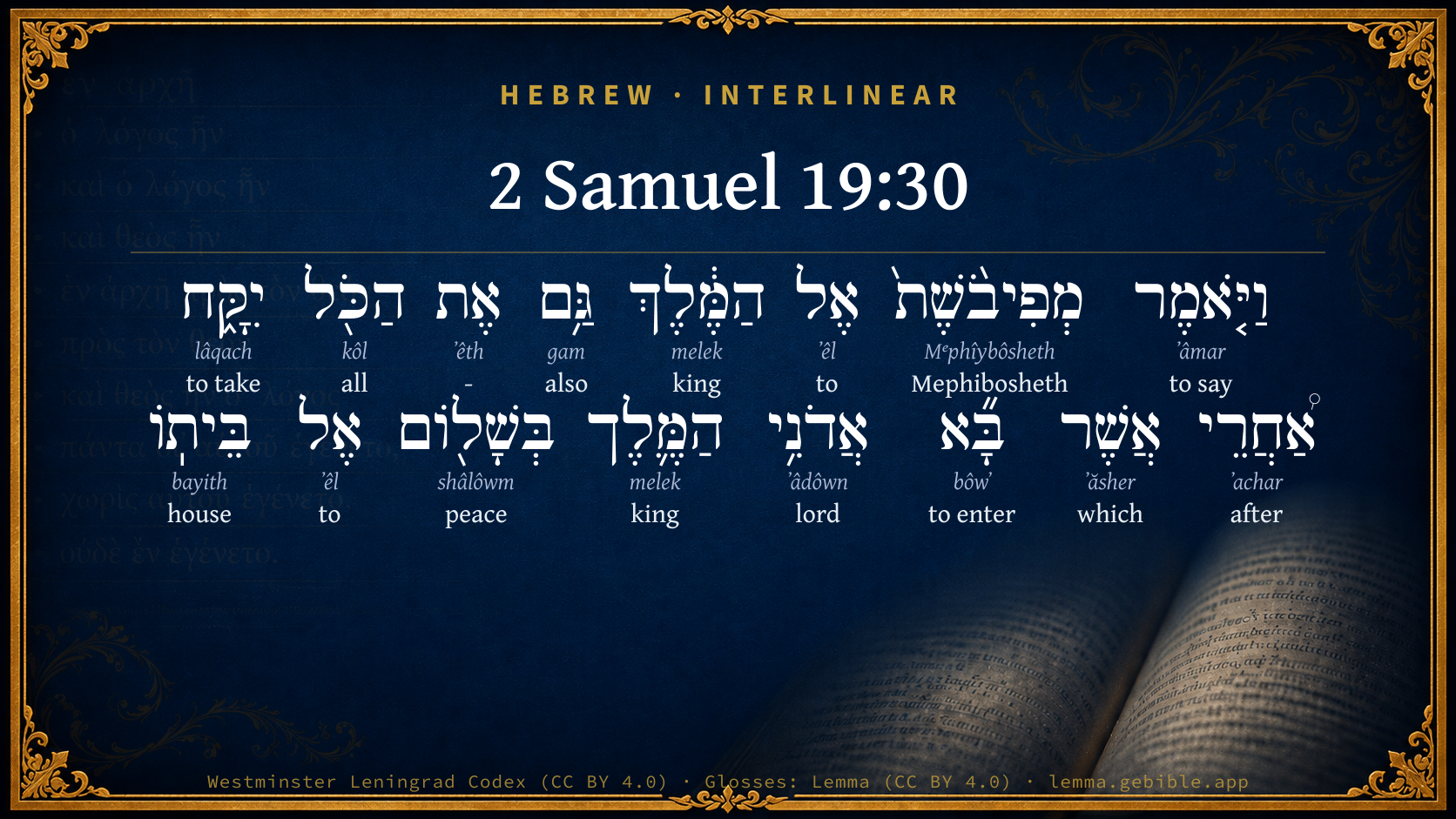
Hebrew (Westminster Leningrad Codex) 2 Samuel 19:30 appears in the Hebrew Old Testament. The text above is from the Westminster Leningrad Codex. Each word links to its Strong’s number, a concise gloss, and parsing drawn from the Open Scriptures Hebrew Bible morphology. Click any word for its full Brown-Driver-Briggs (BDB) entry.
Download image
Cite this verse

2 Samuel 19:30 (World English Bible). Public Domain. Lemma interlinear Bible study tool, https://lemma.gebible.app/v/2-samuel/19/30.

Show BibTeX & RIS
BibTeX
RIS
English Translation
Mephibosheth said to the king, yes, let him take all, because my lord the king is come in peace to his own house.
World English Bible · Public Domain
Download a study sheet

One document with this verse’s original text, its word-by-word gloss line, the meaning frame, cross-references with their text, attributed commentary, and full source and license credits — printable, and it pastes into notes with its structure intact.

This verse Autodidact and up

Study sheet (.html) Plain text (.txt)

A passage Seminary Student

Up to 50 verses in one chapter. A passage sheet keeps up to 6 commentary sources and 12 cross-references per verse, in the order this page ranks them, and says so on the sheet whenever that leaves anything out. Ask for a single verse and you get the Autodidact verse sheet above.

Everything on this page stays free to read, with no account — the sheet is a download of what is already on screen, not access to it.

Want to remove ads? Support Godless Engineer
Compare translations 3

The same verse in 3 English versions, stacked beneath the original-language interlinear above. Click any original word for its lexicon entry.

Each is an independent rendering of the whole verse — the interlinear is not word-aligned to these translations.

Highlighted words mark where these versions differ — a whole-verse word diff, not a word-by-word alignment.

  • World English Bible Public Domain
    Mephibosheth said to the king, yes, let him take all, because my lord the king is come in peace to his own house.
  • King James Version Public Domain
    And Mephibosheth said unto the king, Yea, let him take all, forasmuch as my lord the king is come again in peace unto his own house.
  • unfoldingWord Literal Text CC BY-SA 4.0
    And Mephibosheth said to the king, “Let him even take the whole, after that my lord the king has come in peace to his house.”

unfoldingWord Literal Text — © unfoldingWord, licensed CC BY-SA 4.0. Word-aligned USFM3 via Door43 (git.door43.org/unfoldingWord/en_ult).

Versions to compare (up to 4)

3 of 4 selected

Show all 18 translations

Every available English version of this verse, each an independent rendering of the whole verse.

  • World English Bible Public Domain
    Mephibosheth said to the king, yes, let him take all, because my lord the king is come in peace to his own house.
  • Berean Standard Bible Public Domain
    And Mephibosheth said to the king, “Instead, since my lord the king has safely come to his own house, let Ziba take it all!”
  • Majority Standard Bible Public Domain
    And Mephibosheth said to the king, “Instead, since my lord the king has safely come to his own house, let Ziba take it all!”
  • King James Version Public Domain
    And Mephibosheth said unto the king, Yea, let him take all, forasmuch as my lord the king is come again in peace unto his own house.
  • American Standard Version (1901) Public Domain
    And Mephibosheth said unto the king, yea, let him take all, forasmuch as my lord the king is come in peace unto his own house.
  • Revised Version (1885) Public Domain
    And Mephibosheth said unto the king, Yea, let him take all, forasmuch as my lord the king is come in peace unto his own house:
  • Geneva Bible (1599) Public Domain
    And Mephibosheth saide vnto the king, Yea, let him take all, seeing my lorde the king is come home in peace.
  • Douay-Rheims (1899) Public Domain
    And Miphiboseth answered the king: Yea, let him take all, for as much as my lord the king is returned peaceably into his house.
  • Young's Literal Translation Public Domain
    And Mephibosheth saith unto the king, `Yea, the whole let him take, after that my lord the king hath come in peace unto his house.'
  • Literal Standard Version CC BY-SA 4.0
    And Mephibosheth says to the king, “Indeed, let him take the whole, after that my lord the king has come in peace to his house.”
  • Unlocked Literal Bible CC BY-SA 4.0
    So Mephibosheth replied to the king, “Yes, let him take it all, since my master the king has come safely to his own home.”
  • unfoldingWord Literal Text CC BY-SA 4.0
    And Mephibosheth said to the king, “Let him even take the whole, after that my lord the king has come in peace to his house.”
  • Darby Bible Public Domain
    And Mephibosheth said to the king, Let him even take all, since my lord the king is come again in peace to his own house.
  • World Messianic Bible Public Domain
    Mephibosheth said to the king, “Yes, let him take all, because my lord the king has come in peace to his own house.”
  • Webster's Bible Public Domain
    And Mephibosheth said to the king, Yes, let him take all, forasmuch as my lord the king hath come again in peace to his own house.
  • Free Bible Version CC BY-SA 4.0
    Mephibosheth replied to the king, “Let him have it all! I'm just happy that Your Majesty has returned home in peace.”
  • Bible in Basic English Public Domain
    And Mephibosheth said, Let him take it all, now that my lord the king has come back to his house in peace!
  • JPS Tanakh (1917) Public Domain
    (19-31) And Mephibosheth said unto the king: 'Yea, let him take all, forasmuch as my lord the king is come in peace unto his own house.'

Literal Standard Version (2020), Covenant Press — licensed CC BY-SA 4.0. Text via the HelloAO Bible API (eBible.org). Unlocked Literal Bible (unfoldingWord) — licensed CC BY-SA 4.0. Text via the HelloAO Bible API (eBible.org). unfoldingWord Literal Text — © unfoldingWord, licensed CC BY-SA 4.0. Word-aligned USFM3 via Door43 (git.door43.org/unfoldingWord/en_ult). Free Bible Version, Dr. Jonathan Gallagher — licensed CC BY-SA 4.0. Text via the HelloAO Bible API (eBible.org).

Word by word

More ways to search: Search by grammar → Find every occurrence → Compare this word →

Practice this passage: Drill this verse → Learn its vocabulary →

מְפִיבֹ֨שֶׁת֙
Mᵉphîybôsheth
H4648
“Mephibosheth”
Noun, Proper
Part of Speech
Noun
Type
Proper
Full BDB Definition

Origin: probably from H6284 and H1322

TWOT: None

Mephibosheth = "exterminating the idol" - grandson of Saul and son of Rizpah the daughter of Aiah, Saul's concubine; he and his brother Armoni were among the 7 victims surrendered by David to the Gibeonites to avert a famine - son of Jonathan and grandson of Saul - also 'Merib-baal'
  1. וַיֹּ֤אמֶר ʼâmar H559 “and · to say” Conjunction + Verb, Qal, Sequential Imperfect, 3rd Person, Masculine, Singular
  2. אֶל ʼêl H413 “to” Preposition
  3. הַמֶּ֔לֶךְ melek H4428 “the · king” Particle, Definite Article + Noun, Common, Masculine, Singular, Absolute
  4. גַּ֥ם gam H1571 “also” Particle, Accusative
  5. אֶת ʼêth H853 “-” Particle, Direct Object
  6. הַכֹּ֖ל kôl H3605 “the · all” Particle, Definite Article + Noun, Common, Masculine, Singular, Absolute
  7. יִקָּ֑ח lâqach H3947 “to take” Verb, Qal, Jussive, 3rd Person, Masculine, Singular
  8. אַ֠חֲרֵי ʼachar H310 “after” Preposition
  9. אֲשֶׁר ʼăsher H834 “which” Particle, Relative
  10. בָּ֞א bôwʼ H935 “to enter” Verb, Qal, Perfect, 3rd Person, Masculine, Singular
  11. אֲדֹנִ֥י ʼâdôwn H113 “lord · my” Noun, Common, Masculine, Singular, Construct + Suffix, Personal, 1st Person, Common, Singular
  12. הַמֶּ֛לֶך melek H4428 “the · king” Particle, Definite Article + Noun, Common, Masculine, Singular, Absolute
  13. בְּשָׁל֖וֹם shâlôwm H7965 “in/at · peace” Preposition + Noun, Common, Masculine, Singular, Absolute
  14. אֶל ʼêl H413 “to” Preposition
  15. בֵּיתֽוֹ bayith H1004 “house · his” Noun, Common, Masculine, Singular, Construct + Suffix, Personal, 3rd Person, Masculine, Singular

About this verse

These counts appear in no published source. They are computed here, from the morphology-tagged text and Lemma’s own curated glosses. What Lemma adds →

16
words
14
distinct lemmas
Historical
section

Notable vocabulary

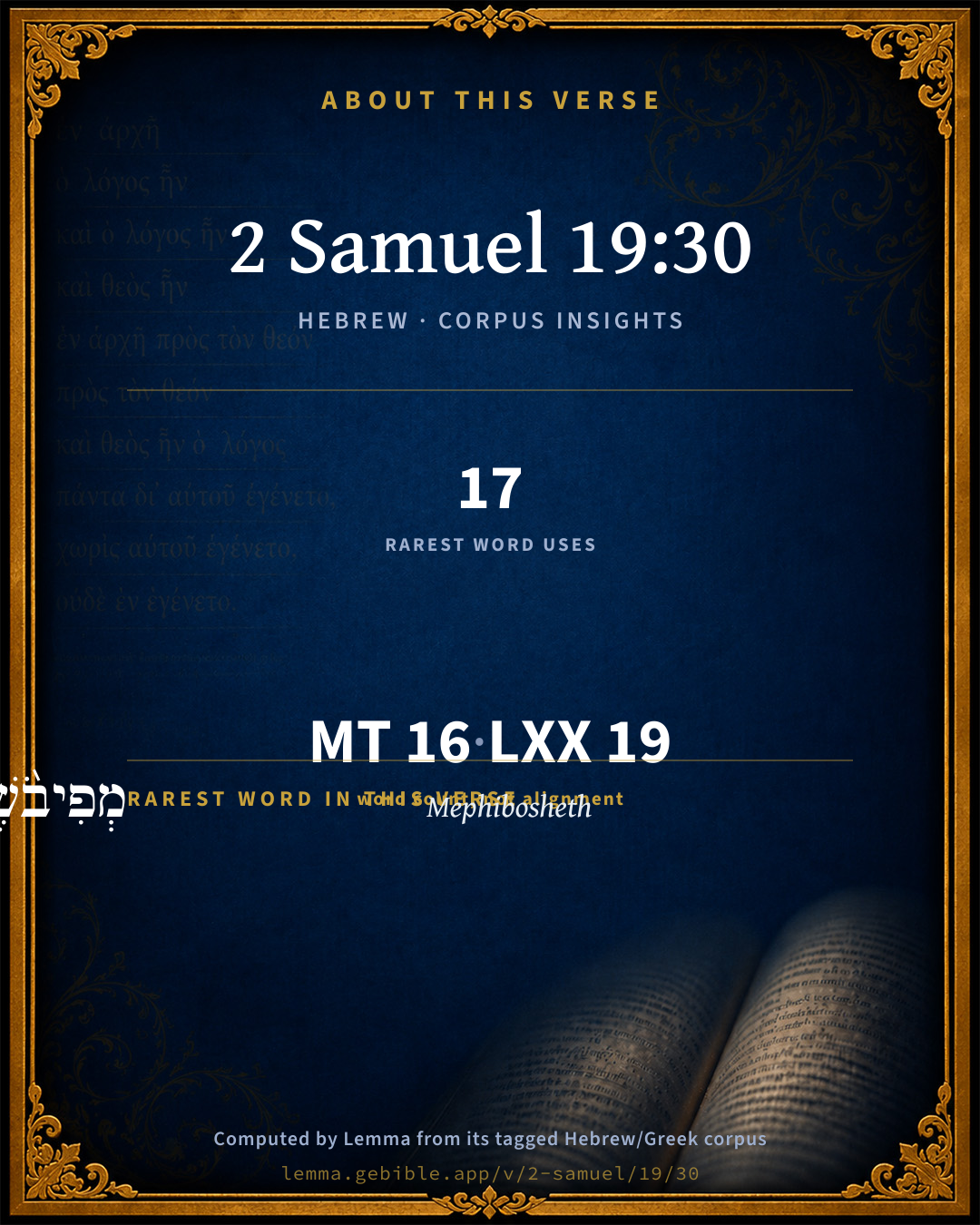
The rarest word here is מְפִיבֹ֨שֶׁת֙ Mephibosheth H4648 — appearing just 17 times in the whole Hebrew Bible.

Shared distinctive vocabulary

מְפִיבֹ֨שֶׁת֙ Mephibosheth H4648 occurs in 13 verses of the Hebrew Bible. Also found in:

Grammatical profile

  • 3 verbs
  • 7 nouns
  • 3 prepositions
  • 3 particles

Verb forms

  • וַיֹּ֤אמֶר Qal · Sequential Imperfect
  • יִקָּ֑ח Qal · Jussive
  • בָּ֞א Qal · Perfect

Repetition

Words recur within this verse — often emphatic in Hebrew:

  • הַמֶּ֔לֶךְ king H4428 ×2
  • אֶל to H413 ×2

Hebrew & Septuagint length

In English translation the verse runs 23 words from the Hebrew and 23 from the Septuagint (LXX English) — the same length.

A rough comparison of the two English renderings, which tokenize alike — not a word-level alignment.

Word counts can differ between the Hebrew and the Greek without any difference in meaning — e.g. the Hebrew direct-object marker אֵת has no separate Greek word, and Greek often adds the article ὁ.

In the original languages it is 16 Hebrew tokens and 19 Greek tokens — but the two are counted differently (Hebrew bundles its prefixes and suffixes into one token; the Greek is in lemma form), so that isn’t a like-for-like length.

Cross-references

3

Topical passages linked to 2 Samuel 19:30 in the Treasury of Scripture Knowledge — connected by theme and wording, ordered by reader-vote popularity; previews shown in the World English Bible.

  • 2 Samuel 1:26 I am distressed for you, my brother Jonathan: Very pleasant have you been to me: Your love to me was wonderful, Passing the love of women.
  • Acts 20:24 But these things don't count; nor do I hold my life dear to myself, so that I may finish my race with joy, and the ministry which I received from the Lord Jesus, to fully testify to the Gospel of the grace of God.
  • Philippians 1:20 according to my earnest expectation and hope, that I will in no way be disappointed, but with all boldness, as always, now also Christ will be magnified in my body, whether by life, or by death.

Cross-references courtesy of OpenBible.info (CC BY 4.0).

Hebrew and Greek witnesses Masoretic Hebrew ↔ Greek Septuagint

The same verse in the two great witnesses to the Old Testament, shown verse-for-verse.

These are two independent witnesses, not word-aligned to each other, and the Septuagint is shown in lemma (dictionary) form.

Hebrew 2 Samuel 19:30 Masoretic · Westminster Leningrad Codex

וַיֹּ֤אמֶר מְפִיבֹ֨שֶׁת֙ אֶל הַמֶּ֔לֶךְ גַּ֥ם אֶת הַכֹּ֖ל יִקָּ֑ח אַ֠חֲרֵי אֲשֶׁר בָּ֞א אֲדֹנִ֥י הַמֶּ֛לֶך בְּשָׁל֖וֹם אֶל בֵּיתֽוֹ

Mephibosheth said to the king, yes, let him take all, because my lord the king is come in peace to his own house.

World English Bible · Public Domain

Greek LXX 2 Samuel 19:30 Septuagint · lemma form

καί εἶπον αὐτός ὁ βασιλεύς ἵνα τίς λαλέω ἔτι ὁ λόγος σύ εἶπον σύ καί σιβα διααἱρέω ὁ ἀγρός

And Memphibosthe said to the king, Yes, let him take all, since my lord the king has come in peace to his house.

LXX2012 (modern English Septuagint) · Public Domain

Hebrew: Westminster Leningrad Codex (CC BY 4.0). Greek: Septuagint (public domain); English from LXX2012 (modern English Septuagint) (Public Domain). How the Septuagint differs from the Hebrew →

Targum (Aramaic paraphrase)

1

The Targum is the ancient Jewish Aramaic paraphrase of the Hebrew Scriptures — an interpretive translation, not the Hebrew text itself. Onkelos (literal) and Pseudo-Jonathan (expansive) render the Torah, and Jonathan the Prophets. Coverage is partial: where no permissively-licensed English translation exists for a verse, only the Aramaic is shown. This is verse-level text, not a word-by-word alignment to the Hebrew.

  1. Targum Jonathan Prophets (Joshua–Malachi)
    וַאֲמַר לֵיהּ מַלְכָּא לְמָא תְמַלֵיל עוֹד פִּתְגָמָךְ אֲמָרִית אַתְּ וְצִיבָא תִּפְלְגוּן יַת אַחְסַנְתָּא:

    (no public-domain English translation for this verse)

    Targum Jonathan — Aramaic: “Mikraot Gedolot” (public domain). English: “Sefaria Community Translation” (CC0 1.0 (public-domain dedication)); “London "Chaldee Paraphrase," 1871” (public domain). Text via Sefaria.

Commentary

Notes on 2 Samuel 19:30 from classic Christian and Jewish commentators (each source and its license shown beneath its notes). The classic Christian expositions comment on the surrounding passage and are grouped to its opening verse, so a note may address several verses; the Jewish commentaries on the Tanakh (Rashi and others) are per-verse, so they appear only where the commentator wrote on this verse.

Lemma curates 59 commentaries, every one of them public domain or Creative Commons licensed, each selected and text-cleaned for this edition rather than reprinted as found. About our sources →

Trapp's Complete Commentary

John Trapp

2Sa 19:30 And Mephibosheth said unto the king, Yea, let him take all, forasmuch as my lord the king is come again in peace unto his own house.

Ver. 30. Yea, let him take all] Ego enim satis dives ac beatus mihi videor, for I am well enough and rich enough, now that thou art safe returned. Seneca could say to his friend who was in heaviness, Fas tibi non est, salvo Caesare, de fortuna tua queri: hoc incolumi, salvi tibi sunt tui, &c. It is not fit for thee to complain of thy hard lot, so long as Caesar is in safety.

John Trapp, A Commentary or Exposition upon All the Books of the Old and New Testament (1647–1656) — public domain. Text from a community e-Sword module.

Joseph Benson's Commentary

2Sa 19:30. Mephibosheth said, Yea, let him take all — Nothing could be more generously spoken, or signify greater affection, than that he was content to be without an estate, now the king was restored to his kingdom.

Joseph Benson's Commentary on the Old and New Testaments (1811–1818) — public domain. Text from a community e-Sword module.

Tyndale Open Study Notes

Tyndale Open Resources

19:30 Mephibosheth’s disinterest in claiming even half of his property showed conclusively that his happiness over David’s return was genuine.

Tyndale Open Study Notes — © Tyndale Open Resources, licensed CC BY-SA 4.0. Text via the HelloAO Bible API.

The Cambridge Bible for Schools and Colleges

gen. ed. J. J. S. Perowne

30. Yea, let him take all] Mephibosheth’s affection was for his master, not for his property. There is no reason for supposing that his version of the story was false and Ziba’s true, in spite of Blunt’s ingenious arguments to prove that he was a traitor and a hypocrite (Undes. Coinc. p. 157 ff.).

The Cambridge Bible for Schools and Colleges (gen. ed. J. J. S. Perowne; Cambridge University Press, 1878–1918) — public domain. Text from a community e-Sword module.

John Gill's Exposition

And Mephibosheth said unto the king, yea, let him take all,.... The whole estate, as David had given it to him; he was content that that last grant should stand:

forasmuch as my lord the king is come again in peace unto his own house; his palace in Jerusalem; which was a strong expression of affection for him, and loyalty to him. (Solomn used a similar test to determine which woman's baby was alive. Kg1 3:16. He purposed the baby be cut in two to reveal who the real mother was. Likewise, David suggests the property should be divided between Ziba and Miphibosheth to determine the true loyalty of the later. Sa2 19:29 Editor.)

John Gill's Exposition of the Whole Bible (1746–1763) — public domain (CC PDM 1.0). Text via the HelloAO Bible API.

Haydock's Catholic Bible Commentary

House. He is all to me. (Menochius)

George Leo Haydock (1774–1849), Haydock's Catholic Family Bible and Commentary, 1859 edition — public domain. Excludes Psalms (Douay-Rheims chapter numbering differs from Protestant) and Deuterocanonical books (Catholic canon only).

Matthew Poole's English Annotations

I am contented to lose all, being fully satisfied with the happiness of seeing my dear and dread sovereign restored to his crown, and truth and peace returned to his kingdom.

Matthew Poole's English Annotations on the Holy Bible (1683–1685) — public domain. Text from a community e-Sword/MySword module.

Whedon's Commentary on the Bible

Daniel D. Whedon

30. Yea, let him take all — He delights more in the king’s safe return than in all his former estate, and yet these words contain, though undesignedly on his part, an expression of wounded feeling that the slanderous Ziba had received riches rather than punishment for his base calumnies.

Daniel D. Whedon (gen. ed.), Commentary on the Old and New Testaments (1874–1909) — public domain. Text from a community e-Sword module.

The Pulpit Commentary

Yea, let him take all. These words betray a feeling of resentment. Though outwardly they profess to regard the loss of the property with indifference, as compared with the joy of the king"s return, yet this sort of "I don"t care" answer usually covers anger. Blunt"s arguments ("Undesigned Coincidences," p. 157, etc.), to show that Mephibosheth really was a traitor, are ingenious, but not convincing.

The Pulpit Commentary (1880–1919), ed. H.D.M. Spence-Jones & Joseph S. Exell — public domain. Text from a community e-Sword module.

Lesson kit

Teaching starters — assembled from the data on this page, not authored interpretation. Every prompt links to the verse data it draws on. Edit before teaching.

2 Samuel, in the Historical, opens this verse with 16 words (14 distinct Hebrew lemmas). Its most distinctive word is Mᵉphîybôsheth (“Mephibosheth”). A historical commentator’s framing appears above. Read the whole chapter for the surrounding context.

Discussion questions

  1. The word Mᵉphîybôsheth carries the sense “Mephibosheth.” How does it shape the verse?
  2. 2 Samuel 4:4 shares the word «Mephibosheth» with this verse. How do the two illuminate each other?
  3. “king” occurs 2× in this one verse. What is the effect of the repetition?
  4. The translations on this page render this verse differently — a whole-verse word diff, not a word-by-word alignment. What might account for the different wordings?
  5. The verb «וַיֹּ֤אמֶר» is Qal Sequential Imperfect. How does its form color the action?
  6. Reading how Trapp's Complete Commentary and Joseph Benson's Commentary read this verse, where do the two commentators agree and where do they part?

Things to notice

Reading settings

Reading text

Shown beneath each verse's original-language words.

Old Testament
Old Testament edition

Read the OT as the Masoretic Hebrew (MT) or the Greek Septuagint (LXX).

English shown for the Greek Septuagint (in the Hebrew ↔ Greek comparison).

Comparing translations? Open the Compare panel on any verse page to stack up to four side by side.