Isaiah 32:17

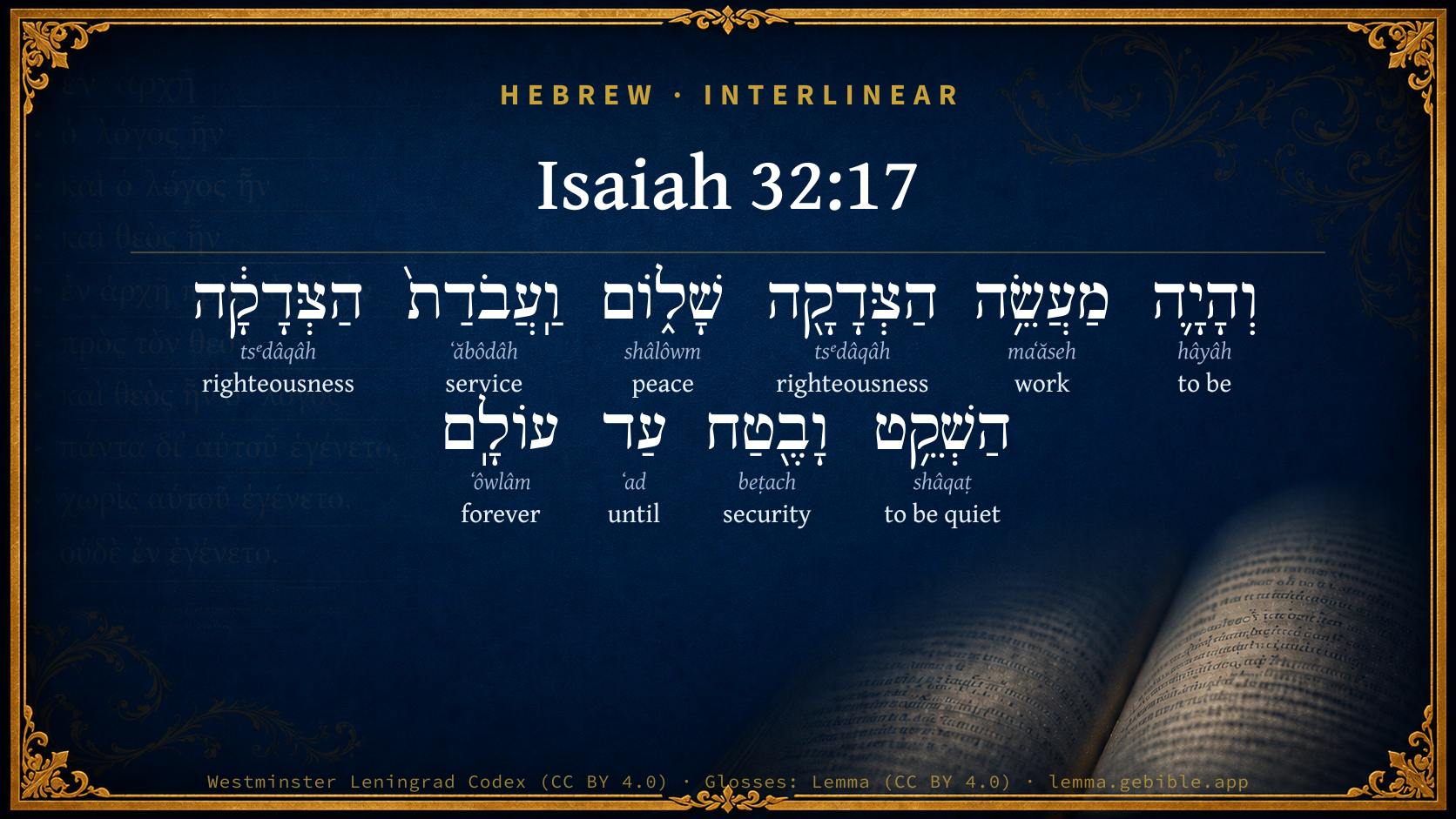
Hebrew (Westminster Leningrad Codex) Isaiah 32:17 appears in the Hebrew Old Testament. The text above is from the Westminster Leningrad Codex. Each word links to its Strong’s number, a concise gloss, and parsing drawn from the Open Scriptures Hebrew Bible morphology. Click any word for its full Brown-Driver-Briggs (BDB) entry.
Download image
Cite this verse

Isaiah 32:17 (World English Bible). Public Domain. Lemma interlinear Bible study tool, https://lemma.gebible.app/v/isaiah/32/17.

Show BibTeX & RIS
BibTeX
RIS
English Translation
The work of righteousness shall be peace; and the effect of righteousness, quietness and confidence forever.
World English Bible · Public Domain
Download a study sheet

One document with this verse’s original text, its word-by-word gloss line, the meaning frame, cross-references with their text, attributed commentary, and full source and license credits — printable, and it pastes into notes with its structure intact.

This verse Autodidact and up

Study sheet (.html) Plain text (.txt)

A passage Seminary Student

Up to 50 verses in one chapter. A passage sheet keeps up to 6 commentary sources and 12 cross-references per verse, in the order this page ranks them, and says so on the sheet whenever that leaves anything out. Ask for a single verse and you get the Autodidact verse sheet above.

Everything on this page stays free to read, with no account — the sheet is a download of what is already on screen, not access to it.

Want to remove ads? Support Godless Engineer
Compare translations 3

The same verse in 3 English versions, stacked beneath the original-language interlinear above. Click any original word for its lexicon entry.

Each is an independent rendering of the whole verse — the interlinear is not word-aligned to these translations.

Highlighted words mark where these versions differ — a whole-verse word diff, not a word-by-word alignment.

  • World English Bible Public Domain
    The work of righteousness shall be peace; and the effect of righteousness, quietness and confidence forever.
  • King James Version Public Domain
    And the work of righteousness shall be peace; and the effect of righteousness quietness and assurance for ever.
  • unfoldingWord Literal Text CC BY-SA 4.0
    And the work of righteousness peace, and the service of righteousness, being quiet and confidence forever.

unfoldingWord Literal Text — © unfoldingWord, licensed CC BY-SA 4.0. Word-aligned USFM3 via Door43 (git.door43.org/unfoldingWord/en_ult).

Versions to compare (up to 4)

3 of 4 selected

Show all 18 translations

Every available English version of this verse, each an independent rendering of the whole verse.

  • World English Bible Public Domain
    The work of righteousness shall be peace; and the effect of righteousness, quietness and confidence forever.
  • Berean Standard Bible Public Domain
    The work of righteousness will be peace; the service of righteousness will be quiet confidence forever.
  • Majority Standard Bible Public Domain
    The work of righteousness will be peace; the service of righteousness will be quiet confidence forever.
  • King James Version Public Domain
    And the work of righteousness shall be peace; and the effect of righteousness quietness and assurance for ever.
  • American Standard Version (1901) Public Domain
    And the work of righteousness shall be peace; and the effect of righteousness, quietness and confidence for ever.
  • Revised Version (1885) Public Domain
    And the work of righteousness shall be peace; and the effect of righteousness quietness and confidence for ever.
  • Geneva Bible (1599) Public Domain
    And the worke of iustice shall bee peace, euen the worke of iustice and quietnesse, and assurance for euer.
  • Douay-Rheims (1899) Public Domain
    And the work of justice shall be peace, and the service of justice quietness, and security for ever.
  • Young's Literal Translation Public Domain
    And a work of the righteousness hath been peace, And a service of the righteousness -- Keeping quiet and confidence unto the age.
  • Literal Standard Version CC BY-SA 4.0
    And a work of the righteousness has been peace, || And a service of the righteousness—Keeping quiet and confidence for all time.
  • Unlocked Literal Bible CC BY-SA 4.0
    The work of righteousness will be peace; and the result of righteousness, quietness and confidence forever.
  • unfoldingWord Literal Text CC BY-SA 4.0
    And the work of righteousness peace, and the service of righteousness, being quiet and confidence forever.
  • Darby Bible Public Domain
    And the work of righteousness shall be peace; and the effect of righteousness, quietness and assurance for ever.
  • World Messianic Bible Public Domain
    The work of righteousness will be peace, and the effect of righteousness, quietness and confidence forever.
  • Webster's Bible Public Domain
    And the work of righteousness shall be peace; and the effect of righteousness, quietness and assurance for ever.
  • Free Bible Version CC BY-SA 4.0
    Living right will bring peace and security that endures.
  • Bible in Basic English Public Domain
    And the work of righteousness will be peace; and the effect of an upright rule will be to take away fear for ever.
  • JPS Tanakh (1917) Public Domain
    And the work of righteousness shall be peace; and the effect of righteousness quietness and confidence for ever.

Literal Standard Version (2020), Covenant Press — licensed CC BY-SA 4.0. Text via the HelloAO Bible API (eBible.org). Unlocked Literal Bible (unfoldingWord) — licensed CC BY-SA 4.0. Text via the HelloAO Bible API (eBible.org). unfoldingWord Literal Text — © unfoldingWord, licensed CC BY-SA 4.0. Word-aligned USFM3 via Door43 (git.door43.org/unfoldingWord/en_ult). Free Bible Version, Dr. Jonathan Gallagher — licensed CC BY-SA 4.0. Text via the HelloAO Bible API (eBible.org).

Word by word

More ways to search: Search by grammar → Find every occurrence → Compare this word →

Practice this passage: Drill this verse → Learn its vocabulary →

הַשְׁקֵ֥ט
shâqaṭ
H8252
“to be quiet”
Verb, Hiphil, Infinitive Absolute
Part of Speech
Verb
Stem
Hiphil
Form
Infinitive Absolute
Full BDB Definition

Origin: a primitive root

TWOT: 2453

to be quiet, be tranquil, be at peace, be quiet, rest, lie still, be undisturbed - (Qal) - to be quiet, be undisturbed - to be at peace (of land) - to be quiet, be inactive - (Hiphil) - to show quietness - quietness, display of quietness (substantive) - to quiet, be quiet - to cause quietness, pacify, allay
  1. וְהָיָ֛ה hâyâh H1961 “and · to be” Conjunction + Verb, Qal, Sequential Perfect, 3rd Person, Masculine, Singular
  2. מַעֲשֵׂ֥ה maʻăseh H4639 “work of” Noun, Common, Masculine, Singular, Construct
  3. הַצְּדָקָ֖ה tsᵉdâqâh H6666 “the · righteousness” Particle, Definite Article + Noun, Common, Feminine, Singular, Absolute
  4. שָׁל֑וֹם shâlôwm H7965 “peace” Noun, Common, Masculine, Singular, Absolute
  5. וַֽעֲבֹדַת֙ ʻăbôdâh H5656 “and · service of” Conjunction + Noun, Common, Feminine, Singular, Construct
  6. הַצְּדָקָ֔ה tsᵉdâqâh H6666 “the · righteousness” Particle, Definite Article + Noun, Common, Feminine, Singular, Absolute
  7. וָבֶ֖טַח beṭach H983 “and · security” Conjunction + Noun, Common, Masculine, Singular, Absolute
  8. עַד ʻad H5704 “until” Preposition
  9. עוֹלָֽם ʻôwlâm H5769 “forever” Noun, Common, Masculine, Singular, Absolute

About this verse

These counts appear in no published source. They are computed here, from the morphology-tagged text and Lemma’s own curated glosses. What Lemma adds →

10
words
9
distinct lemmas
Prophets
section

Shared distinctive vocabulary

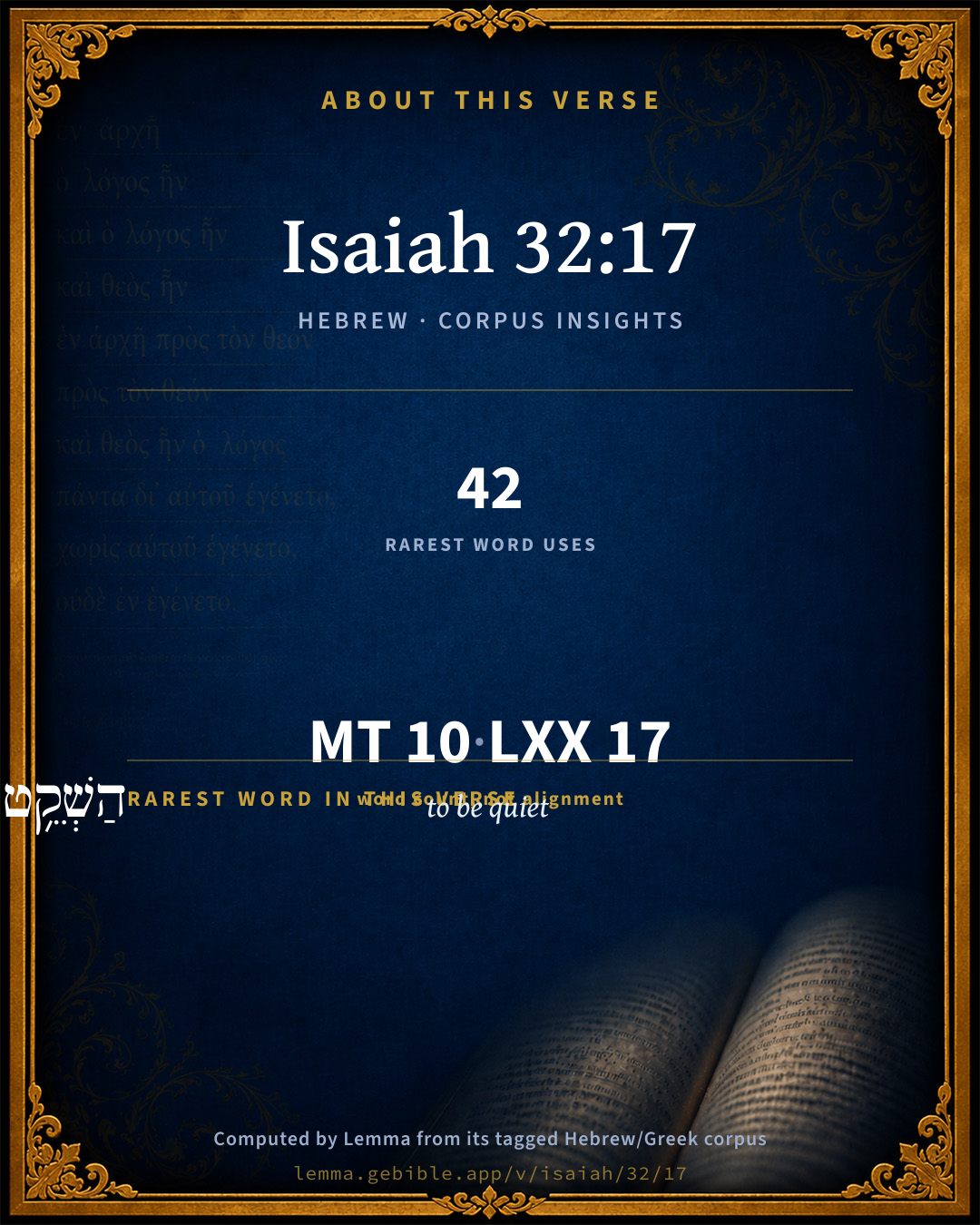
הַשְׁקֵ֥ט to be quiet H8252 occurs in 41 verses of the Hebrew Bible. Also found in:

Grammatical profile

  • 2 verbs
  • 7 nouns
  • 1 preposition

Verb forms

  • וְהָיָ֛ה Qal · Sequential Perfect
  • הַשְׁקֵ֥ט Hiphil · Infinitive Absolute

Repetition

A word recurs within this verse — often emphatic in Hebrew:

  • הַצְּדָקָ֖ה righteousness H6666 ×2

Hebrew & Septuagint length

In English translation the verse runs 16 words from the Hebrew and 21 from the Septuagint (LXX English) — closely comparable.

A rough comparison of the two English renderings, which tokenize alike — not a word-level alignment.

Word counts can differ between the Hebrew and the Greek without any difference in meaning — e.g. the Hebrew direct-object marker אֵת has no separate Greek word, and Greek often adds the article ὁ.

In the original languages it is 10 Hebrew tokens and 17 Greek tokens — but the two are counted differently (Hebrew bundles its prefixes and suffixes into one token; the Greek is in lemma form), so that isn’t a like-for-like length.

Cross-references

28

Topical passages linked to Isaiah 32:17 in the Treasury of Scripture Knowledge — connected by theme and wording, ordered by reader-vote popularity; previews shown in the World English Bible.

  • Isaiah 26:3 You will keep [him] in perfect peace, [whose] mind [is] stayed [on you]; because he trusts in you.
  • Psalms 119:165 Those who love your law have great peace. Nothing causes them to stumble.
  • Romans 14:17 for the Kingdom of God is not eating and drinking, but righteousness, peace, and joy in the Holy Spirit.
  • Philippians 4:6–9 In nothing be anxious, but in everything, by prayer and petition with thanksgiving, let your requests be made known to God.
  • James 3:17–18 But the wisdom that is from above is first pure, then peaceful, gentle, reasonable, full of mercy and good fruits, without partiality, and without hypocrisy.
  • Psalms 85:8 I will hear what God, Yahweh, will speak, For he will speak peace to his people, his saints; But let them not turn again to folly.
  • 2 Peter 1:10–11 Therefore, brothers, be more diligent to make your calling and election sure. For if you do these things, you will never stumble.
  • 1 John 3:18–24 My little children, let's not love in word only, neither with the tongue only, but in deed and truth.
  • 1 John 4:17 In this love has been made perfect among us, that we may have boldness in the day of judgment, because as he is, even so are we in this world.
  • Isaiah 11:6–9 The wolf shall dwell with the lamb, and the leopard shall lie down with the kid; and the calf and the young lion and the fattened calf together; and a little child shall lead them.
  • Ezekiel 39:29 neither will I hide my face any more from them; for I have poured out my Spirit on the house of Israel, says the Lord Yahweh.
  • Isaiah 55:12 For you shall go out with joy, and be led forth with peace: the mountains and the hills shall break forth before you into singing; and all the trees of the fields shall clap their hands.
  • Isaiah 57:19 I create the fruit of the lips: Peace, peace, to him who is far off and to him who is near, says Yahweh; and I will heal him.
  • Isaiah 48:18 Oh that you had listened to my commandments! then had your peace been as a river, and your righteousness as the waves of the sea:
  • Hebrews 6:11 We desire that each one of you may show the same diligence to the fullness of hope even to the end,
  • Isaiah 54:13–14 All your children shall be taught of Yahweh; and great shall be the peace of your children.
  • Micah 4:3–4 And he will judge between many peoples, And will decide concerning strong nations afar off. They will beat their swords into plowshares, And their spears into pruning hooks. Nation will not lift up sword against nation, Neither will they learn war any more.
  • 2 Corinthians 1:12 For our boasting is this: the testimony of our conscience, that in holiness and sincerity of God, not in fleshly wisdom but in the grace of God we behaved ourselves in the world, and more abundantly toward you.
  • Psalms 72:2–3 He will judge your people with righteousness, And your poor with justice.
  • Psalms 112:6–9 For he will never be shaken. The righteous will be remembered forever.
  • Proverbs 14:26 In the fear of Yahweh is a secure fortress, And he will be a refuge for his children.
  • Isaiah 2:3–4 Many peoples shall go and say, "Come, let's go up to the mountain of Yahweh, To the house of the God of Jacob; And he will teach us of his ways, And we will walk in his paths. For out of Zion the law shall go forth, And the word of Yahweh from Jerusalem.
  • Isaiah 11:13 The envy also of Ephraim shall depart, and those who vex Judah shall be cut off: Ephraim shall not envy Judah, and Judah shall not vex Ephraim.
  • Isaiah 30:15 For thus said the Lord Yahweh, the Holy One of Israel, In returning and rest shall you be saved; in quietness and in confidence shall be your strength. You would not:
  • Isaiah 66:12 For thus says Yahweh, Behold, I will extend peace to her like a river, and the glory of the nations like an overflowing stream: and you shall suck [of it]; you shall be borne on the side, and shall be dandled on the knees.
  • Ezekiel 37:21–22 Say to them, Thus says the Lord Yahweh: Behold, I will take the children of Israel from among the nations, where they are gone, and will gather them on every side, and bring them into their own land:
  • Ezekiel 37:25 They shall dwell in the land that I have given to Jacob my servant, in which your fathers lived; and they shall dwell therein, they, and their children, and their children's children, forever: and David my servant shall be their prince for ever.
  • Isaiah 9:7 Of the increase of his government and of peace there shall be no end, on the throne of David, and on his kingdom, to establish it, and to uphold it with justice and with righteousness from henceforth even forever. The zeal of Yahweh of Hosts will perform this.

Cross-references courtesy of OpenBible.info (CC BY 4.0).

Hebrew and Greek witnesses Masoretic Hebrew ↔ Greek Septuagint

The same verse in the two great witnesses to the Old Testament, shown verse-for-verse.

These are two independent witnesses, not word-aligned to each other, and the Septuagint is shown in lemma (dictionary) form.

Hebrew Isaiah 32:17 Masoretic · Westminster Leningrad Codex

וְהָיָ֛ה מַעֲשֵׂ֥ה הַצְּדָקָ֖ה שָׁל֑וֹם וַֽעֲבֹדַת֙ הַצְּדָקָ֔ה הַשְׁקֵ֥ט וָבֶ֖טַח עַד עוֹלָֽם

The work of righteousness shall be peace; and the effect of righteousness, quietness and confidence forever.

World English Bible · Public Domain

Greek LXX Isaiah 32:17 Septuagint · lemma form

καί εἰμί ὁ ἔργον ὁ δικαιοσύνη εἰρήνη καί κρατέω ὁ δικαιοσύνη ἀνάπαυσις καί πείθω ἕως ὁ αἰών

And the works of righteousness shall be peace; and righteousness shall ensure rest, and the righteous shall be confident for ever.

LXX2012 (modern English Septuagint) · Public Domain

Hebrew: Westminster Leningrad Codex (CC BY 4.0). Greek: Septuagint (public domain); English from LXX2012 (modern English Septuagint) (Public Domain). How the Septuagint differs from the Hebrew →

Targum (Aramaic paraphrase)

1

The Targum is the ancient Jewish Aramaic paraphrase of the Hebrew Scriptures — an interpretive translation, not the Hebrew text itself. Onkelos (literal) and Pseudo-Jonathan (expansive) render the Torah, and Jonathan the Prophets. Coverage is partial: where no permissively-licensed English translation exists for a verse, only the Aramaic is shown. This is verse-level text, not a word-by-word alignment to the Hebrew.

  1. Targum Jonathan Prophets (Joshua–Malachi)
    וִיהוֹן עָבְדֵי צְדַקְתָּא שְׁלָם וּמְפַלְחֵי צְדַקְתָּא יִשְׁקְטוּן וְיִשְׁרוּן לְרוֹחֲצָן עַד עָלְמַיָא:

    And they that do righteousness shall be at peace, and those that adorn righteousness shall be in quietness, and they shall be in safety for ever.

    Targum Jonathan — Aramaic: “Mikraot Gedolot” (public domain). English: “Sefaria Community Translation” (CC0 1.0 (public-domain dedication)); “London "Chaldee Paraphrase," 1871” (public domain). Text via Sefaria.

Commentary

Notes on Isaiah 32:17 from classic Christian and Jewish commentators (each source and its license shown beneath its notes). The classic Christian expositions comment on the surrounding passage and are grouped to its opening verse, so a note may address several verses; the Jewish commentaries on the Tanakh (Rashi and others) are per-verse, so they appear only where the commentator wrote on this verse.

Lemma curates 59 commentaries, every one of them public domain or Creative Commons licensed, each selected and text-cleaned for this edition rather than reprinted as found. About our sources →

Trapp's Complete Commentary

John Trapp

Isa 32:17 And the work of righteousness shall be peace; and the effect of righteousness quietness and assurance for ever.

Ver. 17. And the work of righteousness shall be peace.] Peace both of country and of conscience; none other but this last can last for ever.

Quietness and assurance for ever.] Such as the world giveth not, such as the wicked meddleth not with. The cock on the dunghill knoweth not the worth of this jewel; it is the new name that none knoweth but he who hath it. Oh this blessed "quietness and assurance for ever," this "boldness and access with confidence by the faith of him," {Eph 3:12} having a full certainty, {Luk 1:4} yea, a confident glorying and boasting, {Rom 5:3} so as to stand upon interrogatories, {1Pe 3:21} such as are those, {Rom 8:35-37} and to have God to make answer. {as Isa 43:25}

John Trapp, A Commentary or Exposition upon All the Books of the Old and New Testament (1647–1656) — public domain. Text from a community e-Sword module.

The Biblical Illustrator

Joseph S. Exell

Isa_32:17

And the work of righteousness shall be peace

The true work of life

I.

THE NATURE OF TRUE LIFE WORK--the work of righteousness. What is righteous work?

1. Working by right law. God has established a law to regulate all action and motion throughout His empire. What is the law by which mind is to be regulated? The will of God, not expediency. Of expediency, we are no safe, no correct judges.

(1) This will is revealed in nature. But the revelation is difficult to interpret.

(2) It is revealed in Christ. There it can be clearly read and easily appreciated. He embodied the great moral code.

2. Working by a right law from a right motive. A mere conformity to the letter of the law, if it could be obtained, is not righteousness. We must keep the law not from the fear of hell, or the hope of heaven, but from a predominant affection for the Lawgiver. It is noteworthy that the work of righteousness is not a work to be limited to any department of action. Righteousness must run through all personal and social relationships.

II. THE BLESSEDNESS OF TRUE LIFE WORK. Peace. This is true.

1. Of individuals.

2. Of families.

3. Of churches.

4. Of nations.

Conclusion--Learn the transcendent worth of the Gospel. The great object of Christs mission was to promote righteousness. His life was a revelation of righteousness, His death a demonstration of righteousness, His whole history one great motive to righteousness. This is the supreme want of humanity. Legislation, philosophy, poets, priesthoods, civilisations, have tried to supply it and have failed. Christ alone can establish righteousness. (Homilist.)

Righteousness and peace

Peace is not a root, but a fruit. It is not the beginning of a process, but its end. It is not the summary creation of an imperial fiat; it is the matured product of the spiritual order. We cannot command peace; we can only grow it. If we would have the reapings we must attend to certain sewings. To obtain peace we must plant righteousness. (J. H. Jowett, M. A.)

The spiritual order

The first bugle-peal proclaims not the advent of peace but the enthronement of right! The herald withholds the word peace until righteousness is established. Behold, a king shall reign in righteousness! That is the voice of the first trumpet, and it is only when certain great redemptions have been wrought, certain perversities corrected, certain degraded monarchies restored, certain pure and muscular dispositions recovered, that we hear the sound of the second trumpet, And the work of righteousness shall be peace, &c. That is the expression of the spiritual order as contained in the teaching of the Divine Word. (J. H.Jowett, D. D.)

Peace

Peace is the general glow of health resulting from the inter-related life of many members, each of whom occupies his appointed place in the spiritual order, and is possessed by the spirit of equity and truth. Peace is the spirit of communion, the genius of co-operation, the cohesion of many members into one pure and indissoluble whole. Now there can be no cohesion among the unclean. Dirt is always divisive. (J. H. Jowett, D. D.)

Righteousness and peace

Before iniquity intruded King Arthurs court was whole, and the angel of peace abode in the temple. But when the iniquitous stole into the court, the rare communion was broken, and the angel of peace flew away into distant exile. (J. H. Jowett, D. D.)

Maladjustments

Maladjustments always produce unrest whether it be in the physical or moral life. You say, I cannot rest at night. How is that? I have a great deal of pain. Where? In this hand. How are you treating it? Oh, I bathe it very frequently, and I use a little ointment. But your finger is out of joint! There is a maladjustment. Your finger is not where God intended it to be. Your finger will have to be set right. Physical righteousness, physical rightness must be the first step to physical rest. The truth is analogous in the moral sphere. There are mal-adjustments there, disjointings there. (J. H.Jowell, D. D.)

Goodness and joy

Why are you singing? a lady asked a little girl. Oh, I dont know, unless it is because I have tried to be good to-day, was the answer.

The Biblical Illustrator, edited by Joseph S. Exell (c. 1880s–1900s) — public domain. Text from a community e-Sword module.

The Preacher's Complete Homiletical Commentary

Joseph S. Exell (gen. ed.)

PEACE THE WORK OF RIGHTEOUSNESS

Isa_32:17. The work of righteousness shall be peace; and the effect of righteousness quietness and assurance for ever.

A large part of the book of Isaiah is taken up in setting forth the glories and the blessedness of Christ’s kingdom. Sometimes this is done by grand images drawn from all that is brightest in the outward world (Isa_30:26). Sometimes the great change to be wrought in mankind is spoken of under the figure of a like change in the beasts of the field (Isa_11:6-9). Again, in other places, as in the text and the adjoining verses, the description puts on more of a moral and spiritual character, and declares how God will be glorified in the hearts and lives of men (Isa_32:15-17). On reading these descriptions of a time when the world is to be full of peace and blessedness, we can hardly help wishing we were in such a world. But that time is not yet come. Many places may we find, where all seem to be bent on hurting and destroying one another. But the sun himself, with his all-piercing eye, though he beholds every dwelling of man, cannot see a single village which is the abode of peace and quietness and assurance for ever. Nor has he in all his journeys seen such a state of things. Did the prophet, then, see falsely? Was the vision which he saw a lying vision? Not so. If the “work,” the effect, is wanting, it is that the cause is wanting. Did righteousness prevail upon the earth, there peace would also prevail. Wherever we find anything like true righteousness, and according to the degree of the likeness, we also find peace. Whatsoever is done to promote righteousness will also promote peace.

“The work of righteousness shall be peace.” The words have a sweet sound; but when we think of the whole meaning that lies wrapt up in them, they may well strike us with awe. For while they declare that righteousness shall produce peace, they at the same time imply that nothing but righteousness shall or can. How, then, can peace ever abide upon earth, or dwell in the heart of man?

Another disturbing recollection is, that when it has pleased the all-righteous God to show forth His righteousness, as in the days of Noah, the work of that righteousness was not peace, but horror, and desolation, and destruction. Even when the ministers and executors of earthly righteousness pass through a land, they do not bring peace to the culprits whom they visit. How, then, can the perfect righteousness of God bring peace to the sinful race of man? There is but one way, a way purposed by God in the counsels of His unfathomable wisdom, the way whereby He vouchsafes to bestow His own righteousness upon man, to the end that He may make man partaker of His peace.

Here some may object, that righteousness, with its sternness and terrors, does not seem to be, of all virtues and graces, the one best fitted to be the parent of peace. Rather, they may say, is peace the work of mercy: for that mercy alone can produce peace, at least in sinners; wherefore we are wont to pray God to grant us pardon and peace. This is true. Unless mercy be shown to sinners, they can never enjoy peace. Yet, unless mercy go along with righteousness, mercy cannot produce peace. If mercy allowed the sinners to abide in their sins, they would still be under the sentence which declares that there is no peace to the wicked [1204] Christ will never give peace alone. He will only give it along with righteousness,—first righteousness and then peace. Unless He had been the Lord our Righteousness, He could not have been the Prince of Peace. Therefore they who will not receive His righteousness, cannot receive His peace. To them He brings no peace, but a sword.

[1204] We may see this in human things. When a parent does not uphold order and law in his family, there will be no peace in that family. When a government does not uphold order and law in a nation, there will be no peace in that nation. They are to be upheld mercifully indeed; but still they are to be upheld. Now in man both are imperfect, both his righteousness and his mercy; and therefore they are ever jarring. Sometimes he will lean to the one, sometimes to the other; and so neither produces the, work of peace. But in God both are at one: neither shall hinder, neither can give way to the other. Sooner shall the heavens split, like a breaking wave, into foam, and melt away, than the slightest shadow of anything that is not perfectly righteous shall pass over the righteousness of God. Accordingly it could only be when perfect mercy and perfect truth met together, that righteousness and mercy could kiss each other. And thus alone shall any ever enjoy perfect peace, when they have received the full forgiveness of their sins from the perfect mercy of God, and are clothed in the perfect righteousness of Christ. Even in heaven there can be no peace, except it be the work of righteousness.—Hare.

But although the course of this world has never been answerable to the magnificent visions of ancient prophecy, still in some measure the prophecies have been fulfilled. To the godly, to all who believe in Christ and love Him, to all who desire to serve and obey Him, He has indeed brought peace; and even amid the endless tumults and troubles and jarrings of the world, they feel that He has done so. They feel that He has set them at peace with God, by making them partakers of that righteousness, of which peace is the work. Moreover, there is hardly one of our Lord’s commandments which does not tend, in proportion as we obey it, to fill our hearts with peace, which does not dry up one source or other of disquieting, harassing care [1207]

[1207] When He teaches us that the eye of God is ever watching over us, and the hand of God ever providing over us,—when He commands us to pray to God with confidence as to our heavenly Father, and to make all our wants and wishes known to Him,—hereby, if we give heed to His bidding, He at once hushes all those never-ending, still-beginning anxieties, which are the thorns and thistles planted by the curse in the human heart. When He teaches us to love our neighbours, and to forgive, nay, to love our enemies, He roots up all the causes which destroy peace and breed quarrels between man and man. Every passion that we subdue is so much gain to our peace; for every passion is a peacebreaker. Covetousness, ambition, lust, drunkenness, vanity, pride are peacebreakers. All these passions set us at variance with neighbours; all of them set us at variance with ourselves. Whereas, contentment, temperance, sobriety, chastity, modesty, meekness are peacemakers.—Hare.

We may now perceive why there is so little peace in the world. It is because there is so little righteousness. The effect cannot exist without the cause. The one simple commandment, “Love thy neighbour as thyself,” were it followed through all the branching duties into which it spreads, would turn the earth into a garden of peace.

“For the wicked,” God has said, “there is no peace.” But light is sown for the righteous, the light of joy and peace. The true disciple of Christ, he who has sought to be clothed in Christ’s righteousness, will always enjoy peace, even here on earth. He will enjoy it in every condition of life. In riches, in poverty, in health, in sickness, in every outward circumstance of life, in the hour of death, the godly, and they alone, enjoy peace: in the day of judgment they, and they alone, will enjoy peace. And the peace they will have enjoyed till then will only have been a poor faint foretaste of the peace into which they will then enter, of the peace of God, which passeth all understanding, and in the full enjoyment of which they will live thenceforward through eternity.—Julius Charles Hare, M.A.: Sermons Preacht in Herstmonceux Church, pp. 325–346.

The Bible is the revelation of a gracious remedy for evil. Points out rightful claims of the divine government. Charges the human race with disregard of those claims. Man is guilty of unrighteousness. There is universal sin. It is in man’s nature. It constitutes a moral disqualification for return. God’s remedial plan comprehends the provision of pardoning mercy, and of regenerating mercy. The former is found in the work of the Lord Jesus Christ, which constitutes a righteous ground on which the penal consequences of sin may be remitted. The latter, in this no less wonderful work of the Holy Spirit by which the sinner’s disposition undergoes a change that makes him a new creature in Christ Jesus. Let it be supposed that this is the universal experience: instead of unrighteousness, the righteousness that springs from such contact with Christ by His Spirit universally prevails. It is a change of which we do not despair. We are taught to expect it. Thus the text will be universally fulfilled.

I. INTERNATIONALLY.

One of the most awful facts of human history is the extent to which war has marked its track. In the causes of all wars unrighteousness is found. But if the supposition we have made were a reality, wars would become impossible. Nations and their rulers would repress the desire to possess themselves of what is not their own. If different interests induced different opinions between them, wise and righteous arbitration would prevent their imbruing their hands in each other’s blood. There would be “quietness and security for ever” (Isa_2:4; Isa_11:6-9).

II. SOCIALLY.

1. Would the scenes witnessed in our streets, and the revelations of police courts continue, if all men were characterised by the righteousness contemplated in our text? Because men are unrighteous, they encroach upon each other. The religion of Christ can be ill spared. Where its influence prevails, society is better, happier, more peaceful, more secure than elsewhere.

2. Think of the family. In the home all exhibit their true selves. Selfishness and injustice may render it a place of incessant strife. But our Christian homes, even where allowance has been made for infirmities and peculiarities, are usually pervaded by an atmosphere of peace and love. The influences that surround them produce mutual forbearance and studiousness of others, restrain the harder and develop the softer passions. Just in the measure in which the subduing influences of Christian character prevail will our homes be secure from strife and discomfort.

3. Think of the Church. There are divisions in the Church, it is said. But there is less alienation of heart than is commonly supposed. The common Christian’s sentiments override the separated denominations. So within the churches. Not many, in proportion to the whole, are divided. Animosity, as arising from difference of opinion, is restrained by Christian love. And if all were perfectly Christian, there would be none.

III. PERSONALLY.

1. There is peace with God. Because there is reconciliation in Christ.

2. There is peace within. The storms of distress and fear raised by the sense of sin are allayed by the cross. The discomfort of unsettled life—purposes is terminated by a decision with which the soul is satisfied. Its peace is enhanced by converse with heaven.

It is abiding peace. The peace in all aspects continues as long as the righteousness. The holiness of heaven, and therefore its peaceful rest, will continue for ever.

Have we this righteousness? Have we it in heart, in sympathy, in life? If not, we are on the side of unrighteousness. We are insecure. We need to be born again. O seek to possess and extend it.—J. Rawlinson.

The Preacher's Complete Homiletical Commentary (gen. ed. Joseph S. Exell; Funk & Wagnalls, c. 1892) — public domain (pre-1929). A full-Bible homiletical/sermon-outline anthology covering 65 of 66 books (2 John is absent from the source module). Text from a community e-Sword module.

Tyndale Open Study Notes

Tyndale Open Resources

32:17 Being right with God and humans will bring peace (Hebrew shalom; see 26:3; 48:18; 52:7; cp. Jas 3:18). Peace is more than the absence of conflict. It includes personal wholeness and does not depend on outside circumstances (see also Rom 5:1).

Tyndale Open Study Notes — © Tyndale Open Resources, licensed CC BY-SA 4.0. Text via the HelloAO Bible API.

Jamieson, Fausset & Brown

Robert Jamieson, A. R. Fausset & David Brown

work--the effect (Pro 14:34; Jam 3:18).

peace--internal and external.

Jamieson, Fausset & Brown — Commentary Critical and Explanatory on the Whole Bible (1871) — public domain (CC PDM 1.0). Text via the HelloAO Bible API.

Adam Clarke's Commentary

Verse 17. The work of righteousness] Righteousness works and produces peace.

The effect of righteousness] עבדת abodath, the culture. Righteousness, cultivated by peace, produces tranquillity of mind and permanent security. Reader, hast thou the principle? If so, dost thou cultivate it? If thou dost, thou hast peace of conscience, joy in the Holy Ghost, and a sure and certain hope of everlasting life.

Adam Clarke's Commentary on the Bible (1810–1826) — public domain. Text from a community e-Sword/MySword module.

The Cambridge Bible for Schools and Colleges

gen. ed. J. J. S. Perowne

17. work and effect are synonyms; both mean literally “work,” and both have the sense of “effect” (the latter only here used in this sense).

quietness and assurance] (R.V. confidence) cf. ch. Isa_30:15.

17, 18. The consequence of this supremacy of righteousness is universal tranquillity and security,—a contrast to the false carnal security denounced in Isa_32:9; Isa_32:11.

The Cambridge Bible for Schools and Colleges (gen. ed. J. J. S. Perowne; Cambridge University Press, 1878–1918) — public domain. Text from a community e-Sword module.

John Gill's Exposition

And the work of righteousness shall be peace,.... Not works of righteousness done by men, no, not by the best of men; for though peace may be had and enjoyed in doing them, yet it does not arise and flow from thence, because there is no justification by them, and salvation through them, without which there can be no true solid peace; nor the work of righteousness in men, which is their sanctification, and is indeed the work of God, and follows upon the pouring forth of his Spirit, and therefore bids fairer to be the sense than the former; yet peace is one part and branch of the work itself; see Rom 14:17 but the work of righteousness wrought out for man is rather meant, even the righteousness of Christ, a work proposed unto him, which he undertook, and has wrought out, and which was a work, and lay in working, and was a very toilsome and laborious one; the consequence of which is "peace", inward peace of soul now, and eternal peace hereafter; the righteousness of Christ applied removes the guilt of sin from the conscience, it being perfect justifies from all things, and yields a tranquillity and serenity of mind, which is had in a way of believing, in this righteousness now, and it will issue in everlasting peace and rest in the world to come; the end of the perfect and upright man, who is perfectly justified by Christ's righteousness, is peace, Psa 37:37,

and the effect of righteousness, quietness and assurance for ever; or, (q) "the service of righteousness"; the same as before, with the "work of righteousness": a service which Christ performed, as a servant, in obedience to the law, in the room and stead of his people; a service perfectly and completely done, and what is well pleasing unto God; and which, when a sensible sinner sees its interest in, produces "quietness" of soul, under the mighty hand of God, amidst all the calamities in the world, and judgments upon men, under the load of calumny and reproach cast upon him, and notwithstanding all the charges and accusations of Satan: moreover, this also gives "assurance for ever", of interest in divine things, in the love of God, and relation to him as a Father, in Christ as a Saviour and Redeemer, and in the glorious inheritance which this gives a title to; or a holy confidence and boldness at the throne of grace now, having this righteousness to make mention of as a justifying one, and also hereafter, before the throne of judgment, this being what will answer for him in a time to come.

(q) "et cultus justitiae", V. L. Montanus; "labor, seu operatio", Piscator, Cocceius.

John Gill's Exposition of the Whole Bible (1746–1763) — public domain (CC PDM 1.0). Text via the HelloAO Bible API.

Albert Barnes' Notes on the Bible

And the work of righteousness - That which righteousness produces; or the effect of the prevalence of righteousness on the nation.

Shall be peace - There shall be no internal agitation, and no conflicts with foreign nations.

Quietness and assurance - This is a beautiful description of the happy effect of the prevalence of piety; and it is as true now as it was in the time of Isaiah. True religion would put an end to strifes and litigations; to riots and mobs; to oppressions and tumults; to alarms and robbery; to battle, and murder, and conflict.

Albert Barnes' Notes on the Bible (1834–1885) — public domain. Text from a community e-Sword/MySword module.

Haydock's Catholic Bible Commentary

Peace. The just shall enjoy peace, under Ezechias.

George Leo Haydock (1774–1849), Haydock's Catholic Family Bible and Commentary, 1859 edition — public domain. Excludes Psalms (Douay-Rheims chapter numbering differs from Protestant) and Deuterocanonical books (Catholic canon only).

Matthew Poole's English Annotations

The work of righteousness shall be peace; the effect of this prevailing practice of righteousness shall be prosperity and outward felicity.

Quietness; tranquillity, both of mind and outward estate.

Assurance; or, confidence. The observation of God’s precepts will beget in them a confidence and assurance of God’s mercy, and the fulfilling of his promises.

Matthew Poole's English Annotations on the Holy Bible (1683–1685) — public domain. Text from a community e-Sword/MySword module.

The Pulpit Commentary

The work of righteousness shall be peace. Peace a true peace, not a false one (Jer_6:14) shall be the result of the reign of righteousness. War, quarrels, enmity, hostile feelings, are all of them the fruit of unrighteousness. In the kingdom of the Messiah, just so far forth as it is thoroughly established, "the fruit of righteousness is sown in peace of them that make peace". (Jam_3:18) The effect of righteousness ; literally, the service of righteousness, which perhaps means here "the wages of righteousness." Quietness and assurance; or, quietness and confidence. (comp. Isa_30:15) The final happiness of the blessed in Christ"s kingdom is always spoken of as a state of "rest and quietness". (see Psa_95:11Jo Psa 3:17 Jer_6:16 Mat_11:28 Heb_4:9-11, etc.) The "confidence" felt would be an assured confidence, not a rash and foolish one, like that of the women of vers. 10, 11.

Vers. 17, 18. peaceable fruit of righteousness.

Righteousness and peace may be supposed to be entirely separate things; by those who look only on the surface they may even be imagined to be opposed to one another. In fact, they are closely and even vitally related to each other.

I THOSE WHO ARE INCAPABLE OF RIGHTEOUSNESS ARE UNRECEPTIVE OF PEACE. To them peace is simply incommunicable; it does not come within the range of their faculties. The horse, the swallow, the salmon, the unintelligent and irresponsible animal, may have quietude and comfort, but it cannot enjoy peace, in the fullest and truest sense in which we use that word. It is only capable of that sense of satisfaction which attends a perfect adjustment of its circumstances to its bodily nature; but that is not peace. Peace is that spiritual contentment which results from inward as well as outward harmony from a sense of rectitude, a consciousness that everything is right in its most important, most sacred relationships. They who are beneath the sense of responsibility, and are therefore incapable of righteousness, can never possibly attain to the possession of peace; they are constitutionally below it.

II THEY WHO HAVE LOST RIGHTEOUSNESS MUST REGAIN IT BEFORE THEY CAN HAVE THE HERITAGE OF PEACE.

1. This is so with the comer, unity. When the country, or the company, or the Church has fallen into disorder because it has fallen into error and the commission of wrong, there is but one way to regain the harmony which has been lost. Absolutism will never yield it. Force will not secure it. Compromise will not permanently restore it. Nothing will avail until righteousness is re-established. Justice must be done to those to whom it has been denied. Rights must be conceded to those who have fairly won them. Relations must be adjusted to changed conditions; every one and everything must make way for rectitude. In no other way whatever will the path of peace be found.

2. It is thus with the human soul. We have all wandered from the way of wisdom and of righteousness; we have refused to God the love, the reverence, the service which is his due and which it is our highest interest to render. We have thereby become disordered, disquieted, confused; instead of dwelling in "a peaceable habitation," in "quiet resting-places," we have become inhabitants of a realm of condemnation, reproach, peril, agitation, misery. There is no way back to the home of rest which we have left behind us but by a return to righteousness; that is to say, by repentance, the turning our back on the sinful selfishness in which we have been living, and becoming right with God, accepting the gracious offer of his Son our Savior. (Mat_11:28, Mat_11:29)

(1) Rejection of truth may give a false security;

(2) absorption in worldly pursuits or in pleasurable excitements may provide temporary indifference; but only righteousness, only the restoration of the soul to its true relation to God, by repentance and faith, will give peace.

III RIGHTEOUSNESS WILL ENSURE PEACE BOTH IN POSSESSION AND IS PROSPECT. It will effect:

1. Reconciliation with God, and the consequent peace which passes understanding a blissful, satisfying "rest unto the soul," which is incomparably more precious than any earthly satisfaction to the body or the spirit.

2. The inward and abiding rest which belongs to spiritual harmony; this is the invariable consequence of the soul being in a right relation with the Supreme, and with its fellows, and of all its faculties being rightly related to one another.

3. A peaceful departure from the present life.

4. A home in the quiet resting-place of the heavenly land. C.

Righteousness and peace.

Christianity means "righteousness," and "righteousness" is an active power, ever working towards the production of peace, quietness, and mutual confidence. "The element of peace is that by which order is established and perpetuated, people are brought to cordial agreement and willing submission, unity is made a living and growing fact, and all the arts of domestic life and of civilized communities are promoted." The great Napoleon said, "War is the business of barbarians." Our own Wellington said, "Men who have nice notions of religion have no business to be soldiers." Lord Brougham said, I abominate war as unchristian. I hold it the greatest of human crimes. I deem it to include all others violence, blood, rapine, fraud, everything that can deform the character, alter the nature, and debase the name of man." John Howe wrote in this way, "Very plain it is that war is a mark of the apostasy, and stigmatizes man as fallen from God, in a degenerated, revolted state; it is the horrid issue of men"s having forsaken God, and of their being abandoned by him to the hurry of their own furious lusts and passions.

I CHRISTIANITY IS, DISTINCTIVELY, RIGHTEOUSNESS. This is its essential characteristic, and its necessary work. In this it stands alone, differing from all other religions. Matthew Arnold finds an expression for God which, though it has been well scorned, is really suggestive and helpful. He speaks of him as "the Eternal which makes for righteousness," which is always working towards this end, and regards this as the highest of all attaiments. Other religions propose methods for propitiating God; in Christianity God proposes to make men good. Jesus Christ is the first, the model Christian, and he is good harmless, undefiled, separate from sinners." His requirement, of all his disciples, is personal character righteousness. Apostles say of this religion, "Herein is the righteousness of God revealed, from faith to faith." Christ"s personal call is, "Be ye holy, for I am holy." Christian growth is "changing into his image from glory to glory." We must "follow peace with all men, and holiness, without which none can see the Lord." Prophets pictured the Christian ages, and saw holiness so pervading that it was even engraven on the bells of the horses. Let the Christian faith come to our hearts, and it will work out into righteousness. Let it go forth into society, and it will establish right principles, show right ways, give right impulses, tone with a right spirit, and work on until righteousness flows over all the land, like the waves of the sea.

II RIGHTEOUSNESS IS LINKED CLOSELY WITH PEACE. "The fruit of righteousness is sown in peace." These two things can never be separated. Find the one, and you will soon find also the other. Unrighteousness, uncharity, selfish passions, and war go naturally together, hand-in-hand. Begin "righteousness" anywhere, and you have started on its working an active power that makes for peace. Every soldier that walks our streets, every cannon forged in our arsenals, is a testimony that the sin-curse yet hangs over us. We are not yet "all righteous," or the sight and the sound of war would be heard no more. When, as individuals, we are set right with God, peace comes at once into our hearts, and peaceableness gives tone and character to all our relations. The inner conflicts are stayed; the struggles between the flesh and the spirit are checked; the fever-heat of ambition is soothed; charity and brotherhood bring us into peace with all men. The gospel comes, "preaching pence by Jesus Christ." Righteousness, thus getting round it the one small circle of a life, soon begins to widen its sphere. It rays out on every side. It flows forth, like a sweet scent, purifying the atmospheres wherever a man goes. Families would have a "peace passing understanding" if their members were "all righteous." Our Churches would cease to be the scenes of dissension, if the members were "all righteous." Social life would no longer witness the bitter antagonism of classes, if the people were "all righteous." Nations would soon turn wasteful war expenditure on armies and weapons into the fruitful channels of commerce, and gracious schemes of education and philanthropy, if righteousness did but pluck up ambitions, envyings, and rivalries, and plant in charity, brotherhood, and peace. Envy, hatred, malice, pride, ambition, these unrighteous things bring forth war. Charity, meekness, self-denial, these righteous things keep happy fellowship with gentle peace. "First pure, then peaceable." Alas that the prophetic picture should still seem to be but a vision of the distant future! But what a vision it is! and how our hearts spring towards it! Prophets paint it. Saints pray for it. God is working towards it. And it shall surely come. "The mountains shall bring peace to the people, and the little hills, by righteousness." "The kingdoms of this world have become the kingdoms of our Lord, and of his Christ the Prince of Peace, and he shall reign forever and ever. R.T.

"Quiet resting-places.

The figure in this verse is connected with the relief afforded by the destruction of Sennacherib"s army, and consequent retirement of Sennacherib to Assyria. Before the invaders all persons living in the country had to flee to the shelter of the walled cities, abandoning the property which they could not readily carry with them. On the removal of the invaders, the sense of security would return, and such persons would go home and find "quiet resting-places." We see in this passage an onlooking to the times when the Holy Ghost should be given, and. he, ruling in hearts and lives, would make for all trustful souls "quiet resting-places." Treating the text meditatively, we dwell on times when, for us, this promise is realized.

I THE QUIET RESTING OF EVENING-TIME. Such it is for wearied bodies and worn minds. Soothing is the calmness of natural evening, when the winds fail, the sun throws level yellow beams and long shadows, and the thousand noises of earth are subdued. Evening has a gracious influence on our spirits. It is the time for meditation, with Isaac. Very precious to Christian hearts are the quiet places for meditation, when holy feeling can be nourished.

II THE QUIET RESTING OF THE SABBATH. Its first idea is "rest." We feel quiet; as if a spell had been breathed over us. The strain of life is relaxed. The world is away. We belong to the eternal world. Life-bustle is stilled. We can give room to other thoughts, and so we rest, body, mind, and soul.

III THE QUIET RESTING OF TIMES OF AFFLICTION. Such times come into all lives. Times when we must be still. In illness, and in convalescence, there are many quiet, lonely hours. These are the scenes to which Christ invites us when he says, "Come ye into a desert place, and rest awhile.

IV THE QUIET RESTING-PLACE OF DEATH. The grave is spoken of as the "place where the wicked cease from troubling, and the weary are at rest." And the place where there are memorials of the dead is often a most "quiet resting-place" for the living. This may be illustrated by the soothing, silencing, solemnizing influence exerted on us by a visit to Westminster Abbey. On earth there can hardly be found a more "quiet resting-place." Sometimes the chamber where we watch the dying of a saint of God is such a place. Beautiful to see the pain-worn face at last go into the repose of death. When sinks the weary soul to rest." We may add that those who have found rest in God prove how graciously he gives restful moments in the very midst of the hurry and worry of life. R.T.

The Pulpit Commentary (1880–1919), ed. H.D.M. Spence-Jones & Joseph S. Exell — public domain. Text from a community e-Sword module.

John Wesley's Explanatory Notes

The work - The effect of this shall be prosperity. Quietness - Tranquility, both of mind and outward estate. Assurance - Of God's mercy, and the fulfilling of his promises.

John Wesley, Explanatory Notes Upon the Whole Bible (1754–1765) — public domain. Text via the GEBible commentary corpus.

J. A. Alexander on Isaiah

Joseph Addison Alexander

As the foregoing verse describes the effect of the effusion of the Spirit to be universal righteousness, so this describes the natural and necessary consequence of righteousness itself. “And the work of righteousness shall be peace, and the effect of righteousness rest and assurance (or security) forever.”

Joseph Addison Alexander, The Prophecies of Isaiah (1846–1847; New York: Scribner, 1870–1878) — public domain. Text from a community e-Sword module.

Ibn Ezra

Rabbi Abraham ibn Ezra

And the work of righteousness shall be peace, as in the time of Hezekiah. Comp. And peace without end (9:6) Some explain ver. 15 sqq. as a blessing.

Ibn Ezra on the Tanakh — English translations: “Sefaria Community Translation” (CC0 1.0 (public-domain dedication)); “Yalkut, Sifsei Chachomim Chumash, Metsudah Publications, 2009” (CC BY 4.0); and “Commentary of Ibn Ezra on Isaiah - trans. by M. Friedlander, 1873” (public domain). Text via Sefaria.

Lesson kit

Teaching starters — assembled from the data on this page, not authored interpretation. Every prompt links to the verse data it draws on. Edit before teaching.

Isaiah, in the Prophets, opens this verse with 10 words (9 distinct Hebrew lemmas). Its most distinctive word is shâqaṭ (“to be quiet”). A historical commentator’s framing appears above. Read the whole chapter for the surrounding context.

Discussion questions

  1. How does “to be quiet” (shâqaṭ) shape what this verse is saying?
  2. Joshua 11:23 shares the word «to be quiet» with this verse. How do the two illuminate each other?
  3. “righteousness” occurs 2× in this one verse. What is the effect of the repetition?
  4. These translations render this verse differently. What is at stake in choosing one wording over another?
  5. The verb «וְהָיָ֛ה» is Qal Sequential Perfect. How does its form color the action?
  6. Reading how Trapp's Complete Commentary and The Biblical Illustrator read this verse, where do the two commentators agree and where do they part?

Things to notice

Reading settings

Reading text

Shown beneath each verse's original-language words.

Old Testament
Old Testament edition

Read the OT as the Masoretic Hebrew (MT) or the Greek Septuagint (LXX).

English shown for the Greek Septuagint (in the Hebrew ↔ Greek comparison).

Comparing translations? Open the Compare panel on any verse page to stack up to four side by side.