
1 Chronicles 12:17

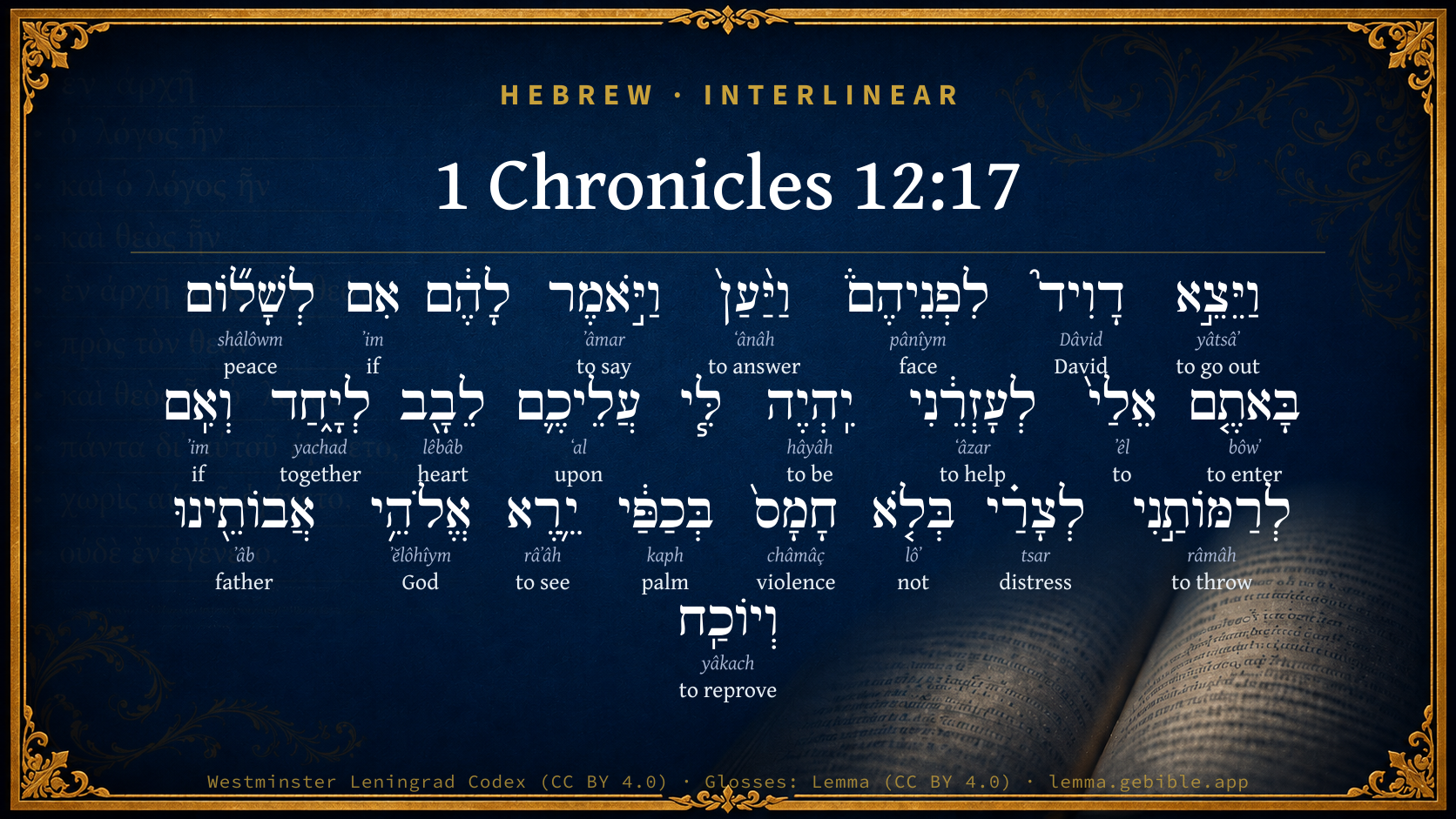
Hebrew (Westminster Leningrad Codex) 1 Chronicles 12:17 appears in the Hebrew Old Testament. The text above is from the Westminster Leningrad Codex. Each word links to its Strong’s number, a concise gloss, and parsing drawn from the Open Scriptures Hebrew Bible morphology. Click any word for its full Brown-Driver-Briggs (BDB) entry.
Download image
Cite this verse

1 Chronicles 12:17 (World English Bible). Public Domain. Lemma interlinear Bible study tool, https://lemma.gebible.app/v/1-chronicles/12/17.

Show BibTeX & RIS
BibTeX
RIS
English Translation
David went out to meet them, and answered them, If you be come peaceably to me to help me, my heart shall be knit to you; but if [you be come] to betray me to my adversaries, seeing there is no wrong in my hands, the God of our fathers look thereon, and rebuke it.
World English Bible · Public Domain
Download a study sheet

One document with this verse’s original text, its word-by-word gloss line, the meaning frame, cross-references with their text, attributed commentary, and full source and license credits — printable, and it pastes into notes with its structure intact.

This verse Autodidact and up

Study sheet (.html) Plain text (.txt)

A passage Seminary Student

Up to 50 verses in one chapter. A passage sheet keeps up to 6 commentary sources and 12 cross-references per verse, in the order this page ranks them, and says so on the sheet whenever that leaves anything out. Ask for a single verse and you get the Autodidact verse sheet above.

Everything on this page stays free to read, with no account — the sheet is a download of what is already on screen, not access to it.

Want to remove ads? Support Godless Engineer
Compare translations 3

The same verse in 3 English versions, stacked beneath the original-language interlinear above. Click any original word for its lexicon entry.

Each is an independent rendering of the whole verse — the interlinear is not word-aligned to these translations.

Highlighted words mark where these versions differ — a whole-verse word diff, not a word-by-word alignment.

  • World English Bible Public Domain
    David went out to meet them, and answered them, If you be come peaceably to me to help me, my heart shall be knit to you; but if [you be come] to betray me to my adversaries, seeing there is no wrong in my hands, the God of our fathers look thereon, and rebuke it.
  • King James Version Public Domain
    And David went out to meet them, and answered and said unto them, If ye be come peaceably unto me to help me, mine heart shall be knit unto you: but if ye be come to betray me to mine enemies, seeing there is no wrong in mine hands, the God of our fathers look thereon, and rebuke it.
  • unfoldingWord Literal Text CC BY-SA 4.0
    And David went out to their faces, and he answered and said to them: “If you have come to me in peace, to help me, a heart will be to me toward you for unity. But if to betray me to my adversaries, with no violence in my palms, may the God of our fathers see and judge.”

unfoldingWord Literal Text — © unfoldingWord, licensed CC BY-SA 4.0. Word-aligned USFM3 via Door43 (git.door43.org/unfoldingWord/en_ult).

Versions to compare (up to 4)

3 of 4 selected

Show all 18 translations

Every available English version of this verse, each an independent rendering of the whole verse.

  • World English Bible Public Domain
    David went out to meet them, and answered them, If you be come peaceably to me to help me, my heart shall be knit to you; but if [you be come] to betray me to my adversaries, seeing there is no wrong in my hands, the God of our fathers look thereon, and rebuke it.
  • Berean Standard Bible Public Domain
    And David went out to meet them, saying, “If you have come to me in peace to help me, my heart will be united with you; but if you have come to betray me to my enemies when my hands are free of violence, may the God of our fathers see it and judge you.”
  • Majority Standard Bible Public Domain
    And David went out to meet them, saying, “If you have come to me in peace to help me, my heart will be united with you; but if you have come to betray me to my enemies when my hands are free of violence, may the God of our fathers see it and judge you.”
  • King James Version Public Domain
    And David went out to meet them, and answered and said unto them, If ye be come peaceably unto me to help me, mine heart shall be knit unto you: but if ye be come to betray me to mine enemies, seeing there is no wrong in mine hands, the God of our fathers look thereon, and rebuke it.
  • American Standard Version (1901) Public Domain
    And David went out to meet them, and answered and said unto them, If ye be come peaceably unto me to help me, my heart shall be knit unto you; but if `ye be come' to betray me to mine adversaries, seeing there is no wrong in my hands, the God of our fathers look thereon, and rebuke it.
  • Revised Version (1885) Public Domain
    And David went out to meet them, and answered and said unto them, If ye be come peaceably unto me to help me, mine heart shall be knit unto you: but if ye be come to betray me to mine adversaries, seeing there is no wrong in mine hands, the God of our fathers look thereon, and rebuke it.
  • Geneva Bible (1599) Public Domain
    And Dauid went out to meete them, and answered and sayde vnto them, If yee be come peaceably vnto me to helpe me, mine heart shall be knit vnto you, but if you come to betray me to mine aduersaries, seeing there is no wickednes in mine handes, the God of our fathers beholde it, and rebuke it.
  • Douay-Rheims (1899) Public Domain
    And David went out to meet them, and said: If you are come peaceably to me to help me, let my heart be joined to you: but if you plot against me for my enemies whereas I have no iniquity in my hands, let the God of our fathers see, and judge.
  • Young's Literal Translation Public Domain
    and David goeth out before them, and answereth and saith to them, `If for peace ye have come in unto me, to help me, I have a heart to unite with you; and if to betray me to mine adversaries -- without violence in my hands -- the God of our fathers doth see and reprove.'
  • Literal Standard Version CC BY-SA 4.0
    and David goes out before them, and answers and says to them, “If you have come to me for peace, to help me, I have a heart to unite with you; and if to betray me to my adversaries—without violence in my hands—the God of our fathers sees and reproves.”
  • Unlocked Literal Bible CC BY-SA 4.0
    David went out to meet them and addressed them: “If you have come in peace to me to help me, you may join me. But if you have come to betray me to my adversaries, may the God of our ancestors see and rebuke you, since I have done no wrong.”
  • unfoldingWord Literal Text CC BY-SA 4.0
    And David went out to their faces, and he answered and said to them: “If you have come to me in peace, to help me, a heart will be to me toward you for unity. But if to betray me to my adversaries, with no violence in my palms, may the God of our fathers see and judge.”
  • Darby Bible Public Domain
    And David went out to meet them, and answered and said to them, If ye come peaceably to me to help me, my heart shall be knit unto you; but if to betray me to mine enemies, seeing there is no wrong in my hands, the God of our fathers see [it] and rebuke [it].
  • World Messianic Bible Public Domain
    David went out to meet them, and answered them, “If you have come peaceably to me to help me, my heart will be united with you; but if you have come to betray me to my adversaries, since there is no wrong in my hands, may the God of our fathers see this and rebuke it.”
  • Webster's Bible Public Domain
    And David went out to meet them, and answered and said to them, If ye have come peaceably to me to help me, my heart shall be knit to you: but if ye have come to betray me to my enemies, seeing there is no wrong in my hands, the God of our fathers look on it, and rebuke it.
  • Free Bible Version CC BY-SA 4.0
    David went out to meet them and told them, “If you've come in peace to help me, we can be friends. But if you've come to betray me to my enemies, even though I've done no wrong, then may the God of our fathers see what you're doing and condemn you.”
  • Bible in Basic English Public Domain
    And David went out to them, and said to them, If you have come in peace to give me help, my heart will be united with yours; but if you have come to give me up to those who would take my life, though my hands are clean from wrongdoing, then may the God of our fathers see it and give you punishment.
  • JPS Tanakh (1917) Public Domain
    (12-18) And David went out to meet them, and answered and said unto them: 'If ye be come peaceably unto me to help me, my heart shall be knit unto you; but if ye be come to betray me to mine adversaries, seeing there is no wrong in my hands, the God of our fathers look thereon, and give judgment.'

Literal Standard Version (2020), Covenant Press — licensed CC BY-SA 4.0. Text via the HelloAO Bible API (eBible.org). Unlocked Literal Bible (unfoldingWord) — licensed CC BY-SA 4.0. Text via the HelloAO Bible API (eBible.org). unfoldingWord Literal Text — © unfoldingWord, licensed CC BY-SA 4.0. Word-aligned USFM3 via Door43 (git.door43.org/unfoldingWord/en_ult). Free Bible Version, Dr. Jonathan Gallagher — licensed CC BY-SA 4.0. Text via the HelloAO Bible API (eBible.org).

Word by word

More ways to search: Search by grammar → Find every occurrence → Compare this word →

Practice this passage: Drill this verse → Learn its vocabulary →

לְרַמּוֹתַ֣נִי
râmâh
H7411
“to throw · me”
Preposition + Verb, Piel, Infinitive Construct + Suffix, Personal, 1st Person, Common, Singular
Part of Speech
Preposition + Verb
Stem
Piel
Form
Infinitive Construct
Full BDB Definition

Origin: a primitive root

TWOT: 2168 , 2169

to cast, shoot, hurl - (Qal) - to throw - bow-shooters, bowmen (participle) - (Piel) to throw down - to beguile, deceive, mislead, deal treacherously - (Piel) - to beguile, deceive, mislead, trick - to deal treacherously with, betray
  1. וַיֵּצֵ֣א yâtsâʼ H3318 “and · to go out” Conjunction + Verb, Qal, Sequential Imperfect, 3rd Person, Masculine, Singular
  2. דָוִיד֮ Dâvid H1732 “David” Noun, Proper
  3. לִפְנֵיהֶם֒ pânîym H6440 “to/for · face(s) · their” Preposition + Noun, Common, Both, Plural, Construct + Suffix, Personal, 3rd Person, Masculine, Plural
  4. וַיַּ֨עַן֙ ʻânâh H6030 “and · to answer” Conjunction + Verb, Qal, Sequential Imperfect, 3rd Person, Masculine, Singular
  5. וַיֹּ֣אמֶר ʼâmar H559 “and · to say” Conjunction + Verb, Qal, Sequential Imperfect, 3rd Person, Masculine, Singular
  6. אִם ʼim H518 “if” Conjunction
  7. לְשָׁל֞וֹם shâlôwm H7965 “to/for · peace” Preposition + Noun, Common, Masculine, Singular, Absolute
  8. בָּאתֶ֤ם bôwʼ H935 “to enter” Verb, Qal, Perfect, 2nd Person, Masculine, Plural
  9. אֵלַי֙ ʼêl H413 “to · me” Preposition + Suffix, Personal, 1st Person, Common, Singular
  10. לְעָזְרֵ֔נִי ʻâzar H5826 “to help · me” Preposition + Verb, Qal, Infinitive Construct + Suffix, Personal, 1st Person, Common, Singular
  11. יִֽהְיֶה hâyâh H1961 “to be” Verb, Qal, Imperfect, 3rd Person, Masculine, Singular
  12. עֲלֵיכֶ֛ם ʻal H5921 “upon · you” Preposition + Suffix, Personal, 2nd Person, Masculine, Plural
  13. לֵבָ֖ב lêbâb H3824 “heart” Noun, Common, Masculine, Singular, Absolute
  14. לְיָ֑חַד yachad H3162 “to/for · together” Preposition + Noun, Common, Masculine, Singular, Absolute
  15. וְאִֽם ʼim H518 “and · if” Conjunction + Conjunction
  16. לְצָרַ֗י tsar H6862 “to/for · distresses · my” Preposition + Noun, Common, Masculine, Plural, Construct + Suffix, Personal, 1st Person, Common, Singular
  17. בְּלֹ֤א lôʼ H3808 “in/at · not” Preposition + Particle, Negative
  18. חָמָס֙ châmâç H2555 “violence” Noun, Common, Masculine, Singular, Absolute
  19. בְּכַפַּ֔י kaph H3709 “in/at · palms · my” Preposition + Noun, Common, Feminine, Dual, Construct + Suffix, Personal, 1st Person, Common, Singular
  20. יֵ֛רֶא râʼâh H7200 “to see” Verb, Qal, Imperfect, 3rd Person, Masculine, Singular
  21. אֱלֹהֵ֥י ʼĕlôhîym H430 “God(s) of” Noun, Common, Masculine, Plural, Construct
  22. אֲבוֹתֵ֖ינוּ ʼâb H1 “fathers · our” Noun, Common, Masculine, Plural, Construct + Suffix, Personal, 1st Person, Common, Plural
  23. וְיוֹכַֽח yâkach H3198 “and · to reprove” Conjunction + Verb, Hiphil, Imperfect, 3rd Person, Masculine, Singular

About this verse

These counts appear in no published source. They are computed here, from the morphology-tagged text and Lemma’s own curated glosses. What Lemma adds →

26
words
23
distinct lemmas
Historical
section

Notable vocabulary

The rarest word here is לְרַמּוֹתַ֣נִי to throw H7411 — appearing just 13 times in the whole Hebrew Bible.

Shared distinctive vocabulary

לְרַמּוֹתַ֣נִי to throw H7411 occurs in 13 verses of the Hebrew Bible. Also found in:

Grammatical profile

  • 9 verbs
  • 10 nouns
  • 4 prepositions
  • 2 conjunctions
  • 1 particle

Verb forms

  • וַיֵּצֵ֣א Qal · Sequential Imperfect
  • וַיַּ֨עַן֙ Qal · Sequential Imperfect
  • וַיֹּ֣אמֶר Qal · Sequential Imperfect
  • בָּאתֶ֤ם Qal · Perfect
  • לְעָזְרֵ֔נִי Qal · Infinitive Construct
  • יִֽהְיֶה Qal · Imperfect
  • לְרַמּוֹתַ֣נִי Piel · Infinitive Construct
  • יֵ֛רֶא Qal · Imperfect
  • וְיוֹכַֽח Hiphil · Imperfect

Repetition

A word recurs within this verse — often emphatic in Hebrew:

  • אִם if H518 ×2

Hebrew & Septuagint length

In English translation the verse runs 55 words from the Hebrew and 49 from the Septuagint (LXX English) — closely comparable.

A rough comparison of the two English renderings, which tokenize alike — not a word-level alignment.

Word counts can differ between the Hebrew and the Greek without any difference in meaning — e.g. the Hebrew direct-object marker אֵת has no separate Greek word, and Greek often adds the article ὁ.

Cross-references

22

Topical passages linked to 1 Chronicles 12:17 in the Treasury of Scripture Knowledge — connected by theme and wording, ordered by reader-vote popularity; previews shown in the World English Bible.

  • 1 Peter 2:23 Who, when he was cursed, didn't curse back. When he suffered, didn't threaten, but committed himself to him who judges righteously;
  • Jude 1:9 But Michael, the archangel, when contending with the devil and arguing about the body of Moses, dared not bring against him an abusive condemnation, but said, "May the Lord rebuke you!"
  • Genesis 31:42 Unless the God of my father, the God of Abraham, and the fear of Isaac, had been with me, surely now you would have sent me away empty. God has seen my affliction and the labor of my hands, and rebuked you last night."
  • Genesis 31:53 The God of Abraham, and the God of Nahor, the God of their father, judge between us." Then Jacob swore by the fear of his father, Isaac.
  • 1 Samuel 16:4 Samuel did that which Yahweh spoke, and came to Bethlehem. The elders of the city came to meet him trembling, and said, Come you peaceably?
  • 1 Samuel 18:1 It happened, when he had made an end of speaking to Saul, that the soul of Jonathan was knit with the soul of David, and Jonathan loved him as his own soul.
  • 1 Samuel 18:3 Then Jonathan and David made a covenant, because he loved him as his own soul.
  • 1 Samuel 24:11–17 Moreover, my father, behold, yes, see the skirt of your robe in my hand; for in that I cut off the skirt of your robe, and didn't kill you, know you and see that there is neither evil nor disobedience in my hand, and I have not sinned against you, though you hunt after my life to take it.
  • 1 Samuel 26:23–24 Yahweh will render to every man his righteousness and his faithfulness; because Yahweh delivered you into my hand today, and I wouldn't put forth my hand against Yahweh's anointed.
  • 2 Samuel 3:20–25 So Abner came to David to Hebron, and twenty men with him. David made Abner and the men who were with him a feast.
  • 1 Kings 2:13 Then Adonijah the son of Haggith came to Bathsheba the mother of Solomon. She said, Come you peaceably? He said, Peaceably.
  • 2 Kings 9:22 It happened, when Joram saw Jehu, that he said, Is it peace, Jehu? He answered, What peace, so long as the prostitution of your mother Jezebel and her witchcraft abound?
  • 2 Kings 10:15 When he was departed there, he lighted on Jehonadab the son of Rechab coming to meet him; and he greeted him, and said to him, Is your heart right, as my heart is with your heart? Jehonadab answered, It is. If it be, give me your hand. He gave him his hand; and he took him up to him into the chariot.
  • Psalms 7:6 Arise, Yahweh, in your anger. Lift up yourself against the rage of my adversaries. Awake for me. You have commanded judgment.
  • Psalms 12:1–2 Help, Yahweh; for the godly man ceases. For the faithful fail from among the children of men.
  • Psalms 86:11 Teach me your way, Yahweh. I will walk in your truth. Make my heart undivided to fear your name.
  • Jeremiah 32:39 and I will give them one heart and one way, that they may fear me forever, for the good of them, and of their children after them:
  • Zechariah 3:2 Yahweh said to Satan, "Yahweh rebuke you, Satan! Yes, Yahweh who has chosen Jerusalem rebuke you! Isn't this a burning stick plucked out of the fire?"
  • Acts 4:32 The multitude of those who believed were of one heart and soul. Not one of them claimed that anything of the things which he possessed was his own, but they had all things in common.
  • 1 Corinthians 1:10 Now I beg you, brothers, through the name of our Lord, Jesus Christ, that you all speak the same thing and that there be no divisions among you, but that you be perfected together in the same mind and in the same judgment.
  • 2 Corinthians 13:11 Finally, brothers, rejoice. Be perfected, be comforted, be of the same mind, live in peace, and the God of love and peace will be with you.
  • Philippians 1:27 Only let your manner of life be worthy of the Gospel of Christ, that, whether I come and see you or am absent, I may hear of your state, that you stand firm in one spirit, with one soul striving for the faith of the Gospel;

Cross-references courtesy of OpenBible.info (CC BY 4.0).

Hebrew and Greek witnesses Masoretic Hebrew ↔ Greek Septuagint

The same verse in the two great witnesses to the Old Testament, shown verse-for-verse.

These are two independent witnesses, not word-aligned to each other, and the Septuagint is shown in lemma (dictionary) form.

Hebrew 1 Chronicles 12:17 Masoretic · Westminster Leningrad Codex

וַיֵּצֵ֣א דָוִיד֮ לִפְנֵיהֶם֒ וַיַּ֨עַן֙ וַיֹּ֣אמֶר לָהֶ֔ם אִם לְשָׁל֞וֹם בָּאתֶ֤ם אֵלַי֙ לְעָזְרֵ֔נִי יִֽהְיֶה לִּ֧י עֲלֵיכֶ֛ם לֵבָ֖ב לְיָ֑חַד וְאִֽם לְרַמּוֹתַ֣נִי לְצָרַ֗י בְּלֹ֤א חָמָס֙ בְּכַפַּ֔י יֵ֛רֶא אֱלֹהֵ֥י אֲבוֹתֵ֖ינוּ וְיוֹכַֽח

David went out to meet them, and answered them, If you be come peaceably to me to help me, my heart shall be knit to you; but if [you be come] to betray me to my adversaries, seeing there is no wrong in my hands, the God of our fathers look thereon, and rebuke it.

World English Bible · Public Domain

Greek LXX 1 Chronicles 12:17 Septuagint · lemma form

καί ἔρχομαι ἀπό ὁ υἱός βενιαμίν καί ἰουδά εἰς βοήθεια ὁ δαυίδ

And David went out to meet them, and said to them, If you⌃ are come peaceably to me, let my heart be at peace with you: but if you⌃ are come to betray me to my enemies unfaithfully, the God of your fathers look upon it, and reprove it.

LXX2012 (modern English Septuagint) · Public Domain

Hebrew: Westminster Leningrad Codex (CC BY 4.0). Greek: Septuagint (public domain); English from LXX2012 (modern English Septuagint) (Public Domain). How the Septuagint differs from the Hebrew →

Commentary

Notes on 1 Chronicles 12:17 from classic Christian and Jewish commentators (each source and its license shown beneath its notes). The classic Christian expositions comment on the surrounding passage and are grouped to its opening verse, so a note may address several verses; the Jewish commentaries on the Tanakh (Rashi and others) are per-verse, so they appear only where the commentator wrote on this verse.

Lemma curates 59 commentaries, every one of them public domain or Creative Commons licensed, each selected and text-cleaned for this edition rather than reprinted as found. About our sources →

Trapp's Complete Commentary

John Trapp

1Ch 12:17 And David went out to meet them, and answered and said unto them, If ye be come peaceably unto me to help me, mine heart shall be knit unto you: but if [ye be come] to betray me to mine enemies, seeing [there is] no wrong in mine hands, the God of our fathers look [thereon], and rebuke [it].

Ver. 17. If you be come peaceably.] It is not safe to be light of belief, or too forward to make friendship. Gedaliah perished by his credulity, and Queen Elizabeth oft complained that "in trust she had found treason." Mohammed, the great Turk, sent a couple of traitors to kill Scanderbeg, under pretence of great love to him and to the Christian religion, &c,

“ Tuta frequensque via est per amici fallere nomen. ”

The God of our fathers.] David could not do his enemies, whether covert or overt, a greater displeasure than to put them over into God’s hands to punish.

John Trapp, A Commentary or Exposition upon All the Books of the Old and New Testament (1647–1656) — public domain. Text from a community e-Sword module.

Joseph Benson's Commentary

1Ch 12:17. David went out to meet them, and answered — That is, spake, for that word is often used in the Scriptures, even of him that speaks first. My heart shall be knit unto you — I shall ever esteem and love you, and show this by my actions to you hereafter. But if ye be come to betray me, &c. — Which your number, and quality, and near relation to Saul, give me some cause to suspect. Seeing there is no wrong in my hands — I have done no injury to Saul nor to you; but have spared him and you when it was in my power to have destroyed you. The God of our fathers look thereon, and rebuke it — Namely, by his power, manifested for me, and against you, for your perfidiousness. In saying, the God of our fathers, meaning both his fathers and theirs, he suggests a reason why they should not deal ill with him: namely, because they were both descendants from the same patriarchs, and servants of the same God. And thus he encourages himself to believe, that God would right him if he were injured. For he was the God of his fathers, therefore a blessing was entailed upon him: and a God to all Israel in particular, as well as a Judge to all the earth.

Joseph Benson's Commentary on the Old and New Testaments (1811–1818) — public domain. Text from a community e-Sword module.

Ellicott's Commentary for English Readers

(17) And David went out to meet them.—From his fastness or hiding-place in the hill or wood. Literally, before them, i.e., confronted them. (Comp, same phrase, 1Ch_14:8.)

And answered and said unto them.—The familiar New Testament phrase, καὶ ὰποκριθϵὶς ϵἰπϵν αύτοῖς. David’s speech and the answer of Amasai have all the marks of a genuine survival of antiquity. “If for peace ye have come unto me to help me.” For peace, i.e., with friendly intent. (Comp. Psa_120:7.)

To help me.—Comp, 1Ch_12:1, where David’s comrades are called “helpers of the war,” ξύμμαχοι.

Mine heart shall be knit unto you.—Lite- rally, I shall have (fiet mihi) towards you a heart for union, or at unity: that is, a heart at one with and true to you. (Comp, “one heart,” 1Ch_12:38, and Psa_133:1, and terms like unanimis, δμόφρων.)

If ye be come to betray me.—Literally, and if to beguile me for my foes, that is, to betray me to them, as Authorised Version. The false part of Sextus Tarquinius at Gabii, or of Zopyrus at Babylon. (Comp. Psa_120:2.)

Seeing there is no wrong in mine hands.—Although (there be) no violence in my palms. (Comp. Job_16:17; Psa_7:4; Isa_53:9.)

The God of our fathers . . . behold and punish.—The verbs are jussive or optative. (Comp. 2Ch_24:22.). The psalms of David breathe a confidence that Jehovah is a righteous judge, who never fails to vindicate innocence, and punish highhanded violence and treacherous cunning. (Comp. Psa_9:12; Psa_10:14; Psa_18:20.)

A Bible Commentary for English Readers, edited by Charles John Ellicott (1878–1897) — public domain. Text from a community e-Sword module.

The Cambridge Bible for Schools and Colleges

gen. ed. J. J. S. Perowne

17. David went out to meet them] Instead of letting himself be surprised he took up a favourable position in advance from which he could hold parley with them. The south of Judah with its ravines and cliffs affords many such positions.

The Cambridge Bible for Schools and Colleges (gen. ed. J. J. S. Perowne; Cambridge University Press, 1878–1918) — public domain. Text from a community e-Sword module.

John Gill's Exposition

As he went to Ziklag, there fell to him of Manasseh,.... Others besides the former, who joined him when he went with the Philistines; these joined him when he was dismissed from them, and was returning to Ziklag: namely:

Adnah, and Jozabad, and Jediael, and Michael, and Jozabad, and Elihu, and Zilthai, captains of the thousands that were of Manasseh; that tribe being, as the rest were, divided into hundreds and thousands; these were captains over the thousands of the militia of the tribe.

John Gill's Exposition of the Whole Bible (1746–1763) — public domain (CC PDM 1.0). Text via the HelloAO Bible API.

Haydock's Catholic Bible Commentary

Hands. At that time he had done no injury to any man. (Haydock)

George Leo Haydock (1774–1849), Haydock's Catholic Family Bible and Commentary, 1859 edition — public domain. Excludes Psalms (Douay-Rheims chapter numbering differs from Protestant) and Deuterocanonical books (Catholic canon only).

Matthew Poole's English Annotations

And answered, i. e. spake, as that word is oft used in Scripture, even of him that speaketh first.

Mine heart shall be knit unto you; I shall ever esteem and love you, and show this by my actions to you hereafter.

If ye be come to betray me to mine enemies; which your number, and quality, and near relation to Saul gives me some cause to suspect.

There is no wrong in mine hands; I have done no injury to Saul, nor to you; but have spared him and you when it was in my power to have destroyed you.

The God of our fathers look thereon, and rebuke it, to wit, by his hand and power manifested for me and against you for your perfidiousness.

Matthew Poole's English Annotations on the Holy Bible (1683–1685) — public domain. Text from a community e-Sword/MySword module.

Whedon's Commentary on the Bible

Daniel D. Whedon

17. If ye be come to betray me to mine enemies — Here we observe an instance of David’s caution and reserve. He had some suspicion that these men of Benjamin and Judah might be crafty emissaries from Saul.

Daniel D. Whedon (gen. ed.), Commentary on the Old and New Testaments (1874–1909) — public domain. Text from a community e-Sword module.

The Pulpit Commentary

The solemn tone of David"s language recorded here, and the beautiful pathos and religious appeal of the last two sentences of the verse, bespeak sufferings and disappointments experienced by David heretofore through deception. It is, however, noticeable that there is no direct testimony of anything of this kind, least of all of any flagrant instance of it, on the part of such detachments of friends as had come to him; and that, though they had occasionally been contributed from sources not the most desirable. (1Sa_22:2)

Ver. 17.

The suspicion that has power to propitiate favour.

There is very great distinction to be drawn between suspicion and suspiciousness. The latter describes the character, expresses a characteristic, and reveals a tendency or bias that can find no admirer, unless it be a man of taste the most vitiated and unlovely. The former may be easily enough the necessity of accident or circumstance, It may possibly mark out the person who on occasion manifests it as deserving and plaintively claiming sympathy and help. The fact of its being betrayed rather than stifled, and the manner in which it expresses itself when it does so, may set up additional pleas for kindly interpretation, nudge some way further than merely to extenuate it. Habitual suspiciousness, then, must be either the result of the badness of inborn quality into the mysteries of which suggestion this is not the place to enter or the outgrowth of a life and of circumstance in nothing more unhappily placed than in producing this as their natural fruit, While of She suspicion that may avail even to ingratiate a man with the best of his fellows, silently beseech kindness and fidelity and propitiate favour, we have a touching example in the history of the text. Notice the explaining, justifying, and redeeming features of this suspicion.

I THE SUSPICION TO WHICH DAVID GIVES EXPRESSION AROSE IN THE MIDST OF CIRCUMSTANCES WHICH INVOLVED THE QUESTION OF LIFE OR DEATH. This question of life or death was that which actually caused the suspicion. He who felt it and spoke it was in supreme danger. The disposition of frankness, generosity, forgivingness, must be brought to think, calculate, be cautious under certain circumstances. If otherwise, that disposition is no longer entitled to its old honourable titles, but to titles of far less repute, not lovely, not of good report such as recklessness, or at least heedlessness. The very perfection of the former will be tarnished if they are not answerable to certain kinds of consideration. Forgivingness in itself is ever one of the noblest dispositions, but it is not under all conceivable circumstances to be exercised and to become forgiveness. The highest teaching, that of the New Testament and of Jesus, runs counter to this, and the sternest and deepest facts of human condition in the presence of God, and placed under the light of Christ"s atonement, disown it. For then forgiveness would both come of indifferent and insufficient estimate of the just and the right, and would be adapted to give fearful encouragement and incentive to the same. So in the same way, confidence is not to be reposed with an equal unhesitatingness in all cases, just because confidingness is an engaging quality and graces the character, while suspicion does the reverse. In the higher moral aspects and relations of our merely human life we constantly recognize this as a principle. And in the highest spiritual aspects and relations of our life its illustrations are inevitable and are arresting even to the point of admiration. There is a sense in which the supreme issues of life or death have been felt by the holiest men who have lived to warrant the expression, for the moment, of some doubt, until the tremblingness of the human heart and the feebleness of the human hand have really felt the force of the Divine presence and the comfort of the Shepherd"s "crook and staff." Many of the supreme facts of our present life, if not all of them, bring us very near indeed to those of our spiritual "unseen" life. But even far within these limits human hearts ask large things of one another, and invoke an immensity of trust and repose an immensity of trust not unfrequently where it is little recognized, little honoured. One walks out with his life in his hand and a weight on his heart almost intolerable, to meet another whose mirth it may be to make mischief, and to hear his sentence and receive his destiny to all human intents from light lip and unthinking heart. This sobers human trust and checks the luxuriant growth of mutual confidence, and justifies David when he prefers to express, rather than seem to disdain, his already hard-bought experience of human compassions and" tender mercies," and finally, sometimes turns the action of suspicion toward men into the virtue of deeper trust toward God.

II THE SUSPICION TO WHICH DAVID GIVES EXPRESSION WAS NOT ONE THAT GREW OUT OF A HEART THAT KNEW IT BECAUSE ITSELF DID THE DEEDS OF IT AND SCENTED ITS OWN REWARD, BUT FROM ONE CONSCIOUS OF INTEGRITY. David directly appeals to Heaven in attestation of his not having earned any faithless treatment at the hands of Saul, and of any such as might possibly be emissaries of Saul. It is a great thing to be able to make such an appeal honestly and with the firmness that comes of the inner answer of a good conscience. It would have been very different, it was very different, with Jacob. When, after an absence of twenty-one years from his father"s house, he must now return and meet Esau, he met him with ill-suppressed suspicion and very natural distrust, and the worst misery of which was that they were self-inflicted and richly merited. A similar proneness to suspicion, a similar distrust of every unwonted whisper of the winds of providence, or unwonted sign of a fellow-creature"s countenance or tone of his voice, evidently dogged the steps and days and very hours of those of Joseph"s brethren who had been "verily guilty concerning" him. For all such suspicion there is no redeeming word to be spoken, except that it is of that retribution which, partial though its manifestations be at present, helps to establish thoughtful men"s faith in the great throne of righteousness, justice, and judgment. But far otherwise is it now with David"s suspicion. "If," says he, "ye be come to betray me to mine enemies there was the fear and the mistrust and the suspicion there is no wrong in mine hands there is the fearless assertion of innocence God of our fathers look thereon, and rebuke it." So does this sort of suspicion issue, in appealing to the omniscience of God, in leaving the matter of avenging and rebuking to God, and in committing his own cause and himself to the care and love of him that judgeth righteously.

III THE SUSPICION TO WHICH DAVID GIVES EXPRESSION WAS ONE BORN OF A HEART THAT NEVERTHELESS YEARNED TO TRUST, TO REPOSE CONFIDENCE, TO LOVE WITH THOROUGH UNION. David any way incurs the risk of going forth to meet these volunteers. It would have been madness to do so had Saul himself been in the company. When Saul was most in David"s hand and within his power, it is noticeable that, with all his generous and God-taught sparing of him, David does not neglect the manifestly necessary precaution as to himself and his own safety. The oft-aimed javelin, though it had missed its literal aim, had not missed mark altogether. It had fixed what might sometimes, what under other circumstances often has been worse than any javelin in the breast or heart, viz. a lifelong cause for caution and distrust. But let there be any justifiable doubt, any reasonable ground for hope in fair play and sincerity, and it is not David"s heart that will be slow to respond to it, hazard its genuineness, and welcome its approach. What an honest speech his is! Nothing disguised, he acknowledges he needed "help." "To help me" is his humble confession, untinged by haughtiness. And nothing affected, warrior though he was, good with every weapon, the sling and stone upward, yet his heart"s deepest desire is peace: "If ye be come peaceably." And nothing ungenuine; his own individuality is not sheltered under the cloak or behind the bulk of a big-sounding "cause" or "principle," or other professed issue at stake. No; he says, "If ye be come unto me. " But what then? what of all this? Why, "Mine heart shall be knit unto you," my heart shall be one with you. There is no offer to make any other bargain. There is no condition of any sufficient credentials, and such as will bear searching and microscopic examination. He takes an honest face, an honest tone, an open offer, a loving heart, one that is prepared to trust and longs to trust suspicion its strange and unwelcome work. And this constitutes for him the inner gift and discernment, to recognize their counterparts in others. And his gladdened ear hears the cheers of his own catchword, "peace," twice re-echoed for himself, and again "one cheer" for his "helpers." While God"s Name and praise and faithful promise close the matter of the dialogue: "Thy God helpeth thee," Happy if every beginning of suspicion ended with such confidence!

The Pulpit Commentary (1880–1919), ed. H.D.M. Spence-Jones & Joseph S. Exell — public domain. Text from a community e-Sword module.

John Wesley's Explanatory Notes

The God of our fathers - He calls God, the God of our fathers, both his fathers and theirs; thus he minds them, not to deal ill with him; for they were both descendents from the same patriarchs, and servants of the same God. And thus he encourages himself to believe, that God would right him, if he was abused. For he was the God of his fathers; therefore a blessing was entailed upon him: and a God to all Israel in particular, as well as a Judge to all the earth.

John Wesley, Explanatory Notes Upon the Whole Bible (1754–1765) — public domain. Text via the GEBible commentary corpus.

Keil & Delitzsch

C. F. Keil & F. Delitzsch

As he went to Ziklag, there fell to him of Manasseh,.... Others besides the former, who joined him when he went with the Philistines; these joined him when he was dismissed from them, and was returning to Ziklag: namely:

Adnah, and Jozabad, and Jediael, and Michael, and Jozabad, and Elihu, and Zilthai, captains of the thousands that were of Manasseh; that tribe being, as the rest were, divided into hundreds and thousands; these were captains over the thousands of the militia of the tribe.

Keil & Delitzsch — Biblical Commentary on the Old Testament (1861–1891) — public domain (CC PDM 1.0). Text via the HelloAO Bible API. (Old Testament only.)

Rashi

Rabbi Shlomo Yitzchaki (Rashi)

And there came some of the sons of Benjamin and Judah up to the stronghold, to David to the stronghold where David was hiding from Saul. And they took David’s sister’s son with them, because the sons of Benjamin were concerned that David might think that the sons of Benjamin had come to bind him and deliver him into Saul’s hands. Therefore, they took Amasa with them to David, and also some of David’s kinsmen from the rest of Judah, as it is written, “some of the sons of Benjamin and Judah,” in order that David would see that they came with them in good faith, so that he should not suspect them of anything.

Rashi on the Tanakh — English translations: “The Judaica Press complete Tanach with Rashi, translated by A. J. Rosenberg” (CC BY 4.0); “Pentateuch with Rashi's commentary by M. Rosenbaum and A.M. Silbermann, 1929-1934” (public domain); “The Metsudah Tanach series, Lakewood, N.J” (CC BY 4.0); and “The Book of Joshua, Metsudah Publications, 1997” (CC BY 4.0). Text via Sefaria.

Lesson kit

Teaching starters — assembled from the data on this page, not authored interpretation. Every prompt links to the verse data it draws on. Edit before teaching.

1 Chronicles, in the Historical, opens this verse with 26 words (23 distinct Hebrew lemmas). Its most distinctive word is râmâh (“to throw”). A historical commentator’s framing appears above. Read the whole chapter for the surrounding context.

Discussion questions

  1. How does “to throw” (râmâh) shape what this verse is saying?
  2. Genesis 29:25 shares the word «to throw» with this verse. How do the two illuminate each other?
  3. “if” occurs 2× in this one verse. What is the effect of the repetition?
  4. These translations render this verse differently; the difference is in the English rendering, not the original. What questions does that raise?
  5. The verb «וַיֵּצֵ֣א» is Qal Sequential Imperfect. How does its form color the action?
  6. Reading how Trapp's Complete Commentary and Joseph Benson's Commentary read this verse, where do the two commentators agree and where do they part?

Things to notice

Reading settings

Reading text

Shown beneath each verse's original-language words.

Old Testament
Old Testament edition

Read the OT as the Masoretic Hebrew (MT) or the Greek Septuagint (LXX).

English shown for the Greek Septuagint (in the Hebrew ↔ Greek comparison).

Comparing translations? Open the Compare panel on any verse page to stack up to four side by side.