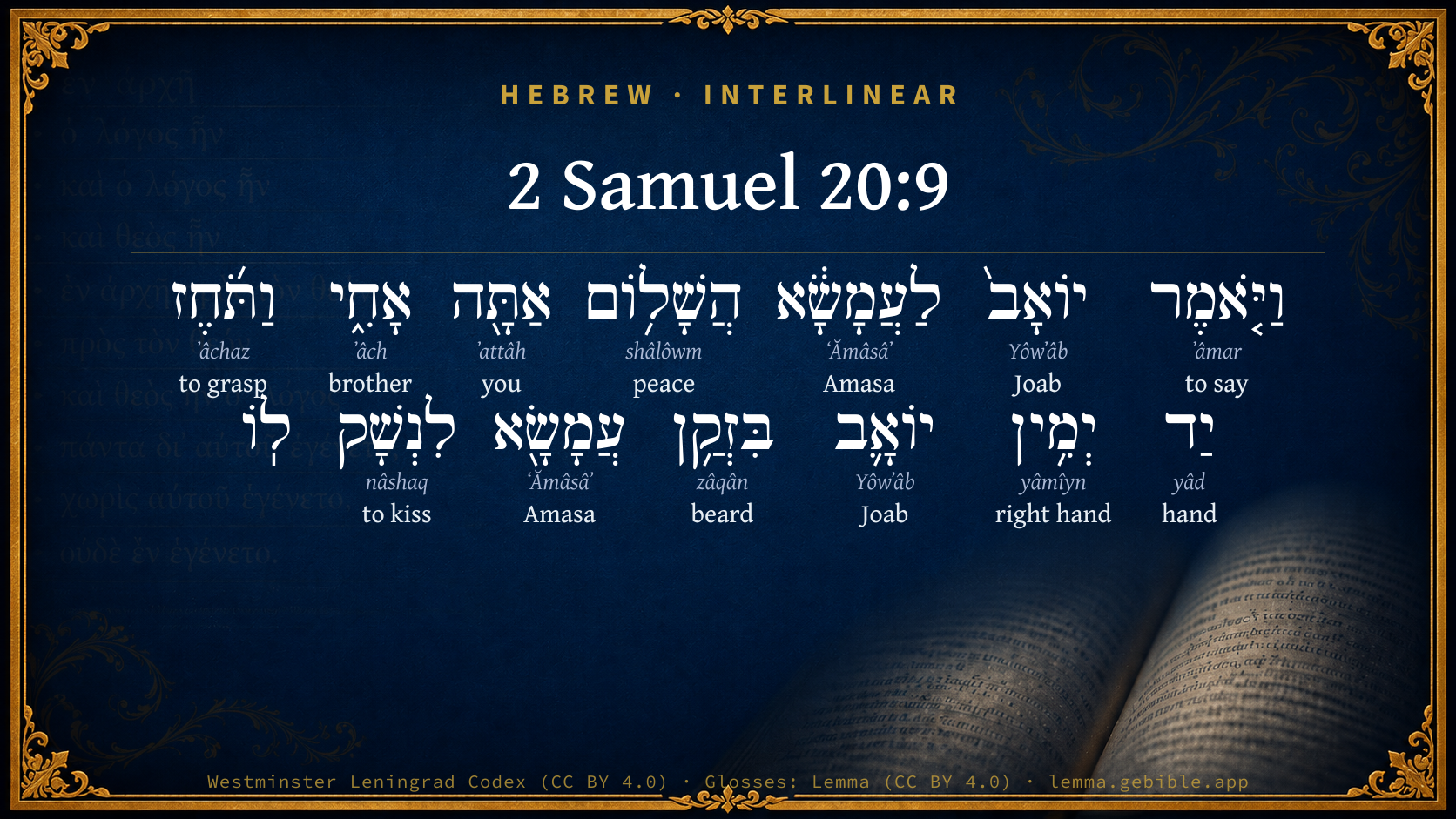
2 Samuel 20:9

Hebrew (Westminster Leningrad Codex) 2 Samuel 20:9 appears in the Hebrew Old Testament. The text above is from the Westminster Leningrad Codex. Each word links to its Strong’s number, a concise gloss, and parsing drawn from the Open Scriptures Hebrew Bible morphology. Click any word for its full Brown-Driver-Briggs (BDB) entry.
Download image
Cite this verse

2 Samuel 20:9 (World English Bible). Public Domain. Lemma interlinear Bible study tool, https://lemma.gebible.app/v/2-samuel/20/9.

Show BibTeX & RIS
BibTeX
RIS
English Translation
Joab said to Amasa, Is it well with you, my brother? Joab took Amasa by the beard with his right hand to kiss him.
World English Bible · Public Domain
Download a study sheet

One document with this verse’s original text, its word-by-word gloss line, the meaning frame, cross-references with their text, attributed commentary, and full source and license credits — printable, and it pastes into notes with its structure intact.

This verse Autodidact and up

Study sheet (.html) Plain text (.txt)

A passage Seminary Student

Up to 50 verses in one chapter. A passage sheet keeps up to 6 commentary sources and 12 cross-references per verse, in the order this page ranks them, and says so on the sheet whenever that leaves anything out. Ask for a single verse and you get the Autodidact verse sheet above.

Everything on this page stays free to read, with no account — the sheet is a download of what is already on screen, not access to it.

Want to remove ads? Support Godless Engineer
Compare translations 3

The same verse in 3 English versions, stacked beneath the original-language interlinear above. Click any original word for its lexicon entry.

Each is an independent rendering of the whole verse — the interlinear is not word-aligned to these translations.

Highlighted words mark where these versions differ — a whole-verse word diff, not a word-by-word alignment.

  • World English Bible Public Domain
    Joab said to Amasa, Is it well with you, my brother? Joab took Amasa by the beard with his right hand to kiss him.
  • King James Version Public Domain
    And Joab said to Amasa, Art thou in health, my brother? And Joab took Amasa by the beard with the right hand to kiss him.
  • unfoldingWord Literal Text CC BY-SA 4.0
    And Joab said to Amasa, “Peace you, my brother?” And the right hand of Joab held onto the beard of Amasa to kiss him.

unfoldingWord Literal Text — © unfoldingWord, licensed CC BY-SA 4.0. Word-aligned USFM3 via Door43 (git.door43.org/unfoldingWord/en_ult).

Versions to compare (up to 4)

3 of 4 selected

Show all 18 translations

Every available English version of this verse, each an independent rendering of the whole verse.

  • World English Bible Public Domain
    Joab said to Amasa, Is it well with you, my brother? Joab took Amasa by the beard with his right hand to kiss him.
  • Berean Standard Bible Public Domain
    “Are you well, my brother?” Joab asked Amasa. And with his right hand Joab grabbed Amasa by the beard to kiss him.
  • Majority Standard Bible Public Domain
    “Are you well, my brother?” Joab asked Amasa. And with his right hand Joab grabbed Amasa by the beard to kiss him.
  • King James Version Public Domain
    And Joab said to Amasa, Art thou in health, my brother? And Joab took Amasa by the beard with the right hand to kiss him.
  • American Standard Version (1901) Public Domain
    And Joab said to Amasa, Is it well with thee, my brother? And Joab took Amasa by the beard with his right hand to kiss him.
  • Revised Version (1885) Public Domain
    And Joab said to Amasa, Is it well with thee, my brother? And Joab took Amasa by the beard with his right hand to kiss him.
  • Geneva Bible (1599) Public Domain
    And Ioab sayde to Amasa, Art thou in health, my brother? and Ioab tooke Amasa by the beard with the right hand to kisse him.
  • Douay-Rheims (1899) Public Domain
    And Joab said to Amasa: God save thee, my brother. And he took Amasa by the chin with his right hand to kiss him.
  • Young's Literal Translation Public Domain
    And Joab saith to Amasa, `Art thou `in' peace, my brother?' and the right hand of Joab layeth hold on the beard of Amasa to give a kiss to him;
  • Literal Standard Version CC BY-SA 4.0
    And Joab says to Amasa, “Are you [in] peace, my brother?” And the right hand of Joab lays hold on the beard of Amasa to give a kiss to him;
  • Unlocked Literal Bible CC BY-SA 4.0
    So Joab said to Amasa, “Is it well with you, my cousin?” Joab took Amasa by the beard with his right hand to kiss him.
  • unfoldingWord Literal Text CC BY-SA 4.0
    And Joab said to Amasa, “Peace you, my brother?” And the right hand of Joab held onto the beard of Amasa to kiss him.
  • Darby Bible Public Domain
    And Joab said to Amasa, Art thou well, my brother? And Joab took Amasa by the beard with the right hand to kiss him.
  • World Messianic Bible Public Domain
    Joab said to Amasa, “Is it well with you, my brother?” Joab took Amasa by the beard with his right hand to kiss him.
  • Webster's Bible Public Domain
    And Joab said to Amasa, Art thou in health, my brother? And Joab took Amasa by the beard with the right hand to kiss him.
  • Free Bible Version CC BY-SA 4.0
    “How are you doing, my brother?” Joab asked Amasa. Joab held Amasa by the beard with his right hand to kiss him.
  • Bible in Basic English Public Domain
    And Joab said to Amasa, Is it well, my brother? And with his right hand he took him by the hair of his chin to give him a kiss.
  • JPS Tanakh (1917) Public Domain
    And Joab said to Amasa: 'Is it well with thee, my brother?' And Joab took Amasa by the beard with his right hand to kiss him.

Literal Standard Version (2020), Covenant Press — licensed CC BY-SA 4.0. Text via the HelloAO Bible API (eBible.org). Unlocked Literal Bible (unfoldingWord) — licensed CC BY-SA 4.0. Text via the HelloAO Bible API (eBible.org). unfoldingWord Literal Text — © unfoldingWord, licensed CC BY-SA 4.0. Word-aligned USFM3 via Door43 (git.door43.org/unfoldingWord/en_ult). Free Bible Version, Dr. Jonathan Gallagher — licensed CC BY-SA 4.0. Text via the HelloAO Bible API (eBible.org).

Word by word

More ways to search: Search by grammar → Find every occurrence → Compare this word →

Practice this passage: Drill this verse → Learn its vocabulary →

לַעֲמָשָׂ֔א
ʻĂmâsâʼ
H6021
“to/for · Amasa”
Preposition + Noun, Proper
Part of Speech
Preposition + Noun
Type
Proper
Full BDB Definition

Origin: from H6006

TWOT: None

Amasa = "burden" - son of Ithra or Jether by Abigail the sister of David and general of the army of Absalom - son of Hadlai and a prince of Ephraim in the reign of king Ahaz
  1. וַיֹּ֤אמֶר ʼâmar H559 “and · to say” Conjunction + Verb, Qal, Sequential Imperfect, 3rd Person, Masculine, Singular
  2. יוֹאָב֙ Yôwʼâb H3097 “Joab” Noun, Proper
  3. הֲשָׁל֥וֹם shâlôwm H7965 “peace” Particle, Interrogative + Noun, Common, Masculine, Singular, Absolute
  4. אַתָּ֖ה ʼattâh H859 “you” Pronoun, Personal, 2nd Person, Masculine, Singular
  5. אָחִ֑י ʼâch H251 “brother · my” Noun, Common, Masculine, Singular, Construct + Suffix, Personal, 1st Person, Common, Singular
  6. וַתֹּ֜חֶז ʼâchaz H270 “and · to grasp” Conjunction + Verb, Qal, Sequential Imperfect, 3rd Person, Feminine, Singular
  7. יַד yâd H3027 “hand of” Noun, Common, Both, Singular, Construct
  8. יְמִ֥ין yâmîyn H3225 “right hand of” Noun, Common, Feminine, Singular, Construct
  9. יוֹאָ֛ב Yôwʼâb H3097 “Joab” Noun, Proper
  10. בִּזְקַ֥ן zâqân H2206 “in/at · beard of” Preposition + Noun, Common, Both, Singular, Construct
  11. עֲמָשָׂ֖א ʻĂmâsâʼ H6021 “Amasa” Noun, Proper
  12. לִנְשָׁק nâshaq H5401 “to kiss” Preposition + Verb, Qal, Infinitive Construct

About this verse

These counts appear in no published source. They are computed here, from the morphology-tagged text and Lemma’s own curated glosses. What Lemma adds →

14
words
11
distinct lemmas
Historical
section

Notable vocabulary

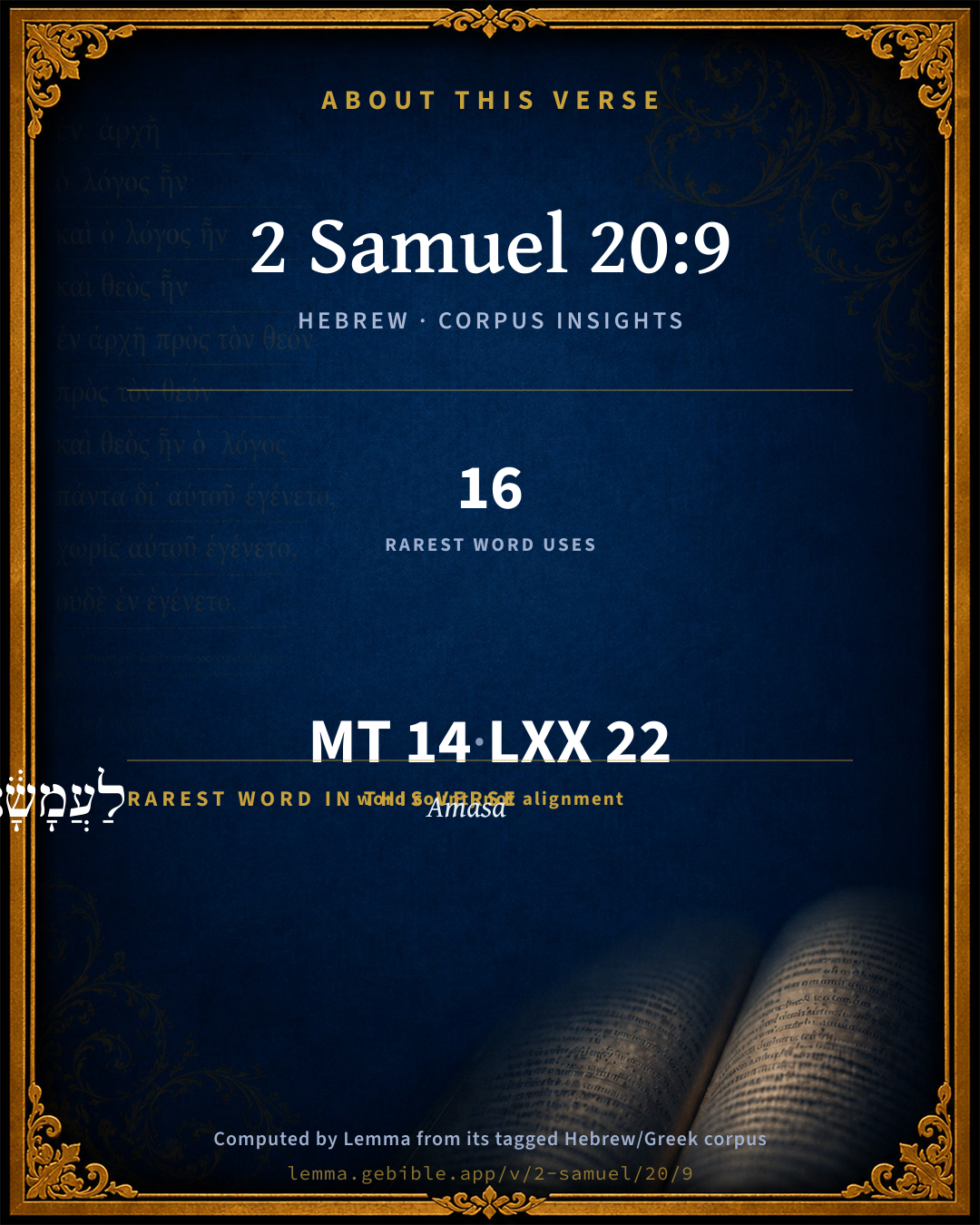
The rarest word here is לַעֲמָשָׂ֔א Amasa H6021 — appearing just 16 times in the whole Hebrew Bible.

Shared distinctive vocabulary

לַעֲמָשָׂ֔א Amasa H6021 occurs in 12 verses of the Hebrew Bible. Also found in:

Grammatical profile

  • 3 verbs
  • 9 nouns
  • 1 pronoun
  • 1 preposition

Verb forms

  • וַיֹּ֤אמֶר Qal · Sequential Imperfect
  • וַתֹּ֜חֶז Qal · Sequential Imperfect
  • לִנְשָׁק Qal · Infinitive Construct

Repetition

Words recur within this verse — often emphatic in Hebrew:

  • יוֹאָב֙ Joab H3097 ×2
  • לַעֲמָשָׂ֔א Amasa H6021 ×2

Hebrew & Septuagint length

In English translation the verse runs 24 words from the Hebrew and 27 from the Septuagint (LXX English) — closely comparable.

A rough comparison of the two English renderings, which tokenize alike — not a word-level alignment.

Word counts can differ between the Hebrew and the Greek without any difference in meaning — e.g. the Hebrew direct-object marker אֵת has no separate Greek word, and Greek often adds the article ὁ.

In the original languages it is 14 Hebrew tokens and 22 Greek tokens — but the two are counted differently (Hebrew bundles its prefixes and suffixes into one token; the Greek is in lemma form), so that isn’t a like-for-like length.

Cross-references

5

Topical passages linked to 2 Samuel 20:9 in the Treasury of Scripture Knowledge — connected by theme and wording, ordered by reader-vote popularity; previews shown in the World English Bible.

  • Matthew 26:48–49 Now he who betrayed him gave them a sign, saying, "Whoever I kiss, he is the one. Seize him."
  • Luke 22:47–48 While he was still speaking, behold, a multitude, and he who was called Judas, one of the twelve, was leading them. He came near to Jesus to kiss him.
  • Psalms 55:21 His mouth was smooth as butter, But his heart was war. His words were softer than oil, Yet they were drawn swords.
  • Proverbs 26:24–26 A malicious man disguises himself with his lips, But he harbors evil in his heart.
  • Micah 7:2 The godly man has perished out of the earth, And there is no one upright among men. They all lie in wait for blood; Every man hunts his brother with a net.

Cross-references courtesy of OpenBible.info (CC BY 4.0).

Hebrew and Greek witnesses Masoretic Hebrew ↔ Greek Septuagint

The same verse in the two great witnesses to the Old Testament, shown verse-for-verse.

These are two independent witnesses, not word-aligned to each other, and the Septuagint is shown in lemma (dictionary) form.

Hebrew 2 Samuel 20:9 Masoretic · Westminster Leningrad Codex

וַיֹּ֤אמֶר יוֹאָב֙ לַעֲמָשָׂ֔א הֲשָׁל֥וֹם אַתָּ֖ה אָחִ֑י וַתֹּ֜חֶז יַד יְמִ֥ין יוֹאָ֛ב בִּזְקַ֥ן עֲמָשָׂ֖א לִנְשָׁק לֽוֹ

Joab said to Amasa, Is it well with you, my brother? Joab took Amasa by the beard with his right hand to kiss him.

World English Bible · Public Domain

Greek LXX 2 Samuel 20:9 Septuagint · lemma form

καί εἶπον ιωαβ ὁ αμεσσαϊ εἰ ὑγιαίνω σύ ἀδελφός καί κρατέω ὁ χείρ ὁ δεξιός ιωαβ ὁ πώγων αμεσσαϊ ὁ καταφιλέω αὐτός

And Joab said to Amessai, Are you in health, my brother? and the right hand of Joab took hold of the beard of Amessai to kiss him.

LXX2012 (modern English Septuagint) · Public Domain

Hebrew: Westminster Leningrad Codex (CC BY 4.0). Greek: Septuagint (public domain); English from LXX2012 (modern English Septuagint) (Public Domain). How the Septuagint differs from the Hebrew →

Targum (Aramaic paraphrase)

1

The Targum is the ancient Jewish Aramaic paraphrase of the Hebrew Scriptures — an interpretive translation, not the Hebrew text itself. Onkelos (literal) and Pseudo-Jonathan (expansive) render the Torah, and Jonathan the Prophets. Coverage is partial: where no permissively-licensed English translation exists for a verse, only the Aramaic is shown. This is verse-level text, not a word-by-word alignment to the Hebrew.

  1. Targum Jonathan Prophets (Joshua–Malachi)
    וַאֲמַר יוֹאָב לַעֲמָשָׂא הַשְׁלָם אַתְּ אָחִי וַאֲחַדַת יַת יְמִין יוֹאָב בְּדִקְנָא דַעֲמָשָׂא לְמִנְשַׁק לֵיהּ:

    (no public-domain English translation for this verse)

    Targum Jonathan — Aramaic: “Mikraot Gedolot” (public domain). English: “Sefaria Community Translation” (CC0 1.0 (public-domain dedication)); “London "Chaldee Paraphrase," 1871” (public domain). Text via Sefaria.

Commentary

Notes on 2 Samuel 20:9 from classic Christian and Jewish commentators (each source and its license shown beneath its notes). The classic Christian expositions comment on the surrounding passage and are grouped to its opening verse, so a note may address several verses; the Jewish commentaries on the Tanakh (Rashi and others) are per-verse, so they appear only where the commentator wrote on this verse.

Lemma curates 59 commentaries, every one of them public domain or Creative Commons licensed, each selected and text-cleaned for this edition rather than reprinted as found. About our sources →

Trapp's Complete Commentary

John Trapp

2Sa 20:9 And Joab said to Amasa, [Art] thou in health, my brother? And Joab took Amasa by the beard with the right hand to kiss him.

Ver. 9. Art thou in health, my brother?] Of all kinds of revenge that is most execrable and deadly, which, like a serpent in the green grass, lies lurking in the flatteries and fawnings of a fleeting face. The Hebrew here hath it, Art thou peace? Oh, base!

And Joab took Amasa by the beard to kiss him.] Indeed, to kill him. But that this was the ancient manner of saluting, see Plin., lib. xi. cap. 5.

John Trapp, A Commentary or Exposition upon All the Books of the Old and New Testament (1647–1656) — public domain. Text from a community e-Sword module.

The Biblical Illustrator

Joseph S. Exell

2Sa_20:9

Art thou in health, my brother?

The Souls Health

The sickness of the soul is the evil of all evils, and one in comparison with which mere bodily pain is nothing. Whether sin be regarded as a disease, or as guilt, or as both combined, there is only one Physician, even God Himself, who can help us. The medicine and the skill are His, and he alone can effectually and permanently heal. He has no pleasure in the sickness or death of His creatures; indeed, so far from this he desires that all should be in health and be happy.

I. We suppose ourselves in a hospital occupied by those who are spiritually diseased, and the symptoms must be inquired into and noted.

1. First, then, as to the condition of the pulse. Does it beat strongly and vigorously, indicating a proper circulation? or is it slow, languid, and irregular? Has joy departed? and has zeal ceased to inspire your soul for the discharge of high and holy duties?

2. Next, let me ask concerning your memory. Are past trials forgotten? Have you ceased to think of gods many mercies with gratitude? There are bitter mercies as well as sweet ones, and the Great Physician administers to us some of His healing remedies in wine, and others in wormwood.

3. The condition of your appetite. Does it relish wholesome fare? Do you find pleasure in the reading of good books; and above all, in the study of gods word? Is plain gospel preaching the nutriment which suits you best; or is there a constant craving after highly-seasoned and stimulating rhapsodies, which constitute so large a proportion of the popular preaching of the day? Mere flowers of rhetoric are like the blue and red blossoms in cornfields--pleasing to those who come for amusement, but prejudicial to those who would reap the grain.

4. The condition of your strength. Is your ability to do Gods will, to work for Him, and to endure pains and sacrifices, up to the highest standard which you have ever reached? or is such spiritual strength perceptibly on the decline? How many forget that it is impossible robe good without self-denial and effort, and that in order to such exertion we must have strength. The soul will always be feeble and sickly so long as this is lacking.

II. Let us go on, then, to describe some timely remedies.

1. Avoid everything which disagrees with your souls health. Many dangerous diseases are infectious, and hence, evil companions, and unlawful pleasures, cannot be too carefully shunned. lord, I trust thou hast pardoned the bad examples I have set before others, said old Thomas Fuller in his prayer, be pleased also to pardon me the sins which they have committed by my bad examples. The Nazarites whose strict vows allowed them to drink no wine, also forbade them to cut grapes from which wine is made. And so, they who would enjoy spiritual health, must not only avoid sin in itself, but also the companionship and associations which lead to it.

2. Retirement. The Great Physician should be sought often, that we may be alone with Him. Virtue always goeth out of Him to heal those who thus manifest a desire for His saving help. Especially, during the holy season of Lent, let us thus seek to be alone with the Saviour. Depart from the highway, says St. Chrysostom, and transplant thyself in some enclosed ground, for it is hard for a tree that stands by the wayside to keep her fruit till it be ripe.

3. We must be willing to take freely of the balm of Gilead, the doctrine of Gods unchangeable love; and also of bitter herbs, such as meditations on the shipwrecks and apostasies of unfaithful Christians.

4. Take plenty of exercise. Attend diligently on all means of grace, public and private prayer, the Lords Supper, and labour with cheerfulness in the Masters vineyard. Again, therefore, I ask the question of the text: Art thou in health, my brother? If honesty obliges you to answer no, then let me implore you to lose no time in seeking for the Good Physician. Cry aloud, this day, to the Good Physician: Have mercy on us, O Lord, Thou Son of David! The virtue which goes forth from Him is no mere temporary palliative. Jesus not only comforts, but He cures. Wilt thou be made whole? Look to Christ Jesus to do it for you. (J. N. Norton.)

Health of body in moral state

The lesson of this close interaction of mind and body is that we should put the whole treatment of the body on a moral basis. De Quincey closes the section dealing with health of his treatise on casuistry with some strong words, which have added weight from his own mistakes in dealing with himself: Casuistry, justly and without infringing any truth of Christianity, urges the care of health as the basis of all moral action, because, in fact, of all voluntary action. Every impulse of bad health jars or untunes some string in the fine harp of human volition, and, because a man cannot be a moral being but in proportion of his free agency, therefore it is clear that no man can be in a high sense moral, except in so far as through health he commands his bodily powers, and is not commanded by them. (Hugh Black, M. A.)

Wanton abuse of health

Health is the sum of money in the bank which will support you, economically spent. But you spend foolishly and draw on the principal. This diminishes the income, and you draw the oftener and the larger drafts until you become bankrupt. Overeating, overworking, every imprudence is a draft on life which health cashes and changes at a thousand per cent and interest. Every abuse of health hastens death. (F. G. Welch, M. D.)

The Biblical Illustrator, edited by Joseph S. Exell (c. 1880s–1900s) — public domain. Text from a community e-Sword module.

Joseph Benson's Commentary

2Sa 20:9. Joab took Amasa by the beard — As the manner of ancient times was when they saluted one another, and, it appears, is still a custom among some of the eastern people, who take one another by the chin or the beard when they would give a hearty salute. Thevenot says it is often done among the Turks, although at the same time he assures us it is a great affront to take one by the beard on any other account than to kiss him.

Joseph Benson's Commentary on the Old and New Testaments (1811–1818) — public domain. Text from a community e-Sword module.

Tyndale Open Study Notes

Tyndale Open Resources

20:9 to kiss him: This affectionate greeting was not always genuine (cp. 14:33).

Tyndale Open Study Notes — © Tyndale Open Resources, licensed CC BY-SA 4.0. Text via the HelloAO Bible API.

Geneva Bible (1599)

Geneva Bible translators

Hebrew, peace.

Geneva Bible (1599) marginal notes — public domain. Text via Bolls.life.

Jamieson, Fausset & Brown

Robert Jamieson, A. R. Fausset & David Brown

took Amasa by the beard with the right hand to kiss him--This act, common with two friends on meeting when one of them returns from a journey, indicates respect as well as kindliness, and the performance of it evinced the deep hypocrisy of Joab, who thereby put Amasa off his guard. No wonder, then, that while this act of friendly gratulation after long absence occupied Amasa's attention, he did not perceive the sword that was in Joab's left hand. The action of Joab was indeed a high compliment, but neither suspicious nor unusual and to this compliment, Amasa paying attention and no doubt returning it with suitable politeness, he could little expect the fatal event that Joab's perfidy produced.

Jamieson, Fausset & Brown — Commentary Critical and Explanatory on the Whole Bible (1871) — public domain (CC PDM 1.0). Text via the HelloAO Bible API.

The Cambridge Bible for Schools and Colleges

gen. ed. J. J. S. Perowne

9. took Amasa by the beard] It is said to be still customary among the Arabs and Turks to lay hold of a person’s beard in giving him the kiss of welcome.

The Cambridge Bible for Schools and Colleges (gen. ed. J. J. S. Perowne; Cambridge University Press, 1878–1918) — public domain. Text from a community e-Sword module.

John Gill's Exposition

And Joab said to Amasa,.... In a friendly manner, with all the air of pleasantry and good humour:

art thou in health, my brother? this looked like a friendly salutation to ask of his health, and wish him it, and a loving appellation to call him brother; though they were near of kin, sisters' children, and so own cousins; thus he addressed him, to cover his design:

and Joab took Amasa by the beard with his right hand to kiss him: as was usual for the eastern people to do when they addressed and saluted one another in an affectionate way, and as the Turks and Arabs do to this day, as travellers relate. Barthius (t) has collected passages from the Greek poets, which show it to be a custom, that when a man asked a favour of another, he caught hold of his beard with the right hand, and of his knee with the left; and in such a posture Joab might easily do what follows.

(t) Animadv. ad Claudian. de Raptu Proserp. l. 1. ver. 50. vid. Homer. Iliad. ver. 500, 501. Iliad. 8. ver. 371. & Alex. ab Alex. Genial. Dier. l. 2. c. 19.

John Gill's Exposition of the Whole Bible (1746–1763) — public domain (CC PDM 1.0). Text via the HelloAO Bible API.

Haydock's Catholic Bible Commentary

God, &c. Literally, "Hail, my brother." (Haydock) --- Kiss him. "In former times it was the custom, in Greece, for supplicants to touch the chin, (Pliny, [Natural History?] xi. 45.) having the left hand upon the person’s knees. (Homer, Iliad A.) The touched a woman’s cheeks; (Euripides, Hecuba.) or, among the Hebrews, her chin, Canticle of Canticles ii. 6. The Turks and Arabs still kiss the beard, with the utmost reverence. (Thevenot xxii.; Darvieux, chap. vii.) (Calmet)

George Leo Haydock (1774–1849), Haydock's Catholic Family Bible and Commentary, 1859 edition — public domain. Excludes Psalms (Douay-Rheims chapter numbering differs from Protestant) and Deuterocanonical books (Catholic canon only).

Matthew Poole's English Annotations

As the manner of ancient times was, when they kissed and saluted one another.

Matthew Poole's English Annotations on the Holy Bible (1683–1685) — public domain. Text from a community e-Sword/MySword module.

Whedon's Commentary on the Bible

Daniel D. Whedon

9. To kiss him — How like the treachery of Judas! Mat_26:49. Joab was versed in treacherous acts like this. Compare 2Sa_3:27.

Daniel D. Whedon (gen. ed.), Commentary on the Old and New Testaments (1874–1909) — public domain. Text from a community e-Sword module.

John Wesley's Explanatory Notes

Beard - As the manner of ancient times was, when they saluted one another.

John Wesley, Explanatory Notes Upon the Whole Bible (1754–1765) — public domain. Text via the GEBible commentary corpus.

unfoldingWord translationNotes

Door43 World Missions Community

my cousin

Amasa was the son of the sister of Joab's mother.

took Amasa by the beard with his right hand to kiss him

This was a common way for men to greet one another.

dagger

a short sword that is easy to hide and was often used for close-in fighting and assassinations

bowels spilled

"intestines spilled"

translationWords

kiss

unfoldingWord translationNotes — © Distant Shores Media and the Door43 World Missions Community, licensed CC BY-SA 4.0. Source: git.door43.org/Door43/en_tn.

Lesson kit

Teaching starters — assembled from the data on this page, not authored interpretation. Every prompt links to the verse data it draws on. Edit before teaching.

2 Samuel, in the Historical, opens this verse with 14 words (11 distinct Hebrew lemmas). Its most distinctive word is ʻĂmâsâʼ (“Amasa”). A historical commentator’s framing appears above. Read the whole chapter for the surrounding context.

Discussion questions

  1. What does “Amasa” (ʻĂmâsâʼ) contribute to the verse as a whole?
  2. 2 Samuel 17:25 shares the word «Amasa» with this verse. How do the two illuminate each other?
  3. “Joab” occurs 2× in this one verse. What is the effect of the repetition?
  4. These translations render this verse differently. What is at stake in choosing one wording over another?
  5. The verb «וַיֹּ֤אמֶר» is Qal Sequential Imperfect. How does its form color the action?
  6. Reading how Trapp's Complete Commentary and The Biblical Illustrator read this verse, where do the two commentators agree and where do they part?

Things to notice

Reading settings

Reading text

Shown beneath each verse's original-language words.

Old Testament
Old Testament edition

Read the OT as the Masoretic Hebrew (MT) or the Greek Septuagint (LXX).

English shown for the Greek Septuagint (in the Hebrew ↔ Greek comparison).

Comparing translations? Open the Compare panel on any verse page to stack up to four side by side.