
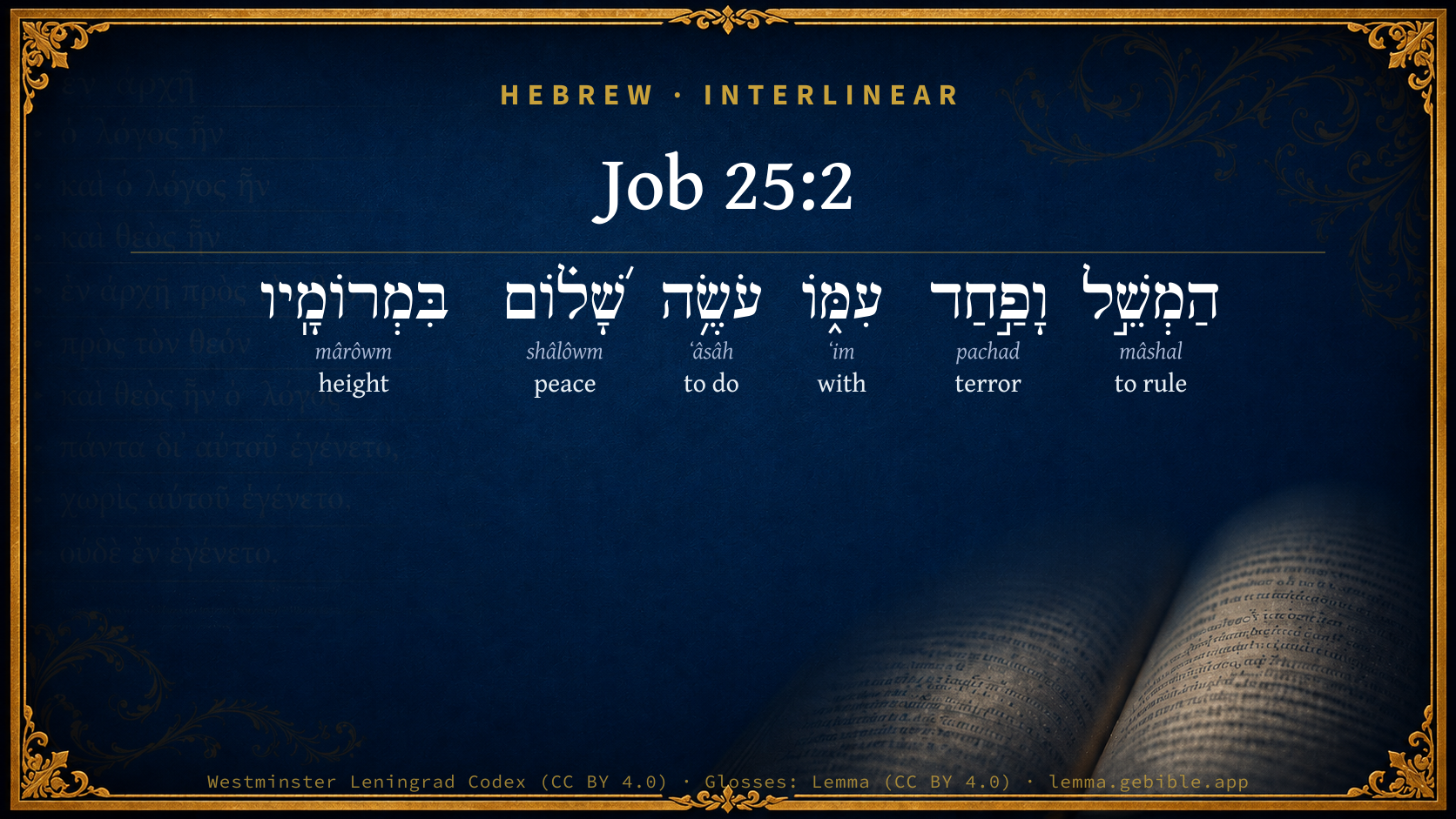
Job 25:2

Hebrew (Westminster Leningrad Codex) Job 25:2 appears in the Hebrew Old Testament. The text above is from the Westminster Leningrad Codex. Each word links to its Strong’s number, a concise gloss, and parsing drawn from the Open Scriptures Hebrew Bible morphology. Click any word for its full Brown-Driver-Briggs (BDB) entry.
Download image
Cite this verse

Job 25:2 (World English Bible). Public Domain. Lemma interlinear Bible study tool, https://lemma.gebible.app/v/job/25/2.

Show BibTeX & RIS
BibTeX
RIS
English Translation
"Dominion and fear are with him; He makes peace in his high places.
World English Bible · Public Domain
Download a study sheet

One document with this verse’s original text, its word-by-word gloss line, the meaning frame, cross-references with their text, attributed commentary, and full source and license credits — printable, and it pastes into notes with its structure intact.

This verse Autodidact and up

Study sheet (.html) Plain text (.txt)

A passage Seminary Student

Up to 50 verses in one chapter. A passage sheet keeps up to 6 commentary sources and 12 cross-references per verse, in the order this page ranks them, and says so on the sheet whenever that leaves anything out. Ask for a single verse and you get the Autodidact verse sheet above.

Everything on this page stays free to read, with no account — the sheet is a download of what is already on screen, not access to it.

Want to remove ads? Support Godless Engineer
Compare translations 3

The same verse in 3 English versions, stacked beneath the original-language interlinear above. Click any original word for its lexicon entry.

Each is an independent rendering of the whole verse — the interlinear is not word-aligned to these translations.

Highlighted words mark where these versions differ — a whole-verse word diff, not a word-by-word alignment.

  • World English Bible Public Domain
    "Dominion and fear are with him; He makes peace in his high places.
  • King James Version Public Domain
    Dominion and fear are with him, he maketh peace in his high places.
  • unfoldingWord Literal Text CC BY-SA 4.0
    “Dominion and fear with him, the one making peace in his heights.

unfoldingWord Literal Text — © unfoldingWord, licensed CC BY-SA 4.0. Word-aligned USFM3 via Door43 (git.door43.org/unfoldingWord/en_ult).

Versions to compare (up to 4)

3 of 4 selected

Show all 18 translations

Every available English version of this verse, each an independent rendering of the whole verse.

  • World English Bible Public Domain
    "Dominion and fear are with him; He makes peace in his high places.
  • Berean Standard Bible Public Domain
    “Dominion and awe belong to God; He establishes harmony in the heights of heaven.
  • Majority Standard Bible Public Domain
    “Dominion and awe belong to God; He establishes harmony in the heights of heaven.
  • King James Version Public Domain
    Dominion and fear are with him, he maketh peace in his high places.
  • American Standard Version (1901) Public Domain
    Dominion and fear are with him; He maketh peace in his high places.
  • Revised Version (1885) Public Domain
    Dominion and fear are with him; he maketh peace in his high places.
  • Geneva Bible (1599) Public Domain
    Power and feare is with him, that maketh peace in his hie places.
  • Douay-Rheims (1899) Public Domain
    Power and terror are with him, who maketh peace in his high places.
  • Young's Literal Translation Public Domain
    The rule and fear `are' with Him, Making peace in His high places.
  • Literal Standard Version CC BY-SA 4.0
    “The rule and fear [are] with Him, || Making peace in His high places.
  • Unlocked Literal Bible CC BY-SA 4.0
    “Dominion and fear are with him; he makes order in his high places of heaven.
  • unfoldingWord Literal Text CC BY-SA 4.0
    “Dominion and fear with him, the one making peace in his heights.
  • Darby Bible Public Domain
    Dominion and fear are with him; he maketh peace in his high places.
  • World Messianic Bible Public Domain
    “Dominion and fear are with him. He makes peace in his high places.
  • Webster's Bible Public Domain
    Dominion and fear are with him, he maketh peace in his high places.
  • Free Bible Version CC BY-SA 4.0
    “Dominion and awe belong to God. He brings peace to his heavens.
  • Bible in Basic English Public Domain
    Rule and power are his; he makes peace in his high places.
  • JPS Tanakh (1917) Public Domain
    Dominion and fear are with Him; He maketh peace in His high places.

Literal Standard Version (2020), Covenant Press — licensed CC BY-SA 4.0. Text via the HelloAO Bible API (eBible.org). Unlocked Literal Bible (unfoldingWord) — licensed CC BY-SA 4.0. Text via the HelloAO Bible API (eBible.org). unfoldingWord Literal Text — © unfoldingWord, licensed CC BY-SA 4.0. Word-aligned USFM3 via Door43 (git.door43.org/unfoldingWord/en_ult). Free Bible Version, Dr. Jonathan Gallagher — licensed CC BY-SA 4.0. Text via the HelloAO Bible API (eBible.org).

Word by word

More ways to search: Search by grammar → Find every occurrence → Compare this word →

Practice this passage: Drill this verse → Learn its vocabulary →

About this verse

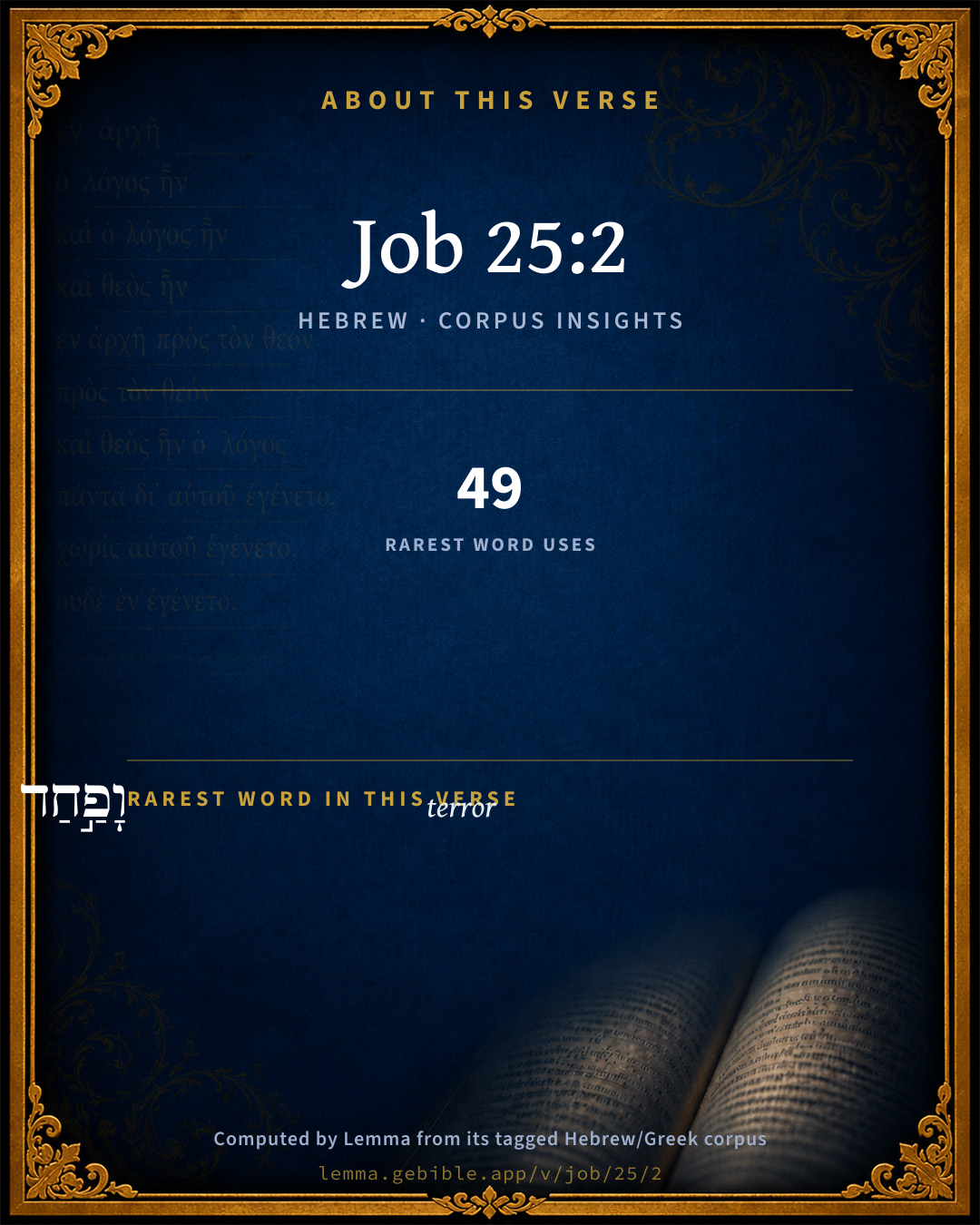
These counts appear in no published source. They are computed here, from the morphology-tagged text and Lemma’s own curated glosses. What Lemma adds →

6
words
6
distinct lemmas
Wisdom
section

Shared distinctive vocabulary

וָפַ֣חַד terror H6343 occurs in 48 verses of the Hebrew Bible. Also found in:

Grammatical profile

  • 2 verbs
  • 3 nouns
  • 1 preposition

Verb forms

  • הַמְשֵׁ֣ל Hiphil · Infinitive Absolute
  • עֹשֶׂ֥ה Qal · Participle Active

Hebrew & Septuagint length

In English translation the verse runs 13 words from the Hebrew and 14 from the Septuagint (LXX English) — closely comparable.

A rough comparison of the two English renderings, which tokenize alike — not a word-level alignment.

Word counts can differ between the Hebrew and the Greek without any difference in meaning — e.g. the Hebrew direct-object marker אֵת has no separate Greek word, and Greek often adds the article ὁ.

Cross-references

17

Topical passages linked to Job 25:2 in the Treasury of Scripture Knowledge — connected by theme and wording, ordered by reader-vote popularity; previews shown in the World English Bible.

  • Colossians 1:20 and through him to reconcile all things to himself, by him, whether things on the earth, or things in the heavens, having made peace through the blood of his cross.
  • Revelation 6:16 They told the mountains and the rocks, "Fall on us, and hide us from the face of him who sits on the throne, and from the wrath of the Lamb,
  • 1 Chronicles 29:11–12 Yours, Yahweh, is the greatness, the power, the glory, the victory, and the majesty: for all that is in the heavens and in the earth is yours. Yours is the kingdom, Yahweh, and you are exalted as head above all.
  • Job 9:2–10 "Truly I know that it is so, But how can man be just with God?
  • Job 26:5–14 "Those who are deceased tremble, Those beneath the waters and all that live in them.
  • Job 40:9–14 Or have you an arm like God? Can you thunder with a voice like him?
  • Psalms 99:1–3 Yahweh reigns! Let the peoples tremble. He sits enthroned among the cherubim. Let the earth be moved.
  • Isaiah 57:19 I create the fruit of the lips: Peace, peace, to him who is far off and to him who is near, says Yahweh; and I will heal him.
  • Jeremiah 10:6–7 There is none like you, Yahweh; you are great, and your name is great in might.
  • Daniel 4:34–37 At the end of the days I, Nebuchadnezzar, lifted up my eyes to heaven, and my understanding returned to me, and I blessed the Most High, and I praised and honored him who lives forever; for his dominion is an everlasting dominion, and his kingdom from generation to generation.
  • Matthew 28:18 Jesus came to them and spoke to them, saying, "All authority has been given to me in heaven and on earth.
  • 2 Corinthians 5:18–21 But all things are of God, who reconciled us to himself through Jesus Christ, and gave to us the ministry of reconciliation;
  • Ephesians 1:20–21 which he worked in Christ, when he raised him from the dead, and made him to sit at his right hand in the heavenly places,
  • Ephesians 2:16–17 and might reconcile them both in one body to God through the cross, having killed the hostility thereby.
  • Jude 1:25 to God our Savior, who alone is wise, be glory and majesty, dominion and power, both now and forever. Amen.
  • Isaiah 57:15 For thus says the high and lofty One who inhabits eternity, whose name is Holy: I dwell in the high and holy place, with him also who is of a contrite and humble spirit, to revive the spirit of the humble, and to revive the heart of the contrite.
  • Matthew 5:9 Blessed are the peacemakers, For they shall be called children of God.

Cross-references courtesy of OpenBible.info (CC BY 4.0).

Hebrew and Greek witnesses Masoretic Hebrew ↔ Greek Septuagint

The same verse in the two great witnesses to the Old Testament, shown verse-for-verse.

These are two independent witnesses, not word-aligned to each other, and the Septuagint is shown in lemma (dictionary) form.

Hebrew Job 25:2 Masoretic · Westminster Leningrad Codex

הַמְשֵׁ֣ל וָפַ֣חַד עִמּ֑וֹ עֹשֶׂ֥ה שָׁ֝ל֗וֹם בִּמְרוֹמָֽיו

"Dominion and fear are with him; He makes peace in his high places.

World English Bible · Public Domain

Greek LXX Job 25:2 Septuagint · lemma form

τίς γάρ προοίμιον ἤ φόβος παρά αὐτός ὁ ποιέω ὁ σύμπας ἐν ὕψιστος

What beginning or fear is his—even he that makes all things in the highest?

LXX2012 (modern English Septuagint) · Public Domain

Hebrew: Westminster Leningrad Codex (CC BY 4.0). Greek: Septuagint (public domain); English from LXX2012 (modern English Septuagint) (Public Domain). How the Septuagint differs from the Hebrew →

Commentary

Notes on Job 25:2 from classic Christian and Jewish commentators (each source and its license shown beneath its notes). The classic Christian expositions comment on the surrounding passage and are grouped to its opening verse, so a note may address several verses; the Jewish commentaries on the Tanakh (Rashi and others) are per-verse, so they appear only where the commentator wrote on this verse.

Lemma curates 59 commentaries, every one of them public domain or Creative Commons licensed, each selected and text-cleaned for this edition rather than reprinted as found. About our sources →

Trapp's Complete Commentary

John Trapp

Job 25:2 Dominion and fear [are] with him, he maketh peace in his high places.

Ver. 2. Dominion and fear are with him] God is therefore to be feared, because Lord over all. If an earthly king be so dread a sovereign, if an apparition of angels hath so amazed the best men, who would net fear that King of nations, since to him doth it appertain? Jer 10:7. "God is greatly to be feared in the assemblies of his saints, and to be had in reverence of all them that are round about him," Psa 89:7. Power and terror are with him, so the Vulgate hath it here. He that is able to destroy both body and soul in hell, is surely to be feared; yea, therefore to be feared, Mat 10:28. If servants should fear their masters because they have power over the flesh, Col 3:23, what should we do, since he can sooner undo us than bid it be done?

He maketh peace in his high places] Or, Among his high persons, those heavenly courtiers, the angels and saints. By an unchangeable decree, God keepeth all persons and things in the heavens, both visible and invisible, in a most firm and quiet condition, so that there is no clashing, but a happy harmony among them. He appeaseth, saith Senault, the differences of the elements, and obligeth them to force their own inclinations, to preserve the quiet of the world. He shakes all the heavens with so much evenness, that in the contrariety of their motions they never disorder themselves. Finally, He maintains peace among the angels, and tempering his justice with his goodness, he makes himself equally loved and feared of those blessed spirits. Therefore Job did ill, saith Mayer, to offer to make a disturbance there (as Bildad at least conceited he did), where there was all peace, Job 23:4.

John Trapp, A Commentary or Exposition upon All the Books of the Old and New Testament (1647–1656) — public domain. Text from a community e-Sword module.

Joseph Benson's Commentary

Job 25:2. Dominion and fear are with him — Absolute and sovereign power over all persons and things, so that it is both rebellion and madness to contend with him; and terror, which justly makes him dreadful to all men, and especially to all that undertake to dispute with him. In other words, awful majesty and infinite knowledge are his, whereby he is much better acquainted with men’s hearts and ways than they are themselves, and sees much sin in them, which themselves do not discover; and to him belong also exact purity and justice, which render him formidable to sinners. These are with him whom thou challengest; with him who is not lightly and irreverently to be named, much less to be contended with; and therefore it is thy duty to humble thyself before him, and quietly and modestly to submit thyself and thy cause to his pleasure. He maketh peace in his high places — This clause, as well as the following verse, seems to be added, to prove God’s dominion and dreadfulness; he keepeth and ruleth all persons and things in heaven, in peace and harmony. The angels, though they be very numerous, all own his sovereignty, and acquiesce in his pleasure. The stars, though vast in their bulk, and various in their motions, exactly keep the order which God hath appointed them: and therefore it is great folly for thee to quarrel with the methods of God’s dealings with thee.

Joseph Benson's Commentary on the Old and New Testaments (1811–1818) — public domain. Text from a community e-Sword module.

Whedon's Commentary on the Bible

Daniel D. Whedon

Double strophe — THE INFINITE EXALTATION OF GOD RAISES HIM ABOVE ARRAIGNMENT BY SUCH A CREATURE AS MAN, Job_25:2-6.

a. In any conceivable comparison of man with God (El) the inconceivable advantage must ever be with the All-powerful, Job_25:2-4.

2. Peace in his high places — One of the varied glimpses into the angel world that this book affords. It signifies either the order, tranquillity, and bliss, which his love has established among the heavenly hosts, as unfailing results of universal obedience to his law, or else the peace which followed the subjugation and banishment of angels that sinned; a Scripture truth, traces of which are found in the mythologies of most nations. The allusion to armies in the next verse countenances the latter view. Compare Job_4:18; Job_15:15.

Daniel D. Whedon (gen. ed.), Commentary on the Old and New Testaments (1874–1909) — public domain. Text from a community e-Sword module.

Geneva Bible (1599)

Geneva Bible translators

His purpose is to prove that albeit God try and afflict the just, yet soon after he sendeth prosperity, and because he did not so to Job he concludeth that he is wicked.

Geneva Bible (1599) marginal notes — public domain. Text via Bolls.life.

Adam Clarke's Commentary

Verse 2. Dominion and fear are with him] God is an absolute sovereign; his fear is on all the hosts of heaven; and by his sovereignty he establishes and preserves order in the heavens, and among all the inhabitants of the eternal world: how canst thou, therefore, dare to appeal to him, or desire to appear before him?

Adam Clarke's Commentary on the Bible (1810–1826) — public domain. Text from a community e-Sword/MySword module.

Ellicott's Commentary for English Readers

(2) Dominion and fear are with him.—He is absolute in sovereignty and terrible in power, so that even in His high places, and among His celestial hosts, He maintaineth peace and harmony.

A Bible Commentary for English Readers, edited by Charles John Ellicott (1878–1897) — public domain. Text from a community e-Sword module.

The Cambridge Bible for Schools and Colleges

gen. ed. J. J. S. Perowne

2. dominion and fear] To God belongs rule, and His majesty inspires terror; He is the Omnipotent ruler over all.

his high places] i. e. the heavens where He dwells. There He “maketh peace” through the dominion and fear belonging to Him. The idea of “making peace in his high places” is suggested first perhaps by the atmospheric phenomenon, the stilling of the warring elements in the tempest on high. When God intervenes the storm becomes a calm. But probably the idea was extended, and the words may include a reference to traditional discords among the heavenly hosts, comp. ch. Job_21:22, Job_40:10 seq.; Isa_24:21; Rev_12:7.

The Cambridge Bible for Schools and Colleges (gen. ed. J. J. S. Perowne; Cambridge University Press, 1878–1918) — public domain. Text from a community e-Sword module.

John Gill's Exposition

Dominion and fear are with him,.... Not with man, as Sephorno interprets it, as that with him is power to rule over the imagination (the evil figment of his heart) to choose the good, and refuse the evil; and with him is fear of punishment, and also the fear of God to restrain him from evil; but with God, as may easily be perceived from the whole context, though his name is not expressed in this clause, and not till Job 25:4; this dominion he is possessed of is universal; his kingdom rules over all, over all the angels, good and bad; over all men, over all the nations of the world, and the great men in it, the kings and princes of it; and over all, of every age, sex, and condition; and it is absolute and uncontrollable; he governs according to his will, and is not to be controlled in his ways; nor is he accountable to any for what he does, and his kingdom is an everlasting one, and his dominion for ever and ever: and by the fear that is with him is not meant actively, with which he fears; for he is afraid of none, be they ever so great and mighty, Job 22:4; but passively, with which he is feared; for holy and reverend is his name, and so his nature, and all that belong to him; he is feared by the angels in heaven, who cover their faces before him, and cast their crowns at his feet; and by the saints on earth, in whose assemblies he is served with reverence and godly fear; and should be stood in awe of by all the inhabitants of the world, because of the glory of his nature, the greatness of his works, and the goodness of his providence:

he maketh peace in his high places; in the high places of his earth, and among the great men of it, creating and commanding peace, and causing war among them to cease, whenever it is his pleasure; and in the regions of the air, where, though there are often thunder and lightning, storms and tempests of wind, hail, and rain, yet, when he says, Peace, be still, all is serene and quiet; and in the orbs of the heaven, the sun, moon, and stars, which know their appointed times and seasons, and keep their place or course, and do their work and office in the most easy and cheerful manner; and among the angels in the highest heaven, which are properly his high places, who, though their numbers are so great, and they themselves thrones, dominions, principalities, and powers, and have various offices and different work assigned them, readily do his will, and are in the utmost harmony and concord among themselves, show no reluctance to him, nor any discord to each other: now Bildad would have Job consider whether he could think himself so significant, that cognizance would be taken of him and his cause by so great, glorious, and majestic a thing; or that he would suffer his high places, where peace reigned, to be disturbed by his noise and brawl.

John Gill's Exposition of the Whole Bible (1746–1763) — public domain (CC PDM 1.0). Text via the HelloAO Bible API.

Albert Barnes' Notes on the Bible

Dominion and fear are with him - That is, God has a right to rule, and he ought to be regarded with reverence. The object of Bildad is to show that He is so great and glorious that it is impossible that man should be regarded as pure in his sight. He begins, therefore, by saying, that he is a Sovereign; that he is clothed with majesty, and that he is worthy of profound veneration.

He maketh peace in his high places - “High places,” here refer to the heavenly worlds. The idea is, that he preserves peace and concord among the hosts of heaven. Numerous and mighty as are the armies of the skies, yet he keeps them in order and in awe. The object is to present an image of the majesty and power of that Being who thus controls a vast number of minds. The phrase does not necessarily imply that there had been variance or strife, and that then God had made peace, but that he preserved or kept them in peace.

Albert Barnes' Notes on the Bible (1834–1885) — public domain. Text from a community e-Sword/MySword module.

Haydock's Catholic Bible Commentary

Places. Directing all the heavenly bodies with perfect harmony. (Calmet)

George Leo Haydock (1774–1849), Haydock's Catholic Family Bible and Commentary, 1859 edition — public domain. Excludes Psalms (Douay-Rheims chapter numbering differs from Protestant) and Deuterocanonical books (Catholic canon only).

Matthew Poole's English Annotations

Dominion, i.e. absolute and sovereign power over all persons and things, with whom to contend is both rebellion and madness.

Fear, actively understood, or terror, i.e. that which justly makes him dreadful to all men, and especially to all that shall undertake to dispute with him; awful majesty, infinite knowledge, whereby he knows men’s hearts and ways far better than they know themselves, and sees much sin in them which themselves do not discover, and exact purity and justice, which renders him formidable to sinners.

Are with him; emphatically spoken; with him whom thou challengest; with him who is not lightly and irreverently to be named, much less to be contended with. And therefore it is thy duty to humble thyself for thy presumptuous words and carriages towards him, and quietly and modestly to submit thyself and thy cause to his pleasure.

He maketh peace in his high places. This clause, as well as the following verse, seems to be added to prove what he last said of God’s dominion and dreadfulness; he keepeth and ruleth all persons and things in heaven in peace and harmony; and the order which he hath established among them. The angels, though they be very numerous, and differing in orders and ministries, do all own his sovereignty, and acquiesce in his pleasure, without any disputing and murmuring. The stars and heavenly bodies, though vast in their bulk, and various in their motions, yet exactly keep their courses and the order which God hath appointed them; and therefore it is great folly and impudence to exempt thyself from God’s jurisdiction, or to quarrel with the methods of God’s dealings with thee.

Matthew Poole's English Annotations on the Holy Bible (1683–1685) — public domain. Text from a community e-Sword/MySword module.

The Pulpit Commentary

HOMILIES BY W.F. ADENEY Ver. 2. "Peace in high places.

Bildad tries to overawe Job by presenting what is indeed a true idea of God, although, if he had known the patriarch, he would have seen that there was nothing in it that was likely to be accepted as a specific rebuke. Job had maintained his innocence, and had cried out for God to vindicate it: "Oh that I knew where I might find him!" Bildad replies that God is a great Ruler in the heavenly heights, maintaining peace among his angelic armies; how can man be justified with One so great? It is meant to be a rebuke to Job"s presumption in appealing to so awful a Judge. Yet, if Job is innocent, why should he not dare to do so? Bildad is right in saying that God is so holy that none can stand before him without being abashed by shame. The unfairness is in making this truth a ground for accusing Job, not of the general evil of fallen creatures, but of exceptional enormities of guilt,

I GOD RULES OVER ALL.

1. He is above all. We rise through the hierarchy of being from one stage to another, and at the head of all we find God. None can equal him, none can reach up to his might and holiness. Supreme in solitary perfection, he crowns the temple of being.

2. He includes all in his sway. His exaltation does not involve his separation from his creatures. On the contrary, it gives him a wide scope; from his exalted position he surveys the whole panorama of existence, and administers the affairs of the universe.

3. He exerts active influence over all. God is not an ornamental figurehead. He not only reigns, he rules. His government is absolute; not despotic, only because it is paternal.

II GOD"S RULE IS A NECESSITY OF THE UNIVERSE. The worlds could not go on without it. Confusion and chaos would follow if he withdrew his hand.

1. It is needed in heaven. Even there it is God who keeps the peace. The best-tempered society needs order and government to save it from falling into confusion. Heaven would become a babel of disorder if no regulating power were supreme there. The highest intelligences and the purest spirits require a regulative influence to keep them all in harmony. However well its harps are tuned, and however perfect is its music, the celestial orchestra needs one great leader.

2. Much more is it needed on earth. If heavenly beings cannot live aright without Divine guidance and rule, much more is this the case with earthly creatures, who are weak, ignorant, and sinful. If God makes his rule felt in maintaining the perfect order of heaven, assuredly he must make it felt in rectifying the wild disorder of earth.

III GOD"S RULE SECURES PEACE.

1. It maintains peace in high places. " There is peace above, though at present there may be confusion below. The heavens are calm, though the earth is storm-tossed. The changeless blue sky is above the shifting rack of clouds. Stars keep to their spheres. Angels perform their functions. The blessed dead are at rest. If we do but look high enough we shall see peace.

2. It will bring peace on earth. " When heaven touches earth the peace of heaven comes down among men. If God can keep peace among the greatest beings, surely he can establish it among puny mortals. He can reconcile all enmity or crush all opposition. Christ has come from the peace of heaven to be "our Peace". W.F.A. (Eph_2:14)

The Pulpit Commentary (1880–1919), ed. H.D.M. Spence-Jones & Joseph S. Exell — public domain. Text from a community e-Sword module.

John Wesley's Explanatory Notes

Dominion - Sovereign power over all persons and things. Fear - Terror, that which justly makes him dreadful to all men, and especially to all that undertake to dispute with him. He - This clause, as well as the following verse, seems to be added to prove God's dominion and dreadfulness: he keepeth and ruleth all persons and things in heaven, in peace and harmony. The angels, though they be very numerous, all own his sovereignty, and acquiesce in his pleasure. The stars, tho' vast in their bulk, and various in their motions: exactly keep the order which God hath appointed them: and therefore it is great folly for thee to quarrel with the methods of God's dealings with thee.

John Wesley, Explanatory Notes Upon the Whole Bible (1754–1765) — public domain. Text via the GEBible commentary corpus.

Rashi

Rabbi Shlomo Yitzchaki (Rashi)

Bildad’s replyDominion and fear Directed towards what Job said (23:4), “I would set out my case before Him,” he says to him, “Dominion and fear are with Him.” “Dominion” refers to Michael, and “fear” refers to Gabriel. Can you answer even one of them?

He makes peace in His heights When the constellations ascend, each one thinks, “I will ascend first,” and because he does not see what is before him, he is not envious. So I heard. [Tanchuma Buber ad loc.] Another explanation: He makes peace in His heights—Fire and water are mixed, and the water does not extinguish the fire; I did not hear this.

Rashi on the Tanakh — English translations: “The Judaica Press complete Tanach with Rashi, translated by A. J. Rosenberg” (CC BY 4.0); “Pentateuch with Rashi's commentary by M. Rosenbaum and A.M. Silbermann, 1929-1934” (public domain); “The Metsudah Tanach series, Lakewood, N.J” (CC BY 4.0); and “The Book of Joshua, Metsudah Publications, 1997” (CC BY 4.0). Text via Sefaria.

Lesson kit

Teaching starters — assembled from the data on this page, not authored interpretation. Every prompt links to the verse data it draws on. Edit before teaching.

Job, in the Wisdom, opens this verse with 6 words (6 distinct Hebrew lemmas). Its most distinctive word is pachad (“terror”). A historical commentator’s framing appears above. Read the whole chapter for the surrounding context.

Discussion questions

  1. What does “terror” (pachad) contribute to the verse as a whole?
  2. Genesis 31:42 shares the word «terror» with this verse. How do the two illuminate each other?
  3. These translations render this verse differently; the difference is in the English rendering, not the original. What questions does that raise?
  4. The verb «הַמְשֵׁ֣ל» is Hiphil Infinitive Absolute. How does its form color the action?
  5. Reading how Trapp's Complete Commentary and Joseph Benson's Commentary read this verse, where do the two commentators agree and where do they part?

Things to notice

Reading settings

Reading text

Shown beneath each verse's original-language words.

Old Testament
Old Testament edition

Read the OT as the Masoretic Hebrew (MT) or the Greek Septuagint (LXX).

English shown for the Greek Septuagint (in the Hebrew ↔ Greek comparison).

Comparing translations? Open the Compare panel on any verse page to stack up to four side by side.