
Psalms 55:20

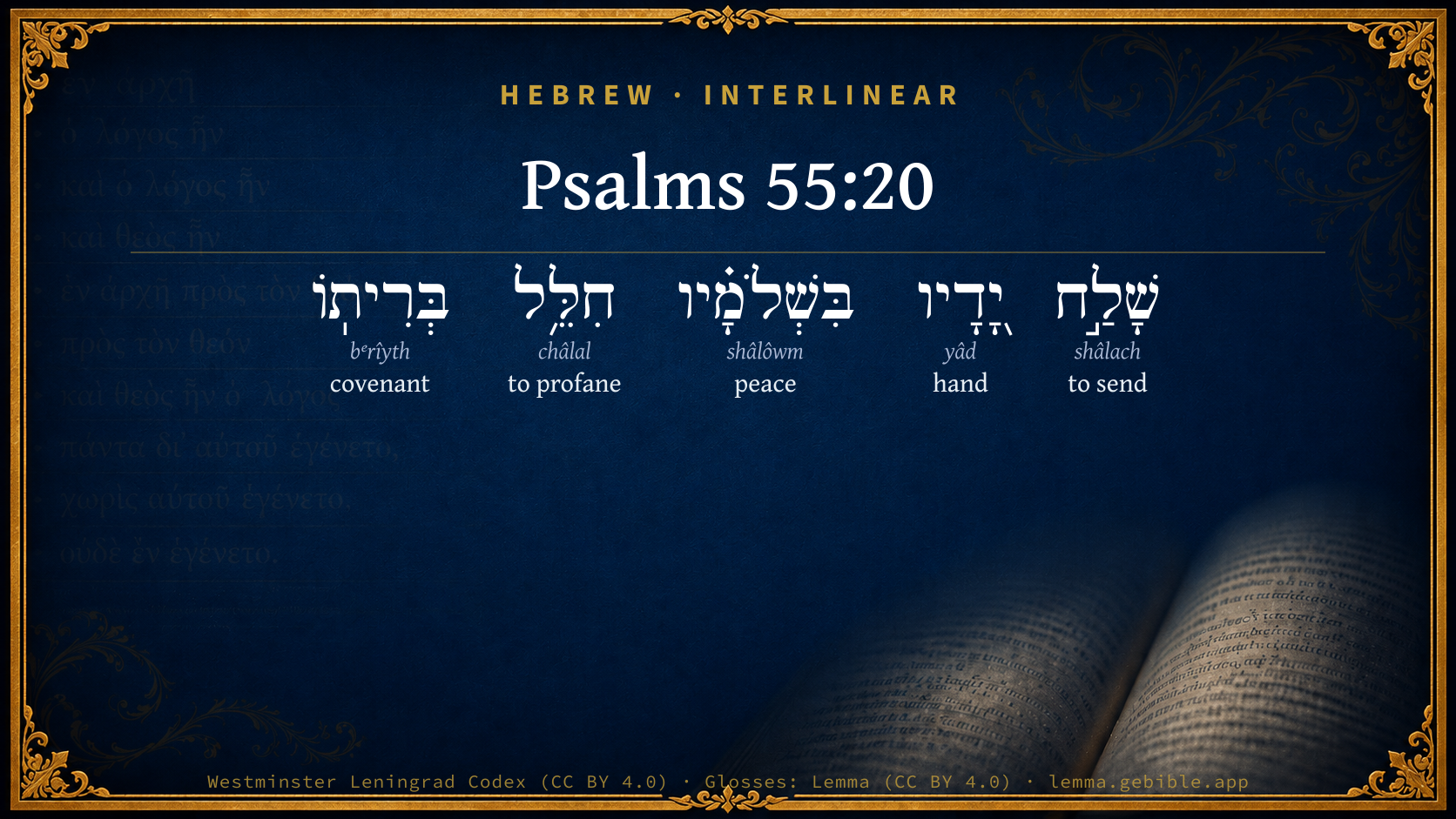
Hebrew (Westminster Leningrad Codex) Psalms 55:20 appears in the Hebrew Old Testament. The text above is from the Westminster Leningrad Codex. Each word links to its Strong’s number, a concise gloss, and parsing drawn from the Open Scriptures Hebrew Bible morphology. Click any word for its full Brown-Driver-Briggs (BDB) entry.
Download image
Cite this verse

Psalms 55:20 (World English Bible). Public Domain. Lemma interlinear Bible study tool, https://lemma.gebible.app/v/psalms/55/20.

Show BibTeX & RIS
BibTeX
RIS
English Translation
He raises his hands against his friends. He has violated his covenant.
World English Bible · Public Domain
Download a study sheet

One document with this verse’s original text, its word-by-word gloss line, the meaning frame, cross-references with their text, attributed commentary, and full source and license credits — printable, and it pastes into notes with its structure intact.

This verse Autodidact and up

Study sheet (.html) Plain text (.txt)

A passage Seminary Student

Up to 50 verses in one chapter. A passage sheet keeps up to 6 commentary sources and 12 cross-references per verse, in the order this page ranks them, and says so on the sheet whenever that leaves anything out. Ask for a single verse and you get the Autodidact verse sheet above.

Everything on this page stays free to read, with no account — the sheet is a download of what is already on screen, not access to it.

Want to remove ads? Support Godless Engineer
Compare translations 3

The same verse in 3 English versions, stacked beneath the original-language interlinear above. Click any original word for its lexicon entry.

Each is an independent rendering of the whole verse — the interlinear is not word-aligned to these translations.

Highlighted words mark where these versions differ — a whole-verse word diff, not a word-by-word alignment.

  • World English Bible Public Domain
    He raises his hands against his friends. He has violated his covenant.
  • King James Version Public Domain
    He hath put forth his hands against such as be at peace with him: he hath broken his covenant.
  • unfoldingWord Literal Text CC BY-SA 4.0
    He stretches out his hands against his friends; he defiles his covenant.

unfoldingWord Literal Text — © unfoldingWord, licensed CC BY-SA 4.0. Word-aligned USFM3 via Door43 (git.door43.org/unfoldingWord/en_ult).

Versions to compare (up to 4)

3 of 4 selected

Show all 18 translations

Every available English version of this verse, each an independent rendering of the whole verse.

  • World English Bible Public Domain
    He raises his hands against his friends. He has violated his covenant.
  • Berean Standard Bible Public Domain
    My companion attacks his friends; he violates his covenant.
  • Majority Standard Bible Public Domain
    My companion attacks his friends; he violates his covenant.
  • King James Version Public Domain
    He hath put forth his hands against such as be at peace with him: he hath broken his covenant.
  • American Standard Version (1901) Public Domain
    He hath put forth his hands against such as were at peace with him: He hath profaned his covenant.
  • Revised Version (1885) Public Domain
    He hath put forth his hands against such as were at peace with him: he hath profaned his covenant.
  • Geneva Bible (1599) Public Domain
    Hee layed his hande vpon such, as be at peace with him, and he brake his couenant.
  • Douay-Rheims (1899) Public Domain
    Evening and morning, and at noon I will speak and declare: and he shall hear my voice.
  • Young's Literal Translation Public Domain
    He hath sent forth his hands against his well-wishers, He hath polluted his covenant.
  • Literal Standard Version CC BY-SA 4.0
    He has sent forth his hands against his well-wishers, || He has defiled his covenant.
  • Unlocked Literal Bible CC BY-SA 4.0
    My friend has raised his hands against those who were at peace with him; he has not respected the covenant that he had.
  • unfoldingWord Literal Text CC BY-SA 4.0
    He stretches out his hands against his friends; he defiles his covenant.
  • Darby Bible Public Domain
    He hath put forth his hands against such as are at peace with him; he hath profaned his covenant.
  • World Messianic Bible Public Domain
    He raises his hands against his friends. He has violated his covenant.
  • Webster's Bible Public Domain
    \\55:19\\God will hear and afflict them, even he that abideth of old. Selah. Because they have no changes, therefore they fear not God.
  • Free Bible Version CC BY-SA 4.0
    As for my best friend, he attacked his friends who had no quarrel with him; he broke the promises he had made to them.
  • Bible in Basic English Public Domain
    He has put out his hand against those who were at peace with him; he has not kept his agreement.
  • JPS Tanakh (1917) Public Domain
    (55-21) He hath put forth his hands against them that were at peace with him; he hath profaned his covenant.

Literal Standard Version (2020), Covenant Press — licensed CC BY-SA 4.0. Text via the HelloAO Bible API (eBible.org). Unlocked Literal Bible (unfoldingWord) — licensed CC BY-SA 4.0. Text via the HelloAO Bible API (eBible.org). unfoldingWord Literal Text — © unfoldingWord, licensed CC BY-SA 4.0. Word-aligned USFM3 via Door43 (git.door43.org/unfoldingWord/en_ult). Free Bible Version, Dr. Jonathan Gallagher — licensed CC BY-SA 4.0. Text via the HelloAO Bible API (eBible.org).

Word by word

More ways to search: Search by grammar → Find every occurrence → Compare this word →

Practice this passage: Drill this verse → Learn its vocabulary →

חִלֵּ֥ל
châlal
H2490
“to profane”
Verb, Piel, Perfect, 3rd Person, Masculine, Singular
Part of Speech
Verb
Stem
Piel
Form
Perfect
Person
3rd Person
Gender
Masculine
Number
Singular
Full BDB Definition

Origin: a primitive root [compare H2470 ]

TWOT: 660 , 661

to profane, defile, pollute, desecrate, begin - (Niphal) - to profane oneself, defile oneself, pollute oneself - ritually - sexually - to be polluted, be defiled - (Piel) - to profane, make common, defile, pollute - to violate the honour of, dishonour - to violate (a covenant) - to treat as common - (Pual) to profane (name of God) - (Hiphil) - to let be profaned - to begin - (Hophal) to be begun - to wound (fatally), bore through, pierce, bore - (Qal) to pierce - (Pual) to be slain - (Poel) to wound, pierce - (Poal) to be wounded - (Piel) to play the flute or pipe
  1. שָׁלַ֣ח shâlach H7971 “to send” Verb, Qal, Perfect, 3rd Person, Masculine, Singular
  2. יָ֭דָיו yâd H3027 “hands · his” Noun, Common, Both, Dual, Construct + Suffix, Personal, 3rd Person, Masculine, Singular
  3. בִּשְׁלֹמָ֗יו shâlôwm H7965 “in/at · peace · his” Preposition + Noun, Common, Masculine, Plural, Construct + Suffix, Personal, 3rd Person, Masculine, Singular
  4. בְּרִיתֽוֹ bᵉrîyth H1285 “covenant · his” Noun, Common, Feminine, Singular, Construct + Suffix, Personal, 3rd Person, Masculine, Singular

About this verse

These counts appear in no published source. They are computed here, from the morphology-tagged text and Lemma’s own curated glosses. What Lemma adds →

5
words
5
distinct lemmas
Wisdom
section

Grammatical profile

  • 2 verbs
  • 3 nouns

Verb forms

  • שָׁלַ֣ח Qal · Perfect
  • חִלֵּ֥ל Piel · Perfect

Hebrew & Septuagint length

In English translation the verse runs 12 words from the Hebrew and 13 from the Septuagint (LXX English) — closely comparable.

A rough comparison of the two English renderings, which tokenize alike — not a word-level alignment.

Word counts can differ between the Hebrew and the Greek without any difference in meaning — e.g. the Hebrew direct-object marker אֵת has no separate Greek word, and Greek often adds the article ὁ.

Cross-references

16

Topical passages linked to Psalms 55:20 in the Treasury of Scripture Knowledge — connected by theme and wording, ordered by reader-vote popularity; previews shown in the World English Bible.

  • Psalms 7:4 If I have rewarded evil to him who was at peace with me (Yes, I have delivered him who without cause was my adversary),
  • Psalms 89:34 I will not break my covenant, Nor alter what my lips have uttered.
  • Acts 12:1 Now about that time, Herod the king stretched out his hands to oppress some of the assembly.
  • Psalms 109:5 They have rewarded me evil for good, And hatred for my love.
  • Psalms 120:6–7 My soul has had her dwelling too long With him who hates peace.
  • 1 Samuel 22:17 The king said to the guard who stood about him, Turn, and kill the priests of Yahweh; because their hand also is with David, and because they knew that he fled, and didn't disclose it to me. But the servants of the king wouldn't put forth their hand to fall on the priests of Yahweh.
  • 1 Samuel 24:10 Behold, this day your eyes have seen how that Yahweh had delivered you today into my hand in the cave: and some bade me kill you; but [my eye] spared you; and I said, I will not put forth my hand against my lord; for he is Yahweh's anointed.
  • Psalms 89:28 I will keep my loving kindness for him forevermore. My covenant will stand firm with him.
  • Psalms 89:38 But you have rejected and spurned. You have been angry with your anointed.
  • Ecclesiastes 8:2 I say, "Keep the king's command!" because of the oath to God.
  • Ezekiel 17:16–19 As I live, says the Lord Yahweh, surely in the place where the king dwells who made him king, whose oath he despised, and whose covenant he broke, even with him in the midst of Babylon he shall die.
  • 2 Samuel 2:4 The men of Judah came, and there they anointed David king over the house of Judah. They told David, saying, The men of Jabesh Gilead were those who buried Saul.
  • 2 Samuel 5:3 So all the elders of Israel came to the king to Hebron; and king David made a covenant with them in Hebron before Yahweh: and they anointed David king over Israel.
  • 2 Samuel 14:32–33 Absalom answered Joab, Behold, I sent to you, saying, Come here, that I may send you to the king, to say, Why am I come from Geshur? it were better for me to be there still. Now therefore let me see the king's face; and if there be iniquity in me, let him kill me.
  • 2 Samuel 15:10–12 But Absalom sent spies throughout all the tribes of Israel, saying, As soon as you hear the sound of the trumpet, then you shall say, Absalom is king in Hebron.
  • 2 Samuel 18:12 The man said to Joab, Though I should receive a thousand [pieces of] silver in my hand, I still wouldn't put forth my hand against the king's son; for in our hearing the king charged you and Abishai and Ittai, saying, Beware that none touch the young man Absalom.

Cross-references courtesy of OpenBible.info (CC BY 4.0).

Hebrew and Greek witnesses Masoretic Hebrew ↔ Greek Septuagint

The same verse in the two great witnesses to the Old Testament, shown verse-for-verse.

You’re reading Greek Psalm 54 (Hebrew Psalm 55). The Septuagint counts the superscription, so verse numbers can differ from the Hebrew — chapter-level alignment, not verse-by-verse. Numbering follows Rahlfs.

These are two independent witnesses, not word-aligned to each other, and the Septuagint is shown in lemma (dictionary) form.

Hebrew Psalms 55:20 Masoretic · Westminster Leningrad Codex

שָׁלַ֣ח יָ֭דָיו בִּשְׁלֹמָ֗יו חִלֵּ֥ל בְּרִיתֽוֹ

He raises his hands against his friends. He has violated his covenant.

World English Bible · Public Domain

Greek LXX Greek Psalm 54:20 Septuagint · lemma form

εἰςἀκούω ὁ θεός καί ταπεινόω αὐτός ὁ ὑποἄρχω πρό ὁ αἰών διάψαλμα οὐ γάρ εἰμί αὐτός ἀντάλλαγμα καί οὐ φοβέω ὁ θεός

He has reached forth his hand for retribution; they have profaned his covenant.

LXX2012 (modern English Septuagint) · Public Domain

On this verse, Albert Barnes' Notes on the Bible discusses the Septuagint’s reading. Read the note in Commentary ↓

Hebrew: Westminster Leningrad Codex (CC BY 4.0). Greek: Septuagint (public domain); English from LXX2012 (modern English Septuagint) (Public Domain). How the Septuagint differs from the Hebrew →

Commentary

Notes on Psalms 55:20 from classic Christian and Jewish commentators (each source and its license shown beneath its notes). The classic Christian expositions comment on the surrounding passage and are grouped to its opening verse, so a note may address several verses; the Jewish commentaries on the Tanakh (Rashi and others) are per-verse, so they appear only where the commentator wrote on this verse.

Lemma curates 59 commentaries, every one of them public domain or Creative Commons licensed, each selected and text-cleaned for this edition rather than reprinted as found. About our sources →

Trapp's Complete Commentary

John Trapp

Psa 55:20 He hath put forth his hands against such as be at peace with him: he hath broken his covenant.

Ver. 20. He hath put forth his hands, &c.] That wicked Ahithophel hath. The Fathers understand it of God and his judgments.

He hath broken his covenant] His oath of allegiance, and a particular oath when he was sworn of David’s counsel. The Scythians were strict covenant keepers (Herod. Melp.); and the Carthaginians infamous for the contrary; as now the Turks are.

John Trapp, A Commentary or Exposition upon All the Books of the Old and New Testament (1647–1656) — public domain. Text from a community e-Sword module.

Joseph Benson's Commentary

Psa 55:20-21. He, &c. — I speak especially of “that perfidious person, who hath not only violated all the laws of friendship, but profanely broken his promise and oath of fidelity, wherein he was engaged to me.” — Bishop Patrick. Although, as we have seen, David did not excuse the rest that were concerned in these treacherous and treasonable practices, yet the base conduct of Ahithophel grieved him most, and dwelt most upon his mind; and, therefore, having mentioned the wickedness: and foretold the punishment of the others, he here returns to him of whom he had spoken, Psa 55:13, and of whose wickedness, as being the chief contriver and promoter of the rebellion, he here adds some new and aggravating circumstances. Hath put forth his hand — In the way of force or violence; against such as be at peace with him — Against me, who gave him no provocation nor disturbance, but lived in great peace, and security, and friendship with him. He hath broken his covenant — All those solemn obligations by which he was tied to me, both as his king and as his friend. The words of his mouth were smoother, &c. — Chandler and Houbigant, taking מחמאת, ma-chamaoth, for an adjective, render the clause, Smooth and deceitful are the buttery words of his mouth. It is, however, considered by Kimchi as a substantive, with the preposition מprefixed, and so taken is properly translated, than butter. Either way the sense is the same, namely, he covered his treasonable and bloody design with fair and flattering speeches. So courteous was he, and obliging, so free in his professions of respect and kindness, and the proffers of his service, that he carried the appearance of a true and faithful friend: but war was in his heart — All this courtesy and pretended kindness was but a stratagem of war, and those very words had a mischievous intention: though softer than oil, yet were they drawn swords — Pernicious in their design and consequences.

Joseph Benson's Commentary on the Old and New Testaments (1811–1818) — public domain. Text from a community e-Sword module.

J. A. Alexander on Psalms

Joseph Addison Alexander

21. (Psa 55:20). He has stretched out his hands against his allies: he has profaned his covenant. This might seem at first sight to refer to God; but such a reference, if not forbidden by the nature of the acts alleged, would be at variance with the subsequent context, where the subject is undoubtedly the wicked enemy. The sudden change of number is in strict accordance with the usage of the Psalmists in speaking of their enemies, or in this case may arise from the same cause as in Psa 55:12 above. See above, on Psa 10:10. The word translated allies is the plural of one meaning peace, but seems to be poetically used here to denote those at peace with him, his friends or allies. Compare the analogous expressions in Psa 7:4), 41:9. To profane a covenant is to treat it as no longer sacred, and by implication to break it. Compare Isa 33:8. This is a varied repetition, under military figures, of the description in Psa 55:12-14.

Joseph Addison Alexander, The Psalms Translated and Explained (1850) — public domain. Text from a community e-Sword module.

Geneva Bible (1599)

Geneva Bible translators

I did not provoke him, but was as at peace with him, yet he made war against me.

Geneva Bible (1599) marginal notes — public domain. Text via Bolls.life.

Jamieson, Fausset & Brown

Robert Jamieson, A. R. Fausset & David Brown

The treachery is aggravated by hypocrisy. The changes of number, Psa 55:15, Psa 55:23, and here, enliven the picture, and imply that the chief traitor and his accomplices are in view together.

Jamieson, Fausset & Brown — Commentary Critical and Explanatory on the Whole Bible (1871) — public domain (CC PDM 1.0). Text via the HelloAO Bible API.

Adam Clarke's Commentary

Verse 20. He hath put forth his hands] A farther description of Ahithophel. He betrayed his friends, and he broke his covenant with his king. He had agreed to serve David for his own emolument, and a stipulation was made accordingly; but while receiving the king's pay, he was endeavouring to subvert the kingdom, and destroy the life of his sovereign.

Adam Clarke's Commentary on the Bible (1810–1826) — public domain. Text from a community e-Sword/MySword module.

John Calvin's Commentaries

20. He hath sent his hands against those that were at peace with him He afterwards speaks in verse 23d in the plural number, but here it is probable that he begins by addressing the leader and head of the wicked conspiracy. He accuses him of waging war in the midst of peace, and being thus guilty of a breach of faith. He had neither suffered provocation, nor had he announced in an open manner his intention to give battle, but had commenced the attack unexpectedly and with treachery. The same charge is insisted upon still further, when it is added, that butter and oil were in his lips, while war was in his heart, and his words themselves were darts. To appearance they were soft and agreeable, but they covered a hidden virulence and cruelty which wounded like a sword or like darts, according to the common proverb, that deceivers carry on their lips poison besmeared with honey. It is well known how many fair promises and flatteries Saul addressed to David with a view to entrap him, and we may conjecture that the same arts were practiced by his courtiers. It is one special trial of the Lord’s people, that they are exposed to such attempts on the part of crafty men to seduce them into destruction. Here the Holy Spirit puts a mark of reprobation upon all subtilty of this kind, and particularly upon treacherous flatteries, exhorting us to cultivate simplicity of intention.

John Calvin's Commentaries (1540-1563) — public domain. Text from the Calvin Translation Society English edition (1840s-50s) via the Christian Classics Ethereal Library (ccel.org). Calvin's coverage is partial (roughly two-thirds of the Bible); uncommented books and verses are honest gaps, never fabricated. The 19th-century editor's footnotes and remarks are omitted so the notes are faithfully Calvin's own voice.

Ellicott's Commentary for English Readers

(20) He hath.—As in Psa_55:12, the individual specially prominent in the traitorous crew is here singled out, and his treachery exposed.

He hath broken . . .—Literally, he perforated. In a note in his work on the Creed, referring to Col_2:14, Bishop Pearson says one mode of cancelling a bond was to drive a nail through it.

A Bible Commentary for English Readers, edited by Charles John Ellicott (1878–1897) — public domain. Text from a community e-Sword module.

The Cambridge Bible for Schools and Colleges

gen. ed. J. J. S. Perowne

20. He hath put forth his hands] The arch-traitor is certainly meant, not (though the Heb. idiom would allow of this explanation) each of the evildoers mentioned in Psa_55:19. For the phrase cp. 1Sa_26:9, R.V.

against such as be at peace with him] R.V., against such as were at peace with him. Cp. Psa_7:4; Psa_41:9 (familiar friend, lit. man of my peace); Jer_20:10; Jer_38:22. The plural may merely generalise, but seems rather to indicate that the Psalmist is the representative of a party.

he hath broken his covenant] R.V., he hath profaned his covenant: desecrated the sacred obligations of friendship (1Sa_18:3).

20, 21. Once more the Psalmist reverts to the treachery of his former friend. It is quite natural that he should do so again, abrupt as is the transition from the great mass of his enemies to the one individual who to his mind stands in the forefront of them as the typical traitor. It is unnecessary to transpose these verses to follow Psa_55:12-14, or to assume that they are a misplaced fragment of another Psalm.

The Cambridge Bible for Schools and Colleges (gen. ed. J. J. S. Perowne; Cambridge University Press, 1878–1918) — public domain. Text from a community e-Sword module.

John Gill's Exposition

The words of his mouth were smoother than butter,.... Such were the words of Ahithophel, when in counsel with David; and such the words of Judas, when he said to Christ, "hail, master", and kissed him, Mat 26:49;

but war was in his heart; even a civil war, rebellion against his prince; that was what Ahithophel meditated in his heart; and nothing less than to take away the life of Christ was designed by Judas. The words may be rendered, "they were divided" (e); that is, his mouth and his heart: "his mouth was butter, and his heart war"; the one declared for peace, when the other intended war; see Jer 9:8;

his words were softer than oil; at one time full of soothing and flattery:

yet were they drawn swords: at another time sharp and cutting, breathing out threatening and slaughter, destruction and death.

(e) Sept. "divisi sunt", V. L. Hammond.

John Gill's Exposition of the Whole Bible (1746–1763) — public domain (CC PDM 1.0). Text via the HelloAO Bible API.

Albert Barnes' Notes on the Bible

He hath put forth his hands against such as be at peace with him - Against those who were his friends, or who had given him no occasion for war. The Septuagint and Vulgate render this, “He hath put forth his hands in recompensing;” that is, in taking vengeance. The Hebrew would bear this construction, but the more correct rendering is that in our common version. The “connection” here would seem to indicate that this is to be referred to God, as God is mentioned in the previous verse. But evidently the design is to refer to the enemies, or the principal enemy of the psalmist - the man whom he had particularly in his eye in the composition of the psalm; and the language is that of one who was “full” of the subject - who was thinking of one thing - and who did not deem it necessary to specify by name the man who had injured him, and whose conduct had so deeply pained him. He, therefore, begins the verse, “He hath put forth his hands,” etc.; showing that his mind was fixed on the base conduct of his enemy. The language is such as leads us to suppose that the psalmist had Ahithophel in view, as being eminently the man that had in this cruel and unexpected manner put forth his hands against one who was his friend, and who had always treated him with confidence.

He hath broken his covenant - He, Ahithophel. The margin, as the Hebrew, is, “He hath profaned.” The idea is, that he had defiled, or polluted it; or he had treated it as a vile thing - a thing to be regarded with contempt and aversion, as a polluted object is. The “covenant” here referred to, according to the views expressed above, may be supposed to refer to the compact or agreement of Ahithophel with David as an officer of his realm - as an adviser and counselor - that he would be faithful to the interests of the king and to his cause. All this he had disregarded, and had treated as if it were a worthless thing, by identifying himself with Absalom in his rebellion. See 2Sa 15:12, 2Sa 15:31.

Albert Barnes' Notes on the Bible (1834–1885) — public domain. Text from a community e-Sword/MySword module.

Matthew Poole's English Annotations

He, i.e. they, the persons last mentioned. Before the singular number, Psa 55:13,14, was suddenly changed into the plural, Psa 55:15, that the punishment might reach not him only, but his partners, in those treacherous and treasonable actions; and here is as sudden a change from the plural into the singular, and he returns to that person who was the chief contriver and promoter of this rebellion under Absalom, even to Ahithophel, of whom he spoke Psa 55:13; and though he doth not excuse the rest, as we have seen, yet he lays the chief blame upon him, and here he adds new aggravations of his treason.

Hath put forth his hands, in way of force or violence, as this phrase is used, Gen 37:22; 1Sa 26:9; Neh 13:21; Act 12:1.

Against such as be at peace with him; against me, who gave him no provocation nor disturbance, but lived in great peace, and security, and friendship with him.

Hath broken his covenant; all those solemn obligations by which he was tied to me, both as his king and as his friend.

Matthew Poole's English Annotations on the Holy Bible (1683–1685) — public domain. Text from a community e-Sword/MySword module.

The Treasury of David

Charles H. Spurgeon

Ver. 20. The psalmist cannot forget the traitor's conduct, and returns again to consider it.

He hath put forth his hands against such as be at peace with him. He smites those to whom he had given the hand of friendship, he breaks the bonds of alliance, he is perfidious to those who dwell at ease because of his friendly profession.

He hath broken his covenant. The most solemn league he has profaned, he is regardless of oaths and promises.

None.

None.

Psalms 55:21*

Charles H. Spurgeon's The Treasury of David (1869–1885) — public domain. Psalms only. Text from a community e-Sword/MySword module.

Whedon's Commentary on the Bible

Daniel D. Whedon

20. He hath broken his covenant—The covenant that was implied by their close friendship. Here again Ahithophel appears to view. See Psa_55:14

Daniel D. Whedon (gen. ed.), Commentary on the Old and New Testaments (1874–1909) — public domain. Text from a community e-Sword module.

The Pulpit Commentary

He hath put forth his hands against such as be at peace with him. Some explain "he" as "the wicked collectively," and maintain that in this verse and the next no particular person is pointed at; but it seems better to regard the psalmist as "suddenly reverting to the fixed and deepest thought in his heart the treachery of his friend" (Canon Cook). Ahithophel had put forth his hand against such as were at peace with him." He hath broken his covenant. The covenant of friendship with David (ver. 14), not, perhaps, a formal one, but involved in the terms on which they stood one towards the other.

The Pulpit Commentary (1880–1919), ed. H.D.M. Spence-Jones & Joseph S. Exell — public domain. Text from a community e-Sword module.

John Wesley's Explanatory Notes

He - They, the persons last mentioned.

John Wesley, Explanatory Notes Upon the Whole Bible (1754–1765) — public domain. Text via the GEBible commentary corpus.

unfoldingWord translationNotes

Door43 World Missions Community

has raised his hands against those

Raising the hand against people represents attacking them. This may be a metaphor for saying things that put people in danger or cause them trouble. AT: "has attacked those" or "has betrayed those" (See: Metonymy and Metaphor)

His mouth

Someone's "mouth" represents what he says. AT: "What my friend said" (See: Metonymy)

His mouth was smooth as butter

Speech that is pleasant or nice to hear is spoken of as if it were smooth and easy to swallow. AT: "What he said was pleasant like smooth butter" or "He said nice things" (See: Simile)

was hostile

"was mean" or "was hateful"

his words

"what he said"

his words were softer than oil

People put oil on their skin to make it feel nice, and they put it on wounds to help them heal. Speech that is kind or helpful is spoken of as if it were soft or soothing. AT: "what he said was kind and soothing like oil" or "he said kind things" (See: Simile)

they were actually drawn swords

Speech that causes people trouble is spoken of as if it were swords that wound people. AT: "what he said wounded people as drawn swords do" or "what he said caused people trouble" (See: Metaphor)

drawn swords

The word "drawn" here means that the swords were pulled out of their covers and ready to be used.

translationWords

raise

hand

peace

covenant

heart

oil

sword

unfoldingWord translationNotes — © Distant Shores Media and the Door43 World Missions Community, licensed CC BY-SA 4.0. Source: git.door43.org/Door43/en_tn.

Rashi

Rabbi Shlomo Yitzchaki (Rashi)

May God hear the prayer of those many people.

and answer them the King, Who dwells from time immemorial.

for there is no passing for them For those wicked men who pursue me. They do not pay heed to the day of their passing, and they do not quake from the day of death.

Rashi on the Tanakh — English translations: “The Judaica Press complete Tanach with Rashi, translated by A. J. Rosenberg” (CC BY 4.0); “Pentateuch with Rashi's commentary by M. Rosenbaum and A.M. Silbermann, 1929-1934” (public domain); “The Metsudah Tanach series, Lakewood, N.J” (CC BY 4.0); and “The Book of Joshua, Metsudah Publications, 1997” (CC BY 4.0). Text via Sefaria.

Lesson kit

Teaching starters — assembled from the data on this page, not authored interpretation. Every prompt links to the verse data it draws on. Edit before teaching.

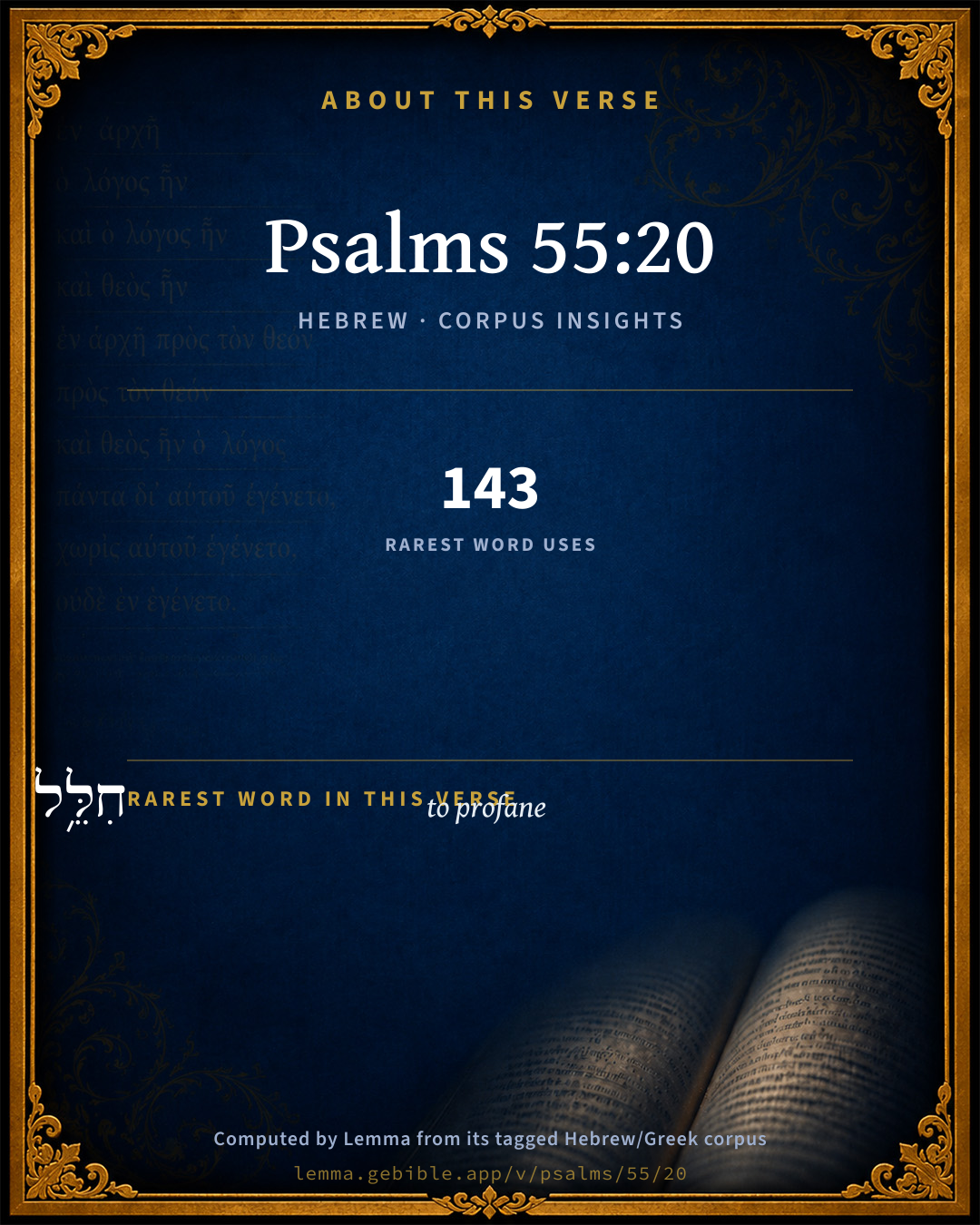
Psalms, in the Wisdom, opens this verse with 5 words (5 distinct Hebrew lemmas). Its most distinctive word is châlal (“to profane”). A historical commentator’s framing appears above. Read the whole chapter for the surrounding context.

Discussion questions

  1. What does “to profane” (châlal) contribute to the verse as a whole?
  2. Psalms 7:4 shares this passage’s theme. How do the two illuminate each other?
  3. These translations render this verse differently; the difference is in the English rendering, not the original. What questions does that raise?
  4. The verb «שָׁלַ֣ח» is Qal Perfect. How does its form color the action?
  5. Reading how Trapp's Complete Commentary and Joseph Benson's Commentary read this verse, where do the two commentators agree and where do they part?

Things to notice

Reading settings

Reading text

Shown beneath each verse's original-language words.

Old Testament
Old Testament edition

Read the OT as the Masoretic Hebrew (MT) or the Greek Septuagint (LXX).

English shown for the Greek Septuagint (in the Hebrew ↔ Greek comparison).

Comparing translations? Open the Compare panel on any verse page to stack up to four side by side.