2 Kings 4:23

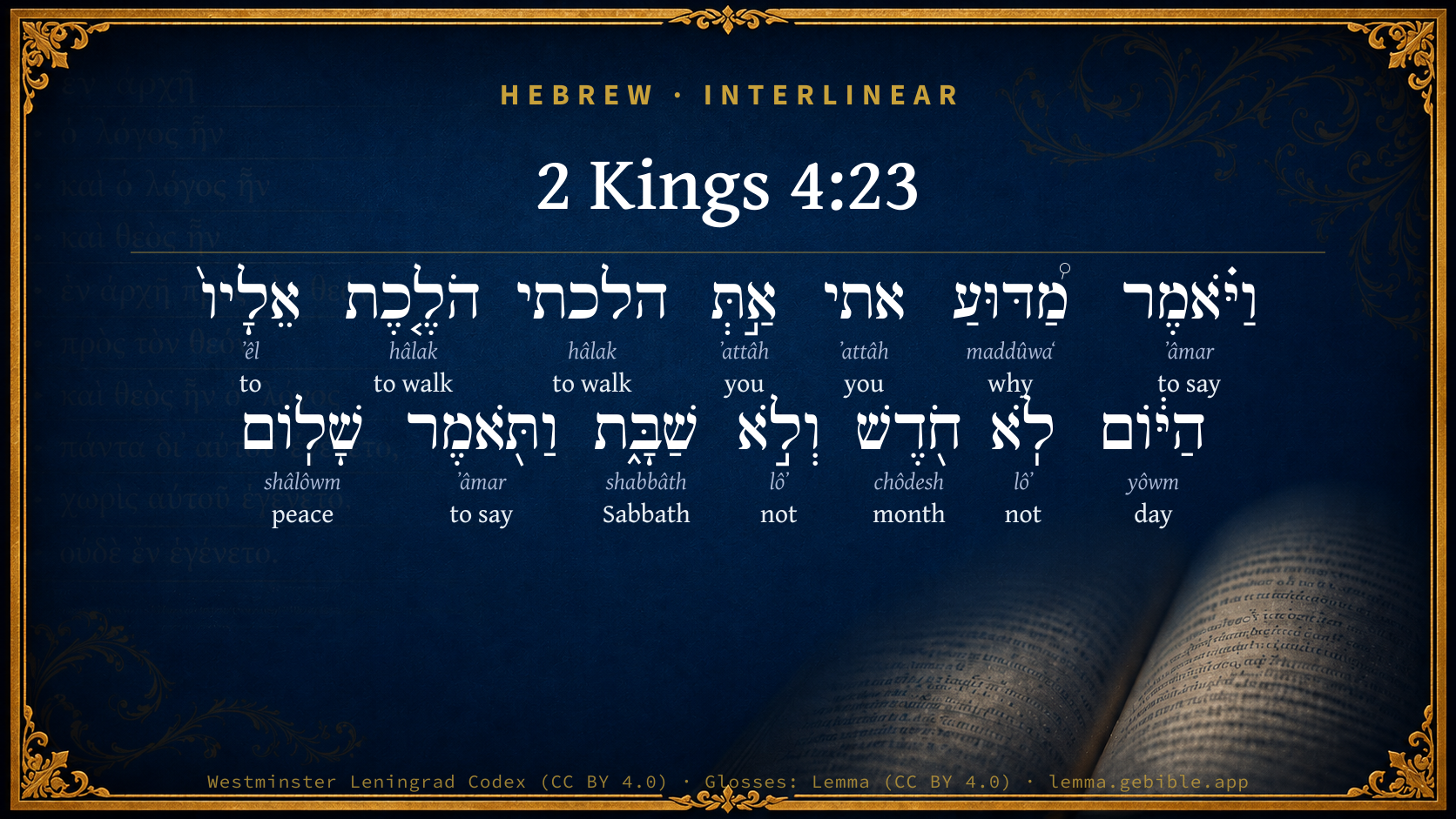
Hebrew (Westminster Leningrad Codex) 2 Kings 4:23 appears in the Hebrew Old Testament. The text above is from the Westminster Leningrad Codex. Each word links to its Strong’s number, a concise gloss, and parsing drawn from the Open Scriptures Hebrew Bible morphology. Click any word for its full Brown-Driver-Briggs (BDB) entry.
Download image
Cite this verse

2 Kings 4:23 (World English Bible). Public Domain. Lemma interlinear Bible study tool, https://lemma.gebible.app/v/2-kings/4/23.

Show BibTeX & RIS
BibTeX
RIS
English Translation
He said, Why will you go to him today? it is neither new moon nor Sabbath. She said, It shall be well.
World English Bible · Public Domain
Download a study sheet

One document with this verse’s original text, its word-by-word gloss line, the meaning frame, cross-references with their text, attributed commentary, and full source and license credits — printable, and it pastes into notes with its structure intact.

This verse Autodidact and up

Study sheet (.html) Plain text (.txt)

A passage Seminary Student

Up to 50 verses in one chapter. A passage sheet keeps up to 6 commentary sources and 12 cross-references per verse, in the order this page ranks them, and says so on the sheet whenever that leaves anything out. Ask for a single verse and you get the Autodidact verse sheet above.

Everything on this page stays free to read, with no account — the sheet is a download of what is already on screen, not access to it.

Want to remove ads? Support Godless Engineer
Compare translations 3

The same verse in 3 English versions, stacked beneath the original-language interlinear above. Click any original word for its lexicon entry.

Each is an independent rendering of the whole verse — the interlinear is not word-aligned to these translations.

Highlighted words mark where these versions differ — a whole-verse word diff, not a word-by-word alignment.

  • World English Bible Public Domain
    He said, Why will you go to him today? it is neither new moon nor Sabbath. She said, It shall be well.
  • King James Version Public Domain
    And he said, Wherefore wilt thou go to him to day? it is neither new moon, nor sabbath. And she said, It shall be well.
  • unfoldingWord Literal Text CC BY-SA 4.0
    And he said, “Why are you going to him today? not a new moon and not a Sabbath.” And she said, “Peace.”

unfoldingWord Literal Text — © unfoldingWord, licensed CC BY-SA 4.0. Word-aligned USFM3 via Door43 (git.door43.org/unfoldingWord/en_ult).

Versions to compare (up to 4)

3 of 4 selected

Show all 18 translations

Every available English version of this verse, each an independent rendering of the whole verse.

  • World English Bible Public Domain
    He said, Why will you go to him today? it is neither new moon nor Sabbath. She said, It shall be well.
  • Berean Standard Bible Public Domain
    “Why would you go to him today?” he replied. “It is not a New Moon or a Sabbath.” “Everything is all right,” she said.
  • Majority Standard Bible Public Domain
    “Why would you go to him today?” he replied. “It is not a New Moon or a Sabbath.” “Everything is all right,” she said.
  • King James Version Public Domain
    And he said, Wherefore wilt thou go to him to day? it is neither new moon, nor sabbath. And she said, It shall be well.
  • American Standard Version (1901) Public Domain
    And he said, Wherefore wilt thou go to him to-day? it is neither new moon nor sabbath. And she said, It shall be well.
  • Revised Version (1885) Public Domain
    And he said, Wherefore wilt thou go to him today? it is neither new moon nor sabbath. And she said, It shall be well.
  • Geneva Bible (1599) Public Domain
    And he sayd, Wherefore wilt thou goe to him to day? it is neither newe moone nor Sabbath day. And she answered, All shalbe well.
  • Douay-Rheims (1899) Public Domain
    And he said to her: Why dost thou go to him? to day is neither new moon nor sabbath. She answered: I will go.
  • Young's Literal Translation Public Domain
    And he saith, `Wherefore art thou going unto him to-day? -- neither new moon nor sabbath!' and she saith, `Peace `to thee'!'
  • Literal Standard Version CC BY-SA 4.0
    And he says, “Why are you going to him today? [It is] neither new moon nor Sabbath!” And she says, “Peace [to you]!”
  • Unlocked Literal Bible CC BY-SA 4.0
    Her husband said, “Why do you want to go to him today? It is not a new moon nor a Sabbath.” She replied, “It will be all right.”
  • unfoldingWord Literal Text CC BY-SA 4.0
    And he said, “Why are you going to him today? not a new moon and not a Sabbath.” And she said, “Peace.”
  • Darby Bible Public Domain
    And he said, Why wilt thou go to him to-day? It is neither new moon nor sabbath. And she said, [It is] well.
  • World Messianic Bible Public Domain
    He said, “Why would you want to go to him today? It is not a new moon or a Sabbath.” She said, “It’s all right.”
  • Webster's Bible Public Domain
    And he said, Why wilt thou go to him to-day? it is neither new-moon, nor sabbath. And she said, It shall be well.
  • Free Bible Version CC BY-SA 4.0
    “Why do you need to go and see him today?” he asked. “It's not the New Moon or the Sabbath.” “Don't worry about it,” she replied.
  • Bible in Basic English Public Domain
    And he said, Why are you going to him today? it is not a new moon or a Sabbath. But she said, It is well.
  • JPS Tanakh (1917) Public Domain
    And he said: Wherefore wilt thou go to him today? it is neither new moon nor sabbath.' And she said: 'It shall be well.'

Literal Standard Version (2020), Covenant Press — licensed CC BY-SA 4.0. Text via the HelloAO Bible API (eBible.org). Unlocked Literal Bible (unfoldingWord) — licensed CC BY-SA 4.0. Text via the HelloAO Bible API (eBible.org). unfoldingWord Literal Text — © unfoldingWord, licensed CC BY-SA 4.0. Word-aligned USFM3 via Door43 (git.door43.org/unfoldingWord/en_ult). Free Bible Version, Dr. Jonathan Gallagher — licensed CC BY-SA 4.0. Text via the HelloAO Bible API (eBible.org).

Word by word

More ways to search: Search by grammar → Find every occurrence → Compare this word →

Practice this passage: Drill this verse → Learn its vocabulary →

מַ֠דּוּעַ
maddûwaʻ
H4069
“why”
Particle, Interrogative
Part of Speech
Particle
Type
Interrogative
Full BDB Definition

Origin: from H4100 and the pass. participle of H3045

TWOT: 848h

why?, on what account?, wherefore?
  1. וַיֹּ֗אמֶר ʼâmar H559 “and · to say” Conjunction + Verb, Qal, Sequential Imperfect, 3rd Person, Masculine, Singular
  2. אתי ʼattâh H859 “you” Pronoun, Personal, 2nd Person, Feminine, Singular
  3. אַ֣תְּ ʼattâh H859 “you” Pronoun, Personal, 2nd Person, Feminine, Singular
  4. הלכתי hâlak H1980 “walking” Verb, Qal, Participle Active, Feminine, Singular, Absolute
  5. הֹלֶ֤כֶת hâlak H1980 “walking” Verb, Qal, Participle Active, Feminine, Singular, Absolute
  6. אֵלָיו֙ ʼêl H413 “to · him” Preposition + Suffix, Personal, 3rd Person, Masculine, Singular
  7. הַיּ֔וֹם yôwm H3117 “the · day” Particle, Definite Article + Noun, Common, Masculine, Singular, Absolute
  8. לֹֽא lôʼ H3808 “not” Particle, Negative
  9. חֹ֖דֶשׁ chôdesh H2320 “month” Noun, Common, Masculine, Singular, Absolute
  10. וְלֹ֣א lôʼ H3808 “and · not” Conjunction + Particle, Negative
  11. שַׁבָּ֑ת shabbâth H7676 “Sabbath” Noun, Common, Both, Singular, Absolute
  12. וַתֹּ֖אמֶר ʼâmar H559 “and · to say” Conjunction + Verb, Qal, Sequential Imperfect, 3rd Person, Feminine, Singular
  13. שָׁלֽוֹם shâlôwm H7965 “peace” Noun, Common, Masculine, Singular, Absolute

About this verse

These counts appear in no published source. They are computed here, from the morphology-tagged text and Lemma’s own curated glosses. What Lemma adds →

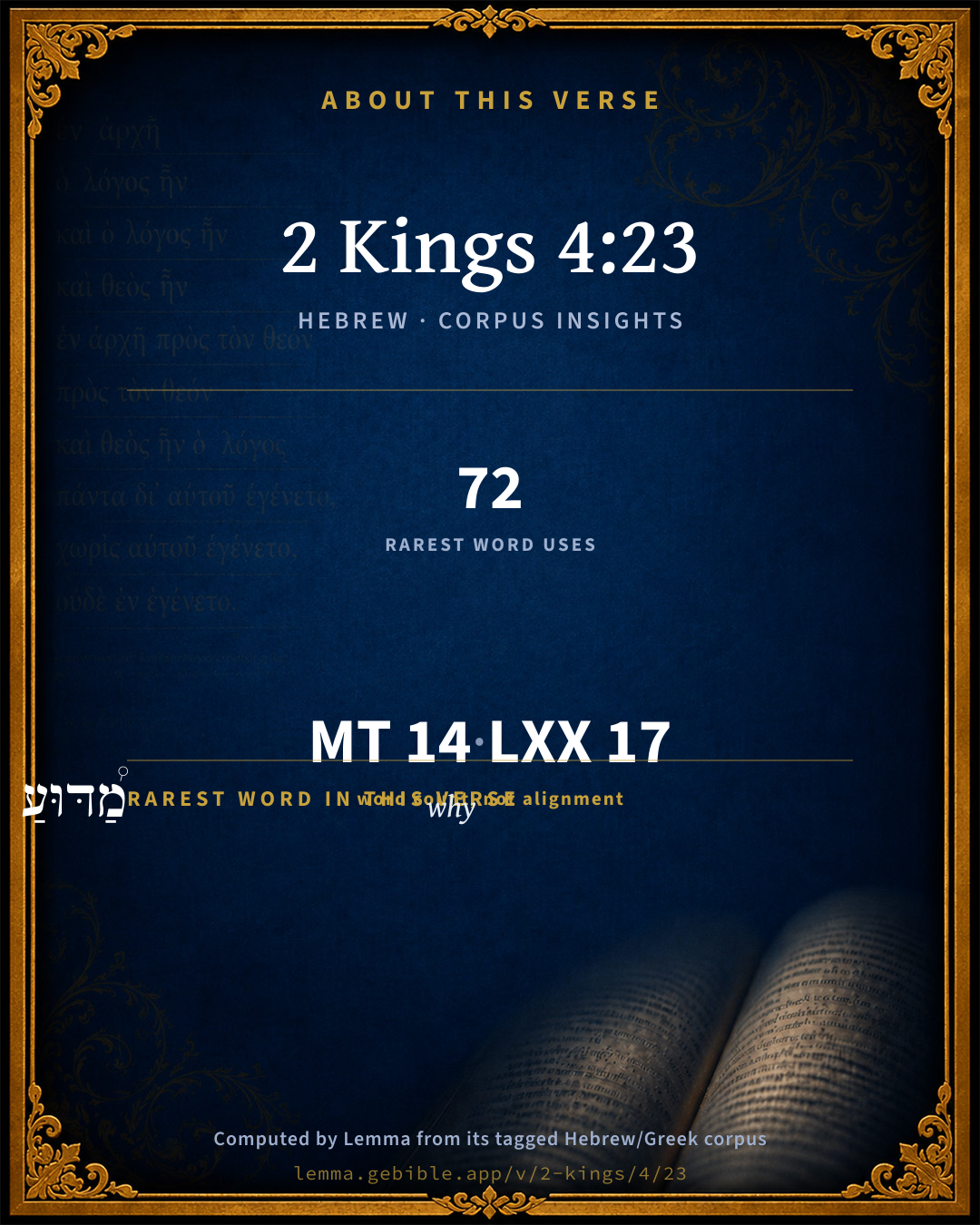
14
words
10
distinct lemmas
Historical
section

Grammatical profile

  • 4 verbs
  • 4 nouns
  • 2 pronouns
  • 1 preposition
  • 3 particles

Verb forms

  • וַיֹּ֗אמֶר Qal · Sequential Imperfect
  • הלכתי Qal · Participle Active
  • הֹלֶ֤כֶת Qal · Participle Active
  • וַתֹּ֖אמֶר Qal · Sequential Imperfect

Repetition

Words recur within this verse — often emphatic in Hebrew:

  • וַיֹּ֗אמֶר to say H559 ×2
  • הלכתי to walk H1980 ×2
  • אתי you H859 ×2
  • לֹֽא not H3808 ×2

Hebrew & Septuagint length

In English translation the verse runs 22 words from the Hebrew and 24 from the Septuagint (LXX English) — closely comparable.

A rough comparison of the two English renderings, which tokenize alike — not a word-level alignment.

Word counts can differ between the Hebrew and the Greek without any difference in meaning — e.g. the Hebrew direct-object marker אֵת has no separate Greek word, and Greek often adds the article ὁ.

In the original languages it is 14 Hebrew tokens and 17 Greek tokens — but the two are counted differently (Hebrew bundles its prefixes and suffixes into one token; the Greek is in lemma form), so that isn’t a like-for-like length.

Cross-references

4

Topical passages linked to 2 Kings 4:23 in the Treasury of Scripture Knowledge — connected by theme and wording, ordered by reader-vote popularity; previews shown in the World English Bible.

  • Numbers 10:10 Also in the day of your gladness, and in your set feasts, and in the beginnings of your months, you shall blow the trumpets over your burnt offerings, and over the sacrifices of your peace-offerings; and they shall be to you for a memorial before your God: I am Yahweh your God.
  • Numbers 28:11 In the beginnings of your months you shall offer a burnt offering to Yahweh: two young bulls, and one ram, seven he-lambs a year old without blemish;
  • 1 Chronicles 23:31 and to offer all burnt offerings to Yahweh, on the Sabbaths, on the new moons, and on the set feasts, in number according to the ordinance concerning them, continually before Yahweh;
  • Isaiah 1:13–15 Bring no more vain offerings. Incense is an abomination to me; New moons, Sabbaths, and convocations: I can't bear with evil assemblies.

Cross-references courtesy of OpenBible.info (CC BY 4.0).

Hebrew and Greek witnesses Masoretic Hebrew ↔ Greek Septuagint

The same verse in the two great witnesses to the Old Testament, shown verse-for-verse.

These are two independent witnesses, not word-aligned to each other, and the Septuagint is shown in lemma (dictionary) form.

Hebrew 2 Kings 4:23 Masoretic · Westminster Leningrad Codex

וַיֹּ֗אמֶר מַ֠דּוּעַ אתי אַ֣תְּ הלכתי הֹלֶ֤כֶת אֵלָיו֙ הַיּ֔וֹם לֹֽא חֹ֖דֶשׁ וְלֹ֣א שַׁבָּ֑ת וַתֹּ֖אמֶר שָׁלֽוֹם

He said, Why will you go to him today? it is neither new moon nor Sabbath. She said, It shall be well.

World English Bible · Public Domain

Greek LXX 2 Kings 4:23 Septuagint · lemma form

καί εἶπον τίς ὅτι σύ πορεύομαι πρός αὐτός σήμερον οὐ νουμηνία οὐδέ σάββατον ὁ δέ εἶπον εἰρήνη

And he said, Why are you going to him today? It is neither new moon, nor the Sabbath. And she said, It is well.

LXX2012 (modern English Septuagint) · Public Domain

Hebrew: Westminster Leningrad Codex (CC BY 4.0). Greek: Septuagint (public domain); English from LXX2012 (modern English Septuagint) (Public Domain). How the Septuagint differs from the Hebrew →

Targum (Aramaic paraphrase)

1

The Targum is the ancient Jewish Aramaic paraphrase of the Hebrew Scriptures — an interpretive translation, not the Hebrew text itself. Onkelos (literal) and Pseudo-Jonathan (expansive) render the Torah, and Jonathan the Prophets. Coverage is partial: where no permissively-licensed English translation exists for a verse, only the Aramaic is shown. This is verse-level text, not a word-by-word alignment to the Hebrew.

  1. Targum Jonathan Prophets (Joshua–Malachi)
    וַאֲמַר מָא דֵין אַתְּ אֲזַלְתָּ לְוָתֵיהּ יוֹמָא דֵין לָא יְרַח וְלָא שַׁבְּתָּא וַאֲמַרַת שְׁלָם:

    (no public-domain English translation for this verse)

    Targum Jonathan — Aramaic: “Mikraot Gedolot” (public domain). English: “Sefaria Community Translation” (CC0 1.0 (public-domain dedication)); “London "Chaldee Paraphrase," 1871” (public domain). Text via Sefaria.

Commentary

Notes on 2 Kings 4:23 from classic Christian and Jewish commentators (each source and its license shown beneath its notes). The classic Christian expositions comment on the surrounding passage and are grouped to its opening verse, so a note may address several verses; the Jewish commentaries on the Tanakh (Rashi and others) are per-verse, so they appear only where the commentator wrote on this verse.

Lemma curates 59 commentaries, every one of them public domain or Creative Commons licensed, each selected and text-cleaned for this edition rather than reprinted as found. About our sources →

Trapp's Complete Commentary

John Trapp

2Ki 4:23 And he said, Wherefore wilt thou go to him to day? [it is] neither new moon, nor sabbath. And she said, [It shall be] well.

Ver. 23. Wherefore wilt thou go to him today?] Her husband knew nothing then of the child’s death.

It is neither new moon, nor sabbath.] On which days good people in those evil times were wont to repair to God’s holy prophets to hear the word and receive instruction.

And she said, It shall be well.] Heb., Peace. Tostatus rendereth it Vale, farewell. The Vulgate, not well, Vadam, I will go; this had been too peremptory and unseemly.

John Trapp, A Commentary or Exposition upon All the Books of the Old and New Testament (1647–1656) — public domain. Text from a community e-Sword module.

Geneva Bible (1599)

Geneva Bible translators

Hebrew, peace.

For at such times the people were wont to resort to the Prophets for doctrine and consolation.

Geneva Bible (1599) marginal notes — public domain. Text via Bolls.life.

Adam Clarke's Commentary

Verse 23. Wherefore wilt thou go] She was a very prudent woman; she would not harass the feelings of her husband by informing him of the death of his son till she had tried the power of the prophet. Though the religion of the true God was not the religion of the state, yet there were no doubt multitudes of the people who continued to worship the true God alone, and were in the habit of going, as is here intimated, on new moons and Sabbaths, to consult the prophet.

Adam Clarke's Commentary on the Bible (1810–1826) — public domain. Text from a community e-Sword/MySword module.

Ellicott's Commentary for English Readers

(23) Wiltt thou go.—Art thou going. Archaic forms of the pronoun and participle are here used.

It is neither new moon, nor sabbath.—Comp. Amo_8:5. This remark is interesting, because it implies that the faithful in the northern kingdom were wont to visit prophets on these holy days for the sake of religious instruction and edification. Thenius suggests a doubt whether the later practice of resorting to the Scribes on these days has not here been transferred by an anachronism to the days of Elisha. (Comp. Num_18:11 seq.; Lev_23:3, for the legal mode of observing new moons and Sabbath days.)

It shall be well.—Omit it shall be. The expression may be equivalent to our common “all right;” admitting the truth of what is said, yet persisting in one’s purpose. She did not want to be delayed, nor to have her faith shaken by argument.

A Bible Commentary for English Readers, edited by Charles John Ellicott (1878–1897) — public domain. Text from a community e-Sword module.

The Cambridge Bible for Schools and Colleges

gen. ed. J. J. S. Perowne

23. it is neither new moon, nor sabbath] These were the principal occasions of assembling for worship, and it is clear from this history that even in Israel, while the house of Ahab was still on the throne, religious services were regularly held by the prophets in the name of Jehovah. The prophets performed all the duties of the priesthood where it was impossible to have the services of priests or Levites. Thus Elijah sacrificed on Mt Carmel before the slaughter of the priests of Baal (1Ki_18:33). And for purposes of teaching and prayer they appear to have observed the days specially appointed in the Law. On the observance of the new moon cf. 1Sa_20:5; 1Sa_20:18; 1Sa_20:24. For its institution see Num_10:10; Num_28:11. In the latter passage is a description of the sacrifice to be offered; and we know from the Psalms (Psa_81:3) that it was celebrated with the sound of the trumpet. On the observance when it came to be without any spiritual reality, see Isa_1:14.

It shall be well] The Heb. word is literally ‘Peace’. But it is used in salutations and enquiries after the welfare of another, as below in verse 26. Here however the woman appears to use it as a means of putting aside further questioning. So it would be equivalent to ‘Let be’. ‘Say no more’. ‘Let me have my way’.

The Cambridge Bible for Schools and Colleges (gen. ed. J. J. S. Perowne; Cambridge University Press, 1878–1918) — public domain. Text from a community e-Sword module.

John Gill's Exposition

And he said, wherefore wilt thou go to him today?.... What reason is there for it? what is the meaning of it?

it is neither new moon nor sabbath; neither the first day of the month, nor the seventh day of the week, times which were religiously observed; so with the Heathens the new moon and the seventh of the week, and so the fourth, were sacred (u); which notions they borrowed from the Jews; see Gill on Sa1 20:5 and when, it seems, it was usual to frequent the house of the prophet, to hear the word of God read and explained, and other religious exercises performed, as praying and singing praise, and receiving some good instructions and advice. Joseph Kimchi gives a different sense of these words:"there is not a month past, no, not a week, since thou sawest him;''why therefore shouldest thou be in such haste to go to him? so the words for new moon and sabbath may signify:

and she said, it shall be well; it was right for her to go, and it would be well for him and her, and the family; or, "peace" (w), be easy and quiet, farewell: it is much he had no mistrust of the death of the child, or that it was worse, since it went from him ill.

(u) Hesiod. Opera & Dies, l. 2. (w) "pax", Pagninus, Montanus, &c.

John Gill's Exposition of the Whole Bible (1746–1763) — public domain (CC PDM 1.0). Text via the HelloAO Bible API.

Albert Barnes' Notes on the Bible

Her husband did not connect the illness with his wife’s demand, but thought she wished to attend one of the prophet’s devotional services. It is evident that such services were now held with something like regularity on Carmel for the benefit of the faithfull in those parts.

New moon - By the Law the first day of each month was to be kept holy. Offerings were appointed for such occasions Num 28:11-15, and they were among the days on which the silver trumpets were to be blown Num 10:10; Psa 81:3. Hence, “new moons” are frequently joined with “sabbaths” (see Isa 1:13; Eze 45:17; Hos 2:11; 1Ch 23:31).

It shall be well - Rather, as in the margin, “Peace.” i. e., “Be quiet - trouble me not with inquiries - only let me do as I wish.”

Albert Barnes' Notes on the Bible (1834–1885) — public domain. Text from a community e-Sword/MySword module.

Haydock's Catholic Bible Commentary

Moon, a day of devotion, (Numbers x. 10.; Calmet) or probably of obligation, like the sabbath, on which no long journey could be undertaken, (Tirinus; ver. 8.) unless for the sake of piety, (Exodus xxvi. 8.) as Sunam is a place six or seven leagues, (Calmet) or eight hours’ walk from Carmel. (Adrichomius) (Menochius) --- Piety was not so far decayed in Israel but many fervent souls still went to hear the prophets. (Calmet) It seems this woman had often made such journeys. (Menochius) --- Go. Hebrew, "peace." Protestants, "it shall be well:" let me depart. She is unwilling to reveal the reason of her journey; but her husband was so well convinced of her virtue, that he placed no obstacle in her way. Perhaps he might partly guess what was the matter, as he had sent the child home sick, and saw his wife so desirous to visit the prophet. (Haydock)

George Leo Haydock (1774–1849), Haydock's Catholic Family Bible and Commentary, 1859 edition — public domain. Excludes Psalms (Douay-Rheims chapter numbering differs from Protestant) and Deuterocanonical books (Catholic canon only).

Matthew Poole's English Annotations

New moon and sabbath were the chief and usual times in which they resorted to the prophets for instruction, for which he supposed she now went, not suspecting but that the child was well by this time.

It shall be well; my going will not be troublesome to him, nor prejudicial to thee or me. Heb. peace, i.e. peace be to thee, farewell; or, be contented, let me go.

Matthew Poole's English Annotations on the Holy Bible (1683–1685) — public domain. Text from a community e-Sword/MySword module.

Whedon's Commentary on the Bible

Daniel D. Whedon

23. Neither new moon, nor sabbath — These words imply that it was customary for the people on these holy days to resort to the prophets for help or instruction, and that the prophetical office had in Israel largely taken the place of the Levitical priesthood. The calf worship at Beth-el and Dan had utterly disorganized the lawful priesthood; and the regular worship of sacrifice and offering, as prescribed in the law, could not be observed in the northern kingdom, away from the ark and temple where Jehovah had recorded his name. Hence the pious were wont to resort to the prophets on the holy days, and perhaps the schools of the prophets answered partially the purpose of the synagogues of a later age. Hence this Shunammite’s husband asks her why she will go to inquire or seek help of the prophet on a day when the prophets were not wont to be inquired of. The fact that the new moons and the sabbaths were still religiously observed, shows that though there were many wide departures from the law of Moses, that law was not unknown in Israel. Comp. Leviticus xxiii, 3; Num_28:11.

Daniel D. Whedon (gen. ed.), Commentary on the Old and New Testaments (1874–1909) — public domain. Text from a community e-Sword module.

The Pulpit Commentary

And he said, Wherefore wilt thou go to him today? it is neither new moon nor sabbath. The husband demurred; he saw no occasion for the journey. It was not either "new moon" or "sabbath times when evidently the prophets conducted services, which were attended by pious persons from the neighborhood: what could she want of Elisha? He had evidently no idea that the child was dead. Probably he had not realized to himself that he was in any danger. And she said, It shall be well. She uttered the single word shalom, literally, "peace," but used, like the German gut, or the English "all right," to content an inquirer without giving him a definite answer. And the husband accepted her assurance, and did not press for an explanation. The ass and the servant were placed at her disposal without more words.

The Pulpit Commentary (1880–1919), ed. H.D.M. Spence-Jones & Joseph S. Exell — public domain. Text from a community e-Sword module.

John Wesley's Explanatory Notes

New moon, &c. - Which were the usual times in which they resorted to the prophets for instruction. It shall be well - My going will not be troublesome to him, nor prejudicial to thee or me.

John Wesley, Explanatory Notes Upon the Whole Bible (1754–1765) — public domain. Text via the GEBible commentary corpus.

unfoldingWord translationNotes

Door43 World Missions Community

It will be all right

The woman states this, knowing this will be the case if her husband does as she requests. The full meaning of this statement can be made explicit. AT: "Everything will be all right if you do as I ask" (See: Assumed Knowledge and Implicit Information)

she saddled a donkey

The woman did not saddle the donkey, rather the servant would have saddled it for her. AT: "she had her servant saddle a donkey" (See: Metonymy)

translationWords

new moon

Sabbath

unfoldingWord translationNotes — © Distant Shores Media and the Door43 World Missions Community, licensed CC BY-SA 4.0. Source: git.door43.org/Door43/en_tn.

Lesson kit

Teaching starters — assembled from the data on this page, not authored interpretation. Every prompt links to the verse data it draws on. Edit before teaching.

2 Kings, in the Historical, opens this verse with 14 words (10 distinct Hebrew lemmas). Its most distinctive word is maddûwaʻ (“why”). A historical commentator’s framing appears above. Read the whole chapter for the surrounding context.

Discussion questions

  1. The word maddûwaʻ carries the sense “why.” How does it shape the verse?
  2. How does Numbers 10:10, which shares this passage’s theme, read alongside this verse?
  3. What does the repetition of “to say” (2× in this one verse) do in this verse?
  4. The translations on this page render this verse differently — a whole-verse word diff, not a word-by-word alignment. What might account for the different wordings?
  5. «וַיֹּ֗אמֶר» is a Qal Sequential Imperfect verb. How does that grammatical form shape the action described?
  6. Compare how Trapp's Complete Commentary and Geneva Bible (1599) read this verse. Where do they agree or differ?

Things to notice

Reading settings

Reading text

Shown beneath each verse's original-language words.

Old Testament
Old Testament edition

Read the OT as the Masoretic Hebrew (MT) or the Greek Septuagint (LXX).

English shown for the Greek Septuagint (in the Hebrew ↔ Greek comparison).

Comparing translations? Open the Compare panel on any verse page to stack up to four side by side.