

Jeremiah 23:17

Hebrew (Westminster Leningrad Codex) Jeremiah 23:17 appears in the Hebrew Old Testament. The text above is from the Westminster Leningrad Codex. Each word links to its Strong’s number, a concise gloss, and parsing drawn from the Open Scriptures Hebrew Bible morphology. Click any word for its full Brown-Driver-Briggs (BDB) entry.
Download image
Cite this verse

Jeremiah 23:17 (World English Bible). Public Domain. Lemma interlinear Bible study tool, https://lemma.gebible.app/v/jeremiah/23/17.

Show BibTeX & RIS
BibTeX
RIS
English Translation
They say continually to those who despise me, Yahweh has said, You shall have peace; and to everyone who walks in the stubbornness of his own heart they say, No evil shall come on you.
World English Bible · Public Domain
Download a study sheet

One document with this verse’s original text, its word-by-word gloss line, the meaning frame, cross-references with their text, attributed commentary, and full source and license credits — printable, and it pastes into notes with its structure intact.

This verse Autodidact and up

Study sheet (.html) Plain text (.txt)

A passage Seminary Student

Up to 50 verses in one chapter. A passage sheet keeps up to 6 commentary sources and 12 cross-references per verse, in the order this page ranks them, and says so on the sheet whenever that leaves anything out. Ask for a single verse and you get the Autodidact verse sheet above.

Everything on this page stays free to read, with no account — the sheet is a download of what is already on screen, not access to it.

Want to remove ads? Support Godless Engineer
Compare translations 3

The same verse in 3 English versions, stacked beneath the original-language interlinear above. Click any original word for its lexicon entry.

Each is an independent rendering of the whole verse — the interlinear is not word-aligned to these translations.

Highlighted words mark where these versions differ — a whole-verse word diff, not a word-by-word alignment.

  • World English Bible Public Domain
    They say continually to those who despise me, Yahweh has said, You shall have peace; and to everyone who walks in the stubbornness of his own heart they say, No evil shall come on you.
  • King James Version Public Domain
    They say still unto them that despise me, The LORD hath said, Ye shall have peace; and they say unto every one that walketh after the imagination of his own heart, No evil shall come upon you.
  • unfoldingWord Literal Text CC BY-SA 4.0
    Saying, they say to the ones despising me, ‘Yahweh has spoken: Peace will be for you.’ And to everyone walking in the stubbornness of his heart they have said, ‘Disaster will not come upon you.’” q1

unfoldingWord Literal Text — © unfoldingWord, licensed CC BY-SA 4.0. Word-aligned USFM3 via Door43 (git.door43.org/unfoldingWord/en_ult).

Versions to compare (up to 4)

3 of 4 selected

Show all 18 translations

Every available English version of this verse, each an independent rendering of the whole verse.

  • World English Bible Public Domain
    They say continually to those who despise me, Yahweh has said, You shall have peace; and to everyone who walks in the stubbornness of his own heart they say, No evil shall come on you.
  • Berean Standard Bible Public Domain
    They keep saying to those who despise Me, ‘The LORD says that you will have peace,’ and to everyone who walks in the stubbornness of his own heart, ‘No harm will come to you.’
  • Majority Standard Bible Public Domain
    They keep saying to those who despise Me, ‘The LORD says that you will have peace,’ and to everyone who walks in the stubbornness of his own heart, ‘No harm will come to you.’
  • King James Version Public Domain
    They say still unto them that despise me, The LORD hath said, Ye shall have peace; and they say unto every one that walketh after the imagination of his own heart, No evil shall come upon you.
  • American Standard Version (1901) Public Domain
    They say continually unto them that despise me, Jehovah hath said, Ye shall have peace; and unto every one that walketh in the stubbornness of his own heart they say, No evil shall come upon you.
  • Revised Version (1885) Public Domain
    They say continually unto them that despise me, The LORD hath said, Ye shall have peace; and unto every one that walketh in the stubbornness of his own heart they say, No evil shall come upon you.
  • Geneva Bible (1599) Public Domain
    They say still vnto them that despise mee, The Lord hath sayde, Ye shall haue peace: and they say vnto euery one that walketh after the stubbernesse of his owne heart, No euill shall come vpon you.
  • Douay-Rheims (1899) Public Domain
    They say tothem that blaspheme me: The Lord hath said: You shall have peace: and to every one that walketh in the perverseness of his own heart, they have said: No evil shall come to you.
  • Young's Literal Translation Public Domain
    Saying diligently to those despising The word of Jehovah: Peace is for you, And `to' every one walking in the stubbornness of his heart they have said: Evil doth not come in unto you.
  • Literal Standard Version CC BY-SA 4.0
    Diligently saying to those despising, || The word of YHWH: Peace is for you, || And [to] everyone walking in the stubbornness of his heart, they have said: Evil does not come to you.”
  • Unlocked Literal Bible CC BY-SA 4.0
    They are constantly saying to those who dishonor me, 'Yahweh declares there will be peace for you.' For everyone walking in the stubbornness of his own heart says, 'Disaster will not come upon you.'
  • unfoldingWord Literal Text CC BY-SA 4.0
    Saying, they say to the ones despising me, ‘Yahweh has spoken: Peace will be for you.’ And to everyone walking in the stubbornness of his heart they have said, ‘Disaster will not come upon you.’” q1
  • Darby Bible Public Domain
    They say constantly unto them that despise me, Jehovah hath said, Ye shall have peace. And they say unto every one that walketh in the stubbornness of his heart, No evil shall come upon you.
  • World Messianic Bible Public Domain
    They say continually to those who despise me, ‘The LORD has said, “You will have peace;”’ and to everyone who walks in the stubbornness of his own heart they say, ‘No evil will come on you.’
  • Webster's Bible Public Domain
    They say still to them that despise me, The LORD hath said, Ye shall have peace; and they say to every one that walketh after the imagination of his own heart, No evil shall come upon you.
  • Free Bible Version CC BY-SA 4.0
    They keep on telling people who don't respect me, “The Lord says that you'll live in peace,” and to everyone following their own stubborn attitude, “Nothing bad is going to happen to you.”
  • Bible in Basic English Public Domain
    They keep on saying to those who have no respect for the word of the Lord, You will have peace; and to everyone who goes on his way in the pride of his heart, they say, No evil will come to you.
  • JPS Tanakh (1917) Public Domain
    They say continually unto them that despise Me: 'The LORD hath said: Ye shall have peace'; and unto every one that walketh in the stubbornness of his own heart they say: 'No evil shall come upon you';

Literal Standard Version (2020), Covenant Press — licensed CC BY-SA 4.0. Text via the HelloAO Bible API (eBible.org). Unlocked Literal Bible (unfoldingWord) — licensed CC BY-SA 4.0. Text via the HelloAO Bible API (eBible.org). unfoldingWord Literal Text — © unfoldingWord, licensed CC BY-SA 4.0. Word-aligned USFM3 via Door43 (git.door43.org/unfoldingWord/en_ult). Free Bible Version, Dr. Jonathan Gallagher — licensed CC BY-SA 4.0. Text via the HelloAO Bible API (eBible.org).

Word by word

More ways to search: Search by grammar → Find every occurrence → Compare this word →

Practice this passage: Drill this verse → Learn its vocabulary →

בִּשְׁרִר֤וּת
shᵉrîyrûwth
H8307
“in/at · stubbornness of”
Preposition + Noun, Common, Feminine, Singular, Construct
Part of Speech
Preposition + Noun
Type
Common
Gender
Feminine
Number
Singular
State
Construct
Full BDB Definition

Origin: from H8324 in the sense of twisted, i.e. firm

TWOT: 2469d

stubbornness, hardness, firmness
  1. אֹמְרִ֤ים ʼâmar H559 “saying” Verb, Qal, Participle Active, Masculine, Plural, Absolute
  2. אָמוֹר֙ ʼâmar H559 “to say” Verb, Qal, Infinitive Absolute
  3. לִֽמְנַאֲצַ֔י nâʼats H5006 “to/for · despising · me” Preposition + Verb, Piel, Participle Active, Masculine, Plural, Construct + Suffix, Personal, 1st Person, Common, Singular
  4. דִּבֶּ֣ר dâbar H1696 “to speak” Verb, Piel, Perfect, 3rd Person, Masculine, Singular
  5. יְהוָ֔ה Yᵉhôvâh H3068 “LORD” Noun, Proper
  6. שָׁל֖וֹם shâlôwm H7965 “peace” Noun, Common, Masculine, Singular, Absolute
  7. יִֽהְיֶ֣ה hâyâh H1961 “to be” Verb, Qal, Imperfect, 3rd Person, Masculine, Singular
  8. וְ֠כֹל kôl H3605 “and · all” Conjunction + Noun, Common, Masculine, Singular, Absolute
  9. הֹלֵ֞ךְ hâlak H1980 “walking” Verb, Qal, Participle Active, Masculine, Singular, Absolute
  10. לִבּוֹ֙ lêb H3820 “heart · his” Noun, Common, Masculine, Singular, Construct + Suffix, Personal, 3rd Person, Masculine, Singular
  11. אָֽמְר֔וּ ʼâmar H559 “to say” Verb, Qal, Perfect, 3rd Person, Common, Plural
  12. לֹֽא lôʼ H3808 “not” Particle, Negative
  13. תָב֥וֹא bôwʼ H935 “to enter” Verb, Qal, Imperfect, 3rd Person, Feminine, Singular
  14. עֲלֵיכֶ֖ם ʻal H5921 “upon · you” Preposition + Suffix, Personal, 2nd Person, Masculine, Plural
  15. רָעָֽה raʻ H7451 “evil” Noun, Common, Feminine, Singular, Absolute

About this verse

These counts appear in no published source. They are computed here, from the morphology-tagged text and Lemma’s own curated glosses. What Lemma adds →

17
words
14
distinct lemmas
Prophets
section

Notable vocabulary

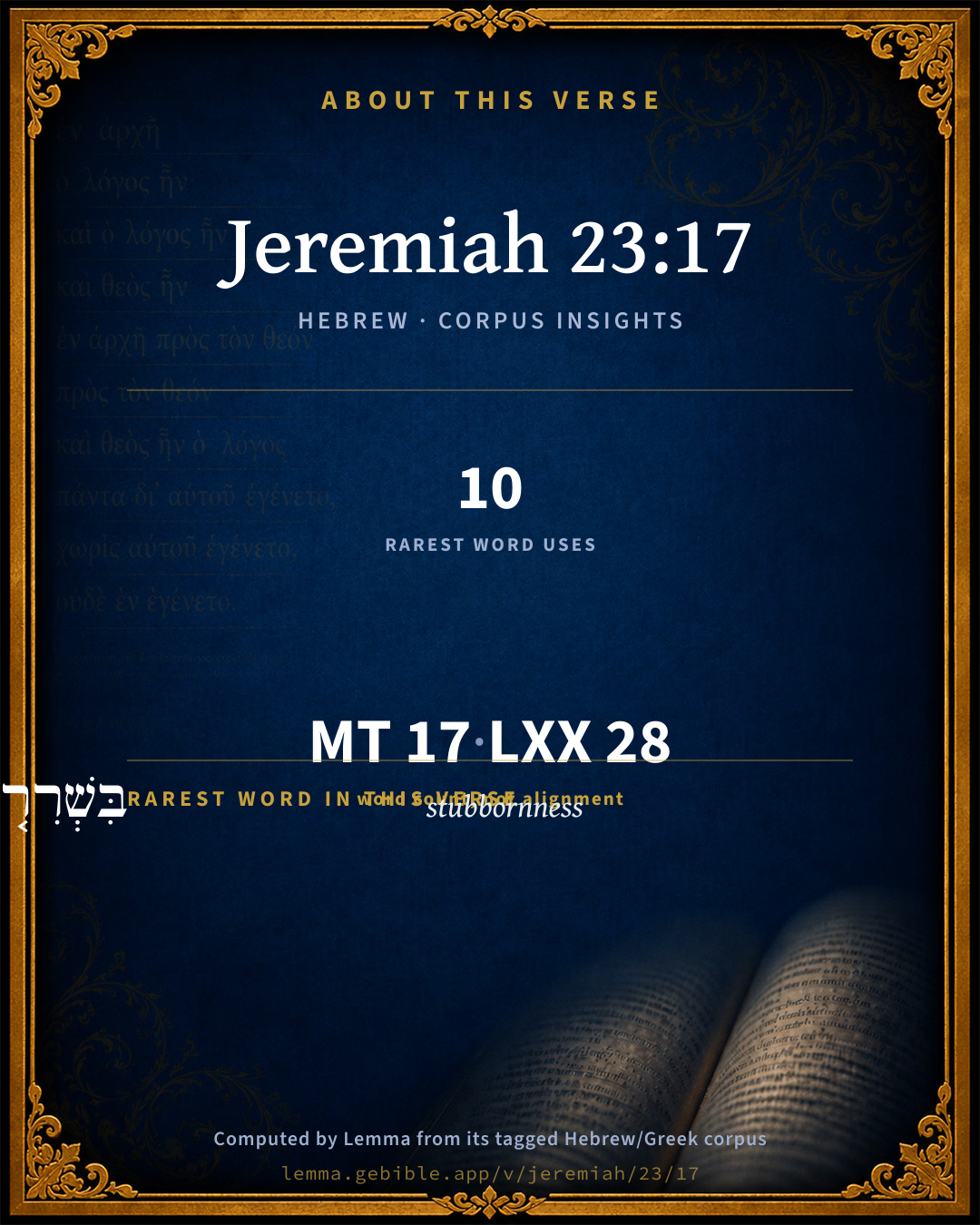
The rarest word here is בִּשְׁרִר֤וּת stubbornness H8307 — appearing just 10 times in the whole Hebrew Bible.

Shared distinctive vocabulary

בִּשְׁרִר֤וּת stubbornness H8307 occurs in 10 verses of the Hebrew Bible. Also found in:

Grammatical profile

  • 8 verbs
  • 6 nouns
  • 2 prepositions
  • 1 particle

Verb forms

  • אֹמְרִ֤ים Qal · Participle Active
  • אָמוֹר֙ Qal · Infinitive Absolute
  • לִֽמְנַאֲצַ֔י Piel · Participle Active
  • דִּבֶּ֣ר Piel · Perfect
  • יִֽהְיֶ֣ה Qal · Imperfect
  • הֹלֵ֞ךְ Qal · Participle Active
  • אָֽמְר֔וּ Qal · Perfect
  • תָב֥וֹא Qal · Imperfect

Repetition

A word recurs within this verse — often emphatic in Hebrew:

  • אֹמְרִ֤ים to say H559 ×3

Hebrew & Septuagint length

In the original languages it is 17 Hebrew tokens and 28 Greek tokens — but the two are counted differently (Hebrew bundles its prefixes and suffixes into one token; the Greek is in lemma form), so that isn’t a like-for-like length.

Cross-references

29

Topical passages linked to Jeremiah 23:17 in the Treasury of Scripture Knowledge — connected by theme and wording, ordered by reader-vote popularity; previews shown in the World English Bible.

  • Micah 3:11 Her leaders judge for bribes, And her priests teach for a price, And her prophets of it tell forturnes for money: Yet they lean on Yahweh, and say, Isn't Yahweh in the midst of us? No disaster will come on us.
  • Jeremiah 13:10 This evil people, who refuse to hear my words, who walk in the stubbornness of their heart, and are gone after other gods to serve them, and to worship them, shall even be as this belt, which is profitable for nothing.
  • Amos 9:10 All the sinners of my people will die by the sword, who say, 'Evil won't overtake nor meet us.'
  • Deuteronomy 29:19 and it happen, when he hears the words of this curse, that he bless himself in his heart, saying, I shall have peace, though I walk in the stubbornness of my heart, to destroy the moist with the dry.
  • Jeremiah 5:12 They have denied Yahweh, and said, It is not he; neither shall evil come on us; neither shall we see sword nor famine:
  • Jeremiah 8:11 They have healed the hurt of the daughter of my people slightly, saying, Peace, peace; when there is no peace.
  • Jeremiah 9:14 but have walked after the stubbornness of their own heart, and after the Baals, which their fathers taught them;
  • Micah 3:5 Thus says Yahweh concerning the prophets who lead my people astray; for those who feed their teeth, they proclaim, "Peace!" and whoever doesn't provide for their mouths, they prepare war against him:
  • Numbers 11:20 but a whole month, until it come out at your nostrils, and it be loathsome to you; because that you have rejected Yahweh who is among you, and have wept before him, saying, Why came we forth out of Egypt?
  • Jeremiah 3:17 At that time they shall call Jerusalem the throne of Yahweh; and all the nations shall be gathered to it, to the name of Yahweh, to Jerusalem: neither shall they walk any more after the stubbornness of their evil heart.
  • Jeremiah 6:14 They have healed also the hurt of my people slightly, saying, Peace, peace; when there is no peace.
  • Jeremiah 18:18 Then said they, Come, and let us devise devices against Jeremiah; for the law shall not perish from the priest, nor counsel from the wise, nor the word from the prophet. Come, and let us strike him with the tongue, and let us not give heed to any of his words.
  • Ezekiel 13:10 Because, even because they have seduced my people, saying, Peace; and there is no peace; and when one builds up a wall, behold, they daub it with whitewash:
  • Zechariah 10:2 For the teraphim have spoken vanity, and the diviners have seen a lie; And they have told false dreams. They comfort in vain. Therefore they go their way like sheep. They are oppressed, because there is no shepherd.
  • 1 Samuel 2:30 Therefore Yahweh, the God of Israel, says, I said indeed that your house, and the house of your father, should walk before me forever: but now Yahweh says, Be it far from me; for those who honor me I will honor, and those who despise me shall be lightly esteemed.
  • 2 Samuel 12:10 Now therefore the sword will never depart from your house, because you have despised me, and have taken the wife of Uriah the Hittite to be your wife.'
  • Isaiah 3:10–11 Tell the righteous "Good!" For they shall eat the fruit of their deeds.
  • Isaiah 57:21 There is no peace, says my God, to the wicked.
  • Jeremiah 4:10 Then said I, Ah, Lord Yahweh! surely you have greatly deceived this people and Jerusalem, saying, You shall have peace; whereas the sword reaches to the life.
  • Jeremiah 7:24 But they didn't listen nor turn their ear, but walked in [their own] counsels [and] in the stubbornness of their evil heart, and went backward, and not forward.
  • Jeremiah 28:3–9 Within two full years will I bring again into this place all the vessels of Yahweh's house, that Nebuchadnezzar king of Babylon took away from this place, and carried to Babylon:
  • Lamentations 2:14 Your prophets have seen for you false and foolish visions; They have not uncovered your iniquity, to bring back your captivity, But have seen for you false oracles and causes of banishment.
  • Ezekiel 13:15–16 Thus will I accomplish my wrath on the wall, and on those who have daubed it with whitewash; and I will tell you, The wall is no more, neither those who daubed it;
  • Ezekiel 13:22 Because with lies you have grieved the heart of the righteous, whom I have not made sad; and strengthened the hands of the wicked, that he should not return from his wicked way, and be saved alive:
  • Luke 10:16 Whoever listens to you listens to me, and whoever rejects you rejects me. Whoever rejects me rejects him who sent me."
  • 1 Thessalonians 4:8 Therefore he who rejects doesn't reject man, but God, who has also given his Holy Spirit to you.
  • Jeremiah 14:13–14 Then said I, Ah, Lord Yahweh! behold, the prophets tell them, You shall not see the sword, neither shall you have famine; but I will give you assured peace in this place.
  • Zephaniah 1:12 It will happen at that time, that I will search Jerusalem with lamps, and I will punish the men who are settled on their dregs, who say in their heart, "Yahweh will not do good, neither will he do evil."
  • Malachi 1:6 "A son honors his father, and a servant his master. If I am a father, then where is my honor? And if I am a master, where is the respect due me? Says Yahweh of Hosts to you, priests, who despise my name. You say, 'How have we despised your name?'

Cross-references courtesy of OpenBible.info (CC BY 4.0).

Hebrew and Greek witnesses Masoretic Hebrew ↔ Greek Septuagint

The same verse in the two great witnesses to the Old Testament, shown verse-for-verse.

These are two independent witnesses, not word-aligned to each other, and the Septuagint is shown in lemma (dictionary) form.

Hebrew Jeremiah 23:17 Masoretic · Westminster Leningrad Codex

אֹמְרִ֤ים אָמוֹר֙ לִֽמְנַאֲצַ֔י דִּבֶּ֣ר יְהוָ֔ה שָׁל֖וֹם יִֽהְיֶ֣ה לָכֶ֑ם וְ֠כֹל הֹלֵ֞ךְ בִּשְׁרִר֤וּת לִבּוֹ֙ אָֽמְר֔וּ לֹֽא תָב֥וֹא עֲלֵיכֶ֖ם רָעָֽה

They say continually to those who despise me, Yahweh has said, You shall have peace; and to everyone who walks in the stubbornness of his own heart they say, No evil shall come on you.

World English Bible · Public Domain

Greek LXX Structure differs

In the Septuagint, Jeremiah is about an eighth shorter than the Hebrew and arranges its material differently — the Oracles Against the Nations (Hebrew chapters 46–51) appear in the middle of the Greek book, after 25:13. Because the chapter and verse boundaries do not line up, a verse-for-verse comparison with the Hebrew is not shown.

A verse-for-verse comparison isn’t shown here because the chapters and verses don’t line up. Switch to the LXX edition with the MT / LXX toggle above to read the Greek directly.

On this verse, John Gill's Exposition discusses the Septuagint’s reading. Read the note in Commentary ↓

Hebrew: Westminster Leningrad Codex (CC BY 4.0). Greek: Septuagint (public domain); English from a public-domain English Septuagint. How the Septuagint differs from the Hebrew →

Targum (Aramaic paraphrase)

1

The Targum is the ancient Jewish Aramaic paraphrase of the Hebrew Scriptures — an interpretive translation, not the Hebrew text itself. Onkelos (literal) and Pseudo-Jonathan (expansive) render the Torah, and Jonathan the Prophets. Coverage is partial: where no permissively-licensed English translation exists for a verse, only the Aramaic is shown. This is verse-level text, not a word-by-word alignment to the Hebrew.

  1. Targum Jonathan Prophets (Joshua–Malachi)
    אָמְרִין בִּנְבוּאַת שִׁקְרֵיהוֹן לִדְמַרְגְזִין קָדָמַי מַלֵיל יְיָ שְׁלָמָא יְהֵא לְכוֹן וְכָל דְאָזֵיל בְּהִרְהוּר לִבֵּיהּ אָמְרִין לָא תֵיתֵי עֲלֵיכוֹן בִּישְׁתָּא:

    (no public-domain English translation for this verse)

    Targum Jonathan — Aramaic: “Mikraot Gedolot” (public domain). English: “Sefaria Community Translation” (CC0 1.0 (public-domain dedication)); “London "Chaldee Paraphrase," 1871” (public domain). Text via Sefaria.

Commentary

Notes on Jeremiah 23:17 from classic Christian and Jewish commentators (each source and its license shown beneath its notes). The classic Christian expositions comment on the surrounding passage and are grouped to its opening verse, so a note may address several verses; the Jewish commentaries on the Tanakh (Rashi and others) are per-verse, so they appear only where the commentator wrote on this verse.

Lemma curates 59 commentaries, every one of them public domain or Creative Commons licensed, each selected and text-cleaned for this edition rather than reprinted as found. About our sources →

Trapp's Complete Commentary

John Trapp

Jer 23:17 They say still unto them that despise me, The LORD hath said, Ye shall have peace; and they say unto every one that walketh after the imagination of his own heart, No evil shall come upon you.

Ver. 17. They say still to them that despise me.] They promise security to the impenitent, and flatter people in their sinful and sensual practices. Socinians set up man’s reason; Arminians, his free will; libertines, his unruly lusts; and Papists gratify his senses with their forms and pomp. In their humble supplication to King James for a toleration, they pleaded for their religion as that which was most agreeable to man’s nature. Sir Walter Raleigh knew what he said, that were he to choose a religion for sensual delights and licentious liberty, he would be a Papist. No sin past, but the Pope can pardon it; none to come, but he could dispense with it; no matter how long they have lived in any sin (thought the sin against the Holy Ghost), yet extreme unction at last will salve all.

John Trapp, A Commentary or Exposition upon All the Books of the Old and New Testament (1647–1656) — public domain. Text from a community e-Sword module.

Tyndale Open Study Notes

Tyndale Open Resources

23:17 These prophets lied to the people, assuring them that peace would soon come, even though they despise the Lord’s word. However, the Lord had already decreed destruction.

Tyndale Open Study Notes — © Tyndale Open Resources, licensed CC BY-SA 4.0. Text via the HelloAO Bible API.

Geneva Bible (1599)

Geneva Bible translators

Read Jer. 6:14 and 8:11.

Geneva Bible (1599) marginal notes — public domain. Text via Bolls.life.

Jamieson, Fausset & Brown

Robert Jamieson, A. R. Fausset & David Brown

say still--Hebrew, "say in saying," that is, say incessantly.

peace-- (Jer 6:14; Eze 13:10; Zac 10:2).

imagination--Hebrew, "obstinacy."

no evil-- (Mic 3:11).

Jamieson, Fausset & Brown — Commentary Critical and Explanatory on the Whole Bible (1871) — public domain (CC PDM 1.0). Text via the HelloAO Bible API.

John Calvin's Commentaries

Jeremiah introduces another mark by which the false prophets might be known as different from the true prophets, — they flattered the ungodly and wicked despisers of God. He thus repeats what he had before said, that they strengthened the hands of the wicked, so that they became hardened in their impiety, and threw aside every care for repentance. Though he uses different words, yet the meaning is the same, that they promised peace, or prosperity, to the despisers of God, for the word שלום, shalum, means to live well or happily.

They say, then, to those who despise or reject me; for נאף, nats, means both. The doubling of the word for “saying,” is also emphatical, אמרים אמור, amrim amur: for we know with how much haughtiness and confidence the false prophets dared to announce their dreams; for they were led by the spirit of pride, as they were the children of Satan. Hence then was their confidence, so that they made their declarations as though they had come down from heaven. They say, then, by saying; that is, they promise, and that with great effrontery, that peace would be to all the despisers of God; and not only so, but they pretended God’s name, Spoken, has Jehovah They wished to be deemed the instruments or agents of the Holy Spirit, while they were vainly announcing, as it has been said, their own imaginations. And hence Jeremiah applied to them, though improperly, the word vision, They speak the vision of their own heart By using this word he makes a concession; for he might have said only, that they adduced nothing but trifles, even the falsehoods which they themselves had devised, but he mentions the word חזון, chezun, which in itself ought to be deemed of high import. And yet he means that they were only apes as prophets, when they prattled of visions and confidently declared that they brought forward the revelations of the Spirit. He then concedes to them, though improperly, that they saw visions; but what did they see? even that Jehovah had spoken, Peace shall be to you

Then he says, They promise to those who walk in the wickedness of their own heart, that all things shall turn out well to them, No evil shall come upon you; as though he had said, “They promise impunity to all the wicked.”

John Calvin's Commentaries (1540-1563) — public domain. Text from the Calvin Translation Society English edition (1840s-50s) via the Christian Classics Ethereal Library (ccel.org). Calvin's coverage is partial (roughly two-thirds of the Bible); uncommented books and verses are honest gaps, never fabricated. The 19th-century editor's footnotes and remarks are omitted so the notes are faithfully Calvin's own voice.

Ellicott's Commentary for English Readers

(17) Imagination.—As before (Jer_3:17 and elsewhere), stubbornness. The tendency of all that the false prophets uttered was to confirm the people in their sins, not to lead them to repentance. It is noticeable that the Hebrew verb for “hath said” is not the same as the received formula of the true prophets, “The Lord hath spoken.” The prophet seems to indicate in this way that those whom he condemns placed the Divine message on a level with a man’s every-day utterance. They were self-convicted by the very phrase they used.

A Bible Commentary for English Readers, edited by Charles John Ellicott (1878–1897) — public domain. Text from a community e-Sword module.

The Cambridge Bible for Schools and Colleges

gen. ed. J. J. S. Perowne

17. that despise me, The Lord hath said, Ye] The mg. is supported by Syr., and is to be preferred, involving only a change of vowels. The MT. for “hath said” is an expression which does not elsewhere introduce the words of the Lord.

stubbornness] See Jer_3:17.

No evil shall come upon you] Cp. Jer_4:10, Jer_6:14, Jer_14:13.

The Cambridge Bible for Schools and Colleges (gen. ed. J. J. S. Perowne; Cambridge University Press, 1878–1918) — public domain. Text from a community e-Sword module.

John Gill's Exposition

They say still unto them that despise me,.... That despised the word, worship, and ordinances of the Lord; with such mockers and scoffers at religion, such abandoned creatures, they associated themselves; finding that their prophecies and doctrines met with approbation and success among them. The Septuagint version is, "they say to them that put away the word of the Lord"; reject it, and cast it behind their backs; see Act 13:46;

the Lord hath said, ye shall have peace; all manner of prosperity; that they should dwell in their own land, and not go into captivity, and enjoy the good things of it in peace and prosperity; this they pretended they had from the Lord; which was an aggravation of their sins; not only to tell a lie, but to tell it in the name of the Lord, and in direct opposition to what the true prophets said from the mouth of the Lord, particularly Jeremiah:

and they say unto everyone that walketh after the imagination of his own heart; which is evil, and that continually, Gen 6:5; whose course of life is after the lusts of his own wicked heart; and a worse guide than these a man cannot well have: and this is a true character and description of an unregenerate man, who walks after the flesh, and not after the Spirit; after his own carnal heart, and the dictates of it; and not according to the will and word of God: and yet to such, to whom the Lord says, "there is no peace", the false prophets said,

no evil shall come upon you; no evil of punishment for the evil of sin, as the prophets of the Lord had threatened; such as the sword, famine, pestilence, and captivity.

John Gill's Exposition of the Whole Bible (1746–1763) — public domain (CC PDM 1.0). Text via the HelloAO Bible API.

Albert Barnes' Notes on the Bible

Still - “Continually.” This verse gives the chief test by which the false prophet is to be detected, namely, that his predictions violate the laws of morality.

Albert Barnes' Notes on the Bible (1834–1885) — public domain. Text from a community e-Sword/MySword module.

Haydock's Catholic Bible Commentary

Blaspheme. Hebrew, "despise;" or Septuagint, "reject disdainfully the word of the Lord, you," &c., chap. vi. 14., and viii. 11.

George Leo Haydock (1774–1849), Haydock's Catholic Family Bible and Commentary, 1859 edition — public domain. Excludes Psalms (Douay-Rheims chapter numbering differs from Protestant) and Deuterocanonical books (Catholic canon only).

Matthew Poole's English Annotations

Lewd and corrupt ministers are a hatred and abomination in the house of the Lord to all serious good people, and are therefore obliged to make themselves a party of those that are like themselves, whose favour they cannot have without indulging them in their lusts. Hence they prophesy

peace to the vilest and worst of men, who have no patience of being daily alarmed with hearing of the wrath of God due and like to come upon them for their sins. Hence they promise no evil to those that walk according to the counsels of their own heart, that is, sinfully, for, Gen 6:5, Every imagination of the thoughts of man’s heart is only evil, and that continually. Hence a sinful course is very often expressed in Scripture under this notion of walking after the imaginations of our own heart, as Deu 29:19; but it is most in prophecy; see Jer 3:17; 7:21; 9:14; 13:10; 16:12; 18:12. Hence a religious walking is called a self denying. None have a worse guide of their actions in their lapsed state, before regeneration, than their own hearts.

Matthew Poole's English Annotations on the Holy Bible (1683–1685) — public domain. Text from a community e-Sword/MySword module.

The Pulpit Commentary

Unto them that despise me, The Lord hath said. The Septuagint and the Syriac render the same text (the consonants are alone the text) with different vowels, thus: "Unto those who despise the word of the Lord." In favor of this it may be urged that the phrase, "The Lord hath said," is nowhere else used in this abrupt way to introduce a real or supposed revelation, and Hitzig and Graf accordingly accept it. Ye shall have peace; as Jer_6:14. After the imagination ; rather, in the stubbornness. (see on Jer_3:17)

The Pulpit Commentary (1880–1919), ed. H.D.M. Spence-Jones & Joseph S. Exell — public domain. Text from a community e-Sword module.

Rashi

Rabbi Shlomo Yitzchaki (Rashi)

and everyone who follows the view of his heart And to everyone who follows the view of his heart, etc.

Rashi on the Tanakh — English translations: “The Judaica Press complete Tanach with Rashi, translated by A. J. Rosenberg” (CC BY 4.0); “Pentateuch with Rashi's commentary by M. Rosenbaum and A.M. Silbermann, 1929-1934” (public domain); “The Metsudah Tanach series, Lakewood, N.J” (CC BY 4.0); and “The Book of Joshua, Metsudah Publications, 1997” (CC BY 4.0). Text via Sefaria.

Lesson kit

Teaching starters — assembled from the data on this page, not authored interpretation. Every prompt links to the verse data it draws on. Edit before teaching.

Jeremiah, in the Prophets, opens this verse with 17 words (14 distinct Hebrew lemmas). Its most distinctive word is shᵉrîyrûwth (“stubbornness”). A historical commentator’s framing appears above. Read the whole chapter for the surrounding context.

Discussion questions

  1. The word shᵉrîyrûwth carries the sense “stubbornness.” How does it shape the verse?
  2. Deuteronomy 29:19 shares the word «stubbornness» with this verse. How do the two illuminate each other?
  3. “to say” occurs 3× in this one verse. What is the effect of the repetition?
  4. The translations on this page render this verse differently — a whole-verse word diff, not a word-by-word alignment. What might account for the different wordings?
  5. The verb «אֹמְרִ֤ים» is Qal Participle Active. How does its form color the action?
  6. Reading how Trapp's Complete Commentary and Tyndale Open Study Notes read this verse, where do the two commentators agree and where do they part?

Things to notice

Reading settings

Reading text

Shown beneath each verse's original-language words.

Old Testament
Old Testament edition

Read the OT as the Masoretic Hebrew (MT) or the Greek Septuagint (LXX).

English shown for the Greek Septuagint (in the Hebrew ↔ Greek comparison).

Comparing translations? Open the Compare panel on any verse page to stack up to four side by side.