
Jeremiah 33:9

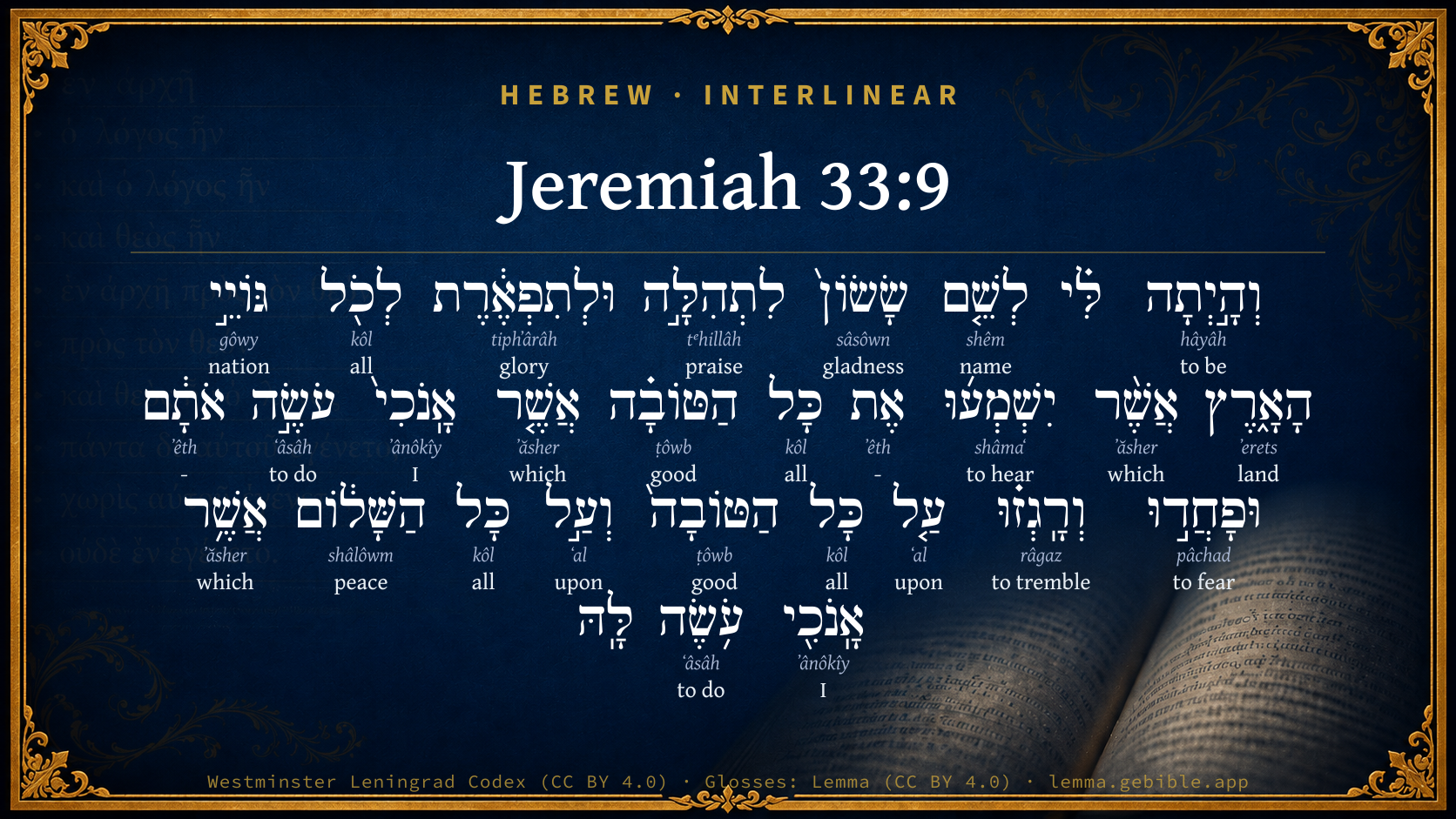
Hebrew (Westminster Leningrad Codex) Jeremiah 33:9 appears in the Hebrew Old Testament. The text above is from the Westminster Leningrad Codex. Each word links to its Strong’s number, a concise gloss, and parsing drawn from the Open Scriptures Hebrew Bible morphology. Click any word for its full Brown-Driver-Briggs (BDB) entry.
Download image
Cite this verse

Jeremiah 33:9 (World English Bible). Public Domain. Lemma interlinear Bible study tool, https://lemma.gebible.app/v/jeremiah/33/9.

Show BibTeX & RIS
BibTeX
RIS
English Translation
[This city] shall be to me for a name of joy, for a praise and for a glory, before all the nations of the earth, which shall hear all the good that I do to them, and shall fear and tremble for all the good and for all the peace that I procure to it.
World English Bible · Public Domain
Download a study sheet

One document with this verse’s original text, its word-by-word gloss line, the meaning frame, cross-references with their text, attributed commentary, and full source and license credits — printable, and it pastes into notes with its structure intact.

This verse Autodidact and up

Study sheet (.html) Plain text (.txt)

A passage Seminary Student

Up to 50 verses in one chapter. A passage sheet keeps up to 6 commentary sources and 12 cross-references per verse, in the order this page ranks them, and says so on the sheet whenever that leaves anything out. Ask for a single verse and you get the Autodidact verse sheet above.

Everything on this page stays free to read, with no account — the sheet is a download of what is already on screen, not access to it.

Want to remove ads? Support Godless Engineer
Compare translations 3

The same verse in 3 English versions, stacked beneath the original-language interlinear above. Click any original word for its lexicon entry.

Each is an independent rendering of the whole verse — the interlinear is not word-aligned to these translations.

Highlighted words mark where these versions differ — a whole-verse word diff, not a word-by-word alignment.

  • World English Bible Public Domain
    [This city] shall be to me for a name of joy, for a praise and for a glory, before all the nations of the earth, which shall hear all the good that I do to them, and shall fear and tremble for all the good and for all the peace that I procure to it.
  • King James Version Public Domain
    And it shall be to me a name of joy, a praise and an honour before all the nations of the earth, which shall hear all the good that I do unto them: and they shall fear and tremble for all the goodness and for all the prosperity that I procure unto it.
  • unfoldingWord Literal Text CC BY-SA 4.0
    For this city will become for me an object of joy, a song of praise and honor for all the nations of the earth who will hear of all the good things that I am going to do for it. Then they will fear and tremble because of all the good things and the peace that I will give to it.’

unfoldingWord Literal Text — © unfoldingWord, licensed CC BY-SA 4.0. Word-aligned USFM3 via Door43 (git.door43.org/unfoldingWord/en_ult).

Versions to compare (up to 4)

3 of 4 selected

Show all 18 translations

Every available English version of this verse, each an independent rendering of the whole verse.

  • World English Bible Public Domain
    [This city] shall be to me for a name of joy, for a praise and for a glory, before all the nations of the earth, which shall hear all the good that I do to them, and shall fear and tremble for all the good and for all the peace that I procure to it.
  • Berean Standard Bible Public Domain
    So this city will bring Me renown, joy, praise, and glory before all the nations of the earth, who will hear of all the good I do for it. They will tremble in awe because of all the goodness and prosperity that I will provide for it.
  • Majority Standard Bible Public Domain
    So this city will bring Me renown, joy, praise, and glory before all the nations of the earth, who will hear of all the good I do for it. They will tremble in awe because of all the goodness and prosperity that I will provide for it.
  • King James Version Public Domain
    And it shall be to me a name of joy, a praise and an honour before all the nations of the earth, which shall hear all the good that I do unto them: and they shall fear and tremble for all the goodness and for all the prosperity that I procure unto it.
  • American Standard Version (1901) Public Domain
    And `this city' shall be to me for a name of joy, for a praise and for a glory, before all the nations of the earth, which shall hear all the good that I do unto them, and shall fear and tremble for all the good and for all the peace that I procure unto it.
  • Revised Version (1885) Public Domain
    And this city shall be to me for a name of joy, for a praise and for a glory, before all the nations of the earth, which shall hear all the good that I do unto them, and shall fear and tremble for all the good and for all the peace that I procure unto it.
  • Geneva Bible (1599) Public Domain
    And it shalbe to me a name, a ioy, a praise, and an honour before all the nations of the earth, which shall heare all ye good that I doe vnto them: and they shall feare and tremble for all the goodnes, and for all the wealth, that I shew vnto this citie.
  • Douay-Rheims (1899) Public Domain
    And it shall be to me a name, and a joy, and a praise, and a gladness before all the nations of the earth, that shall hear of all the good things which I will do to them: and they shall fear and be troubled for all the good things, and for all the peace that I will make for them.
  • Young's Literal Translation Public Domain
    And it hath been to Me for a name of joy, For praise, and for beauty, to all nations of the earth, Who hear of all the good that I am doing them, And they have feared, And they have trembled for all the good, And for all the peace, that I am doing to it.
  • Literal Standard Version CC BY-SA 4.0
    And it has been for a name of joy to Me, || For praise, and for beauty, to all nations of the earth, || Who hear of all the good that I am doing them, || And they have feared, || And they have trembled for all the good, || And for all the peace, that I am doing to it.”
  • Unlocked Literal Bible CC BY-SA 4.0
    For this city will become for me an object of joy, a song of praise and honor for all the nations of the earth who will hear of all the good things that I am going to do for it. Then they will fear and tremble because of all the good things and the peace that I will give to it.'
  • unfoldingWord Literal Text CC BY-SA 4.0
    For this city will become for me an object of joy, a song of praise and honor for all the nations of the earth who will hear of all the good things that I am going to do for it. Then they will fear and tremble because of all the good things and the peace that I will give to it.’
  • Darby Bible Public Domain
    And it shall be to me a name of joy, a praise and a glory before all the nations of the earth, which shall hear of all the good that I do unto them; and they shall fear and tremble for all the good and for all the prosperity that I procure unto it.
  • World Messianic Bible Public Domain
    This city will be to me for a name of joy, for praise, and for glory, before all the nations of the earth, which will hear all the good that I do to them, and will fear and tremble for all the good and for all the peace that I provide to it.’”
  • Webster's Bible Public Domain
    And it shall be to me a name of joy, a praise, and an honor before all the nations of the earth, which shall hear all the good that I do to them: and they shall fear and tremble for all the goodness and for all the prosperity that I procure to it.
  • Free Bible Version CC BY-SA 4.0
    Then this city will bring me a glorious reputation, celebrated and praised by all the nations of the earth who get to hear of all the good things I do for it. They will tremble, amazed at how much good I have done for it, how I have made it so prosperous.
  • Bible in Basic English Public Domain
    And this town will be to me for a name of joy, for a praise and a glory before all the nations of the earth, who, hearing of all the good which I am doing for them, will be shaking with fear because of all the good and the peace which I am doing for it.
  • JPS Tanakh (1917) Public Domain
    And this city shall be to Me for a name of joy, for a praise and for a glory, before all the nations of the earth, which shall hear all the good that I do unto them, and shall fear and tremble for all the good and for all the peace that I procure unto it.

Literal Standard Version (2020), Covenant Press — licensed CC BY-SA 4.0. Text via the HelloAO Bible API (eBible.org). Unlocked Literal Bible (unfoldingWord) — licensed CC BY-SA 4.0. Text via the HelloAO Bible API (eBible.org). unfoldingWord Literal Text — © unfoldingWord, licensed CC BY-SA 4.0. Word-aligned USFM3 via Door43 (git.door43.org/unfoldingWord/en_ult). Free Bible Version, Dr. Jonathan Gallagher — licensed CC BY-SA 4.0. Text via the HelloAO Bible API (eBible.org).

Word by word

More ways to search: Search by grammar → Find every occurrence → Compare this word →

Practice this passage: Drill this verse → Learn its vocabulary →

שָׂשׂוֹן֙
sâsôwn
H8342
“gladness”
Noun, Common, Masculine, Singular, Absolute
Part of Speech
Noun
Type
Common
Gender
Masculine
Number
Singular
State
Absolute
Full BDB Definition

Origin: from H7797

TWOT: 2246a

gladness, joy, exultation, rejoicing - exultation, joy
  1. וְהָ֣יְתָה hâyâh H1961 “and · to be” Conjunction + Verb, Qal, Sequential Perfect, 3rd Person, Feminine, Singular
  2. לְשֵׁ֤ם shêm H8034 “to/for · name of” Preposition + Noun, Common, Masculine, Singular, Construct
  3. לִתְהִלָּ֣ה tᵉhillâh H8416 “to/for · praise” Preposition + Noun, Common, Feminine, Singular, Absolute
  4. וּלְתִפְאֶ֔רֶת tiphʼârâh H8597 “and · to/for · glory” Conjunction + Preposition + Noun, Common, Feminine, Singular, Absolute
  5. לְכֹ֖ל kôl H3605 “to/for · all of” Preposition + Noun, Common, Masculine, Singular, Construct
  6. גּוֹיֵ֣י gôwy H1471 “nations of” Noun, Common, Masculine, Plural, Construct
  7. הָאָ֑רֶץ ʼerets H776 “the · land” Particle, Definite Article + Noun, Common, Both, Singular, Absolute
  8. אֲשֶׁ֨ר ʼăsher H834 “which” Particle, Relative
  9. יִשְׁמְע֜וּ shâmaʻ H8085 “to hear” Verb, Qal, Imperfect, 3rd Person, Masculine, Plural
  10. אֶת ʼêth H853 “-” Particle, Direct Object
  11. כָּל kôl H3605 “all of” Noun, Common, Masculine, Singular, Construct
  12. הַטּוֹבָ֗ה ṭôwb H2896 “the · good” Particle, Definite Article + Adjective, Adjective, Feminine, Singular, Absolute
  13. אֲשֶׁ֤ר ʼăsher H834 “which” Particle, Relative
  14. אָֽנֹכִי֙ ʼânôkîy H595 “I” Pronoun, Personal, 1st Person, Common, Singular
  15. עֹשֶׂ֣ה ʻâsâh H6213 “doing” Verb, Qal, Participle Active, Masculine, Singular, Absolute
  16. אֹתָ֔ם ʼêth H853 “- · them” Particle, Direct Object + Suffix, Personal, 3rd Person, Masculine, Plural
  17. וּפָחֲד֣וּ pâchad H6342 “and · to fear” Conjunction + Verb, Qal, Sequential Perfect, 3rd Person, Common, Plural
  18. וְרָֽגְז֗וּ râgaz H7264 “and · to tremble” Conjunction + Verb, Qal, Sequential Perfect, 3rd Person, Common, Plural
  19. עַ֤ל ʻal H5921 “upon” Preposition
  20. כָּל kôl H3605 “all of” Noun, Common, Masculine, Singular, Construct
  21. הַטּוֹבָה֙ ṭôwb H2896 “the · good” Particle, Definite Article + Adjective, Adjective, Feminine, Singular, Absolute
  22. וְעַ֣ל ʻal H5921 “and · upon” Conjunction + Preposition
  23. כָּל kôl H3605 “all of” Noun, Common, Masculine, Singular, Construct
  24. הַשָּׁל֔וֹם shâlôwm H7965 “the · peace” Particle, Definite Article + Noun, Common, Masculine, Singular, Absolute
  25. אֲשֶׁ֥ר ʼăsher H834 “which” Particle, Relative
  26. אָֽנֹכִ֖י ʼânôkîy H595 “I” Pronoun, Personal, 1st Person, Common, Singular
  27. עֹ֥שֶׂה ʻâsâh H6213 “doing” Verb, Qal, Participle Active, Masculine, Singular, Absolute

About this verse

These counts appear in no published source. They are computed here, from the morphology-tagged text and Lemma’s own curated glosses. What Lemma adds →

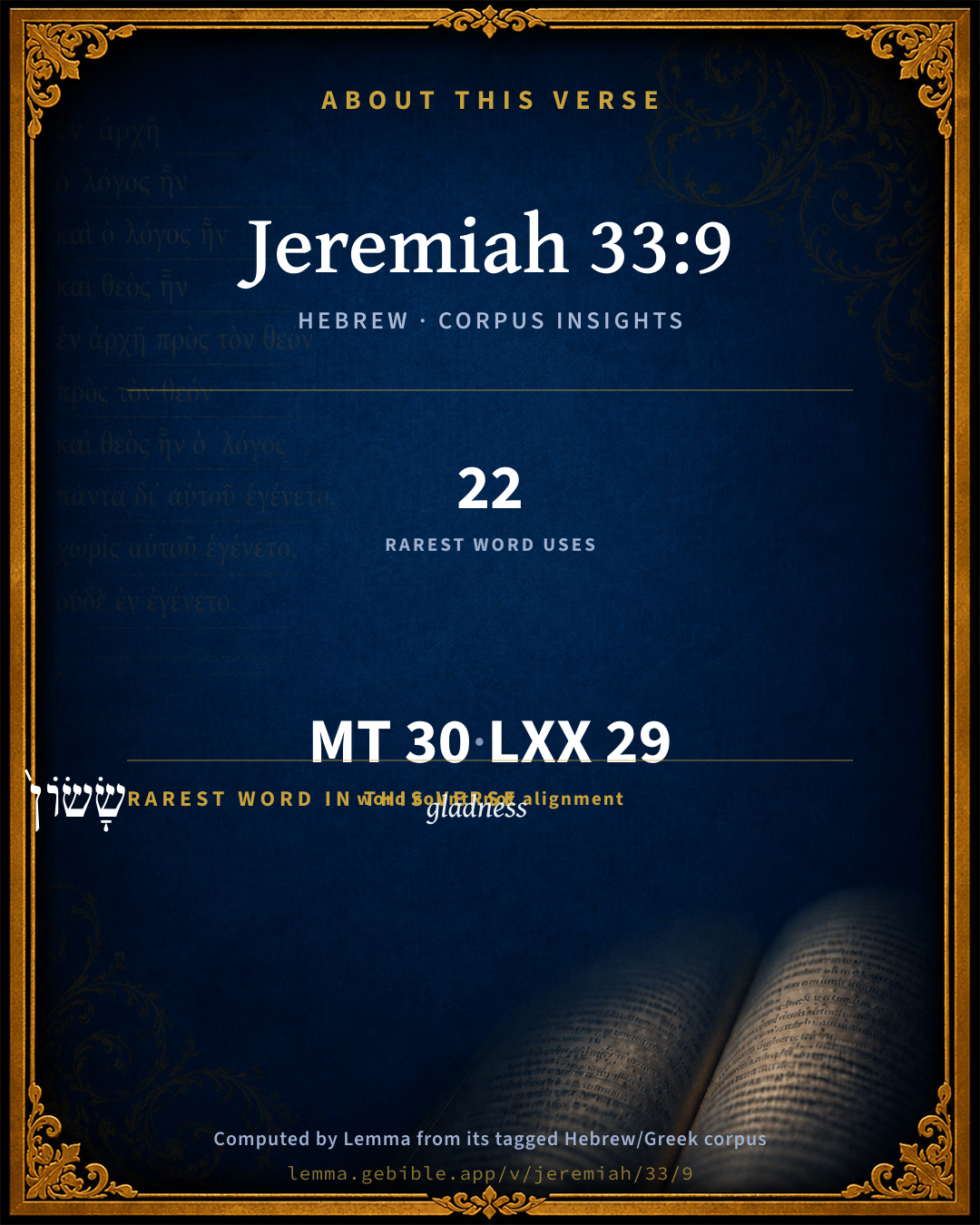
30
words
18
distinct lemmas
Prophets
section

Notable vocabulary

The rarest word here is שָׂשׂוֹן֙ gladness H8342 — appearing just 22 times in the whole Hebrew Bible.

Shared distinctive vocabulary

שָׂשׂוֹן֙ gladness H8342 occurs in 22 verses of the Hebrew Bible. Also found in:

Grammatical profile

  • 6 verbs
  • 11 nouns
  • 2 adjectives
  • 2 pronouns
  • 4 prepositions
  • 5 particles

Verb forms

  • וְהָ֣יְתָה Qal · Sequential Perfect
  • יִשְׁמְע֜וּ Qal · Imperfect
  • עֹשֶׂ֣ה Qal · Participle Active
  • וּפָחֲד֣וּ Qal · Sequential Perfect
  • וְרָֽגְז֗וּ Qal · Sequential Perfect
  • עֹ֥שֶׂה Qal · Participle Active

Repetition

Words recur within this verse — often emphatic in Hebrew:

  • לְכֹ֖ל all H3605 ×4
  • הַטּוֹבָ֗ה good H2896 ×2
  • עֹשֶׂ֣ה to do H6213 ×2
  • עַ֤ל upon H5921 ×2
  • אֲשֶׁ֨ר which H834 ×3
  • אָֽנֹכִי֙ I H595 ×2

Hebrew & Septuagint length

In the original languages it is 30 Hebrew tokens and 29 Greek tokens — but the two are counted differently (Hebrew bundles its prefixes and suffixes into one token; the Greek is in lemma form), so that isn’t a like-for-like length.

Cross-references

20

Topical passages linked to Jeremiah 33:9 in the Treasury of Scripture Knowledge — connected by theme and wording, ordered by reader-vote popularity; previews shown in the World English Bible.

  • Psalms 126:2–3 Then our mouth was filled with laughter, And our tongue with singing. Then they said among the nations, "Yahweh has done great things for them."
  • Isaiah 60:5 Then you shall see and be radiant, and your heart shall thrill and be enlarged; because the abundance of the sea shall be turned to you, the wealth of the nations shall come to you.
  • Zephaniah 3:17–20 Yahweh, your God, is in the midst of you, a mighty one who will save. He will rejoice over you with joy. He will rest in his love. He will rejoice over you with singing.
  • Nehemiah 6:16 It happened, when all our enemies heard [of it], that all the nations that were about us feared, and were much cast down in their own eyes; for they perceived that this work was worked of our God.
  • Isaiah 62:7 and give him no rest, until he establish, and until he make Jerusalem a praise in the earth.
  • Jeremiah 13:11 For as the belt cleaves to the loins of a man, so have I caused to cleave to me the whole house of Israel and the whole house of Judah, says Yahweh; that they may be to me for a people, and for a name, and for a praise, and for a glory: but they would not hear.
  • Psalms 40:3 He has put a new song in my mouth, even praise to our God. Many shall see it, and fear, and shall trust in Yahweh.
  • Isaiah 62:2–3 The nations shall see your righteousness, and all kings your glory, and you shall be called by a new name, which the mouth of Yahweh shall name.
  • Isaiah 62:12 They shall call them The holy people, The redeemed of Yahweh: and you shall be called Sought out, A city not forsaken.
  • Jeremiah 26:6 then will I make this house like Shiloh, and will make this city a curse to all the nations of the earth.
  • Jeremiah 31:4 Again will I build you, and you shall be built, O virgin of Israel: again shall you be adorned with your tambourines, and shall go forth in the dances of those who make merry.
  • Hosea 3:5 Afterward the children of Israel shall return, and seek Yahweh their God, and David their king, and shall come with trembling to Yahweh and to his blessings in the last days.
  • Zechariah 8:20–23 Thus says Yahweh of Hosts: "Many peoples, and the inhabitants of many cities will yet come;
  • Exodus 15:14–16 The peoples have heard. They tremble. Pangs have taken hold on the inhabitants of Philistia.
  • 2 Chronicles 20:29 The fear of God was on all the kingdoms of the countries, when they heard that Yahweh fought against the enemies of Israel.
  • Esther 8:17 In every province, and in every city, wherever the king's commandment and his decree came, the Jews had gladness and joy, a feast and a good day. Many from among the peoples of the land became Jews; for the fear of the Jews was fallen on them.
  • Jeremiah 3:17 At that time they shall call Jerusalem the throne of Yahweh; and all the nations shall be gathered to it, to the name of Yahweh, to Jerusalem: neither shall they walk any more after the stubbornness of their evil heart.
  • Jeremiah 29:1 Now these are the words of the letter that Jeremiah the prophet sent from Jerusalem to the residue of the elders of the captivity, and to the priests, and to the prophets, and to all the people, whom Nebuchadnezzar had carried away captive from Jerusalem to Babylon,
  • Jeremiah 44:8 in that you provoke me to anger with the works of your hands, burning incense to other gods in the land of Egypt, where you are gone to sojourn; that you may be cut off, and that you may be a curse and a reproach among all the nations of the earth?
  • Zechariah 12:2 "Behold, I will make Jerusalem a cup of reeling to all the surrounding peoples, and on Judah also will it be in the siege against Jerusalem.

Cross-references courtesy of OpenBible.info (CC BY 4.0).

Hebrew and Greek witnesses Masoretic Hebrew ↔ Greek Septuagint

The same verse in the two great witnesses to the Old Testament, shown verse-for-verse.

These are two independent witnesses, not word-aligned to each other, and the Septuagint is shown in lemma (dictionary) form.

Hebrew Jeremiah 33:9 Masoretic · Westminster Leningrad Codex

וְהָ֣יְתָה לִּ֗י לְשֵׁ֤ם שָׂשׂוֹן֙ לִתְהִלָּ֣ה וּלְתִפְאֶ֔רֶת לְכֹ֖ל גּוֹיֵ֣י הָאָ֑רֶץ אֲשֶׁ֨ר יִשְׁמְע֜וּ אֶת כָּל הַטּוֹבָ֗ה אֲשֶׁ֤ר אָֽנֹכִי֙ עֹשֶׂ֣ה אֹתָ֔ם וּפָחֲד֣וּ וְרָֽגְז֗וּ עַ֤ל כָּל הַטּוֹבָה֙ וְעַ֣ל כָּל הַשָּׁל֔וֹם אֲשֶׁ֥ר אָֽנֹכִ֖י עֹ֥שֶׂה לָּֽהּ

[This city] shall be to me for a name of joy, for a praise and for a glory, before all the nations of the earth, which shall hear all the good that I do to them, and shall fear and tremble for all the good and for all the peace that I procure to it.

World English Bible · Public Domain

Greek LXX Structure differs

In the Septuagint, Jeremiah is about an eighth shorter than the Hebrew and arranges its material differently — the Oracles Against the Nations (Hebrew chapters 46–51) appear in the middle of the Greek book, after 25:13. Because the chapter and verse boundaries do not line up, a verse-for-verse comparison with the Hebrew is not shown.

A verse-for-verse comparison isn’t shown here because the chapters and verses don’t line up. Switch to the LXX edition with the MT / LXX toggle above to read the Greek directly.

Hebrew: Westminster Leningrad Codex (CC BY 4.0). Greek: Septuagint (public domain); English from a public-domain English Septuagint. How the Septuagint differs from the Hebrew →

Targum (Aramaic paraphrase)

1

The Targum is the ancient Jewish Aramaic paraphrase of the Hebrew Scriptures — an interpretive translation, not the Hebrew text itself. Onkelos (literal) and Pseudo-Jonathan (expansive) render the Torah, and Jonathan the Prophets. Coverage is partial: where no permissively-licensed English translation exists for a verse, only the Aramaic is shown. This is verse-level text, not a word-by-word alignment to the Hebrew.

  1. Targum Jonathan Prophets (Joshua–Malachi)
    וִיהוֹן קֳדָמַי לְשׁוּם דְחֶדְוָא לְתוּשְׁבְּחָא וְלִיקַר לְכָל עַמְמֵי אַרְעָא דִי יִשְׁמְעוּן יַת כָּל טַבְתָּא דִי אֲנָא עָבֵיד עִמְהוֹן וִיזוּעוּן וִידַחֲלוּן עַל כָּל טַבְתָא וְעַל כָּל שְׁלָמָא דַאֲנָא עָבֵיד לְהוֹן:

    (no public-domain English translation for this verse)

    Targum Jonathan — Aramaic: “Mikraot Gedolot” (public domain). English: “Sefaria Community Translation” (CC0 1.0 (public-domain dedication)); “London "Chaldee Paraphrase," 1871” (public domain). Text via Sefaria.

Commentary

Notes on Jeremiah 33:9 from classic Christian and Jewish commentators (each source and its license shown beneath its notes). The classic Christian expositions comment on the surrounding passage and are grouped to its opening verse, so a note may address several verses; the Jewish commentaries on the Tanakh (Rashi and others) are per-verse, so they appear only where the commentator wrote on this verse.

Lemma curates 59 commentaries, every one of them public domain or Creative Commons licensed, each selected and text-cleaned for this edition rather than reprinted as found. About our sources →

Trapp's Complete Commentary

John Trapp

Jer 33:9 And it shall be to me a name of joy, a praise and an honour before all the nations of the earth, which shall hear all the good that I do unto them: and they shall fear and tremble for all the goodness and for all the prosperity that I procure unto it.

Ver. 9. And it shall be to me a name {a} of joy,] i.e., An honour, that I shall take singular delight in.

And they shall fear and tremble for all the goodness.] Which bodes no good to them; for the Church’s welfare is ever joined with the downfall and destruction of her enemies.

{a} In nomen laetum, i.e., laeificum.

John Trapp, A Commentary or Exposition upon All the Books of the Old and New Testament (1647–1656) — public domain. Text from a community e-Sword module.

The Biblical Illustrator

Joseph S. Exell

Jer_33:9

They shall fear and tremble for all the goodness and for all the prosperity that I procure unto it.

Chastened happiness

Our text suggests at the outset the remark that all the good things which make up prosperity are to be traced unto the Lord. These benefits are not from beneath, but from above; let them not be passed by in ungrateful silence, but let us send upward humble and warm acknowledgments. He who forgets mercy deserves that mercy should forget him. Remark next, that temporal mercies are always best when they come in their proper order. Blessed be God if He has given to us first the fruits of the sun of grace, and then the fruits put forth by the moon of providence. The main thing is to be able to sing, Bless the Lord, who forgiveth all thine iniquities, who healeth all thy diseases, and after that it is most pleasant to add, Who satisfieth thy mouth with good things. What shall I say of the happiness of those persons who have spiritual and temporal blessings united, to whom God has given both the upper and the nether springs, so that they possess all things needful for this life in fair proportion, and then, far above all, enjoy the blessings of the life to come? Such are first blessed in their spirits and then blessed in their basket and in their store. In their case double favour calls for double praise, double service, double delight in God. And yet, and yet, and yet, if we are very happy to-day, and though that happiness be lawful and proper, because it arises both out of spiritual and temporal things in due order, yet in all human happiness there lurks a danger. There is a wealth which hath a sorrow necessarily connected with it, and I ween that even when God maketh rich and addeth no sorrow therewith, yet He makes provision against an ill which else would surely come. The text speaks of goodness and prosperity procured for us, and then tells us that all danger which might arise out of it is averted by a gracious work upon the heart. The Lord sends a chastened joy. They shall fear and tremble. I Let us think a little about the toning down of our great joys.

1. In the cup of salvation there are drops of bitterness, and so must it be, for unmixed delight in this world would be dangerous. When the sea is smooth the ship makes poor sailing. Men are bird-limed by their rest and ease, and have small care to fly heavenward. We are apt to lose our God among our goods, Is it not so? If the worlds roses had no thorns should we not think it paradise, and forego all desire for the gardens above?

2. Unmixed joy would be fallacious, because there is no such thing here below. If a man should become perfectly contented with the things of this world, it would be the result of a false view of things. This is an error against which we should pray; for this world cannot fill the soul, and if a man thinks he has filled his soul with it, he must be under a gross delusion. As to spiritual joy, I say that in no mans experience can it be long without admixture and yet be true. Never at any moment can a Christian be in such a position that he has not some cause either for dissatisfaction with himself, or fear of the tempter, or anxiety to he faithful in service.

3. Unmixed delight on earth would be unnatural. When the Dutch had the trade of the East in their hands they were accustomed to sell birds of paradise to the untravelled people of these realms. These specimen birds had no feet, for they had craftily removed them, and the merchants declared that the species lived on the wing and never alighted. There was so much of truth in the fable that had they been really and veritably birds of paradise they would not have found a place for their feet upon this globe. Truly, birds of paradise do come and go, and flit from heaven to earth, but we see them not, neither can we build tabernacles to detain them. While you are here expect reminders of the fact that this is not your rest.

II. The feelings by which this sobering effect is produced. They fear and tremble for all the goodness and for all the prosperity that I procure unto it. Why fear and tremble?

1. Is not this in part a holy awe of Gods presence? Work out your own salvation with fear and trembling, for it is God which worketh in you both to will and to do of His good pleasure. The argument for fear and trembling is the work of God in the soul. Because God is working m you there must be no trifling. If the eternal Deity deigns to make a workshop of my nature, I too must work, but it must be with fear and trembling.

2. But next to that there arises up in the mind of every favoured Christian a deep repentance for past sin. Have you not felt as if you could never open Four mouth any more because of all your unkindness to your heavenly Friend? Such penitent, reflections keep the Lords people right, by creating a fear and trembling m the presence of His overflowing goodness.

3. Has not your deepest sense of unworthiness come upon you when you have been conscious of superlative mercy? We tremble and are afraid, because of the unutterable grace which has met our utter unworthiness, and rivalled it, until grace has gotten unto itself the victory.

4. Have you never noticed how the Lord brings His people to their bearings, and keeps them steady, under a sense of great love, by suggesting to their hearts the question, How can I live as becometh one who has been favoured like this? Did you ever feel that the glory of the palace of love made you afraid to dwell in it?

5. And have you never felt a fear lest Gods goodness should be abused by you? He who has never questioned his own condition had better make an immediate inquiry. He who has never felt great searchings of heart needs to be searched with candles. No mans hell shall be more terrible than that of the self-confident one who made so sure of heaven that he would not take the ordinary precaution to ask whether his title-deeds were genuine or no.

6. One more thought may also occur to the most joyous believer. He will say, What if after rejoicing in all this blessedness I should lose it? What, cries one, do you not believe in the final perseverance of the saints? Assuredly I do, but are we saints! Theres the question. Moreover, many a believer who has not lost his soul has, nevertheless, lost his present joy and prosperity, and why may not we?

III. The measure in which you and I can enter into this experience. We have hundreds of us perceived the benefits of the dark lines and shadings of lifes picture, and we see how fit and proper it is that trembling should mingle with transport. As the fruit of experience I have learned to look for a hurricane soon after an unusually delightful calm. When the wind blows hard, and the tempest lowers, I hope that before long there will be s lull; but when the sea-birds sit on the wave, and the sail hangs idly, I wonder when a gale will come. To my mind there is no temptation so bad as not being tempted at all. The worst devil in the world is when you cannot see the devil at all, because the villain has hidden himself away within the heart, and is preparing to give you a fatal stab. Since there is an everlasting arm that never can he palsied, since there is a brow that knows no wrinkle, and a Divine mind that is never perplexed, we go forward in hope, and cast ourselves upon our eternal Helper once again. You have heard of the ancient giant Antaeus, who could not be overcome, because as often as Hercules threw him to the ground, he touched his mother earth, and rose renewed. Such be your lot and mine, often to be cast down, and as often to rise by that downcasting. When I am weak then am I strong. Let us glory in infirmity, because the power of Christ doth rest upon us. (C. H. Spurgeon.)

The Biblical Illustrator, edited by Joseph S. Exell (c. 1880s–1900s) — public domain. Text from a community e-Sword module.

Joseph Benson's Commentary

Jer 33:9. And it shall be to me a praise and an honour — Jerusalem thus rebuilt, and Judah thus re-established, shall be to my glory before all the nations. In other words, it is foretold here that God’s especial providence over the Jews, in restoring their city and temple, and re-establishing them in their own land, should be taken notice of by the heathen world, and should cause them to give glory to that God whom the Jews worshipped: see Ezr 1:2; Ezr 6:12. Or, as the words may imply, This renewed nation shall be as much a reputation to religion as formerly they were a reproach to it. This promise, however, has been much more signally fulfilled in the Christian Church, to which the heathen resorted, as to the seat and temple of truth, than it has yet been in the Jewish. And they shall fear and tremble for the goodness that I do unto it — These surprising effects of my goodness shall produce an astonishment like that which arises from fear. Or, the meaning is, They shall fear to engage against a nation so beloved and favoured by me, Exo 15:14-16.

Joseph Benson's Commentary on the Old and New Testaments (1811–1818) — public domain. Text from a community e-Sword module.

Tyndale Open Study Notes

Tyndale Open Resources

33:9 Once the new covenant was established, all the nations of the earth would see the Lord’s blessing on Jerusalem.

Tyndale Open Study Notes — © Tyndale Open Resources, licensed CC BY-SA 4.0. Text via the HelloAO Bible API.

Geneva Bible (1599)

Geneva Bible translators

Whereby he showeth that the Church wherein is remission of sins, is God’s honor and glory, so that whosoever is enemy to it, laboreth to dishonor God.

Geneva Bible (1599) marginal notes — public domain. Text via Bolls.life.

Jamieson, Fausset & Brown

Robert Jamieson, A. R. Fausset & David Brown

it--the city.

a name . . . a praise-- (Jer 13:11; Isa 62:7).

them--the inhabitants of Jerusalem.

they shall fear . . . for all the goodness-- (Psa 130:4). The Gentiles shall be led to "fear" God by the proofs of His power displayed in behalf of the Jews; the ungodly among them shall "tremble" for fear of God's judgments on them; the penitent shall reverentially fear and be converted to Him (Psa 102:15; Isa 60:3).

Jamieson, Fausset & Brown — Commentary Critical and Explanatory on the Whole Bible (1871) — public domain (CC PDM 1.0). Text via the HelloAO Bible API.

Adam Clarke's Commentary

Verse 9. They shall fear and tremble] The surrounding nations shall be persuaded that it is the hand of the Almighty that has wrought this change in your behalf; and shall fear to molest you, and tremble lest they should incur the displeasure of your God by doing you any kind of evil.

Adam Clarke's Commentary on the Bible (1810–1826) — public domain. Text from a community e-Sword/MySword module.

John Calvin's Commentaries

Here God testifies that his favor would be such as to deserve praise in all the world, or, which is the same thing, that his bounty would be worthy of being remembered. Hence he says, that it would be to him for a name among all nations; but as he designed to extol the greatness of his glory, he adds, a praise and an honor, or a glory; and it is emphatically added, among all nations And this passage shews to us that the Prophet did not speak only of the people’s return, and that this prophecy ought not to be confined to the state of the city, such as it was before the coming of Christ; for though the favor of God was known among the Chaldeans and some other nations, it was not yet known through the whole world, for he says, among all the nations of the earth; and God no doubt included all parts of the world. We hence then conclude that the favor of which the Prophet speaks refers to the kingdom of Christ, for God did not then attain a name to himself among all nations, but, as it is well known, only in some portions of the east. When, therefore, he says that the favor he would shew to his people, would be to him a name, he promises no doubt that deliverance which was at length brought by Christ.

And in the same sense must be taken what follows, Because they shall hear, etc.; for the relative אשר asher, is here a causative, as the Prophet expresses here the way and manner in which glory and honor would come to God on account of the deliverance of his people, even because the nations would hear of this; and this has been done by the preaching of the Gospel, because then only was God’s goodness towards the Jews everywhere made known, when the knowledge of the Law and of prophetic truth came to aliens who had previously heard nothing of the true doctrine of religion. We now then understand the design of the holy Spirit.

Further, by these words God exhorts all to gratitude; for whenever the fountain of God’s blessings is pointed out to us, we ought not to be indifferent, but to be stimulated to give thanks to him. When therefore God declares that the redemption of his people would be a name to him among all nations, he thus shews to the godly that they ought not to be torpid, but to proclaim his goodness. And at the same time it serves for a confirmation, when God intimates that he would be the Redeemer of his people, in order that he might acquire to himself a name, for there is to be understood a contrast, that in this kindness, he would not regard what the Jews deserved, but would seek for a cause in himself, as it is expressed more fully elsewhere,

“Not on your account will I do this, O house of Israel,” (Ezekiel 36:22)

and the faithful sing in their turn,

“Not on our account, O Lord, but on account of thy name.” (Psalm 79:9; Psalm 115:1)

We then see that God brings forward his own name, that the Jews might continue to entertain hope, however guilty they may have been, and own themselves worthy of eternal destruction.

If we read, “It shall be to me for a name of joy,” the sense would be, “for a name in which I delight.” If we read the words apart, “For a name and joy,” the sense would be still the same; nor ought it to be deemed unreasonable that God testifies that it would be to him for joy. For though he is not moved and influenced as we are, yet this mode of speaking is elsewhere adopted, as in Psalm 104:31,

“The Lord shall rejoice in his works.”

God then is said to take delight in doing good, because he is in his nature inclined to goodness and mercy.

He afterwards adds, they, shall fear and tremble for all the goodness, etc. The word כל cal, “all,” denotes greatness, and is to be taken emphatically. The words, however, may at first sight appear singular, “they shall fear and tremble for all the goodness,” etc.; for it seems not reasonable that men should fear, when they acknowledge God’s goodness, for this, on the contrary, is a reason for joy and confidence. This clause is sometimes applied to the ungodly, for they have no taste for God’s favor so as to be cheered by it, but on the contrary they fret and gnash their teeth when God appears kind to his people; for they are vexed, when they see that they are excluded from the enjoyment of those blessings, which are laid up, as it is said elsewhere, for them who fear God. But I have not the least doubt but the Prophet means the conversion of the Gentiles when he says, they shall fear and tremble for all the goodness, etc.; as though he had said, that not only the name of God would be known among the nations, so that they would proclaim that he had been merciful to his people, but that it would at the same time be the effect and influence of his grace, that the nations would become obedient to God. Moreover, it is a usual thing to designate the worship and fear of God by the words fear, dread, and trembling. For though the faithful do not dread the presence of God, but cheerfully present themselves to him whenever he invites them, and in full confidence call on him, there is yet no reason why they should not tremble when they think of his majesty. For these two things are connected together, even the fear and trembling which humble us before God, and the confidence which raises us up so as to dare familiarly to approach him. Here then is pointed out the conversion of the Gentiles; as though the Prophet had said, that the favor of deliverance to the Church would not only avail for this end, to make the Gentiles to proclaim God’s goodness, but would also have the effect of bringing them under his authority, that they might reverence and fear him as the only true God. He again adds the word peace, but in the same sense as before: he mentions goodness, the cause of prosperity, and then he adds peace or prosperity as its effect. It afterwards follows, —

John Calvin's Commentaries (1540-1563) — public domain. Text from the Calvin Translation Society English edition (1840s-50s) via the Christian Classics Ethereal Library (ccel.org). Calvin's coverage is partial (roughly two-thirds of the Bible); uncommented books and verses are honest gaps, never fabricated. The 19th-century editor's footnotes and remarks are omitted so the notes are faithfully Calvin's own voice.

Ellicott's Commentary for English Readers

(9) It shall be to me a name of joy . . .—The thought presents two aspects in its bearing on the outlying nations. On the one hand, they shall sing the praises of the restored city; on the other, they shall fear and tremble before its greatness, as showing that it was under the protection of the Lord of Israel. The word for “fear” is used in Isa_60:5; Hos_3:5, for the quivering, trembling emotion that accompanies great joy, and is, perhaps, used here to convey the thought that the fear would not be a mere slavish terror.

A Bible Commentary for English Readers, edited by Charles John Ellicott (1878–1897) — public domain. Text from a community e-Sword module.

The Cambridge Bible for Schools and Colleges

gen. ed. J. J. S. Perowne

9. shall fear and tremble] inferring that He who so honours those who seek Him will punish with equal emphasis those who disregard Him.

The Cambridge Bible for Schools and Colleges (gen. ed. J. J. S. Perowne; Cambridge University Press, 1878–1918) — public domain. Text from a community e-Sword module.

John Gill's Exposition

And it shall be to me a name of joy, a praise, and an honour,.... That is, the church and people of God, being redeemed and rebuilt by Christ, and being cleansed from their sins in his blood, and all their iniquities forgiven for his sake, would be a cause of joy to themselves and others, and bring joy, praise, and honour unto God: so the church, in the latter day, will be an eternal excellency, a joy of many generations, and a praise in the earth, Isa 60:15; and here they are said to be so,

before all the nations, which shall hear all the good that I do unto them; in redeeming them by the Messiah; calling them by his Spirit and grace; justifying them by the righteousness of Christ; pardoning their sins through his blood; making them meet for, and giving them a title to, eternal glory and happiness; all which would be made known, as it has been to the Gentiles, through the preaching of the Gospel; and which has occasioned joy and gladness among them, and praise and thanksgiving unto God, and which has redounded to his honour and glory:

and they shall fear and tremble, for all the goodness and for all the prosperity that I procure unto it; that is, they shall fear the Lord, and tremble at his word; not with a slavish, but filial fear, which is consistent with joy and gladness; and which fear will be influenced not by the terrors of the law, but by the goodness of God; being of the same nature with the fear of the converted Jews at the latter day, who will fear the Lord, and his goodness, Hos 3:5; so the Gentiles, seeing and hearing of the goodness of God bestowed upon the believing Jews, will be solicitous for the same, and be encouraged to seek after it; and finding it, shall be engaged to fear the Lord, and worship him.

John Gill's Exposition of the Whole Bible (1746–1763) — public domain (CC PDM 1.0). Text via the HelloAO Bible API.

Albert Barnes' Notes on the Bible

It - The city, Jerusalem.

They shall fear and tremble - With terror, because of the eternal opposition between right and wrong, truth and error. The nations of the earth as opposed to Israel represent the world as opposed to the Church.

Albert Barnes' Notes on the Bible (1834–1885) — public domain. Text from a community e-Sword/MySword module.

Haydock's Catholic Bible Commentary

And it. Jerusalem, as figure of the Church. (Menochius) --- Fear, worship, and desist from persecuting God in his saints, (Haydock) whom he so highly favours.

George Leo Haydock (1774–1849), Haydock's Catholic Family Bible and Commentary, 1859 edition — public domain. Excludes Psalms (Douay-Rheims chapter numbering differs from Protestant) and Deuterocanonical books (Catholic canon only).

Matthew Poole's English Annotations

I will do so well by this people, that other nations shall honour and praise me for my goodness to them; and not only so, but shall fear to engage against a nation so beloved and favoured by me, Exo 15:14,16; Others interpret it of a religious fear and trembling, to which God’s mercy to the Israelites should invite those people that should see and hear of it; but I think the former is the most probable sense of the prophet here.

Matthew Poole's English Annotations on the Holy Bible (1683–1685) — public domain. Text from a community e-Sword/MySword module.

Whedon's Commentary on the Bible

Daniel D. Whedon

9. It — The city.

Shall fear and tremble — Because of the overwhelming revelation of that God “who doeth his pleasure in the armies of heaven and among the inhabitants of the earth.”

Daniel D. Whedon (gen. ed.), Commentary on the Old and New Testaments (1874–1909) — public domain. Text from a community e-Sword module.

The Pulpit Commentary

And it shall be; viz. Jerusalem. A name of joy; rather, on the analogy of Isa_55:13. etc., a monument of joy; i.e. joy giving. They shall fear and tremble. As feeling the contrast between their "unprofitable" idol gods and the faithful God of Israel.

The Church an honour to God.

What is here promised to the Jews finds its fulfilment, not in the Jews alone, nor in them at all until they submit to the Christian influences of the new covenant, but in all the spiritual Israel in the Church of Christ.

I CONSIDER THE FACT THAT THE CHURCH IS AN HONOUR TO GOD. It is described as a "monument of joy" because God takes delight in, (Jer_32:41) and as "a praise and an honour" because by means of it God"s glory is manifested abroad. This, in turn, is an honour to the Church. Though God picks his fallen children up from the mire of sin he does not leave them in shame and degradation. The prodigal is stripped of his rags and clothed with the best robe. God regards his Church, even here, with the stains of war and toil and sin upon her, as capable of manifesting forth his glory. What greater mission could she have?

II INQUIRE INTO THE SOURCES OF THIS HONOUR. How comes it that the Church is an honour to God? Her own excellences can scarcely be considered as glorious in themselves. It is not in the inherent worth of these that we find the secret of the glory given by the Church to God. The Church is formed by God, redeemed by his mercy, delivered by his power, maintained by his help. Her very existence is a witness to God"s forgiving and restoring grace. All that she does for good is not accomplished by her own might, but through the inspiration of his Spirit. The picture is an honour to the painter because it is the fruit of his well directed labour. We do not admire it only for its simple beauty. If it is a representation of the humblest scene in nature, the reality must be infinitely more beautiful than the picture; yet we give great admiration to the work of art because it is a work and because it reveals art. So the Church is an honour to God as the fruit of his work and of Christ"s sacrifice.

III NOTE THE EFFECTS OF THIS HONOUR.

1. It is to impress the world. The Jews were a standing witness of the power and goodness of God to the neighbouring nations. The Church of Christ is called to a similar mission on a world wide scale. The very existence of the Church as the ark upon the waters preserved and blessed by God is one of the greatest means of making known the grace and glory of redemption. More eloquent than any words is the silent testimony of the good and peaceful lives of godly men.

2. Therefore a great responsibility rests upon all Christians. God entrusts his honour to his Church. If, therefore, she can glorify him, she has also the power to bring dishonour on his Name. The "good soldier of Jesus Christ" is an honour to his Captain; but the sluggard, the coward, and the traitor are a discredit to his high name, and their faithlessness does something to smirch the beauty of the banner of redemption.

Fruits of pardon.

Some of these are declared here; e.g.

I IN REGARD TO GOD.

1. Joy. God, not Deus impassibilis a God who does not feel.

2. Praise and honour. The theme of the Church on earth, and especially in heaven, is this, "Unto him that loved us," etc. There is no glory equal to that which shall accrue to God by "Jesus Christ," for through him pardon comes to guilty men.

II IN REGARD TO THE PARDONED THEMSELVES. They enjoy the goodness and prosperity which God procures them. Pardon is not mere acquittal, but acceptance and adoption, and hence the goodness and prosperity.

III IN REGARD TO THE WORLD AT LARGE. "They shall fear and tremble." Why this?

1. Because of its manifestation of power. His people a feeble flock, but thus raised and exalted.

2. Because of its exposure of idolatry. It will be seen how foolish they have been to trust in their false gods.

3. Because of its manifestation of grace. The fear and trembling shall not be of dread so much as of repentance repentance wrought by the evident grace of God in the rich pardon he has bestowed. C.

The Pulpit Commentary (1880–1919), ed. H.D.M. Spence-Jones & Joseph S. Exell — public domain. Text from a community e-Sword module.

John Wesley's Explanatory Notes

They shalt fear - And not only so but shall fear to engage against a nation so beloved and favoured by me.

John Wesley, Explanatory Notes Upon the Whole Bible (1754–1765) — public domain. Text via the GEBible commentary corpus.

Keil & Delitzsch

C. F. Keil & F. Delitzsch

In consequence of the renovation of Israel externally and internally, Jerusalem will become to the Lord a name of delight, i.e., a name which affords joy, delight. שׁם here signifies, not fame, but a name. But the name, as always in Scripture, is the expression of the essential nature; the meaning therefore is, "she will develope into a city over which men will rejoice, whenever her name is mentioned." On the following words, "for praise and for glory," i.e., for a subject of praise, etc., cf. Jer 13:11. לכל־גּויי, "to all," or "among all nations." How far Jerusalem becomes such is shown by the succeeding clauses: "who shall hear...and tremble and quake because of the good," i.e., not from fear "because they are seized with terror through these proofs of the wonderful power of God in contrast with the helplessness of their idols, and through the feeling of their miserable and destitute condition as contrasted with the happiness and prosperity of the people of Israel" (Graf). Against this usual view of the words, it has already been remarked in the Berleburger Bible, that it does not agree with what precedes, viz., with the statement that Jerusalem shall become a name of joy to all nations. Moreover, פּחד and רגז, in the sense of fear and terror, are construed with מפּני or מן; here, they signify to shake and tremble for joy, like פּחד in Isa 60:5, cf. Hos 3:5, i.e., as it is expressed in the Berleburger Bible, "not with a slavish fear, but with the filial fear of penitents, which will also draw and drive them to the reconciled God in Christ, with holy fear and trembling." Calvin had previously recognised this Messianic idea, and fitly elucidated the words thus: haec duo inter se conjuncta, nempe pavor et tremor, qui nos humiliet coram Deo, et fiducia quae nos erigat, ut audeamus familiariter ad ipsum accedere. אותם may be for אתּם, cf. Jer 1:16; but probably עשׂה is construed with a double accusative, as in Isa 42:16.

The prosperity which the Lord designs to procure for His people, is, Jer 33:10-13, further described in two strophes (Jer 33:10-11 and Jer 33:12-13); in Jer 33:10, Jer 33:11, the joyous life of men. In the land now laid waste, gladness and joy shall once more prevail, and God will be praised for this. The description, "it is desolate," etc., does not imply the burning of Jerusalem, Jer 52:12., but only the desolation which began about the end of the siege. "In this place" means "in this land;" this is apparent from the more detailed statement, "in the cities of Judah and in the streets of Jerusalem." "The voice of gladness," etc., forms the subject of the verb ישּׁמע. On the expression see Jer 7:34; Jer 16:9; Jer 25:10. There is here added: "the voice of those who say, 'Praise the Lord,' " etc. - the usual liturgic formula in thanksgiving to God; cf. Ch2 5:13; Ch2 7:3; Ezr 3:11; Psa 106:1. תּודה, praise and thanks in word and deed; see Jer 17:26. On אשׁיב את־שׁבוּת see Jer 32:44. The rendering, "I shall bring back the captives of the land" (here as in Jer 33:7), is both grammatically indefensible, and further, unsuitable: (a) inappropriate, on account of כּבראשׁנה, for no previous restoration of captives had taken place; the leading of the people out of Egypt is never represented as a bringing back from captivity. And (b) it is grammatically untenable, because restoration to Canaan is expressed either by אל־הארץ הביא, after Deu 30:5; or by השׁיב, with the mention of the place (); cf. Jer 16:15; Jer 24:6; Jer 32:37, etc.

Keil & Delitzsch — Biblical Commentary on the Old Testament (1861–1891) — public domain (CC PDM 1.0). Text via the HelloAO Bible API. (Old Testament only.)

Lesson kit

Teaching starters — assembled from the data on this page, not authored interpretation. Every prompt links to the verse data it draws on. Edit before teaching.

Jeremiah, in the Prophets, opens this verse with 30 words (18 distinct Hebrew lemmas). Its most distinctive word is sâsôwn (“gladness”). A historical commentator’s framing appears above. Read the whole chapter for the surrounding context.

Discussion questions

  1. The word sâsôwn carries the sense “gladness.” How does it shape the verse?
  2. Esther 8:16 shares the word «gladness» with this verse. How do the two illuminate each other?
  3. “all” occurs 4× in this one verse. What is the effect of the repetition?
  4. These translations render this verse differently; the difference is in the English rendering, not the original. What questions does that raise?
  5. The verb «וְהָ֣יְתָה» is Qal Sequential Perfect. How does its form color the action?
  6. Reading how Trapp's Complete Commentary and The Biblical Illustrator read this verse, where do the two commentators agree and where do they part?

Things to notice

Reading settings

Reading text

Shown beneath each verse's original-language words.

Old Testament
Old Testament edition

Read the OT as the Masoretic Hebrew (MT) or the Greek Septuagint (LXX).

English shown for the Greek Septuagint (in the Hebrew ↔ Greek comparison).

Comparing translations? Open the Compare panel on any verse page to stack up to four side by side.