
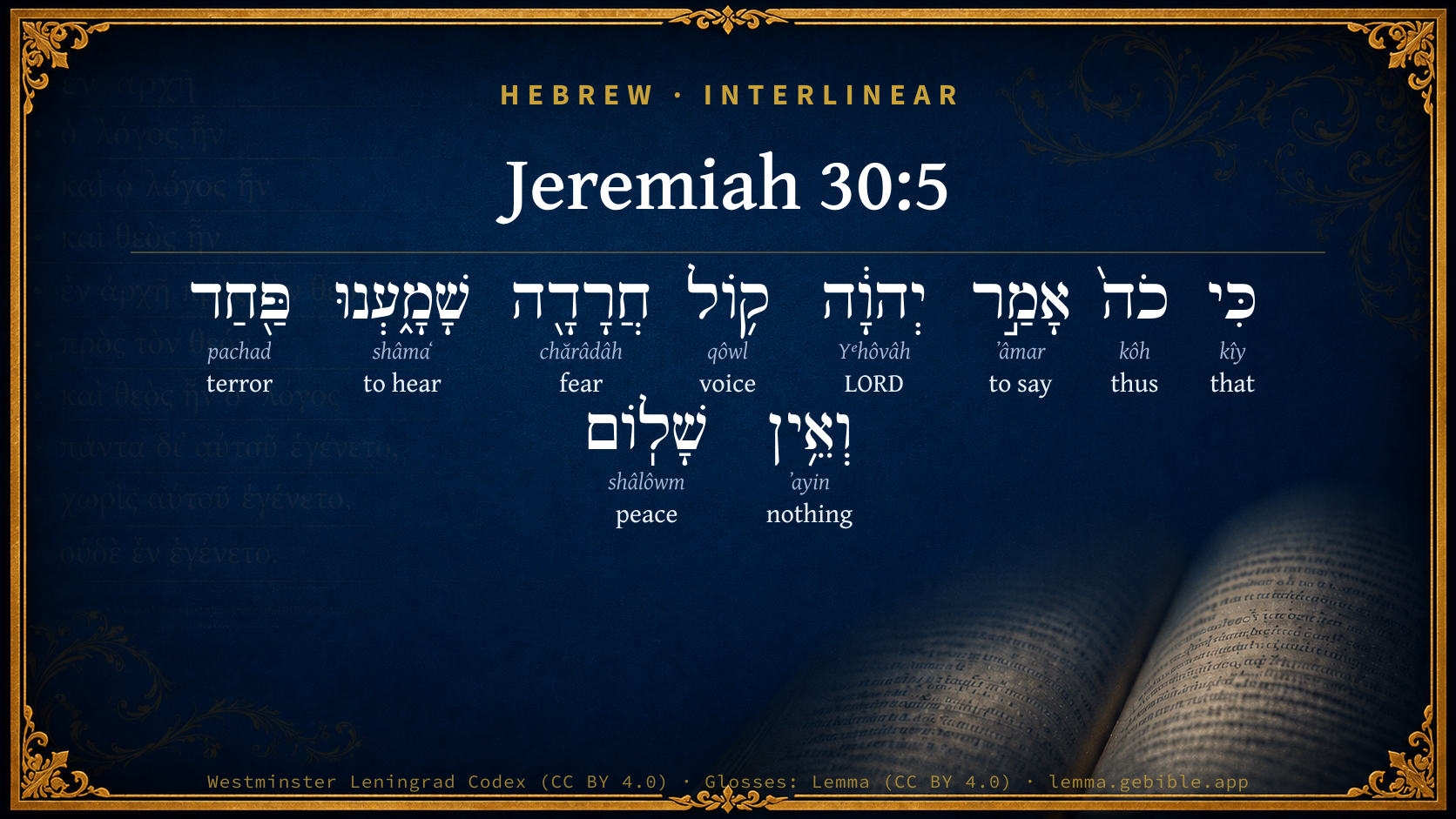
Jeremiah 30:5

Hebrew (Westminster Leningrad Codex) Jeremiah 30:5 appears in the Hebrew Old Testament. The text above is from the Westminster Leningrad Codex. Each word links to its Strong’s number, a concise gloss, and parsing drawn from the Open Scriptures Hebrew Bible morphology. Click any word for its full Brown-Driver-Briggs (BDB) entry.
Download image
Cite this verse

Jeremiah 30:5 (World English Bible). Public Domain. Lemma interlinear Bible study tool, https://lemma.gebible.app/v/jeremiah/30/5.

Show BibTeX & RIS
BibTeX
RIS
English Translation
For thus says Yahweh: We have heard a voice of trembling, of fear, and not of peace.
World English Bible · Public Domain
Download a study sheet

One document with this verse’s original text, its word-by-word gloss line, the meaning frame, cross-references with their text, attributed commentary, and full source and license credits — printable, and it pastes into notes with its structure intact.

This verse Autodidact and up

Study sheet (.html) Plain text (.txt)

A passage Seminary Student

Up to 50 verses in one chapter. A passage sheet keeps up to 6 commentary sources and 12 cross-references per verse, in the order this page ranks them, and says so on the sheet whenever that leaves anything out. Ask for a single verse and you get the Autodidact verse sheet above.

Everything on this page stays free to read, with no account — the sheet is a download of what is already on screen, not access to it.

Want to remove ads? Support Godless Engineer
Compare translations 3

The same verse in 3 English versions, stacked beneath the original-language interlinear above. Click any original word for its lexicon entry.

Each is an independent rendering of the whole verse — the interlinear is not word-aligned to these translations.

Highlighted words mark where these versions differ — a whole-verse word diff, not a word-by-word alignment.

  • World English Bible Public Domain
    For thus says Yahweh: We have heard a voice of trembling, of fear, and not of peace.
  • King James Version Public Domain
    For thus saith the LORD; We have heard a voice of trembling, of fear, and not of peace.
  • unfoldingWord Literal Text CC BY-SA 4.0
    “For Yahweh says this, ‘We have heard a trembling voice of dread and not of peace.

unfoldingWord Literal Text — © unfoldingWord, licensed CC BY-SA 4.0. Word-aligned USFM3 via Door43 (git.door43.org/unfoldingWord/en_ult).

Versions to compare (up to 4)

3 of 4 selected

Show all 18 translations

Every available English version of this verse, each an independent rendering of the whole verse.

  • World English Bible Public Domain
    For thus says Yahweh: We have heard a voice of trembling, of fear, and not of peace.
  • Berean Standard Bible Public Domain
    Yes, this is what the LORD says: “A cry of panic is heard—a cry of terror, not of peace.
  • Majority Standard Bible Public Domain
    Yes, this is what the LORD says: “A cry of panic is heard—a cry of terror, not of peace.
  • King James Version Public Domain
    For thus saith the LORD; We have heard a voice of trembling, of fear, and not of peace.
  • American Standard Version (1901) Public Domain
    For thus saith Jehovah: We have heard a voice of trembling, of fear, and not of peace.
  • Revised Version (1885) Public Domain
    For thus saith the LORD: We have heard a voice of trembling, of fear, and not of peace.
  • Geneva Bible (1599) Public Domain
    For thus saith the Lord, wee haue heard a terrible voyce, of feare and not of peace.
  • Douay-Rheims (1899) Public Domain
    For thus saith the Lord: We have heard a voice of terror: there is fear and no peace.
  • Young's Literal Translation Public Domain
    Surely thus said Jehovah: A voice of trembling we have heard, Fear -- and there is no peace.
  • Literal Standard Version CC BY-SA 4.0
    Surely thus said YHWH: “We have heard a voice of trembling, || Fear—and there is no peace.
  • Unlocked Literal Bible CC BY-SA 4.0
    “For Yahweh says this, 'We have heard a trembling voice of dread and not of peace.
  • unfoldingWord Literal Text CC BY-SA 4.0
    “For Yahweh says this, ‘We have heard a trembling voice of dread and not of peace.
  • Darby Bible Public Domain
    for thus saith Jehovah: We have heard a voice of trembling, there is fear, and no peace.
  • World Messianic Bible Public Domain
    For the LORD says: “We have heard a voice of trembling; a voice of fear, and not of peace.
  • Webster's Bible Public Domain
    For thus saith the LORD; We have heard a voice of trembling, of fear, and not of peace.
  • Free Bible Version CC BY-SA 4.0
    This is what the Lord says: Hear the cries of panic, cries of fear, not peace.
  • Bible in Basic English Public Domain
    This is what the Lord has said: A voice of shaking fear has come to our ears, of fear and not of peace.
  • JPS Tanakh (1917) Public Domain
    For thus saith the LORD: We have heard a voice of trembling, of fear, and not of peace.

Literal Standard Version (2020), Covenant Press — licensed CC BY-SA 4.0. Text via the HelloAO Bible API (eBible.org). Unlocked Literal Bible (unfoldingWord) — licensed CC BY-SA 4.0. Text via the HelloAO Bible API (eBible.org). unfoldingWord Literal Text — © unfoldingWord, licensed CC BY-SA 4.0. Word-aligned USFM3 via Door43 (git.door43.org/unfoldingWord/en_ult). Free Bible Version, Dr. Jonathan Gallagher — licensed CC BY-SA 4.0. Text via the HelloAO Bible API (eBible.org).

Word by word

More ways to search: Search by grammar → Find every occurrence → Compare this word →

Practice this passage: Drill this verse → Learn its vocabulary →

About this verse

These counts appear in no published source. They are computed here, from the morphology-tagged text and Lemma’s own curated glosses. What Lemma adds →

10
words
10
distinct lemmas
Prophets
section

Notable vocabulary

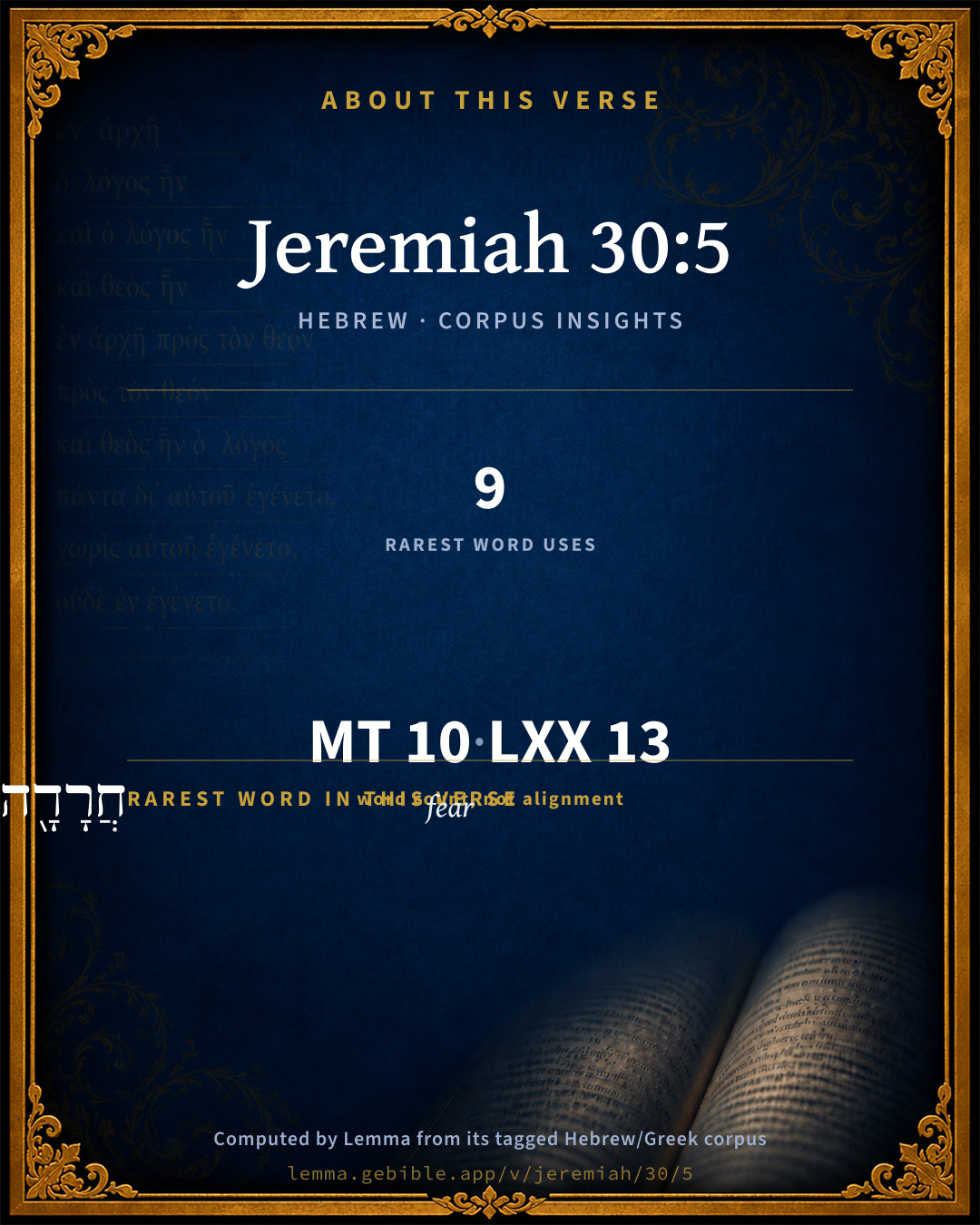
The rarest word here is חֲרָדָ֖ה fear H2731 — appearing just 9 times in the whole Hebrew Bible.

Shared distinctive vocabulary

חֲרָדָ֖ה fear H2731 occurs in 8 verses of the Hebrew Bible. Also found in:

Grammatical profile

  • 2 verbs
  • 5 nouns
  • 1 conjunction
  • 1 adverb
  • 1 particle

Verb forms

  • אָמַ֣ר Qal · Perfect
  • שָׁמָ֑עְנוּ Qal · Perfect

Hebrew & Septuagint length

In the original languages it is 10 Hebrew tokens and 13 Greek tokens — but the two are counted differently (Hebrew bundles its prefixes and suffixes into one token; the Greek is in lemma form), so that isn’t a like-for-like length.

Cross-references

15

Topical passages linked to Jeremiah 30:5 in the Treasury of Scripture Knowledge — connected by theme and wording, ordered by reader-vote popularity; previews shown in the World English Bible.

  • Isaiah 5:30 They will roar against them in that day like the roaring of the sea. If one looks to the land, behold, darkness and distress. The light is darkened in its clouds.
  • Amos 8:10 I will turn your feasts into mourning, And all your songs into lamentation; And I will make you wear sackcloth on all your bodies, And baldness on every head. I will make it like the mourning for an only son, And the end of it like a bitter day.
  • Zephaniah 1:10–11 In that day, says Yahweh, there will be the noise of a cry from the fish gate, a wailing from the second quarter, and a great crashing from the hills.
  • Luke 19:41–44 When he drew near, he saw the city and wept over it,
  • Isaiah 59:11 We roar all like bears, and moan sore like doves: we look for justice, but there is none; for salvation, but it is far off from us.
  • Jeremiah 4:15–20 For a voice declares from Dan, and publishes evil from the hills of Ephraim:
  • Jeremiah 6:23–25 They lay hold on bow and spear; they are cruel, and have no mercy; their voice roars like the sea, and they ride on horses, everyone set in array, as a man to the battle, against you, daughter of Zion.
  • Jeremiah 8:19 Behold, the voice of the cry of the daughter of my people from a land that is very far off: isn't Yahweh in Zion? Isn't her King in her? Why have they provoked me to anger with their engraved images, and with foreign vanities?
  • Jeremiah 9:19 For a voice of wailing is heard out of Zion, How are we ruined! we are greatly confounded, because we have forsaken the land, because they have cast down our dwellings.
  • Jeremiah 25:36 A voice of the cry of the shepherds, and the wailing of the principal of the flock! for Yahweh lays waste their pasture.
  • Jeremiah 31:15–16 Thus says Yahweh: A voice is heard in Ramah, lamentation, and bitter weeping, Rachel weeping for her children; she refuses to be comforted for her children, because they are no more.
  • Jeremiah 46:5 Why have I seen it? they are dismayed and are turned backward; and their mighty ones are beaten down, and have fled apace, and don't look back: terror is on every side, says Yahweh.
  • Amos 5:16–18 Therefore thus says Yahweh, the God of hosts, the Lord: "Wailing will be in all the broad ways; And they will say in all the streets, 'Alas! Alas!' And they will call the farmer to mourning, And those who are skillful in lamentation to wailing.
  • Luke 21:25–26 There will be signs in the sun, moon, and stars; and on the earth anxiety of nations, in perplexity for the roaring of the sea and the waves;
  • Luke 23:29–30 For behold, the days are coming in which they will say, 'Blessed are the barren, the wombs that never bore, and the breasts that never nursed.'

Cross-references courtesy of OpenBible.info (CC BY 4.0).

Hebrew and Greek witnesses Masoretic Hebrew ↔ Greek Septuagint

The same verse in the two great witnesses to the Old Testament, shown verse-for-verse.

These are two independent witnesses, not word-aligned to each other, and the Septuagint is shown in lemma (dictionary) form.

Hebrew Jeremiah 30:5 Masoretic · Westminster Leningrad Codex

כִּי כֹה֙ אָמַ֣ר יְהוָ֔ה ק֥וֹל חֲרָדָ֖ה שָׁמָ֑עְנוּ פַּ֖חַד וְאֵ֥ין שָׁלֽוֹם

For thus says Yahweh: We have heard a voice of trembling, of fear, and not of peace.

World English Bible · Public Domain

Greek LXX Structure differs

In the Septuagint, Jeremiah is about an eighth shorter than the Hebrew and arranges its material differently — the Oracles Against the Nations (Hebrew chapters 46–51) appear in the middle of the Greek book, after 25:13. Because the chapter and verse boundaries do not line up, a verse-for-verse comparison with the Hebrew is not shown.

A verse-for-verse comparison isn’t shown here because the chapters and verses don’t line up. Switch to the LXX edition with the MT / LXX toggle above to read the Greek directly.

Hebrew: Westminster Leningrad Codex (CC BY 4.0). Greek: Septuagint (public domain); English from a public-domain English Septuagint. How the Septuagint differs from the Hebrew →

Targum (Aramaic paraphrase)

1

The Targum is the ancient Jewish Aramaic paraphrase of the Hebrew Scriptures — an interpretive translation, not the Hebrew text itself. Onkelos (literal) and Pseudo-Jonathan (expansive) render the Torah, and Jonathan the Prophets. Coverage is partial: where no permissively-licensed English translation exists for a verse, only the Aramaic is shown. This is verse-level text, not a word-by-word alignment to the Hebrew.

  1. Targum Jonathan Prophets (Joshua–Malachi)
    אֲרֵי כִּדְנַן אֲמַר יְיָ קַל זְוָעָה שְׁמַעְנָא דַחֲלָא וְלֵית שְׁלָם:

    (no public-domain English translation for this verse)

    Targum Jonathan — Aramaic: “Mikraot Gedolot” (public domain). English: “Sefaria Community Translation” (CC0 1.0 (public-domain dedication)); “London "Chaldee Paraphrase," 1871” (public domain). Text via Sefaria.

Commentary

Notes on Jeremiah 30:5 from classic Christian and Jewish commentators (each source and its license shown beneath its notes). The classic Christian expositions comment on the surrounding passage and are grouped to its opening verse, so a note may address several verses; the Jewish commentaries on the Tanakh (Rashi and others) are per-verse, so they appear only where the commentator wrote on this verse.

Lemma curates 59 commentaries, every one of them public domain or Creative Commons licensed, each selected and text-cleaned for this edition rather than reprinted as found. About our sources →

The Cambridge Bible for Schools and Colleges

gen. ed. J. J. S. Perowne

5. We have heard … of peace] Jehovah is quoting the words of consternation which He hears the people uttering; but more probably the words “Thus saith the Lord” are the insertion of a scribe, and it is really the people who are speaking.

of fear, and not of peace] mg. (better) there is fear, and no peace.

5–22. See introd. note to section. For a parallel in the character of the description in Jer_30:5-11, Dr. compares Isa_13:6-15 (the overthrow of Babylon) followed by Isa_14:1 f. (the deliverance of Israel); also Isa_24:14-15; Isa_24:23; Isa_25:1-5.

The Cambridge Bible for Schools and Colleges (gen. ed. J. J. S. Perowne; Cambridge University Press, 1878–1918) — public domain. Text from a community e-Sword module.

Trapp's Complete Commentary

John Trapp

Jer 30:5 For thus saith the LORD; We have heard a voice of trembling, of fear, and not of peace.

Ver. 5. We have heard a voice of trembling.] We were at first in a pitiful plight, scil., when the city was taken and the temple burnt (and this is elegantly here set forth, and in the two next verses); but better times are at hand:

“ Flebile principium melior fortuna sequetur. ”

John Trapp, A Commentary or Exposition upon All the Books of the Old and New Testament (1647–1656) — public domain. Text from a community e-Sword module.

Geneva Bible (1599)

Geneva Bible translators

He showeth that before that this deliverance shall come, the Chaldeans should be extremely afflicted by their enemies, and that they should be in such perplexity and sorrow as a woman in her travail, as Isa. 13:8.

Geneva Bible (1599) marginal notes — public domain. Text via Bolls.life.

Jamieson, Fausset & Brown

Robert Jamieson, A. R. Fausset & David Brown

We have heard . . . trembling--God introduces the Jews speaking that which they will be reduced to at last in spite of their stubbornness. Threat and promise are combined: the former briefly; namely, the misery of the Jews in the Babylonian captivity down to their "trembling" and "fear" arising from the approach of the Medo-Persian army of Cyrus against Babylon; the promise is more fully dwelt on; namely, their "trembling" will issue in a deliverance as speedy as is the transition from a woman's labor pangs to her joy at giving birth to a child (Jer 30:6).

Jamieson, Fausset & Brown — Commentary Critical and Explanatory on the Whole Bible (1871) — public domain (CC PDM 1.0). Text via the HelloAO Bible API.

Adam Clarke's Commentary

Verse 5. We have heard a voice of trembling] This may refer to the state and feelings of the people during the war which Cyrus carried on against the Babylonians. Trembling and terror would no doubt affect them, and put an end to peace and all prosperity; as they could not tell what would be the issue of the struggle, and whether their state would be better or worse should their present masters fall in the conflict. This is well described in the next verse, where men are represented as being, through pain and anguish, like women in travail. See the same comparison Isa 13:6-8.

Adam Clarke's Commentary on the Bible (1810–1826) — public domain. Text from a community e-Sword/MySword module.

John Calvin's Commentaries

Now he says, Thus saith Jehovah, A cry, or, the voice of trembling, or of fear, have we heard. The word חרדה, cherede, is thought to mean properly that dread which makes the whole body to tremble, and is therefore rendered trembling. God speaks, and yet in the person of the people. Why? In order to expose their insensibility; for as they were obstinate in their wickedness, so they were not terrified by threatenings, however many and dreadful. God dictated words for them, for they were altogether void of feeling. We now see why God assumed the person of those who were secure, though Jeremiah daily represented to them God’s vengeance as near at hand. The meaning is, that though the people were asleep in their sins, and thought themselves beyond the reach of danger, even when God was displeased with them, yet the threatenings by which God sought to lead them to repentance would not be in vain. Hence God says, We have heard the voice of fear; that is, “Deride and scoff as you please, or remain insensible in your delusions, so as to disregard as the drunken what is said, being destitute of feeling, reason, and memory, yet God will extort from you this confession, this voice of trembling and fear.”

John Calvin's Commentaries (1540-1563) — public domain. Text from the Calvin Translation Society English edition (1840s-50s) via the Christian Classics Ethereal Library (ccel.org). Calvin's coverage is partial (roughly two-thirds of the Bible); uncommented books and verses are honest gaps, never fabricated. The 19th-century editor's footnotes and remarks are omitted so the notes are faithfully Calvin's own voice.

Ellicott's Commentary for English Readers

(5, 6) Thus saith the Lord; We have heard a voice of trembling . . .—There is a strange mingling of the divine and human elements in these words. The prophet speaks with the sense that the words are not his own, and yet what he utters is, at first, the expression of his own horror and astonishment at the vision of woe that is opening before his eyes. He sees, as it were, the famine-stricken people, their faces gathering blackness, the strong men giving way to a woman’s anguish, wailing with their hands on their loins. In horror rather than in scorn, he asks the question, What means all this? Are these men in the pangs of childbirth? (Comp. Jer_4:31; Jer_6:24; Jer_13:21.) In Lam_2:19-22 we have a fuller picture of a like scene. By some commentators the three verses (5-7) are referred to the alarm caused in Babylon by the advance of Cyrus, and “that day” is the day of his capture of the city, but there seems no sufficient reason for such an interpretation.

A Bible Commentary for English Readers, edited by Charles John Ellicott (1878–1897) — public domain. Text from a community e-Sword module.

John Gill's Exposition

For thus saith the Lord,.... Yet what follows are the words of others; wherefore some supply it, "for thus saith the Lord, the nations shall say" (p); so Kimchi and Ben Melech interpret it as what the Gentiles will say in the times of the Messiah; but it might be better supplied, "ye shall say"; that is, Israel and Judah; to whom the words of the Lord are spoken in Jer 30:3; or else the Lord here represents his people, saying:

we have heard a voice of trembling, ear, and not of peace; which is to be understood, of the fear and dread injected into them by the Babylonians when they besieged their city, and burned that, and their temple; nor of the fear and dread which came upon the Babylonians at the taking of their city by Cyrus, upon which followed the deliverance of the Jews. Kimchi interprets this of something yet future, the war of Gog and Magog, which he supposes wilt be when their Messiah comes; and Jarchi sans it is so understood in their Midrash Agadah. This distress, I think, refers to the slaying of the witnesses, and to that hour of temptation which shall come upon all the earth to try the inhabitants of it; and which will be followed with the destruction of antichrist; and that will make way for the call and conversion of the Jews.

(p) "Gentes dicturae sunt", Vatablus.

John Gill's Exposition of the Whole Bible (1746–1763) — public domain (CC PDM 1.0). Text via the HelloAO Bible API.

Albert Barnes' Notes on the Bible

Better, as in the margin. The prophet places his hearers in the center of Babylon, and describes it as convulsed with terror as the armies of Cyrus draw near. The voice of trembling is the war-cry of the advancing host: while fear and no peace implies that even among the exiles there is only alarm at the prospect of the city, where they had so long dwelt, being destroyed.

Albert Barnes' Notes on the Bible (1834–1885) — public domain. Text from a community e-Sword/MySword module.

Haydock's Catholic Bible Commentary

We. Jeremias is ordered to express the alarms of the captives, at the news of the destruction of Jerusalem, or rather of the Chaldean empire, by Cyrus. They were naturally afraid that they would also suffer.

George Leo Haydock (1774–1849), Haydock's Catholic Family Bible and Commentary, 1859 edition — public domain. Excludes Psalms (Douay-Rheims chapter numbering differs from Protestant) and Deuterocanonical books (Catholic canon only).

Matthew Poole's English Annotations

God here speaketh, but whether personating other nations or the Jewish nation is not agreed, nor yet whether this text refers to the times of the Messiah, when the nations should tremble, or the time when Darius invaded Babylon, or the times of Gog and Magog, (of which read Eze 38) or the time when the Chaldeans invaded Judah: this last seemeth most probable, and that God by this intended only to rouse the Jews out of their security, and put them off from expecting peace according to the flatteries of the false prophets, assuring them that the times that were coming next were not times of peace, but such as should make them tremble.

Matthew Poole's English Annotations on the Holy Bible (1683–1685) — public domain. Text from a community e-Sword/MySword module.

Whedon's Commentary on the Bible

Daniel D. Whedon

JUDGMENT ON THE NATIONS, Jer_30:4-7.

5. A voice of trembling, etc. — This comforting prophecy has a most dramatic beginning. This verse seems to be located in the very darkest hour of their national night. The excitement and alarm consequent on the approach of the Medo-Persian army is here depicted. Though this coming was to work deliverance, yet at the first it produces only fear and apprehension.

Daniel D. Whedon (gen. ed.), Commentary on the Old and New Testaments (1874–1909) — public domain. Text from a community e-Sword module.

The Pulpit Commentary

Vers. 5-11. The great judgment of Israel"s deliverance. It is nothing less than the "day of Jehovah" which the prophet sees in spirit a day which is "great" (ver. 7; comp. Joe_2:11 Zep_1:14) and terrible (vers. 5, 6; comp. Amo_5:18, 20 Isa_13:6 Joe_2:1, Joe_2:11) for Israel, a day of "trouble" (ver. 7), but for his enemies of destruction.

A voice of trembling; rather, a sound of trembling, a sound causing men to tremble; doubtless it is "the sound of the trumpet, the alarm of war". (Jer_4:19) Of fear, and not of peace; rather, there is fear, and no peace. "Peace," as usual, means the harmony of a well ordered, secure, and peaceful community. Literally, it is wholeness; its opposite is "breaking," i.e. outward ruin and inward anguish.

The Pulpit Commentary (1880–1919), ed. H.D.M. Spence-Jones & Joseph S. Exell — public domain. Text from a community e-Sword module.

Rashi

Rabbi Shlomo Yitzchaki (Rashi)

A sound of quaking we have heard Some interpret this as alluding to the tidings of Babylon, from which those exiled there quaked. But the Midrash Aggadah explains it as an allusion to the war of Gog and Magog.

Rashi on the Tanakh — English translations: “The Judaica Press complete Tanach with Rashi, translated by A. J. Rosenberg” (CC BY 4.0); “Pentateuch with Rashi's commentary by M. Rosenbaum and A.M. Silbermann, 1929-1934” (public domain); “The Metsudah Tanach series, Lakewood, N.J” (CC BY 4.0); and “The Book of Joshua, Metsudah Publications, 1997” (CC BY 4.0). Text via Sefaria.

Lesson kit

Teaching starters — assembled from the data on this page, not authored interpretation. Every prompt links to the verse data it draws on. Edit before teaching.

Jeremiah, in the Prophets, opens this verse with 10 words (10 distinct Hebrew lemmas). Its most distinctive word is chărâdâh (“fear”). A historical commentator’s framing appears above. Read the whole chapter for the surrounding context.

Discussion questions

  1. The word chărâdâh carries the sense “fear.” How does it shape the verse?
  2. How does Genesis 27:33, which shares the word «fear», read alongside this verse?
  3. These translations render this verse differently; the difference is in the English rendering, not the original. What questions does that raise?
  4. «אָמַ֣ר» is a Qal Perfect verb. How does that grammatical form shape the action described?
  5. Compare how The Cambridge Bible for Schools and Colleges and Trapp's Complete Commentary read this verse. Where do they agree or differ?

Things to notice

Reading settings

Reading text

Shown beneath each verse's original-language words.

Old Testament
Old Testament edition

Read the OT as the Masoretic Hebrew (MT) or the Greek Septuagint (LXX).

English shown for the Greek Septuagint (in the Hebrew ↔ Greek comparison).

Comparing translations? Open the Compare panel on any verse page to stack up to four side by side.