
2 Samuel 19:24

Hebrew (Westminster Leningrad Codex) 2 Samuel 19:24 appears in the Hebrew Old Testament. The text above is from the Westminster Leningrad Codex. Each word links to its Strong’s number, a concise gloss, and parsing drawn from the Open Scriptures Hebrew Bible morphology. Click any word for its full Brown-Driver-Briggs (BDB) entry.
Download image
Cite this verse

2 Samuel 19:24 (World English Bible). Public Domain. Lemma interlinear Bible study tool, https://lemma.gebible.app/v/2-samuel/19/24.

Show BibTeX & RIS
BibTeX
RIS
English Translation
Mephibosheth the son of Saul came down to meet the king; and he had neither dressed his feet, nor trimmed his beard, nor washed his clothes, from the day the king departed until the day he came home in peace.
World English Bible · Public Domain
Download a study sheet

One document with this verse’s original text, its word-by-word gloss line, the meaning frame, cross-references with their text, attributed commentary, and full source and license credits — printable, and it pastes into notes with its structure intact.

This verse Autodidact and up

Study sheet (.html) Plain text (.txt)

A passage Seminary Student

Up to 50 verses in one chapter. A passage sheet keeps up to 6 commentary sources and 12 cross-references per verse, in the order this page ranks them, and says so on the sheet whenever that leaves anything out. Ask for a single verse and you get the Autodidact verse sheet above.

Everything on this page stays free to read, with no account — the sheet is a download of what is already on screen, not access to it.

Want to remove ads? Support Godless Engineer
Compare translations 3

The same verse in 3 English versions, stacked beneath the original-language interlinear above. Click any original word for its lexicon entry.

Each is an independent rendering of the whole verse — the interlinear is not word-aligned to these translations.

Highlighted words mark where these versions differ — a whole-verse word diff, not a word-by-word alignment.

  • World English Bible Public Domain
    Mephibosheth the son of Saul came down to meet the king; and he had neither dressed his feet, nor trimmed his beard, nor washed his clothes, from the day the king departed until the day he came home in peace.
  • King James Version Public Domain
    And Mephibosheth the son of Saul came down to meet the king, and had neither dressed his feet, nor trimmed his beard, nor washed his clothes, from the day the king departed until the day he came again in peace.
  • unfoldingWord Literal Text CC BY-SA 4.0
    And Mephibosheth, the son of Saul, came down to meet the king. And he had not done his feet, and he had not done his mustache, and he had not washed his clothes from the day the king went up to the day that he came in peace.

unfoldingWord Literal Text — © unfoldingWord, licensed CC BY-SA 4.0. Word-aligned USFM3 via Door43 (git.door43.org/unfoldingWord/en_ult).

Versions to compare (up to 4)

3 of 4 selected

Show all 18 translations

Every available English version of this verse, each an independent rendering of the whole verse.

  • World English Bible Public Domain
    Mephibosheth the son of Saul came down to meet the king; and he had neither dressed his feet, nor trimmed his beard, nor washed his clothes, from the day the king departed until the day he came home in peace.
  • Berean Standard Bible Public Domain
    Then Mephibosheth, Saul’s grandson, went down to meet the king. He had not cared for his feet or trimmed his mustache or washed his clothes from the day the king had left until the day he returned safely.
  • Majority Standard Bible Public Domain
    Then Mephibosheth, Saul’s grandson, went down to meet the king. He had not cared for his feet or trimmed his mustache or washed his clothes from the day the king had left until the day he returned safely.
  • King James Version Public Domain
    And Mephibosheth the son of Saul came down to meet the king, and had neither dressed his feet, nor trimmed his beard, nor washed his clothes, from the day the king departed until the day he came again in peace.
  • American Standard Version (1901) Public Domain
    And Mephibosheth the son of Saul came down to meet the king; and he had neither dressed his feet, nor trimmed his beard, nor washed his clothes, from the day the king departed until the day he came home in peace.
  • Revised Version (1885) Public Domain
    And Mephibosheth the son of Saul came down to meet the king; and he had neither dressed his feet, nor trimmed his beard, nor washed his clothes, from the day the king departed until the day he came home in peace.
  • Geneva Bible (1599) Public Domain
    And Mephibosheth the sonne of Saul came downe to meete the king, and had neither washed his feete, nor dressed his beard, nor washed his clothes from the time the king departed, vntill he returned in peace.
  • Douay-Rheims (1899) Public Domain
    And Miphiboseth the son of Saul came down to meet the king, and he had neither washed his feet, nor trimmed his beard: nor washed his garments from the day that the king went out, until the day of his return in peace.
  • Young's Literal Translation Public Domain
    And Mephibosheth son of Saul hath come down to meet the king -- and he prepared not his feet, nor did he prepare his upper lip, yea, his garments he washed not, even from the day of the going away of the king, till the day that he came in peace --
  • Literal Standard Version CC BY-SA 4.0
    And Mephibosheth son of Saul has come down to meet the king—and he did not prepare his feet, nor did he prepare his upper lip, indeed, he did not wash his garments, even from the day of the going away of the king, until the day that he came in peace—
  • Unlocked Literal Bible CC BY-SA 4.0
    Then Mephibosheth son of Saul came down to meet the king. He had not dressed his feet, or trimmed his beard, or washed his clothes from the day the king left until the day he came home in peace.
  • unfoldingWord Literal Text CC BY-SA 4.0
    And Mephibosheth, the son of Saul, came down to meet the king. And he had not done his feet, and he had not done his mustache, and he had not washed his clothes from the day the king went up to the day that he came in peace.
  • Darby Bible Public Domain
    And Mephibosheth the son of Saul came down to meet the king. Now he had neither washed his feet, nor trimmed his beard, nor washed his clothes, from the day the king departed until the day he came [again] in peace.
  • World Messianic Bible Public Domain
    Mephibosheth the son of Saul came down to meet the king; and he had neither groomed his feet, nor trimmed his beard, nor washed his clothes, from the day the king departed until the day he came home in peace.
  • Webster's Bible Public Domain
    And Mephibosheth the son of Saul came down to meet the king, and had neither dressed his feet, nor trimmed his beard, nor washed his clothes, from the day the king departed until the day he came again in peace.
  • Free Bible Version CC BY-SA 4.0
    Then Mephibosheth, Saul's grandson, went to meet the king. He had refused to look after his feet or trim his mustache or have his clothes washed from the day the king left until the day of his peaceful return.
  • Bible in Basic English Public Domain
    And Mephibosheth, the son of Saul's son, came down for the purpose of meeting the king; his feet had not been cared for or his hair cut or his clothing washed from the day when the king went away till the day when he came back in peace.
  • JPS Tanakh (1917) Public Domain
    (19-25) And Mephibosheth the son of Saul came down to meet the king; and he had neither dressed his feet, nor trimmed his beard, nor washed his clothes, from the day the king departed until the day he came home in peace.

Literal Standard Version (2020), Covenant Press — licensed CC BY-SA 4.0. Text via the HelloAO Bible API (eBible.org). Unlocked Literal Bible (unfoldingWord) — licensed CC BY-SA 4.0. Text via the HelloAO Bible API (eBible.org). unfoldingWord Literal Text — © unfoldingWord, licensed CC BY-SA 4.0. Word-aligned USFM3 via Door43 (git.door43.org/unfoldingWord/en_ult). Free Bible Version, Dr. Jonathan Gallagher — licensed CC BY-SA 4.0. Text via the HelloAO Bible API (eBible.org).

Word by word

More ways to search: Search by grammar → Find every occurrence → Compare this word →

Practice this passage: Drill this verse → Learn its vocabulary →

שְׂפָמ֗וֹ
sâphâm
H8222
“mustache · his”
Noun, Common, Masculine, Singular, Construct + Suffix, Personal, 3rd Person, Masculine, Singular
Part of Speech
Noun
Type
Common
Gender
Masculine
Number
Singular
State
Construct
Full BDB Definition

Origin: from H8193

TWOT: 2279

moustache
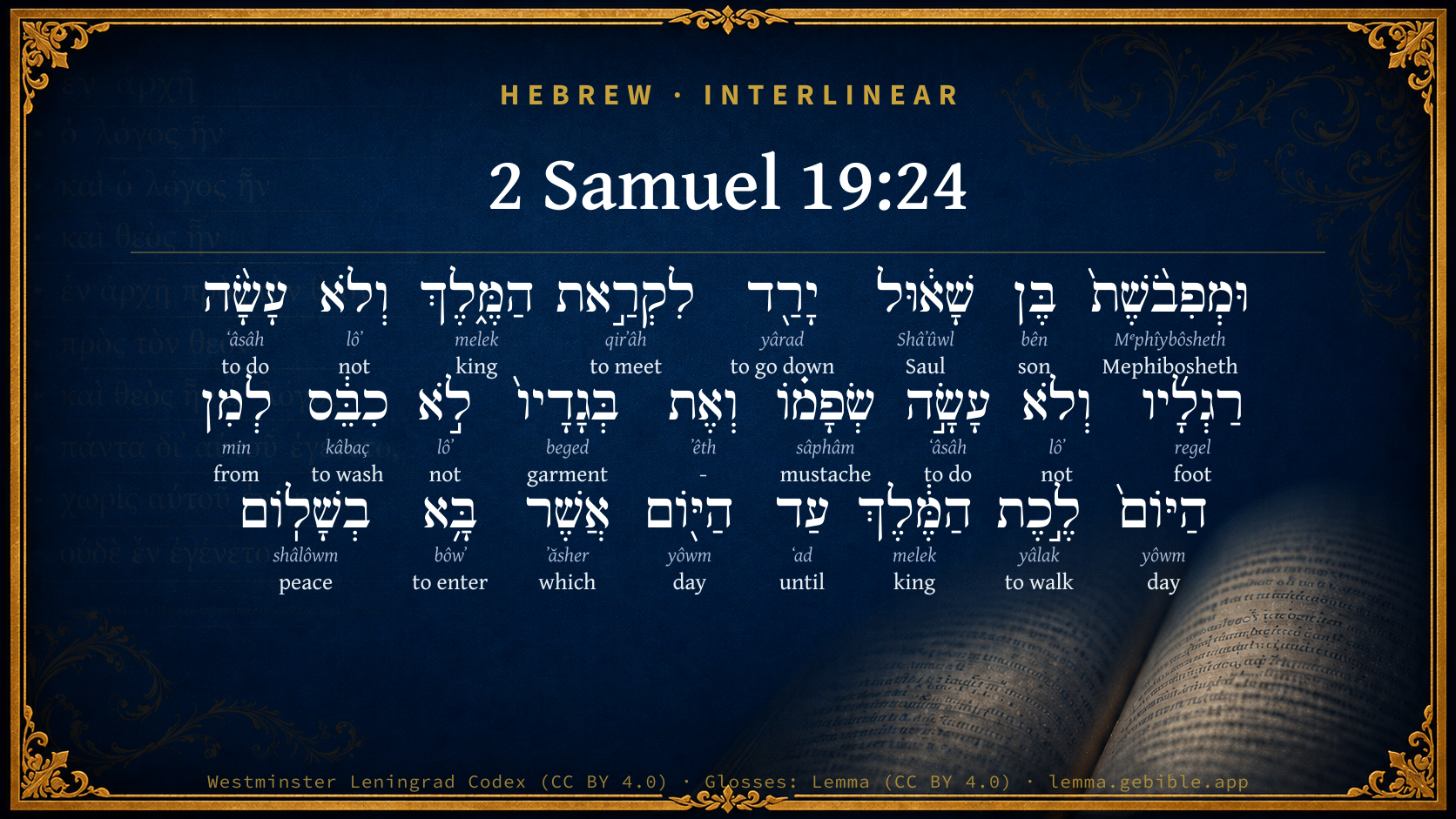
  1. וּמְפִבֹ֨שֶׁת֙ Mᵉphîybôsheth H4648 “and · Mephibosheth” Conjunction + Noun, Proper
  2. בֶּן bên H1121 “son of” Noun, Common, Masculine, Singular, Construct
  3. שָׁא֔וּל Shâʼûwl H7586 “Saul” Noun, Proper
  4. יָרַ֖ד yârad H3381 “to go down” Verb, Qal, Perfect, 3rd Person, Masculine, Singular
  5. לִקְרַ֣את qirʼâh H7125 “to meet” Preposition + Verb, Qal, Infinitive Construct
  6. הַמֶּ֑לֶךְ melek H4428 “the · king” Particle, Definite Article + Noun, Common, Masculine, Singular, Absolute
  7. וְלֹא lôʼ H3808 “and · not” Conjunction + Particle, Negative
  8. עָשָׂ֨ה ʻâsâh H6213 “to do” Verb, Qal, Perfect, 3rd Person, Masculine, Singular
  9. רַגְלָ֜יו regel H7272 “feet · his” Noun, Common, Feminine, Dual, Construct + Suffix, Personal, 3rd Person, Masculine, Singular
  10. וְלֹא lôʼ H3808 “and · not” Conjunction + Particle, Negative
  11. עָשָׂ֣ה ʻâsâh H6213 “to do” Verb, Qal, Perfect, 3rd Person, Masculine, Singular
  12. וְאֶת ʼêth H853 “and · -” Conjunction + Particle, Direct Object
  13. בְּגָדָיו֙ beged H899 “garments · his” Noun, Common, Masculine, Plural, Construct + Suffix, Personal, 3rd Person, Masculine, Singular
  14. לֹ֣א lôʼ H3808 “not” Particle, Negative
  15. כִבֵּ֔ס kâbaç H3526 “to wash” Verb, Piel, Perfect, 3rd Person, Masculine, Singular
  16. לְמִן min H4480 “to/for · from” Preposition + Preposition
  17. הַיּוֹם֙ yôwm H3117 “the · day” Particle, Definite Article + Noun, Common, Masculine, Singular, Absolute
  18. לֶ֣כֶת yâlak H3212 “to walk” Verb, Qal, Infinitive Construct
  19. הַמֶּ֔לֶךְ melek H4428 “the · king” Particle, Definite Article + Noun, Common, Masculine, Singular, Absolute
  20. עַד ʻad H5704 “until” Preposition
  21. הַיּ֖וֹם yôwm H3117 “the · day” Particle, Definite Article + Noun, Common, Masculine, Singular, Absolute
  22. אֲשֶׁר ʼăsher H834 “which” Particle, Relative
  23. בָּ֥א bôwʼ H935 “to enter” Verb, Qal, Perfect, 3rd Person, Masculine, Singular
  24. בְשָׁלֽוֹם shâlôwm H7965 “in/at · peace” Preposition + Noun, Common, Masculine, Singular, Absolute

About this verse

These counts appear in no published source. They are computed here, from the morphology-tagged text and Lemma’s own curated glosses. What Lemma adds →

25
words
20
distinct lemmas
Historical
section

Notable vocabulary

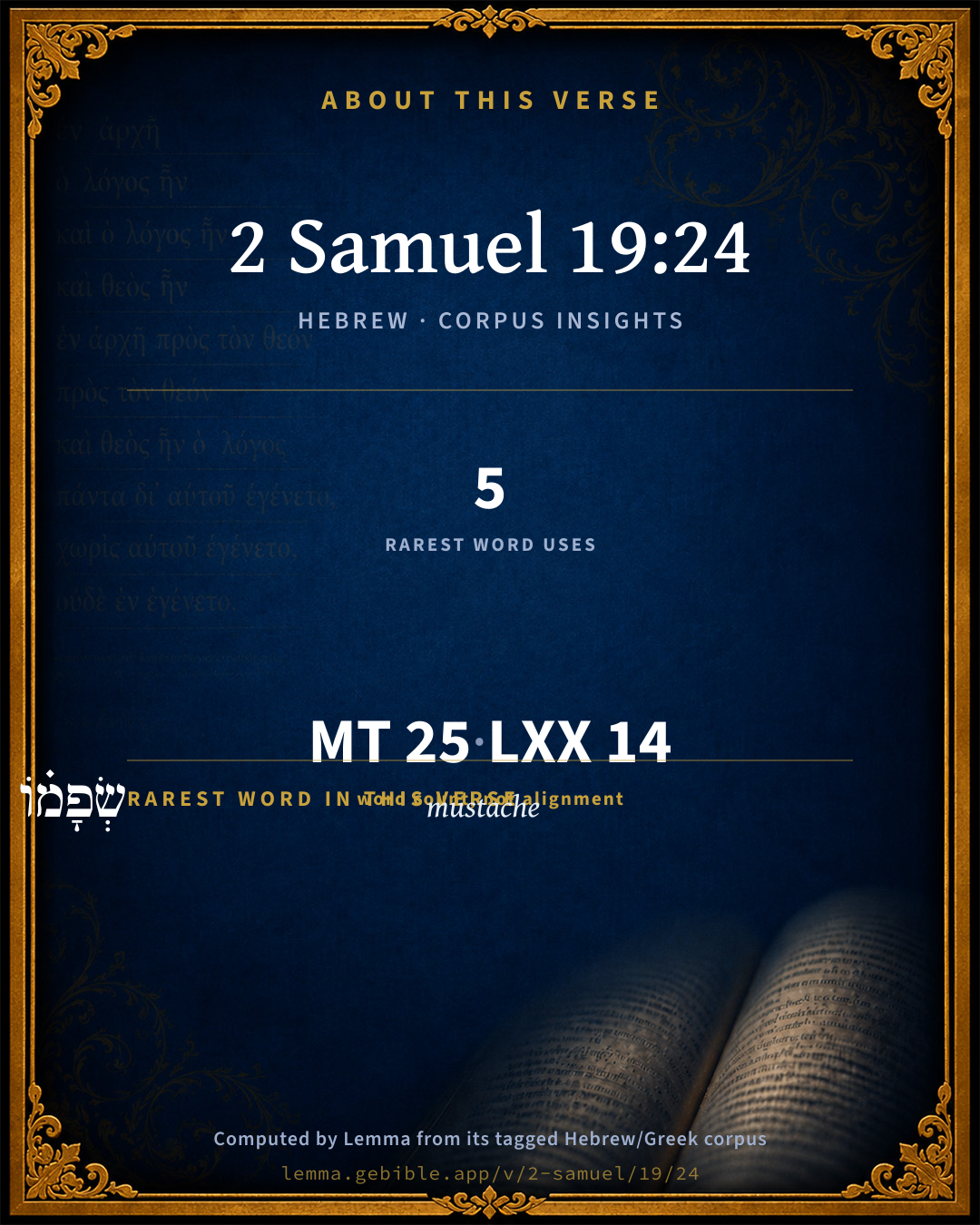
The rarest word here is שְׂפָמ֗וֹ mustache H8222 — appearing just 5 times in the whole Hebrew Bible.

Shared distinctive vocabulary

שְׂפָמ֗וֹ mustache H8222 occurs in 5 verses of the Hebrew Bible. Also found in:

Grammatical profile

  • 7 verbs
  • 11 nouns
  • 2 prepositions
  • 5 particles

Verb forms

  • יָרַ֖ד Qal · Perfect
  • לִקְרַ֣את Qal · Infinitive Construct
  • עָשָׂ֨ה Qal · Perfect
  • עָשָׂ֣ה Qal · Perfect
  • כִבֵּ֔ס Piel · Perfect
  • לֶ֣כֶת Qal · Infinitive Construct
  • בָּ֥א Qal · Perfect

Repetition

Words recur within this verse — often emphatic in Hebrew:

  • הַמֶּ֑לֶךְ king H4428 ×2
  • עָשָׂ֨ה to do H6213 ×2
  • הַיּוֹם֙ day H3117 ×2
  • וְלֹא not H3808 ×3

Hebrew & Septuagint length

In English translation the verse runs 40 words from the Hebrew and 47 from the Septuagint (LXX English) — closely comparable.

A rough comparison of the two English renderings, which tokenize alike — not a word-level alignment.

Word counts can differ between the Hebrew and the Greek without any difference in meaning — e.g. the Hebrew direct-object marker אֵת has no separate Greek word, and Greek often adds the article ὁ.

In the original languages it is 25 Hebrew tokens and 14 Greek tokens — but the two are counted differently (Hebrew bundles its prefixes and suffixes into one token; the Greek is in lemma form), so that isn’t a like-for-like length.

Cross-references

8

Topical passages linked to 2 Samuel 19:24 in the Treasury of Scripture Knowledge — connected by theme and wording, ordered by reader-vote popularity; previews shown in the World English Bible.

  • 2 Samuel 9:6–10 Mephibosheth, the son of Jonathan, the son of Saul, came to David, and fell on his face, and did obeisance. David said, Mephibosheth. He answered, Behold, your servant!
  • 2 Samuel 15:30 David went up by the ascent of the [Mount of] Olives, and wept as he went up; and he had his head covered, and went barefoot: and all the people who were with him covered every man his head, and they went up, weeping as they went up.
  • 2 Samuel 16:3 The king said, Where is your master's son? Ziba said to the king, Behold, he abides at Jerusalem; for he said, Today will the house of Israel restore me the kingdom of my father.
  • Isaiah 15:2 They are gone up to Bayith, and to Dibon, to the high places, to weep: Moab wails over Nebo, and over Medeba; on all their heads is baldness, every beard is cut off.
  • Jeremiah 41:5 that there came men from Shechem, from Shiloh, and from Samaria, even eighty men, having their beards shaved and their clothes torn, and having cut themselves, with meal-offerings and frankincense in their hand, to bring them to the house of Yahweh.
  • Matthew 6:16 "Moreover when you fast, don't be like the hypocrites, with sad faces. For they disfigure their faces, that they may be seen by men to be fasting. Most assuredly I tell you, they have received their reward.
  • Romans 12:15 Rejoice with those who rejoice. Weep with those who weep.
  • Hebrews 13:3 Remember those who are in bonds, as bound with them; and those who are ill-treated, since you are also in the body.

Cross-references courtesy of OpenBible.info (CC BY 4.0).

Hebrew and Greek witnesses Masoretic Hebrew ↔ Greek Septuagint

The same verse in the two great witnesses to the Old Testament, shown verse-for-verse.

These are two independent witnesses, not word-aligned to each other, and the Septuagint is shown in lemma (dictionary) form.

Hebrew 2 Samuel 19:24 Masoretic · Westminster Leningrad Codex

וּמְפִבֹ֨שֶׁת֙ בֶּן שָׁא֔וּל יָרַ֖ד לִקְרַ֣את הַמֶּ֑לֶךְ וְלֹא עָשָׂ֨ה רַגְלָ֜יו וְלֹא עָשָׂ֣ה שְׂפָמ֗וֹ וְאֶת בְּגָדָיו֙ לֹ֣א כִבֵּ֔ס לְמִן הַיּוֹם֙ לֶ֣כֶת הַמֶּ֔לֶךְ עַד הַיּ֖וֹם אֲשֶׁר בָּ֥א בְשָׁלֽוֹם

Mephibosheth the son of Saul came down to meet the king; and he had neither dressed his feet, nor trimmed his beard, nor washed his clothes, from the day the king departed until the day he came home in peace.

World English Bible · Public Domain

Greek LXX 2 Samuel 19:24 Septuagint · lemma form

καί εἶπον ὁ βασιλεύς πρός σεμεϊ οὐ μή ἀποθνήσκω καί ὄμνυμι αὐτός ὁ βασιλεύς

And Memphibosthe the son of Saul's son went down to meet the king, and had not dressed his feet, nor pared his nails, nor shaved himself, neither had he washed his garments, from the day that the king departed, until the day when he arrived in peace.

LXX2012 (modern English Septuagint) · Public Domain

On this verse, Keil & Delitzsch discusses the Septuagint’s reading. Read the note in Commentary ↓

Hebrew: Westminster Leningrad Codex (CC BY 4.0). Greek: Septuagint (public domain); English from LXX2012 (modern English Septuagint) (Public Domain). How the Septuagint differs from the Hebrew →

Targum (Aramaic paraphrase)

1

The Targum is the ancient Jewish Aramaic paraphrase of the Hebrew Scriptures — an interpretive translation, not the Hebrew text itself. Onkelos (literal) and Pseudo-Jonathan (expansive) render the Torah, and Jonathan the Prophets. Coverage is partial: where no permissively-licensed English translation exists for a verse, only the Aramaic is shown. This is verse-level text, not a word-by-word alignment to the Hebrew.

  1. Targum Jonathan Prophets (Joshua–Malachi)
    וַאֲמַר מַלְכָּא לְשִׁמְעִי לָא תְמוּת וְקַיָם לֵיהּ מַלְכָּא:

    (no public-domain English translation for this verse)

    Targum Jonathan — Aramaic: “Mikraot Gedolot” (public domain). English: “Sefaria Community Translation” (CC0 1.0 (public-domain dedication)); “London "Chaldee Paraphrase," 1871” (public domain). Text via Sefaria.

Commentary

Notes on 2 Samuel 19:24 from classic Christian and Jewish commentators (each source and its license shown beneath its notes). The classic Christian expositions comment on the surrounding passage and are grouped to its opening verse, so a note may address several verses; the Jewish commentaries on the Tanakh (Rashi and others) are per-verse, so they appear only where the commentator wrote on this verse.

Lemma curates 59 commentaries, every one of them public domain or Creative Commons licensed, each selected and text-cleaned for this edition rather than reprinted as found. About our sources →

Matthew Henry's Commentary

The day of David's return was a day of bringing to remembrance, a day of account, in which what had passed in his flight was called over again; among other things, after the case of Shimei, that of Mephibosheth comes to be enquired into, and he himself brings it on.

I. He went down in the crowd to meet the king (Sa2 19:24), and as a proof of the sincerity of his joy in the king's return, we are here told what a true mourner he was for the king's banishment. During that melancholy time, when one of the greatest glories of Israel had departed, Mephibosheth continued in a very melancholy state. He was never trimmed, nor put on clean linen, but wholly neglected himself, as one abandoned to grief for the king's affliction and the kingdom's misery. In times of public calamity we ought to abridge our enjoyments in the delights of sense, in conformity to the season. There are times when God calls to weeping and mourning, and we must comply with the call.

II. When the king came to Jerusalem (since he could not sooner have an opportunity) he made his appearance before him (Sa2 19:25); and when the king asked him why he, being one of his family, had staid behind, and not accompanied him in his exile, he opened his case fully to the king. 1. He complained of Ziba, his servant who should have been his friend, but had been in two ways his enemy; for, first, he had hindered him from going along with the king, by taking the ass himself which he was ordered to make ready for his master (Sa2 19:26), basely taking advantage of his lameness and his inability to help himself; and, secondly, he had accused him to David of a design to usurp the government, Sa2 19:27. How much mischief is it in the power of a wicked servant to do to the best master! 2. He gratefully acknowledged the king's great kindness to him when he and all his father's house lay at the king's mercy, Sa2 19:28. When he might justly have been dealt with as a rebel, he was treated as a friend, as a child: Thou didst set thy servant among those that did eat at thy own table. This shows that Ziba's suggestion was improbable; for could Mephibosheth be so foolish as to aim higher when he lived so easily, so happily as he did? And could he be so very disingenuous as to design any harm to David, of whose great kindness to him he was thus sensible? (3.) He referred his cause to the king's pleasure (Do what is good in thy eyes with me and my estate), depending on the king's wisdom, and his ability to discern between truth and falsehood (My lord the king is as an angel from God), and disclaiming all pretensions of his own merit: "So much kindness I have received above what I deserved, and what right have I to cry any more unto the king? Why should I trouble the king with my complaints when I have already been so troublesome to him? Why should I think any thing hard that is put upon me when I hitherto been so kindly treated?" We were all as dead men before God; yet he has not only spared us, but taken us to sit at his table. How little reason then have we to complain of any trouble we are in, and how much reason to take all well that God does!

III. David hereupon recalls the sequestration of Mephibosheth's estate; being deceived in his grant, he revokes it, and confirms his former settlement of it: "I have said, Thou and Ziba divide the land (Sa2 19:29), that is, Let it be as I first ordered it (Sa2 9:10); the property shall still be vested in thee, but Ziba shall have occupancy: he shall till the land, paying thee a rent." Thus Mephibosheth is where he was; no harm is done, only Ziba goes away unpunished for his false and malicious information against his master. David either feared him too much, or loved him too well, to do justice upon him according to that law, Deu 19:18, Deu 19:19; and he was now in the humour of forgiving and resolved to make every body easy.

IV. Mephibosheth drowns all he cares about his estate in his joy for the king's return (Sa2 19:30): "Yea, let him take all, the presence and favour of the king shall be to me instead of all." A good man can contentedly bear his own private losses and disappointments, while he see Israel in peace, and the throne of the Son of David exalted and established. Let Ziba take all, so that David may be in peace.

Matthew Henry's Commentary on the Whole Bible (1708–1710) — public domain (CC PDM 1.0). Text via the HelloAO Bible API.

Trapp's Complete Commentary

John Trapp

2Sa 19:24 And Mephibosheth the son of Saul came down to meet the king, and had neither dressed his feet, nor trimmed his beard, nor washed his clothes, from the day the king departed until the day he came [again] in peace.

Ver. 24. And had neither dressed his feet.] Which in those parts were frequently fouled with travelling, and in that people - qui ex complexione olent aeque ac Arabes instar hircorum, who naturally stink as goats, say some - were usually washed and dressed, as apt to smell most of any part.

Nor trimmed his beard.] Ut squallidus et hirtus appareret, in token of mourning.

Nor washed his clothes.] His inner clothes, his linens.

John Trapp, A Commentary or Exposition upon All the Books of the Old and New Testament (1647–1656) — public domain. Text from a community e-Sword module.

The Biblical Illustrator

Joseph S. Exell

2Sa_19:24-30

Mephibosheth the son of Saul came down to meet the king.

Mephibosheth an enigma of motive

And Mephibosheth, also, the son of Saul, came down to meet the king. Our too otiose English is unjust to Mephibosheth; or else it has taken Mephibosheths infirmity in his feet much too seriously. Mephibosheth was not so crippled in his intellect, at any rate, as to stay in Jerusalem till the king came home. He was too eager for that to congratulate the king on his victory. We all know how the mind overmasters the body, and makes us forget all about its lameness on occasions. And Mephibosheth was at the Jordan all the way from Jerusalem almost as soon as Shimei himself. Four hundred years before, just at the same place, when the inhabitants of Gideon heard what Joshua had done to Jericho and to Ai, they did work wilily, and went and made as if they had been ambassadors, and took old sacks upon their asses, and wine bottles old and rent and bound up, and old shoes and clouted upon their feet, and old garments upon them, and all the bread of their provisions was dry and mouldy. And Joshua said, Who are ye, and whence come ye? And they said, From a very far country thy servants are come, because of the name of the Lord thy God. And Joshua made a league with them, to let them live; and the princes of the congregation sware unto them. And all that about Joshua and the Gibeonites came back to Davids mind when he saw Mephibosheth lifted down off his ass. For Mephibosheth had not dressed his wooden feet, nor trimmed his beard, nor washed his clothes for grief, so he said, from the day that the king departed. Nor had he taken time to-day to make himself decent for such a journey, such was his joy that the king was coming back again to Jerusalem, Yes, but what came of thee that morning, Mephibosheth? asked David. I looked for thee. I was afraid that in the overthrow some evil had befallen thee. Thou art not able to bear arms for me; but thy father so strengthened my hands in God that to have seen the face of his son that morning, and to have heard thy voice would have done for me and for my cause what thy father did. My lord, said Mephibosheth--but the tale was as lame as the tale-bearer. Ziba had stolen his ass just as he was mounting him to come with the king--and so on. David did not stoop to ask whose ass this was that Mephibosheth had got saddled so soon this morning. Say no more, Mephibosheth, said David, as he saw Jonathans son crawling so abjectly before him. Dr. Kitto complains of Davids tart answer to Mephibosheth. But if David was too tart, then with what extraordinary and saintly sweetness Mephibosheth received the over-tartness of the king. Let Ziba take all my estates to-day forasmuch as nay lord the king is come again in peace to his own house. No, there was nothing cripple in Mephibosheths intellects. Mephibosheth was a philosopher, says Dr. Parker. I find no defect of his wits in Mephibosheth, says honest Joseph Hall. And the king spared Mephibosheth, the son of Jonathan, the son of Saul, because of the Lords oath that was between them, between David and Jonathan, the son of Saul. (A. Whyte, D. D.)

Self-interest the parent of ingratitude

In poor Mephibosheths case, it would seem as if his early and lifelong infirmity, taken along with the hopeless loss of his brilliant prospects, had all eaten into his heart till he became the false, scheming creature that David found him out to be. Hephaeston loved Alexander, while Craterus loved the king. And Jonathan was like Hephaeston in this, that he loved David at all times, whereas his son Mephibosheth resembled Craterus in this, that he preferred David on the throne to David off the throne. Jonathan strengthened Davids hand in God in the wood of Ziph; but Mephibosheth, like another classical character, fled the empty cask. How Mephibosheths heart had overflowed with gratitude to David when the royal command came that he was to leave Machirs house:in Lo-debar, and was henceforth to take up his quarters in the kings house in Jerusalem! All Mephibosheths morosity and misanthropy melted off his heart that day. But such was Mephibosheth at the bottom of his heart that, as he continued to eat at Davids table, Satan entered into Mephibosheth and said to him in his heart that all this was by original and Divine right his own. All this wealth, and power, and honour, and glory. But for the bad fortune of his fathers royal house on Mount Gilboa, all this would to-day have been his own. Ingratitude, says Mozley, is not only a species of injustice, it is the highest species of injustice. And the ingratitude of Mephibosheth grew at Davids table to this high injustice, that he waited for both David and Absalom to be chased out of Jerusalem, that, he might take their place. There is no baser heart than an ungrateful heart. And it was Mephibosheths ungrateful heart that prepared him for the baseness that he was found out in both at the flight of David and at his victorious return.

The virtues were invited once

To banquet with the Lord of All:

They came--the great ones rather grim,

And not so pleasant as the small.

They talked and chatted oer the meal,

They even laughed with temprate glee;

And each one knew the other well,

And all were good as good could be.

Benevolence and Gratitude

Alone of all seemed strangers yet;

They stared when they were introduced

On earth they never once had met.

Dean Milman says that the writings both of Tacitus and Dante are full of remorse. And it is, as I believe, in our own remorse that we shall find the true key to Mephibosheths heart. When a government goes out of power, when a church is under a cloud, when religion has lost her silver slippers, and when she walks in the shadow of the street, and when any friend has lost his silver slippers--then we discover Mephibosheth in ourselves, and hate both him and ourselves like hell. And commentators have taken sides over the case of Mephibosheth very much as they have found that contemptible creature skulking in themselves, and have had bitter remorse on account of him. I am full of self-love, fear to confess Thee, or to hazard myself, or my estate, or my peace . . . My perplexity continues as to whether I shall move now or not, stay or return, hold by Lauderdale, or make use of the Bishop. I went to Sir George Mushets funeral, where I was looked at, as I thought, like a speckled bird . . . Die Dom.

I find great averseness in myself to suffering. I am afraid to lose life or estate. Shall I forbear to hear that honest minister, James Urquhart, for a time, seeing the stone is like to fall on me if I do so? And then our modern Mephibosheth has the grace to add in his diary, like the book of judgment: A grain of sound faith would easily answer all these questions:--I have before me Mr. Rutherfords letter desiring me to deny myself. And though you will not easily believe it; the author of that letter himself has enough of Jonathans crippled and disinherited son still in himself to give a tang, and more than a tang, of remorse to some of his best letters. Oh, if I were free of myself! Myself is another devil, and as evil as the prince of devils. Myself! Myself! Every man blames the devil for his sins, but the house and heart devil of every man is himself. I think I shall die still but minting and aiming to be a Christian man! This, then, is the prize for finding out that enigma of motive, Mephobosheths hidden heart. This is the first prize, to receive of God the inward eye to discover Mephibosheth in our ourselves. (A. Whyte, D. D.)

Mephibosheth . . . had neither dressed his feet nor trimmed his beard.--

Regard for personal appearance

There is a very suggestive story told of Napoleon when his army was in dire need, retreating from Moscow in 1813. The soldiers were ragged, dirty, starved, and unkempt, and it seemed to be impossible to present the smart and orderly appearance which usually characterises troops on the march. But in the very heart of their necessity one of the generals came before Napoleon one morning as nearly attired as if for parade. The Emperors commendation was instant: My General, he said, you are a brave man! Napoleon was a man of the keenest and clearest insight, and he could read a character through a trifle. He knew perfectly well that a man who put care and energy and precision into a courtesy would not be lacking upon the field. Is not the story suggestive of the finer characteristics of the Christian life? Real Christian heroism manifests itself in trifles. How do we finish our speech? Into what kind of dress do we put our courtesies? In what form and manner does our service express itself? Are we as scrupulous and painstaking when little demand is made upon us, as we are amid the crises and heavier battles of life? Christian heroism is not only an affair of great conflicts, it also manifests itself on those smaller occasions when so many people relax both effort and desire. (Hartley Aspen.)

The Biblical Illustrator, edited by Joseph S. Exell (c. 1880s–1900s) — public domain. Text from a community e-Sword module.

Joseph Benson's Commentary

2Sa 19:24. Mephibosheth the son of Saul — That is, the grandson, 2Sa 4:4. Had neither dressed his feet — Neither washed them, which in those hot climates was usual and very refreshing; nor cut the nails of his toes, but let them grow, as he did his beard, which he had not trimmed nor taken any care of, but suffered to become very long and disorderly. Nor washed his clothes — His linen clothes. He had wholly neglected himself, as persons were wont to do in a time of public sorrow. From the day the king departed — This long-continued mourning argued him to be really afflicted for the king’s exile, and was evidence sufficient of the falsehood of Ziba’s relation concerning him, 2Sa 16:3.

Joseph Benson's Commentary on the Old and New Testaments (1811–1818) — public domain. Text from a community e-Sword module.

Whedon's Commentary on the Bible

Daniel D. Whedon

THE MEETING WITH MEPHIBOSHETH, 2Sa_19:24-30.

24. Mephibosheth — Who had been basely slandered by his servant. See 2Sa_16:3. His appearance gave ample evidence of the strongest attachment and devotion to the interests of David.

Daniel D. Whedon (gen. ed.), Commentary on the Old and New Testaments (1874–1909) — public domain. Text from a community e-Sword module.

Keil & Delitzsch

C. F. Keil & F. Delitzsch

David's conduct towards Mephibosheth admits still less of justification.

Sa2 19:24

Mephibosheth, the son, i.e., grandson, of Saul, had also come down (from Jerusalem to the Jordan) to meet David, and had not "made his feet and his beard," i.e., had not washed his feet or arranged his beard (עשׂה, as in Deu 21:12), and had not washed his clothes - all of them signs of deep mourning (cf. Eze 24:17) - since the day that the king had gone (i.e., had fled from Jerusalem) until the day that he came (again) in peace.

Sa2 19:25

"Now when Jerusalem (i.e., the inhabitants of the capital) came to meet the king,"

(Note: Dathe and Thenius propose to alter ירוּשׁלים into מירוּשׁלים (from Jerusalem), from a simple misunderstanding of the true meaning of the words; for, as Bttcher has observed, the latter (from Jerusalem) would be quite superfluous, as it is already contained in the previous ירד. But Bttcher's emendation of בּא into בּאה, because Jerusalem or the population of Jerusalem is a feminine notion, is equally unnecessary, since towns and lands are frequently construed as masculines when the inhabitants are intended (vid., Ewald, 318, a.). On the other hand, the rendering adopted by the lxx, and by Luther, Michaelis, and Maurer, in which ירוּשׁלים is taken as an accusative in the sense of "when Mephibosheth came to Jerusalem to meet the king," is altogether wrong, and has been very properly given up by modern expositors, inasmuch as it is at variance not only with the word ירד, but also with Sa2 16:3 and Sa2 9:13, where Mephibosheth is said to have lived in Jerusalem.)

David said to him (i.e., to Mephibosheth, who was with the deputation from the capital which welcomed David at the Jordan), "Why wentest thou not with me, Mephibosheth?" David was justified in putting this question after what Ziba had told him concerning Mephibosheth (Sa2 16:3).

Sa2 19:26

Mephibosheth replied, "My lord king, my servant hath deceived me: for thy servant thought I will have the ass saddled and go to the king; for thy servant is lame." If we understand אחבּשׁד as signifying that Mephibosheth had the ass saddled by a servant, and not that he saddled it with his own hands, the meaning is obvious, and there is no ground whatever for altering the text. חבשׁ is certainly used in this sense in Gen 22:3, and it is very common for things to be said to be done by a person, even though not done with his own hands. The rendering adopted by the lxx and Vulgate, "Thy servant said to him (the servant), Saddle me the ass," is not true to the words, though correct so far as the sense is concerned.

Sa2 19:27-30

"And he (Ziba) slandered thy servant to my lord the king." Mephibosheth had not merely inferred this from David's words, and the tone in which they were spoken, but had certainly found it out long ago, since Ziba would not delay very long to put David's assurance, that all the possessions of Mephibosheth should belong to him, in force against his master, so that Mephibosheth would discover from that how Ziba had slandered him. "And my lord the king is as the angel of God," i.e., he sees all just as it really is (see at Sa2 14:17); "and do what is good in thy sight: for all my father's house (the whole of my family) were but men of death against my lord the king (i.e., thou mightest have had us all put to death), and thou didst set thy servant among thy companions at table (see Sa2 9:7, Sa2 9:11); and what right or (what) more have I still to cry (for help) to the king?" The meaning is, "I cannot assert any claims, but will yield to anything you decide concerning me." It must have been very evident to David from these words of Mephibosheth, that he had been deceived by Ziba, and that he had formed an unfounded prejudice against Mephibosheth, and committed an act of injustice in handing over his property to Ziba. He therefore replied, in evident displeasure (Sa2 19:29), "Why talkest thou still of thine affairs? I have said, thou and Ziba shall divide the field?" to which Mephibosheth answered (Sa2 19:30), "He may take the whole, since my lord the king has returned in peace to his own house." This reply shows very clearly that an injustice had been done to Mephibosheth, even if it is not regarded as an expression of wounded feeling on the part of Mephibosheth because of David's words, but, according to the view taken by Seb. Schmidt and others, as a vindication of himself, as said not to blame the king for the opinion he had formed, but simply to defend himself. But this completely overthrows the opinion held by Thenius and O. v. Gerlach, that David's words in Sa2 19:30 contain nothing more than a revocation of his hasty declaration in Sa2 16:4, and a confirmation of his first decision in Sa2 9:7-10, and are to be understood as signifying, "Let everything be as I settled it at first; hold the property jointly," inasmuch as Ziba and his sons had of course obtained their living from the produce of the land. Moreover, the words "thou and Ziba divide the land" are directly at variance with the promise in Sa2 9:7, "I will restore thee all the land of Saul thy father," and the statement in Sa2 9:9, "I have given unto thy master's son all that pertained to Saul, and to all his house." By the words, "I have said, thou and Ziba divide the land," David retracted the hasty decree in Sa2 16:4, so as to modify to some extent the wrong that he had done to Mephibosheth, but he had not courage enough to retract it altogether. He did not venture to dispute the fact that Mephibosheth had really been calumniated by Ziba, which was placed beyond all doubt by his mourning during the whole period of David's flight, as described in Sa2 19:24. There is no ground for Winer's statement, therefore, that "it is impossible now to determine whether Mephibosheth was really innocent or not."

Keil & Delitzsch — Biblical Commentary on the Old Testament (1861–1891) — public domain (CC PDM 1.0). Text via the HelloAO Bible API. (Old Testament only.)

Tyndale Open Study Notes

Tyndale Open Resources

19:24-30 See 16:1-4.

19:24 Mephibosheth’s inattention to grooming throughout David’s absence from Jerusalem was an act of mourning that proved his loyalty to David. If Mephibosheth had designs on the throne (16:3), he would not have retained such an unkempt appearance.

Tyndale Open Study Notes — © Tyndale Open Resources, licensed CC BY-SA 4.0. Text via the HelloAO Bible API.

Jamieson, Fausset & Brown

Robert Jamieson, A. R. Fausset & David Brown

Mephibosheth . . . came down to meet the king--The reception given to Mephibosheth was less creditable to David. The sincerity of that prince's grief for the misfortunes of the king cannot be doubted.

He had neither dressed his feet--not taken the bath,

nor trimmed his beard--The Hebrews cut off the hair on the upper lip (see on Lev 13:45), and cheeks, but carefully cherished it on the chin from ear to ear. Besides dyeing it black or red colors, which, however, is the exception, and not the rule in the East, there are various modes of trimming it: they train it into a massy, bushy form, swelling and round; or they terminate it like a pyramid, in a sharp point. Whatever the mode, it is always trimmed with the greatest care; and they usually carry a small comb for the purpose. The neglect of this attention to his beard was an undoubted proof of the depth of Mephibosheth's grief. The king seems to have received him upbraidingly, and not to have been altogether sure either of his guilt or innocence. It is impossible to commend the cavalier treatment, any more than to approve the partial award, of David in this case. If he were too hurried and distracted by the pressure of circumstances to inquire fully into the matter, he should have postponed his decision; for if by "dividing the land" (Sa2 19:29) he meant that the former arrangement should be continued by which Mephibosheth was acknowledged the proprietor, and Ziba the farmer, it was a hardship inflicted on the owner to fix him with a tenant who had so grossly slandered him. But if by "dividing the land," they were now to share alike, the injustice of the decision was greatly increased. In any view, the generous, disinterested spirit displayed by Mephibosheth was worthy a son of the noble-hearted Jonathan.

Jamieson, Fausset & Brown — Commentary Critical and Explanatory on the Whole Bible (1871) — public domain (CC PDM 1.0). Text via the HelloAO Bible API.

Adam Clarke's Commentary

Verse 24. Neither dressed his feet] He had given the fullest proof of his sincere attachment to David and his cause; and by what he had done, amply refuted the calumnies of his servant Ziba.

Adam Clarke's Commentary on the Bible (1810–1826) — public domain. Text from a community e-Sword/MySword module.

Ellicott's Commentary for English Readers

(24) Came down to meet.—The obvious meaning of this is that Mephibosheth came down from the high land of Jerusalem to meet the king in the Jordan valley, and in this case the following verse should be translated, “And it came to pass when Jerusalem” (meaning its inhabitants, with Mephibosheth among them) “was come to meet the king.” Some writers, however, prefer to keep 2Sa_19:25 as it is, and to suppose that during the rebellion Mephibosheth had taken refuge on his ancestral estate near the heights of Gibeah, and that he came thence to Jerusalem to meet David. In either case the signs of deep mourning used by Mephibosheth “from the day the king departed” were an evidence of his loyalty. The word for beard is used only for the moustache.

A Bible Commentary for English Readers, edited by Charles John Ellicott (1878–1897) — public domain. Text from a community e-Sword module.

The Cambridge Bible for Schools and Colleges

gen. ed. J. J. S. Perowne

24–30. Mephibosheth’s meeting with David

24. had neither dressed his feet, &c.] The neglect of his person, the unwashed feet, the untrimmed moustache, the soiled garments, were outward signs of extreme grief. Cp. ch. 2Sa_12:20; Eze_24:17. The Sept. adds “nor trimmed his nails,” after “dressed his feet” (see Deu_21:12), but the words are perhaps only a duplicate rendering of the Hebrew.

beard] Properly moustache. The word occurs elsewhere only in connexion with the custom of covering the upper lip or moustache in mourning. See Lev_13:45; Eze_24:17; Eze_24:22; Mic_3:7.

The Cambridge Bible for Schools and Colleges (gen. ed. J. J. S. Perowne; Cambridge University Press, 1878–1918) — public domain. Text from a community e-Sword module.

John Gill's Exposition

And Mephibosheth the son of Saul came down to meet the king,.... Not down to Jordan, but Jerusalem; when the king was come thither, he came from his own dwelling to the king's palace; he is called the son of Saul, though he was his grandson, and grandsons are sometimes called sons; though in the Septuagint it is, the son's son of Saul; and the Syriac and Arabic versions are, the son of Jonathan, the son of Saul:

and had neither dressed his feet; had not cut his nails, as the Septuagint adds, his toenails; or rather had not washed his feet, as the Targum paraphrases it; which was frequently done in those countries, partly for refreshment, and partly to remove the filth of them contracted by walking barefooted, or only with sandals; as also because of the ill smell of them, which was offensive:

nor trimmed his beard; or shaved his upper lip, and took no care that the hair of his chin should be in any order; otherwise that was never shaved, to do it would be contrary to the law in Lev 19:27,

nor washed his clothes; his linen clothes, his shirts, or any other that used to be washed; or "whitened" them, as the Targum, he had not sent them, his woollen clothes, to the fuller, to get out the spots, and whiten them. All these were tokens of mourning, and showed him to be a sincere mourner for the king's departure, and the trouble he was in, since it was so long continued:

from the day the king departed, until the day he came again in peace; which must be a considerable time, and therefore he must be in a most sordid and rueful condition.

John Gill's Exposition of the Whole Bible (1746–1763) — public domain (CC PDM 1.0). Text via the HelloAO Bible API.

Albert Barnes' Notes on the Bible

Beard - The “moustache,” the beard of the upper lip. The fact related in this verse tends to clear Mephibosheth from the suspicion of unfaithfulness to David.

Albert Barnes' Notes on the Bible (1834–1885) — public domain. Text from a community e-Sword/MySword module.

Haydock's Catholic Bible Commentary

Feet, which was very requisite in those countries, to prevent a disagreeable smell, for which the Jews were noted. (Martial iv. 4.) --- Ammianus (2) speaking of the emperor Marcus says, Cum Palestinam transiret, fœtentium Juædorum et tumultuantium sæpe tædio percitur. Some have thought that this odour was removed by baptism. (Basnage, T. iii. p. 194.) Roman Septuagint adds, "neither had he cut his nails, nor (made or) dressed his mustaches," or upper lip. The chin, as far as the ears, was not shaved by the Jews. To cut all the hair was a mark of sorrow, no less than to neglect dressing it. See Leviticus xxi. 5. (Calmet) --- By the external appearance of Miphiboseth, David might be convinced that he had indulged his grief for a long time; (Menochius) which might serve to remove the ill impressions which he had received against the helpless son of his friend Jonathan.

George Leo Haydock (1774–1849), Haydock's Catholic Family Bible and Commentary, 1859 edition — public domain. Excludes Psalms (Douay-Rheims chapter numbering differs from Protestant) and Deuterocanonical books (Catholic canon only).

Matthew Poole's English Annotations

The son of Saul, i.e. the grandson, 2Sa 9:3,6.

Had neither dressed his feet; by cutting his nails, and by washing his feet, which was usual in those hot climates, and very refreshing; and therefore now neglected, as becoming a mourner.

Nor trimmed his beard; but suffered it to grow very long and disorderly, as was usual with many persons in a forlorn or mournful state.

Nor washed his clothes; his linen clothes. This and the former were signs that he was a true and obstinate mourner, that laid aside his usual refreshments; and they are here mentioned as evidences of the falsehood of Ziba’s former relation concerning him, 2Sa 16:3.

Matthew Poole's English Annotations on the Holy Bible (1683–1685) — public domain. Text from a community e-Sword/MySword module.

The Pulpit Commentary

Mephibosheth. The meeting of David and Mephibosheth possibly took place at Jerusalem (see on ver. 25), and, if so, the order of events is not chronological. Ziba certainly came to the Jordan fords, and the narrative may have been introduced here to complete the account of his doings. In neglecting his person and his dress, Mephibosheth was showing signs of heartfelt sorrow, and as he thus mourned during Absalom"s tenure of power, it exposed him to the usurper"s displeasure, and was a public avowal that his sympathies were with David. And his treatment was unjust; but David was in a strait. Ziba had been actively useful to him in his flight, and had also aided greatly in his recall. It was, probably, even owing to his influence that Shimei came with a thousand men of Benjamin. He deserved, therefore, a reward, but not at his master"s cost. His beard; Hebrew, the upper lip (see Lev_13:45; Eze_24:17, Eze_24:22)

Vers. 24-30. (THE JORDAN.)

The vindication of Mephibosheth.

hath slandered thy servant unto my lord the king" (ver. 27). The lame son of Jonathan comes upon the scene once more before his final disappearance. During the rebellion he seems to have continued at Jerusalem; and a strange spectacle he must have presented there, with his neglected person and mournful countenance. On hearing that the king was returning, he set out from Jerusalem (Hebrew, to; or "Jerusalem came," Keil) to meet him. But he had been preceded by Ziba, who was present, when, in answer to the inquiry, "Wherefore," etc., he said, "My lord, O king, my servant deceived me," etc.. (2Sa_16:1-4)

1. The unfortunate and helpless are commonly made the victims of a slanderous tongue. Others may not escape its venom; but these become its ready prey. Ziba knew that he could not be pursued and punished; and destroyed the reputation of his master with the king for the sake of his own profit.

1. The voice of slander is put to silence in the presence of honesty and truth. Already, before Mephibosheth spoke, his appearance must have borne witness to his innocence. His explanation of his conduct, the tone of his defence, and the silence of his accuser, would hardly fail to convince the king that, whatever may have been the designs of others concerning the house of Saul, (2Sa_16:5) the son of his friend Jonathan was not

2. implicated therein. Slander may remain long unchallenged; but it is sure to be ultimately put to shame.

3. No vindication from slander is able to do away with all its mischievous effects. The property of which Mephibosheth had been deprived might be restored in whole or in part; but the feelings and actions induced in others could not be obliterated. "Reluctant to think that he had been too hasty; having a royal aversion to admit that he could err and had been duped; and being, in his present humour of overlooking and pardoning everything, indisposed to the task of calling to account a man of such influence as Ziba, who had been forward in his cause when many tried friends forsook him, the king"s answer was something less than generous and much less than kind to the son of Jonathan" (Kitto).

1. Notwithstanding the wrong which he suffers, a man of humble and grateful heart still possesses abundant satisfaction. Seeking no revenge, acknowledging his dependence even for life, thankful for the kindness formerly shown toward him, and foregoing every claim (vers. 27, 28), he is little concerned about worldly possessions in comparison with the honour and welfare of his lord, and finds his chief delight in "the king"s favour." "True to his noble saintly nature, all that he desires is to love and to be loved again" (Plumptre). "Let him also take all," etc. (ver. 30).

Fret not thyself because of the evil doers, Be not envious against the workers of iniquity, The meek shall inherit the land, And shall delight themselves in the abundance of peace," etc. (Psa_37:1-11)

D.

Vers. 24-30.

Inability hindering desired service.

Although some are disposed to accept Ziba"s account of his master"s conduct (2Sa_16:3) rather than Mephibosheth"s own, as given in these verses, there seems to be no just reason to doubt his truth and sincerity. He did not go with David because, owing to his lameness and the treachery and cunning of Ziba, he was unable to do so. The narrative suggests such thoughts as follow.

I INABILITY DEBARS MANY CHRISTIANS FROM SOME DEMONSTRATIONS OF LOVE AND LOYALTY TO THEIR KING WHICH THEY WOULD FAIN MAKE. Indeed, every one, however strong in some respects, is weak in others. The inability may be in body or mind, in understanding, or heart, or speech, or in purse; but to its extent it disables from forms of service which others can adopt. We can only serve Christ with the faculties and powers we have. To attempt what we cannot accomplish is to be hindrances rather than helps.

II INABILITY IN SOME RESPECTS WILL NOT PREVENT THE TRUE HEARTED FROM MAKING SUCH MANIFESTATIONS OF LOVE AND LOYALTY AS ARE WITHIN THEIR POWER. If Mephibesheth could not follow David in his exile. or take part in the contest, he could mourn for him, and exhibit signs of mourning; and this he did. He thus showed a courage as great as, or greater than, that of those who took part in the war. In like manner, every one, however feeble, poor, or obscure, may do something for Christ; and, if his heart be right, he will. He who cannot preach can speak to a neighbour. He who cannot say much for Christ can bring others where they can hear of him, or give them an instructive book or tract. He who cannot give much money towards the evangelization of the world can give a little, and at least can pray. He who cannot found a hospital can visit the sick poor. All have some power, and, according to the measure of their power, are responsible. All who love their King will employ such ability as they have in serving him. And the service is accepted by him which comes from a true heart and is according to the ability possessed. Work or gift for Christ is valued by him, not for its quantity, or even quality of the material, or merely mental kind, but for the love to him which it expresses; and many a man who wins the plaudits of men for his talents, his outward success in religious work, or his large gifts for its sustentation, is less pleasing to Christ than some poor and humble friend of his who can give and do but little, but thinks much of him, mourns in secret the dishonour done to him, and prays without ceasing for his triumph. Ziba"s handsome and timely presents were really of far less worth than helpless Mephibosheth"s mourning and self-neglect.

III INABILITY IS LIABLE TO BE MISUNDERSTOOD AND MISREPRESENTED. Not only by the malicious or designing, as here, but by the inconsiderate. Men judge of others by their own peculiar standards. If truly zealous in a good cause, they show their zeal in the way most natural and available to themselves, and are ready to condemn as lukewarm those who do not adopt their methods, though these may with equal zeal seek the same ends by the means natural and available to them. Even David judged harshly and unjustly of Mephibosheth. It was, in truth, unreasonable to expect his lame friend to accompany him. He could only have been a burden. It was absurdly unjust to accept Ziba"s insinuation that his master was hoping to be placed on the vacant throne. But judgments equally unjust are constantly being pronounced upon zealous servants of Christ, whose only fault is that they are not of the same Order of mind, or cannot practise the same bustling activity as their accusers, or have not equal incomes, or equal physical strength or energy, or do not care to exhibit their "zeal for the Lord" (2Ki_10:16) in the same manner or to secure similar results. Happily, the King knows his servants better than they know each other.

IV INABILITY IS OFTEN ASSOCIATED WITH QUALITIES THAT RECONCILE TO THE DISADVANTAGES WHICH BELONG TO IT. Mephibosheth was enabled to bear meekly what he had to endure, because he was humble, thankful, sincerely and disinterestedly devoted to the king, and ready to submit without murmuring to his will. Similar qualities are of great value to those servants of our Lord who are deficient in some endowments or possessions by which others are equipped for Christian service.

1. Thankfulness for, and contentment with, the powers and opportunities granted to them, and the kind and measure of success accorded to them.

2. Humility arising from the consciousness of their defects orunworthiness.

3. Absence of envy of those who are more abundantly favoured in respectto talents or success.

4. Consciousness of sincere devotion to the King, however men mayreflect on them.

5. Joy that, by whomsoever and in whatever way, the King"s cause istriumphing. Such qualities are frequently found associated with deficient abilities, and go far to compensate those who possess them for the lack of power, or obvious efficiency, or appreciation of them and their work, which may be their lot. Let the less liberally endowed cultivate them.

V INABILITY WILL AT LENGTH BE EXPLAINED AND JUSTIFIED. When the King comes back, all his servants will receive commendation and reward, not according to their several abilities, but according to their fidelity. Mistakes will be rectified, unjust judgments reversed. Many a plaudit will be hushed; many an inflated reputation will collapse; many a brave looking building will be reduced to a mass of rubbish by the searching fires, and the builder put to shame, if not utterly rejected. (1Co_3:12-15) On the other hand, many an obscure and perhaps disregarded servant of Christ will find himself unexpectedly applauded and exalted. "Lord, when saw we thee," etc.?. (Mat_25:37)

Wherefore:

1. "Judge nothing before the time. (1Co_4:5)

2. Let Christians of limited powers and opportunities be encouraged to do their best. Their Lord appreciates their spirit and services, though men may mistake and misjudge; and he will pass a juster judgment than David did (ver. 29) in the case of Mephibosheth. G.W.

The Pulpit Commentary (1880–1919), ed. H.D.M. Spence-Jones & Joseph S. Exell — public domain. Text from a community e-Sword module.

John Wesley's Explanatory Notes

The son - That is, the grandson, chap. vi, 3, 6. His feet - By washing his feet, which was usual in those hot climates, and very refreshing; and therefore now neglected, as becoming a mourner. Beard - But suffered it to grow very long, and disorderly, as was usual with persons in a forlorn, or mournful state. Clothes - His linen cloathes. This and the former were signs, that he was a true and obstinate mourner, and evidences of the falsehood of Ziba's relation concerning him, chap. xvi, 3.

John Wesley, Explanatory Notes Upon the Whole Bible (1754–1765) — public domain. Text via the GEBible commentary corpus.

Kretzmann's Popular Commentary

Paul E. Kretzmann

David’s Treatment of Mephibosheth and Barzillai

v. 24. And Mephibosheth, the son of Saul (in the wider sense, since lie was his grandson) came down to meet the king, and had neither dressed his feet, nor trimmed his beard, nor washed his clothes, all evidences of deepest mourning, signs of his sincere, faithful attachment to the house of David, from the day the king departed until the day he came again in peace.

v. 25. And it came to pass, when he was come to Jerusalem to meet the king, when the inhabitants of Jerusalem went down in a body to welcome David, Mephibosheth being in the procession also, that the king said unto him, Wherefore wentest thou not with me, Mephibosheth? This question was prompted by Ziba’s slander, 2Sa 16:3.

v. 26. And he answered, My lord. O king, my servant (Ziba) deceived me, he had injured him by lies, betrayed his confidence; for thy servant (Mephibosheth) said, I will saddle me an ass, Ziba being ordered to do this, that I may ride thereon, and go to the king; because thy servant is lame, he could not have joined the procession afoot.

v. 27. And he (Ziba) hath slandered thy servant unto my lord the king, as Mephibosheth had meanwhile found out; but my lord the king is as an angel of God, to know and to do what justice required in this case; do, therefore, what is good in thine eyes.

v. 28. For all my father’s house were but dead men before my lord the king, who might, according to Oriental custom, have put them all to death upon his accession to the throne; yet didst thou set thy servant among them that did eat at thine own table, 2Sa 9:7 to 2Sa 10:13. What right, therefore, have I yet to cry any more unto the king? Being without rights, he willingly subjected himself to any order which the king might give.

v. 29. And the king said unto him, evidently unwilling to acknowledge that he had done wrong in accepting the slander of Ziba, Why speakest thou any more of thy matters? I have said, Thou and Ziba divide the land. This was not quite in conformity with the truth, since David had restored the entire inheritance of Saul to Mephibosheth and merely made Ziba the farmer or steward of the estate, 2Sa 9:6-11.

v. 30. And Mephibosheth, without a word of protest against this manifest injustice, said unto the king, Yea, let him take all, forasmuch as my lord the king is come again in peace unto his own house. This fact was worth more to his loyal soul than the possession of the estate at Gibeah. Mark: Sin, also in the case of David, weakens the will, the evil consequences being seen in false decisions.

v. 31. And Barzillai the Gileadite, one of those men who had sent provisions for David and his army to Mahanaim, 2Sa 17:27, came down from Rogelim, and went over Jordan with the king to conduct him over Jordan, intending only to accompany David to the other side of the river, and then to return.

v. 32. Now, Barzillai was a very aged man, even fourscore years old; and he had provided the king of sustenance while he lay at Mahanaim, before the army of the rebels had been dispersed; for he was a very great man, rich and influential

v. 33. And the king said unto Barzillai, Come thou over with me, and I will feed thee with me in Jerusalem, in return for the kindness shown him in Mahanaim.

v. 34. And Barzillai said unto the king, How long have I to live that I should go up with the king unto Jerusalem? His expectation of life was so short that he did not want to plunge into the dissipations of court life.

v. 35. I am this day fourscore years old; and can I discern between good and evil? His intellect was becoming so dull that he would have made a poor counselor. Can thy servant taste what I eat or what I drink? Can I hear any more the voice of singing men and singing women? His senses becoming feeble, he could no longer enjoy the pleasures of court life. Wherefore, then, should thy servant be yet a burden unto my lord the king?

v. 36. Thy servant will go a little way over Jordan with the king, only to escort him across the river; and why should the king recompense it me with such a reward? He had not shown his kindness with the expectation of any return.

v. 37. Let thy servant, I pray thee, turn back again that I may die in mine own city and be buried by the grave of my father and of my mother. Since the king might have commanded him to go along to Jerusalem, Barzillai, in all simplicity and cheerfulness, requests permission to return home, since life at court held no allurement for him. But behold thy servant Chimham, his son, who had accompanied his aged father to the meeting with the king; let him go over with my lord the king, and do to him what shall seem good unto thee. He was still young enough to enter into the service of the king.

v. 38. And the king answered, Chimham shall go over with me, and I will do to him that which shall seem good unto thee, deferring to the aged father’s wishes; and whatsoever thou shalt require of me, that will I do for thee, for he still considered himself under obligations to Barzillai.

v. 39. And all the people went over Jordan, the passage was finally effected. And when the king was come over, the king kissed Barzillai, and blessed him, taking leave of him in an affectionate and respectful manner; and he returned unto his own place.

v. 40. Then the king went on to Gilgal, the ancient encampment near the site of Jericho, and Chimham went on with him; and all the people of Judah conducted the king, and also half the people of Israel, as many as had been able to assemble at this time.

v. 41. And, behold, all the men of Israel, representatives of all the other tribes, came to the king, and said unto the king, Why have our brethren the men of Judah stolen thee away, in arranging this reception, and have brought the king and his household and all David’s men with him over Jordan?

v. 42. And all the men of Judah answered the men of Israel, Because the king is near of kin to us, being a member of their tribe; wherefore, then, be ye angry for this matter? Have we eaten at all of the king’s cost? They had enjoyed no special privileges from him, had not been fed by the royal bounty. Or hath he given us any gift? It was a case where jealousy once more led to unpleasant rivalry and finally to hostility

v. 43. And the men of Israel, reacting to the sharp words of Judah in kind, answered the men of Judah and said, We have ten parts in the king, since theirs were ten tribes to the two of Judah and Benjamin, and we have also more right in David than ye, by virtue of their greater number; why, then, did ye despise us, by slighting them, by not inviting them, that our advice should not be first had in bringing back our king? Their word had been first, the suggestion to bring back the king had come from members of Israel. And the words of the men of Judah, in this unpleasant quarrel over precedence, in this jealous ill feeling, were fiercer than the words of the men of Israel. The entire scene led to a new, evil purpose on the part of Israel; it paved the way for Sheba’s rebellion. The entire matter, in the Lands of God, was a means to keep David humble. For such is His way of dealing with His believers.

Paul E. Kretzmann, Popular Commentary of the Bible (1921–1924) — public domain. Text from a community e-Sword module.

unfoldingWord translationNotes

Door43 World Missions Community

Mephibosheth

See how you translated this man's name in 2 Samuel 4:4. (See: How to Translate Names)

He had not dressed his feet

"He had not cared for his feet." Mephibosheth's feet were crippled. This phrase means that he had not taken proper care of his feet.

Why did you not go with me, Mephibosheth?

David is asking Mephibosheth why he did not go with David when David and all the people who followed him left Jerusalem. AT: "Why did you not go with me when I left Jerusalem, Mephibosheth?" (See: Assumed Knowledge and Implicit Information)

translationWords

son

Saul (OT)

king

peace

Jerusalem

unfoldingWord translationNotes — © Distant Shores Media and the Door43 World Missions Community, licensed CC BY-SA 4.0. Source: git.door43.org/Door43/en_tn.

Lesson kit

Teaching starters — assembled from the data on this page, not authored interpretation. Every prompt links to the verse data it draws on. Edit before teaching.

2 Samuel, in the Historical, opens this verse with 25 words (20 distinct Hebrew lemmas). Its most distinctive word is sâphâm (“mustache”). A historical commentator’s framing appears above. Read the whole chapter for the surrounding context.

Discussion questions

  1. The word sâphâm carries the sense “mustache.” How does it shape the verse?
  2. How does Leviticus 13:45, which shares the word «mustache», read alongside this verse?
  3. What does the repetition of “king” (2× in this one verse) do in this verse?
  4. The translations on this page render this verse differently — a whole-verse word diff, not a word-by-word alignment. What might account for the different wordings?
  5. «יָרַ֖ד» is a Qal Perfect verb. How does that grammatical form shape the action described?
  6. Compare how Matthew Henry's Commentary and Trapp's Complete Commentary read this verse. Where do they agree or differ?

Things to notice

Reading settings

Reading text

Shown beneath each verse's original-language words.

Old Testament
Old Testament edition

Read the OT as the Masoretic Hebrew (MT) or the Greek Septuagint (LXX).

English shown for the Greek Septuagint (in the Hebrew ↔ Greek comparison).

Comparing translations? Open the Compare panel on any verse page to stack up to four side by side.