Jeremiah 33:6

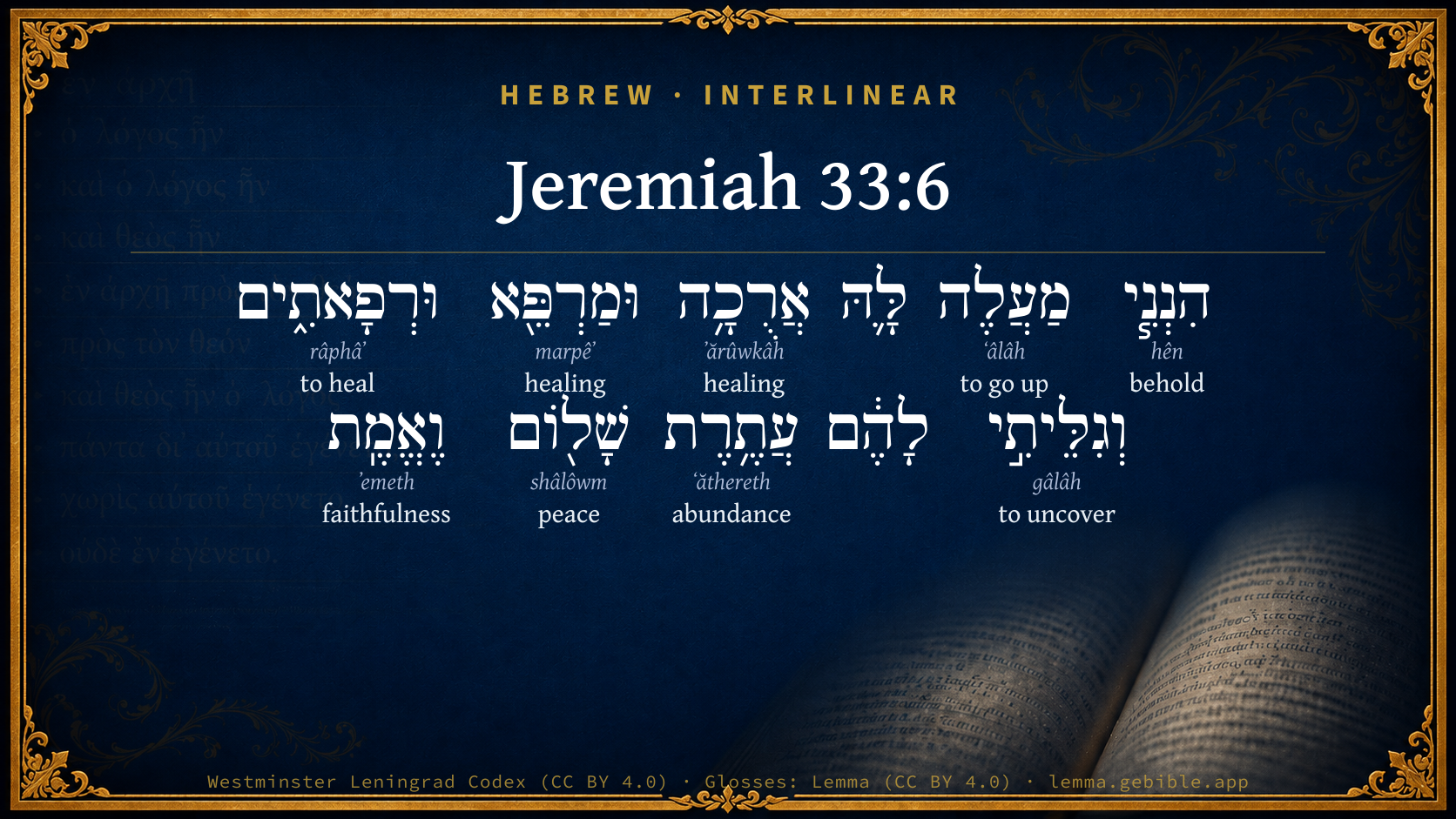
Hebrew (Westminster Leningrad Codex) Jeremiah 33:6 appears in the Hebrew Old Testament. The text above is from the Westminster Leningrad Codex. Each word links to its Strong’s number, a concise gloss, and parsing drawn from the Open Scriptures Hebrew Bible morphology. Click any word for its full Brown-Driver-Briggs (BDB) entry.
Download image
Cite this verse

Jeremiah 33:6 (World English Bible). Public Domain. Lemma interlinear Bible study tool, https://lemma.gebible.app/v/jeremiah/33/6.

Show BibTeX & RIS
BibTeX
RIS
English Translation
Behold, I will bring it health and cure, and I will cure them; and I will reveal to them abundance of peace and truth.
World English Bible · Public Domain
Highlights
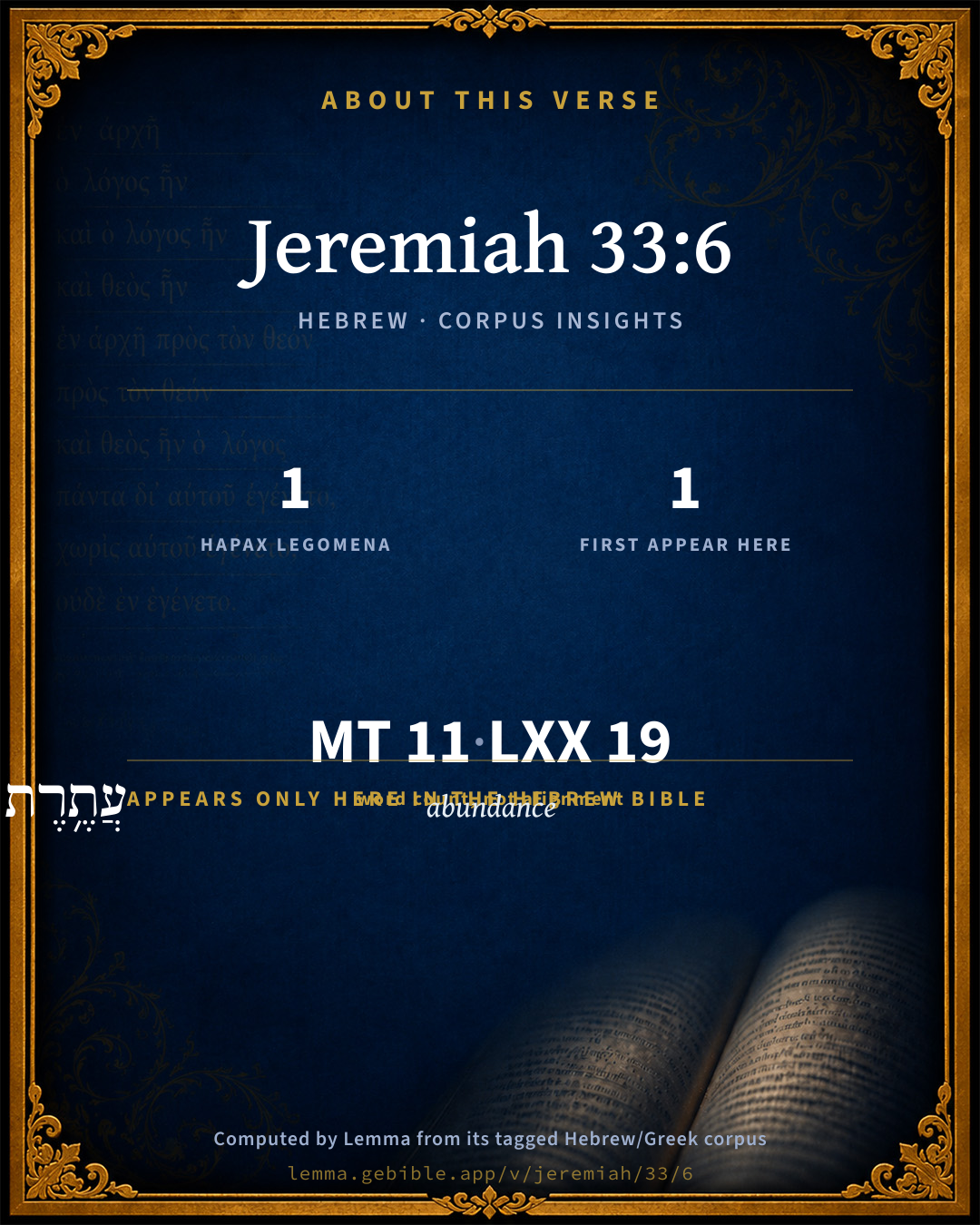
  • 1 hapax legomenon — only here in the Hebrew Bible
  • 1 first appearance in the Hebrew Bible
Full analysis ↓
Download a study sheet

One document with this verse’s original text, its word-by-word gloss line, the meaning frame, cross-references with their text, attributed commentary, and full source and license credits — printable, and it pastes into notes with its structure intact.

This verse Autodidact and up

Study sheet (.html) Plain text (.txt)

A passage Seminary Student

Up to 50 verses in one chapter. A passage sheet keeps up to 6 commentary sources and 12 cross-references per verse, in the order this page ranks them, and says so on the sheet whenever that leaves anything out. Ask for a single verse and you get the Autodidact verse sheet above.

Everything on this page stays free to read, with no account — the sheet is a download of what is already on screen, not access to it.

Want to remove ads? Support Godless Engineer
Compare translations 3

The same verse in 3 English versions, stacked beneath the original-language interlinear above. Click any original word for its lexicon entry.

Each is an independent rendering of the whole verse — the interlinear is not word-aligned to these translations.

Highlighted words mark where these versions differ — a whole-verse word diff, not a word-by-word alignment.

  • World English Bible Public Domain
    Behold, I will bring it health and cure, and I will cure them; and I will reveal to them abundance of peace and truth.
  • King James Version Public Domain
    Behold, I will bring it health and cure, and I will cure them, and will reveal unto them the abundance of peace and truth.
  • unfoldingWord Literal Text CC BY-SA 4.0
    But see, I am about to bring healing and a cure, for I will heal them and will bring to them abundance, peace, and faithfulness.

unfoldingWord Literal Text — © unfoldingWord, licensed CC BY-SA 4.0. Word-aligned USFM3 via Door43 (git.door43.org/unfoldingWord/en_ult).

Versions to compare (up to 4)

3 of 4 selected

Show all 18 translations

Every available English version of this verse, each an independent rendering of the whole verse.

  • World English Bible Public Domain
    Behold, I will bring it health and cure, and I will cure them; and I will reveal to them abundance of peace and truth.
  • Berean Standard Bible Public Domain
    Nevertheless, I will bring to it health and healing, and I will heal its people and reveal to them the abundance of peace and truth.
  • Majority Standard Bible Public Domain
    Nevertheless, I will bring to it health and healing, and I will heal its people and reveal to them the abundance of peace and truth.
  • King James Version Public Domain
    Behold, I will bring it health and cure, and I will cure them, and will reveal unto them the abundance of peace and truth.
  • American Standard Version (1901) Public Domain
    Behold, I will bring it health and cure, and I will cure them; and I will reveal unto them abundance of peace and truth.
  • Revised Version (1885) Public Domain
    Behold, I will bring it health and cure, and I will cure them; and I will reveal unto them abundance of peace and truth.
  • Geneva Bible (1599) Public Domain
    Behold, I will giue it health and amendment: for I wil cure them, and will reueile vnto them the abundance of peace, and trueth.
  • Douay-Rheims (1899) Public Domain
    Behold I will close their wounds and give them health, and I will cure them: and I will reveal to them the prayer of peace and truth.
  • Young's Literal Translation Public Domain
    Lo, I am increasing to it health and cure, And have healed them, and revealed to them The abundance of peace and truth.
  • Literal Standard Version CC BY-SA 4.0
    Behold, I am increasing health and cure to it, || And have healed them, and revealed to them || The abundance of peace and truth.
  • Unlocked Literal Bible CC BY-SA 4.0
    But see, I am about to bring healing and a cure, for I will heal them and will bring to them abundance, peace, and faithfulness.
  • unfoldingWord Literal Text CC BY-SA 4.0
    But see, I am about to bring healing and a cure, for I will heal them and will bring to them abundance, peace, and faithfulness.
  • Darby Bible Public Domain
    Behold, I will apply a healing dressing to it and cure, and I will heal them, and will reveal unto them an abundance of peace and truth.
  • World Messianic Bible Public Domain
    behold, I will bring it health and healing, and I will cure them; and I will reveal to them abundance of peace and truth.
  • Webster's Bible Public Domain
    Behold, I will bring it health and cure, and I will cure them, and will reveal to them the abundance of peace and truth.
  • Free Bible Version CC BY-SA 4.0
    But even so, in the future I will restore and repair it, and I will heal its people and give them lasting peace and safety.
  • Bible in Basic English Public Domain
    See, I will make it healthy and well again, I will even make them well; I will let them see peace and good faith in full measure.
  • JPS Tanakh (1917) Public Domain
    Behold, I will bring it healing and cure, and I will cure them; and I will reveal unto them the abundance of peace and truth.

Literal Standard Version (2020), Covenant Press — licensed CC BY-SA 4.0. Text via the HelloAO Bible API (eBible.org). Unlocked Literal Bible (unfoldingWord) — licensed CC BY-SA 4.0. Text via the HelloAO Bible API (eBible.org). unfoldingWord Literal Text — © unfoldingWord, licensed CC BY-SA 4.0. Word-aligned USFM3 via Door43 (git.door43.org/unfoldingWord/en_ult). Free Bible Version, Dr. Jonathan Gallagher — licensed CC BY-SA 4.0. Text via the HelloAO Bible API (eBible.org).

Word by word

More ways to search: Search by grammar → Find every occurrence → Compare this word →

Practice this passage: Drill this verse → Learn its vocabulary →

עֲתֶ֥רֶת
ʻăthereth
H6283
“abundance of”
Noun, Common, Feminine, Singular, Construct
Part of Speech
Noun
Type
Common
Gender
Feminine
Number
Singular
State
Construct
Full BDB Definition

Origin: from H6280

TWOT: 1723a

abundance, excess, copiousness
  1. הִנְנִ֧י hên H2005 “behold · me” Particle, Demonstrative + Suffix, Personal, 1st Person, Common, Singular
  2. מַעֲלֶה ʻâlâh H5927 “going up” Verb, Hiphil, Participle Active, Masculine, Singular, Absolute
  3. אֲרֻכָ֥ה ʼărûwkâh H724 “healing” Noun, Common, Feminine, Singular, Absolute
  4. וּמַרְפֵּ֖א marpêʼ H4832 “and · healing” Conjunction + Noun, Common, Masculine, Singular, Absolute
  5. וּרְפָאתִ֑ים râphâʼ H7495 “and · to heal · them” Conjunction + Verb, Qal, Sequential Perfect, 1st Person, Common, Singular + Suffix, Personal, 3rd Person, Masculine, Plural
  6. וְגִלֵּיתִ֣י gâlâh H1540 “and · to uncover” Conjunction + Verb, Piel, Sequential Perfect, 1st Person, Common, Singular
  7. שָׁל֖וֹם shâlôwm H7965 “peace” Noun, Common, Masculine, Singular, Absolute
  8. וֶאֱמֶֽת ʼemeth H571 “and · faithfulness” Conjunction + Noun, Common, Feminine, Singular, Absolute

About this verse

These counts appear in no published source. They are computed here, from the morphology-tagged text and Lemma’s own curated glosses. What Lemma adds →

11
words
9
distinct lemmas
Prophets
section

Notable vocabulary

1 hapax legomenon — a word that appears only here in the entire Hebrew Bible:

  • עֲתֶ֥רֶת abundance H6283

First appearance in Scripture

This word makes its first canonical appearance in the Hebrew Bible here:

  • עֲתֶ֥רֶת abundance H6283

Shared distinctive vocabulary

אֲרֻכָ֥ה healing H724 occurs in 6 verses of the Hebrew Bible. Also found in:

Grammatical profile

  • 3 verbs
  • 5 nouns
  • 2 prepositions
  • 1 particle

Verb forms

  • מַעֲלֶה Hiphil · Participle Active
  • וּרְפָאתִ֑ים Qal · Sequential Perfect
  • וְגִלֵּיתִ֣י Piel · Sequential Perfect

Hebrew & Septuagint length

In the original languages it is 11 Hebrew tokens and 19 Greek tokens — but the two are counted differently (Hebrew bundles its prefixes and suffixes into one token; the Greek is in lemma form), so that isn’t a like-for-like length.

Cross-references

28

Topical passages linked to Jeremiah 33:6 in the Treasury of Scripture Knowledge — connected by theme and wording, ordered by reader-vote popularity; previews shown in the World English Bible.

  • John 10:10 The thief only comes to steal, kill, and destroy. I came that they may have life, and may have it abundantly.
  • Isaiah 30:26 Moreover the light of the moon shall be as the light of the sun, and the light of the sun shall be sevenfold, as the light of seven days, in the day that Yahweh binds up the hurt of his people, and heals the stroke of their wound.
  • Titus 3:5–6 not by works of righteousness, which we did ourselves, but according to his mercy, he saved us, through the washing of regeneration and renewing by the Holy Spirit,
  • Psalms 67:2 That your way may be known on earth, And your salvation among all nations,
  • Isaiah 58:8 Then shall your light break forth as the morning, and your healing shall spring forth speedily; and your righteousness shall go before you; the glory of Yahweh shall by your rearward.
  • Hosea 6:1 "Come, and let us return to Yahweh; For he has torn us to pieces, And he will heal us; He has injured us, And he will bind up our wounds.
  • Isaiah 66:12 For thus says Yahweh, Behold, I will extend peace to her like a river, and the glory of the nations like an overflowing stream: and you shall suck [of it]; you shall be borne on the side, and shall be dandled on the knees.
  • Galatians 5:22–23 But the fruit of the Spirit is love, joy, peace, patience, kindness, goodness, faithfulness,
  • 1 Peter 1:3 Blessed be the God and Father of our Lord Jesus Christ, who according to his great mercy became our father again to a living hope through the resurrection of Jesus Christ from the dead,
  • Psalms 37:11 But the humble shall inherit the land, And shall delight themselves in the abundance of peace.
  • Isaiah 26:2–4 Open you the gates, that the righteous nation which keeps faith may enter in.
  • Isaiah 54:13 All your children shall be taught of Yahweh; and great shall be the peace of your children.
  • Jeremiah 17:14 Heal me, O Yahweh, and I shall be healed; save me, and I shall be saved: for you are my praise.
  • Hosea 7:1 When I would heal Israel, Then the iniquity of Ephraim is uncovered, Also the wickedness of Samaria; For they commit falsehood, And the thief enters in, And the gang of robbers ravages outside.
  • Deuteronomy 32:39 See now that I, even I, am he, There is no god with me: I kill, and I make alive; I wound, and I heal; There is none who can deliver out of my hand.
  • Isaiah 2:4 He will judge between the nations, And will decide concerning many peoples; And they shall beat their swords into plowshares, And their spears into pruning-hooks. Nation shall not lift up sword against nation, Neither shall they learn war any more.
  • Isaiah 11:5–9 Righteousness shall be the belt of his waist, and faithfulness the belt of his loins.
  • Isaiah 33:15–18 He who walks righteously, and speaks blamelessly; he who despises the gain of oppressions, who shakes his hands from taking a bribe, who stops his ears from hearing of blood, and shuts his eyes from looking on evil:
  • Isaiah 48:17–18 Thus says Yahweh, your Redeemer, the Holy One of Israel: I am Yahweh your God, who teaches you to profit, who leads you by the way that you should go.
  • Isaiah 55:7 let the wicked forsake his way, and the unrighteous man his thoughts; and let him return to Yahweh, and he will have mercy on him; and to our God, for he will abundantly pardon.
  • Micah 4:3 And he will judge between many peoples, And will decide concerning strong nations afar off. They will beat their swords into plowshares, And their spears into pruning hooks. Nation will not lift up sword against nation, Neither will they learn war any more.
  • Psalms 72:7 In his days, the righteous shall flourish, And abundance of peace, until the moon is no more.
  • Psalms 85:10–12 Mercy and truth meet together. Righteousness and peace have kissed each other.
  • Ephesians 6:23 Peace be to the brothers, and love with faith, from God the Father and the Lord Jesus Christ.
  • Hebrews 6:17–18 In this way God, being determined to show more abundantly to the heirs of the promise the immutability of his counsel, interposed with an oath;
  • Exodus 34:6 Yahweh passed by before him, and proclaimed, "Yahweh! Yahweh, a merciful and gracious God, slow to anger, and abundant in loving kindness and truth,
  • Isaiah 39:8 Then said Hezekiah to Isaiah, Good is the word of Yahweh which you have spoken. He said moreover, For there shall be peace and truth in my days.
  • Jeremiah 30:12–17 For thus says Yahweh, Your hurt is incurable, and your wound grievous.

Cross-references courtesy of OpenBible.info (CC BY 4.0).

Hebrew and Greek witnesses Masoretic Hebrew ↔ Greek Septuagint

The same verse in the two great witnesses to the Old Testament, shown verse-for-verse.

These are two independent witnesses, not word-aligned to each other, and the Septuagint is shown in lemma (dictionary) form.

Hebrew Jeremiah 33:6 Masoretic · Westminster Leningrad Codex

הִנְנִ֧י מַעֲלֶה לָּ֛הּ אֲרֻכָ֥ה וּמַרְפֵּ֖א וּרְפָאתִ֑ים וְגִלֵּיתִ֣י לָהֶ֔ם עֲתֶ֥רֶת שָׁל֖וֹם וֶאֱמֶֽת

Behold, I will bring it health and cure, and I will cure them; and I will reveal to them abundance of peace and truth.

World English Bible · Public Domain

Greek LXX Structure differs

In the Septuagint, Jeremiah is about an eighth shorter than the Hebrew and arranges its material differently — the Oracles Against the Nations (Hebrew chapters 46–51) appear in the middle of the Greek book, after 25:13. Because the chapter and verse boundaries do not line up, a verse-for-verse comparison with the Hebrew is not shown.

A verse-for-verse comparison isn’t shown here because the chapters and verses don’t line up. Switch to the LXX edition with the MT / LXX toggle above to read the Greek directly.

On this verse, Haydock's Catholic Bible Commentary discusses the Septuagint’s reading. Read the note in Commentary ↓

Hebrew: Westminster Leningrad Codex (CC BY 4.0). Greek: Septuagint (public domain); English from a public-domain English Septuagint. How the Septuagint differs from the Hebrew →

Targum (Aramaic paraphrase)

1

The Targum is the ancient Jewish Aramaic paraphrase of the Hebrew Scriptures — an interpretive translation, not the Hebrew text itself. Onkelos (literal) and Pseudo-Jonathan (expansive) render the Torah, and Jonathan the Prophets. Coverage is partial: where no permissively-licensed English translation exists for a verse, only the Aramaic is shown. This is verse-level text, not a word-by-word alignment to the Hebrew.

  1. Targum Jonathan Prophets (Joshua–Malachi)
    הָא אֲנָא מַיְתִי לְהוֹן אָסוּ וּפוּרְקַן וְאַסִינוּן וְאֶגְלֵי לְהוֹן תְּרַע תְיוּבָא וֶאֱחַוִינוּן דִיהָכוּן בְּאוֹרַח שָׁלֵם וּקְשׁוֹט:

    (no public-domain English translation for this verse)

    Targum Jonathan — Aramaic: “Mikraot Gedolot” (public domain). English: “Sefaria Community Translation” (CC0 1.0 (public-domain dedication)); “London "Chaldee Paraphrase," 1871” (public domain). Text via Sefaria.

Commentary

Notes on Jeremiah 33:6 from classic Christian and Jewish commentators (each source and its license shown beneath its notes). The classic Christian expositions comment on the surrounding passage and are grouped to its opening verse, so a note may address several verses; the Jewish commentaries on the Tanakh (Rashi and others) are per-verse, so they appear only where the commentator wrote on this verse.

Lemma curates 59 commentaries, every one of them public domain or Creative Commons licensed, each selected and text-cleaned for this edition rather than reprinted as found. About our sources →

Trapp's Complete Commentary

John Trapp

Jer 33:6 Behold, I will bring it health and cure, and I will cure them, and will reveal unto them the abundance of peace and truth.

Ver. 6. Behold, I will bring it health and cure.] Una eademque manus vulnus opemque feret. This is God’s usual method and manner of dealing with his people, {Hos 6:1} as a skilful physician, primo pungit, deinde ungit.

“ Enecat, ut possit vivificare Deus. ”

And I will reveal {a} unto them abundance of peace and truth.] Why then, feri, Domine, feri; such gold as "peace and truth" cannot be bought too dear. The Chaldee here hath it, Revelabo iis portam poenitentiae, I will reveal unto them the gate of repentance, and show them how they may walk in the way of peace and truth.

{a} Revelabo., i.e., re ipsa exhibebo.

John Trapp, A Commentary or Exposition upon All the Books of the Old and New Testament (1647–1656) — public domain. Text from a community e-Sword module.

The Biblical Illustrator

Joseph S. Exell

Jer_33:6

Behold I will bring it health and cure.

This passage, in its more immediate application, relates to the city and people of Jerusalem, and conveys a promise to the unhappy nation of the Jews of blessings which are yet in store for them.

The Great Physician

I. The visit which this Good Physician pays to the poor patient who has need of Him. The patient is a wretched being, who, in a spiritual point of view, is diseased from head to foot, and hath no soundness in him. He has the disease of human nature, the disease which you and I have--sin. He has become painfully alive to the humiliating fact that there is no good thing in him--that all his doings have been evil--and that the sentence of death eternal hangs over his soul. He cannot heal himself. His fellow-sinners cannot heal him. Is not then his case desperate? It would be so indeed were it not for a voice from heaven which saith of this poor sinner, I will bring him health and cure. Every word is a word of comfort to that sinners soul. There is comfort in the first word I--I will do it. For who is it that speaks? It is Jesus, the great, the mighty Saviour of the soul--that famous, that renowned Physician who hath healed already such a multitude of sinners, and hath never lost a single patient. There is comfort in the next word, I will bring--for, alas! this sinner cannot fetch his cure. But look at the last words of the sentence, and behold still more abundant comfort for this perishing transgressor. I will bring, saith the Lord--What? A medicine? A healing application that will be likely to avail--that may conduce towards recovery? No, but--Oh, bold words! words only fit for an Almighty Saviour!--I will bring him health and cure--something so sovereign in its virtue, so sure, so swift in its effects, that, the moment it is tried upon the patient, he is well; not only in part restored; not only altogether freed from his disease; but well--in full, in perfect health. The balm which the Physician brings to cure the sinner with is the blood which He hath shed for them, the life which He hath given for them, the full, the perfect and sufficient sacrifice which He hath offered up for them. And this balm, is not medicine only--for that may heal or not heal; that is a mere experiment upon a broken constitution, and may be ineffectual; but the balm which Jesus brings the sinner may well be styled health and cure; for it is everything at once which the sinners case requires. This precious blood cleanseth from all sin. But we have not yet attended this Good Physician to His patient. We have not yet ascertained, I mean, how He may be said to bring this health and cure to the poor sinners soul. It is when He opens that sinners eyes to view Him as a Saviour--when, by His word or by His ministers, He sets His love before that sinners soul, and by His Holy Spirit makes him see it.

II. Observe the Good Physicial actually curing the poor patient He attends. There is a difference between a remedy brought near, and a remedy applied; and there is a difference again between Christs bringing health and cure to the sinner, and that sinners being cured. The grace of God that bringeth salvation is said to appear unto all men; but we know that all men to whom it appeareth are not saved by it. Many men perceive that Christ is their Physician, yet will not take His remedy; and many men believe that they have used the remedy when they have only done so in appearance. The patient we have endeavoured to describe is a really humbled and awakened soul, and the Lord, who brings him health, gives him faith also, to be healed. He believes in Jesus as a Saviour. He casts his soul on Him for pardon and righteousness.

III. Now proceed to the blessings my text describes Him as bestowing on the poor patients He has healed. I will reveal to them, says He, the abundance of peace and truth.

1. We may regard this peace and truth as the privileges of the redeemed sinner. When our poor sick bodies are recovered unexpectedly from a painful and a dangerous disease, how do we rejoice in our newly acquired health! How are our fears calmed and our anxieties removed! but these natural emotions are not to be compared for a moment with the spiritual feelings and experiences of the pardoned sinner; no sooner hath the Good Physician healed the soul than what doth He reveal to it? The abundance of peace and truth. Peace--for being justified by faith, he hath peace with God through Jesus Christ our Lord. Christ revealeth also to him the abundance of truth. He enjoys, through the Spirit which Christ sends him, a glorious and most comfortable apprehension of the truth of God--of the truth of His grace, of the truth of His covenant, of the truth of His promises.

2. Consider this abundance of peace and truth as referring also to the character acquired by the believer in consequence of his faith. Christ may be said to have revealed to His people the abundance of peace in that He hath given them a peaceful spirit--in that He hath sent that Dove-like Messenger to rest upon their souls who is first pure, then peaceable, and who makes the hearts He enters like Himself. And Christ may be said also to have revealed to him the abundance of truth, by enabling him to walk in truth. He is an Israelite indeed in whom is no guile, no crooked policy, no artful management. His aim is, on all occasions, to be a child of the light and of the day--sincere and without offence unto the day of Christ--having no fellowship with the unfruitful works of darkness, but rather reproving them. (A. Roberts, M. A.)

Health for the soul

I. The patient and his disease. The patient is man; the disease is sin. We see the disease equally in the most refined as in the most ignorant. It stares us in the face when we read of an African negress sacrificing a fowl to her little image; and it shows itself equally when we read of a Grecian philosopher proposing before his death the sacrifice of a cock to Esculapius. We see the ignorance of the true God; we see at the same time such a consciousness of sin that something must be done to appease the apprehension which they have of the reality of a God. But we need a closer application of the subject. You may all of you say perhaps, I have never been guilty of idolatry; I am neither Mohammetan, nor Socialist, nor Communist, nor an infidel. Let us look, then, at some of the peculiar features of the disease of sin, and see whether it is not preying upon you as it is upon other men in the world. Now, it is well illustrated by the effect which sickness produces upon our body. For instance, sickness produces languor through the whole body; and this is exactly Gods account of the effect of sin (Isa_1:5-6). Take the faculties of man. Take his understanding. The understanding, we are told, is darkened, so that man is no longer wise to do good; he is only wise to do evil. Again, look at his will. The will of man has a wrong bias. Once, I cannot doubt, it was true of Adam, as spoken of our Lord in the fortieth Psalm, I delight to do Thy will, O God; yea, it is within my heart. I cannot doubt there was a time when that was the natural expression of Adams heart; but now it is not the expression of any mans heart until he is renewed by the Holy Ghost. But again: sickness takes away our desire for what is wholesome. So it is with sinners. They put bitter for sweet, and sweet for bitter; they call darkness light, and light darkness, and evil good, and good evil: whereas the spiritual man delights in the law of God after the inward man renewed by the Holy Ghost. Another effect produced by sickness upon the frame is, that it takes away the comfort of life. There is no enjoyment in anything put before the sick man enfeebled by disease, anything in which he was once able to take delight. Yea, life itself often becomes a burden. Now, what is the burden? Why, sin is the burden; it is this, only you do not know it; it is this which at times poisons the joy even of the most thoughtless--the consciousness of sin, the consciousness of your opposition to a holy God.

II. The physician and the cure. Behold I will bring it health and cure--I--Jesus. And it has been Jesus always. The remedy may have been stated more distinctly under the Gospel than under the law, but not more really. It was Jesus always, it was the precious blood of Jesus always, pointed at in the very first premise that was made by God, that the seed of the woman should bruise the serpents head. And salvation has always been shut up in that seed. It may have been expressed sometimes as being Abrahams seed, sometimes the seed of Isaac, and sometimes the seed of Jacob, but it had only one meaning; as the apostle said in the third chapter of Galatians, Not unto seeds, as of many; but as of one, and to thy seed, which is Christ. There is the Physician that God has always revealed. And what is His character? I cannot give you a better picture of Him than He has given of Himself in the parable of the good Samaritan. The wounded man had no charges; he had nothing to pay; the good Samaritan paid for all It is so with Jesus. The only fee, if I may so speak with reverence of Jesus, is--all He asks of us is, that we should trust Him, that we should believe in Him. He holds out to us in the Gospel perfect cure of all our disease, whatever it may be, and however aggravated; and He only says, Let Me cure you. And when I point you to this Good Samaritan as a Physician, I would have you remember that He is the only One. I call this another inexpressible mercy, that the poor sinners mind, anxious for relief, is not distracted in the Gospel by choosing between physicians. As the sun is clear in the firmament of heaven at noonday, so does Jesus shine forth as the Sun of Righteousness with healing in His wings to every poor sinner. And observe how He brings this before you. He says, Direct your attention, behold, take notice, I will bring you health and cure. Here is purpose, here is determination, here is sovereign will. I will cure, I will heal, I will reveal abundance of peace and truth. We may ask, then, if the way be so simple, why is not the health of the daughter of my people recovered! Is there no balm in Gilead? Is there no physician there? Yes, there is balm, there is the blood of Jesus; there is a Physician, there is Jesus Himself. Then why is not the health of the daughter of my people recovered! I will put before you some reasons. Some are not healed because they do not know they are sick. There is often very great mischief going on in our frames without our knowing it. That is the way in which mortal diseases get hold of a man. Then some are not healed because they love their disease. Yea, they love sin. We read of a very celebrated man, St. Augustine, that there was a time when his conscience was so harassed by the oppression of sin, at the same time that his affections were set upon the enjoyment and indulgence of it, that he declared he was afraid his prayers should be heard when he prayed for deliverance from sin. Now I would ask whether that is not the ease with many. Some, again, are not healed because they are not willing to be healed. Our Lord says, Ye will not come to Me that ye might have life. Again, some hearts are not healed because they will not take the Gospel remedies. What are the two great remedies that Jesus proposes? Repentance towards God, and faith towards Himself. But these are bitter and nauseous draughts to the natural man. There is one other reason which I would give why some are not healed--because they put no confidence in the Physician. Here is the root of all the evil--a want of faith. If they trusted Him, they would trust His word; and if they trusted His Word, they would take His remedies. (J. W. Reeve, M. A.)

The Biblical Illustrator, edited by Joseph S. Exell (c. 1880s–1900s) — public domain. Text from a community e-Sword module.

Joseph Benson's Commentary

Jer 33:6-8. Behold, I will bring it health and cure — The latter part of this verse expounds the former: for, by health and cure, the prophet means peace and truth, or, stability. Blaney renders it, I will make it, namely, the city or state perfectly sound and whole. The disturbed and calamitous state of the nation being compared to wounds and sickness, (see Jer 8:21-22; Jer 30:17,) the restoring of it to a peaceful and prosperous state is fitly called its health and cure. And will build them as at the first — When they, by repentance, do their first works, God will, by their restoration, manifest toward them his ancient mercies and loving- kindnesses. He will not only cause their captivity to return, as is expressed, in plain words, in the former clause, but will re-establish them in the possession of their civil and religious privileges, and hereby promote both their virtue and happiness. And I will cleanse them from all their iniquity — I will make them pious and holy, as well as virtuous and happy; and I will pardon all their iniquities — Will not impute their past sins any longer to them as I have done, but will remit the further punishments to which for sin they were liable.

Joseph Benson's Commentary on the Old and New Testaments (1811–1818) — public domain. Text from a community e-Sword module.

Geneva Bible (1599)

Geneva Bible translators

In the midst of his threatenings God remembereth his, and comforteth them.

Geneva Bible (1599) marginal notes — public domain. Text via Bolls.life.

Jamieson, Fausset & Brown

Robert Jamieson, A. R. Fausset & David Brown

(Jer 30:17). The answer to Jeremiah's mournful question (Jer 8:22).

cure--literally, the long linen bandage employed in dressing wounds.

truth--that is, stability; I will bring forth for them abundant and permanent peace, that is, prosperity.

Jamieson, Fausset & Brown — Commentary Critical and Explanatory on the Whole Bible (1871) — public domain (CC PDM 1.0). Text via the HelloAO Bible API.

Adam Clarke's Commentary

Verse 6. Behold I will bring it health and cure] ארכה aruchah, an extensive plaister; or, as we phrase it, a plaister as large as the sore. I will repair the losses of families by numerous births, and bless the land with fertility.

Adam Clarke's Commentary on the Bible (1810–1826) — public domain. Text from a community e-Sword/MySword module.

John Calvin's Commentaries

He afterwards says, Behold, I will bring a renewal and a healing, and I will heal them This is the main point, as they say, in the passage. He had been hitherto shewing, that the Jews had deserved so heavy a punishment, because by their obstinacy they had not ceased to provoke God against themselves. But he promises here to be propitious to them after having moderately corrected them. For we have said, that the design of this prophecy was to sustain the Jews, so that they might not despond, but rely on the promise of favor, however bitter exile might be. Then he says, I will bring a renewal, or restoration, and a healing

And it is added, I will open to them abundance of peace and of truth Some render the last word, אמת, amet, prayer; for the verb אמן amen, means sometimes to pray and also to multiply. There may then be a twofold meaning; the first, that God would open to them an access to prayer; for things were so hopeless among the people, that no one dared to utter a word. Even Jeremiah himself was forbidden to pray, (Jeremiah 11:14) because God had resolved to destroy those miserable men respecting whom there was no hope of repentance. Some therefore understand that an access to prayer is here promised, so that the faithful and the servants of God might pray for the prosperity of the city. But this explanation seems to me to be too far-fetched. I take, therefore, a simpler interpretation, — that God would give them abundance of peace, or rather the prolonging or continuance of peace. By peace is meant, as it is well known, a happy state. Then to Jerusalem, reduced to extreme miseries, God promises joyful things, so that she should afterwards live prosperously; and he adds the word truth, which is to be taken here for stability, as, indeed, everywhere in Scripture, as though he had said, that the prosperous state of the city would notbe for a month, or a short time, but continual and even perpetual, as he declares in the next verse.

John Calvin's Commentaries (1540-1563) — public domain. Text from the Calvin Translation Society English edition (1840s-50s) via the Christian Classics Ethereal Library (ccel.org). Calvin's coverage is partial (roughly two-thirds of the Bible); uncommented books and verses are honest gaps, never fabricated. The 19th-century editor's footnotes and remarks are omitted so the notes are faithfully Calvin's own voice.

Ellicott's Commentary for English Readers

(6) Health and cure . . .—The first word is, as in Jer_8:22; Jer_30:17, the bandage, or “plaister,” which was prominent in the therapeutics of the East. It is possible that both words may have been spoken in direct contrast with the pestilence which was ravaging the city (Jer_21:9; Jer_27:13; Jer_38:2). In any case, however, the words have a higher and figurative meaning. It was true of the city and its people that the “whole head was sick, and the whole heart faint” (Isa_1:5); and Jehovah promises to manifest Himself as the healer of that spiritual disease which was worse than any pestilence.

A Bible Commentary for English Readers, edited by Charles John Ellicott (1878–1897) — public domain. Text from a community e-Sword module.

The Cambridge Bible for Schools and Colleges

gen. ed. J. J. S. Perowne

6. health] mg. healing; lit. fresh flesh; See on Jer_8:22.

abundance] The word in MT. occurs here only, the meaning that the corresponding root bears in Eze_35:13; Pro_27:6, being taken to justify the sense assigned here. But the text is probably corrupt. A word almost identical in consonants denotes treasures, and so is very apposite here as a conjectural emendation (so Du.).

truth] (God’s) faithfulness.

The Cambridge Bible for Schools and Colleges (gen. ed. J. J. S. Perowne; Cambridge University Press, 1878–1918) — public domain. Text from a community e-Sword module.

John Gill's Exposition

Behold, I will bring it health and cure, and I will cure them,.... That is, the church of God, the members of it, typified by Jerusalem; and it is to be understood of the healing of their spiritual maladies, the diseases of sin, through the blood of the Messiah, who should arise with healing in his wings; that is, with remission of sin, which is often meant by healing in Scripture: Christ is the physician; his blood the balm in Gilead, which being applied to those that are diseased with sin, to sin sick souls, it makes an effectual cure of them; so that they shall not say they are sick, because their iniquities are forgiven them; see Psa 103:3;

and will reveal unto them the abundance of peace and truth; the same with "grace and truth", which are come by Christ, Joh 1:17; under the Old Testament, these were figured out by types and shadows; but not revealed clearly, as under the New Testament, to which this prophecy belongs. "Peace" may intend peace made with God by the blood of Christ; peace of conscience, which he gives, and arises from a sense of pardon and atonement by his blood, and justification by his righteousness; and all kind of spiritual welfare, prosperity, and happiness; of which there will be an abundance, especially in the latter days of the Messiah, Psa 72:8. "Truth" may design the faithfulness of God, in fulfilling all his promises and prophecies concerning the Messiah, and salvation by him, and may stand opposed to the types and shadows of the old law; and include the Gospel, the word of truth, and all the doctrines of it; which are clearly and fully revealed by the spirit of truth, wisdom, and revelation, in the knowledge of Christ. Here begins the account of the great, mighty, and hidden things the Lord promised to show the prophet, Jer 33:3. The Targum of this last clause is,

"and I will reveal the gate of repentance unto them, and I will show them, how they shall walk in the way of peace and truth;''

and the Syriac version is,

"I will reveal unto them the paths of peace and faith;''

but the word here used signifies abundance, as Kimchi and Ben Melech observe.

John Gill's Exposition of the Whole Bible (1746–1763) — public domain (CC PDM 1.0). Text via the HelloAO Bible API.

Albert Barnes' Notes on the Bible

I will bring it health and cure - I will lay upon it a bandage and healing, i. e., a healing bandage, a plaster with healing medicines.

Albert Barnes' Notes on the Bible (1834–1885) — public domain. Text from a community e-Sword/MySword module.

Haydock's Catholic Bible Commentary

Their. The houses, wounds, or breaches. (Hebrew and Septuagint) (Calmet) --- Peace. That is, the peace and welfare which they pray for. (Challoner) --- I will teach them how to pray for a durable peace.

George Leo Haydock (1774–1849), Haydock's Catholic Family Bible and Commentary, 1859 edition — public domain. Excludes Psalms (Douay-Rheims chapter numbering differs from Protestant) and Deuterocanonical books (Catholic canon only).

Matthew Poole's English Annotations

The latter part of this verse expoundeth the former, for by

health and

cure the prophet meaneth peace and truth: we met with the like metaphorical expression Jer 30:17; See Poole "Jer 30:17". The miserable disturbed state of a nation being compared to wounds and sickness, the restoring of it to a peaceable, prosperous state is fitly called its health and cure. By

truth here seems to be meant faithfulness, or stability, not truth of propositions: q.d. I will, after this great wound which I have given this people, bring them again into a quiet and peaceable state, in which they shall abide many days.

Matthew Poole's English Annotations on the Holy Bible (1683–1685) — public domain. Text from a community e-Sword/MySword module.

Whedon's Commentary on the Bible

Daniel D. Whedon

6. I will bring it health and cure — Literally, I will apply to it a bandage and healing, that is, a healing bandage. The language following sets forth the idea more fully: I will cure them, and will reveal, etc.

Daniel D. Whedon (gen. ed.), Commentary on the Old and New Testaments (1874–1909) — public domain. Text from a community e-Sword module.

The Pulpit Commentary

I will bring it health and cure, etc. "Health" is properly the fresh skin which grows over a healing wound. (as Jer_8:22 Jer_30:17) First the city is spoken of, then its inhabitants. Will reveal unto them; or perhaps, will roll unto them. (comp. Jer_11:20 Jer_20:12) In this ease the figure will be that of a mighty stream. (comp. Isa_48:18 Isa_66:12) Truth; rather, continuance. (comp. Jer_14:13)

See on Jer_30:17.

The Divine treatment of sin.

"Behold, I will bring it health and cure, and I will cure them." Here, as in so many other Scriptures, the moral, political, social, and spiritual recovery of Israel is spoken of under the image of bodily healing. For all healings of the body are types and pledges of the better healing. If God so cares for the body, which today is and tomorrow is cast into the tomb, shall he not care for the soul, which is eternal? This ver. 6 is a promise that the Divine treatment of sin shall be effectual. The Lord is Jehovah-rophi. He heals them that have need of healing.

I SIN IS AN AWFUL FACT. All nations have recognized this and mourned over it. But it has not been created by Christianity. True, the Christian faith brands it with the stigma of shame as none other does; for everywhere sin has cast its deep shadow and driven noble souls, not a few, to utter despair. But it was here before Christianity. Hence

II THE QUESTION OF QUESTIONS HAS BEEN WHAT IS TO BE DONE WITH IT? And the answers have been very different. Note:

1. The answer of the philosopher, which extenuates it, on the ground:

(1) Of the imperfection of our nature. If we knew more, it is said, had larger comprehension of truth, we should not sin. But is that true? Is increase of knowledge always increase of virtue? Are little children, who know so little, less virtuous than many an educated man? The names that are accursed forever, Nero, Herod, Balaam, Philip II of Spain, Alva, and many more, were all educated men.

(2) Of the tyranny of the body. It is this cursed flesh, they say. Get rid of that, and the soul will be pure. Hence one reason wherefore St. Paul"s doctrine of the resurrection was so opposed at Corinth, because they thought it was a bringing back of all that dread source of evil which it was hoped was done with forever when death came. Now, no doubt, the flesh is the occasion of sins not a few. But there are many sins, and those which probably God will most sternly condemn, which are quite independent of the body. Malice, envy, hatred, and all uncharitableness need no "flesh" for their existence. And even in those sins which are especially of the flesh, myriads of victories over it, victories continually renewed, prove that it can, as it ought to, be kept under and brought into subjection.

(3) Of its being a form of good. Without it, it is urged, virtue could not be attained; for it is in the conflict with sin that virtue is developed, disciplined, and strengthened. Virtue would lie dormant, lethargic, and be a miserable weakling, were it not that sin roused her up, exasperated her, and forced her to stand on her defence. But such argument confounds temptation with sin. What is urged is true of temptation, but never of sin. Nor is sin needed as the foil, the dark background on which virtue shall shine out with greater lustre than but for this foil had been possible to it. For sin is, some affirm, a necessary condition, almost an ingredient, of good. Moral evil cannot be so evil as it is thought. The devil is not so black as he is painted. But is sin necessary to manifest goodness? Where, then, is such background in God, or in the angels, or in the saints in glory? None, therefore, of these extenuations will stand. Reason, conscience, and God"s Word alike condemn them.

2. There is the answer of despair, which regards it as inevitable and invincible. This answer does not make light of it, but regards it as that which can neither be helped nor overcome. They believe there is a kingdom of evil, independent of God, with its all but omnipotent, omnipresent, and omniscient head, like unto God. This was the creed of ancient Persia, against which, that his countrymen might not be carried away by it, Isaiah protested with all his might; cf. Isa_45:5-7, "I am the Lord, and there is none else, there is no God beside me... I form the light, and create darkness: I make peace, and create evil: I the Lord do all these things." And Manicheism was a like heresy. And the moral despair which regards sin as inevitable is practical Manicheism. But this is a terrible error; for he who has come to believe in the existence of a god of evil as well as a God of goodness will soon come to believe only in the former and not in the latter at all. Moreover, conscience in her deepest utterances gives no countenance to this invincibility of evil. "Father, I have sinned," is its confession. It never urges that it had no power to resist that it was forced to sin. It is a dread snare of the devil to persuade men that sin is invincible. Believe him not. Myriads of holy souls give him the lie; and, through the might of Christ your Lord, you may give him the lie likewise. But note now

III CHRIST"S ANSWER TO THIS QUESTION. This verse is one of innumerable others which affirm the same truth.

1. He does not make light of it or extenuate it. His high and holy teaching, his blameless life, the doom he pronounced on sin, above all, the death he died, were one emphatic protest against and condemnation of sin. But:

2. He did not regard it as invincible. He distinctly promises deliverance from it, and:

3. This he gives. By blotting out the record of the past. By the present help of his Spirit. By the bright prospect of eternal life. Facts prove all this. He healed them that had need of healing. No disease baffled him. His resources did not run out, and the healing was a real one. And so it is still. Let us come to him and see. C.

HOMILIES BY D. YOUNG Ver. 6. The abundance of peace and truth.

I THE NEED OF SUCH A REVELATION. There is already abundance of discord, mutual hostility, instability, deceit. What a picture of misery is at once suggested by contrast with the state presented in this promise! Instead of the welcome salutation of peace, there is too often threatening. And when the salutation does come, it is too often only a mere conventional expression, and in some instances even an elaborated hypocrisy put forward to carry on war behind it, and instead of the feeling that one is on a sure foundation, there are continual quakings that disturb what is underneath, and continual blasts that disturb what is above. And beside what attacks man from without, there is within a spirit of hostility and rivalry to others, a spirit striving to shake their position and triumph over them. So that peace and truth need to be revealed within us first of all. We need, not merely to have amicable feelings towards others, freedom from envy and malice, but we need positive cordiality. Loving, unselfish cohesion is the true way to escape bitter habitual contention. Moreover, this peace and truth are needed in abundance. It must be said of them, as is said in the New Testament of God"s Spirit, that they are given without measure. The promise of the peace that passeth all understanding is assuredly a promise correspondent to our necessity.

II THE FACT OF SUCH A REVELATION. Peace is revealed in Jesus Christ. In him there is the secret of a composure and a steadfastness unaffected by all the common causes of discord and instability. He had an unusual number of enemies, and this because he was so persistent in declaring righteousness; and yet all the time he had that peace within which showed how outside forces only affected the mere shell of life. In this life there was ever the joint manifestation of peace and steadfastness, and the steadfastness was explained by the fact that he came from God, continued in God, did the will of God, and so, ever having this hold on the Eternal, and being held by the Eternal, the shaking influences of time did ever more and more both to reveal his strength and their own weakness. All the exhortations of Jesus with respect to faith are meant to reveal to us the abundance of peace and truth. With what pity Jesus must look on the abortive, melancholy attempts of men to trust in the untrustworthy! and yet the unveiled magnificence of peace and truth is unseen. What we have to do is to look desiringly, hopefully, towards God"s revelation; for surely the complete revelation includes not only something gracious to be seen, but full insight to see it. The apocalypse to John in Patmos came to one who "was in the Spirit on the Lord"s day. Y.

The Pulpit Commentary (1880–1919), ed. H.D.M. Spence-Jones & Joseph S. Exell — public domain. Text from a community e-Sword module.

John Wesley's Explanatory Notes

I will cure - The miserable disturbed state of a nation being compared to wounds and sickness, the restoring of it to a peaceable prosperous state is fitly called its health and cure. I will bring them again to a quiet and peaceable state in which they shall abide many days.

John Wesley, Explanatory Notes Upon the Whole Bible (1754–1765) — public domain. Text via the GEBible commentary corpus.

unfoldingWord translationNotes

Door43 World Missions Community

I will bring back the fortunes of Judah and Israel

"I will cause things to go well for Judah and Israel again" or "I will cause Judah and Israel to live well again." See how similar words are translated in Jeremiah 29:14.

this city ... do for it ... give to it

The city is a metonym for the people who live in the city. AT: "the people who live in this city ... do for the people who live there ... give to the people who live there" (See: Metonymy)

a song of praise and honor for all the nations of the earth

The word "song" is a metonym for the object about which people will sing the song. AT: "something about which all the people groups of the earth will sing songs of praise and honor to me, Yahweh" (See: Metonymy)

they will fear and tremble

The hendiadys "fear and tremble" can be translated by a single verb. AT: "they will tremble with fear" (See: Hendiadys)

fear

Another possible meaning is "awe."

because of all the good things and the peace that I will give to it

The abstract noun "peace" can be translated as an adjective. AT: "because of all the good things that I will give to it and because I will cause it to be peaceful" (See: Abstract Nouns)

translationWords

cure

peace

faithful

pure

iniquity

forgive

joy

praise

honor

nation

earth

tremble

peace

unfoldingWord translationNotes — © Distant Shores Media and the Door43 World Missions Community, licensed CC BY-SA 4.0. Source: git.door43.org/Door43/en_tn.

Rashi

Rabbi Shlomo Yitzchaki (Rashi)

a greeting of peace a blessing (salud in O.F., salut in modern French), a greeting.

Rashi on the Tanakh — English translations: “The Judaica Press complete Tanach with Rashi, translated by A. J. Rosenberg” (CC BY 4.0); “Pentateuch with Rashi's commentary by M. Rosenbaum and A.M. Silbermann, 1929-1934” (public domain); “The Metsudah Tanach series, Lakewood, N.J” (CC BY 4.0); and “The Book of Joshua, Metsudah Publications, 1997” (CC BY 4.0). Text via Sefaria.

Lesson kit

Teaching starters — assembled from the data on this page, not authored interpretation. Every prompt links to the verse data it draws on. Edit before teaching.

Jeremiah, in the Prophets, opens this verse with 11 words (9 distinct Hebrew lemmas). Its most distinctive word is ʻăthereth (“abundance”). A historical commentator’s framing appears above. Read the whole chapter for the surrounding context.

Discussion questions

  1. What does “abundance” (ʻăthereth) contribute to the verse as a whole?
  2. 1 word here appears nowhere else in the Hebrew Bible. Why might the author reach for such rare wording?
  3. This is the first place “abundance” appears in Scripture (first appears here). What does its debut here establish?
  4. How does 2 Chronicles 24:13, which shares the word «healing», read alongside this verse?
  5. These translations render this verse differently; the difference is in the English rendering, not the original. What questions does that raise?
  6. «מַעֲלֶה» is a Hiphil Participle Active verb. How does that grammatical form shape the action described?
  7. Compare how Trapp's Complete Commentary and The Biblical Illustrator read this verse. Where do they agree or differ?

Things to notice

Reading settings

Reading text

Shown beneath each verse's original-language words.

Old Testament
Old Testament edition

Read the OT as the Masoretic Hebrew (MT) or the Greek Septuagint (LXX).

English shown for the Greek Septuagint (in the Hebrew ↔ Greek comparison).

Comparing translations? Open the Compare panel on any verse page to stack up to four side by side.