
2 Kings 9:19

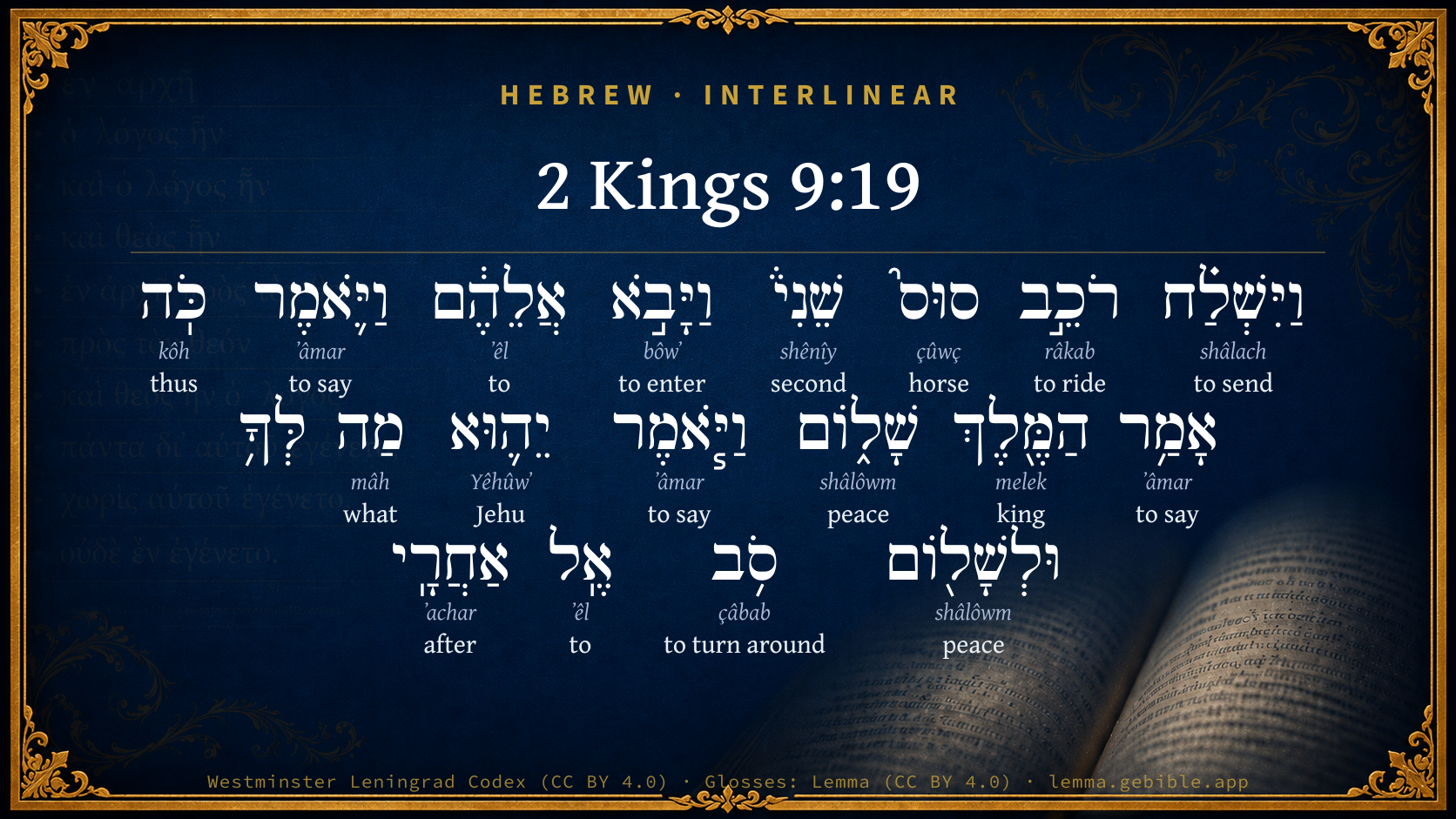
Hebrew (Westminster Leningrad Codex) 2 Kings 9:19 appears in the Hebrew Old Testament. The text above is from the Westminster Leningrad Codex. Each word links to its Strong’s number, a concise gloss, and parsing drawn from the Open Scriptures Hebrew Bible morphology. Click any word for its full Brown-Driver-Briggs (BDB) entry.
Download image
Cite this verse

2 Kings 9:19 (World English Bible). Public Domain. Lemma interlinear Bible study tool, https://lemma.gebible.app/v/2-kings/9/19.

Show BibTeX & RIS
BibTeX
RIS
English Translation
Then he sent out a second on horseback, who came to them, and said, Thus says the king, Is it peace? Jehu answered, What have you to do with peace? turn you behind me.
World English Bible · Public Domain
Download a study sheet

One document with this verse’s original text, its word-by-word gloss line, the meaning frame, cross-references with their text, attributed commentary, and full source and license credits — printable, and it pastes into notes with its structure intact.

This verse Autodidact and up

Study sheet (.html) Plain text (.txt)

A passage Seminary Student

Up to 50 verses in one chapter. A passage sheet keeps up to 6 commentary sources and 12 cross-references per verse, in the order this page ranks them, and says so on the sheet whenever that leaves anything out. Ask for a single verse and you get the Autodidact verse sheet above.

Everything on this page stays free to read, with no account — the sheet is a download of what is already on screen, not access to it.

Want to remove ads? Support Godless Engineer
Compare translations 3

The same verse in 3 English versions, stacked beneath the original-language interlinear above. Click any original word for its lexicon entry.

Each is an independent rendering of the whole verse — the interlinear is not word-aligned to these translations.

Highlighted words mark where these versions differ — a whole-verse word diff, not a word-by-word alignment.

  • World English Bible Public Domain
    Then he sent out a second on horseback, who came to them, and said, Thus says the king, Is it peace? Jehu answered, What have you to do with peace? turn you behind me.
  • King James Version Public Domain
    Then he sent out a second on horseback, which came to them, and said, Thus saith the king, Is it peace? And Jehu answered, What hast thou to do with peace? turn thee behind me.
  • unfoldingWord Literal Text CC BY-SA 4.0
    So he sent out a second rider of a horse, and he came to them, and he said, “Thus says the king: ‘Peace.’” And Jehu said, “What to you and to peace? Turn around to after me.”

unfoldingWord Literal Text — © unfoldingWord, licensed CC BY-SA 4.0. Word-aligned USFM3 via Door43 (git.door43.org/unfoldingWord/en_ult).

Versions to compare (up to 4)

3 of 4 selected

Show all 18 translations

Every available English version of this verse, each an independent rendering of the whole verse.

  • World English Bible Public Domain
    Then he sent out a second on horseback, who came to them, and said, Thus says the king, Is it peace? Jehu answered, What have you to do with peace? turn you behind me.
  • Berean Standard Bible Public Domain
    So the king sent out a second horseman, who went to them and said, “This is what the king asks: ‘Have you come in peace?’” “What do you know about peace?” Jehu replied. “Fall in behind me.”
  • Majority Standard Bible Public Domain
    So the king sent out a second horseman, who went to them and said, “This is what the king asks: ‘Have you come in peace?’” “What do you know about peace?” Jehu replied. “Fall in behind me.”
  • King James Version Public Domain
    Then he sent out a second on horseback, which came to them, and said, Thus saith the king, Is it peace? And Jehu answered, What hast thou to do with peace? turn thee behind me.
  • American Standard Version (1901) Public Domain
    Then he sent out a second on horseback, who came to them, and said, Thus saith the king, Is it peace? And Jehu answered, What hast thou to do with peace? turn thee behind me.
  • Revised Version (1885) Public Domain
    Then he sent out a second on horseback, which came to them, and said, Thus saith the king, Is it peace? And Jehu answered, What hast thou to do with peace? turn thee behind me.
  • Geneva Bible (1599) Public Domain
    Then hee sent out another on horsebacke, which came to them, and sayde, Thus sayth the King, Is it peace? And Iehu answered, What hast thou to doe with peace? turne behinde me.
  • Douay-Rheims (1899) Public Domain
    And he sent a second chariot of horses: and he came to them, and said: Thus saith the king: Is there peace? And Jehu said: What hast thou to do with peace? pass, and follow me.
  • Young's Literal Translation Public Domain
    And he sendeth a second rider on a horse, and he cometh in unto them, and saith, `Thus said the king, Is there peace?' and Jehu saith, `What -- to thee and to peace? turn round behind me.'
  • Literal Standard Version CC BY-SA 4.0
    And he sends a second rider on a horse, and he comes to them and says, “Thus said the king: Is there peace?” And Jehu says, “And what is peace to you? Turn around behind me.”
  • Unlocked Literal Bible CC BY-SA 4.0
    Then he sent out a second man on horseback, who came to them and said, “The king says this: 'Are you coming in peace?'” Jehu answered, “What have you to do with peace? Turn and ride behind me.”
  • unfoldingWord Literal Text CC BY-SA 4.0
    So he sent out a second rider of a horse, and he came to them, and he said, “Thus says the king: ‘Peace.’” And Jehu said, “What to you and to peace? Turn around to after me.”
  • Darby Bible Public Domain
    And he sent out a second on horseback; and he came to them and said, Thus saith the king: Is it peace? And Jehu said, What hast thou to do with peace? turn thee behind me.
  • World Messianic Bible Public Domain
    Then he sent out a second on horseback, who came to them and said, “The king says, ‘Is it peace?’” Jehu answered, “What do you have to do with peace? Fall in behind me!”
  • Webster's Bible Public Domain
    Then he sent out a second on horseback, who came to them, and said, Thus saith the king, Is it peace? And Jehu answered, What hast thou to do with peace? turn thee behind me.
  • Free Bible Version CC BY-SA 4.0
    The king sent out a second horseman. He went up to them and said, “This is what the king asks: ‘Do you come in peace?’” “What has peace got to do with you?” Jehu replied. “Turn around and follow me.”
  • Bible in Basic English Public Domain
    Then he sent out a second horseman, who came up to them and said, The king says, Is it peace? And Jehu said in answer, What have you to do with peace? come after me.
  • JPS Tanakh (1917) Public Domain
    Then he sent out a second on horseback, who came to them, and said: 'Thus saith the king: Is it peace?' And Jehu answered: 'What hast thou to do with peace? turn thee behind me.'

Literal Standard Version (2020), Covenant Press — licensed CC BY-SA 4.0. Text via the HelloAO Bible API (eBible.org). Unlocked Literal Bible (unfoldingWord) — licensed CC BY-SA 4.0. Text via the HelloAO Bible API (eBible.org). unfoldingWord Literal Text — © unfoldingWord, licensed CC BY-SA 4.0. Word-aligned USFM3 via Door43 (git.door43.org/unfoldingWord/en_ult). Free Bible Version, Dr. Jonathan Gallagher — licensed CC BY-SA 4.0. Text via the HelloAO Bible API (eBible.org).

Word by word

More ways to search: Search by grammar → Find every occurrence → Compare this word →

Practice this passage: Drill this verse → Learn its vocabulary →

יֵה֛וּא
Yêhûwʼ
H3058
“Jehu”
Noun, Proper
Part of Speech
Noun
Type
Proper
Full BDB Definition

Origin: from H3068 and H1931

TWOT: None

Jehu = "Jehovah is He" - the king of the northern kingdom Israel who overthrew the dynasty of Omri - son of Hanani and an Israelite prophet in the time of Baasha and Jehoshaphat - the Antothite, a Benjamite, one of David's mighty warriors - a descendant of Judah of the house of Hezron - son of Josibiah and a chief of the tribe of Simeon
  1. וַיִּשְׁלַ֗ח shâlach H7971 “and · to send” Conjunction + Verb, Qal, Sequential Imperfect, 3rd Person, Masculine, Singular
  2. רֹכֵ֣ב râkab H7392 “riding” Verb, Qal, Participle Active, Masculine, Singular, Construct
  3. סוּס֮ çûwç H5483 “horse” Noun, Common, Masculine, Singular, Absolute
  4. שֵׁנִי֒ shênîy H8145 “second” Adjective, Ordinal number, Masculine, Singular, Absolute
  5. וַיָּבֹ֣א bôwʼ H935 “and · to enter” Conjunction + Verb, Qal, Sequential Imperfect, 3rd Person, Masculine, Singular
  6. אֲלֵהֶ֔ם ʼêl H413 “to · them” Preposition + Suffix, Personal, 3rd Person, Masculine, Plural
  7. וַיֹּ֛אמֶר ʼâmar H559 “and · to say” Conjunction + Verb, Qal, Sequential Imperfect, 3rd Person, Masculine, Singular
  8. כֹּֽה kôh H3541 “thus” Adverb
  9. אָמַ֥ר ʼâmar H559 “to say” Verb, Qal, Perfect, 3rd Person, Masculine, Singular
  10. הַמֶּ֖לֶךְ melek H4428 “the · king” Particle, Definite Article + Noun, Common, Masculine, Singular, Absolute
  11. שָׁל֑וֹם shâlôwm H7965 “peace” Noun, Common, Masculine, Singular, Absolute
  12. וַיֹּ֧אמֶר ʼâmar H559 “and · to say” Conjunction + Verb, Qal, Sequential Imperfect, 3rd Person, Masculine, Singular
  13. מַה mâh H4100 “what” Particle, Interrogative
  14. וּלְשָׁל֖וֹם shâlôwm H7965 “and · to/for · peace” Conjunction + Preposition + Noun, Common, Masculine, Singular, Absolute
  15. סֹ֥ב çâbab H5437 “turn around” Verb, Qal, Imperative, 2nd Person, Masculine, Singular
  16. אֶֽל ʼêl H413 “to” Preposition
  17. אַחֲרָֽי ʼachar H310 “after · me” Preposition + Suffix, Personal, 1st Person, Common, Singular

About this verse

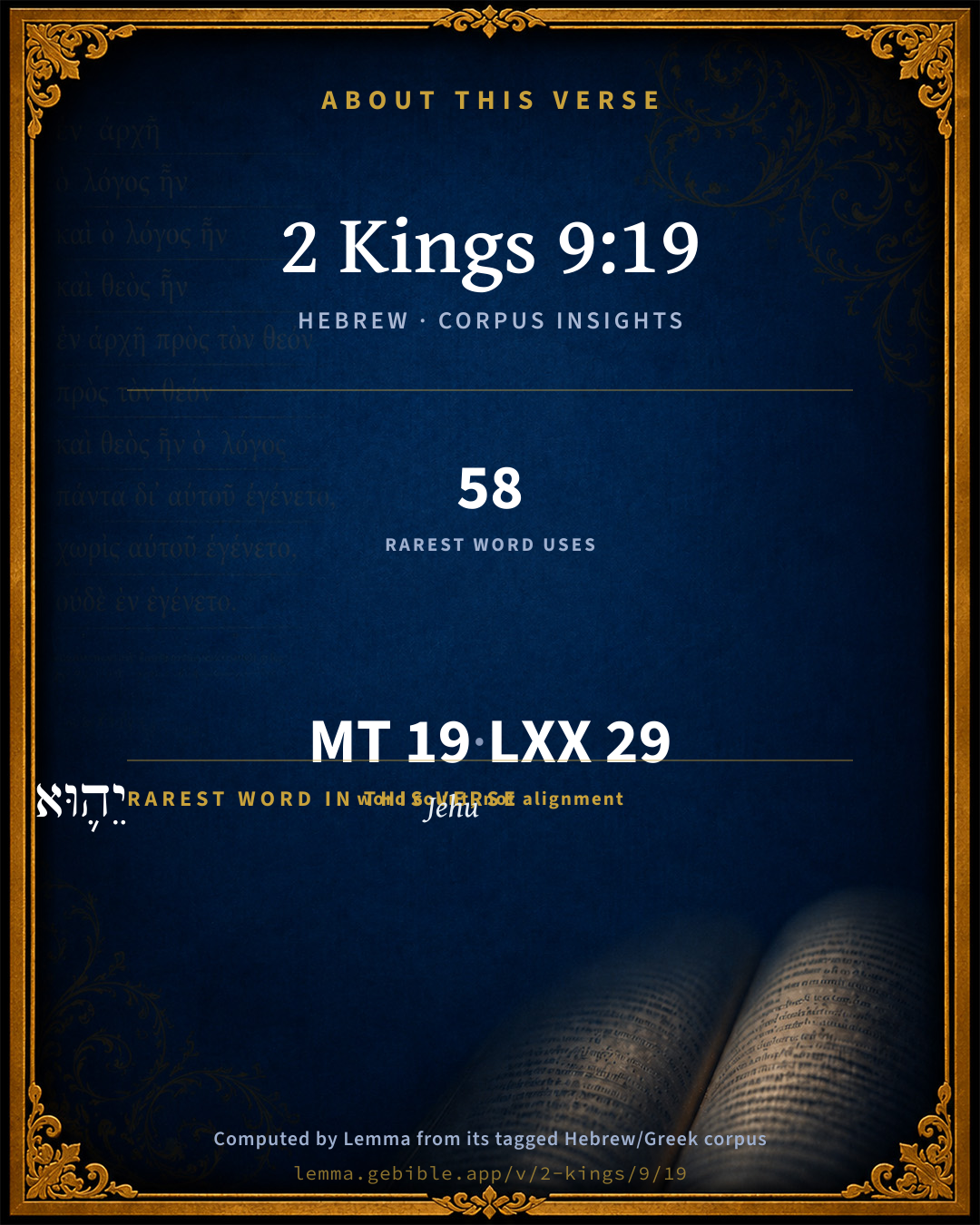
These counts appear in no published source. They are computed here, from the morphology-tagged text and Lemma’s own curated glosses. What Lemma adds →

19
words
14
distinct lemmas
Historical
section

Shared distinctive vocabulary

יֵה֛וּא Jehu H3058 occurs in 54 verses of the Hebrew Bible. Also found in:

Grammatical profile

  • 7 verbs
  • 5 nouns
  • 1 adjective
  • 4 prepositions
  • 1 adverb
  • 1 particle

Verb forms

  • וַיִּשְׁלַ֗ח Qal · Sequential Imperfect
  • רֹכֵ֣ב Qal · Participle Active
  • וַיָּבֹ֣א Qal · Sequential Imperfect
  • וַיֹּ֛אמֶר Qal · Sequential Imperfect
  • אָמַ֥ר Qal · Perfect
  • וַיֹּ֧אמֶר Qal · Sequential Imperfect
  • סֹ֥ב Qal · Imperative

Repetition

Words recur within this verse — often emphatic in Hebrew:

  • וַיֹּ֛אמֶר to say H559 ×3
  • שָׁל֑וֹם peace H7965 ×2
  • אֲלֵהֶ֔ם to H413 ×2

Hebrew & Septuagint length

In English translation the verse runs 34 words from the Hebrew and 30 from the Septuagint (LXX English) — closely comparable.

A rough comparison of the two English renderings, which tokenize alike — not a word-level alignment.

Word counts can differ between the Hebrew and the Greek without any difference in meaning — e.g. the Hebrew direct-object marker אֵת has no separate Greek word, and Greek often adds the article ὁ.

In the original languages it is 19 Hebrew tokens and 29 Greek tokens — but the two are counted differently (Hebrew bundles its prefixes and suffixes into one token; the Greek is in lemma form), so that isn’t a like-for-like length.

Hebrew and Greek witnesses Masoretic Hebrew ↔ Greek Septuagint

The same verse in the two great witnesses to the Old Testament, shown verse-for-verse.

These are two independent witnesses, not word-aligned to each other, and the Septuagint is shown in lemma (dictionary) form.

Hebrew 2 Kings 9:19 Masoretic · Westminster Leningrad Codex

וַיִּשְׁלַ֗ח רֹכֵ֣ב סוּס֮ שֵׁנִי֒ וַיָּבֹ֣א אֲלֵהֶ֔ם וַיֹּ֛אמֶר כֹּֽה אָמַ֥ר הַמֶּ֖לֶךְ שָׁל֑וֹם וַיֹּ֧אמֶר יֵה֛וּא מַה לְּךָ֥ וּלְשָׁל֖וֹם סֹ֥ב אֶֽל אַחֲרָֽי

Then he sent out a second on horseback, who came to them, and said, Thus says the king, Is it peace? Jehu answered, What have you to do with peace? turn you behind me.

World English Bible · Public Domain

Greek LXX 2 Kings 9:19 Septuagint · lemma form

καί ἀποστέλλω ἐπιβάτης ἵππος δεύτερος καί ἔρχομαι πρός αὐτός καί εἶπον ὅδε λέγω ὁ βασιλεύς εἰ εἰρήνη καί εἶπον ιου τίς σύ καί εἰρήνη ἐπιστρέφω εἰς ὁ ὀπίσω ἐγώ

And he sent another horseman, and he came to him, and said, Thus says the king, Peace. And Ju said, What have you to do with peace? turn behind me.

LXX2012 (modern English Septuagint) · Public Domain

Hebrew: Westminster Leningrad Codex (CC BY 4.0). Greek: Septuagint (public domain); English from LXX2012 (modern English Septuagint) (Public Domain). How the Septuagint differs from the Hebrew →

Targum (Aramaic paraphrase)

1

The Targum is the ancient Jewish Aramaic paraphrase of the Hebrew Scriptures — an interpretive translation, not the Hebrew text itself. Onkelos (literal) and Pseudo-Jonathan (expansive) render the Torah, and Jonathan the Prophets. Coverage is partial: where no permissively-licensed English translation exists for a verse, only the Aramaic is shown. This is verse-level text, not a word-by-word alignment to the Hebrew.

  1. Targum Jonathan Prophets (Joshua–Malachi)
    וּשְׁלַח רְכִיב סוּסְיָא תִּנְיָנָא וַאֲתָא לְוַתְהוֹן וַאֲמַר כִּדְנַן אֲמַר מַלְכָּא הַשְׁלָם וַאֲמַר יֵהוּא מַה לָךְ וְלִשְׁלָם אִסְתְּחַר לַאֲחוֹרָי:

    (no public-domain English translation for this verse)

    Targum Jonathan — Aramaic: “Mikraot Gedolot” (public domain). English: “Sefaria Community Translation” (CC0 1.0 (public-domain dedication)); “London "Chaldee Paraphrase," 1871” (public domain). Text via Sefaria.

Commentary

Notes on 2 Kings 9:19 from classic Christian and Jewish commentators (each source and its license shown beneath its notes). The classic Christian expositions comment on the surrounding passage and are grouped to its opening verse, so a note may address several verses; the Jewish commentaries on the Tanakh (Rashi and others) are per-verse, so they appear only where the commentator wrote on this verse.

Lemma curates 59 commentaries, every one of them public domain or Creative Commons licensed, each selected and text-cleaned for this edition rather than reprinted as found. About our sources →

Trapp's Complete Commentary

John Trapp

2Ki 9:19 Then he sent out a second on horseback, which came to them, and said, Thus saith the king, [Is it] peace? And Jehu answered, What hast thou to do with peace? turn thee behind me.

Ver. 19. What hast thou to do with peace?] Heb., What is it to thee and peace? Trouble not thyself and me with such inquiries; I myself will answer Joram.

John Trapp, A Commentary or Exposition upon All the Books of the Old and New Testament (1647–1656) — public domain. Text from a community e-Sword module.

Ellicott's Commentary for English Readers

(19) Then.—Literally, And he sent a second rider of a horse.

Is it peace?—So the versions, many editions, and some MSS. The ordinary Hebrew text gives it as a salutation: “Peace!” but wrongly. Joram is still unsuspicious of evil. Some accident might have detained his first messenger.

A Bible Commentary for English Readers, edited by Charles John Ellicott (1878–1897) — public domain. Text from a community e-Sword module.

John Gill's Exposition

And it came to pass, when Joram saw, Jehu, that he said, is it peace, Jehu?.... Have things gone well at Ramothgilead? art thou come in triumph from thence? or obliged to fly from the Syrians? or art thou come in a peaceable, or in an hostile manner to me?

and he answered, what peace; canst thou expect at home or abroad, from me or others:

so long as the whoredoms of thy mother Jezebel and her witchcrafts are so many? which may be understood both literally of corporeal whoredom, and diabolical arts she was addicted to, and figuratively of idolatry, often called whoredom in Scripture, and of the wicked arts and methods she made use of to inveigle and entice persons into it; and both these very often went together; see Nah 3:4 and of which Joram was guilty, at least in part; he connived at all in her, and did not attempt to restrain her, and therefore had no claim to peace, protection, and safety.

John Gill's Exposition of the Whole Bible (1746–1763) — public domain (CC PDM 1.0). Text via the HelloAO Bible API.

The Pulpit Commentary

Then he sent out a second on horseback. Persistency in a course shown by experience to be futile was characteristic of the sons of Ahab and Jezebel. (compare the conduct of Ahaziah, as described in 2Ki_1:9, 2Ki_1:11, 2Ki_1:13) Which came to them, and said, Thus saith the king, Is it peace? Exactly the same inquiry as before, and no doubt in the same sense (see the comment on ver. 17). Jehu, addressed with the same words thinks it sufficient to give the same answer. His object is to lose no time, but to reach the king as quickly as possible. And Jehu answered, What hast thou to do with peace? turn thee behind me.

The Pulpit Commentary (1880–1919), ed. H.D.M. Spence-Jones & Joseph S. Exell — public domain. Text from a community e-Sword module.

unfoldingWord translationNotes

Door43 World Missions Community

Then he sent out a second man on horseback, who came to them

"Then king Joram sent a second messenger riding a horse, who went out to meet Jehu and his army"

a second man

Joram had already sent one man. This was the next. AT: "another man" (See: Ordinal Numbers)

What have you to do with peace?

Jehu uses this rhetorical question to tell the messenger that it is none of his concern if he comes in peace or not. This may be written as a statement. See how you translated this question in 2 Kings 9:18. AT: "It is not your concern if I have come in peace!" or "It is not for you to know if I have come in peace!" (See: Rhetorical Question)

For the way that the chariot is being driven is the way that Jehu son of Nimshi drives

This may be stated in active form. AT: "Because the driver of the chariot drives the same way that Jehu son of Nimshi drives" (See: Active or Passive)

translationWords

king

Jehu

unfoldingWord translationNotes — © Distant Shores Media and the Door43 World Missions Community, licensed CC BY-SA 4.0. Source: git.door43.org/Door43/en_tn.

Lesson kit

Teaching starters — assembled from the data on this page, not authored interpretation. Every prompt links to the verse data it draws on. Edit before teaching.

2 Kings, in the Historical, opens this verse with 19 words (14 distinct Hebrew lemmas). Its most distinctive word is Yêhûwʼ (“Jehu”). A historical commentator’s framing appears above. Read the whole chapter for the surrounding context.

Discussion questions

  1. How does “Jehu” (Yêhûwʼ) shape what this verse is saying?
  2. How does 1 Kings 16:1, which shares the word «Jehu», read alongside this verse?
  3. What does the repetition of “to say” (3× in this one verse) do in this verse?
  4. These translations render this verse differently; the difference is in the English rendering, not the original. What questions does that raise?
  5. «וַיִּשְׁלַ֗ח» is a Qal Sequential Imperfect verb. How does that grammatical form shape the action described?
  6. Compare how Trapp's Complete Commentary and Ellicott's Commentary for English Readers read this verse. Where do they agree or differ?

Things to notice

Reading settings

Reading text

Shown beneath each verse's original-language words.

Old Testament
Old Testament edition

Read the OT as the Masoretic Hebrew (MT) or the Greek Septuagint (LXX).

English shown for the Greek Septuagint (in the Hebrew ↔ Greek comparison).

Comparing translations? Open the Compare panel on any verse page to stack up to four side by side.