Ezekiel 13:16

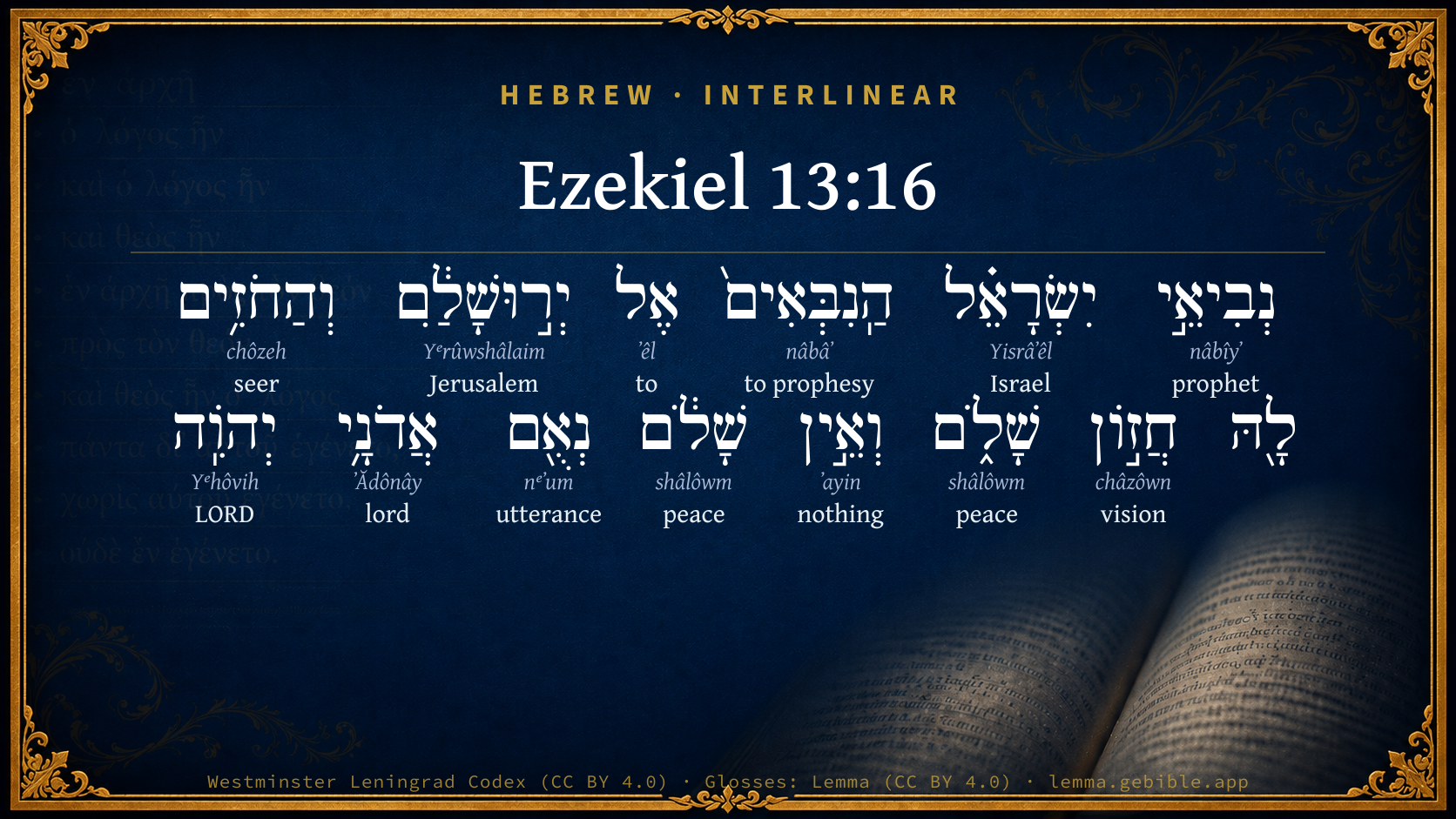
Hebrew (Westminster Leningrad Codex) Ezekiel 13:16 appears in the Hebrew Old Testament. The text above is from the Westminster Leningrad Codex. Each word links to its Strong’s number, a concise gloss, and parsing drawn from the Open Scriptures Hebrew Bible morphology. Click any word for its full Brown-Driver-Briggs (BDB) entry.
Download image
Cite this verse

Ezekiel 13:16 (World English Bible). Public Domain. Lemma interlinear Bible study tool, https://lemma.gebible.app/v/ezekiel/13/16.

Show BibTeX & RIS
BibTeX
RIS
English Translation
[to wit], the prophets of Israel who prophesy concerning Jerusalem, and who see visions of peace for her, and there is no peace, says the Lord Yahweh.
World English Bible · Public Domain
Download a study sheet

One document with this verse’s original text, its word-by-word gloss line, the meaning frame, cross-references with their text, attributed commentary, and full source and license credits — printable, and it pastes into notes with its structure intact.

This verse Autodidact and up

Study sheet (.html) Plain text (.txt)

A passage Seminary Student

Up to 50 verses in one chapter. A passage sheet keeps up to 6 commentary sources and 12 cross-references per verse, in the order this page ranks them, and says so on the sheet whenever that leaves anything out. Ask for a single verse and you get the Autodidact verse sheet above.

Everything on this page stays free to read, with no account — the sheet is a download of what is already on screen, not access to it.

Want to remove ads? Support Godless Engineer
Compare translations 3

The same verse in 3 English versions, stacked beneath the original-language interlinear above. Click any original word for its lexicon entry.

Each is an independent rendering of the whole verse — the interlinear is not word-aligned to these translations.

Highlighted words mark where these versions differ — a whole-verse word diff, not a word-by-word alignment.

  • World English Bible Public Domain
    [to wit], the prophets of Israel who prophesy concerning Jerusalem, and who see visions of peace for her, and there is no peace, says the Lord Yahweh.
  • King James Version Public Domain
    To wit, the prophets of Israel which prophesy concerning Jerusalem, and which see visions of peace for her, and there is no peace, saith the Lord GOD.
  • unfoldingWord Literal Text CC BY-SA 4.0
    the prophets of Israel who prophesied about Jerusalem and who had visions of peace for her. But there is no peace!—this is the Lord Yahweh’s declaration.”’

unfoldingWord Literal Text — © unfoldingWord, licensed CC BY-SA 4.0. Word-aligned USFM3 via Door43 (git.door43.org/unfoldingWord/en_ult).

Versions to compare (up to 4)

3 of 4 selected

Show all 18 translations

Every available English version of this verse, each an independent rendering of the whole verse.

  • World English Bible Public Domain
    [to wit], the prophets of Israel who prophesy concerning Jerusalem, and who see visions of peace for her, and there is no peace, says the Lord Yahweh.
  • Berean Standard Bible Public Domain
    those prophets of Israel who prophesied to Jerusalem and saw a vision of peace for her when there was no peace, declares the Lord GOD.’
  • Majority Standard Bible Public Domain
    those prophets of Israel who prophesied to Jerusalem and saw a vision of peace for her when there was no peace, declares the Lord GOD.’
  • King James Version Public Domain
    To wit, the prophets of Israel which prophesy concerning Jerusalem, and which see visions of peace for her, and there is no peace, saith the Lord GOD.
  • American Standard Version (1901) Public Domain
    `to wit', the prophets of Israel that prophesy concerning Jerusalem, and that see visions of peace for her, and there is no peace, saith the Lord Jehovah.
  • Revised Version (1885) Public Domain
    to wit, the prophets of Israel which prophesy concerning Jerusalem, and which see visions of peace for her, and there is no peace, saith the Lord GOD.
  • Geneva Bible (1599) Public Domain
    To wit, the Prophets of Israel, which prophesie vpon Ierusalem, and see visions of peace for it, and there is no peace, sayth the Lord God.
  • Douay-Rheims (1899) Public Domain
    Even the prophets of Israel that prophesy to Jerusalem, and that see visions of peace for her: and there is no peace, saith the Lord God.
  • Young's Literal Translation Public Domain
    The prophets of Israel who are prophesying concerning Jerusalem, And who are seeing for her a vision of peace, And there is no peace, An affirmation of the Lord Jehovah.
  • Literal Standard Version CC BY-SA 4.0
    [These]—the prophets of Israel, who are prophesying concerning Jerusalem, || And who are seeing a vision of peace for her, || And there is no peace, || A declaration of Lord YHWH.
  • Unlocked Literal Bible CC BY-SA 4.0
    the prophets of Israel who prophesied about Jerusalem and who had visions of peace for her. But there is no peace!—this is the Lord Yahweh's declaration.”'
  • unfoldingWord Literal Text CC BY-SA 4.0
    the prophets of Israel who prophesied about Jerusalem and who had visions of peace for her. But there is no peace!—this is the Lord Yahweh’s declaration.”’
  • Darby Bible Public Domain
    the prophets of Israel who prophesy concerning Jerusalem, and who see a vision of peace for her, and there is no peace, saith the Lord Jehovah.
  • World Messianic Bible Public Domain
    to wit, the prophets of Israel who prophesy concerning Jerusalem, and who see visions of peace for her, and there is no peace,’” says the Lord GOD.’”
  • Webster's Bible Public Domain
    To wit, the prophets of Israel who prophesy concerning Jerusalem, and who see visions of peace for her, and there is no peace, saith the Lord GOD.
  • Free Bible Version CC BY-SA 4.0
    those ‘prophets’ of Israel who prophesied to Jerusalem and claimed to have seen a vision of peace for her when there wasn't going to be any peace, declares the Lord God.
  • Bible in Basic English Public Domain
    Even the prophets of Israel who say words to Jerusalem, who see visions of peace for her when there is no peace, says the Lord.
  • JPS Tanakh (1917) Public Domain
    to wit, the prophets of Israel that prophesy concerning Jerusalem, and that see visions of peace for her, and there is no peace, saith the Lord GOD.

Literal Standard Version (2020), Covenant Press — licensed CC BY-SA 4.0. Text via the HelloAO Bible API (eBible.org). Unlocked Literal Bible (unfoldingWord) — licensed CC BY-SA 4.0. Text via the HelloAO Bible API (eBible.org). unfoldingWord Literal Text — © unfoldingWord, licensed CC BY-SA 4.0. Word-aligned USFM3 via Door43 (git.door43.org/unfoldingWord/en_ult). Free Bible Version, Dr. Jonathan Gallagher — licensed CC BY-SA 4.0. Text via the HelloAO Bible API (eBible.org).

Word by word

More ways to search: Search by grammar → Find every occurrence → Compare this word →

Practice this passage: Drill this verse → Learn its vocabulary →

וְהַחֹזִ֥ים
chôzeh
H2374
“and · the · seer”
Conjunction + Particle, Definite Article + Verb, Qal, Participle Active, Masculine, Plural, Absolute
Part of Speech
Conjunction + Particle + Verb
Stem
Qal
Form
Participle Active
Gender
Masculine
Number
Plural
State
Absolute
Full BDB Definition

Origin: active participle of H2372

TWOT: 633b

seer - seer - vision
  1. נְבִיאֵ֣י nâbîyʼ H5030 “prophets of” Noun, Common, Masculine, Plural, Construct
  2. יִשְׂרָאֵ֗ל Yisrâʼêl H3478 “Israel” Noun, Proper
  3. הַֽנִבְּאִים֙ nâbâʼ H5012 “the · prophesying” Particle, Definite Article + Verb, Niphal, Participle Active, Masculine, Plural, Absolute
  4. אֶל ʼêl H413 “to” Preposition
  5. יְר֣וּשָׁלִַ֔ם Yᵉrûwshâlaim H3389 “Jerusalem” Noun, Proper
  6. חֲז֣וֹן châzôwn H2377 “vision of” Noun, Common, Masculine, Singular, Construct
  7. שָׁלֹ֑ם shâlôwm H7965 “peace” Noun, Common, Masculine, Singular, Absolute
  8. וְאֵ֣ין ʼayin H369 “and · nothing” Conjunction + Particle, Negative
  9. שָׁלֹ֔ם shâlôwm H7965 “peace” Noun, Common, Masculine, Singular, Absolute
  10. נְאֻ֖ם nᵉʼum H5002 “utterance of” Noun, Common, Masculine, Singular, Construct
  11. אֲדֹנָ֥י ʼĂdônây H136 “Lord · my” Noun, Common, Masculine, Plural, Construct + Suffix, Personal, 1st Person, Common, Singular
  12. יְהֹוִֽה Yᵉhôvih H3069 “LORD” Noun, Proper

About this verse

These counts appear in no published source. They are computed here, from the morphology-tagged text and Lemma’s own curated glosses. What Lemma adds →

14
words
12
distinct lemmas
Prophets
section

Notable vocabulary

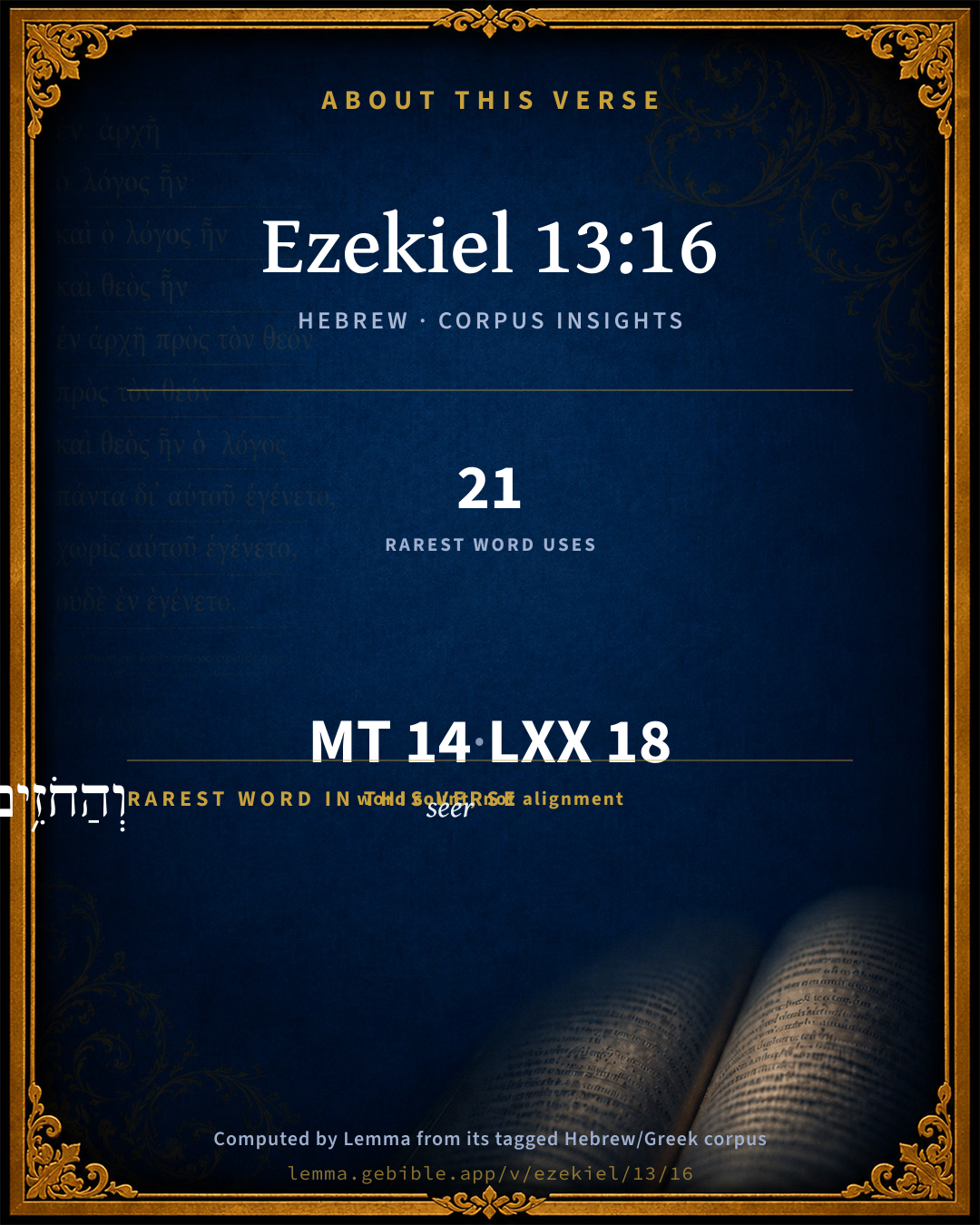
The rarest word here is וְהַחֹזִ֥ים seer H2374 — appearing just 21 times in the whole Hebrew Bible.

Shared distinctive vocabulary

וְהַחֹזִ֥ים seer H2374 occurs in 21 verses of the Hebrew Bible. Also found in:

Grammatical profile

  • 2 verbs
  • 9 nouns
  • 2 prepositions
  • 1 particle

Verb forms

  • הַֽנִבְּאִים֙ Niphal · Participle Active
  • וְהַחֹזִ֥ים Qal · Participle Active

Repetition

A word recurs within this verse — often emphatic in Hebrew:

  • שָׁלֹ֑ם peace H7965 ×2

Hebrew & Septuagint length

In English translation the verse runs 27 words from the Hebrew and 25 from the Septuagint (LXX English) — closely comparable.

A rough comparison of the two English renderings, which tokenize alike — not a word-level alignment.

Word counts can differ between the Hebrew and the Greek without any difference in meaning — e.g. the Hebrew direct-object marker אֵת has no separate Greek word, and Greek often adds the article ὁ.

In the original languages it is 14 Hebrew tokens and 18 Greek tokens — but the two are counted differently (Hebrew bundles its prefixes and suffixes into one token; the Greek is in lemma form), so that isn’t a like-for-like length.

Cross-references

9

Topical passages linked to Ezekiel 13:16 in the Treasury of Scripture Knowledge — connected by theme and wording, ordered by reader-vote popularity; previews shown in the World English Bible.

  • Jeremiah 6:14 They have healed also the hurt of my people slightly, saying, Peace, peace; when there is no peace.
  • Ezekiel 13:10 Because, even because they have seduced my people, saying, Peace; and there is no peace; and when one builds up a wall, behold, they daub it with whitewash:
  • Jeremiah 8:11 They have healed the hurt of the daughter of my people slightly, saying, Peace, peace; when there is no peace.
  • Isaiah 48:22 There is no peace, says Yahweh, to the wicked.
  • Isaiah 57:20–21 But the wicked are like the troubled sea; for it can't rest, and its waters cast up mire and dirt.
  • Jeremiah 5:31 the prophets prophesy falsely, and the priests bear rule by their means; and my people love to have it so: and what will you do in the end of it?
  • Jeremiah 28:1 It happened the same year, in the beginning of the reign of Zedekiah king of Judah, in the fourth year, in the fifth month, that Hananiah the son of Azzur, the prophet, who was of Gibeon, spoke to me in the house of Yahweh, in the presence of the priests and of all the people, saying,
  • Jeremiah 29:31 Send to all them of the captivity, saying, Thus says Yahweh concerning Shemaiah the Nehelamite: Because Shemaiah has prophesied to you, and I didn't send him, and he has caused you to trust in a lie;
  • Jeremiah 28:9–17 The prophet who prophesies of peace, when the word of the prophet shall happen, then shall the prophet be known, that Yahweh has truly sent him.

Cross-references courtesy of OpenBible.info (CC BY 4.0).

Hebrew and Greek witnesses Masoretic Hebrew ↔ Greek Septuagint

The same verse in the two great witnesses to the Old Testament, shown verse-for-verse.

These are two independent witnesses, not word-aligned to each other, and the Septuagint is shown in lemma (dictionary) form.

Hebrew Ezekiel 13:16 Masoretic · Westminster Leningrad Codex

נְבִיאֵ֣י יִשְׂרָאֵ֗ל הַֽנִבְּאִים֙ אֶל יְר֣וּשָׁלִַ֔ם וְהַחֹזִ֥ים לָ֖הּ חֲז֣וֹן שָׁלֹ֑ם וְאֵ֣ין שָׁלֹ֔ם נְאֻ֖ם אֲדֹנָ֥י יְהֹוִֽה

[to wit], the prophets of Israel who prophesy concerning Jerusalem, and who see visions of peace for her, and there is no peace, says the Lord Yahweh.

World English Bible · Public Domain

Greek LXX Ezekiel 13:16 Septuagint · lemma form

προφήτης ὁ ἰσραήλ ὁ προφητεύω ἐπί ἰερουσαλήμ καί ὁ ὁράω αὐτός εἰρήνη καί εἰρήνη οὐ εἰμί λέγω κύριος

even the prophets of Israel, who prophesy concerning Jerusalem, and who see visions of peace for her, and there is no peace, says the Lord.

LXX2012 (modern English Septuagint) · Public Domain

On this verse, John Gill's Exposition discusses the Septuagint’s reading. Read the note in Commentary ↓

Hebrew: Westminster Leningrad Codex (CC BY 4.0). Greek: Septuagint (public domain); English from LXX2012 (modern English Septuagint) (Public Domain). How the Septuagint differs from the Hebrew →

Targum (Aramaic paraphrase)

1

The Targum is the ancient Jewish Aramaic paraphrase of the Hebrew Scriptures — an interpretive translation, not the Hebrew text itself. Onkelos (literal) and Pseudo-Jonathan (expansive) render the Torah, and Jonathan the Prophets. Coverage is partial: where no permissively-licensed English translation exists for a verse, only the Aramaic is shown. This is verse-level text, not a word-by-word alignment to the Hebrew.

  1. Targum Jonathan Prophets (Joshua–Malachi)
    נְבִיֵי שִׁקְרָא דְיִשְׂרָאֵל דְמִתְנַבֵּין עַל יְרוּשְׁלֵם וּמַטְעִין לָהּ בְּאוּלְפַן שְׁלָם וְלֵית שְׁלָם אֲמַר יְיָ אֱלֹהִים:

    (no public-domain English translation for this verse)

    Targum Jonathan — Aramaic: “Mikraot Gedolot” (public domain). English: “Sefaria Community Translation” (CC0 1.0 (public-domain dedication)); “London "Chaldee Paraphrase," 1871” (public domain). Text via Sefaria.

Commentary

Notes on Ezekiel 13:16 from classic Christian and Jewish commentators (each source and its license shown beneath its notes). The classic Christian expositions comment on the surrounding passage and are grouped to its opening verse, so a note may address several verses; the Jewish commentaries on the Tanakh (Rashi and others) are per-verse, so they appear only where the commentator wrote on this verse.

Lemma curates 59 commentaries, every one of them public domain or Creative Commons licensed, each selected and text-cleaned for this edition rather than reprinted as found. About our sources →

Trapp's Complete Commentary

John Trapp

Eze 13:16 [To wit], the prophets of Israel which prophesy concerning Jerusalem, and which see visions of peace for her, and [there is] no peace, saith the Lord GOD.

Ver. 16. To wit, the prophets of Israel.] A name too good for them; but so they would needs be called. See Tit 1:12 2Pe 2:1.

John Trapp, A Commentary or Exposition upon All the Books of the Old and New Testament (1647–1656) — public domain. Text from a community e-Sword module.

The Biblical Illustrator

Joseph S. Exell

Eze_13:16

Which see visions of peace for her, and there is no peace.

Peace, and there is no peace

I. They see visions of peace who preach and speak what is pleasing rather than what is of truth and of God. A peoples folly will find exponents. But truth perverted will be avenged. False doctrine is but untempered mortar.

II. They see visions of peace, and there is no peace. Who neglect duty and still hope for reward. Foolish dreamers are they who look for fortune, or learning, or piety without careful attention and unremitting diligence.

III. They see visions of peace when there is no peace who live in sin and worldliness, and hope for everlasting salvation. (Homiletic Magazine.)

The Biblical Illustrator, edited by Joseph S. Exell (c. 1880s–1900s) — public domain. Text from a community e-Sword module.

Jamieson, Fausset & Brown

Robert Jamieson, A. R. Fausset & David Brown

prophesy concerning Jerusalem--With all their "seeing visions of peace for her," they cannot ensure peace or safety to themselves.

Jamieson, Fausset & Brown — Commentary Critical and Explanatory on the Whole Bible (1871) — public domain (CC PDM 1.0). Text via the HelloAO Bible API.

John Calvin's Commentaries

He now concludes this discourse, and shows what he had hitherto intended by a building badly cemented, by using sand without lime. The prophets of Israel prophesied concerning Jerusalem. Here he does not mean false prophets, with whom Jeremiah was continually contending, but those who in exile still hardened the wretched. While they thought to make use of the occasion, and so to humble the people who had been so grievously wounded by the hand of God, they stirred them up to pride, as we have formerly seen. Our Prophet was obliged to strive with them for the comfort of his exiles, for he was peculiarly sent to the captives, as we have said, although the advantage of his prophecies also reached Jerusalem. The prophets, those of Israel, that is, the ten tribes dispersed in different directions, prophesied concerning Jerusalem. Why then did they not rather predict a happy result? For they were reduced to extremes, and meanwhile promised victory to the Jews. And they saw a vision, for it, says he. This clause seems opposed to another, in which the Prophet says that they saw nothing. How, then, do these two things agree — to see a vision, and yet to see nothing’? What he now says as to seeing a vision refers to their false boasting. For they were altogether without the Spirit of God, nor did they possess any revelation. Yet when they boasted themselves to be endowed with the Spirit, and many had faith in their words, the Prophet concedes to them the name of a vision, although there was none, by accommodation. He says, therefore, that they saw a vision, that is, that they boasted in one since they professed to be spiritual. As at this time the Papists deny that they utter anything out of their own minds, and say that they have all those fictions, by which they adulterate all piety, from the Holy Spirit; so these prophets said they were spiritual: and as far as the title is concerned, the Prophet grants what in reality he disallows when he adds, there was no peace when they said there was peace. Hence it appears that a vision was in their mouth united with sacrilegious boldness: yet there was no vision; because, if God had manifested anything by his Spirit, he would really have proved it as he says by Moses. (Deuteronomy 18:22.) Since, then, there was no peace, but the final overthrow of the city was at hand, it is easily collected that they saw nothing, but made false use of that sacred name of vision to acquire confidence for themselves. As to his saying there is no peace, it extends to the future. They promised peace by saying that the siege of the city was to be raised, and prosperity to await the Jews. But God, on the other hand, pronounces there should be no peace, because it will shortly be evident that Jerusalem is devoted to utter destruction.

John Calvin's Commentaries (1540-1563) — public domain. Text from the Calvin Translation Society English edition (1840s-50s) via the Christian Classics Ethereal Library (ccel.org). Calvin's coverage is partial (roughly two-thirds of the Bible); uncommented books and verses are honest gaps, never fabricated. The 19th-century editor's footnotes and remarks are omitted so the notes are faithfully Calvin's own voice.

The Cambridge Bible for Schools and Colleges

gen. ed. J. J. S. Perowne

16. to wit, the prophets] This construction puts “the prophets” in apposition with the last words of Eze_13:15 “they that daubed it.” The words may be taken as an address: Ye prophets of Israel &c.

The Cambridge Bible for Schools and Colleges (gen. ed. J. J. S. Perowne; Cambridge University Press, 1878–1918) — public domain. Text from a community e-Sword module.

John Gill's Exposition

And say, thus saith the Lord God, woe to the women that sew pillows to all armholes,.... Or, "put pillows to all elbows" (l); thereby signifying that they might be at ease, and rest secure, and look upon themselves as in the utmost safety, and not fear any enemy, the invasion of the Chaldeans; or that their city would be destroyed, and they carried captive, as the prophets of the Lord had foretold:

and make kerchiefs upon the head of every stature; whether taller or lower; the word stature, according to Kimchi, is used, because the people stood when they inquired of these prophetesses whether they should have peace or not, or good or evil should befall them: or, "of every age", as the Septuagint version; young or old; they put these kerchiefs, or "veils" (m), as some render the word, upon all sorts of persons (for they refused none that came to them they could get any thing by), upon their heads, either as a token of victory and triumph, signifying that they should have the better of their enemies, and rejoice over them; or to make them proud, and suggest to them that they should never be stripped of their ornaments; or else, as the former sign shows that they lulled them asleep upon pillows, and led them on in a carnal security, so they kept them in blindness and ignorance: and this they did,

to hunt souls; to bring them into their nets and snares; to catch them with their false prophecies, and deceive them by their fallacious signs, and superstitious rites and ceremonies, and so ruin and destroy them (n);

will ye hunt the souls of my people; that cleave to me, and regard my prophets; will ye endeavour to ensnare those, and seek to destroy their peace and comfort, and even their souls? ye shall not be able to do it:

and will ye save the souls alive that come unto you? and inquire of you how things will be, and listen to your lying divinations; can you save them from the ruin and destruction that is coming upon them? no, you will not be able to do it; and what wickedness is it in you to attempt the one or the other? The Targum is,

"the souls of my people can ye destroy or quicken? your souls, which are yours, can you quicken?''

the sense is they could neither do the one nor the other; and yet such was their iniquity, that they sought to do both.

(l) "applicantibus, sive accommodantibus", Gataker; "conjungentibus, vel adunantibus", Gussetius, Ebr. Comment. p. 947. "pulvillos super omnes cubitos manus", Calvin; "pro omnibus cubitis manuum", Piscator. (m) "Velamina", Polanus. So Kimchi and Ben Melech. (n) Gussetius thinks that by the words rendered "pillows" and "kerchiefs" are meant "nets", with which they covered their heads and arms; for, otherwise, what connection is there between the above things and hunting? Ebr. Comment. p. 395, 565.

John Gill's Exposition of the Whole Bible (1746–1763) — public domain (CC PDM 1.0). Text via the HelloAO Bible API.

Matthew Poole's English Annotations

The prophets of Israel: see Eze 13:2,4.

Which see visions: see Eze 13:7.

Matthew Poole's English Annotations on the Holy Bible (1683–1685) — public domain. Text from a community e-Sword/MySword module.

Whedon's Commentary on the Bible

Daniel D. Whedon

16. There is no peace, saith the Lord God — The song which the angels most love to sing is that of “Peace, good will;” but woe to the prophet who cries peace to the man with whom God is at war. To ease the conscience and quiet the fears of the wicked is a fearful sin.

Daniel D. Whedon (gen. ed.), Commentary on the Old and New Testaments (1874–1909) — public domain. Text from a community e-Sword module.

Lesson kit

Teaching starters — assembled from the data on this page, not authored interpretation. Every prompt links to the verse data it draws on. Edit before teaching.

Ezekiel, in the Prophets, opens this verse with 14 words (12 distinct Hebrew lemmas). Its most distinctive word is chôzeh (“seer”). A historical commentator’s framing appears above. Read the whole chapter for the surrounding context.

Discussion questions

  1. The word chôzeh carries the sense “seer.” How does it shape the verse?
  2. 2 Samuel 24:11 shares the word «seer» with this verse. How do the two illuminate each other?
  3. “peace” occurs 2× in this one verse. What is the effect of the repetition?
  4. The translations on this page render this verse differently — a whole-verse word diff, not a word-by-word alignment. What might account for the different wordings?
  5. The verb «הַֽנִבְּאִים֙» is Niphal Participle Active. How does its form color the action?
  6. Reading how Trapp's Complete Commentary and The Biblical Illustrator read this verse, where do the two commentators agree and where do they part?

Things to notice

Reading settings

Reading text

Shown beneath each verse's original-language words.

Old Testament
Old Testament edition

Read the OT as the Masoretic Hebrew (MT) or the Greek Septuagint (LXX).

English shown for the Greek Septuagint (in the Hebrew ↔ Greek comparison).

Comparing translations? Open the Compare panel on any verse page to stack up to four side by side.