
Jeremiah 16:5

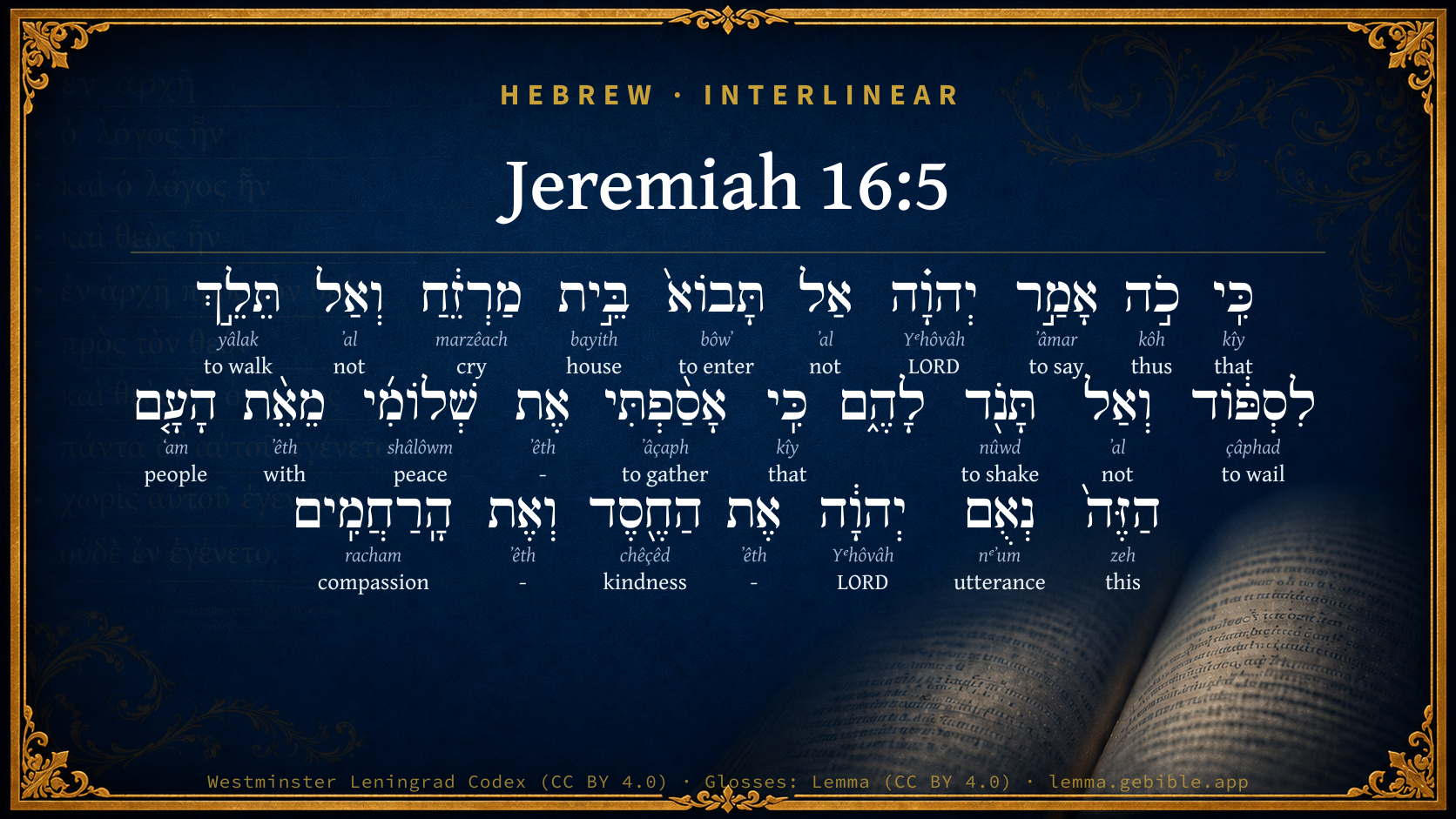
Hebrew (Westminster Leningrad Codex) Jeremiah 16:5 appears in the Hebrew Old Testament. The text above is from the Westminster Leningrad Codex. Each word links to its Strong’s number, a concise gloss, and parsing drawn from the Open Scriptures Hebrew Bible morphology. Click any word for its full Brown-Driver-Briggs (BDB) entry.
Download image
Cite this verse

Jeremiah 16:5 (World English Bible). Public Domain. Lemma interlinear Bible study tool, https://lemma.gebible.app/v/jeremiah/16/5.

Show BibTeX & RIS
BibTeX
RIS
English Translation
For thus says Yahweh, Don't enter into the house of mourning, neither go to lament, neither bemoan them; for I have taken away my peace from this people, says Yahweh, even loving kindness and tender mercies.
World English Bible · Public Domain
Highlights
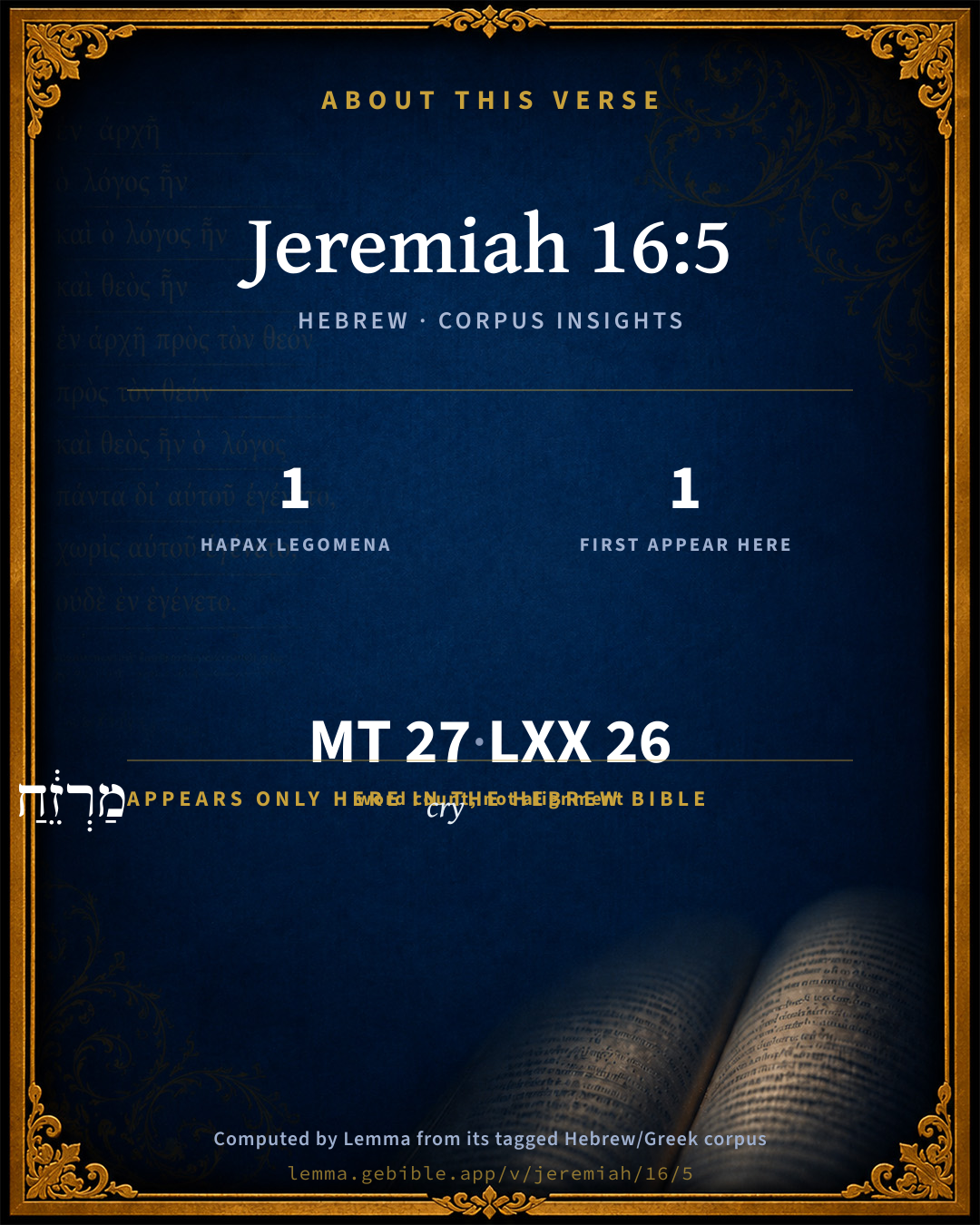
  • 1 hapax legomenon — only here in the Hebrew Bible
  • 1 first appearance in the Hebrew Bible
Full analysis ↓
Download a study sheet

One document with this verse’s original text, its word-by-word gloss line, the meaning frame, cross-references with their text, attributed commentary, and full source and license credits — printable, and it pastes into notes with its structure intact.

This verse Autodidact and up

Study sheet (.html) Plain text (.txt)

A passage Seminary Student

Up to 50 verses in one chapter. A passage sheet keeps up to 6 commentary sources and 12 cross-references per verse, in the order this page ranks them, and says so on the sheet whenever that leaves anything out. Ask for a single verse and you get the Autodidact verse sheet above.

Everything on this page stays free to read, with no account — the sheet is a download of what is already on screen, not access to it.

Want to remove ads? Support Godless Engineer
Compare translations 3

The same verse in 3 English versions, stacked beneath the original-language interlinear above. Click any original word for its lexicon entry.

Each is an independent rendering of the whole verse — the interlinear is not word-aligned to these translations.

Highlighted words mark where these versions differ — a whole-verse word diff, not a word-by-word alignment.

  • World English Bible Public Domain
    For thus says Yahweh, Don't enter into the house of mourning, neither go to lament, neither bemoan them; for I have taken away my peace from this people, says Yahweh, even loving kindness and tender mercies.
  • King James Version Public Domain
    For thus saith the LORD, Enter not into the house of mourning, neither go to lament nor bemoan them: for I have taken away my peace from this people, saith the LORD, even lovingkindness and mercies.
  • unfoldingWord Literal Text CC BY-SA 4.0
    For thus says Yahweh, “Do not enter house of a funeral meal nor go to lament nor grieve for them, for I have taken away my peace from this people”—the declaration of Yahweh—“covenant faithfulness and mercies.

unfoldingWord Literal Text — © unfoldingWord, licensed CC BY-SA 4.0. Word-aligned USFM3 via Door43 (git.door43.org/unfoldingWord/en_ult).

Versions to compare (up to 4)

3 of 4 selected

Show all 18 translations

Every available English version of this verse, each an independent rendering of the whole verse.

  • World English Bible Public Domain
    For thus says Yahweh, Don't enter into the house of mourning, neither go to lament, neither bemoan them; for I have taken away my peace from this people, says Yahweh, even loving kindness and tender mercies.
  • Berean Standard Bible Public Domain
    Indeed, this is what the LORD says: “Do not enter a house where there is a funeral meal. Do not go to mourn or show sympathy, for I have removed from this people My peace, My loving devotion, and My compassion,” declares the LORD.
  • Majority Standard Bible Public Domain
    Indeed, this is what the LORD says: “Do not enter a house where there is a funeral meal. Do not go to mourn or show sympathy, for I have removed from this people My peace, My loving devotion, and My compassion,” declares the LORD.
  • King James Version Public Domain
    For thus saith the LORD, Enter not into the house of mourning, neither go to lament nor bemoan them: for I have taken away my peace from this people, saith the LORD, even lovingkindness and mercies.
  • American Standard Version (1901) Public Domain
    For thus saith Jehovah, Enter not into the house of mourning, neither go to lament, neither bemoan them; for I have taken away my peace from this people, saith Jehovah, even lovingkindness and tender mercies.
  • Revised Version (1885) Public Domain
    For thus saith the LORD, Enter not into the house of mourning, neither go to lament, neither bemoan them: for I have taken away my peace from this people, saith the LORD, even lovingkindness and tender mercies.
  • Geneva Bible (1599) Public Domain
    For thus saith the Lord, Enter not into the house of mourning, neither goe to lament, nor be moued for the: for I haue taken my peace, from this people, saith the Lord, euen mercy and compassion.
  • Douay-Rheims (1899) Public Domain
    For thus saith the Lord: Enter not into the house of feasting, neither go thou to mourn, nor to comfort them: because I have taken away my peace from this people, saith the Lord, my mercy and commiserations.
  • Young's Literal Translation Public Domain
    For thus said Jehovah: Do not enter the house of a mourning-feast, Nor go to lament nor bemoan for them, For I have removed My peace from this people, An affirmation of Jehovah, The kindness and the mercies.
  • Literal Standard Version CC BY-SA 4.0
    For thus said YHWH: “Do not enter the house of a mourning-feast, || Nor go to lament nor bemoan for them, || For I have removed My peace from this people,” || A declaration of YHWH, || “The kindness and the mercies.
  • Unlocked Literal Bible CC BY-SA 4.0
    For the word of Yahweh came to me, saying, 'Do not enter a house where there is mourning. Do not go to mourn or to show sympathy for them, for I have taken away my peace from this people—this is Yahweh's declaration—and my steadfast love and mercy.
  • unfoldingWord Literal Text CC BY-SA 4.0
    For thus says Yahweh, “Do not enter house of a funeral meal nor go to lament nor grieve for them, for I have taken away my peace from this people”—the declaration of Yahweh—“covenant faithfulness and mercies.
  • Darby Bible Public Domain
    For thus saith Jehovah: Enter not into the house of wailing, neither go to lament or bemoan them; for I have taken away my peace from this people, saith Jehovah, the loving-kindness and the tender mercies.
  • World Messianic Bible Public Domain
    For the LORD says, “Don’t enter into the house of mourning. Don’t go to lament. Don’t bemoan them, for I have taken away my peace from this people,” says the LORD, “even loving kindness and tender mercies.
  • Webster's Bible Public Domain
    For thus saith the LORD, Enter not into the house of mourning, neither go to lament nor bemoan them: for I have taken away my peace from this people, saith the LORD, even loving-kindness and mercies.
  • Free Bible Version CC BY-SA 4.0
    This is what the Lord says: Don't enter a home where people are having a funeral meal. Don't visit them to mourn or to offer condolences, for I have taken away my peace, my trustworthy love, and my mercy from these people, declares the Lord.
  • Bible in Basic English Public Domain
    For this is what the Lord has said: Do not go into the house of sorrow, do not go to make weeping or songs of grief for them: for I have taken away my peace from this people, says the Lord, even mercy and pity.
  • JPS Tanakh (1917) Public Domain
    For thus saith the LORD: Enter not into the house of mourning, neither go to lament, neither bemoan them; for I have taken away My peace from this people, saith the LORD, even mercy and compassion.

Literal Standard Version (2020), Covenant Press — licensed CC BY-SA 4.0. Text via the HelloAO Bible API (eBible.org). Unlocked Literal Bible (unfoldingWord) — licensed CC BY-SA 4.0. Text via the HelloAO Bible API (eBible.org). unfoldingWord Literal Text — © unfoldingWord, licensed CC BY-SA 4.0. Word-aligned USFM3 via Door43 (git.door43.org/unfoldingWord/en_ult). Free Bible Version, Dr. Jonathan Gallagher — licensed CC BY-SA 4.0. Text via the HelloAO Bible API (eBible.org).

Word by word

More ways to search: Search by grammar → Find every occurrence → Compare this word →

Practice this passage: Drill this verse → Learn its vocabulary →

מַרְזֵ֔חַ
marzêach
H4798
“cry”
Noun, Common, Masculine, Singular, Absolute
Part of Speech
Noun
Type
Common
Gender
Masculine
Number
Singular
State
Absolute
Full BDB Definition

Origin: formed like H4797

TWOT: 2140a

cry, cry of joy, revelry - mourning cry - perhaps, feast cry - cry of revelry
  1. כִּֽי kîy H3588 “that” Conjunction
  2. כֹ֣ה kôh H3541 “thus” Adverb
  3. אָמַ֣ר ʼâmar H559 “to say” Verb, Qal, Perfect, 3rd Person, Masculine, Singular
  4. יְהוָ֗ה Yᵉhôvâh H3068 “LORD” Noun, Proper
  5. אַל ʼal H408 “not” Particle, Negative
  6. תָּבוֹא֙ bôwʼ H935 “to enter” Verb, Qal, Jussive, 2nd Person, Masculine, Singular
  7. בֵּ֣ית bayith H1004 “house of” Noun, Common, Masculine, Singular, Construct
  8. וְאַל ʼal H408 “and · not” Conjunction + Particle, Negative
  9. תֵּלֵ֣ךְ yâlak H3212 “to walk” Verb, Qal, Jussive, 2nd Person, Masculine, Singular
  10. לִסְפּ֔וֹד çâphad H5594 “to wail” Preposition + Verb, Qal, Infinitive Construct
  11. וְאַל ʼal H408 “and · not” Conjunction + Particle, Negative
  12. תָּנֹ֖ד nûwd H5110 “to shake” Verb, Qal, Jussive, 2nd Person, Masculine, Singular
  13. כִּֽי kîy H3588 “that” Conjunction
  14. אָסַ֨פְתִּי ʼâçaph H622 “to gather” Verb, Qal, Perfect, 1st Person, Common, Singular
  15. אֶת ʼêth H853 “-” Particle, Direct Object
  16. שְׁלוֹמִ֜י shâlôwm H7965 “peace · my” Noun, Common, Masculine, Singular, Construct + Suffix, Personal, 1st Person, Common, Singular
  17. מֵאֵ֨ת ʼêth H854 “from · with” Preposition + Preposition
  18. הָעָ֤ם ʻam H5971 “the · people” Particle, Definite Article + Noun, Common, Masculine, Singular, Absolute
  19. הַזֶּה֙ zeh H2088 “the · this” Particle, Definite Article + Pronoun, Demonstrative, Masculine, Singular
  20. נְאֻם nᵉʼum H5002 “utterance of” Noun, Common, Masculine, Singular, Construct
  21. יְהוָ֔ה Yᵉhôvâh H3068 “LORD” Noun, Proper
  22. אֶת ʼêth H853 “-” Particle, Direct Object
  23. הַחֶ֖סֶד chêçêd H2617 “the · kindness” Particle, Definite Article + Noun, Common, Masculine, Singular, Absolute
  24. וְאֶת ʼêth H853 “and · -” Conjunction + Particle, Direct Object
  25. הָֽרַחֲמִֽים racham H7356 “the · compassion” Particle, Definite Article + Noun, Common, Masculine, Plural, Absolute

About this verse

These counts appear in no published source. They are computed here, from the morphology-tagged text and Lemma’s own curated glosses. What Lemma adds →

27
words
20
distinct lemmas
Prophets
section

Notable vocabulary

1 hapax legomenon — a word that appears only here in the entire Hebrew Bible:

  • מַרְזֵ֔חַ cry H4798

First appearance in Scripture

This word makes its first canonical appearance in the Hebrew Bible here:

  • מַרְזֵ֔חַ cry H4798

Shared distinctive vocabulary

תָּנֹ֖ד to shake H5110 occurs in 24 verses of the Hebrew Bible. Also found in:

Grammatical profile

  • 6 verbs
  • 9 nouns
  • 1 pronoun
  • 2 prepositions
  • 2 conjunctions
  • 1 adverb
  • 6 particles

Verb forms

  • אָמַ֣ר Qal · Perfect
  • תָּבוֹא֙ Qal · Jussive
  • תֵּלֵ֣ךְ Qal · Jussive
  • לִסְפּ֔וֹד Qal · Infinitive Construct
  • תָּנֹ֖ד Qal · Jussive
  • אָסַ֨פְתִּי Qal · Perfect

Repetition

Words recur within this verse — often emphatic in Hebrew:

  • יְהוָ֗ה LORD H3068 ×2
  • אַל not H408 ×3
  • כִּֽי that H3588 ×2

Hebrew & Septuagint length

In the original languages it is 27 Hebrew tokens and 26 Greek tokens — but the two are counted differently (Hebrew bundles its prefixes and suffixes into one token; the Greek is in lemma form), so that isn’t a like-for-like length.

Cross-references

8

Topical passages linked to Jeremiah 16:5 in the Treasury of Scripture Knowledge — connected by theme and wording, ordered by reader-vote popularity; previews shown in the World English Bible.

  • Ezekiel 24:16–23 Son of man, behold, I take away from you the desire of your eyes with a stroke: yet you shall neither mourn nor weep, neither shall your tears run down.
  • Isaiah 27:11 When the boughs of it are withered, they shall be broken off; the women shall come, and set them on fire; for it is a people of no understanding: therefore he who made them will not have compassion on them, and he who formed them will show them no favor.
  • Deuteronomy 31:17 Then my anger shall be kindled against them in that day, and I will forsake them, and I will hide my face from them, and they shall be devoured, and many evils and troubles shall come on them; so that they will say in that day, Haven't these evils come on us because our God is not among us?
  • Jeremiah 15:1–4 Then said Yahweh to me, Though Moses and Samuel stood before me, yet my mind would not be toward this people: cast them out of my sight, and let them go forth.
  • Jeremiah 16:6–7 Both great and small shall die in this land; they shall not be buried, neither shall men lament for them, nor cut themselves, nor make themselves bald for them;
  • Revelation 6:4 Another came forth, a red horse. To him who sat on it was given power to take peace from the earth, and that they should kill one another. There was given to him a great sword.
  • 2 Chronicles 15:5–6 In those times there was no peace to him who went out, nor to him who came in; but great vexations were on all the inhabitants of the lands.
  • Zechariah 8:10 For before those days there was no wages for man, nor any wages for an animal; neither was there any peace to him who went out or came in, because of the adversary. For I set all men everyone against his neighbor.

Cross-references courtesy of OpenBible.info (CC BY 4.0).

Hebrew and Greek witnesses Masoretic Hebrew ↔ Greek Septuagint

The same verse in the two great witnesses to the Old Testament, shown verse-for-verse.

These are two independent witnesses, not word-aligned to each other, and the Septuagint is shown in lemma (dictionary) form.

Hebrew Jeremiah 16:5 Masoretic · Westminster Leningrad Codex

כִּֽי כֹ֣ה אָמַ֣ר יְהוָ֗ה אַל תָּבוֹא֙ בֵּ֣ית מַרְזֵ֔חַ וְאַל תֵּלֵ֣ךְ לִסְפּ֔וֹד וְאַל תָּנֹ֖ד לָהֶ֑ם כִּֽי אָסַ֨פְתִּי אֶת שְׁלוֹמִ֜י מֵאֵ֨ת הָעָ֤ם הַזֶּה֙ נְאֻם יְהוָ֔ה אֶת הַחֶ֖סֶד וְאֶת הָֽרַחֲמִֽים

For thus says Yahweh, Don't enter into the house of mourning, neither go to lament, neither bemoan them; for I have taken away my peace from this people, says Yahweh, even loving kindness and tender mercies.

World English Bible · Public Domain

Greek LXX Structure differs

In the Septuagint, Jeremiah is about an eighth shorter than the Hebrew and arranges its material differently — the Oracles Against the Nations (Hebrew chapters 46–51) appear in the middle of the Greek book, after 25:13. Because the chapter and verse boundaries do not line up, a verse-for-verse comparison with the Hebrew is not shown.

A verse-for-verse comparison isn’t shown here because the chapters and verses don’t line up. Switch to the LXX edition with the MT / LXX toggle above to read the Greek directly.

On this verse, Ellicott's Commentary for English Readers discusses the Septuagint’s reading. Read the note in Commentary ↓

Hebrew: Westminster Leningrad Codex (CC BY 4.0). Greek: Septuagint (public domain); English from a public-domain English Septuagint. How the Septuagint differs from the Hebrew →

Targum (Aramaic paraphrase)

1

The Targum is the ancient Jewish Aramaic paraphrase of the Hebrew Scriptures — an interpretive translation, not the Hebrew text itself. Onkelos (literal) and Pseudo-Jonathan (expansive) render the Torah, and Jonathan the Prophets. Coverage is partial: where no permissively-licensed English translation exists for a verse, only the Aramaic is shown. This is verse-level text, not a word-by-word alignment to the Hebrew.

  1. Targum Jonathan Prophets (Joshua–Malachi)
    אֲרֵי כִדְנַן אָמַר יְיָ לָא תֵעוֹל לְבֵית מַרְזְחָא וְלָא תְהָךְ לְמִסְפַּד וְלָא תִדְנֵי לְהוֹן אֲרֵי כְנֵשֵׁית יַת שְׁלָמִי מִן עַמָא הָדֵין אֲמַר יְיָ יַת חִסְדָא וְיַת רַחֲמֵי:

    (no public-domain English translation for this verse)

    Targum Jonathan — Aramaic: “Mikraot Gedolot” (public domain). English: “Sefaria Community Translation” (CC0 1.0 (public-domain dedication)); “London "Chaldee Paraphrase," 1871” (public domain). Text via Sefaria.

Commentary

Notes on Jeremiah 16:5 from classic Christian and Jewish commentators (each source and its license shown beneath its notes). The classic Christian expositions comment on the surrounding passage and are grouped to its opening verse, so a note may address several verses; the Jewish commentaries on the Tanakh (Rashi and others) are per-verse, so they appear only where the commentator wrote on this verse.

Lemma curates 59 commentaries, every one of them public domain or Creative Commons licensed, each selected and text-cleaned for this edition rather than reprinted as found. About our sources →

Trapp's Complete Commentary

John Trapp

Jer 16:5 For thus saith the LORD, Enter not into the house of mourning, neither go to lament nor bemoan them: for I have taken away my peace from this people, saith the LORD, [even] lovingkindness and mercies.

Ver. 5. Enter not into the house of mourning.] Or banquets, whether at burials or bridals. {as Amo 6:7} Of funeral banquets, see Deu 26:14. These the Greeks called περιδειπνα, the Latins Parentalia. See Jer 16:7.

John Trapp, A Commentary or Exposition upon All the Books of the Old and New Testament (1647–1656) — public domain. Text from a community e-Sword module.

Joseph Benson's Commentary

Jer 16:5-6. Enter not into the house of mourning — Or, of a mourning feast, according to the reading in the margin, the word מרזח, occurring also Amo 6:7, and being there rendered a banquet. The sense seems to be, Do not go to comfort such as mourn for any friends or relations dead; their feastings on those occasions being upon a consolatory account: those that die are most happy. For I have taken away my peace from this people — That is, I have put a full period to their prosperity, and deprived them of every thing wherewith they might comfort themselves and one another; even loving-kindness and mercies — These shall be shut up and restrained, which are the springs from whence all the streams of comfort flow to mankind. Both the great and the small shall die in this land — The land of Canaan that used to be called the land of the living. They shall not be buried, &c. — So many of all ranks and ages shall die that men shall have no time to bury them, or there shall not be a sufficient number left alive to bury the dead. Neither shall men lament for them — Nor shall men have leisure, through their own miseries, to lament for the miseries of others. Or their own calamities shall be so great that they will render them insensible to the calamities of others. Nor cut themselves, &c. — The law expressly forbade the Israelites to make any cuttings in their flesh at funeral obsequies, Lev 19:28; Deu 14:1. Notwithstanding which prohibition, this practice seems to have been adopted by the Jews, among other heathenish customs. Shaving of the head also was a usual expression of mourning, chap. Jer 7:29.

Joseph Benson's Commentary on the Old and New Testaments (1811–1818) — public domain. Text from a community e-Sword module.

Tyndale Open Study Notes

Tyndale Open Resources

16:5-7 The ban on funerals and mourning was a parable with a message to the people of Judah. Destruction would be so great and widespread that no one would mourn properly or comfort others.

Tyndale Open Study Notes — © Tyndale Open Resources, licensed CC BY-SA 4.0. Text via the HelloAO Bible API.

Geneva Bible (1599)

Geneva Bible translators

Signifying, that the affliction should be so great, that one should not have leisure to comfort another.

Geneva Bible (1599) marginal notes — public domain. Text via Bolls.life.

Jamieson, Fausset & Brown

Robert Jamieson, A. R. Fausset & David Brown

(Eze 24:17, Eze 24:22-23).

house of mourning-- (Mar 5:38). Margin, "mourning-feast"; such feasts were usual at funerals. The Hebrew means, in Amo 6:7, the cry of joy at a banquet; here, and Lam 2:19, the cry of sorrow.

Jamieson, Fausset & Brown — Commentary Critical and Explanatory on the Whole Bible (1871) — public domain (CC PDM 1.0). Text via the HelloAO Bible API.

Adam Clarke's Commentary

Verse 5. Enter not into the house of mourning] The public calamities are too great to permit individual losses to come into consideration.

Adam Clarke's Commentary on the Bible (1810–1826) — public domain. Text from a community e-Sword/MySword module.

John Calvin's Commentaries

As Jeremiah was forbidden at the beginning of the chapter to take a wife, for a dreadful devastation of the whole land was very nigh; so now God confirms what he had previously said, that so great would be the slaughter, that none would be found to perform the common office of lamenting the dead: at the same time he intimates now something more grievous, — that they who perished would be unworthy of any kind office. As he had said before, “Their carcases shall be cast to the “beasts of the earth and to the birds of heaven;” so now in this place he intimates, that their deaths would be so ignominious, that they would be deprived of the honor of a grave, and would be buried, as it is said in another place, like asses.

But when God forbids his Prophet to mourn, we are not to understand that he refers to excess of grief, as when God intends to moderate grief, when he takes away from us our parents, or our relatives, or our friends; for the subject here is not the private feeling of Jeremiah. God only declares that the land would be so desolate that hardly one would survive to mourn for the dead.

He says, Enter not into the house of mourning Some render מרזה, merezach, a funeral feast; and it is probable, nay, it may be gathered from the context, that such feasts were made when any one was dead. And the same custom we see has been observed by other nations, but for a different purpose. When the Romans celebrated a funeral feast, their object was to shake off grief, and in a manner to convert the dead into gods. Hence Cicero condemns Vatinius, because he came clothed in black to the feast of Q. Arius, (Orat. pro L. Mur.) and elsewhere he says, that Tuberonis was laughed at and everywhere repulsed, because he covered the beds with goat’s skins, when Q. Maximus made a feast at the death of his uncle Africanus. Then these feasts were among the Romans full of rejoicing; but among the Jews, as it appears, when they lamented the dead, who were their relatives, they invited children and widows, in order that there might be some relief to their sorrow.

However this may be, God intimates by this figurative language, that the Jews, when they perished in great numbers, would be deprived of that common practice, because they were unworthy of having any survivors to bewail them.

Neither go, he says, to lament, nor be moved on their account and why? For I have taken away my peace from this people, that is, all prosperity; for under the term, peace, the Jews included whatever was desirable. God then says, that he had taken away peace from them, and his peace, because he had pronounced that wicked nation accursed. He then adds, that he had taken away his kindness and his mercies. For the Prophet might have raised an objection and said, that this was not consistent with the nature of God, who testifies that he is ready to shew mercy; but God meets this objection and intimates, that there was now no place for kindness and mercy, for the impiety of the people had become past all hope. It follows —

John Calvin's Commentaries (1540-1563) — public domain. Text from the Calvin Translation Society English edition (1840s-50s) via the Christian Classics Ethereal Library (ccel.org). Calvin's coverage is partial (roughly two-thirds of the Bible); uncommented books and verses are honest gaps, never fabricated. The 19th-century editor's footnotes and remarks are omitted so the notes are faithfully Calvin's own voice.

Ellicott's Commentary for English Readers

(5) The house of mourning.—Better, mourning-feast. The word is found only here and in Amo_6:7, where it is translated “banquet.” So the Vulg. gives here domus convivii, and the LXX. the Greek word for a “drinking party.” The word literally means a “shout,” and is so far applicable to either joy or sorrow. The context seems decisive in favour of the latter meaning, but the idea of the “feast” or “social gathering” should be, at least, recognised. Not to go into the house of mirth would be a light matter as compared with abstaining even from visits of sympathy and condolence. In Ecc_7:4 the Hebrew gives a different word.

My peace.—The word is used in its highest power, as including all other blessings. It is Jehovah’s peace: that which He once had given, but which He now withholds (comp. Joh_14:27). Men were to accept that withdrawal in silent awe, not with the conventional routine of customary sorrow.

A Bible Commentary for English Readers, edited by Charles John Ellicott (1878–1897) — public domain. Text from a community e-Sword module.

The Cambridge Bible for Schools and Colleges

gen. ed. J. J. S. Perowne

5. Enter not …] The prophet’s abstinence from the accustomed marks of respect to the dead and sympathy with the relatives is to be a forecast of the time when such abstinence shall become general on account of the universal prevalence of suffering and death.

mourning] lit. a cry, found elsewhere only Amo_6:7 “revelry,” in which sense Du. and Co. (who strike out Jer_16:8) understand it here. If so, the v. will mean, Neither rejoice with them that rejoice, nor weep with them that weep.

The Cambridge Bible for Schools and Colleges (gen. ed. J. J. S. Perowne; Cambridge University Press, 1878–1918) — public domain. Text from a community e-Sword module.

John Gill's Exposition

Both the great and the small shall die in this land,.... The nobles as well as the common people, high and low, rich and poor; none shall be exempted from the grievous deaths by the sword, famine, and pestilence.

They shall not be buried, neither shall men lament for them; as before, Jer 16:4, this shall be the common case of them all; the great and the rich shall have no more care and notice taken of them than the poor:

nor cut themselves; their flesh, with their nails, or with knives, to show their grief for the dead, and to alleviate the sorrow of surviving friends, by bearing a part with them:

nor make themselves bald for them; by plucking off the hair of their heads, or by shaving them, and between their eyes; which though forbidden the Jews by the law of God, as being Heathenish customs, yet obtained in the times of Jeremiah, and were usually done; see Deu 14:1.

John Gill's Exposition of the Whole Bible (1746–1763) — public domain (CC PDM 1.0). Text via the HelloAO Bible API.

Haydock's Catholic Bible Commentary

Feasting: usual at burials for all relations. (Calmet) --- This custom reduced many to poverty. (Josephus, Jewish Wars ii. 1.) --- Sed cænam funerishæres

Negliget iratus quod rem curtaverit. (Pers. vi.)

--- Mourn, if thou shouldst meet a funeral, Luke vii. 32.

George Leo Haydock (1774–1849), Haydock's Catholic Family Bible and Commentary, 1859 edition — public domain. Excludes Psalms (Douay-Rheims chapter numbering differs from Protestant) and Deuterocanonical books (Catholic canon only).

Matthew Poole's English Annotations

Mourning, מרזח There is so great a difference in the translation of this word, that, Amo 6:7, the very same word signifieth a banquet, and is so translated; yet is there no contradiction, for banquets are now (and probably anciently were) in the houses of mourning, as well as in the houses of those that rejoiced. It appeareth plainly by the words that follow, that the apostle was here forbidden to go to funeral feasts, or to lament and bemoan any.

For (saith God)

I have, that is, I will take away peace from this people. Possibly the meaning of God might be this, Do not go to comfort such as mourn for any relations dead, (for their feastings upon those occasions were upon a consolatory account; thence, Jer 16:7, you read of a cup of consolation,) for, saith God, they have no need of it; those that die are most happy; for I will take away the peace of this people, and deprive them of all my mercy and loving-kindness which I have hitherto showed them.

Matthew Poole's English Annotations on the Holy Bible (1683–1685) — public domain. Text from a community e-Sword/MySword module.

Whedon's Commentary on the Bible

Daniel D. Whedon

5. House of mourning — Literally, outcry; which may be of joy, as the Vulgate actually translates in this place, or of wailing, which only harmonizes with the rest of the passage. Peace… lovingkindness (better, grace)… mercies — There is here threatened just the opposite of the apostolic benediction. No more portentous threat could be uttered than the taking away of “grace, mercy, and peace.”

Daniel D. Whedon (gen. ed.), Commentary on the Old and New Testaments (1874–1909) — public domain. Text from a community e-Sword module.

The Pulpit Commentary

Compare this prohibition with that given to Ezekiel, (Eze_24:15-27) The house of mourning; literally, of. screaming. (an uncommon word, only occurring again of banqueters in Amo_6:7) It is, no doubt, the wail of mourning relatives which is meant.

Vers. 5-9. The house of mourning and the house of feasting alike forbidden.

It is made plain upon the surface of this command that the house of mourning and the house of feasting are not forbidden in themselves. The man on whom the injunction is laid is a special man, and he is spoken to in special circumstances. All others may cross the threshold of such houses; the prophet alone must remain outside. This peculiar conduct was meant to emphasize his predictions. Every time there is a funeral or a marriage-feast, the terrible judgments shortly coming on the land are once more set forth. The worst sorrows of the present are but as a child"s shallow grief compared with the universal and dreadful experiences that are yet to come; and in the joys of the present it would be unseemly for the man to share whose breast is filled with the sense of how soon these joys must pass away. A man who had to live as Jeremiah lived, in such an age, with such a message, seeing visions of so much woe, how could he receive pleasure from any festive gathering, or bring pleasure to it? The more he advances in his mission as prophet the more he has to walk alone. This commanded attitude towards the house of mourning and the house of feasting indicates to us the spirit in which those who may have to make such visits should pay their visits. We must not go to fall in with the wishes of those who are visited, but rather to do the will of God, at whatever cost, and with whatever difficulty. Consider this

I WITH REGARD TO THE HOUSE OF MOURNING. One feels that the prophet must have been exposed to much misapprehension in carrying out this command with the symbolic prophecy involved in it. It would be said that he was not only an unpatriotic man but an unfeeling one. Happily we have abundant proof that, whatever the imperfections of Jeremiah, a cold indifference to the griefs of others was not one of them. He may often have had to do violence to his own impulses in keeping away from the homes where the dead were lying; and yet he only did by command what we should sometimes like to do by preference, if it were only possible to do it without wounding the feelings of others. Think of the houses of mourning where little or nothing can be said that is comforting. What could have been done to comfort stricken parents that night when there was one dead in every Egyptian household? There is a way of offering sympathy which, well intended as it is, only exacerbates instead of mollifying. What false consolations, what hackneyed commonplaces, are made use of in the house of mourning! There is a falling back on what is called the good moral character of the dead. Deathbed repentances may be made too much of. The chamber of mourning is the stronghold of an immense amount of very dangerous error in the attitude of man towards God. The temporary pain of the freshly wounded heart of man is more considered than the abiding truth of God. Then what censurable regrets there are! What utter and unconcealed selfishness on the part of survivors! It is not a feeling of pain for what the departed may have lost, but rebellious wrath for what the survivor may have lost. And so we may say that, to enter into a house of mourning where there is the right and Christian spirit, is a matter for joy and not for grief, because indeed the peace and the loving-kindness and mercies of God are there. Let us aim so to live, in such unworldliness and heavenliness of life, that survivors shall not be tempted into vain consolations when we are gone.

II WITH REGARD TO THE HOUSE OF FEASTING. The absence of Jeremiah from festive gatherings would be as a most significant presence; seeing that he was absent, not by accident, not from any personal feeling, not from any ascetic dislike to such gatherings, but by the special command of God. Not only was he forbidden to become himself a bridegroom, he could not even congratulate any other. It will be noticed that the marriage-feast in particular is referred to. The wedding was a time for a special gathering, and invited guests would make special efforts to be present. Jesus, for instance, at the wedding-feast at Cana. Mere rioting and reveling, and the laughter of fools and such merry-making as cost the Baptist his life, were at all times forbidden. There is much of rebuke to us in this command of the prophet here. He did not take part even in an innocent festive gathering. It jarred on him as he thought of the future, so different and yet so near. And possibly, if we thought more as we ought to think on what has yet to come in the way of judgment and destruction, we should walk through the world feeling that we had no heart even for what is reckoned innocent merriment. We can never be sufficiently serious when the burden of human life, with all its vast and varied trials, comes to lie upon our thoughts. Y.

The Pulpit Commentary (1880–1919), ed. H.D.M. Spence-Jones & Joseph S. Exell — public domain. Text from a community e-Sword module.

John Wesley's Explanatory Notes

Enter not - Do not go to comfort such as mourn for any relations dead, (for their feastings upon those occasions were upon a consolatory account) those that die are most happy, for I will take away the peace of this people, and deprive them of all my mercy and loving-kindness.

John Wesley, Explanatory Notes Upon the Whole Bible (1754–1765) — public domain. Text via the GEBible commentary corpus.

Keil & Delitzsch

C. F. Keil & F. Delitzsch

The command not to go into a house of mourning (מרזח, loud crying, cry of lament for one dead, see on Amo 6:7), not to show sympathy with the survivors, is explained by the Lord in the fearfully solemn saying: I withdraw from this people my peace, grace, and mercy. שׁלום is not "the inviolateness of the relation between me and my people" (Graf), but the pace of God which rested on Judah, the source of its well-being, of its life and prosperity, and which showed itself to the sinful race in the extension to them of grace and mercy. The consequence of the withdrawal of this peace is the death of great and small in such multitudes that they can neither be buried nor mourned for (Jer 16:6). התגּדד, but one's self, is used in Deu 14:1 for נתן שׂרט, to make cuts in the body, Lev 19:28; and קרח, Niph., to crop one's self bald, acc. to Deu 14:1, to shave a bare place on the front part of the head above the eyes. These are two modes of expressing passionate mourning for the dead which were forbidden to the Israelites in the law, yet which remained in use among the people, see on Lev 19:28 and Deu 14:1. להם, for them, in honour of the dead.

Keil & Delitzsch — Biblical Commentary on the Old Testament (1861–1891) — public domain (CC PDM 1.0). Text via the HelloAO Bible API. (Old Testament only.)

unfoldingWord translationNotes

Door43 World Missions Community

the word of Yahweh came to me, saying, 'Do

This idiom is used to introduce a special message from God. See how you translated it in Jeremiah 1:4. AT: "Yahweh gave me a message. He said, 'Do" or "Yahweh spoke this message to me: 'Do" (See: Idiom)

where there is mourning

The word "mourning" can be translated with a verbal phrase. AT: "where people are mourning" (See: Abstract Nouns)

I have taken away my peace from this people ... and my steadfast love and mercy

Yahweh speaks of no longer acting towards the people with peace, steadfast love, and mercy as if these were items that he has taken away from them. AT: "I will no longer act towards them with peace ... or with steadfast love and mercy" (See: Metaphor)

this is Yahweh's declaration

Yahweh speaks of himself by name to express the certainty of what he is declaring. See how you translated this in Jeremiah 1:8. AT: "this is what Yahweh has declared" or "this is what I, Yahweh, have declared" (See: First, Second, or Third Person)

Both the great and the small will

This refers to all kinds of people and uses size to refer to how important they are. AT: "Both the important and the unimportant" or "Many people, regardless of how important they are, will" (See: Merism)

They will not be buried

This can be stated in active form. AT: "No one will bury them" (See: Active or Passive)

no one will ... cut themselves or shave their heads for them

Cutting oneself and shaving one's head were symbolic actions that expressed strong grief, especially when a loved one died. (See: Symbolic Action)

translationWords

Yahweh

mourn

lament

people group

peace

covenant faithfulness

mercy

die

bury

unfoldingWord translationNotes — © Distant Shores Media and the Door43 World Missions Community, licensed CC BY-SA 4.0. Source: git.door43.org/Door43/en_tn.

Rashi

Rabbi Shlomo Yitzchaki (Rashi)

house of mourning feasting. In Sifrei, in the section dealing with Beth-peor (Balak), I saw. They returned to make feasts (מַרְזֵיחִין) for them, but our Rabbis explained מַרְזֵחַ as ‘a mourner.’

you bemoan you shall lament.

for I have gathered in My peace, etc. When their father Abraham performed charity and justice, I gave his children loving-kindness and mercy, as in Deut. 7:12: “And the Lord your God shall keep for you the covenant and the loving-kindness, etc.” Also (Deut. 13:18), “And He shall give you mercy.” They turned “justice into wormwood, and cast righteousness to the ground” (Amos 5:7). I, too, have returned and gathered in to Me My loving-kindness and My mercies.

I have gathered in (ote in O.F.), taken off. Comp. (Gen. 30:23) “God has gathered (אסף) in my disgrace.”

Rashi on the Tanakh — English translations: “The Judaica Press complete Tanach with Rashi, translated by A. J. Rosenberg” (CC BY 4.0); “Pentateuch with Rashi's commentary by M. Rosenbaum and A.M. Silbermann, 1929-1934” (public domain); “The Metsudah Tanach series, Lakewood, N.J” (CC BY 4.0); and “The Book of Joshua, Metsudah Publications, 1997” (CC BY 4.0). Text via Sefaria.

Lesson kit

Teaching starters — assembled from the data on this page, not authored interpretation. Every prompt links to the verse data it draws on. Edit before teaching.

Jeremiah, in the Prophets, opens this verse with 27 words (20 distinct Hebrew lemmas). Its most distinctive word is marzêach (“cry”). A historical commentator’s framing appears above. Read the whole chapter for the surrounding context.

Discussion questions

  1. The word marzêach carries the sense “cry.” How does it shape the verse?
  2. 1 word here appears nowhere else in the Hebrew Bible. Why might the author reach for such rare wording?
  3. This is the first place “cry” appears in Scripture (first appears here). What does its debut here establish?
  4. How does Genesis 4:12, which shares the word «to shake», read alongside this verse?
  5. What does the repetition of “LORD” (2× in this one verse) do in this verse?
  6. These translations render this verse differently. What is at stake in choosing one wording over another?
  7. «אָמַ֣ר» is a Qal Perfect verb. How does that grammatical form shape the action described?
  8. Compare how Trapp's Complete Commentary and Joseph Benson's Commentary read this verse. Where do they agree or differ?

Things to notice

  • 1 word in this verse appears nowhere else in the Hebrew Bible.
  • 1 word makes its first canonical appearance in Scripture here.
  • This verse counts 27 Hebrew ↔ 26 Greek words.
  • These translations choose different wording for 22 words in this verse.
  • “LORD” occurs 2× in this single verse.

Reading settings

Reading text

Shown beneath each verse's original-language words.

Old Testament
Old Testament edition

Read the OT as the Masoretic Hebrew (MT) or the Greek Septuagint (LXX).

English shown for the Greek Septuagint (in the Hebrew ↔ Greek comparison).

Comparing translations? Open the Compare panel on any verse page to stack up to four side by side.