

Isaiah 54:10

Hebrew (Westminster Leningrad Codex) Isaiah 54:10 appears in the Hebrew Old Testament. The text above is from the Westminster Leningrad Codex. Each word links to its Strong’s number, a concise gloss, and parsing drawn from the Open Scriptures Hebrew Bible morphology. Click any word for its full Brown-Driver-Briggs (BDB) entry.
Download image
Cite this verse

Isaiah 54:10 (World English Bible). Public Domain. Lemma interlinear Bible study tool, https://lemma.gebible.app/v/isaiah/54/10.

Show BibTeX & RIS
BibTeX
RIS
English Translation
For the mountains may depart, and the hills be removed; but my loving kindness shall not depart from you, neither shall my covenant of peace be removed, says Yahweh who has mercy on you.
World English Bible · Public Domain
Download a study sheet

One document with this verse’s original text, its word-by-word gloss line, the meaning frame, cross-references with their text, attributed commentary, and full source and license credits — printable, and it pastes into notes with its structure intact.

This verse Autodidact and up

Study sheet (.html) Plain text (.txt)

A passage Seminary Student

Up to 50 verses in one chapter. A passage sheet keeps up to 6 commentary sources and 12 cross-references per verse, in the order this page ranks them, and says so on the sheet whenever that leaves anything out. Ask for a single verse and you get the Autodidact verse sheet above.

Everything on this page stays free to read, with no account — the sheet is a download of what is already on screen, not access to it.

Want to remove ads? Support Godless Engineer
Compare translations 3

The same verse in 3 English versions, stacked beneath the original-language interlinear above. Click any original word for its lexicon entry.

Each is an independent rendering of the whole verse — the interlinear is not word-aligned to these translations.

Highlighted words mark where these versions differ — a whole-verse word diff, not a word-by-word alignment.

  • World English Bible Public Domain
    For the mountains may depart, and the hills be removed; but my loving kindness shall not depart from you, neither shall my covenant of peace be removed, says Yahweh who has mercy on you.
  • King James Version Public Domain
    For the mountains shall depart, and the hills be removed; but my kindness shall not depart from thee, neither shall the covenant of my peace be removed, saith the LORD that hath mercy on thee.
  • unfoldingWord Literal Text CC BY-SA 4.0
    For the mountains may depart, and the hills may shake, but my covenant faithfulness will not depart from you, and the covenant of my peace will not shake,” says Yahweh, the one having compassion on you. q1

unfoldingWord Literal Text — © unfoldingWord, licensed CC BY-SA 4.0. Word-aligned USFM3 via Door43 (git.door43.org/unfoldingWord/en_ult).

Versions to compare (up to 4)

3 of 4 selected

Show all 18 translations

Every available English version of this verse, each an independent rendering of the whole verse.

  • World English Bible Public Domain
    For the mountains may depart, and the hills be removed; but my loving kindness shall not depart from you, neither shall my covenant of peace be removed, says Yahweh who has mercy on you.
  • Berean Standard Bible Public Domain
    Though the mountains may be removed and the hills may be shaken, My loving devotion will not depart from you, and My covenant of peace will not be broken,” says the LORD, who has compassion on you.
  • Majority Standard Bible Public Domain
    Though the mountains may be removed and the hills may be shaken, My loving devotion will not depart from you, and My covenant of peace will not be broken,” says the LORD, who has compassion on you.
  • King James Version Public Domain
    For the mountains shall depart, and the hills be removed; but my kindness shall not depart from thee, neither shall the covenant of my peace be removed, saith the LORD that hath mercy on thee.
  • American Standard Version (1901) Public Domain
    For the mountains may depart, and the hills be removed; but my lovingkindness shall not depart from thee, neither shall my covenant of peace be removed, saith Jehovah that hath mercy on thee.
  • Revised Version (1885) Public Domain
    For the mountains shall depart, and the hills be removed; but my kindness shall not depart from thee, neither shall my covenant of peace be removed, saith the LORD that hath mercy on thee.
  • Geneva Bible (1599) Public Domain
    For the mountaines shall remoue and the hilles shall fall downe: but my mercy shall not depart from thee, neither shall the couenant of my peace fall away, saith the Lord, that hath compassion on thee.
  • Douay-Rheims (1899) Public Domain
    For the mountains shall be moved, and the hills shall tremble; but my mercy shall not depart from thee, and the covenant of my peace shall not be moved: said the Lord that hath mercy on thee.
  • Young's Literal Translation Public Domain
    For the mountains depart, and the hills remove, And My kindness from thee departeth not, And the covenant of My peace removeth not, Said hath thy loving one -- Jehovah.
  • Literal Standard Version CC BY-SA 4.0
    For the mountains depart, and the hills remove, || And My kindness does not depart from you, || And the covenant of My peace does not remove,” || Says YHWH, your loving one.
  • Unlocked Literal Bible CC BY-SA 4.0
    Though the mountains may fall and the hills be shaken, yet my steadfast love will not turn away from you, nor will my covenant of peace be shaken— says Yahweh, who has mercy on you.
  • unfoldingWord Literal Text CC BY-SA 4.0
    For the mountains may depart, and the hills may shake, but my covenant faithfulness will not depart from you, and the covenant of my peace will not shake,” says Yahweh, the one having compassion on you. q1
  • Darby Bible Public Domain
    For the mountains shall depart, and the hills be removed; but my loving-kindness shall not depart from thee, neither shall my covenant of peace be removed, saith Jehovah, that hath mercy on thee.
  • World Messianic Bible Public Domain
    For the mountains may depart, and the hills be removed, but my loving kindness will not depart from you, and my covenant of peace will not be removed,” says the LORD who has mercy on you.
  • Webster's Bible Public Domain
    For the mountains shall depart, and the hills be removed, but my kindness shall not depart from thee, neither shall the covenant of my peace be removed, saith the LORD that hath mercy on thee.
  • Free Bible Version CC BY-SA 4.0
    Though the mountains cease to exist and the hills disappear, yet my trustworthy love for you won't cease to exist and my agreement of peace won't disappear, says the Lord, who shows you kindness.
  • Bible in Basic English Public Domain
    For the mountains may be taken away, and the hills be moved out of their places, but my love will not be taken from you, or my agreement of peace broken, says the Lord, who has had mercy on you.
  • JPS Tanakh (1917) Public Domain
    For the mountains may depart, and the hills be removed; but My kindness shall not depart from thee, neither shall My covenant of peace be removed, saith the LORD that hath compassion on thee.

Literal Standard Version (2020), Covenant Press — licensed CC BY-SA 4.0. Text via the HelloAO Bible API (eBible.org). Unlocked Literal Bible (unfoldingWord) — licensed CC BY-SA 4.0. Text via the HelloAO Bible API (eBible.org). unfoldingWord Literal Text — © unfoldingWord, licensed CC BY-SA 4.0. Word-aligned USFM3 via Door43 (git.door43.org/unfoldingWord/en_ult). Free Bible Version, Dr. Jonathan Gallagher — licensed CC BY-SA 4.0. Text via the HelloAO Bible API (eBible.org).

Word by word

More ways to search: Search by grammar → Find every occurrence → Compare this word →

Practice this passage: Drill this verse → Learn its vocabulary →

יָמ֔וּשׁוּ
mûwsh
H4185
“to depart”
Verb, Qal, Imperfect, 3rd Person, Masculine, Plural
Part of Speech
Verb
Stem
Qal
Form
Imperfect
Person
3rd Person
Gender
Masculine
Number
Plural
Full BDB Definition

Origin: a primitive root [perhaps rather the same as H4184 through the idea of receding by contact]

TWOT: 1167

to depart, remove - (Qal) - to depart - to remove - to be removed (of inanimate objects) - (Hiphil) to remove, depart
  1. כִּ֤י kîy H3588 “that” Conjunction
  2. הֶֽהָרִים֙ har H2022 “the · mountains” Particle, Definite Article + Noun, Common, Masculine, Plural, Absolute
  3. וְהַגְּבָע֖וֹת gibʻâh H1389 “and · the · hills” Conjunction + Particle, Definite Article + Noun, Common, Feminine, Plural, Absolute
  4. תְּמוּטֶ֑נָה môwṭ H4131 “to totter” Verb, Qal, Imperfect, 3rd Person, Feminine, Plural
  5. וְחַסְדִּ֞י chêçêd H2617 “and · kindness · my” Conjunction + Noun, Common, Masculine, Singular, Construct + Suffix, Personal, 1st Person, Common, Singular
  6. מֵאִתֵּ֣ךְ ʼêth H854 “from · with · you” Preposition + Preposition + Suffix, Personal, 2nd Person, Feminine, Singular
  7. לֹֽא lôʼ H3808 “not” Particle, Negative
  8. יָמ֗וּשׁ mûwsh H4185 “to depart” Verb, Qal, Imperfect, 3rd Person, Masculine, Singular
  9. וּבְרִ֤ית bᵉrîyth H1285 “and · covenant of” Conjunction + Noun, Common, Feminine, Singular, Construct
  10. שְׁלוֹמִי֙ shâlôwm H7965 “peace · my” Noun, Common, Masculine, Singular, Construct + Suffix, Personal, 1st Person, Common, Singular
  11. לֹ֣א lôʼ H3808 “not” Particle, Negative
  12. תָמ֔וּט môwṭ H4131 “to totter” Verb, Qal, Imperfect, 3rd Person, Feminine, Singular
  13. אָמַ֥ר ʼâmar H559 “to say” Verb, Qal, Perfect, 3rd Person, Masculine, Singular
  14. מְרַחֲמֵ֖ךְ râcham H7355 “loving · you” Verb, Piel, Participle Active, Masculine, Singular, Construct + Suffix, Personal, 2nd Person, Feminine, Singular
  15. יְהוָֽה Yᵉhôvâh H3068 “LORD” Noun, Proper

About this verse

These counts appear in no published source. They are computed here, from the morphology-tagged text and Lemma’s own curated glosses. What Lemma adds →

16
words
13
distinct lemmas
Prophets
section

Notable vocabulary

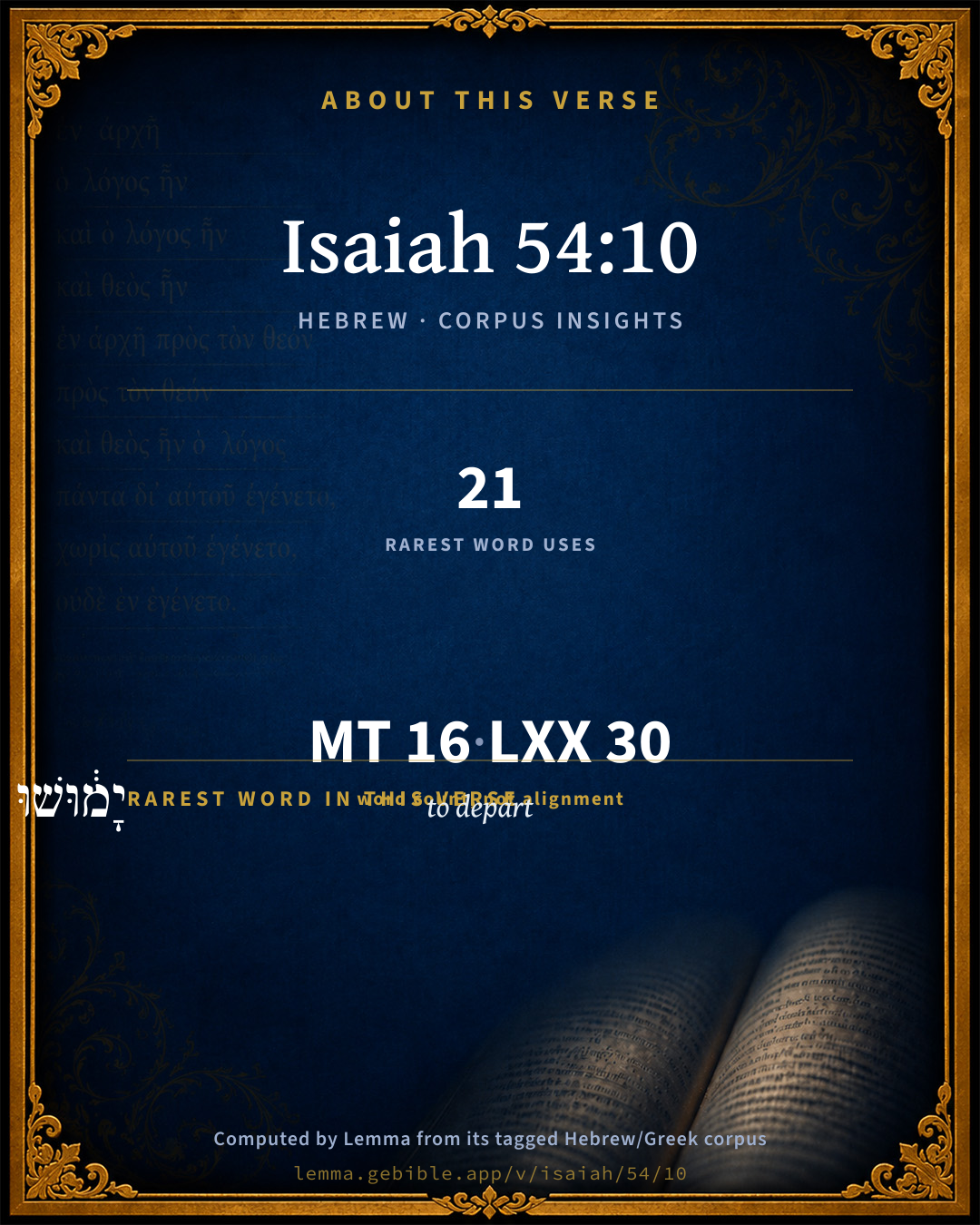
The rarest word here is יָמ֔וּשׁוּ to depart H4185 — appearing just 21 times in the whole Hebrew Bible.

Shared distinctive vocabulary

יָמ֔וּשׁוּ to depart H4185 occurs in 19 verses of the Hebrew Bible. Also found in:

Grammatical profile

  • 6 verbs
  • 6 nouns
  • 1 preposition
  • 1 conjunction
  • 2 particles

Verb forms

  • יָמ֔וּשׁוּ Qal · Imperfect
  • תְּמוּטֶ֑נָה Qal · Imperfect
  • יָמ֗וּשׁ Qal · Imperfect
  • תָמ֔וּט Qal · Imperfect
  • אָמַ֥ר Qal · Perfect
  • מְרַחֲמֵ֖ךְ Piel · Participle Active

Repetition

Words recur within this verse — often emphatic in Hebrew:

  • יָמ֔וּשׁוּ to depart H4185 ×2
  • תְּמוּטֶ֑נָה to totter H4131 ×2
  • לֹֽא not H3808 ×2

Hebrew & Septuagint length

In English translation the verse runs 34 words from the Hebrew and 39 from the Septuagint (LXX English) — closely comparable.

A rough comparison of the two English renderings, which tokenize alike — not a word-level alignment.

Word counts can differ between the Hebrew and the Greek without any difference in meaning — e.g. the Hebrew direct-object marker אֵת has no separate Greek word, and Greek often adds the article ὁ.

In the original languages it is 16 Hebrew tokens and 30 Greek tokens — but the two are counted differently (Hebrew bundles its prefixes and suffixes into one token; the Greek is in lemma form), so that isn’t a like-for-like length.

Cross-references

17

Topical passages linked to Isaiah 54:10 in the Treasury of Scripture Knowledge — connected by theme and wording, ordered by reader-vote popularity; previews shown in the World English Bible.

  • Psalms 89:33–34 But I will not completely take my loving kindness from him, Nor allow my faithfulness to fail.
  • Psalms 46:2 Therefore we won't be afraid, though the earth changes, Though the mountains are shaken into the heart of the seas;
  • Ephesians 2:4–5 But God, being rich in mercy, for his great love with which he loved us,
  • Matthew 24:35 Heaven and earth will pass away, but my words will not pass away.
  • Romans 11:29 For the gifts and the calling of God are irrevocable.
  • Isaiah 51:6–7 Lift up your eyes to the heavens, and look on the earth beneath; for the heavens shall vanish away like smoke, and the earth shall wax old like a garment; and those who dwell therein shall die in like manner: but my salvation shall be forever, and my righteousness shall not be abolished.
  • Isaiah 55:3 Turn your ear, and come to me; hear, and your soul shall live: and I will make an everlasting covenant with you, even the sure mercies of David.
  • Isaiah 54:8 In overflowing wrath I hid my face from you for a moment; but with everlasting loving kindness will I have mercy on you, says Yahweh your Redeemer.
  • Malachi 2:5 "My covenant was with him of life and peace; and I gave them to him who he might be reverent toward me; and he was reverent toward me, and stood in awe of my name.
  • Hebrews 13:20–21 Now may the God of peace, who brought again from the dead the great shepherd of the sheep with the blood of an eternal covenant, our Lord Jesus,
  • Isaiah 49:10 They shall not hunger nor thirst; neither shall the heat nor sun strike them: for he who has mercy on them will lead them, even by springs of water will he guide them.
  • 2 Samuel 23:5 Most assuredly my house is not so with God; Yet he has made with me an everlasting covenant, Ordered in all things, and sure: For it is all my salvation, and all [my] desire, Although he doesn't make it grow.
  • Titus 3:5 not by works of righteousness, which we did ourselves, but according to his mercy, he saved us, through the washing of regeneration and renewing by the Holy Spirit,
  • Hebrews 8:6–13 But now he has obtained a more excellent ministry, by so much as he is also the mediator of a better covenant, which has been enacted on better promises.
  • Matthew 5:18 For most assuredly, I tell you, until heaven and earth pass away, not even one smallest letter or one tiny pen stroke shall in any way pass away from the law, until all things are accomplished.
  • Matthew 16:18 I also tell you that you are Peter, and on this rock I will build my assembly, and the gates of Hades will not prevail against it.
  • 2 Peter 3:10–13 But the day of the Lord will come as a thief in the night; in which the heavens will pass away with a great noise, and the elements will be dissolved with fervent heat, and the earth and the works that are in it will be burned up.

Cross-references courtesy of OpenBible.info (CC BY 4.0).

Hebrew and Greek witnesses Masoretic Hebrew ↔ Greek Septuagint

The same verse in the two great witnesses to the Old Testament, shown verse-for-verse.

These are two independent witnesses, not word-aligned to each other, and the Septuagint is shown in lemma (dictionary) form.

Hebrew Isaiah 54:10 Masoretic · Westminster Leningrad Codex

כִּ֤י הֶֽהָרִים֙ יָמ֔וּשׁוּ וְהַגְּבָע֖וֹת תְּמוּטֶ֑נָה וְחַסְדִּ֞י מֵאִתֵּ֣ךְ לֹֽא יָמ֗וּשׁ וּבְרִ֤ית שְׁלוֹמִי֙ לֹ֣א תָמ֔וּט אָמַ֥ר מְרַחֲמֵ֖ךְ יְהוָֽה

For the mountains may depart, and the hills be removed; but my loving kindness shall not depart from you, neither shall my covenant of peace be removed, says Yahweh who has mercy on you.

World English Bible · Public Domain

Greek LXX Isaiah 54:10 Septuagint · lemma form

ὁ ὄρος μεταἵστημι οὐδέ ὁ βουνός σύ μετακινέω οὕτως οὐδέ ὁ παρά ἐγώ σύ ἔλεος ἐκλείπω οὐδέ ὁ διαθήκη ὁ εἰρήνη σύ οὐ μή μεταἵστημι εἶπον γάρ κύριος ἕλεος σύ

shall the mountains depart, nor shall your hills be removed: so neither shall my mercy fail you, nor shall the covenant of your peace be at all removed: for the Lord who is gracious to you has spoken it.

LXX2012 (modern English Septuagint) · Public Domain

Hebrew: Westminster Leningrad Codex (CC BY 4.0). Greek: Septuagint (public domain); English from LXX2012 (modern English Septuagint) (Public Domain). How the Septuagint differs from the Hebrew →

Targum (Aramaic paraphrase)

1

The Targum is the ancient Jewish Aramaic paraphrase of the Hebrew Scriptures — an interpretive translation, not the Hebrew text itself. Onkelos (literal) and Pseudo-Jonathan (expansive) render the Torah, and Jonathan the Prophets. Coverage is partial: where no permissively-licensed English translation exists for a verse, only the Aramaic is shown. This is verse-level text, not a word-by-word alignment to the Hebrew.

  1. Targum Jonathan Prophets (Joshua–Malachi)
    אֲרֵי טוּרַיָא יֶעְדוּן וְרָמָתָא יִתְפַּרְקוּן וְטוּבִי מִנִיךְ יְרוּשְׁלֵם לָא יֶעְדֵי וּקְיַם שְׁלָמִי לָא יִתְרְחַק אֲמַר דְעָתִיד לְרַחֲמָא עֲלָךְ יְיָ:

    For the mountains shall depart, and the hills shall be rent; but my kindness shall not depart from thee, O Jerusalem, neither shall the covenant of my peace be removed, saith the Lord, that will have mercy on thee.

    Targum Jonathan — Aramaic: “Mikraot Gedolot” (public domain). English: “Sefaria Community Translation” (CC0 1.0 (public-domain dedication)); “London "Chaldee Paraphrase," 1871” (public domain). Text via Sefaria.

Commentary

Notes on Isaiah 54:10 from classic Christian and Jewish commentators (each source and its license shown beneath its notes). The classic Christian expositions comment on the surrounding passage and are grouped to its opening verse, so a note may address several verses; the Jewish commentaries on the Tanakh (Rashi and others) are per-verse, so they appear only where the commentator wrote on this verse.

Lemma curates 59 commentaries, every one of them public domain or Creative Commons licensed, each selected and text-cleaned for this edition rather than reprinted as found. About our sources →

Trapp's Complete Commentary

John Trapp

Isa 54:10 For the mountains shall depart, and the hills be removed; but my kindness shall not depart from thee, neither shall the covenant of my peace be removed, saith the LORD that hath mercy on thee.

Ver. 10. For the mountains shall depart.] See Mat 24:35 Psa 46:2. {See Trapp on "Mat 24:35"} {See Trapp on "Psa 46:2"}

But my kindness shall not depart from thee.] This sweet promise comforted Olevian at the point of death. Although sight, hearing, speech depart from me, said he, yet God’s lovingkindness shall never depart. This was somewhat like that of David in Psa 73:26, "My flesh and my heart faileth: but God is the strength of my heart, and my portion for ever."

Neither shall the covenant of my peace.] God is in a league with his people, offensive and defensive, such as was that of Jehoshaphat with Ahab, and this covenant is a hive of heavenly honey.

John Trapp, A Commentary or Exposition upon All the Books of the Old and New Testament (1647–1656) — public domain. Text from a community e-Sword module.

The Biblical Illustrator

Joseph S. Exell

Isa_54:10

For the mountains shall depart

Mountains stable, yet crumbling

Those who have been reared and nurtured among the everlasting hills always look upon them as old friends.

To them there is in mountain, valley and glen a peace reposing in the bosom of strength that soothes the heart to rest. Jean Paul says that the great hills are like great men--the first to catch and the last to lose the light; and he might further say that, like great men, they afford kindliest shelter in their mighty bosoms to the weary and heart-sore. While the idea of stability is connected with the everlasting hills, science, with stern truthfulness, alarms that they are gradually crumbling away. They say that the Alleghanies, in their prime were three thousand feet higher than human eyes have ever seen them. There was a time when the igneous forces possessed the advantage, and island and continent and alp rose triumphant over the sea. But for thousands of years the energies of fire have been wasting, and earthquake and fire have been smitten with the palsy of age. River and stream are filching soil from mountain and plain and restoring it again to the sea. Defiant granite, which baffled the lightnings that rent Sinai, and frowned upon the flood that drowned the world, shall yet be brought down by the continuous pelting of rain and the insidious sapping of frost. (A. Macfarlane.)

The unchangeable duration of Gods kindness and covenant

I. THE CHANGEABLE STATE AND FRAME OF THIS WORLD, which shall issue in its final dissolution. The mountains shall depart, and the hills be removed. In opposition hereunto we have--

II. THE UNCHANGEABLE DURATION OF GODS KINDNESS TO, AND COVENANT WITH HIS PEOPLE. But My kindness shall not depart from thee, neither shall the covenants of My peace be removed.

III. THE CONFIRMATION AND REASON OF THIS, as contained in the words, saith the Lord, that hath mercy on thee. (J. Guyse. D. D.)

The enduring in the universe

I. THE GOOD MANS EXISTENCE IS MORE DURABLE THAN THE MOUNTAINS. This is here implied. The people here addressed are supposed to live after the mountains have departed. The fact that a man is more durable than the mountains gives consistency to our life--and grandeur.

II. GODS KINDNESS IS MORE DURABLE THAN THE MOUNTAINS. My kindness shall not depart from thee. Gods kindness is more durable even than man. Though man will never have an end, he had a beginning. Gods kindness never had a beginning, and will never have an end. Kindness is the very essence of the Eternal, the root of all existence, the primal font of all blessedness in all worlds.

1. His kindness will continue notwithstanding the sins of humanity.

2. His kindness continues notwithstanding the sufferings of humanity. In fact, His kindness is expressed in human suffering. Does not the loving father often show more love to his child in correcting him for his offences than in gratifying his desires? There is kindness in the judgments that befall men. The most terrible judgments are but Gods mercy weeding the world of its evils.

III. THE UNION BETWEEN BOTH WILL BE MORE DURABLE THAN THE MOUNTAINS. My kindness shall not depart from thee. These words were addressed to His own people, and not to men in general; and the idea is, that His kindness will continue for ever in connection with the truly good. Gods kindness is indissolubly associated with the good. St. Paul challenges the universe to effect a separation. Who shall separate from the love of Christ? (D. Thomas, D.D.)

Fears and their antidote

When God called the Jewish captives to go forth to their own land, they began to be full of fears about the future. They mused over possible or imaginary difficulties. They groaned under prospective burdens. How should they get across the wilderness? From whence should they receive their supplies? Who would protect them from the roving bands of robbers? And even if they should really live through all the perils of the wilderness, and get safe again into Palestine, how would they find the country? Would it be desolate and waste, or cultivated and attractive? Would it be free from enemies, or full of foes T Who was then to be their shield and buckler, their strong tower, their rock of defence to save them? It was this temper of mind which the prophet was commissioned by Jehovah to remove. Why, said the fervid son of Amos, are you so fearful? Think of Gods momentary anger, and eternal mercy (verses 7, 8). Think of the covenant which God made to the preacher of righteousness (verse 9). Think of the most stable and enduring things of which you know: not of fortresses--they can be demolished, and not one stone be left upon another that is not thrown down; nor yet of temples, though they rear their heads and smite the stars, like the temple of Bolus in the city which has so long been your home. Think, not of those, but of the everlasting mountains. What so secure, so deep-rooted, so enduring? Yet, the mountains shall depart, etc. (verse 10).

I. THE TEMPER OF THE JEWISH CAPTIVES IS ALSO THE TEMPER OF MANY GODLY MEN IN OUR DAY. The words of the prophet are words which they also need to hear, to be reassured and to recover their confidence and hope.

1. We have fears about matters purely secular.

2. There are fears which spring from matters as purely spiritual.

3. Fears also arise from temptations. These temptations are very many and very subtle.

4. There are foes to face, other foes than Satan, but who may be prompted by his evil counsels. What will be our condition in relation to them? There are foes in our own heart, foes in our own house, foes in our daily toil and our rest. Shall we be able to meet and overcome them?

5. Perhaps, with a very large number of devout and godly men, the greatest source of fear is the possibility of the coming on of an hour of darkness.

6. In numberless other instances, the fear originates through a morbid apprehension of death, a hatred of it that is far more Pagan than Christian, a shrinking back from the thought of dissolution, and all that dissolution carries with it.

II. LET US NOW LOOK, NOT AT THE FEARS, BUT AT THEIR TRUE ANTIDOTE. For the mountains shall depart, and the hills be removed, etc.

1. Here is the declaration of the perpetual providence of God.

2. Another antidote to fear is given in the Divine pledge of peace. The covenant of My peace shall not be broken. When the sacred writers speak of Gods covenant, it is at once apparent that they are describing the things of heaven in the language of earth. But when the word is used as in the case before us, it stands for a Divine pledge or promise. Remember, still further, that peace was a word which, in the estimation of the Jew, carried with it every possible earthly advantage. It meant more than the cessation of hostility. It meant, opportunity for business; success in commercial ventures; home-life, home-joys, to which the ancient Hebrew was so partial; quiet, love, happiness. The blessings which Jehovah promised to the Jews were manifold; but all those blessings were summed up in this one expressive word--peace. So also to us, in the later economy. Gods pledge to us is--peace, putting the still larger Christian meaning into that word. But when God promises that the covenant of His peace shall not be broken, He expects us to fulfil our part of the covenant. He gives no assurance of peace, if we swerve from Him.

3. The Divine assurance of mercy is another antidote to fear. The Lord, who hath mercy on thee. Mercy was the basis of all Gods treatment of the ancient Jews. Mercy is still the foundation of Gods dealings with us. (J. J.Goadby.)

The unchangeableness of Gods covenant the saints security

I. AN ACCOUNT GIVEN OF A COVENANT, which is ascribed to God, and said to be a covenant of peace.

II. THE SPRING AND SOURCE OF THIS COVENANT. Kindness and mercy.

III. A MOST SOLEMN ASSURANCE OF THE STABILITY, PERPETUITY, AND UNCHANGEABLENESS OF IT. It shall not depart nor be removed.

IV. THE AMPLIFICATION OR FARTHER ILLUSTRATION OF THIS SECURITY. This is as the waters of Noah unto Me, and though the mountains may depart, and the hills be removed, etc. (S. Wilson.)

My kindness shall not depart from thee

Kindness

There is something very suggestive in that word kindness. Kindness is originally that which is felt and shown to ones kind or kin. Kind is kinned; so that, according to the primitive signification of the word, kindness grows out of natural relationship. And this is really the basis of Gods kindness. Men are His children: and the relation of parent and child implies kindness. (M. R. Vincent, D. D.)

The kindness of God

The word kindness as applied to Deity is a very comprehensive term. It embraces the attributes of love and mercy in all their manifestations and numerous relations, and may be understood to be one with pity, compassion, sympathy, and tenderness.

I. The kindness of Deity is UNCHANGEABLE. It is contrasted with the mutability of earthly objects--even with the mightiest and the most endurable--The mountains shall depart, and the hills be removed.

II. The kindness of God is UNIVERSAL, while in some cases it is SPECIAL.

III. The PERPETUITY of this kindness. It shall not depart from thee. The kindness of Deity has its law. It may be granted, or it may be withdrawn, conditionally; and the law of kindness acts in union with the law of justice. (W. D.Horwood.)

The covenant of My peace

Gods peace-giving covenant

The covenant of My peace does not give the sense as fully as My covenant of peace; i.e. My peace-giving covenant. (J. A. Alexander.)

The blessings and stability of the covenant of grace

I. A VIEW OF THE PARTIES CONCERNED IN MAKING THIS COVENANT.

II. A VIEW OF THE BLESSINGS CONTAINED IN IT.

III. A VIEW OF THE STABILITY AND CERTAINTY OF THIS COVENANT, WITH ALL ITS BLESSINGS AND BENEFITS, TO EVERY TRUE BELIEVER. (J. Kidd, D. D.)

The covenant of Gods peace

1. It proceeds from Him as the God of peace.

2. In this way He hath formed between Himself and His people the most intimate, endearing connection, ratified by the Mediator, who is our peace.

3. All the blessings requisite to their peace and felicity are therein bestowed. (R. Macculloch.)

The Biblical Illustrator, edited by Joseph S. Exell (c. 1880s–1900s) — public domain. Text from a community e-Sword module.

MacLaren's Expositions of Holy Scripture

Alexander MacLaren

Isaiah

THE PASSING AND THE PERMANENT

Isa 54:10.

There is something of music in the very sound of these words. The stately march of the grand English translation lends itself with wonderful beauty to the melody of Isaiah’s words. But the thought that lies below them, sweeping as it does through the whole creation, and parting all things into the transient and eternal, the mortal and immortal, is still greater than the music of the words. These are removed; this abides. And the thing in God which abides is all-gentle tenderness, that strange love mightier than all the powers of Deity beside, permanent with the permanence of His changeless heart. The mountains shall depart, the emblems of eternity shall crumble and change and pass, and the hills be removed; but this immortal, impalpable, and, in some men’s minds, fantastic and unreal something, ‘My loving kindness and the covenant of My peace,’ shall outlast them all. And this great promise is stamped with the sign manual of Heaven, being spoken by the Lord that hath mercy on thee.’

So then, dear friends, I think I shall most reverentially deal with these words if I handle them in the simplest possible way, and think, first of all, of that great antithesis that is set before us here-what passes and what abides; and, secondly, draw two or three plain, homely lessons and applications from the thoughts thus suggested.

I. First, then, we have to deal with the contrast between the apparently enduring which passes, and that which truly abides.

‘The mountains depart, the hills remove, My loving-kindness shall not depart, neither shall the covenant of My peace be removed.’ Let me then say a word or two about that first thought-’the mountains shall depart.’ There they tower over the plains, looking down upon the flat valley beneath as they did when the prophet spoke. The eternal buttresses of the hills stand to the eyes of the fleeting generations as emblems of permanence, and yet winter storms and summer heats, and the slow processes of decay which we call the gnawing of time, are ever working upon them, and changing their forms, and at last they shall pass. Modern science, whilst it has all but incalculably enlarged our conceptions of the duration of the material universe, emphasises, as faith alone never could, the thought of the ultimate perishing of this material world. For geology tells us that ‘where rears the cliff there rolled the sea,’ that through the cycles of the shifting history of the world there have been elevations and depressions so that the ancient hills in many places are the newest of all things, and the world’s form has changed many and many a time since first it circled as a planet. And researches into the ultimate constitution of matter have taught us to think of solids and liquids and gases, as being an infinite multitude of atoms all in rapid motion with inconceivable velocity, and have shown us the very atoms in the act of breaking up. So that the old guess of the infancy of physical science which divined that ‘all things are in a state of flux’ is confirmed by its last utterances. Science prophesies too, and bids us expect that the earth shall one day become, like some of the stars, a burnt out mass of uniform temperature, incapable of change or of sustaining life, and shall end by falling into the diminished sun, and so the old word will be fulfilled that ‘the earth and the works that are therein shall be burnt up.’ None should be able to utter the words of my text, ‘The mountains shall depart and the hills be removed,’ with such emphasis of certitude as the present students of physical science.

But our text does not stop there. It brings into view the transiency of the transient, in order to throw into greater relief and prominence the perpetuity of the abiding. If we had nothing abiding beyond this perishable material universe, it would indeed be misery to exist. Life would be not only insignificant but wretched, and a ghastly irony, a meaningless, aimless ripple on the surface of that silent, shoreless sea. The great ‘But’ of this text lifts the oppression from humanity with which the one-sided truth of the passing of all the Visible loads it.

And so turn for a moment to the other side of this great text. There stands out above all that is mortal, which, although it counts its existence by millenniums, is but for an instant, visible to the eye of faith, the Great Spirit who moves all the material universe, Himself unmoved, and lives undiminished by creation, and undiminished if creation were swept out of existence. Let that which may pass, pass; let that which can perish, perish; let the mountains crumble and the hills melt away; beyond the smoke and conflagration, and rising high above destruction and chaos, stands the calm throne of God, with a loving Heart upon it, with a council of peace and purpose of mercy for you and for me, the creatures of a day indeed, but who are to live when the days shall cease to be. ‘My kindness!’ What a wonderful word that is, so far above all the cold delusion of so-called theism! ‘My kindness!’ the tender-heartedness of an infinite love, the abounding favour of the Father of my spirit, His gentle goodness bending down to me, His tenderness round about me, eternal love that never can die; the thing that lasts in the universe is His kindness, which continues from everlasting to everlasting. What a revelation of God! Oh, dear friends, if only our hearts could open to the full acceptance of that thought, sorrow and care and anxiety, and every other form of trouble, would fade away and we should be at rest. The infinite, undying, imperishable love of God is mine. Older than the mountains, deeper than their roots, wider than the heavens, and stronger than all my sin, is the love that grasps me and keeps me and will not let me go, and lavishes its tenderness upon me, and beseeches me, and pleads with me, and woos me, and rebukes me, and corrects me when I need, and sent His Son to die for me. ‘My kindness shall not depart from thee.’

But even that great conception does not exhaust the encouragement which the prophet has to give to souls weighed upon with the transiency of the material. He speaks of ‘the covenant of My peace.’ We are to think of this great, tender, changeless love of God, which underlies all things and towers above all things, which overlaps them all and fills eternity, as being placed, so to speak, under the guarantee of a solemn obligation. God’s covenant is a great thought of Scripture which we far too little apprehend in the depth and power of its meaning. His covenant with you and me, poor creatures, is this, ‘I promise that My love shall never leave thee.’ He makes Himself a constitutional monarch, so to speak, giving us a plighted word to which we can appeal and go to Him and say, ‘There, that is the charter given by Thyself, given irrevocably for ever, and I hold Thee to it. Fulfil it, O Thou God of Truth.’

‘My covenant of peace.’ Dear friends, the prophet spoke a deeper thing than he knew when he uttered these words. Let me remind you of the large meaning which the New Testament puts into them. ‘Now the God of Peace that brought again from the dead our Lord Jesus, the Great Shepherd of the Sheep, through the blood of the everlasting Covenant, make us perfect in every good work, to do His will.’ God has bound Himself by His promise to give you and me the peace that belongs to His own nature, and that covenant is sealed to us in the blood of Jesus Christ upon the Cross, and so we sinful men, with all the burden of our evil upon us, with all our sins known to us, with all our manifest failings and infirmities, can turn to Him and say, ‘Thou hast pledged Thyself to forgive and accept, and that covenant is made sure to me because Thy Son hath died, and I come and ask Thee to fulfil it.’ And be sure of this, that no poor creature upon earth, however lame his hand, who puts out that hand to grasp that peaceful covenant-that new covenant in the blood of Christ-can plead in vain.

My brother, have you done that? Have you entered into this covenant of peace with God-peace in believing, peace by the blood of Christ, peace that fills a new heart, peace that rules amidst all the perturbations and disappointments of life? Then you may be sure that that covenant will stand for evermore, though the mountains depart and the hills be removed.

II. Now turn with me to a few practical lessons which we may gather from these great contrasts here, between the perishable mortal and the immortal divine love.

Surely the first plain one is a warning against fastening our love, our hope, or our trust on these transient things.

What folly it is for a man to risk his peace and the strength and the joy of his life upon things that crumble and change, when all the while there is lying before him open for his entrance, and wooing him to come into the eternal home of his spirit, this covenant! Here are we, from day to day, plunged into these passing vanities, and always tempted to think that they are the true abiding things, and it needs great discipline and watchfulness to live the better life. There is nothing that will help us to do it like a firm grasp of the love of God in Jesus Christ. Then we can hold these mortal joys with a loose hand, knowing that they are only for a little time, and feeling that they are passing whilst we look at them, and are changing like the scenery in the sky on a summer’s night, with its cliffs and hills in the clouds, even while we gaze. Where there was a mountain a moment ago up there, there is now a depression, and the world and everything in it lasts very little longer than these. It is only a film on the surface of the great sea of eternity-there is no reality about it. It is but a dream-a vision, slipping, slipping, slipping away, and you and I slipping along with it. How foolishly, how obstinately, we all cling to it, though even the very grasp of our hands tends to make it pass away, as the children coming in from the fields with their store of buttercups and daisies in their hot hands, which by their very clutch hasten the withering. And that is just our position. We have them for a brief moment, and they all perish in the using. Oh, brother, have you set your heart on that which is not, when all the while there, longing to bless and love us, stands the Eternal God, with His unchanging love and faithful covenant of His perpetual peace? Surely it were wiser-wiser, to put it on the lowest ground-to seek the things that are above, and, knowing as we do that the mountains shall depart and the hills be removed, so make our portion the kindness which shall not depart, and seek our share in the peace that shall not pass away.

But there is another lesson to be put in the same simple fashion. Surely we ought to use thoughts like these of my text in order to stay the soul in seasons which come to every one sometimes, when we are made painfully conscious of the transiency of this Present. Meditative hours come to us all-moments when perhaps some strain of music gives us back childhood’s days; when perhaps some perfume of a flower reminds us of long-vanished gardens and hands that have crumbled into dust; when some touch of a sunset sky, or some word of a book, or some providence of our lives, comes upon the heart and mind, reminding us how everything is passing. You have all had these thoughts. Some of us stifle them-they are not pleasant to many of us; some of us brood over them unwholesomely, and that is not wise; but the best use of them is to bear us onward into the peaceful region where we clasp to our troubled hearts that which cannot go. If any of us are making experience to-day of earthly change, if any of us have hearts heavy with earthly losses, if any of us are bending under the weight of that awful law, that everything becomes part and parcel of that dreadful past, if any of us are looking at our empty hands and saying, ‘They have taken away my god and what have I more?’ let us listen to the better voice that says, ‘My kindness shall not depart from thee, and so, whatever goes, thou canst not be desolate if thou hast Me.’

And then, still further, let me remind you that this same thought may avail to give to us hopes of years as immortal as itself. We do not belong to the mountains and hills that shall depart, or to the order of things to which they belong. There is coming a very solemn day, I believe, not by any mere processes of natural decay as I take it, but by the action of God Himself, the Judge that ‘day of the Lord that shall come as a thief in the night’-when the mountains shall depart, and the hills be removed, and the throne of judgment shall be set, and you and I will be there. My brother, lay your hand on that covenant of peace which is made for us all in Christ Jesus the Lord, and then ‘calm as the summer’s ocean we shall be, and all the wreck of nature’ cannot disturb us, for we shall abide unshaken as the throne of God. The mountains may pass, the hills be removed, but herein is our love made perfect, that we may have boldness in the day of ‘judgment,’ for that kindness shall not depart from us, and God’s gentle tenderness is eternal as Himself. Then we shall not depart from it either, and we are immortal as the tenderness that encloses us. God’s endless love must have undying creatures on whom to pour itself out, and if to-day I possess-as we all may possess in however feeble a measure-some sips and prelibations of that great flood of love that is in God, I can look unblanched right into the eyes of death and say, ‘Thou hast no power at all over me, I am eternal because the God that loves me is so, and since He hath loved me with an everlasting love, His loving-kindness shall not depart from me. Therefore, seeing that all these things shall be dissolved, I know that I have a building of God, a house not made with hands, eternal in the heavens, and because He lives I shall live also.’ The hope that is built upon the eternal love of God in Christ is the true guarantee to me of immortal existence, and this hope is ours if, and only if, we come into the covenant-the covenant of peace. God says, ‘I will love thee, I will bless thee, I will keep thee, I will pardon thee, I will save thee, I will glorify thee, and there is My bond on that Cross, the new covenant in His blood.’ Close with the covenant that God is ready to make with you, and then ‘life and death, principalities and powers, things present and things to come, height and depth, and every other creature shall be impotent to separate you from the love of God that is in Christ Jesus our Lord.’

Alexander MacLaren, Expositions of Holy Scripture (1904–1910) — public domain. Text from a community e-Sword module.

Tyndale Open Study Notes

Tyndale Open Resources

54:10 God’s faithful love for his people endures despite their unfaithfulness. • God’s covenant of blessing was the assurance of his presence, resulting in wholeness, blessing, and protection. It replaces the shame and disgrace of the Exile (see Ezek 34:25; 37:26).

Tyndale Open Study Notes — © Tyndale Open Resources, licensed CC BY-SA 4.0. Text via the HelloAO Bible API.

Jamieson, Fausset & Brown

Robert Jamieson, A. R. Fausset & David Brown

(Isa 51:6; Psa 89:33-34; Rom 11:29).

covenant of my peace-- (Sa2 23:5). The covenant whereby I have made thee at peace with Me.

Jamieson, Fausset & Brown — Commentary Critical and Explanatory on the Whole Bible (1871) — public domain (CC PDM 1.0). Text via the HelloAO Bible API.

Ellicott's Commentary for English Readers

(10) For the mountains shall depart.—Better, “may depart.” The same bold hyperbole is found in Psa_46:3; Jer_31:36; Mat_24:35.

The covenant of my peace.—The phrase is taken from Num_25:12, and re-appears in Eze_34:25; Eze_37:26. “Peace,” as elsewhere in the Old Testament, includes well-nigh all that is wrapped up in the “salvation” of the New.

A Bible Commentary for English Readers, edited by Charles John Ellicott (1878–1897) — public domain. Text from a community e-Sword module.

The Cambridge Bible for Schools and Colleges

gen. ed. J. J. S. Perowne

10. Comp. Psa_46:2 f.; Hab_3:6.

The first sentence may be rendered concessively: Though the mountains should remove and the hills be shaken, yet &c.

my covenant of peace] (R.V.) Eze_34:25; Eze_37:26; Mal_2:5. that hath compassion] as Isa_49:10.

The Cambridge Bible for Schools and Colleges (gen. ed. J. J. S. Perowne; Cambridge University Press, 1878–1918) — public domain. Text from a community e-Sword module.

John Gill's Exposition

For the mountains shall depart, and the hills be removed,.... As sometimes by earthquakes, and as they will at the last day, when the earth shall be dissolved, and all in it, things the most solid, firm, and durable: it may be understood comparatively; sooner shall these depart and be removed than the kindness and covenant of God: it may be interpreted figuratively of revolutions in kingdoms and states, and particularly of the abolition of Paganism in the times of Constantine; and which is expressed in much such language; "the heaven departed as a scroll when it is rolled together, and every mountain and island were moved out of their places", Rev 6:14. Kimchi observes, that mountains and hills may be interpreted of the kings of the nations; with this compare Rev 6:15,

but my kindness shall not depart from thee; the love of God to his people is an everlasting love; it always continues; it never did, nor never will depart, notwithstanding their fall in Adam, their depraved state by nature, their actual sins and transgressions, their many revoltings and backslidings; though the Lord may hide his face from them, and afflict them, still he loves them; whatever departs from them, his kindness shall not; though riches may flee away from them, friends stand aloof off from them, health may be taken away, and life itself, yet the love of God is always the same; and so, whatever providences may attend his church and interest in any period of time, he has the same paternal care for it, and kindness for his people, as ever:

neither shall the covenant of my peace be removed; the covenant of grace made with Christ and his people in him from everlasting, so called, because peace is a considerable article of it; even that peace which was upon the heart and thought of God from everlasting; the scheme of which was drawn by him; all things relating to it were settled in this covenant, as that Christ should be the Maker of it, and that it should be made by his blood; besides, peace includes all the blessings of grace which that covenant is stored with; and the covenant is the spring and source of all peace, spiritual and eternal: moreover, as this refers to Gospel times, the new covenant is here meant, and the publication of it, in which the Gospel of peace, or peace by Jesus Christ, is preached unto men; to which may be added, that one part, at least, of the sense of the passage, may be, that notwithstanding all the troubles and exercises the church of Christ should meet with from Rome Pagan or Papal, yet the promise and covenant of God, that it should enjoy peace and prosperity in the latter day, should never be made void, but should have its sure and certain accomplishment:

saith the Lord, that hath mercy on thee; for all springs from the mercy of God, and not the merits of men; and therefore the fulfilment of the covenant and promises may be depended upon.

John Gill's Exposition of the Whole Bible (1746–1763) — public domain (CC PDM 1.0). Text via the HelloAO Bible API.

Albert Barnes' Notes on the Bible

For the mountains shall depart - (See the notes at Isa 51:6).

The covenant of my peace - That is, the covenant by which I promise peace and prosperity to thee.

Albert Barnes' Notes on the Bible (1834–1885) — public domain. Text from a community e-Sword/MySword module.

Matthew Poole's English Annotations

The mountains shall depart, and the hills be removed; which hath been verified in some mountains and hills, that by earthquakes, or otherwise, have been removed from their places. But these kind of absolute expressions are ofttimes comparatively understood, of which See Poole "Isa 51:6"; and so the sense is, The mountains shall sooner depart from their places, than my kindness shall depart from thee. As when it is said absolutely, I desired mercy, and not sacrifice, it is meant comparatively, I desired mercy more than sacrifice, as it is explained in the following clause.

The covenant of my peace; that covenant whereby I have made peace and friendship with thee, and have promised unto thee all manner of happiness, which frequently comes under the name of peace in Scripture. The sense of the place is, that God will not cast off his Christian church, as he did cast off the church of the Jews; and that the new covenant is established upon better and surer promises than the old, as is observed, Heb 8:6,7, &c., and elsewhere.

That hath mercy on thee; who doth thus with thee not for thine own merits, but merely for his own grace and mercy.

Matthew Poole's English Annotations on the Holy Bible (1683–1685) — public domain. Text from a community e-Sword/MySword module.

The Pulpit Commentary

The mountains shall depart... but my kindness shall not depart. (comp. Mat_24:35, "Heaven and earth shall pass away, but my words shall not pass away Everything material may fail, depart, perish; but God"s promises remain firm and secure for ever. The covenant of my peace; or, my covenant of peace any promise which God makes to his creatures for their advantage. (comp. Num_25:12 Eze_34:25 Eze_37:26 Mal_2:5) Here there is a special allusion to the promise just made and confirmed by oath (ver. 9).

HOMILIES BY W.M. STATHAM Ver. 10. Perennial kindness.

"My kindness shall not depart from thee." Much kindness does. It is fervid, but fickle, and is too often conditioned by mood and temper and circumstance. Moreover, it may depart through lack of power and opportunity.

I THE SAVIOR"S KINDNESS IS TRUE KINDNESS. He knows what kindness is. We too often mistake favour and indulgence for kindness. God is often kindest when he is most severe.

II THE SAVIOUR"S KINDNESS IS MANIFESTED KINDNESS. It costs him something. Much kindness evaporates in sentiment and speech. It does not impinge on the ease and the comfort of our friends. Jesus Christ said, "Lo, I come to do thy will, O God!" and, "although he was rich, yet for our sakes he became poor." His kindness was tested:

1. By the treatment he received.

2. By the nature that suffered. So deep in feeling; so infinite in its capacity for enduring sorrow.

3. By the sacrifice he offered.

4. By the permanence of his work, as "Head over all things to the Church." Then let the faint-hearted rest on the promise, "It shall not depart. W.M.S.

The eternal constancy: a meditation on change.

"My kindness shall not depart from thee." How much does depart in this world! There are departed sorrows, departed joys, departed friends; and in one sense, concerning life and joy and duty, the world is full of graves. But we have an unchanging Lord, Jesus Christ, "the same yesterday, and today, and for ever." "My kindness!" Is there not a comfort in the very emphasis? For much kindness does depart. Fervent, but evanescent, it has its little day, and then vanishes away. "We are such stuff as dreams are made of." The nobility of our nature fails before the strains of littleness in character of others and distance of place and time. The eternal constancy is beautiful. Mark the connection of thought. The mountains may depart, Galilee"s lake may embosom the surrounding hills, but the great Father"s love is immutable and eternal. To take to heart these words would be to dispel our darkest fears. A faith strong enough to grasp this will light up every forest, and overcome every foe. There are strange mysteries of suffering in this world. Sorrow has many synonyms in human speech answering to the many phases of human experience. There are agonies of endurance, breaches of trust, sighings of solitude, sadnesses of disappointment, wailings of bereavement. To-day there are disciples terrified in the storm, Rachels mourning for their departed, Peters dropping scalding tears over denials of the Lord. Can it be wondered at that in such a world, amid such human trials and such spiritual experiences, kindness the Divine kindness should be so precious a thing? Let us recall the multitude of God"s mercies; let us remember his hand in the glacier-passes of temptation, and the nights of tribulation. The strings of our human harps must sweep forth the music of love. There has been no change in Christ.

I THE SURPRISE. Think of what we are! Fickle, irresolute, ungrateful, unfaithful. Our God is a God of insight. He searcheth the heart. He sees not only conduct, but character. No disguise can cloak from him. And what secrets there are in these hearts of ours! There are mirrors there which flash hack, even to ourselves, the hidden things of darkness. Yet he loves us still! The previous chapter says, "All we like sheep have gone astray." Yet it is the stray lambs the Saviour seeks, and the poor prodigal wanderer the Father loves! The strongest ties we know of are in our human relationships; they are images of the Divine love. Only an artificial theology has made the rectoral character of God override the paternal. Think you that on some wild Christmas, amid home"s most festive scenes, with the children and the children"s children about him, that father, whose hair is whiter than the winter snow, can forget the prodigal? With the ruddy fire-glow around him, and the yule logs piled high, his mind wanders over the bleak and barren moorland of the outside world; and one faint knock at the portal, one weary step, one quivering lip, brings more music to his heart than the tabret and the dance. He knows all about the squandered wealth, the profligate life, the reckless pilgrimage of vanity. But his kindness cannot depart from him, for he is a father still. I claim for God the very amplest application of that analogy. "Now then we are ambassadors for Christ,... we pray you in Christ"s stead, be ye reconciled to God." "In Christ"s stead!" What words! Many evil things the Church has done Roman, Anglican, and Puritan would look strange enough if Christ"s gentle image had been thought upon, and men had inscribed above it, "We are Christ"s!" God gave such tension and tenderness to the human heart to make our fatherhood a parable of his own! "If we knew all!" Thus even we who love him, who have been reconciled to him, say sometimes in our darker moods. Does God know all? Then could he be kind to us still. We have served other gods. We have been faithless stewards. We have been at heart callous and cold. Yet to us comes this message of the eternal constancy: "My kindness shall not depart from thee.

II THE CONTRAST. Think of what human nature is. We make retrospect concerning ourselves. We do not depreciate humanity when we say that kindness is an uncertain thing. We do not charge it upon others to the exclusion of ourselves. We are all unstable as water. We find how difficult it is to be unselfish. And no kindness can be perpetual without that. There are occasions when kindness is lacking in us; when a feeble witticism has wounded a friend; when a cruel sarcasm has bruised a brother"s sensibilities; when a personal enjoyment has inflicted deprivation on others. Kindness is easy when its manifestations are costless. Nay, it cannot be dignified with the name; for it ministers to our own pride and satisfaction. But we cannot conceal the fact that courtesy, compassion, and care do fail, and, in one word, "love" is absent. I am not speaking of the false kindness of the deceiver, or the tender mercies of the gay, or the heartless mannerism which feigns affection. This is devils" work, and fills the sinner"s night of death with spectres worse than the genius of Dante ever described or Dore ever designed. I am speaking of the common fact of instability in human feeling, inconstancy in human love. Explainable, indeed, sometimes by the detection of selfishness, superficiality, or unworthiness, as we think, in others, but manifest, in some measure, in us all. Now, the Divine Saviour is the ideal of all unselfishness. He gave himself. He humbled himself. He became obedient unto death even the death of the cross for us. While we were yet enemies, he died for us. And this was no solitary embodiment of his nature. It was a revelation of what his eternal nature is. Take, then, a review of yourself; take a review of society and forget not all the revelations you have had of blessed contrast in God, whose kindness has not departed from you.

III THE REVIEW. Think of what the past time says. Life has been full of mercy to us all. Homes have been revisited, friends have been restored, love has been consummated, new homes have been set up, accident has been averted, health has been restored, deliverance has been vouchsafed, affliction has been sanctified, and religious faith has in some cases been renewed and restored. Most wonderful of all is this. We have lived through seasons in which subtle temptations have had their enchanter"s wand broken, and difficulties in our Christian faith have been removed. True, indeed, it is that to some these words would mean nothing would, perhaps, raise a smile of condescending pity for those of us who still believe in a God at all. Some there are who wonder at the worship which rises above the stream of tendency," or the laws of evolution, to the Fountain of Life and Power which fills the universe with life and joy; and to others the words would sound like the bitter irony of fate. Kindness! when the fig tree has withered, and there is slender produce in the vine? for some have not yet learned that Providence has higher ends than to weave purple robes and to grow costly fruits. What blessedness there is to most of us in the continuous belief in a personal God and Father in a hand that rules, a voice that speaks, and a heart that loves! Truly it sufficeth us to show us the Father; for, try as men may, they can never create an impersonal religion. Greece raised her altars to Pity and Fame, and the abstract virtues; but the testimony of history was the total neglect of them all. The human heart can worship a Divine heart only must seek after a God, even if he be "the Unknown God." Certainly, also, we cannot worship, adore, praise, and glorify any embodied idea of humanity the positivists cannot make a beautiful image of that. No; its shame, its vice, its corruption, its evil, remain; the statue may have gold in it, but it has iron and clay as well. The Lord revealed in the Bible is our God and Father to-day! "My soul thirsteth for God, the living God;" "Unto thee, O Lord, will I sing;" "Great is the Lord, and of great power, and his understanding is infinite." We retain our prayer, "Our Father which art in heaven." We retain our pathway of approach. "Christ, the Way, the Truth, and the Life." We retain our altar of love, the one Mediator between God and man, the Lord Jesus Christ. Looking back, then, and taking a review of life preserved and life sustained, of friends given or restored, of love cemented and consecrated, of faith purified and elevated, must not our seal be set afresh to the truth of the words, "My kindness shall not depart from thee"?

IV THE PROSPECT. Think what the future will bring. The coming days. These are the most constant theme of our meditation. We project ourselves into life"s to-morrow. We never live wholly for the present time. We are all artists in this wise, colouring our picture by means of our faith or our experience. We are sometimes morbid, and doubt whether good times will come to us again, forgetful of the past seasons of trouble which gave place in time to the brighter morrow. Alas! we too often say, Hath God forgotten to be gracious? hath he in anger shut up his tender mercy?

Kindness departed! That is our earthly and our spiritual dread. But the bow in the cloud is God"s silent prophecy. And there is a bow in every cloud, if we will but gaze upon the heaven of mercy above us. To-morrow is coming, but on its wings mercy and love will also come. God will still show forth his loving-kindness in the morning. The throne of God is not to be covered with the crape of a departed majesty. We believe in "the Eternal. From everlasting to everlasting thou art God." God is the Good! His sceptre is no iron mace of authority, but he is the Father of our spirits, and the God of our salvation. What will to-morrow bring? The seed-time and the harvest. The summer sky and the song of the reaper. The release of the ice-bound fountain and the beauty and fragrance of a thousand fields. To-morrow there is to be more and more departure of ignorance and wrong, of desolation and darkness. The light is to shine more and more unto the perfect day; for Christ must reign. Every season of life will have its kindness. If father and mother forsake us in childhood, the Lord will take us up. If widowhood comes, Christ will be the Husband of the widow. Frosty, but kindly, as Shakespeare says, will old age be itself, when the evening comes, and death too will be kind when it comes, taking down the tabernacle with a quiet hand, and gently hushing us into the calm sleep of the child whose morning is heaven. Let us get rid, then, of the habit of dark foreboding, for thereby we deprive ourselves of the music of to-day. We all sometimes think of Divine mercy as though its meridian had passed, and as though God"s grace was setting over the plains of life. We have an ever-living Saviour, an indwelling Spirit, the blessing of spiritual sonship, the foretaste of the sweet vineyards of Canaan, and a fountain ever open for sin and uncleanness. Let us seek to make God"s kindness in its constancy the image of our own. Love is the law of heaven; the angels are all ministering spirits. When poor Hagar, with haggard eyes and dishevelled hair, was in the wilderness, it was an angel-hand which led her to the well. When Gideon was threshing his wheat, his face pictures forth the great sorrow of his people, and we hear him saying, "O my Lord, if the Lord be with us, why then is all this befallen us?" And an angel"s voice then reassures him with the promise, "Surely I will be with thee. " When the ship is driven helplessly through the storm, an angel-voice says to the apostle, "Fear not, Paul!" Yes; there is a sympathy and a constant kindness in the angelic ministry. And we are to be ministering spirits too. A part of our nature, constituted as it is to live in others, would be shorn of its blessedness if we could not also be ministers of kindness. Onward, then, my brethren, with these words on your banner. The light which falls on the letters of gold will attract the eyes of others, as you show them what a religious faith can do in renewing the life of the world. Faith in God our Saviour will change the countenance, strengthen even the physical nerves, and make us better companions and brighter friends. Like a talisman, these words will keep you from the dread which has darkened man"s earthly life in every age. You will bear them aloft on your banner, not as rejoicing in a God who loves and cares for you alone; but you will say to the world, "Let our people be your people, and our God your God." Yield your hearts to him. "Look unto me, and be ye saved, all the ends of the earth." You will fear no evil, for the Lord is with you! There. will be manna in the wilderness; the Jordan itself will be dry; the warder will throw wide the open gates at your home-going, and the Saviour will give you the welcome rest. These words are those of the faithful and true. "My kindness shall not depart from thee. W.M.S.

The Pulpit Commentary (1880–1919), ed. H.D.M. Spence-Jones & Joseph S. Exell — public domain. Text from a community e-Sword module.

John Wesley's Explanatory Notes

The mountains - Shall sooner depart from their places than any kindness shall depart from thee. The covenant - That covenant whereby I have made peace and friendship with thee, and have promised to thee all manner of happiness. God will not cast off his Christian church, as he cast off the church of the Jews, the New covenant is established upon better and surer promises than the Old. The Lord - Who doth this not for thine own merits, but merely for his own grace and mercy.

John Wesley, Explanatory Notes Upon the Whole Bible (1754–1765) — public domain. Text via the GEBible commentary corpus.

Keil & Delitzsch

C. F. Keil & F. Delitzsch

"For the mountains may depart, and the hills may shake; my grace will not depart from thee, and my covenant of peace will not shake, saith Jehovah who hath compassion on thee." Jehovah's grace and covenant of peace (cf., Num 25:12) stand as firm as the mountains of God (Psa 36:7), without departing from Jerusalem (מאתּך instead of the usual מאתּך) and without shaking; and they will be fulfilled. This fulfilment will not take place either by force or by enchantment; but the church which is to be glorified must pass through sufferings, until it has attained the form which answers to the glory promised to it on oath. And this will also take place; for the old Jerusalem will come forth as a new one out of the furnace of affliction.

Keil & Delitzsch — Biblical Commentary on the Old Testament (1861–1891) — public domain (CC PDM 1.0). Text via the HelloAO Bible API. (Old Testament only.)

J. A. Alexander on Isaiah

Joseph Addison Alexander

“For the mountains shall move and the hills shall shake; but my favor from thee shall not move, and my covenant of peace shall not shake, saith thy pitier, Jehovah.” The meaning is not that God’s promise is as stable as the mountains, but that it is more so; they shall be removed, but it shall stand forever. The mountains and hills in this place are not symbols of states and empires, but natural emblems of stability. (See Deu 33:15; Psa 45:6; Psa 125:1-2). The phrase ‘covenant of peace’ denotes a divine promise or engagement, securing the enjoyment of peace, both in the strict sense and in the wide one of prosperity or happiness. (Compare Isa 54:13; Isa 53:5; Eze 34:25; Eze 37:26). “The covenant of my peace” does not give the sense so fully as my covenant of peace, (i.e., my peace-giving covenant). The force of the last phrase is impaired by the circumlocution of the common version, ‘the Lord that hath mercy on thee’; still more by Lowth’s diluted paraphrase, ‘Jehovah who beareth toward thee the most tender affection’.

Joseph Addison Alexander, The Prophecies of Isaiah (1846–1847; New York: Scribner, 1870–1878) — public domain. Text from a community e-Sword module.

Rashi

Rabbi Shlomo Yitzchaki (Rashi)

For the mountains shall depart Even if the merit of the Patriarchs and the Matriarchs is depleted, My kindness shall not depart from you.

Rashi on the Tanakh — English translations: “The Judaica Press complete Tanach with Rashi, translated by A. J. Rosenberg” (CC BY 4.0); “Pentateuch with Rashi's commentary by M. Rosenbaum and A.M. Silbermann, 1929-1934” (public domain); “The Metsudah Tanach series, Lakewood, N.J” (CC BY 4.0); and “The Book of Joshua, Metsudah Publications, 1997” (CC BY 4.0). Text via Sefaria.

Ibn Ezra

Rabbi Abraham ibn Ezra

The mountains shall depart, etc. It is possible that the mountains should depart, but my kindness cannot depart from thee. The covenant of my peace, etc. A figure taken from the mutual promise between husband and wife, who live together in peace and happiness.

תמוטינה Shall be removed. It is the same form as תשובֶינׇה (Ez. 16:55); the plural feminine of the verb ע״ו has two forms.

Ibn Ezra on the Tanakh — English translations: “Sefaria Community Translation” (CC0 1.0 (public-domain dedication)); “Yalkut, Sifsei Chachomim Chumash, Metsudah Publications, 2009” (CC BY 4.0); and “Commentary of Ibn Ezra on Isaiah - trans. by M. Friedlander, 1873” (public domain). Text via Sefaria.

Lesson kit

Teaching starters — assembled from the data on this page, not authored interpretation. Every prompt links to the verse data it draws on. Edit before teaching.

Isaiah, in the Prophets, opens this verse with 16 words (13 distinct Hebrew lemmas). Its most distinctive word is mûwsh (“to depart”). A historical commentator’s framing appears above. Read the whole chapter for the surrounding context.

Discussion questions

  1. What does “to depart” (mûwsh) contribute to the verse as a whole?
  2. How does Exodus 13:22, which shares the word «to depart», read alongside this verse?
  3. What does the repetition of “to depart” (2× in this one verse) do in this verse?
  4. The translations on this page render this verse differently — a whole-verse word diff, not a word-by-word alignment. What might account for the different wordings?
  5. «יָמ֔וּשׁוּ» is a Qal Imperfect verb. How does that grammatical form shape the action described?
  6. Compare how Trapp's Complete Commentary and The Biblical Illustrator read this verse. Where do they agree or differ?

Things to notice

Reading settings

Reading text

Shown beneath each verse's original-language words.

Old Testament
Old Testament edition

Read the OT as the Masoretic Hebrew (MT) or the Greek Septuagint (LXX).

English shown for the Greek Septuagint (in the Hebrew ↔ Greek comparison).

Comparing translations? Open the Compare panel on any verse page to stack up to four side by side.