

2 Kings 5:19

Hebrew (Westminster Leningrad Codex) 2 Kings 5:19 appears in the Hebrew Old Testament. The text above is from the Westminster Leningrad Codex. Each word links to its Strong’s number, a concise gloss, and parsing drawn from the Open Scriptures Hebrew Bible morphology. Click any word for its full Brown-Driver-Briggs (BDB) entry.
Download image
Cite this verse

2 Kings 5:19 (World English Bible). Public Domain. Lemma interlinear Bible study tool, https://lemma.gebible.app/v/2-kings/5/19.

Show BibTeX & RIS
BibTeX
RIS
English Translation
He said to him, Go in peace. So he departed from him a little way.
World English Bible · Public Domain
Download a study sheet

One document with this verse’s original text, its word-by-word gloss line, the meaning frame, cross-references with their text, attributed commentary, and full source and license credits — printable, and it pastes into notes with its structure intact.

This verse Autodidact and up

Study sheet (.html) Plain text (.txt)

A passage Seminary Student

Up to 50 verses in one chapter. A passage sheet keeps up to 6 commentary sources and 12 cross-references per verse, in the order this page ranks them, and says so on the sheet whenever that leaves anything out. Ask for a single verse and you get the Autodidact verse sheet above.

Everything on this page stays free to read, with no account — the sheet is a download of what is already on screen, not access to it.

Want to remove ads? Support Godless Engineer
Compare translations 3

The same verse in 3 English versions, stacked beneath the original-language interlinear above. Click any original word for its lexicon entry.

Each is an independent rendering of the whole verse — the interlinear is not word-aligned to these translations.

Highlighted words mark where these versions differ — a whole-verse word diff, not a word-by-word alignment.

  • World English Bible Public Domain
    He said to him, Go in peace. So he departed from him a little way.
  • King James Version Public Domain
    And he said unto him, Go in peace. So he departed from him a little way.
  • unfoldingWord Literal Text CC BY-SA 4.0
    And he said to him, “Go in peace.” And he went from him a length of land.

unfoldingWord Literal Text — © unfoldingWord, licensed CC BY-SA 4.0. Word-aligned USFM3 via Door43 (git.door43.org/unfoldingWord/en_ult).

Versions to compare (up to 4)

3 of 4 selected

Show all 18 translations

Every available English version of this verse, each an independent rendering of the whole verse.

  • World English Bible Public Domain
    He said to him, Go in peace. So he departed from him a little way.
  • Berean Standard Bible Public Domain
    “Go in peace,” said Elisha. But after Naaman had traveled a short distance,
  • Majority Standard Bible Public Domain
    “Go in peace,” said Elisha. But after Naaman had traveled a short distance,
  • King James Version Public Domain
    And he said unto him, Go in peace. So he departed from him a little way.
  • American Standard Version (1901) Public Domain
    And he said unto him, Go in peace. So he departed from him a little way.
  • Revised Version (1885) Public Domain
    And he said unto him, Go in peace. So he departed from him a little way.
  • Geneva Bible (1599) Public Domain
    Vnto whome he saide, Goe in peace. So he departed from him about halfe a dayes iourney of grounde.
  • Douay-Rheims (1899) Public Domain
    And he said to him: Go in peace. So he departed from him in the springtime of the earth.
  • Young's Literal Translation Public Domain
    And he saith to him, `Go in peace.' And he goeth from him a kibrath of land,
  • Literal Standard Version CC BY-SA 4.0
    And he says to him, “Go in peace.” And he goes from him a distance of land,
  • Unlocked Literal Bible CC BY-SA 4.0
    Elisha said to him, “Go in peace.” So Naaman left.
  • unfoldingWord Literal Text CC BY-SA 4.0
    And he said to him, “Go in peace.” And he went from him a length of land.
  • Darby Bible Public Domain
    And he said to him, Go in peace. And he departed from him a little way.
  • World Messianic Bible Public Domain
    He said to him, “Go in peace.” So he departed from him a little way.
  • Webster's Bible Public Domain
    And he said to him, Go in peace. So he departed from him a little way.
  • Free Bible Version CC BY-SA 4.0
    “Go in peace,” said Elisha, and Naaman left. But he had only gone a short way
  • Bible in Basic English Public Domain
    And he said to him, Go in peace. And he went from him some distance.
  • JPS Tanakh (1917) Public Domain
    And he said unto him: 'Go in peace.' So he departed from him some way.

Literal Standard Version (2020), Covenant Press — licensed CC BY-SA 4.0. Text via the HelloAO Bible API (eBible.org). Unlocked Literal Bible (unfoldingWord) — licensed CC BY-SA 4.0. Text via the HelloAO Bible API (eBible.org). unfoldingWord Literal Text — © unfoldingWord, licensed CC BY-SA 4.0. Word-aligned USFM3 via Door43 (git.door43.org/unfoldingWord/en_ult). Free Bible Version, Dr. Jonathan Gallagher — licensed CC BY-SA 4.0. Text via the HelloAO Bible API (eBible.org).

Word by word

More ways to search: Search by grammar → Find every occurrence → Compare this word →

Practice this passage: Drill this verse → Learn its vocabulary →

About this verse

These counts appear in no published source. They are computed here, from the morphology-tagged text and Lemma’s own curated glosses. What Lemma adds →

8
words
6
distinct lemmas
Historical
section

Notable vocabulary

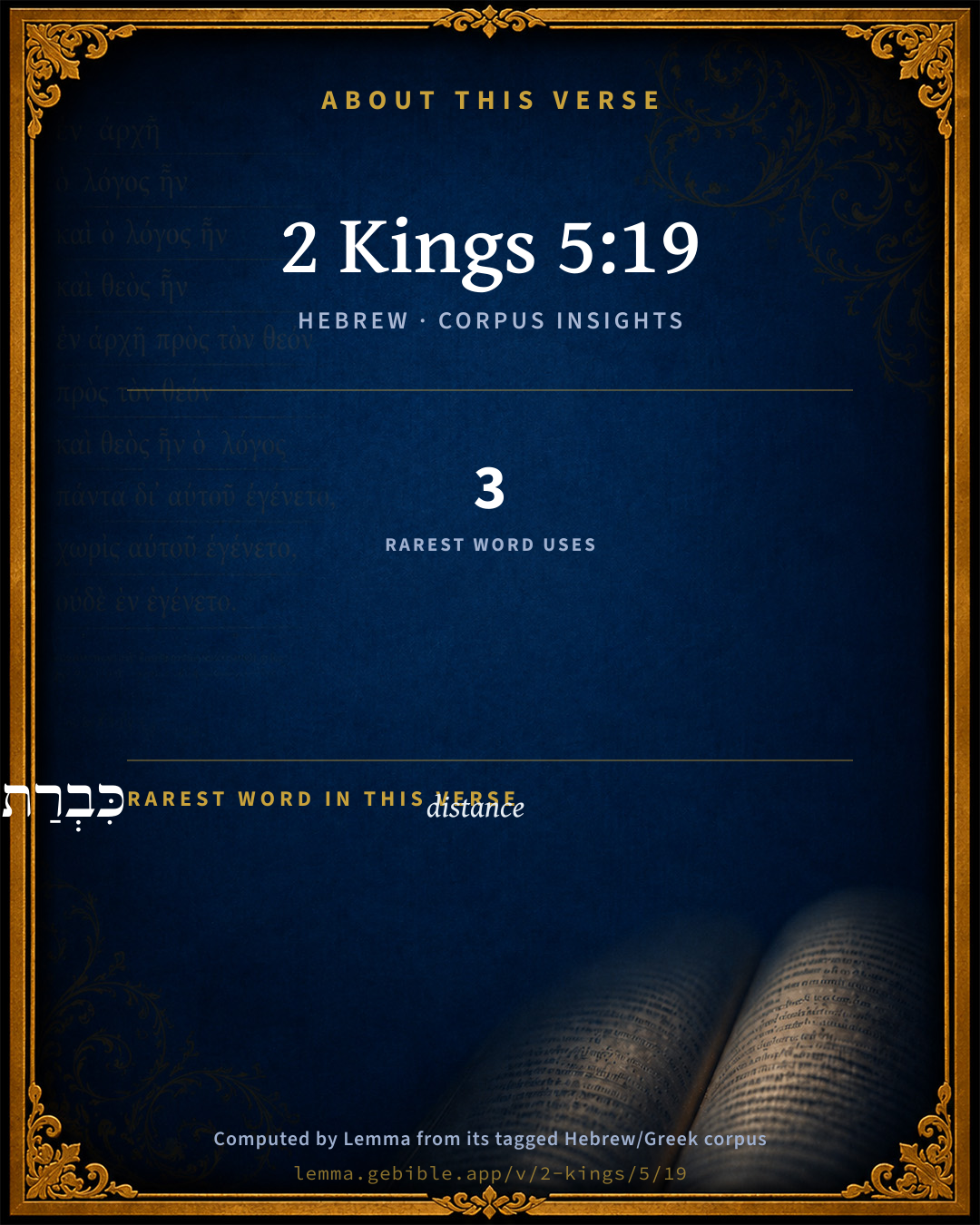
The rarest word here is כִּבְרַת distance H3530 — appearing just 3 times in the whole Hebrew Bible.

Shared distinctive vocabulary

כִּבְרַת distance H3530 occurs in 3 verses of the Hebrew Bible. Also found in:

Grammatical profile

  • 3 verbs
  • 3 nouns
  • 2 prepositions

Verb forms

  • וַיֹּ֥אמֶר Qal · Sequential Imperfect
  • לֵ֣ךְ Qal · Imperative
  • וַיֵּ֥לֶךְ Qal · Sequential Imperfect

Repetition

A word recurs within this verse — often emphatic in Hebrew:

  • לֵ֣ךְ to walk H3212 ×2

Hebrew & Septuagint length

In English translation the verse runs 15 words from the Hebrew and 16 from the Septuagint (LXX English) — closely comparable.

A rough comparison of the two English renderings, which tokenize alike — not a word-level alignment.

Word counts can differ between the Hebrew and the Greek without any difference in meaning — e.g. the Hebrew direct-object marker אֵת has no separate Greek word, and Greek often adds the article ὁ.

Cross-references

11

Topical passages linked to 2 Kings 5:19 in the Treasury of Scripture Knowledge — connected by theme and wording, ordered by reader-vote popularity; previews shown in the World English Bible.

  • 1 Samuel 1:17 Then Eli answered, Go in peace; and the God of Israel grant your petition that you have asked of him.
  • Exodus 4:18 Moses went and returned to Jethro his father-in-law, and said to him, "Please let me go and return to my brothers who are in Egypt, and see whether they are still alive." Jethro said to Moses, "Go in peace."
  • Mark 5:34 He said to her, "Daughter, your faith has made you well. Go in peace, and be cured of your disease."
  • Genesis 35:16 They traveled from Bethel. There was still some distance to come to Ephrath, and Rachel travailed. She had hard labor.
  • 1 Samuel 25:35 So David received of her hand that which she had brought him: and he said to her, Go up in peace to your house; behold, I have listened to your voice, and have accepted your person.
  • Matthew 9:16–17 No one puts a piece of unshrunk cloth on an old garment; for the patch would tear away from the garment, and a worse hole is made.
  • Luke 7:50 He said to the woman, "Your faith has saved you. Go in peace."
  • Luke 8:48 He said to her, "Daughter, cheer up. Your faith has made you well. Go in peace."
  • John 16:12 "I have yet many things to tell you, but you can't bear them now.
  • 1 Corinthians 3:2 I fed you with milk, not with meat; for you weren't yet ready. Indeed, not even now are you ready,
  • Hebrews 5:13–14 For everyone who lives on milk is not experienced in the word of righteousness, for he is a baby.

Cross-references courtesy of OpenBible.info (CC BY 4.0).

Hebrew and Greek witnesses Masoretic Hebrew ↔ Greek Septuagint

The same verse in the two great witnesses to the Old Testament, shown verse-for-verse.

These are two independent witnesses, not word-aligned to each other, and the Septuagint is shown in lemma (dictionary) form.

Hebrew 2 Kings 5:19 Masoretic · Westminster Leningrad Codex

וַיֹּ֥אמֶר ל֖וֹ לֵ֣ךְ לְשָׁל֑וֹם וַיֵּ֥לֶךְ מֵאִתּ֖וֹ כִּבְרַת אָֽרֶץ

He said to him, Go in peace. So he departed from him a little way.

World English Bible · Public Domain

Greek LXX 2 Kings 5:19 Septuagint · lemma form

καί εἶπον ελισαιε πρός ναιμαν δεῦρο εἰς εἰρήνη καί ἀποἔρχομαι ἀπό αὐτός εἰς δεβραθα ὁ γῆ

And Elisaie said to Naiman, Go in peace. And he departed from him a little way.

LXX2012 (modern English Septuagint) · Public Domain

On this verse, Haydock's Catholic Bible Commentary discusses the Septuagint’s reading. Read the note in Commentary ↓

Hebrew: Westminster Leningrad Codex (CC BY 4.0). Greek: Septuagint (public domain); English from LXX2012 (modern English Septuagint) (Public Domain). How the Septuagint differs from the Hebrew →

Targum (Aramaic paraphrase)

1

The Targum is the ancient Jewish Aramaic paraphrase of the Hebrew Scriptures — an interpretive translation, not the Hebrew text itself. Onkelos (literal) and Pseudo-Jonathan (expansive) render the Torah, and Jonathan the Prophets. Coverage is partial: where no permissively-licensed English translation exists for a verse, only the Aramaic is shown. This is verse-level text, not a word-by-word alignment to the Hebrew.

  1. Targum Jonathan Prophets (Joshua–Malachi)
    וַאֲמַר לֵיהּ אֱזִיל לִשְׁלָם וַאֲזַל מִלְוָתֵיהּ כְּרוּב אַרְעָא:

    (no public-domain English translation for this verse)

    Targum Jonathan — Aramaic: “Mikraot Gedolot” (public domain). English: “Sefaria Community Translation” (CC0 1.0 (public-domain dedication)); “London "Chaldee Paraphrase," 1871” (public domain). Text via Sefaria.

Commentary

Notes on 2 Kings 5:19 from classic Christian and Jewish commentators (each source and its license shown beneath its notes). The classic Christian expositions comment on the surrounding passage and are grouped to its opening verse, so a note may address several verses; the Jewish commentaries on the Tanakh (Rashi and others) are per-verse, so they appear only where the commentator wrote on this verse.

Lemma curates 59 commentaries, every one of them public domain or Creative Commons licensed, each selected and text-cleaned for this edition rather than reprinted as found. About our sources →

Trapp's Complete Commentary

John Trapp

2Ki 5:19 And he said unto him, Go in peace. So he departed from him a little way.

Ver. 19. Go in peace.] A friendly dismission, or as some will have it, a dilatory answer - q.d., Go thy way, trouble not thyself with points of this nature, the resolution whereof thou, being a babe as yet, art uncapable of. Content thyself with the benefit which thou hast already received. I hope the Lord will so direct thee that thou shalt not offend him in any such way. Valentinian would not attend upon Julian the emperor into the idol temple, and smote the priest that sprinkled him with holy water. So the Duke of Saxony and the other Protestant princes are much commended for this, that at the Imperial Diet, about religion, they went only to the church door with Charles V, Emperor, going to mass, but would not enter in with him.

John Trapp, A Commentary or Exposition upon All the Books of the Old and New Testament (1647–1656) — public domain. Text from a community e-Sword module.

Geneva Bible (1599)

Geneva Bible translators

The Prophet did not approve his act, but after the common manner of speech he biddeth him farewell.

Geneva Bible (1599) marginal notes — public domain. Text via Bolls.life.

Adam Clarke's Commentary

Verse 19. And he said unto him] There is a most singular and important reading in one of De Rossi's MSS., which he numbers 191. It has in the margin לא ק that is, "read לא lo, not, instead of לו lo, to him." Now this reading supposes that Naaman did ask permission from the prophet to worship in Rimmon's temple; to which the prophet answers, No; go in peace: that is, maintain thy holy resolutions, be a consistent worshipper of the true God, and avoid all idolatrous practices. Another MS., No. 383, appears first to have written לו to him, but to have corrected it immediately by inserting an א aleph after the ו vau; and thus, instead of making it לא no, it has made it לוא lu, which is no word.

Adam Clarke's Commentary on the Bible (1810–1826) — public domain. Text from a community e-Sword/MySword module.

Ellicott's Commentary for English Readers

(19) A little way.—Heb., a kibrâh of ground (Gen_35:16). It seems to mean “a length of ground,” “a certain distance,” without defining exactly how far. Had it been a parasang, as the Syriac renders, Gehazi could not have overtaken the company so easily.

A Bible Commentary for English Readers, edited by Charles John Ellicott (1878–1897) — public domain. Text from a community e-Sword module.

The Cambridge Bible for Schools and Colleges

gen. ed. J. J. S. Perowne

19. Go in peace] We are not to consider this answer as implying that service of God and service of Rimmon might be combined without any incongruity. The prophet appears rather to be willing to leave the good seed already sown to bear fruit in due season. Being sown of God it must fructify, and peace would be the result of its further development.

a little way] The expression literally signifying ‘a length of country’ is very indefinite. It is found only here and in Gen_35:16; Gen_48:7. We may estimate its length roughly by considering how far Gehazi could have gone if he had to overtake a mounted cavalcade. It could not be very far.

The Cambridge Bible for Schools and Colleges (gen. ed. J. J. S. Perowne; Cambridge University Press, 1878–1918) — public domain. Text from a community e-Sword module.

John Gill's Exposition

And he said unto him,.... That is, the prophet said to Naaman:

go in peace: in peace of mind; be assured that God has pardoned this and all other transgressions:

so he departed from him a little way; about a mile, as the Targum, and so other Jewish writers; of this phrase; see Gill on Gen 35:16, some say a land's length, that is, about one hundred and twenty feet; rather it was a thousand cubits, or half a mile.

John Gill's Exposition of the Whole Bible (1746–1763) — public domain (CC PDM 1.0). Text via the HelloAO Bible API.

Albert Barnes' Notes on the Bible

So he departed ... - This clause should not be separated from the succeeding verse. The meaning is, “So he departed from him, and had gone a little way, when Gehazi bethought himself of what he would do, and followed after him.”

Albert Barnes' Notes on the Bible (1834–1885) — public domain. Text from a community e-Sword/MySword module.

Haydock's Catholic Bible Commentary

Go in peace. What the prophet here allowed, was not an outward conformity to an idolatrous worship, but only a service which by his office he cowed to his master; who, on all public occasions, leaned on him: so that his bowing down when his master bowed himself down, was not in effect adoring the idols; nor was it so understood by the standers by, (since he publicly professed himself a worshipper of the only true and living God) but it was no more than doing a civil office to the king, his master, whose leaning upon him obliged him to bow at the same time that he bowed. (Challoner) --- Some assert that the prophet does not even authorize this civil assistance in the temple of idols, but simply tells Naaman to go in peace, and to think no more of his former religion; that he will beseech the Lord not to suffer him to be exposed to the danger. (Junius and Piscator) (Calmet) --- Some formerly pleaded this example, to excuse their occasional conformity in going to the Protestant churches, as the law required. But the case was very different. Greater perfection is required in the new law. They had not to act in the capacity of Naaman; and their attendance was considered a profession of a false religion. Their directors loudly condemned the practice. They ought rather to have imitated Eleazar, &c., who refused to eat swine’s flesh, 2 Machabees vi., and vii. (Worthington) --- Though the king intended to adore the idol, Naaman referred his worship, to God alone. (Bristow, Mot. 23.; Theodoret, q. 19.; and a Greek interpreter.) --- The Hebrew term signifies, either to adore mentally, or to bend down; which latter is the sense applicable to Naaman. (Cajetan) (Amama) --- His "request must certainly refer to the time past, and not to that to come; as if he begged an indulgence in idolatry, or of countenancing his master’s idol-worship, by his presence." (Button, Dict.) --- The Jews foolishly pretend (Calmet) that "the proselyte of dwelling," like Naaman, might return to the service of idols, in his own country, without its being imputed to him. (Selden, Jur. ii. 11.) (Maimonides) --- The conduct of the Syrian convert, whether past or future, undoubtedly filled him with alarm. If he considered the danger of a merely civil attendance upon the king, in an idolatrous temple, we cannot condemn him for idle scrupulosity; (Haycock) since many have found a difficulty in admitting the lawfulness of such a practice, and have even blamed both Naaman and the prophet. (Greg. de Valentia, &c., ep. Cornelius a Lapide) (Calmet) --- But if the practice was irreprehensible, as most interpreters assert, the answer of Eliseus might give this assurance to Naaman, and inform him that he need be under no farther apprehension on that account. God in peace. These words do not expressly solve the difficulty; but he mode in which they were uttered might intimate, either that the general would be no longer under that embarrassment, (as we do not read that he ever attended the king of Syria into the temple afterwards) or that God had forgiven his former offences, and particularly the scandalous idolatry which now gave him so much pain. The original, ver. 18, which is generally translated in the present of future, (Haydock) may be better rendered in the past tense, as the Chaldean has it. "In this thing the Lord pardon thy servant. My master going into the temple of Remmon to worship there, and leaning upon my hand, and I worshipped in the temple of Remmon, when I did worship in the temple of Remmon, that the Lord pardon," &c. St. Jerome and the Septuagint seem to have read more correctly, when he, &c. We may also render it in the present tense, "and I worship," or, "am wont to adore;" not that he meant to prevaricate any longer. The Syriac and Arabic read with an interrogation. "When I shall adore....(Calmet; or bow down, Haydock) wil the Lord pardon me?" But this rather increases the difficulty. (Calmet) --- We may therefore conclude either that Naaman had no decision, or that he had leave to serve his master, (Haydock) in a civil capacity even in the temple; (Menochius; Tirinus; Alex. 2. dis. 7.; Santius, &c.) or, that he obtained pardon for his past transgressions. (Bochart; Calmet, &c.) --- Earth, as the expression is rendered [in] Genesis xxxv. 16., thoug here it is literally, "at the chosen season;" electo, not verno. The sense is the same. Cibrath, untranslated by the Septuagint, may denote a certain space, or village; (Haydock) "a furrow," of 240 feet long, and half that breadth; (Calmet) "a mile;" (Chaldean; Pagnin) or a portion of time allowed by the law, about a quarter of an hour, during which a mile, or sabbath-day’s journey, might be performed. (Tirinus) --- Protestants, "a little way."

George Leo Haydock (1774–1849), Haydock's Catholic Family Bible and Commentary, 1859 edition — public domain. Excludes Psalms (Douay-Rheims chapter numbering differs from Protestant) and Deuterocanonical books (Catholic canon only).

Matthew Poole's English Annotations

Go in peace: these words may contain an answer, either, first, To his last petition, 2Ki 5:18; and so the sense may be this, Be not too solicitous about this matter; go, and the peace or blessing of God go along with thee. So the prophet both prays to God to bless and direct him in this and all other things, and intimates that God would do so. Or, secondly, To the former, 2Ki 5:17; Trouble not thyself about any of our earth, but go to thy own land, and I wish thee from God, and doubt not but God will give thee, peace, i.e. his favour and other blessings, which are oft contained in this word, if thou dost persist in this religion which thou hast now received. Or rather, this is only a farewell salutation, wherewith the prophet dismisseth him without any further answer to his requests, or instruction about his doubt; which he forbore by the motion of God’s Spirit, which sometimes gives and sometimes denies instructions to persons or people, as he thinks fit. See Act 16:6,7. And the prophet by the Spirit’s direction might forbear to give him particular answers, partly because these matters were not of such importance as to concern the essence or foundation of religion; and partly because he was yet but a novice, and not able to bear all truths, which was for a time the condition of the apostles, Joh 16:12, nor fit to be pressed to the practice of the hardest duties, which Christ himself thought not convenient for his disciples; Mat 9:14-17. And therefore he at present accepts of his profession of the true, and his renunciation of the false religion; and of this declaration, that what he did in the temple of Rimmon should not now be (as he had formerly intended and practised it) a religious action towards the idol, but only a civil respect to his master. And what was necessary for him to know further about the lawfulness or sinfulness of that action, the prophet might take another and a more convenient time to inform him.

Matthew Poole's English Annotations on the Holy Bible (1683–1685) — public domain. Text from a community e-Sword/MySword module.

Whedon's Commentary on the Bible

Daniel D. Whedon

19. Go in peace — The prophet neither approves nor disapproves what Naaman says. He simply bids him farewell, without expressing any judgment on the sentiments he had uttered. He doubtless had wise reasons for this course of action towards him. To have sought to correct all Naaman’s erroneous notions might have led Elisha too far aside from his proper work in Israel, and might also have imposed on the Syrian captain obligations which he had no power to meet, and which, under his peculiar circumstances, might as well remain unknown to him. Elisha, therefore, wisely leaving him to the spiritual guidance of the Almighty, bids him depart in peace.

Daniel D. Whedon (gen. ed.), Commentary on the Old and New Testaments (1874–1909) — public domain. Text from a community e-Sword module.

The Pulpit Commentary

And he said unto him; Go in peace. Elisha declared neither that God would nor that he would net forgive Naaman his departure from the path of strict right. He was not called upon to give an answer, since Naaman had not put a question, but had only expressed a wish. His Go in peace is to be taken simply as "wishing the departing Syrian the peace of God upon the road." So Keil, rightly. So he departed from him a little way. Naaman left the presence of Elisha, quitted Samaria, and had gone a short way on his homeward journey when Gehazi overtook him. Ver. 19 is closely connected with ver. 20.

The Pulpit Commentary (1880–1919), ed. H.D.M. Spence-Jones & Joseph S. Exell — public domain. Text from a community e-Sword module.

Rashi

Rabbi Shlomo Yitzchaki (Rashi)

A distance. כִּבְרַת אֶרֶץ is the name of a land measure, as in, “portions [צִמְדֵי] of vineyard,” arpent, in O.F.

Rashi on the Tanakh — English translations: “The Judaica Press complete Tanach with Rashi, translated by A. J. Rosenberg” (CC BY 4.0); “Pentateuch with Rashi's commentary by M. Rosenbaum and A.M. Silbermann, 1929-1934” (public domain); “The Metsudah Tanach series, Lakewood, N.J” (CC BY 4.0); and “The Book of Joshua, Metsudah Publications, 1997” (CC BY 4.0). Text via Sefaria.

Lesson kit

Teaching starters — assembled from the data on this page, not authored interpretation. Every prompt links to the verse data it draws on. Edit before teaching.

2 Kings, in the Historical, opens this verse with 8 words (6 distinct Hebrew lemmas). Its most distinctive word is kibrâh (“distance”). A historical commentator’s framing appears above. Read the whole chapter for the surrounding context.

Discussion questions

  1. What does “distance” (kibrâh) contribute to the verse as a whole?
  2. How does Genesis 35:16, which shares the word «distance», read alongside this verse?
  3. What does the repetition of “to walk” (2× in this one verse) do in this verse?
  4. These translations render this verse differently; the difference is in the English rendering, not the original. What questions does that raise?
  5. «וַיֹּ֥אמֶר» is a Qal Sequential Imperfect verb. How does that grammatical form shape the action described?
  6. Compare how Trapp's Complete Commentary and Geneva Bible (1599) read this verse. Where do they agree or differ?

Things to notice

  • These translations choose different wording for 6 words in this verse.
  • “to walk” occurs 2× in this single verse.
  • 6 distinct Hebrew lemmas span 8 words in this verse.

Reading settings

Reading text

Shown beneath each verse's original-language words.

Old Testament
Old Testament edition

Read the OT as the Masoretic Hebrew (MT) or the Greek Septuagint (LXX).

English shown for the Greek Septuagint (in the Hebrew ↔ Greek comparison).

Comparing translations? Open the Compare panel on any verse page to stack up to four side by side.