
2 Kings 9:17

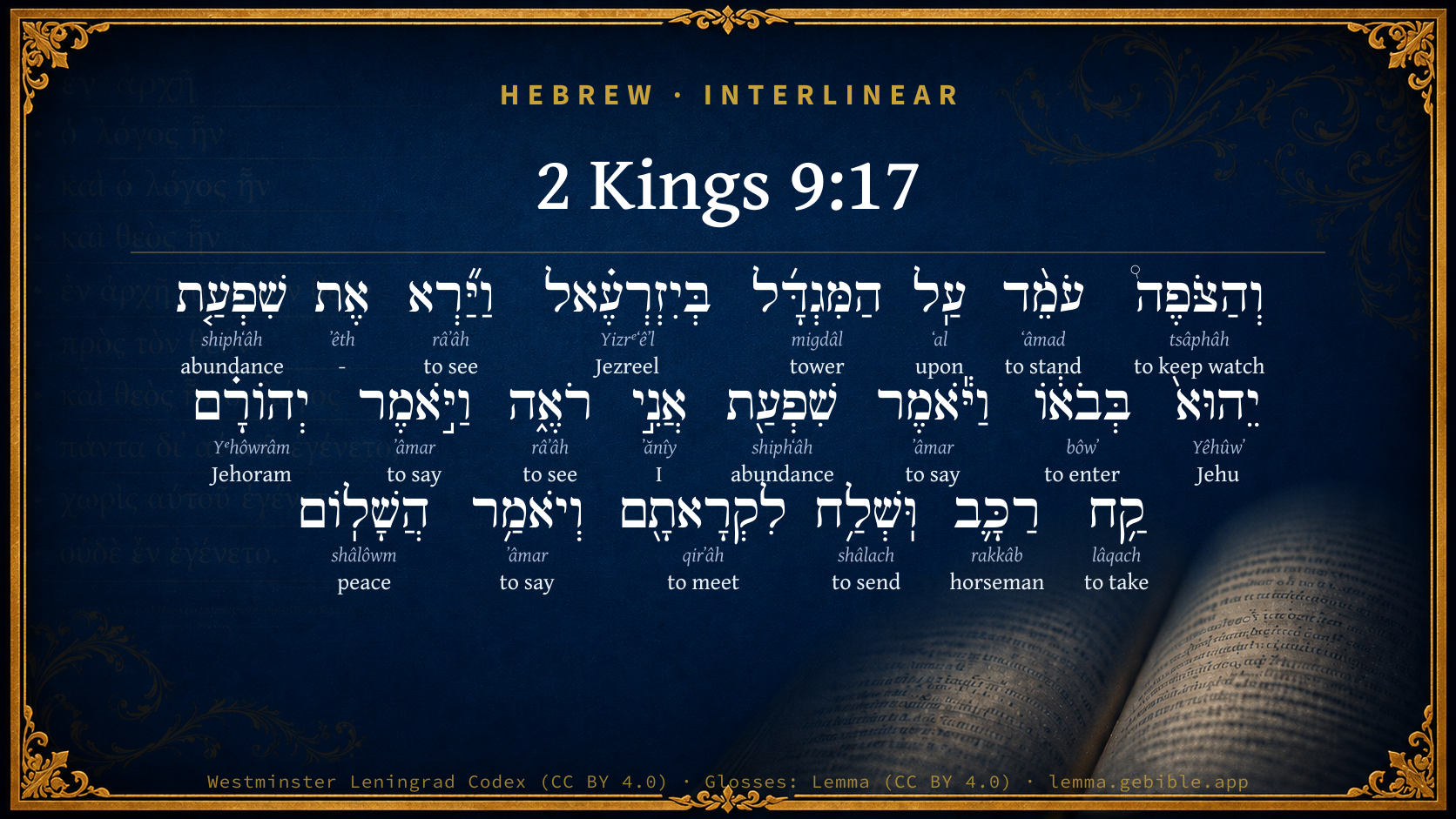
Hebrew (Westminster Leningrad Codex) 2 Kings 9:17 appears in the Hebrew Old Testament. The text above is from the Westminster Leningrad Codex. Each word links to its Strong’s number, a concise gloss, and parsing drawn from the Open Scriptures Hebrew Bible morphology. Click any word for its full Brown-Driver-Briggs (BDB) entry.
Download image
Cite this verse

2 Kings 9:17 (World English Bible). Public Domain. Lemma interlinear Bible study tool, https://lemma.gebible.app/v/2-kings/9/17.

Show BibTeX & RIS
BibTeX
RIS
English Translation
Now the watchman was standing on the tower in Jezreel, and he spied the company of Jehu as he came, and said, I see a company. Joram said, Take a horseman, and send to meet them, and let him say, Is it peace?
World English Bible · Public Domain
Highlights
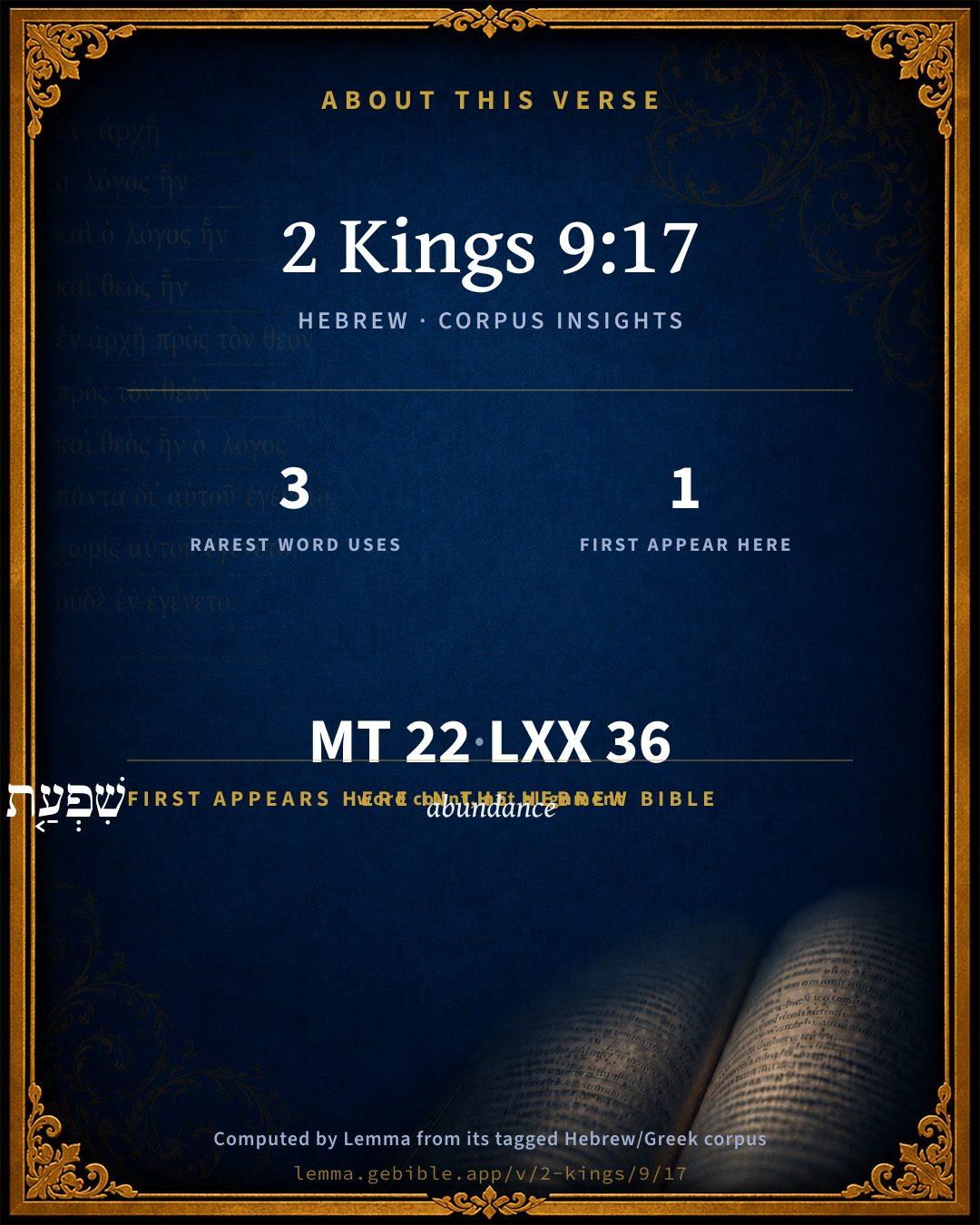
  • 1 first appearance in the Hebrew Bible
Full analysis ↓
Download a study sheet

One document with this verse’s original text, its word-by-word gloss line, the meaning frame, cross-references with their text, attributed commentary, and full source and license credits — printable, and it pastes into notes with its structure intact.

This verse Autodidact and up

Study sheet (.html) Plain text (.txt)

A passage Seminary Student

Up to 50 verses in one chapter. A passage sheet keeps up to 6 commentary sources and 12 cross-references per verse, in the order this page ranks them, and says so on the sheet whenever that leaves anything out. Ask for a single verse and you get the Autodidact verse sheet above.

Everything on this page stays free to read, with no account — the sheet is a download of what is already on screen, not access to it.

Want to remove ads? Support Godless Engineer
Compare translations 3

The same verse in 3 English versions, stacked beneath the original-language interlinear above. Click any original word for its lexicon entry.

Each is an independent rendering of the whole verse — the interlinear is not word-aligned to these translations.

Highlighted words mark where these versions differ — a whole-verse word diff, not a word-by-word alignment.

  • World English Bible Public Domain
    Now the watchman was standing on the tower in Jezreel, and he spied the company of Jehu as he came, and said, I see a company. Joram said, Take a horseman, and send to meet them, and let him say, Is it peace?
  • King James Version Public Domain
    And there stood a watchman on the tower in Jezreel, and he spied the company of Jehu as he came, and said, I see a company. And Joram said, Take an horseman, and send to meet them, and let him say, Is it peace?
  • unfoldingWord Literal Text CC BY-SA 4.0
    And a watchman was standing on the tower in Jezreel, and he saw the multitude of Jehu as he came, and he said, “I am seeing a multitude.” And Jehoram said, “Take a horseman and send to meet them, and he shall say, ‘Peace?’”

unfoldingWord Literal Text — © unfoldingWord, licensed CC BY-SA 4.0. Word-aligned USFM3 via Door43 (git.door43.org/unfoldingWord/en_ult).

Versions to compare (up to 4)

3 of 4 selected

Show all 18 translations

Every available English version of this verse, each an independent rendering of the whole verse.

  • World English Bible Public Domain
    Now the watchman was standing on the tower in Jezreel, and he spied the company of Jehu as he came, and said, I see a company. Joram said, Take a horseman, and send to meet them, and let him say, Is it peace?
  • Berean Standard Bible Public Domain
    Now the watchman standing on the tower in Jezreel saw Jehu’s troops approaching, and he called out, “I see a company of troops!” “Choose a rider,” Joram commanded. “Send him out to meet them and ask, ‘Have you come in peace?’”
  • Majority Standard Bible Public Domain
    Now the watchman standing on the tower in Jezreel saw Jehu’s troops approaching, and he called out, “I see a company of troops!” “Choose a rider,” Joram commanded. “Send him out to meet them and ask, ‘Have you come in peace?’”
  • King James Version Public Domain
    And there stood a watchman on the tower in Jezreel, and he spied the company of Jehu as he came, and said, I see a company. And Joram said, Take an horseman, and send to meet them, and let him say, Is it peace?
  • American Standard Version (1901) Public Domain
    Now the watchman was standing on the tower in Jezreel, and he spied the company of Jehu as he came, and said, I see a company. And Joram said, Take a horseman, and send to meet them, and let him say, Is it peace?
  • Revised Version (1885) Public Domain
    Now the watchman stood on the tower in Jezreel, and he spied the company of Jehu as he came, and said, I see a company. And Joram said, Take an horseman, and send to meet them, and let him say, Is it peace?
  • Geneva Bible (1599) Public Domain
    And the watchman that stoode in the towre in Izreel spyed the companie of Iehu as hee came, and sayd, I see a companie. And Iehoram said, Take a horseman and send to meete them, that hee may say, Is it peace?
  • Douay-Rheims (1899) Public Domain
    The watchmen therefore, that stood upon the tower of Jezrahel, saw the troop of Jehu coming, and said: I see a troop. And Joram said: Take a chariot, and send to meet them, and let him that goeth say: Is all well?
  • Young's Literal Translation Public Domain
    And the watchman is standing on the tower in Jezreel, and seeth the company of Jehu in his coming, and saith, `A company I see;' and Joram saith, `Take a rider and send to meet them, and let him say, Is there peace?'
  • Literal Standard Version CC BY-SA 4.0
    And the watchman is standing on the tower in Jezreel, and sees the company of Jehu in his coming, and says, “I see a company”; and Joram says, “Take a rider and send [him] to meet them, and let him say, Is there peace?”
  • Unlocked Literal Bible CC BY-SA 4.0
    The watchman was standing on the tower in Jezreel, and he saw the company of Jehu as he came at a distance; he said, “I see a group of men coming.” Joram said, “Take a horseman, and send him out to meet them; tell him to say, 'Are you coming in peace?'”
  • unfoldingWord Literal Text CC BY-SA 4.0
    And a watchman was standing on the tower in Jezreel, and he saw the multitude of Jehu as he came, and he said, “I am seeing a multitude.” And Jehoram said, “Take a horseman and send to meet them, and he shall say, ‘Peace?’”
  • Darby Bible Public Domain
    And the watchman stood on the tower in Jizreel, and saw Jehu's company as he came, and said, I see a company. And Joram said, Take a horseman, and send to meet them, and let him say, Is it peace?
  • World Messianic Bible Public Domain
    Now the watchman was standing on the tower in Jezreel, and he spied the company of Jehu as he came, and said, “I see a company.” Joram said, “Take a horseman, and send to meet them, and let him say, ‘Is it peace?’”
  • Webster's Bible Public Domain
    And there stood a watchman on the tower in Jezreel, and he spied the company of Jehu as he came, and said, I see a company. And Joram said, Take a horseman, and send to meet them, and let him say, Is it peace?
  • Free Bible Version CC BY-SA 4.0
    The watchman on the tower in Jezreel saw Jehu's soldiers approaching, and he shouted out, “I see soldiers coming!” “Choose a horseman,” Joram ordered. “Send him out to meet them and ask, ‘Do you come in peace?’”
  • Bible in Basic English Public Domain
    And the watchman on the tower in Jezreel saw Jehu and his band coming, and said, I see a band of people. And Joram said, Send out a horseman to them, and let him say, Is it peace?
  • JPS Tanakh (1917) Public Domain
    Now the watchman stood on the tower in Jezreel, and he spied the company of Jehu as he came, and said: 'I see a company.' And Joram said: 'Take a horseman, and send to meet them, and let him say: Is it peace?'

Literal Standard Version (2020), Covenant Press — licensed CC BY-SA 4.0. Text via the HelloAO Bible API (eBible.org). Unlocked Literal Bible (unfoldingWord) — licensed CC BY-SA 4.0. Text via the HelloAO Bible API (eBible.org). unfoldingWord Literal Text — © unfoldingWord, licensed CC BY-SA 4.0. Word-aligned USFM3 via Door43 (git.door43.org/unfoldingWord/en_ult). Free Bible Version, Dr. Jonathan Gallagher — licensed CC BY-SA 4.0. Text via the HelloAO Bible API (eBible.org).

Word by word

More ways to search: Search by grammar → Find every occurrence → Compare this word →

Practice this passage: Drill this verse → Learn its vocabulary →

רַכָּ֛ב
rakkâb
H7395
“horseman”
Noun, Common, Masculine, Singular, Absolute
Part of Speech
Noun
Type
Common
Gender
Masculine
Number
Singular
State
Absolute
Full BDB Definition

Origin: from H7392

TWOT: 2163c

driver, charioteer, horseman - charioteer - horseman
  1. וְהַצֹּפֶה֩ tsâphâh H6822 “and · the · keeping watch” Conjunction + Particle, Definite Article + Verb, Qal, Participle Active, Masculine, Singular, Absolute
  2. עֹמֵ֨ד ʻâmad H5975 “standing” Verb, Qal, Participle Active, Masculine, Singular, Absolute
  3. עַֽל ʻal H5921 “upon” Preposition
  4. הַמִּגְדָּ֜ל migdâl H4026 “the · tower” Particle, Definite Article + Noun, Common, Both, Singular, Absolute
  5. בְּיִזְרְעֶ֗אל Yizrᵉʻêʼl H3157 “in/at · Jezreel” Preposition + Noun, Proper
  6. וַיַּ֞רְא râʼâh H7200 “and · to see” Conjunction + Verb, Qal, Sequential Imperfect, 3rd Person, Masculine, Singular
  7. אֶת ʼêth H853 “-” Particle, Direct Object
  8. שִׁפְעַ֤ת shiphʻâh H8229 “abundance of” Noun, Common, Feminine, Singular, Construct
  9. יֵהוּא֙ Yêhûwʼ H3058 “Jehu” Noun, Proper
  10. בְּבֹא֔וֹ bôwʼ H935 “in/at · to enter · him” Preposition + Verb, Qal, Infinitive Construct + Suffix, Personal, 3rd Person, Masculine, Singular
  11. וַיֹּ֕אמֶר ʼâmar H559 “and · to say” Conjunction + Verb, Qal, Sequential Imperfect, 3rd Person, Masculine, Singular
  12. שִׁפְעַ֖ת shiphʻâh H8229 “abundance of” Noun, Common, Feminine, Singular, Construct
  13. אֲנִ֣י ʼănîy H589 “I” Pronoun, Personal, 1st Person, Common, Singular
  14. רֹאֶ֑ה râʼâh H7200 “seeing” Verb, Qal, Participle Active, Masculine, Singular, Absolute
  15. וַיֹּ֣אמֶר ʼâmar H559 “and · to say” Conjunction + Verb, Qal, Sequential Imperfect, 3rd Person, Masculine, Singular
  16. יְהוֹרָ֗ם Yᵉhôwrâm H3088 “Jehoram” Noun, Proper
  17. קַ֥ח lâqach H3947 “take” Verb, Qal, Imperative, 2nd Person, Masculine, Singular
  18. וּֽשְׁלַ֥ח shâlach H7971 “and · send” Conjunction + Verb, Qal, Imperative, 2nd Person, Masculine, Singular
  19. לִקְרָאתָ֖ם qirʼâh H7125 “to meet · them” Preposition + Verb, Qal, Infinitive Construct + Suffix, Personal, 3rd Person, Masculine, Plural
  20. וְיֹאמַ֥ר ʼâmar H559 “and · to say” Conjunction + Verb, Qal, Imperfect, 3rd Person, Masculine, Singular
  21. הֲשָׁלֽוֹם shâlôwm H7965 “peace” Particle, Interrogative + Noun, Common, Masculine, Singular, Absolute

About this verse

These counts appear in no published source. They are computed here, from the morphology-tagged text and Lemma’s own curated glosses. What Lemma adds →

22
words
18
distinct lemmas
Historical
section

Notable vocabulary

The rarest word here is רַכָּ֛ב horseman H7395 — appearing just 3 times in the whole Hebrew Bible.

First appearance in Scripture

This word makes its first canonical appearance in the Hebrew Bible here:

  • שִׁפְעַ֤ת abundance H8229

Shared distinctive vocabulary

רַכָּ֛ב horseman H7395 occurs in 3 verses of the Hebrew Bible. Also found in:

Grammatical profile

  • 11 verbs
  • 8 nouns
  • 1 pronoun
  • 1 preposition
  • 1 particle

Verb forms

  • וְהַצֹּפֶה֩ Qal · Participle Active
  • עֹמֵ֨ד Qal · Participle Active
  • וַיַּ֞רְא Qal · Sequential Imperfect
  • בְּבֹא֔וֹ Qal · Infinitive Construct
  • וַיֹּ֕אמֶר Qal · Sequential Imperfect
  • רֹאֶ֑ה Qal · Participle Active
  • וַיֹּ֣אמֶר Qal · Sequential Imperfect
  • קַ֥ח Qal · Imperative
  • וּֽשְׁלַ֥ח Qal · Imperative
  • לִקְרָאתָ֖ם Qal · Infinitive Construct
  • וְיֹאמַ֥ר Qal · Imperfect

Repetition

Words recur within this verse — often emphatic in Hebrew:

  • וַיֹּ֕אמֶר to say H559 ×3
  • וַיַּ֞רְא to see H7200 ×2
  • שִׁפְעַ֤ת abundance H8229 ×2

Hebrew & Septuagint length

In English translation the verse runs 43 words from the Hebrew and 43 from the Septuagint (LXX English) — the same length.

A rough comparison of the two English renderings, which tokenize alike — not a word-level alignment.

Word counts can differ between the Hebrew and the Greek without any difference in meaning — e.g. the Hebrew direct-object marker אֵת has no separate Greek word, and Greek often adds the article ὁ.

In the original languages it is 22 Hebrew tokens and 36 Greek tokens — but the two are counted differently (Hebrew bundles its prefixes and suffixes into one token; the Greek is in lemma form), so that isn’t a like-for-like length.

Cross-references

14

Topical passages linked to 2 Kings 9:17 in the Treasury of Scripture Knowledge — connected by theme and wording, ordered by reader-vote popularity; previews shown in the World English Bible.

  • 1 Samuel 16:4 Samuel did that which Yahweh spoke, and came to Bethlehem. The elders of the city came to meet him trembling, and said, Come you peaceably?
  • 1 Samuel 17:22 David left his baggage in the hand of the keeper of the baggage, and ran to the army, and came and greeted his brothers.
  • 2 Samuel 13:34 But Absalom fled. The young man who kept the watch lifted up his eyes, and looked, and, behold, there came much people by the way of the hill-side behind him.
  • 2 Samuel 18:24 Now David was sitting between the two gates: and the watchman went up to the roof of the gate to the wall, and lifted up his eyes, and looked, and, behold, a man running alone.
  • 1 Kings 2:15 He said, You know that the kingdom was mine, and that all Israel set their faces on me, that I should reign: however the kingdom is turned about, and is become my brother's; for it was his from Yahweh.
  • 2 Kings 7:14 They took therefore two chariots with horses; and the king sent after the host of the Syrians, saying, Go and see.
  • 2 Kings 9:19 Then he sent out a second on horseback, who came to them, and said, Thus says the king, Is it peace? Jehu answered, What have you to do with peace? turn you behind me.
  • Isaiah 21:6–9 For thus has the Lord said to me, Go, set a watchman: let him declare what he sees:
  • Isaiah 21:11–12 The burden of Dumah. One calls to me out of Seir, Watchman, what of the night? Watchman, what of the night?
  • Isaiah 56:10 His watchmen are blind, they are all without knowledge; they are all mute dogs, they can't bark; dreaming, lying down, loving to slumber.
  • Isaiah 62:6 I have set watchmen on your walls, Jerusalem; they shall never hold their peace day nor night: you who call on Yahweh, take no rest,
  • Ezekiel 33:2–9 Son of man, speak to the children of your people, and tell them, When I bring the sword on a land, and the people of the land take a man from among them, and set him for their watchman;
  • Luke 10:5–6 Into whatever house you enter, first say, 'Peace be to this house.'
  • Acts 20:26–31 Therefore I testify to you this day that I am clean from the blood of all men,

Cross-references courtesy of OpenBible.info (CC BY 4.0).

Hebrew and Greek witnesses Masoretic Hebrew ↔ Greek Septuagint

The same verse in the two great witnesses to the Old Testament, shown verse-for-verse.

These are two independent witnesses, not word-aligned to each other, and the Septuagint is shown in lemma (dictionary) form.

Hebrew 2 Kings 9:17 Masoretic · Westminster Leningrad Codex

וְהַצֹּפֶה֩ עֹמֵ֨ד עַֽל הַמִּגְדָּ֜ל בְּיִזְרְעֶ֗אל וַיַּ֞רְא אֶת שִׁפְעַ֤ת יֵהוּא֙ בְּבֹא֔וֹ וַיֹּ֕אמֶר שִׁפְעַ֖ת אֲנִ֣י רֹאֶ֑ה וַיֹּ֣אמֶר יְהוֹרָ֗ם קַ֥ח רַכָּ֛ב וּֽשְׁלַ֥ח לִקְרָאתָ֖ם וְיֹאמַ֥ר הֲשָׁלֽוֹם

Now the watchman was standing on the tower in Jezreel, and he spied the company of Jehu as he came, and said, I see a company. Joram said, Take a horseman, and send to meet them, and let him say, Is it peace?

World English Bible · Public Domain

Greek LXX 2 Kings 9:17 Septuagint · lemma form

καί ὁ σκοπός ἀναβαίνω ἐπί ὁ πύργος ἐν ιεζραελ καί ὁράω ὁ κονιορτός ιου ἐν ὁ παραγίγνομαι αὐτός καί εἶπον κονιορτόν ἐγώ βλέπω καί εἶπον ιωραμ λαμβάνω ἐπιβάτης καί ἀποστέλλω ἔμπροσθεν αὐτός καί εἶπον εἰ εἰρήνη

And there went up a watchman upon the tower of Jezrael, and saw the dust made by Ju as he approached; and he said, I see dust. And Joram said, Take a horseman, and send to meet them, and let him say, Peace.

LXX2012 (modern English Septuagint) · Public Domain

On this verse, Haydock's Catholic Bible Commentary discusses the Septuagint’s reading. Read the note in Commentary ↓

Hebrew: Westminster Leningrad Codex (CC BY 4.0). Greek: Septuagint (public domain); English from LXX2012 (modern English Septuagint) (Public Domain). How the Septuagint differs from the Hebrew →

Targum (Aramaic paraphrase)

1

The Targum is the ancient Jewish Aramaic paraphrase of the Hebrew Scriptures — an interpretive translation, not the Hebrew text itself. Onkelos (literal) and Pseudo-Jonathan (expansive) render the Torah, and Jonathan the Prophets. Coverage is partial: where no permissively-licensed English translation exists for a verse, only the Aramaic is shown. This is verse-level text, not a word-by-word alignment to the Hebrew.

  1. Targum Jonathan Prophets (Joshua–Malachi)
    וְסַכְוָאָה קָאִים עַל מִגְדְלָא בְּיִזְרְעֶאל וַחֲזָא יַת מַשִׁרְיַת יֵהוּא בְּמֵיתוֹהִי וַאֲמַר מַשִׁרְיַת אֲנָא חָזֵי וַאֲמַר יְהוֹרָם דְבַר רַכָּבָא וּשְׁלַח לִקְדָמוּתְהוֹן וְיֵימַר הַשְׁלָם:

    (no public-domain English translation for this verse)

    Targum Jonathan — Aramaic: “Mikraot Gedolot” (public domain). English: “Sefaria Community Translation” (CC0 1.0 (public-domain dedication)); “London "Chaldee Paraphrase," 1871” (public domain). Text via Sefaria.

Commentary

Notes on 2 Kings 9:17 from classic Christian and Jewish commentators (each source and its license shown beneath its notes). The classic Christian expositions comment on the surrounding passage and are grouped to its opening verse, so a note may address several verses; the Jewish commentaries on the Tanakh (Rashi and others) are per-verse, so they appear only where the commentator wrote on this verse.

Lemma curates 59 commentaries, every one of them public domain or Creative Commons licensed, each selected and text-cleaned for this edition rather than reprinted as found. About our sources →

Trapp's Complete Commentary

John Trapp

2Ki 9:17 And there stood a watchman on the tower in Jezreel, and he spied the company of Jehu as he came, and said, I see a company. And Joram said, Take an horseman, and send to meet them, and let him say, [Is it] peace?

Ver. 17. Is it peace?] This was ever the great question; 2Ki 9:11, Is all well? Heb., Is it peace? This their guiltiness asketh. All would be well but for their sins. They fear not these; they fear all others, as Cain did, who to them, like comets, are seldom seen without the portendment of a mischief.

John Trapp, A Commentary or Exposition upon All the Books of the Old and New Testament (1647–1656) — public domain. Text from a community e-Sword module.

Joseph Benson's Commentary

2Ki 9:17-18. There stood a watchmen on the tower — For watchmen were set on high places in time of peace as well as war wherever the king was, that he might not be surprised. Let him say, Is it peace? — Inquire who it is that comes, and if he comes on peaceable terms. For he feared lest either the Syrians had prevailed at Ramoth-gilead, or some sedition or rebellion was raised against him, which the example of Libnah, and his own guilty conscience, made him fear. Jehu said, What hast thou to do with peace? — It is not to thee, but to him that sent thee, that I will give answer. Turn thee behind me — Join thyself to my followers, if thou wishest for safety. This order he did not dare to disobey, seeing such a company of soldiers with Jehu.

Joseph Benson's Commentary on the Old and New Testaments (1811–1818) — public domain. Text from a community e-Sword module.

Jamieson, Fausset & Brown

Robert Jamieson, A. R. Fausset & David Brown

there stood a watchman on the tower of Jezreel--The Hebrew palaces, besides being situated on hills had usually towers attached to them, not only for the pleasure of a fine prospect, but as posts of useful observation. The ancient watchtower of Jezreel must have commanded a view of the whole region eastward, nearly down to the Jordan. Beth-shan stands on a rising ground about six or seven miles below it, in a narrow part of the plain; and when Jehu and his retinue reached that point between Gilboa and Beth-shan, they could be fully descried by the watchman on the tower. A report was made to Joram in his palace below. A messenger on horseback was quickly despatched down into the plain to meet the ambiguous host and to question the object of their approach. "Is it peace?" We may safely assume that this messenger would meet Jehu at the distance of three miles or more. On the report made of his being detained and turned into the rear of the still advancing troops, a second messenger was in like manner despatched, who would naturally meet Jehu at the distance of a mile or a mile and a half down on the plain. He also being turned into the rear, the watchman now distinctly perceived "the driving to be like the driving of Jehu, the son of Nimshi; for he driveth furiously." The alarmed monarch, awakened to a sense of his impending danger, quickly summoned his forces to meet the crisis. Accompanied by Ahaziah, king of Judah, the two sovereigns ascended their chariots to make a feeble resistance to the impetuous onset of Jehu, who quickly from the plain ascended the steep northern sides of the site on which Jezreel stood, and the conflicting parties met "in the portion of Naboth the Jezreelite," where Joram was quickly despatched by an arrow from the strong arm of Jehu. We were impressed with the obvious accuracy of the sacred historian; the localities and distances being such as seem naturally to be required by the incidents related, affording just time for the transactions to have occurred in the order in which they are recorded [HOWE].

Jamieson, Fausset & Brown — Commentary Critical and Explanatory on the Whole Bible (1871) — public domain (CC PDM 1.0). Text via the HelloAO Bible API.

Adam Clarke's Commentary

Verse 17. A watchman on the tower] These watchmen, fixed on elevated places and generally within hearing of each other, served as a kind of telegraphs, to communicate intelligence through the whole country. But, in some cases, it appears that the intelligence was conveyed by a horseman to the next stage, as in the case before us. At this time, when the armies were at Ramoth-gilead, they were, no doubt, doubly watchful to observe the state of the country, and to notice every movement. See on 2Sa 13:34.

Adam Clarke's Commentary on the Bible (1810–1826) — public domain. Text from a community e-Sword/MySword module.

Ellicott's Commentary for English Readers

(17) And there stood a watchman.—Literally, and the watchman was standing. The tower was attached to the palace, and the latter was, perhaps, near the eastern wall of the town.

The company of Jehu.—The word (shiph‘âh) literally means overflow, and so a multitude of waters (Job_22:11), of camels (Isa_60:6), of horses (Eze_26:10). Jehu was accompanied, therefore, by a considerable force.

Joram said.—Not to the watchman, but to one of his courtiers. The narrative is very concise.

Is it peace?—This hardly represents the force of the original. Joram is not yet apprehensive. His question merely means, “What is the news?” He expects news from the army at Ramoth. Thenius, however, explains “Come ye with friendly or hostile intention?” In that case, would the king have sent a single horseman to ascertain the truth?

A Bible Commentary for English Readers, edited by Charles John Ellicott (1878–1897) — public domain. Text from a community e-Sword module.

The Cambridge Bible for Schools and Colleges

gen. ed. J. J. S. Perowne

17. And there stood a watchman] R.V. Now the watchman stood. While such danger was threatening one part of the land, and the army was in the field, the watchman would be kept permanently on the lookout for any messenger that might be seen coming. The tower was probably some lofty part of the royal palace, for the news seems easily to have been conveyed to the king.

Is it peace?] There would be much anxiety in the king’s mind, though he would not expect what was coming. He might suppose that the army in Ramoth had been defeated, and that the hasty messenger was coming to announce that Ramoth was again in the hand of Syria. So the ‘Is all well?’ of the margin of R.V. gives an excellent sense, and is the rendering of the same phrase in verse 11, though it does not admit of the reply which Jehu gives in the next verse.

The Cambridge Bible for Schools and Colleges (gen. ed. J. J. S. Perowne; Cambridge University Press, 1878–1918) — public domain. Text from a community e-Sword module.

John Gill's Exposition

Then he sent out a second on horseback, which came to them, and said,.... The same as the first messenger did, and had the same answer, and was bid to do the same as in the preceding verse.

Then he sent out a second on horseback, which came to them, and said,.... The same as the first messenger did, and had the same answer, and was bid to do the same as in the preceding verse.

2 Kings 9:20

kg2 9:20

kg2 9:20

kg2 9:20And the watchman told, saying, he came even unto them, and cometh not again,.... Was detained, as the other was:

and the driving is like the driving of Jehu the son of Nimshi; for, coming nearer, the watchman could discern the manner of his driving:

for he driveth furiously; in great haste, making much speed, being a man of a very warm and active spirit; and now being eager to come up with Joram, and seize him unprepared, and ascend the throne; the Targum is the reverse,

"for he driveth quietly or slowly,''being desirous of drawing Joram out of the city, and get him into his hands, and slay him, that he might not have the trouble of besieging the place, which was able to hold out some time against him; and besides, he remembered the prophecy of Elisha, that Naboth's blood would be requited in the field of Jezreel, Kg2 9:26, and therefore was desirous of drawing him out of the city, in order to slay him there.

John Gill's Exposition of the Whole Bible (1746–1763) — public domain (CC PDM 1.0). Text via the HelloAO Bible API.

Haydock's Catholic Bible Commentary

Watchman. Such were very common, (2 Kings xviii. 24., and 1 Machabees xii. 26.) and as the army was at Ramoth, the attention of the people would be drawn that way. (Calmet) --- Troop. Septuagint, "the dust of the," &c. (Menochius)

George Leo Haydock (1774–1849), Haydock's Catholic Family Bible and Commentary, 1859 edition — public domain. Excludes Psalms (Douay-Rheims chapter numbering differs from Protestant) and Deuterocanonical books (Catholic canon only).

Matthew Poole's English Annotations

Inquire who it is comes, and if he come upon peaceable terms. For he feared, lest either the Syrians had prevailed there, or some sedition or rebellion was raised against him; which the example of Libnah, and his own guilty conscience, made him fear.

Matthew Poole's English Annotations on the Holy Bible (1683–1685) — public domain. Text from a community e-Sword/MySword module.

Whedon's Commentary on the Bible

Daniel D. Whedon

17. A watchman on the tower — “There was usually in ancient times a watchtower over the royal residence, where a man was always stationed, night and day, to keep a good look out in all directions, but especially in that direction from which any sort of tidings could be expected. What he beheld, which he deemed of any consequence, he declared below in the courts of the palace. In the present case the frequency of reports from the seat of war, and the king’s anxiety for intelligence, naturally kept the attention of the watchman much in that direction.” — Kitto. Dr. Robinson, describing the modern village of Jezreel, mentions “a square tower of some height, partly in ruins, from the several windows of which we enjoyed a splendid view of the adjacent country in all directions.”

I see a company — A vast multitude. Jehu had not come alone; probably a large part of the army followed him.

Take a horseman — Jehu’s company were yet a great way off, and the position of Jezreel — the modern Zerin — (see note on 1Ki_18:45,) commanded a wide view both to the east and west.

Jehu and his company must have approached Jezreel from the east, through the deep broad valley of the Wady Jalud. From the heights of Jezreel one can see the acropolis of Beth-shean, some ten miles down this valley, and also the mountains beyond the Jordan.

Daniel D. Whedon (gen. ed.), Commentary on the Old and New Testaments (1874–1909) — public domain. Text from a community e-Sword module.

The Pulpit Commentary

And there stood a watchman on the tower in Jezreel; literally, and the watchman stood on the tower in Jezreel. The watchtower on the southeast, towards Ramoth-Gilead, is intended. There were probably others in other directions; but the writer is not concerned with them. Each watchtower had its one watchman, who gave warning if anything unusual caught his attention. And he spied the company of Jehu as he came. Shiph"ah is generally "abundance," "multitude" (Deu_33:19; Job_22:11; Isa_60:6) but seems here todesignate a "baud" or "company" of moderate size. It is a somewhat rare word. And said, I see a company. The watchman gave notice to those whose business it was to inform the king, that a band or company of men was approaching the city. And Joram said, Take an horseman, and send to meet them, and let him say, Is it peace? Joram apprehended no danger. If the "company" had been a band of Syrians, or other enemies, coming in hostile fashion, the watchman would have worded his warning differently. The king probably concluded that he was about to receive tidings from the seat of war, and meant to ask, "Is the news good or bad peaceful or the contrary?" No blame attaches to him for not takingalarm at once.

The Pulpit Commentary (1880–1919), ed. H.D.M. Spence-Jones & Joseph S. Exell — public domain. Text from a community e-Sword module.

unfoldingWord translationNotes

Door43 World Missions Community

watchman

guard

the company of Jehu as he came at a distance

"Jehu and his men as they were still far away"

What have you to do with peace?

Jehu uses this rhetorical question to tell the messenger that it is none of his concern if he comes in peace or not. This may be written as a statement. AT: "It is not your concern if I have come in peace!" or "It is not for you to know if I have come in peace!" (See: Rhetorical Question)

The messenger has met them, but he is not coming back

The watchman told King Joram that the man he sent out is not coming back with a reply to the king's question.

translationWords

watchtower

horseman

send

peace

messenger

unfoldingWord translationNotes — © Distant Shores Media and the Door43 World Missions Community, licensed CC BY-SA 4.0. Source: git.door43.org/Door43/en_tn.

Rashi

Rabbi Shlomo Yitzchaki (Rashi)

Troop. Troop.

Rashi on the Tanakh — English translations: “The Judaica Press complete Tanach with Rashi, translated by A. J. Rosenberg” (CC BY 4.0); “Pentateuch with Rashi's commentary by M. Rosenbaum and A.M. Silbermann, 1929-1934” (public domain); “The Metsudah Tanach series, Lakewood, N.J” (CC BY 4.0); and “The Book of Joshua, Metsudah Publications, 1997” (CC BY 4.0). Text via Sefaria.

Lesson kit

Teaching starters — assembled from the data on this page, not authored interpretation. Every prompt links to the verse data it draws on. Edit before teaching.

2 Kings, in the Historical, opens this verse with 22 words (18 distinct Hebrew lemmas). Its most distinctive word is rakkâb (“horseman”). A historical commentator’s framing appears above. Read the whole chapter for the surrounding context.

Discussion questions

  1. The word rakkâb carries the sense “horseman.” How does it shape the verse?
  2. This is the first place “abundance” appears in Scripture (first appears here). What does its debut here establish?
  3. How does 1 Kings 22:34, which shares the word «horseman», read alongside this verse?
  4. What does the repetition of “to say” (3× in this one verse) do in this verse?
  5. These translations render this verse differently. What is at stake in choosing one wording over another?
  6. «וְהַצֹּפֶה֩» is a Qal Participle Active verb. How does that grammatical form shape the action described?
  7. Compare how Trapp's Complete Commentary and Joseph Benson's Commentary read this verse. Where do they agree or differ?

Things to notice

Reading settings

Reading text

Shown beneath each verse's original-language words.

Old Testament
Old Testament edition

Read the OT as the Masoretic Hebrew (MT) or the Greek Septuagint (LXX).

English shown for the Greek Septuagint (in the Hebrew ↔ Greek comparison).

Comparing translations? Open the Compare panel on any verse page to stack up to four side by side.